A Mirror Image of Magdalene Elting LeFevre

Creation: As humans we will never truly be able to see ourselves with our own eyes, we will only ever be able to see a reflection. Cavemen since the beginning of time used puddles, observing their reflection as something of magic. With evolution, mirrors were made of polished stones, eventually after the secular desire to see a reflection was understood, varying techniques to achieve this were implemented in different countries. Ultimately,  the final and most successful process involved coating glass with a metallic silver.  As society became more established and advanced, mirrors became an object richly sought after, used both for practical purposes and as demonstrated through ornate and intricate framing, as decorations. This Federal style mirror located on Historic Huguenot Street in New Paltz, New York can be found in the Deyo House Federal Bedroom.

148401.jpg

This Federal Style Mirror sits in the corner of the Federal Bedroom in the Deyo House on Historic Huguenot Street in New Paltz, New York. Its Federal Style featuring a gold eagle or pheasant wide spread across the top is reflective of America’s newfound stature in 18th century as a sovereign and strong United Nation. Though this piece is fairly small it is largely representational as a glimpse into this period in time.

Physical Description: This rectangular shaped mirror measures 35 inches in length and 16 inches in width. The frame is made of a rich colored wood, possibly mahogany, that surrounds the glass mirror piece, which is inlaid in the center of the wood. The very inner edge of the frame that is in direct contact with the glass itself is painted gold, though it difficult to distinguish due to years of wear. The wood has fretwork carvings on the top and bottom. The carvings resemble flames or torches on the top, which can be seen as symbolic of power. It is clear this wood was carved by hand due to the imperfections of the carvings. Upon close inspection, the carvings do not exactly mirror each other on either side and are not perfectly sanded, with a rough edge to them, reflecting further that this frame was created by hand. 

The top of the mirror features a three-dimensional gold eagle or pheasant with its wings spread broadly across the wood. The Federal era lasted roughly from 1780 through 1830 in the United States and furnishings created during this period were heavily influenced by Greece and Rome (Thurlow 2009). After the Revolutionary War and the Treaty of Paris, the United States was recognized as a sovereign nation. The eagle then became a symbol of unity — an expression for Americans to be recognized in their own way with their own values (Liebster 2012). Having a mirror in your home with this type of symbol further emphasized the sense of American Patriotism that existed within the home. 

7facf96b-fdeb-485f-83dc-c6e3221c5447.jpg

The Gold Eagle/Pheasant Spread Proud Upon the Mirror.

Provenance: This mirror has provenance with the Elting family who actually lived on Huguenot Street, so it has existed in New Paltz for quite some time. The donor of the mirror to Huguenot Street was Helena LeFevre. When she passed away in 1965, she left the mirror to Historic Huguenot Street (2013). She was a member of the Huguenot Historical Society; her donation of her things to the society paying great homage to her passion for historical preservation. Her receipt of donation entailed that the mirror belonged to Magdalene Elting LeFevre, daughter of Roelof Elting and Mary Louw, wife of Peter LeFevre with whom she had ten children.

Narrative: Magdalene Elting LeFevre was born on February 22, 1766 and died March 10, 1823. She lived in the Bevier-Elting house on Huguenot Street while she was growing up. Her father, Roelof was sentenced to prison and then exiled for refusing to accept Continental currency from a customer in addition to a land dispute. In Roelof’s absence, two of his daughters passed away. Without a father present, Magdalene had to suffer through losing two siblings.  A traumatic experience for any individual, as loss is something difficult to understand, especially at a young age. 
IMG_9258.jpg

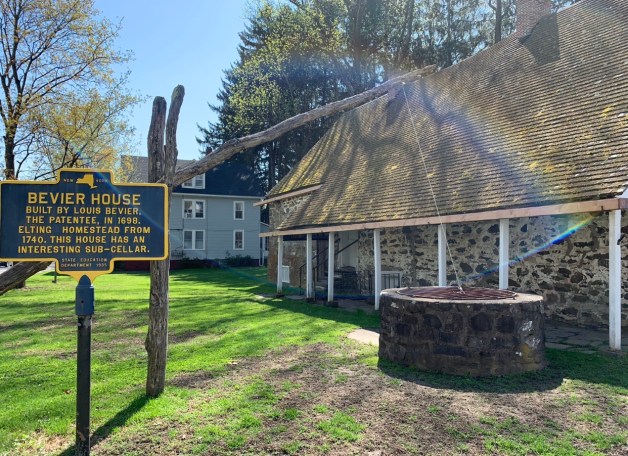
The Bevier-Elting House. 2019.

Magdalene went on and married Peter LeFevre in 1789, where they lived on the Bontekoe farm in a stone house. According to Peter’s tax records, he ranked in the higher end of the middle-income tax bracket, though his stone house was fairly run down. It is difficult to say exactly when or how Magdalene came to own this mirror. However, it can be surmised that it was a wedding gift to Magdalene and Peter, or perhaps she came to own it through an acquisition of a similar nature. Though, there is no accessible information to be certain of this. This suggests the level of financial comfort which Magdalene and Peter lived with.

Further emphasizing Peter and Magdalene’s comfort was the fact that they owned three slaves. According to the 1798 census, Peter owned three slaves, whom were not subject to taxation. This means they were either children under twelve years of age, or that they were older than fifty. There are documents that define one of Peter’s purchases of Molly, in 1798. Were Peter and Magdalene living beyond their means? Had they purchased slaves that they could not afford, as suggested by the run down condition of their home? Peter and Magdalene’s owning of slaves while the mirror was in their home, paints a vivid picture of the time in history this mirror was a part of. A nuanced definition of American Patriotism can further be applied to the owning of the mirror. The eagle/pheasant represents American Patriotism, but it is clear that part of their American values at this time included owning other human beings. 

This mirror was likely displayed in a room where Magdalene and Peter’s guests would see it. This is because it was a reflection of their American values, ones they were prideful in. In this same room, one of the slaves they owned would likely have been responsible for maintaining the condition of the mirror.

“Molly, please see to it that the mirror is in pristine condition before this afternoon, we have guests coming.” Molly then would make her way to the room where the mirror was hung on the wall and have no choice but to stare at her own reflection as she wiped it down. It is not difficult to imagine the brutality felt by a human being who is owned, being forced to look at their own reflection while serving their owners. The reflection seen by Molly was one that forced her to embody the bitter reality that she was purchased by these people as property and existed to serve them. The reflection seen by Magdalene and Peter, or their guests was much different. Looking into the mirror they saw themselves and became enveloped by a sense of American pride and patriotism. Reflective of the attitudes of this period, where the owning of slaves was not given a second thought.

While there is not substantial information available about this mirror specifically, other than its chain of ownership, the stories of its owners and their trials and tribulations are highly reflective of the period in time this mirror was owned. This mirror stands in the Deyo Federal Bedroom as a reflection and encapsulation of life in 18th century New Paltz.


References

“Bill of Sale for Molly to Peter Lefevre : Historic Huguenot Street.” Hudson River Valley Heritage, hrvh.org/cdm/singleitem/collection/hhs/id/633/rec/6.

“Helena S. LeFevre.” Findagrave.com, Poughkeepsie Journal , 22 Oct. 2013, http://www.findagrave.com/memorial/119140830/helena-s_-lefevre.

Liebster, Amy. “Eagles After the American Revolution.” Metmuseum.org, June 2012, www.metmuseum.org/toah/hd/eagl/hd_eagl.htm.

“Peter and Josiah P. LeFevre Family Papers: ‘The Bontecoe LeFevres’ (1703-1937).” Historic Huguenot Street, http://www.huguenotstreet.org/peter-and-josiah-p-lefevre-family-papers-the-bontecoe-lefevres.

“Tax Roll, 1779 : Historic Huguenot Street.” Hudson River Valley Heritage, hrvh.org/cdm/compoundobject/collection/hhs/id/3027/rec/86.

Thurlow, Matthew. “American Federal-Era Period Rooms.” Metmuseum.org, Nov. 2009, http://www.metmuseum.org/toah/hd/fede/hd_fede.htm.

Introduction to The Frick Collection

Marisa, Nick, Katie, Isabelle

The Frick Collection is a one-of-a-kind personal collection that has become a public museum in Manhattan. Henry Clay Frick was an industrialist and art collector who devoted his last dying wish to sustain his collection in a way that was public and intentional. This has become a museum that is esteemed and sensational. Our central theme surrounding this collection revolves around the extravagance of it all. This ties into various aspects of the Frick: the extravagance of the home itself, the uncanny nature of the contents of the collection, and how although many of the pieces in this collection are vastly different, they share a common thread of being over-the-top in their own respect. This is a very unconventional situation; art collections are extremely personal. An art connoisseur putting their entire collection—all of the fanciful objects compiled with millions and millions of dollars—on display in a public museum after they died to allow the public to experience it is exceedingly extravagant.

Henry Clay Frick was involved in what some describe as “dirty” industries; oil, coke and steel. His desire for collecting art stemmed from a desire for greater respectability. Frick began collecting Old Masters before he left Pittsburgh behind in pursuit of New York in 1905. A large sum of his wealth came from a court settlement which was a result of his inability to work or see eye to eye with Andrew Carnegie. This settlement allotted him $30 million in securities, a great sum to further pursue the collection of fine art. Acquisitions of pieces by renowned artists such as Rembrandt and Vermeer defined Frick’s exceptional taste and established him as a major collector. Some of these pieces such as Rembrandt’s Self-Portrait (1906) and Vermeer’s The Officer and Laughing Girl (1911) are among the highlights of Frick’s collection present day.

The Frick home was no cheap investment, and the details of the interior overwhelmingly prove it. Many individuals in New York find their way to The Frick Collection to experience the lavish personal collection left behind by Henry Clay Frick. The Roger New York on Twitter suggests to visit the “tranquil environment” where “masterpieces by artists such as Bellini, Rembrandt, Vermeer, and more!” are housed. If you were to visit this collection, we would suggest looking at the home as an object the same way you’d look at the art as an object. If the home were stripped of the precious art collection, it itself could stand alone as a testament to Henry Clay Frick’s indulgence in his affluent taste and desires. The house, on its own, is an awe-inspiring construction, clearly announcing Frick’s wealth and status.


Screen Shot 2019-03-12 at 2.58.18 PM

The Frick House (Bailey)


Ultimately, the home is what provides accommodation for this extraordinary collection of art; it is only fitting that it matches the nature of the pieces, contributing to the fabulous and ornate qualities of the paintings, sculptures, furniture, and other fascinating objects.

Daniel Weber’s 1653 table clock stands in the South Hall as a pretentious tour de force. Made to display his skill, rather than for functionality, it features an array of dials containing information ranging from the location of the stars at one’s local latitude on to the present astrological sign, to the time, month and day (Berman). Gilded in fine brass and ornamented with flowers and angels clad in silver, it dominates its surroundings, as triumphant as the woman at its apex, a monument to man’s mastery over the material world.

Screen Shot 2019-03-12 at 2.59.48 PM

Weber’s Table Clock (“Table Clock with Astronomical and Calendrical Dials.”)

Refurbished by the Frick collection in 2013 for an exhibition on clocks, Weber’s masterpiece has since remained as a permanent part of the collection on display.

The painting of Lady Selina Skipwith was done in May of 1787 by Sir Joshua Reynolds, an English painter who specialized in portraits and promoted the “Grand Style,” an approach that idealized the imperfect. The depiction of the woman in Reynolds’ painting contains obvious signifiers of wealth—the puffy tulle dress, the satin gloves, the powdered hair, the white face makeup. In late 18th century England, paleness was a sign that one lived in prosperity and idleness, and did not have to labor in the sun. However, the face makeup used during this time usually contained lead; many women applied it regardless, some suffering illness or even death from lead poisoning. The painting itself, and the sacrifices made by the woman in it to attain a certain beauty ideal, demonstrate a common thread of extravagance and refinement, which connects all of the art and objects in the Frick Collection.

Screen Shot 2019-03-12 at 3.00.43 PM.png

Selina, Lady Skipwith


The overarching theme of the Frick collection is its extravagance. The pieces on display reminisce on a long history of vanity, amalgamating fine art, architecture, and craftsmanship from throughout the centuries. The objects selected for this presentation exemplify this opulence, each a window into the pursuit of material excess.


Bibliography

“Acquisitions Fund.” The Dutch Golden Age | The Frick Collection, www.frick.org/support/acquisitions_fund.

Andrewes, William J. H. “A Chronicle of Timekeeping.” Scientific American Special Edition, vol. 16, no. 1, Feb2006 Special Edition 2006, pp. 46–55. EBSCOhost, doi:10.1038/scientificamerican0206-46sp.

“Annual Fund.” The Dutch Golden Age | The Frick Collection, www.frick.org/support/annual_fund.

Bailey, Colin B. Building the Frick Collection: an Introduction to the House and Its Collections. The Frick Collection, 2016.

Berman, Ann E. “The Gallery: Beautiful Relics of Timekeeping’s Past — an Eccentric Collector’s Clocks Reveal an Age when Art and Precision Conjoined.” Wall Street Journal, Eastern edition ed., Jan 02 2002, p. A15. ProQuest. Web. 4 Mar. 2019 .

Collection, The Frick. “David Weber, Gilt-Brass and Silver Table Clock.” YouTube, Frick Collection, 04 Jan. 2014, www.youtube.com/watch?v=o6lDnHeGFLA.

Collection, The Frick. YouTube, YouTube, 3 Aug. 2010, www.youtube.com/watch?v=ySdGFKE0ELk.

Engel, Laura. Fashioning Celebrity: Eighteenth-Century British Actresses and Strategies for Image Making. Ohio State Univ Press, 2011.

“Garden Court.” Garden Court | The Frick Collection, http://www.frick.org/about/gardens/garden_court.

Gunzburg, Darrelyn. “Collecting a Vision: Henry Clay Frick and the Frick Collection, New York.” Art Book, vol. 16, no. 3, Aug. 2009, pp. 19–21. EBSCOhost, doi:10.1111/j.1467-8357.2009.01041.x.

Hipple, Walter J. “General and Particular in the Discourses of Sir Joshua Reynolds: A Study in Method.” The Journal of Aesthetics and Art Criticism, vol. 11, no. 3, 1953, pp. 231–247. JSTOR, doi: 10.2307/426762.

Miller, Daniel. Stuff. Polity Press, 2010.

Reynolds, Joshua. A Selection from the Discourses Delivered to the Students of the Royal Academy. Edited by J. J. Findlay, Blackie, 1906.

Reynolds, Joshua. “Selina, Lady Skipwith.” – Works – Collections.frick.org, The Frick Collection, collections.frick.org/objects/127/selina-lady-skipwith#showAudios.

Roark, Elisabeth. “Pittsburgh.” Grove Art Online.  May 28, 2015. Oxford University Press,. Date of access 11 Mar. 2019, http://www.oxfordartonline.com/groveart/view/10.1093/gao/9781884446054.001.0001/oao-9781884446054-e-7000067991.

“Roman Domestic Architecture (Domus).” Khan Academy, Khan Academy, http://www.khanacademy.org/humanities/ancient-art-civilizations/roman/beginners-guide-rome/a/roman-domestic-architecture-domus.

Scherer, Barrymore L. “Horology: What’s Ticking at the Frick.” Wall Street Journal, Eastern edition ed., Aug 28 2013, ProQuest. Web. 4 Mar. 2019 .

Siple, Ella S. “The Opening of the Frick Collection.” The Burlington Magazine for Connoisseurs, vol. 68, no. 395, 1936, pp. 102–103. JSTOR, www.jstor.org/stable/866463.

The Frick Collection: An Illustrated Catalogue. Vol. 1, The Frick Collection, 1968.

“The Garden Court.” The Garden Court | The Frick Collection, http://www.frick.org/support/garden_court.

@therogerny. “Step out of the cold and into the tranquil environment of the @frickcollection. You’ll be able to discover masterpieces by artists such as Bellini, Rembrandt, Vermeer, and more!” Twitter 06 March 2019, 1:15 p.m., https://twitter.com/therogerny/status/1103358336169402371

Weber, David. “Table Clock with Astronomical and Calendrical Dials.” – Works – Collections.frick.org, 2018, collections.frick.org/objects/1555/table-clock-with-astronomical-and-calendrical-dials?ctx=bfa60384-de7c-4176-af67-4b2e5b2c8b7d&idx=41#showImages.


Burton Beanie

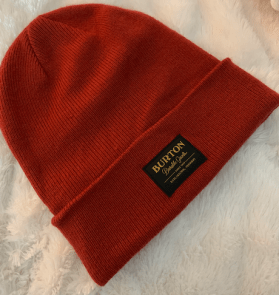
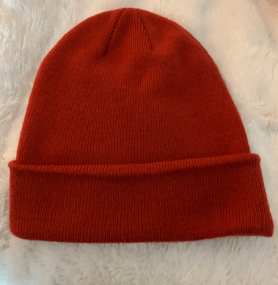
Hats, for me, serve as an essential accessory in my wardrobe. Beanies, specifically are one of my favorite subcategories. This week I will be exploring my favorite beanie that I own. This beanie, burnt orange in color is by the brand BURTON. Burton is a company that emphasizes how their process “started in the mountains.” Their goal is to innovate and change the way people experience the outdoors.

This beanie like I previously mentioned is burnt orange in color, has a folded brim, a slouchy fit and a small black label stitched onto the brim that says BURTON Durable Goods Since 1977 Burlington, Vermont. This specific beanie is labeled by Burton as their “Burton Kactusbunch Tall Beanie.” This material is made from 100% acrylic.

Screen Shot 2019-03-01 at 11.31.05 AM.pngScreen Shot 2019-03-01 at 11.29.39 AM

This beanie would not exist without the founding of Burton itself. Burton was founded in 1977 by Jake Burton Carpenter, who is now 64, has dedicated his life to snowboarding. Burton itself has been held in high regards for being innovative and transformative in the snowboarding community, changing it from a backyard hobby to a serious recreational sport.

Burton as a brand is going through a transformative period that is highly geared towards taking greater strides in sustainability. Their 2020 sustainability goals are to have 100% Fair Labor Association compliance in their factories. This means every person working and creating their products will be working in safe, healthy and environmentally friendly conditions. I cannot say with absolute certainty that my beanie specifically was made in these conditions, wishful thinking says it was, but I know going forward Burton as a brand is fostering an environment behind the manufacturing of their products that aligns nicely with my morals for where my consumerism is directed, that especially in cases of mass production workers are being treated fairly and ethically.

Burton’s main headquarters are in Vermont, but they also have offices in Australia, Austria, Canada, California, China, Japan, and Republic of Korea. I didn’t think I would be able to trace where mine originated but then I remembered I had the shipping information from when I purchased it. I ordered it on January 25th, and got a shipping confirmation email on January 29th. Upon inspection of that, the first place of origin listed is Columbus, Ohio, on January 29th. I cannot say this with absolute certainty, however, I do believe my beanie was manufactured in the United States. If I am wrong about this, I can say with greater certainty that it at the very least resided in the United States when I purchased it. I believe I can make this claim because generally it takes more than four days to ship something overseas.

IMG_4614.PNG

Burton uses highly technical life cycle assessment (LCA) software. This software gives a detailed look at their full product cycle, from extracting natural resources through manufacturing, to transport and end of life. They place a great emphasis on how their materials are ethically sourced. Burton has a publicly accessible comprehensive list of restricted substances so they only produce products that are safe for their customers and the environment. They also have a partnership with bluesign, which ensures that the inputs into their products are made with the safest chemicals, as well as the air and water emissions from their processes are clean. This allows me to conclude that my beanie has been crafted with minimal adverse effects on the environment, which makes me feel better about wearing it. Concurrently, Burton’s commitment to fair labor for their employees makes me support their brand and the items that I own from them.

Additionally, Burton has a commitment to minimizing the packaging of their products. Their goal by 2020 is to have packaging that is 100% compostable or recyclable, 80% post-consumer recycled content and lastly that their packaging is the right size so no excess is ever used. My beanie came in a package that fit these characteristics, came just big enough to fit the beanie and was 100% recyclable. This is just another reason I support Burton as a brand and feel confident about my purchase.

Ultimately, while my beanie did not at first glance have a whole lot to discuss because it was only made from one material, tracing how that material was sourced was an interesting exploration that led to many discoveries about the entire process of it being manufactured through it arriving to me in the mail. Unveiling all of the positive characteristics Burton has and is working towards as a brand, such as fair labor for their employees who manufacture these products, ethically sourcing their materials and up-cycling them when possible, and putting an emphasis on minimal and recyclable packing makes me feel that much more love for my beanie and respect for the minds who had a hand in putting it together.


References

https://www.burton.com/us/en/sustainability-people

https://www.burton.com/us/en/sustainability-product

Click to access Burton-Supply-Chain-Sustainability-Policies-and-Standards_V1-0.pdf

Click to access bluesign-RSL-v8_0.pdf


Bookmark From Spain

A bookmark may seem like an obsolete object in the grand scheme of life. You can place a multitude of objects inside a book in an effort to hold the page you’re on. This goes against my better judgement in saying this, so I hope no book lovers hold it against me, but realistically, you do not even need another object to hold your place in a book. You can just…fold the page…

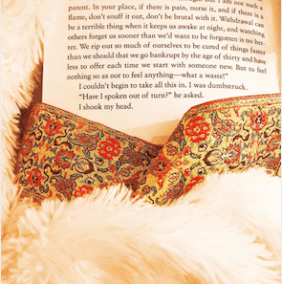
Although I recognize this, I tend to prefer having a special designated object to hold the place of whichever book I am currently delving into. Folding the page only comes as a very last resort for me (and makes me feel guilty). This leads me to a new object I will be discussing this week. My favorite book mark.

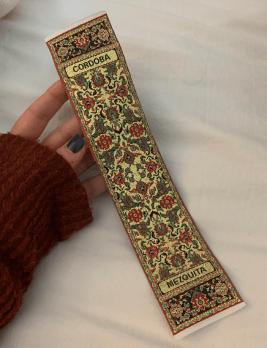
This bookmark measures approximately 8 inches long and 2 inches wide. It is so thin I do not have a ruler that can get me an accurate measurement, but it is about as thin as the edge of one of my finger nails. It is made of a material I am unsure of, some kind of textiles, embroidery floss or something similar. They are woven or sewn together very tightly on the front side, but when you flip it over to the back you can see all of the various colored strings. The pattern on the front is very ornate and intricate. On the top there is the word CORDOBA etched into a gold rectangle with black stitching. The word MEZQUITA is etched in the same fashion on the bottom. When this bookmark is in directly contact with the pages of a book it feels scratchy, it does not glide smoothy over the paper.

I was given this bookmark as a gift at the end of my senior year of high school. It was not a gift for any momentous occasion, it was extremely random – which happen to be my favorite kinds of gifts. During this time of my senior year with not much work to do, I was working on painting a large mural as a sort of legacy to leave behind in the school after I’d left. So, as I spent most of my days in the basement back corner stairwell painting away, my friend stopped by to visit. He, in one very swift motion, pulled two thin and upon first glance indistinguishable items out of his pocket and handed them to me.

Screen Shot 2019-02-15 at 12.40.25 PM.png

My Bookmark

Screen Shot 2019-02-15 at 12.41.36 PM.png

Backside of Bookmark


At first, I was perplexed, he hadn’t given me a gift before. I believe I stared at him in confusion- asking without asking for clarification. He then went on to tell me he bought these for me two years prior on a trip he took to Spain. He and I were very close when he took that trip, I missed him greatly while he was gone. Though, our relationship became increasingly complex between the time he went to Spain and the time he gave me this gift.

He gave me two bookmarks, though I am now only talking about one. This bookmark means a lot to me and has now been in my possession for around four years or so. It has lined the pages of some of my favorite books and has served as a constant reminder of how small gestures can serve as the ones that are the most meaningful.

Screen Shot 2019-02-15 at 12.46.55 PM.png

Lining one of my favorite passages from Call Me By Your Name by Andre Aciman

Prior to my owning of this bookmark, my friend owned them for two years. I believe they likely became objects that blended into his bedroom going unnoticed for awhile. He claims he was too awkward to give them to me, so I imagine from time to time he looked at them and considered giving them to me and then decided against it.

I had never inquired in depth about where he purchased the bookmarks, until now. These bookmarks originated in the south of Spain at the Mosque of Córdoba, also known as the Great Mosque of Córdoba and the Mezquita.


image.png

Mosque of Córdoba

This mosque is located in the Spanish region of Andalusia. Looking this Mosque up online, it is breathtakingly beautiful. The architecture is unlike anything I’ve ever seen. It makes me wish I was there too, so many years ago to experience this incredible structure with all of my senses. Although this mosque has a deep religious history, I do not think it necessarily pertains much to my bookmark, it was just a souvenir. Perhaps if my object were of a more religious nature delving into the history here would be worth considering, in this case although, I do not think it is overwhelmingly relevant.


image

Another Look

I don’t often consider where my objects have originated, even when I bring home souvenirs from other places around the world. I tend to forget how far they have traveled or where they originated until I am asked about them. However, it is remarkable to consider that this object made its way across the Atlantic Ocean, through various airports, spent two years on Long Island and is now currently residing in New Paltz, New York.

Screen Shot 2019-02-15 at 12.42.38 PM.png

The Original Distance Traveled

It was refreshing to delve deeper into this object I’ve had in my possession for so many years and discover not only where it has came from but also where it has been. I can only wonder where else it will go in its lifetime.


More on Josie’s Ring

This may be very straightforward, as far as I have been able to find my grandmother only ever wore this ring on her finger, she did not wear it on a necklace or use it for any other purpose. I believe the ring was designed to be worn, perhaps due to its value and flashy set stones it was meant to be worn on more special occasions rather than for everyday wear. This is how I assume my grandmother wore it. Perhaps, my grandmother may have worn this costly ring as a symbol of status. I tend to think this may not have been the case because she was not a flashy person and embraced her humble lifestyle, but I cannot be sure, it could have been a possibility. I generally remember her wearing rather simple gold jewelry from day to day, her wedding rings and a necklace. I do not believe this ring belonged to anybody before my grandmother, but as for the chain of ownership, it now belongs to me.

After scouring the LeVian website I can say with certainty this ring is no longer being manufactured. I have only been able to find one identical ring which was pre-owned and listed on ebay. I have not been able to find any details about its original manufacturing other than it being by the brand LeVian and its general specs which I mentioned in my previous post.

I can make a general assumption that my grandmother wore this ring at least once in a way that was clumsy, due to the chip in one of the sapphire stones. Or at the very least, she was being careless and hit it against something else that caused the minor break.

My best chance at learning anything new about the way my grandmother wore this ring was by making a phone call to my grandfather. But he is 89 and is generally not concerned with such small details. There are certain pieces of her jewelry he comments on from time to time, the ones she wore a lot and the ones he specifically bought her for anniversaries, such as a long chained silver heart necklace engraved for their 25th wedding anniversary. I do not think this piece stuck out in his mind, as it didn’t stick out in mine either. However, from the condition the ring was in, I can say with certainty that if my grandmother did not wear it often she still wore it enough. Ultimately, when I had my grandfather on the phone inquiring about my grandmother’s habits of wearing this specific ring he did not have much to offer the conversation.

This ring I believe has had waves of use. I believe there was a time my grandmother wore it, but I believe as she grew older and later into her life she stored it away and it became an object that was hidden away where it remained untouched until years after she passed away. My grandmother wore a lot of costume jewelry pieces, ones that were not of much worth. But she kept especially safe care of the items of hers which were more valuable than the rest. These pieces of jewelry were kept in their own box, stored in a different place than the rest, which only my grandfather knew the whereabouts of. Now, this ring in its second life cycle is being worn again, but not everyday. I wear this ring on special occasions, ones that are family oriented; weddings, engagement parties, special celebratory family dinners– occasions that to me have a special meaning to have a piece of my grandmother there to celebrate with us. Furthermore, I continue to only wear it alone on one hand, it just feels more special that way. But like I believe my grandmother did, when I am not wearing this ring I store it away safely in my jewelry box. It does not become an item that is on display but one that is hidden and tucked safely away. Perhaps at my wedding this will be my “something blue.”

I can never be too certain what purpose this ring fulfilled in my grandmother’s life. Was it a ring that had a significance to her? Did it make her feel as though she had status? Did she simply just like it? I will never know for sure. Despite my painstaking effort to find out more, I am afraid the details of this ring and the role it played in my grandmother’s life have passed along with her.


Josie’s Ring

The object I am choosing to analyze and describe is a ring that once belonged to my late grandmother, Josephine.

IMG_3742 2

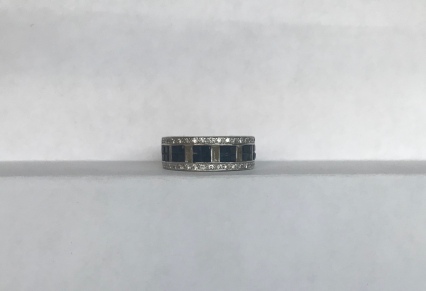
Front View of Ring

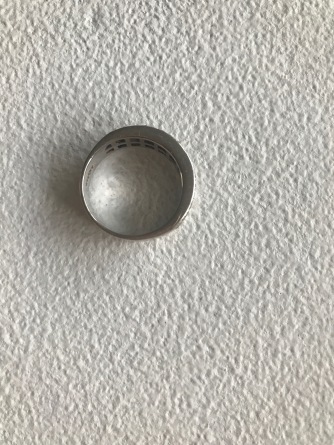
This ring measures approximately one inch across, and fits a ring size of 7 & ½. The ring band is 18k white gold, set with 24 square cut sapphires and further set with 5 baguette cut and 32 full cut diamonds. The word “LEVIAN” is inscribed on the inner band (this is the brand) as well as “18k”

When struck by sunlight the diamonds sparkle and the sapphires glow with an ominous deep blue undertone. The “top” half of the ring is where most of its weight exists, because of all the stones it is set with. The outer part of the bottom of the band is etched with multiple scratches that you can feel like grooves when you run your finger over them. These I’m sure could be buffed out with a cleaning but I like them the way they are.

IMG_3741

LEVIAN inscription in the top left of this image, also featuring the inside of the stone settings

While this ring is stunning, it has one slight imperfection (other than some scratches due to wear). On the fourth set of sapphires from the left, the bottom right sapphire stone is cracked in its upper right hand corner. I’m sure this probably diminishes the worth of the ring slightly, however that does not concern me. Normally, if a piece of expensive jewelry that I owned was in some way tarnished, I would be upset and feel discouraged. But in this case, I embrace the imperfection for a few reasons. First, on the most basic level, it reminds me that not everything in life is perfect, even the shiny seemingly perfect things. Secondly, it makes me yearn to know what caused the stone to crack. I wonder how my grandmother cracked it, what she was wearing that day, if she noticed immediately there had been damage, if she continued to wear it after it had been damaged, and so on. It makes me wonder about a past that I was not at all a part of. I think this is the reason my attachment to objects of great sentimental value is so strong, because they make me wonder so many different things about what occurred around them before my time.

Losing my grandmother was one of the most difficult events for my family. When a person no longer is a living, breathing being on this earth most often what we have left of them are their possessions, photographs, perhaps some video if we are lucky– and lastly our memories of them. After sustaining two serious head injuries, my difficulty recalling memories sometimes gets the best of me, so I rely heavily on more tangible mementos. I have a few objects that belonged to my grandmother, perhaps even a few that hold more sentimental value, such as a silver heart necklace my grandfather gave my grandmother on their 25th wedding anniversary with a very special inscription on the back– but ultimately this ring is what brings me the most joy.

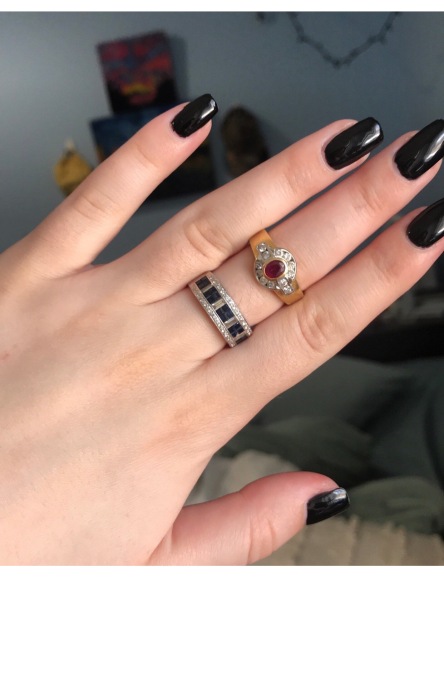
Years after my grandmother passed away my grandfather passed this ring down to me as what I believe was a mark of my maturation in his eyes. It was a ring I do not remember seeing her wear, she often wore yellow gold (which you can see in the image below, which includes the other ring my grandfather passed down to me which is yellow gold that he had custom made for her in Italy)

IMG_9090

Both rings on my finger. The chipped stone is visible on the right side of the band.

I believe the fact that I do not remember seeing her wear this ring is part of what makes it feel very special to me. It makes me wonder about a lifetime of hers that I was not a part of and that I cannot fully understand because I was not there. It reminds me whenever I look at it on my finger that she had a history that did not involve me. I find that to be an immensely special and sometimes complex part of being human. I have only ever known the life that I have lived, but the people in my life, (mostly referencing my family members), have lived a lot of life before my existence. My grandfather giving me this ring also reminds me to dig deeper into his history. When I look at it on my finger I feel highly inclined to sit with him and take the time to ask questions– about his life, about my grandmothers, about theirs together. This method is the only way left I have access to my grandparent’s history and I cherish it.

While the ring is simply a ring, it has immense sentimental value to me. I often wear a ring on nearly every finger, but I refuse to pair this ring with any others, if I am wearing it I let it stand alone as I feel it should. It’s great monetary value also reminds me in an interesting way of my family’s history. My grandfather dropped out of school in 8th grade to provide for his family. In his adult life, he worked everyday doing manual labor as a cement mason. He did not come from nor have a lot of money. My grandma was a bit more fortunate than my grandfather growing up, but still not well off by any means. I know from asking that my grandparents did not live beyond their means, and they certainly did not buy luxury items. However, this ring is valued around $3000, which years ago was even more money than it is today. My grandfather buying my grandmother this ring signifies to me the true value of their relationships. Although it definitely cannot be quantified by price, just the sentiment of spending such an enormous sum of money (for a ring that was not a wedding ring) shows to me the eternal nature of their relationship. Ultimately, wearing it reminds me how I fortunate I am to be surrounded by the most loving and endearing family, and you can never put a price tag on that.


Tidying Up

After reading Marie Kondo’s “The Life-Changing Magic of Tidying Up” I chose to go through my clothing putting the joy test to practice. I began with a full armoire of clothing, which held various items hanging and a drawer filled with tops. Additionally, I had a separate dresser drawer devoted mostly to pants. Overall, I would estimate I had nearly 100 articles of clothing. For the sake of space in my small dorm room I sorted through my clothing by sections, which for the most part lent itself to article type, (i.e., tops, pants, etc.)

First, I assessed the hanging items.

Screen Shot 2019-01-25 at 11.51.28 AM.png

Hanging Items Before Joy Test

I found that it was easier for me to part with items that I could not readily see, specifically the items that were tucked into the corners rather than in the middle in my direct line of sight. I found that nearly half of the items I had hanging were not articles of clothing that brought me joy at all. I did not have trouble parting with them, but rather appreciated the times they made me happy to wear.

Screen Shot 2019-01-25 at 11.53.26 AM.png

Hanging Items After Joy Test


What I found interesting after assessing before and after photos was they look fairly similar. This reinforces Kondo’s idea that things in our plain sight that become invisible to us almost do not even really exist to us. Upon further application of the joy test I found this to be even more apparent for my experience.


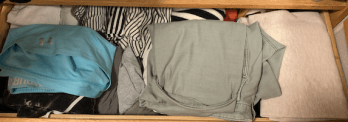
Upon inspecting the first drawer that was filled with mostly tops and sweaters, I found there were many items I more or less entirely forgot I owned- things that had been tucked away that I did not actively seek out or think of when I was getting dressed.

Screen Shot 2019-01-25 at 12.04.18 PM.png

Extremely Messy and Cluttered “Tops” Drawer

This made me think of how Kondo describes these articles as dormant or unseen. I had an uncanny number of t-shirts obscurely folded tightly to fit in this drawer. After an application of the joy test, I found that half of the tops I owned did not bring me joy. There were many items that I was only keeping because I had sentimental value attached to them. I was able to choose one item of many that represented the same sentiment to me and gracefully part with the rest.

Half of the contents of the drawer brought me pleasure and those were the items I chose to keep. After this realization I became conflicted- I felt somewhat guilty for owning so many items that I did not truly value, but I also felt relieved that I was able to peacefully let go of these items that were not meant for me anymore.

Screen Shot 2019-01-25 at 12.08.25 PM.png

“Tops” Drawer After Parting With Half of the Contents

The final drawer I sorted through housed my bottoms, mostly pants. This drawer was jam-packed with multiple pairs of similar jeans. When I was picking through each item applying the joy test I was wondering why I owned so many pairs of jeans that just had slight variances between each other. I was able to sort through them and conclude that about half brought me joy and half did not. I was not conflicted trying

Screen Shot 2019-01-25 at 12.11.47 PM.png

“Bottoms” Drawer Before Joy Test

to choose which items brought me joy, I was actually very relieved that I could part with these items that were tucked deeply into my drawers, because when I had tried to get rid of clothing in the past I always fell victim to the voice in my head convincing me that I would perhaps want to wear this item again in the future. Like the other sections of my clothing, I decided to keep about half of these items.

Screen Shot 2019-01-25 at 12.32.32 PM.png

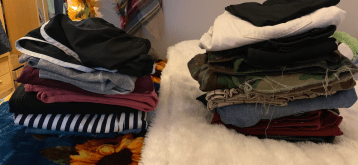
Left Pile: Discard. Right Pile: Brought Me Joy, Keep

Overall, I chose to keep about half of the clothing I owned after applying the joy test. This experience was not difficult for me, but in the past trying to do this with clothing has been. One interesting thing I became aware of was for the most part clothing is not very difficult for me to part with.

However, when I was thinking about what items I wanted to sort through for this exercise, thinking about my more sentimental items, like my books, evoked a sick feeling in my stomach. I did not want to consider the possibility that I would have to choose between them. This gave me insight into my personal relationship with objects that I am more attached to items that evoke emotion or a sentimental meaning to me. I could choose to discard fairly easily of an item of clothing, but thinking about discarding something like a book or a letter that had a more personal and emotional meaning to me felt nearly impossible. I believe my attitudes about objects stemmed from my family who taught me to value sentiments and keep them close to my heart, it makes parting with items of sentimental value feel like I am losing a friend. Overall, I found this exercise to open my eyes about my relationships with objects and why I feel more attached to objects that have depth and meaning in my heart and mind.