The Comfort of College Student Things

Inspired by Daniel Miller’s novel, The Comfort of Things, Ricardo Hernandez interviewed 16 college students at SUNY New Paltz. He asked them about a personal object they brought to college with them. In these emotional and thoughtful interviews, students share touching stories, family histories and tear-jerking pasts.

Follow the link at: http://bit.ly/18lgExa

The Comfort of College Student Things

To emulate Daniel Miller’s work in The Comfort of Things, I’ll be interviewing students on campus to find out what really matters to the community. As Miller’s book reveals, each character is faced with a linear story of why they have an object, why they decided to keep it and what they expect to do with these objects in the future. The objects, in ownership of each person or each portrait within the work, also has some meaning. Items include anything from a form of rehabilitation to security, from love to loneliness.  In its most basic solid or liquid form, the object has representation of another subject, emotion, person, event or thing.

However, objects might indicate the opposite, where objects don’t represent anything or are not seen as important to certain human beings. For example, in his chapter “A Thousand Places to See Before You Die,” Miller reveals a couple who have no attachment to objects. The portrait reveals the couple as unsentimental to objects, given their traveling experiences.

For my project, I’ll be choosing students from a floor within a residence hall. In my research, I don’t want to only include one gender identity. Given that most floors are split between males and females, as of right now on campus, I have chosen to do a multi-gendered floor. It would be interesting to analyze what students value within their dorms. Dorms are interesting because most students, who live on campus, don’t usually have personal possessions within their dorms. However, I hope each person will have an object with some significance.

For this project, I’ll be creating a number of videos, audio pieces and slideshows of each student after I interview them. I am concerned with the timing of the final project because it is due soon, but I think I’ll have a great batch of multimedia pieces to show the community at the end of the semester.

Here’s a short preview of what I’ll be doing. Emily Weiss is a third-year art education major at SUNY New Paltz. She shares the story behind a family heirloom which has been passed down through generations of women. Her locket and its chain has been worn during family gatherings, struggling times and war.

Emily Weiss

Please be advised that this is a draft. I’m currently working on editing the sound and getting actual pictures of the locket. Photo credit: Emily Weiss’ Facebook

Needlework, Quilting, and Marginalized Voices

AIDS Quilt

By Ricardo Hernandez and Sandy Marsh

Traditional histories of the United States focus on the activities and achievements of the white male.  It was this group who held the power to write history and decide what was significant to include.  Only in the last few decades has there been an attempt to spotlight the history of marginalized groups such as women, blacks, Native Americans and, more recently, the LGBT community.

Scholars have searched through diaries, letters and court records to uncover the story of women in society.  Unfortunately until the latter half of the 19th century, girls had little access to education beyond learning to read and sew.  Girls and boys were taught to read in the home by means of oral recitation from the printed page; both sexes needed to be able to read the Bible.  Boys then continued on to a town school, where they were taught to write in cursive script and to master basic arithmetic, both skills to be used in the professions and trade.  Beyond reading, the most important skill for girls was  proficiency in sewing.

With the scarcity of written documents by the women of early America, the study of material objects reveals a great deal about the role of women in society.  In particular, the embroidery sampler tells a meaningful story.  The earliest samplers were created by experienced needle workers as a means to record a variety of stitches and patterns.  These pieces were long and narrow, rolled up and stored as a reference guide for future projects.  Once printed patterns became available, the sampler became used as a tool to teach young girls the alphabet, numbers, perhaps a moral lesson, as well as sewing.   A working-class girl might stitch a ‘marking’ or ‘darning’ sampler in order to master the skills to be used as a wife in the home, or as a domestic servant.  An elaborate pictorial sampler rendered in silk thread on fine linen indicated femininity and gentility of the upper class.

Since colonial times, the stitching of a quilt has been used as an expression of community.  Women would gather to stitch a bed cover as a wedding gift; frequently following the sewing session, the ‘menfolk’ would arrive for a meal and dancing.  The patchwork quilt developed in the early 19th century as a frugal means to use leftover bits of fabric from the making of clothing and household items.  The use of color and pattern in quilting allowed women creative expression, yet the quilt served a function rather than being perceived as frivolous activity.

The art of quilting has been adopted by modern marginalized groups in the United States.  Both African Americans and Native Americans embraced quilting as a means to express the history of their people.  Elaborate use of appliquéd symbolic images in story quilts provide a powerful view into cultural identity within these groups.

Needlework has always been used to carry out a mission. Marginalized groups have found refuge in pattern making, quilting, needlework and knitting as a form of hope, disapproval or unity. The AIDS quilt does just that. It was first created in 1987 when Cleve Jones realized the potential of creating a quilt, which not only creates a representation of mourning, but also one of political activism through the LGBT community in San Francisco, California. When word of the AIDS quilt reached national coverage and submissions rolled into San Francisco, political activism took on a new method in the LGBT community. As a tool used for both mourning and remembering, the quilt helped the community show the world how much damage AIDS could do to a particular community. With these lives lost and media coverage surrounding these individuals to put a megaphone to their voices, government had to respond.

Research on the AIDS quilt has been quite extensive. Sociologist, psychologists and political scientist have studied the effects of the AIDS quilt on human beings. According to Peter S. Hawkins, professor of religion and literature, the quilt is more than just patches, lines, and material. “The panels betray a delight in the telling of tales, revealing in those who have died a taste for leather or for chintz, for motorbikes or drag shows. Secrets are shared with everybody,” (Hawkins, 770). While researchers, journalists and academics question the role of the AIDS quilt in the LGBT community, they come to realize that the object has become more than a tool of remembering, mourning and grief. As Jones says:

“History will record that in the last quarter of the 20th century, a new and deadly virus emerged. And that the one nation on earth with the resources, knowledge and institutions to respond to the new epidemic, failed to do so. History will further record that our nation’s failure was based on ignorance, prejudice, greed and fear not within the heartlands of America, but in the oval office and the halls of congress,” (gcncincinnati, Youtube.com)

The LGBT community used the AIDS quilt to bring attention to the inefficiencies of the Reagan administration. While they mourn their siblings, friends and lovers, activists used the quilt as a means for media coverage. Their mission to end ignorance by pushing their voices beyond the walls of Washington D.C. and into the hearts of all Americans, was achieved.

The study of material culture is an interesting one. It doesn’t have to just tell about the history of a person, object or time period. We realize that the AIDS quilt, in its most concrete form of patterns and materials, was used to showcase the lives of individuals who’ve lost their lives at the height of AIDS, but that’s not all. The use of this quilt, like many, takes material culture a step further when used as a weapon by marginalized groups. We’ve seen this occur with women through suffrage, African Americans during slavery and segregation, and of course, LGBT individuals in the fight against AIDS. This portion of material culture brings light to the events of marginalized groups in history.

Annotated Bibliography:

Cash, Floris Barnett. “Kinship and Quilting: An Examination of an African American Tradition.” The Journal of Negro History, Vol. 80, No. 2 (1995):  30-41. Print.

This article describes the use of quilting and knitting by African Americans, specifically women who are by the author’s views, the most marginalized group in American history. The author says that the use of quilting has been passed down as an African American tradition to eradicate the discrimination this marginalized group experienced. This tool was a method to voice their opinions on their own lives.

Edwards, Clive.  “‘Home is Where the Art is’:  Women, Handicrafts and Home Improvements 1750-1900.”  Journal of Design History, Vol. 19, No. 1 (2006) Print.

A discussion of the history of women’s crafts on levels of  frugality & financial necessity, creative/artistic expression and entertainment.

Friedland, Anne M.  “The Sampler and the American Schoolgirl 18th and 19th Century.”  Dutchess County Historical Society Yearbook 79 (1994)Poughkeepsie, NY:  Dutchess County Historical Society (1994): 22-36. Print.

Essay on the application of the sampler as a teaching tool for girls.

gcncincinnati. “AIDS Quilt: 1st Anniversary Coverage.” Youtube.com. 11 Dec. 2009. Web. 11 Apr. 2013.

In its one year anniversary, this video gives a deeper understanding of the impact the AIDS quilt can create within the LGBT community. The beginning speech by Cleve Jones delivers a powerful message towards the president and congress for their actions in avoiding the discussion of AIDS, and providing assistance to those who’s lives were lost. This ceremony and moment in history brings the names of the people right to the offical’s doorsteps.

Goggin, Maureen Daly and Beth Fowkes Tobin (eds.).  Women and the Material Culture of Needlework and Textiles, 1750-1950.  Surrey, England:  Ashgate Publishing Ltd. (2009) Print.

Collection of essays by multiple authors on a variety of topics regarding the significance of needlework in the study of women’s history.

Hawkins, Peter S. “Naming Names: The Art of Memory and the NAMES Project AIDS Quilt.” Critical Inquiry, Vol. 19, No. 4. (1993): 752-779. Print.

In Peter S. Hawkins’ article, the NAMES Project is presented as a form of political activism, mourning and memory. Hawkins places an emphasis on the AIDS quilt, which he says tells the stories of lives. Each patchwork tells how individual stories are told from childhood events to explorations of love. Each quilt is an open book on a certain person or people, which depicts a deeper meaning behind this material. He also emphasizes the use of the tool as a form of political activism.

Monaghan, E. Jennifer.  “Literacy Instruction and Gender in Colonial New England.”  American Quarterly, Vol. 40, No. 1 (1988), 18-41.  Web. 30 Mar. 2013.

An essay explaining the discrepancy between the levels of education for boys and girls in early America.

Morris III, Charles E. Rhetoric and Public Affairs: Remembering the AIDS Quilt. East Lansing, Michigan: Michigan State University Press (2011) Print.

The book is written by a number of individuals who have researched, experienced or have some way been affected by the AIDS quilt. The book also identifies strong material culture significances on the basis of memory and mourning. One author compares the AIDS quilt to photos from the Holocaust, arguing that it reveals a stronger significance because each patch tells a story of a person’s life, rather than photos of a particular event.

SeanChapin1. “AIDS Quilt – 25 Years Later.” Youtube.com 20 Feb. 2012. Web. 11 Apr. 2013.

The video gives a look on the impact the AIDS quilt had on Washington D.C. However, the video also pulls on heart strings when texts on quilts are read and shown to viewers. The video gives an overview of the number of quilts, exposing how many lives were lost due to AIDS.

Ulrich, Laurel Thatcher.  Good Wives:  Image and Reality in the Lives of Women in Northern New England 1650-1750.   New York: Alfred A. Knopf (1982) Print.

A thorough study of the multiplicity of roles encompassing the lives of women in early America.

Xtra! “Cleve Jones on Harvey Milk & AIDS Memorial Quilt.” Youtube.com 29 Nov. 2011. Web. 11 Apr. 2013.

Cleve Jones shares how the AIDS quilt was founded during a march for Harvey Milk in San Francisco, where he realized how many lives were taken by AIDS. He also states that the quilt was a form of tool to hold the government accountable for their actions in turning away from a deadly disease right in their backyard. He also acknowledges that this was more than just a piece of material; it was a tool for remembering lives and pushing for action.
The Normal Review

Normal Review 1Normal Review 2

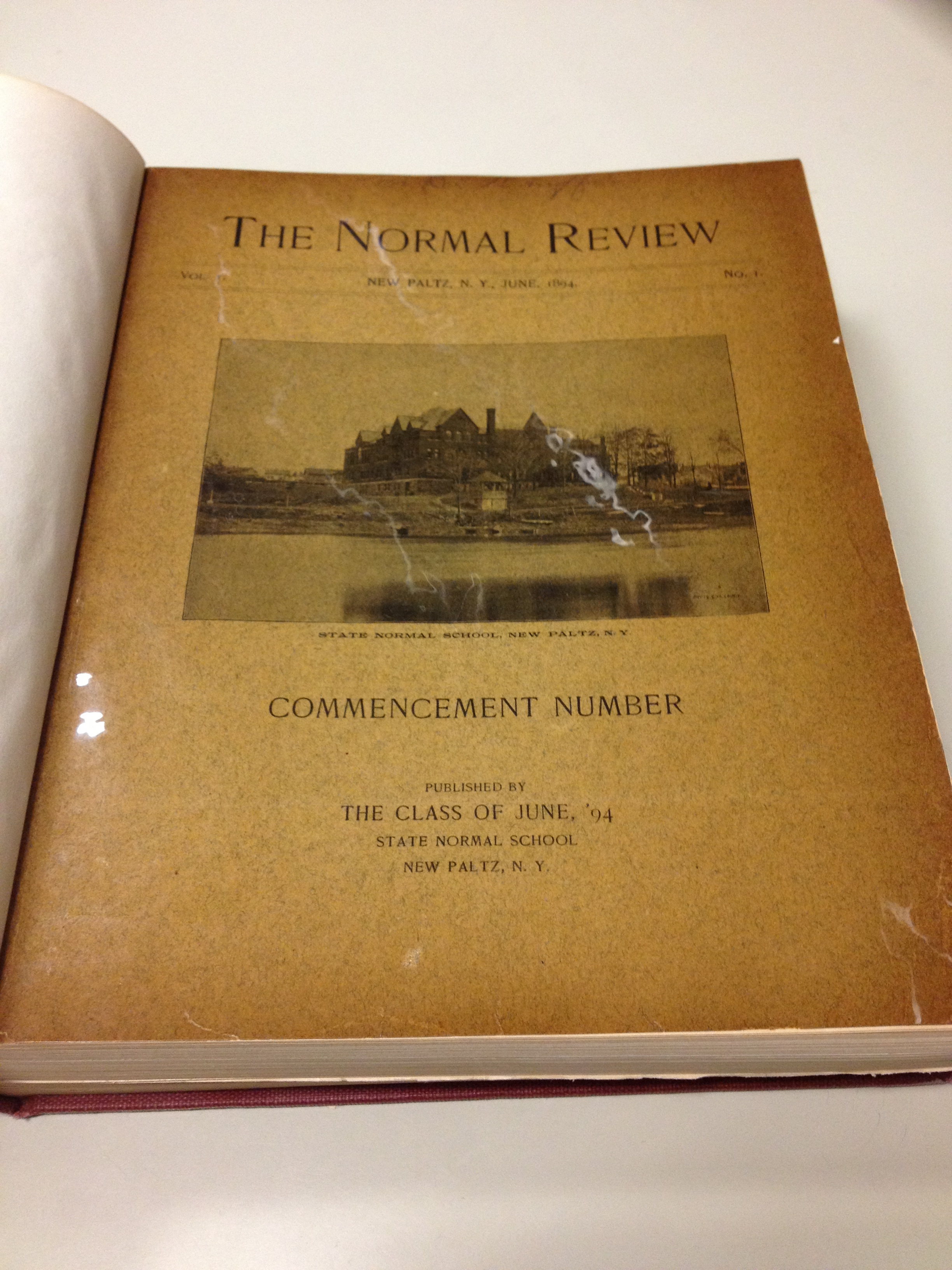
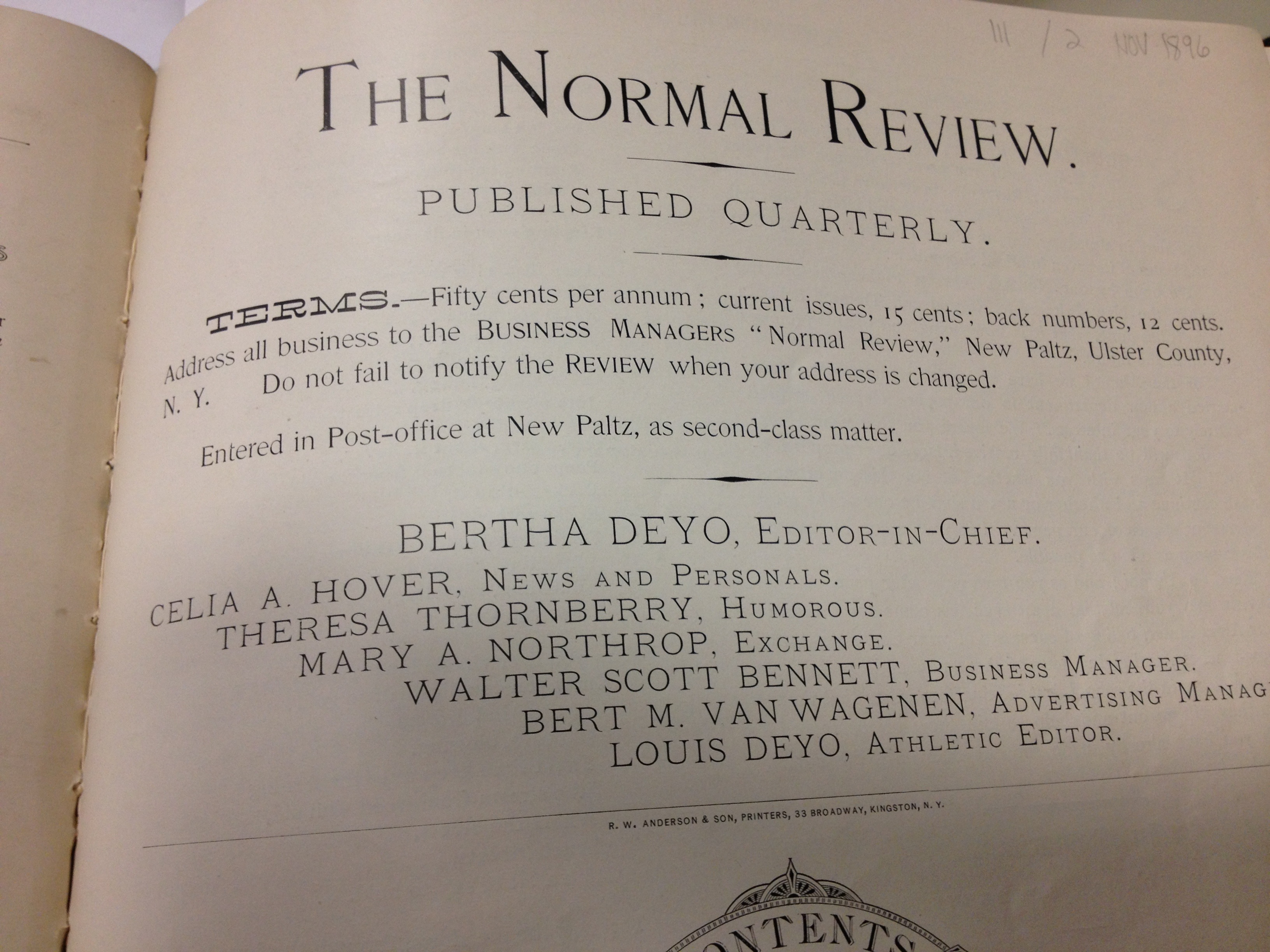
Caption: Distributed quarterly, The Normal Review became the first-ever literary magazine at the New Paltz Normal School in June of 1894. The 26-page publication contained news, poetry, narratives and other forms of writing from students within the school. The magazine folded in 1901 after years of journalistic service to the New Paltz community.

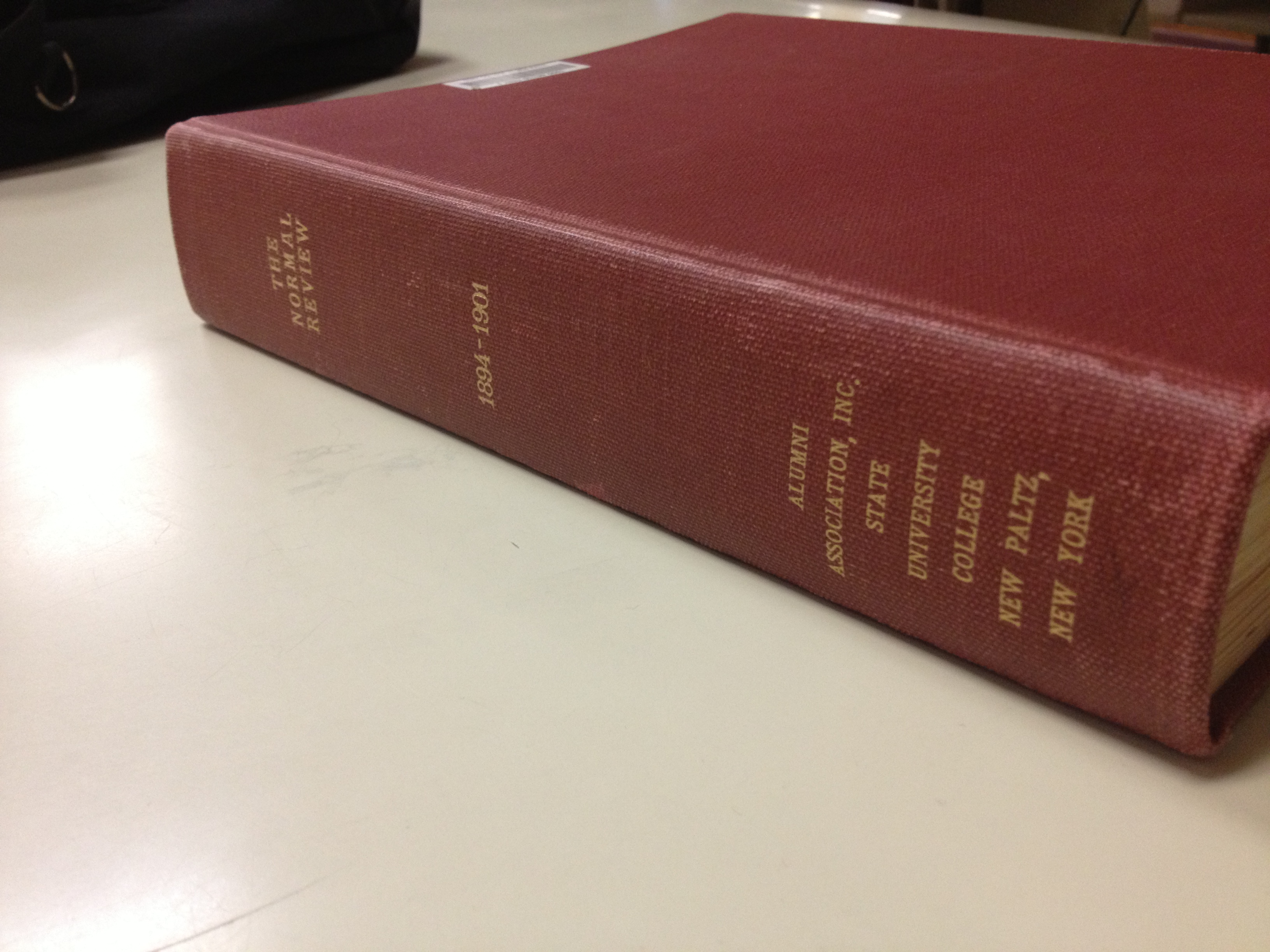
Physical Description: The Normal Review catalog contains a burgundy red hard cover. The 11-by-7 book feels rough at the touch. If you caress the book with your finger, you could feel years of wear displayed as lines on the book. The book also contains gold lettering with the words “The Normal Review” on it’s binding. Below, in the same gold letters are the active years, “1894-1901” On the bottom of the binding reads, “Alumni Association, INC. State University College. New Paltz, New York. The library placed a barcode on it’s top middle corner. When you open the book you’re displayed with the first issue’s cover page, table of contents and words. All written work is in a black san serif font, while advertisements in the back are of different fonts.

Provenance: The book of literary magazines has been in possession of SUNY New Paltz since its creation. However, the magazines were in possession of the New Paltz State Normal School, a new building after the first fire which burned down the New Paltz Classical School in 1884. After the second fire which burned down the Normal School, the issues were moved  to “Old Main,” which is currently part of what is today SUNY New Paltz. The book of magazines was most likely created sometime after the magazine’s final issue. The catalog of the Normal Review issues are available today through the Sojourner Truth Library.

Date of Creation: June 1894 – June 1901.

Narrative (Rough Draft):

Normal Review 5

It was their first meeting. The staff of The Normal Review were sitting in a room with piles of papers in front of them. If they were to succeed this would be The New Paltz State Normal School’s first-ever literary magazine. Before the first editor in chief, Albert C. Mayham, grabbed the first submission to the magazine, he spoke with his staff and gave them requirements of editing. The magazine’s staff must check for spelling errors, grammar and use their own form of journalistic writing, which some of it compares to what is known today as Associated Press style. After a few words, the editing began.

The Normal Review’s first issue became a 26-page issue with combined forms of writing. The staff edited narratives, love being a very common theme. One issue in particular was of a woman who saw her former lover on a train heading south, but she didn’t say where. But, she tried to make her self known. Although she was hoping to never speak with him again, she made herself known and wanted to feel desired. Other literary works contained poetry by students experiencing love, success, hatred, and sadness. These were written pieces seemed like they were submitted by students and faculty who evaluated and graded student work. It’s interesting because it isn’t clear if they submitted students work for the sake of competition and satisfaction of being published, or because alumni would pick up an issue of the literary magazine and see work of current students within the school. Given that the publication includes a alumni section, it can be assumed that they wanted to target alumni—possibly for donations, as well.

Normal Review 3

However, The Normal Review didn’t just keep to literary work. They succeeded in writing news briefs of events and celebrations taking place in the school and around town. However, the magazine didn’t contain any form of quotes. They mostly used attribution when necessary. For example, “Principle Frank S. Capen said … ” The editorial staff of the publication also incorporated sports within their section publication with references to the scores. However, it wasn’t just literary work and pieces of news which made up the publication. The Normal Review consistently published debates in every issue. A student would take the affirmative and another would take the negative. A favorite was the women’s suffrage where a woman wrote of how women voting could benefit New Paltz and society. In the negative, a male student wrote on how it could be detrimental.

Most importantly, just like any publication, this literary magazine created a sense of community. It was a piece of material which brought the student body together. With about a 12-student staff, the published work would be distributed to students, faculty, and residents in town. Although it cost 15 cents to own, the publication made known to all what students were doing in classes and in their spare time. It made announcements of upcoming events and provided a place for literary expression, not available to students who were strictly learning to write essays and more research based work.

Similar to the Shawangunk Review or the Stonesthrow Review, The Normal Review brought together a “department” of students and faculty to learn and prosper from each other’s writings. Debates such as the women’s suffrage debate were regularly seen. What’s interesting is this sense of women’s rights built up in the school through the editorial staff as well. Since the magazine started, the publication hardly had a female editor in chief. According to the publication itself, the first female editor in chief was a Bertha Deyo of 1896. The last one was Grace B. Travis of 1900.

Normal Review 4


Research:

English Department. “The Shawangunk Review.” SUNY New Paltz. 1998. Web. 7 Apr. 2013.

SUNY New Paltz English Department. “The Stonesthrow Review.” SUNY New Paltz. Web. 7 Apr. 2013.

The New Paltz Normal School. “The Normal Review.” SUNY New Paltz. 1894. Print. 7 Apr. 2013.

Sojourner Truth Library. “College publications.” College History Collection. Feb 2001. Web. 7 Apr 2013.

State University of New York at New Paltz. “Past Presidents.” Office of the President. Updated in 2010. Web. 7 Apr. 2013.

The New Paltz Normal School. “The Normal Review.” SUNY New Paltz. 1894. Print. 7 Apr. 2013.

Pocket Chess-Board

Pocket Chess-Board

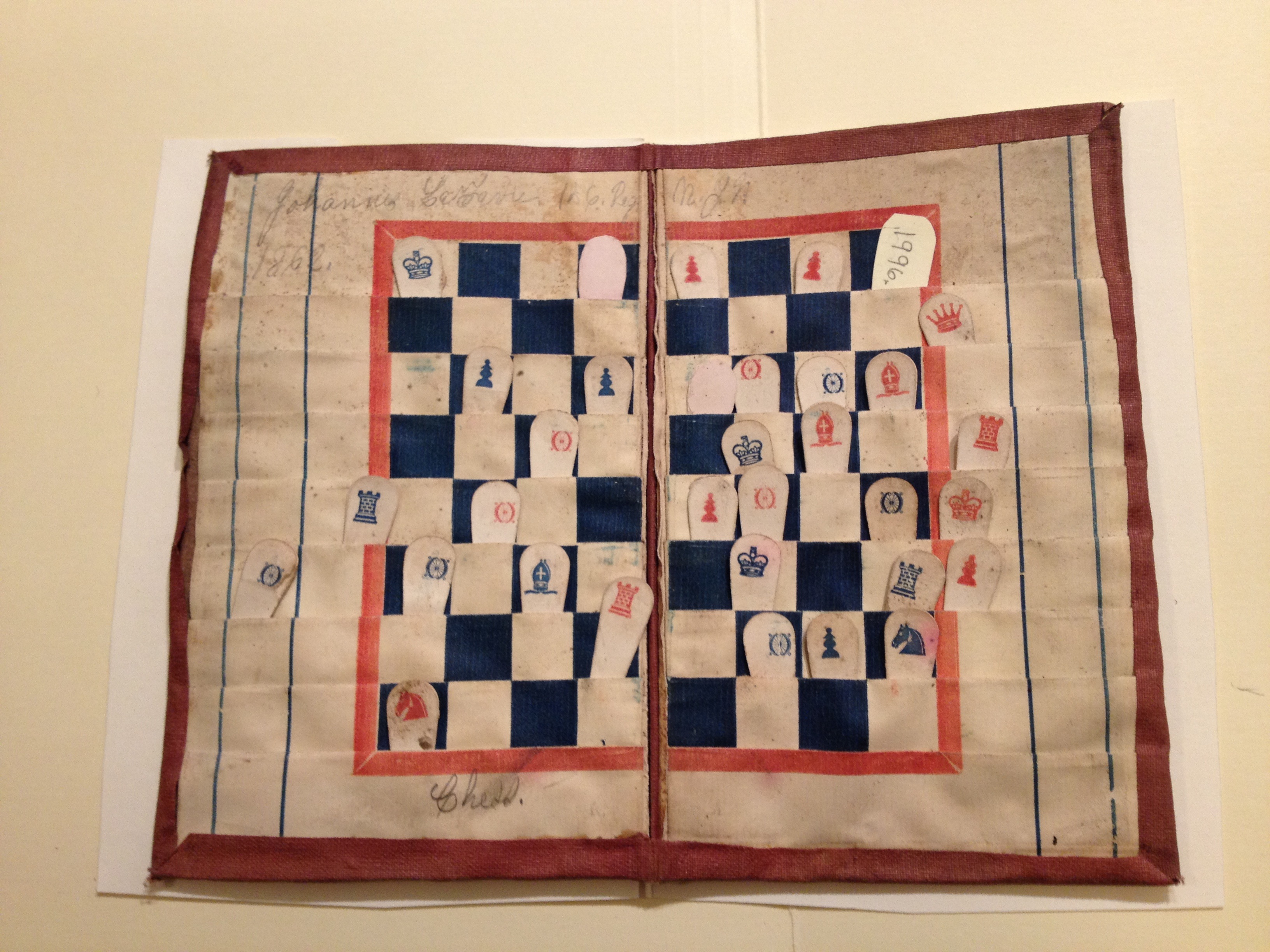
Smaller than your modern chess set, the pocket chess-board was a portable game for travelers to carry from one destination to the next. Because the object was created with a series of slips and paper chess pieces, it was easy to stop at any moment and close the book without disturbing the game.

Description:

The pocket chess-board, when closed, looks like a small hard cover book made out of cloth material. When closed, you can feel the roughness of the object as if you’re touching the cuff of a fresh pair of jeans. There are small bubbles on the back cover where air trapped itself inside the cloth material over time. On the object’s edges, you can see pieces of the cloth are slowly starting to rip off. The word chess is written in pencil at the top left. The chess board is light brown, but was probably burgundy or red once upon a time. Upon opening the small 4-by-6 book, a mini chess board is located in the middle with blue and white squares surrounded by a red-orange border. Below the border are the words Chess written in script again. Above the border reads: “Johannes Lefevre 126 reg. N.Y.R.” and “1862” on the left corner. The chess board is made out of paper with blue lines on the left and right side, creating little slips for small white tear-drop shaped chess pieces. On the pieces there are printed chess shapes in red and blue ink. Some are in chess slots, others are to the side, waiting to be used.

Provenance:

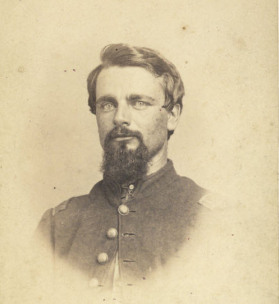
The object was owned by Civil War Soldier Johannes Lefevre of New Paltz. It is believed he carried the object with him during his time in the war. The object was perfect for the life of a solider because of its portability and inability to be disrupted by closing the game at any given moment. Though it is unclear how Lefevre possessed the object, the pocket chess-board was manufactured by D. Appleton & Company in New York City 13 years after its invention by Peter Mark Roget. After Lefevre’s death it was given back to the family and passed down through generations. It presently is located at Historic Huguenot Street.

Johannes Lefevre

Dates of Creation:

The object was manufactured in 1858, but was said to be created 13 years ago by Peter Mark Roget (1779-1869) prior to being sold in general D. Appleton & Company shops.

Narrative (VERY ROUGH DRAFT):

In 1858, D. Appleton & Company began selling its first-ever pocket chess-board for all to own. It became a staple for those who traveled because it was a portable form of entertainment for long journeys. Prior to it being sold at the D. Appleton & Company general store in New York City, it was invented by Peter Mark Roget. During the Civil War, its invention was created for the entertainment of travelers, soldiers and sailors who were always on the go during the Civil War. It was during this time period where Johannes Lefevre took ownership of his own pocket chess-board where he used it for entertainment on long travels and nights throughout the war.

It wasn’t uncommon for a civil war soldier to have such an item. For Lefevre, he probably either had the item before the civil war. He was traveling and looking for jobs upon graduating from Union College, where he obtained a science degree. He most likely used the item as a form of entertainment and played with other travelers. If this wasn’t the case, Lefevre mostly likely obtained the item once he returned to New Paltz upon hearing of his brother Peter’s enlisting in the Union Army. He was visiting his uncle in Michigan at the time. Johannes must have received the item as a gift or bought the item before his departure.

On his journey, Lefevre never wrote about his chess-board to his family and friends, but he was surely in possession of it during his duty as a solider. Throughout his journey in the Union Army, Lefevre picked up a pencil and wrote on the inside of the item: “Johannes Lefevre 126 reg. N.Y.R.”  He also wrote “1862” on the left corner of the chess-board  He wrote “Chess” at the bottom of the page and on the cover of his pocket chess-board too, possibly because of boredom.

Johannes Lefevre had a successful and emotional career in the military, as was depicted in his civil war letters about death, women and family. He soon faced a horrible death when he was fatally wounded during the battle of Cedar Creek. The bullet went into the side of his rear. He was then taken to a Dr. West who was helping him recover. His father, Josiah Lefevre, went south after receiving a letter from Dr. West about his son’s injury. Upon reaching him, Josiah realized his son was recovering and left for New Paltz. However, it wasn’t until his departure that Johannes developed Gangrene disease from the exposed wound. He died in the late fall of 1864.

The chess-board, at that moment, was with all of Lefevre’s things when he died. His brother, Isaac went down to get the body and return it to the family in a coffin, according to Huguenot Street researchers. His belongings, such as the chess-board, were passed down through relatives until finally ending up at Historic Huguenot Street, where it was donated. The chess-board is now part of a larger Johannes Lefevre collection which is split between Historic Huguenot Street and Elting Memorial Library.

Work Cited (More will be added):

Hudson River Valley Heritage, “Civil War Letters of Johannes Lefevre.” Historic Huguenot Street. 1864. Web. 15 Mar. 2013.

Glazer, George D. “The Pocket Chess-Board.” George Glazer Gallery: Antiquarian Globes, Maps and Prints. 1997. Web. 15 Mar 2013.

Sutler Of Fort Scott. “Pocket Chess/Checker Board.” Museum Quality Reproductions. 17 Jan 2013. Web. 15 Mar 2013.

Phillips, Del. “Brewster Viewer By Appleton.” Double Exposure. 2001. Web. 15 Mar 2013.

More Than An Object (History of the World)

I have to confess my love for this introduction. Although I am not an anthropology scholar, I did find some sentences which spoke to anthropological studies. “The Caribbean Taino, the Australian Aboriginals, the African people of Benin and the Incas, all of whom appear in this book, can speak to us now of their achievements most powerfully through the objects they made: a history told through things gives them back a voice.” I found this quote to be extremely powerful and comforting because in a sense our work and history doesn’t die with us. We have all this material from early settlers and tribes so we can fully analyze their lives. We can turn away from the empirical analysis and realize that these were actual people who used these items for a purpose or treasured them.

I also liked how the author describes written history vs object history. I like that the author introduced the problem of no textual or written history from early ancestors. Some more of my insights include literate vs. illiterate history. We did have written works from the enlightenment, but groups of indigenous tribes didn’t write or they wrote in a different language. Through objects we can analyze that tool and use it to our advantage in finding the history of these individuals. I completely agree with the notion that we must view history through objects and not through written material, because objects give us a deeper history than what appears on a page. Although not mentioned in the text, textual form is one-sided, but an object can mean different things to a different person—just another thought.

Objects create a significance to the story their told. As I said in the previous paragraph, they create multiple meanings and histories for different people. Textual information is a little tough to analyze since it’s one-sided. Objects also go into deeper meaning. A diamond which was passed down by the royal family was probably found or created by slaves or servants. This creates more of an understanding of the time and I find that absolutely interesting, am I wrong?

I think we can use this knowledge to our advantage. When we encounter an object and analyze its surfaces, descriptions and history we can find out not only what they were used for, but also how they were created. Why use this item as opposed to another? Why create it this way? Was this object passed down? How was this item used and by whom? How can we fully grasp the use of this object? I think that when we do our own research we need to consider all aspects of an object and not just its use by one person. There’s a history behind the person or manufacturer who created the object. We must listen to their voices as well. Were they mistreated? Were they slaves? How did the object get to the person or place who has it now? It may seem like a lot of questions, but you’d have to act like a journalist when researching and finding out all details.

Essentially, go out there and question everything about the object. Ask yourself what do you want to know about the object.

An American Fortune

Fortune1

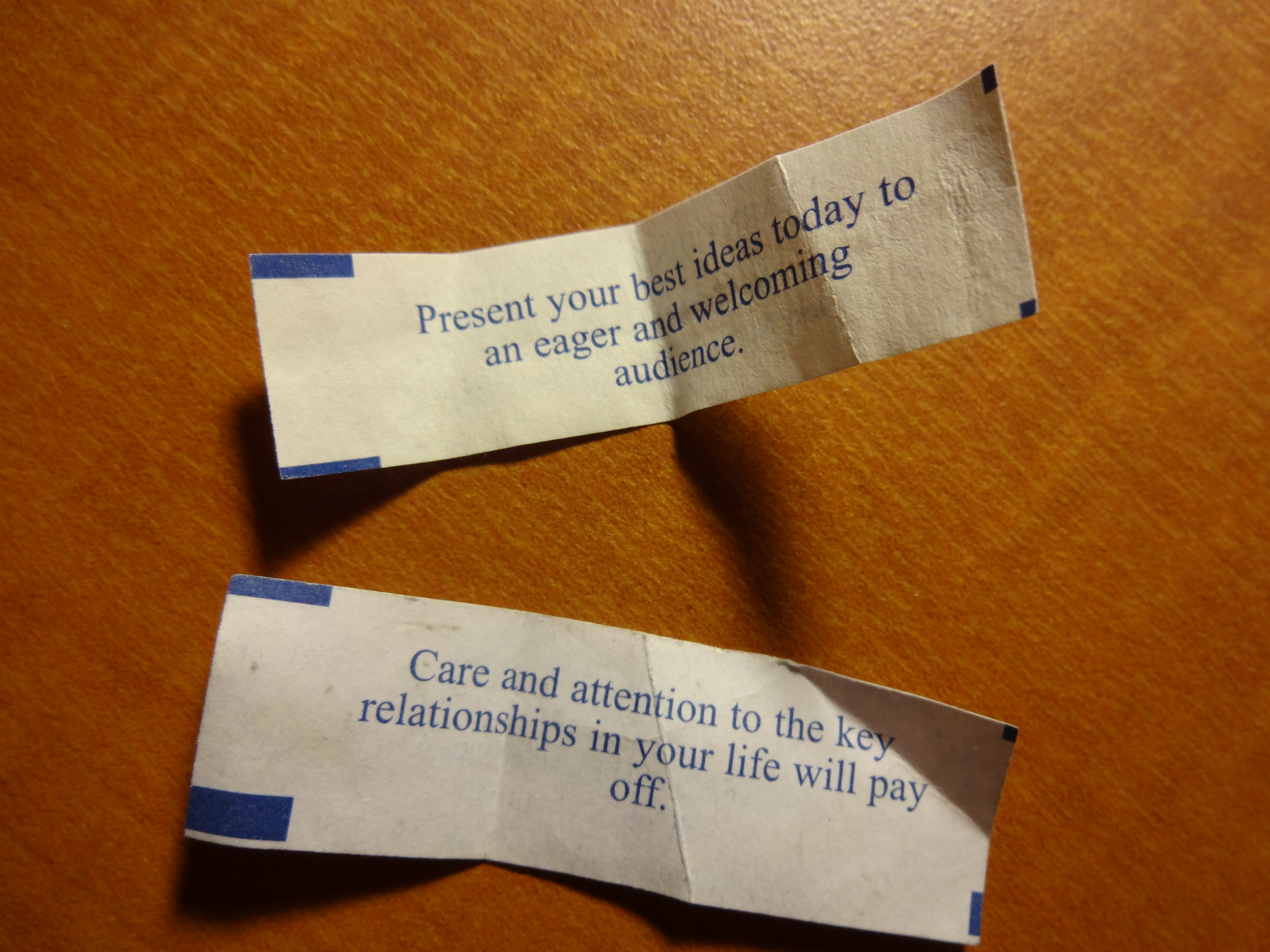
Picking an object wasn’t easy this week. The Hare with Amber Eyes had made me realize that I really don’t collect anything. That was until my friend was going through my wallet last night and found about 12 fortunes from fortune cookies. Some from this past weekend, others from years ago. Let’s just say, I have a fortune problem.

“Fortunes” are pieces of paper with words of inspiration, wisdom and vague prophesies or phrases. About an inch and a fourth long, the fortune also holds a chinese word or phrase on the back with lucky numbers attached to them. Mine currently says family and my lucky numbers are four, 25, 27, 52, 11 and 24.

According to Wikipedia (not exactly the best source for information) fortune cookies were “introduced by the Japanese, popularized by the Chinese but ultimately consumed by Americans.” According to ABC News, fortune cookies originated in Japan, and then were brought over to California. It wasn’t until the Japanese-American internment period that the Chinese took over the booming fortune cookie market and began spreading their fortune cookie wealth. The Japanese never achieved their fortune cookie status again.

The white piece of paper with red or blue writing was an essential part of Japanese culture. The fortune cookie in Japan, both larger and darker than the modern object, contained fortunes from Japanese temples. These cookies were seen as a dessert delicacy and were sold in some regions of Japan. Wikipedia reports that the most notable neighborhood was Fushimi Inari-taisha.

Erik Sumiharu Hagiwara-Nagata is the relative of the original Japanese-American introducer of the fortune cookie, Makoto Hagiwara. They reveal that the Japanese fortune cookie was also eaten at New Year’s festivities at Shinto shrines. They were called “folkcraft” or the Japanese name, tsuji ura sembei. These treats also weren’t owned or manufactured by one individual. They were a Japanese tradition, much like how apple pie or pizza have been called an “American” tradition today, according to ABC News and Hagiwara-Nagata.

DSC00154

However, today the object is much different compared to its original form in Japan. They still do have the same function as a treat, but they’re smaller, shaped differently and contain fortunes written by retired history professors and freelance writers in Brooklyn, N.Y. (Wonton Foods) The largest fortune cookie manufactures today, Wonton Foods, contains a databank of 10,000 fortunes which are rotated frequently. This is much different compared to the original fortunes, created in temples.

The only form of ownership was in America where Makoto Hagiwara served the first American fortune cookie at his restaurant, Japanese Tea Garden in San Francisco during the early 1900s. Since then the fortune cookie trend expanded throughout the United States by the Chinese due to the Japanese American internment period.

Although the original fortune cookie is from Japan, both Japanese and Chinese citizens say that the fortune cookie is an American food and is only expected to be served in American Chinese restaurants. Today, the fortune cookies are sold in China and Japan as American imported treats. So, remember: Next time you receive a fortune cookie at a restaurant, the words are actually written by a writer and not some wise man or woman in a temple.

Shark Tooth Necklace

Shark Shark

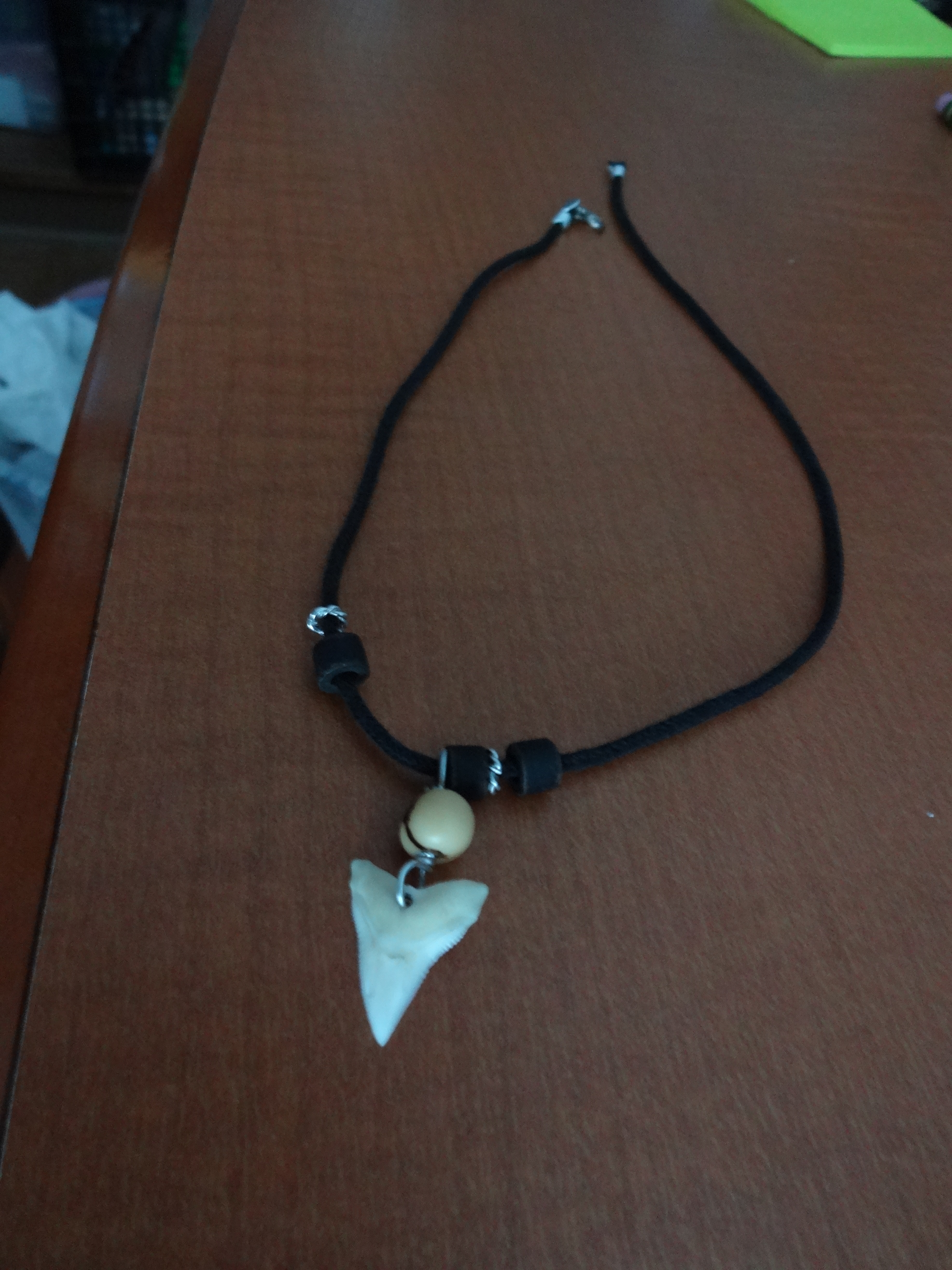
So, I decided to change it up this time and give my rosary beads a break. For this week’s blog I decided to showcase my shark tooth necklace. The necklace was given to me by a friend. She gave me the necklace on my 20th birthday before she transferred to another school in the middle of my second year at SUNY New Paltz. I consider it a symbol of our friendship. I wear it a lot now that she’s studying abroad in Italy. Maybe she’ll bring me back something else, who knows?

If you hold the shark tooth necklace at its sides you can feel the metal pieces which connect to each other. The metal pieces spiral into a thick black material, which almost feels like the strings of sweatshirts and hoodies. The string is rough as denim material. The necklace is about 7 to 8 inches long, revealing pieces of metal and wood around the string. The wood is dark, almost black even. The wood and pieces of metal, wrapped around the string, are uneven in quantity. When you hold up the necklace, there are two pieces of wood and one piece of metal on one side of the shark tooth, but then there is one piece of wood and one piece of metal on the left side.

Finally at the end of the necklace a piece of metal material holds the shark tooth necklace. Between the shark tooth necklace and metal is a plastic ball which feels smooth at the touch as if you’re rubbing a marble. Below, the shark tooth necklace is about a half an inch long. The white shark tooth is sharp around the edges. If you place your finger against the end, you’ll feel the sharpness against your skin. I wouldn’t push too hard though, you might create a cut.

So, I thought I would share my image’s description before I delve into what I’ve learned about it so far. Although they’re considered a fashion choice today, the tool was used very differently in the past. Shark teeth were used as weapons, and tools for food preparation. These tools were originally used by Native Hawaiians, who called them leiomano. Native Hawaiians would pass down some types of shark teeth to royalty. As the 20th century came along, the use of shark teeth became less a tool of survival and more of a fashion accessory.

It turns out a shark tooth necklace was a symbol of “male strength, potency and a proud display of masculinity,” as described by a few websites. The fashion choice was unsuccessful in the 1970s where they were worn to make up for some masculine shortcomings. Given their masculine and strength meaning, these necklaces offer a natural charm of “man of the wild.” They’re known to lure women and create “irresistible attraction for women near and far.” I don’t necessarily agree, but I do happen to love the quality of my necklace.

Unfortunately, the necklace broke this week, but maybe I’ll find a new latch soon. Any suggestions?

Rosary Beads

Rosary Beads

When I was a child, my mother and I used to attend Sunday mass every week. It was a ritual. She believed that church was a place of peace, forgiveness and most importantly, worship. Although we haven’t attended our church in a few years, we both have become religious in our own ways. So, it wasn’t a surprise to me when she handed me rosary beads before giving me a tight hug; brief, but a feeling no one forgets. “Take these rosary beads,” she said. “Remember God is always with you, and so am I.” I always associate these rosary beads with that moment and today, it still brings tears to my eyes.

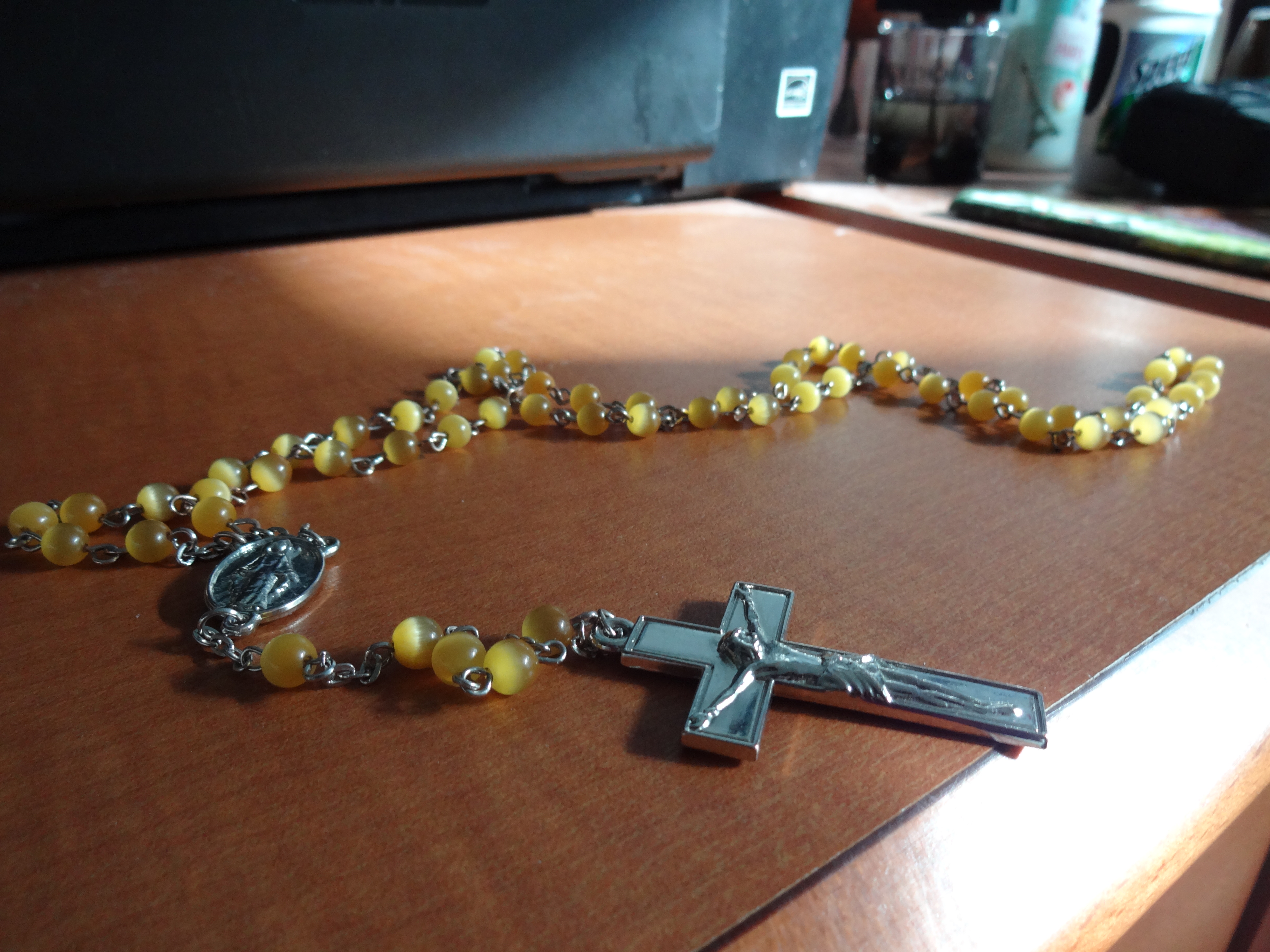
The beads together are about a foot long. The rosary is filled with yellow beads down a long metal chain. The separation between the beads from start to finish are about a half centimeter apart, with some variation as you go down the beads. They then become about a centimeter apart in some areas, but return to half a centimeter. As you continue on the chain of bright yellow beads, like a ring of suns attached to one another, the chains meet at an end. The ends are attached to an oval metal piece. On the oval is an engraved figure of the Virgin Mary. As you continue to scan the rosary beads, the metal pieces become one and are hooked to a cross, where Jesus is engraved with arms spread, a depiction of the day of his death. At the end, the rosary beads continue to have variations between one centimeter and a half a centimeter apart.

The beads are sphere-like and soft. Rosary beads come in all different types of materials, but mine seem to be pearls. The cross’ edges are sharp and as I begin to touch it, my thumb slowly elevates with the shape of Jesus’ body. Above the cross, Mary’s figure on the oval is less dominant. The sides of the oval are smooth, and her body creates less elevation as you rub your fingers on top of the oval. When you put the beads in your hand and shake, they create a jingle. It’s not loud or obnoxious, but there’s a clear tune when the beads hit each other. It reminds me of the time when I used to play with my grandmother’s rosary beads, located at the top of her dresser. She didn’t like that very much.

Although the rosary beads stand for a religious symbol, I have modified it to mean so much more. The beads and chain symbolize the connection my mother and I have. As it becomes one, I realize that we are one in the same. She’s my best friend. I find myself praying when times are difficult, and realizing that just like God, my mother is also with me. Although not present in the place where I stand, she’s just a phone call away. She’s proud of me and what I’ve become, but I think I’m more proud of her. It takes courage, determination and love to be who she is.

Don’t get me wrong, I’m still religious today. I usually take the rosary beads with me when I need to travel or when I’m afraid. I stick them in my pockets and grab them at my most vulnerable moments. I also pray with them. I usually just fiddle with them or wrap the beads around my hands and pray. I’ll sometimes say a prayer, or just talk to God. Of course, everyone has their own view on religion. But, I find that there’s comfort in knowing there’s a higher power looking over me, or maybe it’s just my mom.