Quilts in History
The Civil War in America saw a major uprise in the production and ownership of quilts. After President Abraham Lincoln signed the Homestead Act in 1862, westward expansion began. The idea of the west proposed such an ideal way of living; it offered new land, new opportunities, and a new life. To many, it was like arriving in a New World all over again. However, westward migration was not something that happened immediately. Pioneers who sought to take the journey spent months, if not years, preparing. The need for clothing and blankets became a dire necessity and no one went anywhere anymore without a sewing kit. Those who were making the migration were told to bring 2-3 blankets or quilts. Quilts became a commonality, not only with the pioneers, but also with the people after they settled. They had proven to be incredibly versatile, serving as quilted blankets as well as cloths, rags, and other types of fabric needed for daily use.
As this was going on, quilts began to serve a greater purpose than merely providing warmth and convenience. Those who sewed these together began to embroider them as well. Scenes were sewn into the textiles of these quilts, telling stories such as the story of westward expansion. They also began to serve the purpose of symbolizing cultural, social, and political matters. One such matter was the presence of slavery in America at the time. A group of people known as the Quakers began to use their quilt-making skills to create a quilted pattern that served as a rebellion against the institution of slavery, as well as the presence and ideals of the Confederates.
History of the Underground Railroad
The Underground Railroad was a name given to a complex network of people within the United States who commonly aimed to lead slaves to freedom. It was developed around the time of the Civil War as an effort to undermine the Confederacy and bring an end to the inhumane practice. One of the main active groups that participated in this movement was the Quakers. The word “quaker” also, unironically, means friend and these were mostly people from the Christian church united in their shared mentality that every human had the ability within them to experience God.
The term “underground” in the title of this network’s name is indicative of its desire to remain relatively unknown. Many were persecuted for attempting to aid slaves on their way to freedom, as were slaves attempting to reach freedom. As a result, it was key that the organization remained unknown to those who may appose its operations. Instead, those who were part of this network developed numerous “secretive” techniques, only meant to be understood by those who were within the operation.
Freedom Quilts
Freedom quilts were thought to be a part of the underground railroad that worked in disguise to lead slaves to freedom. The quilts were usually adorned with some sort of arrow shaped pattern. This was a common pattern regardless, but when hung outside of one’s house they became directional symbols, pointing the way to freedom. Since quilts were such common objects to have hung outside of one’s home, this method was able to remain undetected, so much so that historians still do not have concrete evidence that this was the main purpose of these quilts. However, despite the lack of the facts, the idea is still an incredibly interesting one and sheds light on the truth of our history and the hardships that slaves dealt with, as well as the extreme methods they needed to pursue to obtain their freedom.
Huguenot Quilts
Huguenot Street has a rich collection of similar quilts, all of which tell a story about the history of the Huguenots and the town of New Paltz. Located in their “commemorative quilts” section of their website, Huguenot Street is in possession of a quilt which is titled the Tercentenary Quilt. This quilt is comprised of thirty-five textiles stitched onto a blue fabric background. This contrast works to make the textile images pop. The Tercentenary Quilt is an example of an album quilt. More specifically, this design is officially known as the Baltimore Album Quilt, a style that, as evident in the name, originated in Baltimore, Maryland during the 1840s and are well-known to tell stories within their designs.
The Tercentenary Quilt was created by thirty-five women as a celebration of the three hundred year anniversary of the New Paltz settlement. As evident in the image below, each block tells a little story about New Paltz’s history. They include the first church built in the town, the Huguenot cross, the Bevier-Elting house, the Walkill River, and many more. This specific quilt is rich in stories and histories, so much so that the object itself has become a historic item, for it serves as a reminder of where Huguenot Street comes from and the stories behind their origin.

The Huguenot Quilt Collection also includes a section called “friendship quilts.” These are collective quilts that were passed down through family lines as a way to commemorate the family members that came before them. One such quilt is The Duboisville Friendship Quilt.
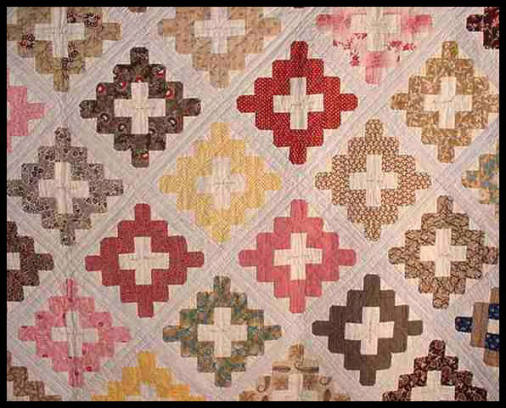
The appearance of this quilt varies greatly from the previous stated one, despite its simple repetitive pattern. This quilt includes brights colors such as reds and oranges, rather than predominantly using blue fabric. However, the significance of this object lies in the signatures that are present within the quilt. In the middle of each diamond-shaped design, as shown in the images, is a signature of who is presumed to be one family member.
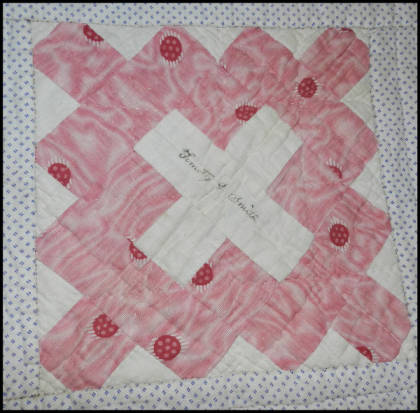
The significance of this object lies in it’s connection to the legacy of the DuBois family. The DuBois family history is rich within the history of New Paltz and Huguenot Street. Descendants of Chretien DuBois and his wife Francoise le Poivre, the DuBois family found their way to American, and eventually Kingston, after years of attempting to escape persecution in Europe. After finally settling in New Paltz along the Wallkill River, the DuBois family began to lay down a legacy that remains prevalent today. The preservation of these quilts and the names of the family members that are embedded within them serves as a reminder of just how deep the history of Huguenot Street lies.
Provenance
The legacy of the Tercentenary Quilt is easier to track than the Duboisville quilt, due to the fact that it was created during the seventies. Celebrating the three hundred year anniversary of the Huguenot settlement, as stated previously, thirty-five women were commissioned to create it. The woman who donated it to Huguenot Street remains anonymous, but it is thought that she is a family member of one of the women who created the quilt.
However, the legacy of Duboisville quilt leaves behind a traceable path. It was owned by a woman named Mary H. Dubois, evidently a descendant of the Dubois family. It is believed that the quilt was likely made as a gift to both Charles and Mary DuBois prior to their departure from Duboisville–a city in Michigan. Afterwards, the quilts fell into the hands of Reverend Edwin Herman DuBois, gifted to him from his aunt Elvie Dubois. Elvie was Mary DuBois’ daughter. She later then passed on the quilt to Evelyn M. Gueho. Evelyn M. Gueho is accredited with the donation of the Duboisville quilt to Historic Huguenot Street. On June 28, 1990, it became a permanent part of their quilt collection.
Narrative
Quilting is an art form that continues to serve an integral part of human history. The word quilt is derived from the French word “cuilte” with the same meaning. However, as a verb, the word quilt translates to “join together,” which serves as a double meaning to the togetherness, of not only the literal stitching in the fabric, but of the legacies and stories they tell.Upon arriving in the new world, European settlers brought the art of quilting with them. During the nineteenth century, quilting became more than just an art form in America; it became a social interaction. Women would often convene in places called quilting bees to swap textiles with one another and complete quilt work they may have been doing alone at home.
With this in mind, it is more understandable as to why thirty-five women were accredited with the creation of the Tercentenary Quilt. Seeing that Huguenot Street, and New Paltz in general, is an incredibly small area nowadays, it makes sense that the women who settled here would convene together to make quilts. It is likely that each little story was sewn on its own before the entire quilt was put together. Each woman was responsible for choosing a landmark, a person, or a family member to create their own square textile on.
The object of the quilt literally–and metaphorically–symbolizes the interwoven histories of these people. When we look at it, we are able to trace every single story that each of the female creators wanted to tell. That is the true beauty of an object, and especially a historic one: the ability to tell a story.
References
Quilts of Historic Huguenot Street, omeka.hrvh.org/exhibits/show/quilts-of-hhs/introduction.
“The Duboisville Friendship Quilt, Historic Huguenot Street.” Hudson River Valley Heritage, http://www.hrvh.org/cdm/ref/collection/hhs/id/2163.
Editors, History.com. “Underground Railroad.” History.com, A&E Television Networks, 29 Oct. 2009, http://www.history.com/topics/black-history/underground-railroad.
Editors, History.com. “Quakers.” History.com, A&E Television Networks, 19 May 2017, http://www.history.com/topics/immigration/history-of-quakerism.
“DuBois Family Association.” Historic Huguenot Street, http://www.huguenotstreet.org/dubois.
“HISTORY OF QUILTING.” Emporia State University, www.emporia.edu/cgps/tales/quilte~1.html.
“Quilt Discovery Experience.” National Parks Service, U.S. Department of the Interior, http://www.nps.gov/home/planyourvisit/quilt-discovery-experience.htm.









 The Materials of History, Thought, and Art