Where did this wallpaper come from?

Nailed to the roof-supporting rafters above the second floor of the Jean Hasbrouck House are various boards forming a surface known as a garret – a small unenclosed attic-like space reachable by a wooden ladder in the center of the second floor. Standing underneath the garret just north of the ladder and looking up, you may notice that one of the boards, slightly darker than the two next to it, is decorated with pieces of wallpaper.
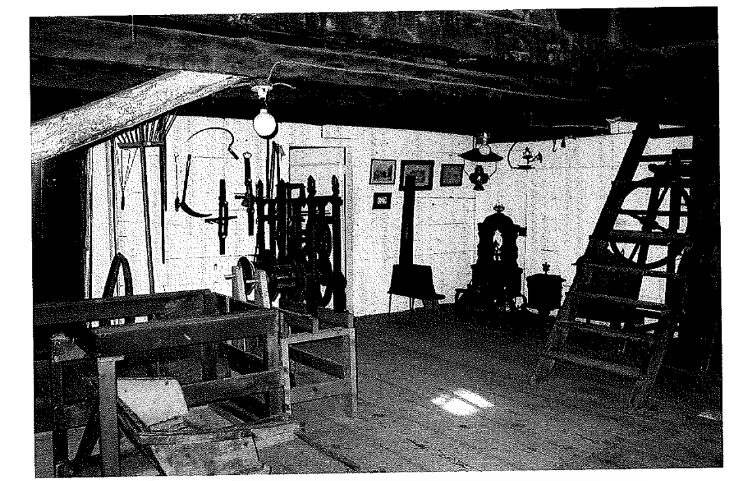
Second floor looking northwest with view of ladder to garret space. (Image: Crawford & Stearns 2002)
Remnants of wallpaper, located on the underside of a garret floorboard above the second floor of the Jean Hasbrouck House on Huguenot Street in New Paltz. (Image: Louise McGoldrick, 2023)

Some of the wallpaper has peeled off, but a large strip remains in the central area of the wooden plank, as well as a thin piece at the top edge and fragments on the bottom and middle. Browning from possible water damage has removed some of the color on the right side of the wallpapered board. Next to the browning there are areas of a cream paper, which seems to have been layered on top of the orange wallpaper, possibly as a border or as a later addition. Looking closely at this paper, there is a subtle glimpse of a minimalistic vine pattern. On the areas of the orange wallpaper that surround this cream paper, there are lines of white where the orange color may have been stripped when the cream paper was removed.

There are two colors used in the pattern of the wallpaper, which was probably printed on white paper – a muted orange background with foliate details, and dark brown dotting outlining the lighter elements. The pattern consists of a scrollwork motif of overlapping curves, some of which terminate in curved points. It is vaguely floral but very stylized. From the remnants of wallpaper that are visible, it is hard to see how and where exactly the pattern repeats.  

Provenance
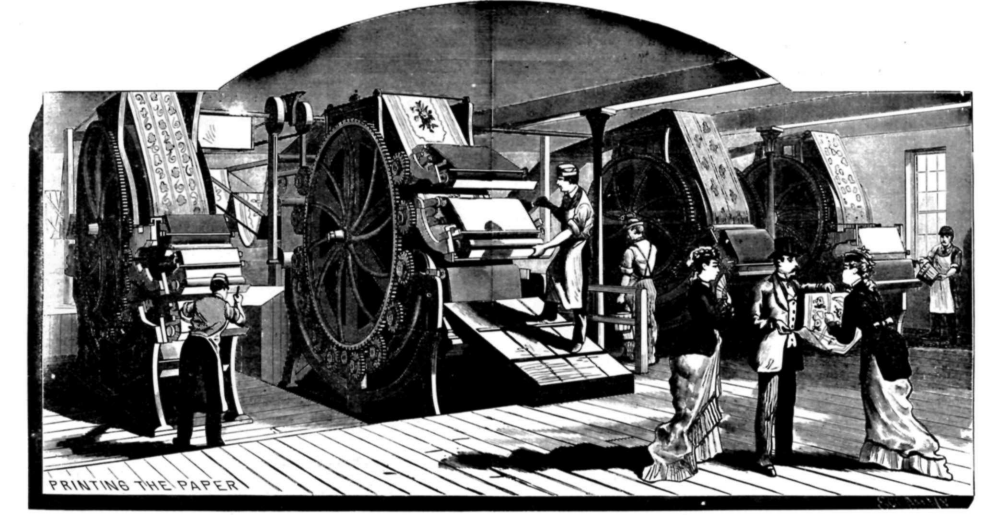
Illustration of machine-printing wallpaper in New York factory. (Image: Scientific American, 1880 in “Wallpapers in Historic Preservation”)

The design on the orange wallpaper suggests that it was machine-printed using a cylindrical stamp to create its scrolling style and thin-bodied color. This means that the wallpaper is older than 1840, when steam-powered wallpaper printing machines were developed and popularized in the United States (Frangiamore 7). The scrollwork pattern of the wallpaper was also in fashion during the mid-19th century (Frangiamore 27).  

The wooden board upon which the wallpaper is affixed has remained in its current location since around 1851, when a series of “mid-century alterations” added a room on the second floor and extended the garret above it, using the wallpapered board (Crawford & Stearns 1.31). Many of the wood planks used in the extension of the garret date to 1786, some of which have been identified as doors previously used in other areas of the house (Crawford & Stearns 2.99). However, the wallpapered board is never specifically dated in the Historic Structure Report. Presumably, the wallpaper had been on the board prior to its use as a floor plank for the garret, since none of the boards around it have wallpaper remnants on them. Also, there is no mention of wallpaper used within the Hasbrouck house, only plaster and paint on the walls of each room. 

Object Narrative

The board may have been in the house prior to its use as a floor plank for the garret, but who lived in the house in the early 19th century is unsure. In 1822, the property was inherited by Levi Hasbrouck, who also owned many other properties in the area and had the highest tax assessment in the town (Crawford & Stearns 1.54). He did not live in the house at the time, but it is unknown whether the property remained vacant or if laborers were boarded in the house. 

Between 1849 and 1862, tenant Samuel D.B. Stokes, who previously lived in Butterville on a different property owned by Levi Hasbrouck, rented the Hasbrouck house on Huguenot Street. He managed the surrounding 230-acre farm of livestock (horses, cows, oxen, sheep, and swine) and crops (wheat, rye, corn, oats, potatoes, buckwheat, peas, and beans). According to the 1850 Agricultural Production Schedule, the farm was valued at $11,350, making it “one of the largest and most productive farms in town” (Crawford & Stearns 1.31).  

Stokes hired 2 laborers as well as his own nephew to live on the property and help with the work (Crawford & Stearns 1.55). Besides these men, Rachel Stokes, his wife, and their 5 children also lived in the Hasbrouck house. The rooms on the second floor were most likely built so that the house could accommodate the large family and the hired laborers. The garret was used for storage above the second floor, with a seemingly random wallpapered board laid down as a floor plank in its construction. 

It is possible that the wallpapered board arrived at the house with the Stokes family because of the lack of wallpaper anywhere else in the house. Butterville, their original residence, is only an hour’s walk westward from Huguenot Street, where the Hasbrouck house is located, so transporting their possessions would not require a long trip. But why would they have carried over a piece of wood, specifically one covered in wallpaper?  

Objects are generally kept for either practical use, aesthetic value, or sentimentality, or more than one of these reasons. This board seems to fulfill all three. My guess is that it had previously been a fireboard at the Butterville residence, used to cover a fireplace opening during the warmer seasons to prevent anything coming in the house through the chimney. It may have been decorated with wallpaper to match the house, as was common during the 19th century (Frangiamore 41). Bringing the fireboard to the new house at Huguenot Street carried over memories as well as serving a useful purpose. Along the solid-color painted walls of the Hasbrouck house, the decorated fireboard may have seemed out of fashion, and been pushed away into the second floor, then later mistaken for an old plank and used in the construction of the garret, where it survives to this day.

The houses on Huguenot Street symbolize what many consider to be the beginning of New Paltz history: the 17th century French settlement by the 12 original patentees. But many of the houses have been transformed over time, with added levels, rooms, decorations, furnishings, and more. Each development embodies a story of the time, the people, and the place, all connected through the last few hundred years. Only by looking closely at the objects that remain can we begin to uncover these layered histories. 
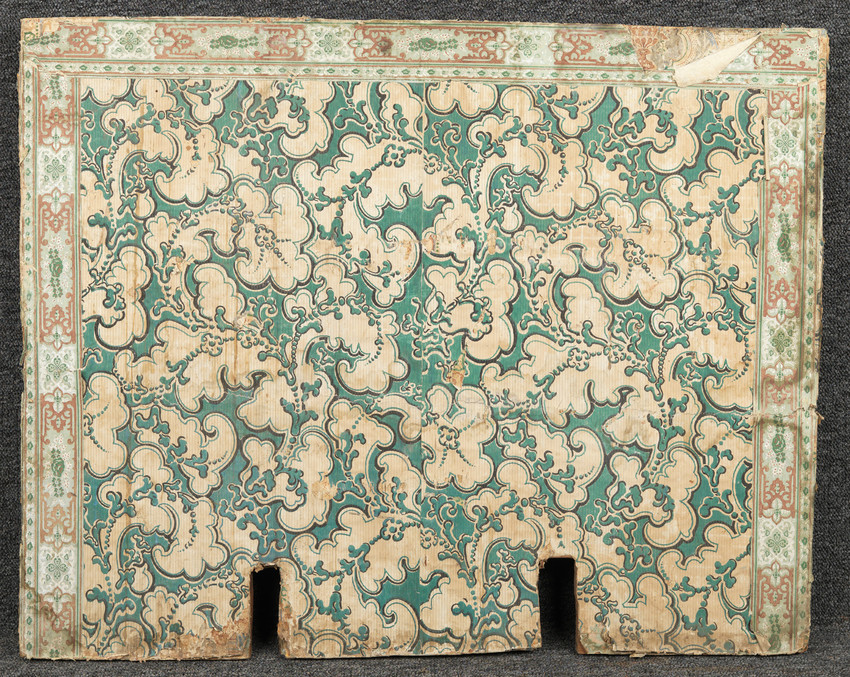
Fireboard with foliate pattern wallpaper. 1855-1865, Historic New England

Works Cited

Crawford & Stearns Architects and Preservation Planners, and Neil Larson & Associates. Historic Structure Report: The Jean Hasbrouck House. 2002.  

Frangiamore, Catherine L. “Wallpapers in Historic Preservation.” National Park Service Office of Archeology and Historic Preservation, 1977, http://npshistory.com/publications/preservation/wallpapers.pdf 
Browsing and Scrolling

True to my oppositional nature, I did the experiments in reverse order. I spent last Saturday afternoon browsing vintage shops and craft markets for about 2 hours, and then scrolled on Wednesday for about an hour. I enjoyed browsing more as I am more interested in objects when I can touch them, smell them, and view them from multiple perspectives, as well as observe the context they are in.

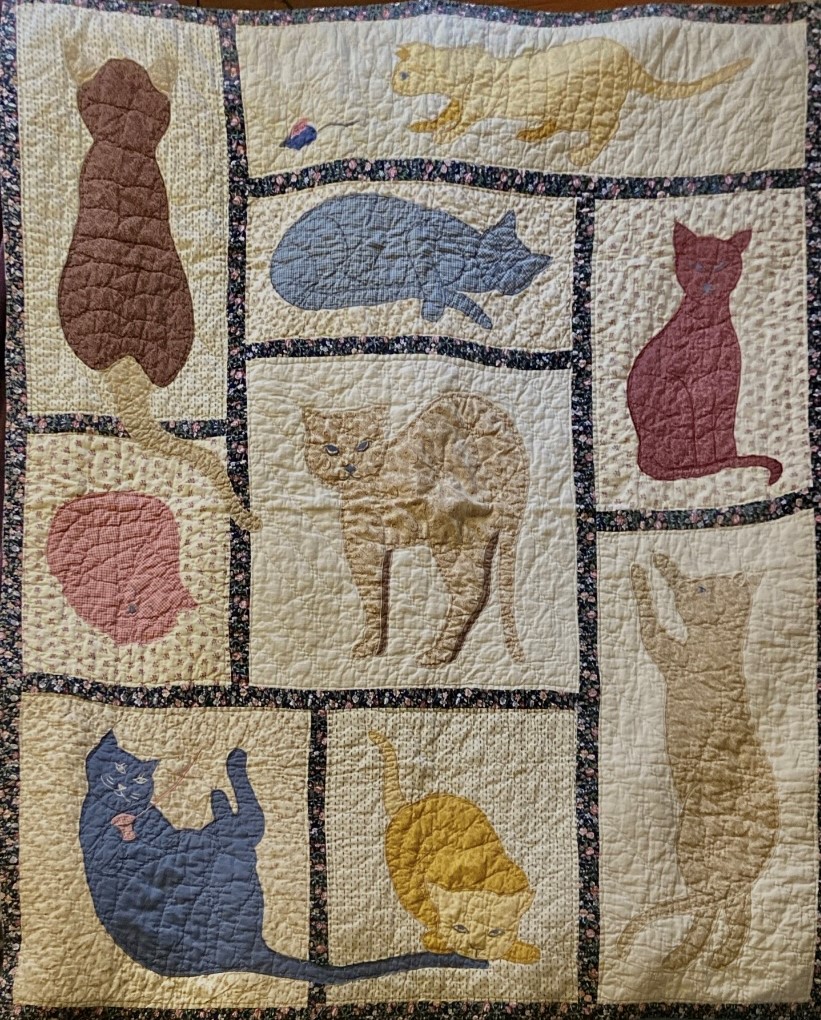
Photograph of cat quilt
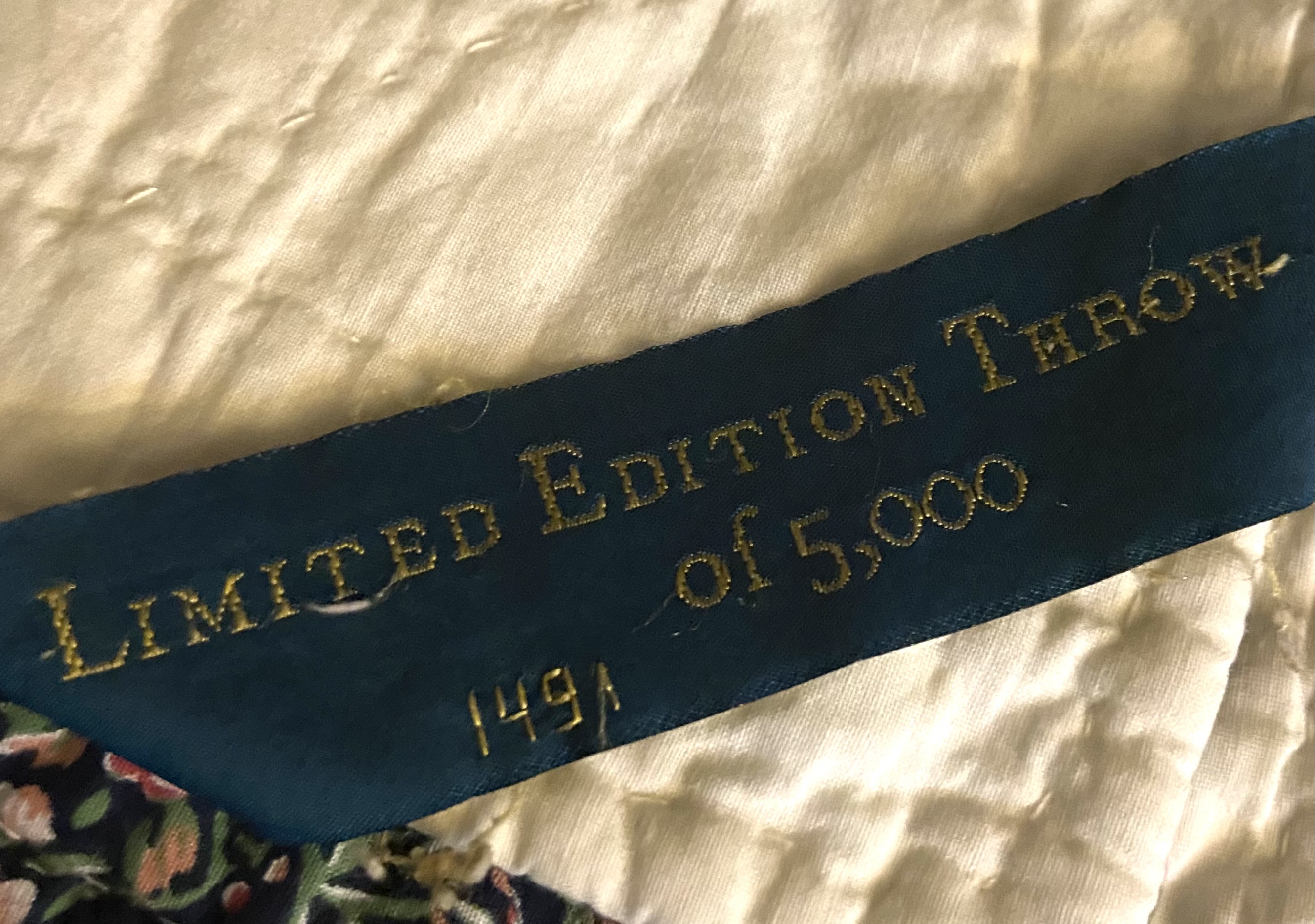
Photograph of quilt label

I ended up purchasing a beautiful quilt decorated with designs of cats from the Marketplace on James in Syracuse, NY, and didn’t realize until I returned to New Paltz that it was labeled as a limited edition throw. I wondered if I could find its counterparts online, so I began to scroll.

This proved to be almost impossible, countering my expectation that browsing is more frustrating as it takes more time and effort to find objects. I personally found scrolling the internet to be harder, even though I used the search engine to my best efforts. I first tried to use key words (“limited edition cat throw”) to find information about my new quilt, but no results matched mine. I then used a reverse image search of a photo of the blanket, but still found no exact matches. I finally tried a reverse image search of the label on the back of the quilt, and found a different quilt on eBay that had a similar label, possibly produced by the same maker or guild. Unfortunately, there was no information there that could help me. 

Based on my experiments browsing and scrolling, I found browsing to be more fulfilling. Since there is no specific thing I’m looking for when I go browsing, the experience itself is rewarding even if I don’t end up purchasing anything. When scrolling, there is usually an end goal, and I get frustrated if I cannot reach it. However, I think that browsing is a luxury; most people cannot afford to spent time on something that may not provide results. Scrolling is generally faster to provide results, even if the results aren’t exactly what you’re looking for. But I think this makes it easier to miss information, since the top results of a Google search are usually the only ones that people click on. We don’t realize that there are thousands of results, one of which could be more relevant to the query. This is what browsing allows: aimless wandering through objects until something truly interesting catches your eye. I think both have their benefits, but if you have time, browsing will provide a more personally rewarding experience.  

My Grandmother’s Book

When I begin this assignment, I’m not sure if have any objects that have survived throughout my family history. My grandparents on both sides had come to India from various places, England (my mother’s mother) and Pakistan (my father’s father), only carrying a limited number of personal belongings. My parents, too, came to America with only a few possessions. What did they deem important enough to pack with them? 

Photograph of the book.

I think for a while, searching my house, until I remember that when I was young and loved to read, my maternal grandmother gifted me a book that she had received as a child. The book was passed directly from her childhood to mine, and I was never forbidden from touching this piece of history. I was allowed to hold the book as I read it, to marvel over the black and white printed image pages, to notice the stains and creasing of the paper.  

To begin my research, I first ask my mother what she knows about this book. She only remembers what her mother told her, that my grandmother received it as a prize in her hometown as a child, that it was very special to her. Together we open the book to see the award affixed to the inside of the front cover: “For Good Conduct, Diligence, and Regular Attendance. Obtained 106 Marks out of a possible 106.”  

After I manage to decipher the handwriting on the bookplate, I’m excited to find quite a bit of information that can help me uncover the story of this book. Tadley Corps refers to the branch of the Salvation Army that my grandmother attended as she grew up. I know my grandmother’s maiden name, Jennifer Hicks, and the date she received this book, January 1951. I know the names of the Salvation Army officers who presented this prize book to her. And of course, I know the title and author of the book: The Form That Liked To Be First by Nancy Breary.  

Photograph of the bookplate.

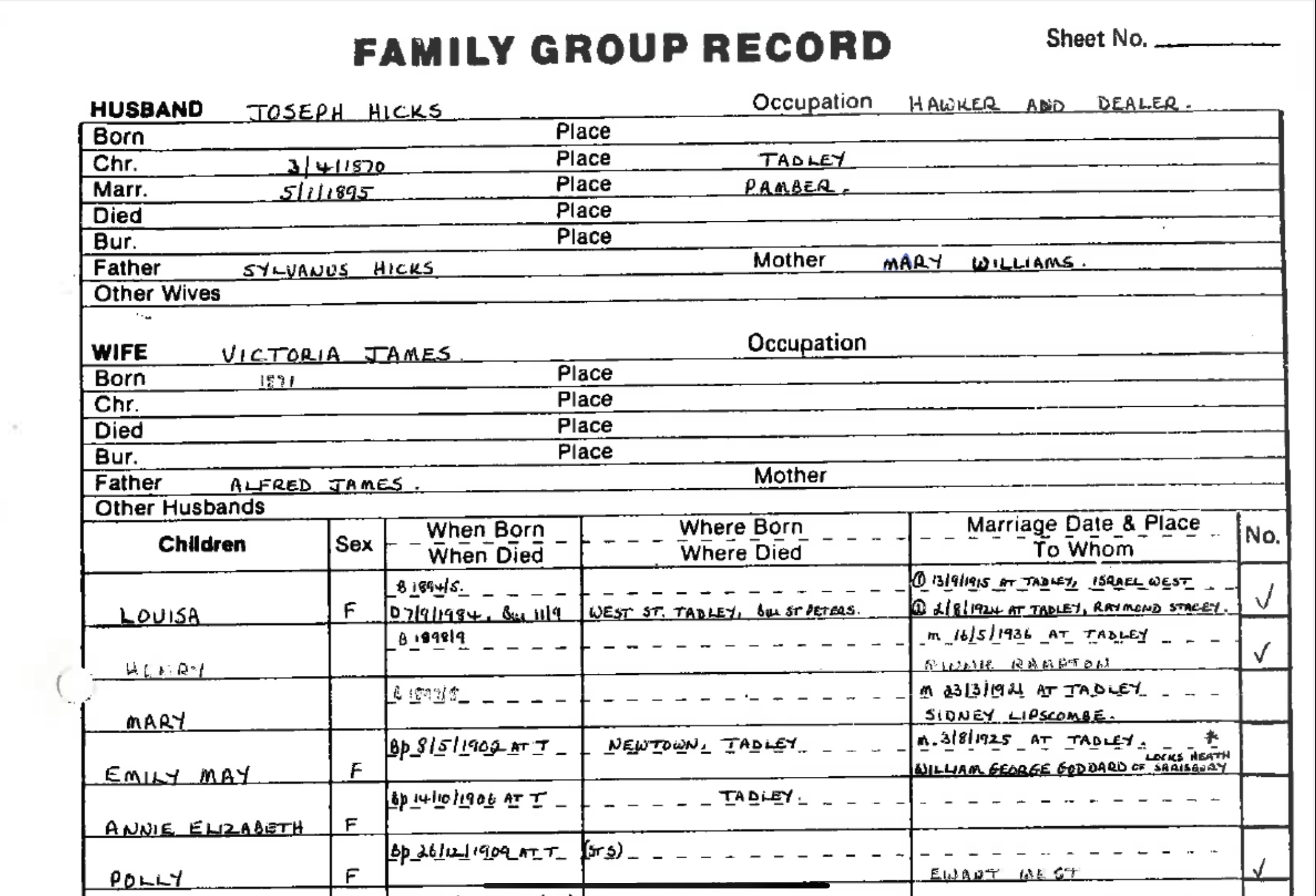
I begin with the small town of Tadley, England. I’m lucky to find an entire website dedicated to the cataloguing of this place and its people, the Tadley and District History Society. Through records of births, baptisms, marriages, and deaths, I confirm that my grandmother was born there in 1938, and her family had been in the area for generations prior. My grandmother referred to her father, Henry Hicks, as a “gypsy” and mentioned that her mother, Minnie Rampton, had urged him to settle down and work a factory job. I trace the lineage of Henry Hicks and find that his grandfather Sylvanus Hicks is recorded as “traveling hawker” and his family was “not living in houses” in 1861, and was living in a “housed van” by 1871 in Tadley. Even his son, Joseph Hicks (my grandmother’s grandfather), was noted as a “hawker and dealer” in terms of his occupation. My family has been moving around for generations, taking with them only the objects they valued. Like this book that I now hold in my hand, which has traveled from England to India and now to America. 

I decide to research the book itself. It was first published in 1948 by Blackie & Son, a company located primarily in London, England. The author Nancy Breary wrote almost 30 books in a genre called “Girls’ School Story,” which “offer amusing stories  – sometimes almost parodies – complete with many over-the-top elements” (Goodreads). My mother tells me that that my grandmother was the first girl to receive a book prize award (my grandmother isn’t sure if this is completely true). I wonder if this is why the church officers chose this book for her, a teenage girl. I think of the entertainment targeted towards teenage girls today, similar exaggerations of the adolescent experience. I wonder what my grandmother thought when she received the book. I want to join her in the moment of congratulations, standing in the Salvation Army Hall, being presented with such a prize.  

A little history: The Salvation Army is a church based on evangelical Christianity, founded in England in the mid-to-late 1800s. A report from the Tadley and District History Society (2009) notes that at the time, it was considered a non-conformist church because many of the meetings were held in the open air and music was an important part of worship. Evangelists known as “officers” preached the word to gain support from the people, and set up “war posts” in areas that had many members. By 1898, the Tadley Corps was meeting in a small building that could not fit the amount of members.

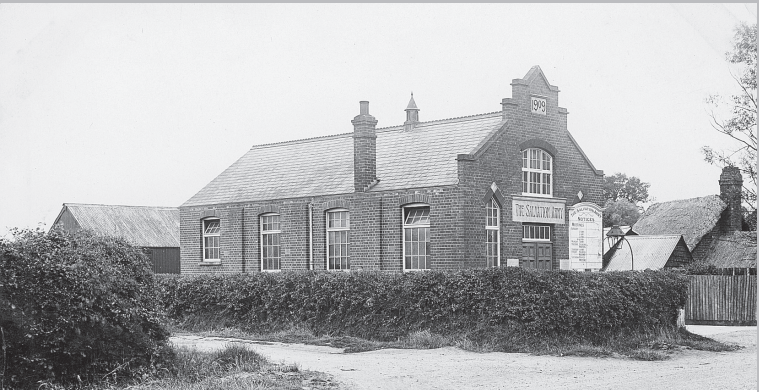
Photograph of the Salvation Army Hall, prior to additions in 1955 and 1978. Source: Terry Hunt, TADS

In 1909, the Salvation Army Hall on Mulfords Hill, the road on which my grandmother lived, was formally opened. This building is still standing today, along with more modern additions to the property.  

I call my grandmother (she lives in India) to ask her what she remembers about her childhood, why her family attended the Salvation Army, why this book has traveled across the world through time. She tells me that her mother’s family, the Ramptons, have always been “chapel people, not Church people” and that her mother joined because she enjoyed watching the Salvation Army band march through the village of Tadley every week. Her mother, Minnie Rampton was highly devoted to the Salvation Army and began studying to become an officer, but her eyesight was too poor. She ended up becoming a Sunday School teacher after marrying Henry Hicks, who also became a Salvationist. My grandmother tells me that when she was growing up she attended Sunday School twice, once before lunch and once after lunch, which explains why she received perfect marks for regular attendance.  

She recounts the months she spent living in hostels in London as a young adult, bringing only a few possessions, including the book. She isn’t sure why exactly she carried it with her. “It’s a children’s story, isn’t it? Must have been just a bit of ‘for old time’s sake’. It’s amazing that the book has reached America. I forgot I brought it to India… maybe I thought I would read it to my children. I didn’t expect it to go to my grandchildren.”  

And yet it has. I wonder where it will end up next. 

References

“Nancy Breary.” Goodreads, https://www.goodreads.com/author/show/717985.Nancy_Breary  

“The Tadley Corps 1898-2009.” Project News, Tadley and District History Society, 2009, https://tadshistory.com/TADS/TADSOLD/Projectnews/projectnews_14pr.pdf 

Woodblock Stamp

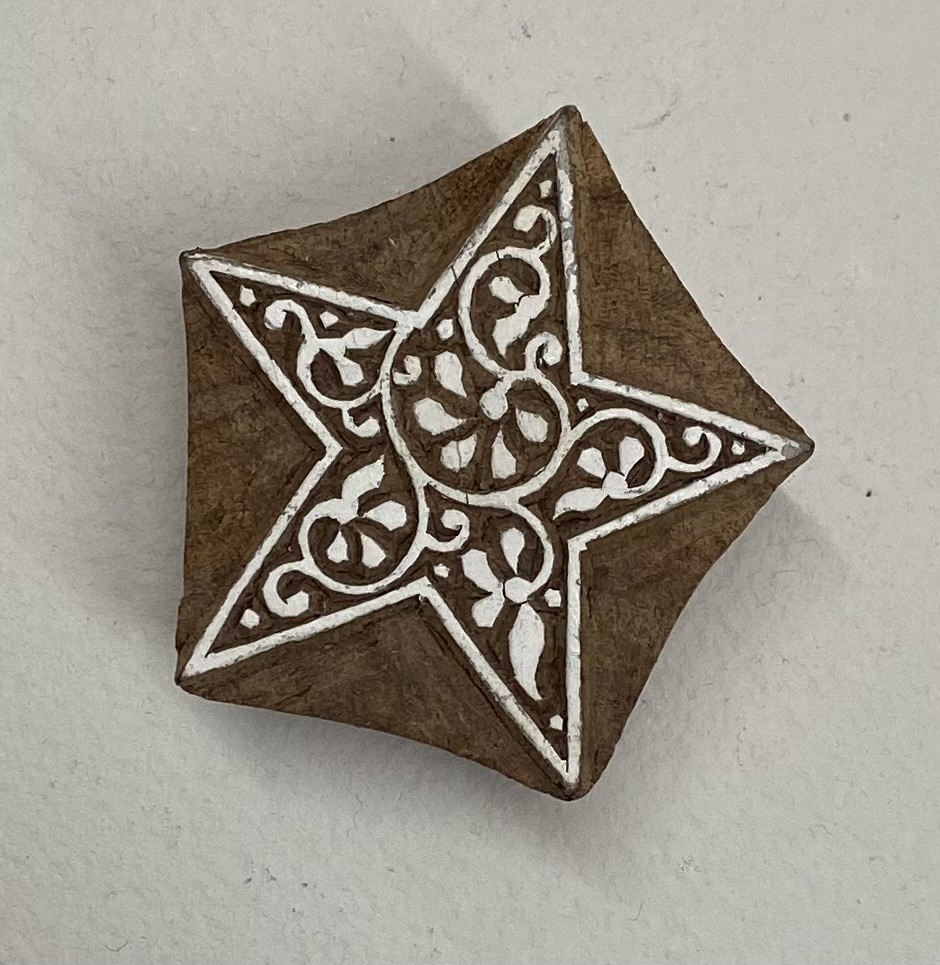
Top view of stamp
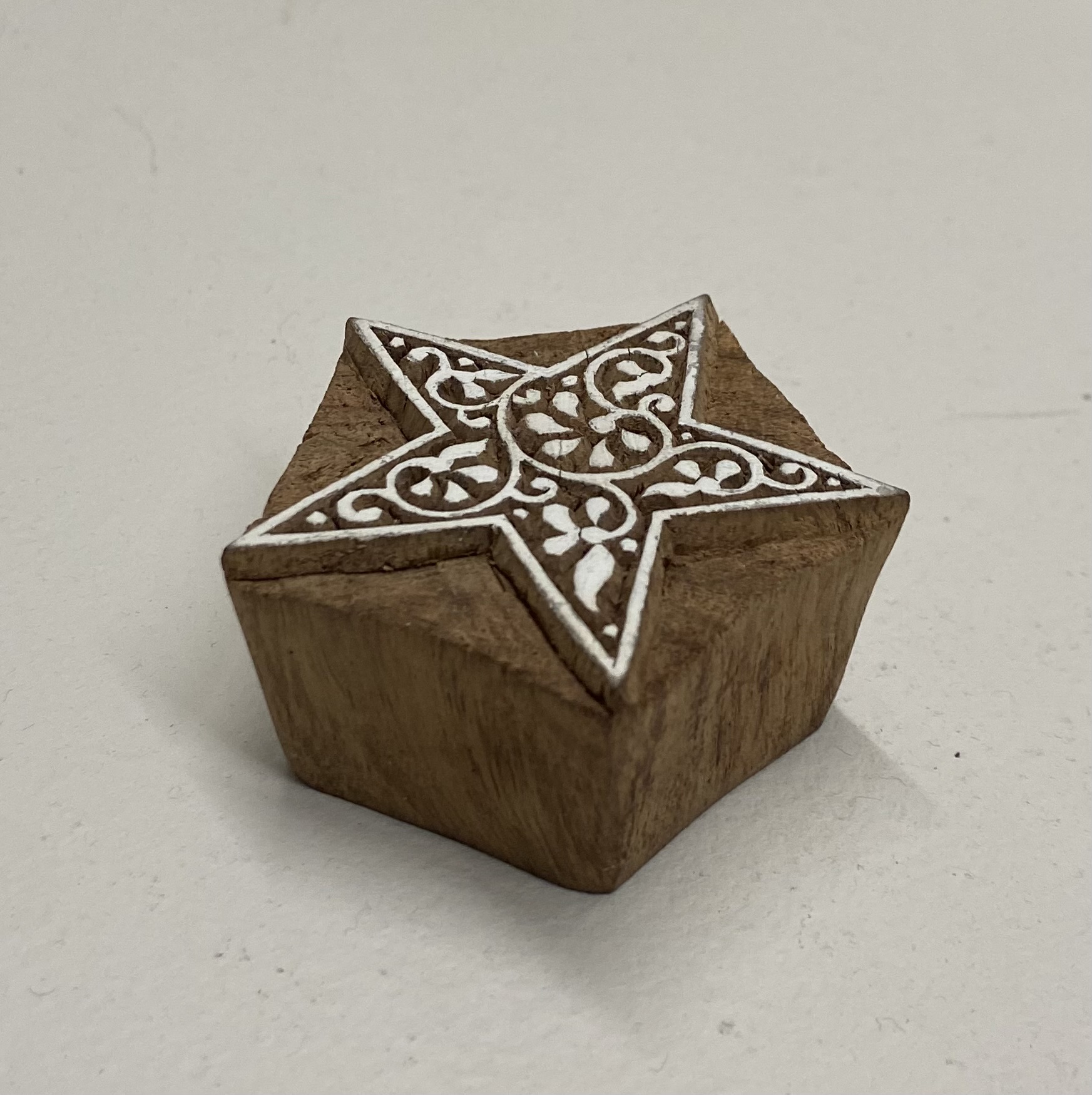
Side view of stamp

This is a woodblock stamp, one of the few that remain of a collection that my mother bought from a woman who was carving them on the side of the road in Mumbai, India when we visited my family there around 15 years ago. 

The stamp is carved from a warm-toned wooden pentagonal prism with a height of around 1” not including the protruding design. The faces are parallel, with the non-incised base being slightly smaller than the incised face so that the walls are not quite perpendicular to the faces. Each wall of the bottom pentagonal base is about 1.25” while each wall of the top pentagonal face is 1.5”. The walls of the prism are slightly concave, some more so than the others. Each wall feels smooth when I drag my thumb across it vertically, but horizontally I can feel the tiny ridges of the wood grain.  

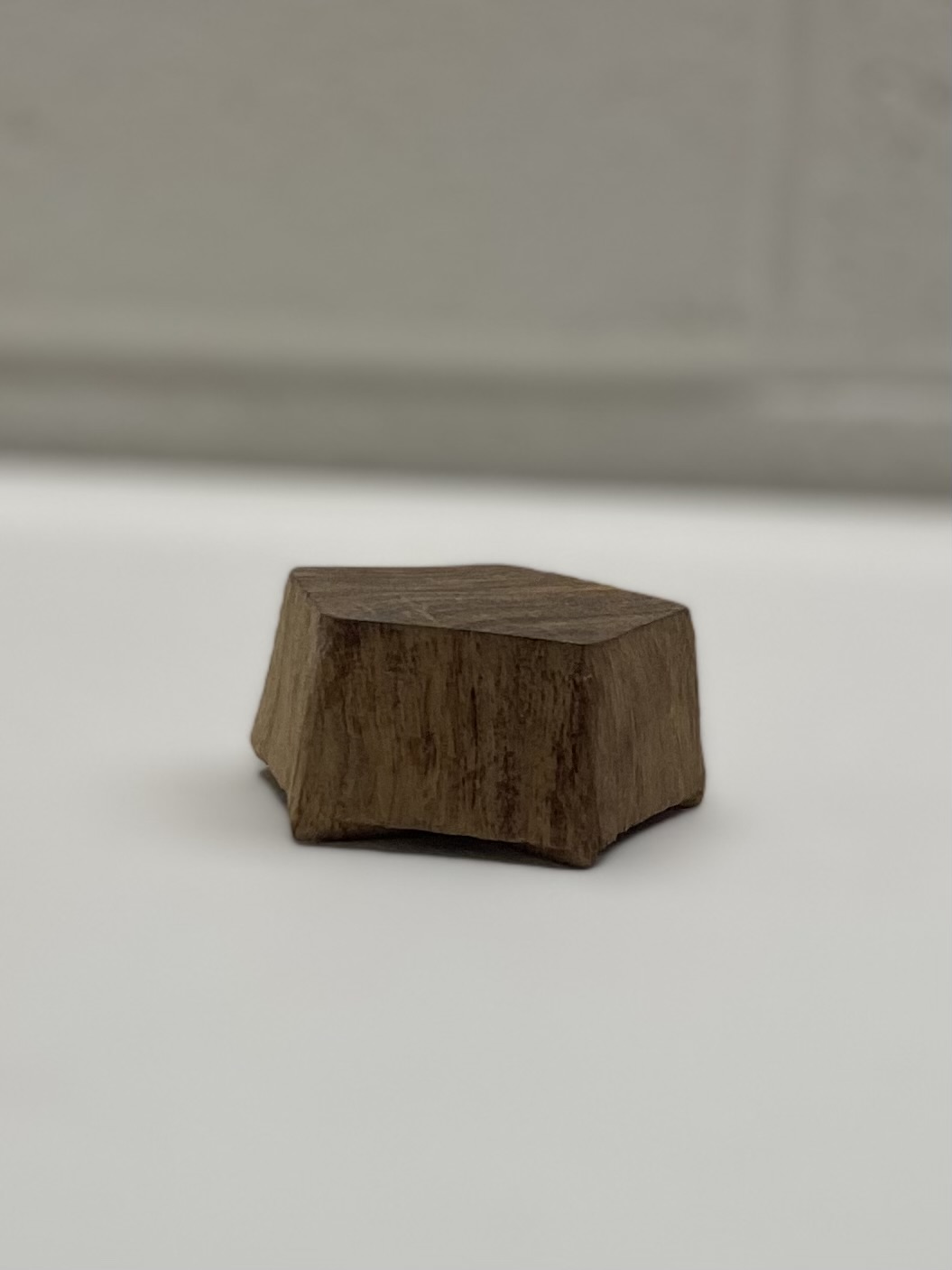
Stamp upside down

The bottom of the stamp is the smoothest, flattest face. I can run my finger along it without catching any rough patches. A pattern of wavy wood grain is visible across the base but has been disrupted a bit by a few scuffs and scratches, although these are so small that they do not affect the level feeling of the surface.  

The top side has a pattern that protrudes about 1/8off the surface of the stamp, emphasized by a thin coating of white paint. A 5-pointed star creates an outline for the pattern, each point at a vertex of the pentagonal surface. Each side of the star is around 1” long. Outside of the star’s outline, the top surface of the stamp is roughly carved so that it resembles the texture of a hard piece of cork. Cracks are visible and my finger can feel the irregularities in the wood. If I try hard enough, I can scratch little splinters off the surface.  

While the star itself is symmetrical, the design inside of it is not. It is made up of a curving spiral, small dots, and organic shapes reminiscent of florals. From one inner vertex of the star comes a curve that coils through the center of the star and branches off into each arm of the star. On the arm of the star directly opposite to where this curve begins, a large organic leaf-like shape reaches up into the point from the curve. The other arms of the star each contain a piece of the same curve that spirals into a rounded end. There is a small dot in the thinnest part of all 5 arms. There are more organic leaf-like shapes and dots throughout the inside of the star, as well as some teardrop-like shapes and smaller spirals extending off the continuous curve.  

Around and in between the white-painted elements of the design, the wood has been etched into so that only the design itself reaches a level height. The etching has not been done strictly perpendicular to the surface, but instead creates little irregular sections within the deeper wood, almost outlining each element of the design. This leaves unfinished areas of wood that are too small to reach but would probably be rough and splintery to the touch.  

But this stamp does not exist simply to be observed; it is meant to be used. When printed onto fabric or paper, the design has a chance to exhibit itself, while the stamp remains a tool. After examining its form and craftsmanship, this stamp seems to be just as worthy of attention, if not more so, compared to the design it produces.