Discovering the Colonial Pipe

IMG_1490

CAPTION: This 17th century pipe fragment was found in Historic Huguenot Street in New Paltz, in late 2012. This particular fragment was part of a clay pipe fashioned by Hendrik Gerdes, a Dutch pipe maker, as his initials can be found on the heel of the pipe. Although a seemingly mundane object, this pipe gives us particular insight on colonial life in the Hudson Valley.

Physical Description:

Called a “little ladle” by the Elizabethans, the tobacco pipe was almost an essential piece of colonial living and there are clues that these pieces give us into the diverse community of Historic New Paltz. The particular piece(s), was discovered by Professor Diamond and his team at Historic Huguenot Street on September 18, 2012. The location of this pipe piece was North of the Freer House in unit 215. The pipe is in four separate pieces, and appears to have been white at one point or another. But, of course with the passage of time, the outside has become jaded. While there are scratches and points of discoloration that appear almost brown along the stem of the pipe. Being that the pipe is broken, one is able to see inside, again there is the same brown discoloration along the smooth interior of this piece. The whole in the mouthpiece is notably very small, and if memory serves me correct, Professor Diamond said that you could not actually smoke out of this pipe. On one of the pieces there is an impression of the initials “HG” on the heel, which signifies the Dutch pipe maker, Hendrik Gerdes.

Provenance:

Hendrik Gerdes was in commission during the 17th century, approximately circa 1668-1685. At the same time another prominent English  pipe maker named Edward Bird. Although he hailed from England, Bird Amsterdam to “fight for the Dutch” and subsequently met and married a woman named Anna Maria van der Heide. After the death of her first husband Anna married the then confectioner, Hendrik Gerdes.  A little odd how the two lives of two different pipe makers so intimately collided. Gerdes may have been a confectioner/sugar refiner or possibly worked one of the “large industrial potteries” that made  ceramic molds for sugar loaves.

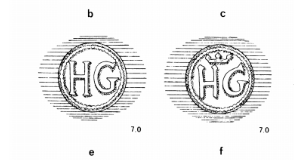
 The heel appears to be a type 2 style heel, which includes a simple border around the initials. While this insignia is relatively simple, Gerdes did have another one that had a three pronged crown above his initials. Besides New Paltz, his pipes have been found everywhere from Caughnawaga Mohawk in Canada to my birthplace of Staten Island.

Although little, but the initials can be determined from merely looking at the pipe, upon further exploration we get the bigger picture. The look of the pipe itself gives insight as to the time period it was manufactured in, as well as where it originated. “…Dutch pipe bowls were often cone-shaped rest backwards on their stems, and were often more highly polished.  English pipes from that time period sat more upright, with a duller finish.” In a more general view, these clay pipes were extremely delicate. And although this particular make was made from clay, others were made from silver, brass or pewter. These typical 17th century, 11-inch clay pipes, if dropped would immediately fragments into six or seven pieces. A fact we see clearly, in the remnants of this piece.

Screen Shot 2015-04-14 at 5.38.10 PM

Pictograph depicting the hell marks on traditional clay pipes. Photo Credit: EUROPEAN CLAY PIPE MARKS FROM 17TH CENTURY ONONDAGA IROQUOIS SITES
Screen Shot 2015-04-14 at 5.37.45 PM

Two versions of Hendrik Gerdes makers mark, that would be found on the heel. Figure B is what is used on the pipe from Huguenot Street. Photo Credit: EUROPEAN CLAY PIPE MARKS FROM 17TH CENTURY ONONDAGA IROQUOIS SITES.

Narrative:

These tobacco pipes were used as a form of trade in colonial times and tobacco itself was a huge source of economic income for the colonies. Often times these pipes were used as a from of trade, in many instances between the colonizers and the Native Americans for furs and such.  And, although the pipes themselves were fashioned in Europe, tobacco was a product from the Americas, being introduced into Europe in the mid-1500’s. Another interesting facet of this practice, was that by the 17th century tobacco spread amongst every race, class and gender. Upon doing further research I also found that women were very much a part of the pipe making process. “Women have always been active in the pipe-making industry…as decorators and finishers, as pipe firers and proprietaries and as independent craft persons”. Although they were invisible to the public eye, women were very much apart of the process. For instance Edward Bird pipes were signed with his initials “EB”, although that did not necessarily mean he crafted the pipe, it could have very well been his son or his widow. Particularly considering that the pipes were still being made after his death. It’s really something to see women being such an instrumental part in creating objects that were so widely used, especially considering the time period. In addition to the pipe showcasing cultural assimilation, it is also representative of an early inclusion of women in economy. This holds true today, as women are central pillars of societies across the globe. For many communities they are the ones who start up their own businesses and support their families. Even in the small village of New Paltz, there is a strong presence of women in the community, as many own their own businesses along and around the bustling Main Street.

Although, I could not find anything specific on the specific owner of this pipe, I think the general idea of such an object is to see how a multi-faceted group produced such things. It was odd at the time to have both men and women making and using the same product. And what’s more, to have a multitude of cultures using each others products also seems a bit revolutionary. For New Paltz, it can signify the early culmination of all different types of people. What’s more it showed the melting pot that places like New Paltz had become. As we are aware, the French, Germans and English had settlements in New Paltz and most notably in Historic Huguenot Street. What is even more interesting is that despite the English conquests, Dutch pipes were still being imported and used. It’s interesting then, that we see a melding of cultures among the inhabitants of New Paltz at this time.

Although this pipe is seemingly just a vessel for tobacco, it represents a community on a much larger scale. It not only gives us context to see what life was like for the people before us, but also allows us to see how objects as mundane as a pipe could help weave the fabric of a community. It’s also quite striking to see, that many of the facets that this “little ladle”has proved to be so unique about it, are still relevant in our community today.

Cleric smoking a pipe with a shorter stem, which was used for easier handling.  Photo Credit: CW Journal

Cleric smoking a pipe with a shorter stem, which was used for easier handling.
Photo Credit: CW Journal

IMG_1486 IMG_1489

Works Cited:

Bradley, James W., and Gordon DeAngelo. EUROPEAN CLAY PIPE MARKS FROM 17TH CENTURY ONONDAGA IROQUOIS SITES. Vol. 9. N.p.: Eastern States Archeological Federation, 1981. Archaeology of Eastern North America. JSTOR.

Web.Mann, Rob. “Smoking and Culture: The Archaeology of Tobacco in Eastern North America.” Academia.edu. N.p., 2015. Web.

Tate, Bob. “Archeologists in New York Uncover Tobacco Pipes Dating Back to the 17th Century.” Pipemagazine.com. N.p., 18 Mar. 2010. Web.

Hume, Ivor Noël. “Hunting For a Little Ladle: Tobacco Pipes.” Colonial Williamsburg. CW Journal, 2002-2003. Web.

Hitchcock

The book I chose to write about this week, is a collection of short stories compiled by Alfred Hitchcock, “Portraits of Murder”. As I thoroughly enjoy anything to do with Hitchcock, when I saw this book on Amazon for three dollars I jumped at the chance to add it to my collection. Along with this edition I also have “Tales of Terror”, another compilation of stories chosen by Hitchcock himself. “Tales of Terror” was a gift given to me by my brother, as he knew of my love for Hitchcock. I’ve never shuddered so much, while reading a work of fiction as when reading “Tales of Terror”. Each story is wickedly crafted, as the authors spin tales of mysterious people, who at first glance could be the person next door. And, as most of these stories were written in the 60’s, you get a glimpse into the everyday life during that time period. Another cool aspect to these collections. Needless to say, my expectations for this book were high. And, it most definitely did not disappoint.

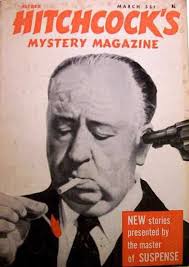
This particular edition I have of “Portraits of Murder” has a copyright date of 1988 under the publishing company, Galahad Books in New York. I couldn’t find much on Galahad books, besides that it’s based in New York. However I would guess it was probably named for Sir Galahad, a Knight of King Arthur’s round table. Although the book was published in the 80’s the stories were written between the mid-50’s ad the late 70’s. The stories are from various authors, who gave Hitchcock permission to publish their stories once again. Originally these stories were featured in Alfred Hitchcock’s Mystery Magazine, which through research, I discovered is still being published. The magazine was founded in 1956 and is based in New York, although the magazine has changed hands over the years. The premise of the magazine is to share original short stories that discuss crime or mystery fiction. The stories that Hitchcock chose for each of these collections, were some of his favorites from the magazine over the years. The magazine itself has won many awards for mystery, including the “Edgar Award” for best short story.

The book contains 47 short stories spanning over 503 pages. As given away in the title, all the stories are enveloped in murder. When I purchased this book, and took it out of the amazon box, there was a black sleeve. Although at present it seems I’ve misplaced it. At the center of the sleeve is the classic silhouette of Hitchcock he used on his show. The title is printed in white lettering on the top, although the word “murder” is capitalized in green lettering. Without the sleeve, the book has block coloring of black while the spine is a light gray. On the front cover, there are dents in the book. I can’t tell if they’re a fault of my own or whether it came like that. If I had to guess, it was probably me. On the spine in shiny green letters, it reads Alfred Hitchcock, “Portraits of Murder”, with Galahad books written on the very bottom.  The bottom edges of the cover are a little tattered. Probably due to the fact that when reading large books, the bottom is usually resting on my stomach or a table. Inside the book, the off-white pages look very new. There are no tatters or folds. I can’t remember if I bought this book used or not, but from the looks of it I’m the first owner. Although it seems like an odd observation, the pages seem thicker than some of the other books I own. Perhaps it speaks to the quality of the materials used to make them. As is my way, I tend not to alter the books I own. I rarely fold over the tops of the page or write along the margins. Although as I’m always drinking coffee, more often than not, there are brown stains covering most ever paper in my possession. This book has evaded by clumsy coffee drinking habits, and is in fairly good condition.

index

There isn’t much to the book as far as alterations go. Just the occasional tattered edge and the dents on the front cover. But the contents of these pages are haunting and a rather exciting read. It’s also cool for me, to read these stories that Hitchcock hand picked. I may be a little biased, based off of my love for his work, but if the Master of Suspense deems these as worthy, I’ll take his word for it.

index16692

Examining the Nest

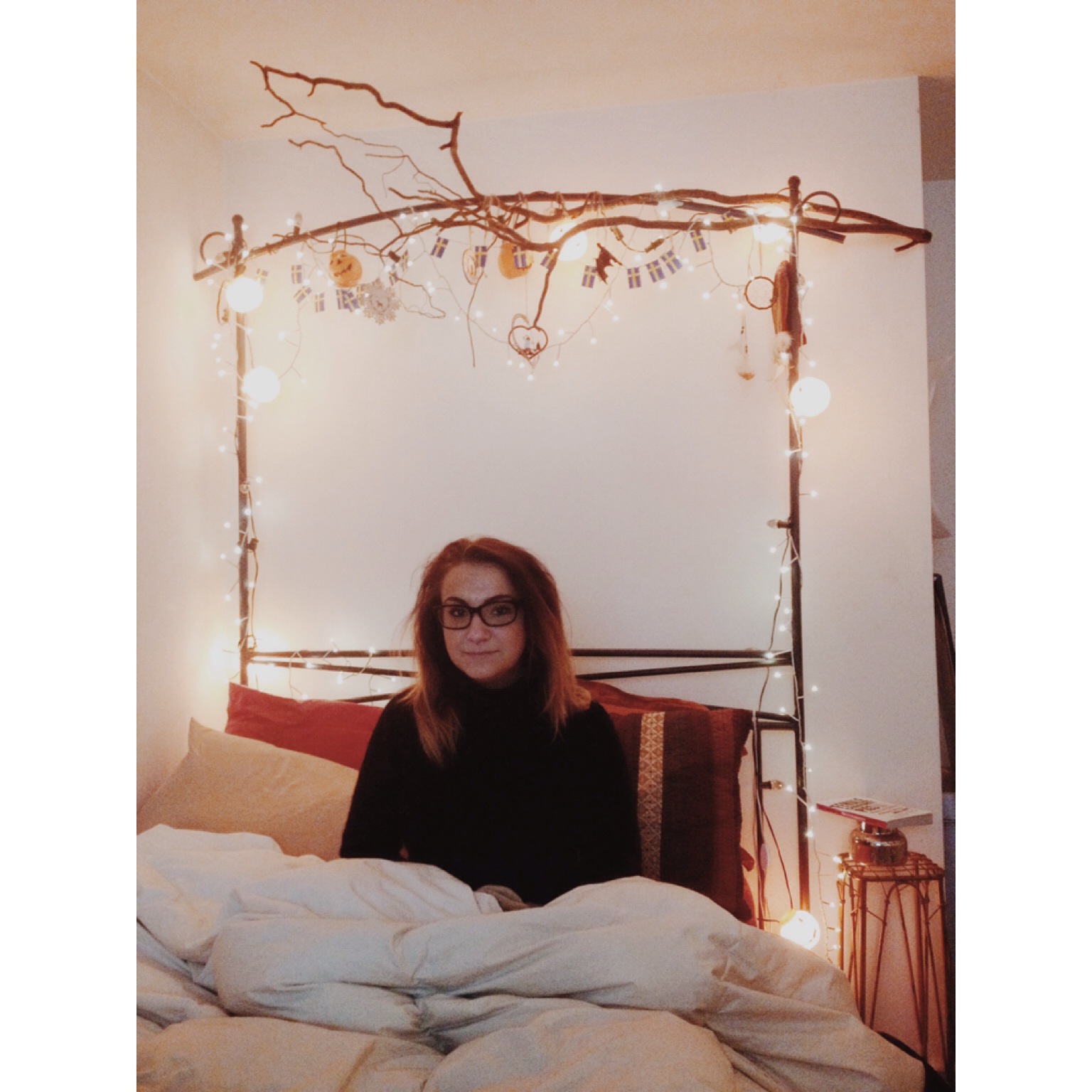
The meticulous mind of an artist, arranges a space unlike any I have ever seen. The inhabitant of this unique, nest like environment is one of my closet friends Alexa. Had I not known her and I walked into her room, I would be wildly confused. Seemingly none of the objects make sense together. There are twinkly lights hanging from branches, that rest alongside tiny Swedish flags and pumpkin lights. Along the walls are dark paintings with obscure subject matter, children of my friend’s vastly creative mind. The room is warmly lit, candles of every color line the book shelves and the distressed armoire. Perhaps one of the more striking ornaments to this living space are the mannequin limbs that hang from the wall and sit on her otherwise pristine and organized bookshelf.The bookshelf itself is full of wicker baskets that house everything from camera film to toiletries. There are book stacks of Renaissance Art and Swedish Folktales. And a record player sits on top. As the Talking Heads vinyl spins slowly, bobbing up and down ever so delicately.  The words “The world was moving and she was right there with it” hauntingly linger in the air as I sat watching this room I have spent so much time in.

Processed with VSCOcam with p5 preset

What may sound like an erratic display of Halloween paraphernalia actually functions as a work space, befitting of a creative and scholarly mind. And amongst the knick-knacks and tree branches is a large bed, that sits like a cloud in the near center of the room. It’s a place friends have congregated to discuss our rather mundane grievances during our college life. A sort of refuge for us all as we’ve filtered in and out of our friend’s home. As the bed is the most normal looking thing in the room it was a good place to sit and take it all in. And as I looked around I realized, everything in here has a purpose. The tiny bats and pumpkin lights that hang from every corner of the room, serve as a reminder of Alexa’s love for the whimsical and perhaps the spooky. The small Swedish flags and wicker witches that hail from the same country are telling of her heritage, and the love she has for those family members that come from Sweden. As far as the rather psychotic sounding mannequins that live in her room, her grandfather does sculptures from these very items. It’s safe to say my friend lives among these items, not the other way around. She explained that although these things seem like they have no use, they do for her. They are all, in some small way a part of her which she projects into her living space. There is a certain darkness to the room, it’s true. But there are points of the romantic throughout. Lace curtains, nostalgic photos and large earrings hanging from a heart shaped holder also live here. It’s a kind of representation of the many sides of Alexa, The seemingly rough exterior houses a more delicate side. Perhaps I can only take this away from the room because I know her well. As I said, the room as a whole, may be confusing if you don’t know her. It’s just fascinating how much a living space can say about a person.

Processed with VSCOcam with g3 preset photo(2)

Revisiting the Music Book

For this post I suppose I’ll return to my grandfather’s music book. I called my mom to ask her about the book, and if she could remember him using it for anything in particular. Unfortunately she couldn’t remember anything specific, she did however inform me of a rather serendipitous coincidence. So, I was born and raised on Staten Island, as was my grandfather, and recently he was featured in an article in the Staten Island advance. The article celebrated musicians hailing from the island, sharing “vintage” pictures of musicians past. My grandfather, Rene Allegre, was part of a big band called the “Modenaires” who played throughout the island. For the most part my grandfather played the trumpet, trombone and french horn for the band, although when needed he could be called upon to play something else. Presumably, my grandfather had this book during his time with the Modenaires. I suppose using it, as one would the top 40 list of our time. Being able to entertain crowds with songs they knew and loved from that era. Although my grandfather was a professional musician, he was a contractor by trade. The man could build pretty much anything. When I was younger I worked for him, in his four garages, which basically meant me cleaning up after my cousins. However, I distinctly remember garage number two. It was a mystery that eluded my sister and I for years. He had fashioned it as a secret room. The entrance was a privilege in which we had to work to gain entrance to. When we were granted entrance, it was bit of a magical day for my sister and I. We were surrounded by twinkle lights and train sets, musical instruments, recording equipment and art projects my grandfather had worked on. It was a look into the softer side of my grandfather, who was usually amongst power tools and PVC pipes. A man who’s car was filled with 2x4s and empty coffee cups, had a sanctuary all his own. And, in this sanctuary was this blue book. Near the recording equipment, strewn about much like everything else my grandfather owned. At that point in his life, he wasn’t playing music as much. He would mess around and play it by himself, but it was rare that he picked up an instrument in front of another person. A stark contrast from his past life, of matching suits and brass songstresses. This bright blue book among the dark wires and recorders stood out, ringing with life.

I remember, after my grandfather had passed, my mom and her siblings collected things of his. Cleaning out the garages I had worked so many years in. My mom, whose one rule in life was to play an instrument until you were at least 18, grabbed the book immediately. She had always enjoyed that we shared a musical connection with my grandfather. The book had been with her for a short while, as she was sifting through his things. And, now as we all know, it’s now in my possession. I suppose it’s interesting how the purpose of this book has changed over the years. For my grandpa, it was a tool of practicality that morphed into a reminder of his youth. For me, the practicality isn’t as strong. It’s more of a sentimental piece.

It’s true I don’t play the piano as much as I should. I’m not really sure why I don’t pay more frequent visits to my friend of 17 years. But, when I do, I enjoy flipping through the pages of “America’s Greatest Standards”. I realize, I’ve romanticized this idea of my grandfather. A rather simple thing to do, when you’ve lost someone you love. I am not claiming perfection. If you flip through the pages of his life, much like those of the music book, you will find tares, spills, imperfections. But, there were some beautiful parts too. And, although he’s been gone about six years now, I’m glad to have been a page in his imperfect book.

photo

My grandfather: second row, second from left.

Discovering the Rubáiyát

Feeling, that I had already touched on the history of my two objects from the first class, I chose another object that has a great significance to me. For this particular assignment, I turned to my favorite collection of poems, the Rubáiyát of Omar Khayyám. The book was originally given to me, by my brother, for what occasion, I can’t remember. However, I had first been introduced to these works in English class, my Freshman year of high school. And, despite my lack of enthusiasm for my teacher at the time, I never forgot the work of Omar Khayyám. It stood out to me as the most interesting and beautiful piece I had read up to that point in my life. The particular version that I have contains the 1st, 3rd, 4th and 5th editions of these poems, translated into English Quatrains by Edward Fitzgerald and published by Random House Inc, the date of Copyright being 1947. As a whole, this collection of poems discusses the brevity of life and the need to find the joy in it. What more, it gives this sense of hope, through a lens, which brings us into the fantastic and colorful world in which both Omar and Fitzgerald have strung together, centuries apart.

Processed with VSCOcam with c1 presetScreen Shot 2015-02-02 at 4.20.06 PM

Examining the information in the preface of this collection, I learned that the title of the book, the word,  Rubáiyát translates to “collection of rhymes” from Persian, self explanatory for sure. The original author, whose full name is, Ghiyathuddin Abulfath Omar bin Ibrahim al-Khayyami, which translates to Omar, son of Abraham, the tent maker, studied with the wise men of the Sultan. He was a mathematician, philosopher, astronomer, and obvious poet, who created work throughout the 11th and 12th centuries. The thing I find most fascinating about this particular work is the ability Fitzgerald possessed to bring to life the words, that were separated by geography, time and language. What is more, Omar apparently created a disjointed and somewhat haphazard collection of thoughts, which Fitzgerald, during the 1900’s wove into a series of some of the most revered poems in history. Perhaps the most interesting part of this collection is that Fitzgerald, originally from Ireland, found a connection between his home of Erin, and Omar’s Iran. Believing himself to connect as the “forgotten poet”. While the content of these poems may not have fit the “Victorian priggishness” of the time, Fitzgerald felt so passionately about this work he decided to publish it himself. To connect so fully to a place and time you haven’t experienced yourself, except through another person’s work, is a beautiful idea. And, I guess if you think about it, many of us have felt the same when reading some of our favorite stories.

Processed with VSCOcam with c1 preset

As I am taking a translation course this semester, I’m learning very quickly the layers upon which a good translation is formulated. Not only is there a need to have a familiarity with the language, but it is necessary to take into account, culture, context and idiomatic phrases that may be culturally specific to that language or time. When reading anything that has been translated, it is always a wonder how much of it is true to the original, and what ideas have been lost in translation. Obviously, with this work, we will never really have an answer as to what was lost, but the way in which Fitzergerald has constructed these ideas, along with the help of beautiful pictures, created by Mahmoud Sayah, what was lost, may not be missed. Altogether this piece of art has surpassed the ages of time to be loved and read by the contemporary world. And, although I have taken only a few printed books with me to college, the Rubáiyát was the first one I packed away. In closing, I’d like to share one of the poems with you guys that I’ve always found thought provoking:

I sent my Soul through the Invisible,

Some Letter of that After-life to spell:

And by and by my soul return’d to me,

And answer’d “I myself am Heav’n and Hell:”

Coins and Music Books

The tattered pages of my Grandfather’s music book hold some of America’s best loved songs from the time. The blue facade, although covered in veins of old age, is decorated in tiny notes and stars, that surround the title. “America’s Best Loved Songs: The Great Standards” in a range of soft to more serious fonts. The bottom reads”For the Professional Musician Only”. From the front you can see pages sticking out, as they’ve fallen from the comfort of the spine. Ripped and bent edges stick out like overgrown vines. Once the book is opened, you can flip from”unchained melody” to “fools rush in” with relative ease. And, although as the title suggests it is a rather “standard” book of music, it has much greater meaning for me. Each rough, yellowed page, is a symbol of something my Grandfather used to play. His hasty highlighting through the measures remind me, that this book, like many other collections of music, are living, breathing documents. They can be altered, in one way or another to fit the need or taste of the musician who is playing it. That maybe the most significant thing about this book to me. I’m not only able to play songs my Grandfather played, I’m able to play them how he would. And, as I flipped through until the very end, looking at the title “Mazl”, a song I’m unfamiliar with, I let the book fall forward, to a close. And, on the back, I see, what can undoubtedly, especially knowing my Grandfather, be a coffee stain. And to me, that just made the book all the better.

Processed with VSCOcam with c1 presetProcessed with VSCOcam with g3 preset

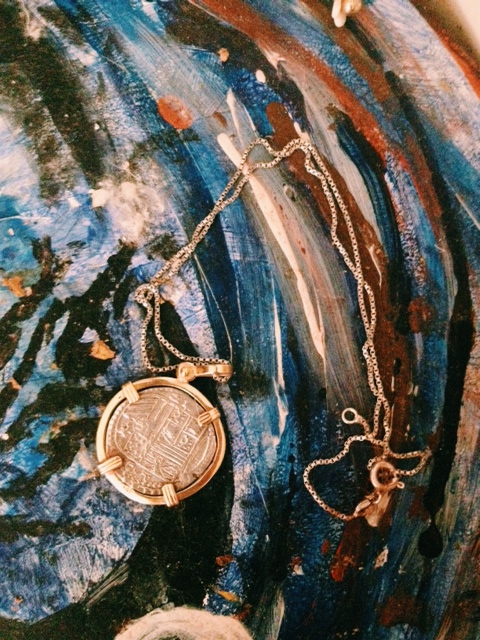
The necklace with the thin silver chain, that has the quarter sized coin hanging from it, and the gold frame, has a history, much longer than it’s chain. Found by the scuba diver/treasure hunter Mel Fischer off the coast of Florida, the Atocha coins were once on  Spanish galleon ships, long before they were found on the bottom of the ocean floor.   One, side has a large cross engraved in it, with a cloud like frame around that. On the other side, there is what looks like a coat of arms, some parts covered in engravings of castles and   lions, while other parts are just adorned with horizontal lines here and there. On the far right of the arms reads the letters, “POD”. What it stands for, I’m not sure. Notably a weird thing to wear everyday, this coin not only reminds me of how cool I thought the treasurer hunter and his loot was, but of my family. As we each have a coin of our own that we wear. For the most part, the coin reminds me of my dad, who has been scuba diving since he was 18 years old. The man would love to get lost in the lull of the ocean, any time, any day. It reminds me of all the times he took me out to go snorkeling. I would always follow him as he harpooned eight feet down, to get a closer look at a fish or shell. And, now that I’m beginning the process of getting my own scuba diving license, I look at the coin as helping lead up to all that. It’s been with me since I was probably twelve years old, and by then I, much like my dad, was very happy staying among the salty waves. And now, 21, graduating college and hopefully doing something enjoyable with the coming years, perhaps it’s a symbol of some adventure to come. On the ocean floor, or bobbing above them.


Processed with VSCOcam with c1 preset