For my analog experience, I kept a daily journal. I was excited about this assignment because I keep a journal for pleasure. However, I like to include photos and drawings in my journal. With a focus on aesthetics, I can admittedly lose focus on the purpose of an analog experience and shift my focus to perfectionism. For this assignment, I simply kept a journal of my day. I was interested to see how this experience differs from my usual journaling. What is different about this experience? What is the importance of the analog world, and why has it become a lost art?
During my experiment, I journaled at different times of the day. Sometimes to start my day, alongside my daily bowl of cereal, jotting down my schedule for the day. These entries usually consisted of my plans for the day, with a to-do list highlighted and checked off by the end of the day. Occasionally, I would have a mid-day journaling session, in between classes or even at work. My favorite of these entries are those at work, with the complaints of students questioning why the mailroom hasn’t processed their package yet, but I don’t know either. Most of the journal entries were at night with a reflection on my day. From this experiment, I’ve found that my favorite time to journal is at night.
I sit at my desk, the dorm room dark aside from the lamp on my desk lighting up the blank pages of my journal. I let my thoughts flow while my hand freely illustrates the story of my day on the page. These are the entries with the most substance, each one shows a pattern. Different from the other entries, these go beyond the minuscule details of my day. These entries give more insight into who I am and how I feel. What made me happy that day, what is stressing me out, or what I’m looking forward to.
From this experience, I learned that while I still appreciate the craft behind the work in my other journal, I preferred the simplicity in this one. It’s therapeutic to remove yourself from the worries of your life and submerse yourself into your writing. Nowadays, the analog world is a lost art, no one keeps anything physical. While I understand the convenience of ranting about your day in your notes app from bed, writing in a journal is a different experience. An experience where you can learn more about who you are. When you do your favorite hobbies in analog, you gain a new love for them. Digital coloring is something I love to do, but there’s nothing like physical coloring. The art of ink from the marker filling in a blank canvas is something that you can’t replicate digitally. Doing things in analog is a deep and enriching experience, something that can be experienced more often if we unplug from the digital world. It is important to learn about who you are outside of the digital world. You have a newfound appreciation of the material world when you do things in analog.
Samuel F. Auchmoody’s Power of Attorney Date of Original Document: 10/17/1864, Photo obtained from Historic Huguenot Street
Caption: These images contain legal documents from, Samuel Auchmoody, a soldier at war casting an absentee vote in the Election of 1864. This election was the first to establish a widespread use of absentee voting for soldiers, significantly impacting the use of absentee and mail-in voting for the future of the United States.
Physical Description of Objects: These images depict pictures of the two legal documents required for soldiers to cast an absentee vote. The first document is Samuel Auchmoody’s Power of Attorney. The document is standard size, estimated to be 8.5 by 14 inches, and still appears white with clean edges despite its years of age. The top of this document reads that Auchmoody can cast his vote while away in the military due to recent legislation passed. The following part of the document addressed South Carolina, where Auchmoody was serving. It acknowledges how he wishes to cast his vote in his hometown of New Paltz and allows his attorney, Morris Wurts, to do so. The final part of this document is a signature from witness Wright Auchmoody, allowing the document to be finalized. In the 1860s, it was standard for legal documents to be written with a dip pen, reflected by cursive signatures in fading ink.
Samuel F. Auchmoody’s Affidavit of Absent Elector Date of Original Document: 10/17/1864, Photo obtained from Historic Huguenot Stree
The second document is the Affidavit of the absent elector, Auchmoody. This document is much smaller in size, appearing to be only half the size of the Power of Attorney. The document is also yellow with ripped edges on the right side, which makes me question what the other piece of this document was, as all the other sides are untouched. The Affidavit acknowledges that Auchmoody has been a United States citizen, is of age to vote, and ensures his hometown residence. The Affidavit also states that Auchmoody is actually serving in the military and has no wagers placed on the elections. Like other documents from this time, the signatures appear in faded black ink.
Both of these legal documents were required for soldiers to have the ability to cast an absentee ballot. These documents are to ensure the vote’s authenticity and keep the election democratic.
Provenance: Samuel Freer Auchmony was born in 1848 in Ulster County, New York. While I do not know exactly how the item found its way into the collection where it now resides, I can assume that due to his vote being cast in New Paltz, he may have had a role to play in the historical significance of absentee voting in both Ulster County and the United States. There is limited information on Samuel Auchmoody, as soldiers were not documented like higher government officials. However, being a legal document required for voting, the initial chain of ownership cannot be traced. From my learned knowledge, I can assume Both items would have begun in Samuel F. Auchmoody’s possession, where he originally signed off on documents in the presence of witness Wright Auchmoody, with whom I am unsure if he shares a relation. The first document, a Power of Attorney, grants legal access for someone to act on their behalf, so in this case, the following line of possession would be Morris Wurts, Auchmoody’s attorney. The second object, the Affidavit of an Absent Elector, has the same line of possession as both objects are legal documents required to cast a vote in the election.
Narrative: This object is significant to the history of elections, democracy, and voting in America. The election in 1864 was one of the most controversial elections in history occurring during the Civil War. What sets this election apart from others is the widespread ability for soldiers to cast absentee ballots. Absentee and mail-in ballots are now more common and have grown in importance due to their convenience and accessibility to citizens who can’t vote in person on Election Day. These objects aid in exploring the history of elections and uncovering how this process has grown in relevance today.
The two candidates in this election were Abraham Lincoln, who ran for the Republican Party, and General George B. McClellan, commander of the Union Army, who ran for the Democratic Party. Abraham Lincoln and his Secretary of War, Edwin Stanton, believed strongly in democratic principles and felt all citizens should be able to cast their vote in an election, even those fighting the frontlines of war. It is acknowledged that the right to vote in an election is a crucial part of democracy, “We cannot have free government without elections… and if the rebellion could force us to forgo, or postpone a national election, it might fairly claim to have conquered and ruined us” (Rotandi). This highlights Lincoln’s stance in the Civil War and on democratic processes. Lincoln wanted to ensure a democratic election, as well as hear the opinions of his soldiers. Lincoln was victorious in the 1864 election largely due to the number of soldiers who voted by mail. Rotondi states that, “Approximately 150,000 out of one million soldiers voted in the election, and Lincoln carried a whopping 78 percent of the military vote” (Rotondi). Lincoln’s victory in the election had multiple effects on both democracy and the future of elections in America.
After the widespread use of mail-in ballots for military personnel during the Civil War, the idea to make voting more convenient and accessible continued into the 1800s, when several states began to offer mail-in ballots for soldiers or absentee voting for those with a legitimate reason other than military service. Rotondi states, “The passage of the 15th Amendment in 1870 and 19th Amendment in 1920 expanded the number of eligible voters in the United States, but it would take another war to propel absentee voting back into the national spotlight”. According to the United States Constitution Amendment 15 grants: “The right of citizens of the United States to vote shall not be denied or abridged by the United States or by any State on account of race, color, or previous condition of servitude;” Amendment 19 grants “The right of citizens of the United States to vote shall not be denied or abridged by the United States or by any State on account of sex.” Although there was legislation passed allowing more people to vote than ever before, there was continued discrimination to prevent women and people of color from voting. It was not until after World War II, with the large social movements from women, industrialization of jobs, and transportation of goods, that minorities could vote without discrimination. As women began to take men’s jobs, they wanted access to the same rights. On the other hand, workers for industrial companies like railroads or transportation of goods throughout the country argued that their jobs also required “tolling and sacrificing” like the military, and they wanted similar rights as well.
Finally, in 1978, California became the first state to allow voters to apply for an absentee ballot without a reason. In addition, “Legislation passed throughout the next few decades made voting easier for servicemen and women and their families: The Federal Voting Assistance Act of 1955; the Uniformed and Overseas Citizens Absentee Voting Act (UOCAVA) in 1986; and the Military and Overseas Voter Empowerment, or MOVE Act, signed by President Barack Obama in 2009” (Rotondi). This helps in demonstrating the continued use of absentee ballots and the widespread accessibility that can be seen today.
However, the ability to vote absently often raises citizens’ concerns regarding the election’s legitimacy. This has been seen in almost all elections since 1864, but notably in the 2020 election, where mail-in ballots were used at an all-time rate for the first time in years because of the Coronavirus Pandemic. Time states that with the 2020 election, “During a period of time full of uncertainties, election officials say American voters can count on vote-by-mail programs being ‘safe and secure.’ What’s also certain is that the 2020 Election is another milestone in the centuries-long history of voting by mail” (Waxman). This idea promotes that mail-in ballots do not affect the outcome of an election but simply offer a more accessible option to those who may not have had the option to vote in the past due to their circumstances. The idea is demonstrated that “Although it is possible for campaigns to bring potential voters together to fill out absentee ballot request forms, the onus to return the ballot once received remains on the individual, and thus does not provide the campaign with the same level of certainty regarding their turnout” (Biggers and Hanmer). This helps rebut an idea that was very prominent in the 2020 election, that mail-in ballots made the election illegitimate.
The records of Samuel Auchmoody casting an absentee vote in the Election of 1864 were the first step to a significant development in American history. The documents help highlight the origins of absentee voting and how it has evolved over time.
Works Cited
Biggers, Daniel R., and Michael J. Hanmer. “Who Makes Voting Convenient? Explaining the Adoption of Early and No-Excuse Absentee Voting in the American States.” State Politics & Policy Quarterly, vol. 15, no. 2, 11 Feb. 2015, pp. 192–210, gvpt.umd.edu/sites/gvpt.umd.edu/files/pubs/Biggers%20and%20Hanmer%20SPPQ%20early%20and%20no-excuse%20absentee%20voting%20adoption.pdf, doi.org/10.1177/1532440015570328. Accessed 1 Nov. 24.
Catlin, Roger. “What the Long History of Mail-in Voting in the U.S. Reveals about the Election Process.” Smithsonian Magazine, 4 Oct. 2024, smithsonianmag.com/smithsonian-institution/what-the-long-history-of-mail-in-voting-in-the-us-reveals-about-the-election-process-180985195/. Accessed 1 Nov. 2024
Library of Congress. “U.S. Constitution.” Constitution.congress.gov, Library of Congress, 1787, constitution.congress.gov/constitution/. Accessed 1 Nov. 2024.
Rotondi, Jessica Pearce. “Vote by Mail Programs Date back to the Civil War.” HISTORY, 24 Sept. 2020, history.com/news/vote-by-mail-soldiers-war. Accessed 1 Nov. 2024.
“Soldier’s Power of Attorney, Samuel Auchmoody.” Oclc.org, 2019, nyheritage.contentdm.oclc.org/digital/collection/p16694coll153/id/0/rec/1. Accessed 1 Nov. 2024.
Stilwell, Blake. “How Absentee Voting for US Troops Won the Civil War and Ended Slavery.” Military.com, 22 Apr. 2020, military.com/military-life/how-absentee-voting-us-troops-won-civil-war-and-ended-slavery.html. Accessed 1 Nov. 2024.
Waxman, Olivia. “A Brief History of Voting by Mail.” Time, 28 Sept. 2020, time.com/5892357/voting-by-mail-history/. Accessed 1 Nov. 2024.
On June 23rd, 2023, students and families gathered outside Sachem East High School’s football field. Over 500 students took the center of the field, their bright red robes and customized graduation caps facing the crowd. The students eagerly waited for their class president to make the announcement, for them to turn their tassels, and for their graduation to be official. The last four years led up to this moment; everything was all for the diploma.
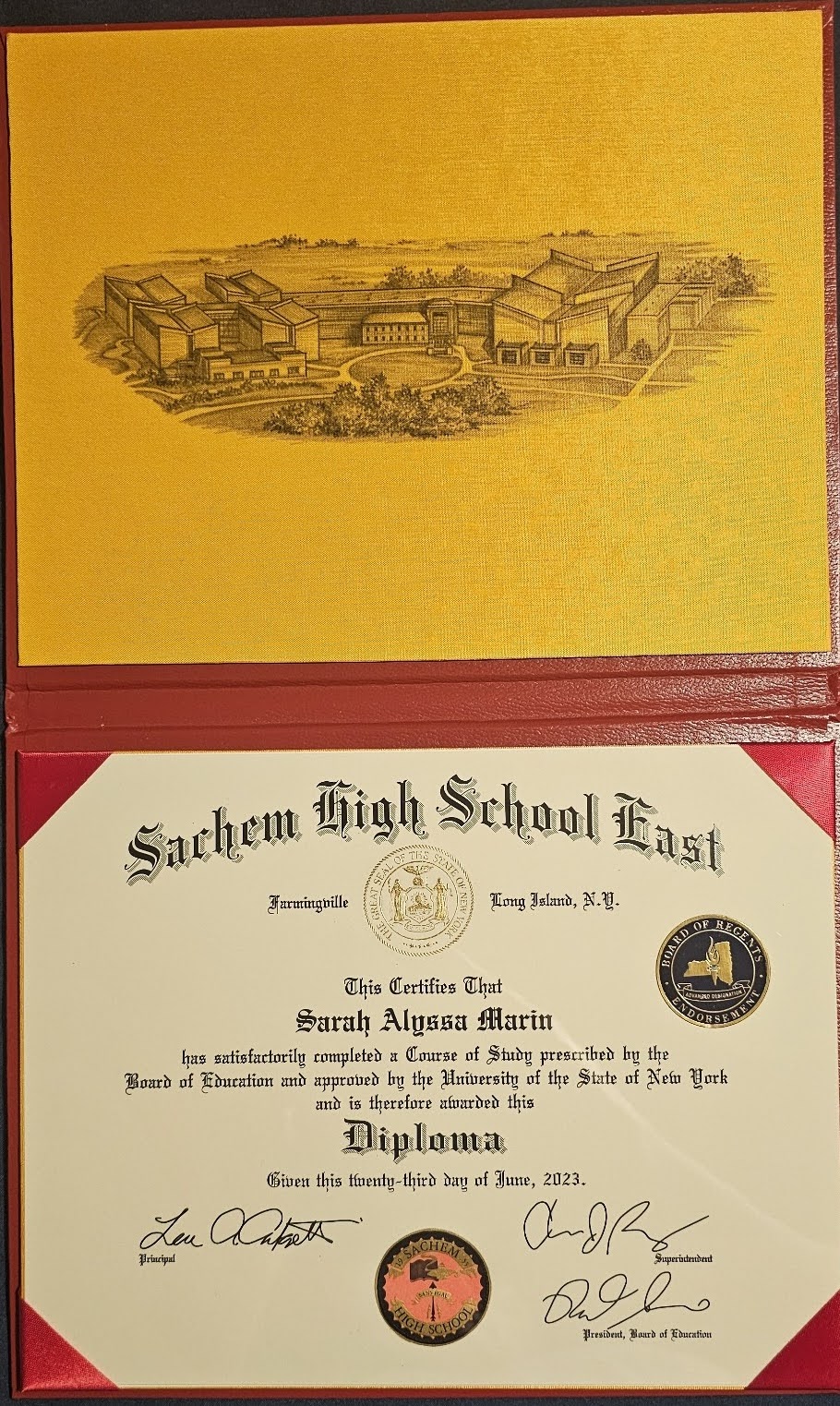
A high school diploma’s importance varies among people. A simple piece of paper, a check box on their resume, or a stepping stone in their academic career. My high school diploma is a reminder of my accomplishments and my background.
Photo of my family on my graduation day, June 23, 2023
This is a photo of my family on my graduation day. Immediately to the left of me is my mother, Tammy, whom only received her high school diploma and sacrificed her education to raise a family. My mother always had big dreams, but her selflessness and love for family she’s always valued most of all. I wouldn’t have been able to accomplish anything I have if it weren’t for her unconditional love and support. My high school diploma is a symbol of her sacrifices that helped others.
Next to her is my father, Peter, a first-generation son who was the first to graduate college. My dad has worked tirelessly since childhood to give me the life I have today. He taught me the importance of hard work and the determination you need to achieve your goals. He worked to get himself and his parents out of the dangerous streets of Hollis, Queens to the suburbs. He’s given up everything to give us everything. My diploma is a symbol of the lessons he’s taught me about hard work.
Inside of my diploma
My dad has his hands around my two little brothers, PJ and Ethan, and next to them is my older sister, Angelina. My little brothers are my motivation for most of the things I do. Watching them grow up, I want to continue to watch them grow into someone they are proud of. After I started college, it opened doors for PJ to begin thinking the same, something he never cared for before. Angelina is one of my biggest supporters in everything I do. Since I’ve been a kid, she’s believed in me and encouraged me the most. Though college wasn’t for her, she continues exploring possibilities of returning to school or pursuing her passion for art. My diploma is a symbol to them that they are capable of anything.
My grandparents are Maria and Pedro, but we call them Mafita and Abuelo. My grandparents are arguably some of the most influential people in this regard. They immigrated from Colombia with essentially nothing but the clothes on their backs. They relentlessly worked three jobs to provide for my father and his sister. Neither of them had the chance to graduate high school, as they began working at such a young age. I am consistently reminding myself of how lucky I am to have the chance to be an educated woman. The first woman in my family to graduate college. My grandmother unexpectedly passed away a couple of months after my graduation, so unbeknownst to me this would be the first and last recognition she saw me receive. She was over the moon for me that day, and I know I will continue to make her proud. I’m studying Spanish to become fluent and stay connected with my culture, which has always been very important to them. My diploma is a symbol of brighter beginnings after significant sacrifices.
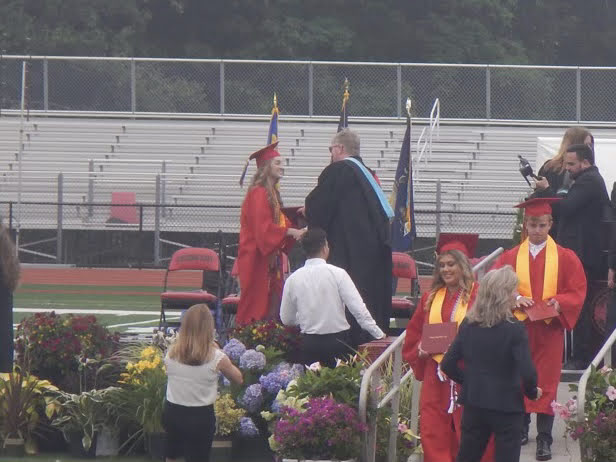
Receiving diploma at graduation ceremony
Finally, what does this diploma mean to me specifically? This diploma is a symbol of my overcoming challenges I never thought I could. My struggle with mental health during my high school years started leading me to believe I may not make it to this point, or I may not accomplish anything I wanted to. The top of my graduation cap reads “She knows she lived through it to get to this moment.” Regardless of feeling like nothing was possible, this was possible. This diploma is a symbol that was only my beginning, that I’m capable of so much more, and I wouldn’t be where I am without the support of my family.
Watching how the use and perspective on consumer goods have changed over time is an interesting phenomenon. Water bottles, for example, began as an object of convenience and necessity. The practice of bottling and transporting water dates back to the earliest times of civilization, when horse-drawn carriages transported heavy and fragile bottles made of ceramic or glass. Eventually, plastic water bottles were developed, a lightweight and durable option more suited for everyday use. Finally, the bottle has progressed to the new sustainable alternative- stainless steel water bottles.
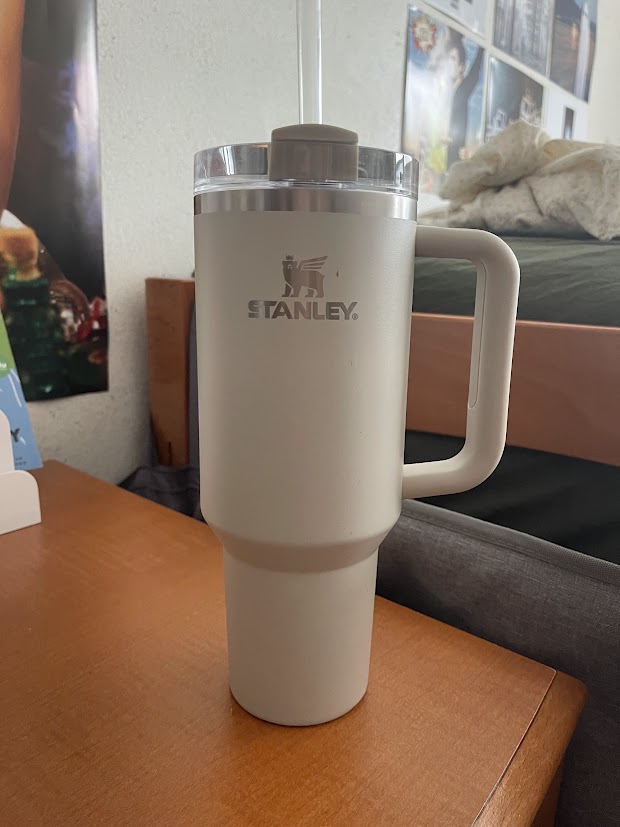
Stanley Tumbler
For my object, I take a closer look at my Stanley Tumbler. The tumbler stands ten inches tall with a capacity of 40 ounces. It is a taupe color, with a silver Stanley logo embellished on the front. I originally purchased this bottle online from Target, to provide myself with a new water bottle for the school year. For me to drink out of this bottle today, there is a lengthy process that often goes unnoticed by consumers. At the most basic level, the bottle itself needs to be produced. Starting with high-grade stainless steel, the bottle goes through a precise shaping and forming process to create a unique design and structure of the bottles. The stainless steel used to produce these models creates durability, corrosion resistance, and hygienic properties to ensure the longevity of the bottle. When looking at the process of shaping and creating the bottle, consumers should consider the specialized machinery and intricate processes that are crucial to the development of an item. Once the bottle was manufactured in Canada, it was shipped to the States and ended its journey in Long Island, New York. Once in Medford, an employee at Target packaged up my water bottle and set it out to be shipped to me. Another worker, someone from a postal service, transported my package from Target to my house, where I received my water bottle. Since then, this water bottle has gone essentially everywhere with me. From long car rides, and tests, to work, this water bottle has been a simple staple in my life.
When examining consumer behavior, there is a clear trend in consumption. What has changed about water bottles from early civilization to now is the context in which we view these bottles. Back then, a water bottle was a simple necessity, a place to store water and easily access it. Nowadays, these water bottles are used as a form of social class. Each year, there is a new rising trend in which water bottle brands are most popular. With each trend, people begin to consume more and more. The point of switching to stainless steel water bottles is to be sustainable and eliminate unnecessary waste where you can. However, rather than just buying one water bottle to be sustainable, it’s become a trend with these bottles for people to consume.
Consumerist trend of “accessorizing Stanley’s”
It would be hypocritical of me to not acknowledge how I myself have fed into consumer culture. Rather than purchasing any stainless steel bottle that I liked, I purchased the one with the logo that would be recognizable. I can acknowledge how I’ve fallen into the consumer trend of buying a new water bottle for the sole purpose of fitting in. While I just use my water bottle to keep my drinks cold, others use it to accessorize an outfit, owning every color the brand sells. Along with this, it’s become a trend to accessorize the bottle itself, with keychains and mini bags. The attempt to move from plastic water bottles to a more sustainable option has inevitably created more waste from the accessorizing of the bottle, and is counteractive to the original purpose of the product. This trend, much like others, is a performative way of contributing to the environment. Recycling, for example, may reduce some waste but mainly makes people feel good about themselves by the thought of contributing. This idea is seen with the trend in water bottles, and it’s interesting to see how I subconsciously fed into this culture myself. In addition to my Stanley, I’ve bought two Hydroflasks while in High School. While part of me wanted to help the environment and move away from excessive plastic waste, the other part wanted to fit into the current consumerist trend.
As a young girl, my sister and I constantly found ourselves getting lost in a fantasy world where only we and our dolls existed. In the summer of 2012, I got Taylor during a day spent in my grandpa’s apartment in Brooklyn. I saw the doll sitting on a dusty shelf, she was in brand-new condition, still wearing the original pink and brown striped dress she came in. I don’t know where or why my grandpa originally purchased a Barbie, but my sister and I pleaded for her to come home with us. She was my favorite thing, always by my side. Years later, as I grew up, this doll began to have a new meaning. In 2020, approaching my fifteenth birthday, I decided I wanted a Quinceañera. I wanted a day to celebrate my heritage and family. Unfortunately, after months of tireless planning, the party was ultimately canceled as we began to enter the peak of a global pandemic. Nevertheless, my mom made sure to gift me my last doll, mi ultimá muñeca.
Taylor in the dress (Thanks to my sister for the picture!)
As part of the ceremony, it is tradition for the quinceañera to be gifted her last doll or ultimá muñeca. The last doll is typically made of porcelain and is gifted as a symbol of transition from childhood to adulthood. My mom, however, took this tradition and turned it into something special. My mother gifted me my doll with a custom version of my dress — a delicate dress made of pink tulle. The dress is strapless, the top has white floral lace embellishments with a long puffy skirt. The back has a corset made of ribbon, with small pearls and gems glimmering throughout the dress.
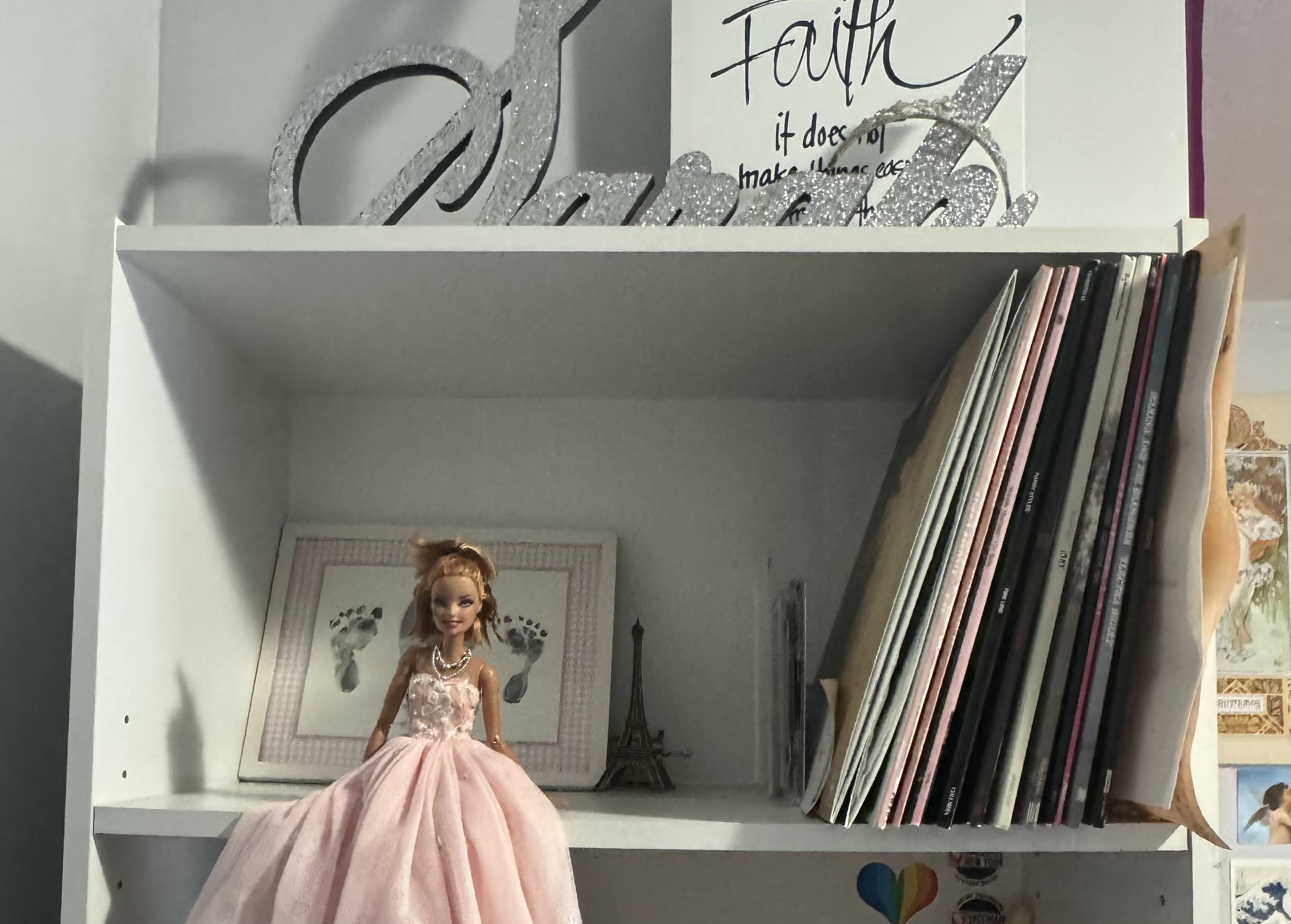
The doll is a symbol of my childhood– an artifact from the most precious and innocent moments of my life. A faded smiley face drawn on her cheek from my sister and I’s failed attempt at giving her a tattoo. Her botched haircut from the days we swore we were hairdressers. Her body, which my sister replaced with a newer version after her old one was broken, with an arm and leg taped on. She, admittedly a bit morbidly, took the head off the old Barbie and put it on the new one, but she would’ve done anything to make me happy. Taylor watched every stage of my life. She sits on the top shelf of my bookcase, in front of my framed newborn footprints and next to my vinyl collection. She watched my bedsheets change from pink Disney Princesses to white minimalist and saw the decorations on my wall change from pictures drawn with my friends to posters of my favorite artists. She watched me go from picking my outfit out for third grade picture day, to packing up to move into my first college dorm. Taylor is my days of being a little sister growing up with her big sister. Young girls dreaming of all the possibilities life holds.
Taylor on the bookshelf of my childhood room
The dress symbolizes family, representing the bond between her mother and daughter. My mother is the strongest and most caring woman I know, and this is a reminder of everything she’s done for me. A reminder of how she spent months planning a party for me, pushing through all obstacles to ensure I had my day. One small item represents a lifetime of love and security. A lifetime of support through everything, and sacrificing what she wanted so I could be where I am today.
The dress is one small piece of a big and beautiful culture. Our Latino heritage is something that has always brought my family together. The language served as the only means of communication to my grandparents, the upbeat music filled the rooms of family gatherings. The food being an outlet for my mother and grandmother to reminisce on their childhood and the food their moms made for them. My Latina background is something my mom has always taught me to be prideful of.
My mom, sister, and I. Taken in Port Jefferson, Long Island in June of 2020. Pictures were taken prior to cancellation.
To many, this is just a doll—a simple toy played with as a child that is eventually put to the side and forgotten. To me, it holds a lifetime of stories and memories. I hope for the stories it holds to continue beyond me. I hope to have a daughter who will share this same love and joy as me— someone who is proud of her culture, the family she came from, and the person she has grown into.
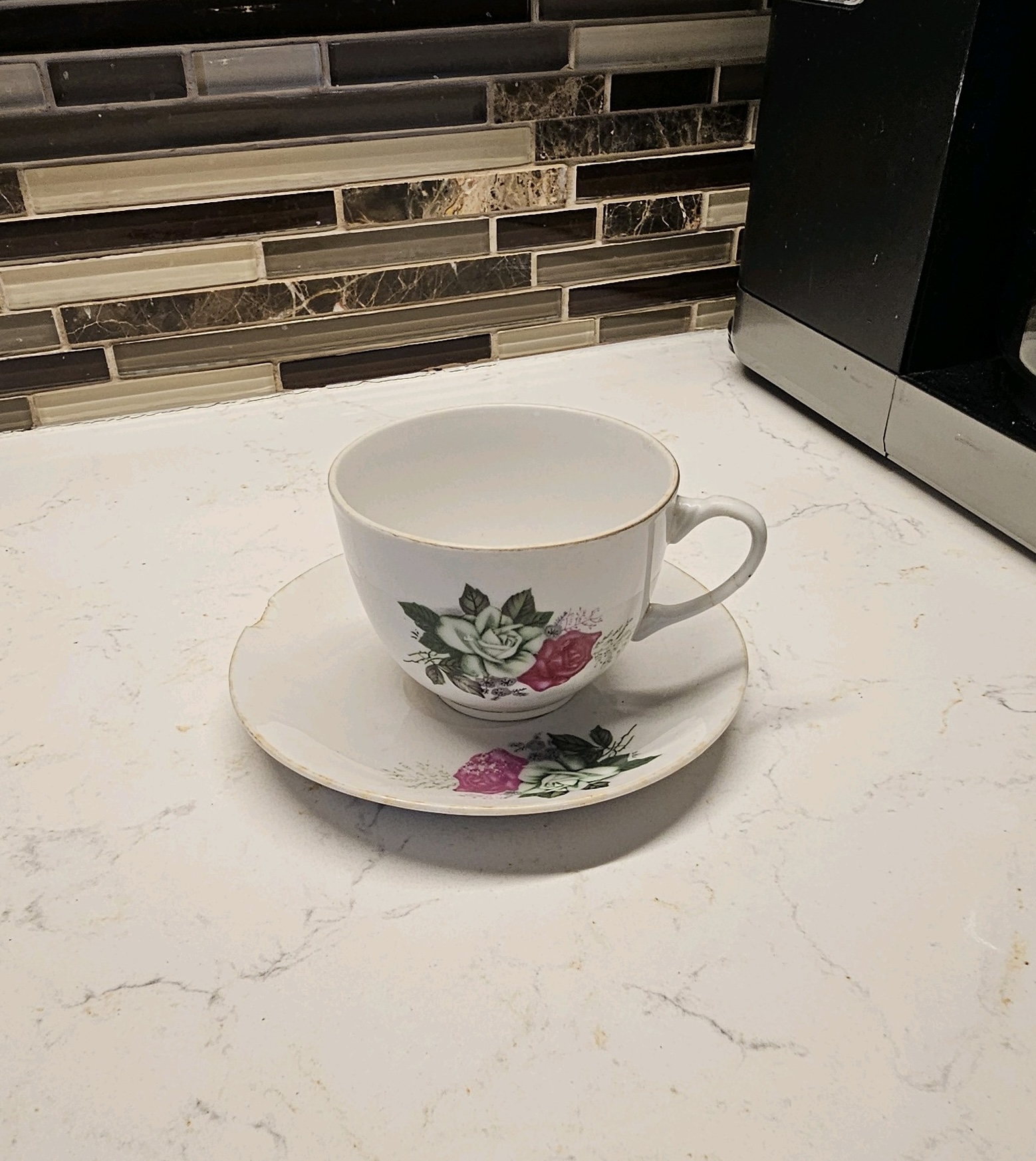
The comforting aroma of fresh coffee fills the morning air as my mom brews my grandmother her daily cup of coffee. As long as I can remember, my grandmother, Lola, would start her day with a hot cup of coffee in her signature cup. The cup is made of delicate white porcelain with a faded gold edge from years of use. Measuring two and a half inches tall and three inches wide, the size proved perfect; even in her final years, the cup fits perfectly in her frail hands. Even as Lola began to forget who she was and what was important, her cup of coffee in the morning remained consistent and something she always remembered. The saucer the cup lays on is 5 inches long, sharing the same delicate white porcelain and faded gold edge, with a slight chip on the edge from decades of love and use. The cup and plate both feature green and magenta roses, adding a floral accent found on many of Lola’s belongings.
Along with her cup and saucer is the rest of her collection of stuff to make coffee. Her colador, or cloth filter, measures eight inches long and four inches deep. The colador’s handle is white, with the cloth stained from coffee and a gradient getting darker towards the bottom, where Lola would use her hands to twist out the fresh coffee. There are two pots: the metal pot measures six by six inches and three inches tall, and the glass pot measures five by five inches and 3 inches tall. The metal pot where she would boil and stir her fresh coffee grinds has a rough feeling to it; there are cracks all around the silver body and a rusting handle. The glass pot is heavier and stained with a light brown film; there’s a spout on the edge, which she would use to pour out her freshly boiled milk. Finally is her tall kettle pot, storing all her freshly brewed coffee for the day. It stands just shy of six inches tall and five by five inches wide. There is some discoloration and fading of the metal, sharing the same rough feeling as the metal pot, and the handle stays held together with black tape. Lola would use all these items together in perfect harmony, as the sounds of the coffee grinding and boiling water created her melody.
This set was eventually passed on to my mother. Entering the later stages of her life, Lola came to accept the kitchen was no longer a happy place for her but rather a source of stress. My mom wanted to give Lola the same sense of love and security she felt growing up, so she took care of her. Every day, she would use the same items to make Lola her coffee, remembering Lola’s joy in the kitchen and her smile while doing what she loved. Lola passed when she was 99 years old, after decades of the same routine, I wonder what everything looked like when she first got it. I wish I could ask her more about the story behind these items, why the handle has tape on it, or how her plate got chipped. Her cup now stays in the China closet in the dining room. It is one small piece of her, and it serves as a reminder of many things. It is a reminder of family, the safe place they create for you, and the love they have to care for you. A reminder to not take things for granted. That one day, we won’t be able to do what we love and will need to turn to the people we love for help. One day, you won’t be able to make your cup of coffee.