19th Century timekeeping in New Paltz (Revised)

Modern objects meant for keeping time are often small. Phones, watches, and clocks might vary in size, but they are all typically small enough to fit into a pocket, or at least to hold in your hand. These objects are personal, and they belong to someone in particular. Even though it is common to ask another for the time, most people tend to have their own timepieces. Here in New Paltz, there is another layer to our timekeeping. Many towns have clocktowers, and we are lucky enough to have one on campus. The van den Berg Clocktower, sits atop van den Berg hall, and it chimes every half hour. Even though no one relies solely on clocktower, it still is a helpful reminder to our community. It feels grand and important, and we all follow its time, even if our own timepieces are out of sync. The clock is an object for a community. It can be heard from anywhere on campus, and the idea of one clocktower reaching everyone at the school, reinforces our sense of solidarity. Unlike other timekeeping objects, a clocktower is much too big to fit it in your hand or your pocket. It is an object to be shared. It is viewed, admired, and used by everyone here, and it belongs to us all.

Among the extensive list of items in the Estate inventory of Cornelius Dubois, there is an object listed as “1 Sundial”. This object seemed out of place, as sundials are usually seen as an archaic method of telling time. Ironically, clocks are seen as timeless, as though they have been around forever. This is not true, and even after the invention of the clock in 1283, alternative methods of timekeeping, such as sundials, did not immediately lose their value. 

Sundials are timepieces that predate clocks. “Sundial, the earliest type of timekeeping device, which indicates the time of day by the position of the shadow of some object exposed to the sun’s rays. As the day progresses, the sun moves across the sky, causing the shadow of the object to move and indicating the passage of time.”(Sundial) They consist of a gnomon, which is a thin piece or pillar that projects out and casts a shadow onto the dial. The dial is the flat surface that the gnomon sits on. It is often marked with a circle of numbers that indicate the time of day based on the position of the shadow. While they can be made to be very complex and expensive, sundials are often inexpensive and reliable ways to tell the time. As long as the sun is shining they can be used to tell the time. 

Before 1816, clocks were expensive and hard to come by. Once the shelf clock was invented, they were able to be mass produced and more commonplace. “Eli Terry designed a shelf clock with interchangeable parts, giving birth to the Connecticut clockmaking industry”(Andrewes). Eli Terry invented shelf clocks in 1816, the same year as the estate inventory. While previously created clocks may have been used, the shelf clock was self-contained and easily installable. It could simply be placed on a shelf with no added assembly. It also was far less expensive to produce and allowed clocks to be widely available. 

Since this specific sundial was purchased before the invention of the shelf clock, it was likely less expensive and difficult to use than a mechanical clock from this time. However sundials were still useful after 1816. “Until the 19th century sundials were still used to reset mechanical clocks.”(Sundial) Even though clocks became more commonplace, they were not always accurate until more precise clocks were invented at the end of the 19th Century. Until then clocks often had to be rewound to display the correct time, and sundials were a reliable source to set them against. 

Currently watches, clocks, and computers are common ways of telling the time, but residents of New Paltz also rely on the chimes of the clocktower. There are two clock towers in town, one on top of van den Berg hall, and the other at the Reform Church of New Paltz on Huguenot Street. Van den Berg hall is one of the oldest building on campus, but its clock is one of the newer ones in town. While the original was built in 1932, it burnt down in 1990. The current clock tower was rebuilt in 2005. The Reform Church dates back hundreds of years, and its clocktower is almost as old as the Estate Inventory. “Our present church, a fine example of Greek Revival architecture with its four-column timekeeping in portico and two-stage clock and bell tower, was erected in 1839”. (Our Church History).  This clock tower was built just twenty-three years after the Estate Inventory was written. It likely affected the same people who once used the sundial to tell time. Two decades later the shift from sundial to clock created a prominent part of the town’s landscape. And it is still used today, hundreds of years later.

Reformed Church of New Paltz Clocktower, built in 1836 (Our Church History)

Rebuilding of the van den Berg Clocktower, 2005 (Van Den Berg Learning Center Clock Tower)

A Sundial from New York made in the late 18th Century, which might be the same type as listed in the inventory. (Horizontal Sundial)

Section of Estate Inventory pg. 12  

Sources:

Andrewes, William J. “A Chronicle of Timekeeping.” Scientific American: A Matter of Time, vol. 23, no. 4s, 2014, pp. 50–57., https://doi.org/10.1038/scientificamericantime1114-50. https://web.s.ebscohost.com/ehost/detail/detail?vid=9&sid=02426177-34e2-434c-87ca-5455c9f7d26b%40redis&bdata=JnNpdGU9ZWhvc3QtbGl2ZQ%3d%3d#AN=98843277&db=a9h

“Estate Inventory of Cornelius Dubois.” 1816.pg. 12

https://omeka.hrvh.org/scripto/transcribe/2907/3454#transcription

“Horizontal Sundial.” National Museum of American History, https://americanhistory.si.edu/collections/search/object/nmah_856464

“Our Church History.” REFORMED CHURCH OF NEW PALTZ 92 HUGUENOT ST. – NEW PALTZ, NY (845) 255-6340, https://www.reformedchurchofnewpaltz.org/our-church-history.html

“Sundial.” Encyclopædia Britannica, Encyclopædia Britannica, Inc., https://www.britannica.com/technology/sundial“Van Den Berg Learning Center Clock Tower.” SUNY New Paltz | Van Den Berg Learning Center Clock Tower | Van Den Berg Learning Center Clock Tower, https://www.newpaltz.edu/clocktower
An Analog Experience

Last year I performed an experiment. Due to the pandemic, all of my classes were online, and I found that I was doing very little of my usual writing by hand. I decided that it might be fun to write only in script. Usually this would be too much of an inconvenience, I am not used to cursive writing and it is harder for me to do quick note taking with it. However, with all my notes done digitally, making all of my other handwriting cursive was a lot more manageable. I wrote everything in cursive for the next few weeks, and my sketchbooks still have some scribbled in the corners. Since then I have mainly gone back to print, but I definitely have grown more comfortable writing in script, and I have a greater appreciation for the aesthetic of it. 

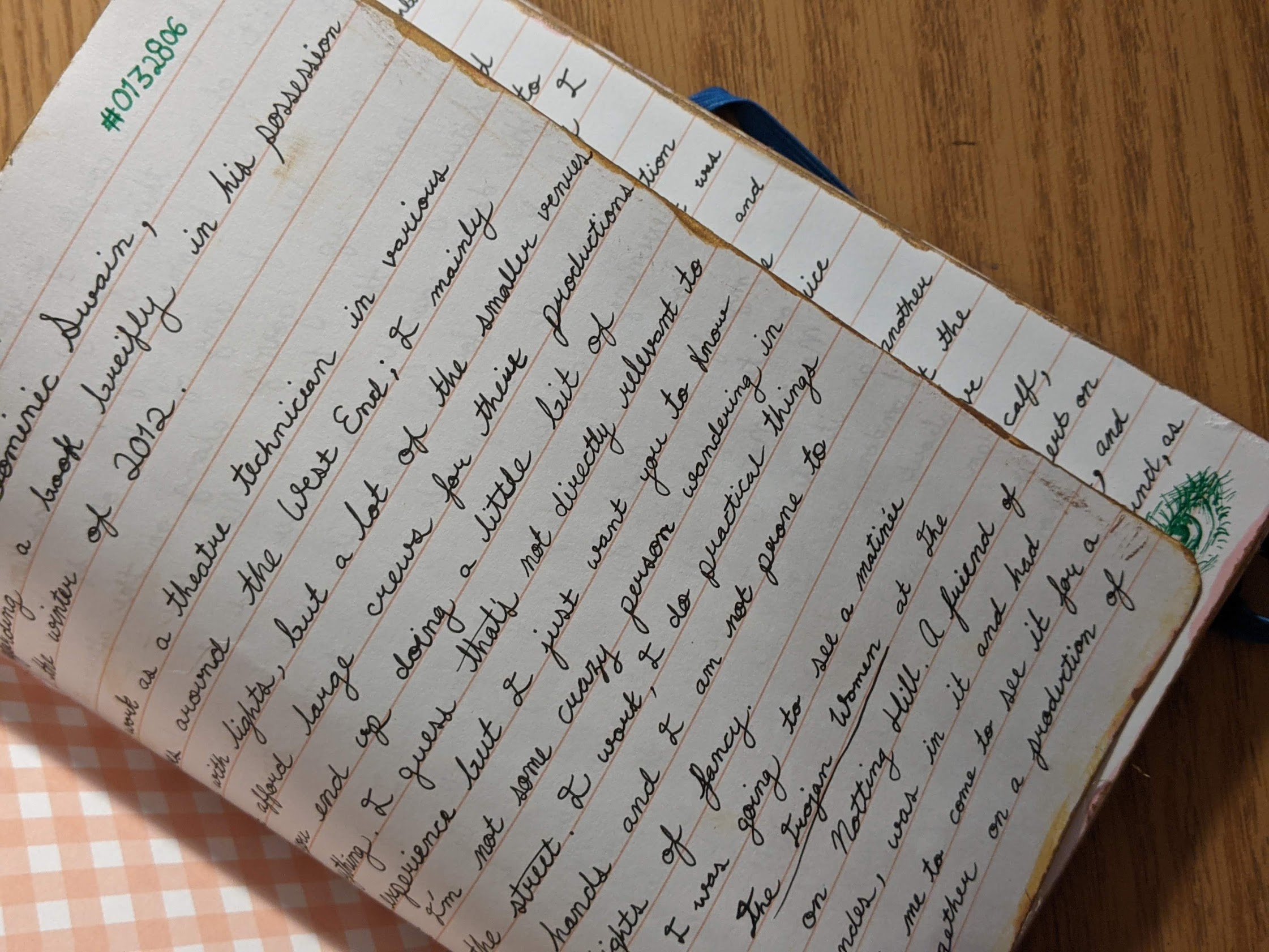
My recent “Analog Experience” was actually a gift that I made for my brother’s birthday. I wanted to give him a notebook that was based on a narrative podcast we both enjoy. While I am not experienced in bookbinding, I did some redecorating to an empty second hand notebook. I wanted an old fashioned feeling to the book, so the worn and yellowed pages worked nicely. Using materials from the art store in town, I pasted patterned paper onto the front and back covers. I even gilded the edges of the pages, and dyed the previously beige elastic band to a bright blue.

Since it was based on a particular episode of the podcast, I decided to include a transcription of it in the first few pages. Keeping with the antique-vibe, I decided to write it in cursive. I expected it to only take up a few pages, but in the end I wrote twenty-seven. 

During that process, I found several new details, both about the object, and the episode. The notebook is lined with faint red ink. This caught my attention, as I am used to the blue of looseleaf, or black lines from other notebooks. I also found the white thread where the pages are bound together. I would have expected to find it halfway through, but it was actually much closer to the beginning. Maybe the book was not unused after all, and the previous owner had ripped the old pages out before donating it to the local bookshop where I bought it.

I also noticed many new details about the episode. I had only ever listened to it before, but copying it down by hand was very different. Having to write each and every word made me pay attention to them. I realized how many points are repeated throughout the episode to help indicate the most important details. I realized that there was a lot of foreshadowing, and the first mention of a character who is not officially introduced for another two seasons. There was even an entire subplot that happened in the first five or six pages that I had completely forgotten listening to.

After finishing it I was most surprised by the sheer amount of time it took. I thought I would finish it within a few days of starting. I did not expect twenty-seven pages written over the course of two weeks. It is truly amazing how many words fit into a twenty minute episode, and how much shorter spoken words feel than written ones. Afterwards I often found myself still in the habit of writing in script, even when I did not mean to. I also developed a fondness for certain cursive letters. I like writing the letters “j”, “s”, “z”, and “f”.

There was an exciting aspect to writing in an analog fashion. Staying up late to write in an old notebook by lamplight has a very good ambiance. With my usual analog writing I mainly use a pencil and cheap looseleaf, but I loved the feeling of the pen scratching against the paper, even if it made the smudges and mistakes hard to fix. There was a nice amount of personalization that came from it being a physical object. It was my handwriting instead of a font, and I was able to change the cover to my own liking rather than finding clip-art online. In addition to actually making it, I had to put aside time to walk to the bookshop and art store. I remember trying to carry the huge stack of books around in the cold, all while trying to not crinkle my newly purchased paper. Even though it was more time consuming than a digital project, it was nice to slow down and spend time on something.

Before:

After:

19th Century Timekeeping in New Paltz

Among the extensive list of items in the Estate inventory of Cornelius Dubois, there is an object listed as “1 Sundial”. This object seemed out of place, as sundials are usually seen as an archaic method of telling time. Ironically, clocks are seen as timeless, as though they have been around forever. This is not true, and even after the invention of the clock, alternative methods of timekeeping, such as sundials, did not immediately lose their value. 

Sundials are timepieces that predate clocks. “Sundial, the earliest type of timekeeping device, which indicates the time of day by the position of the shadow of some object exposed to the sun’s rays. As the day progresses, the sun moves across the sky, causing the shadow of the object to move and indicating the passage of time.”(Sundial) They consist of a gnomon, which is a thin piece or pillar that projects out and casts a shadow onto the dial. The dial is the flat surface that the gnomon sits on. It is often marked with a circle of numbers that indicate the time of day based on the position of the shadow. While they can be made to be very complex and expensive, sundials are often inexpensive and reliable ways to tell the time. As long as the sun is shining they can be used to tell the time. 

Before 1816, clocks were expensive and hard to come by. Once the shelf clock was invented, they were able to be mass produced and more commonplace. “Eli Terry designed a shelf clock with interchangeable parts, giving birth to the Connecticut clockmaking industry”(Andrewes). Eli Terry invented shelf clocks in 1816, the same year as the estate inventory. While previously created clocks may have been used, the shelf clock was self-contained and easily installable. It could simply be placed on a shelf with no added assembly. It also was far less expensive to produce and allowed clocks to be widely available. 

Since this specific sundial was purchased before the invention of the shelf clock, it was likely less expensive and difficult to use than a mechanical clock from this time. However sundials were still useful after 1816. “Until the 19th century sundials were still used to reset mechanical clocks.”(Sundial) Even though clocks became more commonplace, they were not always accurate until more precise clocks were invented at the end of the 19th Century. Until then clocks often had to be rewound to display the correct time, and sundials were a reliable source to set them against. 

Currently watches, clocks, and computers are common ways of telling the time, but residents of New Paltz also rely on the chimes of the clocktower. There are two clock towers in town, one on top of van den Berg hall, and the other at the Reform Church of New Paltz on Huguenot Street. Van den Berg hall is one of the oldest building on campus, but its clock is one of the newer ones in town. While the original was built in 1932, it burnt down in 1990. The current clock tower was rebuilt in 2005. The Reform Church dates back hundreds of years, and its clocktower is almost as old as the Estate Inventory. “Our present church, a fine example of Greek Revival architecture with its four-column timekeeping in portico and two-stage clock and bell tower, was erected in 1839”. (Our Church History).  This clock tower was built just twenty-three years after the Estate Inventory was written. It likely affected the same people who once used the sundial to tell time. Two decades later the shift from sundial to clock created a prominent part of the town’s landscape. And it is still used today, hundreds of years later.

Reformed Church of New Paltz Clocktower, built in 1836 (Our Church History)

Rebuilding of the van den Berg Clocktower, 2005 (Van Den Berg Learning Center Clock Tower)

A Sundial from New York made in the late 18th Century, which might be the same type as listed in the inventory. (Horizontal Sundial)

Section of Estate Inventory pg. 12  

Sources:

Andrewes, William J. “A Chronicle of Timekeeping.” Scientific American: A Matter of Time, vol. 23, no. 4s, 2014, pp. 50–57., https://doi.org/10.1038/scientificamericantime1114-50. https://web.s.ebscohost.com/ehost/detail/detail?vid=9&sid=02426177-34e2-434c-87ca-5455c9f7d26b%40redis&bdata=JnNpdGU9ZWhvc3QtbGl2ZQ%3d%3d#AN=98843277&db=a9h

“Estate Inventory of Cornelius Dubois.” 1816.pg. 12

https://omeka.hrvh.org/scripto/transcribe/2907/3454#transcription

“Horizontal Sundial.” National Museum of American History, https://americanhistory.si.edu/collections/search/object/nmah_856464

“Our Church History.” REFORMED CHURCH OF NEW PALTZ 92 HUGUENOT ST. – NEW PALTZ, NY (845) 255-6340, https://www.reformedchurchofnewpaltz.org/our-church-history.html

“Sundial.” Encyclopædia Britannica, Encyclopædia Britannica, Inc., https://www.britannica.com/technology/sundial“Van Den Berg Learning Center Clock Tower.” SUNY New Paltz | Van Den Berg Learning Center Clock Tower | Van Den Berg Learning Center Clock Tower, https://www.newpaltz.edu/clocktower

Doing the Marie Kondo Method for a Box of Books

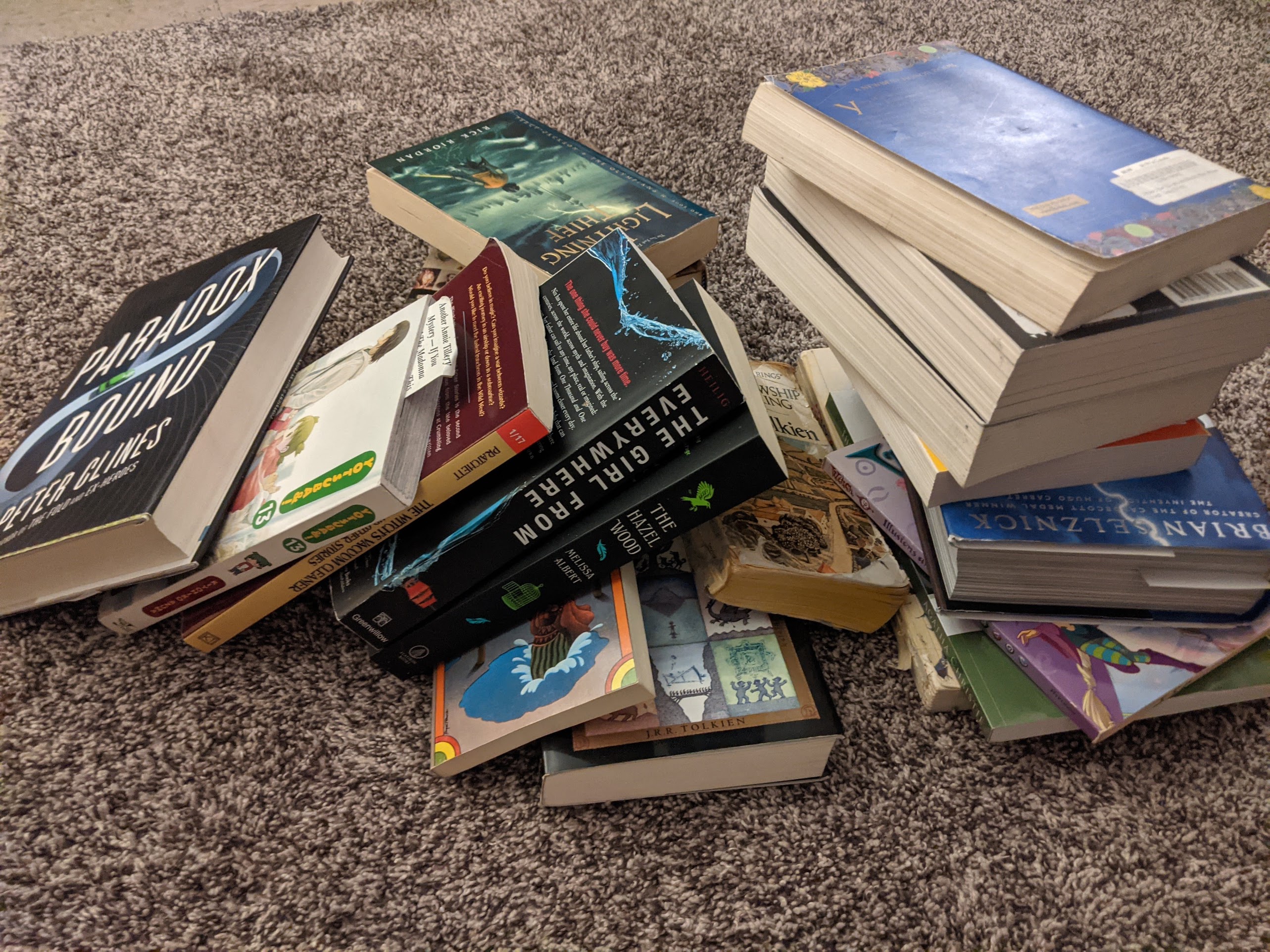
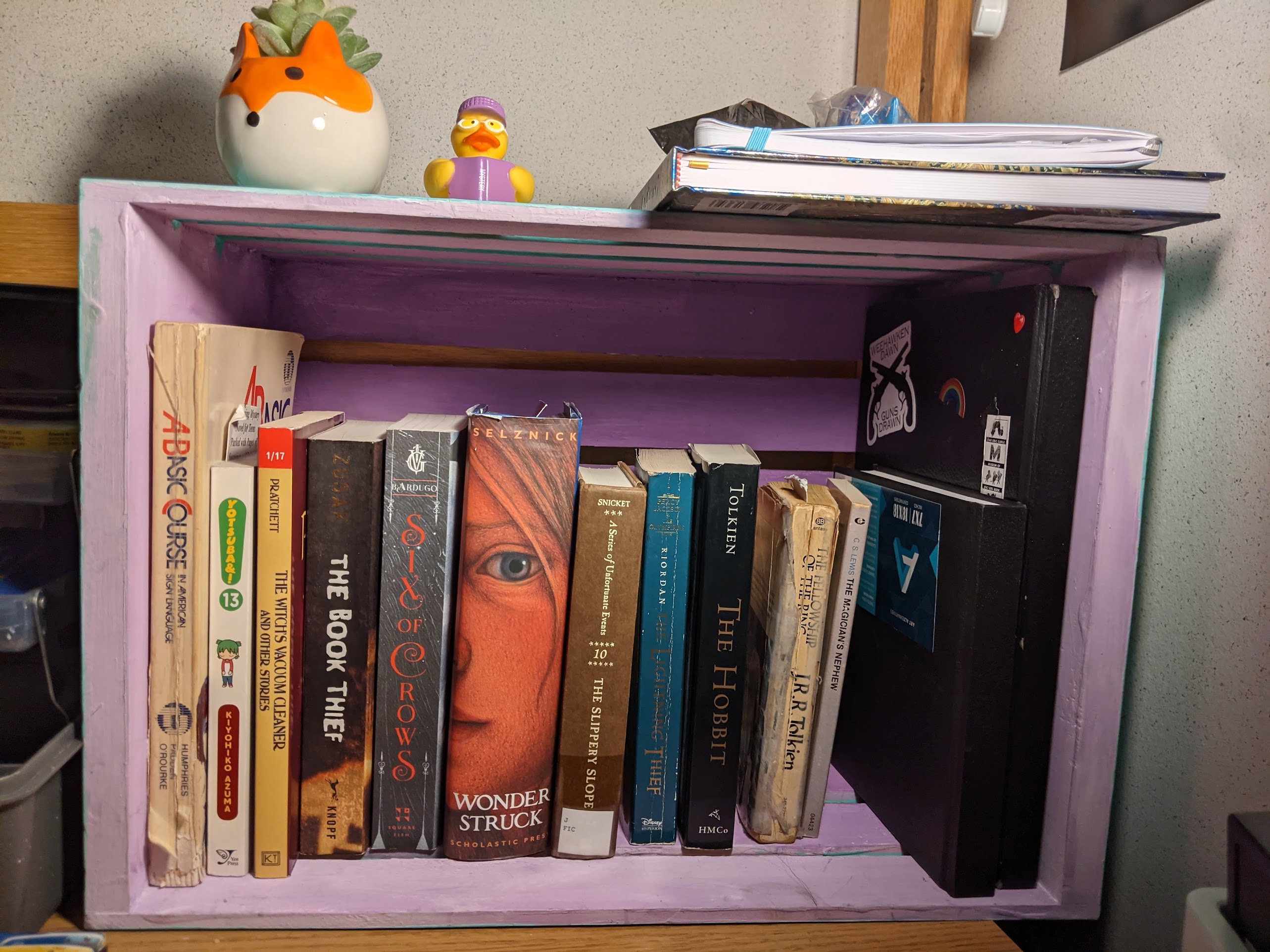
I decided to focus on tidying my books. This is not my whole collection, as I live in a dorm, and most of my things  are already in smaller quantities than they would be in at home. All my books are kept in a painted milk crate that I use as a bookshelf. As you can see it’s starting to overflow. I have books stacked horizontally on top of other books, and some are sitting on top of the crate rather than inside it.

I have collected a lot of books from library and book sales, and the two bookstores in town. Second hand book shops have become a weakness of mine, and I can not seem to leave one without a new purchase.

I also have a number of sketchpads, but I am just going to focus on the books. The first thing I did was take every book that I had and pile them on the center of my floor.

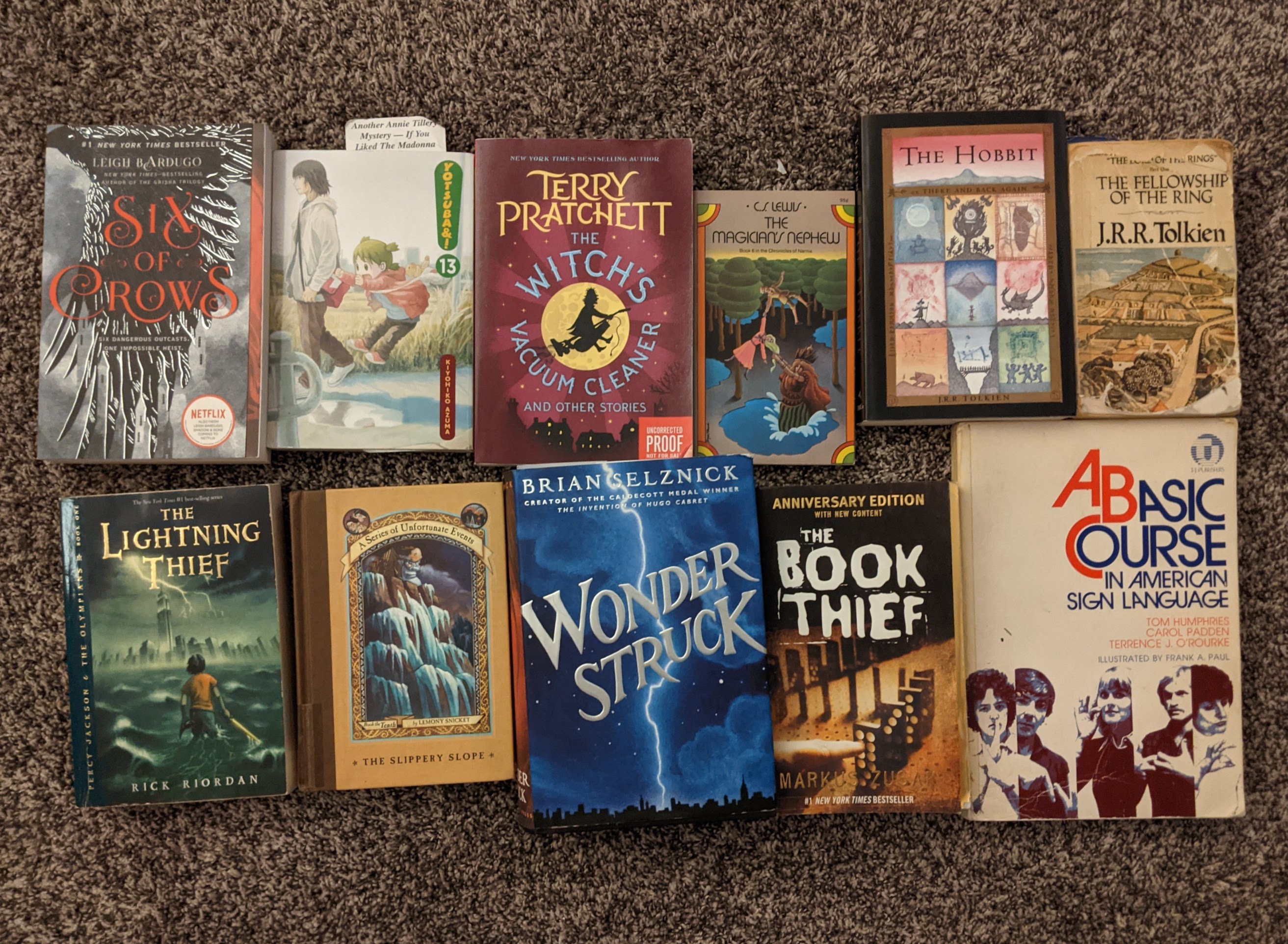
Then I organized the piles so that I could see them all laid out side by side. I had a total of nineteen books.

There were definitely some books that I wanted to keep immediately. The Book Thief is one of my favorite books, so I definitely felt a spark of joy for that one. Wonderstruck is a book that I have always loved, and it has beautiful illustrations. It made me so excited to find it in the bookstore, and I still feel that excitement when I hold it. I have never read Six of Crows, but it was recommended to me, and it was the last book that I bought in my favorite bookstore before it shut down. 

The books that I kept tended to be those that are, or ever were, my favorite books, and books that I had memories attached to. Some of them were part of a series that I had slowly been collecting a set of.

There were some books that I knew that I didn’t want, and I have several that I bought with the intention of giving them away. But there were a few that have been in my reading list for years, and I have never even opened them. I do not even know what The Hazel Wood is about, I just thought it had a pretty cover. While I enjoyed The Hare with Amber Eyes, I put it in this pile because I wanted to give it to my mom. I was always thinking of her while reading it, and it seemed like just the kind of book she would like.

After tidying my books and removing the ones that do not spark joy, I found that my bookshelf was much neater. I no longer have to pack in all of my books, or rest any on top. They all fit side by side. It is much lighter and easier to move around, which will be helpful for moving out of my dorm at the end of the year.

As a young child, I inherited all of the books that my two older siblings grew out of. This led to a bookshelf full of books that I never bought or picked out myself. Whenever I was bored, I would wander over to my bookshelf and find a book that I had never read before, or even realized was there. It was like having my own little bookstore or library, I could always find something new. Of course this did not last forever, and I eventually read and outgrew all of those books. Since I grew up with it, I still want the feeling of being able to find something new in my bookshelf, so I always buy books to save for later. I do not read quite as many books as I used to, so that has started to build up.

Dream of Italy, a Collection of Art at Le Musée du Louvre

While many may associate Italy with Christian or Catholic imagery, it is important to remember the vast, rich, and storied history of Italy before the rise of monotheistic religions. When visiting the “A Dream of Italy” exhibit and viewing Marquis Campana’s Collection, this is something important to keep in mind. While there are a few works of art that are influenced by Christianity, such as Sandro Botticelli’s, “La Vierge et l’Enfant” or the Virgin and Child, many of the pieces in this collection are influenced by Greek mythos. These works of art were mostly created during the 1st century BC, 2nd century BC, or 3rd century BC. While one would not need to be an expert on Greek mythology to appreciate the art within this collection, doing research on the different characters, Gods or Goddesses within this exhibit will allow you to have a richer experience. I found in my research into the Bust of Ariadne that learning about her fate – while at first tragic – allowed me to appreciate her beauty that much more. The mythology behind this art is just as important to understanding the art itself, as is in the case of the “Plaque Campana, thiase dionysiaque” which depicts the God Dionysus’ procession of advisors, worshippers, or “inebriated revelers” (“Thiasus”). Dionysus is the God who is said to have rescued Ariadne from the island of Naxos (“Ariadne”), and that these works of art were created within similar time periods exemplifies the motifs that were most common during that time. Something else to look out for is what these objects are made of. Many of the objects are made using clay or terracotta clay, materials more easily available between the 1st and 3rd centuries BC. Any color used is another thing to focus on. Paint and pigments are not something that were so easy to come by in the earliest centuries, especially any that are blue or have a blue hue to them. Be introspective – how did the artists get these colors? How were they created? Who provided the labor that allowed such pigments to be created? Most importantly, allow yourself to be transported to another time. Such art is less commonly created today – as art evolves over time, with themes and materials changing and evolving. How do these ancient works of art move you?

This collection is so significant because it genuinely feels like a collection. It was the collection created through various connections by one person. The research into the story of these objects shows how it started as many lost individual objects from ancient artists in Italy, until they were rediscovered. Before Campana these objects had no connection to one another. “He brought together this extraordinary collection by way of excavations, the antique and art market, the network of collectors between Rome, Naples and Florence, and his links with scientific institutions”(Dream of Italy). This collection of artwork only exists because of its curation. Campana did not create the objects, but he did create the collection. When it was eventually broken up and sold to numerous different buyers across Europe, the grouping that he established was not forgotten. He established his vision of Italian Art  through his ensemble of objects, and even though it did not last forever, the collection still managed to find its way back together. By becoming an exhibit in the Louvre, the ties between the object, and the importance of these ties is enforced. Campana’s idea of Italian art that he found, bought, and acquired one object at a time is now on display for anyone to see. The most important finding of this collection is how it proves the importance and endurance of collections, and how they can be just as important as the objects within them.

Bibliography

“A Dream of Italy.” What’s On | Past Exhibitions, Louvre, https://www.louvre.fr/en/what-s-on/exhibitions/a-dream-of-italy

“Ariadne.” Encyclopædia Britannica, Encyclopædia Britannica, Inc., https://www.britannica.com/topic/Ariadne-Greek-mythology

“Bacchanal, Adj. and n.” OED Online, Oxford University Press, Sept. 2021, www.oed.com/view/Entry/14285.

“Bacchanal English Definition and Meaning.” Lexico Dictionaries | English, Lexico Dictionaries, https://www.lexico.com/en/definition/bacchanal

“Bust of a Woman : Ariadne at The Louvre, Paris.” 3D Printable Bust of a Woman : Ariadne at The Louvre, Paris by Scan The World, MyMiniFactory, https://www.myminifactory.com/object/3d-print-bust-of-a-woman-ariadne-at-the-louvre-paris-12406.

“Dionysus.” Encyclopædia Britannica, Encyclopædia Britannica, Inc., https://www.britannica.com/topic/Dionysus

Garcia, Brittany. “Minotaur.” World History Encyclopedia, World History Encyclopedia, 1 Sept. 2013, https://www.worldhistory.org/Minotaur/

Harrsch, Mary. Achelous and the Origin of the Horn of Plenty, 17 Jan. 2021, https://ancientimes.blogspot.com/2021/01/achelous-and-origin-of-horn-of-plenty.html. 

“Statue.” Musée Du Louvre, Louvre, https://collections.louvre.fr/en/ark:/53355/cl010286384

“Thiasus.” Wikipedia, Wikimedia Foundation, 24 June 2021, https://en.wikipedia.org/wiki/Thiasus

3D Tours:

https://www.louvre.fr/en/online-tours

https://www.google.com/maps/@48.8600231,2.3370687,3a,75y,132.07h,65.46t/data=!3m7!1e1!3m5!1sAF1QipOVCwfqS0b3rHeesH-QBBaQQvf1fI_NLIyRCoay!2e10!3e11!7i5472!8i2736

Pigments and Colors

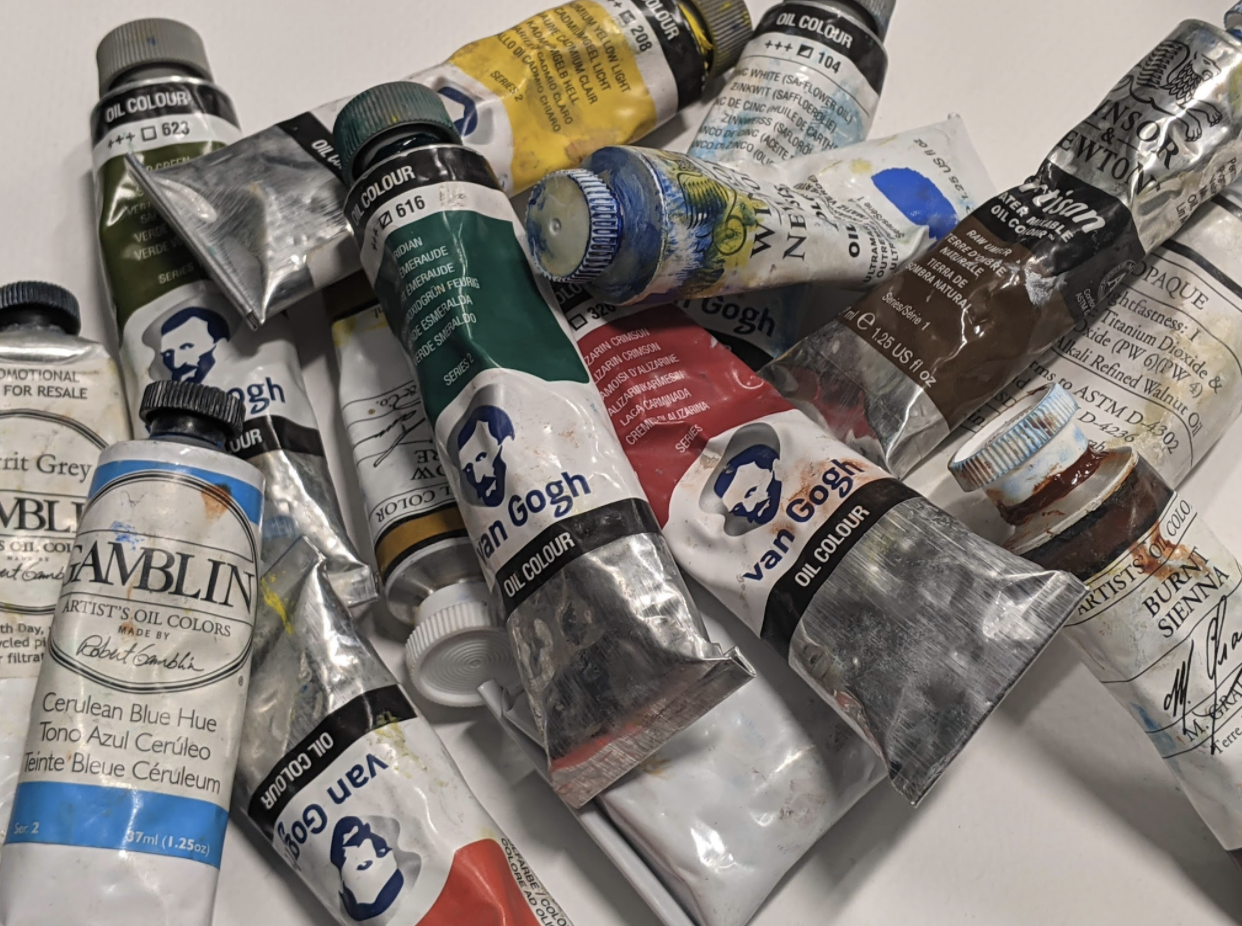
I chose to look into my set of oil paints. The paint itself consists of two major ingredients, pigment and oil. Of course, there is also packaging and mixing in the process of creating a tube of paint ready to be sold in a store. The oil in my paint comes from walnut, linseed, and safflower plants. These plants need to be farmed and processed into oil for the paint. These oils are combined with pigments to create colored paint. Pigment comes from many places like metals, minerals, and elements. Sometimes they also come from insects, such as carmine red, none of my paints do. Mineral pigments need to be mined, crushed into powder or otherwise processed, and shipped. The paints are mixed and packaged by different companies. In my case those include Gamblin, Van Gogh, or Winsor Newton. They are packaged in aluminium tubes with plastic caps. I have also heard of people mixing their own paints. But to do that they still need to get the pigments and oils, which are often impossible to produce on your own.

Pigments are one of the most complex and important parts of paint. We tend to see color as surface level, something that does not really affect the make-up of an object, but different colors can change so much about an object. They come from different places, and have different backgrounds, chemical processes, toxicities, and expenses depending on the color. Even price changes based on the pigment and oil type. While a t-shirt may not change price based on color, paint often does. It is easy to notice with a material that is so grounded in the need for color variation. At the beginning of the semester, I went to get supplies at the art store, but spent the whole time calculating which paints would burn the smallest hole in my pocket. Even among the same color, different brands can vary in hue, saturation, and viscosity.

Viridian green is my favorite color of all of my paints. It is a deep bluish green that lightens to mint. This pigment is made using powder from a rare mineral called eskolaite. This green is one of the less toxic green paints, which is why it is still used today. Other greens like Scheele’s green, which contains arsenic, were extremely toxic and are no longer in use. Viridian green was patented in 1859, and the eskolaite used to make it is mainly mined in northern Europe.

White is usually produced from metals, often heavy metals. I have two different kinds of white, titanium and zinc. Titanium white, as you might guess, comes from titanium, a heavy metal. While it is not as toxic as paints that come from lead or arsenic, it is still one of the less safe colors. My second tube of white is zinc white. Zinc is a less toxic alternative white, but it is less commonly used. It is a harder paint to make, because the zinc does not react as well with the oil, and it took a lot longer for people to perfect it in oil paints. It is also known for being a cooler shade of white that leans towards blue. Zinc is often mined in Canada, but processed in Eastern Asia.

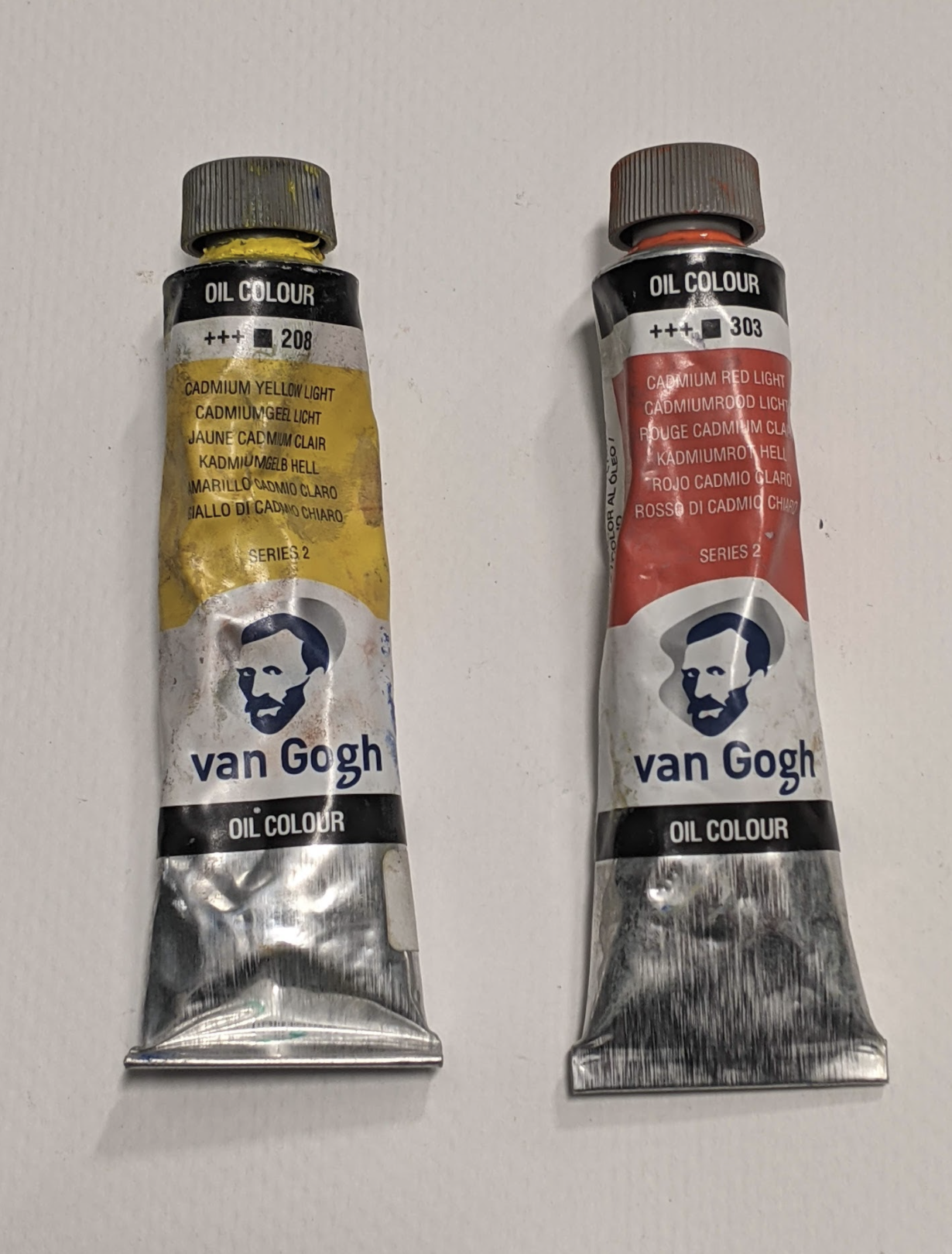
One pair of paints that interested me were cadmium red and yellow light. I was surprised how two different colors could come from the same source. Cadmium is an element, and is a byproduct of zinc ore processing. It is used in reds, oranges, and yellows, but is less commonly so due to its toxicity. Usually is produced in eastern Asia, where zinc is processed.

Ultramarine is a shade of blue made from crushed lapis lazuli. Blues in nature are very rare, and ultramarine was a very rare and expensive pigment throughout history. This has been one of the most important pigments since the renaissance, and has always seemed like a magical substance. Since it only came from very few places, the process behind making it was often a mystery. Its name means “beyond the sea” which does a great job of representing how otherworldly people considered this intense blue. When I paint with it. I always find myself cutting it with another color because of how overpowering it is. The lapis lazuli used to make it is commonly and historically mined in Afghanistan.

My paints are a collection of objects that I bought, kept, and used together. They are always grouped as the same thing and considered to be variations of the same object. But each one is very different. Because of their differing colors and brands, these paints all have different components, labor, and histories. Even though these things are often forgotten, they still matter and have an impact on our world.

For more information on paints and pigments you can look at:

http://www.webexhibits.org/pigments/

Daisy Earrings

I have a pair of earrings. They are clip-on earrings since I do not have pierced ears. They have gold colored backs, and a bright yellow enamel circle with matching white enamel petals on the front. The daisies are about the size of a quarter. And the hinged mechanism on the back is the size of a fingernail.

I first found these earrings in my mom’s jewelry box. She had a collection of earrings, both clip-ons and regular ones, since her previously pierced ears had long since closed up. This was about three or four years ago, when my sister pierced her ears and asked my mom to borrow some old earrings. My mom keeps her jewelry in boxes at the back of a drawer. She likes to hold onto everything, and I found several old beaded bracelets and necklaces that I had made for her as a little kid. This led to an afternoon of the three of us digging through lots of old jewelry with varying degrees of value and patina.

My sister found the earrings she was looking for, but I also found the daisy earrings. I really like anything with flowers on it, so I was pretty excited about this. They were also clip-ons so I could wear them, despite not having pierced ears. My mom had not worn them in years, and was happy to see someone using them again, so she gave them to me.

I just assumed that they were bought by my mom, and she wore them for a while before they found a home deep within the jewelry box. However, I soon found out that this was not quite what happened. Once when I was wearing them she informed me that my aunt would be so happy to see someone wearing her earrings. I was not very surprised by this, since many of the sets of old clothes and jewelry came from my aunt. She was a fashion major at FIT, and my mom has a box of “dress up” clothes filled with all the bright and colorful things she sewed as a student there.  

Again, I assumed that was the end of the story; that she had bought them, and then later given them to my mother, but a few weeks ago I went to visit her, I happened to be wearing the earrings. When she first saw them, she did not remember them, but told me that she really liked my earrings. Then she realized that they were familiar, and asked me if they were the ones that she used to wear. I told her they were, and she said that she got them from my grandmother. Unfortunately she did not know where my grandma had gotten them, and there is nobody else who I can ask. She definitely remembered my grandma wearing them, and then giving them to her. Then my aunt passed them on to my mom.

While they do not have any identifying marks, I found a few Etsy shops that sold identical and similar pairs. However all of them identified them as merely “Retro Daisy Earrings”, and only one shop indicated them as being from the 1970s. Most of the shops also seemed to be reselling thrifted items, and did not actually know anything about the items themselves.

While I would like to believe that my grandmother had inherited them from a long chain of relatives, I believe that they are from the 70s, which means that she could not have had them for more than five or ten years before giving them to my aunt. Perhaps they were a gift from my grandfather, or her cousins in Connecticut. The exact origins of this object has been lost to time, but it is nice to know that so many women in my family share my fondness for flowers.

My grandmother’s Visa

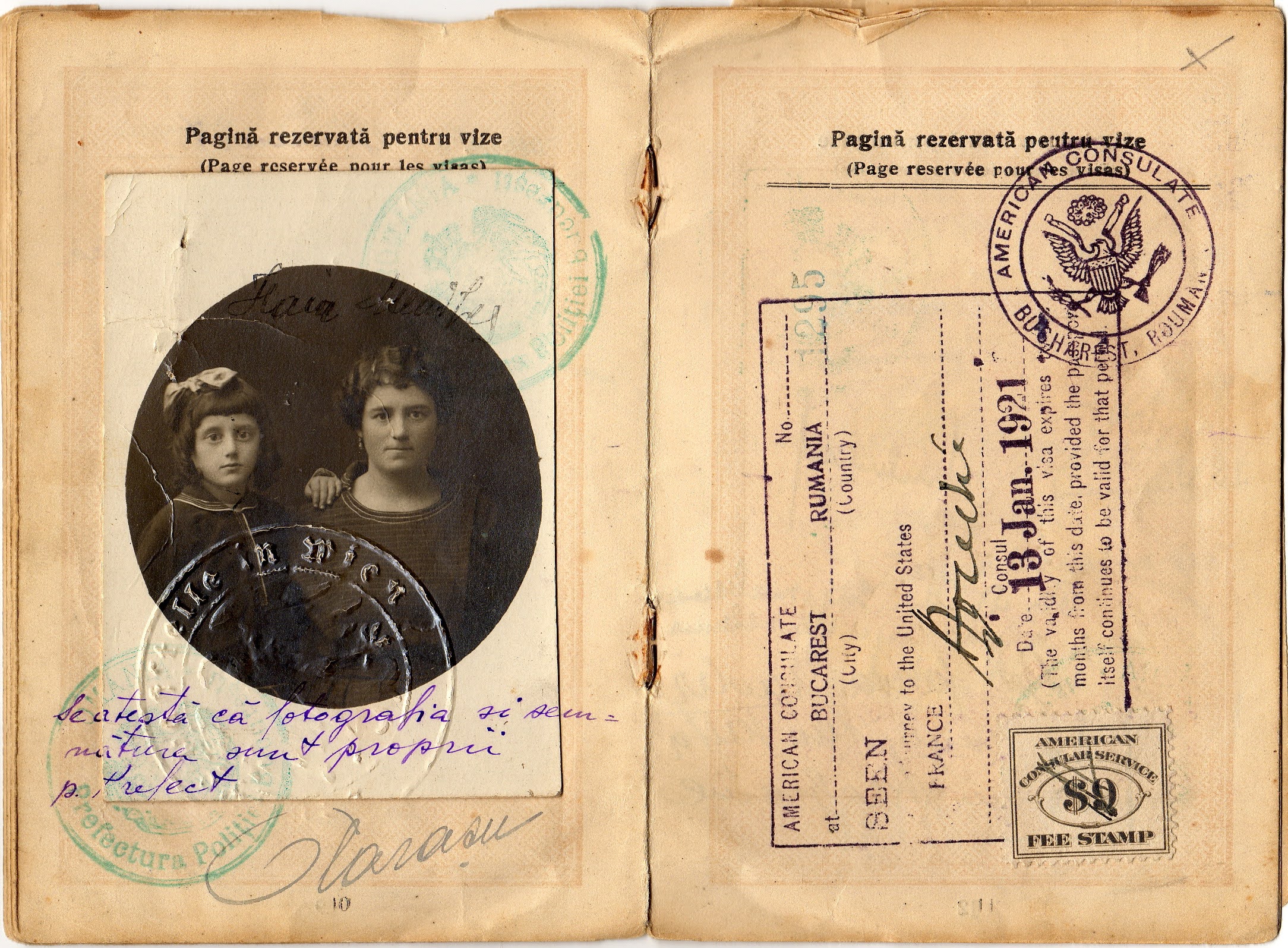
The object that I chose was my grandmother and great grandmother’s immigration visa. This object has a personal connection to my family, but also a connection to The Hare With Amber Eyes, as this takes place in parallel to the events discussed in parts one and two of the book. I have the digital scan of the visa, but since it is so old I try to avoid touching it. Knowing my mother, she probably has it tucked away somewhere in one of our many filing cabinets.  

The visa is a hundred years old now. It is stamped with the date 13 Jan. 1921. The pages are old tan paper that look like they have been stained with tea, and they curl and crumple at their edges. The booklet is bound together by two very old and rusty staples. There are so many layers of paper, writing and ink that it is hard to make out any of what has been written on it. It is written in a jumble of French, Romanian, and English. One of the clearest stamps on page eleven in the right side of the booklet reads “American Consulate Bucharest, Rouman” before cutting off. There is also a fee stamp, like one used for postage, also from the United States consulate that has “$2” written in bold font. That is worth about thirty dollars in today’s money. The visa lists them as coming from Bucarest, Rumania by way of France, and the fine print underneath warns that the documents will expire in two months, but it is covered in stamps. Behind all of this text is a faded red pattern that is smudged with the green stamp ink. The French and Romanian text above indicate that “This page is reserved for visas”. On the left page the same red pattern and visa reservation are there. There are three stamps on this page, two of them green and one a transparent white. They are almost completely illegible, but you can catch a few Romanian words here and there. There are also several things scribbled in cursive handwriting, but between the language barriers, age, and layers of ink, it is very difficult to read. The last thing on this page is the most interesting, it is a photograph of my grandmother Chaika, soon to be Clara, and my great grandmother Chana, who will become Anne. The photo is on its own separate piece of paper that has been pasted in. It has its own yellowed and crumpled edges, and features a sepia portrait of my two relatives. My great grandmother is wearing earrings, I will have to look for them next time I am home. My grandmother looks glassy-eyed and has a shiny bow in her hair. She is seven years old at this point. 

My great grandmother, Annie Meyerson and her daughter, Clara, immigrated to Boston from Bucharest, Romania (although it is listed as Bucarest, Rumania on the visa). She had lived in Romania for about three years while trying to secure passage to America. Prior to that she lived in Kodima with Clara, my grandmother, and her husband Isidore, my great grandfather. Kodima is a town in Russia (present day Ukraine) in the Galicia region outside of Odessa. At the time about half of its population was jewish, my relatives included. Antisemitism was on the rise at this point and there were pogroms in and around Odessa. These pogroms forced my family to flee, and they eventually ended up in Brooklyn.