The History Behind the Stone Walls

Description

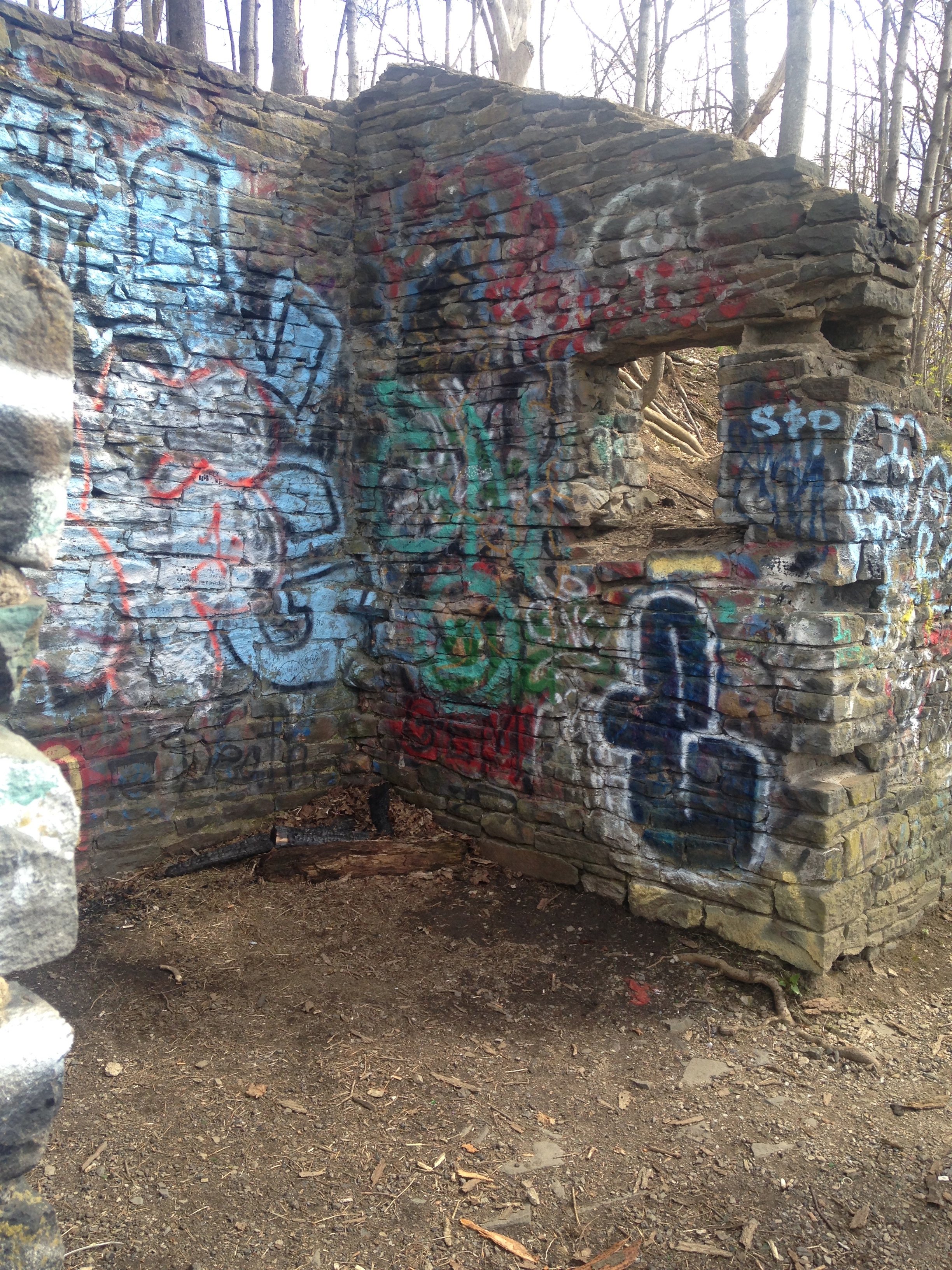
You’ve all seen it. That dilapidated stonewall that lies along the banks of the Wallkill River. Freshman and tourists walk by and wonder: “What the heck is that?” While seasoned SUNY New Paltz students avoid it for fear of harassment or assault or use it for their smoke circles and hangouts. Upon entering the New Paltz section of the Wallkill Valley Railtrail, walkers, runners and bikers pass this crumbling stone structure without any thought of what it might have been. The once closed structure now consists of only three walls. Any foundation that might have been there centuries ago when it was constructed is now dirt and leaves. The wall that once faced the Wallkill River is now nonexistent. What’s left of the structure is now covered in graffiti from the various decades of rebellious hippies and risky students wanting to leave their mark on the town. What they didn’t know was that the neglected stone that they were defacing was actually centuries old and built by two of the founding families of the town of New Paltz.

Provenance

The Elting family and the Lefevre family initially purchased the property together in an agreement for 3,000 acres of land along varying parts of the Wallkill River (Village of New Paltz). On this specific plot of land the Elting family built a steam mill equipped with various warehouses and shed, including the tool shed. For the first century or so after the purchase, the Elting family successfully ran their factory. However, when the business failed in 1894, A.P. Lefevre bought the steam mill property at an Elting Real Estate Sale (Village of New Paltz). The Lefevre’s retained ownership of the property until 1986 when most of the buildings were sold and demolished.

Narrative

Studying the old maps of the Village of New Paltz shows us that the structure was once a tool house, however it neglects to detail whose tools it held. One possibility is that it could have been used for both the Elting factory and the later Lefevre family business that stood on the opposite side of the train tracks. In 1748 Noah Elting, in conjunction with Nathaniel Lefevre, gained ownership of 3,000 acres of land “lying on both sides of the Wallkill” (Lefevre 485). On this land the Elting family built “Elting & Son”, a steam mill consisting of an icehouse, two lumber sheds, the flourmill and a coal shed that was shared between the factory and the neighboring trains that ran along the Wallkill Valley Railroad.IMG_4628

The family ran the steam mill and New Paltz’ one and only canning company until the business failed in 1894 (Village of New Paltz). Upon the failure of their business, the Elting family delegated ownership of the factory to the assignee A.K. Hays of Walden (Lefevre 485). For the next two years, Hays ran his barrel crafting company out of the factory and continued to utilize the far off tool shed on the other side of the tracks. Then, in 1896, the Elting family was forced to sell their properties in an estate sale, including the steam mill. At this sale, A.P. Lefevre purchased the property as the second location for his established lumberyard and hardware company (Village of New Paltz).

IMG_4629The 1905 map of the village shows that upon taking over the farm A.P. Lefevre and Sons Lumber and Hardware Company cleared out some of the buildings from the original Elting factory and added new spaces for their different business. However, the tool shed remains standing on the other side of the train tracks. In 1907, Lefevre rented out part of the coal shed to D.C. Storr’s Concrete Block Company, which allowed him to then build the residential areas of New Paltz (Village of New Paltz). Storr built almost all of the cottages that still remain standing on Oakwood Terrace and Manheim Boulevard. As if this was not enough, Storr also donated land for St. Andrew’s Episcopal Church, built a windmill to supply the residents of the village with fresh water and erected entire new streets and walkways. Working out of the Lefevre’s coal shed with tools from the tool shed on the other side of the tracks, D.C. Storr modernized the village of New Paltz and turned it into a living destination for both students and families alike. For more than 70 years after initially acquiring the property, the Lefevre’s lumber business continued to thrive at their location alongside the Wallkill Valley train tracks. The tool shed also remained as a part of the property throughout the changing businesses and was continually shared with both the Wallkill Valley Railroad and the Consolidated Rail Corporation who continued to make stops to the lumberyard even after the closure of the New Paltz Train Station in 1959 (Mabee and Jacobs). This dilapidated structure that continues to stand along the banks of the Wallkill River has watched many businesses come and go. The stones in those three remaining walls watched over the course of centuries as the Eltings ran New Paltz’ one and only canning company until it failed, the railroad companies stopped coming through town, the Lefevre family ran a successful lumber yard and D.C. Storr built half of New Paltz with concrete.
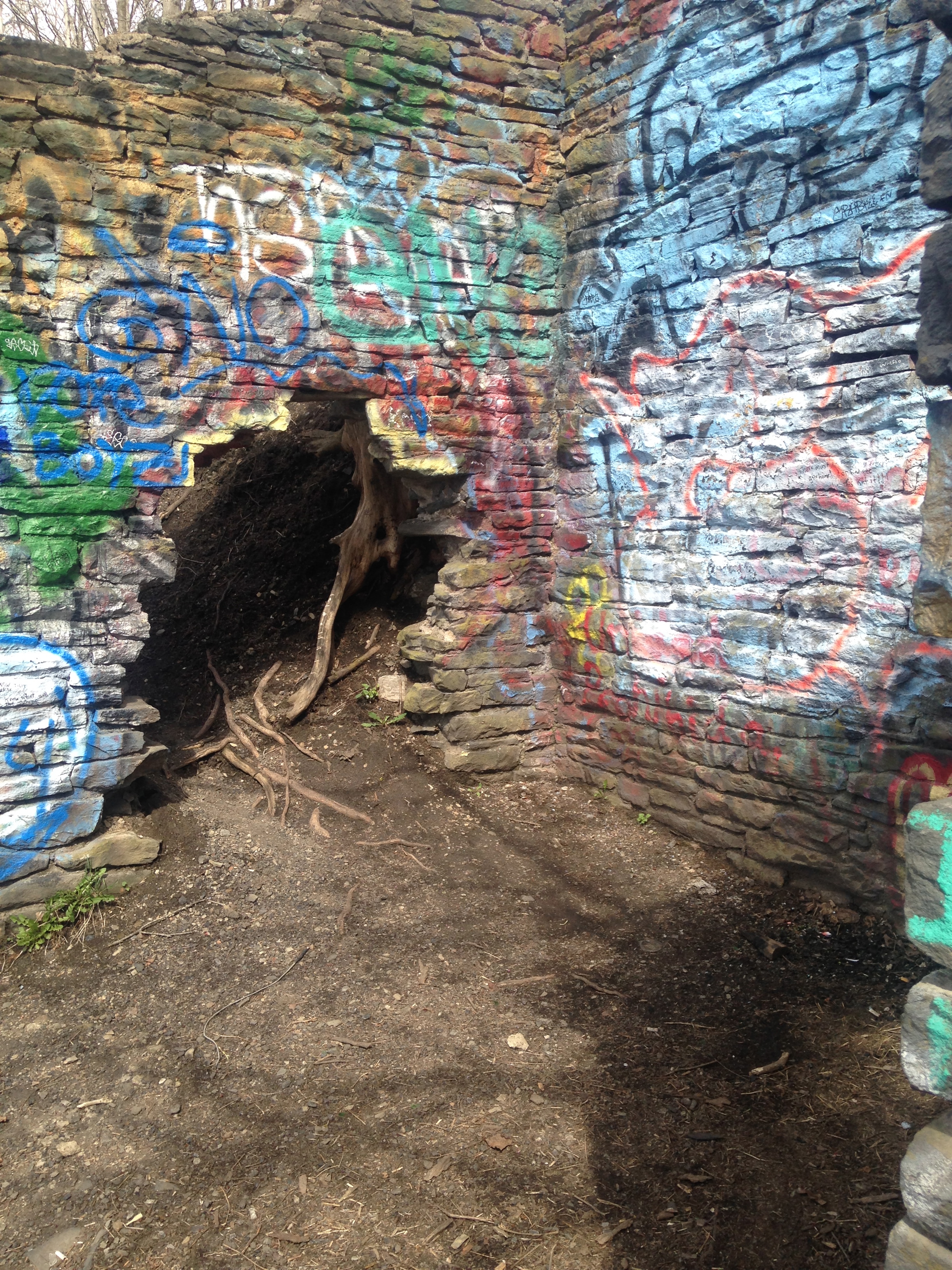
IMG_4681IMG_4678IMG_4682

Today, students, residents and tourists alike pass it by while walking along the Wallkill Valley Rail Trail. After sitting abandoned for years, plans were launched to turn the rail road tracks into a “linear park” in 1983 (Wallkill Valley Rail Trail Association). Volunteers worked together to clear the brush, smooth out paths for hiking and biking and repair the various bridges between New Paltz and Gardiner. After over a decade of hard work, the trail informally opened in 1991. When it first opened, it stretched along the river from the Village of New Paltz to the neighboring towns of Gardiner, Rosendale and Kingston (Mabee). In recent years, the Wallkill Valley Rail Trail Association has been rumored to be working to connect with the Dutchess County Rail Trail, which would connect New Paltz to the other side of the river. All the while, the volunteers have been passing by this abandoned structure that stood beside the trail and the Wallkill River. That graffiti covered and forgotten tool shed watches as the current residents of New Paltz pass it by and completely overlook the centuries of history hidden behind its neglected stones.

IMG_2098

Photo Credit: Shelby Seipp, Charlie Seipp

Works Cited

Lefevre, Ralph. History of New Paltz, New York and Its Old Families

(from 1678 to 1820): Including the Huguenot Pioneers and Others Who Settled in New Paltz Previous to the Revolution. Albany, N.Y.: Fort Orange, 1903. Print.

Mabee, Carleton, and John K. Jacobs. Listen to the Whistle: An Anecdotal History of the

Wallkill Valley Railroad in Ulster and Orange Counties, New York. Fleischmanns, N.Y.: Purple Mountain, 1995. Print.

The Village of New Paltz: 100 Years of Community Life. New Paltz,

N.Y.: Centennial Committee, Village of New Paltz, 1988. Print.

“Villageofnewpaltz.org.” Villageofnewpaltz.org. Web. 15 Apr. 2015.

<http://dosingpdf.com/v/villageofnewpaltz.org1.html&gt;.

Wallkill Valley Rail Trail Association. “History-The Wallkill Valley Rail Trail.”

Wallkill Valley Rail Trail. Web. 24 April 2015.
Yorick’s Skull

When thinking about objects in Shakespeare’s Hamlet one particular scene comes to mind. Yorick’s skull, which originally appears in Act 5 Scene 1, turned into the iconic symbol of the tragedy as a whole. Hamlet is usually seen on DVD covers, book covers and performance posters in the iconic kneeling position as he holds up the skull.

This skull turns into more than human bones for the Prince of Denmark. While Hamlet holds the skull he begins to examine how the jester’s life no longer has any meaning because it no longer exists. He then takes it a step farther and discusses how no ones life has more meaning or importance than anyone else’s because all human beings end up as this skull. He emphasizes this when he asks Horatio: “Dost thou think Alexander looked o’ this fashion i’ the earth?” (Shakespeare 5.144). Here, Hamlet realizes that all people, noble or not, return to these “base uses” and become nothing more than dust and clay. In comparing the life of Alexander the Great with the songs and jokes of court jester, Hamlet diminishes both to meaningless human lives that both culminate in death. The realization that death comes to all humans seems to definitively prove to the prince that not one human life matters.

At this moment the skull serves as something like a catalyst for Hamlet’s actions. Once he realizes that death is a universal truth for all of humankind, Hamlet easily disregards the idea of an afterlife. This overwhelming realization seems to prove to him that every human’s soul, regardless of actions or social status, will end up as meaningless dust. With this in mind, Hamlet can finally take up his task without any thought towards the preservation of his own spiritual sanctity. Yorick’s skull ultimately changes Hamlet’s entire way of thinking. The question of “To be or not be” no longer matters because whatever answer he may choose, his life will always end with his body being committed to the earth. Shakespeare then emphasizes this idea that life itself is meaningless for Hamlet by following the scene with the skull immediately with Ophelia’s funeral.

As the procession of nobles move past Hamlet and the bones of the court jester it solidifies the idea that no amount of noble blood, good deeds or forgiveness of sins can save them from turning into dust and dirt. Yorick’s skull reveals this truth to both Hamlet and the audience as the same time. In Shakespeare’s time, the Black Death was devastating the population of Europe and bodies were littering the streets of London. With this scene, Shakespeare clearly illustrates to the nobles and the groundlings that they will all meet the same end. In a way, this scene unites the social classes of Elizabethan England behind the message that all human life ends in the same way and is, therefore, meaningless. On a personal note, Shakespeare lost his only son to the Plague, which may have inspired this depressing outlook on life and his emphasis on death in this particular tragedy.

Yorick’s skull not only serves as a catalyst for Hamlet and the action of the play, but it also negates the famous question of being by emphasizing the expansive meaninglessness of life. Shakespeare uses Hamlet to examine the meaning of life in an unconventional way. This iconic object proves to both the protagonist and the author that life has no meaning because it all leads to the same place: a grave.

Vassar Hospital Room 436

Considering how much I have been in and out of Vassar Hospital this past weekend, I’ve decided to use that as an inspiration for this week’s blog post. My grandmother entered the hospital early last week, which was enough time for her to make the space her own. Her hospital room consisted of a single bed, two chairs and a bathroom. Over the course of a few days, my grandmother managed to make it her own.

She had the comfiest chair in between her bed and the windows, so that she could look out at the view of the Hudson River. That chair, although already lined with cushions to make it as comfortable as possible, was then covered with various blankets that she would use to drape over herself for warmth.

For most of her visit, the food tray was in front of that one chair by the window. It held all of the necessities like a tissue box, a water pitcher, and sanitary wipes. However, it had also accumulated various items that she determined necessary for life. This included Hershey’s chocolate bars, sugar packets (hidden of course), and Mallomars. The essentials were always hidden in the various drawers of this tray table. Although this table was mostly stationed in front of her window seat, it traveled over the bed for the occasional breakfast.

Now, the bed was definitely her personal space by the end of her hospital stay. At the foot of her bed we tied extra slipper socks around the bed handles to make sure that she always had a pair available. At the head of the bed, which only ever had one pillow, there was also a lengthy scarf that I gave her for her birthday last month. When I went to visit her on Valentines Day she was wearing it around her neck and although she did look a little ridiculous draped in this long red, white and green scarf, it brought color into the otherwise white hospital room. When she the scarf is not keeping her warm, it remains at the top of her bed with that single pillow and somehow manages to brighten up the horribly drab room. On top of both the scarf and the pillow rests a tiny plush puppy that she recently received as a gift for Valentines Day. The small dog barely left her pillow in the day or so since she got him except to follow her to chair this morning. Regardless of its placement in the room, it also seemed to lighten the air in the room.

This morning when we packed all of these individual items into a plastic hospital bag they lost some of their importance. Then the room became just another messy, unoccupied room on the fourth floor of the hospital. While her stay may have been short, thankfully, my grandmother made the small space they gave her into her own personal living area. Now that room is just another blank slate, waiting for someone else’s relative to lie in the bed and move in their important belongings.

I hope that once this week is over I will not have to step foot in Vassar for a fairly long time. However, if another one of my family members goes in, I have already compiled a list of the essential items they will need with them during their stay in the hospital.

My Nametag

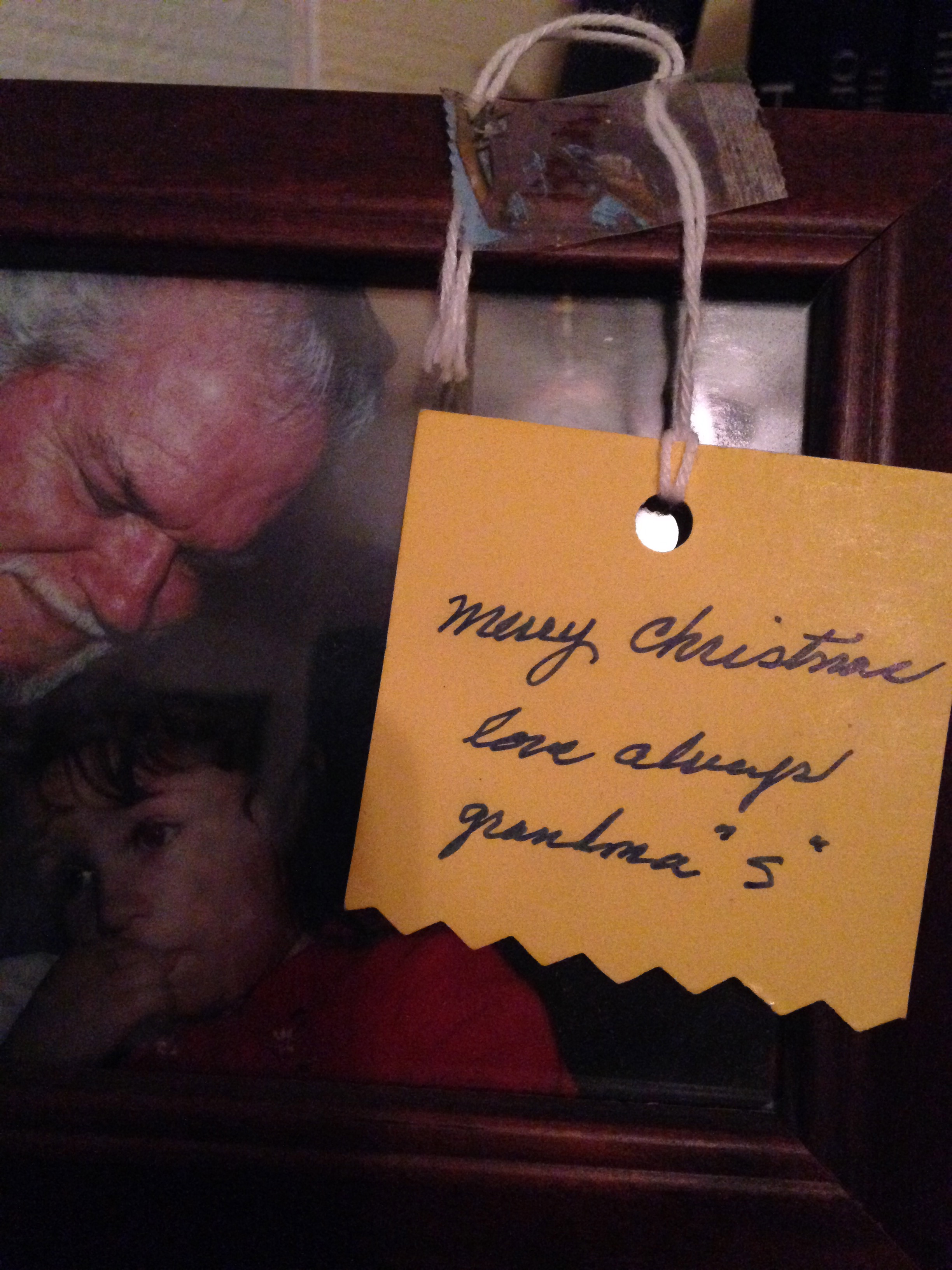
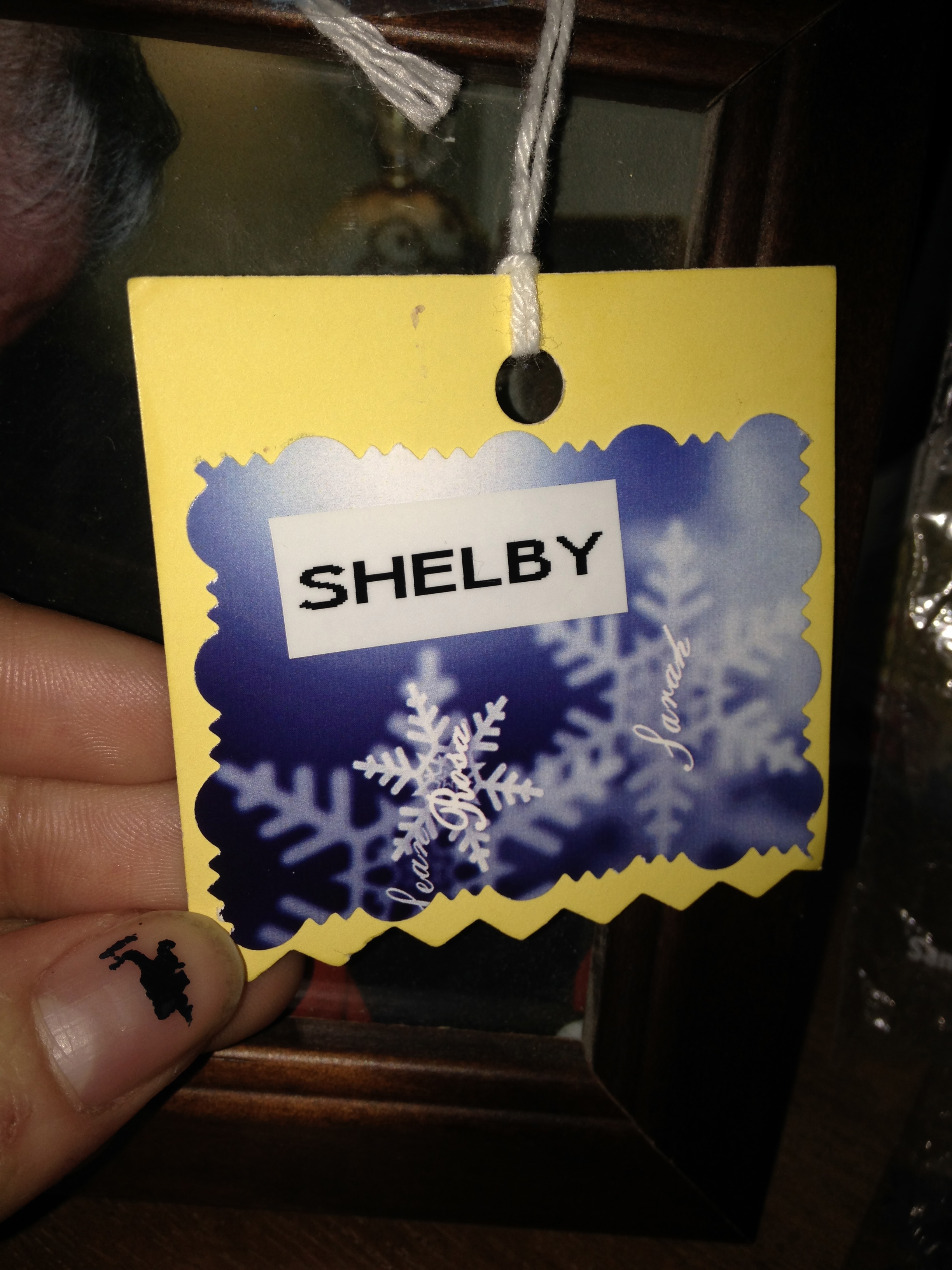
This small piece of paper was the only object that came to mind for this week’s post. The small yellow paper was and still is a nametag that identifies which of the Christmas presents or Easter baskets belonged to me. On one side, there is a personalized sticker that has my name on it.

IMG_4457

My grandmother made one of these for each of her children and grandchildren to make sure that everybody got their respective gift. She cut each square out with those designer crafting scissors that leaves the edges wavy looking. Then she personalized eighteen different stickers with each of our names and put them on one side of the square. My sticker has snowflakes on it because she could use it for both Christmas and my birthday. The other side of the tag was always blank or would say something generic like Merry Christmas. This allowed her to reuse the tags over and over again for each Christmas and Easter instead of making new ones.

All of us Seipps have this money saving trait that we like to thank our grandfather for. My grandmother’s recycling of the nametags was the last great example of our frugal ancestry. Each year after we finished unwrapping all of our gifts we would have to return the tag to her to make sure that none of them were thrown in the trash or lost under mountains of wrapping paper.

Last Christmas was the last time we got those nametags. Our Christmas last year was after my grandmother had passed away. Our aunt handed each of us our present and my eleven cousins and I took a collective breath. Some of the younger cousins decided not to open them; while us older ones felt that opening it anywhere else would only make it harder. For a while I just played with the nametag. Its ownership had changed right then. Finally, we didn’t have to hand back the tags.

IMG_4456

That’s when I realized the other side of my tag wasn’t blank. In her scribbled handwriting it read: “Love Always – Gma S”. I checked the other tags as my cousins took them off of their presents, but only mine had a message on the blank side. Later my aunt told me that she didn’t have enough time to write on everybody’s tag. A lot of the presents were not even wrapped yet. Now instead of being Grandma’s nametag, the little yellow piece of paper is my last note from her. It now stays taped to a picture frame and serves as a daily reminder that somewhere an angel still loves me.

Alice in Wonderland

This week my object is Alice in Wonderland by Lewis Carroll. The book is particularly important to me for personal reasons, but the book itself has a history all of its own. Lewis Carroll was born Charles Dodgson and was actually not a writer at all. Dodgson was a professor who taught elementary mathematics at Oxford. He had a passion for photography at an early age and a particular affinity for young girls. Most outstanding of which was his fondness for the real Alice, Alice Liddell. As the daughter of the dean of Christ Church, Alice Liddell had her own tutors and was well known in the area around Cheshire. Dodgson took a liking to her over the dean’s other two daughters, which is why all of his stories focus on Alice. These stories began as short tales that he told Alice and her two older sisters. While many readers have speculated whether or not the author experimented with hallucinogenic drugs to come up with his fantastical stories, the reality behind the tales of Alice in Wonderland and Through the Looking Glass is that they each began as Dodgson’s creative fairy tales. Carroll used to tell stories to the three girls, but also liked Alice the best.

IMG_4440

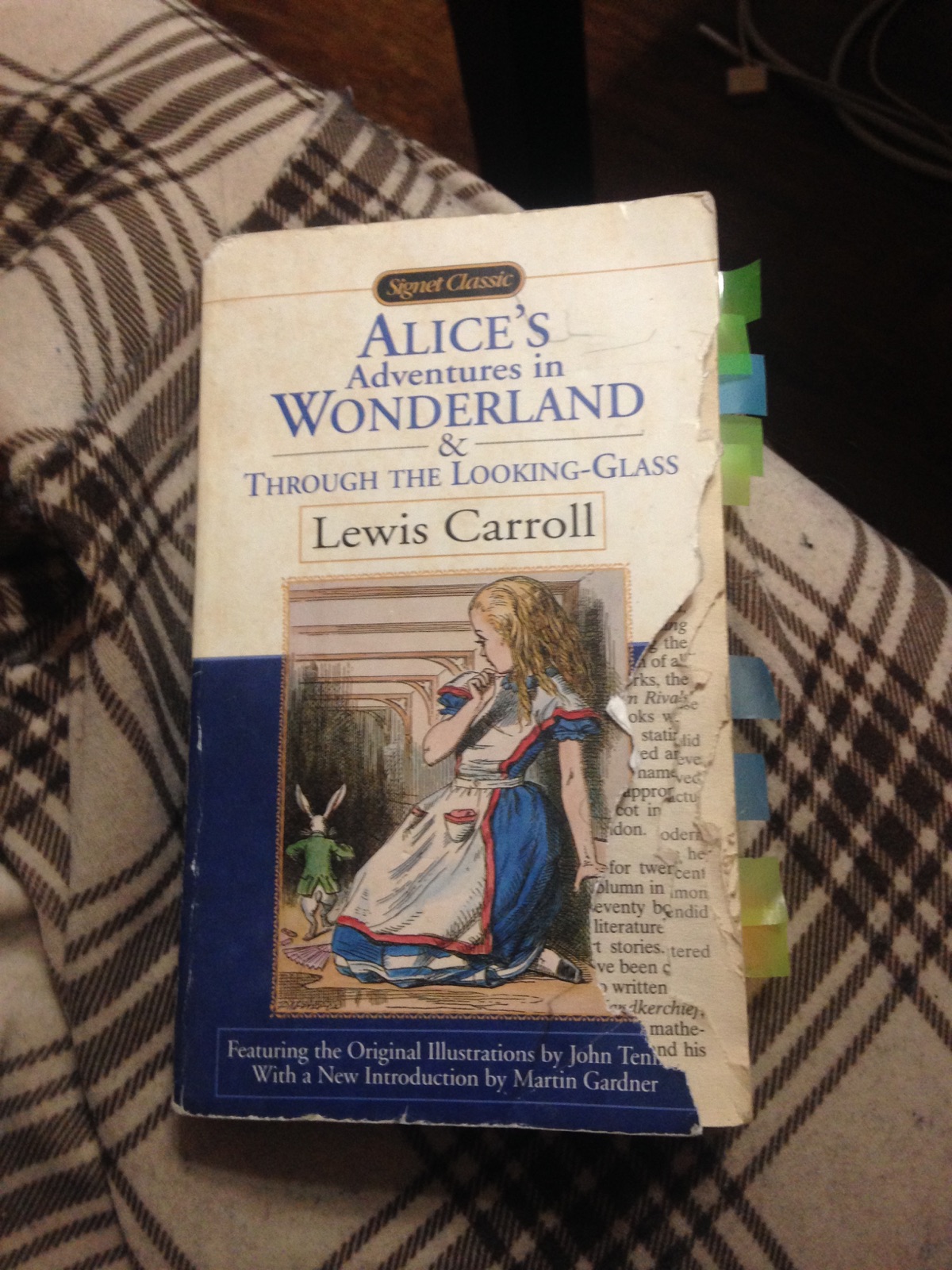
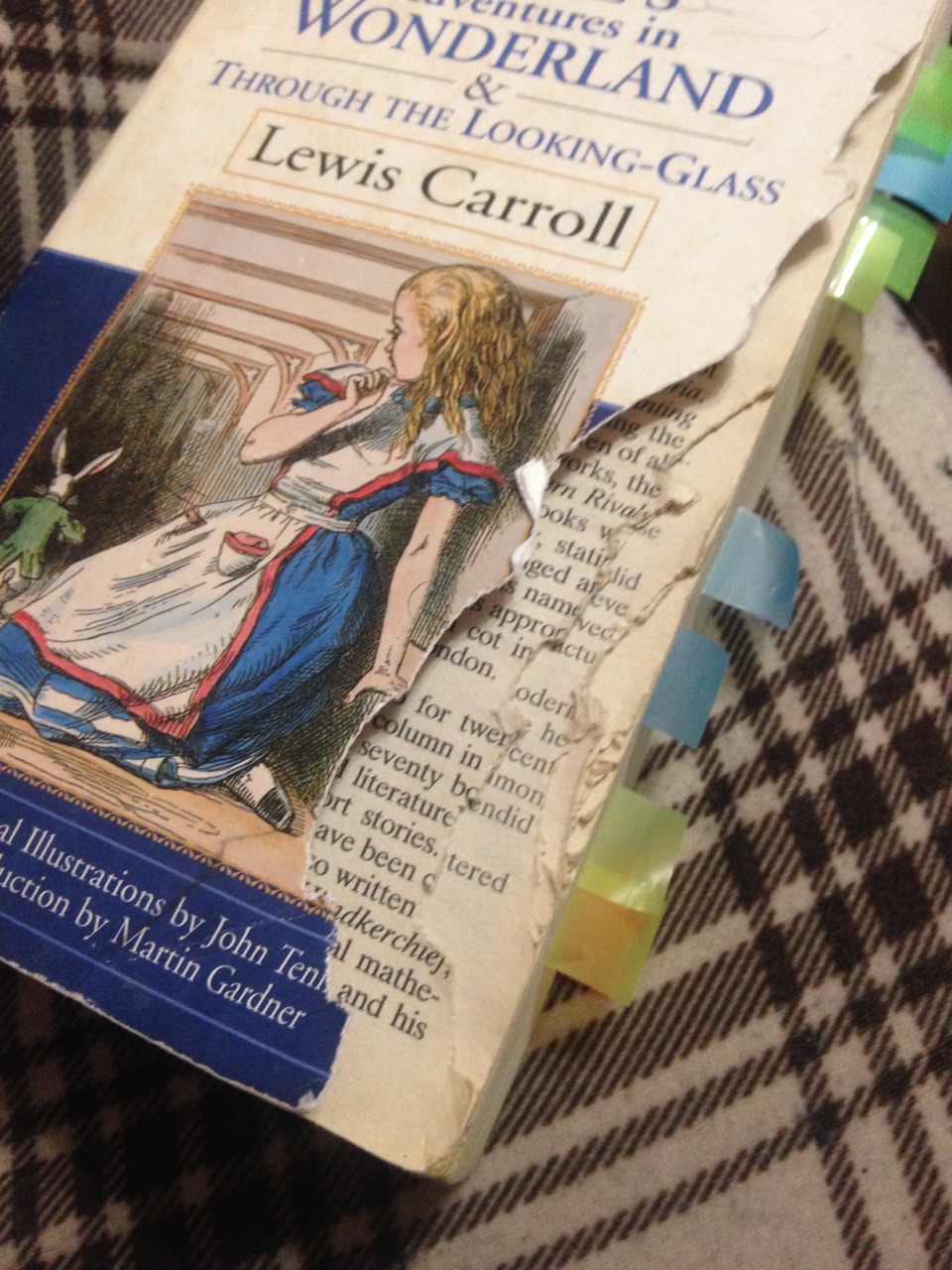
The cover of the book is calendared, meaning that it has a plastic feel in your hands. The pages that actually contain the text are made of newspaper style paper and are held together with a perfect binding. Ironically, this technique is not perfect at all. In fact, this style simply means that the pages are sewn together and then glued into the binding with a temporary adhesive. Ultimately, the perfect binding technique can only hold it together for so long. These physical properties of this specific copy were originally pretty standard to each issue, but of course that changed once it came into my possession. As you can see, this copy is missing quite a bit from its front cover and first few pages. These small bits were actually chewed off by a bunny that was just as hungry if not hungrier than Eric Carle’s caterpillar. My bunny, Stormy, chewed off the corner of the cover and the few beginning pages, luckily, he never made it to any of the actual story.

IMG_4441

Besides these physical properties, it also has a library barcode on the spine that indicates that it once belonged to a local library. In fact, it belonged to my high school library, but I managed to steal it and kept it with me through all these years. This was not the first book that I stole, but it was one of the more meaningful. I fell in love with the story the first time that I read it and decided that I needed to keep this book. Fortunately, I never ended up in any trouble for stealing, but this origin added something extra special to the book that I knew made it something that no one else can ever own. This story of how it came to my possession along with the story of its desecration by rabbit teeth makes it a unique object that could only be found on my bookshelf.

Handmade Scarf

scarf

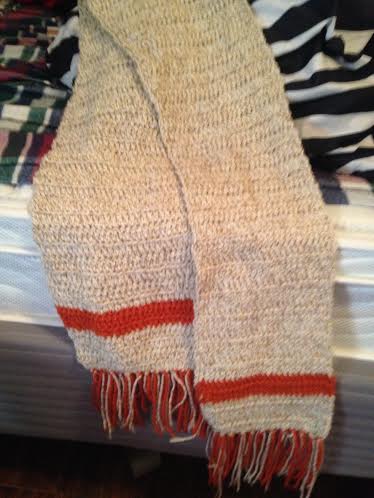
The object I chose is a fringed scarf that I hand made about five years ago. The scarf is about five feet long including the length of the fringe. In width the scarf spans 30 stitches across. The material is 100% acrylic yarn of two different colors. A majority of the scarf is beige with 4 rows of orange at the end to add an accent color. At one end the orange stripe is detaching because of a missed stitch. These orange and beige colors are also the colors used in the fringe at each end of the scarf. I crocheted the scarf myself over the course of about 3 weeks.

Despite its simplistic materials and physical appearance, the handcrafted nature of the object makes it something special. All of the work and time that went into crafting this gift gives it more meaning than if I had simply purchased a scarf. Five years ago I lost my grandfather to pancreatic cancer, but more importantly, my grandmother lost the love of her life. Since they were married the only time they were ever apart was during the hours that he had to work. Every morning she would stand on the front steps and wave goodbye to him as he drove away. The day he passed away was the last day she every waved him goodbye.

Obviously, the next birthday would be difficult for her because he would not be by her side. So I decided to make something that would give her a bit of comfort. That’s how the scarf came into existence. The small stripe of orange at the bottom was my grandfather’s favorite color, which incorporated a little piece of him into the scarf. I made her and my father matching scarves that they both opened during their shared birthday party. I still am not sure whether she was more excited about the memory of him in the scarf or the fact that her son that shares his name had a matching one.

At the beginning of this month the scarf came back into my possession. With all six of her children surrounding her, my grandmother was reunited with the love of her life on December 26, 2014. She was one of the more amazing women that I’ve been lucky to have in my life. Although the nurses in intensive care continuously said that she was the lucky woman to have six children and twelve grandchildren with her as she passed. Both sides were lucky to have each other, which is why the scarf became something more than a scarf when my father handed it to me earlier this month.

Not only does this simple article of clothing continues to connect me to both my grandfather and my grandmother, but it also connects me to my father who owns the only other one in existence. This scarf symbolizes my family itself in a way because without their lives there would be none of us, without their love we would not be here today. Finally, this scarf reminds me of what kind of person I want to be. Both of my grandparents put everyone else before themselves, cared for everyone in their community as if they were family and loved unconditionally. That’s the kind of life I want to live. That’s what this scarf reminds me to do every day I look at it and wear it. That’s what gives this object value.