Taking Up the Hatchet

DESCRIPTION: In modern English lexicon, we’re all aware of the phrase “burying the hatchet”, literally meaning to end a feud or dispute by putting a dead stop to whatever we’re bickering about. But just several hundred years ago, that phrase had an entirely different meaning. According to The History of the Indian Tribes of Hudson’s River, the process of going to war was a simple yet elegant one; if a hatchet was stuck into the head of a murdered victim not from the same tribe as a murderer, anyone could literally “take up the hatchet” and declare war (Ruttenber 31). According to author William R. Gerard in his article “The Term Tomahawk”, the etymology of the word is seemingly derived from a Lenape word “tamahak”, which is essentially a root meaning “used for cutting” (Gerard 277). The first use of a term similar to this in English is from Captain John Smith’s account in his work Map of Virginia, in which he describes a tool called a tomahack, likely an erroneous spelling, which is “a long stone sharpened at both ends”. Gerard also explains that despite its obvious applications as a weapon, that a tomahawk’s cutting ability was somewhat weak. Rather than hacking downward into wood or meat, a “succession of blows would occur in a slanting direction, a sort of chipping operation” (Gerard 278).

Hatchet and axe heads aren’t particularly unique, as according to author Herbert C. Kraft in his book The Lenape-Delaware Indian Heritage, “finding arrowheads, spear points, and axes is exciting and enjoyable but often go undocumented” (25).  While I could find no specific examples of an axe head in the local area, more often than not, axes among Native American tribes did not differ very much. For example, axe heads were usually employed as “celts”, which is essentially an archaic tool with both digging and chopping abilities thanks in large part to its distinct edges. The second picture in this post, courtesy of Ice Age Artifacts, is typical of this style, as its distinctive edges and wide shape indicate possible implications like digging. PROVENANCE: According to archival work According to archival work NYS Arrowheads, it is very likely that “a Lenape warrior would have used a bow and arrow along with either a ball-headed war club or a ‘tomahawk’ hatchet”, likely acting as a short and long range compliment to one another (251). When a Lenape warrior would take up their arms, they would chant; “Let us go and devour them! Do not sit inactive! Follow the impulse of your hereditary valor! Anoint your hair! Paint your faces! Fill your quivers! Make the woods echo with your voices! Comfort the spirits of the deceased and avenge their blood!” (Ruttenber 31). A chant like this would often accompany a charge issued by a warchief or captain, as the Europeans would call them and more often than not, these were counter-attacks against the land encroaching Europeans, most often the Dutch settlers in the region (Ruttenber 30). For this reason, it seems likely that the Lenape would attempt to settle disputes peacefully before taking action, and likely the act of the Europeans forcing them off of their land or killing tribe members was a good enough impetus to fight back. However, war wasn’t always initiated by taking up the hatchet, and instead reparations could be made through gifts or simply giving the murderer up (Ruttenber 31). Clearly this wouldn’t be the case between tribes like the Lenape and the Dutch or any number of the other European settlers in the region but in addition to its uses as a weapon, an arrowhead such as the one depicted had many other roles to fulfil. Kraft explains that because the climate in the region around when the Dutch, the French Huguenots, and the English were settling roughly four hundred years ago was temperate, activities such as hunting and fishing were likely enacted alongside gardening and agriculture (34). For that reason, a Lenape axe head may have seen use chopping wood or breaking small stones in addition to hunting turkeys and turtles for meat as well as trapping and skinning wolves for their pelts (6).

DATE OF CREATION NARRATIVE: Very simply put, an axe had such as the ones in the pictures would have no unique history beyond what could be assumed. As most adzes, axes, and celts were made for functionality and not form, no distinct markings are typically found on them and as such, their own personal narratives are often lost to time. However, in this way of thinking, a practical history could be imagined rather easily. Likely created for both its utility as a tool and a weapon, a Lenape tribesman would have probably chosen stones that were of an appropriate but manageable size and weight, as a stone too big would be weighted improperly and cause swinging mishaps. After choosing the correct stone, the tribesman would likely attempt to chip the stone down to points to sharpen it at either one or both ends. This was probably done in the off chance that one end would break or simply dull over time, and as most mounted axe heads were done so on simple sticks, the “handles” likely wouldn’t have been meant for either hand nor had a definite head or tail. Most wrappings for axe heads were similar if not the same sinews used to bind arrowheads to shafts, and these sinews were likely from animal carcasses killed on previous hunts. The axes could then be employed as simple cutting implements, likely making woodchips if the cutting motion required it or for felling small trees. In terms of warfare usage, they were likely thrown rather than used in hand to hand combat because of their delicate constructions, leaving that duty to weaponry like warclubs and the like (Gerard 280). However, you might be asking what makes axe heads like the images shown unique to New Paltz?  Again, simply put, nothing really makes any axe head unique to the Lenape or New Paltz itself, however the cultural significance behind any objects like these is what matters most. As axe heads and celts were replaced with the traded iron cutting and digging implements used by the Europeans, the cultural practice of making personal implements became more or less lost to time. For that matter, each Native American tool that’s found is significant in some way, as even though the direct history behind it is lost, it signifies a history that is far older than the more widely known European narrative we are all accustomed to.

Works Cited:

William R. Gerard. “The Term Tomahawk”. American Anthropologist. New Series, Vol. 10, No. 2 (Apr. – Jun., 1908). pp. 277-280. Print.

Kraft, Herbert C. The Lenape-Delaware Indian Heritage: 10,000 B.C.- A.D. 2000. Lenape, 2001. Print.

NYS Arrowheads. Author unknown.

Ruttenber, Edward Manning. History of the Indian Tribes of Hudson’s River. Port Washington, NY: I.J. Friedman Division, Kennikat, 1971. Print.

Image Sources:

http://www.warpaths2peacepipes.com/images/stone-tomahawk

http://www.iceageartifacts.com/images/Gray%20Axe%20-%20KH%20(338%20x%20300)

http://www.penn.museum/sites/expedition/files/1999/03/grooved_stone_axe
Good Ol’ Frankenstein

For this assignment, I was a bit sad to find that I didn’t actually bring the one book I really wanted to talk about, which was a little known novel titled We by Russian writer Yevegeny Zamyatin. Somehow, in my cloudy, collegiate brain I didn’t think to bring this one little book, a book that I fell in love with and read nearly from cover to cover despite my particularly bad habit of so rarely reading, just because I had filed it away under, “finished” and therefore unimportant. So for this particular assignment, I took a look at my sadly underpopulated bookcase and scanned for another book I could claim that I read in its entirety and lo and behold after some deliberation, I found it; my copy of the Oxford World’s Classics edition of the 1818 original text version of Mary Shelley’s Frankenstein or the Modern Prometheus.

Now, from what I know, the book is roughly eight inches in height, about an inch in thickness, and about five inches in width. Like all Oxford World’s Classics books, this particular version of Frankenstein sports a smooth, almost stone-like cover that seemingly has a layer of “new” dust to it, the kind of dust that comes with completely new books like a preservative to keep the pages semi-white. Along the front cover, the book sports the OWC’s usual conventions for their brand of books; a picture designed the represent the core theme of the novel along with a white strip near the bottom of the cover that sits against the picture that contains the title, author, edition and finally the OWC’s brand name. The picture on the front cover is an oddly grotesque painting of the Creature from the novel and what’s so immediately striking about it is the somehow cartoonishly large eyes that the Creature sports which give him a somewhat sassy look to him.

Like most books in my possession, I tend to try and keep all the pages straight and unblemished, the cover and corners unbent, and the spine straight. For this particular copy I own, all of those requirements have been met despite the fact that I brought this book to two separate classes nearly four days a week. I bought this book new and for the most part, it still looks new, which I take an odd amount of pride and satisfaction in.

The actual blood and bones of the book are fairly simple; OWC’s usually scoops up the rights to a pretty wide swath of novels ranging from antiquity to the early twentieth century and they typically include an index of important references, footnotes and other bibliographical information as well as a history section documenting a particular book’s publication process and relevant history about the author’s life and colleagues. In any case, this version of Frankenstein is, like I mentioned previously, the 1818 unrevised text version of the novel. Mary Shelley, who authored two versions of the novel, the initial and widely regarded to be “superior” version of the text and a later revised version published in 1831 at the behest of her publishers Richard Bentley and Henry Colburn to be a tad more conservative and truncated. While I have but little knowledge of the 1831 version of the novel, as I’ve only read and owned the 1818 version, I can understand why the novel was toned down. When Mary Shelley was in the process of writing the story on her famed vacation at the Villa Diodati with her husband Percy, step-sister Claire, their friend Lord Byron, and his physician John Polidori, the impetus for which was both a terribly cold climate affecting much of the populated world, (known as the “Year Without a Summer”) as well as a challenge by Byron to write a “ghost” story, Mary fashioned what was ostensibly conceived to be a horror story from the very beginning and as a result, the book contained themes of sublime isolation, terrible, murderous weather and of course, a monster so closely resembling man that much of the novel is spent uncovering what it is to be human. Though it’s a bit difficult to understand why a book like this would be scary, the subject matter of the book is somewhat grotesque and unsettling and therefore it’s easy to understand why someone would want the content to be toned down.

In any case, I just have a weird connection this book. I read it in highschool and liked it but didn’t “get” it, and I knew that I’d have to read it some time in college, which luckily I did. And you know what? I actually took the time to sit and read its relatively brief 191 pages and came to find that I really enjoyed it.

Where the jersey sleeps…

When i’m at home for the summer, I typically take all of my sweaters, jackets, jeans, pants, robes, etc. out of my closet here at school and stow them away in my weird attic closet at home because for the past couple of years I’ve always had a lease that was up or I couldn’t stay in the dorms because I was transferring schools. But for the first time ever, I now have a place where all of my outerwear and other accouterments can hang and sleep forever. Or at least until my lease is up here at this apartment too.

Right now, the double-doored sliding closet that’s to my left is seven feet tall on the outside and about nine or so on the inside and each of the doors are offset from each other so they can easily slide back and forth. Inside the closet are like I said, a good portion of my jackets, sweaters, robes and whatever else I happen to have brought up to New Paltz. Being that I wear alot of sweaters, I’ve had to leave some at home so my closet is currently a little lean but from where I’m sitting right now, the left door is open and everything seems to be perfectly in place; my jeans and pants are all hung accordingly in how often I wear them, then there are a few unused plastic hangers, then of course my red wings jersey, next to that is an incredibly itchy sweater that I got from a roommate, and as far as I can see right now, my “dad” robe is clinging to the wool sweater. Below those things are my laundry basket which I’ve had since the beginning of college and next to that are my current pair of jeans that I’ve been wearing for the past few days.

In the closet there are two shelves, the one closest to the hanging stuff has my laptop case, a pair of relatively unused track pants, and my also relatively unused winter hat laid on it. Above that is a shelf with some shoe boxes which I should really get rid of at this point and a terribly uncomfortable “summer” backpack that my current roommate convinced me to buy. As of writing this, all these sit comfortably in their respective places and “sleep” until I decided to wear them or pick them up. As a kid, I always personified objects in this way and for whatever reason, I never really questioned it. I never really named any of my possessions and oddly enough I always thought it was weird when people did. As I got older, I always was worried that things like that; the personification of objects I mean, was a sign of some weird neurological disorder but apparently it’s a relatively normal phenomenon.

Besides all this, I like to imagine that all these objects in my closet are just like I described, sleeping until I choose to pick them up or use them. In some bizarre way, it encourages me to wear everything I have here with me and never neglect what’s all but three feet away from me.

Memories of the Movies

After speaking to my dad for about half an hour or so on the phone, I began to realize that in writing these posts about the Red Wings jersey that my dad didn’t so much care about the symbolism of the thing itself, but rather the memories that he associated with the process of making Bueller and his life before and since that point. Elaborating on the previous post about the Wrigley Field game in ’02, it was a lot more momentous than I remembered.When I asked about what my dad felt when he was called onto the field, he simply said “I honestly don’t remember. It just kind of happened. I was more happy about everyone being there. You remember Michael Stepanek and his kids? And I think Tom Joyce was there too. And Jack Hickey and his kids. Something like that” and it was then that I realized that it was places like Chicago and friends like these that were far more important to my dad than any single movie or production he’d worked on. This huge swath of my mom and dad’s old Chicago friends were at the game; the Hickeys, the Stepaneks, Tom Joyce, literally all these people that I’ve only met in passing or been familiar with but never perhaps friendly and it became immediately clear to me that the jersey itself wasn’t the focus of his life. He had gotten past that. He’d moved on but looked wistfully back at who he’d met, why he’d done things, when and where too. My dad realized that a simple jersey he’d worn in a movie would simply always be just a jersey to him; it wasn’t about the shadow that that image would cast on impressionable American teenagers to him, it was about his experiences and his own personal connections with people that were far more significant to him.

Then our conversation changed, he had something to say but almost immediately forgot what it was; “God I can’t remember anything anymore. I used to have such a good memory. I don’t even remember what I did yesterday!” I said almost he same thing back to him, how I couldn’t remember much beyond what i’d done in the previous few hours until talking to him. But then my dad said something I didn’t expect, “See I think I get it from your Grandpa, when him and my mom started dating, they would go out to the movies. Because, you know, a movie would be a nickel or something. And when I’d watch reruns on tv of older stuff with him, he’d always be able to point out obscure actors and actresses. So later on when I was in college, i’d be with Jack (Hickey) and we’d do the same exact thing and Jack would always say, ‘how the fuck do you know all this stuff!?’ But I can’t remember much of any of that stuff anymore. Ah well.” From that point on in our conversation, I knew that the little details of his career were unimportant, it was his life and his experiences that really meant the most to him. Like I said before, I don’t really know Jack Hickey. From what I know, he’s a crazy college pal of my dad’s. But that’s okay, because much like how the jersey means comparatively little to my dad, I know that it’s not about the specifics, but of the big picture looming in your face. As cliche as it sounds, like a pointillism painting it’s not about the individual dots that make up the picture it’s the image that forms over time that truly leaves a lasting imprint.

The Red Wings Jersey… Again

Beyond what’s initially obvious about a hockey jersey, there may be a few questions left unanswered as to who it belonged to, where it came from and ultimately what it’s used for at the current moment. As many of you already know, my father is or was, depending on how you look at it, Cameron from Ferris Bueller’s Day Off and in many ways the jersey itself is representative of his accomplishments and life in general. Considering that my dad came from the small-ish town of Parma, Ohio with no previous connections to the entertainment industry or the like, he’s what I would consider to be a pretty successful and lucky person. As a result, my dad and indirectly the jersey itself are a lot to live up to, but being that my dad is a really humble and warm guy, it doesn’t really ever seem like that. More often than not, he’s encouraging me to get in trouble, make mistakes and have fun more than anything else in my life because he knows that I’m straight-laced and goal driven. In a lot of ways, my dad sits on both of my shoulders equally, spurring me on to be both fun and responsible simultaneously all the while being a good dad, despite not seeing him all that much.

So in that case, the jersey itself is very representative of my relationship with my dad. I cherish it. I take it off its hanger maybe once every few months either to just look at it or to wear it somewhere because my friends think it’s fascinating. But likely I think most people get the wrong idea when I wear it out; “Is that THE jersey?”, “Why would he give something up like that?”, “YOUR DAD IS WHO!?”. So for the sake of the matter, I’ll explain the origins behind this exact jersey of mine.

This particular jersey was given to my dad in 2002 by some very overzealous Cub’s officials in Chicago for what I’m assuming was at that time the 15th anniversary of Ferris Bueller. Like any movie that glorifies an American city that isn’t LA or New York, Bueller made Chicago fun and lively, and absolutely demystified any preconceived notions of the city being a sleepy, midwestern burg. For that matter, my Dad was invited to Chicago to this particular Cub’s game to essentially just say hi and be a good sport. He was invited down from the box seat that the city had given him and as he got down to the field, a Wrigley Stadium staff member handed him the fresh, Gordie Howe jersey to put on. He then sung the National Anthem, shook a few hands and came back up to the box to sit with me, my mom and my sister. A couple of years later, my dad gave me the jersey along with a few other things he had kept over the years from his various jobs, including a Ranger’s jersey with our name on the back and a fez.

Other than those anecdotes about my dad, the jersey itself is pretty un-extraordinary. The player who the jersey originally belonged to was a man named Gordie Howe, who played for the Detroit Red Wings from 1946 to 1971. Nicknamed “Mr. Hockey”, Gordie Howe won four Stanley Cups for the Red Wings and is generally considered to be “one of the greatest athletes in the sport of hockey”.

http://www.gordiehowe.com/?p=45

IMG_20150201_160521

Red Wings Jersey

This jersey that sits before me is in near pristine condition, as it is so rarely worn and usually hung back up after being just a few hours off of its hanger. Looking at the jersey straight on, the first noticeable attributes of the thing are inherently very clear; the jersey is a mixed combination of a dark scarlet or bloody crimson with very plain white trappings. The center piece of the jersey is the Detroit Red Wings logo, an antique car wheel, perhaps a wheel from a Packard or another classic motor city car with feathered, elegant wings branching off of the center rim of the wheel. The symbol itself is mainly outlined in that plain white, with nearly every detail like the spokes, the wheel well and the feathered etchings embroidered in such a way that they have a distinct patch-like but smooth texture to them. The scarlet seeps into the emblem and fills in the empty spaces in between the spokes, the rim, and the feathers, creating a very striking image from a distance as in the right light, the wheel looks as if it shines. The emblem is stitched very heavily onto the jersey itself and sits rather high on the chest about four or so inches below the collar. At the bottom of the jersey, a thick white tapering about three inches in length is similarly stitched onto the jersey and the contrast of the scarlet and white again adds to the shimmering effect of the wheel from a distance. The jersey is also porous to allow players to let excess heat escape from the thick cloth and every single part of the jersey, minus the collar and the emblem has these pores.

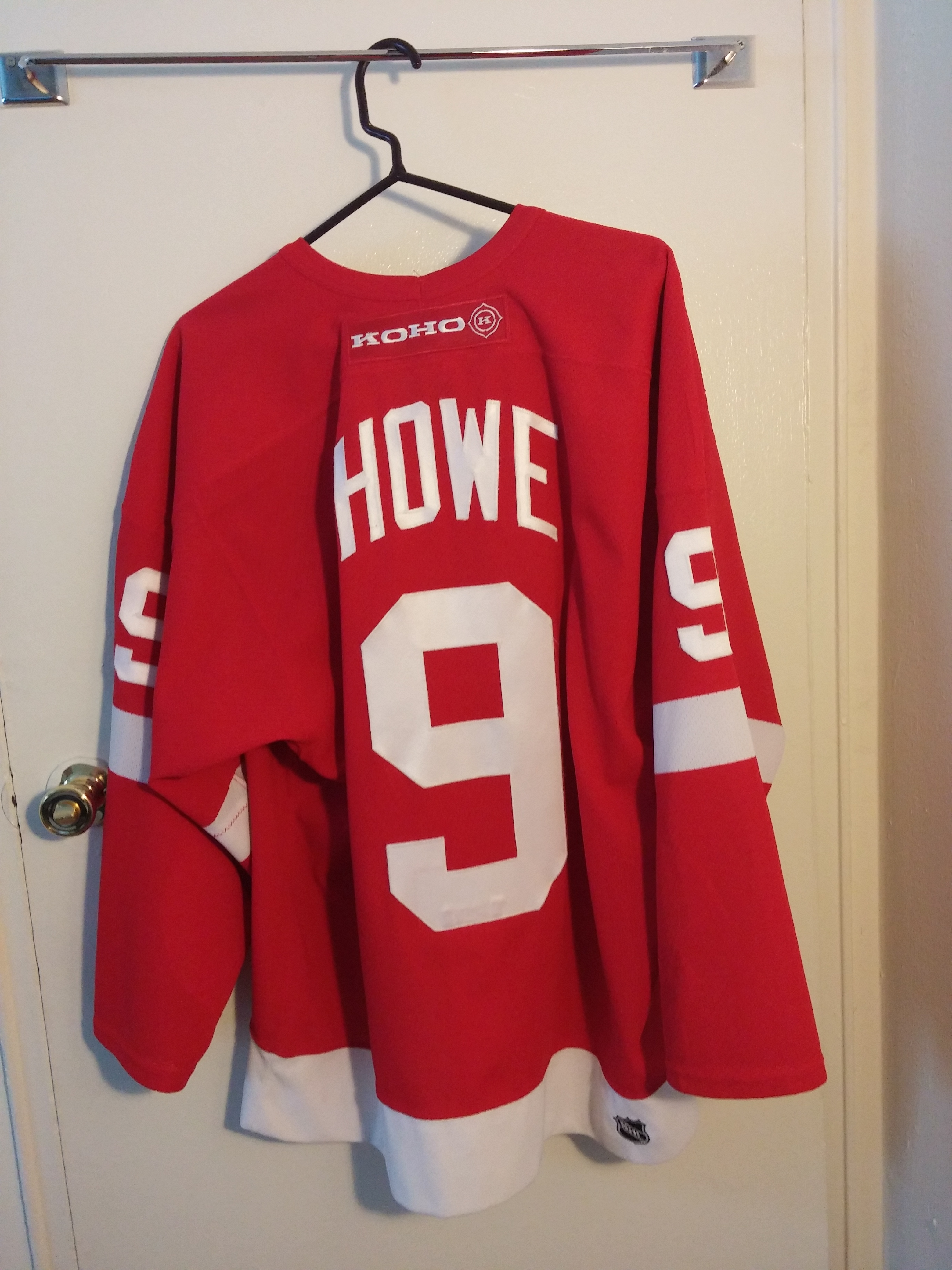
The sleeves of the jersey are fairly thick and end quite abruptly despite the jersey being made for a large, hockey playing man. The alleged reason that they end mid forearm is to prevent the cloth itself from wrapping around the player’s hands and restricting their ability to play but when you wear the thing, your forearms tend to get chilly. Ironic how that works. Each sleeve features one white stripe roughly eleven inches from the cuff and each stripe is about two inches or so in length. On the reverse side of the right sleeve, is the player number 9 which is another patch but it’s made of a much more silky material and again this patch is the same white color as all the other detailing of the jersey.

Looking into the neck of the jersey is a thick tag that reads “KOHO. AUTHENTIC ON-ICE GAME JERSEY. CENTER ICE AUTHENTIC. CHANDAIL AUTHENTIQUE.” This tag is mostly black with grey embroidering on the edges and the KOHO label is outlined in gold. Attached to this tag is a smaller white one with a Canadian flag on it that reads “MADE IN CANADA. FABRIQUE AU CANADA. HECHO EN CANADA. 48” and underneath this tag is another even smaller one that reads “48”.

Flipping over to the back of the jersey, the final emblems and patches are quite prominently displayed. A large KOHO patch sits less than an inch from the cover and is embroidered with scarlet and white, the letters of the word being white surrounded by a field of scarlet. About an inch and a half underneath the KOHO label is the name of player number 9, “HOWE”. The name is made of the same material as the small arm number and each of the ends of the name are slightly frayed from sitting against chairs. Finally about two inches underneath of that is the player’s number, 9 again made of the same silky material and very prominently displayed against the field of crimson. The patch is roughly twelve inches long and the 9 is cut in such a way that it looks as if it were composed of a bunch of trapezoids.

The reason why the jersey is so significant to me is far more simple than most would think, as it’s become very much a coat of arms of my family and it to me at least represents the relationship between myself and my dad. Like I explained before, my parents divorced when I was about eleven years old and as such I don’t see my dad a whole lot, as he moved to California to work. So in the ensuing decade, any time I got to see my dad was significant to me and through inheriting the replica jersey, it’s like I have a piece of him near me at all times.

IMG_20150124_154517