Learning about Where I Do My Learning

Object Description

My object is van den Berg Hall.  As a business major, most of my classes are in this building, as it is the current home to the School of Business.  The van den Berg Learning Center is located in the northwestern corner of the SUNY New Paltz campus.  It shares a border with Plattekill Ave. and is directly adjacent to Hasbrouck Park.  The exterior of the building is made largely of brick, along with a metal roof to prevent fire damage (more on that later).  The building itself has a vast area of 67,700 square feet.  While ground was originally broken for the building in 1930, multiple renovations have been made to the building.  Most intensively, these include the replacement of the original clock tower and large technological infusion that occurred in the mid-2000s.

Van_den_Berg_Hall_-_SUNY_New_Paltz

A photo of the front of van den Berg Hall – the home of the School of Business

Vandenberg_2_930x470_72dpi

The contracting company’s photo of new van den Berg classrooms, there is a projector that can be turned on and off remotely or at the touch of a button.

Historical Context

The current home of the School of Business, van den Berg Hall, is the second oldest building on campus, only behind Old Main (1909). As many would know, the educational institution now known as SUNY New Paltz was founded in 1828. At the time, it existed as the New Paltz Charter School. In 1933, it became New Paltz Academy, and then in 1885, the New Paltz Normal School was founded. New Paltz Normal existed as a school and training program / facility for young professionals and high school graduates to learn to become teachers. The school’s principals may sound familiar; Eugene Bouton (1886-1889), Frank S. Capen (1889-1899), Myron T. Scudder (1899-1908), John C. Bliss (1908-1923), Lawrence H. van den Berg (1923-1942).
Screen Shot 2017-04-25 at 7.41.25 AM

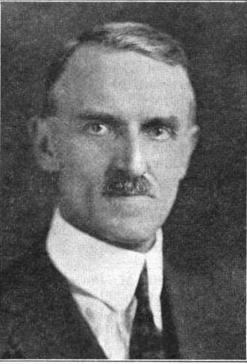
Lawrence H. van den Berg circa 1923 – when he was appointed principal of New Paltz Normal

At varying times during the first 45 years of its existence, New Paltz Normal grew and expanded, but during the 1920s, there became a need for a new training facility. In 1929, Principal van den Berg approved the architectural design for a new school. As perhaps one of the most interesting events attached to this story, a ceremony was held for the breaking of ground on this new project in October of 1930. The speaker at this event was Governor Franklin D. Roosevelt (who actually had trouble getting in as the crowd was so large in size). In 1932, this new school opened its doors, and in May of 1934, it officially became the Lawrence H. van den Berg School of Practice. The program offered slowly began to evolve as the improvements to the training process were implemented, and students began attending classes at the New Paltz State Teachers College. This new entity was founded in 1942, and van den Berg was the first president. Six years later, New Paltz was one of the founding members of the SUNY system. This new program served as a school for students ranging from Nursery school ages all the way through eighth grade. In 1982, the van den Berg school closed its doors to students, as the final graduation was held that June.
Screen Shot 2017-04-28 at 8.13.00 AM

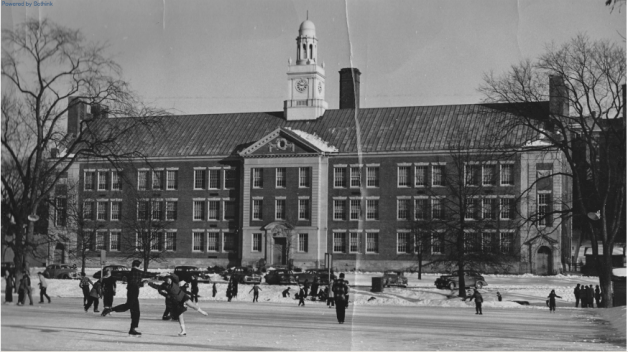
An old photo of the van den Berg School of Practice, featuring a view of Hasbrouck Park, where children are ice skating… Not something seen there anymore
vdb_1990

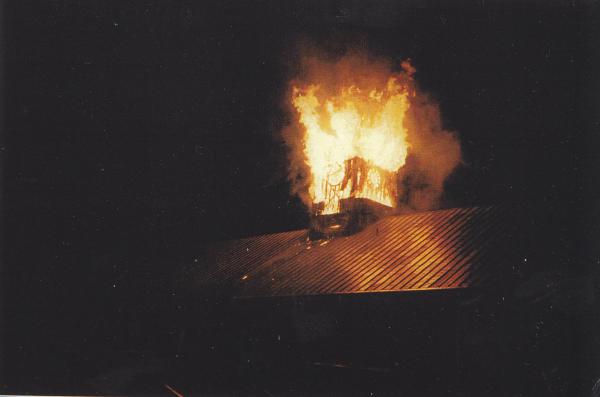
The 1990 Clock Tower Fire

vdb_2005

Installation of the new clock tower in 2005


Narrative

After the van den Berg Learning Center closed in 1982, the building served as the home for the Children’s Center.  In 1987, SUNY New Paltz created an accounting program, effectively laying the framework for what would later become the School of Business.  One would speculate that given my father’s personal experience in van den Berg as a student from 1988-89, that van den Berg housed this program.  In 1990, van den Berg Hall became an academic building under the umbrella of SUNY New Paltz, housing the School of Business. In May of 1990, there was a fire in the clock tower that caused damage in the building, but this was limited due to the fire retardant nature of the metal roof of the building. It is important to note that in the history of SUNY New Paltz (dating back to 1828), the primary building housing its programs had experienced severe fire damage, so it is likely the metal roof was planned as a precautionary measure to avoid a third occurrence. The new clock tower was installed in 2005.


Impact on New Paltz

There is a clear impact van den Berg Hall has on New Paltz, as it is an academic building on campus.  The building served as the home of the school prior to the founding of the SUNY system, so it gave New Paltz a platform to be a site for a public entity of the state when the system was established in 1948.  Now, van den Berg Hall houses the School of Business, which is why I’m here… So if nothing else, it is largely responsible for this blog post.  The SUNY New Paltz campus leans on an integration of its history and the future to create a strong academic environment.  When the van den Berg Learning Center closed, the education program shifted into Old Main, where it remains today.  At the time, the institution was named the State University College of Education at New Paltz, its name did not change until the academic programs became more diverse, officially changing to the State University of New York at New Paltz in 1994.  Since re-establishing van den Berg as a member of the campus, SUNY New Paltz has grown to encapture the spirit of New Paltz Academy and the Normal School; all of the dormitory buildings are named after former school presidents.  SUNY New Paltz is stronger than ever, creating more academic buildings and a firm place in the SUNY system, as one of the top schools in the state.  Integration of van den Berg Hall back into the SUNY New Paltz family was one of many steps that allowed the school to strengthen its reputation in the last 25 years.  Now, the institution is nearly 190 years old, and some of its richest history has occurred in, thanks to, or because of van den Berg Hall and its place in the New Paltz community.


Works Cited

Mid-Hudson Library System. Campus School programs : annual commencement programs, International Night programs, music concert programs, Children’s atre Workshop programs, also various brochures, newsletters and miscellaneous material from events held by the Campus School.n.d.: n. pag. Print.

“College History Collection – SUNY New Paltz Timeline .” Sojourner Truth Library. SUNY New Paltz, n.d. Web. 01 May 2017.

“History of the Campus.” SUNY New Paltz. N.p., n.d. Web. 26 Apr. 2017.

“New York State Education.” Google Books. N.p., n.d. Web. 26 Apr. 2017.

“Rehabilitation of van den Berg Learning Center.” SUNY New Paltz. N.p., n.d. Web. 01 May 2017.

Simons, Joshua. “Historic Preservation Commission.” Van den Berg. N.p., n.d. Web. 26 Apr. 2017.


Maybe it’s Just Not My Type

A few weeks ago, I read ahead on the syllabus and saw Professor Mulready’s suggestion to write a letter, or perhaps even use a typewriter to complete our analog experience.  I chose a hybrid of the two, as I wrote a letter with a typewriter.  I must say, it was a highly effective choice as this certainly was an experience.  To give a quick history on my knowledge and “experience” with typewriters, I have faint but fond memories of admiring the two my grandfather had.  One was in the study in his house, where my brother and I would often spend our time watching television, and another was at “the business”, the small warehouse / office space that occupied the business he and my grandmother inherited as I had cited on our first class day.  I’d never used these typewriters, maybe I banged on a few keys, but that’s about it.

Last week, I did my due diligence to ensure that typewriters were available, and learned I’d be able to check one out from circulation.  On Monday, I went to the library and asked to check out a typewriter… it turns out, the girl who was at the circulation desk (she was young, I could only assume she is a student who works there), was totally unaware that there were typewriters available for checkout… So she said this revelation made her day.  I’ll skip ahead to the first sign that this wouldn’t go super well.  The first typewriter I was given had a broken ribbon, so I could not even type.  I had to switch the typewriters out at circulation, and take two begins.  I’d venture to say this large case weighed about 20 pounds, just had an awkward feel, with a hard shell and tops that feel like a mix between plastic and tweed, but basically it seemed like a small suitcase.  I felt as if this process would be rather self explanatory.  Well, no, it’s not that easy.  I couldn’t find an alphanumeric 1 key, hitting shift+comma did not produce an apostrophe, and the spacing is tricky.  If you look at my drafted letter, you’ll notice I was off center, though I thought I did a pretty good job.  There was a serious fade in ink for my final paragraph, so I actually typed it twice, sadly making mistakes the second time over.  I’ll presume I went first, and that’s probably why Briana’s type was fairly faded (sorry!).  Lastly, I got a nice chuckle when I noticed the brand of my typewriter, Olympia.  I have never heard of this brand, but I currently work at Olympia Sports so to me, it was one of those mysterious, funny little connections that you couldn’t make up if you wanted to do so.

I’ll dive in to explain what I wrote and the actual experience now.  I thought it would be a wonderful idea to use this opportunity to write a letter to my parents.  The main focus of the letter is to thank them for all of their love and support, and I’ll be giving it to them next month on my graduation day.  I must say, typing these out in this setting rather than on a computer, or for some, a touch screen tablet or other device, was special.  I felt an extreme connection to what I was writing, and it’s even more remarkable because I’d already made an outline of this that I wrote in my notebook to avoid any writer’s block while at the keys.  So I’ll be honest, as far as ease of use, and of course, record keeping, digital technology blows typewriter technology out of the water.  The number one reason why I’ll say that is the ability to make mistakes.  Just in typing this blog, I’ve probably made north of 20 typing errors, whether it be hitting keys out of order, the wrong key, or misspelling a word.  But I have the ability to go back and edit, the magic of the red line indicating misspellings which I’m sure we’re all a little thankful for but you may also hate if you have a last name like Szymczak.  I’ll digress.  What I love about the typewriter, from my sole use, is the TLC factor instilled in it.  It’s not easily replicable, as in, it’s not like digital where I have the letter saved on my computer and could just reprint right now if I wanted to, and that’s special.  The mistakes, the faded type, they show a special extra effort taken to pen the letter that is lost in digital technology.  For that, and that alone, I very much enjoyed my experience, and am extremely thankful that I got to use this technology to express myself as I complete one of my final assignments.  So I’ll take this moment to digitally say it, thank you Professor Mulready for providing the extra incentive that gave me this idea, as I feel it’s one of the more special assignments I’ve completed in my time here at New Paltz.


Learning about where I do my Learning (A Draft)

I actually get to do something pretty fun with my history project, and I will examine the building I’ve had a majority of my classes, the current home of the School of Business, van den Berg Hall. van den Berg is the second oldest building on campus, only behind Old Main (1909). As many would know, the educational institution now known as SUNY New Paltz was founded in 1828. At the time, it existed as the New Paltz Charter School. In 1933, it became New Paltz Academy, and then in 1885, the New Paltz Normal School was founded. New Paltz Normal existed as a school and training program / facility for young professionals and high school graduates to learn to become teachers. The school’s principals may sound familiar; Eugene Bouton (1886-1889), Frank S. Capen (1889-1899), Myron T. Scudder (1899-1908), John C. Bliss (1908-1923), Lawrence H. van den Berg (1923-1942).

Screen Shot 2017-04-25 at 7.41.25 AM

Lawrence H. van den Berg circa 1923 – when he was appointed principal of New Paltz Normal

At varying times during the first 45 years of its existence, New Paltz Normal grew and expanded, but during the 1920s, there became a need for a new training facility. In 1929, Principal van den Berg approved the architectural design for a new school. As perhaps one of the most interesting events attached to this story, a ceremony was held for the breaking of ground on this new project in October of 1930. The speaker at this event was Governor Franklin D. Roosevelt (who actually had trouble getting in as the crowd was so large in size). In 1932, this new school opened its doors, and in May of 1934, it officially became the Lawrence H. van den Berg School of Practice. The program offered slowly began to evolve as the improvements to the training process were implemented, and students began attending classes at the New Paltz State Teachers College. This new entity was founded in 1942, and van den Berg was the first president. Six years later, New Paltz was one of the founding members of the SUNY system. This new program served as a school for students ranging from Nursery school ages all the way through eighth grade. In 1982, the van den Berg school closed its doors to students, as the final graduation was held that June. In 1990, van den Berg Hall became an academic building under the umbrella of SUNY New Paltz, housing the School of Business. In May of 1990, there was a fire in the clock tower that caused damage in the building, but this was limited due to the fire retardant nature of the metal roof of the building. It is important to note that in the history of SUNY New Paltz (dating back to 1828), the primary building housing its programs had experienced severe fire damage, so it is likely the metal roof was planned as a precautionary measure to avoid a third occurrence. The new clock tower was installed in 2005.


A photo of the front of van den Berg Hall – the home of the School of Business

Screen Shot 2017-04-28 at 8.13.00 AM

An old photo of the van den Berg School of Practice, featuring a view of Hasbrouck Park, where children are ice skating… Not something seen there anymore

I feel as if this is an interesting quick look into the history of New Paltz’s overarching higher education programs, and specifically at the history of the building in which I spend most of my class time. Moving forward in my research, I am fascinated to determine a few things, including all of the renovations in van den Berg, from classrooms, to the programs offered, to the construction of the VH annex, and the clock tower installation. Additionally, I’d like to look into the gap of work between 1982 and 1990. Fascinatingly enough, my father graduated from the School of Business, he describes in its infancy, and he states that he took a bulk of his classes in van den Berg during 1988 and 1989, which is inconsistent with my research. I suspect one of two things, 1) there happened to be a small window of time in which SUNY New Paltz classes were being held in van den Berg Hall, but prior to van den Berg becoming an actual “campus building,” or 2) my research is wrong. I’d obviously be hoping for the former, as that would be more interesting anyway. Additionally, I’d like to know when the name changed from School of Practice to Hall; I suspect this would be when VH became a SUNY New Paltz academic building, but that is certainly something I’d like to confirm.  I find there’s still a lot to be discovered, but it’s certainly exciting to get a closer look at van den Berg and SUNY New Paltz this way.

The Tale of the Cutty Sark

This week I’ll be discussing a bit of an odd family heirloom.  Perhaps heirloom is the wrong word, as basically I was asked if I wanted it, otherwise, it would be thrown away.  For some odd reason, I felt a strong urge to keep it, and so now, it sits in my room, sort of on display, sort of just in there.

img_2507

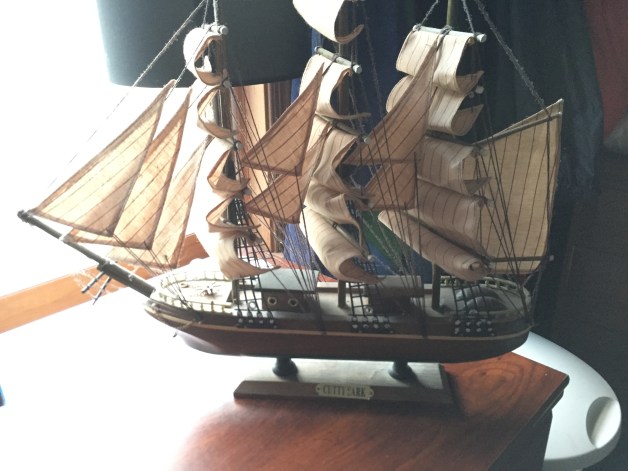
The replica model of “Cutty Sark”

This model, weighing somewhere around 3 pounds, it’s awfully light, is about 18″ long and 18″ tall (it doesn’t look that way but when you factor in the whole length and the tallest point, that’s a fair approximation.  Regardless of its dimensions, what I find additionally puzzling about the model is why it exists, or even more importantly, why my grandfather had it.  I researched the original Cutty Sark ship and it was a tea clipper constructed in 1869 that became a wool transport ship as steam technology was making sailing ships slow and outdated.  This was a fairly fast ship for a sailer, as it held the record from Australia to Britain for ten years; obviously the record was broken by a steam ship.  After its transport value diminished, the Cutty Sark exchanged hands and names a few times, lasting two generations in Portugal, but was finally repurchased for preservation in 1953 and has officially been out of service since December of 1954.  It would be important for the family ties to share that no one in my family is British nor Portuguese.  My honest guess for why my grandfather had this was that he was a history buff.  He was exactly one of those people that every time you saw him, he had read a new book about World War II.. I was always surprised with how limited his readings seemed to be, yet how extensive his knowledge of world history was.  He and my grandmother were world travelers, having been to dozens of countries, from Britain to France to Prague to Spain and quite possibly everywhere in between.  So as an honest guess, my grandparents were in Britain, and he had either known about or seen signage for the Cutty Stark museum, and bought this replica as a souvenir, perhaps the start of a collection that never got off the ground.  Maybe I’m mistaken, maybe it was a gift, or something given to him by a friend, I couldn’t possibly know.  I could only make the assumption that this wooden vessel is around or less than 60 years old, as that was when the ship was retired to be preserved.

Regardless of this, I still have no idea why I was so fascinated with it and wanted to keep it.  I’d never heard of the ship before so there certainly wasn’t any rationale for me to keep it due to my fascination with it.  Perhaps the thought of throwing it away was too painful.  Maybe I too want to preserve the Cutty Sark.  Personally, I wouldn’t find that true, and I’d probably place a lot more value on nostalgia, as my grandfather didn’t have many positions of this nature, and I wanted to maintain it for his sake.  Regardless, it sits with me, continuing to serve no functional purpose, just leaving me a memory, and a reason to wonder.

Cups Made for Memories

Previously, I’d described my habitus as the map I have in which I’m tracking which baseball stadiums I’d been to, and which ones I still need to conquer. Prior to this tracking system, I had developed a collection to commemorate where I’d been, and perhaps piece together when. In every trip I’d take, every stadium I’d attend, I would purchase the souvenir cup. The plastic, oversized cups used for marked up beverages, something I was willing to pay an additional $10 for, and may every time. That endeavor, assuming I ever attend all 30 parks, will run me $300 (another $230 now), before even considering tickets and travel.

img_2505

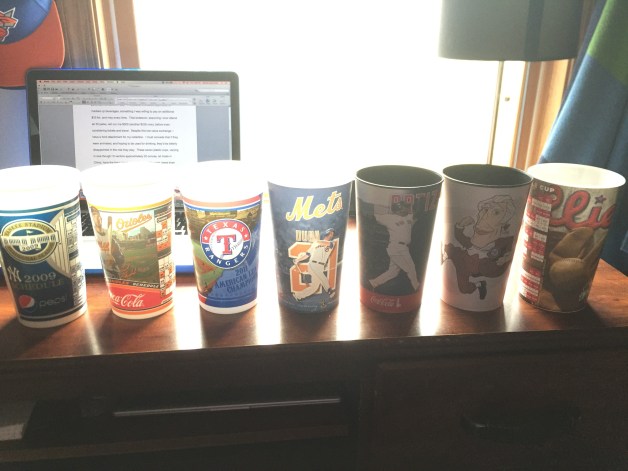
All 7 cups in order in which I bought them. Left to right: Yankees (2009), Orioles (2009), Rangers (2012), Mets (2012), Red Sox (2016), Nationals (2016), Phillies (2016)


Despite this low-value exchange, I have a fond attachment for my collection. I must concede that if they were animated, and hoping to be used for drinking, they’d be bitterly disappointed in the role they play. I use them as a display, and a reminder of where I’ve been, and when I see seven, I remember that I still need 23 more.  These seven plastic cups, varying in size though I’d venture approximately 32 ounces, all made in China, have the team logos, promotions, and the season’s schedule. I have accumulated this collection over time, ranging from 2009-2016, I would presume each one was manufactured in the year in which I bought it.  They vary in the messages they send, and are meant for drinking, I suppose, given that they are literally called souvenirs.  These cups obviously haven’t changed hands much, from manufacturer to buyer to the stadium concession stands where I purchased them.  I would enjoy my beverages on some hot days and nights, and some much cooler than I’d like (night games in May tend to leave you a little numb from cold).  Perhaps the most interesting part of compiling this collection is how difficult it is to get the cup from cupholder back to my house.  They’re so big and clunky and often still wet or sticky, without a lid to hold everything in.  It honestly is far more of a challenge than one would believe.  That fact, the obnoxious task of having to bring the cups from stadium to home, only increases my appreciation of them, as it is far more of an investment than it seems, I promise.  I’m sure you’ve all done it at one point or another, and you’ll probably agree, it’s just not as simple as bringing it home, there’s always something else at play.

Can a Watch Tell More Than the Time?

My wooden watch is a timepiece constructed of wood, glass, metals, a strap, and some batteries working to keep time.  It has a brown, leather strap that is loose fitting and comfortable, and as you can see, it has clearly been worn many times.  At its core, it is just a small, wearable timepiece. However, it means much more to me.

This was my “object that gives me joy” for the first class session. It is difficult to explain completely why it gives me so much joy, though I’ve often referred to it as the greatest gift I’d ever gotten. Perhaps it’s just the romantic in me, but I seem to have this grand appreciation for anything my girlfriend gives me. The watch is brown, a color I hate, and it doesn’t have any numbers, which would normally be a horrible feature for me (I often will make a mistake and say that the watch reads 7:22 as opposed to 7:27 in the picture above).  However, the watch seems to goes well with just about everything and I don’t seem to mind the lack of numbers. So why does a silly timepiece, less functional and harder to read than my cell phone, mean so much?

Perhaps it is what it means.  The watch obviously is what it is, but it serves as a symbol, as the date in which we started dating is engraved on the underside of the face.  Maybe it’s because I never imagined wanting it, I’m really not sure.  What I do know, is that I love the watch, it means more to me than what a normal watch does, and yes, it does serve as a nice accessory.  It gives me a tremendous amount of joy, and of course to me, it’s far more aesthetically pleasing looking at it in the picture above, than I really think.

Tying the Room Together

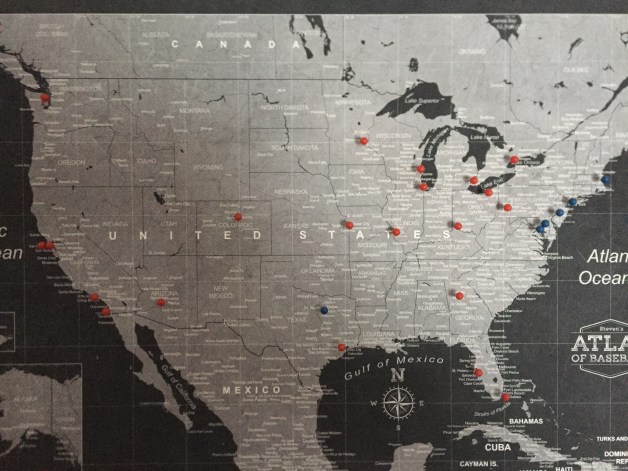
Throughout the reading, particular when Miller described objects in one’s home, I kept considering the phrase, “it really ties the room together.”  I felt that because it proved the point that I felt Miller is trying to make, that objects mean everything, and they also mean nothing.  To suggest that a room is not a room, or it isn’t a sufficient and fit room in which to be, if there isn’t a proper picture on the wall, or a beautiful pillow or blanket for the couch, perhaps a centerpiece or bowl on a table.  It’s cultural, it’s comforting, it’s downright odd.  With that said, I’ll move on into something I’ve gained some insight into recently about my own room.  I live at home with my parents, in the same room I grew up, and so many objects are new, but plenty are old.  I plan to graduate soon, and this means that in some capacity I plan to move out, whether I go to grad school or get a job, logistically, it may be a while until I do so.  Nevertheless, my mind moves towards what will stay, and what will go when I do.  I looked at all of the posters, bulletin boards, etc. hanging on my wall.  They provided comfort, they brightened up the room when I was growing up, and even in my recent endeavors.  Among these are TWO bulletin boards, I mostly hang pictures, school information, and other mementos on them.  Moving on, I have the headline from Derek Jeter’s final game in Yankee Stadium, a poster of the Super Bowl XLII (2007) Champion New York Giants, a few plaques I’d been gifted of old teams I’d admired, a frame in which the picture has been swapped numerous times (honestly I like the frame and that’s why it’s still hanging).  On Valentine’s Day last year, my girlfriend Alexa gave me a “candy poster”, which is my best way of describing it.  I’m sure some of you have seen one, it’s a poster with various sayings where candy is attached to add meaning, (ex. the first line reads “To my Sweetart” and a roll of Sweetart candy is attached).  Moreover, the bottom line is, at one point or another, these all meant a great deal to me, and in many ways they still do, or I would have taken them down a la Marie Kondo.  However, the most recent one I received is perhaps the most precious in that it defines me best.  Despite my affinity towards all of the posters and fixtures I’ve just described, they will likely stay here when I leave, and that’s not a bad thing by any means.  As cliche as this sounds, these are all symbols of where I’ve been.  So now you may be wondering logically, “won’t this new fixture turn out the same way.”  And the answer is yes, but not for a long, long time.  One of my true goals in life, and by that, I mean, my list of “A Thousand Places to See Before You Die”, consists of the 30 Major League ballparks in North America.  This Christmas, Alexa gave me “Steven’s Atlas of Baseball” which in its simplest form, is a map of North America.  The design purpose of this map is to showcase which stadiums I’ve been to, and which ones are still on the list.

baseball

My “Atlas of Baseball”

I conclude this by saying that this is my “habitus.”  For the rest of my life, I’ll never want to live without this, it is part of my lifestyle, as you all have no idea how badly I want to make those red pins disappear.  To think I’ve only made it to 7 of 30 (if you count closely, there are only 27 pins, as two won’t fit in New York, Chicago, and Los Angeles).  The bottom line being that for me, this map, will tie any room together.

The Necessity of Self-Evaluation in Tidying

Considering all the clothes I have, I figured it would be simpler, as far as the experiment is concerned, to examine my book “collection”.  Not to be a contrarian, but based on the discussion in class, I appear to have a much lesser affinity for books and literature than the others taking this seminar.  Recently, I tidied up my room, essentially cramming unnecessary objects in places where they will be out of the way.  Among those objects, at least for me, were my books.  Now not to get it twisted, I have not yet thrown away, donated, or otherwise disposed of my books, nor do I know if I eventually will.  When I looked at the collection, I discovered the books of my childhood, the some of the first series and books I’d ever read, including Harry Potter and even the works of Shel Silverstein, of whom I was a fan, and still am today.  Those books, ones that are all-time favorites, and ones I would like my children to read, ones with that great level of sentimentality that even my parents (who didn’t read the aforementioned titles) can appreciate, have been moved to a separate bookcase in our “extra room” in the house.  For the most part, the books that remained in my room were kept in a crate placed on top of a dresser, which in hindsight is a little dangerous, as I tried to get them down and it was not a simple task.  And therein lies the rub, since I put the crate up there about a year ago, this was the first time that I actually went to take anything from it.  Immediately I knew that if I adopted the KonMari practice, all the books would go.  I must admit though, when I took the books out of the crate, I became nostalgic and realized why I kept them in the first place.  Many of them are sports related, most heavily based on the Yankees, of whom I have been a huge fan for years, even though my dad is a Mets fan..  Anyway, I had moments where I remembered when I chose to buy the books, or who gave them to me.  Some came to me a long time ago, and others fairly recently.  Two were heavily a part of the beginning of my collegiate life, two books that I actually read for English 101 back in Senior Year of high school.  I remembered my appreciation of these books as I read them, and a lack thereof for those I never got around to reading.  I have long realized that I do not enjoy reading the way many others, like those in the seminar, do.  It’s certainly not something I take pride in, but something I’ve learned to “deal with”.  It’s entirely possible, and in my opinion likely, that I will never again have the compulsion to pick up a book and begin reading, although there have been books that have made me feel so before, and there have certainly been required scholarly materials that have felt glued to my hands.  So my pile on the floor is probably underwhelming and exceptionally modest to some, though to me, the weight of sentimentality outweighs that of the physical weight of my pile.  My after picture is of the crate, empty, fittingly so, as if I were to fully participate in the experiment, at least 90% of those books would no longer be in my possession, and there would be no need for a crate.  I wish that there was, or maybe for a personal bookshelf instead, but alas, I am not a reader, only a collector of things.

A blurry reminder of what once wasDisplaying IMG_2488.JPG


Perhaps what the future should beDisplaying IMG_2489.JPG