Social Butterfly

Before I left for class this morning, I knew what to expect as I continued packing by backpack, except this time throwing in a few extra things. I grabbed my pencil case housing all the sketching tools I could need, even though I only really use the HB pencil. I also packed my colored pencil set in case I got bored of gray and white. My sketchbook was small enough to fit in the bag with my other academic supplies, but just big enough to overwhelm me when I stared at the white, empty page.

When I walked through the classroom door, my peers were already settling into their activities: typewriting, coloring, crocheting. I unpacked my supplies and arranged them in front of me as I observed my classmates. The chatter of the class was typical and familiar, so I chimed in and giggled with the group every so often. I was enjoying conversing with my classmates when a foreign sound broke up our sentences. I have obviously heard the clacking of a keyboard before, so that does not grab my attention as this did. But the sounds of a typewriter, I have never heard. The clicking was different than a keyboard, more deeply pitched and significant. Each punching of a letter resounded as the paper moved from right to left. I wasn’t the only one who found the deep clicks intriguing. A recognizable member of the honors program staff, Alicia, peeked her head in the door in disbelief. She reminisced over the memories those sounds brought back to her, ones of her childhood and college days. These new noises interested me enough that I left my seat to get a closer look at this aged technology. I admired its construction and observed it carefully for a minute before returning back to my sketching.

I tried to settle into my analogue activity by opening my sketch book to a fresh page and laying out my colored pencils. I picked a random color in hopes to spark some creativity. I thought and stared at the page for too long. I kept getting distracted by the conversation around me. I consider myself to be a social person, so having a time during the day where I am encouraged to socialize, kept my mouth moving. When I wasn’t talking, I tried to return back to my empty page, but still nothing came to mind that convinced me to move my pencil.

At one point during the class, it was suggested that the record player be turned on, and classmates quickly voiced their artist recommendations. Everyone waited patiently for the music to begin. The vinyl spun as the album “Tapestry” by Carole King filled the air. The first song everyone knew, “I Feel The Earth Move,” and a few quietly sang along. This class day introduced me to not only one new sound, but two, as I have not heard the echo of a record player before. The song was slightly more muffled than I was used to when listening with my headphones, but I liked it. It was a cozier sound, that was just loud enough to create a warmth in the room, blending with the chatter and enhancing the ambiance.

Music always tends to put me in a productive mood and I finally started putting color on my blank page. I drew shapes and lines and dots, starting from the center of the page bounding outwards. Some shapes were colored in, others were just empty circles or curvy zigzags. I started, but quickly drifted my way back into the conversation. I added shapes here and there but mostly focused on what everyone was gossiping about.

This experience brought me to the realization that when I draw or color, I typically do it in solitude. The last time I was in any sort of drawing class was more than four years ago, making it difficult for me to be creative and also have a conversation at the same time. It is possible that I can perform both activities, but my work turns out less impressive and precise than I would like it to be, leaving it unfinished. It was slightly unusual for me to be in a classroom setting where I did not have to pay attention to the things going on around me. This fact did not prompt me to focus more on my analogue activity, instead I found myself still aware of my surroundings. Unlike some of my classmates, I am not studying art, so being surrounded by good conversation and laughter inhibited my creativity.

I learned that my ideal analogue activity is a form of learning, learning about people. Hearing something new I haven’t known about a friend or peer never fails to interest me. Observing, listening, and socializing keeps me connected and grounded, enriching my most powerful object, my brain. I have a great love for people and relationships. To understand them and care for them blossoms the love I have to give.

The Pyramid

Unfortunately, this photo does not have and artist to credit, but it was posted on The Atlantic and was taken during the 1920s, at the Great Pyramid of Giza.

Ever since we were children, my sister and I have always been inseparable. Perhaps it’s because we are identical twins, or maybe it’s because we only ever had each other. Mother and Father left behind little evidence of their existence apart from little trinkets and old belongings here and there. One item in particular held their memory the most: an old scrapbook documenting Mother and Father’s trip to Egypt. They were young and full of spirit, embracing each other in front of a landmark. I can feel the love and emotion radiating through the photograph. I suppose Mother and Father became busy (and a little forgetful) since the scrapbook was only filled to the second page, one page with two pictures of the desert and the other, being the only picture I have of them. The landmark that stood magnificently behind them was unlike any structure Sister and I have seen here in New York City, or anywhere for that matter. It was a simple yet complex object, a triangular prism, that started wide at the bottom and came to a perfect point in the sky. I couldn’t quite make out the exact color of the pyramid since the photo was black and white, but It appeared to be light in color, lighter than Mother’s tanned skin, but darker than the white clouds above. I couldn’t make out much else from the old picture but ever since we saw it, Sister and I knew where we needed to go.

Our fascination with this mysterious structure started out as our favorite game to play as children, where Sister was always the bold, strong leader of our adventures and I was the happy-go-lucky explorer who really only knew how to read our hand drawn maps. But slowly the longing for Egypt faded, becoming an unreachable destiny, a path never taken, a stone left unturned. We grew up some more, held jobs, and looked pretty for long enough for us to leave Grandmother’s tiny apartment and make homes for ourselves with our husbands. Sister was a teacher at the local elementary school and I found work at a nearby bookstore. We each enjoyed our jobs, even though there wasn’t much else for us to pursue. Sister had a child first just before I did, a sweet little girl. To my surprise, my child was two children, twin boys to be exact. We made an effort to allow the three children to grow up together, so they knew they would always have someone, just like Sister and I always had each other.

Sister and I were about to turn 23, so I was on the lookout for the perfect birthday gift. While restocking the dusty bookshelves, I mindlessly pulled books one by one from a big cardboard box, until something caught my eye. As I was reaching for the next novel, I noticed a familiar pointed shape. Towards the bottom of the box I dug out a thick book, and on its cover, the same pyramid behind Mother and Father. All at once the desire to explore and the longing for adventure came rushing back. I knew what I was getting Sister for our birthday.

At the end of the work day I took off to the nearest travelling agency. They questioned my destination choice but helpfully directed me to the harbor. A voyage out to sea was an ambitious mode of travel, but so what? Isn’t that what a journey is about? I left in a rush, feeling more spontaneous than ever, and set out for the water. I knew I was nearing the harbor when the air started to smell less like automobile fumes and hot dogs and more like low tide and fish.

I barely remember the trip home, as my mind was taken over by my forgotten childhood imagination. The thrill of excitement consumed me as I held the boat tickets in my right pocket. I could picture it, the pyramid, surrounded by a flat monochromatic landscape, rising tall and strong from the dusty earth. Finally, our dream is not so far from us.

3 weeks later, there we were, standing on the ship pulling out from the harbor, and I still couldn’t believe Sister agreed to embark on this long awaited exhibition. I suppose she still had the same deep wanderlust as I, even when our fascination slipped away from us. We waved goodbye to the children and our husbands until we could no longer see the bittersweet looks on their faces.

11 days at sea went by. We spent all our time thinking about the moment we finally reached land once more, in hopes it would come sooner. On the final day of the voyage, Sister and I trembled with excitement. There it was. The land of mystery and love. We have finally arrived in Egypt.

It was much more grand than I could have ever imagined, taking our breath away. Each rectangular rock fit together perfectly, making me wonder if one block was removed the whole prism would come tumbling down. The cracks and weathering were noticeable too, but somehow its aging made the pyramid even more beautiful and impressive. Sister and I stared at the pyramid for what seemed like forever, until Sister snapped out of it and noticed a large structure behind the pyramid that appeared to be ascendable. We were both wearing flowy skirts and our strapped high heeled shoes, making us ill prepared for the dry heat of the air and toughness of the rock. Our legs ached as we reached the top of the platform. Sister and I marvelled once more about the place we knew so well in our mind’s eye. I couldn’t comprehend the sight before me. All the years of wonder and curiosity has built up to this moment.

The longer we stared and baffled over this masterpiece, the more we realized travelling all this way hasn’t brought upon us any answers, and connection, or any new information about Mother and Father. For a second I grew angry; I had sincerely convinced myself that this moment would have the power to rid all the years of longing and sadness from my mind. Feelings of mourning the loss of Mother and Father grew more apparent than ever. I stood unsettlingly still, until I broke free from my thoughts when a man entered our field of view. I watched as he sat in front of us, legs crossed, in the perfect spot for viewing the pyramid. As he sat, he faced away from the pyramid, staring at something else. Sister and I looked at eachother, confused, then back at him. We turned away from the big triangle to see what this man could possibly be more interested in. He breathed deeply as he watched the sun set over the tannish yellow desert, creating a hazy glow over the land. I felt a rush of calm release, melting the anger and grief away. The thing we came all this way to discover held the intangible reality that might bring us a piece of our parents. The soft fading light of the sun washed away the false reality, leaving only peace and acceptance. Sister and I stood there in silence as we embraced this shared moment of existential bliss.

It was time for us to move onwards, carrying our newfound wisdom, without forgetting who we came from.

Works Cited:

Photo:
https://www.theatlantic.com/photo/2018/01/weird-wonderful-photos-from-the-archives/551378/#img12

Information:
https://study.com/learn/lesson/women-1920s-roles-jobs.html#:~:text=Women’s%20Jobs%20in%20the%201920s,-The%20United%20States&text=Women%20worked%20primarily%20as%20factory,typists%2C%20operators%2C%20and%20manufacturing.
https://drstephenrobertson.com/digitalharlemblog/maps/childcare-in-1920s-harlem/
https://metroairportnews.com/travel-by-air-the-golden-years-1920s-1960s/#:~:text=Airliners%20carried%20less%20than%2020,and%20hats%20to%20keep%20warm.
https://www.altexsoft.com/blog/travel-in-the-1920s/
https://vafsjay.quora.com/How-long-did-it-take-for-ships-coming-from-Europe-to-arrive-in-America-in-the-early-1920s#:~:text=In%20the%20early%201920s%2C%20the%20average%20voyage%20from%20Europe%20to,%2C%20speed%2C%20and%20other%20circumstances.

Community History Project: The Mantle Clock

Charlie Strittmatter

Image via Historic Huguenot Street website. This pillar and scroll mantle clock made in 1830 is decorated with a soft painting towards the bottom surrounded by a dark wooden frame. The clock made its way from its creation site in Connecticut to the possession of an influential New Paltz figure, Josiah Bruyn DuBois, who’s legacy, carried through this clock, rests in the permanent collection of Historic Huguenot Street thanks to his great-granddaughter, Emily DuBois Hoysradt.

The Clock

The wooden frame is stained to a dark brownish red that accentuates the natural grain of the wood while outlining the 20 inch tall, 17 and a half inch wide body. At the very top of this object, the wooden frame has a mirroring pattern of curvy, decorative wood carvings highlighted by the dark stain. The symmetry of the clock is conserved towards the bottom of the frame as well, but the carvings are more functional in that they serve as feet, holding the weight of the object.

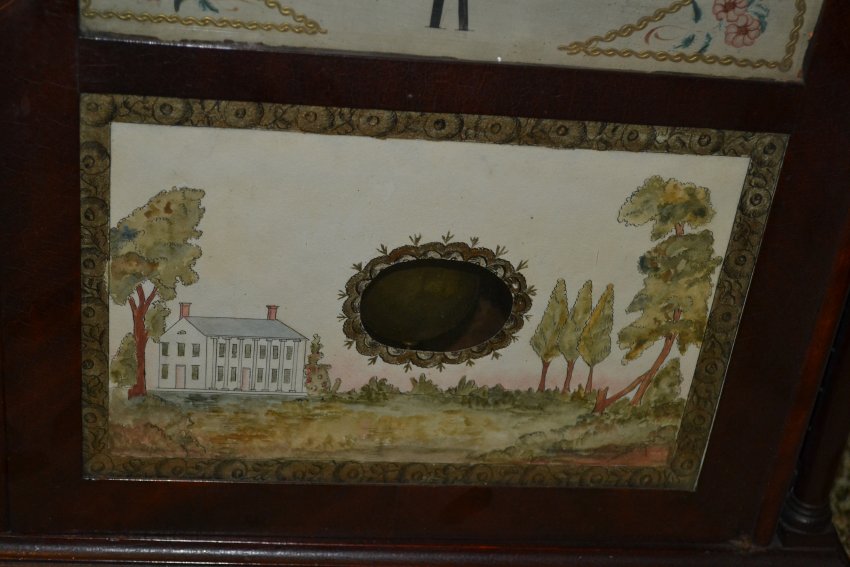
The hinged door, that reveals the clock beneath, is made of glass, to showcase the Roman numerals and pointy hands that indicate the time of day. The diamond shaped keyhole on the left side of the door stands out against the dark wood stain due to its stark white color. On the same rectangular plane as the clock’s Roman numerals, there are small, daisy-like flowers with bright green leaves painted in each corner, enclosed by squiggling gold lines. Below the clock, separated by a bar of stained wood, there is a more detailed painting of a simple landscape, which has been reverse painted onto the back of the glass paneling of the door. The painting depicts several trees growing on a lush, green piece of land with one lonely white estate rising from the grasses. There is an ellipse shaped portion in the center of the image that has been left unpainted so the holder of the object may view the clock’s golden pendulum as it moves with time.

Image via Louise McGoldrick, staff of Historic Huguenot Street. A closer look at the reverse painting on the lower portion of the glass paneling of the hinged door.

Provenance

This mantle clock was originally made in 1830, by a company called Eli Terry & Sons of Plymouth, located in Connecticut. This company manufactured several varieties of mantle clocks of the same configuration as this one, each with their own unique decorations in the corners of the clock as well as uniqueness in the paintings below the clock. Originally, the clock was owned by Josiah Bruyn DuBois Sr. who made a living mainly as a merchant in New Paltz, with his business partner (and father-in-law) Josiah Hasbrouck. It is unknown how he obtained the clock, whether he purchased it himself or it was gifted to him by another. Being a member of an influential family in New Paltz society, the mantle clock remained as a family heirloom passed down from generation to generation.

The clock eventually landed in the hands of Josiah’s great-granddaughter, Emily DuBois Hoysradt. Emily was a local artist and included this beautiful mantle clock in one of her works. Later on, Emily gifted the clock to Historic Huguenot Street where it belongs as part of the sites’ permanent collection

Image via Historic Huguenot website. Emily’s painting features the mantle clock, located above the fireplace, as well as a chair and candle holder, all which are objects she donated to Historic Huguenot Street. She even donated this painting.

Connections

At the time, a mantle clock like this one would have cost between $30 to $60 compared to now where the worth of the clock has increased to between $1,000 to $2,000 today. During the 1830s, this sum of money was not of billionaire status but it did reflect someone who lived comfortably. Josiah’s merchant business was successful enough not only for him to be in possession of this lavish clock but also to construct a home along Wallkill River on a plot of land named Libertyville, now Libertyville Road.

This land had been under the proprietorship of the DuBois family beginning with Josiah’s great-great grandfather, Louis DuBois, one of the founders of New Paltz. The house Josiah built was a Federal style estate, which was not small and typically consisted of 2-3 stories. These kinds of homes were based on symmetry, similar to the clock’s construction. Josiah’s house also may have resembled the estate depicted in the bottom left of the painting on the mantle clock, rectangular in shape with a door in the center and an even amount of windows on either side of the entrance as well as on the sides of the house. On the interior, houses like these typically were decorated with wooden furnishings and accents, curved structures, and lots of intricate molding and wallpaper. It can be imagined that the mantle clock may have been a centerpiece in a room with a cozy fireplace and plenty of places to sit. It may have been in the kind of room Josiah and his business partners conducted work, as they had their hands full with tasks so it was important they be aware of the time in case they needed to attend to other matters. This house is historically known as the Blake House although it was built by Josiah DuBois, it was eventually sold to William H. D. Blake, who’s name remained.

Josiah’s work was almost exclusively to do with money and financial activities. This included buying and selling goods from his store Josiah ran with his father-in-law Josiah Hasbrouck located in what is known as the Jean Hasbrouck House. Many of his documented sales also included goods such as magazine subscriptions, livestock, as well as enslaved peoples. Josiah also documented many exchanges of labor where workers were paid for their time and service. He handled much of his family’s real estate business as well, evidenced by the numerous documents of deeds, mortgages, maps, and legal papers meticulously dated and signed by Josiah.

Josiah’s role in the New Paltz community extended further than him being the local merchant and familial land manager. He was influential enough to be a member of the local political sphere, in which he served as Overseer of the Poor. This job was one he was elected to do, meaning one of two things, he was a trusted individual of the community or he was a member of an elite family that had the power and privilege to control certain aspects of society. Josiah’s role in this position was important for those who were not as privileged as he may have been. He provided money and resources for those in need and could not afford food, clothing, or medicine. Overseer of the Poor was a role that was common in most local communities during this time. Typically each town would have their own Overseer who distributed money to those who needed it most. Evidence of Josiah’s work was carefully documented and included every cent he authorized to be expended along with what it was used for and a reasoning why. Overseer of the Poor is interestingly an early version of the modern welfare systems we have in place today. Although Josiah’s role was limited to the local level, it can be observed that his field of work was significant and transformed into a hugely vital part of America’s modern political system.

Circling back to the object that started it all, the clock itself is reflective of the kind of lifestyle and taste Josiah DuBois had during his time of life. It serves as a reminder of the influential families that not only founded a thriving town, but also brought forth government systems and policies that are still in use today. The mantle clock emphasizes the idea that although time moves forward, systems, political practices, ways of life, and societal structure have persisted and remained as part of present day life, just like the existence of the clock, in all its antiquity.

Works Cited

Apmann, Sarah Bean, and Sarah Bean Apmann. “The Federal Style Explained – Village Preservation.” Village Preservation – Greenwich Village Society for Historic Preservation, 19 May 2020, http://www.villagepreservation.org/2016/03/30/the-federa.

CONTENTdm. nyheritage.contentdm.oclc.org/digital/collection.

Edit Cell. cs.newpaltz.edu/p/s23-06/v5/item.php?pkname=cid&i.

Eli Terrys for Sale. Prices, Appraisals and Auctions Rochester NY. http://www.cottoneauctions.com/for-sale/eli-terry.

Inflation Rate Between 1830-2024 | Inflation Calculator. http://www.officialdata.org/us/inflation/1830#:~:tex.

Miller, Ann Brush, and Virginia Transportation Research Council. Orange County Road Orders, 1750-1800. 1 Jan. 1989, rosap.ntl.bts.gov/view/dot/19247#:~:text=Ea.

Tschirch, John R. “Federal Style Houses: A History.” Period Homes, 14 Nov. 2017, http://www.period-homes.com/features/history-federal-style. Accessed 5 Nov. 2024.“William H. D. Blake Family Papers (1794-1982) — Historic Huguenot Street.” Historic Huguenot Street, http://www.huguenotstreet.org/william-h-d-blake-family-papers.

Dr. Bronner’s Magic All-One Chocolate

Charlie Strittmatter

Image via Dr. Bronner’s website, featuring the flavor I purchased, Smooth Coconut Praline (highly recommend trying).

A few days ago I was craving something sweet. I’ve never really been one to enjoy a chocolate bar on its own, although I always liked chocolate in baked goods or added to other things. As I have matured and gained some sense, chocolate is a commodity I am delighted to get my hands on.

I am not interested in just any brand of chocolate, but real chocolate. Certainly not Hershey’s or even Ghirardelli or Lindt. The chocolate I eventually settled on purchasing was Dr. Bronner’s Magic All-One Chocolate. Dr. Bronner’s, as a brand, is collectively most known for their long line of castile soaps, ranging in a variety of scents and forms, from liquid to solid bar. But to my surprise, they also make chocolate. As I was scanning the candy aisle in the ShopRite just up Main Street, my eyes were drawn to the bright magenta paper wrapping and silver holographic letters printed over top. I carefully scanned the ingredient list and eventually decided I was okay with these ingredients entering my body, the thing I try to keep happy the most.

Image via Dr. Bronner’s website of the ingredient list.

The reason I chose to purchase this chocolate bar over the other kinds is because of the nature of the ingredients. Each item listed (excluding the sunflower oil) was labeled as “fair trade” and “organic.” I appreciate this because it is difficult, especially now, to find things with ingredients that are sourced ethically or not sprayed with chemicals. This led me to look into where these ingredients really come from and determine if I believe Dr. Bronner’s claims.

Something that did persuade me to trust such a big company is the way Dr. Bronner’s was founded. Emanuel Bronner, a third-generation soap maker, prided himself on his push for unity and harmony among humanity after suffering the loss of both his parental figures as a result of the Holocaust. Emanuel began Dr. Bronner’s in 1948 with this as the driving force backing his brand. The central statement is written on the packaging of his products: “IN ALL WE DO, let us be generous, fair & loving to Spaceship Earth and all its inhabitants. For we’re ALL-ONE OR NONE! ALL-ONE!” Emanuel wanted to spread his message of unity and ecological fairness on his well known soaps. The company was inherited by his family and is now under the management of two of his grandsons, David and Michael, who continue to spread his meaningful message.

Returning to the chocolate itself, I began to dive into the most important part, the ingredients list. I was pleased to discover how easy it was to find the origins of most of the ingredients, as they were explicitly listed on the Dr. Bronner’s website. The cocoa beans are harvested from a large farm in West Africa, specifically Ghana, where the workers seem content with the job they are doing based on the feel-good video provided on the Dr. Bronner’s website. Slightly south and further east is where the cocoa butter is sourced, from the Democratic Republic of Congo. In combination with these chocolate products is the sweetener, the coconut sugar, which has come from across the Indian Ocean, Indonesia. A little flavoring of vanilla brings us back closer to the cocoa, from Madagascar. I was unable to find the source of the sunflower seed oil, which I am slightly disappointed about since it was the only thing in the ingredients list without being labeled as “fair trade,” but still as “organic.”

All of these components are then (most likely shipped by plane or boat) brought together in the perfect ratios in Switzerland, the masters of chocolate in my opinion. From there, I can infer the bars are then sealed up in their thin silver foil, rolled in brightly colored packaging (which is made from 100% recycled paper), and sent over to the Dr. Bronner’s headquarters to be distributed to the masses. Their headquarter resides in, you guessed it, none other than California, more specifically, in a city called Vista. Domestic shipments across the United States land the chocolate bars in their semi-final resting place. I am unsure of how ShopRite receives their products, but I can imagine they get scheduled shipments of inventory to display on their shelves.

From the company executives, to the foreign farmers, then to the shipping workers, passed onto the skilled chocolatiers, shipped to the store retailers, and finally, in the hand of the consumer (me), this chocolate has traveled more than I have and most likely ever will in my lifetime. Now, the chocolate bar is sitting in my dorm room fridge, half eaten but thoroughly enjoyed.

Works Cited:

“Smooth Coconut Praline – Dark Chocolate Bars.” Dr. Bronner’s, www.drbronner.com/products/coconut-praline-pack-magic-all-one-chocolate.

“Dr. Bronner’s Magic All-One Chocolate Bars – Dark and Oat Milk.” Dr. Bronner’s, www.drbronner.com/pages/magic-all-one-chocolate.

“Dr. Bronner’s | Who We Are | Our Cosmic Principles.” Dr. Bronner’s, www.drbronner.com/pages/about.

Roger’s Token

Charlie Strittmatter

My necklace

Since being tasked with writing my previous blog post, I continued to be intrigued by the story and history behind the necklace I treasure. It only made sense to me to continue to share its story as it unexpectedly revealed itself to me. This object formerly meant (and presently still means) a great deal to me. Although, through nostalgic conversation and inquisitive questioning its meaning and importance has entirely transformed.

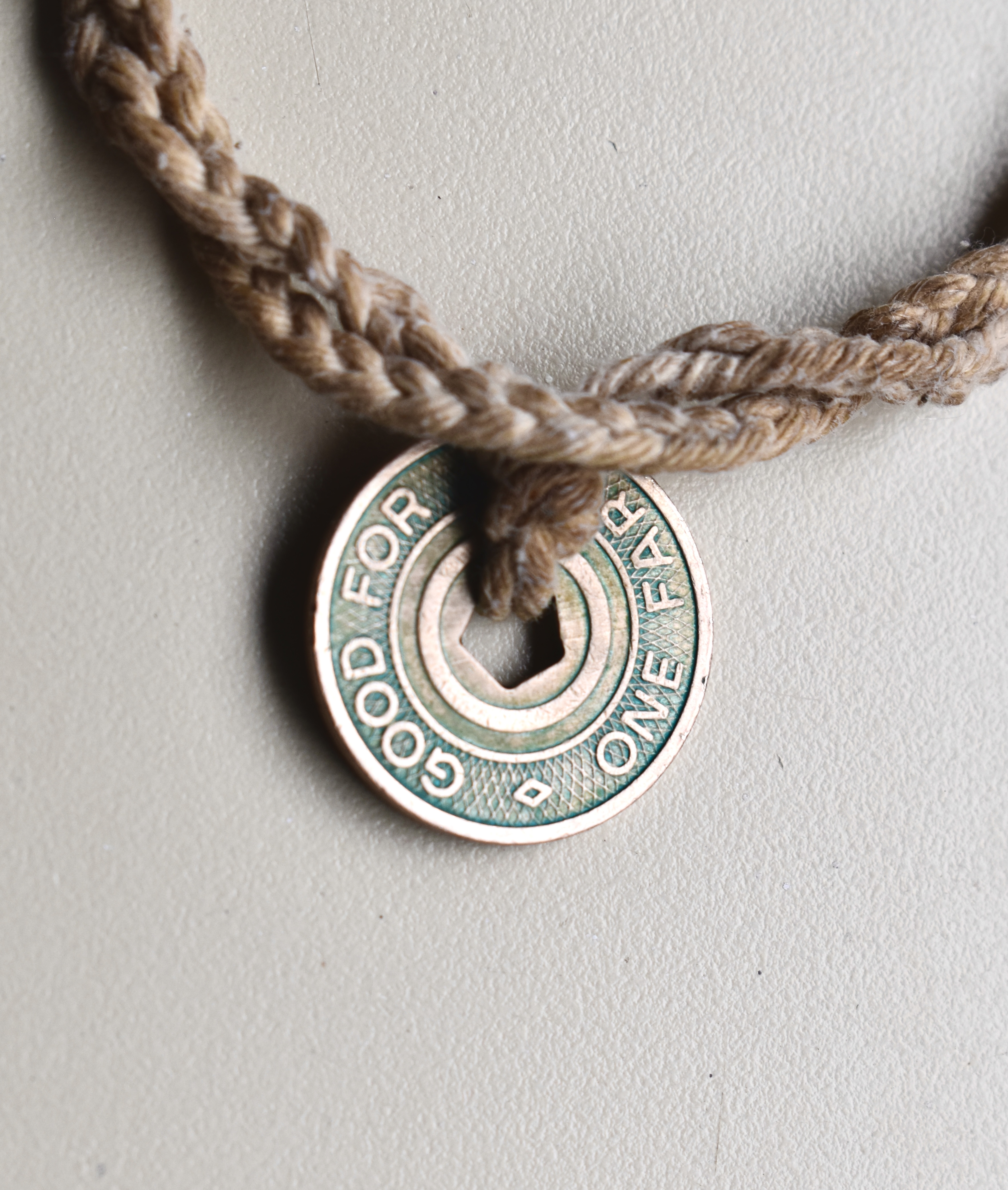
This necklace, in all its simplicity, I cherish immensely, because Eric made it and gave it to me. It hangs on the shorter side, the chain being made of a thin braid of three pieces of twine. A New York City subway token, fixed in the center of the necklace, is attached tightly with another, smaller braided piece of twine. To start off easy, I asked Eric from where he had gotten the string the necklace is made out of. The farthest back I got regarding its original location was in his pantry, but the string now resides in his bedroom. It sits there, still bundled up on a cardboard spool, waiting for the next time Eric puts his creative skills to use. The focus of my curiosity, the token, was discovered when Eric fished it out of a jar, filled with miscellaneous objects, he had found sitting in his father’s room. 

About three years ago (when he first found it), Eric fashioned the token onto a metal chain that he wore around his neck consistently for quite a while. Eventually, the chain had seen better days and snapped, no longer able to hold the token. Eric kept the token, awaiting a time when he came across a more functional chain to replace the old one. That led me to question why he eventually fashioned the token onto a twine necklace and then gifted it to me. Eric said he wanted to give me a gift that was unique and special to him; it being special to him because he believed that his father kept the token for a reason. That statement sparked more interest in me, since Eric had not known the reason why his father kept the token.

After a while of interrogating Eric, I hit a wall with the information I received, and took matters into my own hands. I sent a text to Eric’s father (Roger), this time, questioning the person I perceived to be the original owner of the token about its origins. The token’s story began to unveil itself.

Young and curious, Roger agreed to go on a trip with his father into New York City. The city was not new to his father, since he was an employee of the Long Island Rail Road and enjoyed traveling often. His father was very familiar with how to navigate the subways, so he knew what lies in store for them. As they arrived in the city, Roger’s father had told him that he wanted to show him a special place few people knew about. I can imagine that Roger was initially excited about this obscure location, but grew confused when he and his father never moved—why they never stepped off the subway each time it stopped. I can also imagine the anticipation building each time the doors opened, waiting for his father to lead the way off the rickety train, signaling they had arrived. The subway took them farther and further, deeper into the city, until finally, they stepped out.

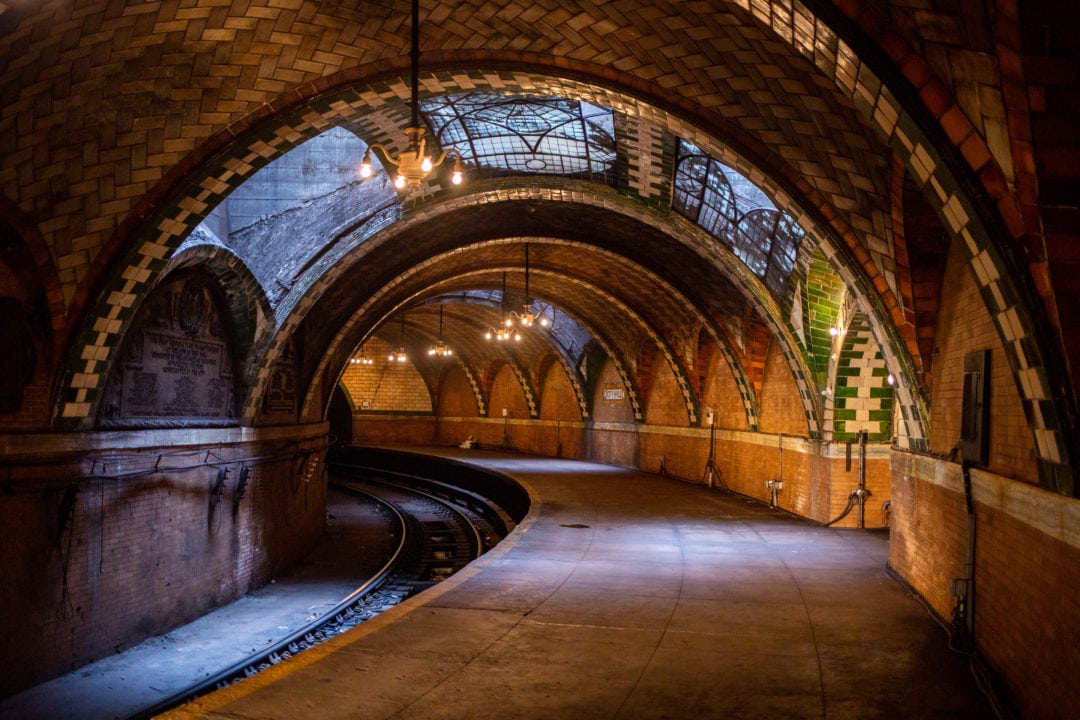
As a lover of architecture, Roger was in awe. The grand arches of Old City Hall, lined with precise tile work, bridged from one side of the tracks to the other, stretching above him and his father. Skylights made of beautifully intricate stained glass let in just the right amount of sunlight to brighten up the darkened tunnel. The lighting was soft, unlike the other subway stations where the fluorescent lights pained your eyes. Here, the natural light combined with the amber bulbs carefully placed in hanging chandeliers above the tracks, lessened the harshness of the subway station. The subway and its stations are known for being filled with antsy people, rushing to get on the train, trying to keep their child under control, hauling 5 suitcases bumping into everyone in their path. Here, time is slowed down, and wound back, back to another place in history. Back to a place where things took time, skill, and patience to create. The remnants of New York City’s transportation history remains wonderfully intact, encapsulated by the opulence of Old City Hall. As a way to remember the trip, Roger’s father had given him the subway token. Every now and then, Roger picks up the dulled token and is reminded of that day, and that subway ride.

This story not only tugged at my heart strings, but made me feel differently about the token hanging from my neck. Should I even have this? It felt wrong being the owner of something with such a sentimental and personal story attached to it (especially since it was not my story). It no longer felt like the token was mine. I expressed these feelings to Eric, who reassured me that Roger had plenty of these tokens, and he did not mind that I held on to one. This is when I truly realized, this is how objects work. They are supposed to change meaning, supposed to evolve. The token, a symbol of remembrance, once shared between a father and son, now reminds a girl of the one she loves.

The obscure location, Old City Hall Station, Photo: Alexandra Charitan

Works Cited:

Roadtrippers. “Here’s your chance to see NYC’s dazzling, abandoned City Hall station without risking a criminal trespass charge.” Roadtrippers, 16 Apr. 2019, roadtrippers.com/magazine/old-city-hall-subway-station.

The Necklace I Treasure

By: Charlie S.

About a year and a few months ago, Eric made me a necklace out of some string he had lying around in his room. To me, this was a grand gesture of love and appreciation for our relationship even though we have a decent distance between us most times during the year. This necklace always reminds me of him and the memories we made when we were not so far apart.

Approximately 14 inches measuring from knotted end to knotted end, the necklace falls perfectly in the concave crater created by the merging point of my collar bones. The string, most likely made from cotton, has a rougher texture in relation to other textures of string, but has softened the more I wear it. It used to be bright white, but over the long year in my possession the twine has turned brownish-yellow from my constant insistence to keep it on at all times. There is a large knot on either end of the necklace, its purpose to keep the twine from unwinding. The ends of the knots have developed short, frayed tufts of freed twine that stick straight despite being soft to the touch. The bulk of the necklace, made from three individual pieces of string, is a braid, for the reason being that Eric is unknowledgeable in how to craft any other kind of strand out of twine. Its simplicity is obvious, but the tightness of the braid itself has maintained very nicely from the tediousness of Eric’s fingers, keeping the individual pieces of string taught in the making of the necklace.

Even though it functions as one piece of adornment, the necklace is made up of two separate parts: a longer, older gift, and a shorter attachment that came with something eye-catching. The longer piece of braided necklace was gifted to me about 2 months before our first parting for the academic year. The shorter segment of the necklace, that Eric carefully crafted a few months later, was created with the purpose of being a “unique” addition to my already existing piece of remembrance. Eric managed to attach a token to the separate, smaller segment of braided twine with some sort of knot I still cannot understand (and Eric is unable to explain). I believe this might have been a thoughtless recall of Eric’s knotting skills from his days as an Eagle Scout. The segment holding the token, somehow, precisely coiled itself around the original twine necklace, perfectly centered, and has cemented itself in that exact position. 

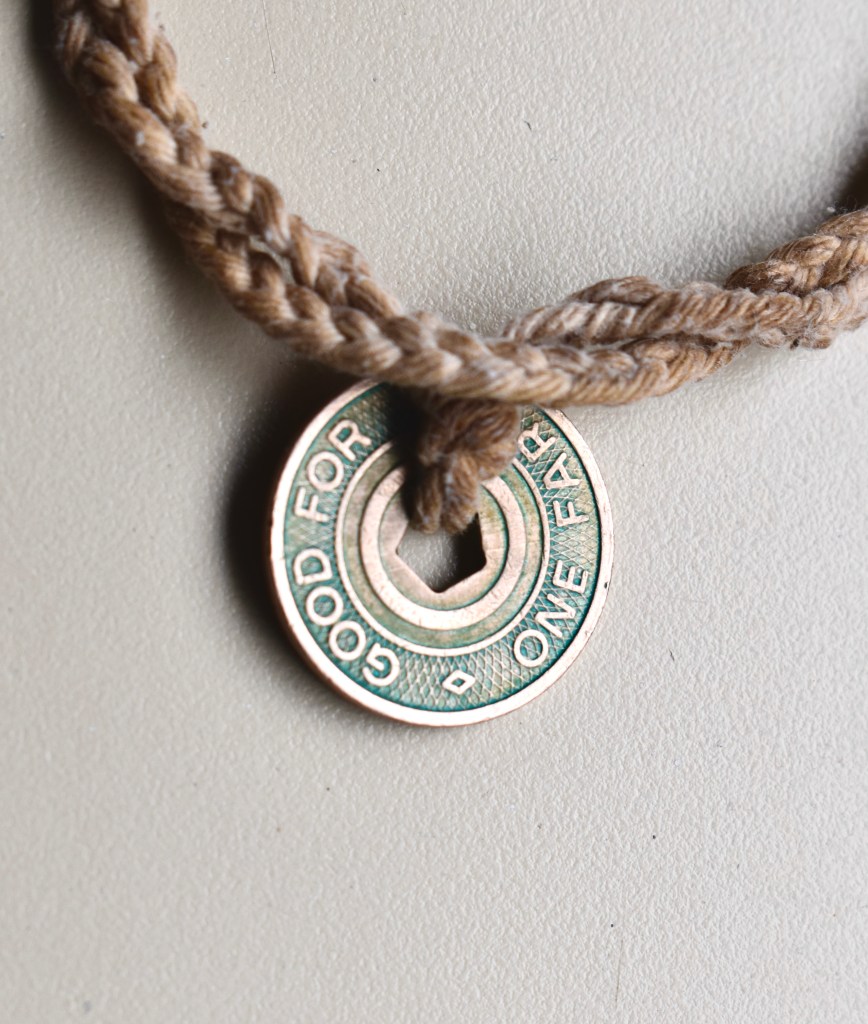
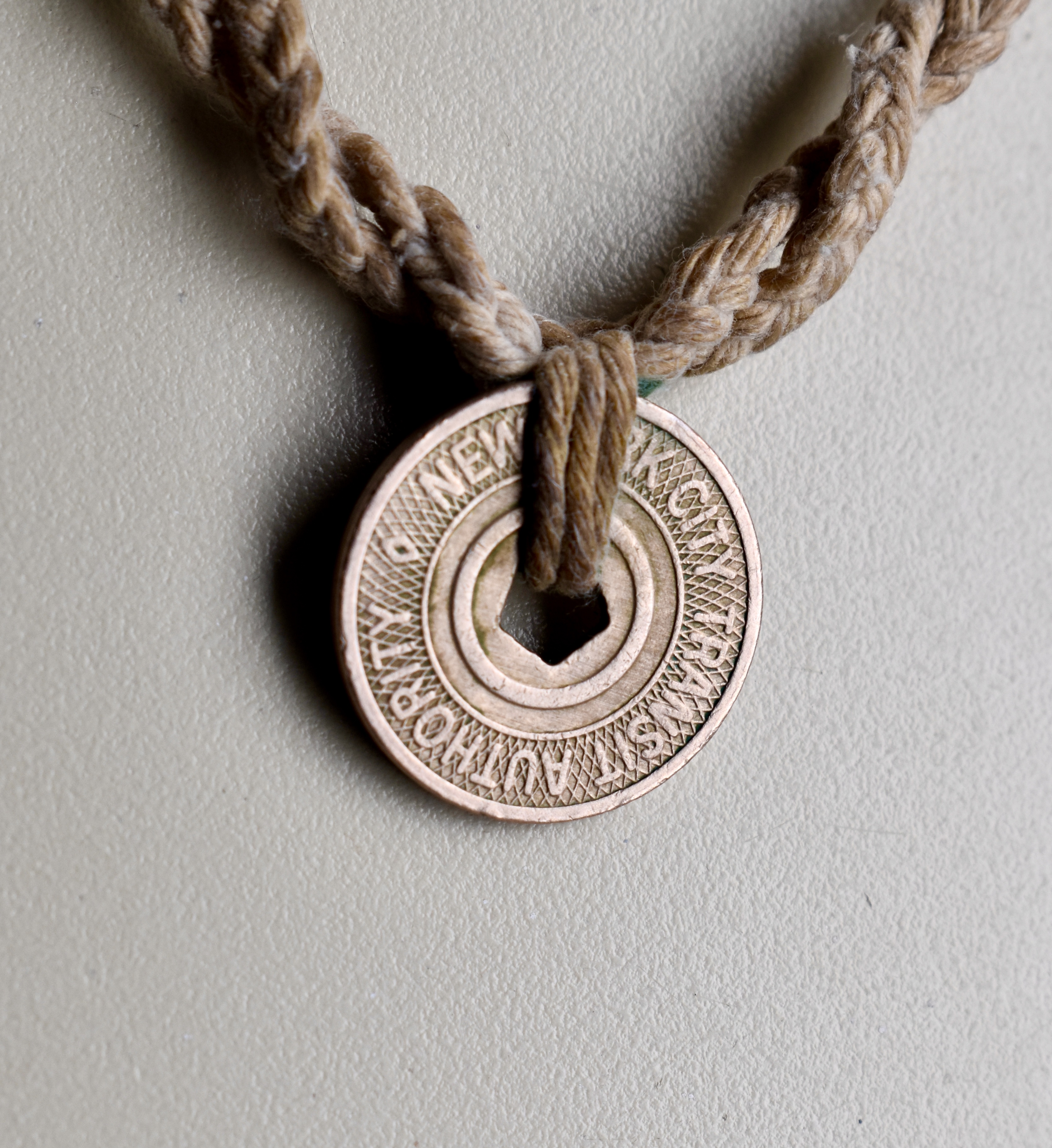
Eric eventually mentioned to me that the thing hanging from my new favorite necklace is a New York City subway token. This token being an object I had never known about until it was uttered into existence. Although the token was unfamiliar to me, I believed it to be interesting enough to wear around my neck for all to see. The token is round with a visible thickness to it, but not so thick that it is too clunky to wear around one’s neck. There is a pentagonal shape cut out from the middle, making it a perfect necklace charm. It appears to be smaller than a quarter, but slightly larger than a nickel. On the front facing side of the token it reads: “New York City Transit Authority.” The beginning of the statement is separated from the end with a small raised diamond, floating, spaced evenly between the first letter “N” and last letter “Y”. Behind the lettering is a diamond grid pattern that makes the words stand out against the monochromatic metal token. The words are surrounded by an outermost ring of smooth, unprinted metal and an inner ring slightly thinner than the outer one. Further within the slightly thinner ring is yet another ring, pressed flat enough to notice a difference in height between that and the previous ring. Repeatedly, there is then one more final ring that is the thickest in width and is raised to the same height as the outermost and inner raised rings. The final portion of the token is the center, where the pentagon shape has been pierced through a more flattened part of the token. On the opposite side, the alternating ring pattern is consistent with that minted on the front. The coloring of the backside is more greenish in contrast to the silvery front, most likely due to its age. The back also has another, differing set of words reading: “Good For One Fare.” This time, there are not one, but two raised floating diamonds: one separating the “G” in “Good” from the “O” in “One” and another separating the “R” in “For” from the “E” in “Fare.”

I have realized through this description I feel more of a connection to this necklace than some of my other pieces of jewelry. Because of the nature of its existence, this necklace never fails to make me smile each time I feel the cool, yet smooth token between my fingers. It reminds me that there is someone out there that cares about me.