The Not So Sunny Side of Historic Huguenot Street

Collars are objects that we often associate with animals, specifically dogs, in order to keep them constrained and close to their owner at all times. In modern times, it is rare that we associate collars with the containment of human beings, yet this inhumane act of cruelty is exactly what happened on Historic Huguenot Street throughout the 18th century.

E. Hardenbergh Slave Collar
The slave collar on display on Historic Huguenot Street. It first went on display publicly in 2016, after Joseph McGill, founder of the Slave Dwelling Project, came to town to spend a night in the slave quarters in the Abraham Hasbrouck House. Engraved in the collar is the name, E. Hardenbergh.

Physical Description

The object I chose to contribute to this collaborative history project is the slave collar that was shown in the Abraham Hasbrouck House. The slave collar that is part of the Huguenot street collection is made of steel and brass. There is a label on the front and a lock on the back that can be tightened based on the circumference of the wearer’s neck. The label is engraved with the slave owner’s name, “E. Hardenbergh,” in neat cursive. There is a peculiar decorative element to the label, with pointed arrow-like symbols engraved around the border. The label is attached to a thick chain link, to ensure security of the collar while in use.

Provenance

The name on the collar, “E. Hardenbergh,” refers to Elias Hardenbergh, son of Abraham Hardenbergh who was the Supervisor of the town of New Paltz from 1751-1761, and then again in 1770 (Le Fevre, 456-457). Elias Hardenbergh was also a relative of Colonel Johannes Hardenbergh, who was a citizen of Swartekill, NY, and owned seven slaves according to the 1790 United States Census. According to the John Jay School of Criminal Justice’s New York Slavery Records Index, Johannes Hardenbergh was the owner of two slaves named Elizabeth “Mau Mau Bet” and James Baumfree, who had a daughter named Isabella. Isabella Baumfree would later change her name to Sojourner Truth.

According to information provided by the Historic Huguenot Street archives, the slave collar was given as a gift from Andrea Coons Foster in January 2010. Preliminary research suggests that Coons Foster is a descendant of a family associated with Huguenot Street. Something that I found interesting was that despite the collar being donated to the historic site in 2010, it wasn’t displayed publicly until 2016. I’m curious as to why the Huguenot Historical Society waited so long to display the collar.

Narrative

Studying and analyzing history almost always guarantees a look into the darker sides of society. Throughout history, there have been many horrific occurrences that make us question how these things could have possibly happened–slavery being one of them. Slavery can be defined as the process of taking ownership over another human being and forcing them to do laborious tasks without their consent. When discussing slavery, minds tend to travel to Southern plantations, where large quantities of slaves were forced to work. While slavery did run rampant in the South, it existed in Northern states as well. Geography aside, the implementation of slavery has undoubtedly influenced racial discrimination and prejudice, both which are still impacting us today. These discussions are important because it directly impacts the black experience in the United States of America, something that I, as a white woman, will never fully understand. After slavery was abolished, black citizens had a hard time understanding their place in American society. W.E.B. DuBois described this phenomenon as a sort of “dual-consciousness,” in reference to the difficulties in identifying as both “African” and “American,” (Groth, xvi).

How does this tie into New Paltz and the Mid-Hudson Valley? At the end of the eighteenth century, New York had the highest population of slaves in the North. Three-fifths of these slaves worked in the Hudson Valley (Groth, xvii). The kind of work that was performed included farming, tending to orchards, trade work (blacksmithing, carpentry, tailoring), and domestic work for female slaves. No matter the labor, none of it was easy. Closer to home, Sojourner Truth was considered “more valuable than a man” because she could perform not only domestic labor but also agricultural labor that brought her to outdoor fields (Groth, 8).

Who wore this collar? How did they feel when they wore it, and then when it was taken off? A collar is not only a tool to physically constrain another being, but it can also be seen as a symbol of power and dominance, similar to handcuffs. However, using a collar on a human being is extremely dehumanizing, more so than handcuffs will ever be. According to the Smithsonian National Museum of American History, slave collars were used as a disciplinary method of identifying slaves who were considered risks of becoming runaways.

It is difficult and maybe a bit painful to consider the founders of New Paltz as slave owners. Yet, that was not all they were. While it is important to recognize this side of the story, the founders of New Paltz were also pioneers, entrepreneurs, and established a lasting community in the Mid-Hudson Valley. We get a firsthand account of a Huguenot Street descendant’s thoughts on this harsh truth in a Press Release from the Historical Huguenot Society. Mary Etta Schneider recalls the reason behind the French Huguenots’ arrival in New York– to escape torture, enslavement, and murder. Yet, she reflects on her ancestors doing these exact things to their slaves, something she admits to being ashamed of.

It’s important to tell the story of slavery in the North, because many people believe it didn’t happen or that it wasn’t as extreme as it was in the South. Especially with the recent activity involving the name changes of buildings on campus, I believe diving into the history of slavery in New Paltz can be enlightening, heartbreaking, and extremely informative.

References

Benton, Ned. “Sojourner Truth – Identifying Her Family and Owners.” New York Slavery Records Index, John Jay College of Criminal Justice, July 4AD, 2017, nyslavery.commons.gc.cuny.edu/2017/07/04/sojourner-truth-identifying-her_family-and-slave-owners/.

Groth, Michael E. Slavery and Freedom in the Mid-Hudson Valley. SUNY Press, 2017. EBSCOhost, search.ebscohost.com/login.aspx?direct=true&AuthType=ip,url,uid,cookie&db=nlebk&AN=1514879.

Le Fevre, Ralph. History of New Paltz, New York and Its Old Families (from 1678 to 1820): Including the Huegenot Pioneers Who Settled in New Paltz Previous to the Revolution. Fort Orange Press, 1903.

The Price of Freedom: Slave Collar, Smithsonian National Museum of American History, amhistory.si.edu/militaryhistory/collection/object.asp?ID=698.

United States, Congress, “Heads of Families at the First Census of the United States Taken in the Year 1790.” Heads of Families at the First Census of the United States Taken in the Year 1790, G.P.O., 1908.

Historic Huguenot Street Press Release
https://www.huguenotstreet.org/news-release-slave-dwelling-projects-mcgill-to-shine-a-light-on-northern-slavery-ownership

Larimar

I never thought I was much of a collector, but this blog post has me reconsidering this notion. I have a medium sized collection of earrings, most of which I’ve purchased from places I’ve traveled to. I have a pair from San Diego, Montreal, Burlington, and of course, New Paltz, to name a few. When I wear any pair of these earrings I’m reminded of salty California air, or the sound of music blaring from a Canadian park. They are all beautiful on their own, but they also represent a place and time in the past in which I was exploring somewhere new. Because of this, these pieces of jewelry mean a lot more to me than an average accessory.

The most recent addition to my collection is a bracelet and earring set from Santo Domingo, the capital city of the Dominican Republic. These pieces of jewelry are particularly special because they contain Larimar, a beautiful gemstone that can only be found on this specific Caribbean island.

My Larimar bracelet.

My trip to the DR wasn’t a typical resort vacation. One of my sisters lives in Cabarete, a beach town on the northern coast of the island. Her boyfriend’s family lives in Santo Domingo, so my parents and I traveled there to meet his family and spend some time in the city they’ve lived in their entire lives. We stayed in Zona Colonial, a historic neighborhood that is actually the oldest permanent European settlement in the Americas. This trip was not only a chance to visit my sister, but it also served as a week-long history lesson. Her boyfriend, Cesar, knew so much about the history of his country, more than the tour guides at every museum we went to. Being immersed in Dominican culture was intimidating yet exciting, and I was forced to communicate in Spanish which definitely pushed me out of my comfort zone.

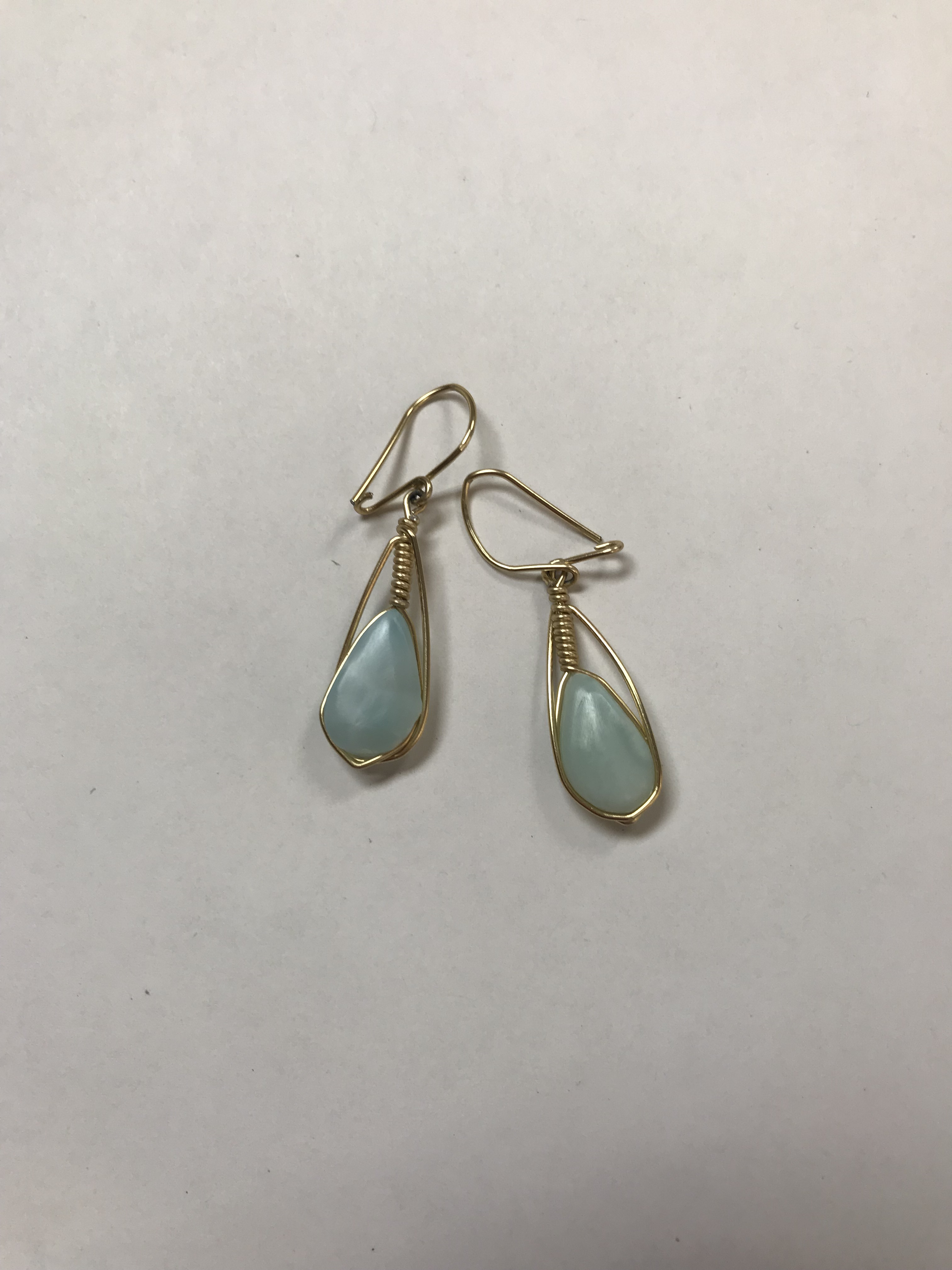
My Larimar earrings.

The Larimar in both the earrings and bracelet are wrapped in thin silver and gold wire, making both pieces of jewelry extremely lightweight. It is unclear whether these were done by machine or by hand, but my guess is by machine due to the extremely tight and almost symmetrical wire wrapping. The Larimar itself is a light sky-blue color with some faint white streaks under the surface. They have been tumbled, leaving the stones with a glossy finish.

Since Larimar is only found naturally in the Dominican Republic, it is strategically marketed toward tourists. This initially turned me off from the stone because I didn’t want to purchase the one thing that every tourist in the Dominican Republic purchases. Yet, I did. One day, my family and I were perusing through an indoor market full of souvenirs, and everywhere we turned people were trying to sell us their products. T-shirts, mugs, guirras (a Dominican percussion instrument), you name it. I had some cash, but wasn’t intending to buy anything. Then I got the corner of the marketplace and there sat an older woman behind a case of beautiful gemstone jewelry containing Larimar and Amber. My bracelet and earrings were sitting together in a small white box, and I looked at the woman and pointed to it. I asked her how much it was (in Spanish), and she replied with 300 pesos, which converts to about 6 U.S. dollars. In the U.S., jewelry containing Larimar can cost anywhere from $50-$700. I gave the woman 300 pesos, she placed the small white box in a plastic bag and I carefully secured it in my purse.

There is a lot of labor that goes into the production of gemstone jewelry, and Larimar in particular. There is only one place in the entire country where the stone can be found, and that’s at the Filipinas Mine in Los Checheses. Miners must dig and search for the stone, and then it has to be cleaned, tumbled, and then set into jewelry. Are the people who work on these pieces of jewelry paid enough? Are they treated fairly? Is there any way for me to know? These questions don’t usually cross my mind when I buy or wear jewelry, but I’m now realizing they probably should.

Let the Games Begin

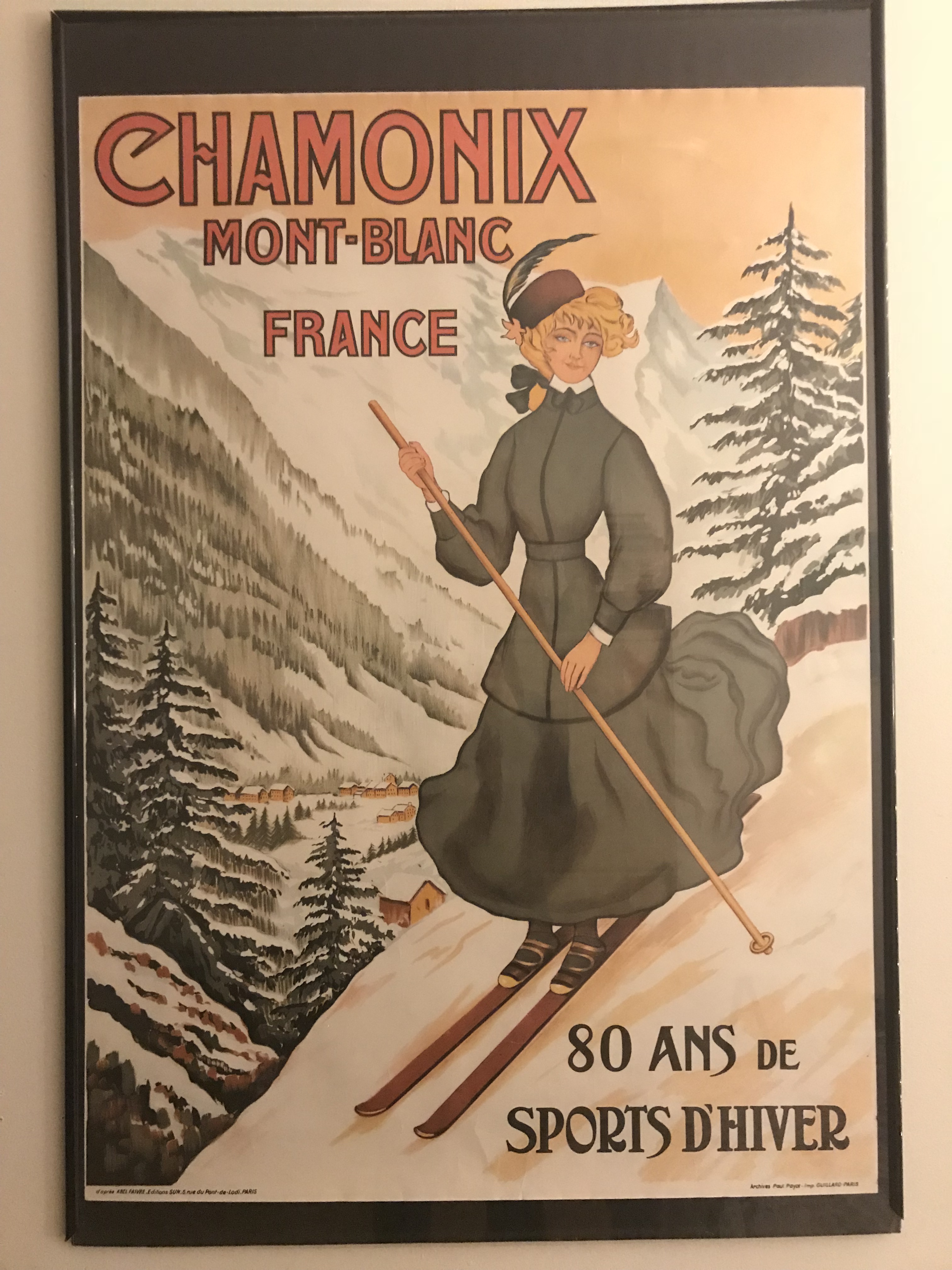
In my initial research in regards to the history of my mother’s Chamonix poster, I was mostly directed to Pinterest boards. There was no evidence of it being an advertisement of any kind, so I was led to believe that it was created solely as a decorative souvenir. Something to remind someone like my mother of the trip they took to France.

However, I wasn’t entirely satisfied with these results, so I dug a little deeper. I typed all of the text from the poster into Google, “Chamonix, 80 ans de sports d’hiver,” in both French and English. This led to the discovery that the first official Winter Olympics were held in Chamonix in January of 1924. I was surprised that this information didn’t come up in my first search, since that seems to pretty noteworthy. I began viewing advertisement posters for those Olympic games, and the style of those posters were similar to my Chamonix poster.

Chamonix-Mont-Blanc, 1924–1924
1924 Winter Olympics advertisement.

The art on this poster was done by an artist named Auguste Matisse, and a lithographic print copy of this poster is currently selling for close to $4,000. My jaw honestly dropped when I saw that. I’m sure my mother’s poster didn’t cost that much, which made me think these two posters were not as related as I originally thought.

This image has an empty alt attribute; its file name is img_2968.jpg
My mother’s Chamonix poster.

However, upon viewing these posters it is clear that they do hold some similarities. The fonts are very similar, as well as the view of the mountain in the background. I believe my mother’s poster was created with allusions to the style of the Olympic Games advertisement due to its popularity not only among people in France, but all over the world.

As discussed last week, the lineage of this poster dates back about 35 years having first belonged to my mother. It was interesting to hear about the poster from her perspective, and it now means a little more to me than it did before. It was also interesting to read about the potential history of the creation of the poster, even though these are mostly speculations. The Winter Olympics in 1924 brought a lot of publicity to the small ski town of Chamonix, which probably contributed to my mother’s desire to go there 60 years later.

More than a decoration.

How someone chooses to decorate their rooms can tell you a lot about that person. Are they neat? Is their bed made? Is there anything on their walls?Wall decor is important because it usually takes some effort to mount, and will most likely always be in view. One specific wall decoration that has graced the walls of teenagers for decades, is the poster.

Posters are usually quite large, and can depict anything from your favorite musician to your favorite piece of artwork. They are something that you use to define your space, objects that you are okay with looking at every day. I have gone through several posters throughout my life, and I have recycled the same ones for most of my time living in New Paltz. Posters serve the function of decoration, but can also induce reflection.

I’m choosing to reflect upon this specific poster, one that used to hang on my wall at my parent’s house but is now here with me in New Paltz. It belonged to my mother, and was purchased in 1984 during a ski trip she took with her brother in Chamonix, France. She was supposed to go with a friend who ended up getting sick, resulting in her brother needing to somehow obtain a passport in two weeks. Luckily, he worked for someone with connections in Washington who pulled a few strings. The poster had caught her eye in a shop window, and she purchased it right away.

My mother’s poster, now on my bedroom wall.

The poster was given to me in the frame pictured above, which may be the cheapest frame I’ve ever seen. It has four plastic caps for each edge, but they frequently slide off and fall on the floor. The poster somehow manages to stay secure despite the frame’s tendency to not do its job.

The style of the poster makes me think that it once functioned as an advertisement. The words at the bottom translate to “80 years of winter sports,” which seems like some sort of tagline that the ski mountain may have used. However, in the hands of my mother, this poster served as a souvenir or memento of a trip she took with her brother. It amazed me that she kept it long enough for it to end up on her youngest daughter’s bedroom wall. Interestingly enough, when she got back from France the poster stayed rolled up until she got married and moved to Rockland in 1987. Why didn’t she unroll it and mount it on her wall when she got back? For three years, was its function just to take up space? She told me that her apartment “was ugly and she didn’t want to put the pretty poster on the wall,” but wouldn’t the pretty poster make the ugly apartment a little more attractive? The poster has some wrinkles in it as proof of wear over time, yet the colors seem just as vibrant as they were in 1984.

For me, this poster is a wall decoration that is visually pleasing, and is an important piece of the puzzle in creating the ambiance of my space. Sometimes I forget that it ever belonged to my mother, but occasionally I do think about the trip she took to France with her brother all those years ago. Its function for me is decoration, with the occasional spark of reflection on the past.

My Instrument

My guitar is my instrument, it is my crutch, it is my saving grace, and my worst enemy.

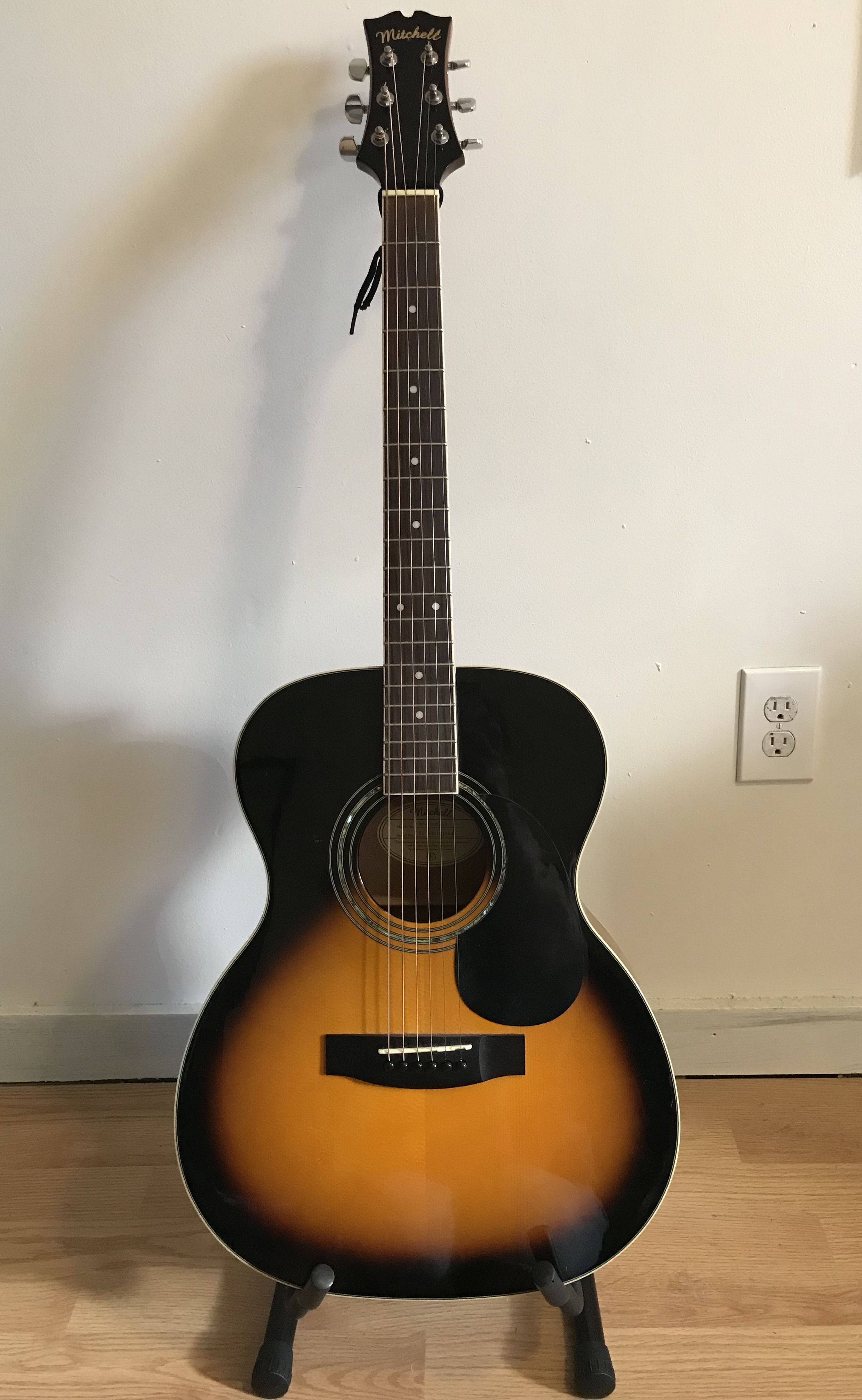
My beloved guitar.

My guitar was given to me as a gift from my mother when I was in middle school, probably around eleven years old. It’s a Mitchell guitar and is part of their 120 series model. It has a vintage sunburst design with a glossy finish. This guitar probably cost a little over $200, which is on the less expensive side for guitars.

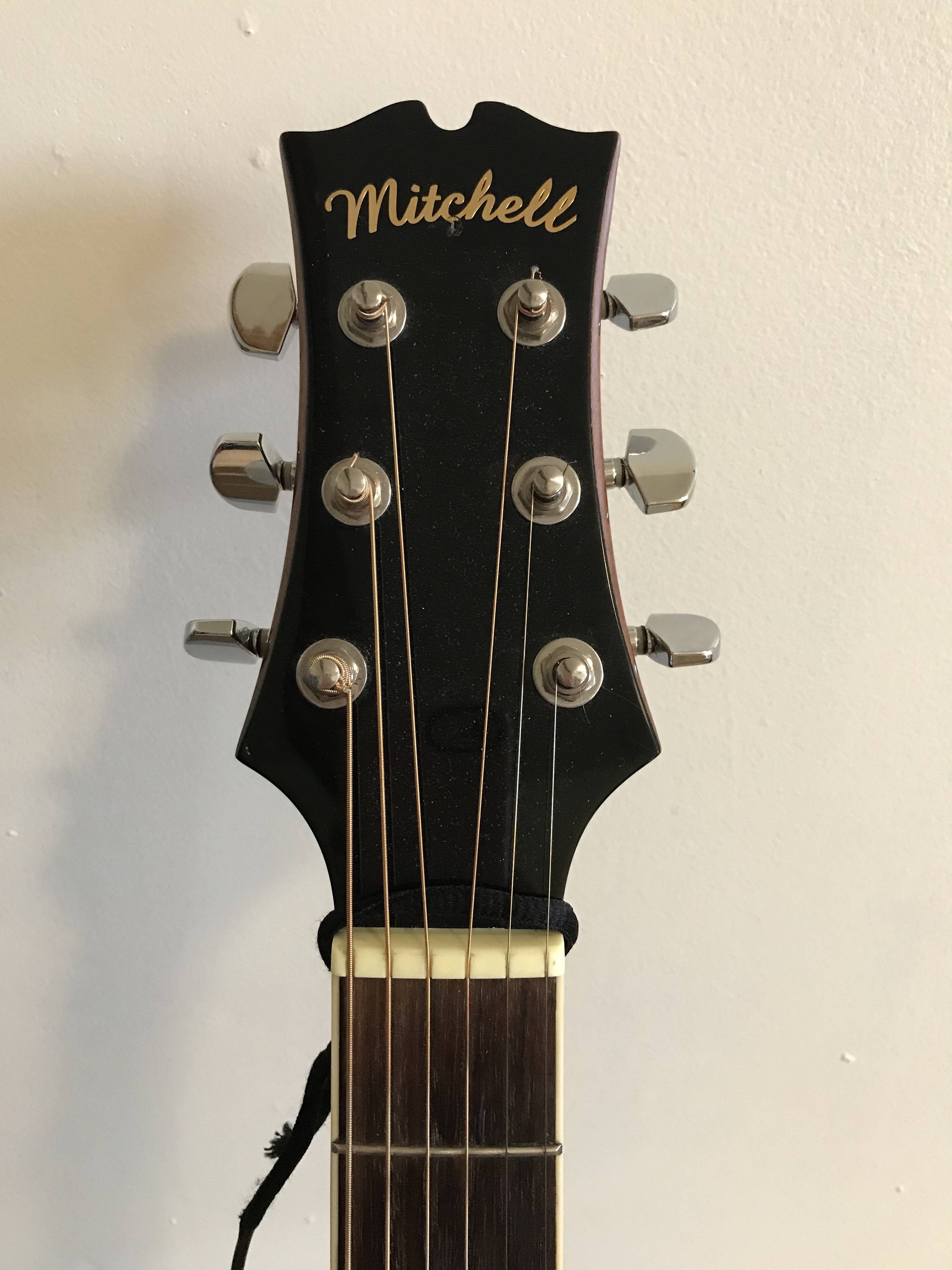
The guitar’s headstock.

Here is a closeup of the headstock, where the instrument can be tuned. Right now, my guitar has Martin strings made out of silk and steel with a .12 gauge. I chose these strings because they are lighter, and have a more mellow sound than strings made out of phosphor bronze. I strung my guitar myself, which has made me feel closer to my instrument and the sound it produces. Tied around the neck of the guitar is a shoelace for me to attach my guitar strap to. Usually guitars have a peg closer to the base of the neck to attach a strap, mine unfortunately does not. A few Google searches later I learned that a shoelace could do the trick.

The guitar has one minor blemish on the left hand side, and I’m honestly not entirely sure how it got there. My guess is it’s from hitting it on a chair or some other hard surface.

I’ve had previous experience with eBay’s photography tips because I sold a guitar on eBay this past summer. How the photo looks will absolutely determine whether or not your product sells, which is why eBay reinforces the importance of taking quality photos. It’s also important to be transparent about the quality of the product as well as any defects or blemishes it may have.

I chose to photograph my guitar frankly because I think it’s beautiful, and it holds a deep sentimental value for me. I taught myself how to play it, and I can remember when it was such a challenge for me to play a simple song with minimal chords. Now I bring it with me when I perform, I use it to write songs, and I even teach other people how to play it. It’s my first guitar, and will always hold a special place in my heart.

KonMari, where have you been all my life?

You really don’t know how many books you have until they’re splayed out on your bedroom floor and you can’t walk without stepping on one. I would consider my book collection pretty reasonable, even though the pile keeps growing every time I go into a book store. I chose to tidy up my book collection because it is one that keeps growing, and it (though I hate to admit) definitely consists of some books I will never read. Or I’ll read one chapter and never pick it up again.

As I stated earlier, I began by laying all of my books on the floor of my bedroom. I honestly enjoyed seeing all of them there. At first glance all of my books bring me joy, but I knew I needed to go deeper and really think about about how each individual book made me feel.

Then, I categorized my books by genre. I was left with a few piles including fiction, religion/spirituality, astrology, non-fiction, journals, and a lone music theory textbook.

Then I dug deep. I picked up each book individually and asked myself if it brought me joy. The answers came to me a lot quicker than I expected. I was left with six books. These are the books that I continue going back to for reference, for fun, or for joy. However, the idea of having new books to read excites me, and I’m not sure if this six book collection actually brings me joy.

I rely on my intuition frequently throughout my every day life, so this felt like an intuitive exercise for me. I’m usually very successful when it comes to knowing what “feels” right to me. Most of the books in my collection are ones I haven’t read yet, so I don’t really have joy evoking relationships with those ones. However, I do want to read them, which is why I bought them, and I don’t see myself getting rid of any of them. Does this mean I failed at using the KonMari method effectively? I know that discarding these books would not bring me joy, which seems to be the end goal of tidying up– freeing your physical space of clutter can help free your mind of clutter. Believe me, I am not a tidy person, and I intend on diving deep into the KonMari method throughout my apartment. I’ve done it in my room at my parent’s house without even knowing it, so I know it’s possible for me. Just not with books. I think I’d be able to actually discard something like clothes or miscellaneous objects around my room, but books hold a sentimental value for me that I can’t seem to shake.

I think the act of tidying up goes a lot deeper than people think. I like that Marie Kondo reinforces the idea that the KonMari method is a mindset, a way of life. That might be why it seems so difficult in the beginning, because adopting any new way of life is not easy. I’m excited to continue implementing the method into my life.