KAI’s Self-Titled EP and the Whirring Machine

I have a very large CD collection that tops a hundred, yet I rarely play them. It seems highly ironic to own such a large number of CDs yet never play them. In order to assuage my guilt for wasting away my checking account, I ordered a CD player off Amazon last year. But instead of playing my CDs more regularly, my CD player has sat unused on my desk. Paired with a different CD every time I want to alter the feng shui of my room, my CD player has mostly melted in the background. 

When I replaced the CD of the month to replace it with Korean artist Kai’s self-titled EP, both the resident CD and the CD player were covered in a fine film of dust. It has been well over six months since I last used the CD player which was evident by the dust covering the contraption. After spending a few minutes cleaning the dust from the CD player, I removed Kai’s EP from the back of the album packaging. To do so without damaging the paper flaps that snugly covered the disc took a few seconds longer than expected. The CD, bought off an online retailer, was embellished with an image of the Korean artist underwater in a white shirt and black pants. Although I don’t speak the same language as the artist, the singer’s artistic presence and warm voice made me a fan.

Once I had removed the disc from the paper confines of the back of the accompanying photobook, I gingerly touched the sides of the CD, careful not to place my finger on either side of the CD and damage it in the few seconds I had it.

I popped the EP into place on the player with a satisfying click. Once I settled into my desk chair, I pulled the cord to start the CD player. It didn’t play at first, and I stood up and peered over the side of the contraption. The audio system has more settings than needed and I had to click the ‘mode’ button a few times to switch it to ‘disc’. The CD began spinning rapidly and producing a low whirring noise. 

Unlike the automatic press of a button music playing I had gotten used to with my computer and phone’s Apple Music, there was a handful of seconds where everything was silent minus the whirring of the device. Once the disc began to play and Kai’s warm voice drifted out of the speaker, the moment was cut short by the device pausing momentarily before continuing on. The title track, 음 (Mmmh), resumed and I was once again surrounded by the Korean artist’s 2020 title. 

I tried to enjoy the song as I usually do so on my headphones, it found it incredibly hard and awkward to do so. Instead of the clear audio, the mini album was accompanied with by the CD player’s unwanted whirring. The whirring undercurrent to the song became like a pickaxe to my ears. As I tried to ignore the sensory issues beginning to give me a headache, I felt myself becoming more irritated than content. The album was one of my most played albums on Apple Music for 2020 (despite only coming out in November of that year), but I couldn’t stand listening to it at that moment. It was like I was listening to a completely different artist. 

As I got up to get away from the whirring of the device, listening to the music felt laborious. Sitting on my bed several feet away from the audio player, the music felt like it wasn’t loud enough but also too loud. Tweaking with the audio settings of the device, it was difficult to find a comfortable setting that was perfect. It only lasted until the next song, Nothing on Me, to get a response from one of my family members to turn it down. 

By the time I had finished listening to CD in its entirety (17 minutes and 55 seconds), I had a growing headache and was unprepared for the continued playing of the CD. I had become so used to the Apple Music default of stopping automatically that I forgot to turn it off. After pulling the cord once again, the whirring noise ended once again and it felt like the room had become less stuffy. Rather than endure the laborious attempt of removing the CD and putting it back on the bookshelf, I have left the CD embossed with Kai’s figure underwater to remain on the CD player.

Throughout this analog experience, I felt very tired and irritated. My life has become very fast paced, and with it I have become impatient with the objects that surround me. I use my phone to listen to music constantly: Apple Music has recorded that I have listened to 1,068 hours of music this year alone – or 44.5 days. While I enjoy the collecting of CDs and the various ways I can arrange the CD albums on my shelf, the whirring and labor of the CD playing experience left me wanting to plug in my headphones. 

The experience of listening to music, I realized, was very intimate to me. I did not want to share the music I listened to aloud with my family. I wanted to contain the music to my ears only, and change it at my will. Rather than walking across the room to reach the CD player to skip a song, I could do so with a pinch of my AirPods.  The exposing of my music for other people to experience made me feel self-conscious despite being in my own house. 

The Life of Morris Jansen

Morris Jansen was born July 22nd, 1793, in the small hamlet of Shawangunk in Ulster, NY to parents Cornelius T. Jansen and Christina Jansen (née Morris). It can be surmised that the Shawangunk native was named after his mother’s maiden name Morris. The youngest of five children, Morris was the last child born to Cornelius before his death in 1796.[1] While the youngest, Morris was predeceased by his brother, Jacob Jansen, who died at the age of one as well as his other brother John Morris Jansen who died relatively early on in life.

The name Jansen, also spelt in records as Janson, Jensen, or Johnson, is a name of Dutch origin. There is no record as to when the Jansen family originally arrived in the Shawangunk or larger Ulster area, the Dutch were some of the first Europeans to settle in the region.[2] There are records of the name Jansen present in the Ulster County archives that date back to the seventeenth century.[3] While this does not correlate explicitly to the family of Morris Jansen, the Dutch population was heavily prevalent in the area for several centuries. Like other local Dutch families in the individuals, Morris Jansen was most likely bilingual in Dutch and English.

While there is no explicit description of the Jansen family as ‘wealthy’, the family had enough wealth to retain six enslaved persons at the time of Cornelius Jansen’s death.[4]  One of the enslaved persons was either born or bought in the last three years before Cornelius’s death.[5]

As one of eleven children himself, Cornelius’ family was able to retain and care for their large family as well as take care of enslaved persons.[6] Although not in Cornelius nor Morris’ immediate family, a local relative by the name of Henry Jansen had sixteen enslaved persons at the time of his death in 1764.[7] Cornelius’s brothers Johannes and Thomas in comparison owned nine and fifteen enslaved persons by the 1790 census.[8] While Cornelius did not own as much wealth and enslaved persons as his brothers, Cornelius was among the last to own slaves in the Shawangunk area. As a result, Morris Jansen grew up alongside the company of his family’s enslaved persons. Two enslaved persons, Bob (b. 1790) and Frank (b. 1788), were only several years older than Morris himself. [9] While Frank was sold to a man in the area by the name of E. Foot, there is no remaining record of what happened to Bob.[10]

While there is no record available of the Cornelius and Christina Jansen’s house surviving or being described in detail, Cornelius’s two brothers’ wealth and reputation is also conveyed in the architecture and prominence of their respective estates.[11] The contemporary maintenance of the two Jansen households allows for the insight into the local prominence of the Jansen family. While the Cornelius did well for himself as can be surmised from available records, his brother Johannes donated an orchard in Kingston to his brother in 1790.[12] There is no description of the orchard nor any reasoning as to why the orchard was donated. But from other records available, the Cornelius Jansen and his two of his brothers Thomas and Johannes often sold or donated their enslaved persons, land, or other objects to one another. 

There is little to be found on Morris Jansen himself as the Dutch man died at the relative early age of 25 in 1818.[13]Despite the Dutch man’s short life, he was able to become a lieutenant. There is no record as to Jansen’s ranking in a specific militia other than his title being used in a letter from a man named Elias Pratt in 1814.[14] There is a description of land in Homer, NY that used to belong to one of his brothers, and Elias Pratt goes on to describe the man as “gone”.[15] While there is no further elaboration into the circumstances of this letter, the description of land away from Jansen and his brothers’ residences is striking. One of the brothers owns land in Homer while Morris Jansen himself owns land in Greene County.[16] The distance land-owning in New York prevalent in the Jansen family is interesting and has no explanation. 

In another letter a year later, Morris is described as in ‘controversy’ in regard to his father’s estate. The letter describes an esquire (or lawyer) by the name of John Duers entering bonds “to settle all controversies”.[17] While Morris’s father died in 1796, his estate was settled for a second time by his widow Christina and her new husband, Cornelius Louw.[18] Through letters and deeds, one can surmise that the second settlement of the estate was not agreed upon by all members of the family.

Much like his uncles and his father, Morris owns land far away from his place of residence in Shawangunk, New York. While it is not across state lines nor oceans, Morris owns land in Pompey, NY which is now in Onondaga County and over 190 miles from each other. While there are no legal records to prove this, letters between Morris and Elias Pratt allow for an interpretation of a landowner and renter relationship. In the final years of Morris life, Pratt contacted him in 1814 regarding sale of land.[19] In future letters between the pair, Pratt complains of “crops por fear of famine” as well as “[agitation] over the prospect of losing his farm…[as] a foreclosure of mortgage will ruin him”.[20]

Besides owning land in Pompey, Morris also owns land in what Roland Sears describes as “Greene Country”.[21] In a letter dated in April 1816, Sears asks for power of attorney and is later granted it.[22] There is no record if the land was sold prior to Morris death in 1818.

Besides the land-owning situation Morris found himself in, the lives of enslaved persons owned by the Jansen family is interesting. As Morris was only six when slavery was outlawed in NY in 1799 and eventual freeing of all slaves was set for 1827, the lives of enslaved persons in the beginning of the nineteenth century is not spoken about. The Jansen family owned slaves for centuries in the Ulster area.[23] There was a repetition of names that seemed to be dehumanizing. There are multiple records of enslaved male persons owned by the Jansen family being called ‘Frank’ with two even at the same time; the two Franks were regarded as ‘old Frank’ and ‘young Frank’. While the motives are not clear for the repetition of this name, the choice to retain this name for enslaved men is worth investigating. Unknown if this is the same ‘old Frank’ that was enslaved by Cornelius Jansen, an enslaved man by name of Frank ran away from Peter Jansen in 1797.[24]

There are still many unanswered questions that surround the lives of the Jansens and the lives of the enslaved persons. While the Jansen family name is not synonymous with slavery in the Hudson Valley, research into this early Dutch family conveys a long relationship with the evil institution.


[1] https://cdm16694.contentdm.oclc.org/digital/collection/hhs/id/491/rec/3

[2] Ulster Co. Archives https://clerk.ulstercountyny.gov/archives/dutch-heritage

[3]https://archives.ulstercountyny.gov/Presto/search/SearchResults.aspx?q=KCJKYW5zZW4iKQ==&qcf=MDRlYWMyYjUtN2Y2YS00NTIxLWFiMjgtMDk1YmM5Y2ZiMDU5

[4] https://cdm16694.contentdm.oclc.org/digital/collection/hhs/id/491/rec/3

[5] https://cdm16694.contentdm.oclc.org/digital/collection/hhs/id/491/rec/3

[6] https://cdm16694.contentdm.oclc.org/digital/collection/hhs/id/491/rec/3

[7] https://cdm16694.contentdm.oclc.org/digital/collection/hhs/id/786/rec/1

[8] https://www.familysearch.org/ark:/61903/3:1:33S7-9YB6-9VVJ?i=3&cc=1803959&personaUrl=%2Fark%3A%2F61903%2F1%3A1%3AXHK5-W8B

[9] https://cdm16694.contentdm.oclc.org/digital/collection/hhs/id/491/rec/3

[10] https://cdm16694.contentdm.oclc.org/digital/collection/hhs/id/1930/rec/1

[11] https://npgallery.nps.gov/NRHP/AssetDetail?assetID=57da65fc-dc41-47ee-a69f-e63984020cba, https://npgallery.nps.gov/NRHP/AssetDetail?assetID=36c4ba77-43b2-4c65-95c7-6e6a0b6e24c1

[12]https://www.google.com/books/edition/Collections_of_the_Ulster_Historical_Soc/AHo_AAAAYAAJ?hl=en&gbpv=1&dq=%22Cornelius+Jansen%22&pg=PR13&printsec=frontcover

[13] https://infoweb-newsbank-com.i.ezproxy.nypl.org/apps/readex/doc?p=EANX&sort=YMD_date%3AA&f=advanced&val-base-0=%22Morris%20jansen%22%20&fld-base-0=ocrtext&docref=image/v2%3A10D3496AD722BEA8%40EANX-10D5C2DC7B1179A8%402385129-10D5C2DCF39BE618%402-10D5C2DEB2ADC910%40Mortuary%2BNotice&firsthit=yes, “Mortuary Notice.” Ulster Plebeian (Kingston, New York) XV, no. 766, February 28, 1818: [3]. Readex: America’s Historical Newspapers. https://infoweb-newsbank-com.i.ezproxy.nypl.org/apps/readex/doc?p=EANX&docref=image/v2%3A10D3496AD722BEA8%40EANX-10D5C2DC7B1179A8%402385129-10D5C2DCF39BE618%402-10D5C2DEB2ADC910%40Mortuary%2BNotice.

[14] https://archive.org/details/hardenbergfamily00mill/page/248/mode/1up?q=%22Morris+Jansen%22&view=theater

[15] https://archive.org/details/hardenbergfamily00mill/page/248/mode/1up?q=%22Morris+Jansen%22&view=theater

[16] “Letters to Morris Jansen from Roland Sears,” Hudson River Valley Heritage Exhibits, accessed November 25, 2021, https://omeka.hrvh.org/items/show/2899.

[17] https://archive.org/details/hardenbergfamily00mill/page/248/mode/1up?q=%22Morris+Jansen%22&view=theater

[18] https://cdm16694.contentdm.oclc.org/digital/collection/hhs/id/830/rec/2

[19] https://archive.org/details/hardenbergfamily00mill/page/248/mode/1up?q=%22Morris+Jansen%22&view=theater

[20] https://archive.org/details/hardenbergfamily00mill/page/248/mode/1up?q=%22Morris+Jansen%22&view=theater

[21] “Letters to Morris Jansen from Roland Sears,” Hudson River Valley Heritage Exhibits, accessed November 25, 2021, https://omeka.hrvh.org/items/show/2899.

[22] https://archive.org/details/hardenbergfamily00mill/page/248/mode/1up?q=%22Morris+Jansen%22&view=theater

[23] https://cdm16694.contentdm.oclc.org/digital/collection/hhs/id/786/rec/6

[24] https://cdm16694.contentdm.oclc.org/digital/collection/hhs/id/623/rec/7

Within Catholicism and Reason: Mary Shelley’s Choice Location of Ingolstadt in Frankenstein

The birthplace of Victor Frankenstein’s ‘daemon’, the small city of Ingolstadt in southeastern Germany was deliberately chosen as the starting point to the end of Victor’s life. The small Bavarian city had a strong identity as a Catholic stronghold against Protestantism, as well as the secret society known as the “Illuminees” or Illuminati. As a critic of Enlightenment thought as well as an individual who “openly scorned…Catholicism”, Ingolstadt and its university were a perfect combination for Mary Shelley to portray as the birthplace of the man-made daemon.[1]

While Shelley never explicitly declares her belief in a titular religion, the author is described as having “stubbornly clung to a belief in God”.[2] A witness to religious instability as well as a passive participant in British abuse of Catholicism, Shelley’s demonization of Ingolstadt’s reputation as a Catholic stronghold and eventual bulwark of intellectual reasoning comes as no surprise in context of the author’s life.[3] While the story of Frankenstein is set outside of the United Kingdom, the novel’s context within the Shelley’s homeland is also significant: the writing and first publication of Frankenstein comes eighteen years before the Roman Catholic Relief Act 1829 which removed legal barriers facing Catholics within the British Isles. A member of a majority Anglican and Protestant country, Shelley’s contempt for Catholicism is discernable in the deliberate choice of Ingolstadt for the birth of a “monster to haunt mankind”.[4]

Located in the central part of the Bavarian state of Germany, Ingolstadt was known “a bastion against Protestantism” for the centuries following the Protestant Reformation.[5] The area, known contemporarily and historically for its counter-reformation orthodoxy, quite noticeably attracted the disdain of Mary Shelley. During Shelley’s time, however, the city was inhabited by Napoleon Bonaparte for much of her early life and until shortly after the publication of Frankenstein. While Ingolstadt’s contemporary existence is important, Shelley is heavily influenced in her novel by the city university’s ties to Catholicism. The university, which eventually moved to Landshut in 1800 and later Munich, was an amplifier for Catholic power as well as an intellectual powerhouse during its peak. 

The Bavarian university that Victor attends in Frankenstein is the same that exists within the city of Ingolstadt. Much like in Shelley’s novel, the University of Ingolstadt “possessed a medical school of stature”.[6] It is in the medical field of anatomy that Shelley once again utilizes religious differences: there were deviations between how Protestant universities and Catholic universities engaged in scientific endeavors concerning anatomy.[7] This is best conveyed by Shelley utilizing Gothic literature’s canon of Catholicism and “its links to the bleeding [and/] or mutilated body…”[8]As Victor mutilates dead bodies in order to create his creature, Shelley is providing an allusion to earlier depictions of Catholicism and the inherent evilness she sees in it. For Shelley, “Catholicism was the very source of subjugation…” that Victor tries to build upon in her novel by creating a new life in the creature.[9]

Those at the University of Ingolstadt such as Adam Landau describe medicine as “been given by God to our just parents,”.[10] The Catholic belief in miracles is also prevalent in both contemporary Catholic medicine as well as Frankenstein. Shelley’s act of integrating a miracle between the creator and the created ‘daemon’ in her novel can be seen as a mocking parallel. The creature’s body becomes a site of rebuff of religion. When Victor creates a the ‘daemon’ through the mutilated body, the Geneva native acts as God.[11]

While Shelley utilized Ingolstadt’s reputation as Catholic stronghold to critique the religion she felt distaste for, the English woman also utilized the city’s more contemporary reputation as the home of the reason-based society known as the “Illuminees” or the Illuminati. As Professor Stephen Kern from Northern Illinois University states, “The novel dramatizes the clash between eighteenth-century enlightenment [reasoning] and nineteenth-century romanticism”.[12]The clash described by Kern is best depicted by the formation of the secret society created by University of Ingolstadt professor Johann Adam Weishaupt in 1796.[13] While Ingolstadt’s secret society did little other than attract dissenters and future conspiracy theorists, the very existence of the Illuminees was to create a reason-based society.[14]  The secret society that developed in the university was aligned to the French Jacobins.[15]

Although the daughter of radical English thinker who depended heavily upon Enlightenment thinkers and human reason, Shelley targets “the enlightenment idolatry of reason…by attacking the idea that man was a predictable and rationally controllable machine”.[16] Between the pure reason utilized by her father, William Godwin, as well as the contemporary political happenings early in Shelley’s life, the author utilized the German city’s connection to pure reason and uncontrollable revolution to echo (French) Conservative critiques.[17]

It is due to pure human reasoning and free will that allows for Victor’s creature to be unleashed on humanity. While also a critique of Catholicism in the depiction of the creation and the creator, the journey to the monster’s creation owes itself to pure reason and will. As Yale’s Jeremy Kessler writes, “The more powerful applied reason became, the more creative…Dr. Frankenstein marks the moment when the work of reason threatened itself with success”.[18] While Frankenstein was debating on how he should create the creature, the Genevan’s pure absolutist pursuit of reason destroyed him and nearly society. 


[1] Schiefelbein ,Michael. “”The Lessons of True Religion”: Mary Shelley’s Tribute to Catholicism in “Valperga”.” Religion & Literature, vol 30, no. 2 (1998): 59.

[2] Schiefelbein, Michael  “The Lure of Babylon: Seven Protestant Novelists and Britain’s Roman Catholic Revival”. (Macon, GA: Mercer University Pres): 2001, 74.

[3] “Roman Catholic.” Romantic Circles. Romantic Circles. Accessed November 22, 2021. https://romantic-circles.org/editions/frankenstein/V1notes/catholic.html?width=400&height=300. 

[4] Shelley, Mary Wollstonecraft. Frankenstein, or, the Modern Prometheus: The Original 1818 Text. Edited by Kathleen Dorothy Scherf and David Lorne Macdonald. 3rd ed. Broadview Press, 2012. 

[5] Helm, Jürgen. “Protestant and Catholic Medicine in the Sixteenth Century? The Case of Ingolstadt Anatomy.” Medical History 45, no. 1 (2001): 83-96. doi:10.1017/S0025727300067405.

[6]  Curran, Stuart, ed. “‘Societies – Illuminati’ .” Frankenstein; or, the Modern Prometheus. UPenn. Accessed November 22, 2021. http://knarf.english.upenn.edu/Contexts/illumin.html. 

[7] Helm, Jürgen. “Protestant and Catholic Medicine in the Sixteenth Century? The Case of Ingolstadt Anatomy.” Medical History 45, no. 1 (2001): 83-96. doi:10.1017/S0025727300067405.

[8] Greenway “Dangerous Bodies: Historicising the Gothic Corporeal. By Marie Mulvey-Roberts”

[9] The Lessons of True Religion: Mary Shelley’s tribute to Catholicism in Valperga Schiefelbein

[10] Helm, Jürgen. “Protestant and Catholic Medicine in the Sixteenth Century? The Case of Ingolstadt Anatomy.” Medical History 45, no. 1 (2001): 83-96. doi:10.1017/S0025727300067405.

[11] Peters, Ted. “Playing God with Frankenstein, Theology and Science”. Vol 16, no. 2, 2018, 145-150, 

[12] Kern, Stephen. “Mary Shelley’s ‘Frankenstein.’” Origins. Ohio State University , March 2018. https://origins.osu.edu/milestones/march-2018-mary-shelleys-frankenstein. 

[13] Hernandez, Isabel. “Meet the Man Who Started the Illuminati.” History. National Geographic, May 3, 2021. https://www.nationalgeographic.com/history/history-magazine/article/profile-adam-weishaupt-illuminati-secret-society. 

[14] Vickory, Matthew. “The Birthplace of the Illuminati.” BBC Travel. BBC, November 28, 2017. https://www.bbc.com/travel/article/20171127-the-birthplace-of-the-illuminati. 

[15] Michael Taylor. “British Conservatism, the Illuminati, and the Conspiracy Theory of the French Revolution, 1797–1802.” Eighteenth-Century Studies 47, no. 3 (2014): 293–312. http://www.jstor.org/stable/24690289.

[16] Kern, Stephen. “Mary Shelley’s ‘Frankenstein.’” Origins. Ohio State University , March 2018. https://origins.osu.edu/milestones/march-2018-mary-shelleys-frankenstein. 

[17] Sterrenburg, Lee.”Mary Shelley’s Monster: Politics and Psyche in Frankenstein”. In The Endurance of “Frankenstein”: Essays on Mary Shelley’s Novel, ed. George Levine and U.C. Knoepflmacher (Berkley, Los Angeles:University of California Press, 1979), 143-171.

[18] Kessler, Jeremy. “Creating Frankenstein.” The New Atlantis, September 26, 2020. https://www.thenewatlantis.com/publications/creating-frankenstein. 

Me, Myself, and My Extension of Self In Books

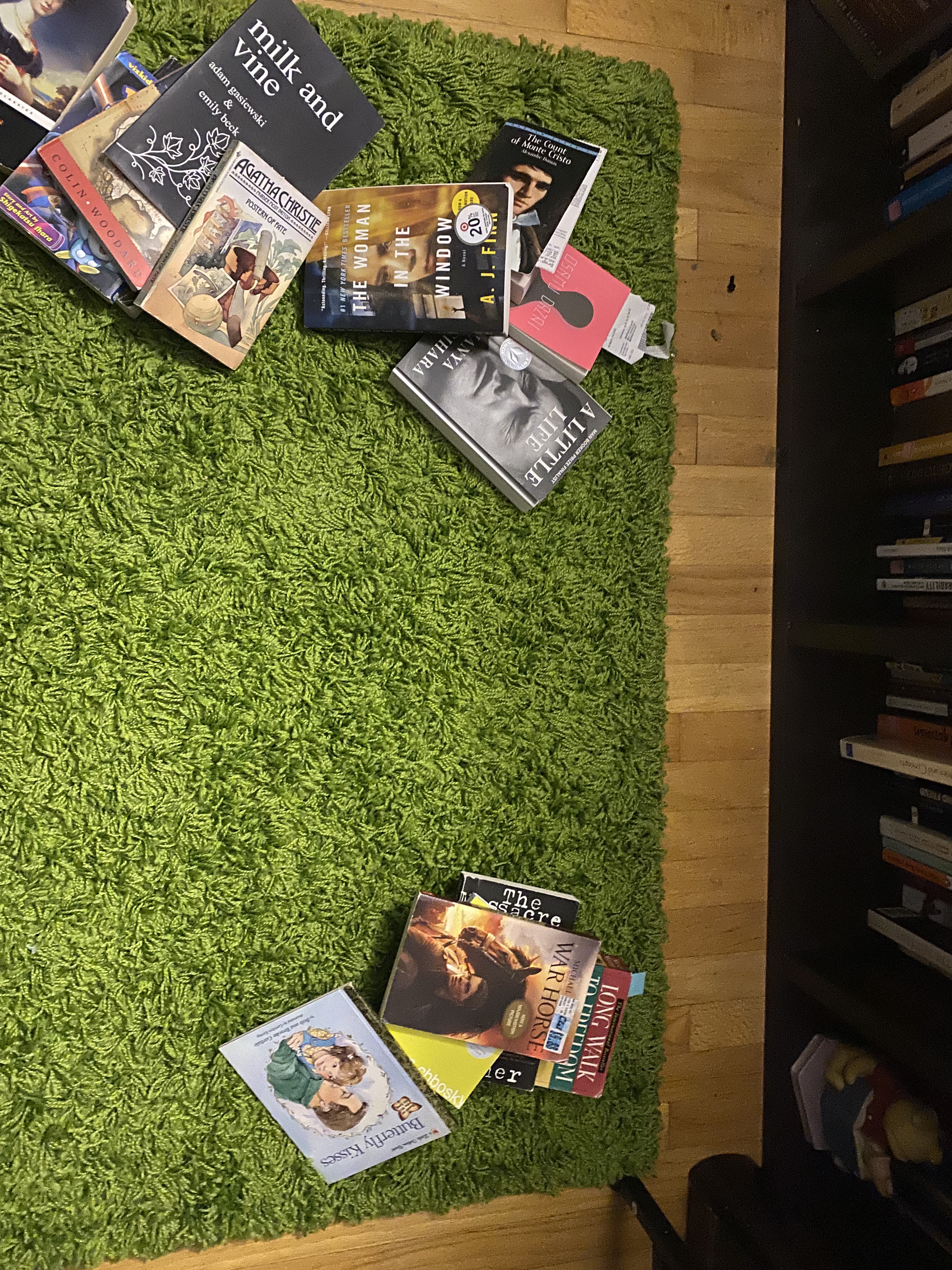
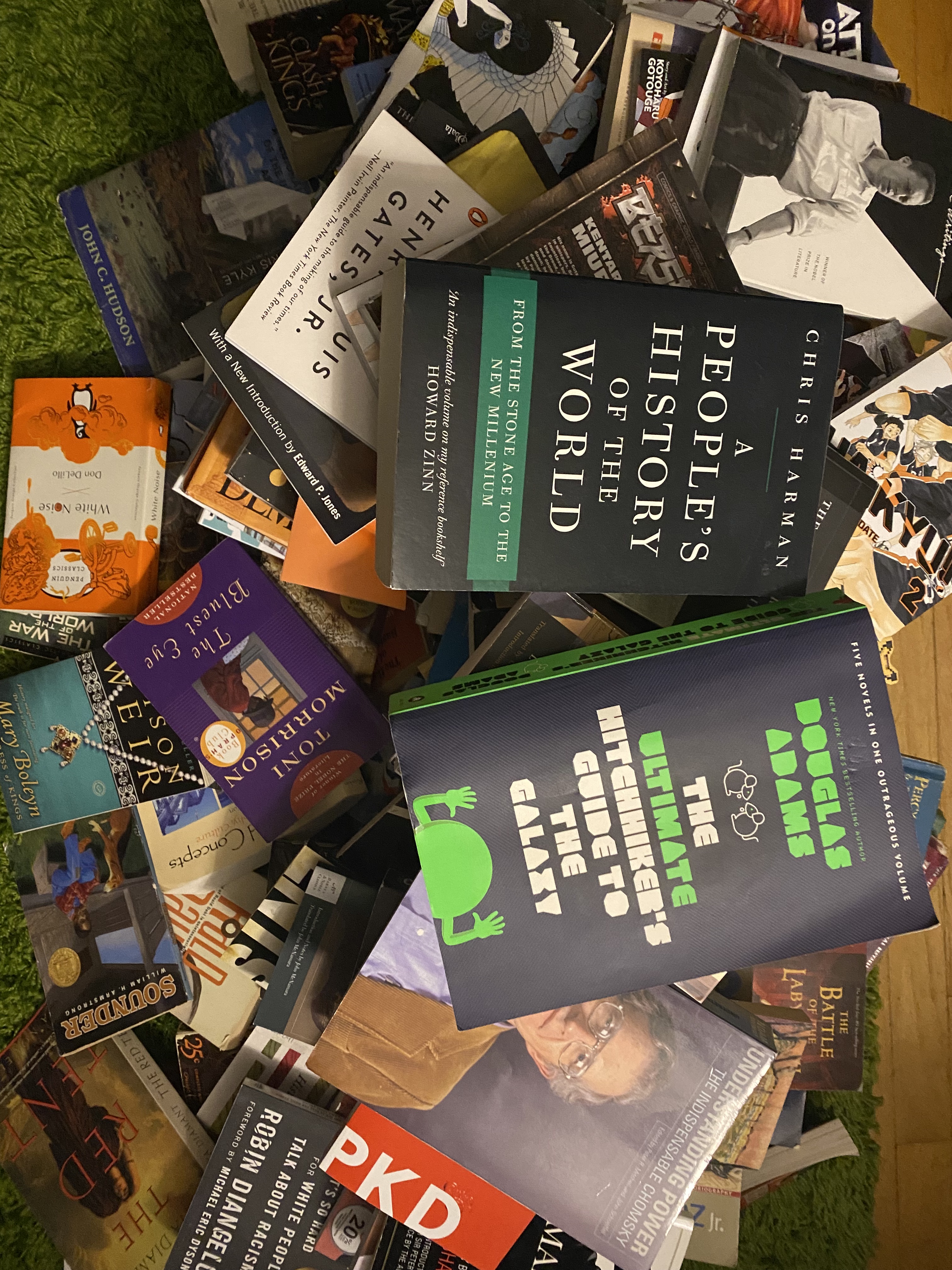
My mom has often accused me of owning too many books. Despite having a very large bookcase (laid on its side is four feet tall and six and a half feet long), a good chunk of my books end up on piles on the floor or shoved haphazardly beneath my bed. It was only a few months ago that I had thrown and donated at least sixty books. Since then, my collection has only grown as I buy new textbooks or find a bunch of Penguin classics at Salvation Army. My bookshelf (as well as the surrounding surfaces) is the amalgamation of my personal identity. While I don’t seem to find joy in my books, the books convey a certain narrative and demonstrate things about myself I would rather not acknowledge. While sorting through some of my older books, I felt an indescribable tightening in my chest. I certainly was not feeling joy, but perhaps a gut-wrenching grasp on the past or my state of being. As a result, I took a different approach than Marie Kondo’s simple “joy test”. I separated the books on my shelf into two distinct piles: books that exist in my periphery and books that have impacted or made me feel an emotion I can’t quite grasp. 

My books share a space with well over a hundred CDs from K-Pop artists (which I find to be particularly humiliating to reveal), but I will be focusing solely on books I own. I underestimated the vast number of books I owned, and I worked up a sheen of sweat as I took the books off the shelf. The books on my shelves numbered past a hundred and vary extensively in subject topic. I began my Kondo-adjacent experiment with well over a hundred books. By the time I had taken all the books off my dusty shelves, I had counted a total of 140 books. 

I was astonished to see how many books I had. It was only a few months ago that I had thrown out and donated over fifty books. Due to the sheer number of books, I was unable to move further than a foot away from my bookshelf. 

I started with my two favorite book series from my childhood: Harry Potter and Percy Jackson. Each of them took up their own cubby in my bookshelf. Despite the centrality of the series’ location on the bookshelf, I only chose two books from each series to put into my “feel something” pile. While I was separating the two series, I realized that the books I had chosen to “keep” had an underlying recurrent theme: a caring collective that ranged from mentors to friends to teachers. As someone who has lived in almost isolating solitude, these books did not evoke a joy but a desire to belong. 

As I continued to separate books, those that ended up in my “feel something” pile did not all evoke this desire I felt with the Harry Potter and Percy Jackson series contained. Those that also evoked an emotion or changed something about me were books like The Massacre at El Mozote and The Book of Job. The former conveyed to me the extent of pure human anguish. While I have never experienced the gruesome crimes against humanity that are described in the book, the book portrays to me the extent of human cruelty but also tenacity. Definitely not a joyous book nor one for the weak-stomached, just looking at The Massacre at El Mozote reminds me of those rare times I heard pure screams of human anguish. The book reminds me that while life is painful, time will keep moving and thus I will as well. 

The Book of Job as well as Albert Camus’ Committed Writings, on the other hand, made me think differently on life and problems within society, religion, and a multitude of other things. I don’t feel a spark of joy when I read these books, but instead a different outlook on life and other things such as religion. I found that the pile of books I had acquired in this experiment conveyed to that I desired certain things like a sense of belonging. But at the same time, the experiment conveyed that I value the human experience despite not knowing how to make sense of it. 

By the end of the experiment, I found myself almost sick to my stomach with emotion and realizations that I am unhappy and alone. The books I had chosen to keep in this experience subconsciously pieced together the parts of myself I thought I was lacking. While I didn’t experience joy with these objects, I find that the books I had kept demonstrated that I find objects to be adjacent to my being. I find it hard to separate myself from objects – as they make up a part of me in a sense. In my life, I am unable to tell where I end and the objects and people around me begin.  

The Story of Anne Frank, Commodification, and Profit

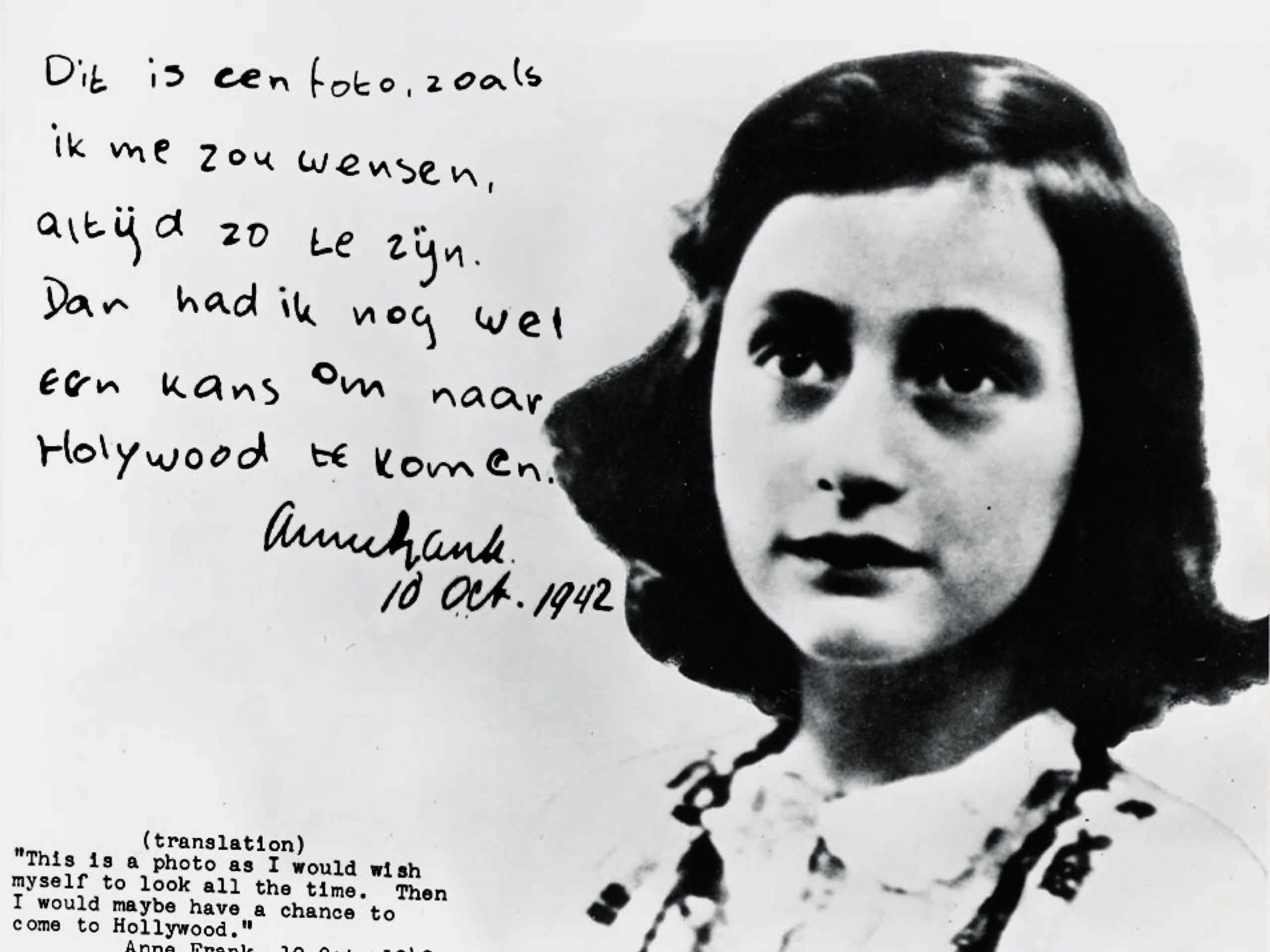
Anne Frank is perhaps the best-known victim of the rise of the Nazi regime in the years leading up and during World War II. The experiences Anne conveys in her diary gives the reader as well as society at large an important insight into the daily life under an oppressive regime and extreme discrimination. A window into anti-Semitism in the mid-twentieth century, Anne’s father Otto 
Frank took it upon himself to preserve both Anne’s diary as well as the ‘Secret Annex’ that the Franks, family friends the Van Pels, and a man by the name of Fritz Pfeffer hid from the Nazis for two years. Named after his youngest daughter, Otto founded the Anne Frank House in the years following the end of the war. 

The museum was built into the existing building that Anne and her family hid in, and houses a collection of contemporary objects that accompanied Jews in hiding. The museum was founded in 1957 by Otto and was later inherited by the state of Netherlands after his death in 1980. The house still serves as a museum to this day and sees over a million visitors a year. 

While the museum was originally created as a way of preserving the memories of the Frank family and those hiding for their survival, the museum and collection’s message has become warped over time due to the potential of profit. The original purpose of the museum has subsided to make the museum more profitable, and no other decision conveys this better than the refurbishment of the house itself in renovation during the coming of the new millennium. 

When Otto started the Anne Frank house, he chose not to refurbish the building, saying: “They took everything out during the war, and I want to keep it that way”.[1] Otto’s goal was ultimately to display to visitors of the museum the bareness and lack of the materiality as well as lives under the genocidal Nazi regime. However, in the 2000s, Amsterdam chose to refurbish the house despite Otto’s intentions. While the explicit reasoning for the refurbishment is unknown, it is highly likely that it is a decision by the museum to be more “immersive” and allows for the visitor to depict themselves in Anne’s situation. The decision to have the museum more like that depicted in Anne’s diary depicts the shifting purpose of the museum from one that shows the palpable fear of Jews in hiding from almost certain death to one that glamorizes the building into a replication that one can be profited off. 

There are other examples of this shift in intent, such as the sale of cardboard models of the Secret Annex as well as replicas of the diary Anne used herself. The Anne Frank House also allowed its duplication in “The Fault in Our Stars” to be used as a background for a kiss scene. These examples depict a key theme: the Anne Frank house and the collection it houses have been transformed from a story into an experience. The house no longer serves as a reminder of the grim story of the Frank family and destructive anti-Semitism. Rather, the house and collection have been reduced to a fantasy setting that aims to make the original story more fantastical and immersive, as if the diary were a fictional tale aimed at the relatability of its readers.

Every museum or collection creates a narrative, whether it be intentional or not. As a replication of history, the Anne Frank Museum and collection has partaken in the setting of a narrative. Rather than portray Anne as a multi-faceted teenage girl who grappled with her adolescence while living in hiding, the museum strips Anne of her agency and depicts her a character. The museum is more focused on making the collection “more immersive” for guest experience instead of relaying the story of the dangers of hatred and fascism. For as long as this persists, the house stands as nothing more than a tourist trap, and the story of Anne and other Jews cease to remember by the collective. Anne Frank has been monetized and commodified in the last couple of decades – no longer a human being who existed less than a century ago but instead a copyrighted character for profit. 


[1]Frank, Otto. “How It All Began.” Anne Frank Website. Anne Frank Museum , October 16, 2019. https://www.annefrank.org/en/about-us/how-it-all-began/. 


Works Cited 

“Anne Frank Collection.” Anne Frank Website. Anne Frank Museum , March 31, 2021. https://www.annefrank.org/en/museum/anne-frank-collection/. 

“Auschwitz Exhibition Blog – New Objects from Anne Frank House Added.” Auschwitz. Auschwitz , November 6, 2018. https://auschwitz.net/new-objects-from-anne-frank-house-on-display/. 

Chakravarti, Sonali. “More than Cheap Sentimentality: Victim Testimony at Nuremberg, the Eichmann Trial, and Truth Commissions1.” Constellations 15, no. 2 (2008): 223–35. https://doi.org/10.1111/j.1467-8675.2008.00486.x. 

Diaries, Radio. “Before Rosa Parks, a Teenager Defied Segregation on an Alabama Bus.” NPR. NPR, March 2, 2015. https://www.npr.org/sections/codeswitch/2015/02/27/389563788/before-rosa-parks-a-teenager-defied-segregation-on-an-alabama-bus. 

Frank, Otto. “How It All Began.” Anne Frank Website. Anne Frank Museum , October 16, 2019. https://www.annefrank.org/en/about-us/how-it-all-began/. 

Ozick, Cynthia. “Who Owns Anne Frank?” The New Yorker. The New Yorker , September 29, 1997. https://www.newyorker.com/magazine/1997/10/06/who-owns-anne-frank. 

Pitock, Todd. “Amsterdam’s Anne Frank Industry.” Haaretz.com. Haaretz, November 17, 2014. https://www.haaretz.com/opinion/.premium-amsterdams-anne-frank-industry-1.5330170. 

“Shop.” Anne Frank Gift Shop. Anne Frank Museum . Accessed October 4, 2021. https://webshop.annefrank.org/en/all-products/

Williams , Zoe. “Totalitarianism in the Age of Trump: Lessons from Hannah Arendt.” The Guardian. Guardian News and Media, February 1, 2017. https://www.theguardian.com/us-news/2017/feb/01/totalitarianism-in-age-donald-trump-lessons-from-hannah-arendt-protests. 

Media 

Tour of the Secret Annex: https://youtu.be/0SJgudCq540

Bookcase as a Secret Door: https://youtu.be/1JSEVBX3cfY

Jeremiah Hunt, a Photo, a Forgotten Story

Despite growing up with an Irish mother and an Irish extended family, I know very little beyond the fact that we call Ballylongford, or Tullahennel South, our home. While I know some stories about Ireland, they are my mother’s and only reach as far back as the 1970s.

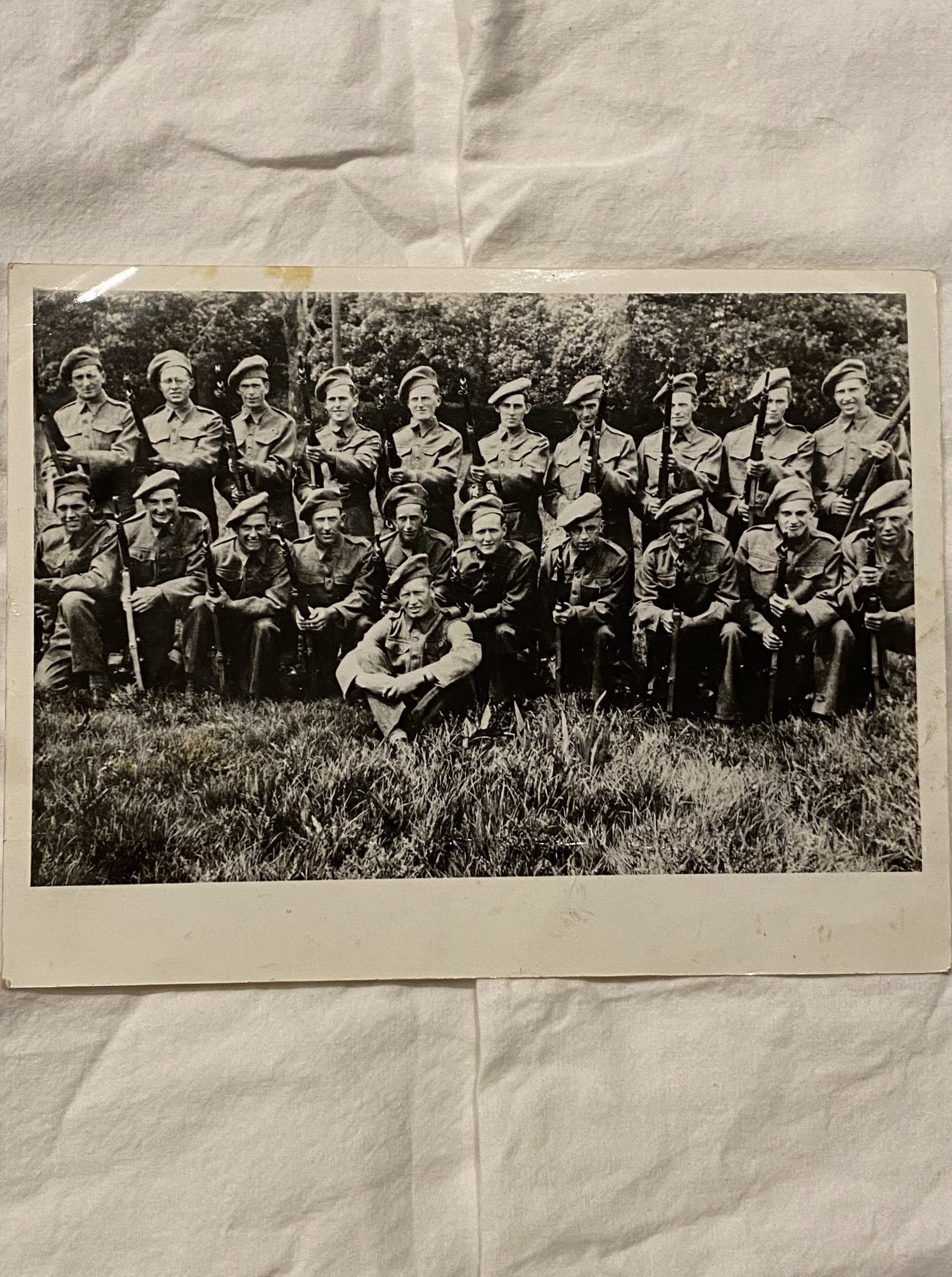
When I was assigned this project, I immediately thought of this photo. Printed on thick glossy paper and weathered by time, the photo weighs more than one might think – literally and metaphorically. The photo is covered by various splotches but the photo is still clear. A bunch of young men dressed in Irish Volunteer Army uniforms with some grinding mischievously at the cameraman.

Pictured: Ballylongford Volunteer Army. Jeremiah Hunt is in the top row and fourth from the right.


All I had to start off with with finding the history behind this photo was a name: Jeremiah Hunt. Jeremiah, also spelled Geremiah, was usually just called Ger. Beyond his name, I had nothing. I had no idea when and where he existed or what his life was like. Jeremiah Hunt, was born May 31st, 1897 under English rule to Patrick and Catherine (nee: Collins) Hunt in Tullahennel. Once I showed my mom a record of Ger, she immediately took a picture to send to her seven siblings on WhatsApp. This photo is perhaps the first solid connection my family has had to this man.

Ger grew up in southwestern Ireland. He attended school at least until the age of 13 and grew up without a father. There is no record of when Patrick Hunt died, his wife is simply labeled as a widow on the 1911 census. When the Irish War of Independence began in 1919, Ger immediately joined the Irish Volunteer Army of Ballylongford. Ger was only 23 when he joined the army, his brother heading off to America and never be heard from again.

Speaking with my Great Uncle Larry, one of Ger’s twelve children, I was told that my great-grandfather owned one of the only guns in his part of the IRA. In his captain’s, Brian O’Grady, witness statement he lists that the only weapons they had were two .32s revolvers and one shotgun. Ger owned one of the two .32s.

The years 1920-21 were some of the worst years my great-grandfather and his fellow neighbors were to endure. Within a period of six months, the Tans twice entered the village of Ballylongford where my great-grandfather was stationed. During this six month period, the Tans burned down houses and businesses, killed both Volunteers and civilians, as well as looting whatever they could put their hands on. These two events are called the “Burning of Ballylongford”.

It was during one of these events that Ger was shot in the chest by a Tan. While he survived, the gunshot wound he suffered ailed him for the rest of his life. My Great Uncle Larry recalls when they were picking turf for the winter, his father would take his shirt off and he had a giant hole in his chest. My great-grandfather didn’t talk about it so his children didn’t ask. It is unfortunate that my grandfather did not speak of what had happened to him. His story can only be told through the vague recollections of those who surrounded him.

After the war, Michael Collins, leader of the Volunteers and famous Irish revolutionary, signed a treaty with the British: 26 of the 32 counties would be free. The remaining six would remain with Britain. These six counties come to form what we consider Northern Ireland today. Perhaps Ger was anti-treaty and regretted his time under Collins. Or maybe he was ashamed of what the IRA became in the years before his death in the 1960s. There is no clear reasoning Ger hid his stories away from those closest to him.

This photo pictured is a copy of the original one that sits in the archives of County Kerry. My grandmother, Ger’s daughter, was the one who inherited the copy of her father. Perhaps it was because she was only one of twelve who remained in Tullahennel. The others moving away to America, England, and Australia. My grandmother, much like her father, did not tell what she knew of Ger’s story. Instead, she hid the picture in her wedding album. The hiding of the photo in an intimate place speaks of a pain close to the heart.

It was only in 2015 after my grandmother died that my mother found the photo in the album. Much like her mother before her, it was hidden away from view but not out of pain but of a detachment from the past. In 2021, the picture of my great-grandfather is no longer hidden from view. Ger never had a chance to tell his story but now, like the photo, I possess both and can tell his story for him.

The Well-Loved German Shepherd

Figure 1: German Shepherd plush toy from the front

I chose to describe my childhood stuffed German Shepherd. This plush toy was given to me by my mother’s boss at a Christmas party in 2004. Invited to a party where everyone was larger and older than my brother and I, we were allowed to spend the hours in his now grown-up children’s playroom. A small holiday gift, we were allowed to take a toy home. Once I set my eyes on this dog, I was strangely drawn to it. Coincidently it was his one of his daughter’s favorites growing up.

Handling the plush, it is roughly the size of a small dog itself. When the plush is laid on its side, it is approximately the same size as a Yorkie. Standing up, the plush is 12 inches by 6 inches. A young child would be almost dwarfed when carrying it around. For someone on the smaller side, the dog would be tedious to carry around.

Figure 2: Side View

On the bottom of the dog is a well-worn white tag that has begun to grey with age. The tag is looped and measures an inch out from the body of the dog. On one side there is a stitched yellow bear holding an unintelligible sign and stitched blue text on the reverse.

Unfortunately, the word on the bear side of the tag has been worn away. Beneath the bear are the letters “C. W” written crookedly in bright pink marker. The other side of the tag reads: “© R. Dakin & Co. – 1986. San Francisco, CA. Product of Korea. PA Reg No. 118. All New Materials. Contents: Polyester”.

The fur, according to its tag, is made from polyester and is smooth to caress. The fur itself is more akin to a cat’s fur than a dog. Squeezing the body of the dog, it is filled with some sort of fluff to give it a fuller shape. The eyes and nose are, on the other hand, are made of harder material. Knocking a knuckle against the eyes and the nose, both appear to be made from the same hard plastic. Rubbing a finger pad across the eyes, scratches can be felt. The eyes share the duplicate sensation as well-used sandpaper. The eyes have a mismatched array of scratches with some deeper than others. When facing towards the plastic eyes, the scratches omit one’s reflection.

The plastic nose has suffered the same fate as the eyes. There are numerous scratches as well as chunks missing from the black plastic. No longer sitting correctly on the snout of the plush, the plastic nose appears to have been glued back onto the plush. Looking head on at the dog, the nose appears crooked in proportion to the rest of its features. Using a hand to feel around the broken plastic nose, what appears to be hardened by aged glue can be felt around the edges.

While filled with stuffing, the front of legs of the dog are hard in comparison to the rest of the body. Putting my entire hand around the right front leg, the animal seems to have some sort of hardened rod in inside of it. Inside the front two legs, the rods seem to have been put in disproportionally. One rod can be felt down to the paw while the other stops just short of it. As a result, the dog leans more to its left side and gives off the same feeling as a crooked painting.

Using a hand to pet the dog as though it was real, there are patches along its back where there is less fur. From a distance, the dog’s back black hair appears splotchy like an incomplete haircut. The front hair and other light brown parts of the dog feels fuller and coarser than the back. While not uncomfortable, there is a stark contrast in the difference of feeling. Running a hand from the black fur to the brown fur, it is like petting two different toys.

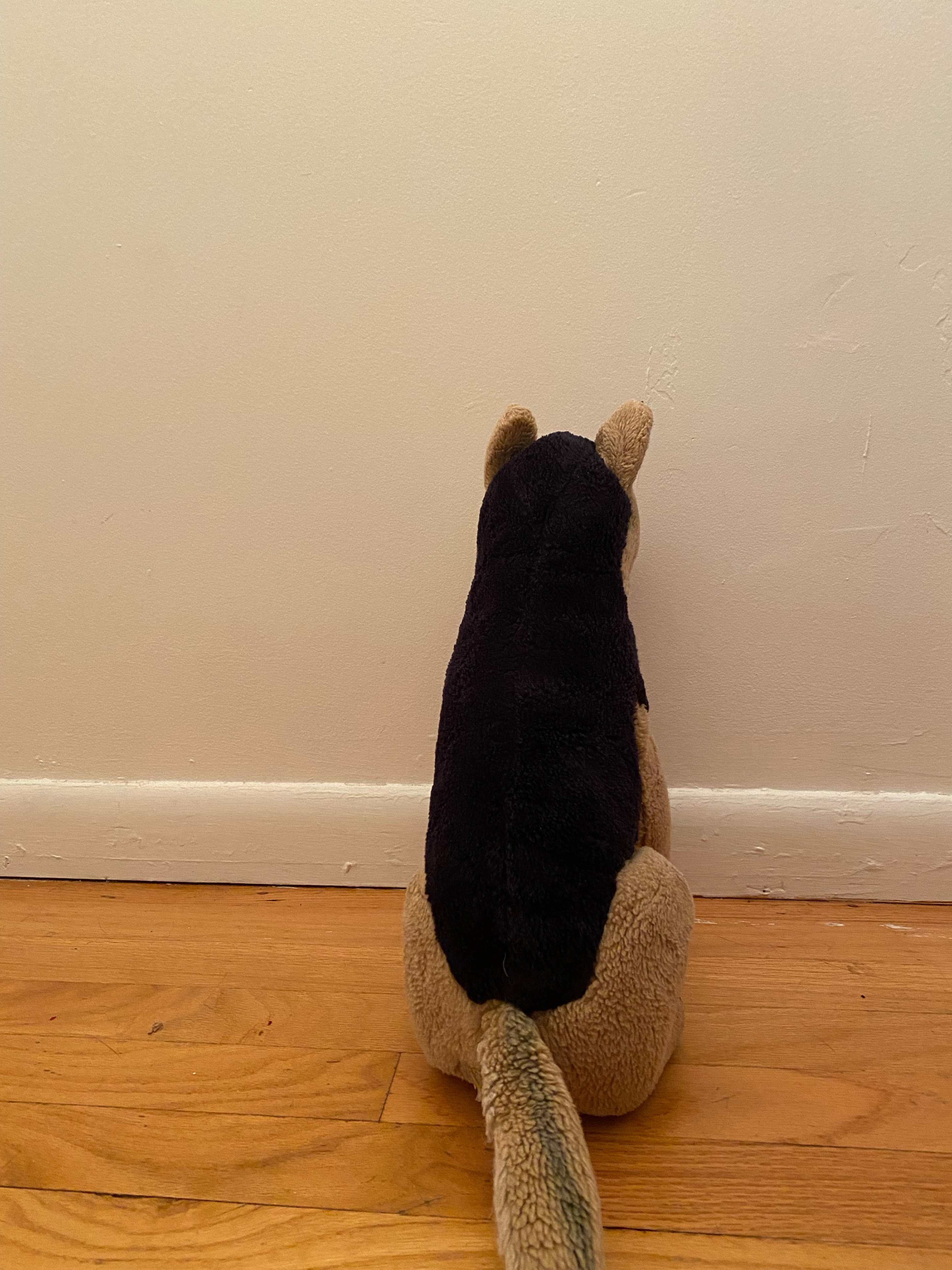
Figure 3: Back View

Near the base of the tail, the original light purple stitching appears where the toy is starting to split at the seams. At the actual base of the tail there are pieces of fine plastic stitching sticking out like a spider’s legs. The very fine yarn loops the base of the tail to the actual body of the plush. Giving the tail a tug, the stitchwork holds and gives very little.

Despite the aging and the threadbare appearance of the toy, the material shows the decades use and love of two young girls growing into young women. Now as one girl is currently attending college, the other is currently practicing law after graduating from Harvard Law. While both may have outgrown the well-loved toy, the toy’s presence has yet to come to an end.