A History of Sorority Objects

My final blog post for this semester is about my favorite part of SUNY New Paltz: my sorority, Alpha Kappa Phi.  Whether we realize it or not, objects are a huge aspect of who we are and how we represent ourselves to others.  Through objects, my sorority has developed its own, unique identity and has been able to pass down traditions for generations.  In examining a handful of sorority objects, I hope to reveal our history and some of our most important traditions, both the old and the new.

The Spoon Pin

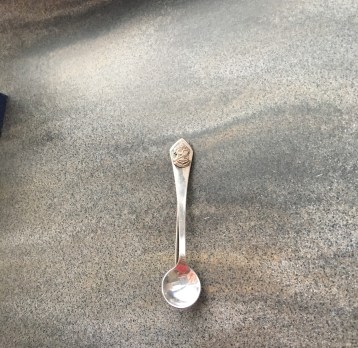
I’ll begin with the blog post that started it all: the spoon pin. When I officially became a member of Alpha Kappa Phi in the Fall of 2015, I went to Florida for Winter break.  There, my grandmother approached me with this pin. She told me it was her sister pin while she was an active sister (meaning while she was in the sorority at New Paltz).  It’s shaped like a spoon, is approximately one inch tall, and has our sorority crest at the top of the handle.  On the back is the needle used to pin the spoon onto whatever clothing a sister is wearing.  The pin is something you receive upon becoming an official member of a Greek organization.  When I became a member of Alpha Kappa Phi, I received my own sister pin: simply the Greek letters ΑΚΦ small and in gold.  I was so proud to hold it, to have my first true letters. The pin, to me, represents that I am part of something bigger than myself. The spoon pin also represents something similar; you are truly a part of the organization. However, when I asked my grandmother why it was in the shape of a spoon, she told me it was to represent hospitality.  Apparently, sororities used their houses to help those who may have needed a place to stay. They were to always be charitable and to give back to the community.
Sister Pin

Spoon Pin with Crest

What I found through my original blog post is how traditions both change and remain the same over time. While we don’t use the spoon pin anymore, we still believe in community service and charity. Any time Relay for Life or some other charitable organization comes to the area, we are there to support the cause, and we are always raising money for our philanthropies.  While the physical object may have changed, its meaning has not.


Link to original blog post: https://npobjects.wordpress.com/2017/02/17/not-a-spoon-you-eat-with/

Tikis
Tiki

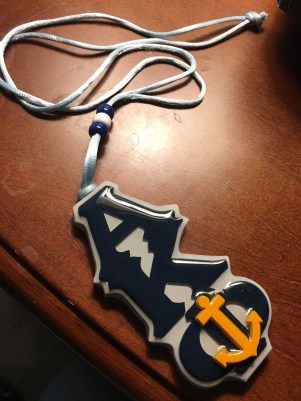
Standard tiki for ΑΚΦ

The objects you see here are called tikis.  A tiki for a Greek organization is usually a wooden block of letters on a long string that you can wear as a necklace. Alpha Kappa Phi has four sorority colors, navy blue, robin’s egg blue, white, and gold, and our symbol is the anchor. The style of tiki we use incorporates all of these representations, depicted in the image on the left.  The tiki below belongs to a member of Tau Kappa Epsilon, and it looks quite different from Alpha Kappa Phi’s tiki. It is black in the shape of a rectangle, with the Greek letters ΤΚΕ going vertically downwards.  On the top of the tiki are the Greek letters ΒΑ, and the bottom displays the number 283.  The whole tiki is wood and is custom for the person who owns it.

TKE tiki

ΤΚΕ Tiki

Functionally, the tiki is very convenient. For us, whenever we are partaking in some event, we are required to show up in letters to represent the organization.  If you forget to wear a lettered T-shirt that day (it happens), having a tiki in your bag is a really easy way to just put on letters for the moment. They essentially just serve as another form of letters.  The ΤΚΕ tiki on the right also can serve as letters, however each tiki is unique to each person.  For this one, the letters ΒΑ stand for “Beta Alpha,” which is this person’s pledge class.  A pledge class is a group of people who work together while in the process of becoming a new member.  His pledge class or group is called the Beta Alpha class.  Someone in a different pledge class would not and could not have BA on his tiki. The number 283 means that he was the 283rd brother to be initiated into Tau Kappa Epsilon’s chapter at New Paltz, the Sigma Nu chapter.  Each part of the tiki represents varying levels of the organization, from the individual all the way to the organization as a whole. This one object connects him to all of these varying levels. Our tiki is slightly less elaborate, however what both tikis do is connect the individual to the organization.

A Mug

This is a mug. More specifically, it’s a sorority beer mug.  That crest on there is our crest. The words printed on it say “Alpha Kappa Phi,” “State University of New York, New Paltz,” “Julie” (my grandmother’s name) and “1954.”  There’s no denying that this beer mug is associated with New Paltz and Alpha Kappa Phi.  Underneath the mug “Nassau China Trenton NJ” is inscribed into the material, perhaps the locations it was made.

As my grandmother showed me this mug, she told me that she, her sisters and other members of Greek Life would go to the bars after classes with their mugs and use them instead of the glasses at the bars. At first I didn’t think much of this story, until later when I realized that an activity like that would never be permissible now.  Ever since I’ve become a member of this organization, alumnae have drilled into me this message: “We are a sorority but we are also a business.” We always strive to maintain professionalism, and that means absolutely NO drinking in any attire that has letters. If I did something illegal or silly with having “Alpha Kappa Phi” all over my shirt, the organization will look bad and unprofessional.  However, clearly this issue didn’t occur to my grandmother or any of the other active sisters in the 1950s. It’s interesting to see how attitudes about professionalism and drinking have changed throughout the past sixty or so years.

Our Song Book

The object here is my grandmother’s song book, one of the original books.  It’s light blue, our color, and the text says, “Alpha Kappa Phi presents Agonian Melodies.” It also has a large anchor (our symbol) with a rose in the center (our flower) along with our Greek letters.
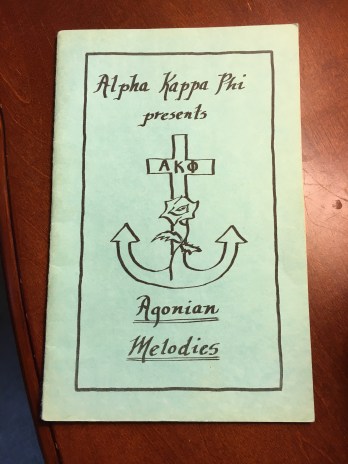
Song Book 2

The song book represents something unique about Alpha Kappa Phi: we are a serenading sorority.  Traditionally, Alpha Kappa Phi would meet up with other organizations and sing to them. I believe that other organizations, including fraternities, would do the same.  We have a position called the Song Leader and her job is to lead the women in the songs as well as to create harmonies.  When my grandmother was active, the Song Leader and the sorority would create whole new songs, usually to preexisting tunes (for example, one song is sung to the tune of “Yankee Doodle”). While we don’t always sing every single song anymore, it is still a requirement for all new sisters to learn some of the songs, particularly the important ones.  Some of the lyrics and melodies have changed over the years as well, but these songs have been passed down for at least 80 years.  This is my absolute favorite part of my sorority; I have never seen another organization do something like this, and this is what I think sets us apart from some other organizations.

A Banner
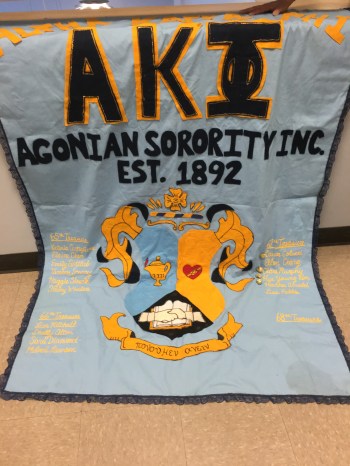
BannerThis banner is one that we often use for tabling events, such as Meet the Greeks or the club and involvement fair.  It’s approximately six feet tall and made of felt with some lace trims.  It features our Greek letters and our full sorority name along with our founding year and a detailed crest. Not visible in the photo are the words “Alpha Kappa Phi” directly above our Greek letters.

There are groupings of names beginning with a heading painted all over the banner, the first one on the left side being the 65th Treasure along with six names.  These names and headings are the reason I chose to use this object.  A “treasure” is analogous to what other organizations call “new member classes” or “pledge classes,” which I briefly explained in the paragraph on tikis. We call them “treasures” because we consider each group of new members a treasure to the organization (cheesy, maybe, but after seeing three treasures cross in my time at New Paltz I must wholeheartedly agree that each group has been a treasure to us). What I think this banner represents about us is not just the fact that it uses all of our colors and depicts our crest so perfectly, but that it also demonstrates a piece of our history that other objects perhaps don’t.  The names on the banner represent the people who not only made this object but also made this organization. A sorority can’t function without people.  Every single person who spent their college years in Alpha Kappa Phi has contributed to who we are now.  We do our best to represent ourselves through objects, but by far the best way to do so is through the amazing individuals who are my sisters.

Letters
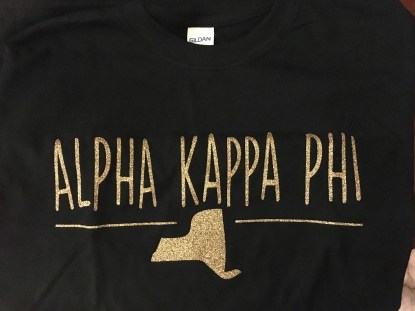
T ShirtThe last set of objects I’m using for this project are one of the best parts of being in any Greek organization: custom letters.  The picture on the left is a t-shirt all of us active sisters recently purchased. It’s a simple, black t-shirt with “Alpha Kappa Phi” printed in glitter-gold.  Underneath that is a picture of New York State, also in glitter-gold.  The New York State picture not only looks cute stylistically but also represents our unique tie to New York since we are only located here.

The set of pictures above are of the sorority jacket.  The color is always navy blue and the back always has 6-inch Greek letters ΑΚΦ in gold with “Agonian Sorority Inc.” written in script beneath them.  The left sleeve always says “Κ chapter” (“Kappa chapter”).  The right sleeve always has the sister’s treasure and semester crossed and the front always has her pledge name written in script.  A pledge name is the name you recieve from your big sister, chosen because the meaning represents you in some way.

The jacket is important and traditional in that every sister, including almost all of the alumnae who attended New Paltz after 1996, has this jacket custom-made for her.  While owning the jacket isn’t a requirement for membership, it is simply a tradition – albeit a new one – that unifies us.  The t-shirt is not tradition but still serves a similar purpose. We recently decided to all buy the same shirt to wear to community service events, in black because it doesn’t show dirt.  All of us active sisters currently have this shirt, and it is one more thing to bind us all together for something we all care about: giving back to the community.  I don’t expect this shirt to become akin to the jacket in terms of traditions.  However, both of them unify each of us to the bigger picture.


To wrap up this long blog post, I want to end with this concept of tradition.  What has become clear to me through examining all of these objects is that each of them at one point were representative of a tradition in Alpha Kappa Phi.  Each object was replicated and passed down to the next generation of sisters, and through these objects the organization became more and more defined.  But as objects have changed over the years, so have traditions. My grandmother and other alumnae who graduated before the 1970s have no idea what a “treasure” is; that title for a pledge class was created in the 1980s and 1990s.  My sister pin looks much different from the 1950s sister pin.  However, they both have the same meaning; I can wear either interchangeably, and both still represent my relationship to the sorority.  What I have found, then, is that just because an aspect of a tradition changes, or even a tradition dies out entirely, that doesn’t mean that the organization as a whole changes. Each Greek organization has a core “essence” about it that makes it unique.  These objects that I’ve examined closely are all attempts at representing the essence of Alpha Kappa Phi, and as long as we still have members, that will never change.
Composite 2

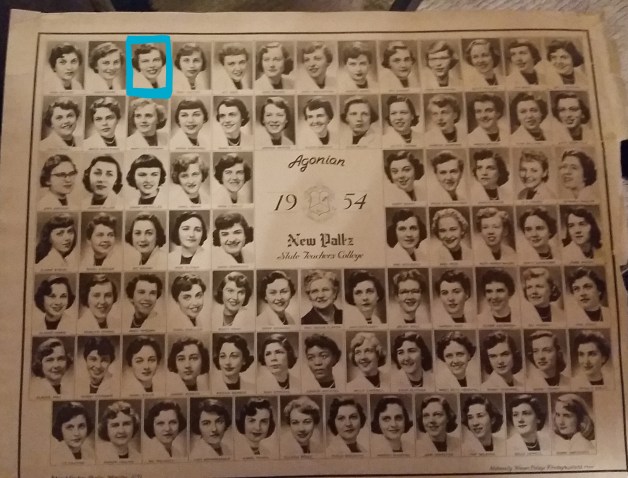
Alpha Kappa Phi, 1954 composite. Grandma Julie is circled in light blue.
Creating an American Culture: The Federal Style

Caption

As baby Cupid rests on grapes and leaves, the United States has only just been born.  Made in 1788, this clock represents the Federal style, an artistic movement that impacted how architecture, furniture, and interior design styles were made. This clock would find its way into the home of Josiah DuBois, a Huguenot descendant and owner of an extravagant Federal inspired home. The house, as well as this clock, are the symbols of an attempt at creating a true “American” culture in the 1800s.

Object Description

Clock

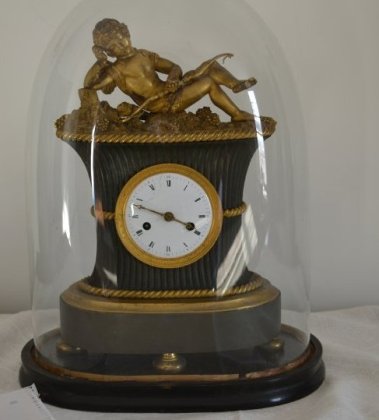
Federal style clock feat. Cupid. Picture Credit: Jessica Wiessner.

The clock contains several parts: a wooden plate for a stand, the main part of the clock where the face is, a golden Cupid laying in leaves and grapes while holding his bow and arrow, and a glass covering.  The clock’s face uses Roman numerals as a signifier for time and is quite small in relation to the whole clock.  The frame containing the face and Cupid is wood painted black with gold trims around it. There are also ridges carved into the wood, giving it a bumpy texture.  Inside are the gears which are no longer functional.  Cupid lays in a comfortable pose on leaves and grapes with his bow facing straight ahead.   The glass is dome-shaped and covers the entire clock to protect it.  The whole clock is approximately 13.5 inches high and 9.5 inches wide and is quite heavy to pick up or handle.

Provenance

This clock is dated to 1788.  It originated from an apartment on Pine Street in New York City owned by a man named Samuel Boyd.  I have not been able to find much historical information on Samuel Boyd other than he lived there and may have owned some type of store.  It ended up at the Blake House, owned by William H.D. Blake, who died in 1926.  The family continued to own the house and its objects until 1984 when the items in the Blake House were donated to Historic Huguenot Street. The clock now resides in the Federal Style Room in the Deyo House.

There are a couple of possibilities as to how Blake acquired this clock. According to the Historic Huguenot Street website, Matilda Blake was very close to her cousin Amy L. Hepburn, whose parents were named Samuel Boyd and Sarah Booth Hepburn, therefore making Samuel Boyd the brother-in-law to William and Matilda (Booth) Blake. Perhaps this is the Samuel Boyd from Pine Street who owned the clock, and William Blake purchased the clock from him or otherwise received it as a gift. It has been extremely difficult, unfortunately, to find evidence of this relationship as the name Samuel Boyd was extremely common. It could also be possible that the Samuel Boyd on Pine Street is a completely different person from William Blake’s brother-in-law, and that William Blake simply purchased the clock directly from this person or from an antique shop.

Narrative

William Henry Dill Blake (1843-1926) was born in Montgomery, New York and served as an officer in the Civil War.  He married Matilda Booth in 1875 and together they had three children: Alfred Booth, William Culbert and Matilda. They moved to New Paltz in 1881 when Blake purchased the late Josiah DuBois’ house and 250-acre farm. He continued to live in New Paltz until his death in 1926. All three of his children graduated from the New Paltz Normal School and were heavily involved in the New Paltz community, especially Matilda.

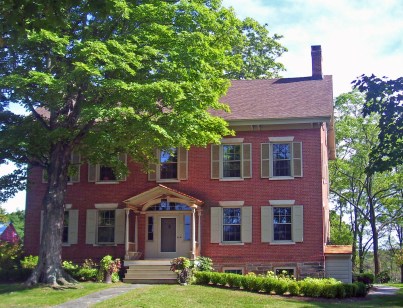
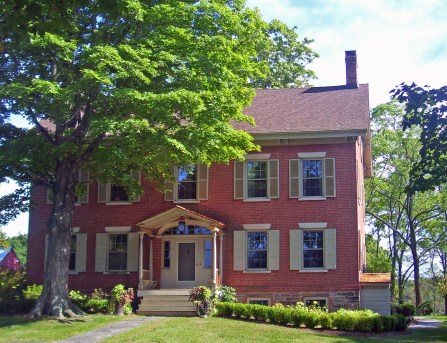
William Blake’s house is a story in and of itself and is important in understanding where the clock fits in.  It was constructed in 1822 on a large portion of land owned by the DuBois family since 1677.  Josiah DuBois owned and lived in the house until his death in 1869.  His daughter Elizabeth and her husband moved in the same year but only lived in it for twelve years until William Blake purchased it.  The house has become a historical landmark in New Paltz due to the property’s involvement in the original Huguenot settlement and the Revolutionary War.  The house was constructed in the Federalist style of architecture, so the clock this project focuses on must have fit in nicely with the theme of the house.

Josiah DuBois Farm House

Josiah DuBois Farm House. Source: WikiMedia Commons (link in references)

The Federal style was a movement in the three decades following the inception of the United States.  The developing system of government largely influenced the term Federal style, and the style itself served as a way for the newfound United States to create its own identity.  A prime example of the Federalist style is the White House, which has come to be a symbol of America and American identity. In addition, Neoclassicism, or a revival of ancient Greek and Roman art and culture, also heavily influenced furniture in this period. This would explain why the clock contains Cupid as its focal point.  Federal style furniture often comprises of thick, dark wood, simple designs, and marble.  Although elements of Neoclassicism (a relatively European movement) exist in the Federal period, the style is representative of the beginning of an American culture.  It is interesting that Josiah DuBois would choose this style for his house and William Blake would choose to maintain it.  The DuBois family were part of the original twelve French

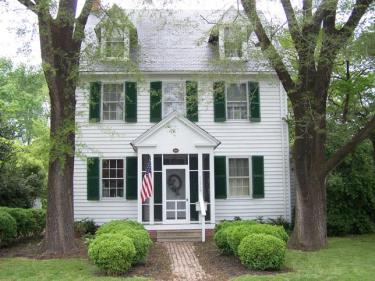
Federal Style Ex 2

Colonel George Handy House, built 1805 in Maryland. Federal Style. Source link listed in references.

Huguenot settlers in New Paltz and brought their European culture and traditions with them when they emigrated to New Paltz in the 1600s.  The property they owned still contains several older structures, including a 1775 Dutch barn.  It is as though DuBois and Blake, like much of America at the time, were attempting to erase their own histories and ascribe to the new “American” story that was emerging through creating and preserving this Federal style.

References

“Landmark Designation Form.” Historic Huguenot Street. Town of New Paltz, New York.  2003.

“William H.D. Blake Family Papers.” Historic Huguenot Street revised 8 June 2005. <www.huguenotstreet.org/william-h-d-blake-family-papers/>

Thurlow, Matthew. “American Federal Era Period Rooms.” In Heilbrunn Timeline of Art History. New York: The Metropolitan Museum of Art, 2000-. <www.metmuseum.org/toah/hd/fede/hd_fede.htm> (November 2009).

Picture of Colonel George Handy House in Maryland. Built 1805. Source: http://www.oldhouses.com/archives/1800-1810?searchname=Built%20between%201800%20and%201810

Picture of Josiah DuBois House. Source Link: https://commons.wikimedia.org/wiki/File:Josiah_DuBois_Farm,_New_Paltz,_NY.jpg

Old Technology as New Technology: Using a Typewriter

For my analog project, I decided to use a typewriter in the Sojourner Truth Library. I had never even been in the same room as a typewriter, let alone used one, so this was certainly a brand new and interesting experience for me.

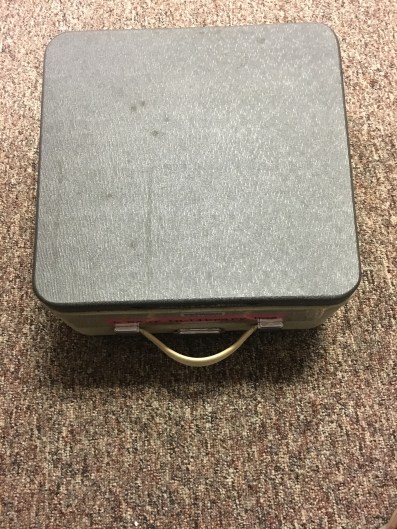
Typewriter 1

Typewriter Case

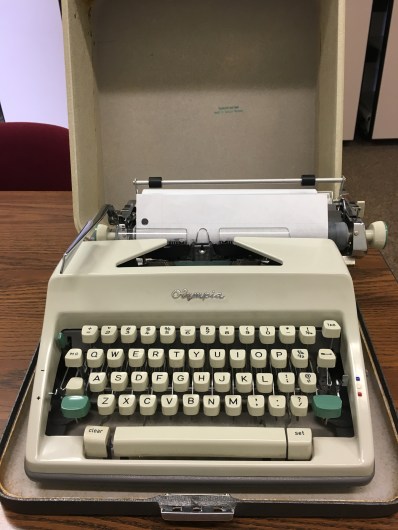
The first thing I noticed about it, before even opening up the case, was how heavy it was. And I do mean heavy, in bold, italics and underlined. I knew right away that I was going to need to find a quiet, secluded place in the library to experiment with it as to not bother anyone around me who may have been studying (which was quite difficult). Once I found a quiet enough area with a large enough desk, I opened up the case to this:

Typewriter 2

The actual typewriter

It was surreal. I had only ever seen these things in movies before. I was so excited to try out this really old piece of technology because it was brand new to me. I thought it would be obvious on how to insert the paper, but it wasn’t; initially, I inserted it upside down, and after a solid two minutes I finally figured out how to place it how I wanted to type on it (admittedly, I had to Google how to do it). After pushing some buttons, I also realized how difficult it was to get the keys to produce letters on the page. When typing on a laptop (as I’m doing right now), the letters appear automatically, even if I tap a letter lightly.  On a typewriter, I needed to press the letters with passion, or else the ink simply wouldn’t stick or would be too light.

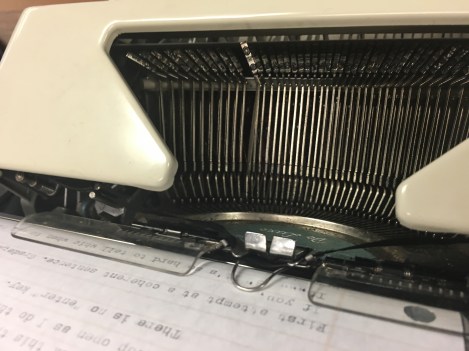
After typing random words and letters for a while and pushing random buttons, I discovered the Shift key and how it actually works. When I discovered this, all on my own, I couldn’t contain myself. I thought I was so clever and whoever designed the original typewriter must have been brilliant.  For those who have never used one, essentially both the lowercase letter and the uppercase letter exist on the same key, with the uppercase letter slightly above the lowercase one. When you press Shift, the entire keyboard lowers so that the uppercase letter is what gets imprinted on the page. I tried my best to capture this in some photos:

Typewriter 3

Entire keyboard, internal view

Typewriter 4

Typing the letter “O”

Since the keys were so hard to type and I needed to practically slam my fingers on the keyboard to get the letters to print, it was very loud.  Also, there were several levers all over the typewriter that didn’t seem to have any particular meaning or use that I could figure out. For example, there is a “Clear” button next to the space bar that didn’t seem to affect what was produced on the page.

Overall, there were two things that I really enjoyed about the typewriter. First, I really liked that there was no way of erasing or deleting what you wrote. While this could be inconvenient, I think it also really makes you think about what you want to say before you say it. I didn’t type anything of particular substance on the page I used (mostly gibberish and random sentences), but when I did try to type a coherent sentence, I had to think hard about what that sentence was. Right now,  typing this blog post, I have typed an equal amount of errors as I have correct sentences, and I’ve typed and retyped the same sentence over and over in different ways to make it better. I don’t have this luxury on a typewriter, and I think that’s a good thing. It forces my brain to work harder.

The second thing I really liked about the typewriter was that I could type anywhere on the page at any point. If I wanted to type in between the lines, I could. If I wanted to type upside down or sideways, I could. I could move the tray and start a new sentence wherever I wanted. I can’t really do that on something like Microsoft Word or even WordPress. In word processors and other digital media, unless I alter the programming I am limited to the template the word processor has already set up.  A typewriter is right in front of me, and I can physically pick it up and manipulate it however I want to.  While some analog technologies make creativity more difficult, I found that with the typewriter creativity was more accessible.

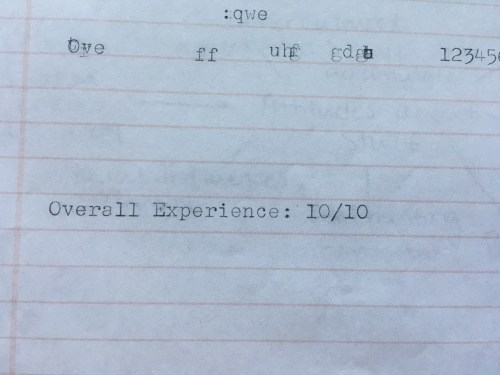
The only negatives I have to say about the typewriter in comparison to a laptop or other computer is that the typewriter is heavy and difficult to type on. However, I would absolutely go back to the library and use it again. My experience can be summed up as such:

Typewriter 5

Typed on a real typewriter (the “1” is actually a lowercase “L”)

Federal Style Clock Draft

Caption

As baby Cupid rests on grapes on leaves, the United States has only just been born.  Made in 1788, this clock represents the Federal style, an artistic movement that impacted how architecture, furniture, and interior design styles were made. This clock would find its way into the home of Josiah DuBois, a Huguenot descendant and owner of an extravagant Federal inspired home. The house, as well as this clock, are the symbols of an attempt at creating a true “American” culture in the 1800s.

Clock

Federal style clock feat. Cupid. Picture Credit: Jessica Wiessner.

Object Description

The clock contains several parts: a wooden plate for a stand, the main part of the clock where the face is, a golden Cupid laying in leaves and grapes while holding his bow and arrow, and a glass covering.  The clock’s face uses Roman numerals as a signifier for time and is quite small in relation to the whole clock.  The frame containing the face and holding up Cupid is wood painted black with gold trims around it. There are also ridges carved into the wood, giving it a bumpy texture.  Inside are the gears which are no longer functional.  Cupid lays in a comfortable pose on leaves and grapes with his bow facing straight ahead.   The glass is dome-shaped and covers the entire clock to protect it.  The whole clock is approximately 13.5 inches high and 9.5 inches wide and is quite heavy to pick up or handle.

Provenance

This clock is dated to 1788.  It originated from an apartment on Pine Street in New York City owned by a man named Samuel Boyd.  I have not been able to find much historical information on Samuel Boyd other than he lived there and may have owned some type of store.  It ended up at the Blake House, owned by William H.D. Blake, who died in 1926.  The family continued to own the house and its objects until 1984 when the items in the Blake House were donated to Historic Huguenot Street. The clock now resides in the Federal Style Room in the Deyo House.

There are a couple of possibilities as to how Blake acquired this clock. According to the Historic Huguenot Street website, Matilda Blake was very close to her cousin Amy L. Hepburn, whose parents were named Samuel Boyd and Sarah Booth Hepburn, therefore making Samuel Boyd the brother-in-law to William and Matilda (Booth) Blake. Perhaps this is the Samuel Boyd from Pine Street who owned the clock, and William Blake purchased the clock from him or otherwise received it as a gift. It has been extremely difficult, unfortunately, to find evidence of this relationship as the name Samuel Boyd was extremely common. It could also be possible that the Samuel Boyd on Pine Street is a completely different person from William Blake’s brother-in-law, and that William Blake simply purchased the clock directly from this person or from an antique shop.

Narrative

William Henry Dill Blake (1843-1926) was born in Montgomery, New York and served as an officer in the Civil War.  He married Matilda Booth in 1875 and together they had three children: Alfred Booth, William Culbert and Matilda. They moved to New Paltz in 1881 when Blake purchased the late Josiah DuBois’ house and 250-acre farm. He continued to live in New Paltz until his death in 1926. All three of his children graduated from the New Paltz Normal School and were heavily involved in the New Paltz community, especially Matilda.

William Blake’s house is a story in and of itself and is important in understanding where the clock fits in.  It was constructed in 1822 on a large portion of land owned by the DuBois family since 1677.  Josiah DuBois owned and lived in the house until his death in 1869.  His daughter Elizabeth and her husband moved in the same year but only lived in it for twelve years until William Blake purchased it.  The house has become a historical landmark in New Paltz due to the property’s involvement in the original Huguenot settlement and the Revolutionary War.  The house was constructed in the Federalist style of architecture, so the clock this project focuses on must have fit in nicely with the theme of the house.

Josiah DuBois Farm House

Josiah DuBois Farm House. Source: WikiMedia Commons. https://commons.wikimedia.org/wiki/File:Josiah_DuBois_Farm,_New_Paltz,_NY.jpg

The Federal style was a movement in the three decades following the inception of the United States.  The developing system of government largely influenced the term Federal style, and the style itself served as a way for the newfound United States to create its own identity.  A prime example of the Federalist style is the White House, which has come to be a symbol of America and American identity. In addition, Neoclassicism, or a revival of ancient Greek and Roman art and culture, also heavily influenced furniture in this period. This would explain why the clock contains Cupid as its focal point.  Federal style furniture often comprises of thick, dark wood, simple designs, and marble.  Although elements of Neoclassicism (a relatively European movement) exist in the Federal period, the style is representative of the beginning of an American culture.  It is interesting that Josiah DuBois would choose this style for his house and William Blake would choose to maintain it.  The DuBois family were part of the original twelve French Huguenot settlers in New Paltz and brought their European culture and traditions with them when they emigrated to New Paltz in the 1600s.  The property they owned still contains several older structures, including a 1775 Dutch barn.  It is as though DuBois and Blake, like much of America at the time, were attempting to erase their own histories and ascribe to the new “American” story that was emerging through creating and preserving this Federal style.

References

“Landmark Designation Form.” Historic Huguenot Street. Town of New Paltz, New York.  2003.

“William H.D. Blake Family Papers.” Historic Huguenot Street revised 8 June 2005. <www.huguenotstreet.org/william-h-d-blake-family-papers/>

Thurlow, Matthew. “American Federal Era Period Rooms.” In Heilbrunn Timeline of Art History. New York: The Metropolitan Museum of Art, 2000-. <www.metmuseum.org/toah/hd/fede/hd_fede.htm> (November 2009).

Wooden Bolivian Woman

This week I decided to write about something I have always seen in my house but knew little about: my mother’s Bolivian wooden sculpture. The only way to explain this object and its chain of ownership is through telling a brief part of my family history.

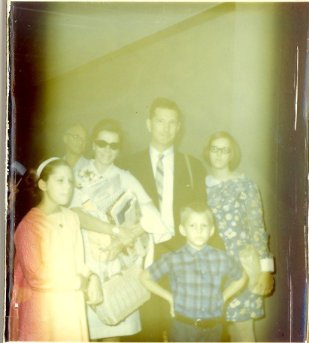
Both of my mother’s parents were teachers. After getting their degrees in education at SUNY New Paltz in the mid-1950s, they took on the real world and joined the workforce. My grandfather, William Gumm, eventually wanted to move up in the ranks and become a principal. However, in the 1960s, one could not become a principal without experience, but one also couldn’t get experience without the job. To get out of this catch-22 situation, he applied to work as a principal for schools affiliated with American companies in developing nations. Gulf Oil Company had offices in Bolivia and their own school for the American children of Gulf Oil’s employees: the Santa Cruz Cooperative School. It was this school in Bolivia that my grandfather became a principal of, and my grandmother taught there as well. Their three kids – my mom, my aunt and my uncle – naturally went with them.  They lived there comfortably for three years before heading back to the States, and my grandfather achieved his dream of becoming a principal.

The small wooden statue in the photos above was made especially for my grandfather. On the bottom of the statue, the carving reads, “To Mr. and Mrs. W. Gum, with all our heart Juan S[illegible] and family, SC 24-V-69.” I presume that “SC” stands for Santa Cruz, the city they lived in, and that the date means May 24, 1969. On the bottom left of the base of the statue, there are the initials “WBC,” of which I don’t know the meaning. I truly wish I could discern what Juan’s last name is, but it’s hard to read. Regardless, it was clearly a personal gift. When I asked my grandmother if she remembers who Juan was or how they got this statue, she said she thinks he might have been a gardener (not sure if he was the family gardener for the house or a gardener in the community). She told me that many of the locals there were extremely talented and great craftsmen, which would explain why we have so many wooden statues within the family.

This statue currently sits on our wall unit next to two Bolivian wooden heads (another set of wooden statues my mom inherited). Although these have not yet been passed down to me, they still sit in my house and I consider them half-mine. The Gumm family’s move to Bolivia was significant for so many reasons. It taught the family Spanish, which would be especially important in my mom’s and my uncle’s lives (my mom studied Spanish Literature in college and my uncle married into a Cuban family). Their experience with Bolivia, its culture and the Spanish language also led me to learn Spanish throughout my entire life, and while I am in no way fluent I do consider it my second language.  The experience created this story, connecting a relatively average, middle-class American family to a South American culture. It affected the entire family’s future up until the present. The carvings on the bottom of the statue by the person who made this wooden Bolivian woman shows how much the Santa Cruz community knew and loved my grandparents.

I think this story really relates to Edmund de Waal’s connection with the netsuke. Although he is certainly not Japanese, the netsuke are a huge piece of his family history and had a significant impact on the family’s future. Stories and history are totally related to objects. If my mom never went to Bolivia she may not have learned Spanish and therefore neither would I, and a huge piece of my life history would be missing. My family history is intertwined with this object. Its passage down from my grandparents to my mom to me demonstrate how history can also be passed down the same way. While I’m no descendant of the elite Ephrussi, I’m proud to be connected to the Gumms.

gumm-family

Slightly awkward family photo, 1970s

It’s a Pillow…it’s a Pet…

For this blog post, I decided to write about the “happy item” I brought in on the first day of class: my infamous Pillow Pet.

That’s him, the one and only. The Pillow Pet was invented around 2003 and was marketed toward little kids. I remember growing up seeing the commercials on Nickelodeon as a kid. It has two primary and obvious functions: to be a stuffed animal that a child can play with and be comforted by, and it’s also a pillow. Both the filling and the outside cover are made of 100% polyester. According to the tag, this particular Pillow Pet must have been made in the year 2010. He apparently was born (manufactured) in Jiangsu, China, and eventually was imported by Ontel Products Corp. to Fairfield, New Jersey. He eventually made his way to Queens, New York, where my mother purchased him as a Christmas gift for me. This little guy has probably done more traveling in 7 years than I have in my entire life.

I received my Pillow Pet either in 2014 or 2015. I have absolutely no reason or desire to use my Pillow Pet as a stuffed animal, so he mostly hangs out as a little pillow and for decoration. He mostly used to hang out on my bed, until I studied abroad in Germany and actually needed to sleep on him as a real pillow (okay, I didn’t need to use him as a pillow, I just preferred him over the pillow I was given). Although he’s a smaller pillow designed for a child’s head, that didn’t hinder me much from using him as a pillow. So far, I am the only person to ever own this particular Pillow Pet, so its function hasn’t really changed and there isn’t any “chain of ownership.”  In a way, you could say he went from a display object to one that was actually functional; however, the function I chose to use weren’t different from the function he was made for.

What I think is cool about my Pillow Pet is that, although Pillow Pets were originally intended to be for a significantly younger age group (the tag says “3+”) and the idea was clearly a mass-marketed capitalist scheme (who doesn’t know the Pillow Pet song?!), this Pillow Pet in particular has become a part of my story and my life. I can never tell the story of what it was like studying abroad without including my Pillow Pet. He is the only stuffed animal I bring to college out of the 10 I currently have at home. When I’m feeling down and alone, I hold him because he reminds me of my mom. I just realized I’ve been referring to my Pet as “he” versus “it” throughout this blog post. Although there are definitely millions of Pillow Pets exactly like this one, none of them have the same meaning to me as him. The idea of objects having a pulse, as Edmund de Waal describes in The Hare with Amber Eyes, holds true for this object in a way that it doesn’t with most of my other objects. One day I will probably have to part with him, and I know already that it will be a challenge. Until then, there will be room for him in my suitcase the next time I travel, just in case.

Not a Spoon You Eat With

For this blog post I decided to use an antique item that belongs to both my sorority and my grandmother.


What you are looking at is a 1-inch tall, sterling silver spoon pin, reminiscent of a sugar spoon.  At the top of the handle is a crest with a Greek inscription as well as some symbols. A long, sharp needle is fastened on the back of the spoon, starting from the top of the handle and going down the entire length of the object. At the sharp end of the needle is a clasp and hook that can be opened or locked to secure the spoon onto clothes as a pin. It is a simple design and its most obvious function is clear.

What is unclear is where or how it was made. It is impossible to know just by looking at the object where it was made, as the only inscription on it (other than the crest) is the word “sterling,” indicating that it is sterling silver. No company, brand, town or location has claimed this particular pin, other than Alpha Kappa Phi.

My grandmother was a member of Alpha Kappa Phi, Agonian Sorority, Incorporated at SUNY New Paltz between 1950 and 1954. The spoon pin was the sorority’s traditional sister pin that is bestowed upon you when you officially “cross” or become a member of Alpha Kappa Phi. It becomes your first set of letters and proves to everyone that you really belong to this organization. Presuming this pin was brand new at the time she became a member, this pin must be at least 63 years old. My grandmother owned this pin until I also became a member of Alpha Kappa Phi. She passed this on to me, along with some other sorority paraphernalia. When I became an official member of my sorority, I also received my own pin. It is very different than my grandmother’s; the pin I received is teeny-tiny with just the letters “ΑΚΦ” in gold. The reason for a spoon pin is that, traditionally, sororities were supposed to maintain and provide hospitality. Thus, the spoon serves as a symbol of this hospitality and a signal to others that that is what this sorority stands for. Other sororities also founded at a similar time as mine (around 1880) feature almost an identical spoon pin, with the particular sorority’s crest on the top of the handle. So, the spoon pin serves a couple of functions. One, as said before, is as a symbol of hospitality. The second function is that the pin serves as a method of proudly displaying to the public that my grandmother and I are a part of Alpha Kappa Phi, and we alone are given the unique privilege of wearing this pin.

I can tell that this pin has received much wear and tear throughout its ~63 years of life, as it has several scratch marks all over it. However, it is still going strong; the clasp and the pin itself are in good shape, and I am able to wear it occasionally. It is always pretty funny to see people’s reactions when they realize that I literally have a spoon on my shirt! While my grandmother has a whole host of other Alpha Kappa Phi things that she plans to give to me someday, this spoon pin is by far the most historically and personally significant. It represents not only Alpha Kappa Phi as an organization and sisterhood, but also that even though traditions may change, it isn’t always for the better or worse. We certainly have come a long way since the 1950s, and hopefully have even more of a ways to go.

My teeny-tiny sister pin, 2015

My teeny-tiny sister pin, 2015

Accommodations and Agency

I have always lived in a rental apartment with my mom. More accurately, my mom has always lived in a rental apartment and I also live there because I’m her daughter. Really, it is her place. My mom has always wanted to own something – a house, a condo, didn’t matter. She wanted something to call her own, but it was never attainable since New York City is so overpriced. She found a nice medium in the apartment we live in now. She’s been very good friends with our landlords for over 30 years and they let her do pretty much whatever she wants with the apartment.

My mom takes up the whole place (which is pretty large). Her trinkets, decorations, pictures, lamps, and furniture are all over the place. The cats have also claimed everything. I am confined to my little room in the back. Even there, her clothes claim the entire second rack in my closet. My room barely fits a regular sized dresser, nightstand, and bed. I could really use that second rack for my clothes. Nevertheless, my mother’s clothes exist there.

When I was in my freshman year of college I commuted, so I lived at home. I was fed up with my cramped little room. I was tired of the wall-to-wall carpet that had been there for decades, the paint peeling off of the walls, my bed that was only a twin size but still too big. We saved up some money and overhauled the entire room. I upgraded to a 7-foot loft bed, a brand new carpet, and some new paint. I could fit a desk under my bed and still had space to move around. As a final touch, I convinced my mom to donate some of her clothes in my closet, allowing me to completely reorganize the depths of my closet that I had never seen before.

For the first time, I had a room that really felt like me. It was spacious and functional. Before, I would trip over my bed or my dresser because they were so close together. Now, I can even do yoga in there, if I really wanted to. I reclaimed my bedroom as “mine,” even when the rest of the apartment is “my mom’s.” It is clutter-free, unlike the rest of my apartment still filled with my mom’s trinkets and favorite pictures, exactly the way I want it. Although I don’t mind the rest of the apartment, I find that I appreciate the things in my own room more. It serves as a sort of practice for when I actually do have my own apartment or place. It’s soothing, it represents me. As Miller notes about accommodation versus accommodating, I think I have finally accommodated the room to me.

The KonMari Method & My “Komono”

I chose to use the KonMari method with my miscellaneous or komono drawer. I chose this drawer mainly because it was the messiest drawer in my entire room. I tend to be very organized, but for some reason this drawer looked like this:

before

Yikes

Pretty awful. I don’t know exactly how many objects I had in there, but it must have been up there in the thirty or forty range. It was certainly time for a clean-up, so I did what KonMari suggested and took every item out first. I looked at them, and tried to use a combination of her “joy” test as well as whether or not the object had some functional value. For example, somewhere in there is my wallet, deodorant, DayQuil and NyQuil, Excedrin migraine, etc. Some of these things I use everyday (like my wallet), others are saved for a rainy day (like the Excedrin). I decided to start putting stuff back in with some sort of organization, so here’s what it looked like about halfway through the process:

For the record, my SpongeBob Squarepants laundry hamper was not a part of my tidying and is here to stay. Anyway, I thought I was making some significant progress, until I came across a few items. While I could come up with a reason for keeping the NyQuil, the moisturizers, and my apparent soap hoard, there were a few items that had absolutely no purpose being there and even gave me the opposite feeling of joy: anger. For example, one item was a bottle of “special contact solution” that actually burned my eyes when I used it to rinse out my contacts last weekend. Since I am terribly sightless without contacts or glasses I failed to notice the bright orange warning labels with the instructions for use. I just thought it was regular contact solution. It wasn’t, and the hydrogen peroxide in the solution burned my eyes.  Another item I found was a LifeProof iPhone case that I bought when I first got my iPhone 6s. It worked really well in that it effectively protected my phone from breaking. However, it had a cover over the headphone jack, so I could not use my favorite headphones without prying the phone case completely off. This is hard to do, since the case essentially seals and locks shut when you put it on. It got annoying, so I stopped using it. It wouldn’t be so bad if the thing didn’t cost me almost $70. Yes, okay, it “technically” works, which is why I’ve kept it, but I can’t even listen to music, the one thing I mainly use my beautiful iPhone for! The fact that I paid money for such a useless item is super irritating.

The other two items were a plastic bag and a New Paltz ID card case. The plastic bag was annoying because I had absolutely no use for it and, in general, I hate plastic bags due to their negative environmental impact. The New Paltz card case doesn’t give me nearly as much anger as the other items, but it just kind of gets in the way and I don’t really ever use it.

no-good-items

The annoying items, excluding my TV and remote

Maybe I am a bit petty or over-dramatic for being so angry at a few items. Nevertheless, I left these items out while I put the others back in. It was quite nice to have a clutter-free drawer without these useless and annoying items! I honestly didn’t expect the project to go the way it did. Seeing the items I had bad experiences with and the emotional reaction I had to them made me appreciate the things I do like/use a lot more. Although I’m not quite sure that was what KonMari intended, I think I ultimately got to where she would want me to be: finding joy in the items I keep. I decided to get rid of the contact solution, as this project prompted me to give it to a friend who uses it. For now, the others are okay sitting in the back of my drawer. Perhaps one day I will need that LifeProof case or plastic bag. Overall, I did not find this process to be too difficult, but I did find it interesting that the KonMari method can apparently work backwards – in finding anger, you can also find joy.

after

Not the most beautiful tidying job, but good enough for me