Since When Does the Daily News Cost Three Dollars

Most mornings I wake up to a bombardment of notifications from a variety of news apps—the New York Time, Le Monde, Al Jazeera, etc. The most pressing headlines, the most pertinent news that one must know. I typically scroll through the national and world news, starting my day off with a nice healthy dose of existential dread. Later in the evenings, I’ll take a walk while listening to current events podcasts, typically in French to improve my language skills.

One could say I’m a tad too dependent on digital media, especially when it comes to news. And so I decided to spend a few days buying and reading a physical newspaper. 

My analog journey began on Tuesday. It was a beautiful, sunny, 60 degree day, completely normal for the middle of November in the North East (ha-ha). I asked my roommate where I could find a physical copy of a daily newspaper since I embarrassingly had little idea. They recommended I go to the gas station, and so that’s what I did; strolling off campus, crunching fallen gold leaves, listening to Janis Joplin, and contemplating the Earth’s warming.

The gas station only sells the Daily News during the week, shaking things up from my usual my usual New York Times read. It was a whopping $3.00, although it seemed like the cashier made the price up on the spot after a confused pause. I figured he probably was not used to college kids walking into the small store to buy the Daily News rather than a pack of White Claws.

I read the paper on my walk back to campus. I read all the articles in the news section, flipping haphazardly through sports and entertainment. Reading the physical paper proved to be better for remembering the smaller details; even writing this post days later, I can still recall which counties are currently under a drought warning in New York State, something I would never remember if I had read the article online. With reading digital news, my eyes seem to skip over certain information, latching onto the most “important” details that I want to remember. Each individual word of the physical newspaper captured my attention; they were part of a greater hole, no longer just black signs on a glowing screen.

The next day brought the newest issue of the New Paltz Oracle, thankfully saving me from the walk to the gas station. I came to realize how much I enjoy flipping through a physical paper, being able to smell the pages the same way I enjoy the smell of old, dusty books. Although I have preferred physical books over downloads on a Kindle or phone for years, I never considered I would feel the same with reading the news.

The final day of my experiment it rained. All day. No longer could I appreciate the warm fall scenery and crisp air; I dramatically trudged to the gas station, the $3.00 charge for the Daily News seeming much more detrimental this time around. I was generally cranky that day, and this journey seemed to make matters worse. What was the point, I wondered, of walking through the rain to get an overpriced paper that didn’t even tell me half of the information available for free on my phone?

I typically find issues with the increasingly digital world, feeling nostalgic for humanity’s dependance on analog experiences. I refuse to use Elfster for Secret Santa, I opt for buying things in person rather than ordering online. But my romanticized vision of the analog world took a blow with this experiment; never have I been more grateful for the option to have an insane amount of media available to me at the press of a button.

Admittedly, I still used my news apps during this experiment. While I did appreciate getting local and state news in the physical paper, I couldn’t give up my access to national and world events, especially not now. I am incredibly grateful to be privileged enough to have access to the internet, and even more so to a walkable town where I have enough money to buy a newspaper (plus a half and half iced tea on occasion). I did appreciate the experience of buying a physical paper, but until I have my own house and enough money to get the New York Times delivered every Sunday, I will stick with my digitized and wonderfully convenient news.


The Twelve Men’s Contract of 1728

Faded script written on fraying, yellowed pieces of paper, this document presents the written “Contract of 1728.” This agreement established the Twelve Men of New Paltz, also known as the Duzine, elected representatives from each of the twelve founding families who would act in the town’s government. The contact resulted from the desire to manage and survey the land the Huguenot settlers had bought from the Esopus tribe.

Physical Description of Object

4 pages, interestingly varying in size, come together to form the Contract of 1728. Their appearance is testament to their age; few stains and tears interrupt the looping and fading script that is reminiscent of many antiquated documents from the era. Pages 1, 2, and 4 are the same size, measuring 12.75 by 15 inches. The third page is the largest length-wise, measuring 12.75 by 21.5 inches. The first three pages include the actual agreement, detailing the institution of the Twelve Men and the power that they would have in the New Paltz government. On the bottom half of the third page and arguably the reason for its length rests 24 wax seals and corresponding signatures of the signatories and witnesses of the document. The final page is a notary statement dated to 1771, written by Dick Wynkoop and signed by three more witnesses.

Photo Credits to Historic Huguenot Street

Provenance

Being a legal document within New Paltz’s government, the 1728 Duzine Agreement has been kept with the town records since its creation. The New Paltz Town Records are stored in the archives of Historic Huguenot Street and consist of 19 boxes of documents and other items relevant to the history of the first two-hundred years of the town, before the incorporation of the New Paltz Village. The document is also associated with and can be better understood through the examining of the Proceedings of the Twelve Men, a 72 page book which documents the discussion of the Duzine from 1738, the year in which the Contract of 1728 was reaffirmed, until 1772.

Narrative

To All Christian People. In four very powerful opening words, the creation of the Contract of 1728 makes clear who in the newly patented New Paltz land would have power and who should be made aware of it. The writers and signatories were aware of their excluding a group of people from their new system of governmental representation, or else there would be no need to address the document specifically to only Christian people. While this could serve as an acknowledgement of the hardships the Huguenots had faced in result of their search for religious freedom, it also illuminates the darker and often unspoken history of slavery and racism in the town of New Paltz.

The Huguenots, Calvinist Protestants who fled France during a time of intense religious persecution, settled in the area now known as the town of New Paltz. The original twelve families who settled on the land entered into an agreement with the Esopus people, the Native American tribe that had already been living there, under the Contract of 1677. This contract officiated the transfer of land from the Espous to the New Paltz founders in exchange for pounds, clothes, gunpowder, lead, and the guarantee that the Natives could continue to hunt on the land. Once having officially obtained the land called the New Paltz Patent, the twelve founders, also known as the “patentees”, equally split the land amongst themselves and their families, supporting a community of 60 total Huguenots. For the first 25 years of their settlement, the New Paltz land was held in common by its population, governed by the heads of the original twelve households. In 1703, the remaining patentees and the heirs of the deceased formally reversed the precedent of commonly owned land and declared ownership over their respective property, leading to the creation of the contract of 1728.

The contract was developed in part as a way of discouraging neighboring towns and individuals from encroaching on the patentee’s land. On the other hand, the contract hoped to create a strong, centralized government that became more desirable as the population continued to grow. The contract created a new system of land management through the institution of the Twelve Men, or the Duzine: one man from each of the original founding families who was elected annually to represent his respective family in council meetings. The Twelve Men held the power to survey and divide the lands bought under the Contract of 1677 and also to “act and sett in good order and unity all common affairs Business or things coming before them.” The contract was renewed ten years later with the Contract of 1738.

The Contract of 1728 established an electoral system of voting and representation, with the families deciding amongst themselves which person—or realistically, which man—would best represent their needs and desires. As the population grew, so did the government; by the end of the 18th century, there were 50 elected officials representing about 1,263 people. Similarly to the modern day discourse over the efficacy of an electoral system in properly representing the citizens of the United States, the establishment of the Twelve Men raises questions of who would have a voice in the government, especially considering the history of slavery in New Paltz. 

The development of New Paltz was built on slavery, in particular during its first 150 years of existence. The Huguenots benefited greatly from the slave trade which was especially prominent in colonial New York, relying on enslaved Africans as a supply of forced labor on farms, and in mills and homes. The first record of slavery in New Paltz is from 1674, three years before the founders bought the New Paltz Patent. According to the census of 1755, there were 28 slaveholders owning a total of 78 slaves over the age of 14. As New Paltz’s population continued to grow, so did the amount of enslaved people; by 1790, slaves made up more than 13% of the population, with records showing prominent New Paltz founding families such as the DuBois’, Freer’s, and LeFever’s owning several slaves. 

These enslaved people were considered the property of their owners and not given a voice. Consider the two slaves owned by Louis DuBois; they, despite living in the home of the DuBois family, were not considered in the election of their representative and could have no say in the government they were living under, the government which decided they were property. Even later when slavery was abolished in New York, freed black men struggled to find their voice within the New Paltz government. It was required to own $250 worth of land, the modern equivalent of $10,000, in order to vote or hold office. Although there is record of one freed black man, Caesar DuBois, being registered to vote, this offers little consolation: one man out of hundreds of both freed black people and those still enslaved could participate in government, a result of the founder’s intentions on who this electoral system was made for. 

When understanding the history of slavery in New Paltz, the question of the language of the Contract of 1728, of its purpose being to inform “all Christian people”, becomes hauntingly clear. The contract was meant to assure the white landowners would have continued ownership over their property and efficient representation in government. Historic lack of representation of people of color in the United States has had continuous oppressive impacts in the contemporary world, and therefore histories of slavery and restricted representation in quaint, “progressive” towns like New Paltz must be acknowledged to repair the communities disenfranchised by racism and enslavement.

Works Cited

“Caesar DuBois · New Paltz Historic Documents Project · Hudson River Valley Heritage Exhibits.” Hrvh.org, 2021, omeka.hrvh.org/exhibits/show/new-paltz-historic-doc-project/research-projects/free-black-community/caesar-dubois. Accessed 2 Nov. 2024.

“Enslavement · New Paltz Historic Documents Project · Hudson River Valley Heritage Exhibits.” Hrvh.org, 2018, omeka.hrvh.org/exhibits/show/new-paltz-historic-doc-project/research-projects/enslavement. Accessed 2 Nov. 2024.

“New Paltz Town Records (1677-1932).” Historic Huguenot Street, http://www.huguenotstreet.org/new-paltz-town-records.

“Proceedings of the Twelve Men.” New York Heritage Digital Collections, 2019, nyheritage.contentdm.oclc.org/digital/collection/p16694coll153/id/21568/rec/1. Accessed 2 Nov. 2024.

Roth, Eric J. For the Village: The Story of Huguenot Street. Huguenot Historical Society of New Paltz, Inc., 2009.

Roth, Eric J. “‘The Society of Negroes Unsettled’: a history of slavery in New Paltz, NY.” Afro-Americans in New York Life and History, vol. 27, no. 1, Jan. 2003, pp. 27+. Gale Academic OneFile, link.gale.com/apps/doc/A128705774/AONE?u=acc&sid=googleScholar&xid=1814ccca. Accessed 2 Nov. 2024.

“Slavery in New York.” http://www.slaveryinnewyork.org, http://www.slaveryinnewyork.org/history.htm.

Smith, Michael J. Natives’ Prosopography of Individuals Mentioned in the 1767 Land Agreement, Loughlo to Moses Depuy, Et.al. Feb. 2024, static1.squarespace.com/static/53285698e4b0689686dbce6c/t/66db17c353c8324988414849/1725634499715/1767+Native+deed+participants-8-30-24.pdf.“The Twelve Men, Agreement for an Annual Election of Representatives.” New York Heritage Digital Collections, 2019, nyheritage.contentdm.oclc.org/digital/collection/p16694coll153/id/21573/rec/3. Accessed 2 Nov. 2024.

Key Misunderstandings on All Hallows’ Eve

“Oh shit. Somebody dropped their keys.”

Mari’s nostrils flared. “I’m trying to have a conversation with you, you know”, she snapped. “Like an actual conversation? About us? All we do is fight and now when I’m trying to solve things you get distracted by someone’s keys?”

James stared blankly at her. “We’re at a Halloween party dressed as Shrek and Fiona. My face is green.”

She looked at him like he had two heads. “What does that have anything to do with this?”

“Why are you bringing this up to me at a Halloween party?”

Mari threw her hands up and let out a harsh laugh. “This is ridiculous. Whatever, go find whoever’s keys those are. I’m done with this.” James watched her push her way through the crowded basement, picking up a half-drunk beer she found discarded on a table. He sighed. They’d been fighting a lot, more than they ever had. He wasn’t sure if that’s what love was supposed to be like.

He anxiously turned the cold keys between his fingers. He missed what they had over the summer—the bliss of a new relationship, the eternal hum of cicadas that filled the gaps between them.

The sharp edges of the keys left indents in his palm from how hard he was gripping them. “God”, he grumbled.

He went further into the basement, shoving past the kids he recognized from some of his classes, although instead of discussing philosophy they now sang loudly and reeked of beer. He found one of the people who actually lived in the house, Ro, standing in the corner of the room with some girl he didn’t recognize. “Hey, someone dropped these,” he said, handing them over to Ro. The girls exchanged glances, locking eyes before each giving him a dirty look; it was obvious he had interrupted something.

“Um, great. Thanks”, Ro said. She looked over at Kate, who was anxiously stirring her drink and notably looking everywhere besides Ro. She knew this was the guy Mari’s been with, but couldn’t remember his name. She figured it didn’t really matter. Everyone knew they were bound to break up any day now.

Kate cleared her throat as the guy walked away. “So”, she started. “I was, uh, going to say something.”

“You were.” Their faces were flushed, both attributing it to the drinking but maybe it was something more. Kate’s eyes were framed by glitter and Ro tried to ignore how her face glowed in the dim, lantern-lit basement, how her plastic tiara sat like it was always meant to be there.

Kate let out a nervous laugh, stirring her drink more and more aggressively. The clicking of the keys as they rolled through Ro’s fingers echoed louder than they should have. “It’s just that I, uh”, she cleared her throat. “I mean, we have known each other for a while, and I don’t want to, you know, mess anything up, but I think, or I guess it’s more of a know, that I like–”

“Hey!”Avery slid in front of Kate, pointing to the keys twirling in Ro’s hand. “Those are my partner’s keys, could I grab them?”

Ro had to bend her neck all the way back to look at Avery. She cursed tall men and their tendencies to ruin things with their loudness. She huffed, shoving the keys into Avery’s hand before pushing him to the side, grabbing Kate’s face in her hands, and kissing her.

Avery didn’t really understand what was going on, but then again he was generally confused by lesbians. And at least he found Wren’s keys.

They were still sitting with their face tucked into their knees by the time Avery found his way outside. The latter sat down next to them, letting the keys dangle from their worn, embroidered lanyard. “See, I told you it would be fine”, Avery smiled. “What would you ever do without me?”

Wren glanced up out of their arms, eyes scrunched from a smile. “Thanks”, they said, their voice muffled by their crossed arms. They uncurled themselves to grab their keys, grateful that they hadn’t been lost or stolen in the house. They traced over the clay ladybug keychain Avery had made them for their last anniversary. Although losing their keys would have sucked, they knew they realistically could have gotten new ones. That keychain, however, would have been lost forever. “Can we go home now? I’m tired and it’s too loud.”

“Of course. I’ll drive.” Avery took the keys back from Wren, holding them extra tight in case they somehow slipped out of his hands and re-entered the void of lost things. Hand in hand, they tiredly bumped into each other, stumbling down the grassy hill to Wren’s Subaru. “You know, I think Ro and Kate are dating”, Avery mentioned as they climbed into their seats. He blasted the heat and played Wren’s favorite jazz playlist.

Wren hummed. “That’s cute. They work well together.” The car’s movement lulled them, their eyes drooping. The street lamps streaked between their eyelashes as they leaned against the cold window.

They were silent for a couple of minutes. “I think Mari and James broke up”, Avery added. The only response he got was a soft snore.

Avery smiled. The key’s lanyard softly bumped against his knee as he drove, making sure to avoid all the potholes his town was too lazy to fix. 

The Buzz Around Burt’s Bees

The annual struggle of frustratingly cracked lips has come to fruition as the seasons shift and the cooler air brings a dryer climate. And so I found myself in Top’s Market, digging through a small bin of chapstick to find my beloved Burt’s Bees pomegranate balm. The company claims to be founded on the idea that “bees are magical”, and what could be more magical than learning about the environmental impacts of your favorite products?

Burt’s Bees chapstick gets its charm from its use of “all-natural” ingredients, specifically beeswax, coconut oil, sunflower oil, vitamin E, rosemary leaf extract, and peppermint oil. The company prides itself on uplifting communities and its ambitions to improve sourcing practices, claiming 63% of waxes, butters, and oils to be “traced to origin and verified by on-site visits” (2022 Progress Report). Possibly the most iconic of these ingredients is the balm’s wax, being a heavily aestheticized and marketed part of this product. The company’s wax is sourced from Tanzania, whose opportunities in beeswax production and processing have attracted many buyers, most notably the European Union member countries, the United States, and Japan.

The Tanzanian beekeeping industry is estimated to employ 2 million rural people. The industry has such a presence that the Tanzania government developed the National Beekeeping Policy in 1998 to increase beekeeping’s contribution to the sustainable development of Tanzania and manage the conservation of the country’s natural resources for “the benefit of present and future generations” (Mwakatobe & Mlingwa, 2006). Here we see traces of the company’s claims; local workers continue to harvest the wax in traditional ways and are monetarily supported by the company’s donations. The journey of the wax is certainly taken for granted by consumers, as we have still not found the product’s final resting place.

Upon being harvested in Tanzania, the wax is shipped to a Burt’s Bees factory in North Carolina. Here machines mix the wax, add the other ingredients that were previously stated, and separate the mixture into the iconic honey-colored plastic tools.. According to their website, 100% of Burt’s Bees packaging is recyclable and the company is certified as carbon neutral. Beginning in 2021, the company switched to being powered by renewable energy and joined three different climate action communities.

Although the company’s website offers plenty of information on the recyclability of its packaging, information on where they source its plastic is lacking. According to Plastic Euope’s article on the process of plastic production, the material comes from “organic materials such as cellulose, coal, natural gas, salt and, of course, crude oil.” The dependence on crude oil for these productions may, unfortunately, cancel out the environmental efforts the Burt’s Bees company has made; oil production releases tons of pollutants into the air and oceans, causing things like ocean noise, habitat degradation and destruction, and interference in the lives of the people who are indigenous to the regions where oil is extracted (“Oil and Gas Development | Threats | WWF”).

Oil spills are a frequent consequence of oil production, with an estimated 150 spills happening each year in U.S. waters alone. These spills are not just disruptive to the lives of animals but to humans, ruining public natural resources and causing detrimental impacts on local communities. Although the Burt’s Bees company has made efforts—much more than many other companies in the cosmetic industry—to reduce their environmental impact, tracing each aspect of the product reveals some not-so-magical effects of production.

Oil spills are a frequent consequence of oil production, with an estimated 150 spills happening each year in U.S. waters alone. These spills are not just disruptive to the lives of animals but to humans, ruining public natural resources and causing detrimental impacts on local communities. The United States makes up most of the world’s crude oil production, creating jobs for many working-class Americans, but we must ask ourselves the cost of this. Although the Burt’s Bees company has made efforts—much more than many other companies in the cosmetic industry—to reduce their environmental impact, tracing each aspect of the product reveals some not-so-magical effects of production. 

Works Cited

“How Burt’s Bees Lip Balm Is Made | How Stuff Is Made.” Youtube, Refinery29, 27 6 2018, https://www.youtube.com/watch?v=bxnNdNzvp8M&ab_channel=Refinery29. Accessed 4 10 2024.

“Largest Oil Spills Affecting U.S. Waters Since 1969 | response.restoration.noaa.gov.” NOAA’s Office of Response and Restoration, https://response.restoration.noaa.gov/oil-and-chemical-spills/oil-spills/largest-oil-spills-affecting-us-waters-1969.html. Accessed 4 October 2024.

Mwakatobe, A., Mlingwa, C., 2006a. . “Tanzania-The status of Tanzanian honey Trade- Domestic and International Markets”.http://www.tanzaniagateway.org/docs/the_status_of_tanzanian_honey_trade_markets_nov2006.pdf (accessed 10.4.24). 

“Oil and Gas Development | Threats | WWF.” World Wildlife Fund, https://www.worldwildlife.org/threats/oil-and-gas-development. Accessed 4 October 2024.

2022 Progress Report. July 2020-June 2022 ed., Burts Bees, 2022, https://assets.ctfassets.net/96vm5wjuyy9f/BuxfFMaAhcZ2GmcukZaGh/485cc2b1722b49554109106cdcb98aaf/2022_BB_ProgressReport__1_.pdf.“Which country is the largest producer of plastics?” Milan Polymer Days, https://www.milanpolymerdays.org/blog/which-country-is-the-largest-producer-of-plastics. Accessed 4 October 2024.

Original Sin and an Old Victorian Gown

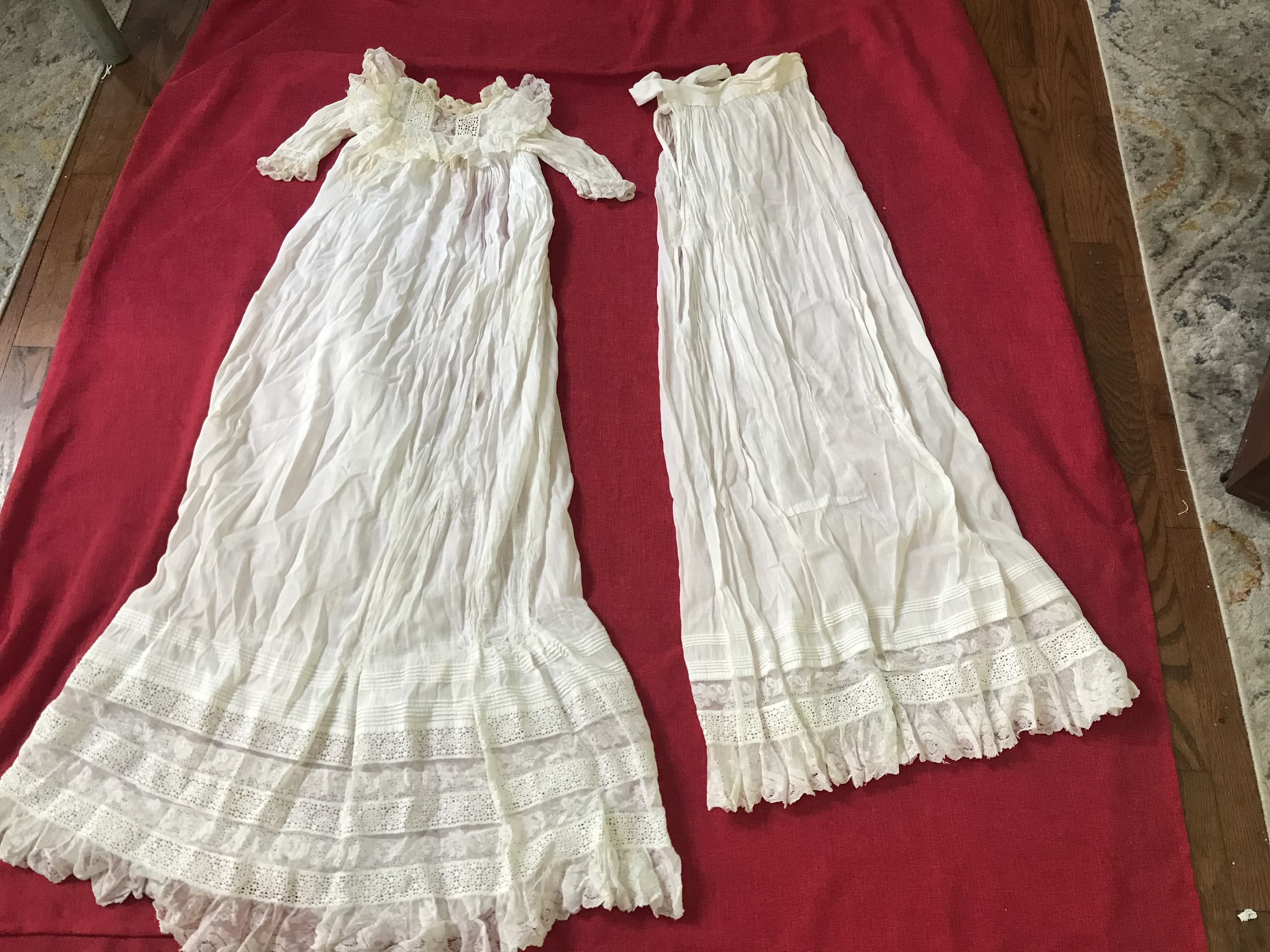
I have, like the majority of Catholic Irish-Americans, been to more baptisms than I can count. Considering my sizeable family—4 aunts, 1 uncle, 12 first cousins, and 14 second cousins—baptisms have seemingly become a semi-annual family reunion. The practice cleanses the newly born, washing away the Original Sin they have somehow carried into this life, symbolic of an official identification with the Church and God. It is emblematic of death and resurrection, of being reborn under holy waters blessed by the priest. It is at this practice that we are introduced to an off-white, frilly, and painfully antiquated baptismal gown with a perfectly matching petticoat.

The baptismal gown and petticoat

My grandmother was the first of her siblings to have a child. Married to a newly converted Catholic (my grandfather had grown up in a French Protestant family), it seemed undebatable that their firstborn would be baptized. Standing before God with hopes of forgiveness for Original Sin, one would think to show their holiness and piety through their dress. A nicely tailored suit, maybe? Perhaps a shining cross necklace?

This, of course, is where our beloved dress comes into the picture. 

Aunt Margaret had been saving this dress—although unknown where she got it—to hopefully dress her children for their baptisms. Upon my grandmother having her first child and never realizing that hope of having children, she gave the dress to her niece. A long and delicate white cotton, the skirt of the dress flows out seemingly far too long to fit the newborn it was meant for. Around the neckline are ruffled circles of lace, sewn in a way that causes the fabric to stick out and radiate from the child’s head. Thinner strands of fabric web together to outline the more prominent details, areas of thick lace that form interwoven circles and star shapes, sometimes connecting in floral patterns. The thin strands, however, are so fine in some areas that it is difficult to make out what the design is. Flower petals? Maybe leaves?

“A beautiful Victorian vintage gown”, in the words of my grandmother. One that is apparently not too long, as some (me) may have previously thought. The length of the skirt is meant to be draped over the arms of the godparents as they present their godchild to the Church for the first time, an act that effectively shows off the lacey frills that reach the floor of the altar. This gown—tagless, perhaps handmade—is far too delicate to be passed around. We see it—perhaps if we’re lucky, feel it—only during the occasion of a baptism. My grandmother is its keeper; when not in use she protects it, afraid of its being ruined. Not only does she guard the gown itself but its history and significance that go far beyond my Great-Great Aunt Margaret. She is graciously always willing to share such intangible stories that cannot, unlike this old Victorian gown, be stained and torn.

My Aunt Katie, Uncle Sean, and two cousins at their family baptism

Aunt Margaret was born to two Irish immigrants, both of whom were baptized into the Catholic Church. Her father, James Charles, was born on a family farm in County Leitrim, Clooncose townland, Ireland, and was christened at the nearby church. James was born in 1844, just a year before historians mark the beginning of the Great Famine, a very possible impetus for his decision to leave Ireland and settle in the United States. Before emigrating, however, he married a young Catholic girl named Annie Beirne. Although this story would tie nicely with an anecdote of finding unexpected love in a time of immense Irish conflict and trial, Annie lived in County Cavan, far too long of a distance from James’ family farm for the two to have met naturally. An arranged marriage, most likely.

After a year of leaving Ireland and settling in New York City alone, Annie too left Ireland to join her husband James. Although this marks quite a large gap in our story, we know that it was in New York (somewhere on Avenue C between 15th and 16th Street) that James and Annie Charles had their daughter Margaret. I don’t know much about her life, but I do know that she followed in my ancestors’ very Catholic footsteps: she was baptized, went to Church with her family, and undoubtedly wished to continue the tradition with her own children. This is why she came to possess the baptismal gown, and how it was eventually gifted to my grandmother. My grandmother who must be making her Aunt Margaret incomprehensibly happy with her continued use of the gown.

Every member of my family, since my grandparents’ firstborn, has worn this gown at their baptism. Although some larger children have had to be squeezed and shoved into the consequently unbuttonable dress (thanks to modern medicine, we no longer need to baptize infants almost immediately after birth), not a single one of us has entered the Church without our faces shining through radiating lace, without soft white cotton adorning our godparents’ arms. And the tradition will continue, so long as we make sure not to rip the fabric on the way.

Great-Grandmother Olive’s Tablecloth

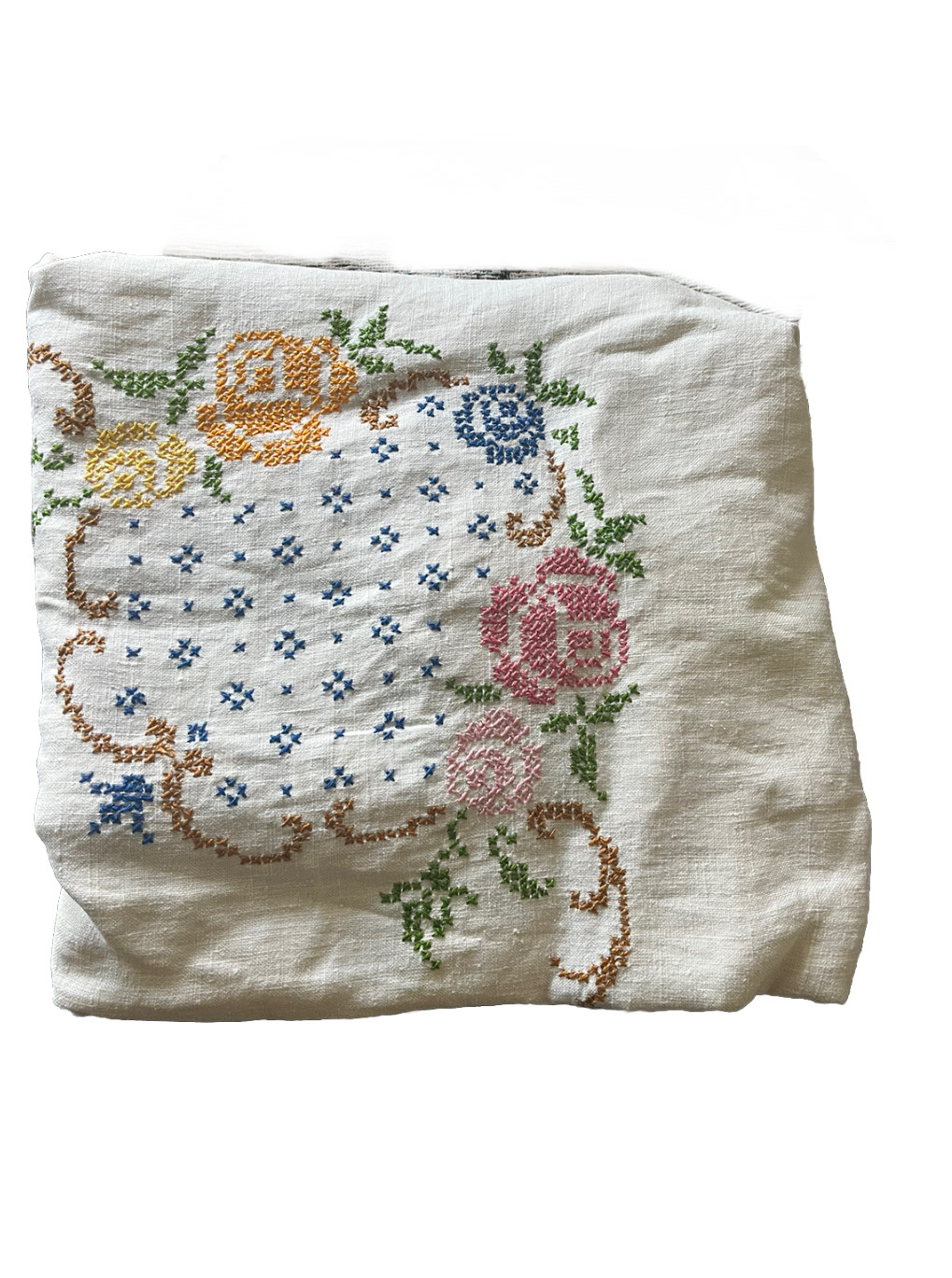
Top view of full tablecloth

The object I have chosen is a tablecloth embroidered by my late great-grandmother Olive, found by my sister during one of her many escapades through our cluttered, object-filled basement. Olive would make one of these tablecloths whenever her children or grandchildren moved out and into their own homes, hoping her gift would be of use in an unfinished home. These children, including my great-aunt Flo, whose house I now live in, opted for folding and putting away these clothes for fear of tarnishing their grandmother’s hard work. This is how Olive’s gift wound up buried in piles of old letters and trinkets until my sister unearthed it and claimed it as our new kitchen tablecloth.

The white, rectangular cloth is 65 inches long by 45 inches wide. The soft, vintage cotton is thin enough to allow light to shine through, especially when pressed against a sunny window. There is a distinct lack of holes in the fabric, no evidence of a mistaken stitch or accidental pulll of fabric. The outer perimeter of the cloth is decorated with half circles of small white stitches with lines that connect the edge of the cloth to the stitched circles, imitating the look of lace. From use and time, these loops have been misshapen and pressed, leading to some being larger or more spread apart than others.

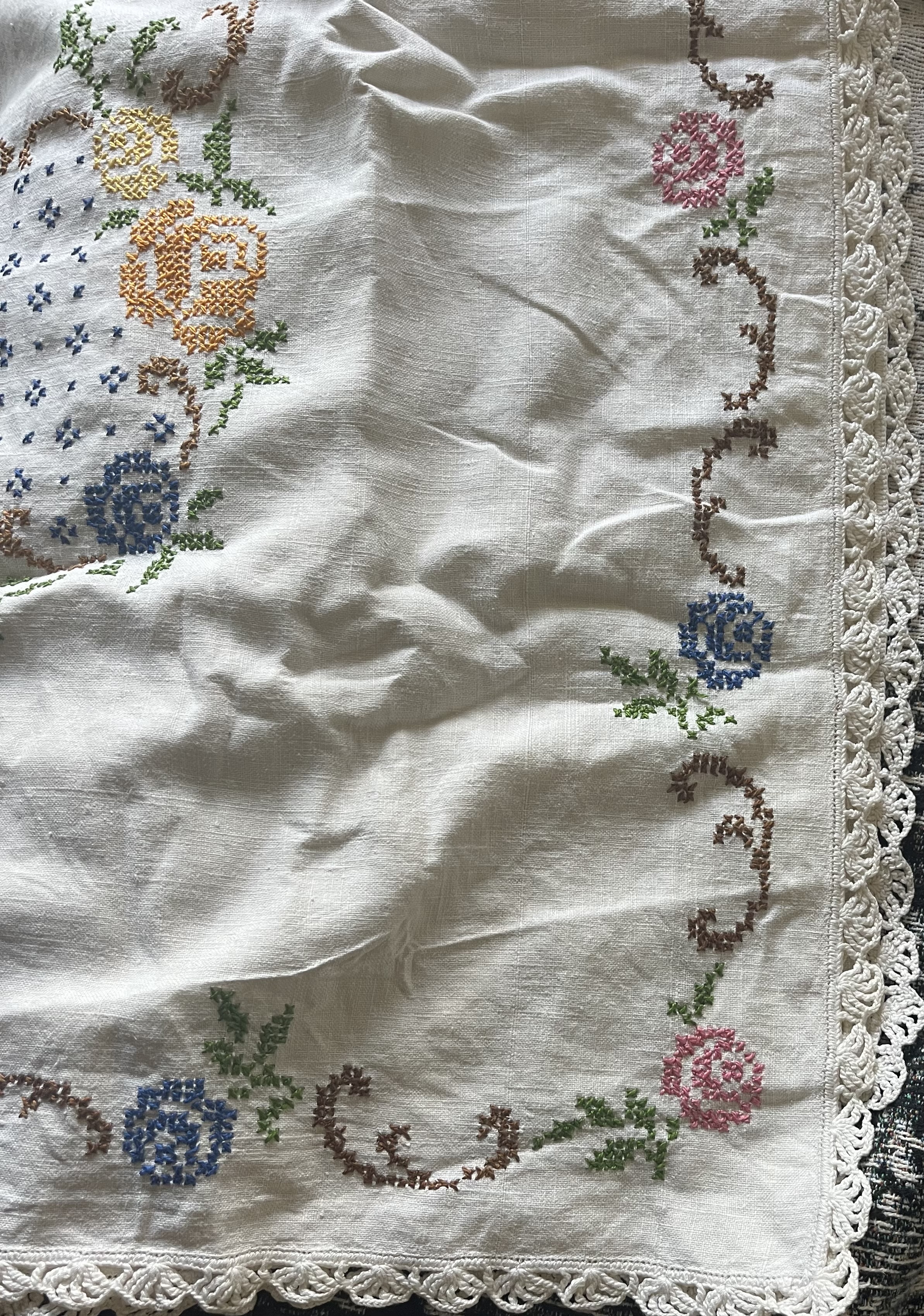
Close Up of a Corner of the Tablecloth

Embroidered thread of blue, green, brown, pink, and yellow line the edges of the cloth. The embroidery is done in a pattern of small x’s, x’s which you only see when examining closely; from far away, they blend together into the design. The patterns done in blue, pink, and yellow are the same; the first three stitched “x’s” make a circle, which is placed within a second, larger circle of the same color. Both these circles are embraced by a half-circle-shaped group of stitches, resembling a simplistic yet colorful rose.

To each side of these roses is green embroidery. Unlike the blues, pinks, and yellows that circle around each other and remain consistent in shape, this green reaches out in different directions; there is always one long string of green stitches with shorter lines departing from it, coming together to form leaves. The green meets the embroidered brown, a collection of stitches that form small swirls. The swirls, one larger than the other two, face in towards each other. Just as they reach their peak, they collapse in on themselves.

This design repeats itself, the flowers changing between blue, pink, or yellow, the green and brown remaining consistent. In the center of the tablecloth is a similar design of flowers and leaves, organized into a rectangular form. In each of the four corners of this rectangle sits an imperfect circle of embroidery; yellow, orange, blue, and two different shades of pink form the shapes of roses, although larger than the ones boarding the cloth. Green thread branches out from the spaces between the flowers, continuing the look of leaves. The brown thread is again embroidered in the shape of swirls, although this time the swirls loop together in half-circle shapes to form an ovular border. Within this oval are small, blue stitches; some of these stitches are singular, while others are done in sets of four in the shape of a diamond. 

A Close-Up View of the Corner of the Center Design

The tablecloth is not a perfect white. There are some oil stains (admittedly from a messy snack of garlic knots that my sisters and I shared) and an unknown deep blue stain in the bottom corner of the cloth, about the same size as one of the smaller flowers. When turned over, the knots and stitches that hold together the design make it clear that, although the stitching is not messy, this was done by hand, without the help of a machine. Although I may be unsettling my ancestors through the staining of this object they tried so hard to keep as perfect as it was the day it was finished, Great-Grandmother Olive intended it to be used. Sitting at my kitchen table with my sisters, mom, and grandmother as we eat on this cloth is a celebration of our dear Olive’s work. She would be happy.