During the early months of 1942, while men over the age 18 were either drafted or enlisting in the military, my grandfather Romeo had to stay at home as he was only 14 years old. While his siblings and cousins went overseas to fight he was upset that at his age he couldn’t fight. During this summer, my grandfather decided that it would be a productive idea to get a job. As a first generation immigrant it was difficult to find work due to discrimination or language barriers. He went to a local summer camp and asked if they were in need of workers. Upon hearing that the pay was only a couple cents for a few hours of work, he exclaimed, “That’s basically slave labor!!!” and immediately looked elsewhere for work.
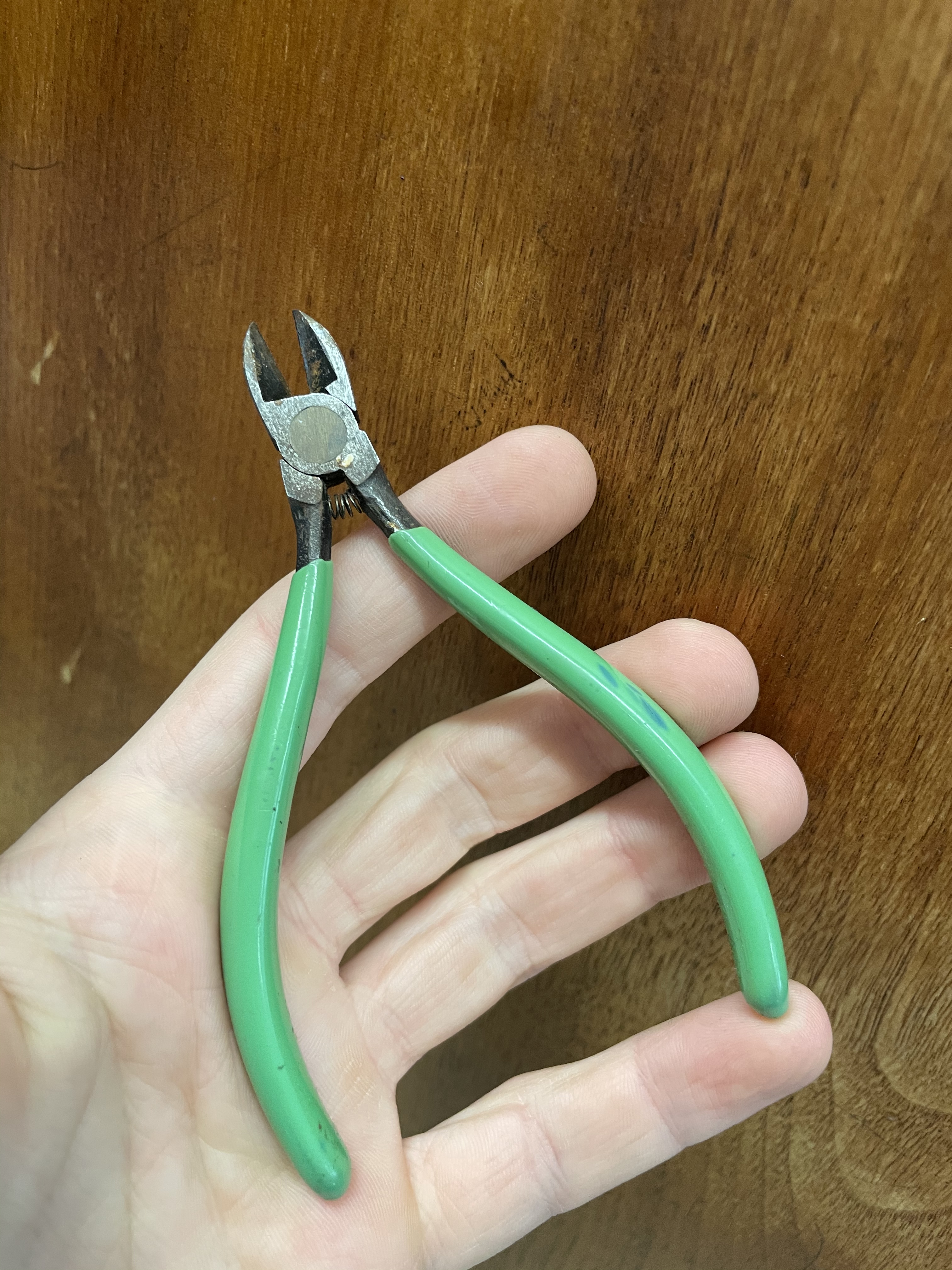
My grandfather is remarkably intelligent, and realized that because all resources, metals, and technology were in demand for the war, being a repair mechanic would be a very lucrative career. He studied up on how to fix up different radios and taught himself how to solder. After a couple weeks he began to market himself as a repair mechanic, with each fix only costing a few dollars. There was such a demand for radio repairs that he was making upwards of 15 dollars a week! While that may not seem like a lot of money nowadays, calculating inflation would be the equivalent of making around 300 dollars a week at 14 years old! His business was so successful that he decided to purchase high end tools to enhance his repairs. That is when he purchased these small green pliers.
Over the course of the next few years he would use these pliers for radio repairs or projects around the house. After marrying and starting a family, these pliers played a very important role in the family. Romeo would teach his sons how to solder and repair radios and other technology. This led to his sons gaining a fascination in science and engineering. With one son going into chemical engineering and the other son (who is also known as my dad) going into computer science, these pliers served as the catapult that launched his kids into STEM related education! After these kids moved out the pliers remained dormant in a tool shed. Never forgotten but laid to rest for a while as the pliers waited for the next opportunity to be used. Only after my dad brought up my passion for jewelry making to Romeo did the pliers find another use. Once my grandfather discovered that I was cutting wire for jewelry making, he rushed towards the garage to give me these pliers.
These pliers now serve once again for a small business! I constantly find myself using these pliers for cutting wire for creating chainmail jewelry. Despite the age of the pliers and the wear on them, they cut beautifully and better then most modern pliers! As I type this assignment I even have a cut from where I accidentally clipped my skin while working with these pliers! These pliers really tell a beautiful story about my grandfather’s values in life. They were used to construct the best life for him and his family, and are still used to this day to support the family he created.
When I begin this assignment, I’m not sure if have any objects that have survived throughout my family history. My grandparents on both sides had come to India from various places, England (my mother’s mother) and Pakistan (my father’s father), only carrying a limited number of personal belongings. My parents, too, came to America with only a few possessions. What did they deem important enough to pack with them?
Photograph of the book.
I think for a while, searching my house, until I remember that when I was young and loved to read, my maternal grandmother gifted me a book that she had received as a child. The book was passed directly from her childhood to mine, and I was never forbidden from touching this piece of history. I was allowed to hold the book as I read it, to marvel over the black and white printed image pages, to notice the stains and creasing of the paper.
To begin my research, I first ask my mother what she knows about this book. She only remembers what her mother told her, that my grandmother received it as a prize in her hometown as a child, that it was very special to her. Together we open the book to see the award affixed to the inside of the front cover: “For Good Conduct, Diligence, and Regular Attendance. Obtained 106 Marks out of a possible 106.”
After I manage to decipher the handwriting on the bookplate, I’m excited to find quite a bit of information that can help me uncover the story of this book. Tadley Corps refers to the branch of the Salvation Army that my grandmother attended as she grew up. I know my grandmother’s maiden name, Jennifer Hicks, and the date she received this book, January 1951. I know the names of the Salvation Army officers who presented this prize book to her. And of course, I know the title and author of the book: The Form That Liked To Be First by Nancy Breary.
Photograph of the bookplate.
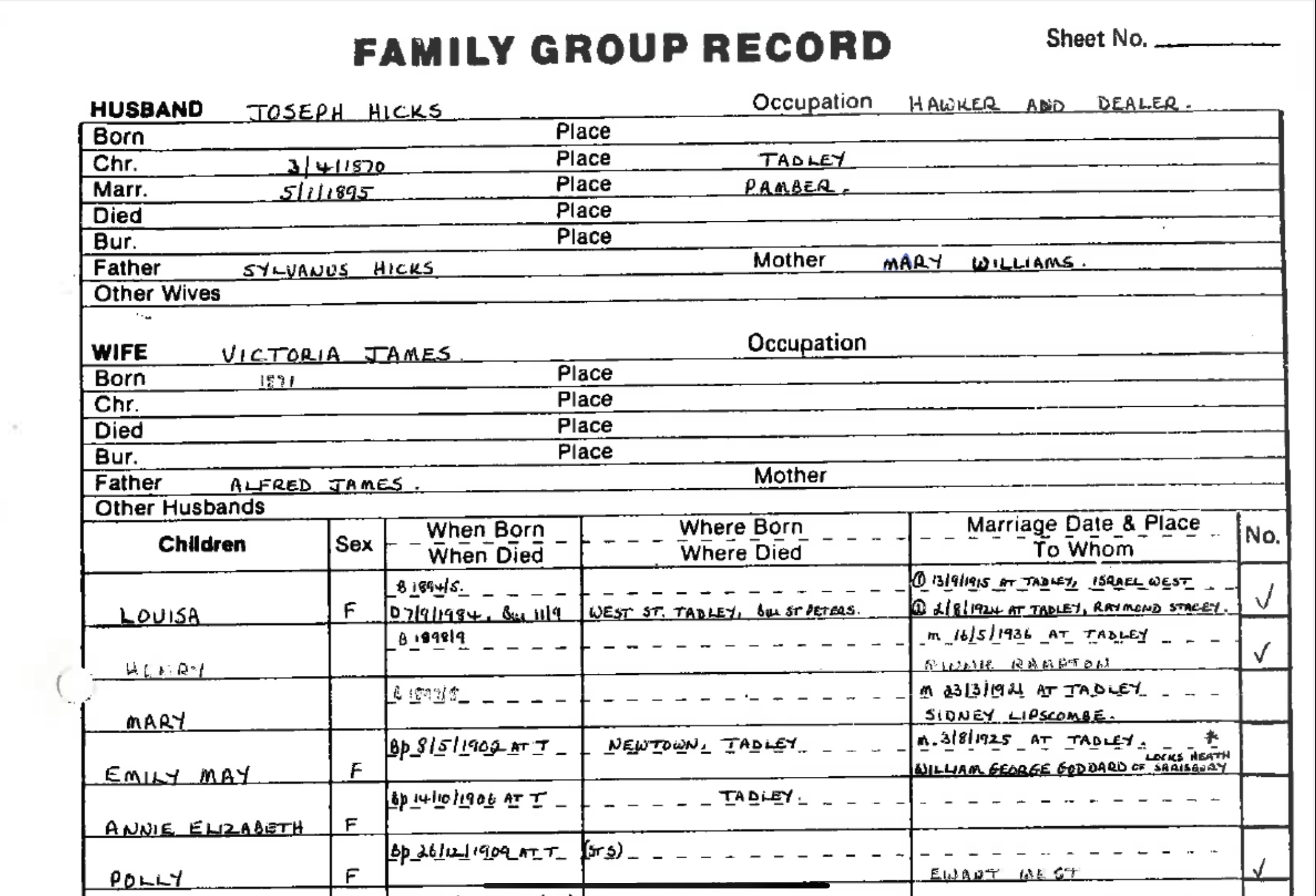
I begin with the small town of Tadley, England. I’m lucky to find an entire website dedicated to the cataloguing of this place and its people, the Tadley and District History Society. Through records of births, baptisms, marriages, and deaths, I confirm that my grandmother was born there in 1938, and her family had been in the area for generations prior. My grandmother referred to her father, Henry Hicks, as a “gypsy” and mentioned that her mother, Minnie Rampton, had urged him to settle down and work a factory job. I trace the lineage of Henry Hicks and find that his grandfather Sylvanus Hicks is recorded as “traveling hawker” and his family was “not living in houses” in 1861, and was living in a “housed van” by 1871 in Tadley. Even his son, Joseph Hicks (my grandmother’s grandfather), was noted as a “hawker and dealer” in terms of his occupation. My family has been moving around for generations, taking with them only the objects they valued. Like this book that I now hold in my hand, which has traveled from England to India and now to America.
Family records of my grandmother and her parents. Source: TADSFamily records of my grandmother’s grandparents. Source: TADSFamily records of my grandmother’s great-grandfather. Source: TADS
I decide to research the book itself. It was first published in 1948 by Blackie & Son, a company located primarily in London, England. The author Nancy Breary wrote almost 30 books in a genre called “Girls’ School Story,” which “offer amusing stories – sometimes almost parodies – complete with many over-the-top elements” (Goodreads). My mother tells me that that my grandmother was the first girl to receive a book prize award (my grandmother isn’t sure if this is completely true). I wonder if this is why the church officers chose this book for her, a teenage girl. I think of the entertainment targeted towards teenage girls today, similar exaggerations of the adolescent experience. I wonder what my grandmother thought when she received the book. I want to join her in the moment of congratulations, standing in the Salvation Army Hall, being presented with such a prize.
A little history: The Salvation Army is a church based on evangelical Christianity, founded in England in the mid-to-late 1800s. A report from the Tadley and District History Society (2009) notes that at the time, it was considered a non-conformist church because many of the meetings were held in the open air and music was an important part of worship. Evangelists known as “officers” preached the word to gain support from the people, and set up “war posts” in areas that had many members. By 1898, the Tadley Corps was meeting in a small building that could not fit the amount of members.
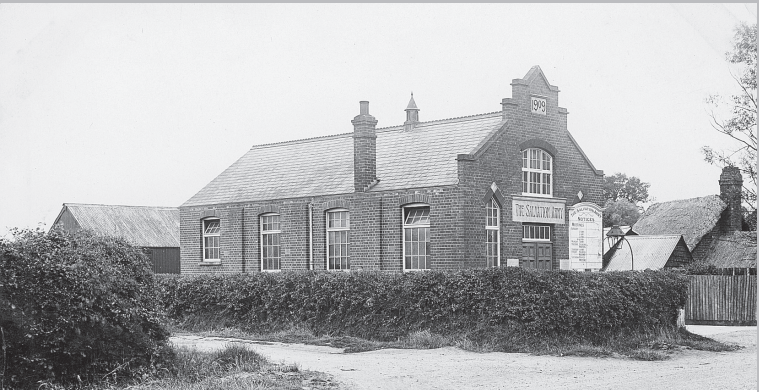
Photograph of the Salvation Army Hall, prior to additions in 1955 and 1978. Source: Terry Hunt, TADS
In 1909, the Salvation Army Hall on Mulfords Hill, the road on which my grandmother lived, was formally opened. This building is still standing today, along with more modern additions to the property.
I call my grandmother (she lives in India) to ask her what she remembers about her childhood, why her family attended the Salvation Army, why this book has traveled across the world through time. She tells me that her mother’s family, the Ramptons, have always been “chapel people, not Church people” and that her mother joined because she enjoyed watching the Salvation Army band march through the village of Tadley every week. Her mother, Minnie Rampton was highly devoted to the Salvation Army and began studying to become an officer, but her eyesight was too poor. She ended up becoming a Sunday School teacher after marrying Henry Hicks, who also became a Salvationist. My grandmother tells me that when she was growing up she attended Sunday School twice, once before lunch and once after lunch, which explains why she received perfect marks for regular attendance.
She recounts the months she spent living in hostels in London as a young adult, bringing only a few possessions, including the book. She isn’t sure why exactly she carried it with her. “It’s a children’s story, isn’t it? Must have been just a bit of ‘for old time’s sake’. It’s amazing that the book has reached America. I forgot I brought it to India… maybe I thought I would read it to my children. I didn’t expect it to go to my grandchildren.”
And yet it has. I wonder where it will end up next.
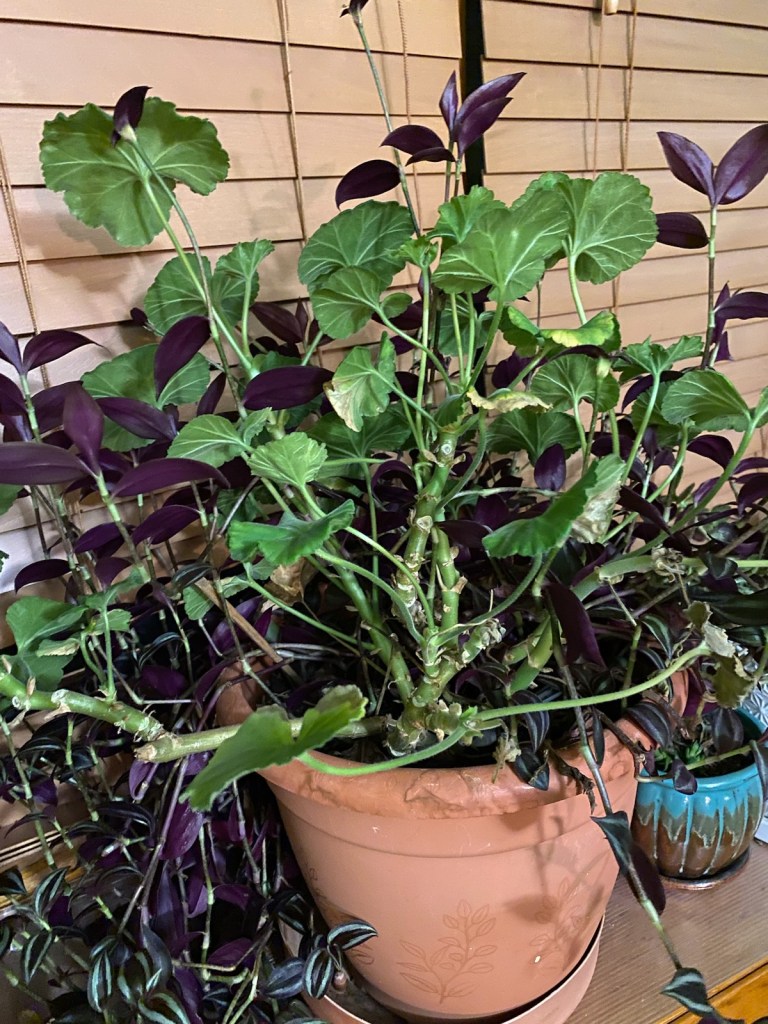
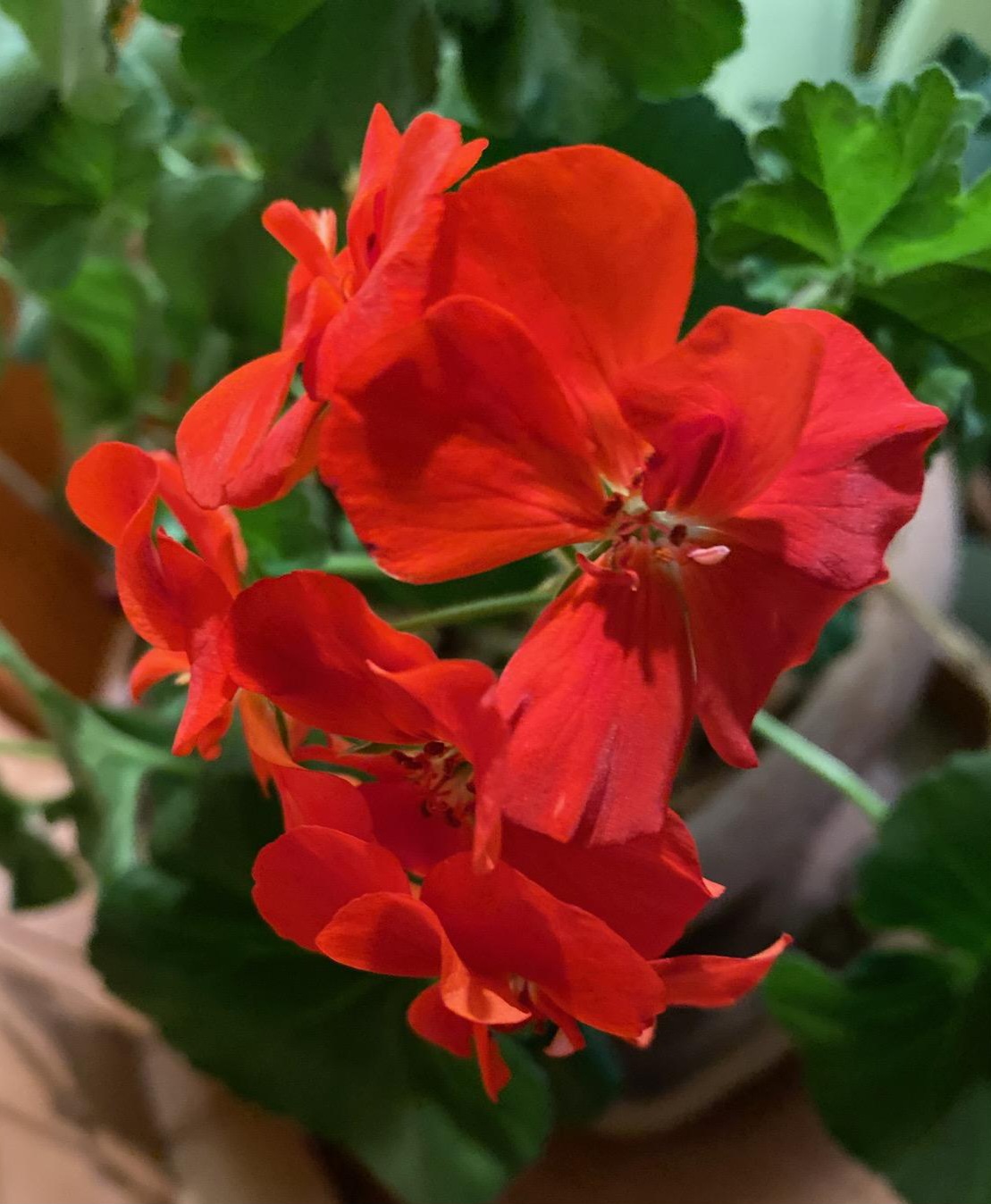
The garden geranium perches undisturbed on my family’s home windowsill. Each day, a member of my family draws open four wooden blinds to flood our living room with the warmth of direct sunlight. Full sun exposure allowed the geraniums to flourish for almost two decades.
Fig 1.1 – Top view of garden geraniums on a windowsill.
Fig 1.2 – Side angle of garden geraniums on a windowsill.
After interviewing my mother (Lisa) over the phone about our geraniums, I recalled many of her oral stories about her childhood that were told over our dining room table. The blossoms of the vibrant red geraniums were my late grandmother’s favorite flower to admire. My brother and I called her “Popo,” which translates to maternal grandmother in Cantonese. She was a caring, hardworking, and sensible woman. Popo instilled values of education—including the importance of learning English—within her three children, Karen, Victor, and Lisa. By completing schoolwork or watching television, the children experienced the cultural values of America.
I pieced together dates and timelines. In the winter of 1983, my mother was eight years old when she immigrated to the United States from the Guangdong Province of China. My mother shared one of her childhood American sitcoms with me on our phone call. Small Wonder, a series that comically features a human-like robot disguised as a family’s adopted daughter, aired from September 1985 to May 1989.
Many of the details in my mother’s personal accounts about Popo’s long working hours at clothing and garment factories in New York City’s Chinatown parallel the muckraking in the New York Times Archives. Popo’s sweatshop experience of cutting, sewing, and stitching clothing is similar to the sweatshop conditions detailed in William Serrin’s “After Years of Decline, Sweatshops are Back.” I could imagine her hunched over large and dangerous sewing machines that threatened to pierce her nimble fingers. Garment workers were not given a sustainable hourly or yearly salary; instead, “wages in a Chinatown shop are 50 cents for a [completed] skirt and 50 cents for a [completed] jacket” (Serrin). Popo faced pressure to meet a high garment quota to earn a sufficient paycheck that covered the family’s necessities—rent, groceries, and clothing. The merger and hard-earned wages from the Chinatown sweatshops were not enough to support a family of five. Popo, Gunggung (my grandfather), Dai Ye (my aunt), Cow Fu (my uncle), and my mother resided in a small apartment. Purchasing a potted houseplant for indoor atmosphere and aesthetics was an unaffordable expense.
Whenever I saw my grandmother as a child, before she passed away from cancer in 2011, she was long retired from working grueling hours at the clothing shops. During Popo’s retirement, she had the luxury of time to pursue a new passion. Under the open sky and comforting rays of sunshine, the whole motion of gardening for Popo was rejuvenating. My cousins and aunt savored the fruits of her labor at their dining room table. For five years, Popo resided in Dai Ye’s home to take care of my four cousins. As a grandmother, she tended a thriving vegetable garden of bell peppers, amaranth greens (“Yin Choy”), and bitter melon. Although the geraniums sitting indoors did not bear fruit, the flowers were special. Popo enjoyed tending to the plant because the geraniums were durable and required minimal maintenance. The presence of red flowers in Chinese culture symbolizes “longevity of life,” but Popo treasures the geraniums because the flowers represent her family’s persistence through hardship (Yelang). I could picture Popo’s proud and serene smile that lifted the corners of her eyes while watering the red geraniums. The red flowers outlived my grandmother’s lifetime and can be found throughout my family’s home.
In 2004, my family moved into our house in Flushing, Queens. Without any houseplants or meaningful objects, our abode full of scattered cardboard boxes felt impersonal. Popo wished to help my parents begin the next chapter of their story, and she still lived at Dai Ye’s home—which was a quick five-minute drive away. From a geranium planted in my aunt’s outdoor garden, Popo snipped off a sturdy green branch that sprouted healthy and full leaves. She gave the branch as a housewarming gift to my parents.
Fig. 1.3 – One branch of a geranium that can be cut from the plant to propagate. The cut should be located at thick brown-green branch, near the black marker. Healthy green leaves, that are circled by yellow markers, should be attached to the branch.
Geraniums can propagate after being cut from their stem. The single geranium branch has blossomed into several bundles of flowers. Today, they continue to thrive despite having an average lifespan of two years. Popo’s love for nature and her green thumb were passed down to my mother. There are many pots full of red geraniums scattered along the windowsill that now welcome house guests. Outside of our home, our front yard is a living and growing collection of peppers, strawberries, roses, sunflowers, and succulents.
The medium-green leaves, knobby-thick trunk, and vermillion-red flowers all grew from Popo’s original geranium branch. Our red garden geranium is a cherished possession that holds a remnant of Popo and a continuing family narrative of tenacity and resilience.
Fig. 1.4 – Zoomed-in image of my family’s red garden geranium in full bloom.
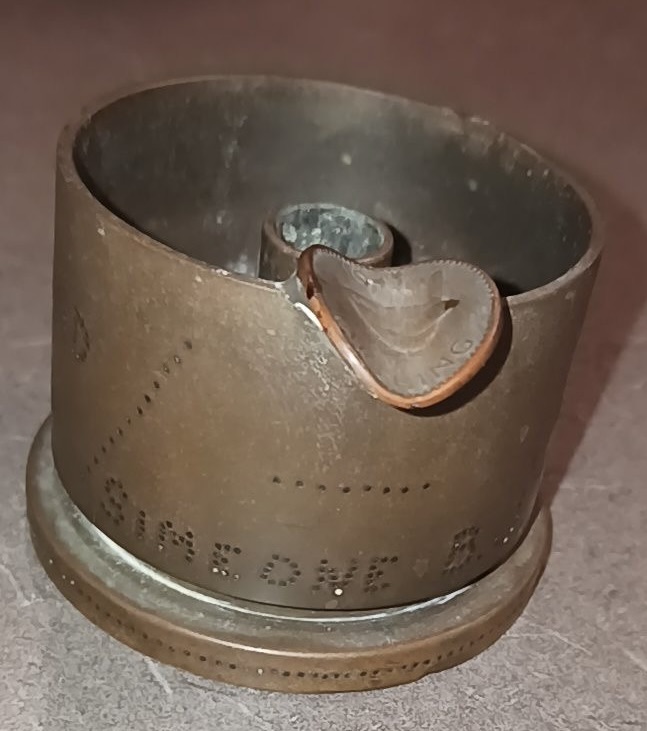
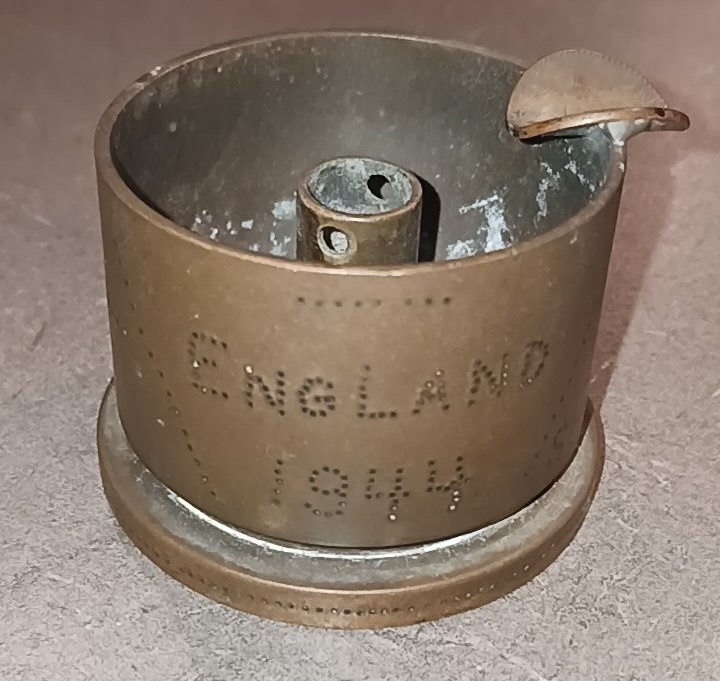
The object that I have chosen for this blog post is a piece of world war 2 trench art that was handmade by my great grandfather’s brother. I was unable to bring these pieces of trench art to college with me, so I asked my family members to take the best photos they could to represent this object. My object is about 3-4 inches in diameter and about the same height as well. It takes the form of a short, hollow, cylindrical shape representing an ash tray of sorts. The general cylinder lies atop a thinner, but wider circular base that has many small holes punched into it. On the general cylinder shape, there are many holes punched into it, creating straight lines, arrow-like slanted lines, and even letters. These letters spell out the name of my great grandfathers brother, “B.J. SIMEONE”.
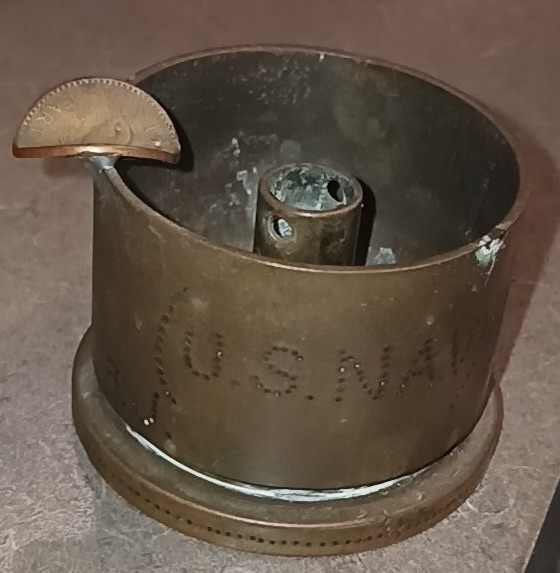
They also spell out the word, “ENGLAND,” as well as the number, “1944”. Finally, the last letters punched into the cylinder spell out the words, “U.S. NAVY”.
Towards the center of the object lies another hollow cylindrical shape that is about 1 inch in diameter and 2-3 inches in height. Towards the top of this cylinder lies two small holes directly across from each other. On the rim of the large cylinder lies a bent, coin-like shape that seems to be welded onto the cylinder rim. On the coin, there is a bird-like image and some letters that are hard to make out. This coin seems to be made of a copper-like material with a small layer of dust covering the surface of it. The cylindrical shape seems to be made of a metal-like material and is brown in color. There are several signs of both white and green patinas throughout my object as well. The object smells somewhat like metal as well.
On the bottom of my object, there are multiple engraved circles surrounding the outer edge and the very middle. There are also multiple engraved numbers and letters, none forming coherent words.
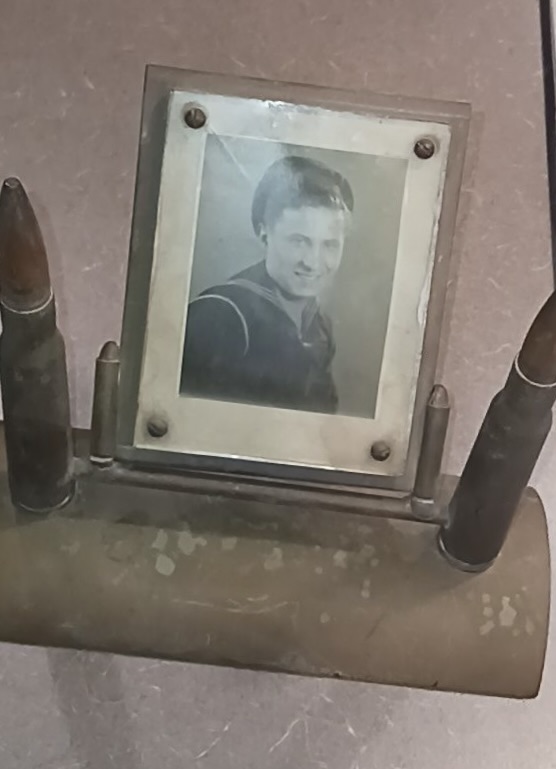
This is a picture of my great grandfathers brother. I am still unsure of his full name and only know minuscule details about him. However, I was able to obtain some information about my great grandfather that helped me figure out some information about B.J. Simeone. My family found these art pieces in our basement while cleaning out some older holiday decorations. The house that we live in used to belong to my great grandmother, Mary Simeone. Fun fact: we still get our water bills addressed to her in the mail! Anyways, Mary and her husband, Urbano Simeone, lived in this house before my family. The house used to be a one story ranch house, with horse stables and wells all throughout the property. My great grandfather, aka Urbano, planted a long row of berry trees along the driveway, and used to make wine in the cellar located in our basement. We even have these soaked wine barrels to this day! We think that Urbano and his family back in Italy used to own their own wine vineyard and he continued on the business here in the United States. He was originally born in Filetto, Italy on July 10th, 1914. He became a registered U.S. citizen after escaping from the rule of Benito Mussolini. From this information I can assume that his brother, B.J. was also born in Filetto, Italy and moved to the U.S. around the same time. In October of 1940, Urbano was drafted into the United States Navy to fight in the second world war, as well as his brother. B.J. was stationed in England in 1944 and had a hobby of creating trench art. This ashtray was one of the pieces he made, along with the picture frame holding his image and even a little wheelbarrow, which I will attach at the end of this post. All of his artwork was created using scraps found on the battlefield, like empty bullet shells. That would explain the serial numbers on the bottom of the ashtray, although I do not know enough about bullets to figure out the exact model. Therefore, the ashtray is made up of many different sized bullets that were welded together in the trenches. Also, the coin on the rim of the ashtray, upon further research, is called a UK Farthing coin and the small bird is a wren to represent one of the smallest birds in Britain. They are worth about $3.00 today, depending on the year located on the coin. Also, during 1944, England was a very active site for the war. Food and clothing were very sparse and rationed among the people. Bombings were very frequent and caused mass death and destruction throughout England. Therefore, I think my great grandfather and his brother must have had a very hard life while stationed in England and I find it extremely impressive that B.J. was able to create these amazing pieces of art.
After the war, these trench art pieces were passed onto Urbano when B.J. died, then passed onto Mary after Urbano died, and when she died, we inherited the house as well as these works. I also love these objects because the love for art is really strong on my fathers side of the family, and seeing these trench art pieces only verified that, and made me feel even closer to my ancestors.
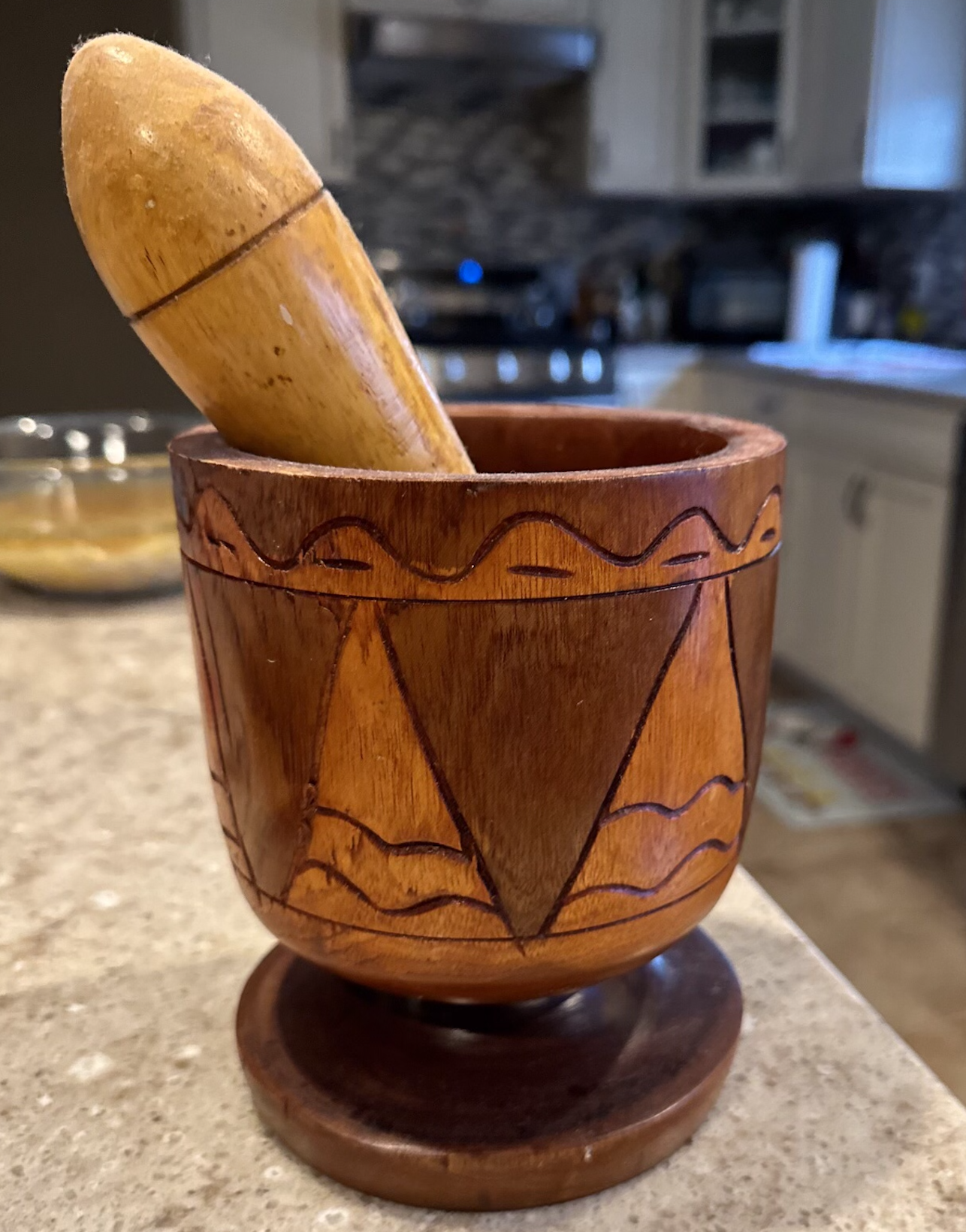
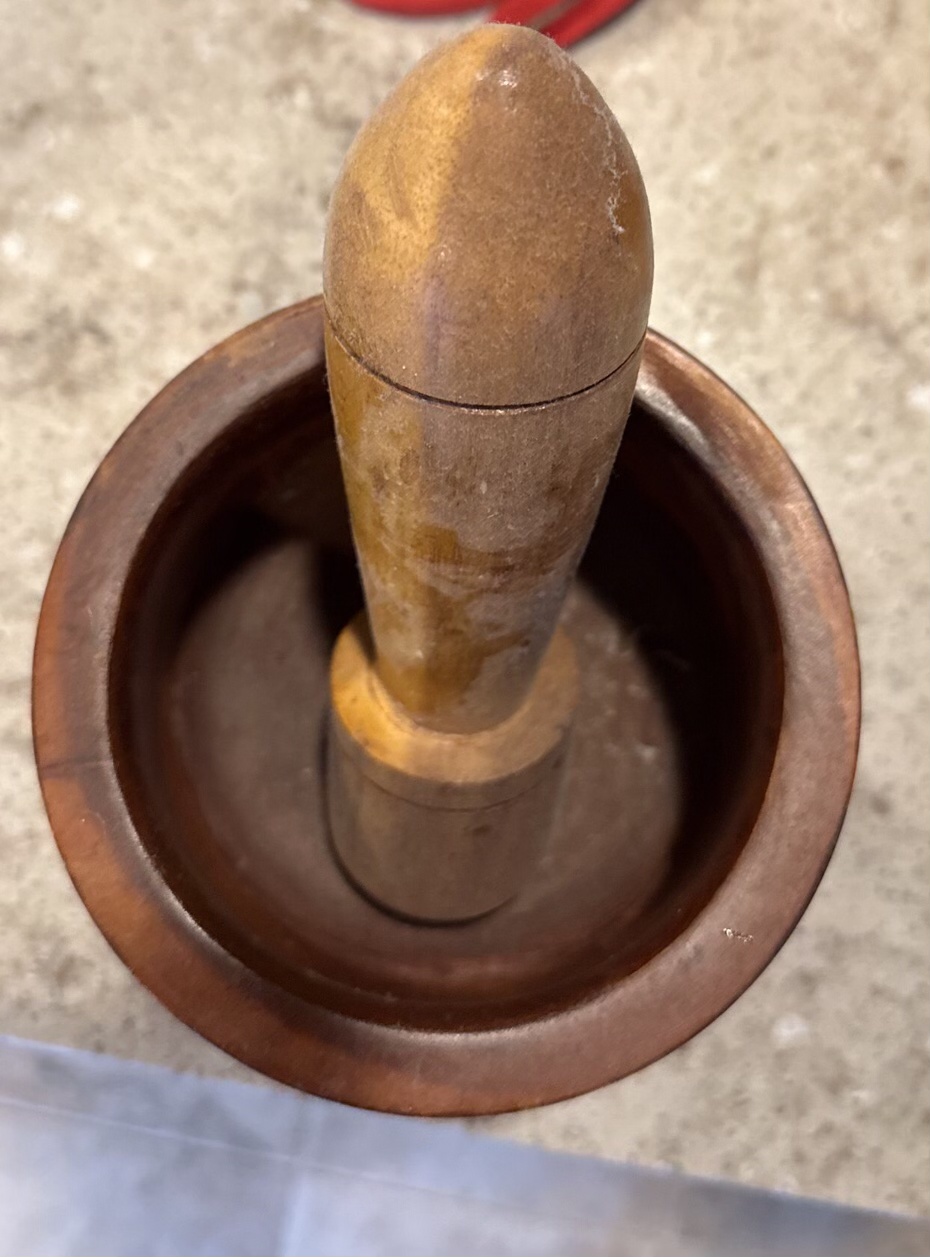
The object I chose to trace is a wooden mortar pilon from Puerto Rico that was my great-great-grandmother’s, Felicidad Rodriguez Baez. Pilons are handmade traditional kitchen item in Puerto Rico. It is used for a variety of purposes but it is most commonly used to mash garlic into powder. Garlic is extremely popular in traditional Puerto Rican cooking and they use the pilon to prepare garlic for meal preparation by smashing it, turning it into a paste like substance. Many people use this kitchen tool to make mofongo which is a traditional Puerto Rico dish that is made up of green plantains and chicharrón (crunchy pork skin). While I have never had mofongo, my dad tells me it is a savory dish with a subtle sweet flavor from the plantains.
My great-great-grandmother, Felicidad Rodriguez Baez, bought this item in her youth from a craftsman Merchant at the market in Dorado, a beach near my great-great-grandmother’s house. She had many pilons at her house but this one, in particular, caught her eye because of the artistic markings. This pilon, in particular, she used throughout her life and prepared many meals with it. When my great-grandmother, Carmen Baez was engaged, Felicidad gave it to her as a gift to start her new life with her husband, my great-grandfather Ignacio Cruz. Same as her mother, she used this very pilon to make these same traditional dishes.
My great-great-grandmother, Felicidad Rodriguez Baez, and her husband Modesto Baez wanted to move to America for a better opportunity. While Carmen stayed in Puerto Rico her daughter, my grandmother, Sandra Coffey moved with her grandparents when she was twenty years old. Her mother, Carmen, gave her the gift of the pilon to bring with her to America.
My grandmother, Sandra, and her grandparents moved to America and settled in St. Louis, Missouri. Even though my grandmother, Sandra, visited her mother frequently, she was homesick for her mother’s cooking in America. Cooking, for my grandmother, was a bridge between her Puerto Rican culture and American cuisine. As she learned to make American dishes she would always incorporate a Spanish twist. For example, she would make meatballs but use the pilon to grind her fresh herbs into seasonings. After my grandmother was married she had my dad, Greg Benlien. He tells me that he has so many memories of his mom and him talking in the kitchen as she would make dinner with the pilon. My dad was always very close with his mom, Sandra, so when he turned ten years old he started to express an interest in cooking. My grandma was so thrilled that she would spend every Sunday cooking with my dad and teaching him traditional meals she learned from her mother back in Puerto Rico.
When my dad was eighteen years old, he was working at CPI and there was a call from the New York office with a problem. The caller on the other line was my mom, Regina Bruno. As they fixed the problem that should have only taken five minutes to fix, they sat on the phone for hours talking. My parents had a long-distance friendship but a year later my dad came to visit my mom in New York. They began to date and four years later they got engaged. When my dad was packing up and leaving St. Louis, my grandmother gave him the pilon to bring with him to New York. After my parents got married a year later they had me. Ever since I could remember this pilon was an active kitchen tool in my house. When I was just four years old I learned how to mash garlic with it just like my great-great-grandmother did. Today, the pilon sits by my oven and I try to invent new ways to use the pilon in new dishes I come up with. I hope I can pass this important family heirloom to my children one day and tell them the story of this pilon.
My great-grandfather, George Dannecker, was randomly part of a group of young men that became the first Navy SEALs. They weren’t called Navy SEALs yet, but they were all young, impressionable, and frankly disposable. They became the men who dove underwater to deconstruct bombs before they could explode. They were called the UDT, “underwater demolition team,” later the SEALs. Their training took place in Hawaii and then they were on boats, I’m not sure exactly where.
Sticking a bunch of young men on a boat in the middle of the ocean ensures one thing: tomfoolery. George had actually lied to join the navy, so he was significantly younger than the other men, standing at a cool seventeen years. Seventeen, eighteen, nineteen, twenty year old boys will always find a way to play games.
And so they played. The game of choice turned out to be ping pong. My great-grandfather turned out to be pretty good at it. He was good enough, in fact, to be crowned a “Ping Pong Doubles Champion” on October 23rd, 1944. Lucky for me and my research, this date is inscribed right on the trophy, which is shaped like a ping pong racket. His name is also inscribed in the metal, proving the original ownership.
The trophy is made of scrap metal from shell casings. 533, the numbers inscribed front and center on the trophy, indicates either the number of his ship or his unit. “CB,” which is inscribed above the numbers, or “seabees,” stands for construction battalion. “MU,” which sits below the numbers, is for “munitions unit.”
When I asked my father, the current owner of the trophy, what “munitions unit” meant, he texted back, simply, “go boom.”
I had the great fortune of knowing George for a lot of my life before he passed away in 2019. It took him a long time to be able to talk about his time in World War Two. In fact, he didn’t talk much about it at all. My cousins and I interviewed him for middle school projects, but that was about it. This trophy is one of the only tangible pieces of evidence I have seen that he was truly there, young, and maybe even having fun at some points.
This trophy made it home from the war with him, which meant it eventually fell into the possession of his daughter, my Grammy. It’s been in my Dad’s office in my house for as long as I can remember. He said he took it from his mom’s house when he moved out, which would have been upwards of twenty-five years ago.
The trophy itself is in fine shape. The black metal of the handle has rubbed off to reveal more silver, and I’m sure it has never seen a duster or any sort of cleaning supplies, but it has a sort of indestructible air to it. I picked it up and spun it in my hands long before I truly understood what it was or what an incredible history it has behind it.
My Dad admired my great-grandfather in a way that I always noticed. George became a firefighter when he returned from war and started a family. My Dad is a retired fire chief. George tied flies and fly-fished his worries away. My Dad retreats to rivers and keeps George’s jars of rabbit hair and twine to do the same. As you can see in the picture, the trophy lives in my Dad’s home office, where he spends most of his days. He keeps it near him.
The trophy does a lot of storytelling on its own, which is convenient for me, the researcher, but I’m positive there’s more to be uncovered. It’s touchy to think about telling too much of a story that George wasn’t telling himself, but something about the trophy feels lighter. It’s a 79 year old bragging right. Don’t worry, George, I’m showing everyone how good you were at doubles ping pong.
In the Sheneman family, the military tradition has thrived.
My grandfather was the second youngest of thirteen, and the last to still be born on their farm in rural Mecosta County, Michigan. With three sisters and one brother passing away in infancy, there were nine healthy young men in the Sheneman household–opportune for military drafts and service.
Earl Sheneman (1915-1949) Army, WWII
James (Jim) Sheneman (1918-1973) Marines, WWII, South Pacific
Glen Sheneman (1924-1996) Navy, Korean War (N. Pacific Aleutian Islands)
Robert (Bob) Sheneman (1932-?) Army, Korean War
Fred Sheneman (1934-?) Army, ?
Neil Sheneman (1936-?) Army, ?
Keith Sheneman (1937-?) Army, ?
Bryce Sheneman (1938-2017) Air Force, Japan and Cold War
Carl Sheneman (1940-) Army and Reserves
When my grandfather was young, around 10 years old in 1948, his father passed away and his mother remarried “the meanest man in Mecosta County,” undoubtedly inadvertently preparing the young men for their difficult and challenging futures.
His eldest brothers Earl and James (Jim) were drafted by the Army to serve in World War II. Jim later told my grandfather of his experiences of the horrors of war. He spoke of the military abandoning him in the South Pacific and “sipping air through a reed” covered in mud for over a week while enemy soldiers ran nearby.
The next four men continued the tradition. Glen served in the North Pacific, the Aleutian islands in the Northern Pacific during the Korean war. As a proud German family, and a surname that made it difficult to keep hidden, my grandfather had been beaten up and called a “kraut” during the life and death of the Second World War. Once, on my grandfather’s bus ride home from school, the bus driver kindly pulled over to offer a walking soldier a ride home, only to discover that it was Glen. My grandfather recounted that “no one ever made fun of him after that.” His brothers Robert (Bob) served in the Army in Korea and Fred, Neil, and Keith served in the Army as well. Their placements are relatively historically inaccessible to me.
The youngest two were the luckiest in their placement, in terms of immediate physical harm. My grandfather’s youngest brother Robert (Bob) worked in the “Motor Pool” (a mechanic) and spent most of his time in the reserves. My grandfather would warn my parents when visiting Bob’s house that he was a thief and if they checked under any of the furniture they would find “PROPERTY OF THE UNITED STATES ARMY” stamped on it because he had access to the paperwork. As the only child to complete his high school education, my grandfather perhaps thought it was his place to help discourage this behavior from his brothers, but ultimately conceded that it was just who they were. My grandfather, slightly older than Bob, stood out among the otherwise traditional military stories for young men from rural Michigan.
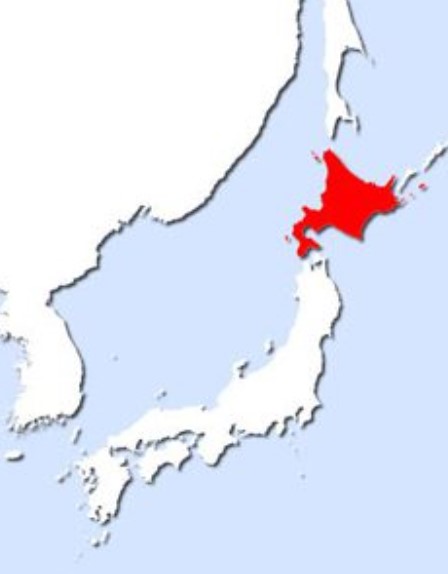
Between 1956 and 1964, my grandfather served in the United States Air Force ultimately earning the title of Staff Sergeant. The academically highest performing of the thirteen children in his farm household, he likely received high marks on entry-level examinations that kept him from being placed as a “grunt.” Instead, they taught him “diddy bop” (morse code) in basic training and sent him to Hokkaido, Japan’s northernmost island, to intercept Soviet messages.
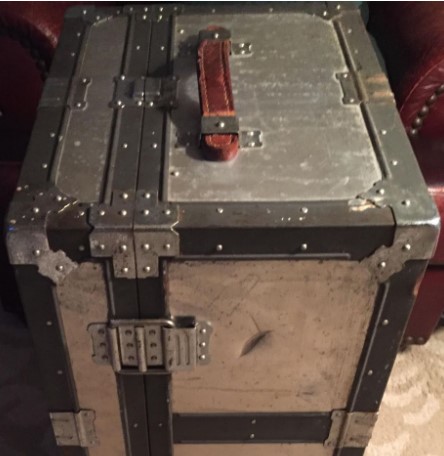
For his journey, he was issued the object that I am studying by the military: a travel trunk.
This trunk was a Korean War-era United States of America Air Force issued Aluminum steamer trunk supplied by Kowa Industry, a Japanese company. Truly a representation of primary geographic interests in the preceding and following decades, it is only fitting that its history is deeply intertwined with the Union of Soviet Socialist Republics (USSR) and the Cold War through my grandfather. The base at which my grandfather was stationed with this trunk was the base that intercepted the message and informed the president of the successful Soviet launch of Sputnik.
There are markings around all faces of the trunk, with one large gash, indicative of its experience being used, and confirming its journey overseas.
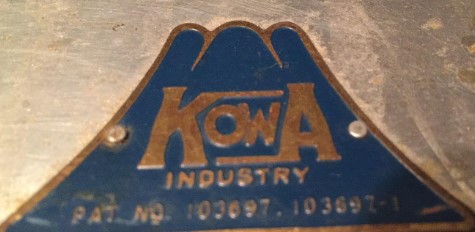
The company Kowa Industry has a logo positioned directly below the key latch in the middle of the trunk, pictured below.
The logo reads “KOWA” with the small text beneath it “INDUSTRY; PAT. NO. 103697.103697-1” enclosed in a triangular shape with a flared bottom and three curves at the top, delineating what appears to be a volcanic mountaintop. There are small screws on either side of the word “KOWA” alluding to the metallic nature of the logo, also revealed by its reflectivity under light.
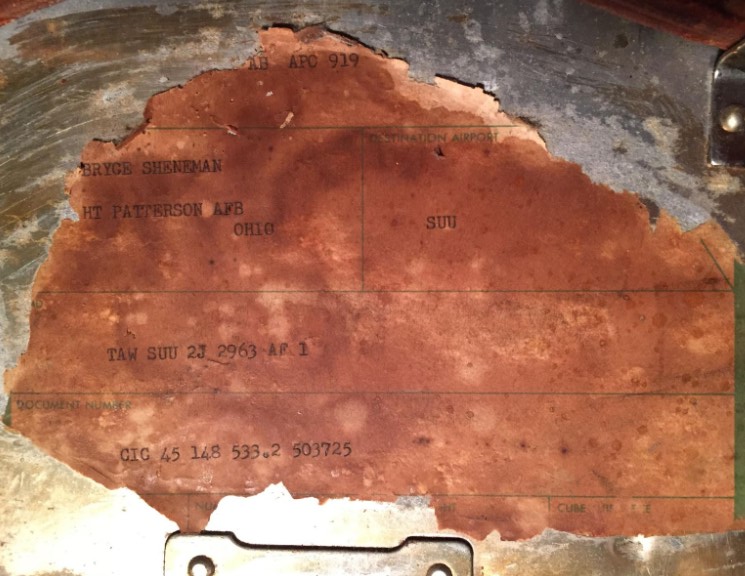
A paper on the side of the trunk without a handle, pictured below, reveals its ownership, location of departure, and its destination: “BRYCE SHENEMAN; HT PATTERSON AFB; OHIO” and in the right box labelled “DESTINATION AIRPORT”: “SUU”. Bryce Sheneman was my grandfather’s name, and his base of departure was the Wright Patterson Air Force Base in Ohio, which he only referred to as “Wright Pat.” His destination, SSU, was the military acronym for Travis Air Force Base in Fairfield, California. The labels for each of the boxes appear as though they were printed with the paper, but the information personal to my grandfather appears added as if by a typewriter.
The tattered edges make some of the information elude me, but there is also information completely present that escapes my comprehension.
My grandfather traveled throughout Hokkaido, likely using this trunk, to connect with a woman he met there. Despite never directly confirming this, except according to his sister Vivian and his only other son Kurt, he was supposedly married to a woman during his time in Japan and had a son with her, named Bryce–the same name as my dad. Upon his death in 2017, my family discovered love letters they had written to each other and a photo of them together. However, due to family conflict and ties being severed with my uncle, these letters and photo are inaccessible to me. This photo, taken between 1956 and 1960 while he was in Japan, appears to depict my grandfather (right) wearing a wedding band. This band has not been recovered to my knowledge. The story I have always heard is that during his return to Ohio, trunk in tow, for the remainder of his service, he was deciding if he should bring them to the United States or return to Japan. However, according to rumor from his sister Vivian, due to an unfortunate train derailment, they tragically passed away, and within a few years my grandfather decided he no longer desired a military career and moved back to Grand Rapids, Michigan where he remained with my grandmother, step-grandmother, and then alone. When my father was young, in the late 1960s and early 1970s, my grandfather would teach him and his brother Japanese words, per their request. He used to teach them Japanese nursery rhymes, one of which my dad can still recount (and made for a fascinating experience on a bus of Japanese tourists in the Bahamas during my parent’s honeymoon). My father said that as he grew older, before the pictures and letters, he knew this story Vivian had told was true. When prompted how he knew so certainly, he asked me, “How did he know the nursery rhymes? His friends sure weren’t learning any.”
He served in Ohio until 1964. My grandfather possessed a “crypto” clearance, a security clearance higher than the general in charge of the base. The general at the base asked him what he wanted to be, seeing as they had no use for a spy and did not want to send an intelligent soldier to be one of the first few on the ground in Vietnam, and so my grandfather became a plane mechanic and engineer. The aluminum trunk remained with him there, even during the transportation of “alien” spacecraft from Roswell, New Mexico to the base.
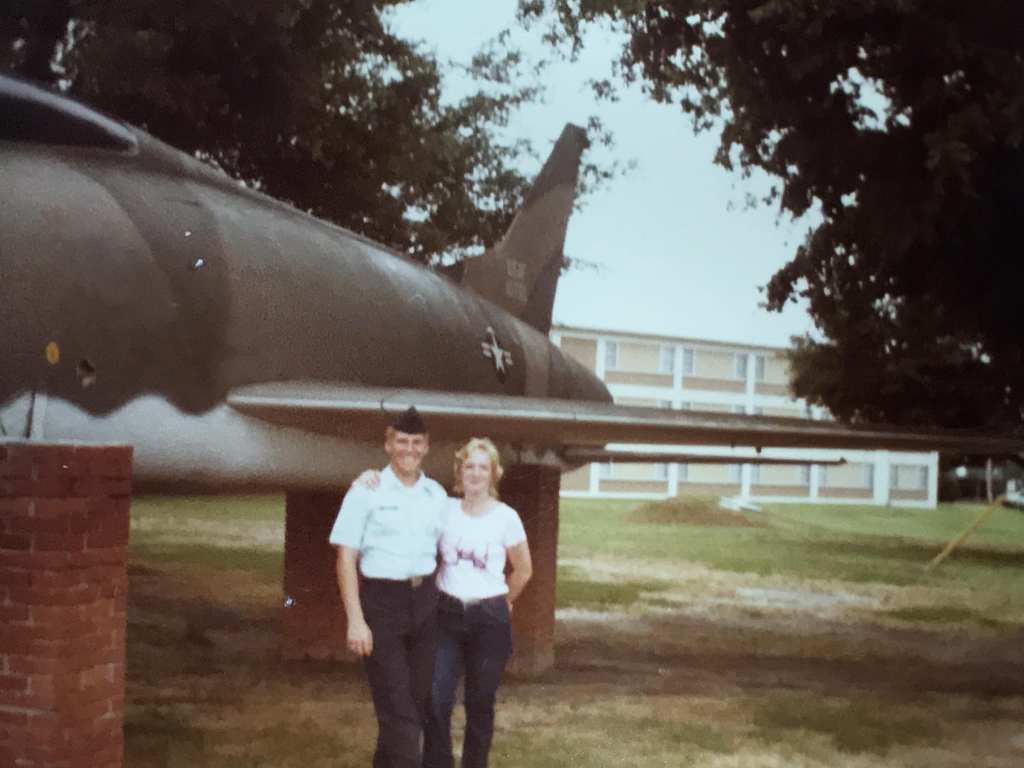
Upon the completion of his service, he returned to Grand Rapids, Michigan where the trunk rested in his closet at my father’s childhood home where my grandfather would spend the rest of his life. It acted as storage still, only in an altered context to its previous travels. He would say it was, “just taking up space.” When my parents moved into their home, my childhood and lifelong home, in 1996, my grandfather offered it to my mother who happily accepted, and my grandfather was no doubt pleased to give it to her. Despite its industrial appearance and damage, my mother sought to repurpose it as storage for her sewing and craft materials. For the next few years and into my lifetime (2002-) it has been in my parents’ bedroom sitting in their closet, holding my mother’s crafting supplies. I had always thought it was my father’s as they share the name “Bryce Sheneman” and share the experience of serving in the Air Force (photo 1: my father in the 1980s near the Air Force Base in Fairbanks, Alaska, left; photo 2: my father and his mother upon his completion of basic training in the early 1980s).
Sometimes more accessible than others with the clutter a household with young children produces, the trunk has only recently been discussed more for its history and importance, especially following the passing of my grandfather.
Now that the military tradition in my lineage has come to an abrupt halt, with my sister and I as well as my uncle’s children not serving, it is unclear who it will be passed along to. As per tradition, I suppose the eldest children get to make that determination. However, and perhaps only because I am the youngest and most invested in the history of this object, I am eager to break that tradition as well.
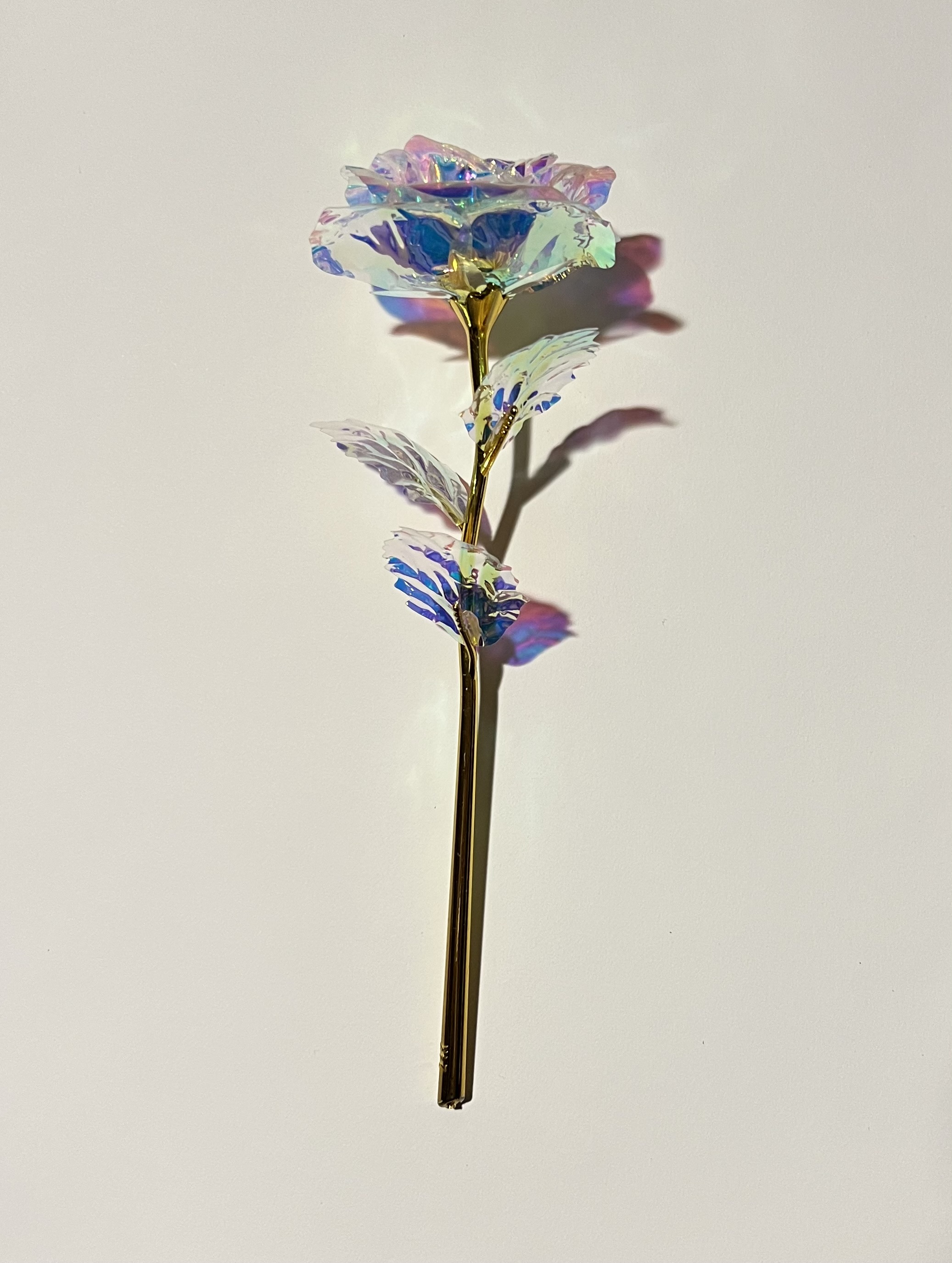
The item I have chosen to describe is a decorative iridescent rose, also known as a “galaxy rose” that my best friend gifted me for my 18th birthday in September.
This item’s height is just 0.5” short of being 10” tall. When holding the object, the bottom of what appears to be the stem is angled downwards and 0.5” from this, “24K” is inscribed vertically measuring 0.5” as well.
At around 4.5” from the bottom of what looks to be the stem (seeming to be made from thick plastic dipped in gold paint) is a protruding piece of the thin gold plastic. It measures almost an inch long and is angled upwards on the left side of the stem (based on the photograph) with 5 indentations equal spaces apart close to the tip. Attached to this extension is what appears to be one of the leaves of the stem, which seems to be made out of a very reflective and iridescent thin plastic. It is flimsy to the touch but bounces back to its original designed shape making it a firmer material than say a plastic bag. Measuring at around 1.75” long, this leaf-like plastic has many indentations with a curvy border, making it bumpy to the touch and mimicking the look of veins on leaves. Around 1.5” from this point there is another protruding piece with the iridescent plastic “leaf” attached to it, however now it is attached to the back of the stick where in between these two leaves is a small bend in the stem leaning towards the right. Moving up 0.75” is the third and final protruding piece of gold-dipped plastic with the leaf structure. The look and texture is identical to the other two however this one is attached to the front of the stick slightly tilted to the left.
As we move about 4” up the “stem”, we reach the top end of the item where the stem extends outward forming a zig-zag type base or holder for what appears to be the rose. The material used to create this rose-like structure seems to be the same as the one the “leaves” were made out of based on the texture and iridescent look to them. The first pieces attached to the base are 4 rounded triangular shapes to mimic the sepal of the rose. Then, like a rose, these petal shaped pieces are slightly bent outward and have a slight wrinkle to them and are layered on top of each other, getting closer and closer as they reach the center.
While this rose has a cheap feel to it, the iridescence of it is what truly makes this a very beautiful object that is nice to look at. Being propped up next to a window with the sunlight hitting it makes it look as if it is glowing or sparkling. This object holds a lot of significance as it not only represents one of my closest friend’s thoughtfulness but also holds a lot of beauty.
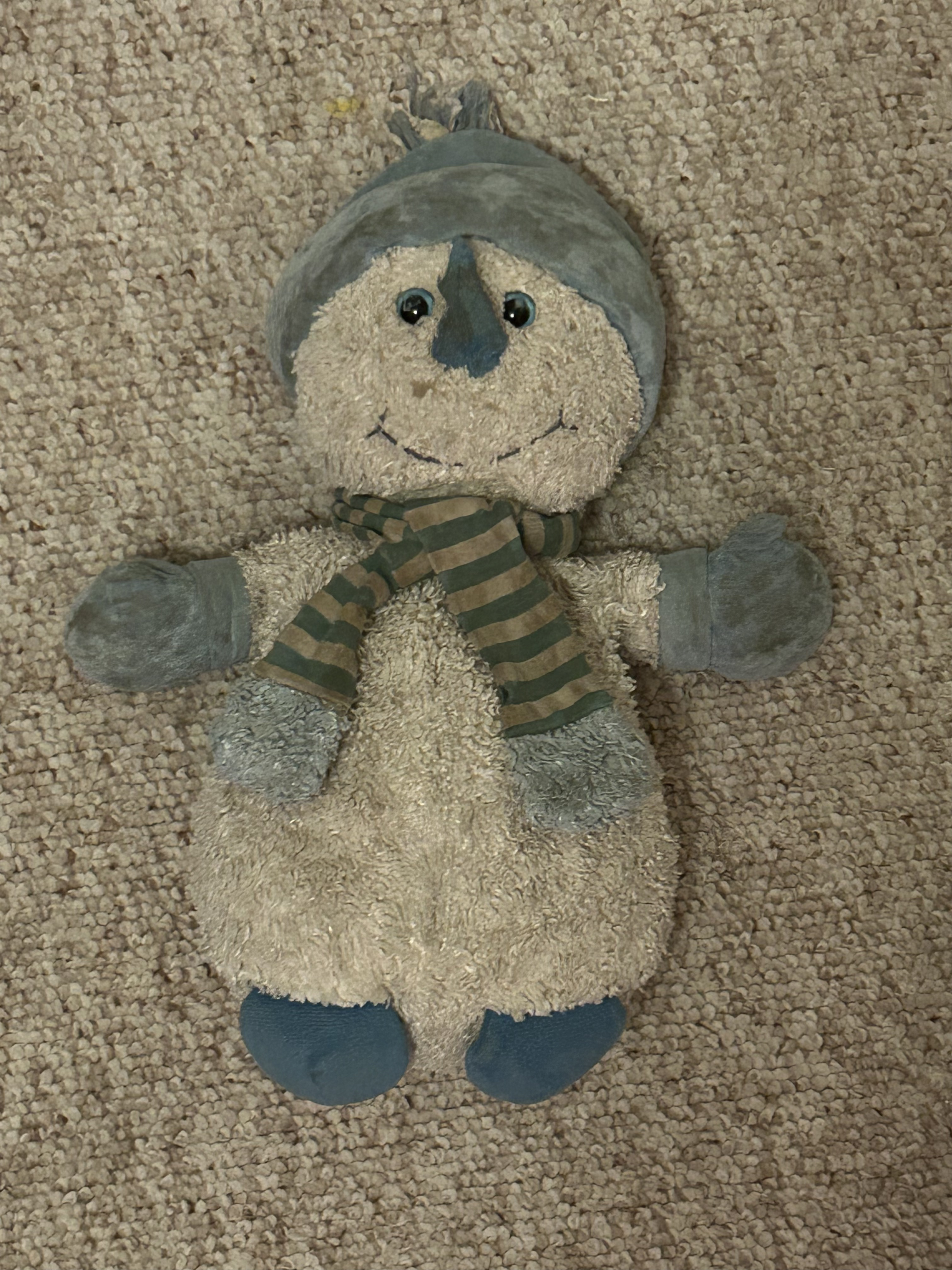
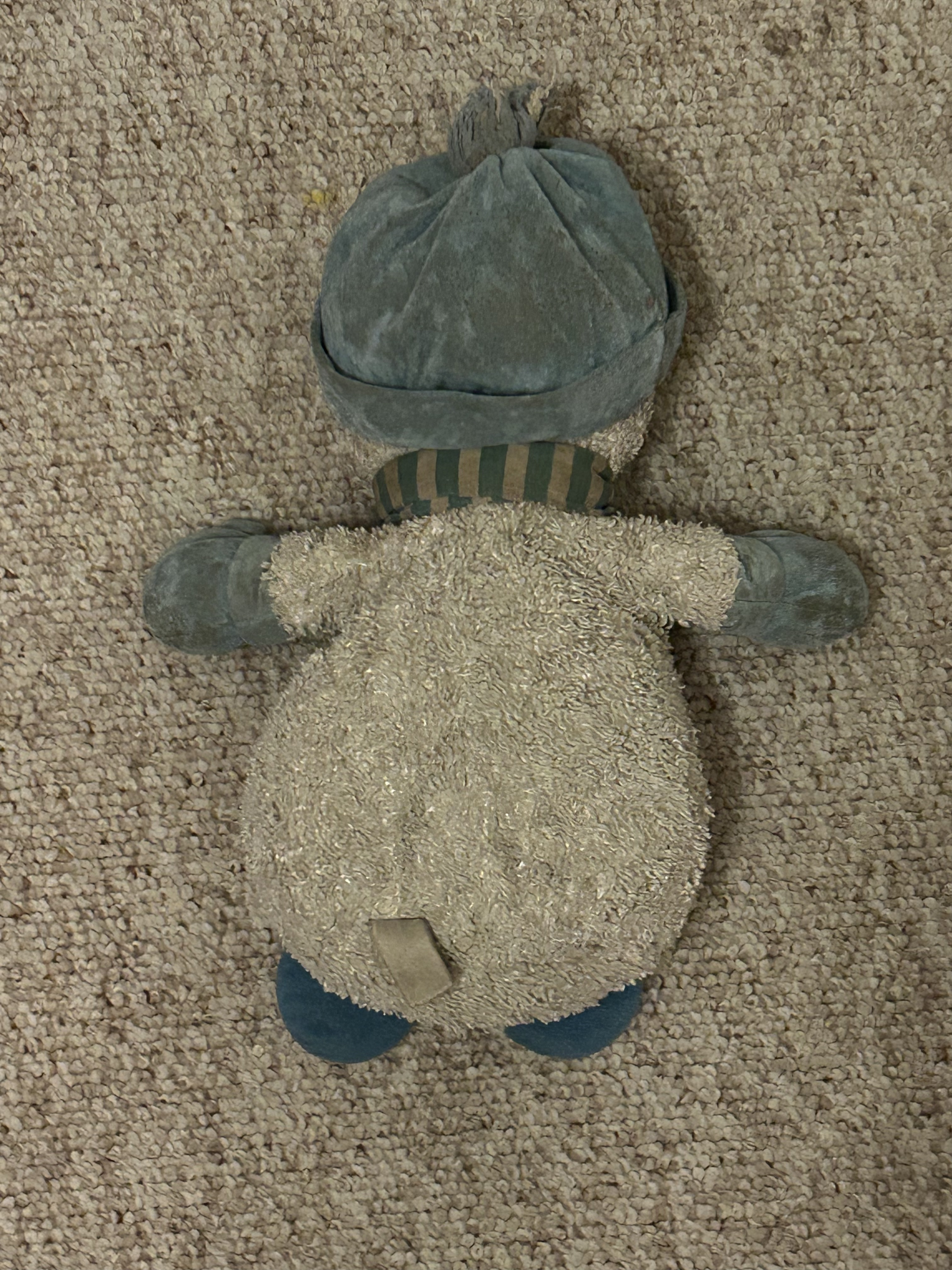
The object I’m choosing to showcase is my stuffed animal, Frosty. My parents gave him to me in January of 2003, when I was born. They bought him from a department store, but don’t remember which one. His tag, located on the bottom back of his body, has long since worn out, leaving behind a polyester gray loop. He is a snowman, with a large round body, small round head, hat with a pompom, two gloves, scarf, and two feet. Overall, he is 35” tall, 10.75″ wide with the arms spread out, and on average 3.75” deep.
Frosty’s head is approximately 14″ wide, 15” tall, and 3.5” deep. What used to be fuzzy white cotton skin has faded into a grayish white color, changed by dirt and aging. There are small patches of missing fabric on the hat, nose, and cheek, exposing the brown stitching underneath the cotton. The biggest patch is to the bottom right of his nose (from Frosty’s perspective). The nose is a thin piece of blue fabric, doubled over and formed into a triangle. A stitch line is visible on the bottom of the nose, running the full length and showing where the manufacturers sewed. The nose is stuck in an upward position, which prominently shows the stitching.
When I was a toddler, I was very sensory. I chewed on Frosty, which resulted in a big hole on the top right of his nose. Only the top layer of the fabric is broken, so the hole is still covered on the bottom. I also chewed on the white and blue fabric strips of the pompom, resulting in the ends being severely frayed.
His hat is made of blue fabric and has a rim slightly smaller than the nose. Turning Frosty around, the back of his head is fully covered by the hat, which goes down to the scarf around his neck. The hat is loosely placed on the head, attached only at the rim. This causes the hat to not look fully stuffed, becoming wrinkled. His eyes are made of glass, with a blue sclera and black pupil. Both glass eyes are scratched, making it look like he has a twinkle in his eye. Lastly, the mouth is a thin piece of blue yarn, threaded loosely into a smile with two yarns indicating the corners.
Frosty’s body is approximately 10.75″ wide with the arms spread out, 20” tall, and 4” deep. His body without the arms is 6″ wide. The skin is the same white cotton as the face, and the gloves and feet are the same blue fabric as the hat and nose. He has a scarf wrapped once around his neck, with alternating blue and white fabric stripes. The scarf is tied in a knot at the front of his body, leaving the ends to dangle for about 4.5”. The ends of the scarf are composed of the same cotton as the body, but it is colored blue. The arms are approximately 2.25″ wide and 1.25” deep, with the blue glove covering ¾ of the arm. Both gloves have one small thumb at its top in the shape of a circle, and a rim where it meets the skin. His feet are shaped like half circles, two pieces of blue fabric doubled over and attached to the bottom of the body. They’re approximately 2.25″ wide, 1.75” tall, and 0.5” deep.
His body was once firm, but over the years the stuffing dried up, leaving him with areas of flatness. The main locations of this are the neck and the two joints where the arms connect to the body. The head is no longer supported by the neck, and flops over if he is standing. The gloves and feet are the stiffest parts of Frosty. The stuffing has not yet flattened, so the original shape is still maintained.
All over Frosty, signs of wear and tear are visible. Small patches of cotton and fabric are missing on the hat, nose, cheek, and body, exposing the stitches. The nose and pompom are especially worn out, due to chewing on them when I was a toddler. The glass eyes are scratched, and a lot of the stuffing has lost its shape. While some might say it’s damaged, I think these traits are what make Frosty unique and well-loved.
My object for this assignment is a handmade souvenir from the first time I went to New York City. I have a hobby of collecting different kinds of handmade souvenirs when I go to new places, and this one of my favorites.
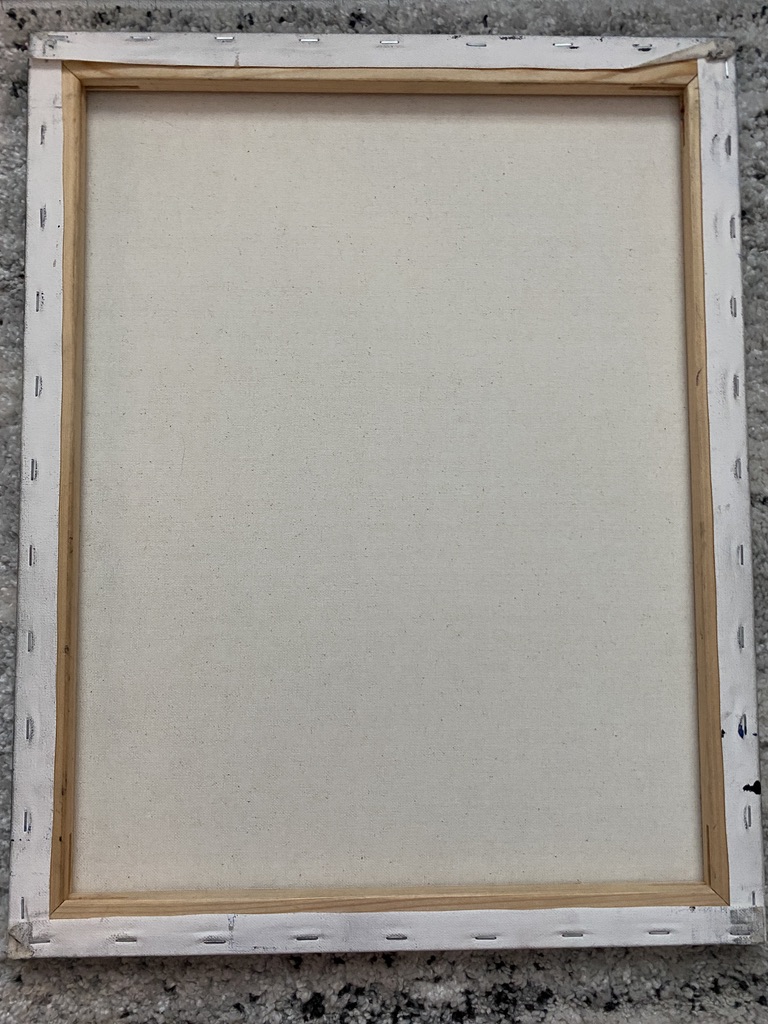
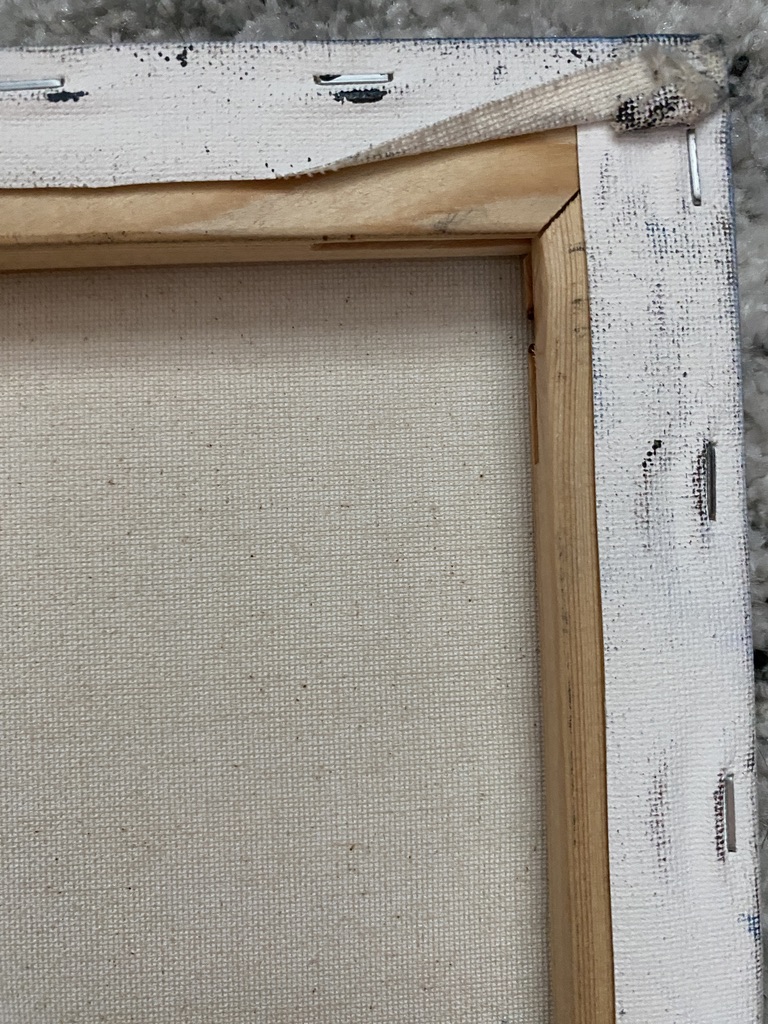
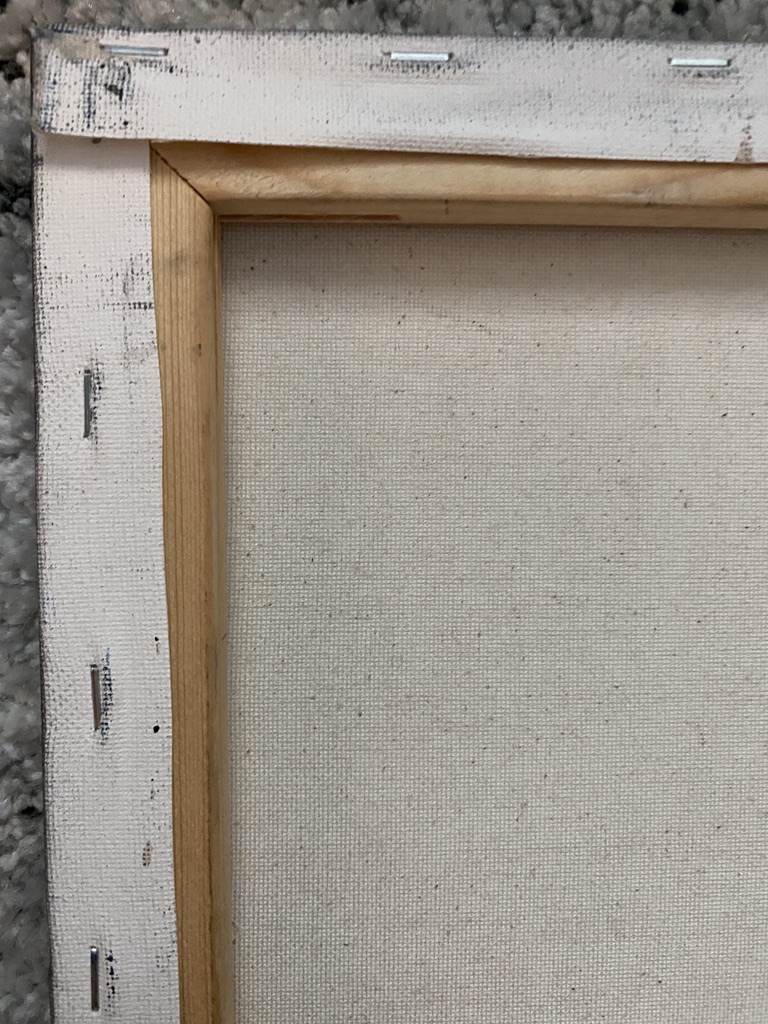
This souvenir is about 16 inches long, 20 inches tall and about half an inch wide. It is composed of a canvas-like base, secured to a wood-like frame by 38 silver staples. This frame contains 8 slots carved into each corner, is smooth to the touch, and is multiple shades of beige. The bare base is rough to the touch, almost like sandpaper, and is white in color. Multiple edges of this base are scuffed up due to years of wear and tear, and even contain traces of blue and black splattered paint. There is also the presence of a pear-like glob of black paint, which seems to have seeped onto the back of the canvas while the painting was wet. The backing of the canvas base is actually hair-like to the touch and softer compared to the rigid front. It is an off-white beige color. In the bottom left hand corner of the backing, the canvas has been torn to reveal a glimpse of the wooden frame beneath. On the top right corner, the canvas seems to be folded upwards and crushed into place. Also, the upper left corner has a looser piece of canvas that may not have been stapled down entirely before being sold.
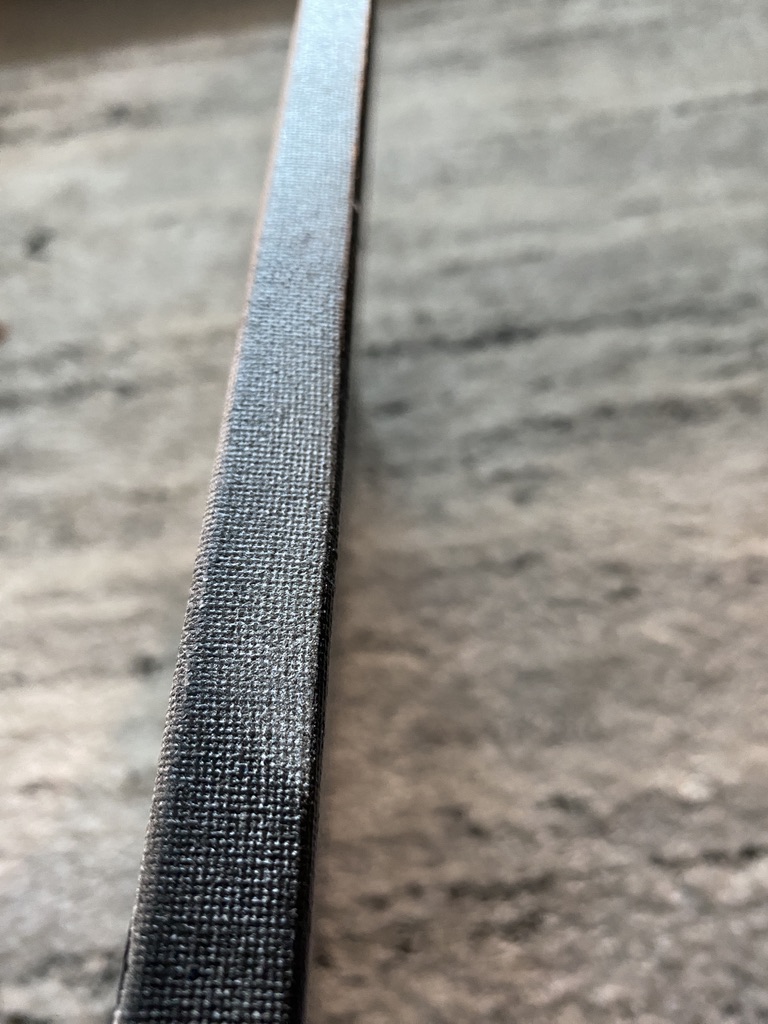
On each of the four sides of the canvas, there are multiple spots where the paint has thinned or worn off. Here, You can see the bits of white canvas peeking out from underneath the heavy black paint. If you look closely, the pattern on the canvas resembles that of a grid, or collection of pixels on a computer screen.
When looking at the front of the souvenir, there is a vast image with many intricate details forming that of a painting. Even after years of use, the painting still smells like that of spray-paint. On the bottom of this painting, there are multiple colors like violet, pink, orange and yellow that create somewhat of a light reflection on water effect, just like the ocean during a sunset. These lines are streaky, as if a finger or paintbrush were used to smooth out the color gradient. This part of the painting also feels rough and rigid like sandpaper. In the middle of the painting, there is a black silhouette of a figure holding up a torch like object. It can be inferred that this represents the statue of Liberty. Around this statue lies a bright white glow, which is reflected in the “water” in the lower half of the painting. Behind the statue lies a bridge like structure, composed of many small blue and white lines, creating a grid-like pattern. These lines look as if they were created by a small palette knife. The bridge connects to an area that appears to be a cluster of buildings. These buildings have the same detailing as the bridge but are all presented in different sizes and shapes. Some are cylindrical, some are rectangular, and some resemble buildings like the Empire State Building and the One World Trade Center. These buildings also have a three dimensional texture outlining them. Across the top of the painting there is a rainbow streak in the sky, that looks as if a paper towel was swiped across it. It seems to represent some sort of galaxy above the city, where there are also a series of white splattered dots representing stars. Lastly, at the top of the painting, there are two north star like objects, one white in color with a pink background and the other with a blue background. There also lies a large circular, planet like figure in the upper left corner of the painting. This planet is rainbow in color with a patchy surface and a blue and pink outline. Overall, this painting is not only pleasant to look at, but represents an important memory in my life.




















 The Materials of History, Thought, and Art