We are currently living in the age of digital media, everything we do we can almost always tie in how technology plays a role in the activity. This includes how we take pictures. I don’t have anything close to a professional camera, but I do have an iPhone. This device is how I take nearly all of my pictures and videos. I’ve shot concerts and music festivals and taken pictures with friends when we’ve gone out. However, during these events, I’ve always wondered if I am missing out on truly living in the moment. Am I truly experiencing something if I am viewing it through a screen? These questions led me to the decision to use a disposable camera for my recent trip to Salem.
About a week before the trip I purchased my first disposable camera at my local Walgreens, spending nearly thirty dollars on it (my mom said they used to be $1.50 when she was in college). The camera itself seemed to be made of plastic and the viewfinder is an “inverted Galilean-type plastic lens finder” (Target, n.d.). The camera is 2.5 inches (H) x 5.9 Inches x 1.4 Inches (D) and weighs about .25lbs. The camera brand and make is a Fujifilm Quicksnap, which was Fuji’s first disposable camera that had model features that allowed for usage in the day and night due to the built-in flash. (Wiki, n.d). Fuji was one of the first brands to ever create a disposable camera making its debut in 1986 (Wiki, n.d.). These cameras grew especially popular in the 90s and early 2000s but have since died down as new digital technology has emerged.
I had never used this type of camera before so there were definitely a few hiccups along the way. The first was I didn’t know how to actually use it. I had thrown out the box the morning before we left for the trip and little to my knowledge the box had the directions on it. After about five minutes of my boyfriend and I standing in massive crowds and trying to figure out how to get it to work we eventually gave up and looked up the directions. First you had to scroll the film wheel to the right, then you line up the shot by looking into a tiny viewfield, and lastly you hold the button at the top of the camera until you hear the click (Bear and McClure, 2021). Once I learned how to actually use it, another issue we ran into was distance. With digital cameras or cell phone cameras there are options like zoom and refocusing the lens but with the disposable camera this wasn’t an option. Every image I took I could only be a maximum of ten feet away from. While this wasn’t a deal breaker or really that inconvenient it was just something that really stuck out to me. The last real “issue” or difference I noticed was that I couldn’t see what the actual pictures looked like. With a digital camera you are able to look back and see if you need to take another picture but with the disposable camera you don’t get that option. I noticed I was just taking a bunch of pictures of the same thing hoping that at least one of them would turn out good. I still don’t know if any of the images came out good since it takes three weeks for the photos to be developed.
All this being said, I enjoyed the experience much more than I anticipated. The disposable camera was chunky so taking it in and out of my purse was a bit of a hassle, especially in the Salem crowds. This eventually led to me taking less pictures than I thought I would, and only using it to capture really important or truly beautiful images. With iPhones specifically you can take 100+ different photos and not feel any real connection with the images but with the disposable camera every picture felt like a moment captured in time. That’s another thing I noticed, I felt more connected to the world around me when using the disposable camera. I can’t explain the feeling, but there is something to pulling out this chunky box and having the person you’re with pose for you or having to stop in the middle of the street to make sure a picture is in focus. It makes you laugh and the moment just feels more real.
When looking back at this experience I can definitely say that I will be using a disposable camera again or maybe even look at investing in a film or polaroid camera in the future. I don’t have anything against iPhone cameras or typical digital cameras, I think they’re both really great tools and honestly phone cameras are just really convenient, but there is something to be said about using a disposable one. As I mentioned before there was a feeling of really living in the moment when using it. Taking the picture made just as good of a memory as what I was trying to capture. I was really able to connect and slow down when using the camera as well. Another thing I noticed was taking the picture felt like creating a souvenir rather than just a photo I could look back on. There was more depth and more of a story connected to the image than you typically would get.
I would never have thought that an object like a camera could create a feeling of liveiness yet when comparing both disposable and iPhone the disposable would win over and over again. The object itself created memories and I think that is my biggest take away from this. Before this experiment I couldn’t really place what Marie Condo meant by only having items that give you joy, but now I can say without a doubt that the disposable camera I used is one of them.
When considering this project, I thought about the form of the typewriter, a mechanical device that used the physical power of one’s hand to press down and activate a mechanism that causes a pin with an engraved letter to stamp down on a piece of paper. The mechanical action of a typewriter versus the light touch of a computer’s keyboard reminded me greatly of the mechanical action of the hammer of a piano. I am a piano player, but I have long since abandoned the frame of wood and wire, for one of plastic and metal. For me, it was a matter of convenience, it is difficult to lug around a 600 pound upright piano after all. When I was first taught piano, it was on an old, rickety upright that we basically got for free, it was later replaced by a much nicer upright “Kawai” brand piano. These uprights were quite tedious, and fairly difficult to maintain, and needed to be tuned every year (though we certainly went a few years without tuning them up). When I was preparing to move in for college, one of the things I decided I absolutely needed was a keyboard. We went to a lot of stores trying to find one that suited my tastes, and eventually, I decided on a Roland brand FP-30. I found this keyboard to be excellent in both feel and sound; the sign of a good keyboard is in the weight. A real piano has a lot of “heft” behind the keys, as your finger muscles need to do some strenuous work moving the complex components of the hammer mechanism or the “action”. A good keyboard should have weighted keys to replicate this effect, and I made sure to find one that met this requirement.
It has been a long time since I actually sat down and played an analog or acoustic piano; I tried to use some of the ones in college hall, but they are all reserved for music students. It was then that I remembered that there was a medium grand in the Student Union Building. So I grabbed my things and I went over to try it out. The creak of the wooden stool is an unmistakable sound, and the weathered machine in front of me looked like it had been played thousands of times. When I placed my hand on top of a key and let the weight of my appendage simply push down on the key, I found that the key did not depress at all. When playing on my keyboard, there are sensitivity options, and I typically set it to the second-highest level of touch, this is due to a condition in my hands that causes weakness and pain, so the lighter touch is well appreciated, and is actually one of the main reasons I switched to a keyboard. On this grand piano, however, I felt no movement from my light touch. Curious about this, I pressed a little harder, and it was only then I felt the mechanism of the key budge. The sound of an acoustic piano comes from the physical strike of a soft felt hammer on a wound string, and as such, a light press of the key simply caused the hammer to touch the string with barely any sound. I then decided to up the strength of my presses, and I attacked the key with a far more powerful press. This is what finally gave me my first real sound. I quickly moved into playing a few short excerpts of pieces, both soft and strong, and what I found was incredible difficulty in depressing the keys consistently. It was clear that this piano was very, very, well-used, to put it nicely. The keys were very “sticky” and clunky, and the pedals of the piano were rickety and loose. Every key seemed to require a different level of pressure to produce a consistent volume, I could press down on middle C with the same force as the adjacent note and it would yield a sound of different volume. When playing some faster pieces, the keys often got caught and would either not press down, or press down for too long, and doing any runs proved very difficult. The physical keys themselves were very smooth and slippery, making my fingers slip off on occasion. I am unsure of the actual make of this piano, but I wonder if the keys are ivory. Ivory keys were discontinued around the 70s, with acrylics and polymers taking their place; I have never compared the two types directly so I am unsure of the actual feel of these different materials. The one thing I was surprised about was the tuning of the piano. I had expected for this machine to be completely out of tune, but surprisingly it seemed as though the tone was not off by much; I do wonder if the college tunes the instrument regularly. Tuning is a non-issue on a keyboard, in fact, you can manipulate it freely and even shift the “key” of the whole board on a whim, leading to some interesting effects.
Overall the “feel” of the piano was quite strange, and something I had not felt in a long time. I have had few opportunities to play expensive, full grand pianos, and this experience makes me want to try one out freely, rather than being limited to something like a recital. This experience made me realize some of the finer aspects of convenience my digital keyboard gives me: it never goes out of tune, the touch can be adjusted to my liking, the sound is always crisp and clear, I can change the sound to my liking, and it is far more convenient and easy to transport. That being said I am sure the analog, acoustic piano is not going to go out of style any time soon.
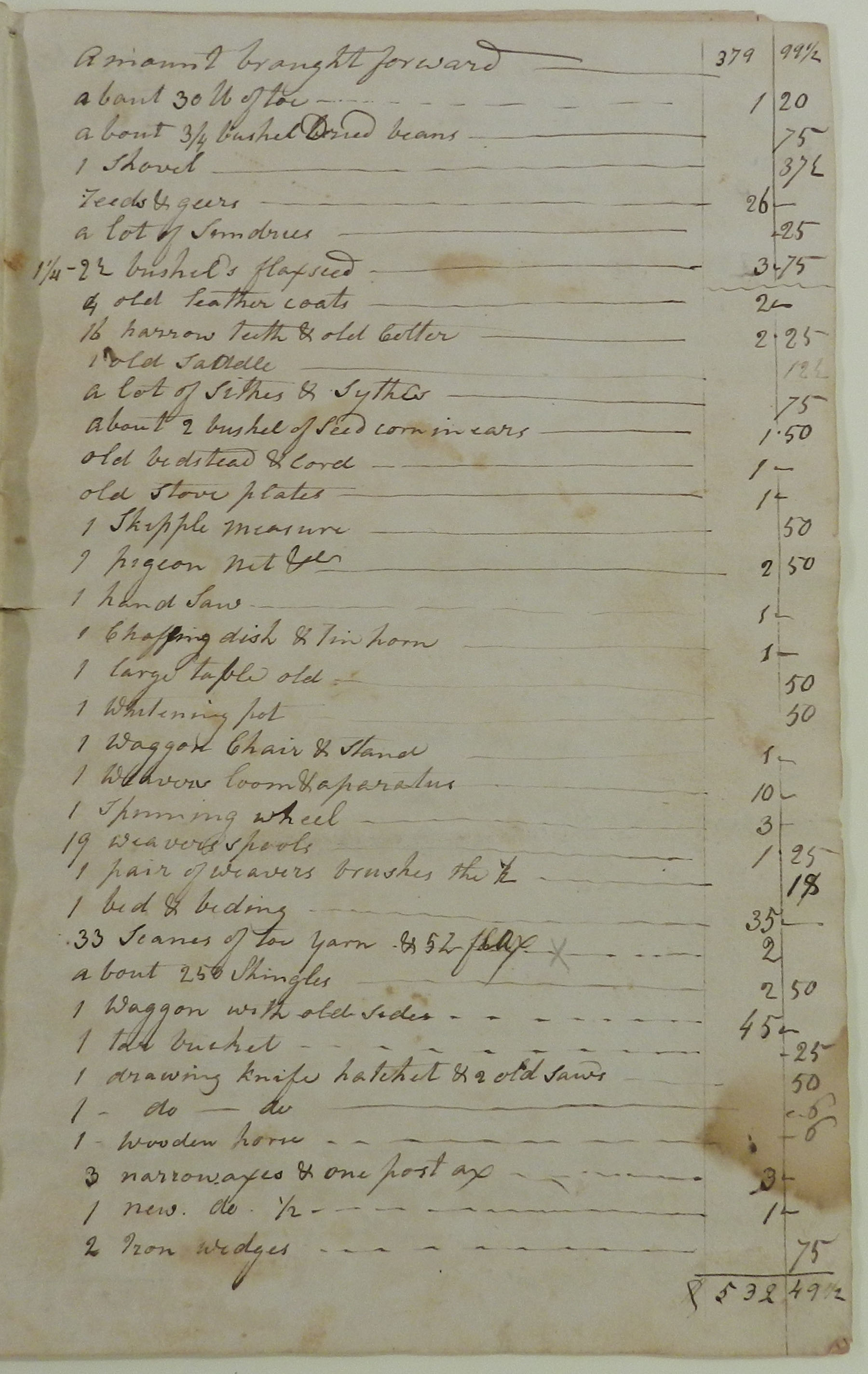
Estate Inventory of Cornelius DuBois page 9Estate Inventory of Cornelius DuBois page 10
This section of the Estate Inventory of Cornelius DuBois mostly lists tools, utensils, and furniture, along with their prices. Within the inventory, utensils made from five different types of metal are recorded. The most frequent of these materials are pewter, appearing 6 times and tin, appearing 7 times. That is in contrast to brass, only appearing twice, and silver which is only listed once. Iron is in the middle, referenced 4 times, not including the tools that can be inferred are also made of iron. Over metal, plates and pitchers are often recorded in this inventory as being made from different types of decorated earthenware, which would be cheaper to produce than any of the metal plates.
Pewter itself is a tin-based alloy, made of mostly tin mixed with a small percent of another metal. When pewter was first being produced in ancient Rome, it would consist of about 70% tin and 30% lead (Britannica). Over time, the amount of lead in the pewter would lessen, though modern pewter tends to contain 90% tin with the other 10% being made of copper, antimony, and/or silver (Britannica). Early pewter’s high lead content allowed it to be made cheaply, however it also made using these utensils very dangerous. Due to lead being a poisonous material, the daily use of pewter utensils and drinking vessels led to many people dying from pewter poisoning (Way). The higher the amount of lead in pewter, the more dangerous it is, this meant that lower income individuals that could only afford high lead pewter were more exposed to lead poisoning. This tended to prove specifically fatal to sailors during the early development of pewter (Way).
Despite this danger, pewter was initially viewed as a very desirable material to have in your home. In modern times, knowing the danger of lead we would avoid these utensils. However in early America this was very different, as stated by the collector Agatha Cowan, “From the time of first settlement through the Revolutionary War, all Americans aspired to eat and drink from pewter. Every American who could afford it used pewter daily. For the common man the appeal of pewter continued into the I870’s…” (Cowan 297). This shows that despite not reaching the same pristine image of silver, pewter was still a hot commodity for the emerging middle class of America in the 18th and 19th centuries.
When looking at the inventory one can see that a collection of 14 silver teaspoons and tongs recorded on page 10 are worth $12. Calculating inflation, this would be equivalent to spending roughly $269 today (Webster). While there is no direct set of 14 pewter spoons listed, for comparison, we may look towards the collection of 3 pewter plates and 6 pewter spoons on the inventory page 9. This set is valued at 50 cents, after calculating inflation, using the same system as we did with the silver spoons, this value equates to roughly $11 today (Webster). This depicts the practicality of buying pewter over silver from a purely financial point of view, which is why it was so desirable as a material for utensils and dinnerware. The fault of pewter came with both its danger when containing high volumes of lead, but also with its degradation. Pewter may replicate the shine of silver at first, but this is hard to maintain, as over time it will become dark and dull.
Set 4 Antique Dundee Silver Fiddle Teaspoons, Dated circa 1810 Alexander CameronThree Large 18th Century Pewter Soup Spoons, Handcrafted
This can be seen when comparing antique silver spoons and antique pewter spoons. While both metals require a certain amount of maintenance and polishing, there is a notable difference in the quality of these utensils. The silver set of spoons from 1810, when maintained, are able to achieve a mirror-like shine and a smooth texture. When viewed beside a set of 18th century pewter spoons, one can see the ways that pewter was used to mimic silver, without reaching that level of brilliance. There is a dullness to the spoons, as this pewter’s surface has darkened and degraded with age. There is also visible damage to the pewter spoons, not visible on the silver spoons. This may be due to the pewter being more of a daily use object rather than the more special or valuable silver spoons. This also could be because of the softs of the metals in pewter as opposed to silver, depicting another one of pewter’s downfalls. Pewter’s tendency to become damaged would go on to be a part of its initial production. The pewter industry in American relied heavily on the metal from worn-out pewter objects for its raw material (Cowan 297). Therefore, recycling of material was an important step in production, making early pewter pieces a rare find in today’s collecting world due to the melting down of these objects.
Pewter, when containing a large amount of lead, can also be notably heavy when compared to other mixtures of the metal (Way). Thus, adding on to its danger and its darkening, pewter is rather clunky to use as opposed to silver. However, the fact that pewter appears far more often on this inventory than silver shows that this household preferred the more affordable material despite its drawbacks. This can be shocking due to the DuBois family’s known wealth. Though pewter might have been seen as a close enough material to silver for utensils used everyday, rather than particularly special silvery utensils which may be used in the presence of guests.
Communication is something people take for granted every day. Whether you reach out to a family member or friend via a quick phone call from the comfort of your home, an email while you’re on the train, or a text message you dictate to Siri while you drive, communicating has never been easier. Even if a family member or friend lives in another country, there are apps like WhatsApp or Telegram that allow people to talk to each other across borders without having to worry about fees from their phone company. My friend, Gabriela, and I have used WhatsApp to communicate since she lived in Venezuela, and we have continued to use the service now that she lives in Canada. I decided that it would be an interesting – and potentially fun – exercise to handwrite a letter and mail it to her.
Writing a letter is more involved than one might realize! Stationery is not as popular as it used to be – even if it is making a comeback – so I was unsure of what to write my letter on at first. I don’t feel right writing a letter on paper with holes in it, so after much deliberation, I decided to find a template of college-ruled, lined paper online – this was the only part of the analog experience that was digital. I then debated whether I should use a pen or pencil for my letter. I thought back to the days when people used quill-pens to write letters – the writing was so fanciful and pleasing to the eye – but then I remembered that my pen is so inky, it is nearly impossible to write a full-page of text without having dark smudges scattered throughout; for this reason, I decided to write my letter with a pencil and give myself more flexibility to make mistakes. I began to write my letter at 2:23 PM on November 20th and I finished at 3:00 PM the same day; by the time I had finished, I had written her a four-page letter! From the outset, the feeling of graphite on paper was very satisfying – it is no wonder I wrote such a long letter – and I only found myself frustrated when the point began to dull. However, even the feeling of a dull pencil against a piece of paper produces its own pleasing sound. After approximately two minutes, my hand and wrist began to hurt. While I typically take class notes by hand, I have recently been using my laptop, so I was surprised to see that I have already grown unaccustomed to a method of notetaking I have used since the early 2000s! After some time had passed, my body got used to how it felt to write by hand, so the discomfort subsided, or I was not consciously aware of it. When I first began writing the letter, I was concerned with the aesthetics of the page and making sure it looked neat. I was worried it would look ugly if there were graphite smudges or eraser marks, but by the time I got halfway through writing I was no longer concerned with appearances and more so concerned with letting my thoughts flow freely. Allowing my thoughts to flow freely made it so that my letter was technically only three paragraphs long, something I would be more worried about if this was an email or text message. The uniformity of the space between each letter, word, and punctuation mark as well as the font itself makes it jarring to look at several sentences without a break in a digital medium. However, variations in spacing and even in handwriting makes it less obvious on paper that there aren’t breaks in the text. Moreover, writing this letter by hand allowed me to ask questions and tell stories without worrying about an immediate, real-time response. I try to refrain from asking too many different questions in a text, for example, because the implication is that the questions will be answered quickly. In my experience, there is more pressure when sending a response digitally than by hand, being that we live in such a fast-paced world. Slowing things down and writing a letter allows people to let their thoughts flow, to pause and return to the letter-writing, or even to scrap the entire letter and begin again. When it comes to letter-writing, there is an understanding between the sender and receiver that a response may not come for several weeks. Less anxiety about when to respond – or when to expect a response – makes letter-writing a much more calming and enjoyable experience!
The experience of writing the letter was pleasant, but I was surprised at how much I also enjoyed mailing it! I wrote the letter on a Saturday so I knew I would not be able to mail it out until the upcoming Tuesday, the earliest. On Sunday, Monday, and then on Tuesday – due to a change of plans – my anticipation kept growing! Gabriela is sentimental, so I was excited thinking about her reaction upon receiving a letter from a friend! I decided not to let her know the letter was on its way so that it would be a true surprise. When I finally went to the post office on Wednesday, I was almost giddy with excitement. How long would it take the letter to arrive? Should I add tracking? Is it more authentic and analog to send the letter without knowing when it would arrive? What if it gets lost in the mail? These were all questions I had while I waited in line to purchase an international stamp – only one is needed when mailing a letter, or three regular stamps. I decided to send the letter without tracking it, not only because it is more authentic to the analog experience of writing a letter, but also because it costs seventeen dollars to track a letter internationally! It has now been four days since the letter was mailed, and with each day that passes, my anticipation grows. I hope that the letter gets to Gabriela within the next week, and I am looking forward to her response! I hope she writes me a letter, too!
Morris Jansen was born July 22nd, 1793, in the small hamlet of Shawangunk in Ulster, NY to parents Cornelius T. Jansen and Christina Jansen (née Morris). It can be surmised that the Shawangunk native was named after his mother’s maiden name Morris. The youngest of five children, Morris was the last child born to Cornelius before his death in 1796.[1] While the youngest, Morris was predeceased by his brother, Jacob Jansen, who died at the age of one as well as his other brother John Morris Jansen who died relatively early on in life.
The name Jansen, also spelt in records as Janson, Jensen, or Johnson, is a name of Dutch origin. There is no record as to when the Jansen family originally arrived in the Shawangunk or larger Ulster area, the Dutch were some of the first Europeans to settle in the region.[2] There are records of the name Jansen present in the Ulster County archives that date back to the seventeenth century.[3] While this does not correlate explicitly to the family of Morris Jansen, the Dutch population was heavily prevalent in the area for several centuries. Like other local Dutch families in the individuals, Morris Jansen was most likely bilingual in Dutch and English.
While there is no explicit description of the Jansen family as ‘wealthy’, the family had enough wealth to retain six enslaved persons at the time of Cornelius Jansen’s death.[4] One of the enslaved persons was either born or bought in the last three years before Cornelius’s death.[5]
As one of eleven children himself, Cornelius’ family was able to retain and care for their large family as well as take care of enslaved persons.[6] Although not in Cornelius nor Morris’ immediate family, a local relative by the name of Henry Jansen had sixteen enslaved persons at the time of his death in 1764.[7] Cornelius’s brothers Johannes and Thomas in comparison owned nine and fifteen enslaved persons by the 1790 census.[8] While Cornelius did not own as much wealth and enslaved persons as his brothers, Cornelius was among the last to own slaves in the Shawangunk area. As a result, Morris Jansen grew up alongside the company of his family’s enslaved persons. Two enslaved persons, Bob (b. 1790) and Frank (b. 1788), were only several years older than Morris himself. [9] While Frank was sold to a man in the area by the name of E. Foot, there is no remaining record of what happened to Bob.[10]
While there is no record available of the Cornelius and Christina Jansen’s house surviving or being described in detail, Cornelius’s two brothers’ wealth and reputation is also conveyed in the architecture and prominence of their respective estates.[11] The contemporary maintenance of the two Jansen households allows for the insight into the local prominence of the Jansen family. While the Cornelius did well for himself as can be surmised from available records, his brother Johannes donated an orchard in Kingston to his brother in 1790.[12] There is no description of the orchard nor any reasoning as to why the orchard was donated. But from other records available, the Cornelius Jansen and his two of his brothers Thomas and Johannes often sold or donated their enslaved persons, land, or other objects to one another.
There is little to be found on Morris Jansen himself as the Dutch man died at the relative early age of 25 in 1818.[13]Despite the Dutch man’s short life, he was able to become a lieutenant. There is no record as to Jansen’s ranking in a specific militia other than his title being used in a letter from a man named Elias Pratt in 1814.[14] There is a description of land in Homer, NY that used to belong to one of his brothers, and Elias Pratt goes on to describe the man as “gone”.[15] While there is no further elaboration into the circumstances of this letter, the description of land away from Jansen and his brothers’ residences is striking. One of the brothers owns land in Homer while Morris Jansen himself owns land in Greene County.[16] The distance land-owning in New York prevalent in the Jansen family is interesting and has no explanation.
In another letter a year later, Morris is described as in ‘controversy’ in regard to his father’s estate. The letter describes an esquire (or lawyer) by the name of John Duers entering bonds “to settle all controversies”.[17] While Morris’s father died in 1796, his estate was settled for a second time by his widow Christina and her new husband, Cornelius Louw.[18] Through letters and deeds, one can surmise that the second settlement of the estate was not agreed upon by all members of the family.
Much like his uncles and his father, Morris owns land far away from his place of residence in Shawangunk, New York. While it is not across state lines nor oceans, Morris owns land in Pompey, NY which is now in Onondaga County and over 190 miles from each other. While there are no legal records to prove this, letters between Morris and Elias Pratt allow for an interpretation of a landowner and renter relationship. In the final years of Morris life, Pratt contacted him in 1814 regarding sale of land.[19] In future letters between the pair, Pratt complains of “crops por fear of famine” as well as “[agitation] over the prospect of losing his farm…[as] a foreclosure of mortgage will ruin him”.[20]
Besides owning land in Pompey, Morris also owns land in what Roland Sears describes as “Greene Country”.[21] In a letter dated in April 1816, Sears asks for power of attorney and is later granted it.[22] There is no record if the land was sold prior to Morris death in 1818.
Besides the land-owning situation Morris found himself in, the lives of enslaved persons owned by the Jansen family is interesting. As Morris was only six when slavery was outlawed in NY in 1799 and eventual freeing of all slaves was set for 1827, the lives of enslaved persons in the beginning of the nineteenth century is not spoken about. The Jansen family owned slaves for centuries in the Ulster area.[23] There was a repetition of names that seemed to be dehumanizing. There are multiple records of enslaved male persons owned by the Jansen family being called ‘Frank’ with two even at the same time; the two Franks were regarded as ‘old Frank’ and ‘young Frank’. While the motives are not clear for the repetition of this name, the choice to retain this name for enslaved men is worth investigating. Unknown if this is the same ‘old Frank’ that was enslaved by Cornelius Jansen, an enslaved man by name of Frank ran away from Peter Jansen in 1797.[24]
There are still many unanswered questions that surround the lives of the Jansens and the lives of the enslaved persons. While the Jansen family name is not synonymous with slavery in the Hudson Valley, research into this early Dutch family conveys a long relationship with the evil institution.
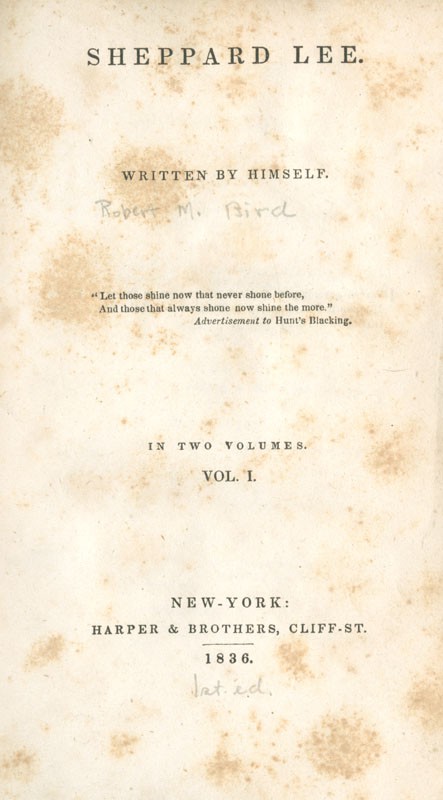
Addressing the historical accounts of New Paltz, including the document “Estate Inventory of Cornelius Dubois, 1816,” feels somewhat mundane in comparison to my English college education. I have always found my education and relationship with SUNY New Paltz to be vital in my understanding of the town, which I have called my home for three years. Studying English literature, in any case, has always caused me to think about the novels written at the time when discussing history. What is history without art? Cornelius Dubois’ Estate Inventory feels monotonous without considering the wide-eyed, ambiguous, unknowing literature written at the time period, such as Robert Montgomery Bird’s Sheppard Lee: Written by Himself. Within my research, I found that looking at the “Estate Inventory of Cornelius Dubois,” through a literary lens offers insight into the nature of life on a farm, as well as the related objects at the time period. I found that the setting and narrative within Sheppard Lee illuminates life in New England America in the 19th century, especially in relation to the paramount moral issue of slavery. As the future of New Paltz pushes on, twenty-first-century dwellers are asked to re-evaluate our understanding of privilege, literacy, and race within New Paltz.
History through the Lens of Literature
I began my education at the State University of New York at New Paltz in Spring 2019 as an English Literature student. I became heavily involved with the English department and began my education as a graduate student in English, which has allowed me to enhance my understanding of literature, particularly in certain time periods. This semester (Fall 2021), I took my first graduate class, “Studies in Nineteenth-Century American Literature” concurrently with “The Materials of History, Thought, and Art.” As we began discussing the historical objects of New Paltz, I couldn’t help but implore my knowledge as an English student, a graduate student, and an honors student. The humanities, and in my personal experience, literature, attempts to answer ‘What does it mean to be a human? What are the fundamentals of our humanity?’ In this case, I would add ‘historically’ to the beginning of these questions.
This semester, Professor Christopher Link offered “Nineteenth-Century American Literature,” and teaches his version of the course to reflect “the era’s national preoccupation with self-identity and questions of one’s responsibility toward the other” (“ENG 579 – Syllabus”). The first book we explored was Sheppard Lee written by Robert Montgomery Bird. The book focuses on the life of Sheppard Lee, who laments about his laziness, inability to find love or happiness, and his lack of wealth. Eventually, he discovers he has a mystical ability to migrate into other people’s bodies. He satirizes the radical different subjectivities he becomes, including a physician, a philanthropist, a money-lender, and most significantly, a slave. The narrative that Sheppard Lee offers reflects the nation’s own inability to have a unified existence, as well as the asymmetrical values that separated America in the 1800s.
When the novel was written in 1836, Sheppard Lee was fairly popular; Edgar Allen Poe even reviewed the book and commended it for its artistic profoundness. Because the novel takes place in close proximity to New Paltz (New England area), I found that the values must align in some ways. While the document that listed Cornelius Dubois’ possessions did not reveal much of his attitudes and beliefs, it did reveal his lifestyle: pages five and six of the document largely contain tools that are used to farm. Here is where I made the connection: Sheppard Lee also owned a farm, and like Dubois, also owned slaves.
Similarities between Cornelius Dubois and Sheppard Lee: Farm Maintenance
The Estate Inventory is documentation of the location and how it operated. I see quite clearly that Cornelius Dubois listed slaves as one of his assets, meaning that slaves were determined by their capital value. However, I cannot capture the essence of the list: how were the tools used? How did Dubois feel about farming? Was he a good farmer? Was he a moral man? These things remained unanswered. With some research, however, I was able to discover much about the Dubois family that cannot be understood from the Estate Inventory. The Dubois family was a “prosperous middle class” family, in a similar way to Sheppard Lee (“Dubois Family Association”). Upon reading Historic Huguenot Street’s “Dubois Family Association,” I found that many similarities tied together Sheppard Lee and Cornelius Dubois. Both of them were middle-class, white land-owning men, slaveholders, farm owners, inhabitants of New England, and from nineteenth-century America. The only difference that separated them was that Sheppard Lee is fictional, while Cornelius Dubois is real. Both, however, reveal truths about a society I am a part of.
In a similar manner to Cornelius Dubois, Sheppard Lee (and previously his father) lives on a farm with his slaves during the early time period of America. This observation led me to ask if the slaves assumed the maintenance of the farm. Lee, in reference to his slaves Jim and Dinah, claims: “What labour was bestowed upon the farm, was bestowed almost altogether by him and his wife Dinah. It is true he did just what he liked, and without consulting me,—planting and harvesting, and even selling what he raised, as if he were the master and owner of all things, and laying out what money he obtained by the sales” (Bird 21). Immediately, I found my question answered through exploring nineteenth-century American literature. On page twelve, the Estate Inventory lists his slaves, human lives, as an asset (“Dubois State Inventory”). I imagine that the slaves Dubois owned most likely performed a majority of the farmwork. While I am uncertain how Dubois conducted his slaves, I can imagine it was with cruelty and force. Again, I contemplated the list of farm tools I had, and asked myself: how much of this stuff is technically, really Cornelius Dubois’?’ I was doubtful that Cornelius used the tools with his own hands frequently, given the implications within Sheppard Lee.
Although the Estate Inventory of Cornelius Dubois detailed his assets, it was overwhelmingly true some of these assets, regardless of their title and value, were not truly his. On pages 5 and 6, the author of the Estate Inventory details what appears to be many farm tools, machinery, and materials. The list includes items such as a “steel shad,” “small hand cart,” “waggon,” “tar bucket,” and other items along those lines (“Dubois Estate Inventory” 5-6). Upon first glance, these items are not much different from items I find in my grandparent’s shed. According to Eric J. Roth, a scholar who reports on the history of New Paltz, New Paltz was once an “isolated, conservative, tightly-knit farming community” (Irene qtd. in Roth). Roth’s research on New Paltz, however, focuses primarily on its history of slavery, and thereby brings cognizance to the townsfolks of New Paltz in the twenty-first century. Roth quotes historian William-Myers when he writes, “Slaves were involved in the production of almost every item used or consumed on the farm: from such simple items as brooms, ladles, and cords of firewood for use year-round to more elaborate ones such as barns and Dutch cellars” (qtd. in Roth). Just like Sheppard Lee, Cornelius Dubois was not essential to the production or maintenance of his farms.
Similarities between Cornelius Dubois and Sheppard Lee: Anti-Abolitionism
With further analysis, I found that Sheppard Lee perpetuated anti-abolitionist standards at the time period. Lee claims, “I resolved to set [Jim] free, and accordingly mentioned my design to him; when, to my surprise, he burst into a passion, swore he would not be free, and told me flatly I was his master, and I should take care of him” (Bird 20). Because most of the readers at the time were white men, I am inclined to believe that the perpetuation of slavery was reinforced by the literature predominantly read by men. When Lee enters the body of the slave Tom, he writes, “the reader, who has seen with what horror and fear I began the life of a slave, may ask if, after I found myself restored to health and strength [. . .] I found myself, for the first time in my life, content, or very nearly so, with my condition, free from cares, far removed from disquiet, and, if not actually in love with my lot, so far from being dissatisfied, that I had not the least desire to exchange it for another” (Bird 341). Considering the popularity of the novel at this time, I am certain Sheppard Lee was meant to be a character his readers could sympathize with, as he migrates to different bodies, lamenting the struggles he feels in each subjectivity. Altogether, it is obvious that the attitudes at this time did not align with the misleading notion that New England and the Northern United States were moved by abolitionism.
Although the “Estate Inventory of Cornelius Dubois” does not reveal much about his anti-abolitionism, I am aware he possessed slaves up until at least 1816 (when the document was created). According to the “Hasbrouck Renaming Report,” created by the Diversity and Inclusion Council here at SUNY New Paltz, “the state [of New York] approved legislation in 1817 to totally abolish slavery as of July 4, 1827” (11). Up until Cornelius Dubois’ death, there was no legislation that prevented him from owning slaves, hence why they were listed as an asset on his document. Even so, many loopholes were used to perpetuate the possession of slavery and utter disenfranchisement of black people in the area. The same document claims that “The disinterest of white New Paltzians regarding their black neighbors was vividly evident in the outcome in the town of a statewide referendum that would extend suffrage to all black men. The measure failed in New Paltz 204 against to 32 in favor” (12). Even if white men could not own slaves, it was of no interest to the majority of them to integrate rights for the black people in the area.
To reiterate, Sheppard Lee: Written by Himself was written in 1836, meaning that slavery persisted in the New England area for years to come. In addition, I was a student here at SUNY New Paltz when the Building Complexes were named after slaveowners, including Dubois. I distinctly remember the shift in language the community had in 2019 when the Residence Halls were no longer referred to as “Bevier” or “DuBois.” Even centuries later, New Paltz’s history of slavery was overlooked in light of honoring the slave owners who disenfranchised them and denied suffrage to them. I am a true believer that literature, art, and texts in their entirety, when not read with a careful eye, can perpetuate a certain paradigm. In the town of New Paltz that would be the ignorance of anti-abolitionism in the area, as well as the false pretense that New Paltz is entirely socially liberal. Literature, I am led to believe, shows real truth about my own location and how it once operated.
Similarities between Cornelius Dubois and Sheppard Lee: Literacy in Nineteenth-Century America
My first question in regards to the Estate Inventory was ‘who wrote this document?’ I never considered the level of literacy in America in the nineteenth century. According to a review of Kenneth Lockridge’s Literacy in Colonial New England, “Lockridge’s raw data for New England show a rise in male literacy from 60% in 1660 to [. . .] 90% in 1790” (Katz 459). Katz implores Lockridge’s belief that “the rise in male literacy primarily in terms of the emergence of effective compulsory public schooling” (459). However, it is important to note that black slaves and women were unable to read because of the “deliberate exclusion from the public education system” (Katz 459). While I was surprised to see such a high literacy rate of people in New England by 1790, I was thoroughly unsurprised, yet unsettled, to find that this was exclusionary of black people. Upon further research, I found a study done by Tom Snyder, which was later used by the National Center for Education Statistics to capture the literacy of America from 1870 to 1979. Because the nation had grown, it was clear to me that the numbers may have some disparity. Regardless, the numbers were fairly similar. According to Snyder, the percentage of people who were fourteen years or older in 1870 was 20% (NCES). Furthermore, of that 20% of people who were illiterate, 79.9% of those people were black (NCES). In relation to my document, I had thought to myself that most anyone could have written up an account of Cornelius Dubois’ assets, but it was most certainly a white man.
According to the “Hasbrouck Renaming Report,” the 1812 “Act of Establishment for Common Schools” required children to attend school and become literate, which Kenneth Lockridge agrees was vital to the literacy of men in New England (13). However, the same document claims, “it is not clear if, in the wake of the 1810 law requiring enslavers to educate their enslaved children, school authorities admitted black children to the new school” (13). Under my current understanding of New Paltz, the university is the second college to have ever implemented a Black Studies Department, yet much of the school has avoided the history of New Paltz’s slavery and the blatant oppression black people faced in the area.
Sheppard Lee succeeds in proving how white men had the privilege of literacy, as confirmed by the National Center for Education Statistics. While Lee inhabits the body of a black slave in the presence of other slaves who find a pamphlet, the following interaction occurs: “‘Let me read it,’ said I. ‘You read, you n—-! whar you larn to read?’ cried, my friends. It was a question I could not well answer; for, as I said before, the memory of my past existence had quite faded from my mind: nevertheless, I had a feeling in me as if I could read; and taking the book from the parson, I succeeded in deciphering the legend” (Bird 350). Because Lee had the advantage of being able to read as a white man, he, in the body of a black slave, could read while none of the other slaves were able to. All in all, my understanding of how disparate those who could read, write and understand language was confirmed through exploring this document. This document, on the surface, appears to be just a list of items in someone’s house; but it has so much more significance. The list represents one’s ability to have money, property, privilege, and especially access to intellectual property. While it represents the agricultural state of New Paltz, it also emphasizes the misleading idea that the North was anti-slavery; it emphasizes the privilege of reading and writing; it emphasizes privilege. When readers interact with this document and its contents, more truths are revealed; even within the simplicity of farming items.
I felt uncomfortable dealing with this knowledge; my ability to read and write defines me. Without getting too personal, I am reminded that I came to New Paltz in the pursuit of education; to further my ability to use the English language in a meaningful, open-minded, and liberal way. I, like many other students, feel conflicted in appreciating an education that was founded in a town that relied on slavery; in appreciating an education that honored six names of slaveholders (including the Dubois’); in appreciating an education that was founded on the basis of making only white men literate. I hold true to the idea that I am an integral part of New Paltz, and my very attendance affects the course of education and how it will later be perceived. Knowing that my ancestors were denied education makes me feel both grateful for my privilege, and angry from the lack of equality in history.
Conclusion
In deep reflection, I found that I approached the “Estate Inventory of Cornelius Dubois, 1816” with prior assumptions: that there was nothing I could learn from this list. After I read through the document thoroughly and noticed that slaves were listed as an asset, I couldn’t help but impart the knowledge I have gained through my years here as an English student. Studying literature without outside information and historical context becomes flat, and novels become totally autonomous and lose their meaning. However, when looking at a novel alongside historical documents, so much truth is revealed. I thought of Sheppard Lee, and how Robert Montgomery Bird portrayed this character to find contentedness in bondage, and justify owning a slave. I was finding parallels between the lifestyles exemplified in both Dubois’ life and Lee’s life. My understanding of both Sheppard Lee and the “Estate Inventory of Cornelius Dubois, 1816” has grown to consider my experiences in New Paltz, particularly when it comes to racism, slavery, and the privilege of my own education and literacy. I revere historical documents as coloring book pages, and literature as crayons, and the “Estate Inventory of Cornelius Dubois, 1816” remains blank unless filled in.
Works Cited:
Bird, Robert Montgomery. Sheppard Lee: Written by Himself. New York Review Books, 2008.
Diversity and Inclusion Council. Hasbrouck Building Complex Renaming Dialogue Report and
On April 5, 1797, Elizabeth DeWitt penned a letter to her father, presumably located in Europe at the time. In this letter, she referenced “the ill state of health of [her] friends” and let her father know that in the colonies, “a great many people die of different disorders the most common [being] pleurisy and inflammation of the head” (“Letter from Elizabeth DeWitt to her father”). Pleurisy is defined as “a condition in which the pleura – two large, thin layers of tissue that separate your lungs from your chest wall – becomes inflamed” (“Pleurisy”). This condition causes difficulty breathing and chest pain, but in the modern era, it is not life-threatening with timely diagnosis and proper treatment. Encephalitis – which is inflammation of the brain – is another disorder that if diagnosed and treated properly does not always lead to serious injury or death. Both pleurisy and encephalitis are caused by underlying disorders, most often an infection of some sort. According to Mayo Clinic’s entry on “Pleurisy,” the condition can be caused by “viral infection, such as the flu (influenza); bacterial infection, such as pneumonia… [and] Tuberculosis (TB),” to name a few. Mayo Clinic’s entry on “Encephalitis” names such viruses as “measles (rubeola), mumps and German measles (rubella)” as “fairly common causes of secondary encephalitis” in the past. So, why is it that during the 18th century, people were commonly dying from these secondary disorders? To answer that question, one must first understand the medicinal beliefs and practices of the 18th century.
Letter from Elizabeth DeWitt to her father
Prior to the 18th century, the prevailing theory on how disease was contracted and spread was based on a miasmic, humoral model: “traditional theory held that disease was caused by bad air, a miasma that upset the balance of humors” (Breslaw 29). It was not until 1721 that this theory was challenged by a Cotton Mather, who believed that “’little animals’ that existed in pus from smallpox victims had something to do with causing the contagion” (29). Mather was a revolutionary thinker in this regard, as he took his theory further and “also suggested that the eggs from that ‘animicular’ matter could invade the body through the pores or the mouth” (29). In the present-day, we can recognize that Mather was referring to microscopic organisms called viruses spreading through droplets in the air. While Mather was taking a different approach to the causes and treatment of illness, other diseases were still being treated with outdated methods. When measles epidemics affected communities, “doctors followed the usual regime of bleeding, vomiting, and purging, which probably increased the danger of death” (39). Methods of purging could involve “laxatives… [which] could leach nutrients and electrolytes from the body,” or “calomel (a combination of mercury and chloride)” which is now an ingredient in “insecticide and fungicide” (46). While bloodletting could have had medicinal properties – “by lowering the availability of iron in the blood, some pathogens lose their ability to grow and multiply” – such a practice hardly helped treat the disorders it was typically used for, such as “smallpox, yellow fever, [or] pneumonia” (46-47). Moreover, physicians relied more on their perceived ability than any other tool they might have had at their disposal. Even if a physician’s methods caused 80% of his patients to become seriously injured or to die, “the doctor was considered successful if he seemingly cured one person” (47). This way of practicing medicine is harmful to patients at any time. If a doctor is unwilling to explore other options when their treatment methods are outdated, harmful, or outright dangerous, then patients cannot get adequate and informed care. Physicians were put on a pedestal, patients “[endowing] their medical practitioners with enormous authority” (47). Additionally, it was much more difficult to diagnose illness in the 18th century than it is now. Typically:
Diagnoses were generally based on symptoms as described by the patient. The doctor seldom touched the patient except to take a pulse or check for fever and thus was dependent on how individuals described their pains or discomforts. He would then diagnose a flux as anything from simple diarrhea, to dysentery, typhoid, or typhus… A pleurisy referred to respiratory or lung diseases such [as] influenza or pneumonia. (45-46)
This is a significant contrast to methods of diagnosing illnesses and disorders today. Modern technology and modern medicine make it possible to diagnose and treat a plethora of diseases. In the case of pleurisy and encephalitis, diagnostic imaging (X-Rays, MRIs, CTs), blood tests, spinal taps, etc. are tools that can be used to determine whether someone is afflicted with pleurisy or encephalitis (“Pleurisy,” “Encephalitis”). Throat or nose swabs can be used to determine whether someone has influenza, strep throat, or now, COVID-19, among others. It is possible misdiagnoses or missed diagnoses were more common during the 18th century due to the lack of reliable diagnostic tools; additionally, even though a “very primitive form” of the thermometer was available during the 18th century, physicians did not use them until “at least… the middle of the nineteenth century” (47). Physicians during this time did not believe, and often rejected, notions that “science [or] technology had any application to medicine” (47). Regarding pleurisy or encephalitis, those conditions would not have been able to be accurately diagnosed during the 18th century, undoubtedly resulting in the deaths of “a great many people” Elizabeth DeWitt would come to write about in the letter to her father.
In the present-day United States, “we have antibiotics to cure contagious diseases and vaccines to prevent them” (Breslaw 1). In the 18th century, this was most certainly not the case. Elizabeth DeWitt lived in the colonies at a time that medicine was not making many strides. Outdated thinking and a refusal to be open to new or improved methods of treatment prevented advancement. Doctors not having reliable and consistent methods of treatment meant that they believed “diseases were peculiar to individuals; each individual required different medications or combinations and depended on the physician’s special understanding of illness” (48). Rather than recognizing that a standard approach would probably be best for the patient, physicians rejected newer ideas or modes of treatment “in favor of established practices” (44). Colonists were exposed to illnesses and diseases that they had no experience with in their homeland, they then relied on the authority of physicians who were not open to new ideas – even if those new ideas could prevent injury or death – and, due to a lack of understanding by the general public, patients took their doctors at their word and did not question their diagnoses or treatment methods. When one takes these facts into consideration, it is not difficult to understand why people were dying due to secondary disorders such as pleurisy or encephalitis. It is possible that these people were afflicted with such infections as influenza, pneumonia, measles, but received improper or incorrect treatment, leading to the development of the aforementioned conditions. Thinking about the medicinal practices of the 18th century can help us to understand the conditions of individuals living during these times.
Among the extensive list of items in the Estate inventory of Cornelius Dubois, there is an object listed as “1 Sundial”. This object seemed out of place, as sundials are usually seen as an archaic method of telling time. Ironically, clocks are seen as timeless, as though they have been around forever. This is not true, and even after the invention of the clock, alternative methods of timekeeping, such as sundials, did not immediately lose their value.
Sundials are timepieces that predate clocks. “Sundial, the earliest type of timekeeping device, which indicates the time of day by the position of the shadow of some object exposed to the sun’s rays. As the day progresses, the sun moves across the sky, causing the shadow of the object to move and indicating the passage of time.”(Sundial) They consist of a gnomon, which is a thin piece or pillar that projects out and casts a shadow onto the dial. The dial is the flat surface that the gnomon sits on. It is often marked with a circle of numbers that indicate the time of day based on the position of the shadow. While they can be made to be very complex and expensive, sundials are often inexpensive and reliable ways to tell the time. As long as the sun is shining they can be used to tell the time.
Before 1816, clocks were expensive and hard to come by. Once the shelf clock was invented, they were able to be mass produced and more commonplace. “Eli Terry designed a shelf clock with interchangeable parts, giving birth to the Connecticut clockmaking industry”(Andrewes). Eli Terry invented shelf clocks in 1816, the same year as the estate inventory. While previously created clocks may have been used, the shelf clock was self-contained and easily installable. It could simply be placed on a shelf with no added assembly. It also was far less expensive to produce and allowed clocks to be widely available.
Since this specific sundial was purchased before the invention of the shelf clock, it was likely less expensive and difficult to use than a mechanical clock from this time. However sundials were still useful after 1816. “Until the 19th century sundials were still used to reset mechanical clocks.”(Sundial) Even though clocks became more commonplace, they were not always accurate until more precise clocks were invented at the end of the 19th Century. Until then clocks often had to be rewound to display the correct time, and sundials were a reliable source to set them against.
Currently watches, clocks, and computers are common ways of telling the time, but residents of New Paltz also rely on the chimes of the clocktower. There are two clock towers in town, one on top of van den Berg hall, and the other at the Reform Church of New Paltz on Huguenot Street. Van den Berg hall is one of the oldest building on campus, but its clock is one of the newer ones in town. While the original was built in 1932, it burnt down in 1990. The current clock tower was rebuilt in 2005. The Reform Church dates back hundreds of years, and its clocktower is almost as old as the Estate Inventory. “Our present church, a fine example of Greek Revival architecture with its four-column timekeeping in portico and two-stage clock and bell tower, was erected in 1839”. (Our Church History). This clock tower was built just twenty-three years after the Estate Inventory was written. It likely affected the same people who once used the sundial to tell time. Two decades later the shift from sundial to clock created a prominent part of the town’s landscape. And it is still used today, hundreds of years later.
Reformed Church of New Paltz Clocktower, built in 1836 (Our Church History)
Rebuilding of the van den Berg Clocktower, 2005 (Van Den Berg Learning Center Clock Tower)
A Sundial from New York made in the late 18th Century, which might be the same type as listed in the inventory. (Horizontal Sundial)
Tea has always been an important commodity in the United States. It is valuable import, and even contributed to the fight for independence from the British in the 18th century. Perhaps it was their English descent, but Americans still had a demand for tea, even after declaring independence. While it did not provide a caffeine boost like coffee, tea lasted longer. One pound of tea can pour 180 six-ounce cups, while a pound of coffee can only pour 50. With the widespread enjoyment of tea in the United States, ultimately came the phenomenon of “taking tea”.
Tea was typically consumed with snacks as a smaller, fourth meal of the day after dinner. However, tea in America, like in Europe, was mostly consumed by the upper-class. Aristocratic women enjoyed entertaining guests with elegant parties, accompanied by elaborate tea sets and refined manners. Hosting and serving tea at these gatherings were some of the only tasks upper-class women did not delegate to servants. It soon became a symbol of femininity and domesticity to properly prepare tea to entertain guests.
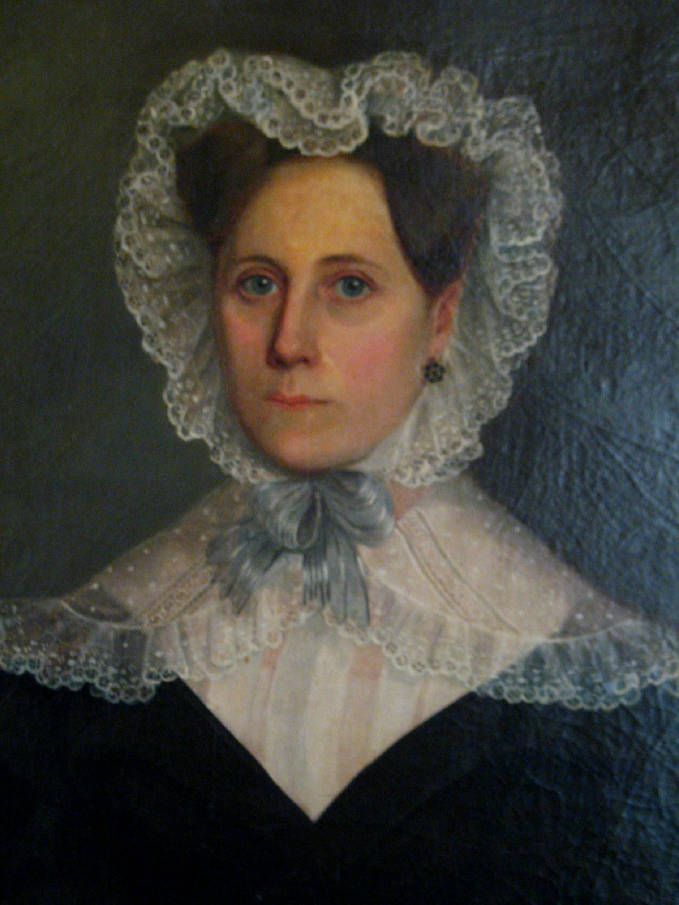
A receipt dated March 25th, 1858, of cutlery purchases made by Mrs. Abraham Deyo in Poughkeepsie, NY, indicates her purchase of a tea set. There is no indication of who made the set, or what it is made of, but it is the most expensive item on the receipt, costing $3.50. Today, that would be $118.06. Mrs. Abraham Deyo’s name was Margaret T. Deyo, she married her her first cousin in 1812, and they had four children. Together, they lived in New Paltz, until Abraham relocated them to Plattekill, NY, where he served as supervisor. He later went on to serve in the Senate, and upon his death, he left their house in New Paltz to his son, Abraham Jr. Compared to the average family at this time, the Deyos were fairly wealthy. This can be inferred from the fact that an oil painting was created of Margaret in 1844, about 15 years before the date on the receipt. In the painting, she is wearing an elegant headpiece and large earrings. It is entirely possible that Margaret had the time and the financial means to entertain guests with tea parties.
Portrait painting of Margaret T. Deyo, Creator unknown
At this time, tea sets expanded beyond teapots, cups and saucers. A typical tea set in the 19th century included other items like spoon holders, cream pitchers, slop bowls, and sugar bowls. Each of these pieces served a distinct purpose and helps to enrich the experience of drinking tea.
Obviously, the central component of a tea set is the teapot. Tea sets were originally made from porcelain, but as time passed, silver teapots became more common. The metal allowed the water inside the teapot to stay hot longer, so they were praised by tea drinkers. They were much easier to manufacture in the United States, as porcelain crafts were most refined in Asia during this time. When they were first used in Europe and the United States, teapots were small, but by the middle of the 18th century, teapots could hold dozens of cups of tea.
Another important part of tea sets is saucers. The idea of saucers originated in China, when the daughter of a military officer found her cups of tea to be too hot to place on a table, so she asked a local potter to create a plate small enough for the cup to sit on. Another part of the tea set that most people do not recognize is the slop bowl. Slop bowls held the water used to brew tea, and for drinkers to pour cold tea in before refilling their cup with fresh, hot tea. They also held the remains at the bottom of the teacup, so they would not affect the next cup.
As an important part of aristocratic life in the 19th century, tea sets included numerous different pieces, each of which provides a simple function. However, without one of these pieces, teatime would not be the same. Women in the 19th century enjoyed using these sets to entertain guests and friends, and without a single one of these pieces, it would be impossible for the set to act as a whole.
Plated hollow ware from A Source Book of Antiques and Jewelry DesignMore silver plated hollow ware from A Source Book of Antiques and Jewelry Design
Hornung, Clarence Pearson. A Source Book of Antiques and Jewelry Designs, Containing over 3800 Engravings of Victorian Americana, Including Jewelry, Silverware, Clocks, Cutlery, Glassware, Musical Instruments, Etc., Etc., Etc., by Clarence P. Hornung. G. Braziller, 1968.
The way medicine has been approached throughout history has changed many times and is still currently changing with new advancements still being made. A ledger of medications from 1825 from of New Paltz provides an inside look at what kind of medications were used to treat illnesses, despite the fact that the ledger only contains prices of the medications prescribed as provided by a man, presumably the physician documenting the medication record, named John Bogardus. The difference between the medicines that can be assumed to be the most common for the time can be seen as being completely different than what is used today, which leads to the question: What was medicine like in the 19th century?
Compared to Europe, medicine in the United States was not nearly as regulated as it is today. During the 1700s, most physicians dispensed their own drugs with the shop to do so attached to their office. Medicines could be bought at stores and from apothecaries, Apothecaries not only served as a place where one could purchase drugs, but they also sold regular goods and provided patient care. Once again apothecaries were not regulated and it was not a requirement for them to be educated and therefore they had the ability to call themselves whatever they want and could pick and choose which parts of the profession they wanted to practice. This lack of regulation on medical practices has been attributed to the fact that at the time the United States was still developing, but also on the prevalence that individualism and the idea of laissez-faire economies had in society at the time which made any idea of regulation be marked as unnecessary.
Prior to the 19th century, the idea of medicine was based on the idea that illness is caused by the imbalance of “humours” within the body thus leading to medicinal treatments to revolve around the idea of restoring balance to the body. However in the 19th century, a more scientific idea of the body and illness was developed; illness/disease was caused by some type of failure of internal body parts. This idea and the development of anatomy led to a person’s symptom being attributed to a change with in the body and also allowed pharmacists and doctors to start to learn how drugs work within the body, which they learned they do so by targeting a specific system within the body rather than the body as a whole. It wasn’t until the late 19th century that actual knowledge on how the process actually occurred was developed, and therefore drugs in the mid-19th century had been classified by the reaction that they had within the body. It is because of this that drugs were given to restore the body to a normal state and didn’t get at the true root cause of whatever was causing the illness.
During the 19th century, interest began to be put towards utilizing native herbs and plants for pharmaceutical reasons after the Revolutionary War. The introduction of herbs and plants as ways to treat illness can be clearly seen in the Ledger of Medications, one of which being Kino which was obtained from tropical trees. A lack of regulation can also be seen during this time period allowing for medical and pharmaceutical practitioners to flourish, including groups known as Thomsonians, eclectics, Reformed Practitioners, and homeopaths. Despite the introduction of these groups, most medicines were still left to be dispensed by apothecaries who still maintained their 18th century status of prescribing and dispensing medicines which created confusion and ultimately led to the of wholesale drug manufacturers. Wholesale drug manufacturers were a commercial enterprise with no medical training and had become responsible for making, mixing, and selling drugs to those who practiced medicine.
As the 19th century progressed, wholesale drugmakers began to sell more of their drugs to the general public from a storefront, a development that led to what we know today as the drugstore which is likely how John Bogardus provided his medicines. It is with the development of the “drug store” that the responsibility to provide consumers with effective medication that actually will provide them care increased and the profit motive that came from this allowed for there to be pharmaceutical expertise shared throughout the trade. While this may seem like professionalism within the pharmaceutical industry was beginning to take place, it was not until the mid-19th century when pharmaceutical societies in schools, states, and nation wide were formed that this professionalism occurred. It is during this time when the idea of regulation became more widely accepted leading to national regulation of the pharmaceutical industry to take place later in the century.
The majority of medicines/drugs used in the 19th century came from herbs and plants native to the area, a use that dates back to the 1500s. In the 1500s, once a medicinal use was found for an herb/plant it was documented in a pharmacopoeia leading to a more scientific approach to medicine. Pharmacists used pharmacopoeias as a reference for many centuries, and it wasn’t until the 19th century when the birth of chemistry and the Enlightenment period when these medicines began to be more understood. Chemistry allowed pharmacists and chemists to isolate and identify the active ingredient in the herbs and plants that acts as a drug which then allowed them to identify how they actually affect the body. As more drugs were discovered throughout the 19th century, the production of medicine moved from small drug stores to industrial facilities allowing for many drugs to be discovered, including strychnine, emetine, morphine, quinine, and caffeine. While the use of quinine was not explicitly stated in the Ledger of Medications, it was repeated multiple times throughout the ledger. Since the use of synthetic chemicals in drug production wasn’t common until the late 19th century, it is likely that the drugs documented on the Ledger of Medications were from herbs and plants. The distribution of drugs throughout the 1800s was in the form of powders, pills, tablets, gelatin capsules, lozenges, tinctures, and mixtures. From this is it likely that whatever drug was provided by John Bogardus held the form of one of these, however the ledger doesn’t state which was used.
 x 1.4 Inches (D) and weighs about .25lbs. The camera brand and make is a Fujifilm Quicksnap, which was Fuji’s first disposable camera that had model features that allowed for usage in the day and night due to the built-in flash. (Wiki, n.d). Fuji was one of the first brands to ever create a disposable camera making its debut in 1986 (Wiki, n.d.). These cameras grew especially popular in the 90s and early 2000s but have since died down as new digital technology has emerged.






 The Materials of History, Thought, and Art