Spinning Wheel of the Dubois Estate

In the “Estate Inventory of Cornelius DuBois Jr.” (1816), among many other items, “2 old spinning wheels old out of repair,” is listed. A spinning wheel is generally known as some sort of old machinery used to create yarn or thread. This type of machinery has grown completely obsolete in the 21st century, which begs the question: despite being useless now, how did this object once play a fundamental role in New Paltz life during the year 1816? How does this object play a role in the specific circumstances of Cornelius Dubois Jr’s life? 

As previously mentioned, a spinning wheel is an early machine used to turn fiber into thread or yarn, which was then woven into cloth on a loom. Typically carved out of hardwood, the structure would support the main fly wheel, the wheel that rotates when treading and causes other parts of the spinning wheel to operate. The band would attach from the fly wheel to the flyer whorl. This apparatus developed from a single spindle, into a wheel structure based on a basic pulley system. The source of energy turning the main fly wheel can come from either the hand or the feet. Typically, the threads or yarn made from the spinning wheel would then be woven into cloth on a loom. The end result could range from clothing fabric to blankets for warmth. The first spinning wheels were likely invented in India or China in between 500 and 1,000 A.D, and later introduced to European countries by the 12th century through the Middle East in the European Middle Ages. As colonizers traveled from Europe to America, European ideas and machinery were brought in. The spinning wheels would be introduced to the New Paltz region at the earliest, during the late 1600s. 

Spinning Wheel
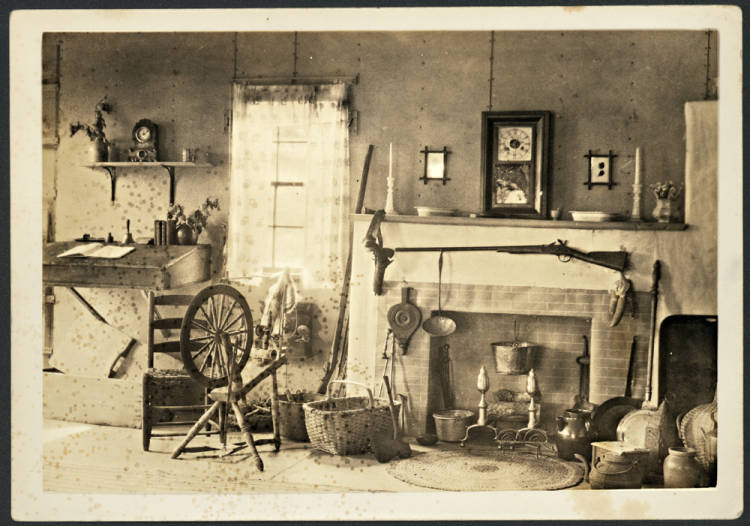
Spinning Wheel seen in unidentified room from Huguenot Historic

The first Huguenots of New Paltz were French, with the goal of finding sanctuary during the religious tirades of Louis XIV during the 1600s. One of the twelve founding families to develop community and settle to the Wallkill River Valley was the Dubois family. Louis Dubois and Abraham Hasbrouck began constructing homes in the year 1678. After several generations, Cornelius Dubois Jr. was born on June 6, 1750 to Cornelius Dubois and Ann Margrietje Hoogteeling. Cornelius Dubois Jr. married a woman named Gertrude Bruyn, and had a total of 11 children. Two old “out of repair spinning wheels” were found in the estate owned by Cornelius Dubois Jr. and his wife Gertrude, considered to belong to the family. The family most likely would have bought spinning wheels from a local craftsperson. 

In addition to the spinning wheels, other supporting materials were listed throughout the pages of the estate inventory. The inventory lists, “½ of 7 U of thread” for what appears to be worth $19.50, as the time. Other mentions of materials include: “1 quill wheel and & 2 swifts,” “19 weavers spools,” “1 pair of weavers brushes,” and “33 seanes of yarn & 52 flax”. Despite all of these items being listed as a belonging of Cornelius Dubois, it is more likely that his wife Gertrude, or another older female figure in the house, put these objects to use.

During the 1700s in America, a spinning wheel was known to be a machine women used, as they contributed to household labor. The women’s jobs and responsibilities were a reflection of cultural attitudes about differing abilities between men and women, and gender roles within a family. In the 1700s, men typically took on roles that required heavy and fast moving machines, such as farming equipment, due to their greater physical strength and physique. In contrast, women were reserved for more delicate and detailed oriented jobs, such as the spinning wheel. In addition to the cultural attitudes of the time, the description of both spinning wheels as broken may insinuate something about the technological advancements at the time. By the late 1700s, most women did not need to spin their own yarn because they could purchase fabric at a local store. Fast-forward, the Industrial Revolution normalized fast-paced large-scale machinery and factories for something that was once known as an individual and tedious task.

This document of Cornelius Dubois Jr’s estate inventory is great primary source to show the relevance of spinning wheels in households of the 1800s. The object of the spinning wheel tells a story of not only its use, but gender roles and cultural attitudes during the time. Due to the extreme shift of the Industrial Revolution, we now expect to see this work occur in factories. As technology progressed, the need for this 19th century spinning wheel vanished, but the lifestyles and stories of the Dubois’ family and other Hugeunots are preserved, through documents such as the Estate Inventory.

“About Spinning Wheels.” The Spinning Wheel Sleuth, https://www.spwhsl.com/about-spinning-wheels/. 

African American Presence in the Hudson Valley, Historic Huguenot Street. “Cornelius Dubois Jr. Inventory, April 1816.” New York Heritage Digital Collections. 1816-04. https://nyheritage.contentdm.oclc.org/digital/collection/hhs/id/1921/rec/3

Mary Anne Thorne Chadeayne Collection, Historic Huguenot Street. “Interior view, unknown house, ca. 1900.” New York Heritage Digital Collections. 1900. https://cdm16694.contentdm.oclc.org/digital/collection/hhs/id/1113/rec/3

Metmuseum.org, https://www.metmuseum.org/art/collection/search/7748. 

“Spinning Wheel.” Encyclopædia Britannica, Encyclopædia Britannica, Inc., https://www.britannica.com/technology/spinning-wheel. Wosk, Julie. “Women and the Machine: Representations from the Spinning Wheel to the Electronic Age.” Woman’s Art Journal, vol. 24, no. 1, 2003, p. 56., https://doi.org/10.2307/1358833.
Wosk, Julie. “Women and the Machine: Representations from the Spinning Wheel to the Electronic Age.” Woman’s Art Journal, vol. 24, no. 1, 2003, p. 56., https://doi.org/10.2307/1358833. 
Horses in New Paltz

The Estate of Cornelius DuBois from 1816 details the belongings from his farm and farmhouse in New Paltz New York. A descendent of Cornelius DuBois, Jennetje, a granddaughter of Cornelius married Jacob Hasbrouck. The Hasbrouck family has ties to the original Huguenot settlers in New Paltz. Cornelius DuBois helped build the DuBois Stone House on 347 Main Street in Catskill New York which is now a historic house in the area. The DuBois family was also part of the early settlers in the area. During this time it was very common for farms to have slaves and the DuBois family was no exception. Part of the Estate details specific slaves that were considered property of Cornelius DuBois.

The itinerary of the estate includes a vast number of belongings from horses to broken tea kettles. The objects included in the estate give insight into the ins and outs of farm life in New Paltz during the 1800s. Agriculture has long been a prominent system in New Paltz and continues to provide many inhabitants with economic stability. Farms in the area were established early on which meant the designs were outdated in comparison to areas that were settled later. The structures on farms were geared toward drying wheat and then started to be remodeled in the mid-1800s to accommodate more hay that was demanded with the growth of many farms. The DuBois estate had some cattle but more horses at the time of Cornelius’ death. This fit into the period of New Paltz history when horses were needed for almost all day-to-day tasks that humans could not complete. With the invention of tractors and other machine-powered equipment horses became less prominent. 

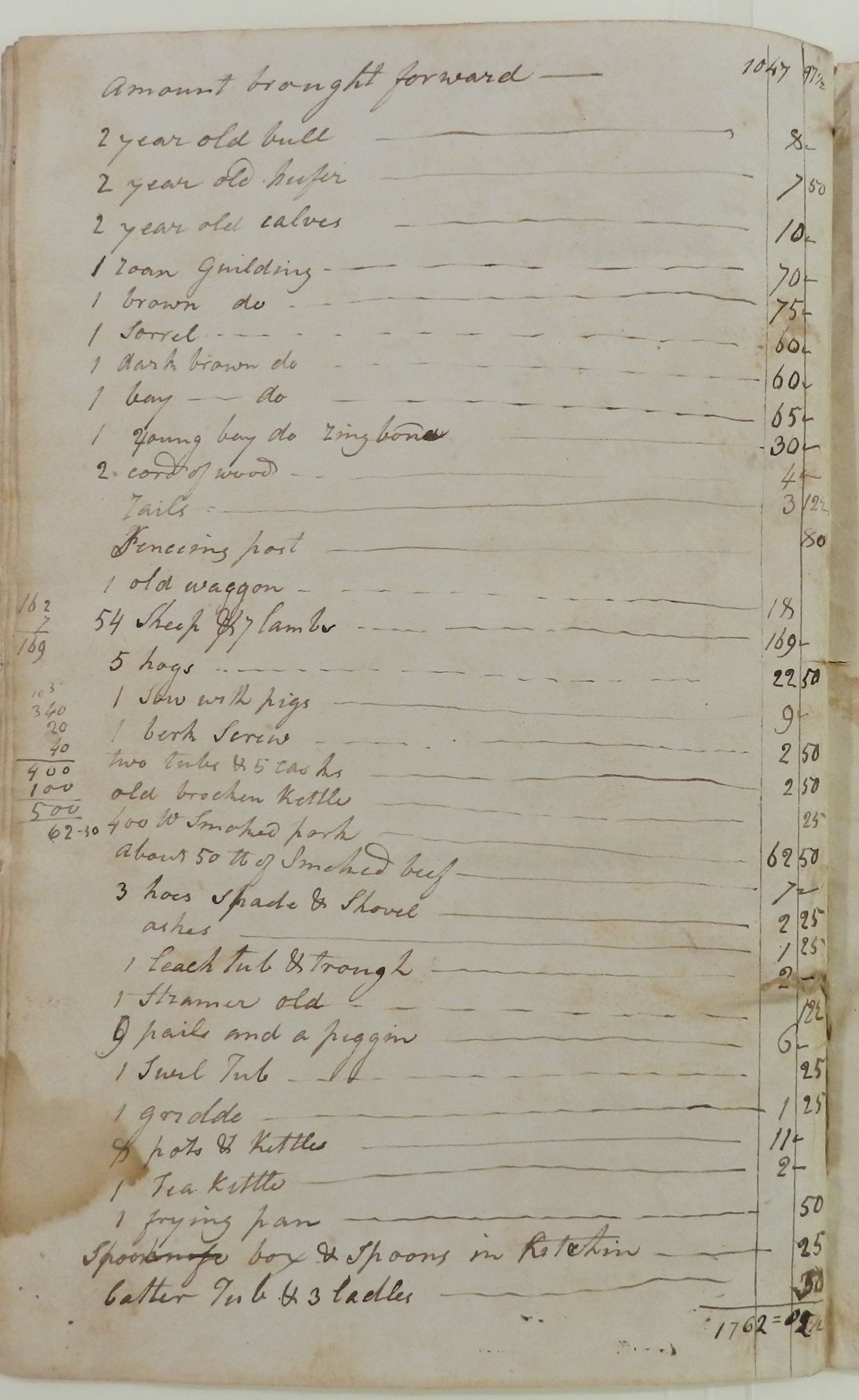
In the document, horses are listed as a “do” which means horse. Several dos are seen throughout the estate with varying price tags. A “dark brown do” was priced at 60 dollars while a “brown do” was priced at 75 dollars. The health of the two animals likely played a role in their pricing. A sorrel is also listed which describes the coloring of the horse’s coat. These horses usually have a reddish color with little to no black coloring. The document provides no insight into what each horse was used for, but their prices are good indications of their age and health.

The structures on farms are dictated by the animals and crops being utilized on the property. Larger farms often included structures used for appliance maintenance and machinery storage. In the document, many of the items probably resided in the barns like the harnesses for horses that are listed. They are a pivotal part of making use of the animals in that they attach to plows and wagons used on the farm. The harnesses were priced at 6 dollars which shows the high quality of the equipment. These farms had shops and garages that required the construction of new structures. Stables continued to be needed in that horse-drawn carriages were still utilized by many families in their endeavors. The remodeling came a bit after the death of Cornelius DuBois, so they were not found on the particular estate.

Hay production on farms in New Paltz was a major source of income for many farms. In the estate, hay barns make up a fair sum of money. The “hay in the barracks” was listed for 27 dollars which probably accounted for a large amount of hay. While the “hay in small hay house” was listed at 3.50 dollars which likely is a small amount but it held some value so it was put in the estate. Structures on the property were also geared toward the storage of hay. As mentioned, there was a small hay house and a large hay house both of which contained the valuable commodity. The demand for hay in New York City grew as the city developed. Hay was used to feed horses and when railroads were getting laid in the area the demand for hay grew. Horses were a massive part of the community in that they dictated the crops grown and allowed daily operations to be run smoothly.

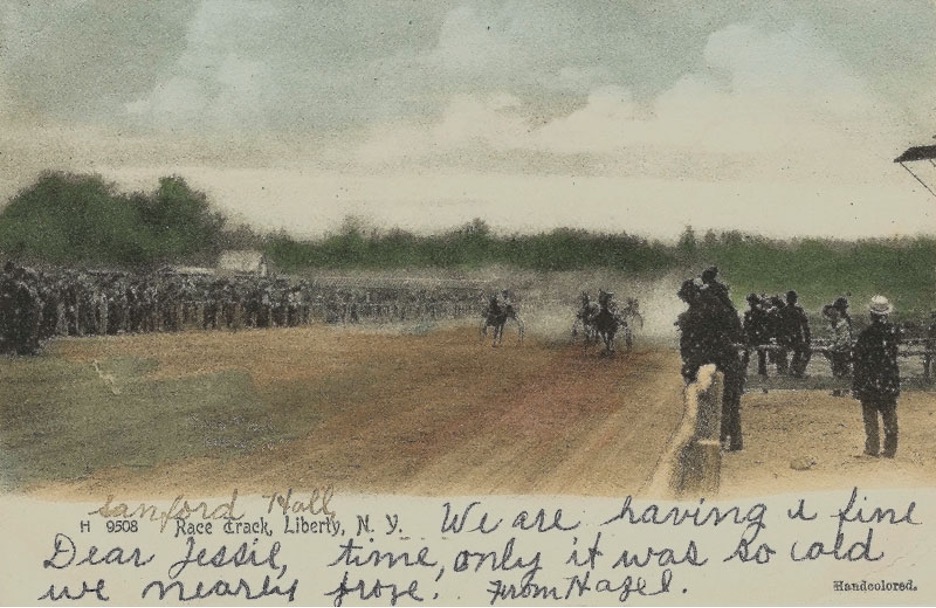
Horses were also involved in entertainment during this time in the form of a racetrack. The racetrack in Wallkill is thought to have begun on July 5, 1897, according to Historian Klinkenberg. It was a half-mile track that ran during the summer where thousands of people often congregated. The horses listed in the estate most likely did not race at the racetrack but instead were used on the farm.

Sources

“Dubois Family Association.” DuBois Family Association, Historic Huguenot Street, https://www.huguenotstreet.org/dubois.

Larson, Neil. “Village of New Paltz Reconnaissance-Level Historic …” Reconnaissance-Level Historic Resource Survey, Village Historic Preservation Commission New Paltz, New York, https://www.villageofnewpaltz.org/download/historic_preservation_commission/Historic_Preservation_Documents/I-Overview.pdf.

Wadlin, Vivian Yess. “Racing Hearts.” Abouttown, Abouttown Ulster, http://abouttown.us/articles/racing-hearts/.

Community Research Project: J. Dewitt Physician Record

At sunrise on September of 1803, J. Dewitt was accidentally shot in the arm and had his forearm shattered. The bullet seemingly entered his arm at the wrist, travelled vertically up his forearm and then lodged at his elbow. The primary physician, Dr. Bogardus, with the assistance of Doctors Brodhead and Wheeler, decided that the arm was to be amputated.

This document presents a record of the process of local physicians performing a difficult procedure. Written by Dr. John Bogardus, the first page describes the techniques and tools used for the amputation procedure.

Dr. John Evertse Bogardus was an influential and prominent physician in the New Paltz community in the late 18th and early 19th centuries. He held various positions in the Ulster County Medical Society, including secretary, vice president, and president in 1823. This society seemed to be a big marker of prominence as a physician. An external document on behalf of the society explained that “It appears that the society determined to establish at once a standard of professional regularity, and desired to bring into connection with themselves all licensed, reputable physicians.” Dr. Bogardus had a big role in the New Paltz community overall, as he was one of the first teachers at the first public school, one of the original trustees of the New Paltz Academy, and served as the Town of New Paltz Supervisor.

The document, while appearing to be quickly written, indicates an accurate understanding of human anatomy, as Dr. Bogardus properly referenced the anatomical nuances of the procedure. The document also indicates the doctors’ surgical confidence and their ability to adequately perform the surgery.

Something that the document fails to mention, is the practice of sanitary measures throughout the procedure. There is no mention of handwashing by the doctors, sterilization of surgical tools and dressing equipment, or antiseptic practices with the patient’s arm. It is hard to ascertain whether Dr. Bogardus failed to mention this in his record for the sake of time, if this wasn’t something considered significant enough to record, or if he simply didn’t take any of the measures at all. However, it may be safe to say that because of the date of the procedure, the physicians likely took little to no sanitary measures.

In 19th century England, something known as “the great sanitary awakening” occurred, which was the public acknowledgement of filth as a cause of disease as well as a vehicle for transmission. This led to an awareness of the significance of cleanliness and the role of sanitation in ensuring public health. Drawing inspiration from Britain, small reforms began in the U.S. In New York in 1848, John Griscom, a science educator and scholar, published The Sanitary Condition of the Labouring Population in New York. This led to the establishment of the first public health agency, the New York City Health Department, in 1866.

Until this period of medical advancement, there was an utter lack of understanding of aspects of medicine that today are essential. There was no concept of pathogenic microorganisms, and most illnesses were diagnosed using the same few principles which were backed up by outlandish theories.

In addition to the lack of sanitary measures, Dr. Bogardus makes no mention of the use of oxygen therapy, or consistent checking of vitals. As anesthesia hadn’t been invented yet, the second page of the document reveals that J. Dewitt was only given wine before the procedure- it is most likely he was in severe pain throughout, if he was conscious.

What is incredible about the lack of cleanliness in daily life and especially in medical practices during the early 19th-century is that it was coupled with a vast understanding of the complexity of the human body, how it heals, how wounds and other ailments were to be treated, and the necessary medications and post-operative measures that were to be taken. It illustrates the paradoxical nature of society during post-colonial America. Not only does it apply to medicine and science, but it is reflective of the social normalcies and practices of this time as a whole.

Another interesting component from the document is one of the tools that was used for the surgery. Specifically, the tenaculum, which Dr. Bogardus used to pull the ends of the arteries together so he could tie and close them off, is a tool that is still used today but usually with a different purpose. It’s still used in surgical operations to hold parts such as arteries, but it’s mostly used in gynecological procedures. It’s used for procedures that require dilation of the cervix to access the uterus, such as the insertion of the contraceptive IUD (intrauterine device) into the uterus.

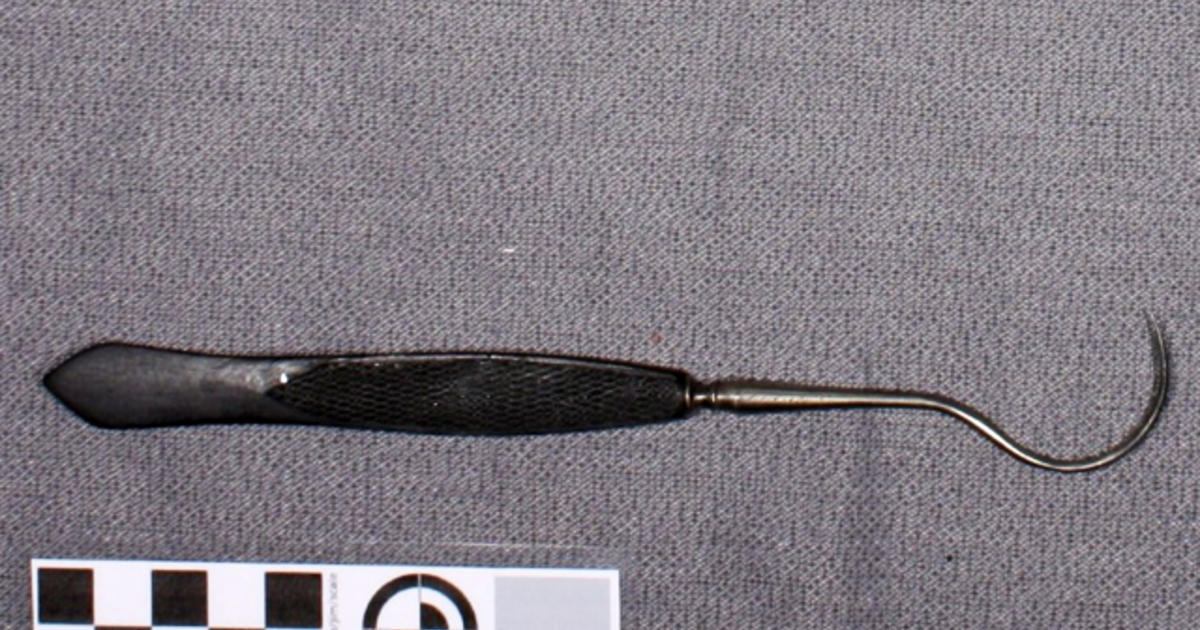
The kind of tenaculum used by Dr. Bogardus to pull the arteries together

The kind that is used in gynecological procedures is very different from the type that Dr. Bogardus details using in his surgery. The tool that is used by gynecologists, formally known as the “cervical tenaculum forceps,” was first invented in 1899 by a gynecologist, and the ones today are eerily similar to the first models. This has been a point of anguish for patients because the tenaculum is an extremely sharp tool that often causes bleeding and intense pain. The tenaculum is used to hold open the cervix as it provides a firm hold, but doing so involves piercing the cervical tissue and pulling it to hold it steady. Additionally, this procedure is often done without anesthesia.

Uterine tenaculum from c. 1910-1920

Miltex MeisterHand Schroeder Uterine Tenaculum Forceps with Round Jaw -  25.4cm - Cardinal Medical Supply
Modern-day uterine tenaculum

As the document has informed us of the lack of anesthetics during the amputation over 200 years ago, it is quite shocking that in the 21st century, women are still subjected to painful and outdated medical procedures without the use of anesthetics. The modern usage of the tenaculum has called for a demand of equal investment in women’s healthcare as in other areas of healthcare. Despite the incredible advancements in medicine and science since Bogardus’ time, women still cannot undergo a trivial, 5-minute procedure without experiencing intense pain and trauma.

This document illuminates the vast differences between pre-Civil war and modern-day medicine. It also provides insight into the archaic medical practices of modern America, and the advancements yet to be made.

Reilly, Robert F. “Medical and surgical care during the American Civil War, 1861-1865.” Proceedings (Baylor University. Medical Center) vol. 29,2 (2016): 138-42. doi:10.1080/08998280.2016.11929390

Institute of Medicine (US) Committee for the Study of the Future of Public Health. “A History of the Public Health System.” The Future of Public Health., U.S. National Library of Medicine, 1 Jan. 1988, https://www.ncbi.nlm.nih.gov/books/NBK218224/.

“Amputation.” Amputation – Health Encyclopedia – University of Rochester Medical Center, https://www.urmc.rochester.edu/encyclopedia/content.aspx?contenttypeid=92&contentid=p08292.

Marylea. “Firing the Canon: Fort Mackinac.” Flickr, Yahoo!, 3 Mar. 2012, https://www.flickr.com/photos/marylea/6950272395/in/photostream/.

Albornoz, Andrea. “Tenaculum: 100 Years Women Have Endured Pain in Gynecology.” Aspivix, Aspivix | Reshaping Gynecology & Women’s Healthcare, 1 July 2021, https://www.aspivix.com/tenaculum-for-over-100-years-women-have-endured-pain-in-gynecology/.

Putt Corners, http://hpc.townofnewpaltz.org/index.php?option=com_content&view=article&id=1852&Itemid=78.

Sylvester, Nathaniel Bartlett. History of Ulster County, New York: With Illustrations and Biographical Sketches of Its Prominent Men and Pioneers. United States, Everts & Peck, 1880.

Mont Blanc in Frankenstein

An aerial photograph of Mont Blanc in the Alps.

Mont Blanc is an important location within Mary Shelley’s Frankenstein. Mont Blanc is the tallest peak in Western Europe, reaching 15,771 feet (or 4,807 meters) in height (Britannica). This peak is within the Alps Mountain range, with Mont Blanc located directly on the border of Italy and France. Shelley uses this peak to display the Romantic ideal of the sublime. When something is described as sublime, it is in reference to a natural scene being awe inspiring, but also intimidating or inducing fear. Mont Blanc surely should instill a sense of fear, as it is one of the most fatal mountains in the world, with an average of 100 climbers dying on the mountain per year (Wallace). The way Victor speaks of the Alps is akin to the way a Romantic poet would write about them. In expressing his initial feeling of viewing the mountains Victor says, “It had then filled me with a sublime ecstasy that gave wings to the soul… The sight of the awful and majestic in nature had indeed always the effect of solemnizing my mind,” (Mary Shelley 75). Victor would go on to describe Mont Blanc in specific as having an “awful majesty” (Mary Shelley 76). The language that Victor uses in discussing Mont Blanc, specifically in the reference to the sublime, can be seen as a reference to Percy Bysshe Shelley’s poem “Mont Blanc: Lines Written in the Vale of Chamouni,” written in 1816 (Percy Shelley). Both Frankenstein and Shelley express similar thoughts when confronted with the sight of Mont Blanc, stating that its imposing grandeur instills a feeling of solitude and self reflection on the viewer. This poem’s focus on the solitude of the human within this natural scene creates a greater tie between the necessity of solitude and the sublime. Thus, Mary Shelley creates this same tie by using Mont Blanc to be a representative of the concept of the sublime and a place of solitude for both Victor and the Creature.

Mont Blanc is also the setting where Victor and the Creature cross paths throughout the novel. In making Mont Blanc the place where the creator and his creation meet, Shelley only highlights the similarities between the two characters and their inescapable connection. Both Victor and the Creature often seek spaces of solitude and hold a deep reverence for sublime nature. The fact that Mont Blanc is a dangerous, glacial mountain calls on the sublime fear induced by nature, as well as the danger these two characters pose to each other. There is also something to say in that Victor is meeting his creation at the highest peak in Western Europe. Not only was the creature meant to be Victor’s highest achievement in his scientific practice, but it also seems to reference Frankenstein’s stance as a modern Prometheus. Prometheus’s hubris caused him to fly too close to the sun, as Victor’s caused him to attempt to reach the level of a god and create life. Thus, the place where he must be confronted by his hubris is the tallest peak in Western Europe.

Britannica, The Editors of Encyclopedia. “Mont Blanc”. Encyclopedia Britannica, 5

Dec. 2018, https://www.britannica.com/place/Mont-Blanc-mountain-Europe.

Accessed 19 November 2021. 

Shelley, Mary Wollstonecraft. Frankenstein. Edited by Marilyn Butler, Oxford University

Press, 2008. 

Shelley, Percy Bysshe. “Mont Blanc: Lines Written in the Vale of Chamouni.” Poetry

Foundation, Poetry Foundation,

https://www.poetryfoundation.org/poems/45130/mont-blanc-lines-written-in-the-

ale-of-chamouni.

Wallace, Lane. “Why Is Mont Blanc One of the World’s Deadliest Mountains?” The

Atlantic, Atlantic Media Company, 25 July 2012,

https://www.theatlantic.com/international/archive/2012/07/why-is-mont-blanc-on

-of-the-worlds-deadliest-mountains/260143/. 

Within Catholicism and Reason: Mary Shelley’s Choice Location of Ingolstadt in Frankenstein

The birthplace of Victor Frankenstein’s ‘daemon’, the small city of Ingolstadt in southeastern Germany was deliberately chosen as the starting point to the end of Victor’s life. The small Bavarian city had a strong identity as a Catholic stronghold against Protestantism, as well as the secret society known as the “Illuminees” or Illuminati. As a critic of Enlightenment thought as well as an individual who “openly scorned…Catholicism”, Ingolstadt and its university were a perfect combination for Mary Shelley to portray as the birthplace of the man-made daemon.[1]

While Shelley never explicitly declares her belief in a titular religion, the author is described as having “stubbornly clung to a belief in God”.[2] A witness to religious instability as well as a passive participant in British abuse of Catholicism, Shelley’s demonization of Ingolstadt’s reputation as a Catholic stronghold and eventual bulwark of intellectual reasoning comes as no surprise in context of the author’s life.[3] While the story of Frankenstein is set outside of the United Kingdom, the novel’s context within the Shelley’s homeland is also significant: the writing and first publication of Frankenstein comes eighteen years before the Roman Catholic Relief Act 1829 which removed legal barriers facing Catholics within the British Isles. A member of a majority Anglican and Protestant country, Shelley’s contempt for Catholicism is discernable in the deliberate choice of Ingolstadt for the birth of a “monster to haunt mankind”.[4]

Located in the central part of the Bavarian state of Germany, Ingolstadt was known “a bastion against Protestantism” for the centuries following the Protestant Reformation.[5] The area, known contemporarily and historically for its counter-reformation orthodoxy, quite noticeably attracted the disdain of Mary Shelley. During Shelley’s time, however, the city was inhabited by Napoleon Bonaparte for much of her early life and until shortly after the publication of Frankenstein. While Ingolstadt’s contemporary existence is important, Shelley is heavily influenced in her novel by the city university’s ties to Catholicism. The university, which eventually moved to Landshut in 1800 and later Munich, was an amplifier for Catholic power as well as an intellectual powerhouse during its peak. 

The Bavarian university that Victor attends in Frankenstein is the same that exists within the city of Ingolstadt. Much like in Shelley’s novel, the University of Ingolstadt “possessed a medical school of stature”.[6] It is in the medical field of anatomy that Shelley once again utilizes religious differences: there were deviations between how Protestant universities and Catholic universities engaged in scientific endeavors concerning anatomy.[7] This is best conveyed by Shelley utilizing Gothic literature’s canon of Catholicism and “its links to the bleeding [and/] or mutilated body…”[8]As Victor mutilates dead bodies in order to create his creature, Shelley is providing an allusion to earlier depictions of Catholicism and the inherent evilness she sees in it. For Shelley, “Catholicism was the very source of subjugation…” that Victor tries to build upon in her novel by creating a new life in the creature.[9]

Those at the University of Ingolstadt such as Adam Landau describe medicine as “been given by God to our just parents,”.[10] The Catholic belief in miracles is also prevalent in both contemporary Catholic medicine as well as Frankenstein. Shelley’s act of integrating a miracle between the creator and the created ‘daemon’ in her novel can be seen as a mocking parallel. The creature’s body becomes a site of rebuff of religion. When Victor creates a the ‘daemon’ through the mutilated body, the Geneva native acts as God.[11]

While Shelley utilized Ingolstadt’s reputation as Catholic stronghold to critique the religion she felt distaste for, the English woman also utilized the city’s more contemporary reputation as the home of the reason-based society known as the “Illuminees” or the Illuminati. As Professor Stephen Kern from Northern Illinois University states, “The novel dramatizes the clash between eighteenth-century enlightenment [reasoning] and nineteenth-century romanticism”.[12]The clash described by Kern is best depicted by the formation of the secret society created by University of Ingolstadt professor Johann Adam Weishaupt in 1796.[13] While Ingolstadt’s secret society did little other than attract dissenters and future conspiracy theorists, the very existence of the Illuminees was to create a reason-based society.[14]  The secret society that developed in the university was aligned to the French Jacobins.[15]

Although the daughter of radical English thinker who depended heavily upon Enlightenment thinkers and human reason, Shelley targets “the enlightenment idolatry of reason…by attacking the idea that man was a predictable and rationally controllable machine”.[16] Between the pure reason utilized by her father, William Godwin, as well as the contemporary political happenings early in Shelley’s life, the author utilized the German city’s connection to pure reason and uncontrollable revolution to echo (French) Conservative critiques.[17]

It is due to pure human reasoning and free will that allows for Victor’s creature to be unleashed on humanity. While also a critique of Catholicism in the depiction of the creation and the creator, the journey to the monster’s creation owes itself to pure reason and will. As Yale’s Jeremy Kessler writes, “The more powerful applied reason became, the more creative…Dr. Frankenstein marks the moment when the work of reason threatened itself with success”.[18] While Frankenstein was debating on how he should create the creature, the Genevan’s pure absolutist pursuit of reason destroyed him and nearly society. 


[1] Schiefelbein ,Michael. “”The Lessons of True Religion”: Mary Shelley’s Tribute to Catholicism in “Valperga”.” Religion & Literature, vol 30, no. 2 (1998): 59.

[2] Schiefelbein, Michael  “The Lure of Babylon: Seven Protestant Novelists and Britain’s Roman Catholic Revival”. (Macon, GA: Mercer University Pres): 2001, 74.

[3] “Roman Catholic.” Romantic Circles. Romantic Circles. Accessed November 22, 2021. https://romantic-circles.org/editions/frankenstein/V1notes/catholic.html?width=400&height=300. 

[4] Shelley, Mary Wollstonecraft. Frankenstein, or, the Modern Prometheus: The Original 1818 Text. Edited by Kathleen Dorothy Scherf and David Lorne Macdonald. 3rd ed. Broadview Press, 2012. 

[5] Helm, Jürgen. “Protestant and Catholic Medicine in the Sixteenth Century? The Case of Ingolstadt Anatomy.” Medical History 45, no. 1 (2001): 83-96. doi:10.1017/S0025727300067405.

[6]  Curran, Stuart, ed. “‘Societies – Illuminati’ .” Frankenstein; or, the Modern Prometheus. UPenn. Accessed November 22, 2021. http://knarf.english.upenn.edu/Contexts/illumin.html. 

[7] Helm, Jürgen. “Protestant and Catholic Medicine in the Sixteenth Century? The Case of Ingolstadt Anatomy.” Medical History 45, no. 1 (2001): 83-96. doi:10.1017/S0025727300067405.

[8] Greenway “Dangerous Bodies: Historicising the Gothic Corporeal. By Marie Mulvey-Roberts”

[9] The Lessons of True Religion: Mary Shelley’s tribute to Catholicism in Valperga Schiefelbein

[10] Helm, Jürgen. “Protestant and Catholic Medicine in the Sixteenth Century? The Case of Ingolstadt Anatomy.” Medical History 45, no. 1 (2001): 83-96. doi:10.1017/S0025727300067405.

[11] Peters, Ted. “Playing God with Frankenstein, Theology and Science”. Vol 16, no. 2, 2018, 145-150, 

[12] Kern, Stephen. “Mary Shelley’s ‘Frankenstein.’” Origins. Ohio State University , March 2018. https://origins.osu.edu/milestones/march-2018-mary-shelleys-frankenstein. 

[13] Hernandez, Isabel. “Meet the Man Who Started the Illuminati.” History. National Geographic, May 3, 2021. https://www.nationalgeographic.com/history/history-magazine/article/profile-adam-weishaupt-illuminati-secret-society. 

[14] Vickory, Matthew. “The Birthplace of the Illuminati.” BBC Travel. BBC, November 28, 2017. https://www.bbc.com/travel/article/20171127-the-birthplace-of-the-illuminati. 

[15] Michael Taylor. “British Conservatism, the Illuminati, and the Conspiracy Theory of the French Revolution, 1797–1802.” Eighteenth-Century Studies 47, no. 3 (2014): 293–312. http://www.jstor.org/stable/24690289.

[16] Kern, Stephen. “Mary Shelley’s ‘Frankenstein.’” Origins. Ohio State University , March 2018. https://origins.osu.edu/milestones/march-2018-mary-shelleys-frankenstein. 

[17] Sterrenburg, Lee.”Mary Shelley’s Monster: Politics and Psyche in Frankenstein”. In The Endurance of “Frankenstein”: Essays on Mary Shelley’s Novel, ed. George Levine and U.C. Knoepflmacher (Berkley, Los Angeles:University of California Press, 1979), 143-171.

[18] Kessler, Jeremy. “Creating Frankenstein.” The New Atlantis, September 26, 2020. https://www.thenewatlantis.com/publications/creating-frankenstein. 

Cornelius Agrippa’s Role in Frankenstein

In Victor Frankenstein’s youth at the age of thirteen, he came across the works of Cornelius Agrippa, a 16th century natural philosopher. Frankenstein recalls this book as that which catapulted him into his obsession with mastering the mystical, alchemical sciences; he says, “My dreams were therefore undisturbed by reality; and I entered with the greatest diligence into the search of the philosopher’s stone and the elixir of life.” It was discovering this field of study and the non-accepting way his father had received his interest in the field that he claims ultimately led him to take on a quest for curing human malady and “rendering man invulnerable to any but a violent death.”

“If, instead of this remark, my father had taken the pains to explain to me, that the principles of Agrippa had been entirely exploded, and that a modern system of science had been introduced, which possessed much greater powers than the ancient…., I should certainly have thrown Agrippa aside… It is even possible, that the train of my ideas would never have received the fatal impulse that led to my ruin.” (Shelley, 68)

Agrippa considered himself a “magus,” someone who practices what was called natural or white magic, one who could perceive the connections of everything in the universe and manipulate them for the greater good. It was the idea of being able to create life out of dead matter by manipulating what was already in existence, that Frankenstein had which was a direct application of Agrippa’s described “natural magic.”

Agrippa’s most famous work, “Three Books of Occult Philosophy,” is one of the most well-known books on the subject to date and led to his repudiation by religious leaders and theologists. However, in Agrippa’s later years he published a book titled, “De Vanitate,” (short for “De Incertitudine Et Vanitate Scientiarum Liber,”) which surprisingly refuted everything he had written in his earlier years in his previous books on the occult. “De Vanitate” was even more widely printed and published in more languages. In it, Agrippa proposes the uncertainty and uselessness of every known field of study, including the occult, which was the heart of his work not too long before. He challenges the disconnect between different schools of thought and seeks cultural, religious, and scientific reform.

There is a lot of speculation as to why Agrippa wrote two books with such contradictory messages. Some scholars, such as Henry Morley in 1856 have posited that “De Vanitate” is a denunciation of the heedless quest for knowledge; a revelation of the dangers of knowledge when met with hubris. As to Victor Frankenstein’s reception of Agrippa’s writings, only the occult writings made an impression on Victor. It’s unusual that Victor didn’t acknowledge such an important aspect of a scholar whose work he admired so much.

It seems fitting that through disregarding an entire element of Agrippa’s works, one which should have made him rethink “his creation,” he did exactly what Agrippa was possibly warning us about. He allowed the innocent pursuit of knowledge to be corrupted with ego and selfish motivation.

I believe the tunnel vision he developed for one aspect of Agrippa’s works while disregarding the other, was Shelley’s intention. Her incorporation of someone with such powerful yet conflicting ideas into Frankenstein’s young impressionable self, was meant to reflect humanity and the motivations that drive our quest for knowledge, the obsession that takes over, and the insatiability that is inherent to it. It was also a perfect foreshadowing of Victor’s fate.

Bowen, Barbara C. “CORNELIUS AGRIPPA’S DE VANITATE: POLEMIC OR PARADOX?” Bibliothèque d’Humanisme et Renaissance 34, no. 2 (1972) http://www.jstor.org/stable/41430209.

https://www.jstor.org/stable/41430209

Nauert, Charles, “Heinrich Cornelius Agrippa von Nettesheim,” Stanford Encyclopedia of Philosophy, first published March 30, 2007

https://stanford.library.sydney.edu.au/archives/sum2010/entries/agrippa-nettesheim/

The Humanities within Frankenstein

How much of a human is Frankenstein’s monster? Is he a pseudo-human? Does Frankenstein’s monster contribute to our understanding of what it means to be a human? These questions floated around my mind as I read Frankenstein. Immediately, I was fascinated by the Monster’s interest in books, specifically when he reads Paradise Lost, Plutarch’s Lives, and Sorrows of Werter. The Creature’s reaction to the books, however, I think is similar to my own reaction to novels in general, which somehow both complicated and reassured my understanding of humanity throughout Frankenstein. The humanity the readers perceive within the Creature raises an epistemic question: What constitutes a human? In Chapter 7 of Volume II, The Creature laments,

I can hardly describe to you the effect of these books [. . .] as I read, however, I applied much personally to my own feelings and condition. I found myself similar, yet at the same time strangely unlike the beings concerning whom I read, and to whose conversation I was a listener. I sympathized with, and partly understood them, but I was unformed in mind [. . .] what did this mean? Who was I? What was I? Whence did I come? What was my destination? These questions continually recurred, but I was unable to solve them.”

(Shelley 142-143).

To react with honesty, I frequently ask myself these questions. I don’t think people can deny their own feelings of alienation, isolation, and difference; at least I certainly can’t. These books and their relation to the reader, in any case, highlight the conflicting feelings the creature feels about his own humanity– and has the readers question how they belong in a world that frequently rejects them based on differences. In relation, an essential feature of Romanticism, as I’ve learned in Professor George’s “The Romantics,” is its reaction to the Enlightenment period. The Enlightenment Period is characterized by its limitations of freedom, industrialization, and organized authoritative attitudes; examples include Rousseau’s The Social Contract and Hume’s “Of the Origin of Government.” Much of the Enlightenment Period attempts to create an organized society with societal roles and stricter ways of thinking, while the Romantic Period reacts with rebellion, rejection, individualism, and the freedom of each person

Moreover, the characteristics of each novel that the Creature listed reflect the historical impact on Romantic ideals. According to Romantic-Circles, Plutarch’s Lives was praised by Rousseau in his book Confessions. Additionally, the footnotes in Romantic-Circles note that “the accounts draw [the Creature] forth from his own isolation to imagine a larger cultural sphere of action in which he might participate.” Just as with the Enlightenment period, Plutarch’s Lives draws the Creature to think about the societal significance of individuals at a large scale since the book tries to compare Roman and Grecian leaders in order to bring the two empires together (Briticanna, “Parallel Lives”). Ultimately giving the Creature an understanding of humanity at a societal level, and as Frankenstein later reveals, begins to resent for rejecting him.

Sorrows of Werter, on the other hand, brought new ideas to the Creature. According to Briticanna, Sorrows of Werter is about “a sensitive, artistic young man who demonstrates the fatal effects of a predilection for absolutes,” showing the philosophical endeavors of Geothe. The Creature claims that he was moved by the philosophical endeavors of Geothe, but in the end, the Creature says “I did not pretend to enter into the merits of the case, yet I inclined towards the opinions of the hero, whose extinction I wept, without precisely understanding it.” (Shelley 142). Here the readers are introduced to the Creature’s understanding of sympathy, where he does not understand the hardships of Werter, but feels bad for him for suffering and eventually committing suicide. 

The most profound book that the Creature read, however, would have to be Paradise Lost. Not only was the book well-known and well-read at the time of Shelley’s Frankenstein, but Paradise Lost captures the Romantic period ideals because of its heavy religious and individualistic characteristics. Percy Shelley, for example, wrote The Necessity of Atheism, which highlights how humans unwillingly, subconsciously follow organized religion, and he himself cannot help but be an Atheist and resist religion. In a similar manner, the cover of Frankenstein quotes Paradise Lost: “Did I request thee, Maker from my clay / To mould me man? Did I solicit thee / From darkness to promote me?” (qtd. in Shelley 47). The imposed existence of man in Paradise Lost reflects the rebellious nature of the Romantic Era, hence why Mary Shelley quoted John Milton in her story. Paradise Lost captures the uncertainty of existence, how it is sprung upon each individual and how conformity attempts to shape our understanding of the world. In a similar manner to Percy Shelley, the Creature feels as if his own existence was forced, and that he did not choose to be the being that he is. As it seems, there are references to books within a book in comparison to another form of literature written in the Romantic Era. In the end, Paradise Lost, The Necessity of Atheism, and Frankenstein share a similar characteristic: rebellion against conformity. 

Because the Creature feels so isolated, it is obvious why he might feel comforted by Paradise Lost. As stated before, reading Paradise Lost lead the Creature to ask many questions about his own existence, why he was there and what his purpose was. The Creature also states, “Like Adam, I was created apparently united by no link to any other being in existence,” followed by “Many times I considered Satan as the fitter emblem of my condition” (Shelley 143). Here, the Creature relates to the characters, such as the isolation Adam feels and the outsider, outcasted feelings that Satan expresses as he watched Adam and Eve. Additionally, the Creature states, “Satan had his companions, fellow-devils, to admire and encourage him; but I am solitary and detested’” (Shelley 144). In contrast to Satan, Frankenstein is reminded of his isolation. Naturally, the readers have empathy for his unfortunate, forced creation, followed by his isolated state and undesired intellectual abilities.

All of these books are much more complex than the understanding Briticanna, Romantic-Circles and Sparknotes provided. However, with a simple understanding of each novel, the Romantic period, and its influencers, it is clear how the Creature gains a sense of humanity through books. In its own way, the novels reflect the way that humanities can intensify our own understanding of humanity: there is a reason why English is a Humanities rather than a science. Just as Frankenstein grapples with the question of ‘What does it mean to be a human?’ it’s important to remember that we, as readers, do as well. 

Works Cited:

Britannica, The Editors of Encyclopaedia. “Parallel Lives”. Encyclopedia Britannica, 4 Feb. 2018, https://www.britannica.com/topic/Parallel-Lives.

Britannica, The Editors of Encyclopaedia. “The Sorrows of Young Werther”. Encyclopedia Britannica, 22 Oct. 2013, https://www.britannica.com/topic/The-Sorrows-of-Young-Werther.

“Paradise Lost.” SparkNotes.com, SparkNotes LLC, 2005, https://www.sparknotes.com/poetry/paradiselost/summary/.
Shelley, Mary. Frankenstein. Edited by D.L. Macdonald and Kathleen Scherf, 3rd ed, broadview editions, 1818.

Wollstonecraft Shelley, Mary. Frankenstein. Romantic-Circle, Edited by Stuart Curran, Published by Romantic-Circle 2009, https://romantic-circles.org/editions/frankenstein.

Research Project: Laudanum

In 1803, J. DeWitt was brought into Dr. John Bogardus’s physician’s office suffering from a gunshot wound to the arm. It can be speculated that J. DeWitt was accidentally shot in the line of duty as at the time he was the sheriff of Dutchess County (DeWitt Family Papers, 1750-1890). Suffering from a gauging wound and multiple fractured bones Bogardus was forced to amputate the arm. His physician records are extremely detailed in the amputation process, yet the document I continued to look at was the second page of the record he kept. This page described the process and meticulous steps that Bogardus had done to ensure a safe healing. 

    21st-century medicine has come an extremely long way from the 19th century yet the same foundation of understanding what physiological process must take place for proper healing essentially remains the same. In his physician notes, he discusses how he ensures that the wound will close and the medications involved. While some of the steps are illegible two distinguished treatments are used: chamomile tea and Laudanum. The healing properties of chamomile tea have been documented for centuries as it is an  anti-inflammatory, antioxidant, mild astringent and healing medicine. Chamomile is a medical practice of the native world and comes in both German and Roman forms (Srivastava et al., 2010). It has properties that allow for treatment of the “ skin and mucous membranes, and for various bacterial infections of the skin…as well as wound healing.” (Srivastava et al., 2010). In a recent study conducted on wound healing, it was found that chamomile is statistically significant in wound drying and epithelialization ability (Srivastava et al., 2010). This medical practice was not new to the 19th-century medical field and was widely practiced. However, Laudanum was a different story. Not knowing much about the drug, to begin with, I became fascinated with this seemingly new and foreign treatment. 

Laudanum, had been deemed as of 1803 as “God’s own medicine” for its reliability, long-lasting effects, and safety (PBS Frontline, n.d). They first entered the United States market in 1800 when the British Levant Company purchased almost half of the opium that was coming out of Turkey with the pure intention of importing it to Europe and the United States (PBS Frontline, n.d). Laudanum is a tincture of opium containing approximately 10% powdered opium, prepared by dissolving extracts from the opium poppy into alcohol (Wikipedia, 2021). The preparation method of this drug is known as a whole opium preparation since it contains all of the alkaloids found in the poppy. Laudanum is extremely bitter, and reddish-brown in color. In the context of this physician’s note, he was most likely using it as a pain medication as it contains morphine and codeine. Historically speaking this drug was also used as a sleeping aid and cough suppressant. In the physician notes Bogardus notes that DeWitt did not once complain of pain and this can explain why.

    When looking at this document and the nuance of this drug (as it was only just approved for medical use in 1803, the same year this note was written) it gives us insight into how the opioid crisis started. With doctors prescribing this “miracle drug”, as well as it becoming over the counter, with very little (if any) longitudinal research done, this would explain how addictive properties of it were seemingly unknown. It is said that “It wasn’t until the late 1890s that the medical community began to understand the seriousness of the country’s opiate addiction problem. By the turn of the century, the estimated number of addicts in the United States was 250,000.” (Fernadez & Libby, 2011). This document can be considered one of the first accounts of the medicinal usage of Laudanum in the United States, as well as gives us insight into how trade and importing must have looked like in New Paltz over 200 years ago. It marks the beginning of an opioid epidemic that rivals that of the mid-1990s. 

References

Fernandez, Humberto, and Therissa A. Libby. Heroin: History, Pharmacology & Treatment. Simon and Schuster, 2011, https://books.google.com/books?id=aEXXDQAAQBAJ&dq=%22Heroin:+Its+History,+Pharmacology+and+Treatment%22+(Hazelden,+2011),&lr=&source=gbs_navlinks_s.

“Laudanum.” Wikipedia, Wikimedia Foundation, 19 Nov. 2021, en.wikipedia.org/wiki/Laudanum#History.

“New York State Library.” DeWitt Family Papers, 1750-1890: New York State Library, http://www.nysl.nysed.gov/msscfa/sc15161.htm.

“Opium throughout History | the Opium Kings | Frontline.” PBS, Public Broadcasting Service, http://www.pbs.org/wgbh/pages/frontline/shows/heroin/etc/history.html.

Putt Corners, hpc.townofnewpaltz.org/index.php?option=com_content&view=article&id=1852&Itemid=78. 

Srivastava, J. K., Shankar, E., & Gupta, S. (2010). Chamomile: A herbal medicine of the past with a bright future. Molecular medicine reports, 3(6), 895–901. https://doi.org/10.3892/mmr.2010.377

Frankenstein, Geneva, and Mount Tambora

Throughout the novel Frankenstein by Mary Shelley, Geneva, Switzerland is marked as a location that holds significance in Victor Frankenstein’s life. The significance of this location led me to wonder why Mary Shelley chose that specific location, why Geneva? Why not a more widely known and recognized city like Paris or London or even Berlin? Was choosing this location purposeful or was it just chosen randomly? With these questions swirling around my head I decided to find out more so I could finally understand Mary Shelley’s thought process in choosing this location. 

Geneva as a key location to the story of Frankenstein was presented in the very first chapter of the story when Victor Frankenstein “introduces” himself to the reader for the very first time. This introduction begins with Victor saying “I am by birth a Genevese; and my family is one of the most distinguished in the republic” (Shelley 64). From this statement I learned that Geneva is the location of the Frankenstein family’s “legacy,” and is Victor’s original home. Later in the story Geneva also serves as the location where William and Justine’s murder by Victor’s Creature takes place. Sure this provides the reason behind why the location is repeated throughout many points of the story due to the personal connection Victor has to the location, however it doesn’t provide the reason why Shelley chose this location out of all the possible cities in Europe. My questions have still been left unanswered. This then led me to dig deeper to  find out whatever I could about Geneva as a location, and hopefully I would discover the true significance of this location. 

My first step to discovering the true significance of Geneva involved a quick Google search of Geneva’s climate. Throughout the novel images of ice and cold and talks about arctic weather are repeated at multiple different parts. This lead me to my first hypothesis: maybe Shelley chose this location because it went along with the very prevalent ideas arctic exploration seen throughout the story with Walton’s arctic exploration and Victor Frankenstein’s own Arctic Travels. However upon looking at a map of Europe (Image 1), it became exceedingly clear that Switzerland was not located anywhere near the Arctic. If fact it was a landlocked country located in-between France, Germany, Italy, and Austria. Geneva’s climate also doesn’t match that of the arctic locations that Victor and Walton venture to throughout the story, however it does have cold winters that can reach freezing temperatures (https://www.climatestotravel.com/climate/switzerland/geneva). Despite the fact Geneva has cold winters, that still didn’t answer my question of why did Shelley choose this location. There are many places in the world that have cold winters, so why did she choose Geneva?

My next step was to find the answer to my next hypothesis— Mary Shelley chose Geneva Switzerland to be a key location in her story because she had some personal connection to it. This led me to my next Google search: “Mary Shelley and Geneva.” This Google search was far more successful, with the first search result being a history.com article titled “‘Frankenstein’ Was Born During a Ghastly Vacation” written by Erin Blakemore. This article begins by mentioning how Shelley wrote the novel while on a vacation to Lake Geneva which is located in Geneva, Switizerland after the 1815 eruption of Indonesian volcano Mount Tambora, which had a death toll over 100,000. What does a volcanic eruption have to do with a novel?

Image 1: Map Location of Switzerland
Source:britannica.com

As an environmental science major I have learned about volcanoes and how in the past they have contributed to climate change in somewhat significant ways, however I would have never thought that this eruption would have led to one of the major pieces of literature. Before reading this article I already knew that large enough volcanic eruptions can create volcanic ash cloud cover covering enough of the atmosphere to the point where it blocks any sunlight from making its way through causing a cooling effect that can last for several months. 

As I continued to read the article, the reason why Shelley chose Geneva, Switzerland became quite clear. From the article I learned that Shelley had arrived in Lake Geneva in May 1816 where she became immediately trapped due to bad weather that had been caused by the Mount Tambora eruption. This poor turn of events most likely provided Shelley with inspiration to write due to there being limited things to do, writing could be used by Shelley as a way to escape the current situation she was in. The reason for Shelley’s “vacation” to Lake Geneva goes further than just the desire to go on a vacation, in fact the main reason had to do with an affair. Mary Shelley went on the trip to Geneva with her husband Percy Shelley and her stepsister Claire Clairmont who had become pregnant with poet Lord Byron. Once it became public knowledge across Europe that Lord Byron had been having an affair with his half sister, Lord Byron exiled himself and left Europe. This then provided Claire with a good enough reason to go on a vacation, which Mary Shelley and her husband accompanied her on, without the knowledge that Lord Byron would also be there. Due to their status as writers, Percy Shelley and Lord Byron became close friends and acquired bought property on Lake Geneva where they spent immense time together at Villa Diodato where they became stuck due to rain, likely to be caused by the cloud cover from the Mount Tambora eruption. 

As most could imagine, being stuck with each other led to conflicts between those staying in Villa Diodato leading them to read horror stories. It is at this point of the article when it became clear that the main reason that Shelley chose to have one of the key locations in the article be Geneva was the fact that it was where she developed the inspiration to write the novel after Lord Byron gave his vacationers a prompt to write a scary story she saw terrifying man assumed to be dead show signs of life. Immediately all my questions were answered, and whether or not I believe this story is to be determined, however in some ways it makes sense. Mary Shelley just happened to be in the right place at the right time with the right conditions to write one of the most famous and well known pieces of literature, Frankenstein. This story also makes senses especially when you consider how rainy and “gloomy” weather is presented as a very present theme throughout the story. So in conclusion, Geneva was used as a location of great importance throughout the novel because it was essentially where the “birth” of Frankenstein as a story and idea was formulated.

Source:

Shelley, Mary Wollstonecraft, et al. Frankenstein, or, the Modern Prometheus. Broadview Press, 2012. 

https://www.climatestotravel.com/climate/switzerland/geneva

https://www.history.com/news/frankenstein-true-story-mary-shelley

The Letters That Make Frankenstein

Letters have been part of human society since ancient Egypt and India. Paper is a relatively new medium for letters. In a story from the Roman poet Ovid, there is a reference to a letter written on an apple. The prominence of paper has since removed apples as a medium for letters, but long-ago people wrote letters on whatever they could get their hands on. Early letters were generally used to communicate with people and to send information. The purpose of letter writing has changed very little over time, the modern letter can look like an email that holds the same purpose as a letter written on an apple.

The story of Frankenstein is passed on through a tale told by Victor Frankenstein in the form of several letters written by Robert Walton to his sister Margaret Saville.  The format of a novel like Mary Shelly’s Frankenstein told through letters is considered an epistolary novel. This tactic of writing allows the reader to feel as if the story is being told to them directly. The connection the audience feels with the story enhances the plot and emotional connection to the characters. The use of letters bridges the gap between private and public storytelling which Mary Shelley uses to her advantage. By having the reader see into private letters between Walton and Margaret, Shelley can portray the story as one told among acquaintances rather than one that is given to the public. The letters themselves are physical objects that build the story. The intangible entity that is a story is constructed through the tangible object of letters.

The novel contains more letters than those between Walton and his sister. Throughout the story, letters between Victor and Elizabeth pop up. These are different from the ones from Walton in that they help tell the story rather than frame the plot. These letters give the reader firsthand insight into how Elizabeth and The novel contains more letters than those between Walton and Victor are feeling. The use of these letters takes the account that Victor is giving Walton and allows the audience to understand how Elizabeth is thinking while Victor is not in Geneva. These letters make the story far more personal than if they were not included.

The story of Frankenstein begins and ends with several letters that could seem out of place when thinking of general information already known about Frankenstein. The letter at the beginning frames the story by giving some background to how the story is being told. The letters at the end bring the story full circle, making the ones at the beginning make complete sense. These several letters are objects that allow the story to be passed on. The letters bring the story into existence which makes it one of the most important objects in the story. These objects create the story that is an epistolary novel. This type of writing became popular in the 18th century because during this period letter writing was in its hay day. This period is considered the “great age of letter writing” and came with the increasing popularity of epistolary novels. Shelley likely wrote Frankenstein around this time and published it in 1818. The period she wrote the novel probably influenced the structure in the way of it being in the epistolary form.