An Abundance of Books

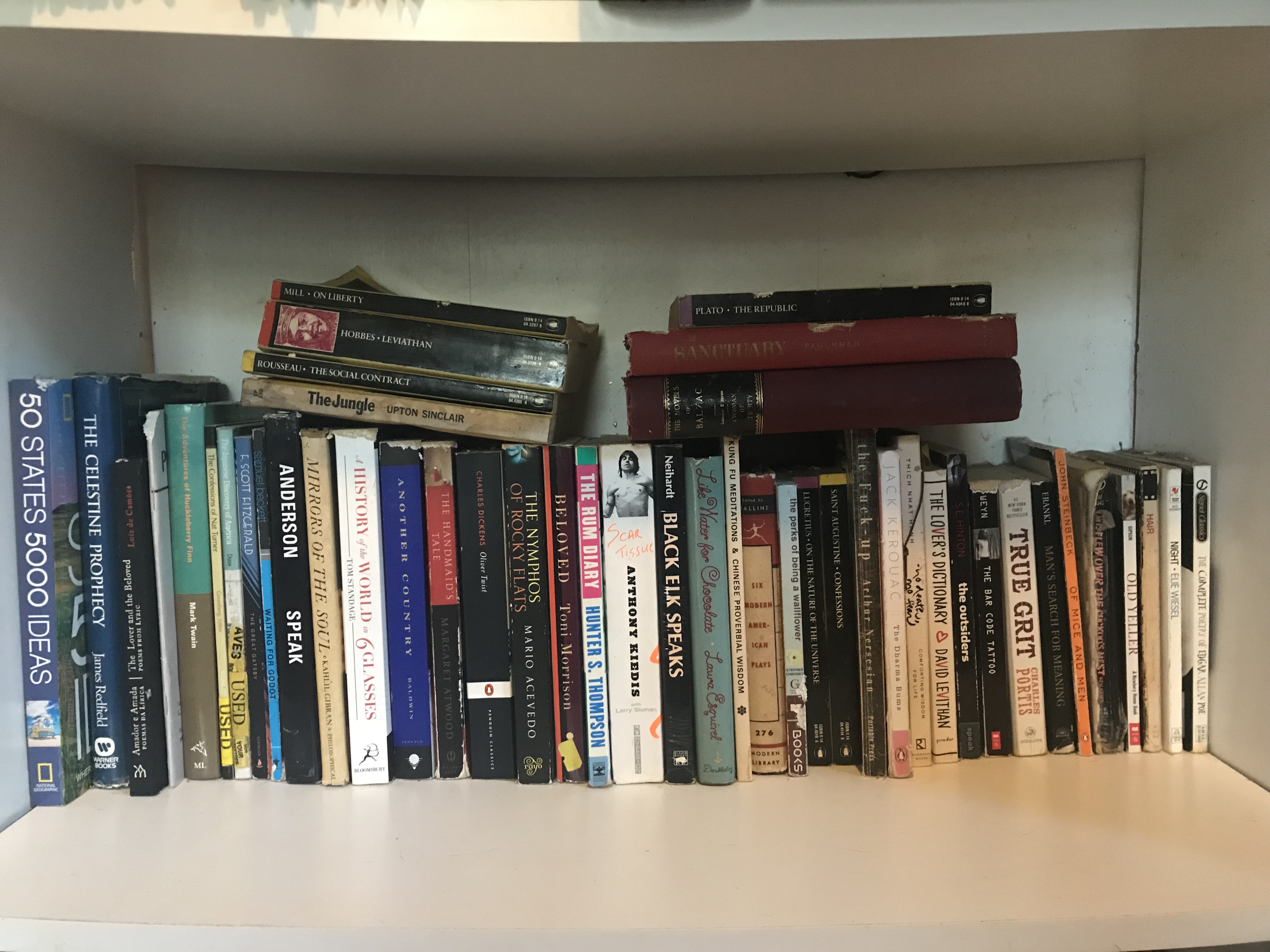
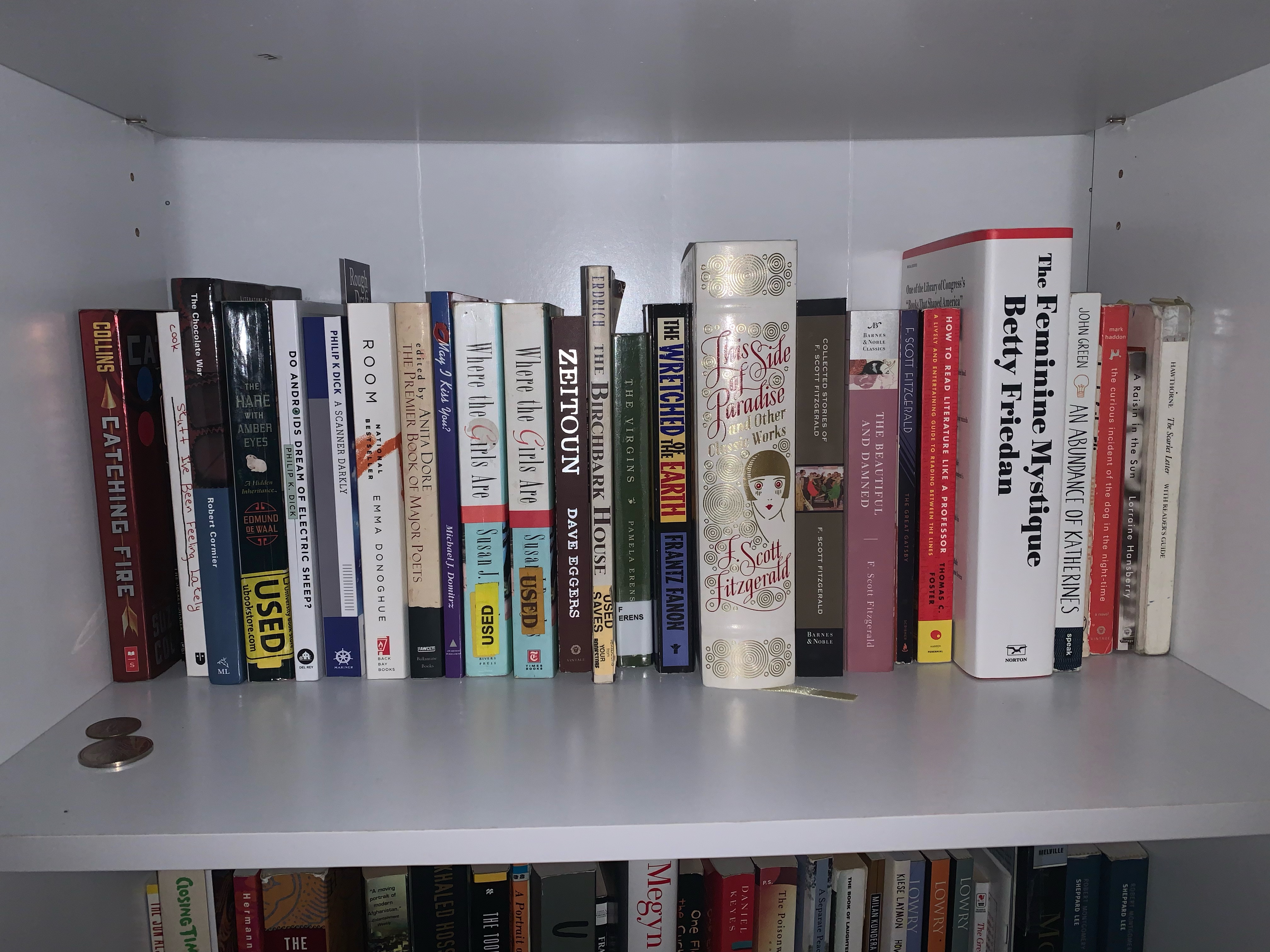
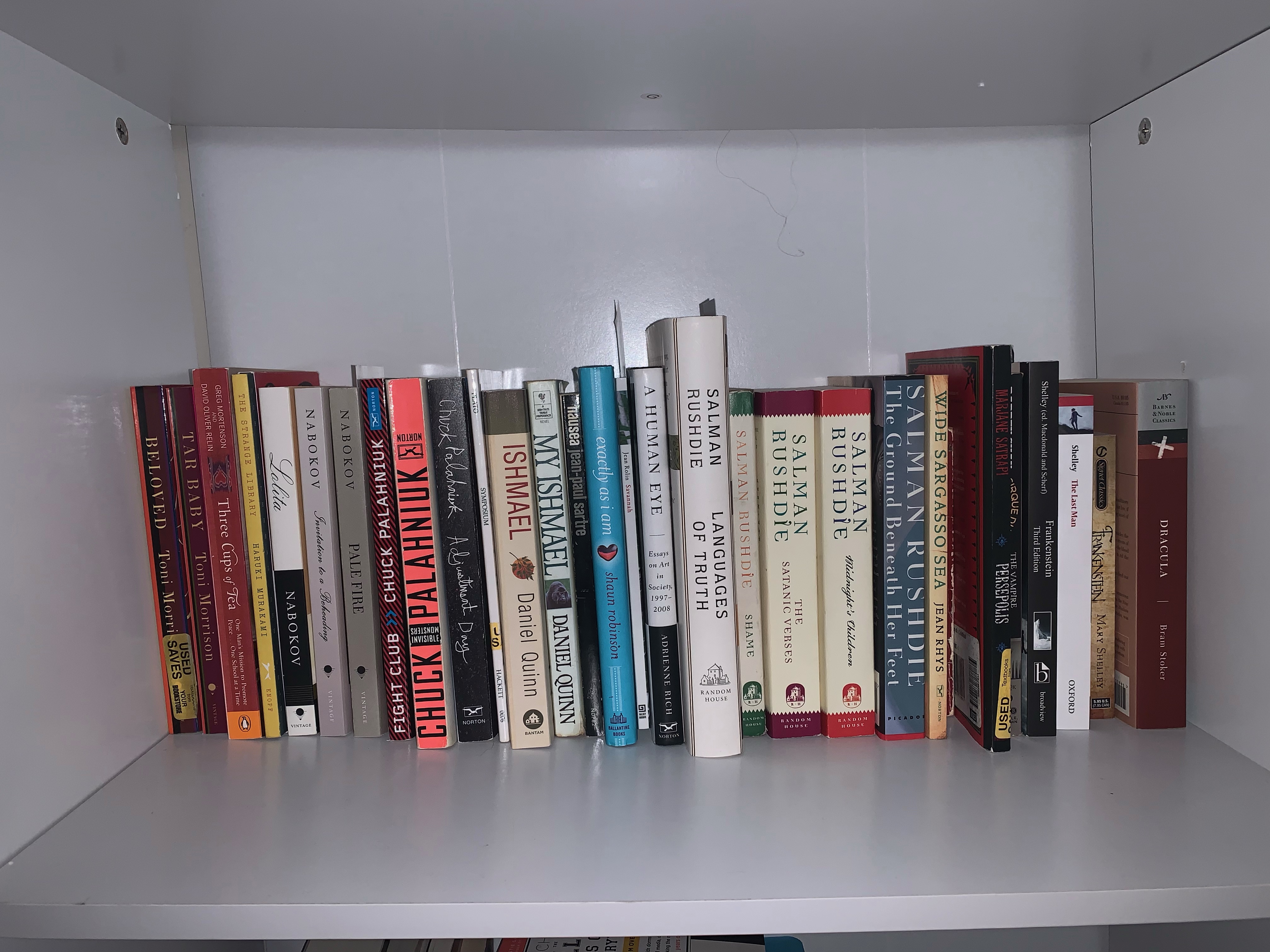
My bookshelf at the start of the process.

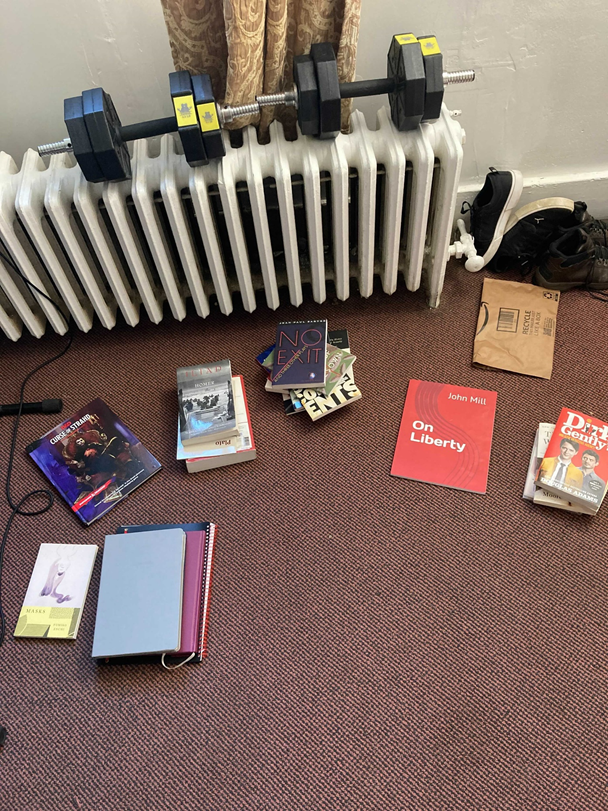
Between my bookshelf at home, my shelf in my art studio, and the books I have in my dorm, I own about ninety books. I have decided to focus on tackling my bookshelf at home, which holds sixty-six books. I have decided to pick up and consider each one of my books, deciding which ones “spark joy” in me and which are really just clutter. To start this process, I have removed all of the books from my shelves, leaving only knick-knacks and paper clutter behind. I have now split my sixty-six books into twelve categories. These categories are not split evenly rather they are based on time period, purpose, or author. Splitting the books into groups made the process a little less overwhelming. 
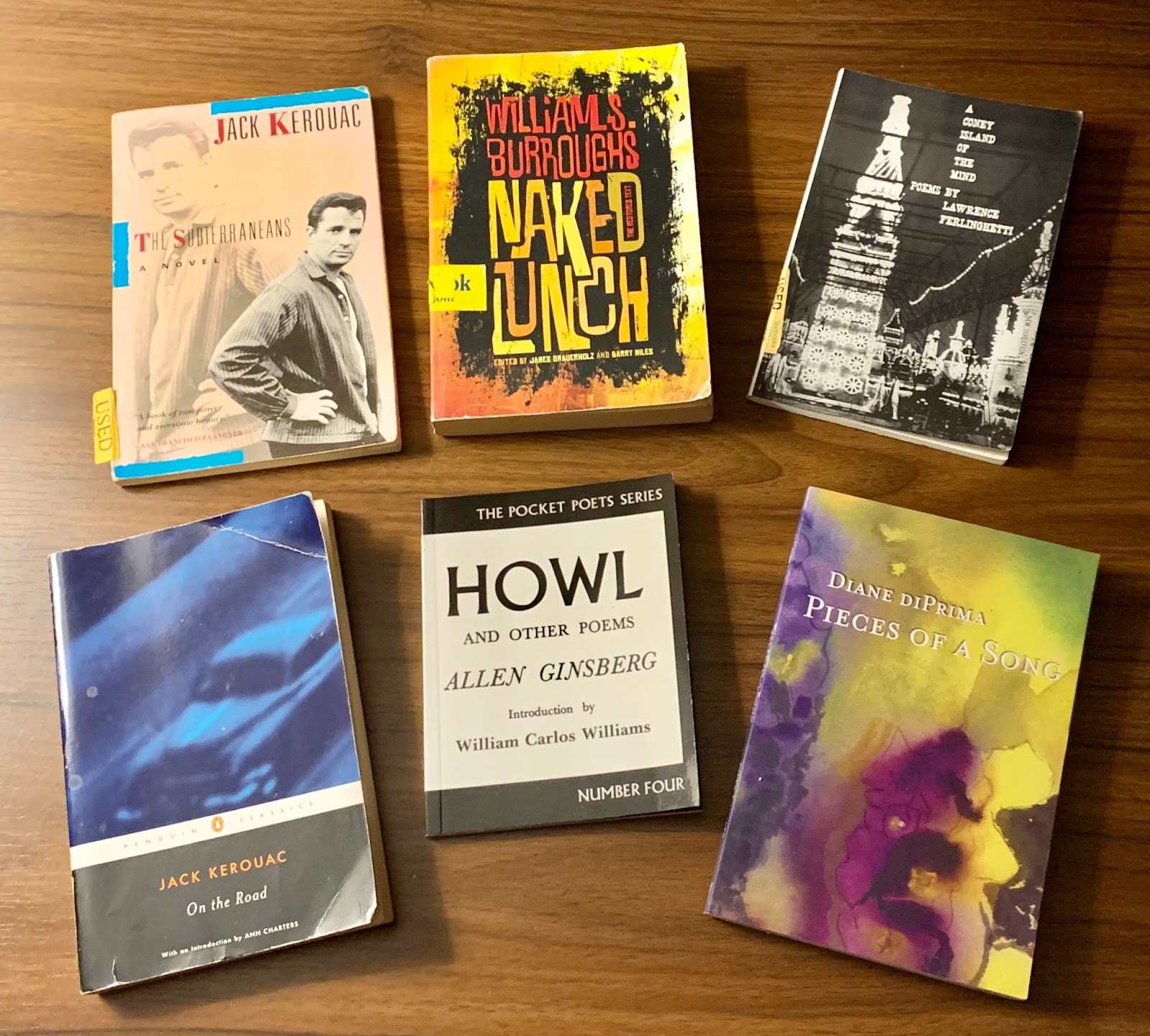
Books by the Beat Generation (Kerouac, Burroughs, Ferlinghetti, di Prima, and Ginsberg)

I found it funny that even when I was first planning this process, I had books in mind that I would be getting rid of. It makes me wonder why I didn’t get rid of these books that have been bothering me in the first place. The first books I knew I wanted to get rid of come from my collection of books written by authors of the Beat Generation. I got these books when I was taking an English class on the Beat Generation last semester. I wanted to get rid of both of my Jack Kerouac books, as the rampant sexism in these two novels brings me the opposite of a spark of joy. As for the other books, I felt very content to put Burroughs, Ferlinghetti, and di Prima in the “sell” pile as I don’t have any desire to reread any of these books. One book I didn’t feel comfortable getting rid of ws Allen Ginsberg’s Howl. The book doesn’t take up much space, being thin and small. I also can say that the handful of Ginsberg’s poems I read in this book did generate a positive response from me and I would like to one day read the rest. This leaves one book in the keep pile and five books in the toss pile.

Whether or not I would read the book again tended to be the trend on how I would determine what books stayed and went. This was quite difficult as I had to make my future actions and the time I would be able to alot to my books predictable. This was easy for books that I just didn’t enjoy, even with multiple readings, as I knew that they brought no joy or positivity into my life. It was also easy to determine what books stayed, as they were all the books that I have really loved. 

Vonnegut books

One set of books that I knew I would keep are my collection of Vonnegut books. One is my first copy of Slaughterhouse-Five that I first bought and read when I was eleven years old. Another book is a graphic novel adaptation of Slaughterhouse-Five that I bought a few months ago. The set of books is a box set of all of Vonnegut’s stories, compacted into four books, bought for me by my mother. While the box set may make my old copy of Slaughterhouse-Five obsolete, I just can’t force myself to get rid of any of these books, as they are so important to me. I can say that every time I pick up one of my Vonnegut books, I feel a spark of pure joy, so they will remain on my shelves.

Some older, classic Western literature (Dante, Boccaccio, Sophocles, and Nietzsche)
Classical British Literature (Swift, Shakespeare, and Carroll)

Sifting through my collection of classic literature left me rather conflicted, as I found myself wanting to get rid of books that I didn’t enjoy, but felt that I should because of their status as “a classic.” After giving in to my own emotions towards these texts, I found myself getting rid of The Tempest, Gulliver’s Travels, and Alice’s Adventures in Wonderland. I didn’t really enjoy reading any of these books so I likely won’t be reading them again. Using this same system I am keeping a lot of my Medieval, Greco-Roman, and modern classical literature that I do see myself reading again. This includes works from Sophocles, Boccaccio, Nietzsche, Sartre, Salinger, and others. I actually find it funny how many of these books I have read upwards of three or four times, specifically titles by Nietzsche.

The books that I have yet to read.

I have a collection of books that I have bought, but not yet read. All of them were purchased during the break before the start of the semester. I am hoping that during my break before graduate school I can chip away at these particular books, so I will not be getting rid of them. Even though I have read The Odyssey three times now, I am still very excited to read Emily Wilson’s translation, in specific, because I have heard great things about it. I also can’t help but feel that getting rid of books you haven’t even given a chance is like throwing away an opportunity.

The nineteen books I am getting rid of.

In totality I am getting rid of nineteen out of sixty-six books, leaving forty-seven behind. I am honestly shocked that I got myself to get rid of so many books. However, the process was oddly freeing. It is nice to see my bookshelf more closely representing my ideals now that I have removed books that I do not feel a connection to. It is also nice to see free space on the shelves, as before it felt like a battle to squeeze a new book onto a shelf. Though, I must say that actually donating or selling these books may be a harder task than putting them in a pile that says “donate.” 

My bookshelf after this process.

Inspired by Marie Kondo

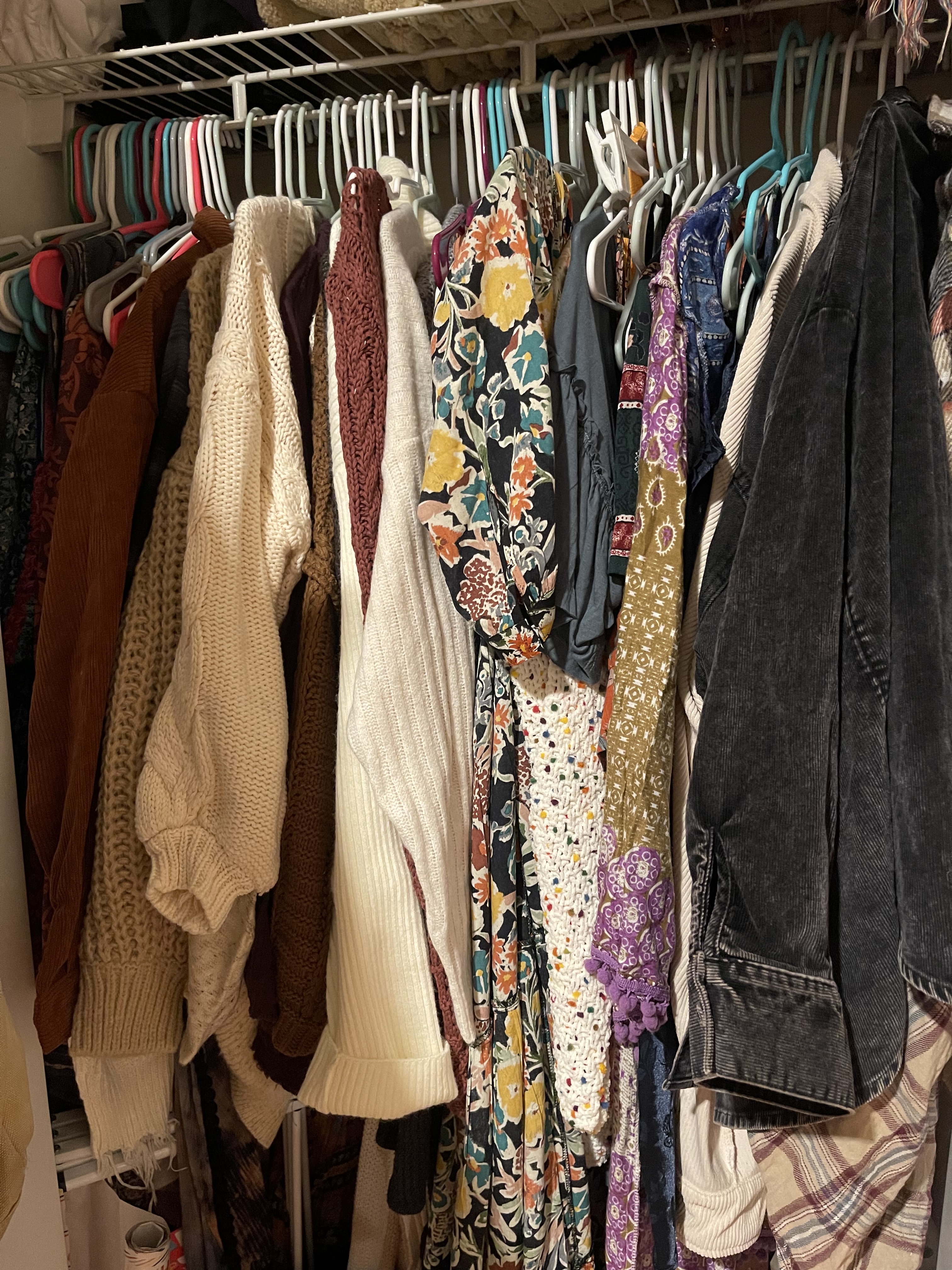
After seeing an episode of Tidying up with Marie Kondo , showing a couple going through their closet, I was inspired to do the same with my own “joy test” experiment. I love to shop, in person, online, anyway there is. Combining my love of shopping with my passion for fashion means clothe shopping has become my kryptonite. Nearly every time I see a new article of clothing that catches my eye, I immediately “have to have it!” As a result, I have a closet full of sweaters, dresses, and jackets in my apartment here in New Paltz; that is only a portion of the entire collection I have at my home. I also have two dressers filled with shirts, workout attire, skirts, and sweatshirts. Everything from statement pieces to everyday basic shirts to one-time wear Occasion pieces, which in the moment of buying them I couldn’t live without. I decided that this experiment would be best done on this collection of clothes I have, and potentially I could even learn a bit of pairing down and working with what I have for the time being. 

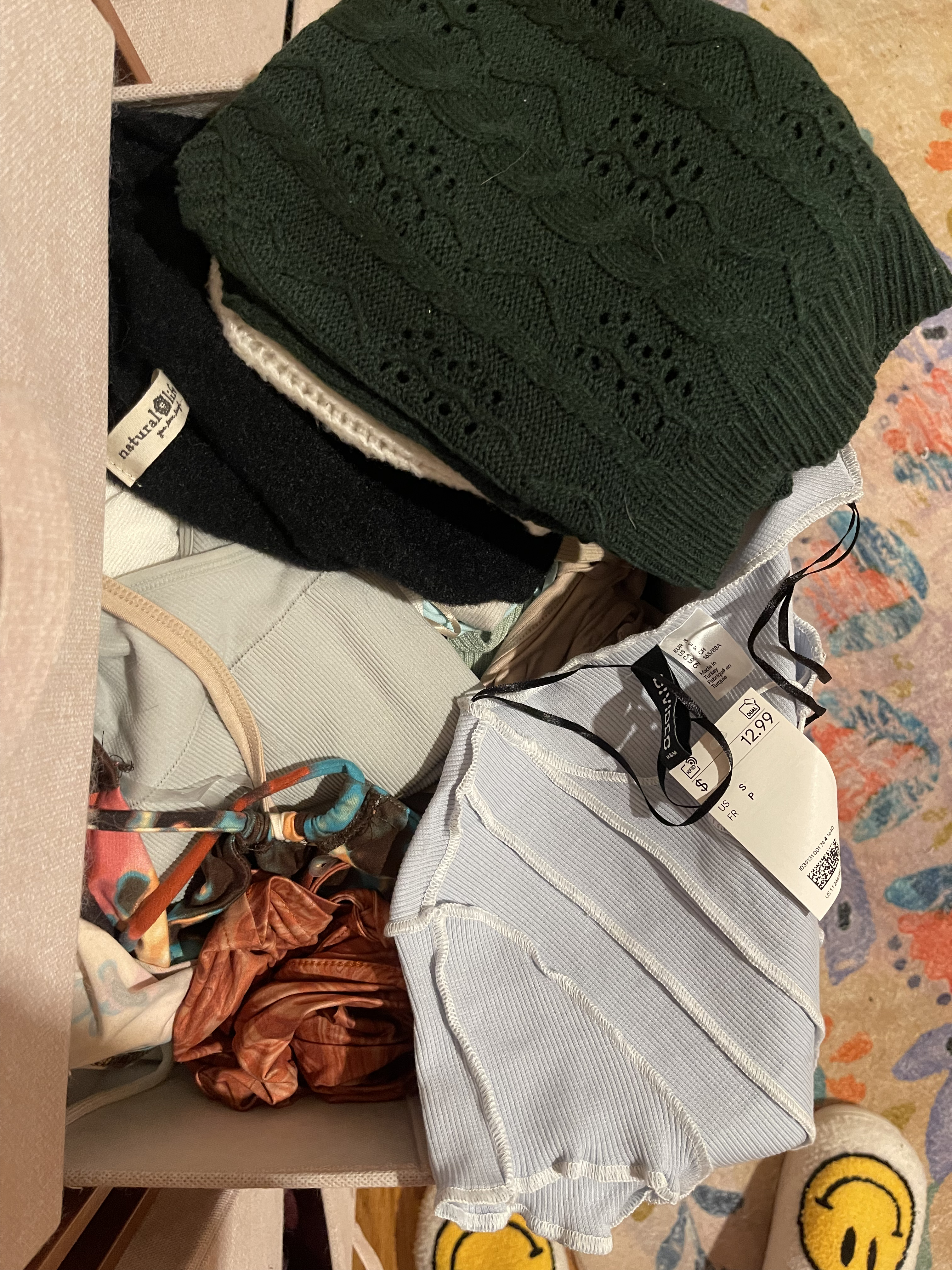
I decided to start with my dressers; each drawer separates a different article of clothing, some being full to the brim due to recent additions and online shopping spontaneous purchases. After emptying the contents of all my drawers, I realized this experiment was going to be very time consuming and could quickly turn into a whole day project, so I decided to break it down a tad more and focus my experiment on my dresser drawers focusing on my sweatshirts, shirts and  I didn’t dare open my closet door after making that decision. I quickly tackled my sweatshirts, for this was simple, I don’t have many, and the ones I do own, I realized quickly, are a necessity, for I do wear all of them regularly. So far, this joy test was going very well. Then it came to my shirts, and this is where some tough decisions were made. I organize my shirts in three separate categories, basics, t-shirts, and as I like to call it my “extra” shirts, they are just a little fancier and can be worn by themselves. I quickly realized I had so many t-shirts I didn’t even realize I had, and it also made me realize this experiment was doing this intended job. I went through and only kept five t-shirts that I genuinely felt connected to and knew I would wear either to the studio during an art project or even to sleep in. The basics went almost as simple as the sweatshirts, for I wear most of them regularly. However, I quickly realized even though these are very practical, a few to almost none of these shirts gave me that “wow” moment. I wasn’t in love with any of these shirts on their own. I sat for a moment and debated keeping or discarding these so-called essential pieces that I relied heavily on in my wardrobe. After a few moments, I realized that these basic shirts didn’t give me joy or make me feel  happy to wear them independently; however, they complete the outfit when paired with other sweaters, skirts, etc. Putting outfits together essentially gives me the joy that Marie Kondo expresses. Therefore, I feel confident and happy in the mundane essential pieces that don’t speak on their own, but rather  are a contribution to that wow outfit. As a result, I decided to keep all but two of them, for I realized I had a lot, and they were very similar, even down to the color. If anything comes out of this experiment, it will be that I don’t need any more basic shirts, as cute as they may seem on the shelf. Finally, it was time to go through the “extra” shirts, a moment I dreaded due to their quantity. Immediately I realized I almost disliked and didn’t feel anything special about most of them. These purchases were primarily made online through fast fashion websites, and I had only worn them once or some not at all; a few pieces even had the tags still on them. I was embarrassed and almost sad that I spent the money on these pieces that just sat there every day being overlooked. I knew I needed to pass these shirts on to a new home literally and metaphorically. All the shirts that did not wow me or I saw myself not happy wearing, I put in a bag that I plan to give away to the local Salvation Army. After I was done sorting them all out, I had paired down my “extra” shirts to about a half of what they used to be, and to my surprise, my mood had lifted. 

After experiencing Marie Kondos’s joy test experiment firsthand, I can see what all the hype is about surrounding her techniques. I only did this experiment on nearly a third of my wardrobe; however, even that slightest change I can say has genuinely made me feel better and a little less cluttered. I quickly found the shirt I wanted to wear, even today, and It made me a little more aware of how many clothes I have! As for that bag of shirts, I intend to go to the Salvation Army after my class and donate them to provide them with a new life, one where they will be worn happily and displayed in the light they should be.  

Books Bring Joy in Different Forms

Of the various collections of objects I own (I’ll admit I have a very hard time letting things go), I decided to try Kondo’s “joy test” on my books, specifically the books in my bookcase (I have books in other places). In my bookcase I have two shelves designated for books.

I began with 110 books. I accumulated these over the course of years and have gotten them from a multitude of places.

The two shelves I decided to sort

Before I started sorting, I couldn’t anticipate how I was going to feel. I have always considered my books to be some of my greatest treasures. They share their lives with you. They become a part of you when their messages turn into the values you live by. They inspire. They represent the art of storytelling and the magic of imagination.

It turned out that this experiment was much easier than I could have imagined. The books that sparked joy in me I didn’t really have to look for. As I eyed my bookshelf they seemed to pull themselves out on their own leaving me saying “Of course. I love you dearly.”

These two immediately sparked joy in me. These are two of my favorite books.
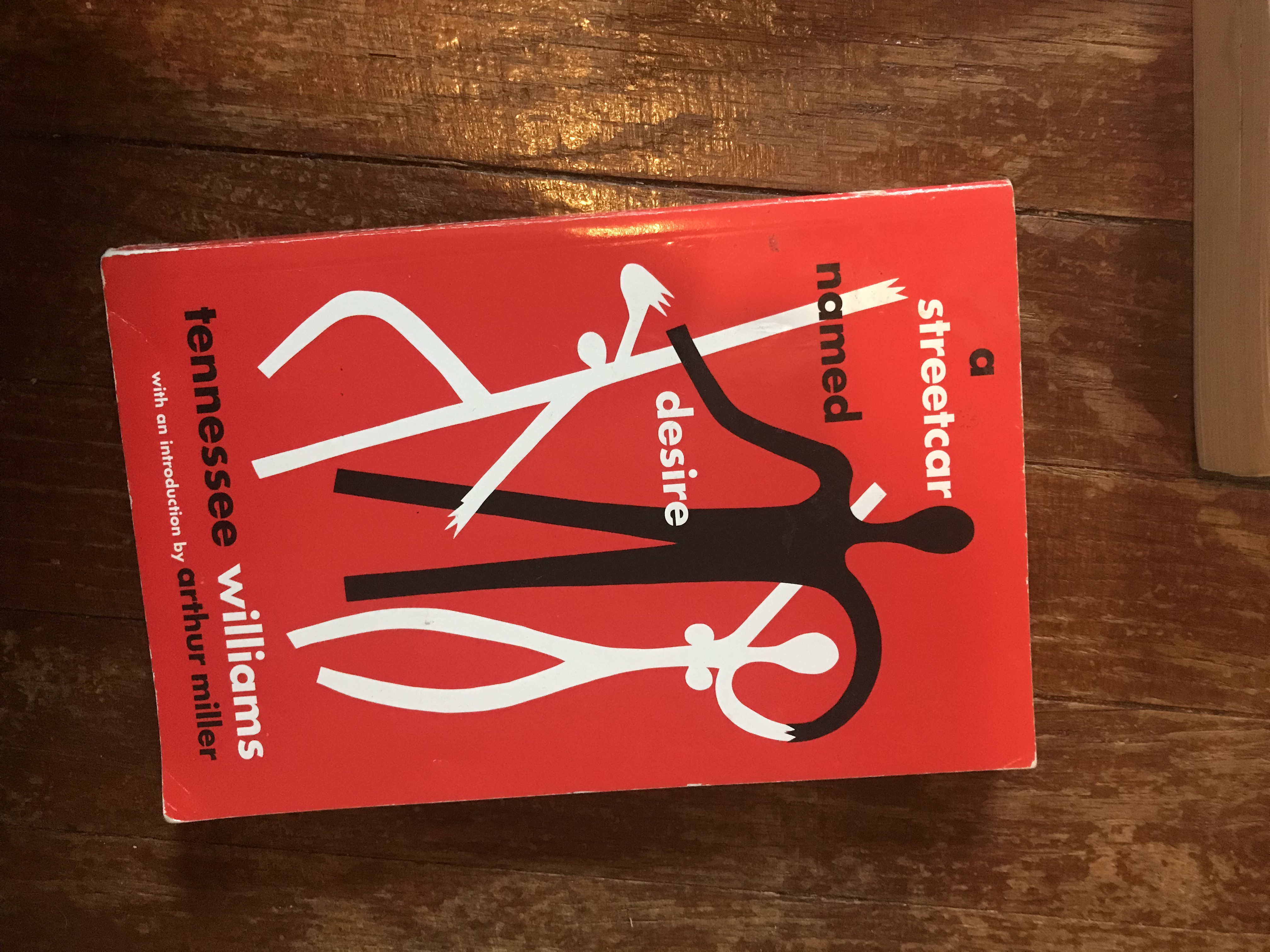
This book, one of my favorite plays of all time, also immediately sparked joy in me.
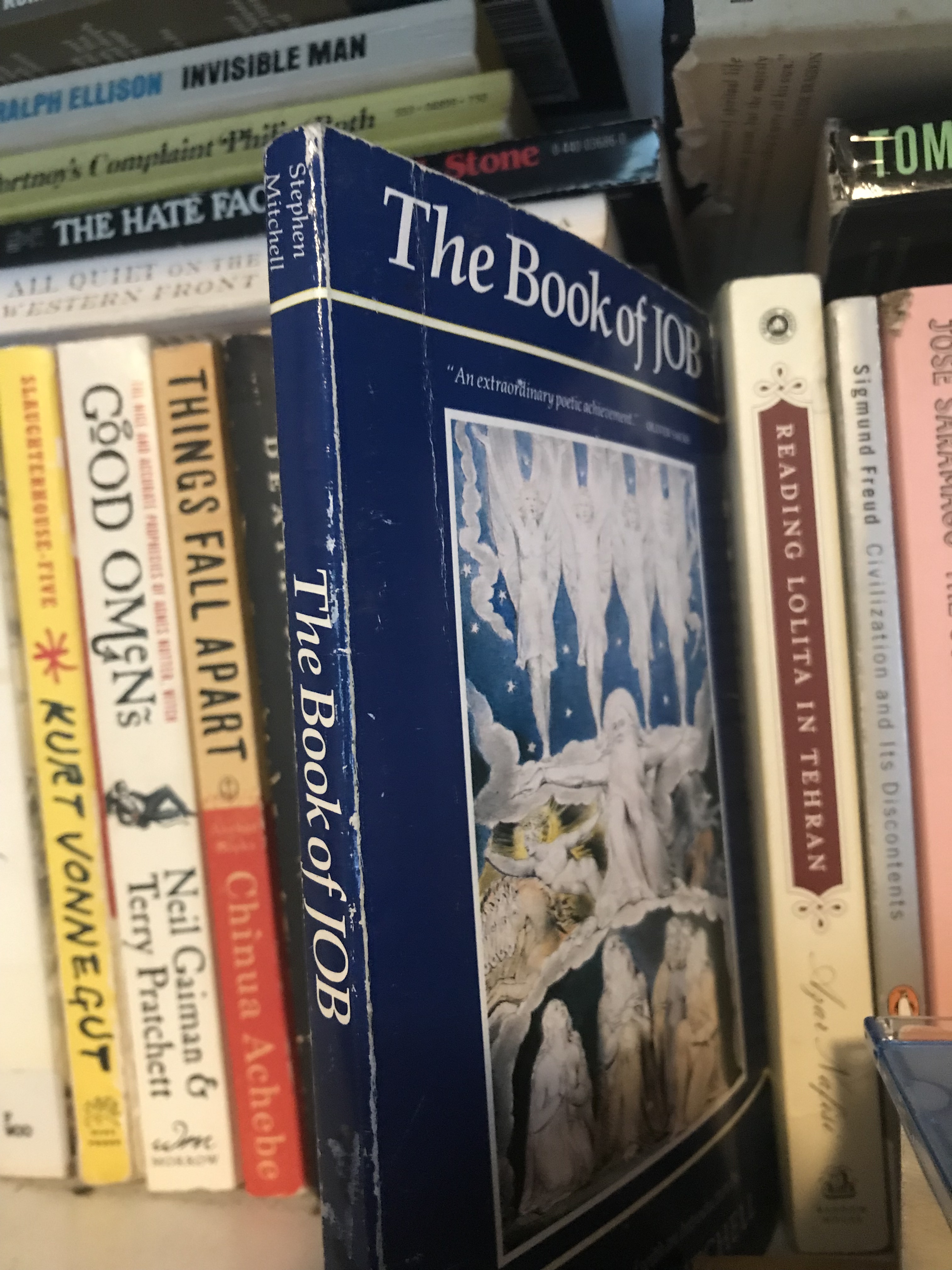
One of my favorite books read for school, “The Book of Job.”
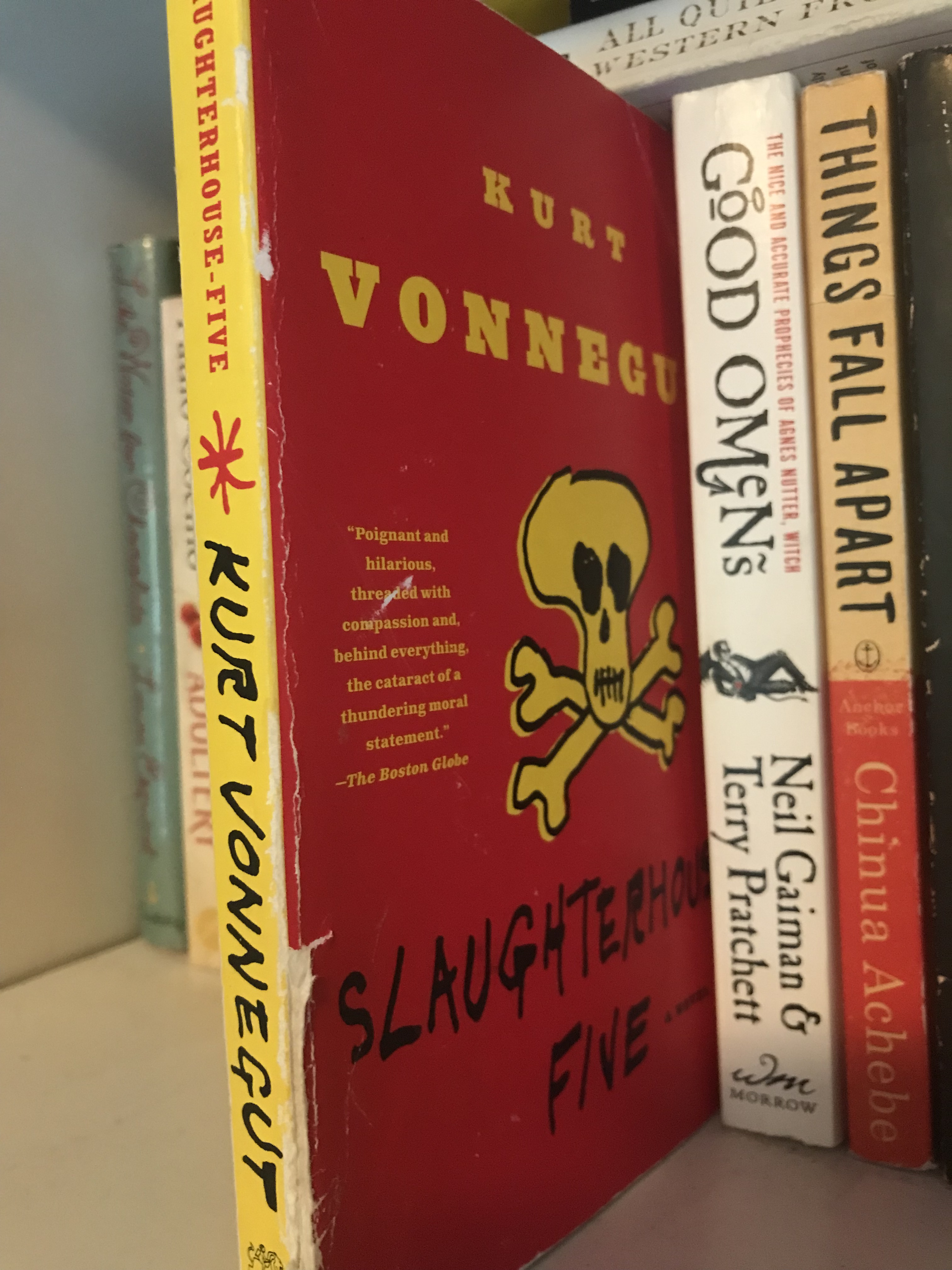
“Slaughterhouse Five,” another one of my favorites.

Something that I noticed is that different books brought different types of joy to me. The ones above brought me joy when I held them because I love them so much. To me they are beautiful, meaningful pieces of art and life. I love them simply for what they gave me when I first read them and also for what they continue to give me when I think of them now.

A book that has provided me comfort and calm during tumultuous times.

This book represents a different type of joy that I experienced. This book contains reassuring spiritual wisdom from Thich Nhat Hanh, a Vietnamese monk, and during several conflicted points of my life I turned to his guidance to find comfort and solace. Knowing that this book helped me during rough times is a different kind of joy, one reminiscent of hope. I plan to hold onto this book forever because I can always come back to it during any point in my life where I feel I need guidance.

These two books were my mother’s when she was in high school, “Kung Fu Meditations” (my mom did kung-fu in high school), and a photo novel of the movie musical “Hair.”

The two books above I have probably opened each only a few times and in a casual, flipping-through-the-pages manner. Despite my lack of using them, I won’t part with them because they were my mom’s and I love having things that belonged to people I love.

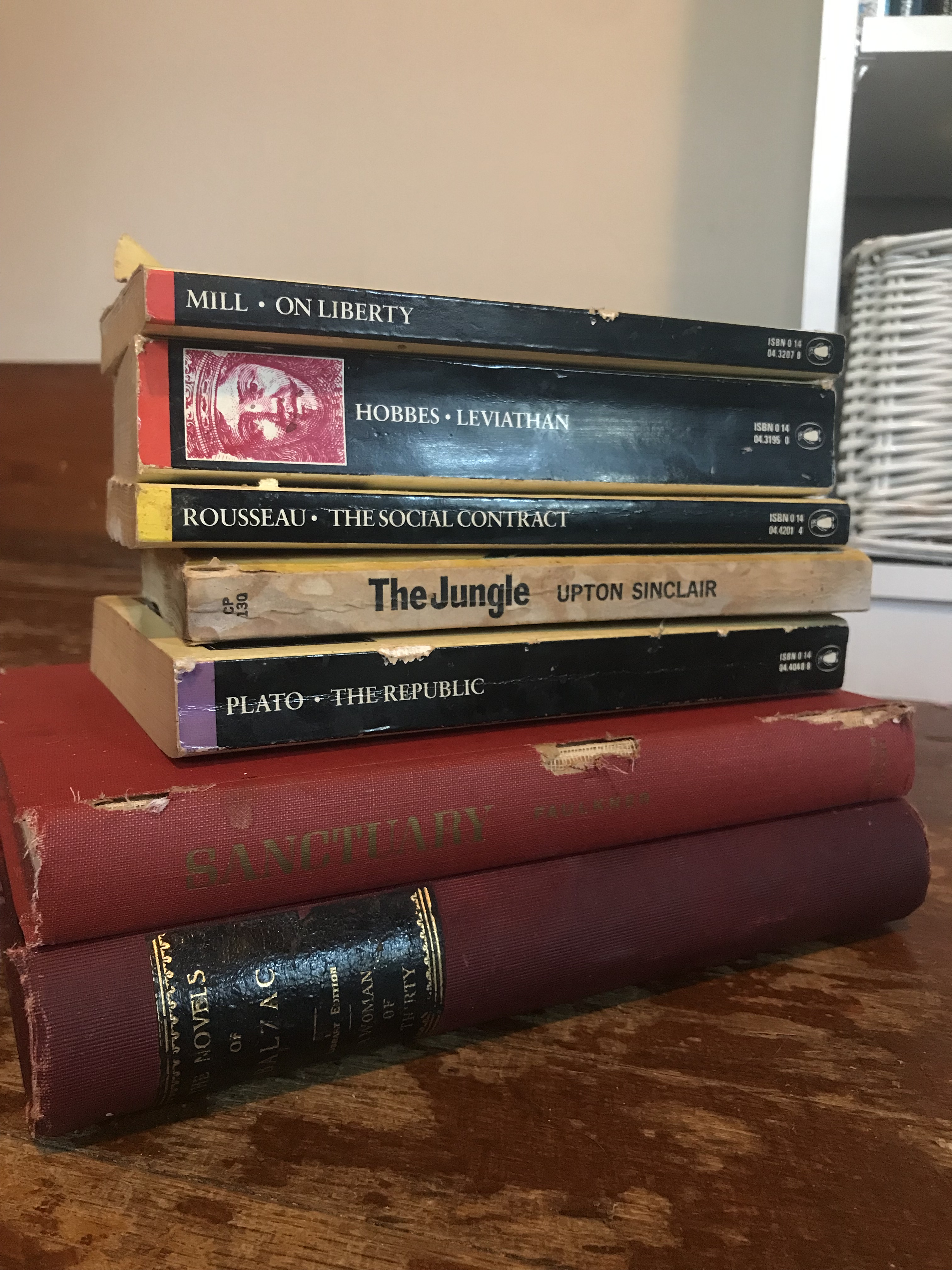
Similarly, the books in the pile below belonged to my grandmother. When my grandma passed away about a year and a half ago, I took in several of her books, I think as a way to memorialize her. My grandma loved literature, and she and I would spend many mornings sipping coffee and talking about books. I think much of my love for reading I get from her. For the joy it brings me to have these books that belonged to someone I loved so dearly, I won’t get rid of them, even though I likely won’t read many or most of them.

My grandmother’s books.

As for the books that didn’t spark immediate joy in me, some of them I haven’t read yet, but I genuinely plan on reading them in the future. I recall Kondo saying “I’ll get around to it someday” is often an excuse given by her clients. However, as a full time college student who has a job, it’s difficult for me to read for pleasure as much as I’d like to. So I mean it when I say “I’ll get to it someday.”

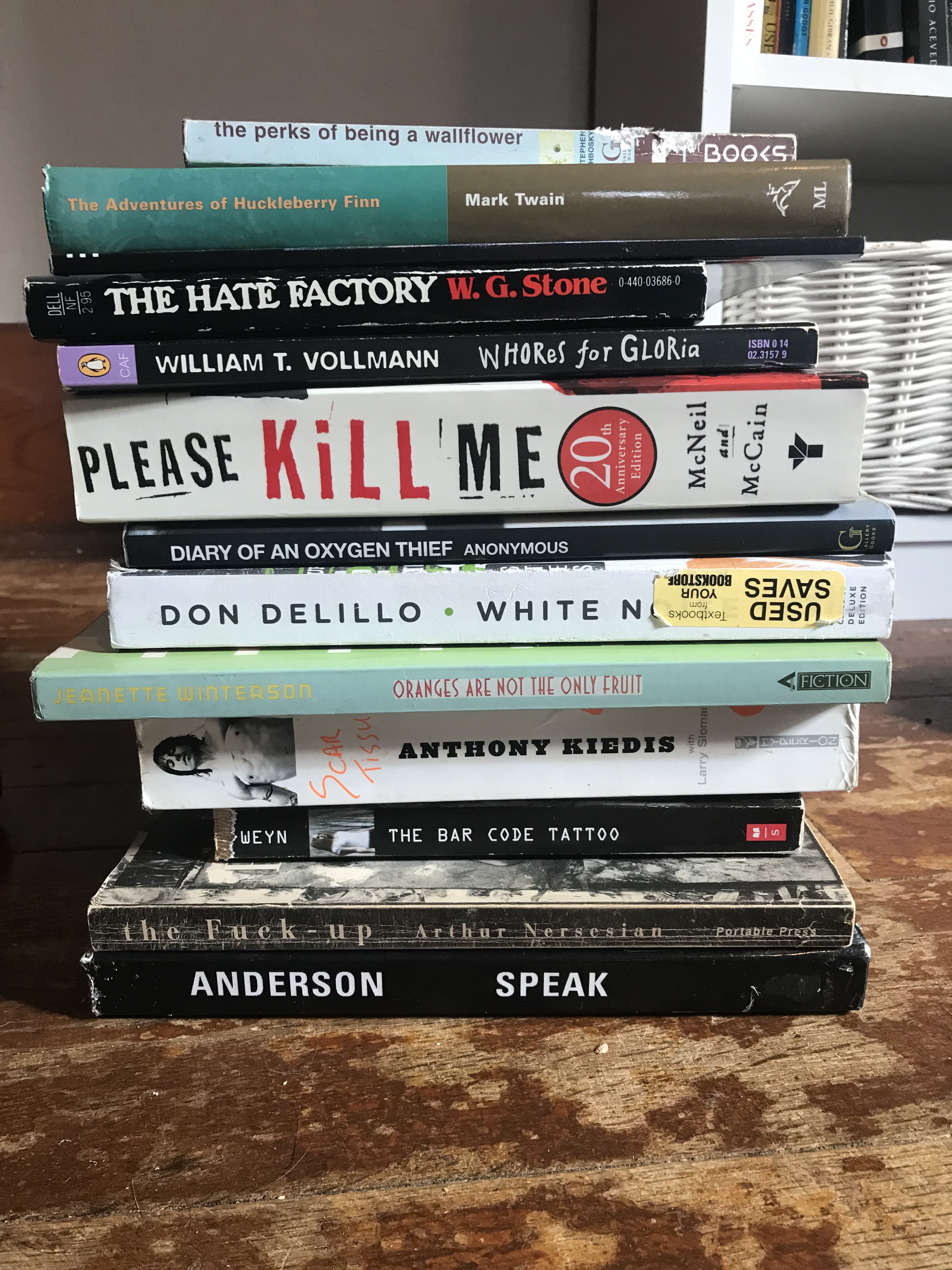
However, from going through my books, I was able to get rid of a total of 13. I actually am going to donate them after doing this experiment. Of the 13 I decided to get rid of, I only read 2 of them. Of the 2 I had read; “Oranges Are Not the Only Fruit” and “Diary of an Oxygen Thief,” neither of them were memorable, and I didn’t feel any attachment toward them. The other books I had decided to get rid of were all ones I had purchased at some time in my life when they piqued my interest, but I had never gotten around to reading them and I no longer have much of an interest.

The 13 books I decided to get rid of.

This experiment reiterated for me the attachment I have to books based on how many I felt genuinely connected to, and thus gave me joy. It also made me think about why objects are so significant to me. It is not necessarily the object itself that brings me joy but the emotion or sentiment it brings me. A book that I loved in high school for example will bring me joy because I feel like it was a part of my high school identity. Books embody certain feelings, attitudes or experiences I had during certain periods in my life and so in that way I feel like they embody a piece of me and my past. Holding on to them makes me feel like I am choosing to hold on to a piece of my past. This gives me comfort as the concept of time confuses and overwhelms me.

Maya Angelou has a famouse quote that says ““You are the sum total of everything you’ve ever seen, heard, eaten, smelled, been told, forgot – it’s all there.” I find this quote to hold a lot of truth. I believe that it also applies to perception. “You are the sum total of everything you’ve ever perceived.” Books are one of the few (tangible) things that mold perception, and perhaps this is why I have such an innate desire to hold onto them.

Joy Test

For this assignment, I decided to try the “joy test” on the desk in my dorm. I have a bad habit of letting loose papers, trash and other things clutter my desk so having an excuse to clean it is always a good thing. I haven’t cleaned my desk since the beginning of the semester, when I moved all of my stuff into the desk. Over the course of half a semester, most of the desk’s space has been claimed by something or another. Whether that be the large laptop I use for my classwork, the textbooks that cluster into a pile in the corner or the many papers scattered around the desk, it can be difficult to find room to do work on the desk itself. 

My desk before cleaning

I’ve cleaned off my desk before, so I had a pretty good idea of where to start. I usually look through all of the objects on and inside the desk and see if I need to keep them and, if I do, is there another place I can put them to keep my workspace more orderly. This time around I tried taking a mental note about the emotions that arose as I cleaned off my desk, not just the usual thoughts of practicality I use when cleaning normally.

I started by looking through the loose papers on the desk, as those are usually the easiest to clean off (oftentimes they’re either on the desk for a reason or they’re just old trash). I went through many old assignments that could be thrown away, I found some old notes I had taken for a class and put them in my notebook, and I threw away some old candy wrappers that were still on the desk. I even found a copy of the syllabus for this very class, which was quite ironic. However there were some objects that surprised me, such as a card I received from my parents and some notes I had jotted down for a potential video game idea, that did spark joy when I found them. For the most part I had forgotten about these items, and seeing them again brought about a joyful feeling. I put the card back on my desk and I put the game notes into my drawer in case I ever wanted to act on my idea.

Not all of this trash was on my desk, but the crumpled paper near the top of the bag was most of it.

After reviewing the papers on my desk, I started looking towards the larger items on my desk. This is where I found the most objects that “sparked joy” for me. I found the bracelet that my girlfriend gave to me, a set of dice that I use when playing DnD with some friends, and a metal sign that I hadn’t hung up in my room at the start of the semester (which I then hung up in a moment of procrastination). There were some things that I threw away, such as an old 3D printed project that I no longer needed and some pencils that had been sharpened down to stubs, but most of these larger items sparked joy for me. The one object, or rather group of objects, that defies this rule for me is the pile of textbooks on my desk. I never really use textbooks for my classes, as if I have a question on the material I prefer to talk to the professor or a classmate about it rather than search through a textbook for a possible solution. Looking back on it, the action of renting the textbooks at all now feels like a waste of money, since I’ve never used them unless the class specifically required it. I put the textbooks in my desk drawer, that way I knew where they’d be when I needed to return them but they stopped taking up room on my desk. I now feel like there is much more space on the desk now that a quarter of it isn’t being taken up by books I wasn’t using. 

My desk after cleaning.

After cleaning off my desk, I feel like I have much more room to do my work. To be honest I don’t feel very different about how I see the objects on my desk, but that may be due to the fact that I tend to go object by object when cleaning off my desk normally. That being said, it was interesting to pay attention to the feelings that emanate while holding certain objects. I’ll be sure to listen to this feeling in the future, since it can help with deciding what objects to keep in the future.

“Sparking” Emotion

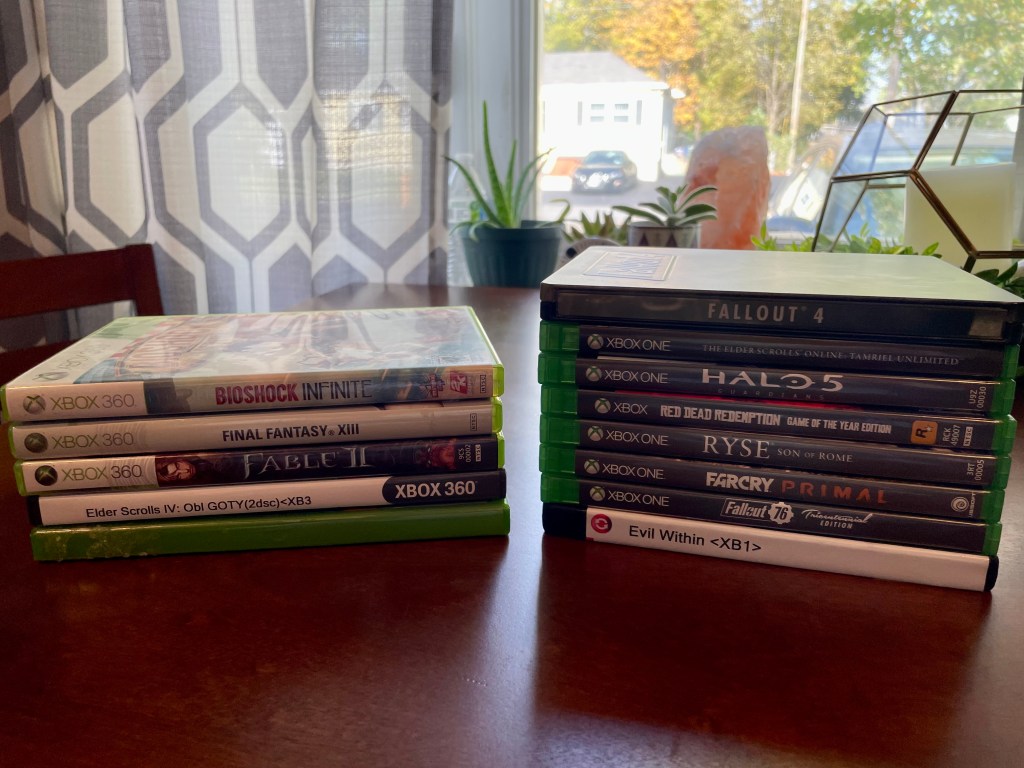
Marie Kondo’s “joy test” is one that seems extremely simple in theory. In practice, it is a bit more complicated. While the categories of clothing or books could have been sorted through, I felt this “joy test” should be done towards objects I feel more connected to, and so I chose my video games. I have several consoles and have purchased and been gifted many games over the years. I have played several of these games multiple times over and have spent countless late nights playing others with friends. I started with ten Xbox 360 games, thirteen Xbox One games, one Xbox Series X game, eight PlayStation 4 games, one PlayStation 5 game, and five Nintendo Switch games, for a grand total of thirty-eight video games across six consoles (not counting those that are still at my childhood home). If you can’t tell, I am more of an Xbox fan than a PlayStation fan!

Sorting through my video games was not as difficult as I expected but I was surprised by some of the choices I made. I expected that every game I own in the “Fallout” franchise would “spark joy” – even those I would rank lower on my list – but that was not the case. Both Fallout 4 and Fallout 76 were put into the “discard” pile. I was surprised by this because I love the “Fallout” franchise in its entirety – I have replayed Fallout 3 and Fallout: New Vegas numerous times and have played Fallout 4 twice. Fallout 76 had its drawbacks, but I enjoyed the time I spent playing with my friends discovering a new post-apocalyptic wasteland. Fallout 3 and Fallout: New Vegas, on the other hand, both caused immense joy. Not only was I flooded with memories of all the different times I have played the game, but I was also reminded of the passion I have for these games – how much knowledge I have of the characters, the setting, and the quests. Certain video games “sparked” conflicting emotions within me. If you know anything about The Last of Us and The Last of Us Part II, they are not feel-good games, especially the most recent installment. Yet, when I held the games in my hand, I found myself yearning to go back into the cordyceps-infected world that Joel, Ellie, and Abby lived in. I wanted to relive the experience that playing those games was – even if it meant going through the five stages of grief all over again – solely because of the deep emotional connection I formed with the characters. I felt the same way about Death Stranding – a game I consider to be a work of art. The Last of Us Part II and Death Stranding both had me sobbing uncontrollably at certain points, and yet I love the games so dearly for the journeys they took me on and the lessons they taught me. So, while these games did not “spark joy” per se, they did illicit a strong emotional reaction. There were, of course, games that received a dull reaction from me. One I was surprised by was Skyrim: VR. Skyrim is tied for my favorite video game of all-time and I was in awe at how well-done the virtual reality version of the game was. However, all I could think about was the awful headache I got every time I played the VR version, and into the “discard” pile that version of the game went.

At the end of this “joy test,” I had “kept” six Xbox 360 games, five Xbox One games, one Xbox Series X game, six PlayStation 4 games, one PlayStation 5 game, and two Nintendo Switch games, for a grand total of nineteen games – exactly half of what I started with.

This exercise was very revealing and taught me a lot about my relationship to objects. For example, the two games from the “Fallout” franchise I chose to “keep” were the Xbox 360 games. Fallout 3 and Fallout: New Vegas were released in 2008 and 2010, respectively – they are both over a decade old and the graphics of Fallout 4 and Fallout 76 (made for Xbox One) far-surpass both games. Why did I choose to “keep” two games that are so old they can barely be played on my console without it crashing? Memory and emotion. Even games such as The Last of Us Part II and Death Stranding – whose poignant stories led to heartbreak and tears – I find great value in due to the way playing them made me feel.  This exercise taught me that I place the most importance on objects that I either have fond memories with/of, or that cause me to have a strong emotional reaction. Almost every game I chose to “keep” I could subcategorize into “games that I have fond memories of” and “games that made me deeply feel things, good or bad.” When I think of other objects I own, I see that same pattern repeating – even with my clothes! Overall, I found Marie Kondo’s “joy test” to be an enlightening and “joyful” experience and I believe many people can learn about themselves, and their relationship to their things, if they try the “joy test” themselves. 

Me, Myself, and My Extension of Self In Books

My mom has often accused me of owning too many books. Despite having a very large bookcase (laid on its side is four feet tall and six and a half feet long), a good chunk of my books end up on piles on the floor or shoved haphazardly beneath my bed. It was only a few months ago that I had thrown and donated at least sixty books. Since then, my collection has only grown as I buy new textbooks or find a bunch of Penguin classics at Salvation Army. My bookshelf (as well as the surrounding surfaces) is the amalgamation of my personal identity. While I don’t seem to find joy in my books, the books convey a certain narrative and demonstrate things about myself I would rather not acknowledge. While sorting through some of my older books, I felt an indescribable tightening in my chest. I certainly was not feeling joy, but perhaps a gut-wrenching grasp on the past or my state of being. As a result, I took a different approach than Marie Kondo’s simple “joy test”. I separated the books on my shelf into two distinct piles: books that exist in my periphery and books that have impacted or made me feel an emotion I can’t quite grasp. 

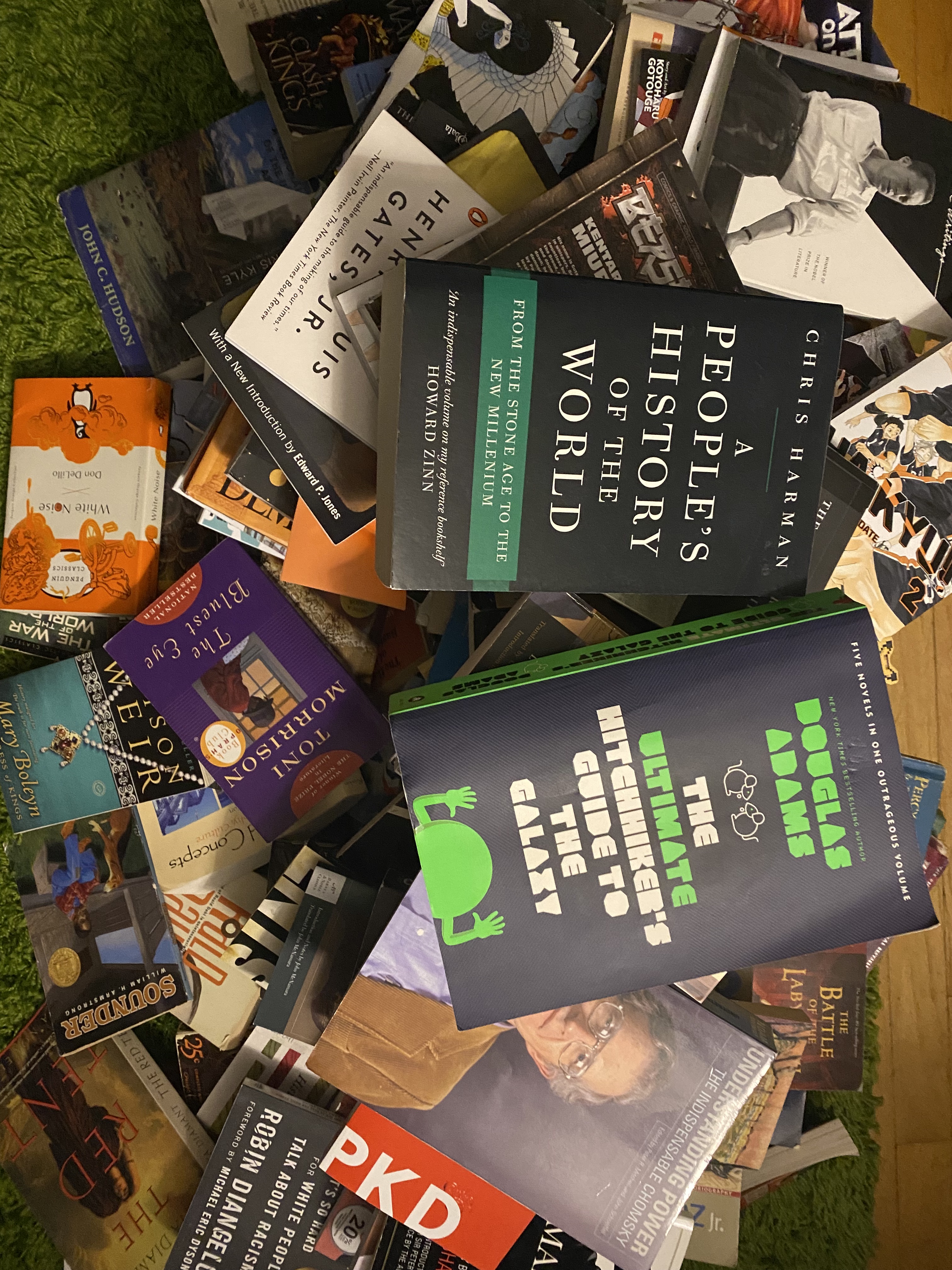
My books share a space with well over a hundred CDs from K-Pop artists (which I find to be particularly humiliating to reveal), but I will be focusing solely on books I own. I underestimated the vast number of books I owned, and I worked up a sheen of sweat as I took the books off the shelf. The books on my shelves numbered past a hundred and vary extensively in subject topic. I began my Kondo-adjacent experiment with well over a hundred books. By the time I had taken all the books off my dusty shelves, I had counted a total of 140 books. 

I was astonished to see how many books I had. It was only a few months ago that I had thrown out and donated over fifty books. Due to the sheer number of books, I was unable to move further than a foot away from my bookshelf. 

I started with my two favorite book series from my childhood: Harry Potter and Percy Jackson. Each of them took up their own cubby in my bookshelf. Despite the centrality of the series’ location on the bookshelf, I only chose two books from each series to put into my “feel something” pile. While I was separating the two series, I realized that the books I had chosen to “keep” had an underlying recurrent theme: a caring collective that ranged from mentors to friends to teachers. As someone who has lived in almost isolating solitude, these books did not evoke a joy but a desire to belong. 

As I continued to separate books, those that ended up in my “feel something” pile did not all evoke this desire I felt with the Harry Potter and Percy Jackson series contained. Those that also evoked an emotion or changed something about me were books like The Massacre at El Mozote and The Book of Job. The former conveyed to me the extent of pure human anguish. While I have never experienced the gruesome crimes against humanity that are described in the book, the book portrays to me the extent of human cruelty but also tenacity. Definitely not a joyous book nor one for the weak-stomached, just looking at The Massacre at El Mozote reminds me of those rare times I heard pure screams of human anguish. The book reminds me that while life is painful, time will keep moving and thus I will as well. 

The Book of Job as well as Albert Camus’ Committed Writings, on the other hand, made me think differently on life and problems within society, religion, and a multitude of other things. I don’t feel a spark of joy when I read these books, but instead a different outlook on life and other things such as religion. I found that the pile of books I had acquired in this experiment conveyed to that I desired certain things like a sense of belonging. But at the same time, the experiment conveyed that I value the human experience despite not knowing how to make sense of it. 

By the end of the experiment, I found myself almost sick to my stomach with emotion and realizations that I am unhappy and alone. The books I had chosen to keep in this experience subconsciously pieced together the parts of myself I thought I was lacking. While I didn’t experience joy with these objects, I find that the books I had kept demonstrated that I find objects to be adjacent to my being. I find it hard to separate myself from objects – as they make up a part of me in a sense. In my life, I am unable to tell where I end and the objects and people around me begin.  

Doing the Marie Kondo Method for a Box of Books

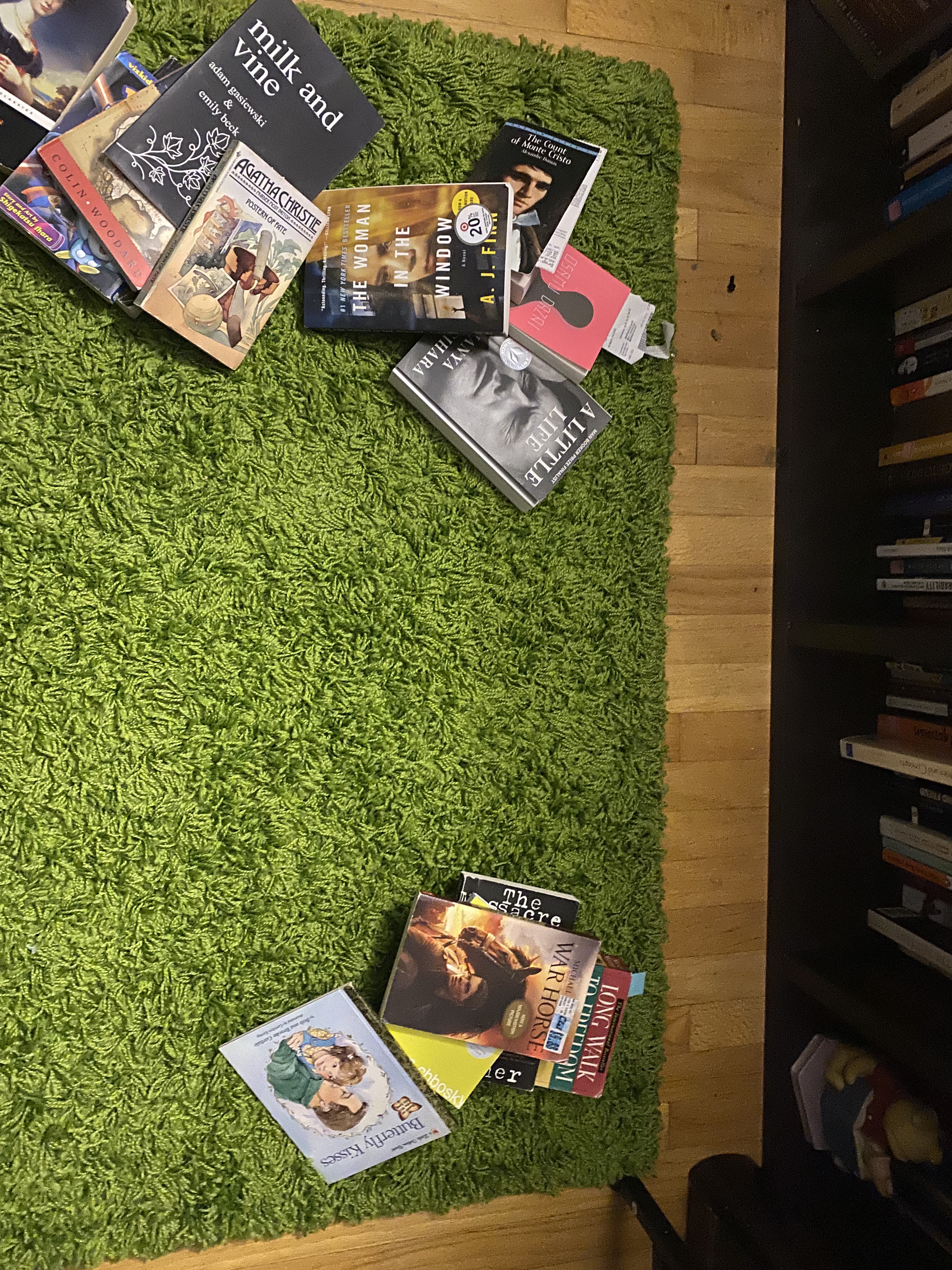
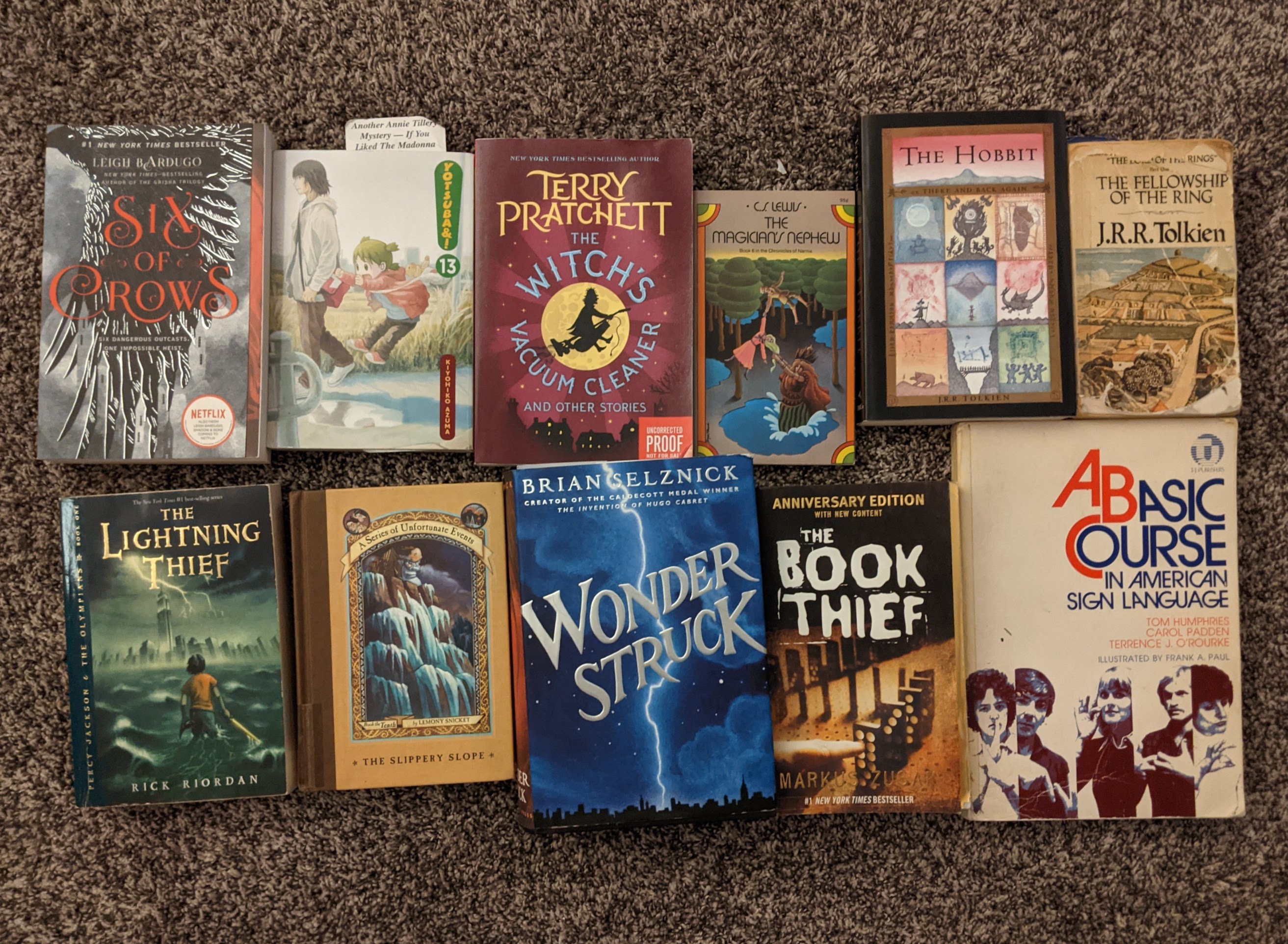
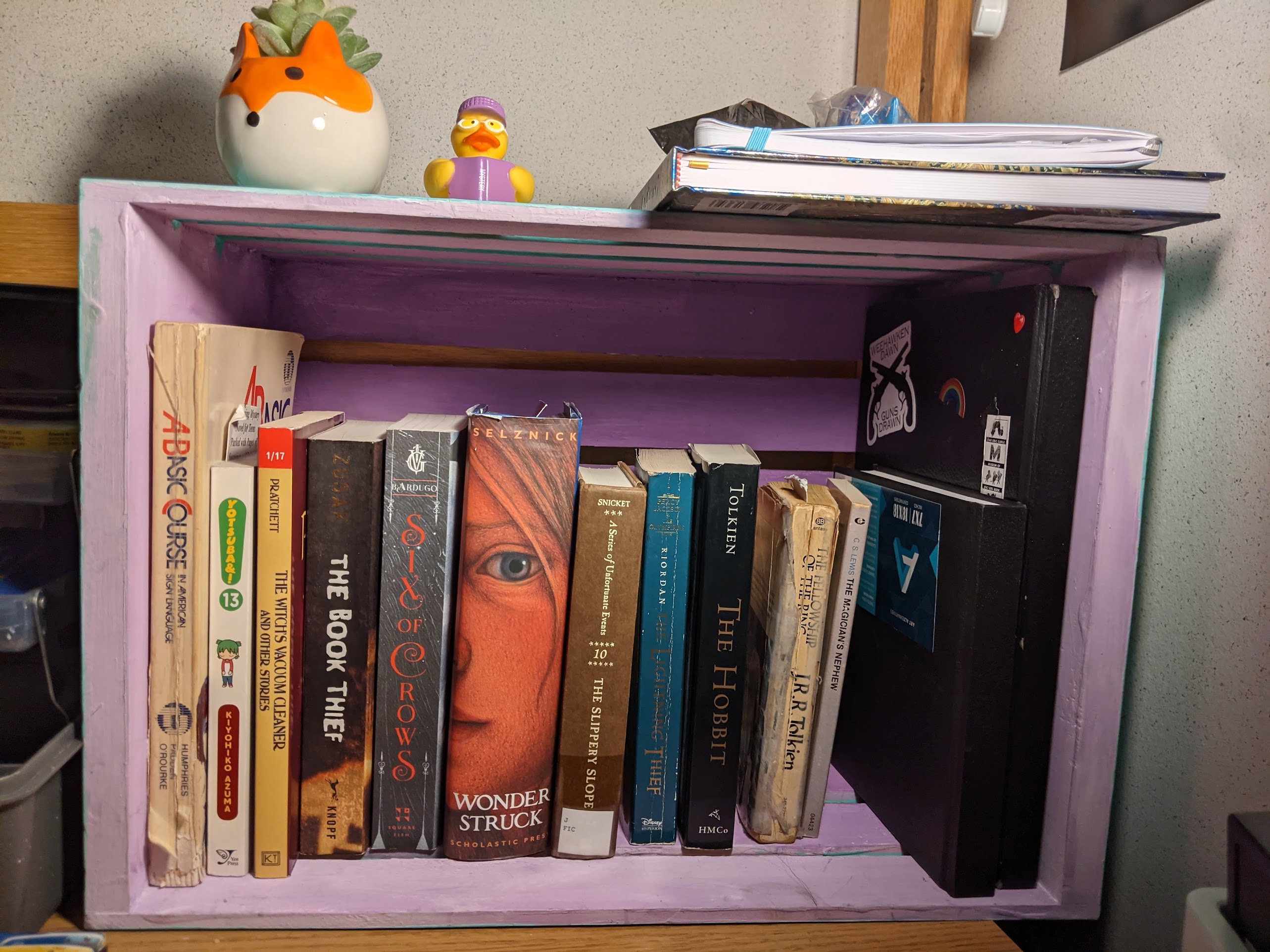
I decided to focus on tidying my books. This is not my whole collection, as I live in a dorm, and most of my things  are already in smaller quantities than they would be in at home. All my books are kept in a painted milk crate that I use as a bookshelf. As you can see it’s starting to overflow. I have books stacked horizontally on top of other books, and some are sitting on top of the crate rather than inside it.

I have collected a lot of books from library and book sales, and the two bookstores in town. Second hand book shops have become a weakness of mine, and I can not seem to leave one without a new purchase.

I also have a number of sketchpads, but I am just going to focus on the books. The first thing I did was take every book that I had and pile them on the center of my floor.

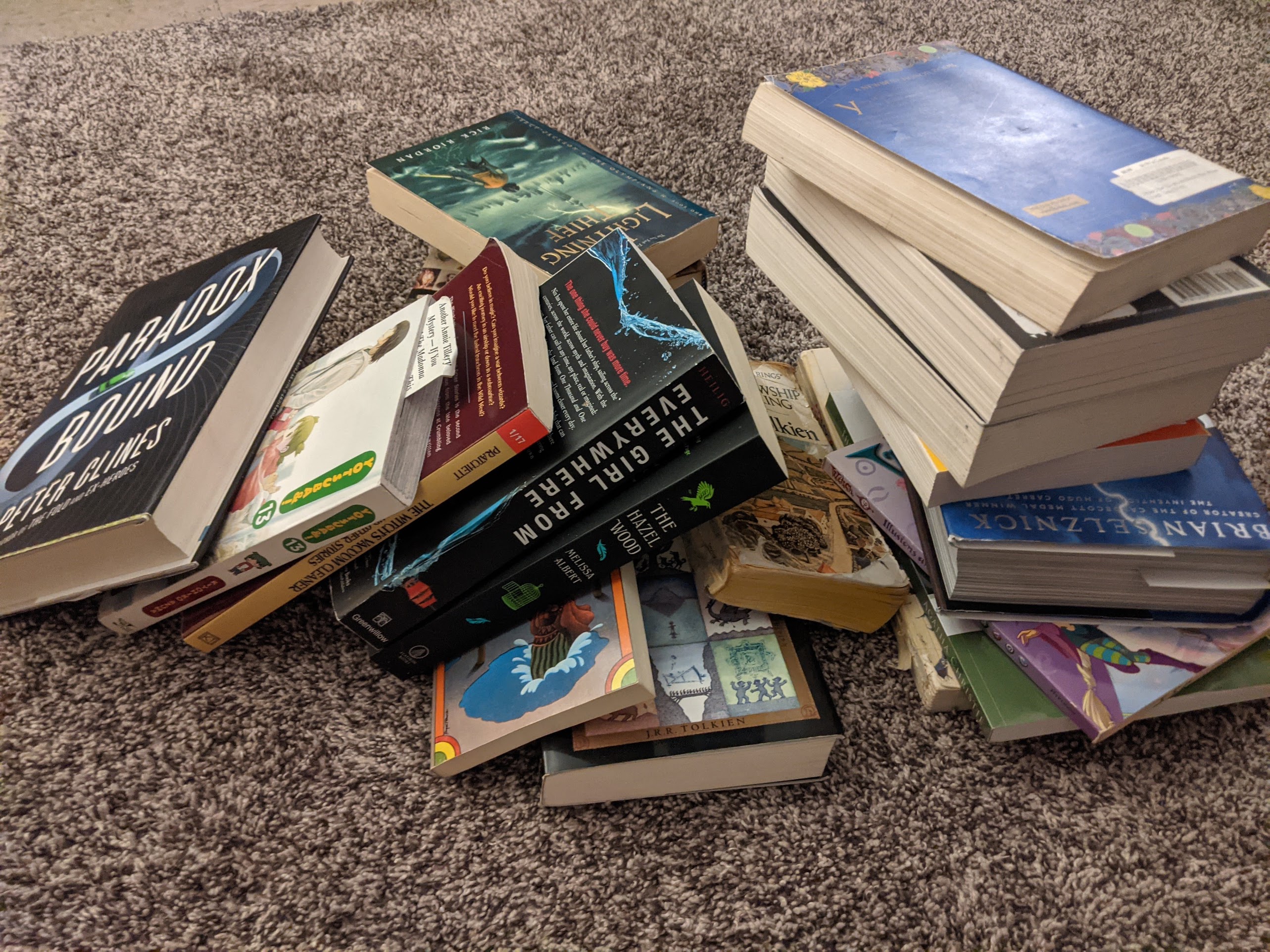
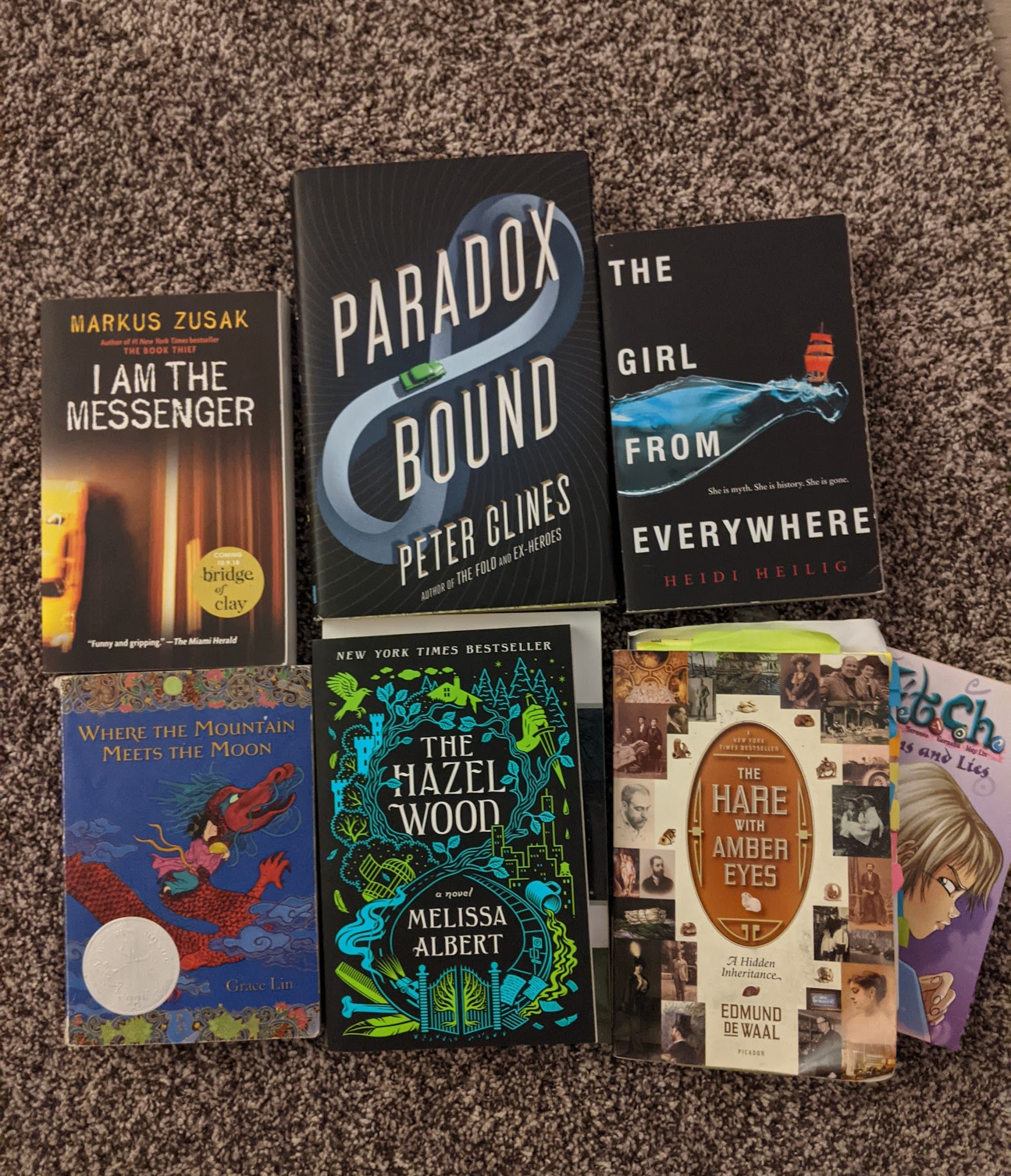
Then I organized the piles so that I could see them all laid out side by side. I had a total of nineteen books.

There were definitely some books that I wanted to keep immediately. The Book Thief is one of my favorite books, so I definitely felt a spark of joy for that one. Wonderstruck is a book that I have always loved, and it has beautiful illustrations. It made me so excited to find it in the bookstore, and I still feel that excitement when I hold it. I have never read Six of Crows, but it was recommended to me, and it was the last book that I bought in my favorite bookstore before it shut down. 

The books that I kept tended to be those that are, or ever were, my favorite books, and books that I had memories attached to. Some of them were part of a series that I had slowly been collecting a set of.

There were some books that I knew that I didn’t want, and I have several that I bought with the intention of giving them away. But there were a few that have been in my reading list for years, and I have never even opened them. I do not even know what The Hazel Wood is about, I just thought it had a pretty cover. While I enjoyed The Hare with Amber Eyes, I put it in this pile because I wanted to give it to my mom. I was always thinking of her while reading it, and it seemed like just the kind of book she would like.

After tidying my books and removing the ones that do not spark joy, I found that my bookshelf was much neater. I no longer have to pack in all of my books, or rest any on top. They all fit side by side. It is much lighter and easier to move around, which will be helpful for moving out of my dorm at the end of the year.

As a young child, I inherited all of the books that my two older siblings grew out of. This led to a bookshelf full of books that I never bought or picked out myself. Whenever I was bored, I would wander over to my bookshelf and find a book that I had never read before, or even realized was there. It was like having my own little bookstore or library, I could always find something new. Of course this did not last forever, and I eventually read and outgrew all of those books. Since I grew up with it, I still want the feeling of being able to find something new in my bookshelf, so I always buy books to save for later. I do not read quite as many books as I used to, so that has started to build up.

Too Many Pants for Only Two Legs

My closet’s overabundance of pants seems to be the category in most need for Marie Kondo’s “joy test”. In the past, I’ve made jokes about how there is only two categories of objects I seem to have no self control over: pants I’ll never wear and sketchbooks I’ll never fill. Since I recently moved into my apartment this past August, I was forced to bring only the pants I would see myself wearing. Once I got to New Paltz, I still continued to purchase pants even when I knew I had no room. Funny how that goes.

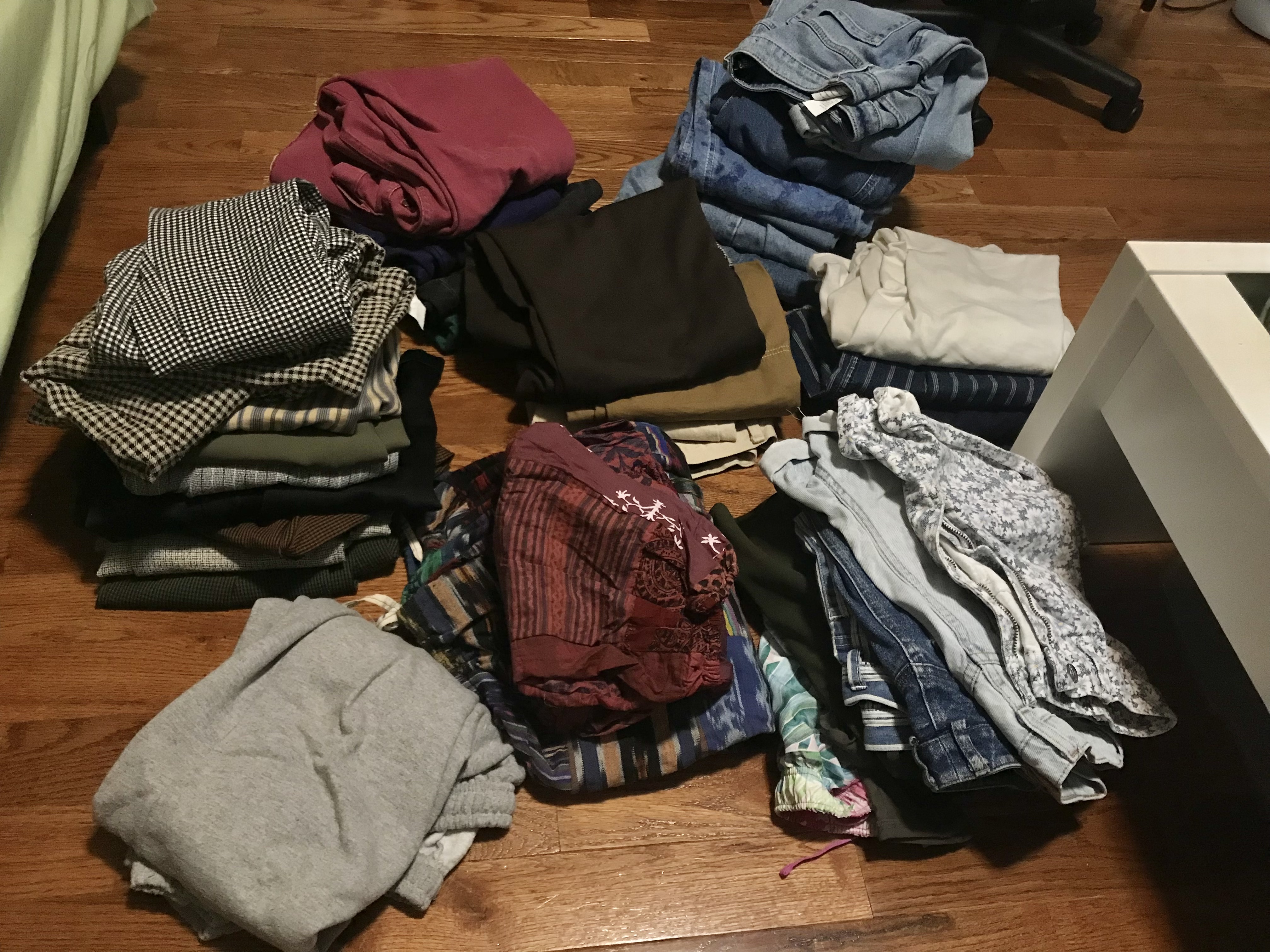
As Marie Kondo suggested, I took out every pair of pants that I had with me and spread them out on the floor. I (embarrassingly) counted 7 pairs of blue denim, 6 pairs of colored denim, 4 khakis, 9 linen/fitted pants, 3 sweatpants, 4 denim shorts, 4 active wear pants, and 2 patterned wide-leg pants. Thirty-nine pairs of bottoms total, and that is only the items I consciously decided to bring to New Paltz, from the larger collection at home. 

The starting pile of pants.

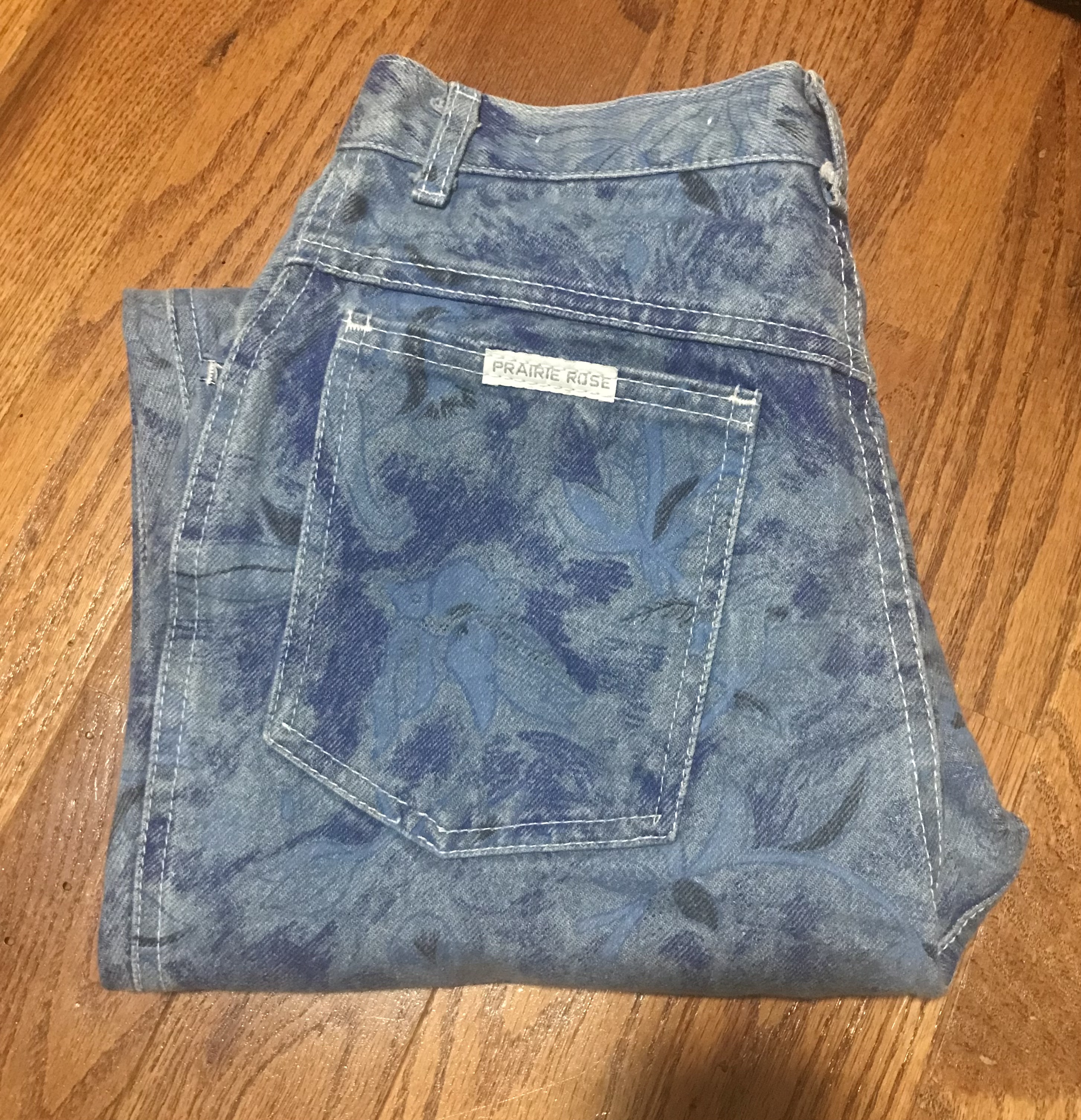
With that, I started the process of holding each individual pair of pants and asking myself if it sparked joy. When I took my pants out of the drawers, I had already categorized them by style/material. I started with my 7 blue denim jeans. I immediately decided to keep 2 medium washed jeans that fit just about perfect. I then had 5 pairs left to consider. One pair was my go-to in high school. They still fit well, look good, but the spark that once lived in the pants has dimmed. I felt the lifespan of the jeans were coming to a close. I thanked the pants for the life it served, and added it as the first discarded item. Another pair struck a response within me. They are paisley jeans that I acquired less than a week ago, gifted from my close housemate. My roommate thrifted them for me, stating “the pants reminded me of you”, and despite her having no idea what my pant size was, she decided to take the risk and bring them home. To our surprise, they fit perfectly. Not only did I have sentiment attached to the jeans because they were gifted, I think the fact that they fit perfectly by chance adds its own magic; this is the joy Marie Kondo is talking about. 

The gifted paisley patterned denim jeans from my roommate.

Next, I moved to colored jeans. I love the pop of color for each of my colored jeans, and that “spark” happened once again, because I was excited at the thought of bright eyeshadow colors I could wear in partner with the pants. I continued this process with each subcategory of pants. I could see my collection gradually getting smaller as more pants were being moved from the floor to my discard dump. After the process was completed, I turned 39 pairs of pants into 19. I looked back at the discard pile and felt no emotional response. The discard pile is fabric, the keep pile is a collection of pieces that express myself and my style.

The pile after exercising Marie Kondo’s joy test.

Reflecting on the work I had just done, I recognized a couple of patterns. Cost of the item never crossed my mind, as the stakes were always low. This is because I was gifted or thrifted every item in my pants collection, with maybe a few coming from the back clearance wall of a JC Penneys. I do not own any articles of clothing that I consider an investment. If anything, I consider value based on the strokes of luck I have with how cheap the deal was. Psychologically, there’s a part of me that likes to brag about “what a good deal I got”, as if it’s some testament to how smart or lucky I am. So when considering the root of “joy”, I might have a brighter spark for a brand new pair of vintage Wranglers that I got for $5, rather than a Forever21 pair of jeans for $15. 

Another pattern I noticed is that I found myself keeping items that are a part of a specific outfit I like to wear. By itself, a pant might not stand out as a stellar item that needs to be kept, but I recognize that it is owned to a larger look. Therefore, the article of clothing must be kept, or else the spark of “joy” the outfit brings would be lost. 

Lastly, I recognized my struggles of letting go seemed to root from the idea that each pair of pant was different. I have this distorted perception in my mind that I should own every style, pattern, and color, of each pant that ever exists, when in reality there is no need. 

Closing the experiment, I was left inspired to actually start donating clothes, considering I could probably eliminate 20 pairs of pants from my closet and feel just alright. However, I know myself too well, and know I would find another 20 new pairs of pants to fill my drawers.

Cleaning Up My Bookshelf

For this assignment I decided to try Kondo’s “joy test” sorting system on some of the books, and papers that were on my shelf, among others small items.

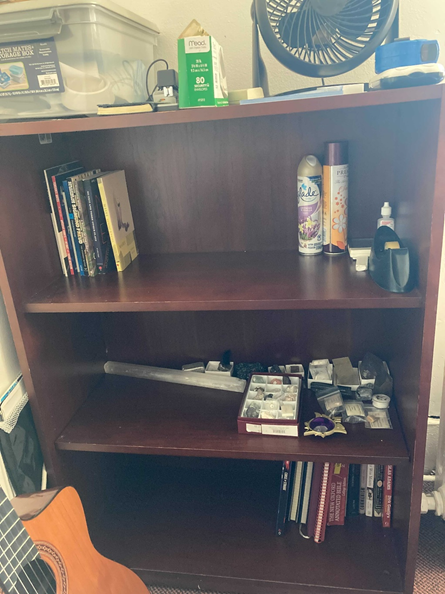
I was fairly neutral about the state of this shelf, but I figured it would be a good place to start. When I took a step back and looked at the things that were on the shelf, I realized that I probably would be ok without a lot of it being out in the open.

The first thing that I immediately decided would have to stay was the rocks and minerals. I cleared out the middle section specifically for them, so I figured I could just arrange them in a neater way and be done with it. If there is anything in this assortment of stuff that really “sparks joy” its my collection. This is just a small portion that I acquired recently but they really hold a special meaning to me. I don’t really spend much on myself, but expanding my collection is one of the few exceptions, as such it is really important to me to keep these close to me and in a place where I can see them and appreciate them.

Next, I moved on to the pencils and pens and other supplies, these I simply moved into a box where I kept other things of that nature. This was the simplest move as I knew where they belonged and had simply neglected to place them in their proper location. The bag of and posters were easily dealt with as well.

The books and papers were the most difficult in my opinion, I usually tend to keep documents and papers for longer than most people as I have a sense they will come in handy down the line. That being said, I was sure that many of these documents were unnecessary, and some of the books I had were either never going to be read or had been read already.

Like the method suggests, I just put all the books and papers on the floor and sorted them vaguely into categories. I separated books from loose papers first, and then sorted the papers into a few sections: Reference material, old assignments, and exams, and miscellaneous. I quickly discarded the miscellaneous pile as It was mostly just junk. I looked through the remaining papers carefully; some of the old labs I have are from freshman year, but I use them as reference when I am doing my job as a teaching assistant. As such, these are important for me to keep on hand, so I put them in a folder for safekeeping. The old assignments and exams were tougher as I keep them to study from. That being said I decided I did not need them at the moments, and they didn’t have to be displayed so openly, so I put them in a separate folder in my closet.

After I had sorted through the papers, I was left with just the books. This proved to a more difficult task, so I started by sorting the books into categories as well. I arranged them based on their uses: books that I need for schoolwork, books that I don’t need for schoolwork at the moment, novels I have read already, and novels I have yet to read as well as miscellaneous. I took the one miscellaneous book and I put it on my piano stand, because I use that one quite frequently. As for the others: I realized that I haven’t referenced any of the older texts since my midterm and I likely won’t need them until my final exams. The notebooks and journals are mostly unused as well, so I relegated them to the bottom shelf, along with the novels I have read already. On my top shelf I basically only have the books that I will need actively continuing the semester.

Overall, this exercise was interesting as I was looking more objectively at these items. Right off the bat I removed the objects that sparked the “most joy”, being the rocks and minerals, I had. The bag of posters was also something I wanted to keep. The issue was mostly with the books and realizing that I probably wouldn’t reread any of the books I had. In this way I was able to separate out most of my materials and even dispose of a lot of stuff I didn’t realize I had. Spreading everything out made the process simpler mentally although more tedious physically, but I can understand where Kondo is coming from in this regard.

An English Major’s Unsurprising Collection of Books

For this assignment, I choose my book collection. I began with approximately 131 books. The idea of getting rid of books, however, troubled me. I came in with a handful of books I know that I actively no longer want. I have a collection of books by Lois Lowry, which creates The Giver Quartet. I have never read past The Giver, and I have never planned to read past The Giver. However, this set was a gift, so I feel sort of guilty giving it away. I had this experience with several other books as well, such as Megyn Kelly’s book Settle for More.

A picture of my full bookshelf, which is slightly slanted because my floors are uneven.

It was a gift from my grandmother, but I have never been interested in autobiographies, especially about people I am completely unfamiliar with. I flipped around the book, read some of the language and felt it was not of interest to me. On the other hand, the book gave me some form of joy, almost like it could spark joy. So, I held onto it a little longer. I began researching the book, and discovered that the book “discusses the unwanted sexual advances she received from Roger Ailes while working at Fox News” (“Settle For More”). I had found this interesting, then began reading some of the reviews on Amazon, and found that she said quite a lot of things that I could not find myself agreeing with. I had mixed feelings about this book; it was a gift from my grandmother, but I didn’t have any desire to read the book. This book was the beginning of my “unsure” pile.

Settle for More by Megyn Kelly.

Recently, I found myself going to a couple bookstores in Kingston. I have a friend who started going to SUNY New Paltz, and she had never been to Kingston before, so I took her to Rough Draft: Bar and Books, and Half Moon Books. At Rough Draft, Gabby recommended to me How to Slowly Kill Yourself and Others in America by Kiese Laymon, so I bought the book. This, however, is a habit of mine. A lot of the books that I purchased that are in my bookshelf I haven’t gotten around to reading yet. These books include Closing Time by Joseph Heller, Siddhartha by Hermann Hesse, One Flew Over the Cuckoo’s Nest by Ken Kesey, and so many more. I suppose part of the “joy-sparking” pleasure in collecting books is the anticipation to read them. Something that sparks joy for me personally, is having someone share their favorite literature with me. Siddhartha was given to me by my girlfriend because she wanted me to have read her favorite book. Knowing that these books were given to me because people I love want me to experience something personal, that is both intangible and tangible, to them makes it more special. Therefore, all books that were gifts/recently purchased absolutely sparked joy in me.

How to Slowly Kill Yourself and Others in America by Kiese Laymon. Picked up at Rough Draft on October 13th, 2021.

Some books, such as the series including The Giver, were easily removed. A few other books I couldn’t remember where I got them. May I Kiss You? By Michael J. Domitrz, my double copy of Where the Girls Are by Susan J. Douglass, The Virgins by Pamela Erens and my double copy of Sheppard Lee, as well as two other books that I couldn’t recall buying/receiving made it into the “discard” pile. For this experiment, I also pretended like I could “discard” my copy of Franklin Evans or The Inebriate by Walt Whitman, which I read for class, because I disliked it so much. All together, I removed ten books. I was surprised I couldn’t get myself to remove more, and ended up putting Settle for More by Megyn Kelly, making it eleven.

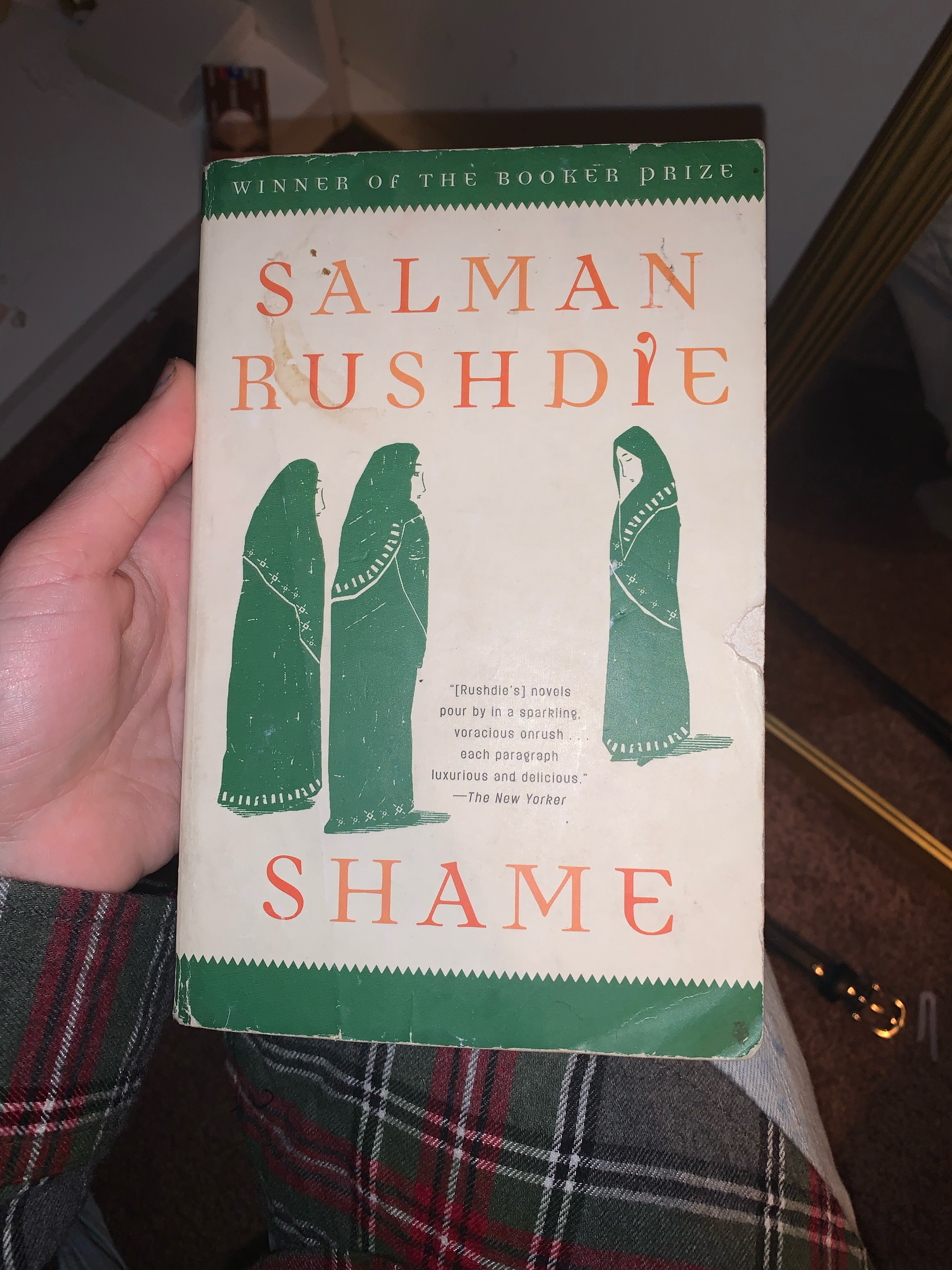
Shame by Salman Rushdie. Book was purchased and read for the Spring 2020 semester in Professor Woods’ Transnational Literature class.

All together, I left feeling pretty emotional. For a period of time, I flipped through Salman Rushdie’s Shame and re-read all of the little notes I left for myself. I read this book at the start of the Covid-19 lockdown, and felt that heart-racing and butterfly-filled stomach-aching (like the original meaning of “tokimeki”). The book was so difficult for me to read at first; I felt so unfamiliar with the language, and there was so much dissonance from myself and the author. Now, I have a tattoo for the book. In class, we’ve spent a lot of time talking about tattoos and how they memorialize objects, experiences and moments as a piece of art.

My tatto memorializing Rushdie’s novel Shame. The language is Urdu, شرم which means ‘sharam’ (shame). The english translation of shame (like tokimeki) is wholly untranslatable.

I also felt a little bit of pride when I was looking at my collection of novels by Angela Carter, which of course sparks joy in me. One of them isn’t featured in the picture since I am currently reading it, but I remembered the excitement I felt upon my attempt to collect all of her books. The book titled Honeybuzzard is a first-printing from 1966. The book is now called Shadow Dance, so it feels heart-warming to own the novel with its original name. 

My collection of novels/books/short stories by Angela Carter, including Honeybuzzard.

At the end of this experiment, I still had over a hundred books, which came to no surprise. This particular collection is the most valuable to me. I know that reading and literature holds a special place in my heart, so making room for more books (both on my bookshelf and in my heart) is always possible. Something I noticed was how the books that sparked the most joy were also the books that I had written in and highlighted. Maintaining the pureness and integrity feels unimportant: I want them to be specifically mine, with my own thoughts and notes inside of them. 

The first row of my book collection (An-Co).
The second row of my book collection (Co-Ha).
The third row of my book collection (He-Mo).
The fourth row of my book collection (Mo-St). I did not include a picture of the fourth row.