A Plastic Water Bottle

I’ve decided to choose a plastic water bottle for this project. It’s an old Poland Spring bottle I drank a few days ago and forgot to throw out. While this item does not have any personal significance to me, I thought it fit this assignment as it’s something that many people have used and have never given much thought towards. I think that by learning where and how these small plastic bottles are made, we can better understand how to deal with the consequences of their mass production. 

First, it’s important to discuss the water itself. Poland Spring (and it’s parent company, Nestle) claim that it gets its water from natural springs, which is correct. What it fails to mention is that the company doesn’t harvest the water itself but rather buys it from the water suppliers for local towns. These towns are the ones who collect the spring water and refine it, but Poland Spring buys and bottles it. This has led to several controversies over the years, such as towns running low on drinking water for its citizens due to a larger than expected purchase from Poland Spring. What was interesting to me is how Poland Spring managed to twist the origin of where the water comes from to make it seem as though they are the providers of water itself, and despite this we still buy bottled water on our campus despite having access to reusable water bottles and several dozen water fountains spread out around campus. 

While the origin of the water has its own history, what I was really interested in was the origin of the bottle itself. About 60 million plastic bottles are thrown away every day, and most end up in landfills. This is devastating to the environment and shows that despite the societal movement to recycle, we as a society throw out far too much trash. 

But this issue is in part caused by an overabundance of trash to begin with, or rather a surplus of trash as a result of our general way of life. For example, the US is predicted to produce over 1.5 billion plastic bottles in the year 2021. Each of these bottles will be drunk from, and while some may be recycled, studies show that the majority will be thrown into landfills. This raises the question: where do all of these bottles come from? While there are several sources for these water bottles, their biggest exporter is China who is responsible for producing around 30% of the world’s plastic products. Other exporters of plastic products, including water bottles, include Germany, the United States, France and Italy. With all of these global superpowers producing such a high quantity of plastic products, it’s no wonder why plastic bottles contribute to so much of the planet’s waste.

While I couldn’t find much information about the location where my specific water bottle was made and sealed, there was still much I learned from researching the origins of the bottle’s core components. What fascinated me the most was how the plastic that made the water, as well as the water itself, likely came from a large first-world country. Going into this assignment I was under the impression that a lot of the water bottled by Poland Spring was taken from smaller springs from less developed countries but it was interesting to see how little the creation of these water bottles actually influenced smaller countries and their economies. 

Sources:

https://www.statista.com/statistics/723191/production-of-polyethylene-terephthalate-bottles-worldwide/

https://healthyhumanlife.com/blogs/news/plastic-water-bottle-pollution-plastic-bottles-end

A Pair of Silver Earrings

The object I’ve chosen to discuss is a pair of silver earrings. I purchased them today at the farmer’s market that is held on campus every Thursday. The vendor assured me that they were sterling silver, and the little 925 engraved on the hook of each earring confirmed this. Sterling silver jewelry should have the 925 engraved on it somewhere. This indicates that 92.5% of the metal is pure silver, and the remaining 7.5% is alloy, usually copper. This is a standard ratio for sterling silver that is utilized by most countries, with the exception of some places like France which use a higher percentage of pure silver. The reason for this is because pure silver, which is 99.9% silver, is too soft to make jewelry with. It’s mixed with harder metals to make products like jewelry and silverware, stronger and more durable.

The earrings are bell-shaped hoops, with a downward point at the bottom. The edges are scalloped. Each earring is no larger than a quarter.

I have no idea where the vendor acquired the earrings, but I know they were not brand-new. Everything he had for sale was second-hand; clothing, jewelry, books, CD’s, and other paraphernalia that he had collected over the years. The price tag on each item he had labeled and applied himself. Because of the fact that there was no original tag or brand attached to the earrings, it would make it even more difficult for me to try to find its origin.

Silver is a natural resource found all over the world, from South America to Europe, and even in the U.S. In 2020, the top 5 silver-producing countries were; Mexico, Peru, China, Chile, and Australia. My earrings could have been mined as nearby as “The Rochester Mine” in Nevada, or as far away as Potosí, the famous Bolivian mining town.

Today, silver comes from 3 main sources: silver mining; silver produced as a by-product of mining for other metals; and silver recycled from used materials. By which of these methods my earrings were produced there is no way to know. However, at least 80% of the world’s silver today is produced as a by-product of mining for other metals, so there is a high chance my earrings were the result of a surprise finding.

To mine silver, miners must go into open pits or in underground mine tunnels. They pack explosives into holes drilled into rock and blast it into smaller pieces. Once the ore has been collected, there are a variety of extraction techniques for the actual silver, which vary based on the type of ore. The techniques include mixing certain chemicals and powders to dissolve parts of the ore, or melting the ore and using filtration processes to separate the metals.

Once the silver has been mined and either exported or brought to a local factory, the process of manufacturing jewelry, specifically earrings in this case, begins. The silver and its alloy are mixed in molten form, and it is then poured into a stainless steel mold where it cools and hardens into a thick hunk of metal. This thick piece of metal is subject to various processes, consisting of flattening, lengthening, soldering, buffing, and other various technical processes that I don’t understand well enough to try to explain.

The labor that goes into this process is perhaps near impossible for me to detail. There are overlooked laborers such as the ones driving the trucks with the metals in it, the ones responsible for ensuring proper mine ventilation, the engineers who make sure the machines used in manufacturing are up to par. The labor that I have more of a grasp of are the individuals working in the mines, literally blowing up rock at the endangerment of their own lives. While there is ventilation in the mines, the air pollution coupled with working in such tight spaces is hazardous to their health. The temperature that deep in the earth can be over 110°F, enabling the possibility of dehydration and other serious heat-related medical emergencies.

I remember the news story a little over a decade ago of the 33 Chilean copper miners who had become trapped underground when the mine collapsed on them. They were there for more than 2 weeks before being rescued. They all survived. They got lucky.

The sourcing and manufacturing of silver for jewelry is more complex than can be done justice in 800 words. This assignment allowed me to better understand all of the manpower, environmental and human strain, and the many facets that went into making what was to me, a simple pair of silver earrings. I no longer see them as simple, and I appreciate them even more.

Sources:

https://www.sciencechannel.com/show/how-its-made-science

https://www.thenaturalsapphirecompany.com/education/precious-metal-mining-refining-techniques/silver-mining-refining/

Harry Potter Pens

(Left to right: Voldemort, Harry, Snape)

I have grown up with a relatively big immediate family. I am one of four girls, so as you can imagine getting Christmas presents for everyone can become rather expensive. Because of this in my house, we do secret Santa among my siblings. Last year for Christmas my sister Sara got me a collection of Harry Potter pens that are made to look like character wands. In the set, I received Harry’s, Snape’s, and Voldemort’s “wand”. I tend to get a little wary when asking for pens because I can really only use ones that are ballpoint. Gel pens are an absolute disaster in my hands, as whenever I use them a trail of smudged ink will follow (blame it on being a lefty). I also have a thing against blue ink pens, as they tend to make my notes look sloppier.

    Upon inspection of the pens I received, I was beyond pleased to realize that they were both ballpoint and black inked. Over the last year, these pens have become my absolute favorite, and I use them whenever I can. Unlike some pens that tend to have a lighter ink (I’m looking at you Bic Round Stic), these pens are prominently black and almost have the same boldness as a fine point sharpie. They also have a medium point tip allowing the writing to be more fluid than when using a fine point pen, which can write choppily. 

As found in the “about this item” section on Amazon these pens are made from ergonomic durable plastic and are officially considered part of the Harry Potter Merchandise. The plastic from Harry’s “wand” was molded to mimic the wood used for the wands. The plastic shaft has been painted the color holly (the wood his wand is made from). When you reach the “handle” of the “wand” it becomes wider in size and is carved to match the jagged wood handle we see in the movies. The handle of the pen is no longer holly colored but black.

Severus Snape’s pen is fully jet black and is said to be made from ebony. Unlike Harry’s wand, there is no molding to be made to look like wood, instead, the shaft is completely smoothed. The handle of the “wand” is divided into two columns separated by a thick black ring. These black rings can also be found at the top of the first column and the bottom of the second. The columns contain intricate carvings of symbols that have been hypothesized to make the “wand” more capable of dark magic.

The last wand/pen is Voldemort’s. The entirety of the pen is ivory, as his wand is said to be made with yew wood. Just like Snape’s wand, the shaft of the wand is completely smooth. The handle of this wand is where we see incredible detail. “Carved” in a hook-like manner the handle of this wand was created to mimic bone. When looking carefully at the handle of this wand there are small areas that are left unpainted (assumingly to give it more depth) which expose a clear material underneath. This material seems to be the plastic the exterior of the pen was molded from. 

    When looking at the shaft of the pens in small black writing is information from how these pens are created. The first title I recognize is Seven20. Seven20, also known as Underground Toy company in the U.K. This company was initially stationed in the U.K. but has begun to branch off into the U.S. for marketing and production time reasons.  This company is also known for the infamous Funko Pop toys as well. This product is designed and licensed under the Seven20 brand. 

Once the product is designed it is sent over to a factory in China where the pen is then produced. I couldn’t find anything on the factory that produces these products. However, once created these products are sent to warehouses located in both the U.K. and the U.S. From the Seven20 warehouses, products are then distributed to stores and warehouses such as Target and The River Colony trade, which is the company Amazon uses to sell and distribute these pens. The River Colony Trading resells goods produced from other companies (such as Seven20). This business address is located in Connecticut.

    When trying to map out the journey my pens took, this is how I believe it proceeded. It started in a design studio in the U.S. From there the product design was sent over to the factory in China, where workers manufactured the product. After manufacturing, it was sent back over to the United States on a plane or cargo ship. The Seven20 warehouses then distributed the product to the specific warehouse, in this case, the River Colony Trading site, where it sits until someone purchases the product through a site (like Amazon). Once the item is bought it is packaged, labeled, and shipped to the buyer’s house. 

Link to References 

https://www.amazon.com/sp?_encoding=UTF8&asin=&isAmazonFulfilled=1&isCBA=&marketplaceID=ATVPDKIKX0DER&orderID=&protocol=current&seller=A1B7M9EQGNCLQA&sshmPath=

https://licensinginternational.org/news/seven-20-brands-former-underground-toys-u-s-to-focus-on-housewares-toys/

https://www.amazon.com/Harry-Potter-Wand-Pens-Pack/dp/B08PDSZKX1/ref=asc_df_B08PDSZKX1/?tag=hyprod-20&linkCode=df0&hvadid=475690120006&hvpos=&hvnetw=g&hvrand=6317465216951890356&hvpone=&hvptwo=&hvqmt=&hvdev=c&hvdvcmdl=&hvlocint=&hvlocphy=9004843&hvtargid=pla-1131898528970&psc=1

Village Candle meets the Village of New Paltz

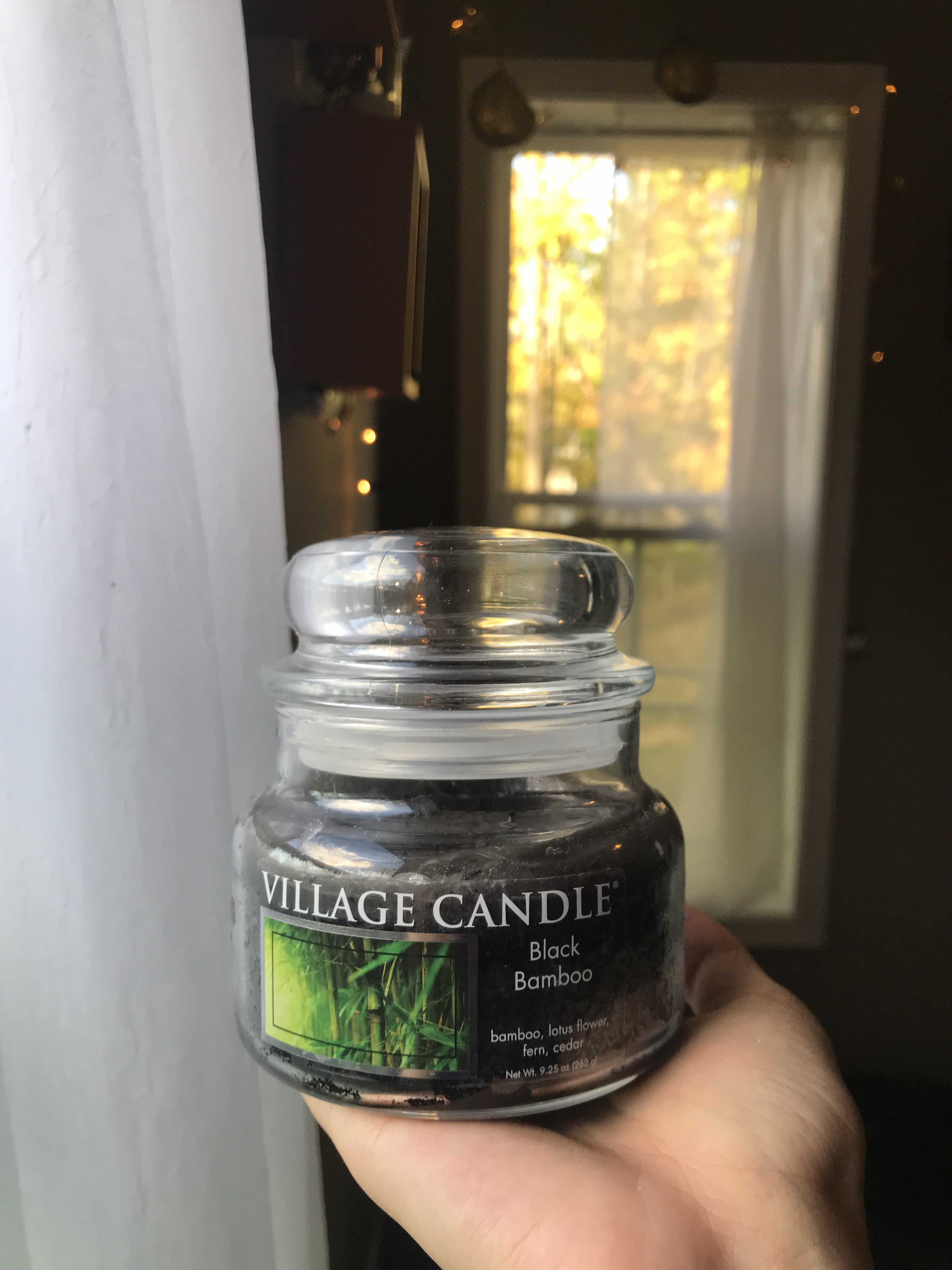
Just this past Tuesday, I had walked into aisle 14 of Tops and bought a Black Bamboo candle by the brand of Village Candle. The object itself is a glass jar about 4 inches wide, with black scented candle wax inside, 2 wicks, and a glass lid with a rubber seal. A sticker label on the bottom of the glass jar states the candle is made in “Wells, Maine, U.S.A”, which gives me some sort of geographical insight. As I looked closer, on the edge of the rubber seal, “MADE IN THE USA” is printed, which confirms to me that in addition to the candle, the glass jar is also produced in the United States. 

I began to research a little bit about the company. How did this company start? Where was it founded? According to the Village Candle website, the Village Candle company started in 1993 on a kitchen stovetop in the home of, founder, Paul Aldrich. He pursued his candle-making hobby as a business and as demands grew, he was able to move his at-home business to a 2,500 sq ft space in Yarmouth, Maine. With continuing success, Village Candle grew into a large candle company owned by the parent company of Stonewall Kitchen, with both United States and international sales. 

Self proclaimed on the website, the candles are born in Maine with meticulous care and craftsmanship. Each candle is crafted with a blend of food grade paraffin wax for a clean and safe burn. With the emphasis of cleanliness and safety, I decided to first take a look at the wax. Paraffin wax is derived from petroleum, coal or oil shale- that consists of hydrocarbon molecules containing 20-40 carbon atoms. Historically, paraffin wax was first created by the German chemist Karl von Reichenbach in 1830. The creation of paraffin wax paved way for developments in candlemaking, because it was clean, reliable, and cheap. With the addition of stearic acid, the candlemaking industry was able to produce efficiently made candles with high melting points. During the early 1900s as meat and oil industries grew, paraffin and stearic acid were byproducts of these productions- leading to a growth in paraffin wax production. For paraffin’s manufacturing process, slack wax is used as the feedstock, which is a byproduct from the refining of lubricating oil. To remove the oils from slack wax, the wax goes through a process of heating, resulting in crystallization and separation between oil and wax. The wax is then filtered and further processed. Because the paraffin wax is naturally white, liquid dye is used to add the black color of my candle. In addition to candle making, paraffin wax is commonly used for lubrication, electrical insulation, cosmetics, and crayons. Throughout my deconstruction research process of paraffin wax, I found out that word itself can be deconstructed. Paraffin derives from the latin word, “parum” which means “lacking affinity” or “lacking reactivity”. Paraffin wax has such an unreative nature, which allows for many different uses.

Besides wax, the fragrance is one of the most important components of a candle. They state that the fragrances include pure essential oils and plant extracts from around the world. My Black Bamboo candle states it includes bamboo, lotus flower, fern, and cedar fragrances. These plant extracts for the fragrances derive from oils, which come from their various native areas of the world; bamboo and lotus flowers are native to Asia, ferns are native to eastern North America, and cedar is native to the Mediterranean region. At around 185 degrees Farenheit, the dye and fragrance oils are able to chemically bond with the paraffin wax. Once prepared, they are distributed into the glass jars, along with the paper and pure cotton core wicks. 

Stated on their website, each candle is quality checked and the wicks are hand trimmed by the Village Candles team. I imagine after my candle jar is filled, hardened, and cured, the jar was checked for any errors by detail driven workers. Once screened, the wicks are hand-cut and placed in boxes, ready to be shipped at the designated locations. Shipped from Wells, Maine, in a truck- the candle travels to New Paltz and distributed at the local grocery store, for a likely young part-time student to unpack and place on the shelf. Through this journey of preparations, manufacturing, packaging, and transportation, the candle finally finds a home in my bedroom of New Paltz.

Sources:

https://www.prweb.com/releases/2018/04/prweb15418054.htm

https://www.stonewallkitchen.com/village-candle-behind-the-scenes/village-candle-behind-the-scents.html

https://web.archive.org/web/20120630024342/http://bitumenengineering.com/materials/paraffin-wax

https://www.oxfordlearnersdictionaries.com/us/definition/english/paraffin

Handmade with Love

The object I choose is one of my favorite dresses that I currently own. This dress is very special to me for many reasons, including how to came to be in my possession and the meaning I now have come to associate with it through determining its origins. 

This tie-dye sun and moon maxi dress was found at a thrift store in Beacon, NY, back in 2017. I happened to stumble upon this dress through the many racks that the store had lined up from door to practically ceiling it felt like. To my surprise, upon first trying it on, I was taken aback that it fit me to a tee, unlike many thrift store finds as we all know are usually way too big or a tad too small. I knew at that moment this dress was made for me and I had to purchase it. Since that spring day nearly five years ago, I have had this dress and have worn it to many fun and memorable occasions.

I never before honestly thought about the life this dress had before me. Before I stumbled across this great find, it undoubtedly belonged to someone else who had discarded it and given it up to the thrift shop, but for what reason? There are no stains, rips, or tears, no visible reason I saw that someone would not want this beautiful attire anymore. Could it simply be that this person didn’t want it in their closet anymore or was cleaning out their wardrobe as so many of us have done with the changing of seasons? It wasn’t until I was searching for a tag on the dress itself, a marker of sorts to where the origins of this dress perhaps were. The search was futile but also, at the same time, eye-opening. There was no tag, no place where a label may have been or ever was. This can only mean one thing, and as a fellow creative, I knew that this dress was handmade. 

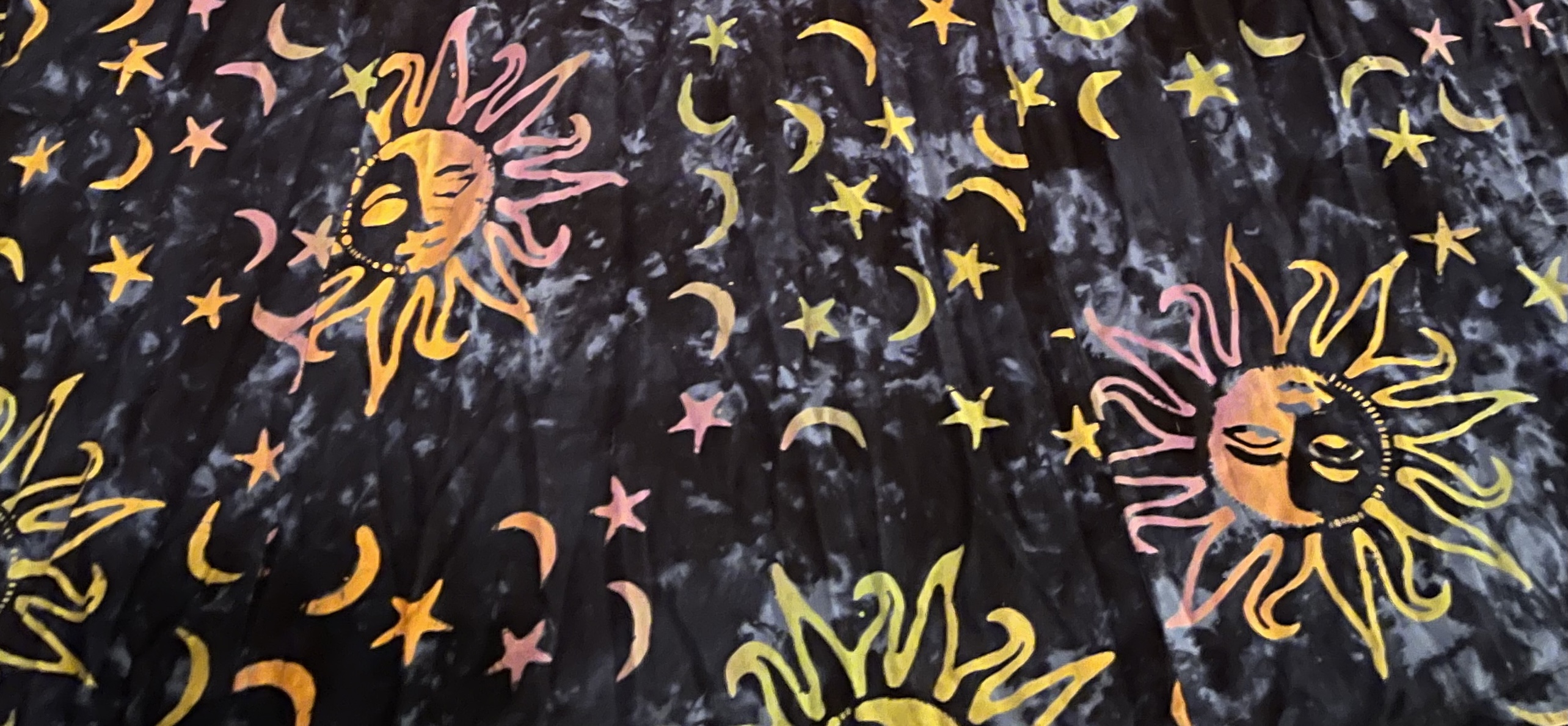
The tie-dye sun and moon fabric are unique, and you can tell that the background indigo fabric was, in fact, hand-dyed, and the stencils of the celestial beings are placed in different spots. This fabric itself is a handmade pattern that is unique unto itself. The rainbow-colored dyes used in both the moon and sun are rich and look as if they are from a tie-dye kit that includes all the primary ROYGBIV colors. As someone who has done the practice of tie-dye before, this is familiar to me, and after looking at it so close, it was something I recognized immediately. The buttons themselves have the fabric sewn onto them and are gently attached to the dress by a simple stitch using navy embroidery thread. It could be from the many times I have worn this dress or even perhaps from the life it had before me, but the thread that holds the button is very fragile and looks as if one or two of the buttons could detach at any second, adding that that handmade touch once more. The last detail that caught my eye was the hem of the dress. On the bottom, you can see that the hem isn’t perfectly straight and looks as if an amateur on a sewing machine was the one behind this creation. If this was a mass-produced dress, the hemlines would be perfectly level. The buttons would be securely fastened to the dress, and the fabric would not be as individualized as it is. Seeing and breaking down all of these details and coming to understand that this dress was made by a lovely artist was heartwarming to me.

The origins of the person are unknown to me, and since 2017, that thrift shop on Main Street in Beacon has closed its doors. I wonder if I had the opportunity to go back there and ask if any local up-and-coming fashion designers or even just everyday crafters had come looking to get their pieces out there, that maybe I could know who is responsible for this beautiful creation. I feel as if I will never truly know, but now I do know that I own a one-of-a-kind piece that I will keep with me forever. I always knew that I felt connected to this dress as if it was made just for me, and I like to think that maybe it really was.

Polymer EVA Sandals

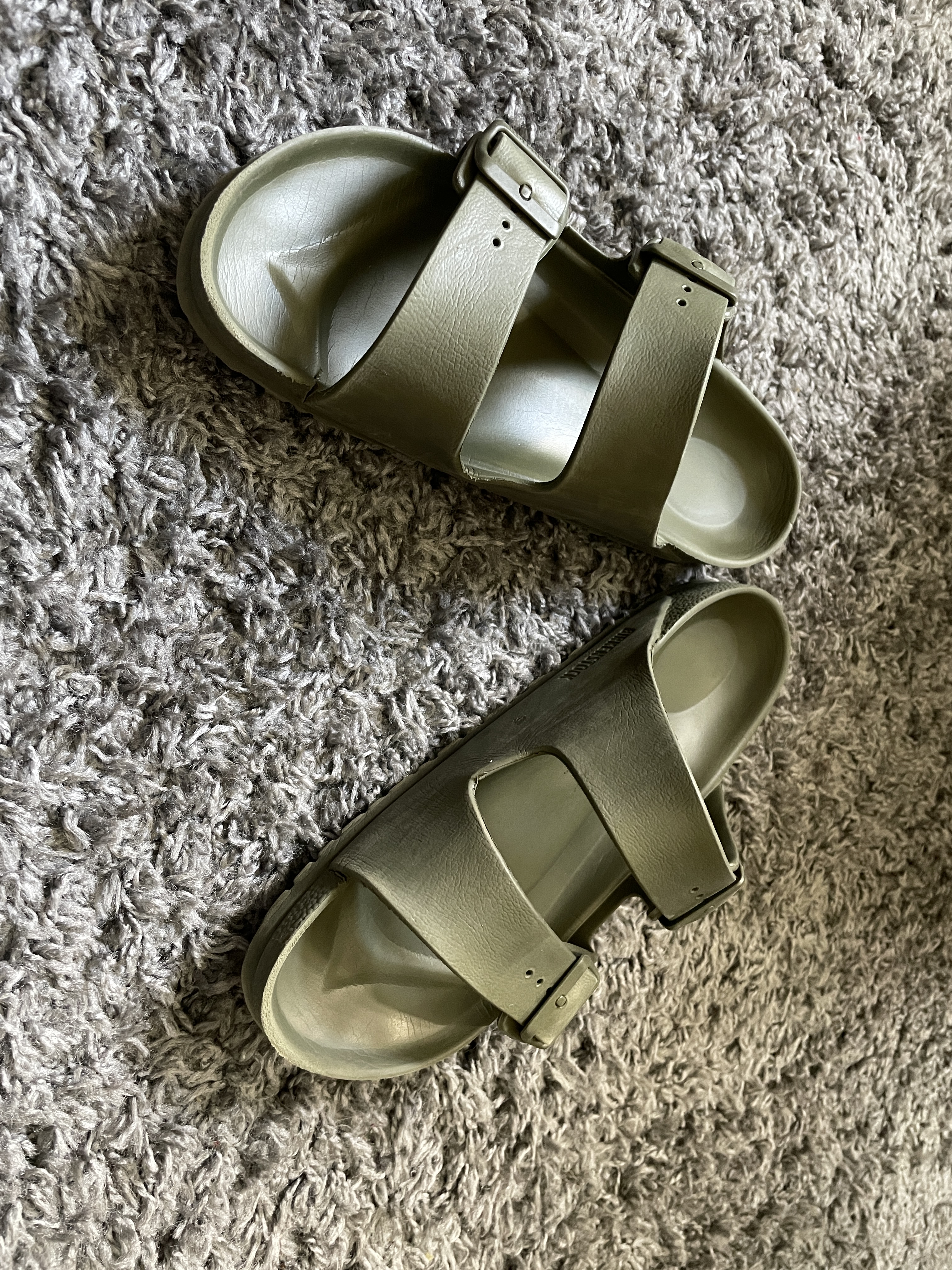
The summer of 2021 was one in which I wore the same pair of boots almost every day. They were functional, comfortable, and (if I say so myself) quite good-looking. This was not an issue until I started thinking about moving back to New Paltz where I would not want to wear the same, beaten and stained leather boots each day. So, I decided to purchase a pair of sandals that a friend of mine wears all the time. The forest green closed cell foam (basically a type of plastic that does not have bubbles between the material) Birkenstocks were on the top of my list for items I wanted for school. I did some online research that brought me to the Birkenstock website. My thrifty self found a solid student discount which solidified my choice to purchase the sandals.
Birkenstock plastic sandals are branded as polymer EVAs which holds little to no meaning for the common person. Ethylene-vinyl acetate (EVA) is a commonly used material that has desirable qualities for plastic sandals. It is lightweight, waterproof, and very elastic which makes it a versatile option when making plastic shoes. Crocs and various other plastic shoes utilize EVA to make quality footwear.

The specific manufacturer that supplies Birkenstock seems to be hidden in some hole in the abyss of the internet but based on Birkenstock’s vow to hold dealings in Germany, one can speculate the company Biesterfeld is the supplier. They are a family-owned company based out of Germany that provides over 30 countries with various plastics. They are known for EVA, so my best guess is they supply Birkenstock with the plastic used for the polymer EVAs.

The production of EVA happens through a process in which the compounds ethylene and vinyl acetate are mixed then compressed under significant pressure to create the material. It typically leaves the high-pressure reactor in long sheets that are then sent off to the companies that use the material. This allows companies like Birkenstock to work the closed cell foam in whatever way they need to.

The metal buckle that holds the straps across the sandal holds mystery when it comes to their origin. Birkenstock’s website delves into the quality of the metal but does not have any sourcing information. The nickel-free metal that is used has the company name etched on the side. The metal is enameled several times which prevents wear. The protective enamel allows the buckle to last longer while maintaining its original glory.

These sandals that typically go for $44.95 are made in Germany. The company prides itself on having their manufacturing happen in the country they are based in. From a quick Google search about where they are made one can gather the working conditions in the factories are ethically acceptable. They claim to have the best working conditions in their production factories which makes me (the consumer) feel better about purchasing new sandals. The steep price points of many products from Birkenstock reflect the fair wages paid to their employees.

Companies such as Birkenstock are fascinating in their ideas about keeping production close to home. They have created a company that consumers do not have to feel bad about purchasing from. Fair treatment of workers and sourcing locally each have their financial drawbacks that Birkenstock is willing to endure to run an ethical company.    

Cubic Galena Crystals

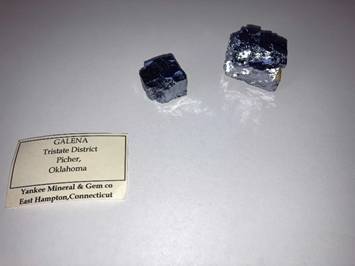
The object I have chosen, is a set of galena crystals. Galena is a sulfide mineral meaning it is a metal atom bonded to a sulfide atom, in this case Lead as lead sulfide PbS. It is safe to handle however, and as long it isn’t ingested it is harmless. The chemical structure of the mineral leads it to have a very cubic shape, and it even breaks off into cubic pieces and makes some step like features on the surface of the crystal. They have a very metallic appearance and a shiny luster; The crystals are silvery gray in color and are fairly soft, for a metal. The smaller cube is about half an inch on each side while the larger cube is about an inch on each side. The larger cube has some brown corrosion on the edge which could be oxidation. There are some spots that are not reflective which are likely spots of lead carbonate tarnish. The actual density of the galena crystals is quite high and feel quite heavy when held in the hand. They are cool and metallic to the touch, and if rubbed sometimes leave a black streak on the fingers, the actual container for the larger crystal is covered with silvery gray marks. They are several times heavier than a typical rock of the same size and weigh about as much as a heavy smartphone. The smaller cube was packaged in a small plastic bag with the name card displayed, the larger piece was simply put in a small carboard box. They were both wrapped in paper towels and bagged in brown paper bags to prevent scratches and damage. I kept the minerals with the others and just kept them in my bag.

The two samples are actually from two different places. The larger piece is from Peru, however there isn’t much more information on this one, however there are a few regions in Peru known for sulfide mines. The smaller piece is from the tristate district in Picher, Oklahoma. The Tri-state district is known for its sulfide deposits and are mined for many metals like Zinc and Lead. There are many mines in this area, so it is difficult to know from which this crystal was sourced. Galena of low quality is often just pulverized and used for ore use, while the nicer pieces are sometimes saved for mineral collectors. The crystal was purchased by the Yankee Mineral company which is regional collector of minerals and gemstones. I was able to buy this sample at the Poughkeepsie Mineral Show, the smaller cube was three dollars while I purchased the larger piece for eight dollars. I purchased many other samples of various minerals from various sellers including some large gypsum, garnets, some calcite rhombs, a hardness kit, silicon carbide and some glass crystals. As for the transport between the fair and my residence, the geology club offered a ride to the fair for students, and we took the department’s vans to the fair.

Magnifying Family History: My Mom’s Panzer Binoculars

For this assignment I have decided to research the history/family history behind a pair of Panzer Tank Binoculars. Before starting this assignment I had wrongly assumed that my family didn’t have many family heirlooms, due mainly to the fact that anything I know about my family has come from stories told to me by my mom and that any heirlooms we did have were given to my Uncle or in the possession of my Grandma. However, when I asked my mom if we had any heirloom, she said yes proving my assumption incorrect and told me that she had tons.

Upon doing my research about the Panzer Tank Binoculars I was able to learn that they had been used by German Tank Crews during World War II. Finding this out immediately led me to wonder how my family had gotten in possession of a pair of binoculars used by Nazi soldiers during WWII. Prior to my research, I had already known that my great grandma, on my mother’s side, had left Germany to come to America, right as Hitler had been taking power before WWII. She had been worried , rightfully so, about what Hitler would do, which was sadly not the case for many others who had eventually been affected by the hatred that Hitler had spread throughout Germany and the rest of Europe. It is from this, and from further confirmation by my mom, that I know that the binoculars hadn’t been in my family’s possession due to their involvement as Nazis during WWII. In fact, my mom has always told me that my great grandmother wouldn’t teach her German because of what had happened in Germany making it clear that my family was not in support of anything that Hitler had done prior to and during WWII.

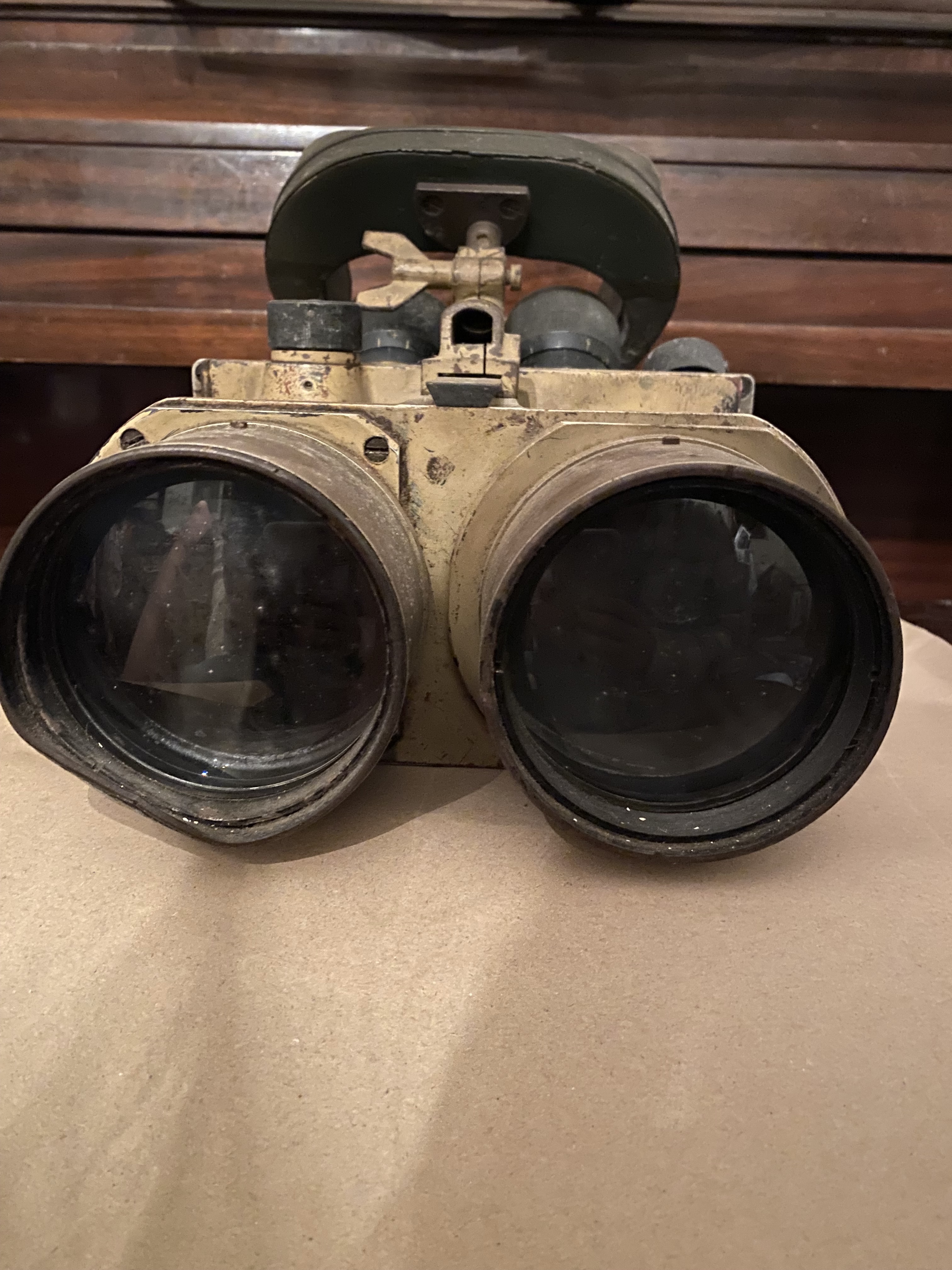
The binoculars are extremely heavy and weigh about 20 pounds, holding them is like holding at least 2 big science textbooks at the same time. They are made of metal and have a rubber guard surrounding the two eyepieces that protrude out from the binoculars. At the base of the eyepieces are visible adjusters, mostly likely for adjusting the focus of the binoculars. On the top of the binoculars is another adjustor knob, but I am unsure of its use. The binoculars appear to have been painted gold over top a brick red color, which has started to come through in multiple places. The bottom of the binoculars is flat, most likely to allow for the binoculars to rest on a surface without being wrecked. The lenses themselves take up the whole front of the binoculars. The binoculars at the lenses are approximately 8 inches wide and are almost a foot long, 11.5 inches, from the base of the eye piece to the lenses,

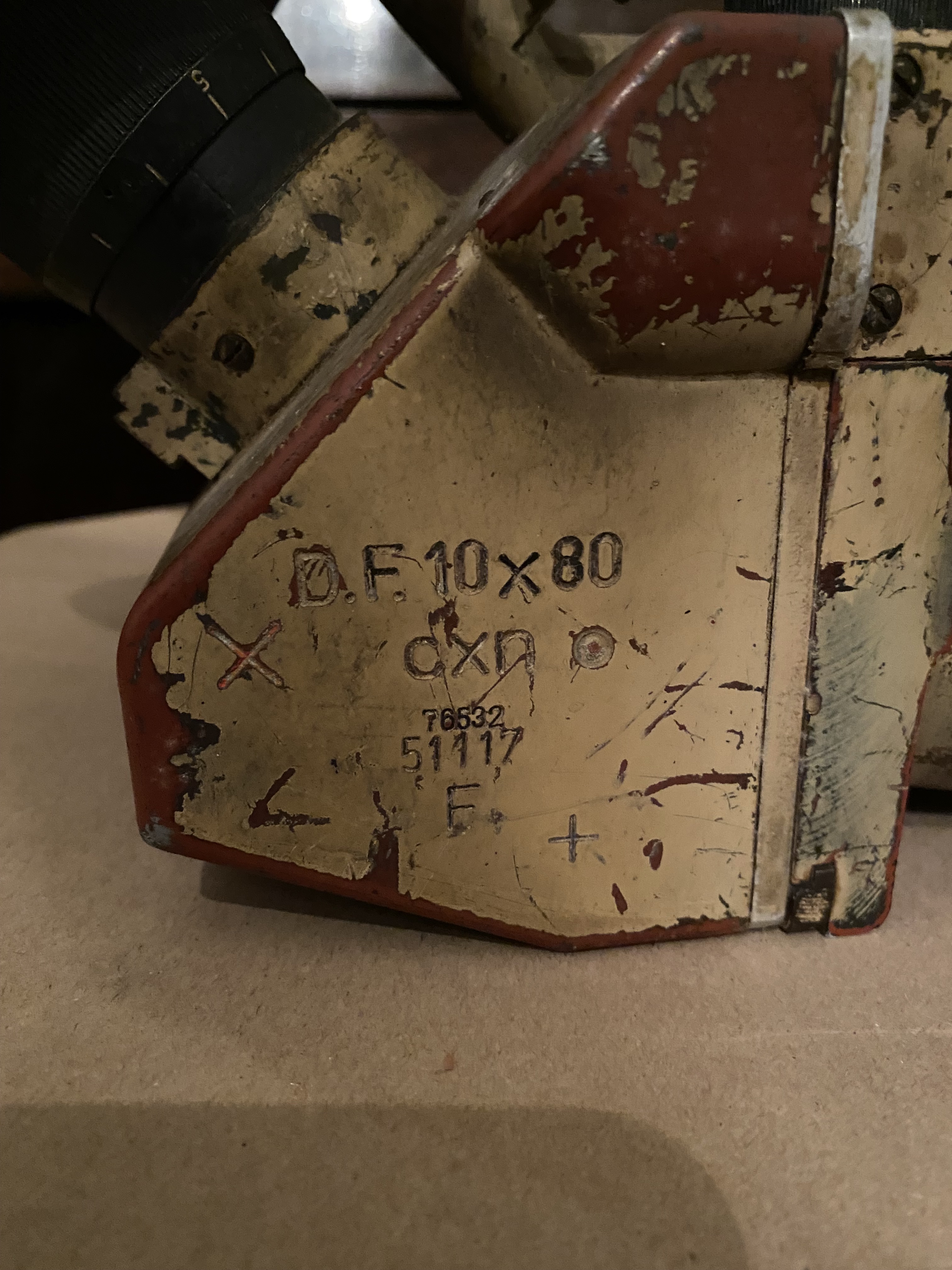
On the right side of the binoculars is an engraving reading, “D.F 10X 80, cxn, 76532, 51117, F.” While conducting my research I was able to learn that the D.F stands for Doppelfernrohr, a German word meaning “double telescope”. I was also able to find out that “cxn” isn’t just some random engraving, it’s the manufacturer’s code standing for E. Busch, Rathenow. This engraving is also able to tell me that these binoculars were made post 1942, and they were used by Luftwaffe Flak Artillery ground crews who had used them to spot and identify enemy aircraft. They had also been used on the battlefield for tactical observation.

After completing this research and learning who the binoculars had been used by and when the binoculars were used, I am still left with more questions, mainly why did my family have these binoculars that had been used by a horrible group of people, why did my family have binoculars that at one time had been used by Nazis? I know that no one in my family had been Nazi sympathizers or Nazis themselves, my great grandmother left Germany because of her fear and worry surrounding Hitler, proving that my great grandmother hadn’t received these from her involvement in the war or as an heirloom from a family member or friend that had been involved. This doesn’t answer the question of why and how my family had these. 

When I asked my mom why we had them, I received a disappointing, but also somewhat relieving, answer cutting my research short significantly: she had bought them as an addition to her military collection, which I wasn’t aware was so expansive until doing this research. So while the historical significance behind these binoculars is a dark one and one representing severe hate, my family had no role in perpetuating this hate. The fact that the binoculars had just been an addition to a military collection also makes sense when I think about it, because my family has this immense interest in history and my mom and uncles often share different books on history with each other. The binoculars are no longer a vehicle of hate, but now serve as a reminder of a horrible period of time in history that sits in the library of my childhood home.

Source: https://www.panzeraufgd.co.uk/optics.html

Her Birthday, and The Lure of Music

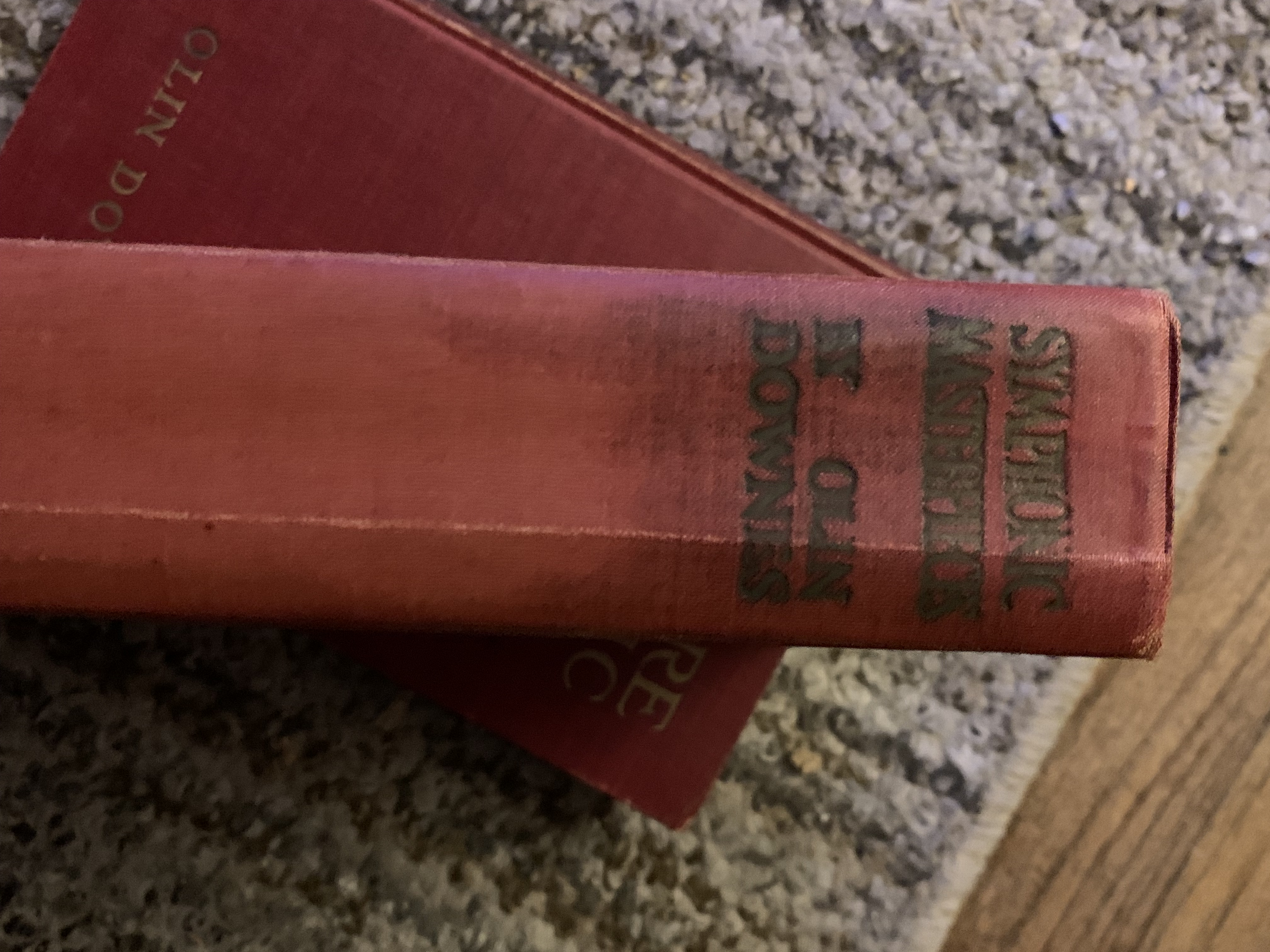
October 26th, 1936: Helen Margaret Kotur purchased Symphonic Masterpieces. Sixty-three years later her great-grand-niece, Abigail Dentico, would be born on the same day. I found it sort of comical that Helen would have never guessed that Abigail Dentico’s college roommate would do a deep-dive on the internet, and dig up old records all because Abigail inherited three books from her great-grandmother’s sister.

The book inherited by Abigail that has the same date as her birthday in it, but 63-years earlier

Helen Margaret Kotur, later Helen Hunter, was born in Austria, Hungary in 1915, but very quickly her parents Anna and Andrew Kontur fled to Yonkers, New York. Shortly after, her sister, Yolanda (and Abigail’s great-grandmother), was born. Helen’s family then moved to, and continued to live in Buffalo for the majority of her life. Her sister Yolanda eventually moved to Rockland County, where Abigail’s family resided (and still resides now).

Abigails great-grandaunt, Helen Margaret Kotur, is in the second low right up front (1932)

Abigail Dentico is a music major at SUNY New Paltz, and while she has an extensive knowledge on music, she is an alluring Celloist. I consider myself lucky to share a space with someone who brings a powerful energy into the house. Abigail’s talents extend beyond her. Her father, David Dentico is a musician himself. And Abigail’s grandparents, Sheila Dentico and Michael Dentico, are lovers of music too. In Sheila’s obituary, she was claimed to adore music, especially going to her husband and son’s bands. And of course, Abigail’s great-grandmother (Yolanda Kotur), and great-grandaunt Helen Margaret Kutor had a love for music. Above I have pictured Helen as a violinist in 1932 at her high school Hutchinson-Central High School.

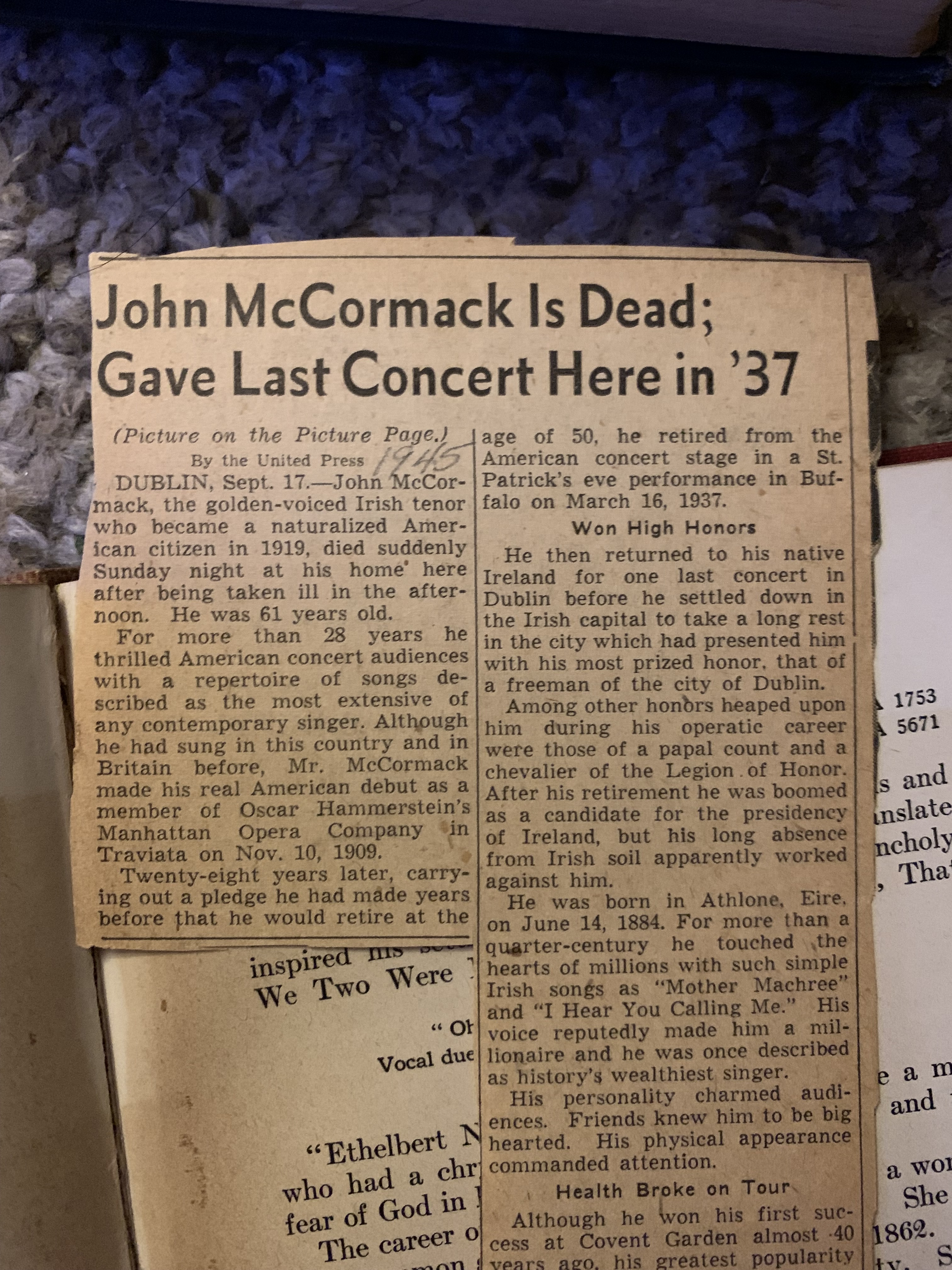
Newspaper Clipping’s in Helen’s three books.

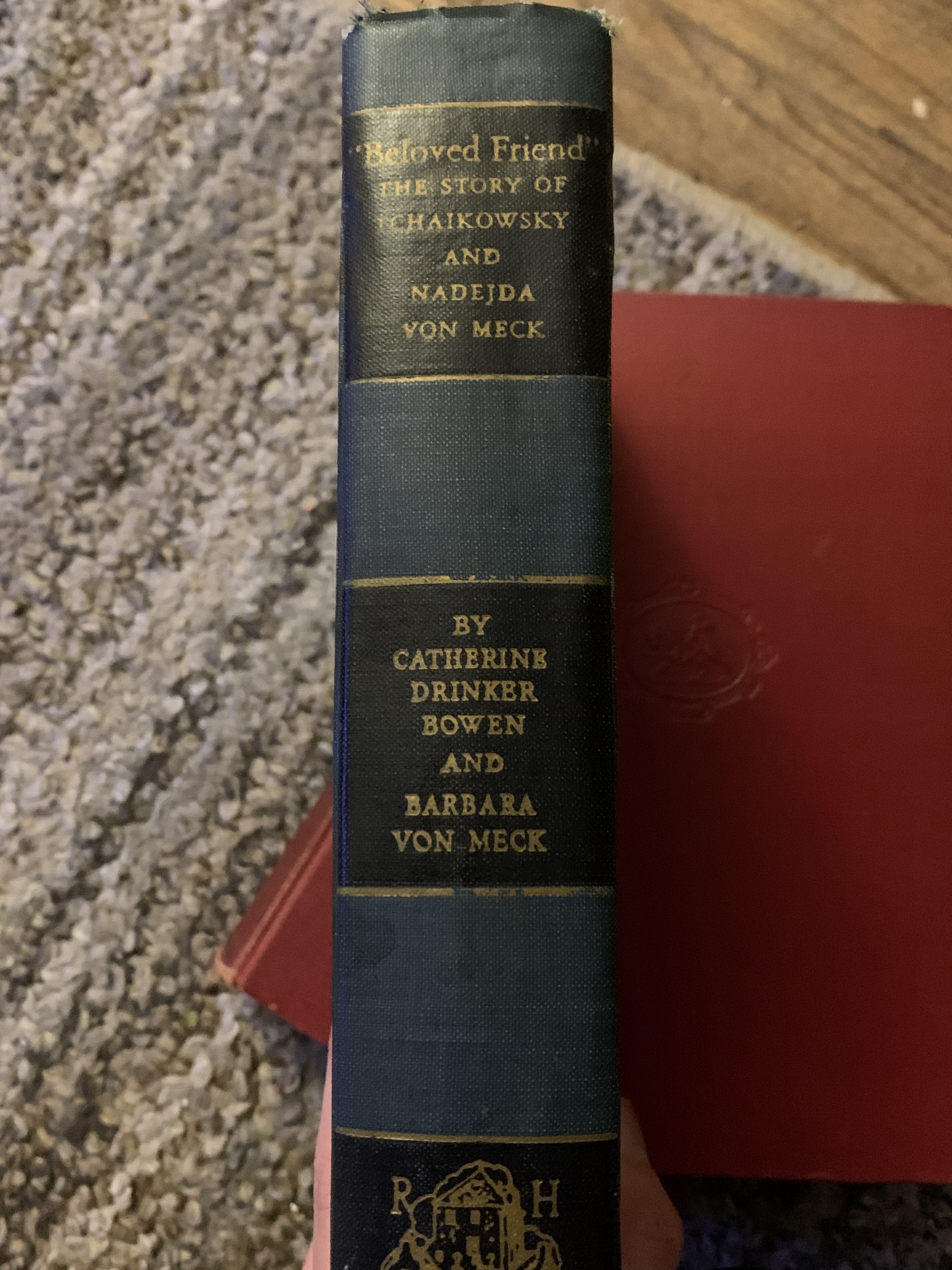
Abigail provided me with three books: Symphonic Masterpieces, The Lure of Music and Beloved Friends: The Story of Tchaikowsky and Nadejda Von Meck. All three of these books have dates in them from the 1930s, around the time Helen was going to school, or finishing up school. Helen was an educated woman. In the 1930’s, only 2% of women achieved a high school degree in the city of Buffalo. As I dug through many of the newspaper clippings, I discovered that she had a love for the Irish Tenor, John McCormack. While the books were purchased in the 1930’s, the newspaper clippings range from the 1930’s to the 1980’s. Some of them are from a newspaper in Fort Lauderdale, others in New York City, and of course, some are from Buffalo, New York. Throughout the book, Helen underlines and writes notes about them. She had a love for music and playing music. She could have never comprehended how music would be passed down through her family.

Certificate of Marriage between Helen Kutor and Wilbur Hunter, 1949.

In 1949, Helen Kutor married Wilbur Hunter. They had no children together. Helen’s whereabouts are hard to discover after her marriage, but it is likely Fort Lauderdale. As I dug through her newspaper clippings, I discovered that many of them are from Fort Lauderdale, Florida. I am assuming after their marriage, Helen moved to Florida. Wilbur passed away in 1980. She passed away in 2003, leaving her sister Yolanda to take her remaining stuff. Yolanda and Helen were very close, and loved each other dearly. Many of Helen’s things went to Yolanda. When Yolanda passed away, Abigail’s grandparents, Michael and Sheila Dentico, cleaned out Yolanda’s house, and these books laid in a box. At the unfortunate passing of the beloved Micheal and Sheila (as they passed away in close proximity of time to each other), Abigail’s father, David Dentico, went to clean out the house. At that point, David must’ve picked up these books, most likely to save for Abigail, who loves classical music.

Abigail, on a trip home one day, asked if she could have them. She inquired with her father about who’s books they were, and he knew that it was Margaret’s book. David, however, was certain that she went ot Julliard. I spent a lot of time researching her name, using ancestry.com, looking through pictures– I was unable to find anything that said so. One 1940 census reported that she had only completed high school, and at that point she was 25. It is unlikely she went to Julliard.

Abigail helped me to start this project, but I took on a lot. I found a picture of her in high school, and found out she was a deep music lover. I also discovered that Abigail’s father, grandparents and great-grandparents were great lovers of music. I feel myself deeply attached to Abigail’s family, and I found that their love for music is intrinsic to their ancestry. All of them were great lovers of music, and performed on many occasions. Abigail, too, has brought a great life in my life. She is one of my best friends, one of the warmest people I know. She brings a great deal of love and music into my life. And I find this to be more effectual and alluring, knowing how important it has been to her family too.

Filomena’s Miraculous Medal

Filomena’s pendant photographed from the front.
Filomena’s pendant photographed from the back.
Filomena’s pendant (⅞ “ x 1 ⅛ “) photographed next to a quarter for scale.

The object I have decided to discuss is my great-grandmother’s medallion of the Virgin Mary. My great-grandmother, Filomena Pugliese has always been a beloved family figure. My mother told me countless stories about her paternal grandmother before I even got to see a photo of her for the first time. Though I don’t think either of the two photos I have of Filomena fully do her justice. The younger photo taken in 1926 shows her at 38 years old with her husband, Pietro Botte, and their seven children, technically eight as at the time she was pregnant with their son Daniel. This photo has become an heirloom in itself, depicting our Albanian-Italian family still partially in its beginnings in Brooklyn, NY. My beloved grandpa can be seen in the center, held by his father, this being one of the earliest photos we have of him. However, through this photo it was hard to know these people, to see past their strong expressions to who they are. That is where my mother’s help came in handy as she was able to let me in on the most endearing parts of Filomena Pugliese. 

Photograph of Filomena and her family taken in 1926.

The most fitting aspect I was able to learn about Filomena is that she had the utmost admiration for the Virgin Mary, even requesting to be buried in a blue dress just like the Madonna. This allows me to know a different meaning of her medallion. This was not just a random religious keepsake, it was HER Madonna that she would keep with her for the entirety of her adult life. It is debated whether it was given to her as a gift for her wedding in September of 1907 or if it was gifted to her by Pietro sometime in the decade following the wedding. Either way, it is known that this was a gift to her, and that the person who gave her the pendant was aware of her love of Mary. 

One can still see her hand on the pendant, clutched between thumb and pointer finger every time Filomena said her Hail Mary. The Mary’s features have been partially wiped away with these decades of rubbing, leaving a slightly smooth texture across her figure. Along the way three of the twenty-eight marcasite stones have become lost to time, perhaps lost to the grabbing of her children or grandchildren. The mother of pearl inlaid in the pendant still holds its smooth, lively shine, adding an ethereal feeling to the piece. When looking at the back of the pendant there is a hole where it looks like there might have once been a pin, so that the pendant may be worn on the clothes, which my mother recalls Filomena doing sometimes. However, the piece at the top shows that the pendant would actually go on to be worn exclusively as a necklace, though it is unclear when this switch actually happened. The chain it was once worn on has also been lost upon its passing from Filomena to my mother, Marie. 

This pendant and its worn appearance gives a glimpse into Filomena’s life and perhaps why she might have so heavily held on to her Mary. By the time she died in August of 1980 at the age of 92, she had buried her husband and six of her ten children. By the time she was 45, Filomena had already lost three of her children as well as her husband. Her twin daughters died in their first year of the Spanish flu in 1919. Her youngest son, Danny, tragically died in 1933 during a botched tonsillectomy. In 1928, Pietro Botte attempted to break up a street fight and had his own smoking pipe jammed into his left eye, dying of an infection days later as the family could not afford the hospital visit. Being left a widow with seven children during the Great Depression would have been unimaginably difficult for Filomena. She overcame so much hardship, yet the only traits my mother can connect to Filomena are her serenity, kindness, and warmth. Filomena’s devotion to her children was paid back to her later in life. Her daughter Catterina, Aunt Kitty, would forgo marriage to spend her life caring for her mother. My grandfather, Jimmy, had such a love for his mother that he stopped eating when he was 92, claiming he wanted to die at the same age as her. 

I am glad that the pendant now sits in my mother’s hands. As a widow herself raising three kids, I think her grandmother has become one of her sources of strength. Filomena has become such a representation of strength and endurance for my family. If anything, I think it might be fitting that the figure on her pendant has become featureless, as it now feels like a representative of Filomena rather than just being a pendant to the Virgin Mary. 

Photograph of Filomena at 91, taken in 1979.