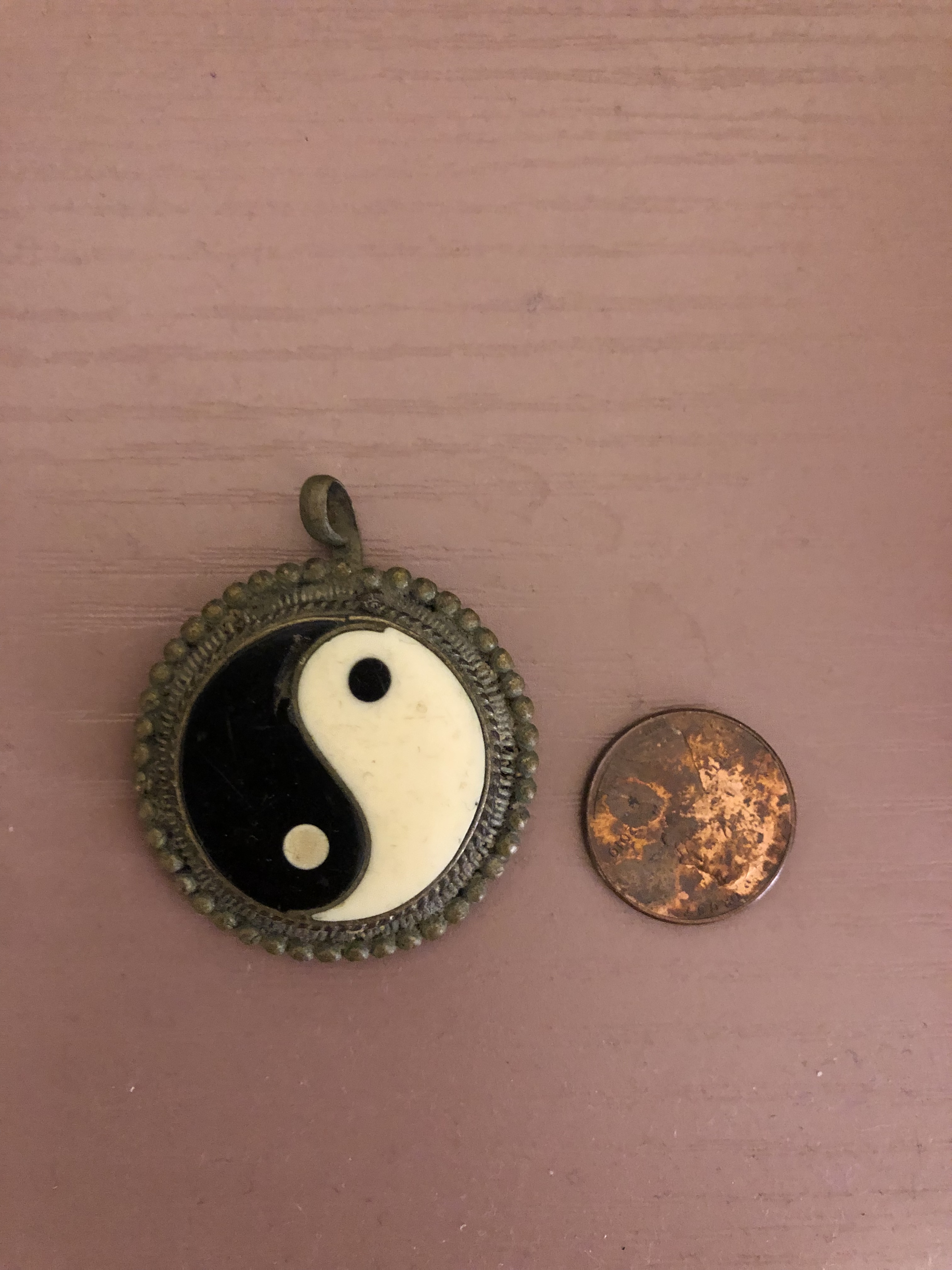
Pendant shown from the front with a penny for scale reference.Pendant shown from the back showing the apparent wear and tear it has undergone. Pendant shown from the side, showing the beveled edge and detailed inlay.
The object I have chosen to describe is my mother’s yin and yang pendant. This pendant was gifted to me when I was just thirteen and I have kept it safe and close all these years.
From an outside perspective, this pendant is no more than meets the eye. Having a circumference of just a little over 3.5 cm, it has a very large presence and makes a statement when worn. A petite neck like mine is not suited for such a large piece adorning my chest. My Mother, on the other hand, can adorn this necklace as if it was made for her, and maybe that is one of the reasons I adore it so much. The pendant has a beveled outer circle inlaid with an abstract pattern consisting of dots and lines. This texture can be felt with your fingertips if grazed slightly over feeling the ridges and dips of the metal. This base structure that the yin yang is placed on is a type of copper or nickel that at one point and time was silver plated. As the years have passed by, so has the once shiny and finished appearance of the pendant leaving it now with a worn and heavily loved appearance.
The yin and yang symbol itself sits a mere .75 cm from the base giving it the appearance of coming out of or towards the intended wearer. The symbol itself is made from Bakelite, a type of synthetic resin that was first used in the 1900s. Despite Bakelite’s advantages of being more durable than other synthetic plastics, the pendant has a chip or two showing great wear and tear on the upper left section of the black teardrop shape. This symbol is from Japanese culture and is an ancient symbol of harmony and balance in the natural world. This idea of balance and the natural ebb and flow in life is an idea that my mother whole heartily believes in and has passed those beliefs down to me.
The origins of this object are pretty much unknown to my mother for she acquired it at a flea market when she was just a teen. The quality of this object and the materials reflect the cheap and often stereotypical flea market qualities we all know, maybe some a little too well. However, this object despite its little to no material value has been with my mom through the fires and back, quite literally. My mother in her early twenty’s, a volunteer firefighter at the time, was battling one relentless and unforgiving fire. Amid everything the dainty delicate chain that once belonged to this pendant, broke in two, releasing the pendant from around her neck. When the flames were snuffed, my mother noticed quickly that her beloved pendant was gone. Later that day when she was taking off her steel-toed boots, on the bottom of her shoe, or the soul of her shoe rather, lied the pendant. The pendant survived the raging fires and as she tells it, helped keep her safe in one of the worst fires she had ever encountered.
With that being said this pendant has come to be a great token of good luck for both my mother and I.
As a young teen, I attended a wilderness camp where I found a passion for carving spoons out of wood. Over the years, I have fine-tuned my skills as a woodworker, especially in the wooden spoon arena. I have become skilled with the many tools used in the process to make a spoon and have developed much knowledge of wood in general. Most of my spoons are given as gifts to loved ones, who use them regularly. Their regular use changes the spoon in terms of its color and feel throughout its life. Wooden spoons are more than a simple eating utensil, they conjure stories and emotions when looked at and held by their users.
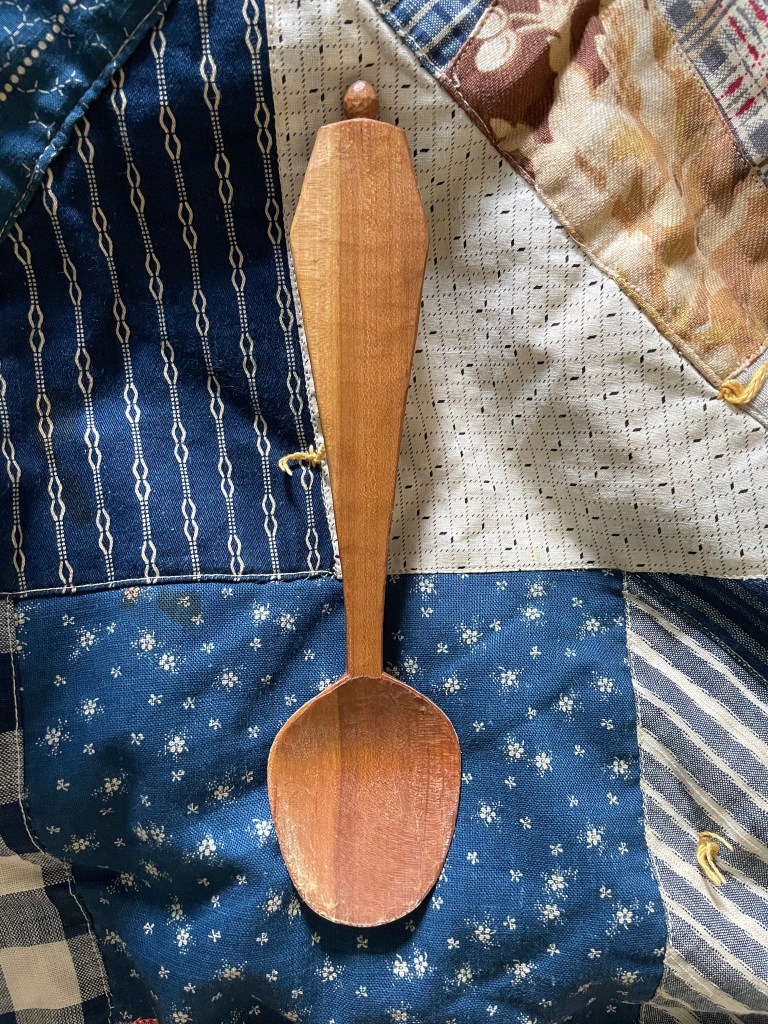
One object particularly close to my heart is a sugar maple eating spoon I made a few years ago. The eight-inch- spoon is ideal for eating cereal, whether it is hot oatmeal on a camping trip or cold Cheerios in my dorm room. Weighing just a little more than a feather, it may seem fragile, but time has proven its durability. This spoon is different from any other spoon I have made in that it is the first one I made that I use consistently.
When looking at the spoon from a bird’s eye view, there is a dividing line that runs vertically along the left side of the spoon that is slightly off-center. The line splits the appearance of the wood into a right and left side. The darker side (on the right) comes from the center of the original log and the smaller, lighter side is from the outer edge of the wood. Sunlight, weather, and age cause the wood to have a lighter tone. The contrast of the colors makes the spoon appear to have two separate sides. The lighter side is a light brown with a slight golden hue. The hue comes from the linseed oil used to put a protective coating on the wood. Over time the color of the spoon becomes richer with use. This is apparent when comparing the current color to photographs taken when the spoon was first made.
The tooled finish gives it a unique smoothness that stays consistent throughout its life. The back of the bowl reveals small knife marks that are smooth themselves but have some roughness when looking at them together. The curvature of the back of the bowl is fairly round which makes it difficult to have long cuts. When making the finishing cuts, the longer a cut is, the smoother the wood feels while short cuts leave a slightly less smooth feel. The curvature of the bowl is exacerbated by the crank of the spoon. The term crank is often used in the spoon carving community to describe the slight upward bend of the bowl. This allows the spoon to hold more food without being too deep. The crank of this particular spoon can be seen by the handle holding a constant plane until a quarter of the way into the bowl where it curves up about an inch. The profile of the spoon is defined by the crank. Looking at a regular metal spoon can illustrate the necessity for this feature. The bowl of the spoon could be described as a soft trapezoid. The end of the bowl is smaller while the part closer to the handle is larger. The edges are rounded as most spoons are for the comfortable feel in the mouth.
The back and front of the bowl are the only parts of the spoon that show tool marks other than the small ball on the top of the handle. The ball (purely for aesthetic) is the size of a small pea that sits on the top middle part of the handle. A decorative ball on the handle of a spoon is a common addition to improve aesthetic. The handle is tapered meaning near the bowl, it is narrower than at the top. This gives the spoon a comfortable feel in the hand. The widest part of the handle is close to an inch and a half. The widest part of the handle is about an inch from the top. It tapers around half an inch in at the top which leaves a half-inch surface for the ball to sit on. The back of the handle has a slight triangular ridge running vertically along the spoon. The area near the end is close to flat but as the handle connects to the bowl it becomes more pronounced and sharper. The ridge contributes to the comfortable feeling when holding the spoon.
This spoon holds a special place in my heart; wherever I am in life, the spoon is with me. Each time I use the ergonomic and solid spoon, it grows; the story develops, the character of the spoon evolves, and the overall look of the spoon changes. Whether the pigment becomes more enhanced from coffee grounds or a small ding on the handle appears after a camping trip, the spoon tells an evolving story and mirrors my busy life.
I have decided to use a simple woven bracelet for this post. While the object doesn’t hold much historical value, neither from my family nor in history in general, it holds a lot of sentimental value to me personally. It was the first gift my girlfriend gave to me, and the first gift I received here in New Paltz.
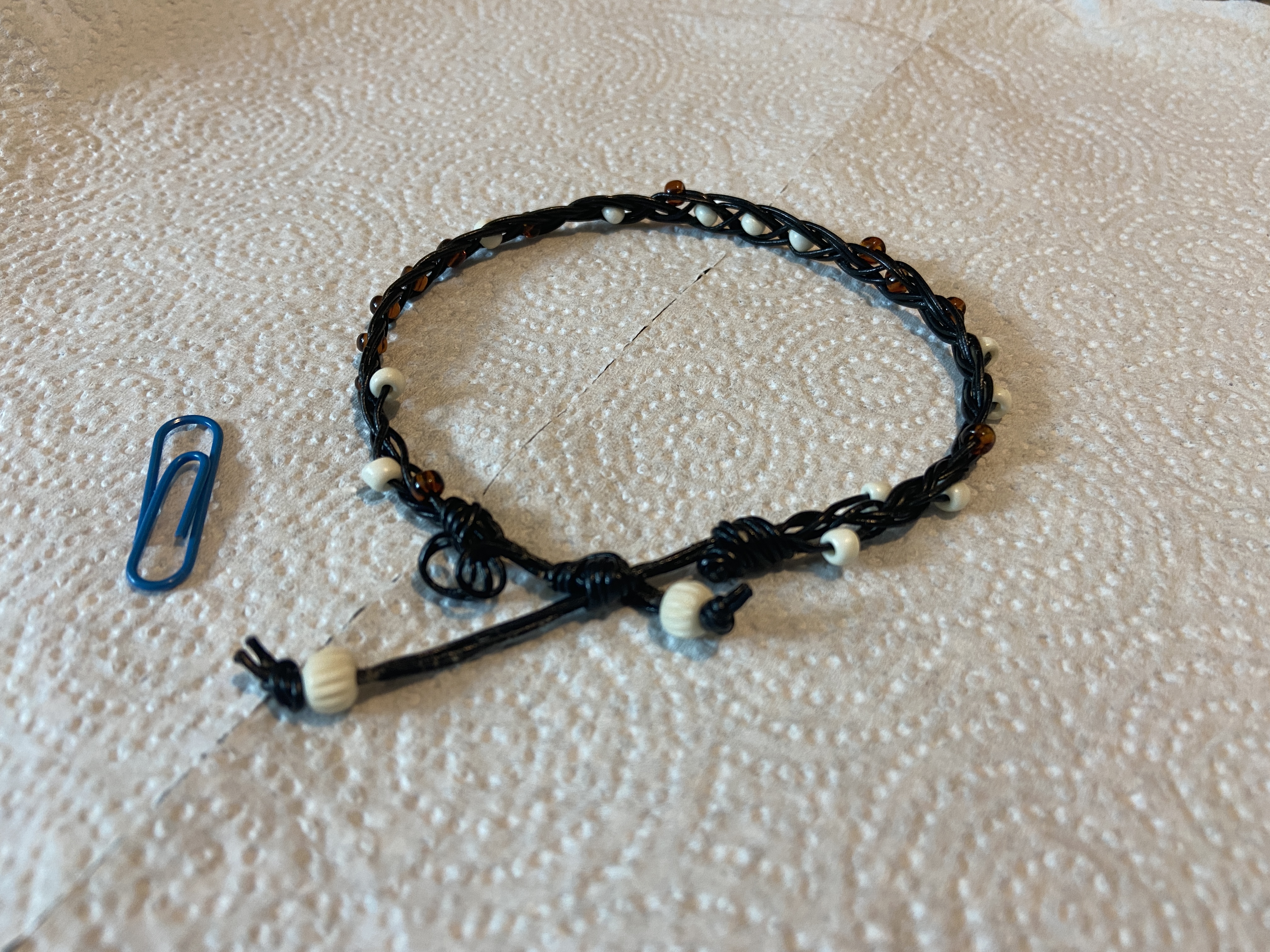
Bracelet and Paperclip for scale
The bracelet is three and a half inches across and is made from black leather and beads. The leather is carefully woven in what appears to be a double-braid, constantly alternating which pair of leather strips flow through the center channel. At equally spaced intervals on the bracelet, small white and amber beads are woven into an intricate pattern. The pattern once translated to “I love You” in morse code but the constant wearing of the bracelet caused the beads to shift and rearrange, leaving the original statement as nothing but a cheerful memory. The two ends of the bracelet are knotted off and tied together with a slip knot, allowing the bracelet to be tightened around the wrist, and two larger white beads are tied at the ends of the knot.
When I first received the bracelet, it was almost shiny with the glint of new materials. However, after much wear and tear, the bracelet has lost much of its pristine glamore it once held. The slip knot is loosening, and the leather strands it runs over are showing cracking from the constant friction. The pattern of beads has become sloppy, much less uniform and more of a random assortment from rolling along the wrist. Still, despite the cracks and deformations, the bracelet holds much sentimental value to me. It was a gift from my girlfriend, whom I met on this very campus, and just the emotional value of the gesture outways the gift itself. The use of new materials, bought from a local crafts shop on main street we’ve walked through many times, shows how much she values me. The careful, hand-worked pattern shows the effort she has put into the gift. The fact that she gave me a gift at all is symbolic in a way, showing how much she enjoyed my company and our time together.
When I first received the bracelet, I wore it every day. I don’t wear jewelry, but the sentimental value of the object along with it’s simple and minimalistic design are appealing to me. As of the time of writing this post, I do not wear the bracelet as I am afraid that doing so will lead to the knots untying and the pattern of beads being lost. But by this point the bracelet has subsided from being a decoration and has become a much more important symbol: that of our bond. I love the woman who gave me this bracelet, not because of the gifts she’s given me but because I enjoy her company and love spending time with her. I do not need a bracelet, nor any other physical object or quantifiable measurement, to prove this fact. We care for each other, we enjoy each other, and we love each other. Besides, if we ever want to make another bracelet we know where to go to make another.
During our class tour of the Huguenot Street houses, I took great interest in the Deyo House. Since I live in a home that was built in 1871, a brick Victorian located in the City of Poughkeepsie. Know a little … Continue reading →
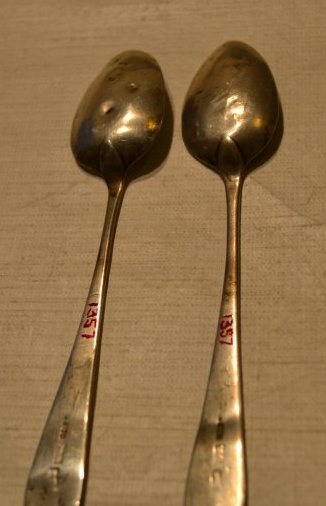
Late 18th century silver teaspoons crafted by Tunis DuBois, a skilled silversmith who defied the standards and took pride in his work, and his customers
The object that I’m analyzing is a pair of silver teaspoons made by Tunis D. DuBois, a descendant of the original Huguenot family. He was a silversmith based out of New York City. At first glance, this pair of teaspoons doesn’t seem too significant. The story of their use are displayed by the worn and battered look of the handle and oval bowl of the spoon. These spoons were probably made just for utilitarian purposes, but these little marks tell a deeper story. They reflect a time when our items were still custom-made, before mass production and manufacturing. The maker would leave little hints, traces, messages on their products—a proud symbol to accredit their work.
Physical
Description:
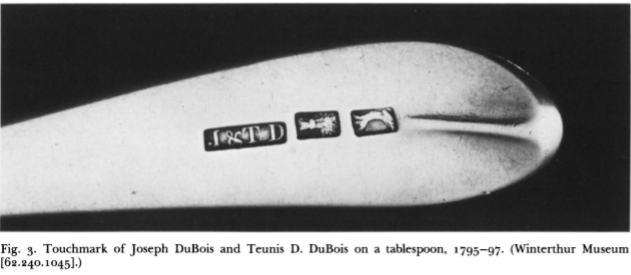
The teaspoons are made out of silver and are 5 and a half inches in length. They have a pointed oval bowl and a pointed arch drop. The space between the spoon’s oval and its handle becomes very narrow, before opening back up into a straight oval handle. On the handle on the front part of the spoon is a simple pattern, a few straight line indents made, one on top of the other, that get smaller as they move up the handle towards the narrow stem, with smaller indented lines coming off of the main ones. This pattern is reminiscent of a plant or flower, which relates to DuBois’ signature wheat sheaf. The teaspoons aren’t in perfect shape—but that’s the point. The bowl is worn and dented, and the silver is tarnished. However, these imperfections are what give these teaspoons character. They weren’t “perfectly” made by a machine in a factory. They required time and labor—they were touched, molded, and crafted by human hands, back when we put a little piece of ourselves into our items. These teaspoons serve as an index—they contain an evidentiary quality that marks a trace of the real—the hands of the maker. DuBois left his signature on the back of the handle of the spoon with three rectangles. One with his initials, TDD, and two wheat sheafs in the other two rectangles. The wheat sheaf symbol typically represented harvest, fertility, and a long life. This was a popular motif to be used at the time (Laidlaw, 42). These marks can be seen on other works by DuBois. The teaspoons reflect a time when quality products were created with care and a unique touch.
Provenance:
These teaspoons were donated by Muriel Pulver, a
resident of Rhinebeck. She was born in 1897. Her mother was Magdalena Elting—the
Elting’s are another prominent New Paltz family. They weren’t one of the
original 12 patentees, but their family intertwines with the founders, and “in
almost any one of the original families one finds a connection with the Dutch
Elting,” (Bevier-Elting Family Association). Magdalena was born in 1872 to
Phillip and Harriet Hasbrouck Elting, and was a New York City native, before
residing in Ulster County. This family donated a lot of items, so it can be
surmised that they were collectors. The year range for these items is estimated
between 1796 and 1799. (Historic Huguenot Street Permanent Collection).
Narrative:
The Huguenots were known to be skilled craftsmen.
However, when they were residing in France in the late 17th century,
the patronage of goldsmiths was forbidden by King Louis XIV (“The Huguenot
Silversmiths of London”). Around this time is also when King Louis XIV revoked
the Edict of Nantes, the document that maintained most of the Huguenots’ rights
in France (“Huguenot”). The renewed persecution against the Huguenots led to a
mass migration from France to London, where they joined a network of persecuted
craftsmen that was already beginning to take shape (“The Huguenot Silversmiths
of London”). The first two generations of craftsmen in London represented different
styles and appealed to different audiences—the first generation made products
for the aristocratic class and began to earn a reputation, whereas the second
generation craftsmen appealed to a wider audience, including other craftsmen,
and they were able to achieve an even greater reputation (“The Huguenot Silversmiths
of London”). The Huguenots took pride in their work, and valued their peers
whom they made their products for—“The network which the Huguenot silversmiths
maintained amongst their own community and the care with which they nurtured
their patrons, created a monopoly which provoked a hostile reaction from native
silversmiths,” (“The Huguenot Silversmiths of London”). The native smiths began
to take on Huguenots in order to sustain their business. The silversmith in our
narrative, Tunis Dubois, carried out a similar style of interacting with his
customers. DuBois’ records show that he made silver products for a consistent
base of customers, and for fellow silversmiths as well (Laidlaw, 28 & 35).
The Huguenots also found their way into other parts of
Europe and America, where they established themselves as craftsmen as well.
They were able to freely worship and carry out their skills as artisans. The
Huguenot silversmiths that moved to America began to diverge in their style.
Their work is “usually very simple and lacks the ornate decoration and details
of execution characteristic of French silver during the first part of the 18th
Century,” (Ormsbee 2009). This can be seen in DuBois’ teaspoons, which contain
just a few ornamental details, but is more functional than decorative.
Tunis DuBois was born in central New Jersey, in Freehold Township, in 1773. His father, Benjamin DuBois, was a reverend of mixed Huguenot and Dutch descent, which can serve as an explanation for DuBois’ affinity to be a silversmith, as this craft was popular among these groups. Especially among the Dutch, solid silver spoons “were considered very precious objects” according to George Way, a well-known collector and author of 16th-17th century Dutch and English furniture, paintings, and decorative objects (“NEWS RELEASE: HHS Holds Closing Reception with George Way”). Way discusses that these spoons were not only highly regarded as works of art in their own right, “but were an indication of great wealth.” It’s part of Dutch custom to give spoons to mark births, deaths, and other momentous occasions (“NEWS RELEASE: HHS Holds Closing Reception with George Way”).
Tunis and brother Jospeh DuBois signature on abck of spoon, with wheat sheaf and bird’s head pseudohallmarks.
What sets DuBois apart from the rest, was his business
model—one that could be seen as being ahead of his time. He produced his goods
to be sold on a wholesale basis. (Laidlaw, 25) This, of course, was before the mid-19th
century industrial boom, when manufacturing goods like this was the new form of
production. However, DuBois was still able to maintain his craftsmanship and
leave his unique mark on each good, while selling to a larger audience. He
followed the footsteps of his brother, Joseph, and moved to New York City to pursue
a profession as a silversmith. Soon after, Joseph took him on as a junior
partner, and they began to create hollowware and flatware pieces together.
Among their more intricate pieces were a neoclassic cruet stand, a sugar bowl,
and a teapot. For most of his career as
a silversmith, DuBois’ business was successful. However, the yellow-fever
epidemic in 1798 began to take a toll on his business, and he decided to move
back to New Jersey, where he acted as both a farmer and a silversmith. This did
not deter DuBois to continue his profession. He was still a successful
silversmith miles away from New York City—he increased his wholesale sales to
his highest levels thus far and continued to attract new customers from the
city. DuBois did all this, while still maintaining local business, although
these sales made up a smaller portion of his work. Dubois was different than
most rural smiths, who tended to only make products for their local customers,
whereas he sold his products to shops in New York City. However, where DuBois
aligned with his fellow rural smiths was in the manufacture of spoons, which
made up almost his entire production. Spoons were almost entirely made by village
and small-town silversmiths, as they appealed more to the rural audience than hollowware,
which would be commissioned by silversmiths in the city. Dubois stopped making
silver around his 40s, and turned more of his attention to farming, until his
death in 1843 (Laidlaw 1988).
DuBois was able to carry out his wholesale model
without employing a whole team of people—he wasn’t operating in a workshop with
a large workforce. DuBois made most of his spoons himself (Laidlaw, 45). This
is another testament to DuBois’ craft and skill, and his ability to be ahead of
the curve, while still maintaining his personal touch on his items. This kind
of handmade craftwork is a lost art. These teaspoons go beyond their function,
they tell a story of an earnest silversmith who took on an ambitious and new
business style, while still being able to care for his work and his customers.
Tunis DuBois’ signature: TDD and two wheat sheaf pseudohallmarks. These same markings are also found on the teaspoons I analyzed.
Historic Huguenot Street Permanent Collection, May
2019.
Laidlaw, Christine Wallace. “Silver by the Dozen: The Wholesale Business of Teunis D.DuBois.” Winterthur Portfolio, vol. 23, no. 1, 1988, pp. 25–50. JSTOR, http://www.jstor.org/stable/1181161.
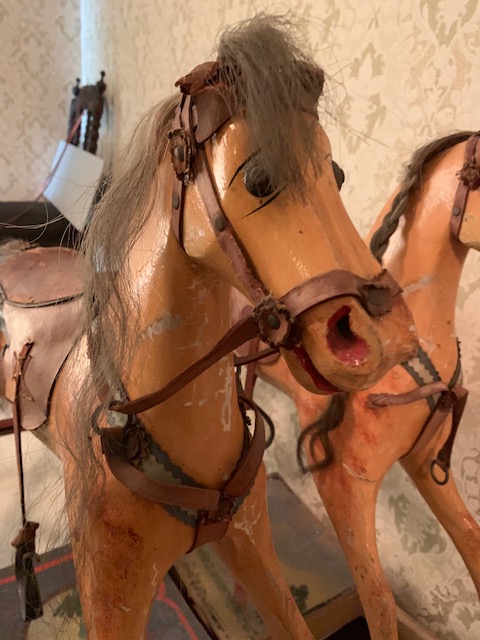
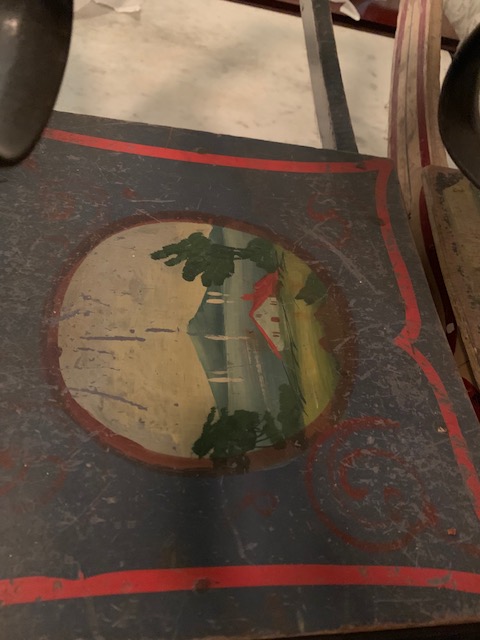
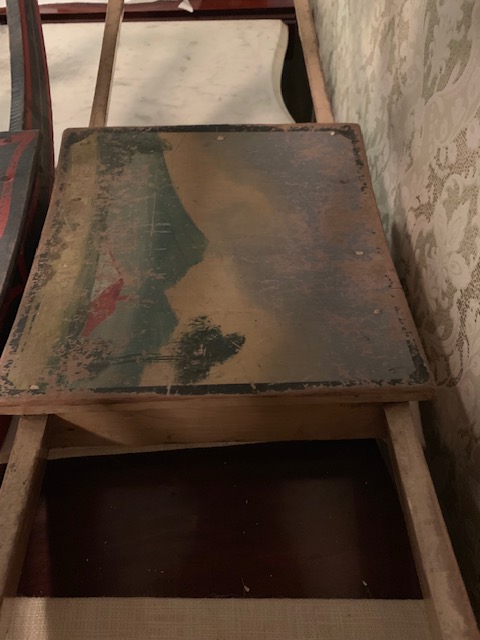
The rocking horses shown above are believed to be from the late 1800s and are primarily made of carved and painted wood, which includes the bodies of the horses as well as the curved bases which allow the horses to rock. While both horse bodies are painted yellow, the bases differ in color and have different landscapes painted on the center squares. Both horses are adorned with gray manes and tails and other features such as the eyes and nose are painted on. The original saddle, stirrups, reins, and even ears of the pieces were made of leather, though the yellow rocker is missing many of these details.
These rocking horses, likely handmade and not produced at a very large scale for the time, have many intricate details. As mentioned, the horses and bases themselves were carved out of wood. However, the horses’ bodies are hollow which was a technique learned in the Victorian era to make the toys less top-heavy, and therefore safer. The exterior of the bodies are painted yellow, though it is probable that it is not exposed wood which was painted but rather a few layers of gesso. This material, which is usually used in fine art paintings, was found to be both easier to sand a created a shinier surface to paint and decorate. Painted details cover the hind quarters of the horses in the form of saddle blankets and landscapes at the base of the rockers. The saddles, stirrups, and reins are all made of real leather, another costly adornment for a child’s toy.
This set of rocking horses, which were used by brothers Winne and Henry Hornnbeck in their childhood years, were donated to the Historic Huguenot collections by the estate of Ida M Hornbeck in 1976. She had died the previous year in 1975 and had left many of her family’s items and historical artifacts to this collection as well as other local historical collections. When tracing her relation to Winne and Henry Hornbeck I discovered that she was their older sister. Neither her brothers nor her sister Lela ever had children therefore I believe that these rocking horses were purchased directly for the family and never left the hands of the siblings. I infer that these items are purchased new as their father Louis Dubois Hornbeck was one of the largest merchants in the area, having owned a large general store in Napanoch. However, it is also possible the family employed craftsmen to create these pieces.
Although these objects were not primarily used in the town of New Paltz, their ties to historical New Paltz and its socioeconomic structure can be easily connected. I see these pieces as a mark of status and luxury; they are not the everyday doll or trinket. Instead, these objects were most likely bought new, possibly from the large general store which their father ran. However, we cannot know for certain how and when these rocking horses were made as there is no apparent makers mark on them. Therefore, it is also possible that these were handmade by someone in or close to the family. These pieces function as both furniture and toys, and as they were both clearly well worn I believe these were pieces that would’ve been put out in the main room as their own pieces of furniture. Toy horses and specifically rocking horses became popular as toys and furniture among the upper middle class after Queen Victoria established that they were her favorite. They were made in many different styles and colors and some had clear inspirations from imagery and forms found in carnivals and fairgrounds, which was a popular source of entertainment of the time. However, during the 1900s the production of rocking horses, especially the intricate handmade ones which had thrived during the Victorian era, were declining due to the Great Depression and the World Wars. The survival of these pieces is extraordinary and gives great insight into the lifestyle of the Hornbeck family who owned them as well as the social culture of the time.
When looking into both their family story as well as their extended genealogy, I found a few evidences of the family’s enriched status. First, as previously mentioned, Louis Hornbeck ran the largest general store in Napanoch, with a very comfortable house–which he owned–connected. His wife Catherine Freer Dubois did not work and I also found evidence of there being a young servant living with the family for a time. This was not uncommon for the area including New Paltz for families with luxurious lifestyle. Additionally, it appears that both Ida and Lela Hornbeck never married and never had to hold a job but were rather able to live off of the estate of their family for the rest of their lives. Brothers Winne and Henry Hornbeck did both end up marrying but neither had children in their lifetime. When looking further into the ancestry records of both the siblings mother Catherine Dubois Freer and their father Louis DuBois Hornbeck I was able to find that their mother was a descendant of Hugo and Isaac Freer, the original patent holders for the town of New Paltz. The Freers had been given 1200 acres to settle on in New Paltz and continued that line of wealth well into their descendants. While this is an interesting fact about their family it is also important to note that both mother and father had previously come from the Dubois family. It was very common in New Paltz among the wealthy families to intermarry children and cousins of the wealthiest families to keep the money close. This is one of the reasons that although the Hornbecks did not live in New Paltz, their prominence in the area was well established. These rocking horses are a symbol of the level of class and financial status of which this specific Hornbeck family was a part.
References
Heidgerd, Ruth P. The Freer Family: the Descendants of Hugo Freer, Patentee of New Paltz (Frear, Fraer, Frayer, Fryer, Etc.). The Huguenot Historical Society, 1991.
The object I’m analyzing is a 19th century brass candlestick, known as a girandole, with a white marble platform. However, this isn’t an ordinary brass candlestick—there’s an entire scene depicted within the base of the candlestick. There is a Revolutionary war veteran in military garb, with a peg leg, standing next to a small, what looks like female, child under a tree. Both of the figures are wearing hats and holding a long, cylindrical object—the man’s looks like a cane, and the young person’s is of a similar shape but harder to tell what it may be. There are flowers and leaves at the feet of the figurines, and vines that adorn the tree, which stretches up to the base of where the candle goes. Right above the head of the soldier are eight faceted cut glass prisms that hang from the brass support in the shape of wood vine. The candlestick is 15 inches tall and about seven inches wide.
A later 19th century brass candlestick (girandole), reminiscent of both the Victorian and Colonial Revival eras, depicting a Civil War veteran standing next to a young child, underneath a tree
This object was located in the Deyo House on Huguenot Street. It was donated around 1958 by an eighth generation Deyo, who also contains some LeFevre heritage, Elizabeth Tallman Winne—her mother was Jane LeFevre Deyo. Winne lived in Kingston for most of her life. Winne made this donation along with a lot of other mid-19th century Victorian objects. By analyzing the objects she donated, it can be surmised that Winne was a collector of Deyo family items and of 19th century objects.
This candle stick is from the later 19th century, and characterizes the Victorian and Colonial Revival eras.
A closeup of the scene depicted, revealing more details of the figures and creating more ambiguities.
The eight faceted cut glass prisms hanging from the brass support wood vine. This is a stlye that is characterized by many girandoles of this time.
What is considered in today’s standards as a basic amenity, central heating in the late 19th and early 20th century was a luxury for Americans. Nestled underneath the two east windows in the Music Room of the Deyo House, the gold painted Rococo cast-iron hot water radiators – manufactured in 1894 by the American Radiator Company in Detroit, Michigan, and subsequently sold to the Hasbrouck and Weismiller Store, a local 19th century heating and plumbing business, formerly located at 101 Main Street, New Paltz, New York – served one integral function for the Broadhead and LeFevre families: showcasing affluence for guests.
Background Information:
When analyzing objects from the 19th century, I often envision objects strictly for affluent families: automobiles, phonographs, telephones, or cameras. I never would have considered a 19th century heating system inside a former Dutch style stone house as an object of any significance. This type of mentality can be explained by the fact that amenities such as central heating, running water, and refrigeration have been fully integrated into modern life in the United States, where people no longer notice the essential role these utilities fulfill every day. Throughout my extensive research in the Historic Huguenot Street collaborative project, I have developed a fundamental understanding of how the gold painted Rococo cast-iron hot water radiators inside the Deyo House served one integral function in the late 19th and early 20th centuries: displaying a family’s opulence for guests.
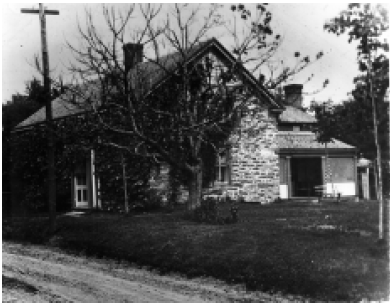
Originally constructed in the 17th century, the Deyo House was a Dutch style stone house consisting of one story. Over the course of 200 years, five generations of the Deyo family would live in this house before it received its first renovation (The Huguenot Historical 7). Displayed in Figure 1 is a photograph of the Deyo House in the late 19th century, before the first renovation.
Figure 1: The Deyo House in the late 19th century (The Huguenot Historical 7).
In 1889, Abraham Deyo Brodhead acquired the property; shortly after in 1894, he authorized the first wave of significant changes to his ancestor’s home (The Huguenot Historical 7). As shown in Figure 2 is the Deyo House after the 1894 renovation.
Figure 2: The Deyo House after the 1894 renovation (The Huguenot Historical 11).
The notable additions to the Deyo House included electric lighting and a central heating system. While these changes were significant for the time, when the Deyo House was sold to Frank J. LeFevre on November 3rd, 1915, the LeFevre family immediately began the house’s second renovation, purchasing “a new heater and a number of new radiators” (New Paltz Independent). All the gold painted radiators currently inside the Deyo House are from the 1894 and 1915 renovations.
Physical Description:
The gold painted radiators I decided to analyze are located inside the Music Room of the Deyo House, the room immediately to the right after walking through the front door. The Music Room is “heated by two ornate cast iron hot water radiators (3’-6” wide by 1’-10 ½” high) located in front of the two east windows” (The Huguenot Historical 55). For each set, there are seventeen individual sections, and each section measures at 2.5” wide by 1’-10 1/2” high, with the capability of housing a half gallon of water. Displayed in Figure 3 is a set of gold painted radiators inside the Music Room.
Figure 3: A set of Rococo radiators located inside the Music Room of the Deyo House.
In an attempt by the Broadhead and the LeFevre families to display their opulence, all the cast iron hot water radiators in the Deyo House were coated with a layer of gold paint. According to an article published by the United States General Services Administration, the technique employed to paint cast iron hot water radiators in the late 19th and early 20th centuries is called bronzing (1). The required materials for bronzing consist of “bronzing liquid and bronzing powder to achieve a metallic surface appearance” (Refinishing a Radiator 1). While the exterior of the radiators may have been aesthetically pleasing inside the Deyo House at the time of the installation, showcasing affluence and sophisticated technology, the one major caveat with bronzing radiators is that the composition of the paint contains lead, a toxic chemical that can wreak havoc on an individual’s brain and central nervous system.
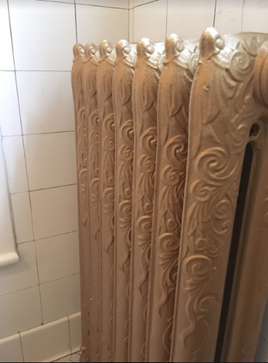
Regarding the exterior design of the Rococo radiators inside the Deyo House, they followed a design commonly employed during the Gilded Age. Attached in Figure 4 is a detailed photograph of the exterior design of the Rococo cast iron hot water radiators.
Figure 4: Exterior design of the Rococo cast iron hot water radiators.
For example, according to the Historic Resource Study
of the Vanderbilt Mansion located in Hyde Park, New York, “by the 1880s,
manufacturers could easily cast metals into decorative design and so radiators
abounded with scrolls and other cast decorative elements” (215). In other
words, the radiators inside the Vanderbilt Mansion, an estate owned by one the
wealthiest families in the United States of America at the time, and the Deyo
House followed a standard, late 19th century design.
Provenance:
While analyzing the Rococo cast iron hot water radiators inside the Music Room, I noticed the words AMERICAN RADIATOR COMPANY were inscribed on each section. Displayed in Figure 5 is an image of the inscription.
Figure 5: One of the Rococo cast iron hot water radiators with AMERICAN RADIATOR COMPANY inscribed on the side.
Established in 1888 as the Michigan Radiator and Iron
Manufacturing Company, and then reincorporated in 1892 as the American Radiator
Company, the company manufactured in 1894 “the first boilers [and radiators]
for house-warming purposes” (Burton 598). The epicenter of manufacturing for
the American Radiator Company at the time was Detroit, Michigan. While the
American Radiator Company did own other manufacturing plants across the
American Midwest, the radiators installed in the Deyo House in 1894 and 1915
were most likely produced in the automotive city.
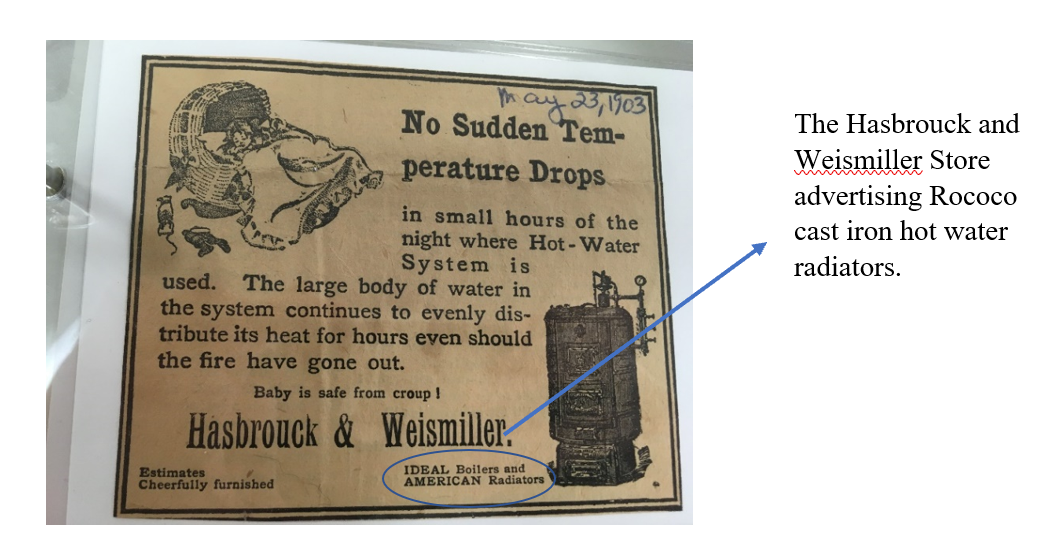
The American Radiator Company throughout the late 19th and early 20th centuries forged business partnerships with local distributors and small businesses across the United States of America. An example of this would be the cooperation between the American Radiator Company and the Hasbrouck and Weismiller Store – a local 19th century heating and plumbing business, formerly located at 101 Main Street, New Paltz, New York (Johnson 79). According to an advertisement published on May 23rd of 1903 in the New Paltz Independent, the Hasbrouck and Weismiller Store was trying to notify the residents of New Paltz about the new heating technology they were selling. Attached in Figure 6 is the advertisement from the New Paltz Independent.
Figure 6: A Hasbrouck and Weismiller Store advertisement in the New Paltz Independent.
Even though there are no financial records from the 1894 and 1915 renovations of the Deyo House, it is likely that Abraham Deyo Broadhead and Frank J. Lefevre supported a local family owned business by purchasing the Rococo radiators from the Hasbrouck and Weismiller Store. While there is no documentation of the price the Hasbrouck and Weismiller Store was selling the Rococo radiators, a Sears, Roebuck catalog from 1910 offers some insight as to how much the Broadhead and LeFevre families paid. Attached in Figure 7 is a page from the Sears, Roebuck catalog, in their heating section.
Figure 7: Heating section from the 1910 Sears, Roebuck catalog (STEAM AND HOT 99).
Based
in Chicago, Illinois, the American Heating Company designed and manufactured the
AMCE radiators shown for sale in Figure 7. In the late 19th and
early 20th century, the American Heating Company was the American
Radiator Company’s rival in the heating industry (Burton 598). While the prices
of the American Radiator Company radiators are not advertised in the Sears,
Roebuck catalog, analyzing their competitor’s prices for a very similar product
offers some insight as to how much the Broadhead and LeFevre families paid. Based
on the dimensions of the Rococo radiators inside the Music Room of the Deyo
House – 3’-6” wide by 1’-10 ½” high – they would correspond to the 20-Inch
Height column, as shown in Figure 7. For each cast iron hot water radiator
inside the Music Room there are 17 sections, so with a little math, the total
theoretical price for the 17 sections in 1910 would be $4.68 (STEAM AND HOT 99).
However, these are not the only radiators inside the Deyo House. Accounting for
all 123 sections purchased during both renovations, the total theoretical cost
for the entire package of Rococo cast iron hot water radiators in 1910 would be
$33.83 (STEAM AND HOT 99). In the late
19th and early 20th century, this was a significant
amount of money to invest in a household utility. According to officialdata.org,
$33.83 in 1915 is equivalent to $851.45 in 2019 (1). Considering all the
radiators inside the Deyo House are identical, this sheds light on the
obsessive and compulsive nature of Frank J. LeFevre to match the other gold
painted radiators.
Narrative:
The late 19th century was a transformative
era in the United States of America, where mass industrialization and
exponential technological growth gave rise to the materialism and consumer
culture of the 20th century. Innovations such as electric lighting,
automobile manufacturing, camera design, audio recording, and central heating
systems were developed. Like most first iterations of a consumer product, these
material items were very expensive, where only affluent families could even
consider purchasing these products. The Broadhead, LeFevre, and Vanderbilt families,
through their rapid spending on luxurious, non-essential technology, are early
examples of Americans immersing themselves in material culture.
In stark contrast to most Americans in the late 19th
century, the Broadhead, LeFevre, and Vanderbilt families enjoyed the luxury of
owning a low maintenance central heating system. The rationale, however, behind
purchasing gold painted radiators was significantly different for each family. For
example, the primary reason Abraham Deyo Broadhead and Frank J. LeFevre
purchased gold painted radiators for the Deyo House was to display their affluence.
During the 1894 and 1915 renovations, the Broadhead and LeFevre families were
attempting to emulate the lifestyle of the Vanderbilt’s, but since neither
family accumulated as much wealth as the Vanderbilt family, the Broadhead and
LeFevre families had to express their wealth through other means. One method
the Broadhead and LeFevre families employed was installing decorative, gold
painted radiators. When the Vanderbilt’s purchased their radiators in the late
19th century, they deemed it “unnecessary… to purchase fancy
radiators [from the American Radiator Company] because they [the radiators]
appeared only in the service areas” (Albee 215). Even though the Vanderbilt’s
cared about displaying their wealth, as shown by their luxurious 211-acre
summer home in Hyde Park, New York, they did not care about expressing their
wealth through smaller material items.
In addition to emulating the Vanderbilt’s lifestyle,
the Broadhead and LeFevre families, through the purchase and installation of
golden radiators, wanted to impress wealthy families in the local Hudson Valley.
An example of this would be the countless events the Broadhead and LeFevre families
hosted at the Deyo House. Articles published on March 1st and March
6th of 1895 in the New Paltz
Independent discussed an event the Broadhead family hosted on February 27th,
1895, where high profile families from the neighboring towns of Kingston and
Newburgh attended. According to these articles, significant emphasis was placed
on the electric lighting and the Rococo gold painted radiators in the Deyo
House (New Paltz Independent). In stark contrast to the high maintenance
heating system most Americans owned at the time – a coal burning oven or a
fireplace – the Broadhead family wanted to communicate a message to their local
community of their vast collection of wealth.
When analyzing this period of American history, it is
important to understand how material culture influenced regions such as the
Hudson Valley. After nearly 200 years of Deyo’s living in a one-story Dutch
style stone house, Abraham Deyo Broadhead authorized in 1894 a complete
transformation of the Deyo House. The final product left the house
unrecognizable, as seen in Figure 1 and Figure 2, and equipped with, at the
time, sophisticated technology – electric lighting and a central heating
system. While the gold painted radiators did fulfill a function in providing
heat in an efficient, low maintenance manner, their intended purpose was to
showcase the wealth of the Broadhead and LeFevre families. In contrast, the
Vanderbilt’s focused on the practical application of a central heating system,
rather than focusing on the optics of owning state-of-the-art technology. The
Huguenot Historical Society and the National Park Service have preserved these
objects so they can serve as a reminder to people of the consumer culture of
the late 19th and early 20th century. I firmly believe
that the preservation of these radiators inside the Deyo House has contributed
immensely to the rich history of New Paltz.
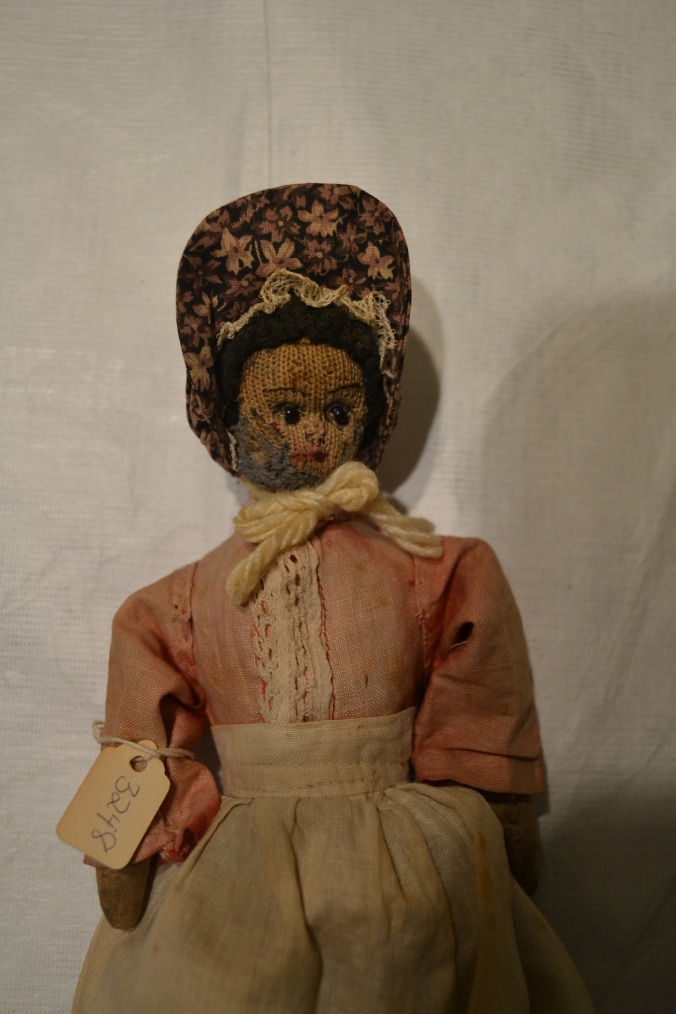
At first glance, one may not be particulary interested in what appears to be a typical antique ragdoll. Closer inspection, however, reveals an interesting glimpse into the history of American doll making and an aspect of New Paltz History too often over looked.
Description:
This homemade doll dates back to mid to late 19th century and once belonged to Gertrude Van Order DuBois. The doll is an African American woman dressed in clothing typical to the period. Her pale pink dress is slightly faded, accented by a once-white apron that is now yellow-tinged. The top of her blouse is accented by lace trim and a “bow” of white string. Her wide-brimmed bonnet sports the same pink and lavendar floral pattern as her skirt. Black woolen hair peaks out from underneath the bonnet, knitted tightly to the bottom of her cap. She is made entirely out of cloth, with a knitted head, sewn on facial features and beads for eyes. The left side of her face has some slight discoloration, likely a product of aging.
Provenance:
There is little information available on Gertrude. The wife of Herman Dubois, she was born in 1874 and died in 1950. The Dubois family and other Huguenot families of New Paltz were slave owners. Louis, one of the founding Dubois family members, purchased two slaves at public auction in Kingston 1674. The 1755 census shows Solomon DuBois as owning seven slaves. It is reasonable to surmise that this doll once belonged to a slave child and eventually fell into the hands of young Gertrude.
Narrative:
The earliest dolls were often crafted from pottery (common in ancient Egypt), baked clay or wood (two mediums used frequently in Ancient Greece). Bone, fur, and wax were also common materials. Dolls in ancient Greece and Rome often had articulated limbs that could be moved around and posed; notably, most modern dolls didn’t have moveable limbs until the 19th century.
Early dolls were often used for educational purposes or as elements in religious and magic rituals. When women married in ancient Greece, they would lovingly dedicate their dolls to the local goddess–a symbolic “rite of passage” into womanhood.
The Industrial Revolution saw a shift from home-made, labors of love playthings to the mass production of dolls in factories. Such dolls were often constructed from porcelain and thus quite expensive, so at home doll-making continued into the early 20th century. Homemade dolls were crafted out of fabric scraps, string, and straw, often crudely rendered due to a lack of materials.
African American dolls, like the one owned by Gertrude Van Order Dubois, have a particularly rich history in American folk art. Cloth rag dolls were originally made by slaves for their children to play with and were not mass-produced until after the Civil War, when their popularity in both America and Europe increased.These factory-made dolls were typically offensive caricatures of African Americans. Porcelain doll makers adopted the practice of painting the heads of white dolls black, resulting in a bizarre looking doll with dark skin and Caucasian features. Such dolls promoted racism against African Americans, including the blackface iconography that became popular in the late 19th and early 20th centuries. The first mass-produced African American dolls with realistic facial features did not exist until the 1960’s. Thus, if mid to late 19th century African American children wanted a doll that actually looked like them, they would have to make one at home.
Like much of New York, New Paltz tends to downplay the existence of slavery here. Remnants of our town’s past, like Gertrude’s doll, remind us that this area did in fact play a role in slavery–and its traces are often far different than we may anticipate.
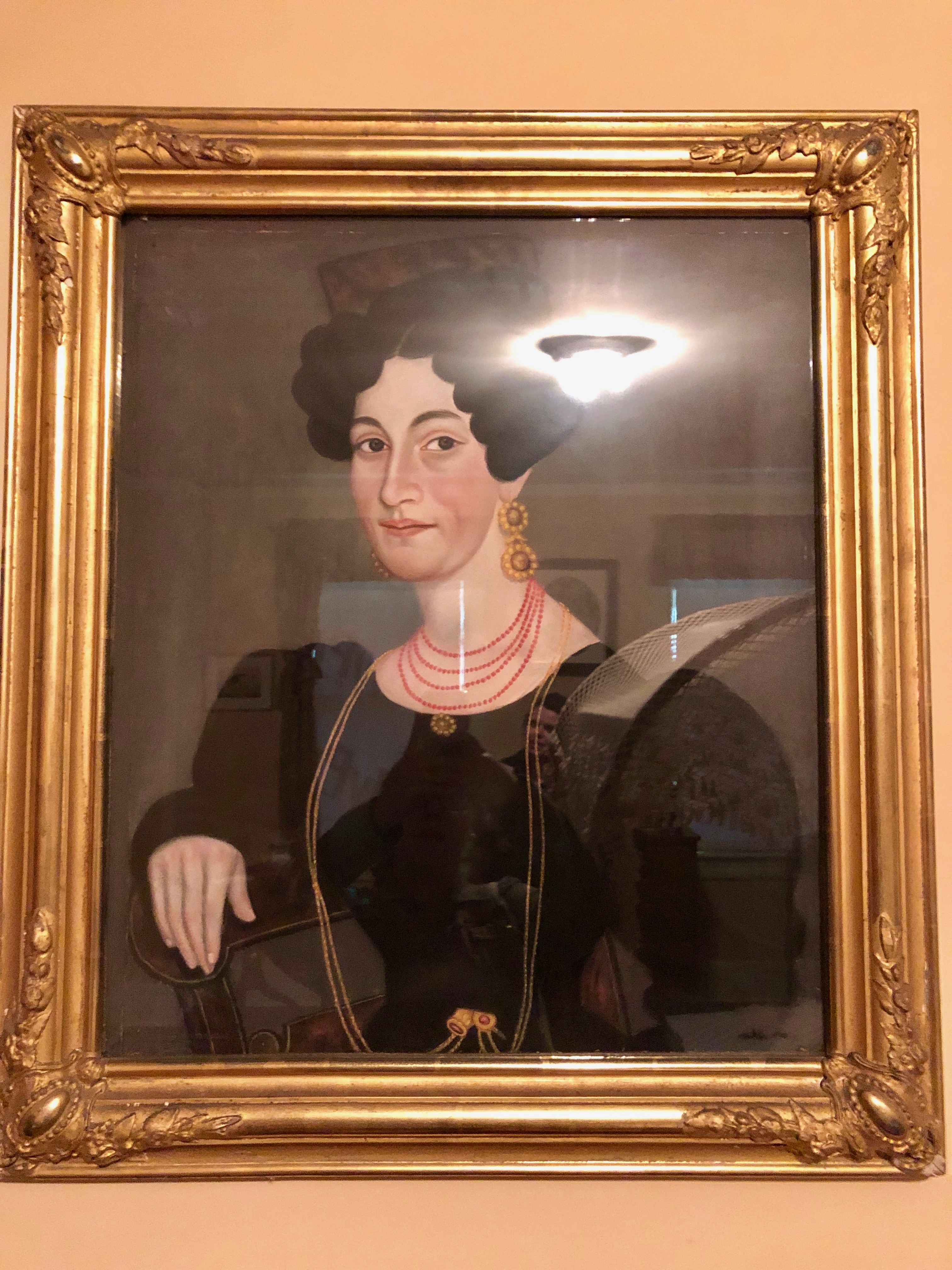
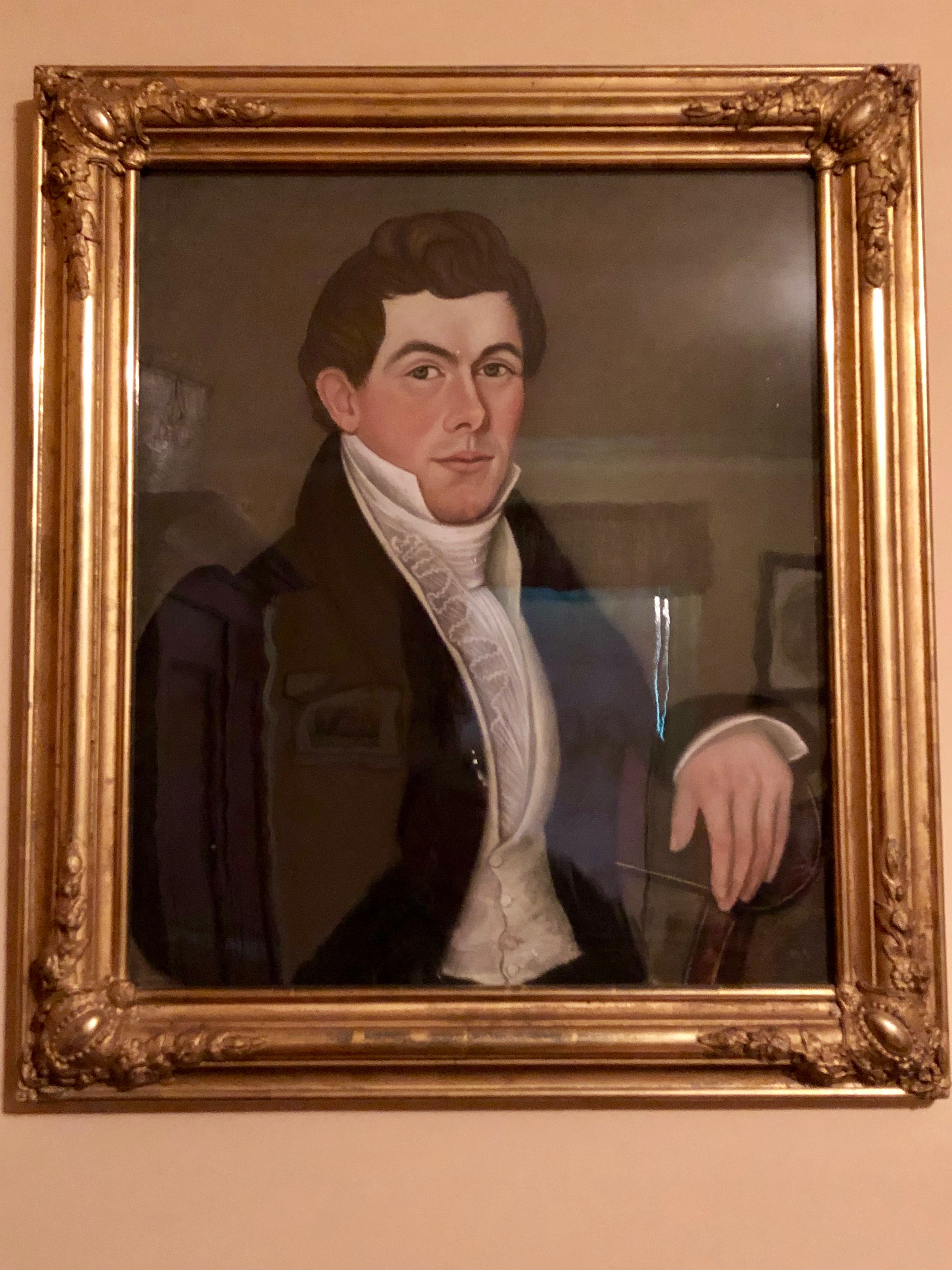
When I think of historical objects, I tend to think literally and picture everyday objects, like utensils, tools, and written documents. Within this mindset, I place art into its own category as I view art as more than just an object. This separation stems from the fact that I have grown up loving and appreciating art, but also due to how the term “art” is given a particular significance. Labeling something as a work of art often implies greater value, more depth, and asks for wonder and awe. However, it is through viewing pieces of art as both objects and works of art that a complete understanding can be made. For this project, I chose to research a pair of pastel portraits from the Huguenot Street Collection, to understand how they were significant both as objects and as works of art. These portraits are of Jane Van Winkle Elting Hasbrouck and Augustus Hasbrouck, created by the artist Micah Williams.
Jane Van Winkle Elting Hasbrouck
Augustus Hasbrouck
The pastel portraits are of standard size for artist Micah Williams, 32 inches in height and 28 inches in width. They are done on a “stretched paper” framed together and reinforced with newspaper clippings on the back of the pastel paper (Choi & Makin 131). This was done so that Williams did not have to travel with as many supplies such as an easel. However, since these panel assemblies were makeshift they are extremely fragile and susceptible to tearing and fracturing (Choi & Makin 131). Within his portraits, Williams paid extreme attention to detail, including all the minor details that the subjects wanted; such as the jewelry, intricate clothing textures like those in collars and sleeves, and hairstyle. Furthermore, this attention to detail extends into the faces of both Jane Van Winkle Elting and Agustus Hasbrouck. They appear here looking rather serious with only small smiles, in their best clothes and jewelry. In order to succeed at such detail, Williams mixed and layered different pigments within each portrait, to individualize the facial features of each subject.
Notice how flash photography influences the outcome of this picture, and adds a glare.
No flash was used for this photograph, but due to the bedroom lighting there is still a glare.
These images depict where the portraits hang now, in the Southeast Bedroom of the Deyo House. They are preserved in gilded frames and depict the couple in their best attire. Jane Van Winkle Elting Hasbrouck is wearing a black dress, and adorned in jewelry. While Augustus Hasbrouck is wearing a white shirt with a ruffled cravat, a waistcoat, and black jacket.
The portraits originally sold in the early 1930’s by descendants of the NJ Hasbrouck family, in Hurley, NY. The portraits later became a part of the Historic Huguenot collection through Fred Johnston of Kingston in 1979. Fred Johnston was an antiques dealer in located in Kingston, who turned his home into both his shop and a museum (Kirby). The Fred Johnston House was built in 1812 by John Sudam, a prominent local attorney, state senator and member of the state Board of Regents (Kirby). Fred Johnston applied for a loan and bought the house to save it from being turned into a gas station, and devoted his life to restoring and preserving the local history of the area (Friends of Historic Kingston & Kirby). Prior to his purchase of the house, it was owned by the Ven Leuven family and their descendants (Friends of Historic Kingston & Kirby).The significance of these portraits goes far beyond what I imagined. Not only do these portraits tell the story of Jane Van Winkle Elting Hasbrouck and Augustus Hasbrouck and their life connected to Huguenot Street, but also of antique’s dealer Fred Johnston of Kingston, and of the artist Micah Williams of New Jersey.
Jane Van Winkle Elting Hasbrouck was a daughter of Reverend Wilhelmus Elting and Jane Houseman, who married Augustus Hasbrouck of the Shawangunks region. According to Hasbrouck, she inherited 100 acres of land in her father’s will, near the Passaic River (112). Furthermore, she created the designs for the Octagon House in New Jersey, that she and her husband lived in (Brown et. al 126). An Elting family descendant, she is an example of how her family flourished despite not being original settlers to Huguenot settlements. Furthermore, it is noted that the Elting family line was known for bring church-goers, moral, thrifty, hospitable, and blunt (Lefevre 498). Jane Van Winkle Elting Hasbrouck, was the mother to sixteen children from her marriage to August Hasbrouck, and raised them all in New Jersey farmland (Hasbrouck 113).
Augustus Hasbrouck is the son of Joseph Issac Hasbrouck and Cornelia Hasbrouck. Father to the sixteen children he shared with Jane, he was a well respected farmer from Goshen, New York (Hasbrouck 113). According to the full obituary found in the Hasbrouck family history, he died of a bladder disease on September 9, 1809 in the Hasbrouck family home (Hasbrouck 113). For the majority of his adult life, he lived with Jane and their family in the farmlands of New Jersey, until shortly before his death when they moved to New York (Hasbrouck 113). According to Hasbrouck, “the deceased was a quiet, upright citizen, who probably had not an enemy in the world” (113). Augustus and Jane therefore, had some status as they were able to have these portraits commissioned from Williams.
Through Fred Johnston, these portraits were able to remain a part of the Hudson Valley’s history and eventually return to Huguenot Street. His work as an antique dealer not only preserved history in Kingston, but also allowed for history to be preserved in New Paltz, and spread knowledge between these communities. Furthermore, his role in these portraits story allows the narrative to become larger than just Jane Van Winkle Elting Hasbrouck and Augustus Hasbrouck, by including the greater communities story.
These paintings also add another level of community history due to their creator and original artist. Micah Williams was a self-trained artist, who had previously had a career as a silver plate craftsmen (La Gorce). Known as a folk artist, he traveled from home to home across New Jersey, New York, and Pennsylvania to complete each portrait (La Gorce). Williams and his wife had seven children together and raised them in New Jersey and some of them later in New York (Rogoff 16). Portraits by Williams would have cost somewhere between five and ten dollars at the times of their creation in the mid eighteen hundred, now cost around sixty-thousand dollars for collectors (La Gorce). Williams knew that pursuing an art career would not ease financial burdens, and was often in debt, at one point even in debtors prison (Rogoff 12). However, he did not let financial burden stop him from pursuing his art career, and his works are now desired by folk art collectors. Williams work reflects the history of the time, as portraits were the method through families were documented. Furthermore, his work demonstrates the significance of the area and of Jane Van Winkle Elting Hasbrouck and Augustus Hasbrouck. These portraits represent both historical objects and incredible works of art that tell the story of the individuals within the frame, but also of those around it.
Works Cited
Brown, T. Robins., et al. The Architecture of Bergen County, New Jersey: the Colonial Period to the Twentieth Century. Rutgers University Press, 2001.
Choi, Soyeon, and Jessica, Makin. “Treatment and Housing Techniques for Pastel Paintings on Paper: Case Studies.” Book and Paper Group Session, AIC’s 41st Annual Meeting. Book and Paper Group Session, AIC’s 41st Annual Meeting, Indianapolis. http://cool.conservation-us.org/coolaic/sg/bpg/annual/v32/bp32-06.pdf
Le Fevre, Ralph. “History of New Paltz, New York, and Its Old Families (from 1678 to 1820).” Google Books, books.google.com/books?id=J3MzN2gTQfgC&pg=PA497&lpg=PA497&dq=Jane Van Winkle Elting Hasbrouck and Augustus Hasbrouck&source=bl&ots=ps2CZC2JbP&sig=ACfU3U0_bI7gTuasMKvPvYmnsMihlFEDWg&hl=en&sa=X&ved=2ahUKEwixtLCA2-bhAhVrk-AKHS9wAgU4ChDoATAAegQICBAB#v=onepage&q=Augustus Hasbrouck&f=false.
















 The Materials of History, Thought, and Art