After visiting the Huguenot houses with our class, the stand out for me was the 1950’s kitchen in the Deyo House. Although replicated, I couldn’t stop thinking about leaving the 1800’s Victorian dining room and walking into what was at the time, a high end kitchen from the post-war era.
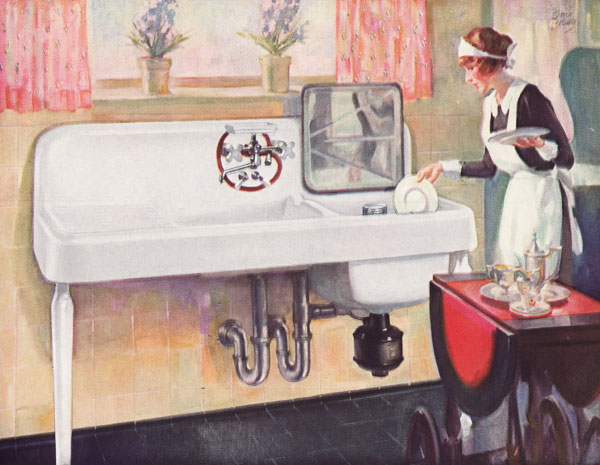
According to documents shared with me by Ashley, from 1894 on, the layout of the kitchen hadn’t changed much. One of the biggest upgrades to the house was when plumbing was brought into the house. That made appliances such as the Kohler Electric Sink from the 1920’s to 1930’s possible. Cabinets were created where the dumbwaiters used to be. Woodwork was painted, where previously it had been varnished.
Kohler Electric Sink ad from the 1920’s
One of the reasons the kitchen hasn’t been brought back to the pre-renovation style is because of what it would take to remove the plumbing. Other factors are also involved.
Ashley recommended I visit the Elting Library to gather more information about the Woods family. They were the residents of the house when the current renovation took place. I will do this in the next couple of days.
According to the Ciphering Book Collection on the official Huguenot Street website, cipher books are handwritten workbooks that were used by students in the early times of education in New Paltz. Many students used these workbooks to learn mathematics, handwriting, spelling, and other disciplines. Most of these books date from the early 19th century and are bounded in cloth, leather or board. They are very old and the pages have turn a light brown. The cloth that was used to cover the book feels like cardboard, slightly thick. The sides of the pages have what looks like watermarks and the bottom of the pages are worn, from the constant turning of the pages. The majority of the books contain entries in English, French and Dutch. The math content in the books were typically simple operations such as addition, subtraction, measurement, and problem solving with several different currencies. As the pages go on, the mathematical operations become more complex with application problems, proportion, interest, decimals, fractions and more. Some of the application problems referred to events that occur in our history, which revealed social issues of the time. Religious and moral lessons, along with simple doodles were written throughout the books.
I was curious about how the curriculum of education began in New Paltz, so I was directly to In a Valley Fair: A History of the State University College of Education at New Paltz. According to the first few chapters of this book, the Huguenot landholders hired Jean Cottin as their headmaster when they settled in New Paltz in 1689. The school was connected to their church, and the headmasters were hired only if they were condemned as a good man, teacher, and true Christians. During the early order from the Classis of Amsterdam, schoolmasters in the Dutch colonies instructed their pupils not only in reading, writing, ciphering and arithmetic, but also in the customary form of prayers. This would explain the writings doodled into some of the cipher books. There was a mantra that was spotted in some of the cipher books, including in DuBois’ cipher book, which I will explain more later on. The school curriculum in 1812 was limited, so it was mostly reading and writing. By 1827, subjects such as math, grammar, and geography became the common branches of public education. In 1828, a group of leading citizens founded the New Paltz Classical School, which began its sessions on the second floor of the Common School. The classical school was meant for the higher class, with more money because those who supported this new school were decedents of the original families: Deyos, DuBoises, Eltings, Hasbroucks, and LeFevres. Those who attended the classical school, paid more money and were taught Greek, geography, history, natural philosophy and math. Those in the regular English schools were taught grammar, French, reading, writing, arithmetic, bookkeeping and elocution. Education in New Paltz in the late 18th/early 19th centuries was largely focused on business and commerce, and was tied in with religious rhetoric. These next two ciphering books will demonstrate this in various ways.
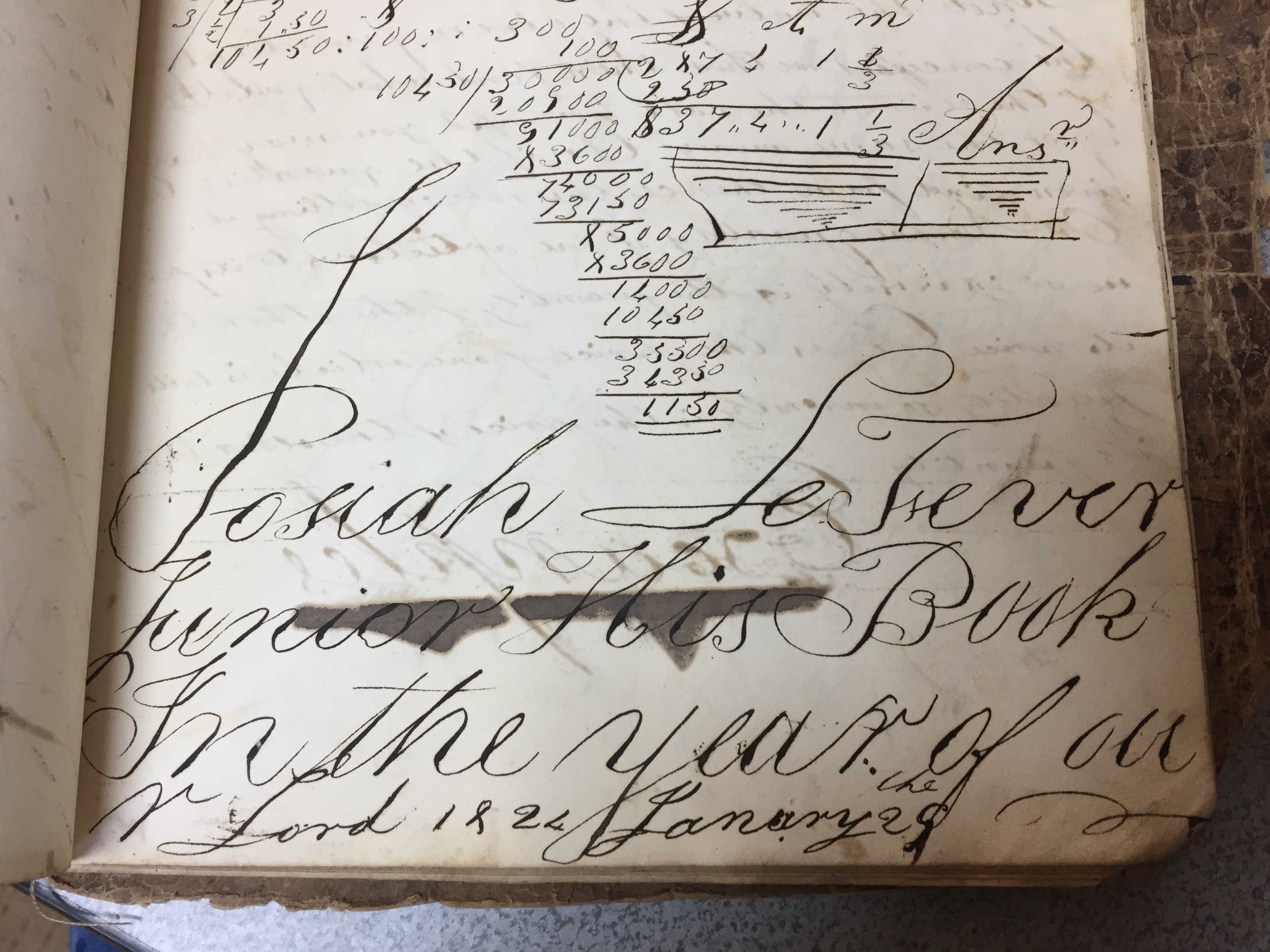
Josiah Lefevre’s cipher book
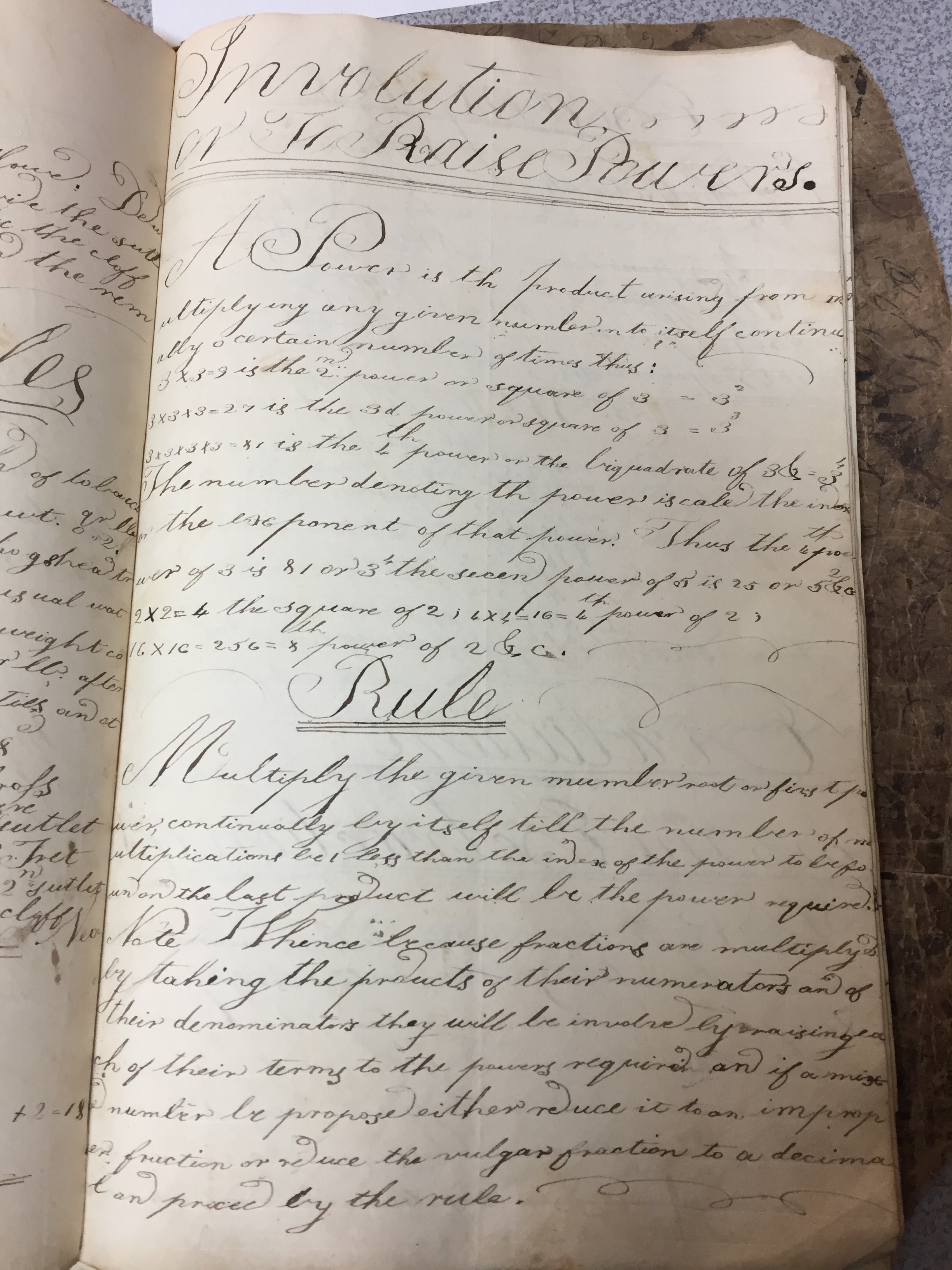
Rule for Raising Powers
The first Cipher book I chose to analyze was Josiah LeFevre’s from 1822-1824. This cipher book was part of an artificial collection, meaning that the donor is unknown and the Huguenot team put the book together. Carrie from Huguenot Street believes this cipher book might have been donated by Sadie Mott, but is unsure. According to Historic Huguenot records, Josiah was born July 7, 1810 and died December 15, 1888. He married his first cousin, Catherine Maria Lefevre and had four kids. On the left side of the first page of the cipher book, he writes “last of May or the first of June; May 31, 1822” and on the other, he writes “Josiah LeFevre his Cyphernbook May the 28th 1822 Tuesday. The arithmetick Printed By Nicoles Tike in the year 1809”. I’m not sure who Nicholes Tike was, but his name was on the inside cover. Maybe it was the author of the workbook he was copying problems from. The cipher book starts off with easy mathematical operations and then they get more complex.
Their long division looks like what we currently learn in schools except they had lbs:g:lbs on top of the equation. I’m not entirely sure why they wrote that before starting the problem. However, whenever Josiah starts a new concept, he defines it and its many rules before creating word problems for the concept. As I continued flipping through the pages, I noticed that their application problems were more about how to deal with purchases of a certain product. “By inventing the order of the _____, it will be 2^n. If ____ (illegible handwriting) buy all of sugar, how much will ___ buy at that rate?”. There were other word problems that spoke about picking up pounds at certain ports and delivering it to other ports for certain rates. These math problems illustrates the business and commerce life that kids Lefevre’s age were learning in school. There were also application problems involving our past history. One word problem said, “America was discovered by Columbus in 1492 and its independence was declared in 1776. How many years elapsed between those two years?”. The next word problem mentioned the Boston massacre and the Battle of Lexington.
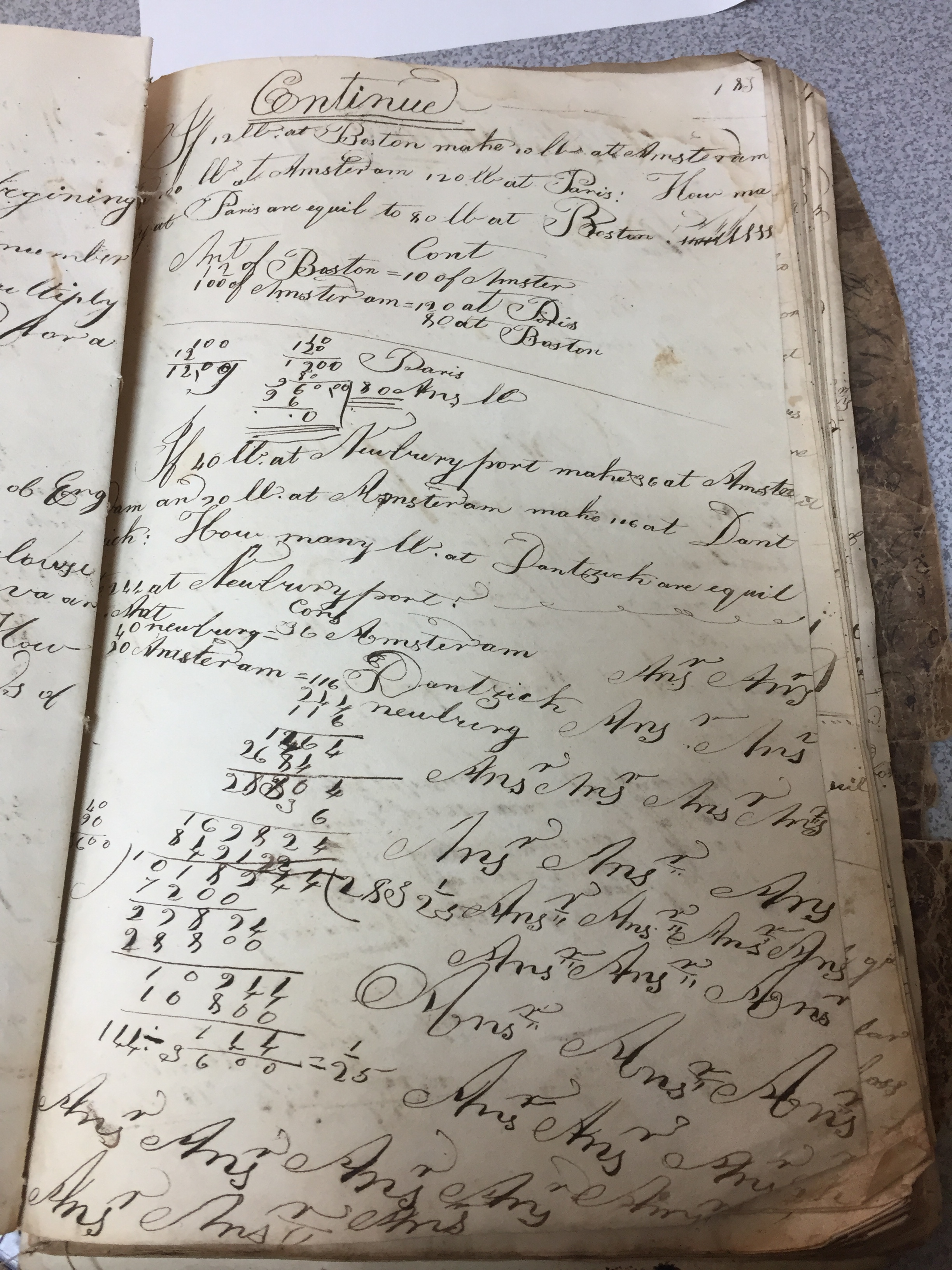
Doodle of 32 “Ans”
American History application problems
Records of products
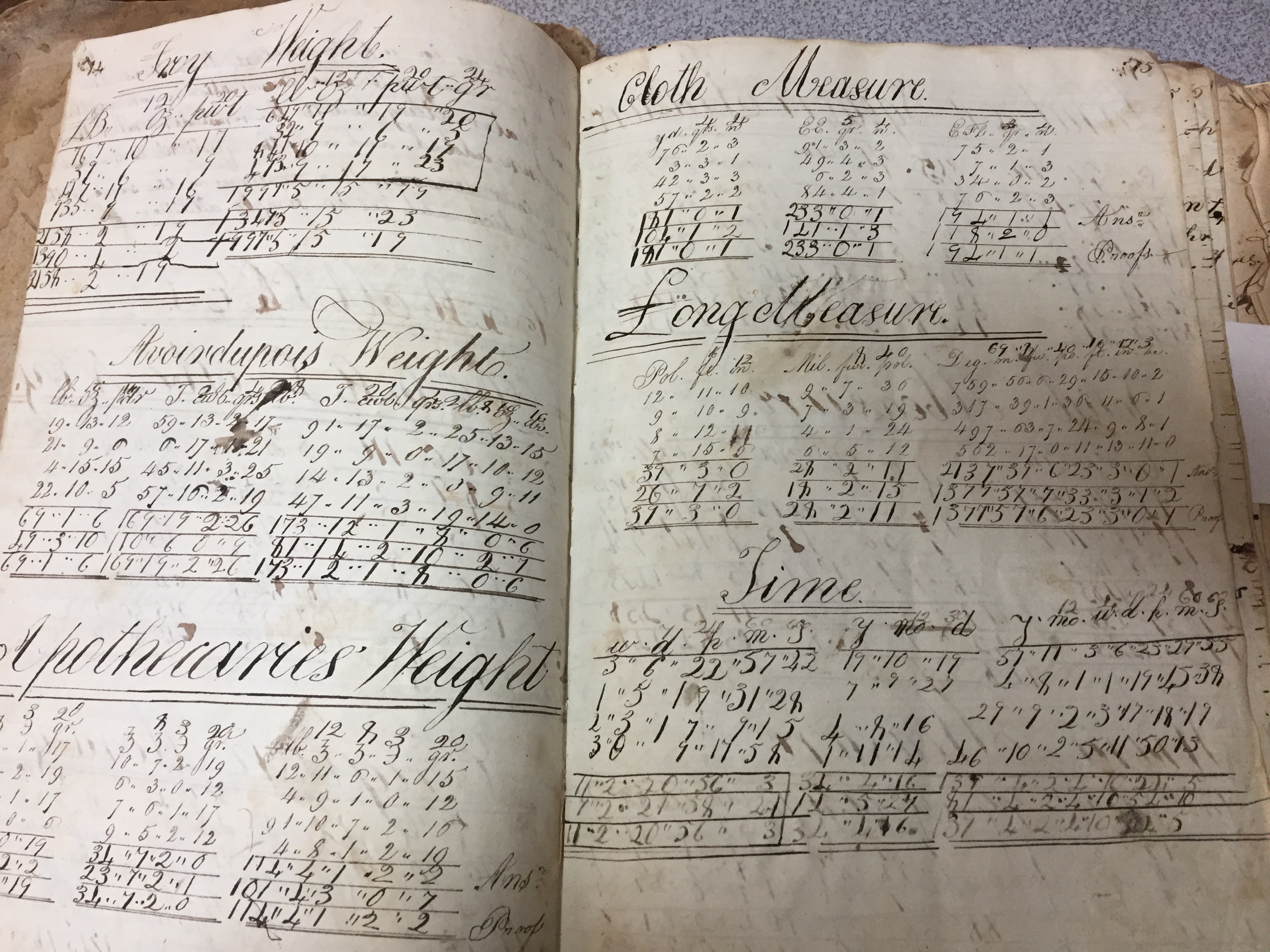
There were also doodles throughout Josiah’s cipher book such as his initials throughout the book. At one point, he wrote the word “Ans” 32 times halfway down the bottom right side. Josiah also kept records of people who paid him for their bills through their bank accounts. It’s very detailed and it runs on for half a page with a chart. Josiah also compared federal money and english money as examples to a new concept. I did not understand why there was different markers on top of each amount and I wonder if that was how they distinguished their money back then. (insert pic) Midway through the cipher book, there were two pages of different measurements of products: ivory weight, avoirdupois weights (system that uses pounds and ounces), apothecaries weight (pharmaceutical measuring system), cloth and long measure, and time. The next two pages had land, square, solid, hhine, hole and beer, and dry measures. These must have been the different ways they measured the goods they traded and sold. The second cipher book was a lot like Lefevre’s, so I wonder if they were in similar grade levels or schools.
Different measurements from Lefevre’s book
More measurements for Lefevre’s book
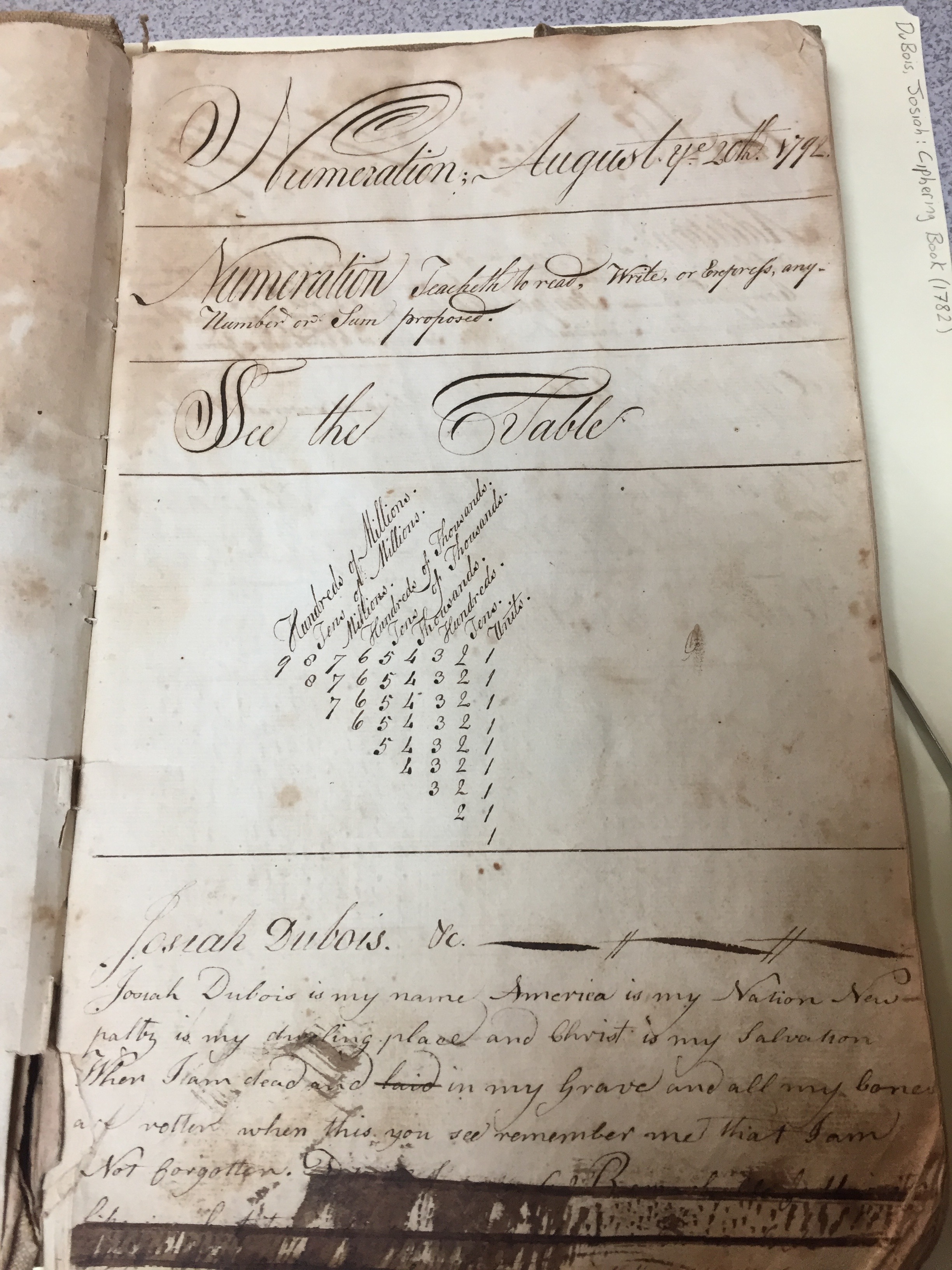
The second cipher book was written by Josiah DuBois in 1792. He was born on December 18, 1781, was baptized in New Paltz in 1732 and died March 11, 1869. He married twice and had many kids. Mr. DuBois was very successful in his early mercantile days and resumed the agriculture upon his ancestral acres, and lived for many years. He carried out his business in what is now the Jean Hasbrouck Memorial House, in partnership with Col. Josiah Hasbrouck. Mr. DuBois was also one of the original trustees of the New Paltz Academy and one of the owners of the Academy grounds. Josiah DuBois started his cipher book with the written words, “Numeration; August 20, 1792; Teacheth to read, Write, or Corprefs, any Number or turn proposed”. He then drew the place value chart up to hundred million. At the bottom of the first page, he wrote “ Josiah DuBois is my name/America is my Nation/New Paltz is my dwelling place and Christ is my Salvation/When I am dead, and in my grave and all my bones are rotten, when this you see remember me that I am not forgotten”. Unfortunately, the rest of that message was crossed out and doodled on top of and illegible. His message illustrates the closeness of the church in schools and in his life. This was the mantra that I had mentioned above that was seen in other similar cipher books. I believe that this saying was probably taught to students in schools, something they lived by, which was why it was doodled into their workbooks.
Josiah DuBois’s opening page
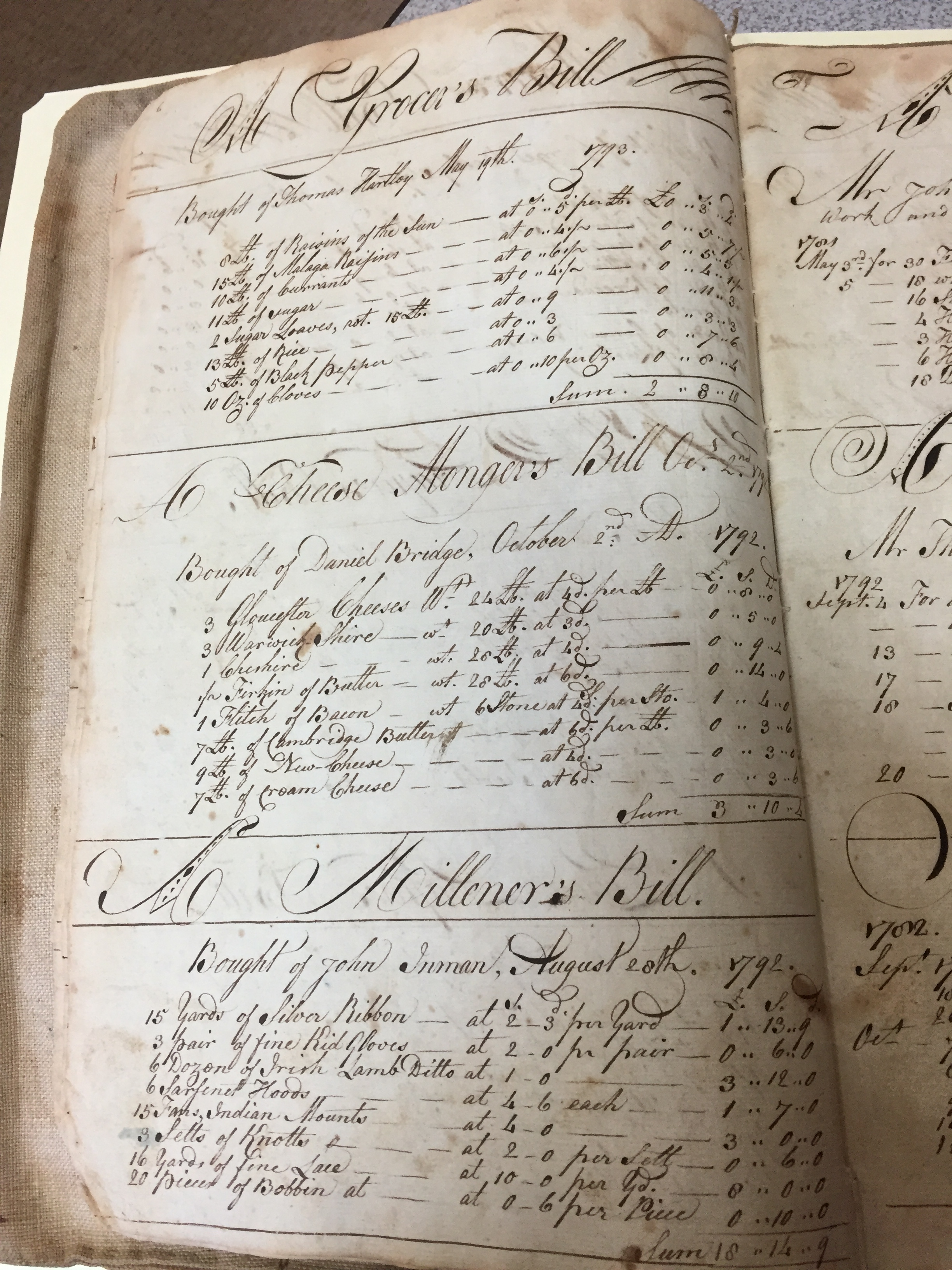
Commerce application problems
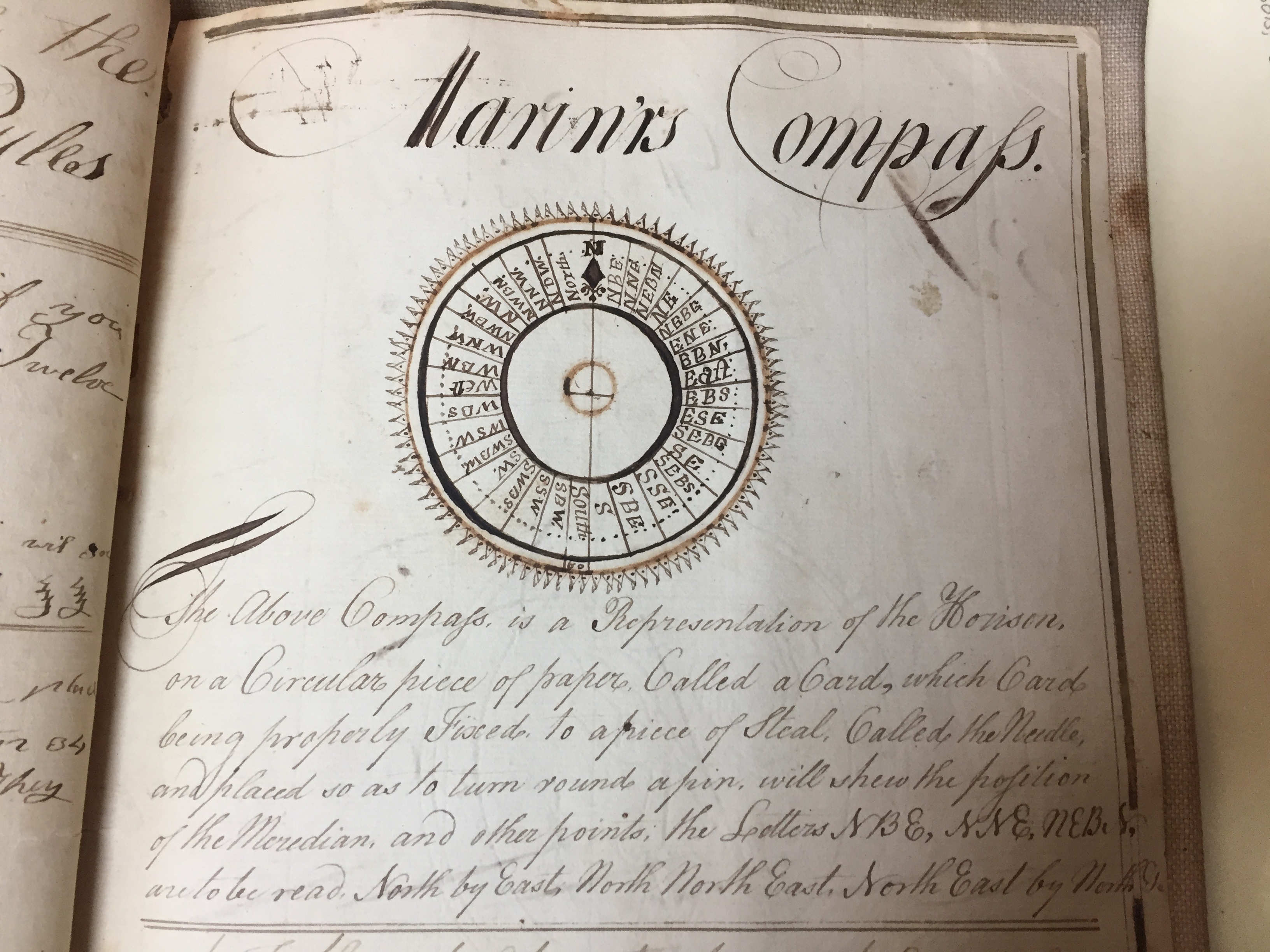
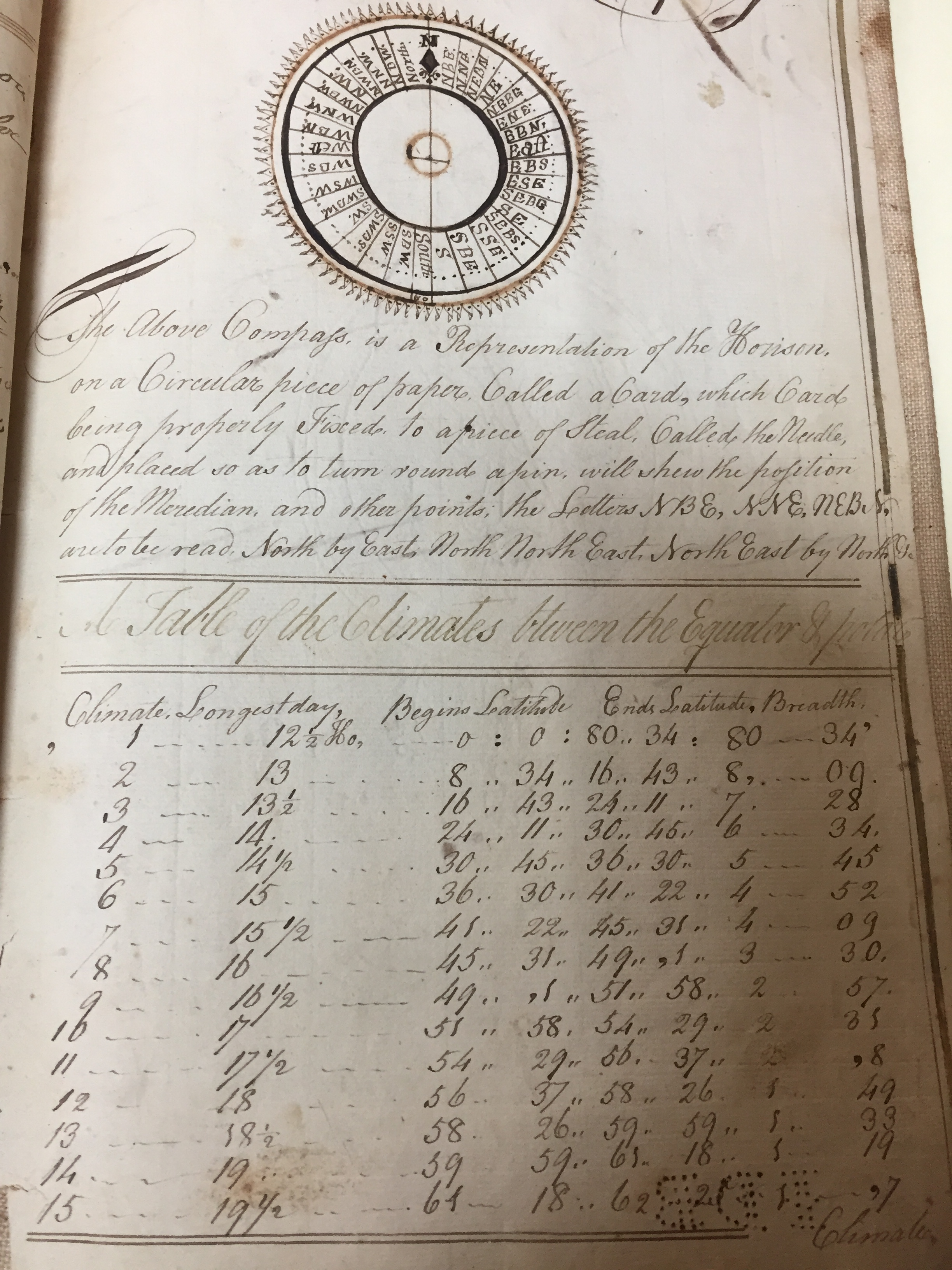
Josiah DuBois’s cipher book was similar to Josiah Lefevre’s book, except that DuBois’s book mentioned the selling of goods such as cloth and food, while Lefevre’s book emphasized on the money part of the business. In Dubois’s cipher book, there were word problems about buying or selling things such as, dog buttons at 3/6’/4 per dog. The problem asked DuBois to find the price, if he were to buy the whole. He also had two pages full of what his customers bought on a specific day. He had six different categories for who bought what. He had someone who was a cheese monger, milliner, carpenter, and baker. For example, he recorded all the products that Thomas Hantloy bought on May 19, 1793. The list consists of “raisins of the sun, malaga baifins, currants, sugars, sugar loaves, rice, black pepper and gloves”. Another interesting thing I found in Josiah DuBois’s cipher book was two poems on mathematical roots such as squared or cubed. One poem had 14 lines and the other had 20 lines, but both followed an aabbcc pattern. The first poem doesn’t make any sense no matter how many times I read it, however before the poem, Josiah wrote at the top of the page that this poem was a “Rule to be got by heart”. I can only assume he means they must memorize this poem to help them understand the rule to the concept of roots. As for the second poem, the first three lines says, “The cube of your first period take/And of its root a Quotient make/Which root into a cube must grow/And from your period taken fro, To the Remainder then you must”. I don’t understand what he was trying to say in the poem, but it looks like something that was taught in their schools to help them memorize rules and concepts. The last interesting thing I found towards the end of the cipher book was a Mariners Compass. According to Webster Dictionary, a Mariners Compass is a navigation compass that consists of magnetic needles permanently attached to a card that marks the direction and degrees of a circle. Josiah DuBois wrote down numbers related to the climate between the Equator and the poles using the compass.
List of products each job needs
Continued page of products for job needs
Poem on the rules of roots
Poem on the rules of powers
Description of what a Mariners Compass is composed of
Climate records between the Equator and the poles
Overall, both Josiah Lefevre and Josiah DuBois’s cipher books had many similar writings and methods to their education. I conclude that it was possible they could have been in similar school grades because the math was so similar. I am assuming that Josiah Lefevre’s education was more focused on the business aspect of commerce, while Josiah DuBois’s education seemed to be more focused on the actual goods they were selling. I may be wrong, but judging from the different kinds of word problems they were given, that was my conclusion. I have learned a lot in my research and I’m glad I picked cipher books as my topic of discovery because I am an Education major and learning about how schools taught back then, was fun to read through. It’s interesting to see what goes on in a child’s head as they are in school. It’s also fascinating to see the methods they used for learning and how it is compared to today.
Works Cited
Lang, Elizabeth and Lang, Robert. In a Valley Fair: A History of the State University College of Education at New Paltz, NY. 1960.
Hedged, William. The American Decedents of Chretien DuBois of Wicres, France Part 3. Du Bois Family Association, Huguenot Historical Society of New Paltz, NY Inc. 1969, Revised and updated 1999.
Roth, Eric. Cipher Book Collection (ca. 1730-1849), Published 28 August 1999, last updated 14 January 2013.
Today, the center focus of our society is on the present. People often tend to worry about how the choices they make today will affect themselves and those around them in the foreseeable future. History, however, is the study of the past; it helps us comprehend the wealth of information about how people and societies behave and evolve over time. Always finding history to be a fascinating academic subject, I was thrilled to be given a unique opportunity to closely research an artifact from the archives of the Historic Huguenot Collection. Due to an interest in the Civil War era, the object I have chosen to explore is an 1836 U.S. Artillery Short Sword used by Union soldiers during this time.
Description and History
A full view of the 1836 Artillery Short Sword.
The U.S. Model 1836 foot artillery short-sword was the first sword contracted by the U.S. with the Ames Manufacturing Company of Chicopee, Massachusetts, with production starting in 1832. Despite there not being marking on this model from the manufacturer, evidence suggests that this short-sword derived from this company due to matching physical characteristics between this model and those produced during the Civil War era. The Ames Manufacturing Company was also a major provider of other side arms, swords, and light artillery for the Union during the American Civil War. With a whooping 16,200 models produced between 1832 and 1872, this weapon played a major symbolic role for artillery regiments during this time. Although the design was impractical for actual combat, it is alleged that artillerymen put this weapon to other uses, such as creating trails and clearing brush.
In terms of physical characteristics, the iconic design of this short-sword has remained relatively consistent throughout centuries. The first iteration of this design came from the Roman gladius, the standard sword of the Roman legionaries. Following the collapse of the Roman Empire, centuries later during the late 1700’s, neo-classical swords began to be revived in Napoleon’s France, and by 1831, the French army was issuing a short-swords centered on the gladius to its artillerymen as a backup weapon in the event they were charged by infantry or cavalry. Eventually, the United States were inspired and began creating their own in 1832.
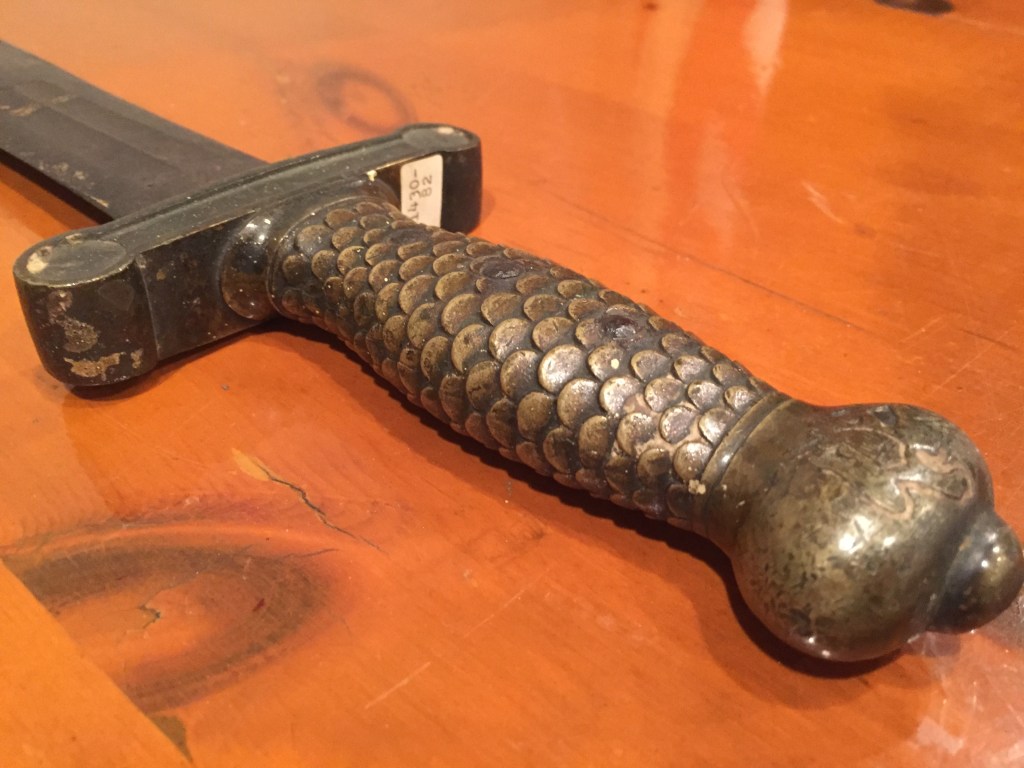
A close of view of the hilt of the 1836 Artillery Short Sword from the Historic Huguenot Street Collection. The sword was donated in 1982 by Myra Wilkins and evidence suggests that her grandfather, William Ackermann, used this sword while enlisted in New York’s 10th Artillery Regiment which was stationed in Virginia. While not designed for actual combat, the weapon played a symbolic role in the events that occurred during the Civil War.
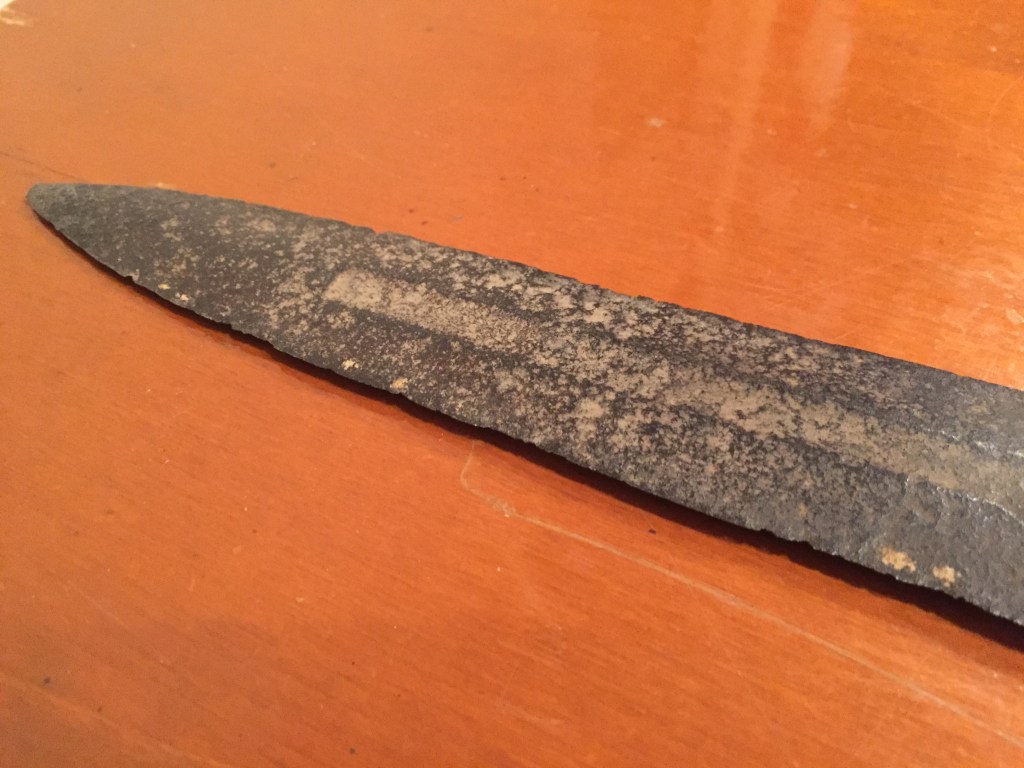
A close up photo of the tip of the 1836 model short sword from the Historic Huguenot Street Collection.
The U.S.
model from our collection was a double-edged sword 25 inches long and was 1.75
inches wide. Moreover, the physical steel blade spans 19 inches with a small
indent that runs down the middle, all with a corroded metal look due to length
of time since its initial creation. Shifting to the lower part of the object,
the sword has a 6-inch solid brass hilt and a 4-inch cross guard with a
curricular design at each end. In addition, one of the most noticeable features
is the fish scale grips that make up the hilt of the sword, along with the
spherical pommel at the base of the sword with a faded image of an eagle.
Provenance
This artillery short-sword was donated to the Historic Huguenot Collection in 1982 by Myra Wilkins, an elderly resident of New Paltz. Mrs. Wilkins, who was born on January 31st, 1908, was 74 years old when she donated a vast array of weaponry to Huguenot street and would eventually pass away and be buried Union Cemetery of Lloyd years later at the age of 83 on the 15th of January, 1992. When analyzing the genealogy of the Wilkin family to determine if this sword was actually utilized during the Civil War, I came across Myra’s grandfather William Ackermann. Upon exploring enlistment records, I discovered an individual with the same name who served in New York’s 10th Heavy Artillery regiment. Although I can not say this with absolute certainty, but evidence suggests that Ackerman, who according to Census data from 1860 was 16 years old at the age of enlistment, served in New York’s 4th regiment which was eventually combined with other groups from New York into the 10th regiment that was listed earlier. According to historical records, the 10th regiment was mainly stationed in Virginia, the state with the highest slave population in the confederacy.
Narrative
The Civil War played a pivotal role in reshaping the status quo of contemporary America. Throughout the entirety of the states, the conflict truly divulged the horrors of war, racial discrimination and polarization. These effects were more than prominent in Ulster county which saw nearly 7,500 men, more than 200 of those from New Paltz itself, enlist for the war effort. As mentioned before, a majority of the soldiers who enlisted from New York eventually combined into the 10th regiment which saw most of their action in the confederate state of Virginia. Unfortunately, the Civil War was one of the bloodiest wars in American history and it is no surprise that many of these soldiers were unable to return home to their loved ones. Just from the 10th regiment, a staggering total of 267 died while serving in the military. What’s most shocking is that although this regiment fought in a total of five battles, 220 men died from disease while only a mere 47 were actually killed in combat.
Of the three million soldiers who served and fought in the Civil War, each represented a unique story waiting to be told. Although no two men shared exact same experiences throughout the conflict, whether their exploits in battle or their emotional state of mind, similar threads weaved their way through a significant number of these narratives. With nearly two-thirds of all enlistments being under the age of 21, Ackermann most likely included, the conflict not only became a test for survival due to gruesome and life-threating conditions, but also to the emotional narratives that ensued throughout their campaign.
A common misconception regarding the cause of enrollment is that Union soldiers fought to liberate southern slaves and Confederate soldiers fought to do the opposite. Unfortunately, evidence suggests that this was not what the soldiers during this time truly believed. During this conflict, Union soldiers fought in order to protect the United States and to reunite America. As a result, the underlying issue of slavery was often seen as a trivial issue by both sides of the war; for many, it seems, emancipation was not a prelude to equality.
Despite
this, however, there were significant differences in the rights of
African-Americans between those who resided in New York and those in Virginia. Within
the former, slavery was officially made illegal in 1827, but in terms of
representation, New York residents were less willing to give blacks equal
voting rights. By the constitution of 1777, voting was restricted to free men
who could satisfy certain property requirements for value of real estate. This
property requirement disfranchised poor men among both blacks and whites. In
spite of this, John Hasbrouck, born to an enslaved woman in New Paltz in 1806
and, later, as a freeman, was able to purchase land in the town. He is commonly
believed to be the first African American eligible to vote in New Paltz.
Although
African-Americans exhibited some rights in the north, slavery was still a
strong issue throughout Virginia where Ackermann was most likely stationed. At
first glance, one may think that Union soldiers would have stop to think about
the cultural and socioeconomic differences between the north and the south, but
to our dismay, that is not what occurred. Upon analyzing letters archived from
the Historic Huguenot street, it can be seen that soldiers cared little about the
lives or wellbeing of these individuals. The language of many of these letters
suggested strong animosity toward the idea of equality, as many writers often
resorted to dehumanizing names toward slaves they encountered.
Its important as a society to be able look back at these records and think about how much times have changed. During this era, even though there were different stances on the issue of slavery, it is undeniable that racism was heavily prevalent from both sides of the conflict. It’s no secret that Historic Huguenot street itself once owned a large slave population, and there are many items apart of its collection that continue to serve as a reminder of the past. In my opinion, I believe that the inclusion of this short sword has contributed an unprecedented amount to the nature of New Paltz’s history. This item in juxtaposition with old remnants of Huguenot Street’s early past help remind us how much we’ve progressed as a society and helps reiterate the demand for change in the near future.
Lanham, Howard G. “Sword Plate from the 1861 U.S. Ordnance Manual.” U.S. Army Regulations Illustration: Link 11d Swords and Scabbards, 2019, http://www.howardlanham.tripod.com/link11d.htm.
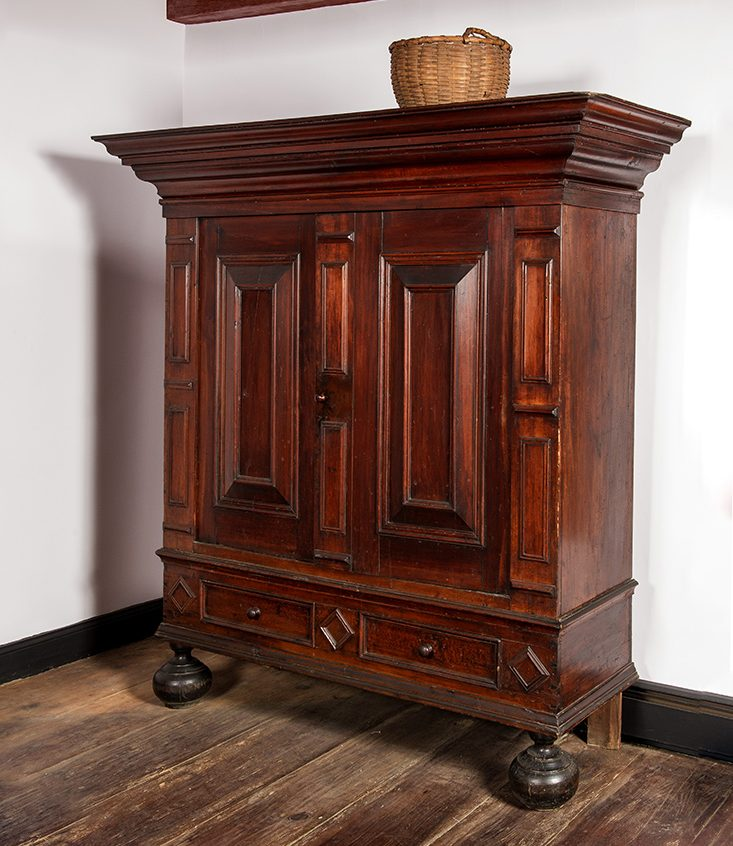
Caption: Kasten are very interesting objects, but not something you would find in many common households today. They were large, spacious objects that were typically owned by people classified to be wealthier. Part of the reason for this is that they were very difficult to transport because of how large they are in size. Typically, they held expensive linens and cloths as well. They were central to domestic life in colonial New York, serving a utilitarian function as the primary storage for linens and furnishing many American homes (Hudson Valley Kasten). Having these Kasten as furniture not only signified the owner’s heritage, but also demonstrated their wealth and social status. There is limited literature published on Kasten. There is even confusion over the terminology used to describe this piece of furniture. At the time of its origin, English was the mandated language of government decisions. Therefore in the most contemporary wills and inventory of objects from this historic time period, they were referred to as “cupboards.” However, cupboard is a very generic term for any generic wooden case piece with doors. The specific functions that people used these kasten for were made unclear in wills and inventories, so they’re uses range (American Kasten). Kasten are one of the many objects that the Dutch contributed to the American culture.The terms kas and kast, were used interchangeably in the seventeenth and eighteenth century. The term attempted to survive throughout the centuries, but regardless was reintroduced to the general public by the early historians of American furniture. Kasten have been recognized as a feature of colonial New York furniture since their first formal studies in the field. There was even later association made in 1900 by Singleton identifying kasten as possessions of New York Dutch families (American Kasten).
Figure 1: Other Kasten within the same collection of the one specifically analyzed.
Physical Description of the Object: The Kas in particular that I chose to work with is described as being, “early 18th century Red gum and pine” (Hudson Valley Kasten). It is 75 ½ x 25 ⅝ inches. Kasten, in general, are characterized to be mid-18th century Dutch style cupboards. Variations in design can exist, however, they usually are large, free standing cupboards. This one in particular has, “two-paneled doors surmounted by an over-scaled cornice” (Hudson Valley Kasten). They typically stand on ball shaped feet and a drawer. The drawer of this Kas is decorated with diamond shapes, which could have been attributed to symbolizing wealth.
Figure 2: Actual image of specific Kasten analyzed.
Narrative: Nowadays girls dream about walk in closets. People’s wealth is sometimes determined by how many shoes line the walls of their walk in closet, or even how many different closets a person has for the different items they possess. However, as much as they need space to put their belongings, you need space for the closet as well. Often walk in closets make sense. A great storage place for all of your personal objects, yet doesn’t take up space within your bedroom. Who wouldn’t want one? Now picture a big, clunky, expensive cupboard taking up half your wall. They’re expensive, symbols of wealth, yet no longer sound as desirable, however, these furnished many Dutch-American homes during this time period. Closets are seen more for their function than for their appearance. Back then, it was more for their appearance than their function. These Dutch immigrants, “concerned themselves much more with domestic economy than with public government” (The ‘Kast’). This cupboard was one of the most important pieces of furniture for these Dutch settlers because it not only held all of their most tangible treasures, but, “Dutch notions of domestic life as well” (The ‘Kast’). These new homes they were establishing were trying to mimic the flourishes they had left behind. Nowadays it seems we are more focused on the quantity of our objects rather than the quality. We are never satisfied with what we have, but always want the latest and greatest, or to be able to say you have it all. In this time period their culture reflects a similar mindset, but a different means of execution. They didn’t have the space and housing we do today to have as many objects as we fill our houses with today. For them, it was about what they had to symbolize their wealth. Items like Kasten, to show their connections to their flourished heritage.
Provenance:
The Kas in particular that I chose to work with was from the Historic Huguenot Street Permanent Collection. It has been attributed to the Elting-Beekman Shops in Kingston, New York. Within these local areas surrounding Kingston, there were many people making Kasten at the time. There were were two families of craftsmen that are known of in Kingston, New York. These families were the Eltings and the Beekmans.This Kas in particular was one of the earliest examples attributed to many of the workshops in these areas, like the ones owned by the Elting and Beekmans. Along with its ties to these early craftsmen families, it is also reported to have connections to both the Hasbrouck and the Hardenberg families of Ulster County.
References:
“Historic Huguenot Street Permanent Collection, Gift of Innis Young.” Hudson Valley Kasten, 31 Oct. 2018, hudsonvalleykasten.org/portfolio-items/innis-young/.
“Hudson Valley Kasten.” Hudson Valley Kasten, hudsonvalleykasten.org/.
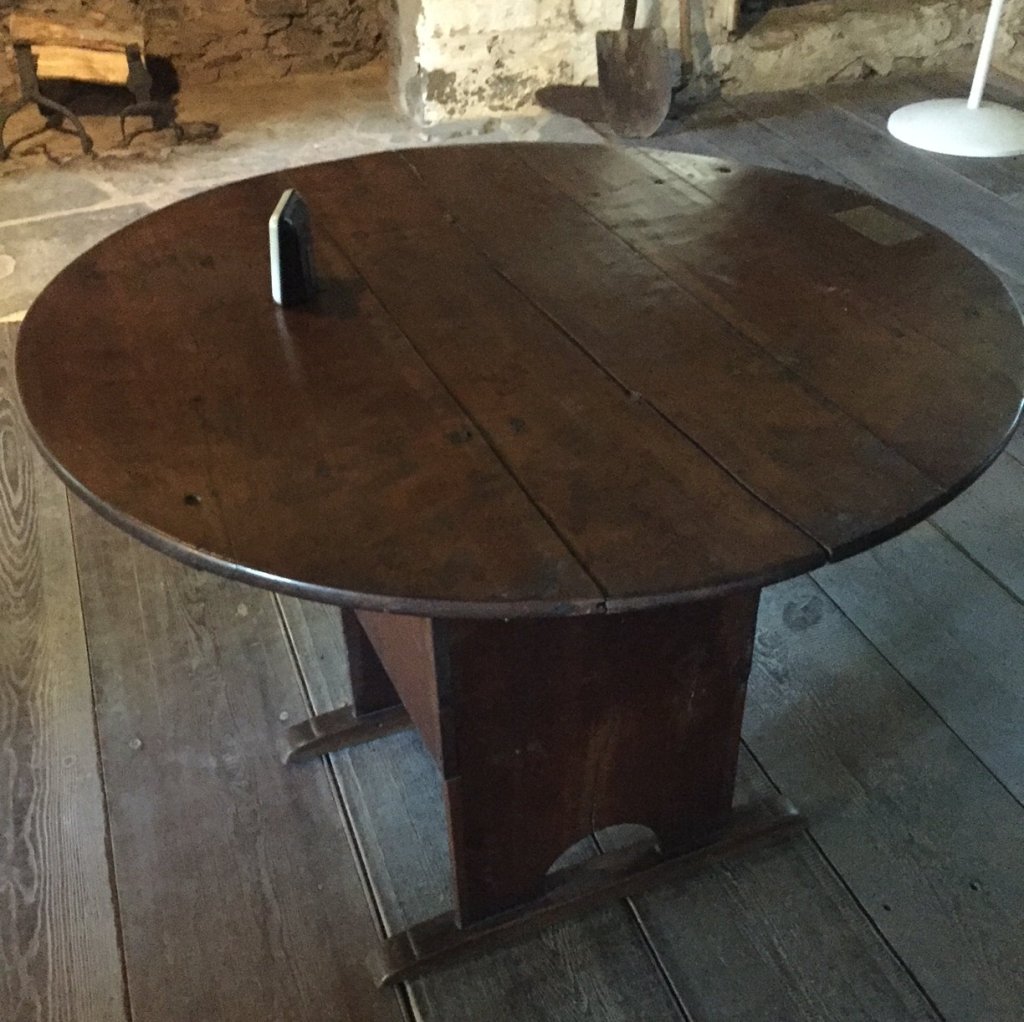
Pictured above is a piece of furniture that serves a dual function as both a table and a chair. Known as a hutch table, it has a top that can either be flipped up or removed to reveal a convenient place to sit for the user. It is a very effective piece of furniture when it comes to saving space and convenience.
When exploring Huguenot Street and all of the historic objects it holds, I was immediately drawn to a piece of furniture within their collection. The object appeared to be a table, but upon looking closer, I found that it also functioned as a chair. I was informed that it is called a hutch table. It serves the purpose of a table when the top is down, and then when the top is flipped up, the chair portion is revealed. The duality of use for this piece of furniture is something that does not appear as often in today’s consumer society. However, the space saving aspect of its functionality is still prevalent.
Description
Generally speaking, hutch tables are a piece of furniture that serve the purpose of both a chair and a table. The specific table being presented is wooden with a round table top attached to a square base. While it is known that the Tilson Hutch Table at Huguenot Street is made of wood, the wood is not specified. According to Common Sense Antiques by Fred Taylor, it is likely made of a “soft wood” such as pine. The table top is split down the center by a large crack. Some discoloration has occurred, though not much, which leads to the belief that this hutch table has been refinished since its original creation. There are a variety of chips and scratches on the surface of the hutch table. On the round top, there is a rectangular metal plaque that is about the size of a credit card. There is an inscription that reads, “Job and Esther Freer Tillson/ Presented by/ O.J. Tilson II/ 1968”. When in the table position, the hutch table measures 39 inches in length and 29 inches in height. The square base rests on feet with an arch and long supports, known as shoe feet. The top is connected to the base by a hinge that allows the top to tilt up and form a chair. There is also a knob that allows the table top part to be taken off (Trainor).
Provenance
The specific hutch table which caught my attention came to reside on Huguenot Street through the donation of Oliver J. Tilson. It resides in the Bevier House Cellar Kitchen. The hutch table was donated in 1968. This piece of furniture is far from the only object donated by Oliver Tilson. He donated enough objects for an entire room to be deemed the Tilson room. The original owners of the hutch table were Esther Freer Tilson and Job Tilson. Esther lived from 1778-1851 and Job lived from 1766-1853. The hutch table was owned by the couple during that period of time. Together, they had four children, and the donor of the hutch table, Oliver Tilson, was one of their descendants.
Narrative
Picture this: You enter the main room of your home in New Paltz, New York after a long day. You want to sit down. You spot your hutch table still in the table position from breakfast this morning. You flip the table up and take a seat in the too small chair that forces you to sit in a terribly uncomfortable manner, though with great posture. You look regal with the background of a table top behind you, and the wind is being blocked from your face with little effort. You have tons of leg room because there is no table in your way.
While the description above may not be a scene one would see in a house today, it does reflect furniture used in homes during the 19th and early 20th centuries. In the late 19th century, multi-use furniture rose to popularity. One furniture purchase for a multitude of uses sounded like a phenomenal concept. This trend can be seen with cabinet beds, murphy beds, and more (Safford). However, this double function can be traced back to the late 17th century. Dual functioning furniture can be seen with the chair table, or the hutch table. One purpose behind this furniture concept is storage (Taylor). Storing a table vertically takes up significantly less space than if it were placed horizontally. Another purpose of the hutch table, when in the chair position, is that the vertical table top blocks the wind from the user, as colonial houses are not as air tight as houses now, the wind was likely prominent indoors (Taylor). While this furniture can be referred to as having a dual purpose, a table and a chair, it provides many more, such as the two listed above.
Hutch tables can range from simple to extravagant, though they all have the basic structure of a base and a top. In many cases, the top can be removed. Despite the varying degrees of affluence, the majority of furniture in the colonial period was expensive, and, therefore, a luxury. It is important to note that this expense did not mean that the furniture would be comfortable. One purpose was actually the opposite of comfort. In order to look of a certain status, the uncomfortable furniture would force people into with a “properly respectable and refined posture” (Crowley). It would also frame their clothing in a way to add to this refined look.
Space saving furniture was popular in colonial households, as there was often a lot of people in a small amount of space. Another example of space saving furniture popular at the same time as the hutch table is the leaf table. A leaf table is a table with a removable piece of wood that can be added to lengthen the table when more people will be using it. However, while the hutch table is no longer prominent in society, the leaf table is still commonly used to this day. It is possible that the death of the hutch table is due to the lack of need in modern day society for some of its many functions. Houses are no longer drafty to the point of needing to block the wind with a table, or at least not commonly, and comfort is valued more.
Comfort is a key factor for many modern day people when it comes to purchasing chairs. This focus can be seen in the creation of arm chairs, rocking chairs, and recliners. However, in the nineteenth century, as long as a chair “suggests lineage, hospitality, and good taste in the owner, it is much sought after and universally admired” (Modern Chairs). With this shift in societal comfort standards, the disappearance of the hutch table can be seen. While a direct connection between the two is not concrete, it is definitely a possibility.
In any case, hutch tables and their variety of functions can give us a glimpse into the lives of those who lived in colonial society.
Works Cited
Crowley, John E. “The Sensibility of Comfort.” The American Historical Review, vol. 104, no. 3, 1999, pp. 749–782. JSTOR, www.jstor.org/stable/2650987.
“Modern Chairs.” The Decorator and Furnisher, vol. 23, no. 1, 1893, pp. 29–30. JSTOR, www.jstor.org/stable/25582554.
This ciphering book belonged to young Philip Hasbrouck in approximately 1796. Beneath the battered, unassuming, faded cover bearing the words “Philip Hasbrouck, His Nice Cyphern Book” are 132 beautifully preserved pages containing his journey through arithmetic, his learning of the business practices of the time period, and his fascinating doodles.
A common thread that can be traced across years and years of history is the education of children. In the time of the Huguenots, they focused on “the three R’s”: reading, writing, and ‘rithmetic, and their educational system was heavily influenced by religion and matters of daily life. On a surface level, this ciphering book only contains Philip’s mathematical exercises and problems; however, diving deeper into the content of this book reveals a great deal about what was considered valuable to teach to children in the New Paltz community in the late-18th century.
Physical Description: The ciphering book is unexpectedly big, and certainly larger than most academic notepads or workbooks used by students today. It is about 12 inches long, 7 inches wide, and less than .5 inches thick, although it is likely the book has been compacted by time and years in storage. The stained and rumpled cover is rough to the touch and feels like a thin cardboard material. The edges of the cover are crinkled and furled, even a bit torn in places, with brown string running through the edges and through the center of the book to serve as binding. The inner pages of the ciphering book are stiff and yellowed with age, and some are stuck together. Despite some watermarks, fading, and ink bleedthrough between pages, the interior of the book is much more well-preserved than the cover and is nearly all clear and legible with Philip’s lovely sweeping script. The bottom right corners of the pages are the most crumpled, suggesting the repeated turning of these pages by Philip, his teacher or tutor, and the many researchers long after, leaving the corners bent and well-used.
Provenance: After its ownership by Philip Hasbrouck, it is difficult to trace this book’s journey. Who felt the need to keep a child’s math problems? Where was it kept? How did it get passed on? It is impossible to be certain of all the answers. We only know that after Philip Hasbrouck’s completion of his ciphering book, it somehow fell into the hands of brother and sister Robert Stokes and Mary Jensen Stokes years and years later, who donated it to Historic Huguenot Street in 2016 after finding it in storage in their family home. The brother and sister have also donated a couple of other artifacts to HHS.
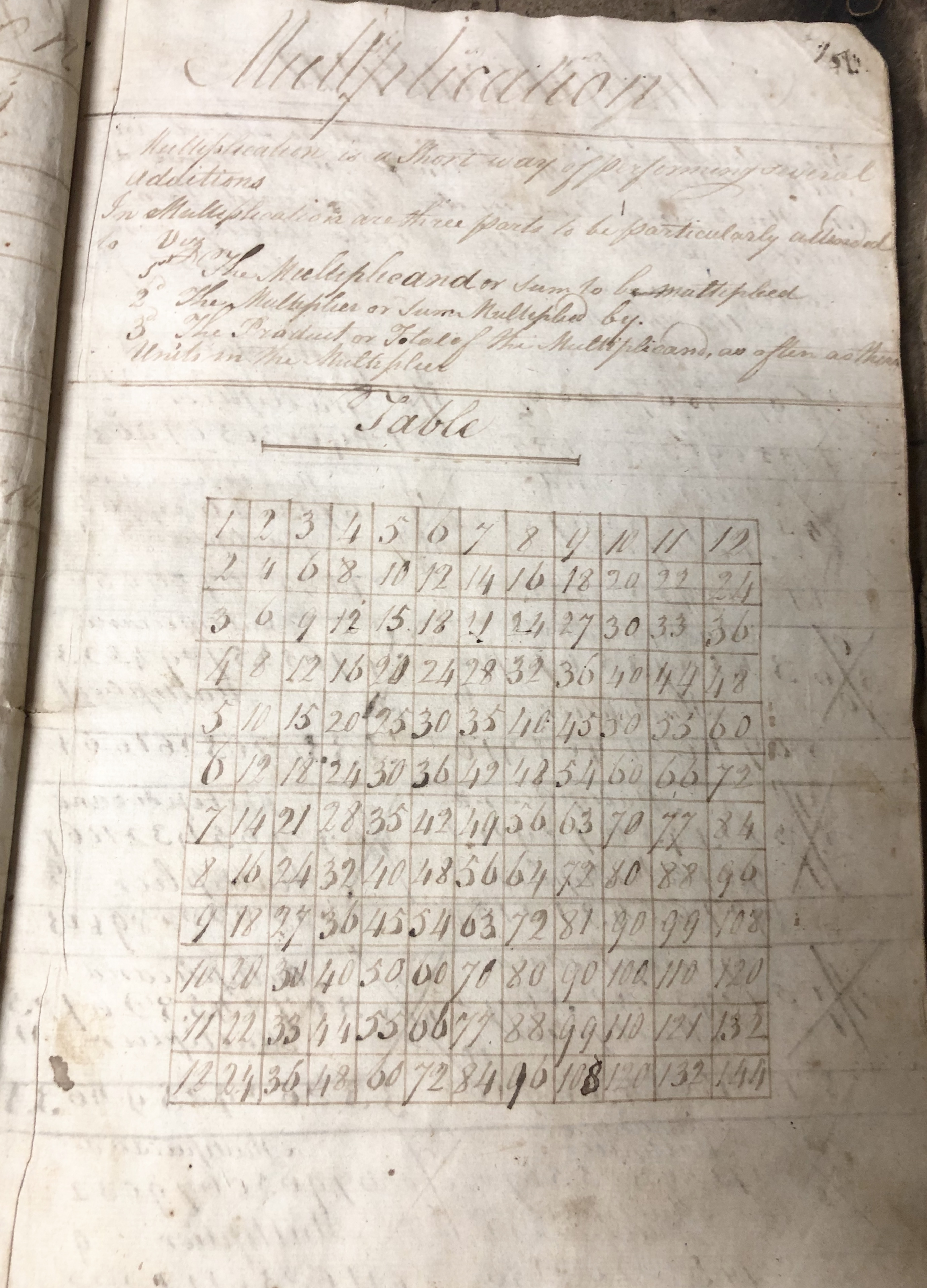
A page on Multiplication, with a table just like today’s multiplication charts
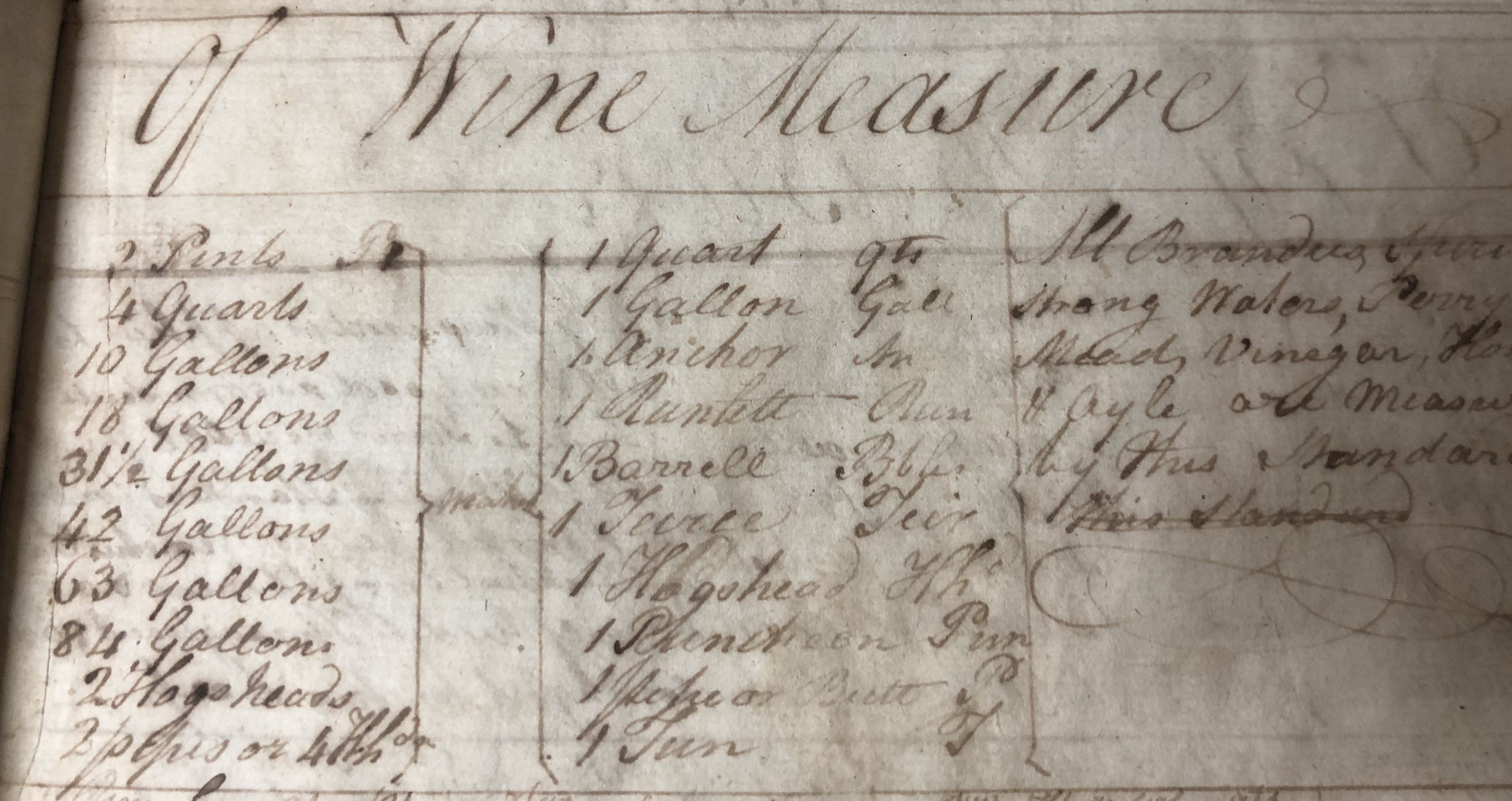
Narrative: Born in 1783 to Joseph Hasbrouck and Elizabeth Bevier, Philip was the great-great-grandson of Abraham Hasbrouck, one of the Patentees and original settlers of New Paltz. It is unclear when Philip first began writing in the book; there may be a date on the cover, but it is impossible to make out. However, one of the pages later on in the book is dated August 1st, 1796, when Philip would have been 13. It is possible that he owned his workbook for a couple of years as he progressed through his math studies. The ciphering book begins with the definitions and practice of the basics: addition, subtraction, multiplication, and division, all exactly the same as how these topics are taught now. There were also the same categories of math, with pages titled, “Of Dry Measure,” “Of Liquid Measure,” “Of Time,” and “Of Money” (though this unit of measure was concerning pounds and shillings), but there are some classifications that seem specific to the time period, such as, “Of Land Measure,” “Of Winchester Measure,” and interestingly, “Of Wine Measure.” Philip’s application examples are largely focused on land, business, and commerce, including problems about selling sheep, purchasing bushels of wheat, measuring the acreage of a ranch, or making sale deals with other merchants. As the book continues, Philip moves on to more complex lessons about types of interest, discounts, rebates, barter, and “brokage,” the definition of which includes a mention of selling goods to “Strangers or Natives.” This made me wonder if the New Paltz community in the late-18th century was still dealing in trade with the local Native Americans, or if they simply saw fit to include this in education. This ciphering book, along with records of the Hasbrouck family accounts, seem to demonstrate that “the economic goals of the settlers in New York’s mid-Hudson River valley and their descendants included meeting annual subsistence needs, increasing the comfort level of daily life, accumulating land, and passing on a legacy to heirs” (Hollister & Schultz 143). Philip’s concrete, realistic arithmetic exercises illustrate the importance of learning the ins and outs of engaging in business and being a merchant, perhaps especially so for a Hasbrouck, whose family store was still operating during Philip’s time.
“Of Brokage” definition, dated 1796; it reads, “What is Brokage. It is an Allowance made to Persons called Brokers at a certain rate per Cent. For finding Customers and selling to them Thee Goods of other men, whether Strangers or Natives.”
A problem relating to merchants: “1. My father sends me word that he has bought goods to the value of [money amounts] upon my account. I demand what his commission comes to at 3 1/2 per cent”
Religion makes only one appearance in Philip’s ciphering book, but the reference is concise and incredibly apparent. Tucked in a neat little box in the middle of a page full of numbers is the following passage: “Philip Hasbrouck is my name and guilt is my station / this earth to be my dwelling place and Christ to be my salvation. When I am dead and gone and all my Bones are rotten / when you see remember me that I am not Forgotten – Philip Hasbrouck.” The rather random placement of this religious excerpt in the midst of Philip’s math problems was incredibly interesting to me and brought up a lot of questions: Did the schoolteacher tell him to write it? Did the whim merely strike Philip? The rhyme is both catchy but foreboding, especially for a child, but it may have been inspired by the study of bible verses. During this time period, many families required their children to “learn to ‘read the Bible and write a legible hand’ by the time they reached adolescence. Reading and writing not only reinforced the child’s religious life, but they suggested a mastery of the fundamental skills needed to pursue further self-directed study” (Volo & Volo 97). Philip’s beautiful cursive suggests a great deal of writing practice. (Funnily enough, however, some of his entries contain misspellings, unnecessary words, lack of punctuation, or missing letters; the aforementioned example, if you look closely, is missing the “T” in Christ, so it reads, “Chris to be my salvation.”)
Philip’s religious entry
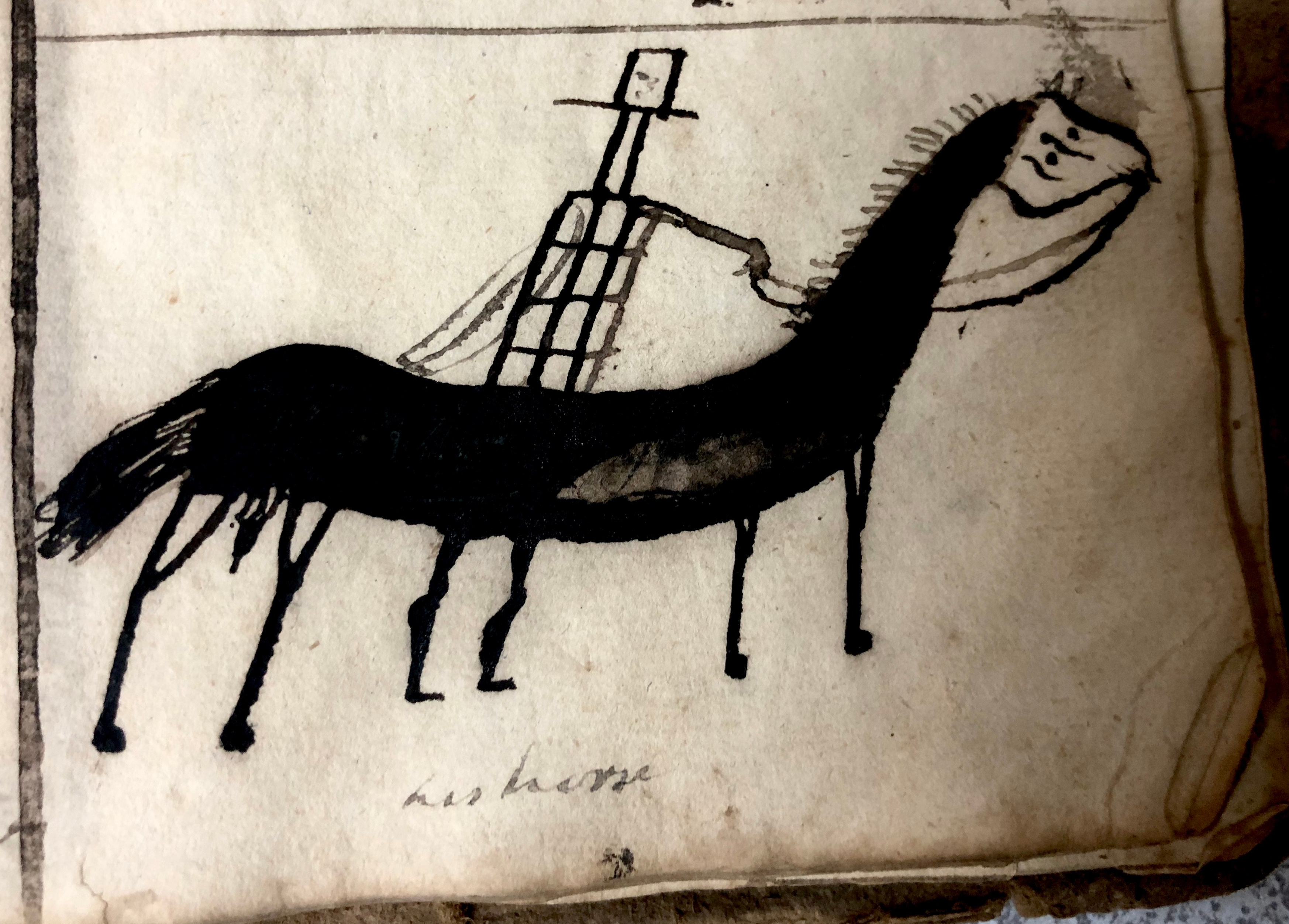
Helpfully labelled “his horse” by Philip
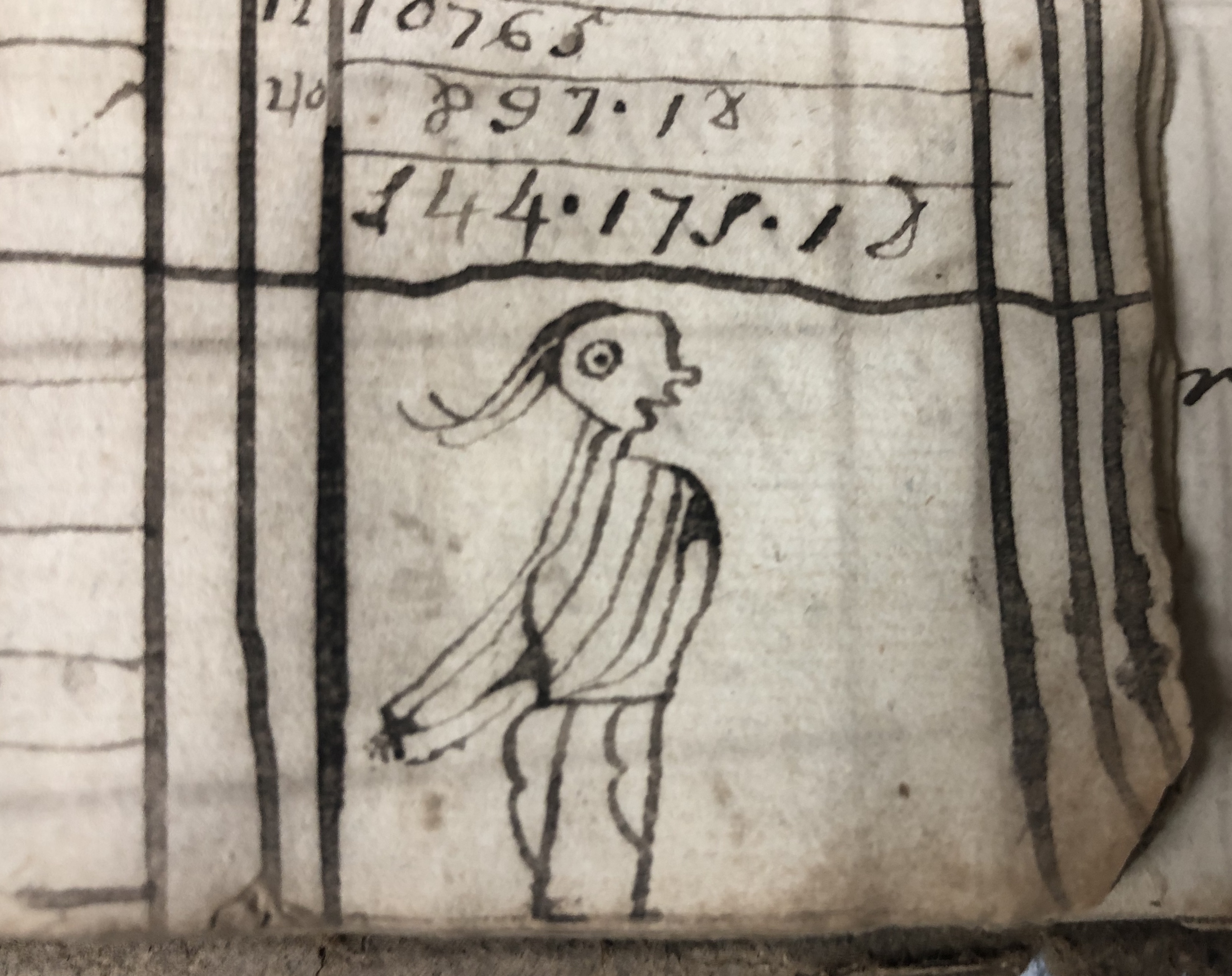
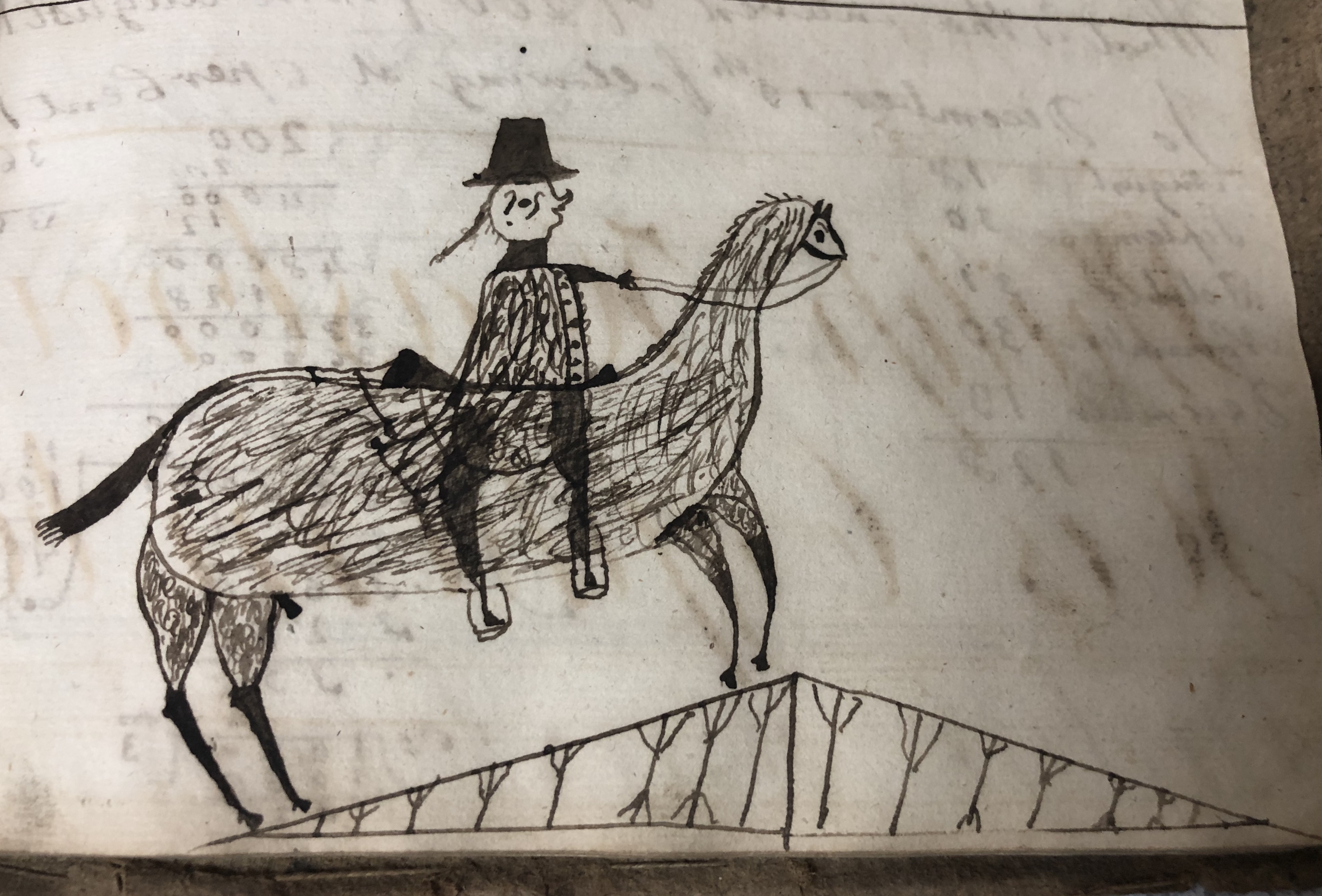
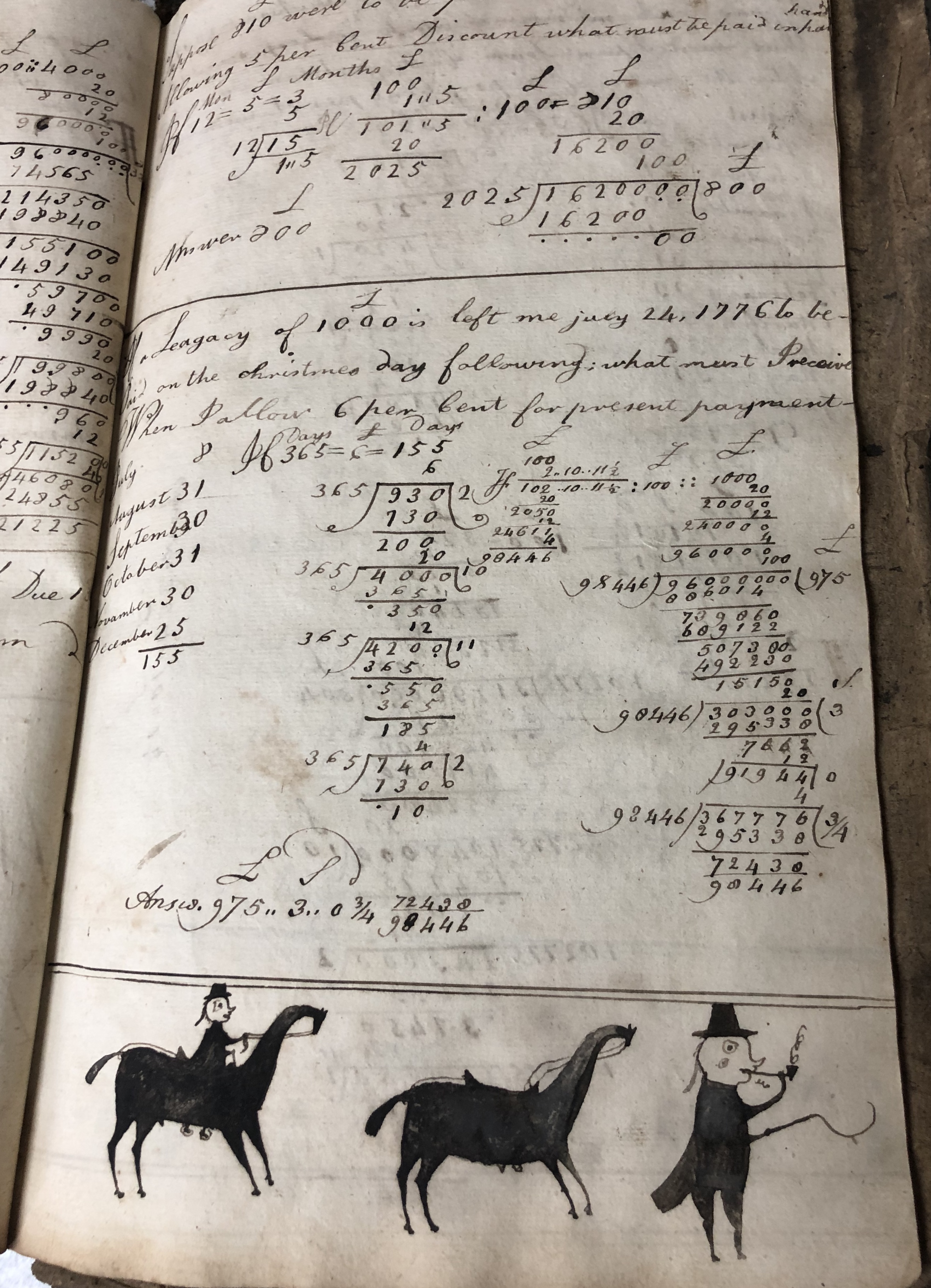
Although clearly a diligent student, the abundant doodles throughout the book are a testament to Philip’s occasionally wandering mind. For me, looking through this book was such a strange experience; its characteristics and content seemed so foreign to my conception of what education is like, and his doodles seemed to lend a bit more humanity and authenticity to the artifact. Seeing his small pictures that appeared more frequently the further I delved into the ciphering book, I was able to more fully reconcile with the fact that a child held this book in his hands, once, and wrote in it, did his math problems, likely became frustrated or tired at times, and turned to drawing in fits of boredom. It seemed that Philip’s favorite things to draw were horses and men, and they have various (sometimes silly) appearances. Some of the men smoke pipes or are holding whips in front of horses, and they are often well-dressed, with long hair and wearing tall hats. I wondered if his doodles spoke to his perception of the men around him, of their activities, and perhaps what it meant to “be a man” in his community in this time period.
A series of men; two smoke pipes and the middle appears to be playing a violinIt looks like Philip tried to scribble out his writing next to this drawing; “Philip Hasbrouck” written down one column, and down the other: “There he Stands Sir he is a gentleman”
Reading through this book was a thought-provoking and surprising learning experience, with the curiosity that was evoked by all that is contained within the ciphering book’s pages. I was struck by the types of problems Philip completed; they were certainly more applicable to his world and his daily life than the kinds of problems we do in math classes today. I also was fascinated by the religious rhetoric demonstrated and how it compares to the separation of education and religion in public schools now; to see the religious passage merged right in with his arithmetic exercises suggested just how deeply intertwined the two were for New Paltz citizens in the late-18th century. As it turns out, his education served him well; young Philip Hasbrouck grew up to be a farmer and merchant, and in 1832, he was part of a group of New Paltz residents who received the deed to a property upon which they would build a Dutch Reformed Church. Exploring Philip’s doodles made me feel as if I could relate to him, a child of the 1790’s. It was comforting, in an odd way, to realize that although the education was incredibly different from the way it is now, the minds of children remain the same, transcending time. His drawings, however, also raised some questions: What would the doodles of a child who was not as well-off as Philip look like? What would a young girl be drawing? After investigating what I thought, quite frankly, might be a mundane representation of old-time education, I was thrilled by the information and insight that can be gleaned from a young boy’s writing in his school book from over 200 years ago.
Hollister, Joan, and Sally M. Schultz. “Single-Entry Accounting in Early America: The Accounts of the Hasbrouck Family.” Accounting Historians Journal, vol. 31, no. 1, June 2004, pp. 141–174. EBSCOhost, doi:10.2308/0148-4184.31.1.141.
Salton, Meredith. “A Child’s Ciphering Book.” Object of the Week, Historic Huguenot Street, 15 Aug. 2016, hhscollections.wordpress.com/2016/08/15/a-childs-ciphering-book/.
Schenkman, A.J. “Philip Hasbrouck’s Account Ledgers.” The Gardiner Gazette, The Gardiner Gazette, gardinergazette.com/article/philip-hasbroucks-account-ledgers/.
Volo, James M., and Dorothy Denneen Volo. Family Life in 17th- and 18th-Century America. Greenwood Press, 2006.
Collars are objects that we often associate with animals, specifically dogs, in order to keep them constrained and close to their owner at all times. In modern times, it is rare that we associate collars with the containment of human beings, yet this inhumane act of cruelty is exactly what happened on Historic Huguenot Street throughout the 18th century.
The slave collar on display on Historic Huguenot Street. It first went on display publicly in 2016, after Joseph McGill, founder of the Slave Dwelling Project, came to town to spend a night in the slave quarters in the Abraham Hasbrouck House. Engraved in the collar is the name, E. Hardenbergh.
Physical Description
The object I chose to contribute to this collaborative history project is the slave collar that was shown in the Abraham Hasbrouck House. The slave collar that is part of the Huguenot street collection is made of steel and brass. There is a label on the front and a lock on the back that can be tightened based on the circumference of the wearer’s neck. The label is engraved with the slave owner’s name, “E. Hardenbergh,” in neat cursive. There is a peculiar decorative element to the label, with pointed arrow-like symbols engraved around the border. The label is attached to a thick chain link, to ensure security of the collar while in use.
Provenance
The name on the collar, “E. Hardenbergh,” refers to Elias Hardenbergh, son of Abraham Hardenbergh who was the Supervisor of the town of New Paltz from 1751-1761, and then again in 1770 (Le Fevre, 456-457). Elias Hardenbergh was also a relative of Colonel Johannes Hardenbergh, who was a citizen of Swartekill, NY, and owned seven slaves according to the 1790 United States Census. According to the John Jay School of Criminal Justice’s New York Slavery Records Index, Johannes Hardenbergh was the owner of two slaves named Elizabeth “Mau Mau Bet” and James Baumfree, who had a daughter named Isabella. Isabella Baumfree would later change her name to Sojourner Truth.
According to information provided by the Historic Huguenot Street archives, the slave collar was given as a gift from Andrea Coons Foster in January 2010. Preliminary research suggests that Coons Foster is a descendant of a family associated with Huguenot Street. Something that I found interesting was that despite the collar being donated to the historic site in 2010, it wasn’t displayed publicly until 2016. I’m curious as to why the Huguenot Historical Society waited so long to display the collar.
Narrative
Studying and analyzing history almost always guarantees a look into the darker sides of society. Throughout history, there have been many horrific occurrences that make us question how these things could have possibly happened–slavery being one of them. Slavery can be defined as the process of taking ownership over another human being and forcing them to do laborious tasks without their consent. When discussing slavery, minds tend to travel to Southern plantations, where large quantities of slaves were forced to work. While slavery did run rampant in the South, it existed in Northern states as well. Geography aside, the implementation of slavery has undoubtedly influenced racial discrimination and prejudice, both which are still impacting us today. These discussions are important because it directly impacts the black experience in the United States of America, something that I, as a white woman, will never fully understand. After slavery was abolished, black citizens had a hard time understanding their place in American society. W.E.B. DuBois described this phenomenon as a sort of “dual-consciousness,” in reference to the difficulties in identifying as both “African” and “American,” (Groth, xvi).
How does this tie into New Paltz and the Mid-Hudson Valley? At the end of the eighteenth century, New York had the highest population of slaves in the North. Three-fifths of these slaves worked in the Hudson Valley (Groth, xvii). The kind of work that was performed included farming, tending to orchards, trade work (blacksmithing, carpentry, tailoring), and domestic work for female slaves. No matter the labor, none of it was easy. Closer to home, Sojourner Truth was considered “more valuable than a man” because she could perform not only domestic labor but also agricultural labor that brought her to outdoor fields (Groth, 8).
Who wore this collar? How did they feel when they wore it, and then when it was taken off? A collar is not only a tool to physically constrain another being, but it can also be seen as a symbol of power and dominance, similar to handcuffs. However, using a collar on a human being is extremely dehumanizing, more so than handcuffs will ever be. According to the Smithsonian National Museum of American History, slave collars were used as a disciplinary method of identifying slaves who were considered risks of becoming runaways.
It is difficult and maybe a bit painful to consider the founders of New Paltz as slave owners. Yet, that was not all they were. While it is important to recognize this side of the story, the founders of New Paltz were also pioneers, entrepreneurs, and established a lasting community in the Mid-Hudson Valley. We get a firsthand account of a Huguenot Street descendant’s thoughts on this harsh truth in a Press Release from the Historical Huguenot Society. Mary Etta Schneider recalls the reason behind the French Huguenots’ arrival in New York– to escape torture, enslavement, and murder. Yet, she reflects on her ancestors doing these exact things to their slaves, something she admits to being ashamed of.
It’s important to tell the story of slavery in the North, because many people believe it didn’t happen or that it wasn’t as extreme as it was in the South. Especially with the recent activity involving the name changes of buildings on campus, I believe diving into the history of slavery in New Paltz can be enlightening, heartbreaking, and extremely informative.
References
Benton, Ned. “Sojourner Truth – Identifying Her Family and Owners.” New York Slavery Records Index, John Jay College of Criminal Justice, July 4AD, 2017, nyslavery.commons.gc.cuny.edu/2017/07/04/sojourner-truth-identifying-her_family-and-slave-owners/.
Groth, Michael E. Slavery and Freedom in the Mid-Hudson Valley. SUNY Press, 2017. EBSCOhost, search.ebscohost.com/login.aspx?direct=true&AuthType=ip,url,uid,cookie&db=nlebk&AN=1514879.
Le Fevre, Ralph. History of New Paltz, New York and Its Old Families (from 1678 to 1820): Including the Huegenot Pioneers Who Settled in New Paltz Previous to the Revolution. Fort Orange Press, 1903.
The Price of Freedom: Slave Collar, Smithsonian National Museum of American History, amhistory.si.edu/militaryhistory/collection/object.asp?ID=698.
United States, Congress, “Heads of Families at the First Census of the United States Taken in the Year 1790.” Heads of Families at the First Census of the United States Taken in the Year 1790, G.P.O., 1908.
The Civil War in America saw a major uprise in the production and ownership of quilts. After President Abraham Lincoln signed the Homestead Act in 1862, westward expansion began. The idea of the west proposed such an ideal way of living; it offered new land, new opportunities, and a new life. To many, it was like arriving in a New World all over again. However, westward migration was not something that happened immediately. Pioneers who sought to take the journey spent months, if not years, preparing. The need for clothing and blankets became a dire necessity and no one went anywhere anymore without a sewing kit. Those who were making the migration were told to bring 2-3 blankets or quilts. Quilts became a commonality, not only with the pioneers, but also with the people after they settled. They had proven to be incredibly versatile, serving as quilted blankets as well as cloths, rags, and other types of fabric needed for daily use.
As this was going on, quilts began to serve a greater purpose than merely providing warmth and convenience. Those who sewed these together began to embroider them as well. Scenes were sewn into the textiles of these quilts, telling stories such as the story of westward expansion. They also began to serve the purpose of symbolizing cultural, social, and political matters. One such matter was the presence of slavery in America at the time. A group of people known as the Quakers began to use their quilt-making skills to create a quilted pattern that served as a rebellion against the institution of slavery, as well as the presence and ideals of the Confederates.
History of the Underground Railroad
The Underground Railroad was a name given to a complex network of people within the United States who commonly aimed to lead slaves to freedom. It was developed around the time of the Civil War as an effort to undermine the Confederacy and bring an end to the inhumane practice. One of the main active groups that participated in this movement was the Quakers. The word “quaker” also, unironically, means friend and these were mostly people from the Christian church united in their shared mentality that every human had the ability within them to experience God.
The term “underground” in the title of this network’s name is indicative of its desire to remain relatively unknown. Many were persecuted for attempting to aid slaves on their way to freedom, as were slaves attempting to reach freedom. As a result, it was key that the organization remained unknown to those who may appose its operations. Instead, those who were part of this network developed numerous “secretive” techniques, only meant to be understood by those who were within the operation.
Freedom Quilts
Freedom quilts were thought to be a part of the underground railroad that worked in disguise to lead slaves to freedom. The quilts were usually adorned with some sort of arrow shaped pattern. This was a common pattern regardless, but when hung outside of one’s house they became directional symbols, pointing the way to freedom. Since quilts were such common objects to have hung outside of one’s home, this method was able to remain undetected, so much so that historians still do not have concrete evidence that this was the main purpose of these quilts. However, despite the lack of the facts, the idea is still an incredibly interesting one and sheds light on the truth of our history and the hardships that slaves dealt with, as well as the extreme methods they needed to pursue to obtain their freedom.
Huguenot Quilts
Huguenot Street has a rich collection of similar quilts, all of which tell a story about the history of the Huguenots and the town of New Paltz. Located in their “commemorative quilts” section of their website, Huguenot Street is in possession of a quilt which is titled the Tercentenary Quilt. This quilt is comprised of thirty-five textiles stitched onto a blue fabric background. This contrast works to make the textile images pop. The Tercentenary Quilt is an example of an album quilt. More specifically, this design is officially known as the Baltimore Album Quilt, a style that, as evident in the name, originated in Baltimore, Maryland during the 1840s and are well-known to tell stories within their designs.
The Tercentenary Quilt was created by thirty-five women as a celebration of the three hundred year anniversary of the New Paltz settlement. As evident in the image below, each block tells a little story about New Paltz’s history. They include the first church built in the town, the Huguenot cross, the Bevier-Elting house, the Walkill River, and many more. This specific quilt is rich in stories and histories, so much so that the object itself has become a historic item, for it serves as a reminder of where Huguenot Street comes from and the stories behind their origin.
This is the full image of the Tercentenary Quilt, part of the collection located at historic Huguenot Street. Hand embroidered, it consists of thirty-five squares, each depicting different aspects of New Paltz’s history. When looked at closely, you can see the individual stitch that was created by one of the sewers. As opposed to a quilt that may be made today, this quilt clearly shows that it was handmade due to minor errors such as slightly crooked textiles and uneven stitching. Nonetheless, this element gives the object a more authentic feel. It was created in 1978.
The Huguenot Quilt Collection also includes a section called “friendship quilts.” These are collective quilts that were passed down through family lines as a way to commemorate the family members that came before them. One such quilt is The Duboisville Friendship Quilt.
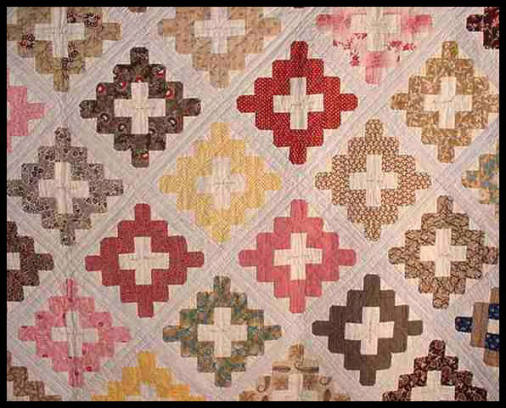
This is a full image of the Duboisville Quilt. Similar to the Tercentenary Quilt, this object is comprised of a repetitive pattern that was hand stitched together by multiple hands. The colors used are very natural and subdued, giving the quilt an earthly vibe. It was created in 1859.
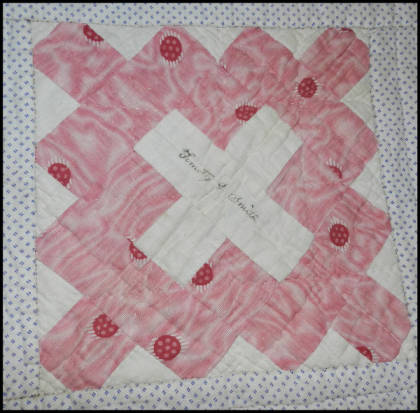
The appearance of this quilt varies greatly from the previous stated one, despite its simple repetitive pattern. This quilt includes brights colors such as reds and oranges, rather than predominantly using blue fabric. However, the significance of this object lies in the signatures that are present within the quilt. In the middle of each diamond-shaped design, as shown in the images, is a signature of who is presumed to be one family member.
As shown in this close-up image, you can see that there is a faint signature in the middle of this textile. The signature is said to belong to one of the family members, either commemorated in this quilt, or one of the ones who worked on its creation.
The significance of this object lies in it’s connection to the legacy of the DuBois family. The DuBois family history is rich within the history of New Paltz and Huguenot Street. Descendants of Chretien DuBois and his wife Francoise le Poivre, the DuBois family found their way to American, and eventually Kingston, after years of attempting to escape persecution in Europe. After finally settling in New Paltz along the Wallkill River, the DuBois family began to lay down a legacy that remains prevalent today. The preservation of these quilts and the names of the family members that are embedded within them serves as a reminder of just how deep the history of Huguenot Street lies.
Provenance
The legacy of the Tercentenary Quilt is easier to track than the Duboisville quilt, due to the fact that it was created during the seventies. Celebrating the three hundred year anniversary of the Huguenot settlement, as stated previously, thirty-five women were commissioned to create it. The woman who donated it to Huguenot Street remains anonymous, but it is thought that she is a family member of one of the women who created the quilt.
However, the legacy of Duboisville quilt leaves behind a traceable path. It was owned by a woman named Mary H. Dubois, evidently a descendant of the Dubois family. It is believed that the quilt was likely made as a gift to both Charles and Mary DuBois prior to their departure from Duboisville–a city in Michigan. Afterwards, the quilts fell into the hands of Reverend Edwin Herman DuBois, gifted to him from his aunt Elvie Dubois. Elvie was Mary DuBois’ daughter. She later then passed on the quilt to Evelyn M. Gueho. Evelyn M. Gueho is accredited with the donation of the Duboisville quilt to Historic Huguenot Street. On June 28, 1990, it became a permanent part of their quilt collection.
Narrative
Quilting is an art form that continues to serve an integral part of human history. The word quilt is derived from the French word “cuilte” with the same meaning. However, as a verb, the word quilt translates to “join together,” which serves as a double meaning to the togetherness, of not only the literal stitching in the fabric, but of the legacies and stories they tell.Upon arriving in the new world, European settlers brought the art of quilting with them. During the nineteenth century, quilting became more than just an art form in America; it became a social interaction. Women would often convene in places called quilting bees to swap textiles with one another and complete quilt work they may have been doing alone at home.
With this in mind, it is more understandable as to why thirty-five women were accredited with the creation of the Tercentenary Quilt. Seeing that Huguenot Street, and New Paltz in general, is an incredibly small area nowadays, it makes sense that the women who settled here would convene together to make quilts. It is likely that each little story was sewn on its own before the entire quilt was put together. Each woman was responsible for choosing a landmark, a person, or a family member to create their own square textile on.
The object of the quilt literally–and metaphorically–symbolizes the interwoven histories of these people. When we look at it, we are able to trace every single story that each of the female creators wanted to tell. That is the true beauty of an object, and especially a historic one: the ability to tell a story.
References
Quilts of Historic Huguenot Street, omeka.hrvh.org/exhibits/show/quilts-of-hhs/introduction.
Creation: As humans we will never truly be able to see ourselves with our own eyes, we will only ever be able to see a reflection. Cavemen since the beginning of time used puddles, observing their reflection as something of magic. With evolution, mirrors were made of polished stones, eventually after the secular desire to see a reflection was understood, varying techniques to achieve this were implemented in different countries. Ultimately, the final and most successful process involved coating glass with a metallic silver. As society became more established and advanced, mirrors became an object richly sought after, used both for practical purposes and as demonstrated through ornate and intricate framing, as decorations. This Federal style mirror located on Historic Huguenot Street in New Paltz, New York can be found in the Deyo House Federal Bedroom.
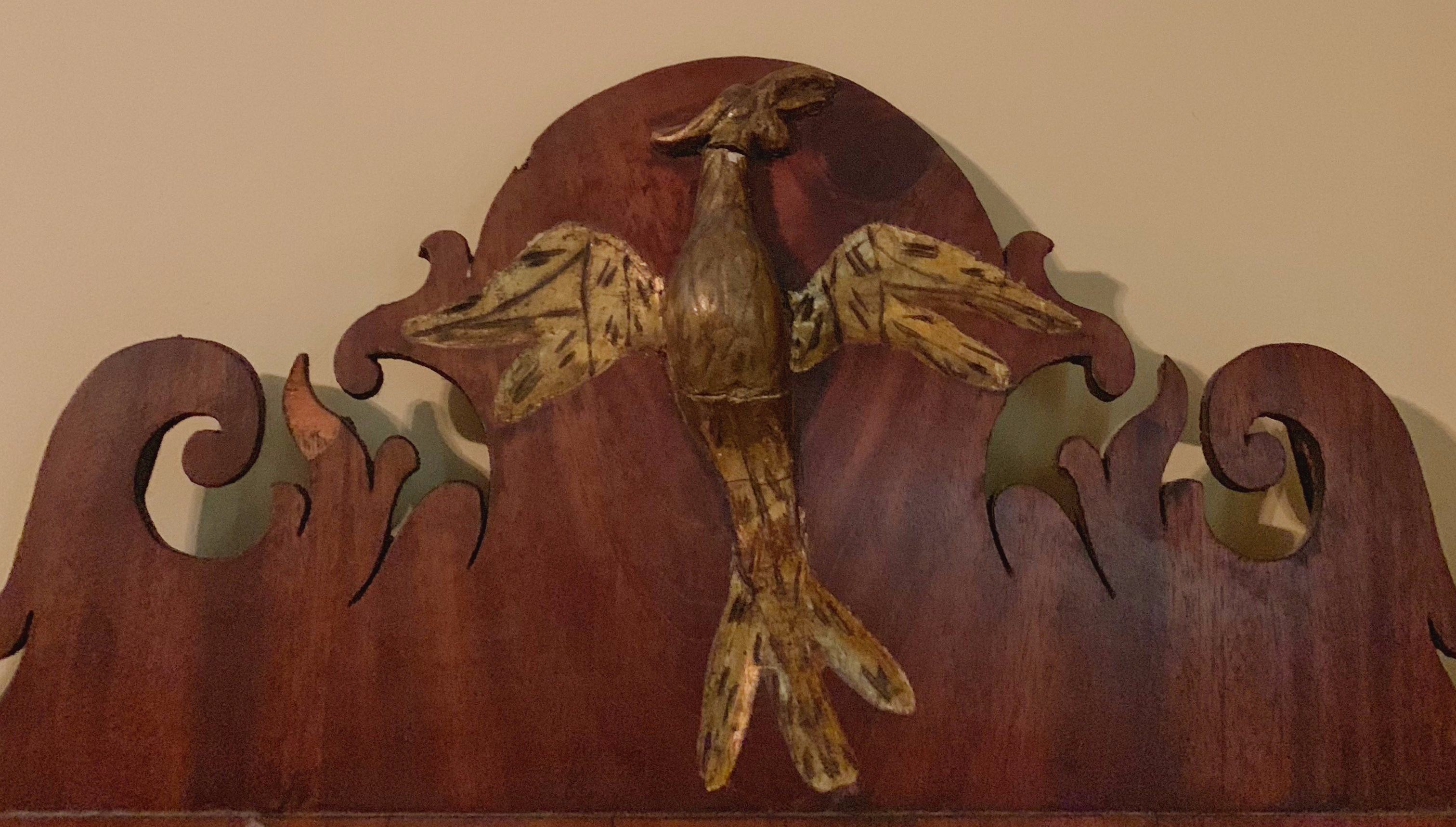
This Federal Style Mirror sits in the corner of the Federal Bedroom in the Deyo House on Historic Huguenot Street in New Paltz, New York. Its Federal Style featuring a gold eagle or pheasant wide spread across the top is reflective of America’s newfound stature in 18th century as a sovereign and strong United Nation. Though this piece is fairly small it is largely representational as a glimpse into this period in time.
Physical Description: This rectangular shaped mirror measures 35 inches in length and 16 inches in width. The frame is made of a rich colored wood, possibly mahogany, that surrounds the glass mirror piece, which is inlaid in the center of the wood. The very inner edge of the frame that is in direct contact with the glass itself is painted gold, though it difficult to distinguish due to years of wear. The wood has fretwork carvings on the top and bottom. The carvings resemble flames or torches on the top, which can be seen as symbolic of power. It is clear this wood was carved by hand due to the imperfections of the carvings. Upon close inspection, the carvings do not exactly mirror each other on either side and are not perfectly sanded, with a rough edge to them, reflecting further that this frame was created by hand.
The top of the mirror features a three-dimensional gold eagle or pheasant with its wings spread broadly across the wood. The Federal era lasted roughly from 1780 through 1830 in the United States and furnishings created during this period were heavily influenced by Greece and Rome (Thurlow 2009). After the Revolutionary War and the Treaty of Paris, the United States was recognized as a sovereign nation. The eagle then became a symbol of unity — an expression for Americans to be recognized in their own way with their own values (Liebster 2012). Having a mirror in your home with this type of symbol further emphasized the sense of American Patriotism that existed within the home.
The Gold Eagle/Pheasant Spread Proud Upon the Mirror.
Provenance: This mirror has provenance with the Elting family who actually lived on Huguenot Street, so it has existed in New Paltz for quite some time. The donor of the mirror to Huguenot Street was Helena LeFevre. When she passed away in 1965, she left the mirror to Historic Huguenot Street (2013). She was a member of the Huguenot Historical Society; her donation of her things to the society paying great homage to her passion for historical preservation. Her receipt of donation entailed that the mirror belonged to Magdalene Elting LeFevre, daughter of Roelof Elting and Mary Louw, wife of Peter LeFevre with whom she had ten children.
Narrative: Magdalene Elting LeFevre was born on February 22, 1766 and died March 10, 1823. She lived in the Bevier-Elting house on Huguenot Street while she was growing up. Her father, Roelof was sentenced to prison and then exiled for refusing to accept Continental currency from a customer in addition to a land dispute. In Roelof’s absence, two of his daughters passed away. Without a father present, Magdalene had to suffer through losing two siblings. A traumatic experience for any individual, as loss is something difficult to understand, especially at a young age.
The Bevier-Elting House. 2019.
Magdalene went on and married Peter LeFevre in 1789, where they lived on the Bontekoe farm in a stone house. According to Peter’s tax records, he ranked in the higher end of the middle-income tax bracket, though his stone house was fairly run down. It is difficult to say exactly when or how Magdalene came to own this mirror. However, it can be surmised that it was a wedding gift to Magdalene and Peter, or perhaps she came to own it through an acquisition of a similar nature. Though, there is no accessible information to be certain of this. This suggests the level of financial comfort which Magdalene and Peter lived with.
Further emphasizing Peter and Magdalene’s comfort was the fact that they owned three slaves. According to the 1798 census, Peter owned three slaves, whom were not subject to taxation. This means they were either children under twelve years of age, or that they were older than fifty. There are documents that define one of Peter’s purchases of Molly, in 1798. Were Peter and Magdalene living beyond their means? Had they purchased slaves that they could not afford, as suggested by the run down condition of their home? Peter and Magdalene’s owning of slaves while the mirror was in their home, paints a vivid picture of the time in history this mirror was a part of. A nuanced definition of American Patriotism can further be applied to the owning of the mirror. The eagle/pheasant represents American Patriotism, but it is clear that part of their American values at this time included owning other human beings.
This mirror was likely displayed in a room where Magdalene and Peter’s guests would see it. This is because it was a reflection of their American values, ones they were prideful in. In this same room, one of the slaves they owned would likely have been responsible for maintaining the condition of the mirror.
“Molly, please see to it that the mirror is in pristine condition before this afternoon, we have guests coming.” Molly then would make her way to the room where the mirror was hung on the wall and have no choice but to stare at her own reflection as she wiped it down. It is not difficult to imagine the brutality felt by a human being who is owned, being forced to look at their own reflection while serving their owners. The reflection seen by Molly was one that forced her to embody the bitter reality that she was purchased by these people as property and existed to serve them. The reflection seen by Magdalene and Peter, or their guests was much different. Looking into the mirror they saw themselves and became enveloped by a sense of American pride and patriotism. Reflective of the attitudes of this period, where the owning of slaves was not given a second thought.
While there is not substantial information available about this mirror specifically, other than its chain of ownership, the stories of its owners and their trials and tribulations are highly reflective of the period in time this mirror was owned. This mirror stands in the Deyo Federal Bedroom as a reflection and encapsulation of life in 18th century New Paltz.
References
“Bill of Sale for Molly to Peter Lefevre : Historic Huguenot Street.” Hudson River Valley Heritage, hrvh.org/cdm/singleitem/collection/hhs/id/633/rec/6.
Originally built in 1694 and later renovated around 1721, this massive stone house was an economic and social class distinction of its time. This house is distinctive because of its square form, central entrance, two room deep passage plan and flanking windows. Even with these unique features it still kept its dutch characteristics by keeping its interior exposed wood beams, jambless fireplaces and stone outer. Set currently upon one-acre of property, this 5 bedroom masterpiece also contains an attic and basement.
Creation
The Huguenots came to what we now know as New Paltz with nothing but hope and ambition to start their new lives. In 1677 they began developing New Paltz into what we know it as today (Home). The seven prominent families who are credited for developing New Paltz such as the Hasbrouck family purchased 40,000 acres from the Esopus Indians and began construction on their new life. At first they built simple wood houses but, due to the high status and wealth of these families, they quickly began construction on distinctive, more expensive Dutch style stone houses. Using more durable materials led to us being able to preserve their history and remind us that they created this town. Many of the structures and homes they created still stand today. “New Paltz is one of the most significant historic towns in New York State history and aspects of its early settlement history are of national significance” (Larson 1). Architecture and decorative arts are the two areas where Dutch culture can be seen surviving still today in the Hudson Valley.
Jean Hasbrouck intentionally created this double-wide Dutch house structure to show off his wealth in the new world. Although there is no permanent record of this due to not all historical houses being registered. It is believed that this is the only one of this kind still standing today in the United States. This house when created in 1694 set the tone for all other stone houses in this area. Although, none could compare to its size and magnificence. Later his son Jacob expanded this house. The house was used for more purposes than when it was created such as a store and also could house more family members. Today, it still stands on Huguenot street, reminding us of the significance of these brave families who came to develop the beloved town we call New Paltz today.
Physical Description
A Dutch style stone house was a tedious, time consuming process to construct. From building the basement foundation, adding the wood frames, plastering the interior, this process took months to begin to take shape. However, these houses were strong and sturdy, leaving the Hudson Valley containing some of the oldest architecture in the eastern United States. The typical seventeenth century stone house contained multiple entrances, a front façade and a steep gable roof. Although containing an attic and a basement, living was restricted to the main floor of usually no more than 3 rooms. However, Jacob expanded his home to five rooms. The houses were heated with jambless fireplaces. These fireplaces are a large hearth with no sides, venting into the chimney. (Larson 5). This is a distinctive feature of Dutch architecture. The Jean-Hasbrouck house is the only or one of the few with this structure still standing.
Dutch Stone House Significance
On top of being made of heavy materials and being a laborious process, stone houses were also costly and pretentious even those containing only one room. Stone became an emblem of wealth (Report 1.7). Stone houses were indicators of upper class status and the material gained value when this distinction of wealth and class became important in the community. Stone houses were only built wealthiest figures living in the area. The style of your house was said to show your social status. This material distinguished successful farmers and families from the everyday townspeople (Larson 4). The Jean Hasbrouck house stood above the traditional stone houses because of its size and amount of stone used to create its massive structure.
There are many similarities from the 17th century Dutch buildings discovered both in America and in Europe. Striving to make a presence in the New World community, the Dutch colonists built their iconic Dutch style houses here in America. The use of stone to build kept the Dutch homes distinct from the English and reminded the English that their Dutch culture was still prevalent even in the New World. These houses stood as a refusal to conform to English new world traditions. The Jean Hasbrouck House is one of the most impressive examples of Dutch Colonial stone architecture remaining in the United States.
Narrative
Jacob Hasbrouck renovated his father Jean’s house into a Dutch style house even more grand than the generic Dutch houses seen around the Hudson Valley. Generally plans for dutch houses were restricted to a three room maximum , one story house plans. Jacob’s house did not fall into these plans, it fell into the Large House category reserved for people generally of local importance. His five bedroom, one and a half floor home became an elite house in the neighborhood. This house stood at over twice the size than his neighbors. It is significant because the house was exceptionally large for its time and represented the Hasbrouck’s participation in the new world. While still keeping traditional Dutch culture, this design also showed his American presence. One feature that set this house apart from the other traditional houses was its roof structure and attic space. The roof frame was constructed with a complicated set of interlocking rafters, collars and braces neatly joined to create the structure and sizable attic space which was unusual for its time. Another reason the Jean-Hasbrouck house stood out amongst the other houses because of its symmetrical façades and center passage plan. It was one of the earliest accounts of this design of elite architecture in eastern America.
Provenance
Originally built in 1694 by Jean Hasbrouck as a small one-room living space, the building we see today was expanded around 1721 to serve as a store and a family house while also reminding the community of his status. While renovating Jacob still wished to keep some of the original characteristics of the 1694 design. You can still see the long oak beam in the southern part of the basement supporting the basement fireplace and a rafter on the west roof avoiding the chimney from the original 1694 house. Remainings of the original jambless fireplace and box bed can also be seen today.
The design we see today is that of his son Jacob Hasbrouck, Jean is said to have passed away before building plans were put in place. He expanded the house into its unusually large proportions. He was able to do this because his father passed all of his inheritance down to him making him unusually wealthy for his age (Larson 8). Jacob was an experienced farmer of only 34 years old. He increased the value of his father’s land through land allotments, his shop and various other ways of lending out his land. This large sum of money left to him led him to show this off through the design of this house.
Currently the sophisticated house that stands has seen no major construction since 1721. There has been work done to solely improve the conditions such as upgrading the windows and minor maintenance. In 1893 the vacant house was purchased by Historic Huguenot Street for $3,000 and the one acre of land it was set upon. 1952 interior work was done to keep it preserved. A light was added to display this historical house more. This home shows the Hasbrouck presence in society and Jacob’s large inheritance of wealth. Standing among the other buildings left, we can see its significance through its size and design even hundreds of years later.
Sources:
Crawford & Stearns. Historic Structure Report: The Jean Hasbrouck House. Architects and Preservation Planners, 2004.
















 The Materials of History, Thought, and Art