Looks can be Deceiving

It’s a bowl. It sits on a shelf in my library, catching a son’s pants pocket contents. Weighing in at three pounds, it is approximately nine inches in diameter and three and half inches deep. The vessel started as a block of brownish red clay, shaped into a circle. Not created on a pottery wheel, it was formed by hand with coils of clay, rolled out and wrapped on and upward from the slab, added two to three rounds at a time, then covered in plastic wrap to stay moist. When the desired height was achieved, the ropes were smoothed by hand. With a day’s worth of drying time in between, the bowl took about a week to form. Once the desired shape was completed, the piece was thoroughly dried.
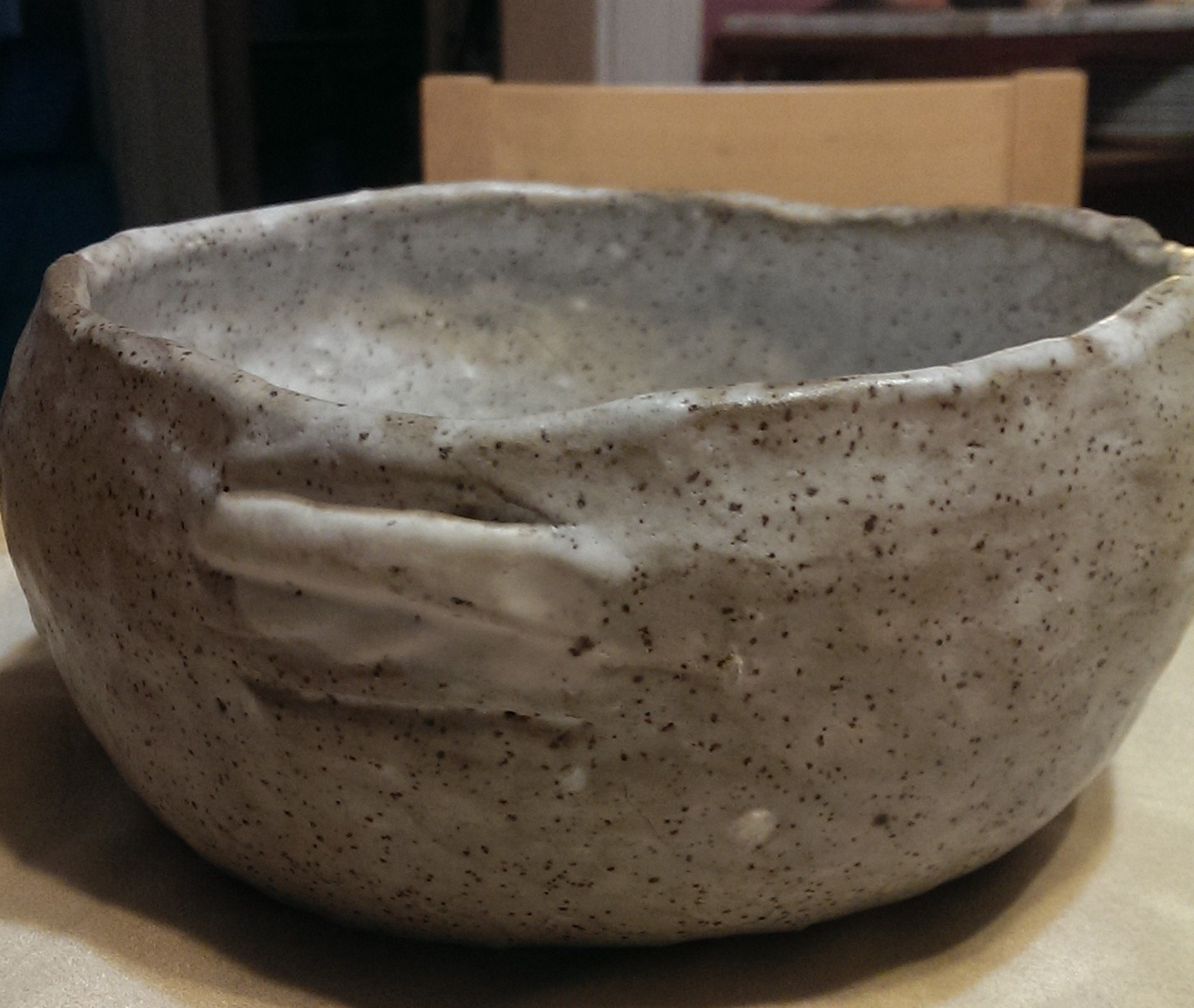
The completed vessel.

With this step completed, a glaze was chosen which was made of lime, talc, manganese, feldspar, zinc, and tin, the last ingredient making the glaze white. Everything was mixed together in a bucket. The bowl was dipped one half at a time. With the clay being so absorbent, one needed to move quickly in the application, wiping off the liquid so it didn’t coat the vessel’s base. The lead free glaze ensured the bowl would be food safe. The piece dried for one to two more weeks, kiln fired for 24 hours, cooled for another day, then removed from the oven. Although the surface was dull, the final result was similar to a glass coating.

The white band where the glaze dip overlapped.

Upon closer inspection, the bowl definitely looks handmade. It is quaint and rustic. It’s finish is uneven: a little white, a little beige, with darker brown speckles. A small area by the rim has some of the coils peeking through a whiter, glazed area. Running one’s hand over the bowl, it feels cool and a little uneven. There are no chips or areas of wear. It is sturdy but would break if dropped.
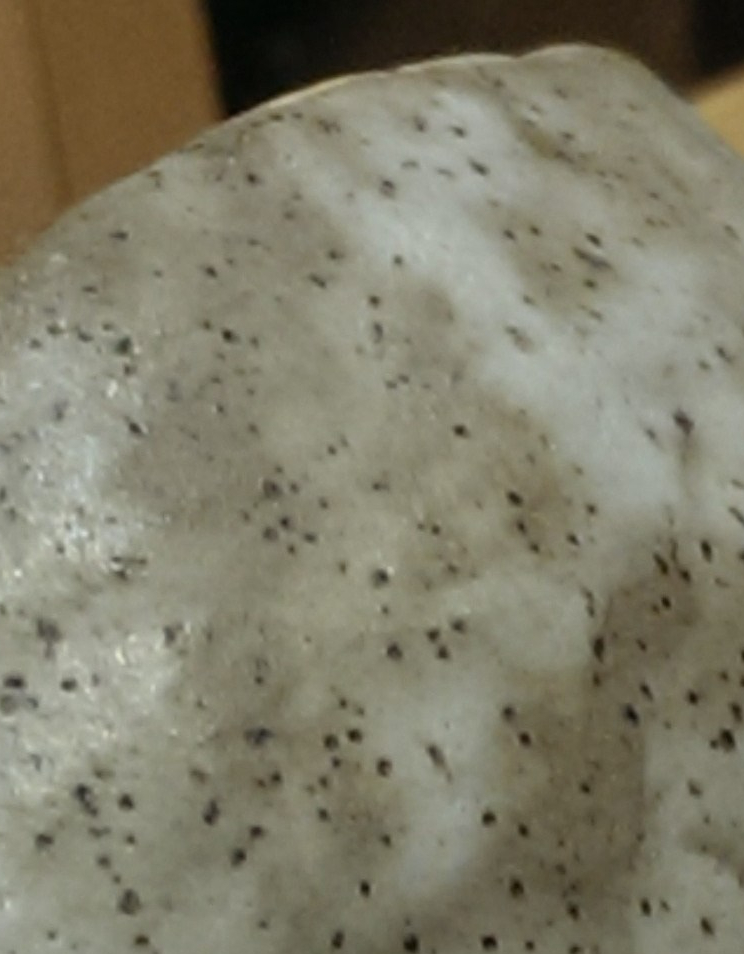
A closeup of the glaze.

So you might be wondering, why write about this piece of pottery? What makes it so special? The thing is, it was made by my late mother, Ute. She left very few things behind when she died. This bowl is precious to me because it came from her hands. As she smoothed the clay roping, she left imprints of her fingers in the surface, especially around the base and the rim. This is similar to hand forming the edge of a pie crust. The added bonus is her signature in its base.

Mom’s signature.

I was able to gather this information about how this bowl came to be during a visit with my mother’s best friend Lynne, on what would have been my mom’s 77th birthday. Lynne is a professional potter. For the last four decades, she has created pieces in clay and porcelain almost daily. The quality of her work is truly extraordinary and art gallery worthy. She taught my mom all facets of this craft and happily shared her recollections. We laughed, cried, and remembered just how one-of-kind Ute was. This vessel holds more than odds and ends; it overflows with memories. I hope it ends up with one of my children, a gentle reminder of a grandmother they never got to meet, but who’s known to them through stories, photos, and a lovingly handmade earthenware bowl.
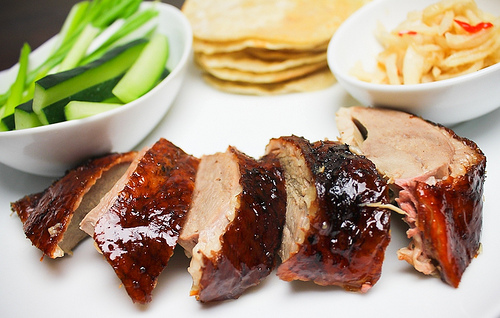
Peking Duck

Thinly, sliced roasted duck

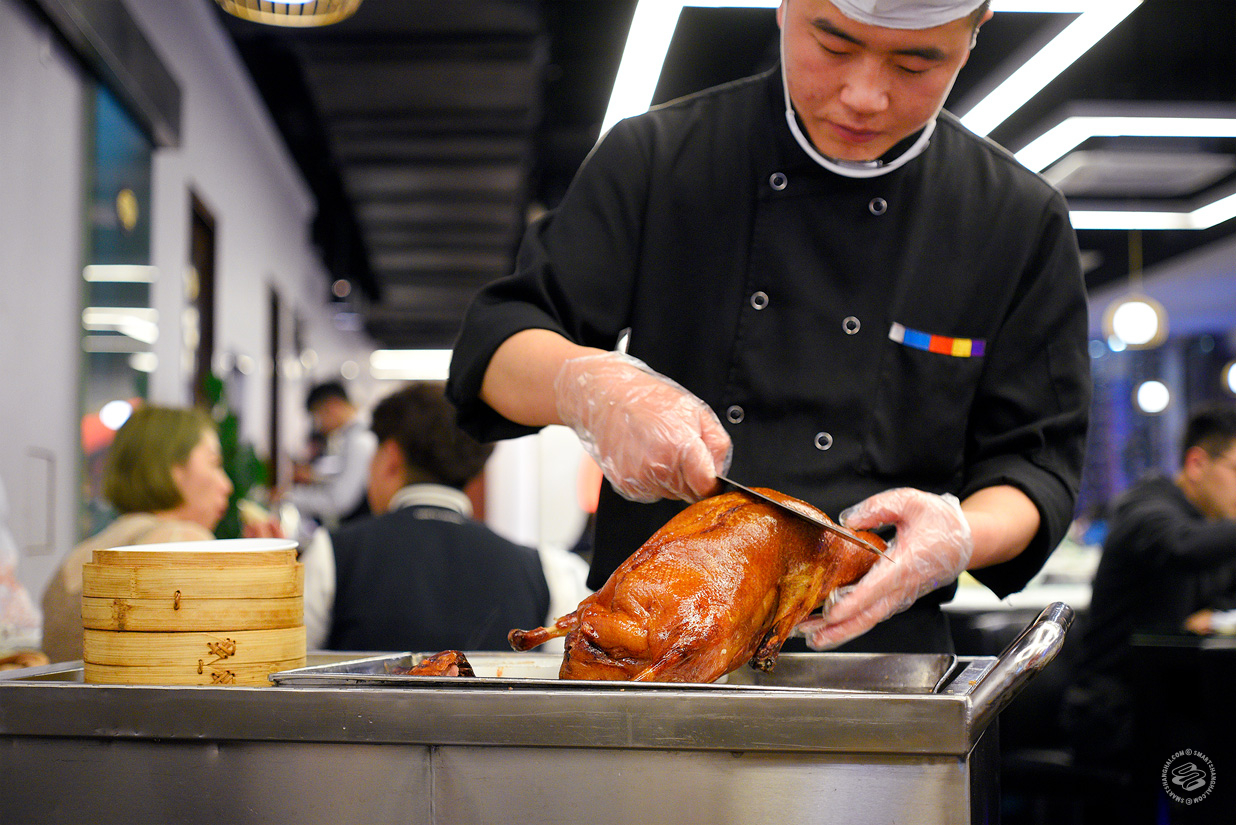
I recently went on a shopping trip to Chinatown to stock up on Asian cuisine for school. I bought $50 worth of food and one of my purchases was half of a peking duck. Peking duck is a famous Northern Chinese dish originated from Beijing. The Peking Duck dates back to Ming Dynasty, about 600 years ago, where top chefs would visit the Emperor and cook for him. When the Qing dynasty fell in 1911, the court chefs left the Forbidden City and bought the Peking duck recipe and other delicious dishes to the public. The preparation of the Peking Duck is an interesting one. According to my research, air is pumped into the duck to separate the skin from the fat. Then the duck is hung to dry in open air before being roasted in an oven until it’s crispy on the outside and tender on the inside. In most places in Chinatown, the duck is served with rice and vegetables, over noodles or in a lotus bun with scallions and hoisin sauce. People can buy a whole or half of a duck, pork, or chicken. They can ask for it to be roasted or fried before it is to be cut into thin slices. A whole duck has to be sliced into 120 pieces and can be served with all sorts of sauces and sides at different restaurants.

Chef slicing the duck in front of clients

After some more research on where the duck came from, I found a website called culturetrip.com about white-feathered ducks that are raised in a free-range environment for 45 days, after which they are force-fed for 15-20 days. According to Britannica.com, this duck isn’t any ordinary duck, but specifically the Imperial Peking. Britannica also includes that the duck’s head and neck is left intact as the bird is killed at about six weeks old. Once they have been killed, plucked, gutted, washed and boiled, then air is pumped into the duck. The duck can be roasted in two different ways: traditional closed oven or the hung oven method developed in the 1860s. I did not know that they would go through such a horrible process but I love the dish so much, I never looked into how it was made. Peking Duck has been around for so long that it also participated in Chinese international relations through the 20th and 21st centuries. Political leaders and diplomats such as Henry Kissinger, Richard Nixon and Fidel Castro have all been wined and dined by the Peking Duck.

Lotus bun with peking duck and scallions

I was introduced to Peking Duck when I was in China nine years ago. My grandparents took me to this restaurant for dinner and they served me peking duck in a fluffy, white, wheat bun with lettuce and scallions. I had never tasted something so delicious and flavorful. It was so simple but it was very filling. Ever since then, Peking Duck has become one of my favorite dishes to order when I visit the city. It’s hard to find Peking Duck up here in New Paltz and even though Hasbrouck has tried to replicate this dish, that’s loved by many people, they just can’t do it justice.  

Burton Beanie

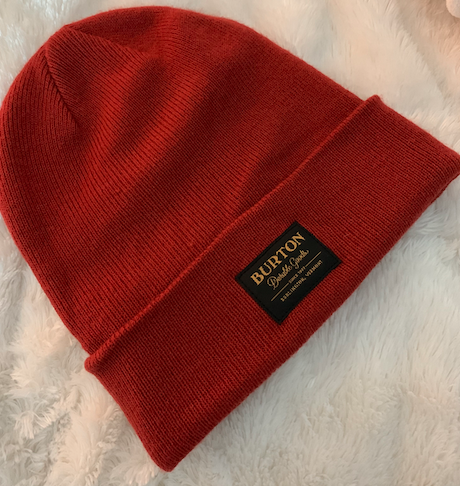
Hats, for me, serve as an essential accessory in my wardrobe. Beanies, specifically are one of my favorite subcategories. This week I will be exploring my favorite beanie that I own. This beanie, burnt orange in color is by the brand BURTON. Burton is a company that emphasizes how their process “started in the mountains.” Their goal is to innovate and change the way people experience the outdoors.

This beanie like I previously mentioned is burnt orange in color, has a folded brim, a slouchy fit and a small black label stitched onto the brim that says BURTON Durable Goods Since 1977 Burlington, Vermont. This specific beanie is labeled by Burton as their “Burton Kactusbunch Tall Beanie.” This material is made from 100% acrylic.

Screen Shot 2019-03-01 at 11.31.05 AM.pngScreen Shot 2019-03-01 at 11.29.39 AM

This beanie would not exist without the founding of Burton itself. Burton was founded in 1977 by Jake Burton Carpenter, who is now 64, has dedicated his life to snowboarding. Burton itself has been held in high regards for being innovative and transformative in the snowboarding community, changing it from a backyard hobby to a serious recreational sport.

Burton as a brand is going through a transformative period that is highly geared towards taking greater strides in sustainability. Their 2020 sustainability goals are to have 100% Fair Labor Association compliance in their factories. This means every person working and creating their products will be working in safe, healthy and environmentally friendly conditions. I cannot say with absolute certainty that my beanie specifically was made in these conditions, wishful thinking says it was, but I know going forward Burton as a brand is fostering an environment behind the manufacturing of their products that aligns nicely with my morals for where my consumerism is directed, that especially in cases of mass production workers are being treated fairly and ethically.

Burton’s main headquarters are in Vermont, but they also have offices in Australia, Austria, Canada, California, China, Japan, and Republic of Korea. I didn’t think I would be able to trace where mine originated but then I remembered I had the shipping information from when I purchased it. I ordered it on January 25th, and got a shipping confirmation email on January 29th. Upon inspection of that, the first place of origin listed is Columbus, Ohio, on January 29th. I cannot say this with absolute certainty, however, I do believe my beanie was manufactured in the United States. If I am wrong about this, I can say with greater certainty that it at the very least resided in the United States when I purchased it. I believe I can make this claim because generally it takes more than four days to ship something overseas.

IMG_4614.PNG

Burton uses highly technical life cycle assessment (LCA) software. This software gives a detailed look at their full product cycle, from extracting natural resources through manufacturing, to transport and end of life. They place a great emphasis on how their materials are ethically sourced. Burton has a publicly accessible comprehensive list of restricted substances so they only produce products that are safe for their customers and the environment. They also have a partnership with bluesign, which ensures that the inputs into their products are made with the safest chemicals, as well as the air and water emissions from their processes are clean. This allows me to conclude that my beanie has been crafted with minimal adverse effects on the environment, which makes me feel better about wearing it. Concurrently, Burton’s commitment to fair labor for their employees makes me support their brand and the items that I own from them.

Additionally, Burton has a commitment to minimizing the packaging of their products. Their goal by 2020 is to have packaging that is 100% compostable or recyclable, 80% post-consumer recycled content and lastly that their packaging is the right size so no excess is ever used. My beanie came in a package that fit these characteristics, came just big enough to fit the beanie and was 100% recyclable. This is just another reason I support Burton as a brand and feel confident about my purchase.

Ultimately, while my beanie did not at first glance have a whole lot to discuss because it was only made from one material, tracing how that material was sourced was an interesting exploration that led to many discoveries about the entire process of it being manufactured through it arriving to me in the mail. Unveiling all of the positive characteristics Burton has and is working towards as a brand, such as fair labor for their employees who manufacture these products, ethically sourcing their materials and up-cycling them when possible, and putting an emphasis on minimal and recyclable packing makes me feel that much more love for my beanie and respect for the minds who had a hand in putting it together.


References

https://www.burton.com/us/en/sustainability-people

https://www.burton.com/us/en/sustainability-product

Click to access Burton-Supply-Chain-Sustainability-Policies-and-Standards_V1-0.pdf

Click to access bluesign-RSL-v8_0.pdf


Let the Games Begin

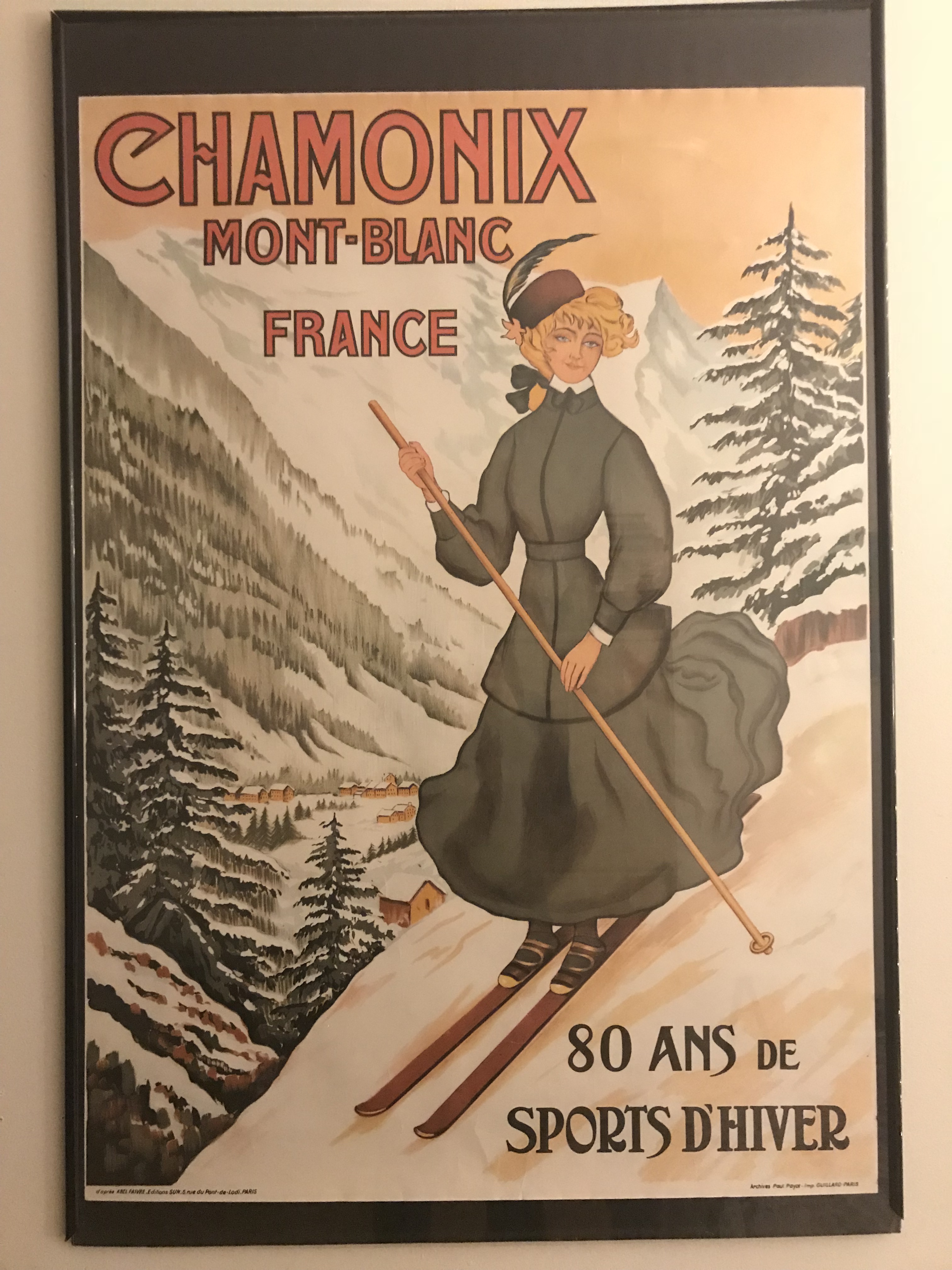
In my initial research in regards to the history of my mother’s Chamonix poster, I was mostly directed to Pinterest boards. There was no evidence of it being an advertisement of any kind, so I was led to believe that it was created solely as a decorative souvenir. Something to remind someone like my mother of the trip they took to France.

However, I wasn’t entirely satisfied with these results, so I dug a little deeper. I typed all of the text from the poster into Google, “Chamonix, 80 ans de sports d’hiver,” in both French and English. This led to the discovery that the first official Winter Olympics were held in Chamonix in January of 1924. I was surprised that this information didn’t come up in my first search, since that seems to pretty noteworthy. I began viewing advertisement posters for those Olympic games, and the style of those posters were similar to my Chamonix poster.

Chamonix-Mont-Blanc, 1924–1924
1924 Winter Olympics advertisement.

The art on this poster was done by an artist named Auguste Matisse, and a lithographic print copy of this poster is currently selling for close to $4,000. My jaw honestly dropped when I saw that. I’m sure my mother’s poster didn’t cost that much, which made me think these two posters were not as related as I originally thought.

This image has an empty alt attribute; its file name is img_2968.jpg
My mother’s Chamonix poster.

However, upon viewing these posters it is clear that they do hold some similarities. The fonts are very similar, as well as the view of the mountain in the background. I believe my mother’s poster was created with allusions to the style of the Olympic Games advertisement due to its popularity not only among people in France, but all over the world.

As discussed last week, the lineage of this poster dates back about 35 years having first belonged to my mother. It was interesting to hear about the poster from her perspective, and it now means a little more to me than it did before. It was also interesting to read about the potential history of the creation of the poster, even though these are mostly speculations. The Winter Olympics in 1924 brought a lot of publicity to the small ski town of Chamonix, which probably contributed to my mother’s desire to go there 60 years later.

Course Blog #4: Ray-Ban Sunglasses

I really enjoy nice things. Despite that I have often shared my experiences of living a rather minimalistic lifestyle throughout previous posts, the objects I do like to surround myself tend to exhibit a strong sense of value either through monetary or symbolic means. One such object that I highly value is my pair of Ray-Ban sunglasses that I have recently acquired about one year ago. When pondering on what my focus for this week’s blog post should be, I felt that diving into the physical nature, history and functionality of my sunglasses would offer an interesting and educational perspective that serves as a culmination to what we have learned so far during our honors seminar.

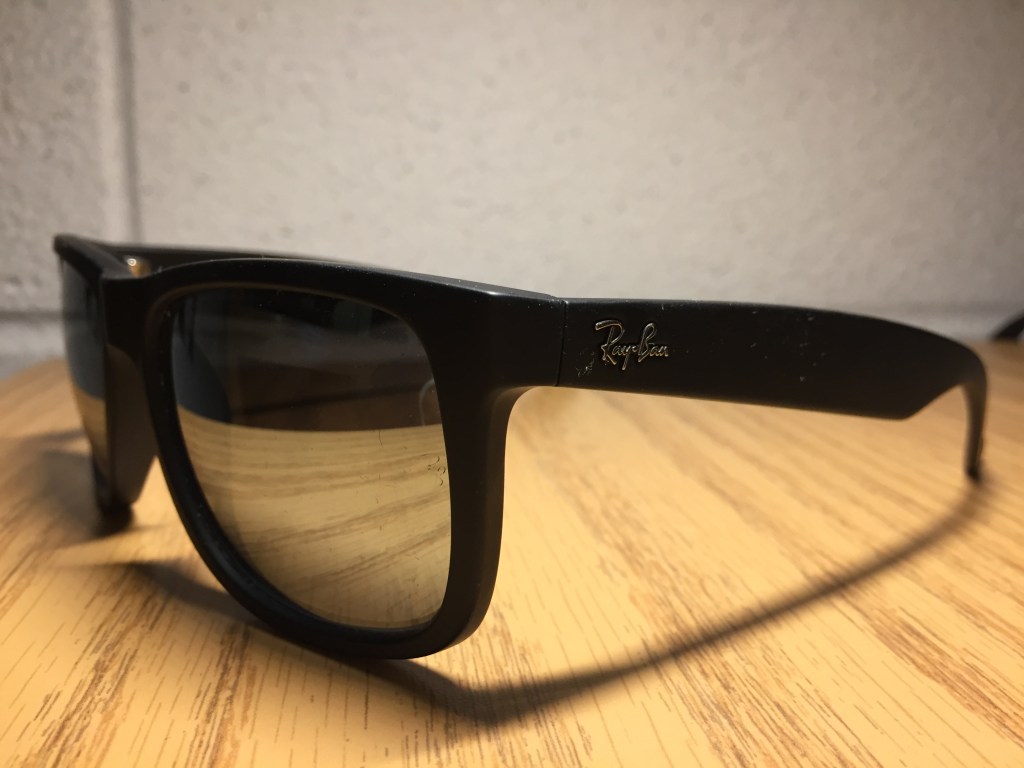
My Ray-Ban sunglasses along with their case.

For starters, I want to give to detailed description of what makes up my pair of Ray-Ban sunglasses. In terms of physical dimensions, the glasses are roughly 5 and a half inches long, 5 inches wide and are about 1 and a half inches in height. Moreover, the frame of the glasses has a nice black matte finish which gives the object a smooth feeling while also preventing fingerprints from emerging across its frame. On both sides of the frame, the Ray-Ban logo extrudes from the corners to help maintain the objects identity in regards to its brand and affiliation. I personally like the Ray-Ban logo on the glasses because I feel that it helps signify its quality as an object. Since I don’t tend to own too many objects, I like to feel reassured that the objects I do own have a purpose and possess quality in both design and worth. As a result, this logo helps to assure that this object is of excellent condition compared to other glasses on the market.

A closer view of my Ray-Ban sunglasses.

Continuing with the physical attributes of my Ray-Ban sunglasses, the inner corners of the glasses have a stainless-steel joint that allows the frame to pivot in order to open and close. Although the frame is a very important aspect of any pair of glasses, it is undeniable the most important portion of this object is centered around its lenses. For this object, despite of having a myriad of diverse lenses to choose from, I ultimately ended up with a lens with a metallic finish. Since standard black lenses were not available for the frame I had chosen, I ended up choosing these silver mirror lenses instead. Although I was a little skeptical of them at first, I eventually became very fond of them as they would soon become my everyday sunglasses.

Before diving into the history of obtaining my object, I would like to touch on one critical aspect of these sunglasses that I have not mentioned yet – they’re prescription. I consider myself to be a generally healthy person but one area that I’m definitely lacking in is my personal vision; while I don’t have terribly bad vision, I don’t have the best vision either. Since I am near sided (meaning I can see clearer up close), and the fact that I don’t enjoy wearing normal glasses, I believed that obtaining a pair of prescription sunglasses would be a suitable compromise. I bring up this point because I feel as if this object perfectly brings up the debate of fashion vs function. I’m often surprised to how many people forget that sunglasses can be prescription and not just a mere accessory. One of the reasons I am drawn to this object is that it serves two purposes, it is a fashionable accessory while also allowing me to see much clearer. As a result, the pragmatic nature of this object is what led me to purchase it in the first place nearly one year ago.

As I stated before, I obtained these sunglasses last June in Danbury, Connecticut at a local retailer called LensCrafters. Ray-Ban, being originally owned by Bausch & Lomb, were eventually sold to the Italian eyewear giant, Luxottica, in 1999. Moreover, since my glasses are made to order based on my prescription and have the writing “Made in Italy” on its frame, I tried to look further to see where exactly they were manufactured. Unfortunately, I was not able to locate any resources online that pinpoint the exact location in Italy where these glasses were made. However, according to Luxottica’s website, the company’s manufacturing footprint includes six facilities located in Italy, the center of Luxottica’s luxury eyewear production, with five of their most prominent factories being located in Northeastern Italy, where most of the country’s eyewear industry is based, and one near Turin.

Although it is a shame that I wasn’t able to find to exact location of where my Ray-Ban sunglasses were manufactured, I’m sure they were produced with passion and exquisite Italian craftsmanship. With such a strong attention to detail, a pragmatic and fashionable purpose and a rich Italian history, there’s no surprise to why this object continues to be one of my favorite possessions. Perhaps one day I’ll have the opportunity to dig even deeper into the history and manufacturing process of these glasses. But for now, I look forward to continue wearing them as I will be able to appreciate and acknowledge this object’s significance, functionality and history.

Family Rings

For this week’s post, I am once again focusing on my family ring: my Irish Claddagh ring. To reiterate, the ring is an object that has been passed down to me through the generations. It began in the possession of my great nana, gifted to her at the later stages of her life. After she passed, it fell into the hands of my grandmother who held onto it until I became of age at thirteen to become to official owner of the ring. This is a family tradition for all the girls on my father’s side of my family, meaning my sister also was given a passed down Claddagh ring when she became a teenager. However, after a recent family discussion, it came to my knowledge that the ring my sister possesses has a much richer family history than my own. Though I am a bit envious of the story behind her ring, I am grateful that I was able to ask my grandmother about it and delve into more of my family’s wonderful history.

The ring my sister has traces back to–and I’m going to hope you can follow this, because it took me awhile to understand–my grandmother’s grandmother’s mother-in-law. So, in other words, the ring comes from the mother of the husband of my grandma’s grandma. I’m not sure if there’s a simpler term for that, but that’s what the text I received regarding the ring’s history says, and so that is what I will write.

The woman who was the first owner of my family ring had been given it by her first fiancee as an engagement ring. He was an irishman through and through, and it had been his own family tradition to propose with Claddagh rings. The woman herself was not Irish, but seeing that she was about to marry into a heavily Irish influenced family, she accepted and wore it proudly. They were engaged for a few brief months until, sadly, the man, who I believe was named Angus, died suddenly. My grandma does not know the details of his passing, other than that the woman was utterly heartbroken.

She carried the ring with her, even as she married her second and last husband who was, fittingly, Irish as well. This man ended up being my grandmother’s great grandfather… if I’ve drawn out the family tree correctly. The ring fell into his possession and he gave it to his first daughter, unknowingly beginning a long line of Claddagh rings given to the women in our family. I am unsure of the details of the rest of the path of my sister’s ring, but I am positive that it has touched, physically and emotionally, many lives throughout my family. Unfortunately, I do not have images of the ring, since my sister has it stashed away somewhere safe in her bedroom back home, but I found an image online that looks very similar to it:

Old fashioned Claddagh ring

Though its appearance does not differ greatly from mine, it is a bit more tarnished and the band shows signs of bending and warping.

It is amazing to me that stories such as the one I’ve told exist in my family. I have never been one to ask much about the history of my lineage. Rather, I’ve accepted that I come from a long line, beginning somewhere in Ireland many centuries ago. However, now every time I put on my necklace with my ring dangling from it, I am reminded of how rich my family history is and of how great of a story there is behind these little heirlooms that my sister and I carry around with us. I hope that someday, down the line, the ring that I pass down will accumulate a great deal of detail and stories to be told to future generations within my family.

The Book That Will Save the Earth

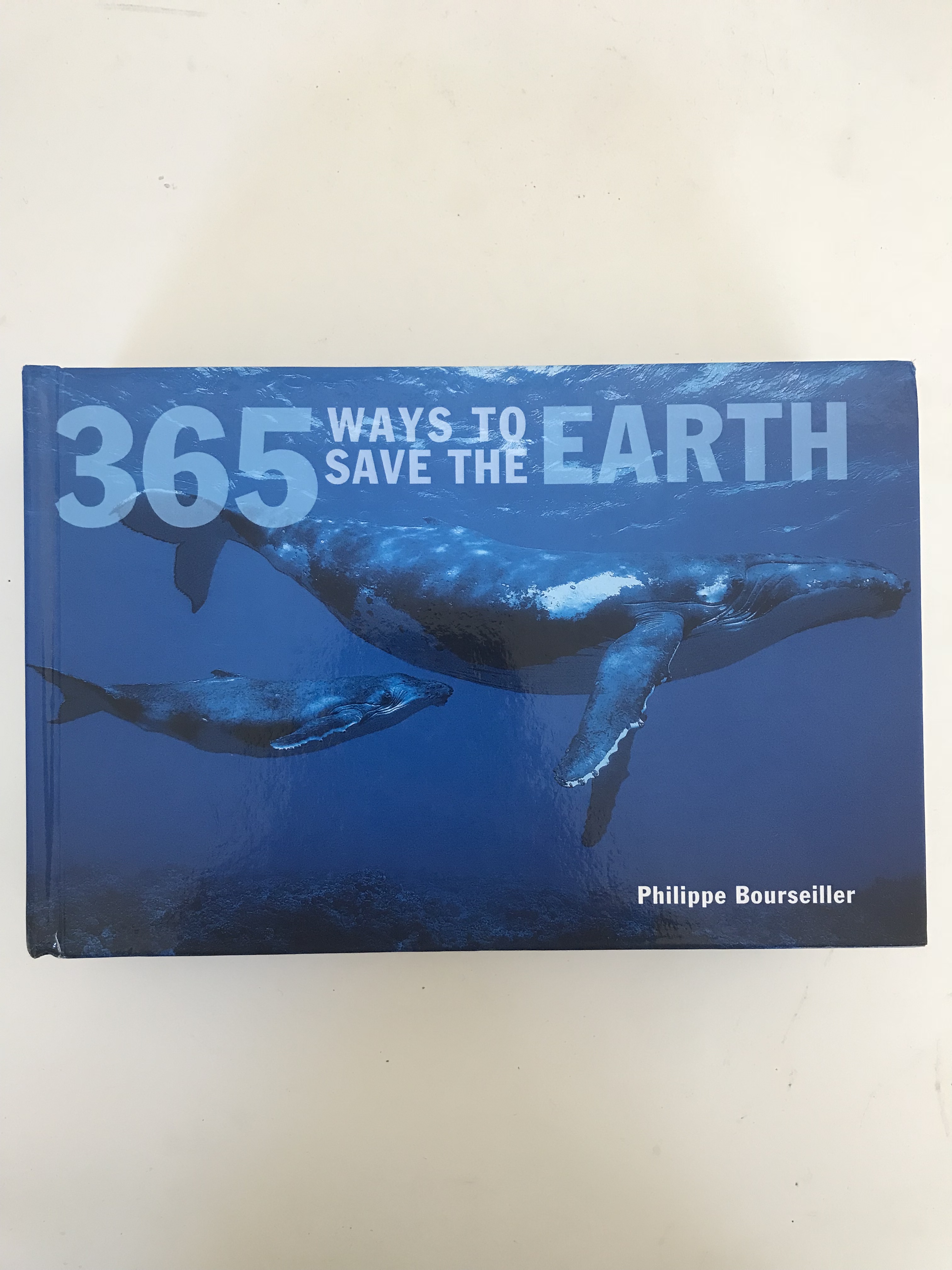
I don’t really have any items that have been passed down in my family, and so I’m lacking in an object that I can trace the chain of ownership of. However, I do have this book that I acquired a few years ago, and sometimes I like to ponder its chain of ownership. This book has an uncanny ability to capture my essence, my being, my spirit. Sometimes I think that this book and I were meant to meet, it feels as if it was made for me. It’s called 365 Ways to Save the Earth, by Phillippe Bourseiller. I’m incredibly passionate about environmental issues and have heavily involved myself in that world on and off campus—through internships, clubs, and attending community meetings and events. Environmental advocacy, whether through the channel of politics or communications, is one of the possible paths I want to take after college. I firmly believe in the issue of climate change and climate justice, and working towards a more sustainable future for everyone, but I also really just enjoy nature and being outside and soaking in the beauty.

The encapsulating book.

I bought this vast book for $1 at the Elting Memorial Library Fair during my freshman year here. I saw this book, laying among the rest, and it was an instant connection—I had to have it. The book’s bold cover, a clear photograph of a mother and baby whale swimming together in a melancholy blue ocean, and its thick, yet compact size is what caught my attention, and then of course, the title. I’m a big book lover, and a big earth lover, so this book seemed perfect. I immediately reached for it and was filled with joy, excitement, and appreciation. This book hits a deep chord for me, and I was inspired by the title, 365 Ways to Save the Earth, and already started to think of the kinds of projects I could do with it. The book is also reflective of the time in which I got it. I was a freshman, bright-eyed and bushy-tailed, with a lot of energy and an activist spirit—I wanted to take on the world, and this book seemed like a pretty good start. Once the book was in my hands, I wasn’t going to let it go, and especially finding out it only cost $1, it made it really easy to not let go. I was amazed. I felt like I was practically stealing the answers to the universe—for a $1! I couldn’t stop showing it off to people once I had gotten it, and I would find myself getting lost, flipping among the pages, carefully reading each tip and studying the photos. I still always have it with me today, and while I look at it less often, I always keep it by my desk, so I can see the cover and be reminded of that magical day, and reignite my passion.

From the side.

One could characterize this book as a “coffee table book.” It’s hefty, intriguing, and has a lot of pictures—easy for guests to peruse through. The book is filled with awe-inspiring and breathtaking photographs of nature—from volcanoes, to elephants, to glaciers, and sea slugs. Each page contains an environmental tip for each day of the year on how we can strive to live a more sustainable and environmentally-conscious life on one page, and a beautiful image on the other, showing us exactly what our actions could be saving. Some tips are easier than others–to reuse materials before buying new ones, or start a compost–and others are a bit harder–like switching the way your house gets energy. Some also call on us as citizens of our respective countries to put pressure on our politicians and demand change. One aspect that I really appreciate about this book is its global mindset—there are photos from all around the world, places you may not even known had existed, or parts of the world you never thought you would see. It also has a universal nature, anyone can relate to this book, even if some of the tips don’t apply to you or aren’t feasible, we can still appreciate the stunning photos of this world that we share.

The inside of the book: an environmental tip (“Read and know your poultry labels”) and a stunning picture to match.
A close up of a tip urging us to speak up.
A close up of the adjoining photo–a true wonder.

The book was published in Paris and New York in 2005. It was originally written in French. The photographs are a compilation of the photographer’s work, Bourseillier, over the past 15 years capturing nature from all angles (leaving no stone unturned). The book originally cost $29.95 in the U.S—I got it for a $1. I bought it used from the library fair, but it’s in really great condition, the binding has just become a little loose. I sometimes think why someone would give this (perfect) book away. There’s no note written in the front cover, as you sometimes see when buying used books. None of the pages are marked or folded. There’s almost zero trace of the past owner(s) or of human touch. Maybe it was owned by a couple who had it on their coffee table, but tired of the message. Maybe it was received as a gift, maybe someone had gotten all that they could from it, and wanted to spread the knowledge. Maybe someone had bought it second hand before I did. Maybe the person knew the photographer and had multiple copies. But I wonder, how did this beautiful book make its way to the Elting Memorial Library Book Fair in New Paltz, NY, during the fall of 2015, and make its way now into my possession? I wonder how long I’ll hold onto it, if I’ll ever donate it (probably not). Maybe I’ll give it to one of my children, if they’re environmentally inclined, and perhaps spark a passion that my mom sparked in me.

Mastering The Tarot

This week I decided to discuss my copy of “Mastering the Tarot: Lessons in An Ancient, Mystic Art” by Eden Gray.

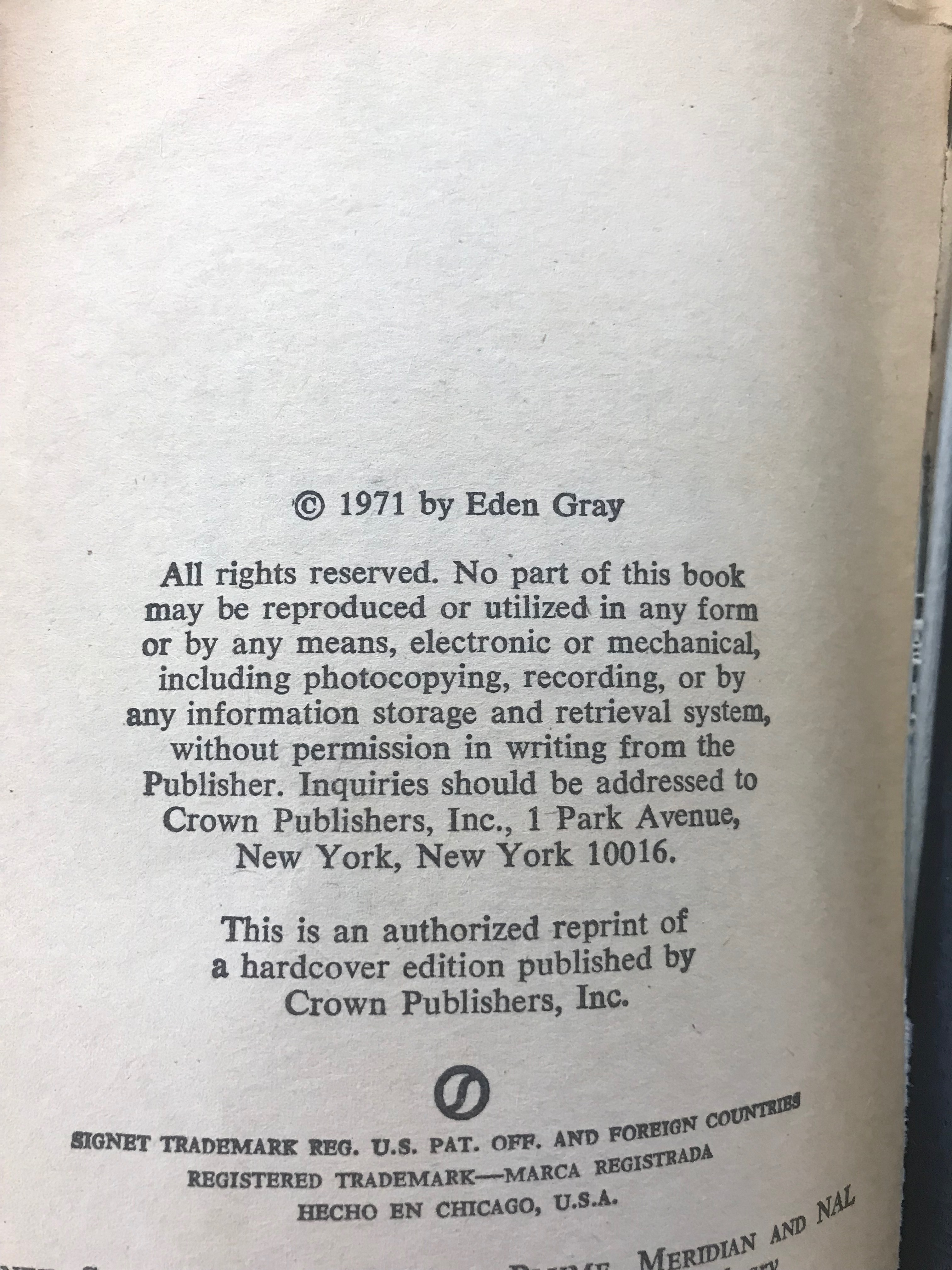
Originally published in 1971, this copy was purchased by my mother in the late 90s at a used bookstore outside of Washington, DC, where I grew up. The neon green price tag reading “McKay Books” remains on the front cover; I spent many afternoons at this bookstore as a kid and have fond memories of purchasing some of my favorite books from there, so I have yet to peel off the price tag after all this time.

There’s no way of knowing who the previous owner of this book was, though I’ve often wondered who may have “mastered the tarot” before donating it to McKay’s. I think that’s the beauty of used bookstores; you always carry a bit of someone else’s history–and the mystery that accompanies this–in the pages of your newly purchased book.

My mom has dabbled in Tarot since she was a teenager. She picked up the hobby from my late grandmother, who always had a great passion for mysticism and spirituality. My mom purchased this book to accompany a new set of cards my dad had given her as a gift. She used the book on and off for years until it ultimately began collecting dust on the bookshelf in our living room. Coincidentally, I took up an interest in tarot in my teenage years (runs in the family I guess) which prompted my mom to give the book to me. Like most things my mom has given me, I feel a special connection to the book–especially because it represents something we have in common and an activity we often do together. We’ve spent countless summer nights sitting at the dining room table reading each other’s cards while my dad teases us for taking it so seriously–these moments have become significant parts of my late teens and early adulthood years.

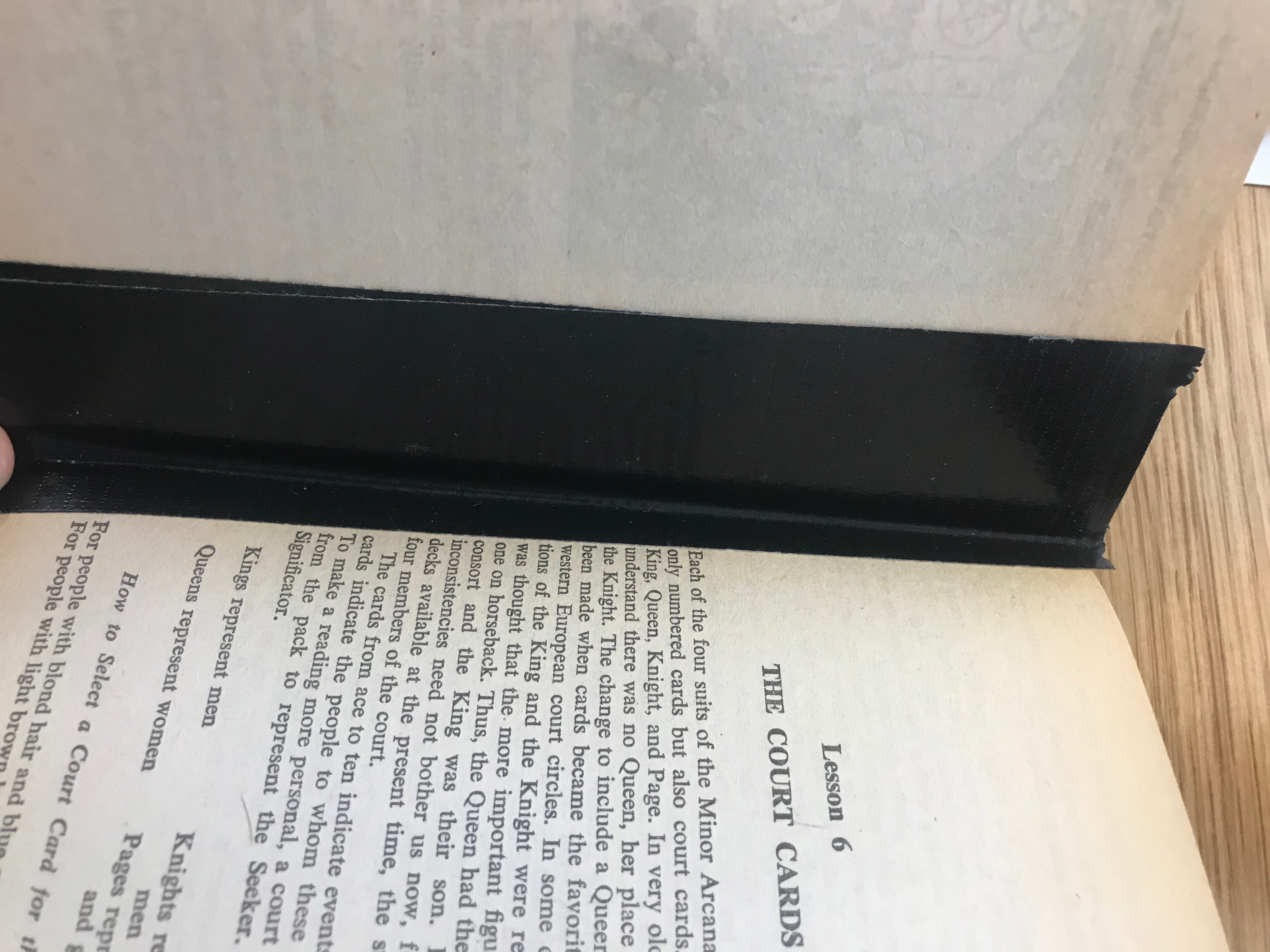
The book is certainly well-worn (or well-loved, as I like to see it). When my mom first gave it to me about 4 years ago it was in decent condition, save for some creasing on the front cover and some tears on the edges of the pages. I’ve since gotten quite a bit of use out of it, eventually resulting in deeper creasing, some paint stains (not quite sure how those got there) on the upper right corner and broken binding. I tried somewhat successfully to patch it back together with duct tape (you can see that not all the pages are reattached to the binding) but it gets the job done.

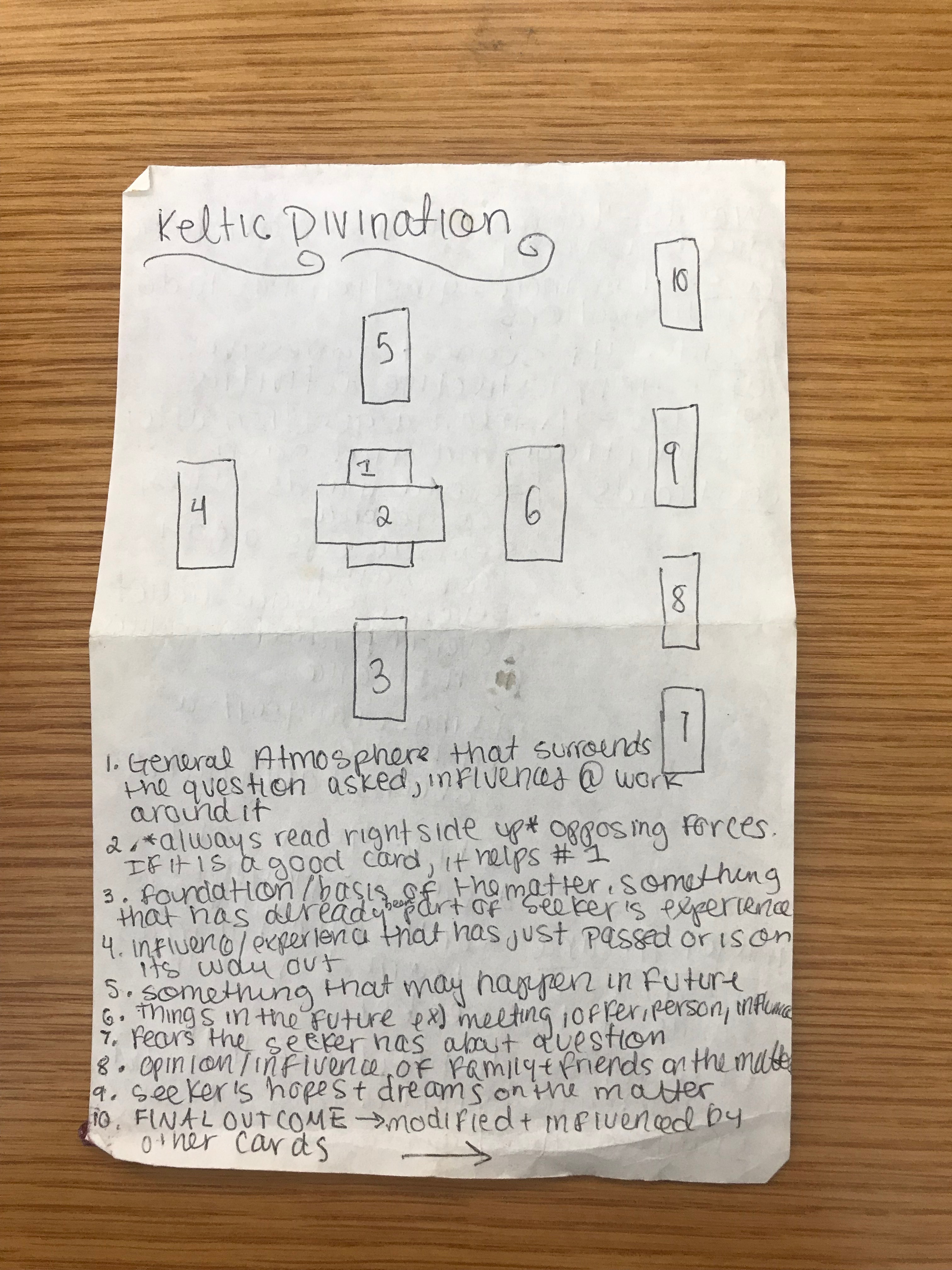
Inside the middle of the book you’ll find a folded up sheet of paper; a few years ago I drew up a key for myself to remind me of the basics of the Celtic Divination layout (a standard card reading method). I’ve kept this sheet of paper in the book for so long now that I consider it a part of the book itself. It’s sort of my way of making the book my own.

The Keltic (spelled with a K in Tarot lure) Divination method with my personal notes about certain card meanings.

Writing this blog post made me realize how much of a constant this book has been in my life. It reminds me of the invisibility of objects; I’ve always known the book to simply be, whether it sat on my mom’s night stand at our old house in Virginia, on the bookshelf in our living room in upstate New York, or now on my own night stand at my house here in New Paltz. I’ve turned to it many times when I needed a sense of guidance about my future; I can’t count how many times my roommates and I have sat on the floor and read our cards in hopes of receiving some “divine” advice from the universe about how the heck to get through college. I’m grateful to have had this tradition passed down along family lines, especially since I never got to meet my grandmother on my mom’s side. Assuming I can keep the book in one piece over the years (we’ll see), I’d like to pass it down to my kids one day and keep my family’s fascination with the weird and mystical going for a few more generations.

A Little Ring

I have claimed in the past that I have no family heirlooms.  I guess whether or not that is true depends on what one considers an heirloom to be.  I don’t have an object that represents my heritage or culture and has been passed down for generations.  I think a reason for this lack of cultural object has to do with the fact that no one in my family has immigrated here recently,  my parents, grandparents, and even some of my great grandparents were born in the United States.

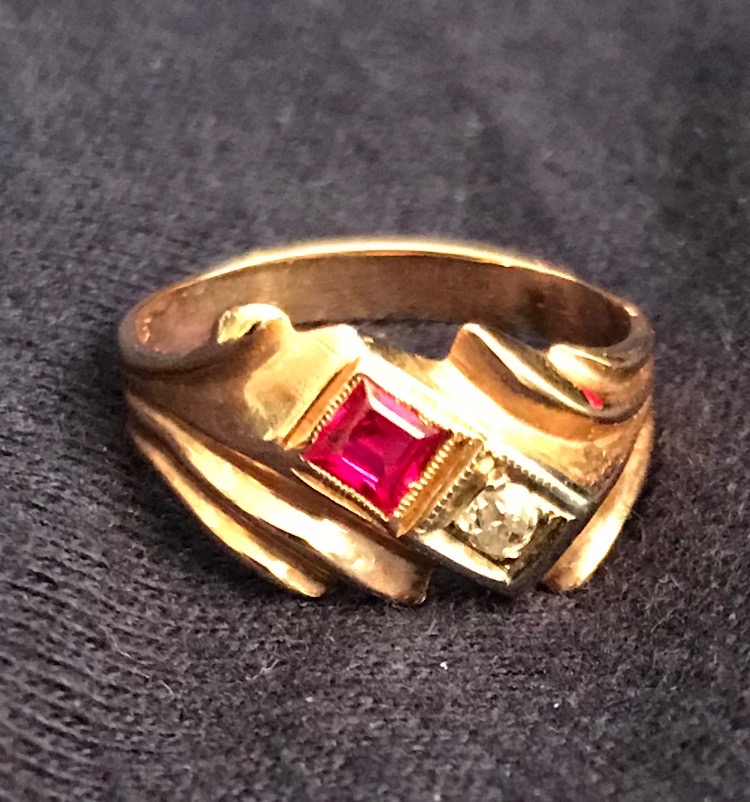
However, I came to the realization recently that I have a ring that was given to me by my grandmother.  She received that ring from her grandmother. I am the oldest granddaughter on my dad’s side of the family, for this reason, I was the recipient of a small, golden ring with two diamond shaped gems, one clear and one red.  This ring is the right size for a relatively thin pinky or a eight year old girl’s finger. Luckily, I was eight when I was given this ring, and currently, it still fits on my pinky finger.

I received this ring for the religious sacrament know as Communion in the Catholic religion.  Unlike a cross to a baptism or a ring to a marriage, a ring holds no relevance to the ceremony of Communion.  However, this ring became something of a religious symbol, as my grandmother also received it as a Communion gift.

Unlike the necklace from my grandmother I wrote about in my last post, which I wear every day, I have never worn this ring.  However, I always make sure that I know where it is. I am very nervous about losing this ring. My fear changes the function of it from being a piece of jewelry meant to be worn, to a memento of a religious sacrament and of my grandmother.  I would like to make this ring an heirloom for my family in the future, something to be passed down through generations to come. I do not know if the ring will continue to be passed down for one’s Communion, but my hopes are mainly just for it to be passed down in general.

I know little about the origins of the ring.  I know that it was purchased as a gift for my grandmother, and not originally owned by her grandmother.  My grandma received Communion when she was eight, sometime in the 1950’s. Meaning that the ring was purchased around this time.  My grandma then kept that ring with her all throughout her childhood and adult life. She decided to hand it down not to her daughter, but to her granddaughter.  After receiving this ring, I immediately gave it to my own mom to hold onto for me until I grew older. Around age seventeen, my mom and I were going through the jewelry in her closet and we found the ring.  She told me how I had received it and returned it to my custody, nearly ten years later. From then on, I kept the ring in the box in which it was given to me, which was not the original box. I bring the ring with me to wherever I reside at the time.  There it remains, unworn, in a box.

My Only Family Tradition

This blog post was very difficult for me. I don’t really have many objects that have been passed down throughout my family and have a “chain of ownership.” However, as I was reading back through last weeks blog posts I thought of the only object that I remember my mom telling me that has been passed down through the years. I responded a little bit in a comment, but these are little recipe cards that my family still makes around the holidays that they are associated with. It has become a tradition in my family. We always have my grandma’s quiche Christmas morning, my Nana’s sugar cookies and “butterscotchies,” also at Christmas, and my Nana’s ambrosia salad at Thanksgiving.

Unfortunately, I could not get a picture of these cards because my mom is currently visiting my grandparents and these index cards are at home. Also, these recipes are very secretive in my family and so when I called my grandma to get these recipes she did not want to send a picture of the recipe itself. The first one that I’m thinking of is my Nana’s (great-grandma)  Ambrosia salad recipe. Although, my grandma believed this recipe actually started with her 98-year old aunt. This recipe stuck out to me first because it is probably the most “secretive.” My mom used to tell me that my Nana never gave out this recipe until she got older. She would only make it for the family; however, would never give anyone in the family this recipe. Once she got older, she finally revealed her secret and passed it down to the rest of us. I’m glad she did because my Nana passed away before I was born and so this recipe is a piece of her that I will have for the rest of my life and be able to pass down to my own kids, when they’re old enough of course.

The next recipe cards are oriented around our Christmas traditions. These include my grandma’s quiche recipe and two of my Nana’s cookie recipes that we make every year. These traditions started on my mom’s side of the family with all of her relatives; however, even after my parents divorced my dad still makes quiche for my brother and I every Christmas and my mom always makes my dad a batch of the butterscotch cookies for us to bring over. Something that I like about these recipes though, is that even though they originated with my family as these special recipes they have changed over time within my family. When my aunt makes the butterscotch cookies she always adds peanuts to them (as the original recipe calls for), yet when my mom makes them she leaves out the nuts because she doesn’t like them as much. Also, the quiche recipes change slightly from year to year to. The base and basics always remain the same; however, sometimes we change what else goes in them. My mom’s new boyfriend hates onions and so now when she makes the quiche she leaves out onions in one of them, so we can all enjoy it.

Although, these index cards don’t seem like much, they mean a lot to me. I love cooking, if I wasn’t currently in college on a criminal justice/ law path, my second plan was to always go to culinary school. These cards are tiny and worn down and constantly changing, yet they’re one of the very few traditions my family treasures and still participates in every year. It’s not a crazy chain of ownership, but every member on my moms side of the family holds these recipes and continue to pass it down. There’s no real historical significance to these cards; however, to my family the history of these recipes is priceless.