Federal Style Clock Draft

Caption

As baby Cupid rests on grapes on leaves, the United States has only just been born.  Made in 1788, this clock represents the Federal style, an artistic movement that impacted how architecture, furniture, and interior design styles were made. This clock would find its way into the home of Josiah DuBois, a Huguenot descendant and owner of an extravagant Federal inspired home. The house, as well as this clock, are the symbols of an attempt at creating a true “American” culture in the 1800s.

Clock

Federal style clock feat. Cupid. Picture Credit: Jessica Wiessner.

Object Description

The clock contains several parts: a wooden plate for a stand, the main part of the clock where the face is, a golden Cupid laying in leaves and grapes while holding his bow and arrow, and a glass covering.  The clock’s face uses Roman numerals as a signifier for time and is quite small in relation to the whole clock.  The frame containing the face and holding up Cupid is wood painted black with gold trims around it. There are also ridges carved into the wood, giving it a bumpy texture.  Inside are the gears which are no longer functional.  Cupid lays in a comfortable pose on leaves and grapes with his bow facing straight ahead.   The glass is dome-shaped and covers the entire clock to protect it.  The whole clock is approximately 13.5 inches high and 9.5 inches wide and is quite heavy to pick up or handle.

Provenance

This clock is dated to 1788.  It originated from an apartment on Pine Street in New York City owned by a man named Samuel Boyd.  I have not been able to find much historical information on Samuel Boyd other than he lived there and may have owned some type of store.  It ended up at the Blake House, owned by William H.D. Blake, who died in 1926.  The family continued to own the house and its objects until 1984 when the items in the Blake House were donated to Historic Huguenot Street. The clock now resides in the Federal Style Room in the Deyo House.

There are a couple of possibilities as to how Blake acquired this clock. According to the Historic Huguenot Street website, Matilda Blake was very close to her cousin Amy L. Hepburn, whose parents were named Samuel Boyd and Sarah Booth Hepburn, therefore making Samuel Boyd the brother-in-law to William and Matilda (Booth) Blake. Perhaps this is the Samuel Boyd from Pine Street who owned the clock, and William Blake purchased the clock from him or otherwise received it as a gift. It has been extremely difficult, unfortunately, to find evidence of this relationship as the name Samuel Boyd was extremely common. It could also be possible that the Samuel Boyd on Pine Street is a completely different person from William Blake’s brother-in-law, and that William Blake simply purchased the clock directly from this person or from an antique shop.

Narrative

William Henry Dill Blake (1843-1926) was born in Montgomery, New York and served as an officer in the Civil War.  He married Matilda Booth in 1875 and together they had three children: Alfred Booth, William Culbert and Matilda. They moved to New Paltz in 1881 when Blake purchased the late Josiah DuBois’ house and 250-acre farm. He continued to live in New Paltz until his death in 1926. All three of his children graduated from the New Paltz Normal School and were heavily involved in the New Paltz community, especially Matilda.

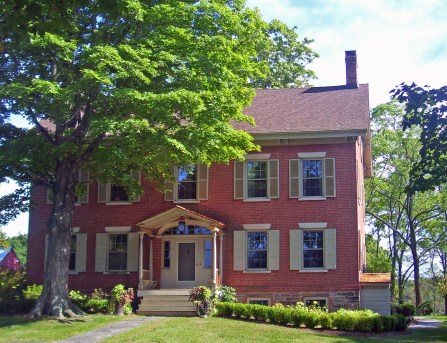
William Blake’s house is a story in and of itself and is important in understanding where the clock fits in.  It was constructed in 1822 on a large portion of land owned by the DuBois family since 1677.  Josiah DuBois owned and lived in the house until his death in 1869.  His daughter Elizabeth and her husband moved in the same year but only lived in it for twelve years until William Blake purchased it.  The house has become a historical landmark in New Paltz due to the property’s involvement in the original Huguenot settlement and the Revolutionary War.  The house was constructed in the Federalist style of architecture, so the clock this project focuses on must have fit in nicely with the theme of the house.
Josiah DuBois Farm House

Josiah DuBois Farm House. Source: WikiMedia Commons. https://commons.wikimedia.org/wiki/File:Josiah_DuBois_Farm,_New_Paltz,_NY.jpg

The Federal style was a movement in the three decades following the inception of the United States.  The developing system of government largely influenced the term Federal style, and the style itself served as a way for the newfound United States to create its own identity.  A prime example of the Federalist style is the White House, which has come to be a symbol of America and American identity. In addition, Neoclassicism, or a revival of ancient Greek and Roman art and culture, also heavily influenced furniture in this period. This would explain why the clock contains Cupid as its focal point.  Federal style furniture often comprises of thick, dark wood, simple designs, and marble.  Although elements of Neoclassicism (a relatively European movement) exist in the Federal period, the style is representative of the beginning of an American culture.  It is interesting that Josiah DuBois would choose this style for his house and William Blake would choose to maintain it.  The DuBois family were part of the original twelve French Huguenot settlers in New Paltz and brought their European culture and traditions with them when they emigrated to New Paltz in the 1600s.  The property they owned still contains several older structures, including a 1775 Dutch barn.  It is as though DuBois and Blake, like much of America at the time, were attempting to erase their own histories and ascribe to the new “American” story that was emerging through creating and preserving this Federal style.

References

“Landmark Designation Form.” Historic Huguenot Street. Town of New Paltz, New York.  2003.

“William H.D. Blake Family Papers.” Historic Huguenot Street revised 8 June 2005. <www.huguenotstreet.org/william-h-d-blake-family-papers/>

Thurlow, Matthew. “American Federal Era Period Rooms.” In Heilbrunn Timeline of Art History. New York: The Metropolitan Museum of Art, 2000-. <www.metmuseum.org/toah/hd/fede/hd_fede.htm> (November 2009).
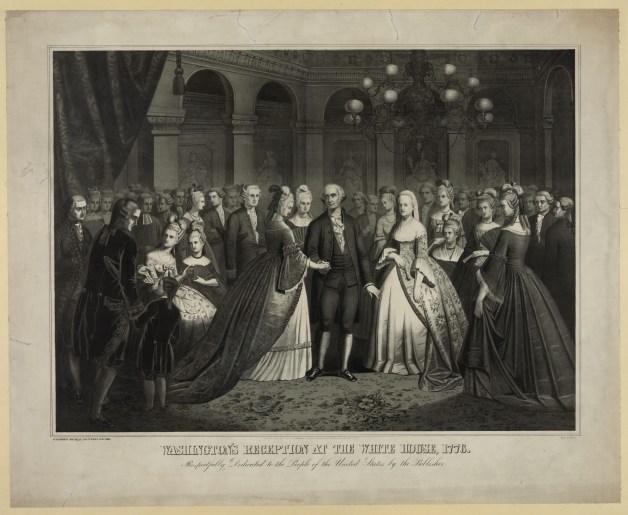
“Washington’s Reception” lithograph

Images:Washington's Reception at the White House, 1776Source: “Washington’s Reception at the White House, 1776.” Library of Congress, US Congress, http://www.loc.gov/pictures/item/2006677658. Accessed 20 Apr. 2017.

102571-3.jpg102571-4Source: Allmendinger, Carrie. “Nathan Bergelson: SUNY New Paltz Honors student emailing about object to study.” Received by Nathan Bergelson, 10 April 2017.

Caption:

To be done when I have all of my information

Physical Description:

The print is a lithograph, sized 33.5 inches by 27.5 inches. It depicts the historically impossible scene of President George Washington greeting guests in an ornate ballroom of one of the US’s most prestigious buildings, the White House, with his wife Martha standing by his side. The title is printed in serifed block letters reminiscent of fonts printed on contemporary US currency, with line weights varying to give the illusion of embossing. Below the title, written in delicate calligraphy is a dedication to the American people, and above in very fine print is essentially written recognition of an 1867 copyright for the print to Kelly. A light gray, linen matte and wooden frame with subtly gilded edges display it simply and cleanly, keeping with the Colonial Revival aesthetic popular at the time of its creation.

• Add more specific, not immediately apparent details once I’ve seen print in person

Provenance:

This print was conceived by a lithographer named George Spohni and then published by Thomas Kelly in downtown Manhattan in 1867. Since the print is in the style that was popular in the late nineteenth century, what seems likely is that a collector purchased it from Kelly, and that it later made its way upstate where it decorated a home in the Colonial Revival style. A descendant of that original homeowner may have decided to give it to Historical Huguenot Street (HHS) once Colonial Revivalism fell out of favor in the mid-twentieth century. This is admittedly speculation, however, because there exist no records regarding HHS’s acquisition of the print.

Narrative:

In the late nineteenth century, Americans became enamored with the Colonial Revival aesthetic, which celebrated historical figures and events in the US’s past. Sometimes, artists took this idealization further by fabricating events and placing these figures in them, as is the case in Washington’s Reception.

  • Give brief overview of the little bit of info found on T. Kelly and G. Spohni?
  • Look into books on American printing in this era that were recommended by Library of Congress curator
      • Look into possibility that the print is a political cartoon
  • Explain how the print would have fit into a room styled in the Colonial Revival aesthetic, using the current interpretation of the Formal Parlor in the Deyo House as model

References:

Allmendinger, Carrie. “Nathan Bergelson: SUNY New Paltz Honors student emailing about object to study.” Received by Nathan Bergelson, 10 April 2017.

Haley, Jacquetta. “East Parlor.” Furnishings Plan: Deyo House, Historical Huguenot Street, New Paltz, NY, 2001, pp. 94–102.

John G. Waite Associates, Architects PLLC. “Room 111 (Music Room).” Deyo House: Historic Structure Report, Historical Huguenot Street, New Paltz, NY, 1997, pp. 54–56.

Kennedy, Martha. “Library Question – Answer [Question #12435925].” Received by Nathan Bergelson, 19 Apr. 2017.

Spohni, George. Washington’s Reception at the White House, 1776. Lithograph. Historic Huguenot Street, New Paltz, NY, 1867.

Trainor, Ashley. “Nathan Bergelson: Dimensions of and materials used in ‘Washington’s Reception’ print.” Received by Nathan Bergelson, 20 April 2017.

“Washington’s Reception at the White House, 1776.” Library of Congress, US Congress, http://www.loc.gov/pictures/item/2006677658. Accessed 20 Apr. 2017.

A Study in Scarlet

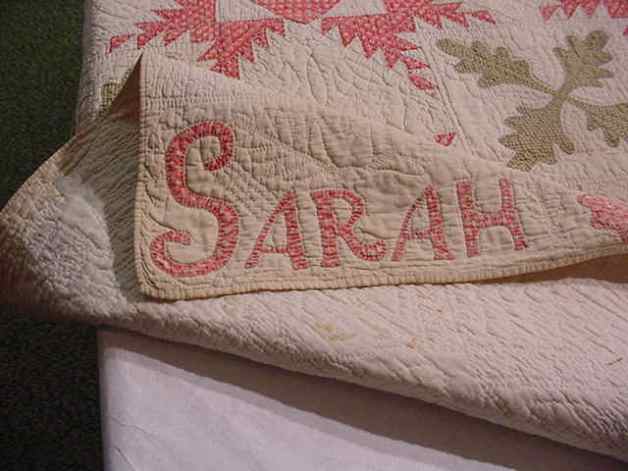
The object I chose to research and analyze for our Historic Huguenot project is a quilt made by Sarah M Lefevre (11/12/1825 – 3/4/1902). Sarah was married to Joseph Hasbrouck, a notable figure of the time in New Paltz.

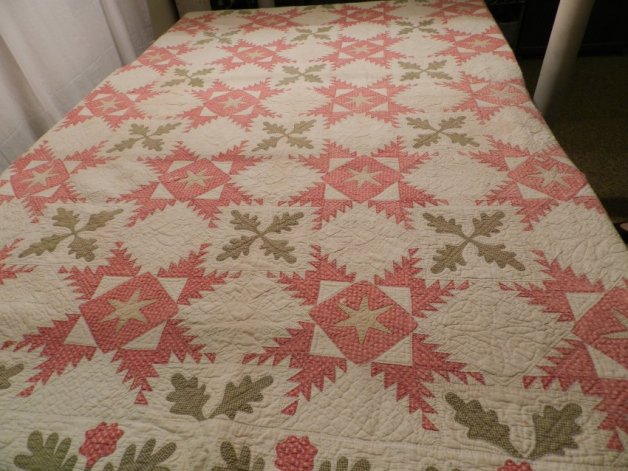
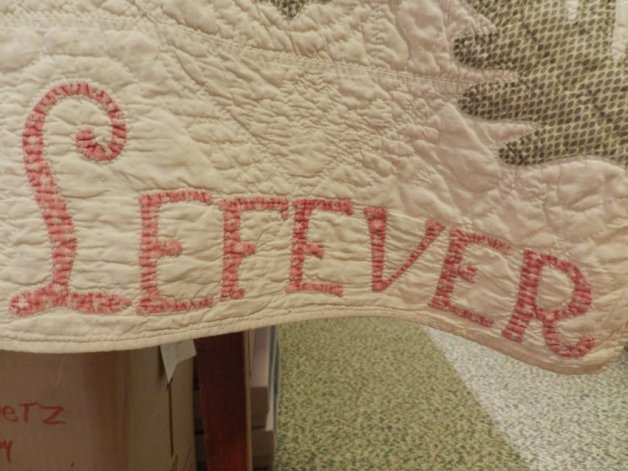
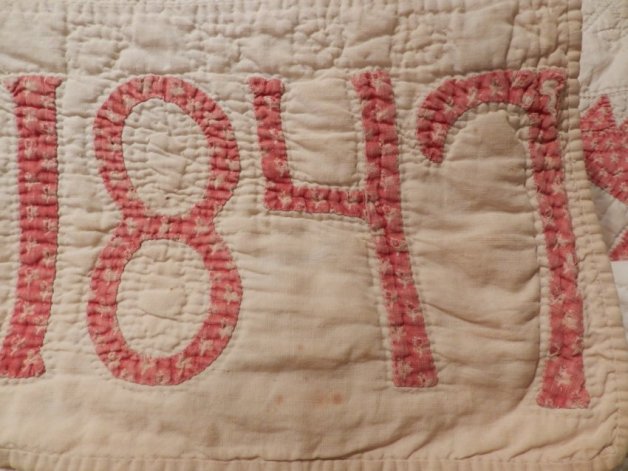
Object description: The quilt has a simple and cohesive pattern, laid out horizontally and vertically, consisting of a white background with pink and green design. These are feathered stars alternating with diagonally crossing oak leaf pieces making up the pattern that spans the entirety of the quilt. In the center of each feathered star there is also an additional 6-pointed star applique. The quilt’s backing is is made of white muslin, white seams, and a cotton backing. The quilt’s front is made of cotton; pink, green, and beige. The border surrounding the quilt is single, with butted corners. On the very end of the front “Sarah M Lefevre 1847” is appliqued in pink. All hand sewn and stitched.

After looking into the unique history of quilting, and how the art played an important role in the lives of 19th Century people, I grew interested in the industries surrounding quilting and textiles, specifically regarding how different textiles were valued and used over others. I researched further into Sarah’s quilt and discovered that many of the colors she used were actually considered very popular at the time, specifically the greens. I also discovered that the pink fabrics she used were at one time originally red, specifically “turkey reds”, and were part of a very complex system of old/new world economics.

The Fascinating History of Turkey Red

“Turkey red” was a very distinguished and vibrant color of red that was very popular in Britain during the 18th and 19th Centuries. The color was used in many different textiles to add vibrancy and regalness to designs, and proliferated quickly through the textile industry, especially in Scotland. Popularized originally as a colour-fast red dye that could withstand frequent washing and sunlight, Turkey Red was a long-standing ambition of dyers in eighteenth-century Britain. Coined “Turkey Red” because it originated from the Levant region of the Middle East (the Red Sea). The color’s original dying process, which was time-consuming and expensive, was based on the extraction of alizarin from the madder root, which was then fixed to fibre using oil and alum, as well as a number of other ingredients such as sheep excrement, bull blood, and urine. Because of its high-quality, in conjunction with its arduous and time-consuming processing, the color became extremely valuable and sought after, and subsequently caused a competitive and aggressive industry to emerge, all surrounding one simple shade of red.

According to the National Museum of Scotland, from their exhibition “Turkey Red: A Study in Scarlet”, The Turkey red dyeing and printing industry in Scotland was concentrated in the Vale of Leven, Dunbartonshire, and was brought to Scotland in 1785 by a Frenchman named Pierre Jacques Papillon. Papillon was hired by David Dale and George Macintosh, both prominent businessmen of Glasgow, and worked together with other manufacturers who saw the potential profitability of Turkey red. The color soon popularized, and a was printed for fabrics made for clothing and furnishings and, unlike tartan, another textile which was popular among Scots, many of the Turkey red fabrics were intended for foreign markets such as India, China, the West Indies, and North America. The Scottish firms at the forefront of the industry went to great lengths in ensuring their designs would be catered to foreign markets. They wrote regularly to agents in different countries and stuck to designs they knew were popular. For example, the “Peacock” was a pattern or motif made of Turkey Red which was popular throughout the nineteenth century and was often produced for saris and shawls for the Indian market.

As markets became more and more competitive, synthetic versions of Turkey Red began emerging to keep up with high demand; and all for lower prices. However, instead of remaining bright and vibrant over time as the Turkey Red was widely known for, these synthetic versions would turn a brown/pink color as they would age. This brown/pink is what we can see in the Sarah Lefevre Quilt, and delineates the demand and prestige of Turkey Red in the 19thy Century, as a sign of wealth and indulgence. Even though at that time, many of the people who must have seen Sarah’s quilt must have thought the Turkey Red was real. But now that some time has past, and the color has faded, we can tell now that it was fake.
Course Connection

Relating back to our class and much of what I have written about thus far regarding my own textiles and Oxford shirts; image, prestige, and ostentation played a large role in the popularization and proliferation of Turkey Red. As I have written previously about my own predilections to well known brands and quality textiles, Turkey Red found itself in the hands of many people because of its reputation, rarity, and prestige. Sarah Lefevre and other wealthy women of her time knew this, and incorporated it into their quilting patterns. I find it interesting to think about how Sarah was not immune to our seemingly 21st Century craze of branded goods, elucidating a connecting between our time and hers.


211101.jpg211101-2.jpg211101-10.jpg211101-8.jpg

This is a giant basket!!! (very rough draft)

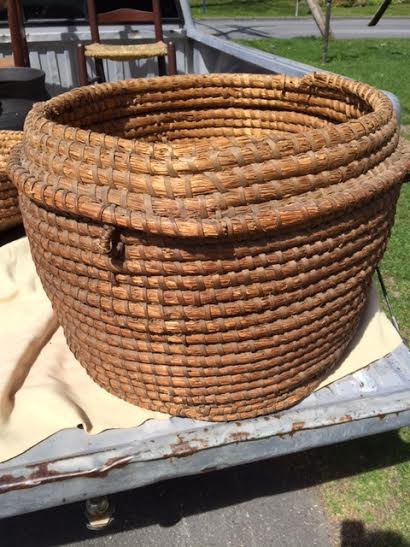
Basket weaving was one of the most common practices throughout early human civilization. Instead of Glad tupperware containers, people had baskets. They held everything from foods, to clothing, to seeds and crops, and were also used to transport goods. The item I have chosen is an enormous basket. It could probably fit a relatively large toddler inside of it. It is rounded, composed of rawhide, reed, and is bound with straw. It is also tightly woven, with two small loops of either side, possibly to string some kind of strap through them. It now resides in the Jean Hasbrouck house, sitting flush against the wall of Joshiah Hasbrouck’s shop as part of the current interpretation of the room.

77301

The toddler sized basket.  Photo courtesy of Ashley Trainor.

The family lore attached to this basket claims that it arrived in America with Louis DuBois in the 17th century, when the Huguenots originally fled religious persecution. In actuality, it is said to most likely be a 19th century basket. This is a period of 200 years that could separate fact from fiction. From the beginning, I knew I would have to do some mythbusting. After researching general material on Artstor, I’ve found that there are many more results for “19th century basket” than “17th century basket.” The first search also yields many similar looking artifacts. Woven baskets, some of them enormous. Right off the bat, this makes me believe that the family lore is simply lore indeed. But, to add only more confusion, the basket was also mislabeled as a clothing basket upon its donation by Evelyn DuBois McLaury. The donation date is prior to 1990, however there is no exact date.

Being made of rawhide, this indicates that it is made of animal skin. If it was made locally, it most likely would have been cow or sheep skin. On a nearby farm called Locust Lawn, located in Gardiner, crops grown included rye, oats, corn, wheat, and apples. Animals included milk cows, chickens, beef cattle, and pigs, all of which were used completely to their full potential.

Also while on my general Artstor search, I found many sketches of cotton pickers. Pictured were slaves carrying huge baskets full of cotton. My immediate thought is that the basket was used for gathering crops. Since it is so large in size and so tightly woven it would make sense that it was used for storing freshly picked crops. If I were to stick to the 19th century track, this would be the most plausible assumption.

Lincoln and His Family

image1

Lithograph on the wall in the office of the Deyo House

This is a lithograph entitled “Lincoln and His Family”, which currently resides in the office of the Deyo House. It was made in 1866 by William Sartain and engraved from a painting of the same name by S.B Waugh. It shows Abraham Lincoln sitting at a table with his one arm around his youngest son, Thomas, and his other arm resting on the table. Thomas is sitting next to Lincoln with one leg and arm pushed back and his opposite leg lunged forward and other arm relaxed on his fathers leg. His oldest son, Robert is standing behind the table with his arm resting on an empty chair and other arm resting at his waist. Mary Lincoln, his wife, is sitting to the left of Lincoln and Thomas. Her right elbow is resting on the table and her hands are in her lap. They are all in elegant clothing; Lincoln in a suit, the boys in a nice shirt and pants, and Mary in a large gown. On the left wall, light is coming in through a window, which through the Capitol Dome can be seen. Next to the window is a bust of George Washington. On the center back wall is a portrait of William, Abraham and Mary’s son who died from Typhoid Fever during Abraham’s first term as president. On the table rests an elegant looking table cloth and on top of it sits a vase of roses, magnolias, sweet clematis, and Virginia creeper(Lincoln Collection). This current print has been shifted in its frame and hides the engraving,  “Lincoln and His Family” on the bottom.

tumblr_inline_nz08881KzF1se3si9_540

Full image where the engraving “Lincoln and His Family” can be seen

This print is particularly interesting since it’s not based off any actual photo of the Lincoln family. There has never been a photo of the entire Lincoln family together. Mrs. Lincoln had taken a group photo with both William and Thomas and Lincoln has only had a picture with Thomas. After Lincoln’s death in 1865, many artists wanted to show they’re grievances by painting pictures of him and his family, yet since there was no full family photo, they had to combine multiple photos to form one. By doing this, they somewhat alter history, making Lincoln seem more like a family man than he really was. But romanticizing the “great” presidents like this wasn’t uncommon during the colonial revival period when this was made. They also idealized his looks; Lincoln was a bit rough around the edges looking and often was self-deprecating about his appearance. Yet after his death, painters created a more flattering image than reality, bringing more color into his skin and smoothing his complexion. (Holzer)

There is also a lot of symbolism in this print that can go easily unnoticed. The George Washington bust is one that connects very well to the historical  Colonial Revival time. The bust is meant to show the connection between the “father” of our country and “savior” of our country.  What is also interesting is that Sartain is known for another piece called “Washington and His family” which is seen as a companion piece to “Lincoln and His Family”.

03458r

Sartain’s “Washington and His Family”

The flowers on the table are also an important symbol. The roses in the bunch are meant to represent the north while the magnolias, sweet clematis, and Virginia creepers are flowers that grow in abundance in the south. The vase is meant to be the union of these flowers, therefore stating there should be peace between north and south.

Since “Lincoln and His Family” is a print, many have been produced but it appears to be the most popular of the Lincoln family prints made during the time. There isn’t much record on the current value of each lithograph either. Yet Saunders in American Faces: A Cultural History of Portraiture and Identity, states that at the time made, it was worth $7.25 for a print and $20 for an artist proof.

The print’s connection to New Paltz is practically unknown since there was a lot of copies of “Lincoln and His Family” made and there is no known donor of this specific print. There has been a print of “Lincoln and His Family” that was donated to a organization in Osage. The family who donated it has said that it has been passed down in their family for generations. I think it’s not a stretch to say it could be a similar situation to this particular print. To own this kind of print, one must have had considerable amount of money. One could hypothesize that this specific print was handed down through generations of the Deyo family (if it’s placement in the house is historically accurate), since they were a wealthy family.


Older than this country–Ladder back chair (rough draft)


chair 3

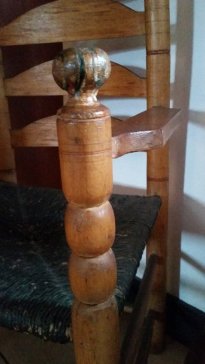
This ladder back chair, owned by Pierre Deyo in his lifetime and by the Deyo family until 1926, is thought to have been built between 1650 and 1700, making it older than the United States. Picture credit: Ashley Trainor

This is a heavy, large wooden chair in the ladder back style. The style was popular in the Middle Ages all the way through the eighteenth century. It has a tall back with four slats. It has a seat of rush, a common plant used in weaving, painted black. The seat is caving inwards, and is fraying towards the front of the seat. The right leg has some scratches on its finial. It is made of a pale wood, such as oak or pine, with a shellac finish.

chair 2

Picture credit: Ashley Trainor. Used with permission.

The chair’s craft is derived of the area. The piece would have been made out of wood that could be obtained easily and locally; pine, or oak, or perhaps maple. Additionally, it would most likely have been finished with linseed oil, which was the custom of the time, as well as shellac (which could be made with tree resin and alcohol). Tar could also be used, but this was mostly used for shipbuilding, and would not likely be used for crafting furniture.

This style reveals an important aspect of New Paltz life at this time: their Protestant religion. Protestants tended to favor simpler, less ornate pieces which were more functional than beautiful. Later on, the Deyos and other important families of New Paltz would obtain the more ostentatious and beautiful furniture of the Victorian era, but the desirability of the furniture shows that there is an enduring charm to this aesthetic.  Simple objects and simple homes speak to the fast held beliefs of these people—witnessed by the plain decoration of the rebuilt French Reform Church. It was less about beauty, more about God and community.

Pierre Deyo, one of the original patentees of New Paltz, was the first owner of this piece.  It is thought to have been built between 1650 and 1700. He most likely would have bought it from a local craftsperson. When Pierre died in 1708, his land and estate was split between his four sons, Abraham, Christian, Pierre, and Hendricus. This item was considered part of the Deyo household, included within Deyo’s grandson Peter’s will in 1791. The chair remained in the Deyo family up until it was purchased from the Andrew LeFevere Deyo estate shortly after his death in 1926.

The shellac on the chair shows that the craftsperson wanted to ensure that the natural beauty of the wood to come through. Shellac does have a shelf life (albeit of months or years), and requires skill to apply, so the reader can infer that Deyo was not the craftsperson, but rather some other local woodworker.

This piece would most likely have sat by the fireplace in one of the few rooms of the Deyo home. After a long day of work, it would have been a comfortable place to return to and to unwind. Possibly, it could have been sat or worked on by a slave—Pierre owned at least one, as evidenced by a receipt from 1694. A piece like this was quietly handed down from family member to family member, until it finally found its way back to Huguenot Street.

War Dances part 2

I wanted to take on the challenge of writing this blog post not about something that is a family heirloom, but rather something that I only recently acquired and is manufactured by the thousands. What I know about the history of this book before it ends up in my hands is that it was owned by Inquiring Minds. Since there is a penciled-in price on the inside, I also know that it is a used book. So it belonged to someone else before it ended up at Inquiring Minds. But when I bought it, it was almost in perfect condition. I thought it might be new until I saw the reduced price. It obviously came from a family—or single person—who knows how to keep their books in order. Either that, or it was never read. It might have been a gift, received by someone who had no desire to read Alexie’s work (which is a real shame, considering I devoured it in less than a day). Perhaps it was a textbook that someone read once for class and then sold back for whatever money they could get back. Before it came to the person who sold it to Inquiring Minds, in all likelihood it probably came from Amazon. It seems like most people buy their books from Amazon now because Amazon offers price cuts on almost every single product in order to boost sales. So, let’s say this was purchased on Amazon; War Dances probably endured a rough ride through the postal service from Amazon to the purchaser’s doorstep. Amazon offers two-day shipping, but I have learned not to trust Amazon’s shipping. I once had to purchase a novel for my German class and, while it was in German, it was coming from Book Depository in the US. Yet it took almost a month for it to arrive. I didn’t order with two-day shipping, but it still shouldn’t have taken an entire month to arrive. I would hazard a guess that War Dances also endured a long ride to its owner’s doorstep. Maybe it sat out in the cold on their doorstep before they brought it in. Before the ride through the postal service, it most certainly sat in a Amazon warehouse.

Even though War Dances is a book and its purpose is to be read, I want to offer an interpretation that is based off slight guesswork, and I want to say that the purpose actually has changed throughout its lifetime. Because of it’s perfect condition, it probably was only read once by its previous owner. Maybe they didn’t like it. Inquiring Minds usually sells a lot of textbooks and previously textbooks. But for me, who devoured the book within one day, this book will stand on my favorites shelf for a long time. I will probably re-read it soon, and the second time, I won’t mind cracking the spine at all. I am very particular with my books. I like to buy books that are in decent shape, but I like to rough them up myself throughout my time with them. I like seeing all the pages dogeared from where I forced myself to stop reading. I like cracking the spine so I can fold the cover back and read with one hand. I know that’s almost blasphemy to say as an English major, but I imagine that War Dances will probably gather a lot of wear during its time with me. It has changed it’s utility from a common book with someone else to a special one with me.

War Dances by Sherman Alexie

When first purchased, the book was uniform. It was a solid 5 x 8 x 0.5 inches around and weighed 7.2 ounces. The book is 209 pages long. Inside the front cover, on the right side at the top right of the page is written $6.50 in pencil. Relativity light for a book, the bright robin’s-eye blue of the cover is enough to catch anyone’s eye from a distance. The cover depicts a pair of what looks like red and white Puma sneakers on right side of the cover, in the bottom half. White outlines of footprints extend behind the shoes. At the top of the book, Sherman Alexie’s name is written in big, white letters. The name of the novel, War Dances, is written on the bottom. Both lines are in all-caps. Inside the front cover, Alexie’s name and the name of the novel are indented from where they were pressed in on the front. Across from the red shoes, on the left side of the cover, bottom half, is a golden circle, indicating that the book wonder a literary prize. Under Sherman Alexie’s name is a centered yellow text with a quote from The Seattle Times that says “Alexie mixes up comedy and tragedy, shoots it through with tenderness, then delivers with a provocateur’s don’t-give-a-damn flourish.” Because the book has been read, the bottom right corner of the book, including most of its pages, is turned upward. At the back of the book, the back cover actually turns outward. Unread, it would have been a perfect rectangular prism. The book would be a uniform width, but it widens further away from the spine because of its being read. Inside the book, some of pages fall open quicker than others, where I spent more time on them. The corners of the book are white where the top layer of the cover wore away from its paper backing.  The spine, from top to bottom, says Alexie’s name, the image of the shoes, then War Dances, then a yellow Grove Press logo. The back of the book says “National Bestseller” at the top in black all-caps. The words are centered. Underneath, in the same yellow that matches the Seattle Times quote on the front, it says: “From one of the most original and celebrated writers working in America today, War Dances is a highly charged collection of stories and poems that deftly captures the myriad aspects of modern relationships.” Underneath that are quotes from PEN/Faulkner judge Al Young, The Miami Herald, and O, the Oprah Magazine. The quotes are in black lettering, but the names of the sources are in yellow. Underneath that, on the left is Sherman Alexie’s picture. Next to the picture is a biography of the author in yellow words. The barcode is on the bottom right. Next to the barcode, the following information is written in small, white font: “Cover design by Charles Rue Woods. Author photograph by Cahse Jarvis. GROVE PRESS / an imprint of Grove/Atlantic, Inc. Distributed by Publishers Group West. http://www.groveatlantic.com Printed in the U.S.A. 0810.”


20170320_185356.jpg

This last object I have chosen to focus on in this post seems, at least to me, like a funny choice. It’s not an heirloom, nor is it a piece of jewelry or some other object like that. In fact, it’s a very commercial item—one that was meant to be used and then thrown away, but which I’ve decided to keep and repurpose. I have a good enough sense of this object’s chain of ownership, though it’s been a bit tricky difficult to find evidence explaining exactly why it was designed as it was and where it was made. I assume a little when I encounter these unanswerable questions, but I think that my understanding of the object is good enough that my assumptions are quite reasonable. Overall, the story behind the object makes it quite appropriate, I think, for this post.

So, here’s this it I keep referring to, a now empty Chinese tin for mint-flavored Fisherman’s Friend lozenges:IMG_4036.JPG

I warned you it might seem silly, but trust me, there’s more than meets the eye. A friend of mine traveled to China last summer, bought the tin, and gave it to me as a little gag gift (I’m more prone to colds and allergies than most people). I had the lozenges, and I decided to keep the tin as a place to keep loose change. I never thought about the tin’s life before my friend purchased it, however. I didn’t realize that even before my friend gave it to me, it had, in fact, traveled more than I ever have! I didn’t even realize that the brand wasn’t Chinese. After doing some digging, here’s what I pieced together about this deceivingly unassuming lozenge tin.

The Fisherman’s Friend brand is headquartered in the port town of Fleetwood in Lancashire, England and manufactures all of its lozenges there. These lozenges are typically packaged in a paper bag, and in fact, prior to receiving this tin as a gift, I’d always assumed that that’s just how they were packaged. Upon receiving the tin, I of course noticed the difference, but I didn’t think too much of it. Research told me, however, that in recent years, the brand has gained a sizable international following, and that it is currently trying to enter the Chinese market, which I am guessing is the cause for the change in packaging. It seems likely to me that the brand had reason to believe that this choice of packaging, admittedly nicer than the standard bags we know in the US, would be more appealing for potential new customers in China. The tin itself was probably manufactured in China, as nearly all objects like it are these days, but all Fisherman’s Friend-brand lozenges are still made in Fleetwood, which means that the tin probably moved about the globe like this: first, it was created in China on October 22, 2014 (a stamp on the tin says so), then it was shipped off to be filled with lozenges in the factory in Fleetwood, and finally, it travelled all the way back to be placed on a store shelf in Hangzhou, where it was eventually purchased by my friend. Already by this point, the tin had traveled thousands of miles and changed hands—I would assume—several times, but it hadn’t reached the end of its voyage. Once in my friend’s possession, it traveled around China for a bit, and then continued its journey eastward to its final destination, New Paltz, NY, where I would receive it as a gift and would enjoy its contents, completely ignorant of the amazing journey it had to make for me to one day open it up and take out a lozenge to soothe my throat.

1894: It was a very good year for topical outlines

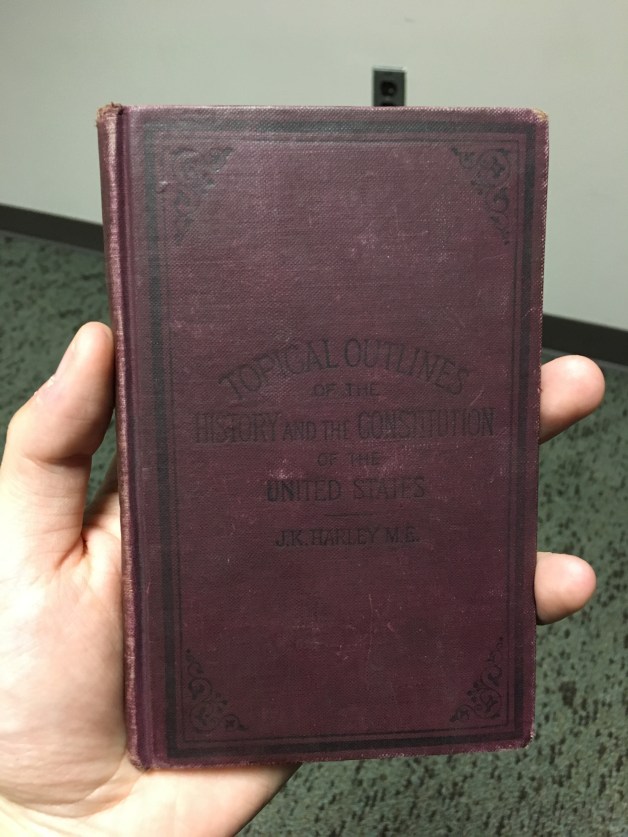
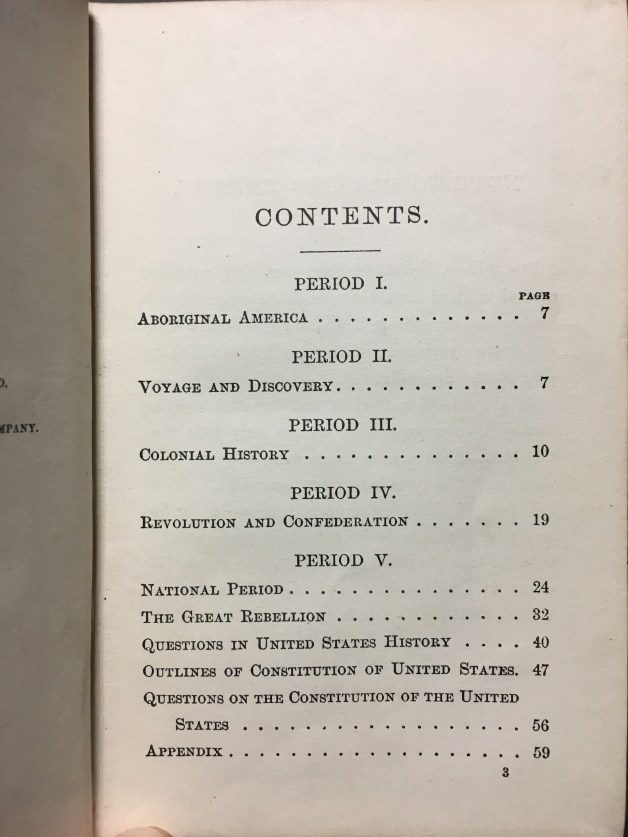
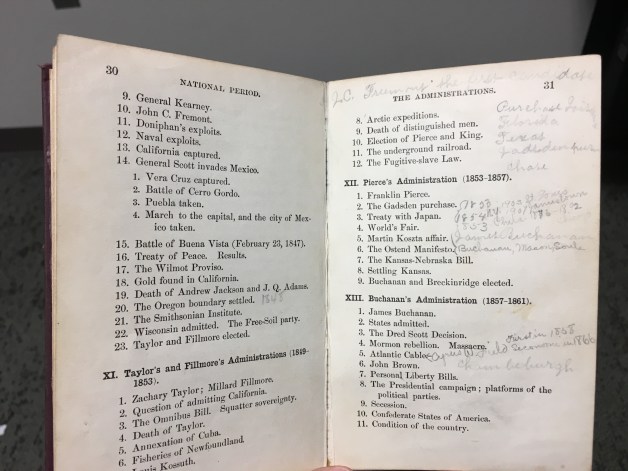
For this post I am going to discuss an odd little book that I own—an 1894 US History and Constitution topical outline written by J.K. Harley. I say that it is odd because, well, it isn’t really a book, even though it is technically a book, as it has a cover, back cover, and pages in between: but it is not a book insofar as a book presents information about the aspects of some subject or range of subjects; this one, rather, presents the aspects themselves. The book contains everything that there is to know about the history of the United States and its constitution, but tells the reader nothing about any of these things; and, in my opinion, it is this characteristic which makes the book so interesting. Never before have I encountered a book that is so immensely lacking in immediate discussion, but is, at the same time, so incredibly useful.

Imagine yourself as a poor young adult in America in the year 1900. You intend to become a teacher someday, and thus wish to undertake a full study of US history, but you cannot afford university. You go to the city library, and, after some searching, come face to face with a shelf about eight feet high and fifteen feet wide, filled completely with books about the history of the United States, hundreds and hundreds of them; and behind this shelf are ten more just like it. Where do you start? Intimidated, you pick one off of the shelf, open it, start reading, and the author is rambling about some random subject that literally couldn’t confuse you any more than it does. You have no internet to turn to for guidance, and the librarian may not have the slightest knowledge about US history; perhaps you could find a professor or scholar at a nearby university to point you in the right direction, but this is still an arduous route to take. Enter this topical outline, published in 1894, inside of which is delineated every single relevant term, historical event, important person, etc., that you could possibly need to know about in studying the history of the country and its constitution. This little book, not even 50 pages long, and not containing a single sentence of elaboration or detail, will now become the centerpiece of your study. It tells you exactly which random historical happening you need to look for on that packed shelf, and places it in the context of other events and pieces of information in a highly structured fashion.img_4395

img_4394img_4396img_4397On to the history of this book. I purchased it for a dollar at a massive book sale at our campus library last semester; before it was there, it had been in the possession of the Gardiner Library, as far as I am aware. I am pretty sure that Gardiner may have collected books from various local libraries for this sale. Before Gardiner had it, however, I have no idea, so we will need to jump back in time to find more information. It is likely that this book was owned by a single student (the handwriting is consistent throughout, which leads me to believe it was not owned by any other students). As can be seen in the above pictures, the book is littered with scribblings and notes and dates and such. However, at the beginning of the book, on the first page, is the name of a person, written in ornate script; what looks like the name of a place, perhaps a school; and a date below it—April 3rd, 1907. These names and the date are written differently and in much larger print than any other handwriting in the book, and their position at the front and the style in which they were written leads me to believe that this is the name of the owner, the place or school s/he lived or attended, and a date that, for some reason, was noteworthy to the owner; I will assume that this is correct, otherwise I won’t be able to proceed. So, 1907. A hundred and ten years ago. The owner of this book was to the Civil War as we are to Vietnam. The name is oddly written and a little hard to read, but I think it says “Otta S. Robley:”probably a female name. The place/school seems to read “Mapleton Depot,” but it is hard to make out. However, if my reading is correct, then it is possible that this Otta girl lived in Mapleton, PA, about five hours away.

Anyway, so Otta seems to have owned this book for a while, and given serious attention to it, as her writing is scattered all throughout the book (except, I may add, in the section dealing with the constitution; I guess she wasn’t interested). Now, having established the probable original owner of the book, and knowing the last few stops that it has made on its long journey, I think the most likely scenario is that, after Otta stopped using it, she kept it somewhere in her house – attic or basement along with other old school stuff, maybe – and, eventually, she either decided to clean house and donated the book to the local Mapleton Library, or she might never have done so, dying with the book still tucked away somewhere. Maybe her children or spouse or some other relative donated it after she died when they went through her stuff. As I said, this seems to me the most likely story of this book, but my speculation is by no means whatsoever authoritative. If I am right, however, then it is potentially possible that Mapleton was one of the libraries that contributed to the book sale on campus. I will talk to some of the library faculty and see if I can find out any more information.