The Dutch Gel Pen

(I don’t know why all my blog posts end up being about pens.)

For the longest time, my favorite pen has been the Pilot G2 pen series. And I’m not saying that suddenly its position has been challenged, but there is another pen that’s come startling close. It’s a ridiculously cheap-in-price pen from the Dutch stationary company, HEMA. Unfortunately, on further investigation, it is impossible to get products from this company in the US because they don’t ship here. I received mine in a Christmas present from my friend who lives in the Netherlands, along with a few notebooks and some sticky notes. For the type of person I am, it was the best gift.

I have been using this pen steadily for about two weeks and the logo is almost completely worn from the surface. There are only a few black specks left that hint at there being something there. I can trace the life and homes of this pen very simply and easily. Moving back from my house, the pen then inhabited hers, and further back from there, it resided in a physical shop at _____, picked up in its package and touched by who knows how many people who decided not to buy it. Or perhaps it lay in the back, stored in boxes until it was needed to fill an order. Before it came to the store, it was probably packaged and shipped from the one distribution warehouse I could find online, in Utrecht, Netherlands.

My friend either picked the pen up at a store, or ordered it online. It is interesting to think about this online shopping space as something that isn’t physical but isn’t quite not-physical either. We talked in one class about “the cloud” and the physical storage farms that exist somewhere we can’t see them, and that these farms give us the illusion that the information we store online is intangible, invisible until we call it up. But there is something physical about the spaces we inhabit online. Online shopping is particular is a liminal space like this. Shopping is such a physical sport, except when one is able to do it all online. So maybe my friend bought these online and then had them shipped to her. Maybe she touched them, transferred her fingerprints onto the surfaces, and then packaged them up for me.

Many people touched the pens on their way to my hands. I have been using the black one almost exclusively since I got it and the ink has almost run out. To me, the pen has been a faithful companion while drafting  my Honors thesis, while outlining the many research projects that I have to do for classes, while comparing graduate programs and mapping out my future. To me, the pen has been much more to me than it was to anyone to had touched it before. It was handled by people who wanted to sell it, touched and packaged by my friend to make me feel good, and then it ended up in my hands, helping me craft ideas and plan out my future.

Silver Earrings: Pt. 3

Having bought these earrings first-hand, the lineage of this item is undeniably direct. I bought them from the man who sold them to me, and the man himself was the silversmith who created them. But this story of lineage does not have to be so simple, and I wish that there were ways that I could investigate further into the background of the man who had sold them to me. How long has he (and presumably his family) been working in Taxco, and by extension, is silversmithing a familial trade? This could say a lot about heritage and work in Mexico, for in my experience it is not uncommon for children to follow in the career paths of their parents, especially when it has to do with a craft. My uncle owns a small taqueria in the town where he has lived his entire life, and although my uncle was an entrepreneur and started the restaurant himself, there is no doubt that one of his two sons will eventually take it over when he retires. Therefore, the earrings themselves may not have a lineage to them, but the craft of silver working is most likely one that has been passed down for at least a few generations in the family of the man I bought them from. There could perhaps be a certain way of making these earrings (and the design within them) that is specific to the way this family works with silver. But, unfortunately, I do not know  for sure. All I can say is that the family trade does not go back further than the aftermath of the Mexican Revolution, because silver in Taxco was not so heavily commercialized (and used as a tourist attraction) before then.

Wooden Bolivian Woman

This week I decided to write about something I have always seen in my house but knew little about: my mother’s Bolivian wooden sculpture. The only way to explain this object and its chain of ownership is through telling a brief part of my family history.

Both of my mother’s parents were teachers. After getting their degrees in education at SUNY New Paltz in the mid-1950s, they took on the real world and joined the workforce. My grandfather, William Gumm, eventually wanted to move up in the ranks and become a principal. However, in the 1960s, one could not become a principal without experience, but one also couldn’t get experience without the job. To get out of this catch-22 situation, he applied to work as a principal for schools affiliated with American companies in developing nations. Gulf Oil Company had offices in Bolivia and their own school for the American children of Gulf Oil’s employees: the Santa Cruz Cooperative School. It was this school in Bolivia that my grandfather became a principal of, and my grandmother taught there as well. Their three kids – my mom, my aunt and my uncle – naturally went with them.  They lived there comfortably for three years before heading back to the States, and my grandfather achieved his dream of becoming a principal.

The small wooden statue in the photos above was made especially for my grandfather. On the bottom of the statue, the carving reads, “To Mr. and Mrs. W. Gum, with all our heart Juan S[illegible] and family, SC 24-V-69.” I presume that “SC” stands for Santa Cruz, the city they lived in, and that the date means May 24, 1969. On the bottom left of the base of the statue, there are the initials “WBC,” of which I don’t know the meaning. I truly wish I could discern what Juan’s last name is, but it’s hard to read. Regardless, it was clearly a personal gift. When I asked my grandmother if she remembers who Juan was or how they got this statue, she said she thinks he might have been a gardener (not sure if he was the family gardener for the house or a gardener in the community). She told me that many of the locals there were extremely talented and great craftsmen, which would explain why we have so many wooden statues within the family.

This statue currently sits on our wall unit next to two Bolivian wooden heads (another set of wooden statues my mom inherited). Although these have not yet been passed down to me, they still sit in my house and I consider them half-mine. The Gumm family’s move to Bolivia was significant for so many reasons. It taught the family Spanish, which would be especially important in my mom’s and my uncle’s lives (my mom studied Spanish Literature in college and my uncle married into a Cuban family). Their experience with Bolivia, its culture and the Spanish language also led me to learn Spanish throughout my entire life, and while I am in no way fluent I do consider it my second language.  The experience created this story, connecting a relatively average, middle-class American family to a South American culture. It affected the entire family’s future up until the present. The carvings on the bottom of the statue by the person who made this wooden Bolivian woman shows how much the Santa Cruz community knew and loved my grandparents.

I think this story really relates to Edmund de Waal’s connection with the netsuke. Although he is certainly not Japanese, the netsuke are a huge piece of his family history and had a significant impact on the family’s future. Stories and history are totally related to objects. If my mom never went to Bolivia she may not have learned Spanish and therefore neither would I, and a huge piece of my life history would be missing. My family history is intertwined with this object. Its passage down from my grandparents to my mom to me demonstrate how history can also be passed down the same way. While I’m no descendant of the elite Ephrussi, I’m proud to be connected to the Gumms.

gumm-family

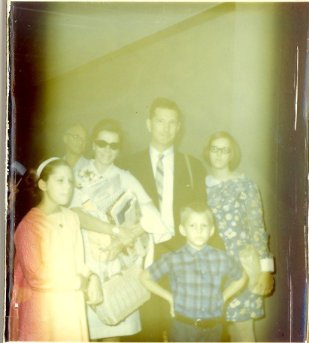
Slightly awkward family photo, 1970s

A Dollar Coin

image1.JPGimage2.JPG


This is a dollar coin my brother got me a couple years ago. It wasn’t given to me for any particular reason other than that my brother thought I’d like it. He has a tendency to do things like that; give odd but thoughtful gifts at random times.

The coin is round, heavy and made of silver. The front has a engraving of Lady Liberty and around the circle says “E. PLURIBUS. UNUM”, which is latin for out of many, one. This is a motto commonly used by the United States to represent the unity of the states and the federal government.  In between the phrase and the date on the bottom (1894) are thirteen stars to represent the thirteen original colonies. On the back of the coin is an engraved picture of the eagle standing on arrows and an olive branch (America’s “great seal”). Around the circle it says The United States of America, on the top “In God We Trust”, and on the bottom “One Dollar”.

I’m assuming the coin was made at The United States Mint, where coin currency is usually made. I don’t know much about coins or how currently is made in general and in this moment I’m wishing I remembered my 5th grade US History facts.I decided to then Google this specific coinage and year. Supposedly the year 1894 is relatively rare for this particular series of dollar coins, which are referred to as “The Morgan Silver Dollar Series”. Some coins this date are worth up to a couple thousand dollars, depending on where they were made. I was doubtful mine would be one of those since my brother, although a coin collector, does not have that kind of money. As I was reading on, the page discussed the different makes of this year and how to figure out what kind your coin was. On the back, there is a “mint mark” which tells you where the coin was made. In this series no mark represents Philadelphia (The most rare and expensive), “S” for San Francisco, and “O” for New Orleans. Mine contained the mark “O”, which meant this coin was worth about $40. The coin could actually be worth nothing for all I know cause there is a hole punched through it, which is why I use it as a keychain.

Besides the hole and some scratches on the side, the coin is in very good condition; there is practically no worn to the engraving.  It makes me wonder, like I do with most kinds of currency, who has used the coin? What did they buy with it? How many years after its making did it remain in circulation? Can I go out right now and even use this? There is a whole history to this coin that I want to, but never will know. Now, with modern day currency there are stamps and other unique things that are put onto money to allow you to track their whereabouts, but this is still limited to paper money. The only thing I know about it’s connection to people, is my brother. After it’s creation 123 years ago, it somehow landed in a shop and then my brothers hand. Now that I think about it, it’s kind of funny the differences in it’s exchange. Once being tossed away to buy other things and now it’s the thing being bought. Money for money, what a strange concept.

The Next Keeper of the Belt

17093059_1500558743288349_616668208_o

The last two objects I wrote about were pieces of jewelry that did not have much of a life to track. They both went from the factory, to the store, and then into my hand. This is why I decided to return to one of my original objects—my grandfather’s belt. I brought this belt with me on the first day of class because I have held onto it, and even brought it with me on campus, without being fully aware of the role it played in my life. I hold a strong connection to this belt because it reminds me of my mother and her side of the family, yet I didn’t think the belt had much meaning other than that. When I was younger, my gave me the belt. She told me in Russian that it belonged to her father and not to give it away. So I didn’t, and that was all it really meant to me.

This belt seems to be made out of material that feels plastic. It could be a form of rubber, but I am not so sure. It has a woven design, where different colored strands of brown and beige are braided into each other, resembling the stitch of a basket. It is a rather small belt.

All I know about this belt is that it supposedly belonged to my grandfather. I never met him because he died when my mother was very young. From its length I can assume that he either had a very small waist, or that it was his as a child’s.

My grandfather was born in Odessa, Ukraine (It’s funny to think that De Waal’s netsuke are connected to this location and so is my object.). II tried searching the history of belt production in the Ukraine on Google, but I couldn’t find much of anything. There were a lot of websites selling belts from the Ukraine presently, but this wasn’t what I was looking for. It was time to call in a family member for help.

I called my grandmother, and she remembered the belt almost immediately after I described it. She said that my grandfather already owned the belt when she met him. They way she spoke about it, it seemed like the belt was one of his favorites, or at least something he often wore. She told me it was hand-made, and that he most likely bought it at a flea market. This explained why I couldn’t find anything like it produced from a factory when I looked online. When I asked her about the size, she said my grandfather was very in shape and had a very small stomach, which explains the short length of the belt.

My grandparents settled in Kiev, and after my grandfather died the belt remained in their home. When my grandmother immigrated to America with her mother, my mother, and my aunt, she found the belt as they were settling in. She unpacked it, gave it to my mother, and in Russian, told her that it belonged to her father and not to give it away. Nothing else was spoken in relation to the belt after that, and my grandmother never saw it again. She had nearly forgotten about until I called her, asking about the belt’s history.

In summation, this belt most likely was made in Odessa, traveled to Kiev where my grandparents began their family, sailed to New York City upon my family’s immigration, and then found its way to the suburbs of Atlantic Beach, Long Island, where my mother moved with my father to start their family Now, the belt is sitting in my drawer in a SUNY New Paltz dorm room. I expect it to travel with me whereever else I go, until I pass it down one day to my children. I had no clue my mom told me the very same words my grandmother told her. I feel a deep sense of obligation to keep this chain going. Writing this post and uncovering the secrets woven into the belt has increased its meaning and value to me tenfold.I had no clue it was going to be such an important item in my family—nor did I know how important it already was.

Atrocious Album of Antiquity.

As a closing from Part III of The Hare with the Amber Eyes I would like to introduce another book I own. Its importance lies in the controversy of its existence, as well as my ownership of it. I do not cherish such an item, but I allow it to have a place in the world, as reminder of how mere words, and well-advertised ideation can influence an entire planet. I myself am conflicted with it, which is the very reason this uncomplicated chain of ownership exists. It is very arduous to view it objectively.
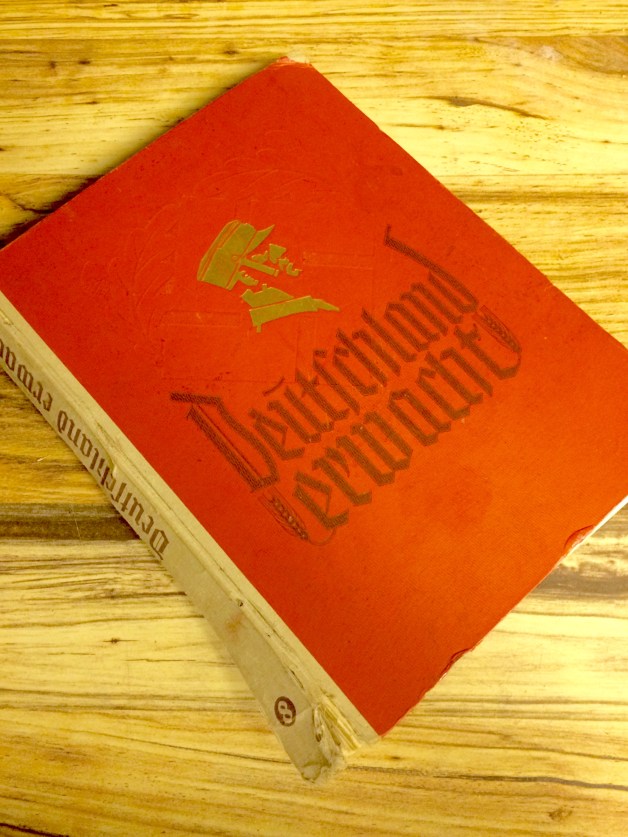
img_7638

As one might set eyes on this object, it is clearly a book. It measures 10-3/8” by 12-3/8”. The cover is a red leather-like material, punched into the material is a swastika surrounded by large leaves and acorns (which is barely visible to the naked eye and very difficult to photograph), a profile of a soldier’s bust embossed with a gold leaf, and lettering in a darker red, which reads, “Deütschland erwacht,” including two stalks of grain. This translates to “Germany Awakened,” the contents are the rise and accomplishments of the NSDAP party, from beginning to the year of publication, which conveys that they are Awake at this time. The binding is a woven beige cloth material showcasing the title in the same dark red lettering as the front cover along with the number eight, or an infinity symbol in a circle of red. There is no indication of the meaning of the “8”. The binding is falling apart, the glue is losing its hold on the pages. There has been no care in preserving this particular book. I have looked through it few times, and it loses a section from the glue on each occasion. The binding has broken in several places and comes apart easily. Despite its regal outer cover, it has fallen apart in several semantic ways. The pages have yellowed and there are quite a few pages in which it looks like there are cigarette burns.

I have looked it up online to find that a well-maintained copy shockingly sells for $174.99, used, on Amazon, as well as collector’s aging websites. Through my research, this piece of putrid propaganda was published in 1933, and this unscrupulous copy is a first edition. The only first edition I do not proudly display, rather, it stays in a musty plastic bag of unknown origin, in a container full of family documents and death certificates, under several other containers, in the back of a walk-in closet. I prefer it to live there, as I do not have a deeper hiding place. It was published by Cigaretten Bilderdienst Altona Bahrenfeld, Berlin. This book is a cooperative distribution by the Altona Cigarette Company and Hitler’s private photographer, Heinrich Hoffmann. The book originally came with just text, completely and elegantly printed in the German language using the font Deutsche Schrift, a favorite of the NSDAP. Initially it had placeholders for the owner to insert photos. As an exchange, one would cut out the proof of purchase from the Altona cigarette packages or cartons and mail them, the photos would have been delivered from the cigarette company by mail, on what I recognize as cheap, thin, easily torn glossy card-stock paper (printed at a high quality, but not actual photos). This allows the owner to create his own personal coffee table book, inserting memories (photos) of the “Werden, Kampf und Sieg der NSDAP,” as the interior subtitling states: The Struggle and Victory of the Nazi party. There were roughly two million printed in the entire run.

In 1958, a young infantryman who specialized in mechanics visited Germany during his tour of duty. This man’s name is Donald, and as the story was told to me, he stole this book from a home, presumably of someone in support (past/present) of the Nazi regime, considering this copy is complete with all photos collected and intact. He smuggled it into his rucksack, and on November 8th, 1958, he mailed it to my great grandmother from Luxemburg. On August 21st, 1959, he died in a motorcycle crash while home on leave, and Eleanor became the owner of a book that would not see the light of day again until her death on August 1st, 1995. It is at that point my grandmother, Cheryl, took possession of all of her mother’s belongings, as well as the lingering effects of her brother Donald. It is at this time, she combs through the book her brother was scolded for mailing when she was a girl of 15. It was viewed in her recollection, twice in its existence (other than to move and place items on top of it). In coming to terms with her fate, she instructed me to consider it her only real possession of her brother’s that had any connection to his year in Germany, and that is why we own it, and to that right, why I will now own it. She understands my mother’s aversion to collecting dusty items she has no connection with and entrusts me with this horrifying printing stating that I am, “never to show or allow anyone to see it.”
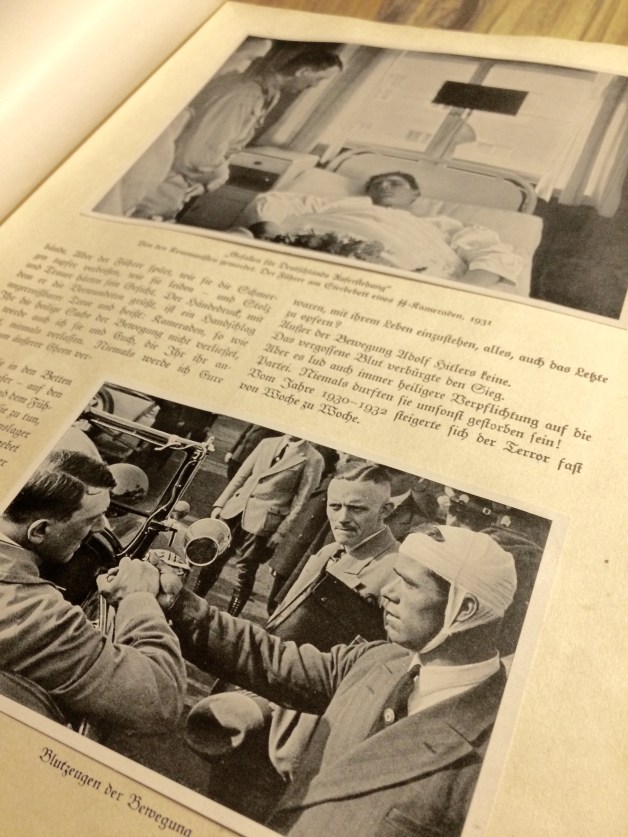
img_7639

Top: Sympathetic Hitler stands concerned at the bedside of a man in a hospital; and bottom: to thank a wounded German veteran for his services. The portrayal of his hard leadership, and soft candor is the story all of the pictures tell, as if to say, “He is just a man.”

I am breaking this oath to provide a grim picture of how our things and the display of them define us. Although it paints a picture of an advantageous young man (my great uncle) with a possible inheritance of kleptomaniacal tendencies, it also speaks to who I am as an owner. My last name is unquestionably German, and with little research I have come to find that my family has been brewing beer in the same building in Bavaria since 1679. I am ashamed in certain ways about this, although one has absolutely nothing to do with the other. I resemble the Gypsy Polacks (who surprisingly found a home in America in the year of this book’s publication), and Presidential Irish of my mother’s heritage (née Filmore), the branch of my family that gave this book a home in New York. If I displayed this in my home like I do my other first editions, one may think differently of me. My former Jamaican spouse would have been in the same conflicting relationship with me, as I am in with this book. Although it reserves my views as a stark contrast, it preserves the power of influence, and what generations of my family have hidden. That we are human, and this fallacious material is a necessity to culture, as it is a history most people would like to avoid repeating.
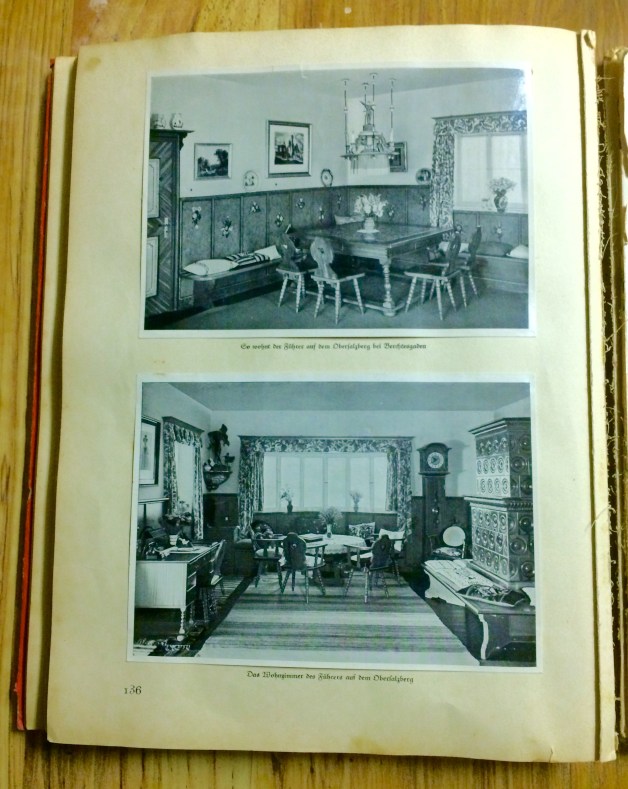
img_7653

I chose to include this picture, because of Miller’s homes, and because the creator of this book felt it necessary the average man have a private view of Hitler’s home, allowing the reader to equate his humble daily life to theirs.

The Tale of the Cutty Sark

This week I’ll be discussing a bit of an odd family heirloom.  Perhaps heirloom is the wrong word, as basically I was asked if I wanted it, otherwise, it would be thrown away.  For some odd reason, I felt a strong urge to keep it, and so now, it sits in my room, sort of on display, sort of just in there.

img_2507

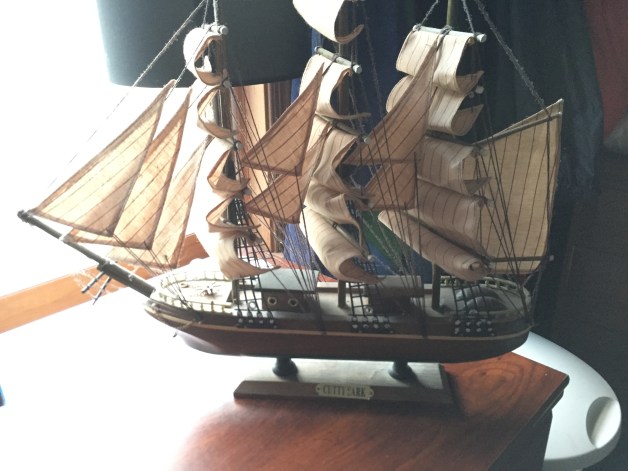
The replica model of “Cutty Sark”

This model, weighing somewhere around 3 pounds, it’s awfully light, is about 18″ long and 18″ tall (it doesn’t look that way but when you factor in the whole length and the tallest point, that’s a fair approximation.  Regardless of its dimensions, what I find additionally puzzling about the model is why it exists, or even more importantly, why my grandfather had it.  I researched the original Cutty Sark ship and it was a tea clipper constructed in 1869 that became a wool transport ship as steam technology was making sailing ships slow and outdated.  This was a fairly fast ship for a sailer, as it held the record from Australia to Britain for ten years; obviously the record was broken by a steam ship.  After its transport value diminished, the Cutty Sark exchanged hands and names a few times, lasting two generations in Portugal, but was finally repurchased for preservation in 1953 and has officially been out of service since December of 1954.  It would be important for the family ties to share that no one in my family is British nor Portuguese.  My honest guess for why my grandfather had this was that he was a history buff.  He was exactly one of those people that every time you saw him, he had read a new book about World War II.. I was always surprised with how limited his readings seemed to be, yet how extensive his knowledge of world history was.  He and my grandmother were world travelers, having been to dozens of countries, from Britain to France to Prague to Spain and quite possibly everywhere in between.  So as an honest guess, my grandparents were in Britain, and he had either known about or seen signage for the Cutty Stark museum, and bought this replica as a souvenir, perhaps the start of a collection that never got off the ground.  Maybe I’m mistaken, maybe it was a gift, or something given to him by a friend, I couldn’t possibly know.  I could only make the assumption that this wooden vessel is around or less than 60 years old, as that was when the ship was retired to be preserved.

Regardless of this, I still have no idea why I was so fascinated with it and wanted to keep it.  I’d never heard of the ship before so there certainly wasn’t any rationale for me to keep it due to my fascination with it.  Perhaps the thought of throwing it away was too painful.  Maybe I too want to preserve the Cutty Sark.  Personally, I wouldn’t find that true, and I’d probably place a lot more value on nostalgia, as my grandfather didn’t have many positions of this nature, and I wanted to maintain it for his sake.  Regardless, it sits with me, continuing to serve no functional purpose, just leaving me a memory, and a reason to wonder.

Still Writing About My Alarm Clock

(Since my alarm clock was a gift and not an heirloom the history of ownership is limited to me.)

As a continuation of last week’s blog post, I decided to look more into the history of alarm clocks. Interestingly enough, there is some dispute on who created the first alarm clock. My last post mentioned an American as the first person to patent an alarm clock. However, I am reading conflicting stories about the first alarm clock originating from Ancient Greece. (Why does it seem like everything was created when the Ancient Greeks walked the earth?) Some of these sources claim that the first alarm clock was created nearly 2,000 years ago. I am careful not to mention these sources because I do not find them to be credible enough after doing some research on the supposed inventor of the first alarm clock, Ctesibius. I realize that these conflicting speculations on the creation of the first alarm clock speaks to a much bigger issue than alarm clocks itself. It reveals the issue of ownership, entitlement and cultural dominance. The issue of ownership is hard to determine in many cases because objects are always in constant motion from place to place or person to person. Then there is the issue of entitlement that somewhat overlaps with ownership. Being entitled to an object does not necessarily mean ownership of that particular object. By cultural domination, I am referring to the fact that because the world is Eurocentric we often trace inventions back to Ancient Greece/Rome and mostly in European nations.  I bring up these issues because clearly in the case of the invention of the alarm clock these are issues we are forced to stop and think about because of the disputing claims we are presented with. Then we also have to take into consideration the possible invention of an alarm clock during the Nok Civilization in present day Nigeria, for example.

As I stated in my last post, I am curious to know about how people who needed to wake up early woke up. Luckily for me, as I was reading an article about the 2,000-year history of alarm clocks I came across the term “knocker-upper.” Indeed, I was just as puzzled as you probably are right now. Apparently, knocker-uppers were people who were hired in Ireland and in Britain to wake people up. This trade started during the Industrial Revolution and continued through the 1950’s because alarm clocks were not as cheap or as reliable then as they are now. Sometimes these jobs were carried out by older men and women and constables making patrols early in the morning*. It is unfathomable for me to even think of being a knocker-upper as a real job. I find it funny to think of, but I also find it profoundly fascinating. To think that there was period of time when people hired other people to wake up for them leaves me speechless. However, it also makes me question how those knocker-uppers woke themselves up. It could be argued that these people had become so used to waking up early in the morning that their circadian rhythm changed accordingly. As of now, I cannot think of anything free of tangled questions that could answer this question.


*All this information was gather from Wikipedia.

Beaded Necklace Revisited

Before I begin this blog I must inform you all that I tried to take this class a couple of semesters before this, however was not able to due to schedule conflicts. When I originally took this class I decided to explore a beaded necklace that was passed down to my mother and father many years ago from distant relatives in Detroit.  I look to revisit it because I found out more information about this necklace. Additionally, it is currently being passed down to me. So this post will be a conglomerate between what I had already learned previously with some new tidbits mixed in.

This necklace was sent to my family by relatives, whom I have never had the opportunity to meet, from Michigan. Two sisters, now in their nineties, who I have been told hold practically hold all the information regarding my heritage on my father’s side of the family. After writing and speaking to them on the phone multiple times (even after I dropped the class) more information began to come out about the movement of this necklace, contributing to the history of this object.  

The necklace that is contained inside of a long gold box has existed in my family for little less than a century. This piece measures approximately 8 to 10 inches long and the chain itself is about one and a half to two inches wide. This necklace is entirely embroidered in blue, silver, gold, and hints of brown glinting beads. The necklace was mainly made with blue beads, but alternates in a maze-type pattern of silver beads with minor gaps of brown beads. Toward the bottom of the necklace is inscribed the initials PB, which stood for Paulena Byllott, my great grandmother. Just below her initials, the very bottom of the necklace is lined with beaded tassels.

Inside the golden box writes ” Given to Grandma Paulina Byllott, by Capuchin Monastery.” This necklace was a gift to her from a Monastery in Detroit, Michigan.

This is a  piece of jewelry worn by my great grandmother, whom I am partially named after (Caryn Paulena Byllott). I had not known much when I first came across however, through further investigation at the time I was informed that a letter was sent to my family along with the necklace.

Paulina Byllott, who I mentioned above, was born in 1868 and immigrated to America in 1886 from Germany. She married in 1887 to August Byllott and lived on McDougall ave, which was walking distance from the St. Bonaventure Monastery. Apparently, they were both great benefactors and supporters of the monastery and the Capuchin Friars there as well. For years they walked to the Monastery at 6a.m. for Sunday Vespers and my Great grandfather, August was a occasionally an usher too. Additionally, August was a blacksmith by trade and made iron hooks that were affixed to the church and used to hold the doors open. Around the turn of the century this gift was bestowed upon Paulina by the other Capuchin Friars for her work and dedication to the church.

With this object resurfacing I decided to take a look at the St. Bonaventure Monastery. This Monastery was founded in 1883 and is home to many of the Detroit Capuchin friars, which are spoken about above.  The Capuchins  themselves were founded in 1528, emphasizing prayer and contemplation, preaching, and physical care of the needy.

As I spoke with these women more they informed me about how this necklace was an icon of Paulina. It was so important for her to wear it all times, they described it was her way to further represent the faith she was apart of. This necklace traveled with her I found out. Her and August did quite a lot of traveling through the midwest and somehow made it to New York for a bit. These women were constantly emphasizing that no matter where she was the necklace was always with her. Also this necklace was one of many gifts from the monastery she received. Those items still remain with the sisters in Detroit, however, they may send more items to my mother soon!

I have been rather blind to my heritage due to early passings of my grandparents and lack of communication among extended family. However, these sisters have been the key into my heritage. Being able to develop a relationship with them over the past two years has been so insightful as well as very grounding. I am feel very honored to be the next owner of this necklace and more so now that I have been able to learn so much about the history of the necklace. Unfortunately I do not have a picture of the necklace at this time. I will see if I can have a picture sent to me soon.

Stress Relief – For a Very Good Cause

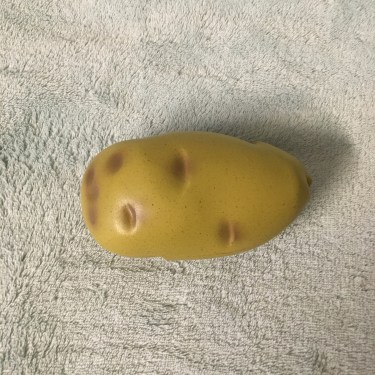
This week, I have decided to examine a potato. Not a real potato; a stress potato. It is a stress ball in the shape and color of a literal potato. Though the color is more green than a perfect Idaho potato would be at the store, it has a realistic representation of dents and eyes on real potatoes.

IMG_1437.JPG

I received this potato from my neighbor, Heather, who my mother is good friends with. They moved in next to us when I was 5 years old. They have been next to us so long that I remember when they brought their baby daughter home from the hospital, and this year, she’s turning fifteen. The potato is four to five inches in length, and on one side it says “green chimneys” with a drawing of a house containing a plant, pet, and two people. The sun is shining down on the house.

I was over at their house one day having dinner. I spotted it on their kitchen counter and immediately picked it up. I was just staring at it, and I heard Heather say, “Em, you can have that if you want. Carter doesn’t use it anymore!” So, of course, the stress potato was mine.

After doing some brief research, I discovered that Green Chimneys is a learning environment dedicated to special needs children who have emotional and mental health disorders. It is centered around animal assisted therapy. It is located in Brewster, New York, and it began as an “unusual boarding school,” as the biography puts it. Sam and Myra Ross are the creators of what Green Chimneys is known for now, but in the beginning, it was simply a boarding school with students between the ages of three and six. It opened in 1948. The home like setting of this boarding school, prepared by Sam’s father, was only part of the unique environment; attending school here came with the opportunity to interact and care for animals.

As Green Chimneys’ history goes on, in the 50s, it gained a reputation of helping students with special needs, and thus blossomed into what it is today: there are more than 200 students attending Green Chimneys today compared to the 11 when it began in 1948. It hosts therapeutic day programs as well as their residential year round school programs, and of course still has the innovative animal-assisted therapy. The Green Chimney’s Farm and Wildlife Center houses three hundred domesticated farm animals and wildlife.

Green Chimneys expanded in 2008 with a brand new campus in Carmel, New York, showing that their services are extremely beneficial, and will continue to be in the future.

Heather’s son, Carter, had serious trouble attending school when he was young. I assume this is one of the places he attended, and it has very clearly paid off. He can function in a learning environment, and is even on his college search right now. After knowing him for basically his whole life, I’m very proud to say the least. I’m really glad my stress potato has come from such a loving and caring place which focuses on emotional well-being while learning, as it has genuinely aided me in times of stress.