Another Piece of Clothing

I decided for this week to change directions, and analyze an object other than my Oxfords. Looking around my room trying to find something worthwhile, my mind drifted towards my closet yet again. My consistent predilection toward the items in my closet seems to be a common theme; something I never expected to realize from this class. I’ve been drawn most strongly towards my clothing consistently throughout the semester, something that has both surprised me and worried me. Anyhow, perusing through my closet, I was drawn to my plaid scarf out of everything I saw, and decided to write about it in depth for this week.

My plaid scarf has always been a mystery. I had only recently acquired it over this past Winter intersession at home, going through old boxes in my basement. I saw it peeking out from underneath a whole bunch of my mother’s old clothes, and decided to take it (with her permission of course). It is curiously made, with horizontal seems that break the scarf’s length into several sections, which perplexed me. It is also frayed on its ends, a style that I knew definitely wasn’t popularized until at least the 2000’s, and so being that this scarf is from before that time I was confused. I didn’t really think much about it, and just took the scarf with me back to school for the Spring semester, where it is now hanging in my closet alongside my coat.

To help gain a better understanding of the scarf and its origin, I called my mother on Wednesday night and inquired about her formally abandoned scarf. It took her a while to remember the scarf I was talking about, I went on for 10 minutes describing it to her, and had to eventually just send her a picture of it from my phone. Once she remembered the exact one I was talking about, she divulged.

Apparently, the scarf was originally my grandmother’s school uniform skirt. My grandmother Joan, a sweet and quintessential Mancunian, used to wear it to her primary school in the late 1950’s. It was later re-purposed by my grandmother after she moved on to secondary school and her uniform changed. Its unusual hemming and frayed edges were just left over from the haphazard attempt of a 13 year old school girl to turn her skirt into a scarf. Maybe an act of defiance, or maybe an act of sheer boredom; I will never know. However makeshift, its convenient plaid pattern suited it well as a scarf back then, and even today too as the style has transcended time and is still considered urbane. After my grandmother used the scarf throughout her secondary school and university years, my mother inherited it as a child growing up in London. Since then it has found its way to New York City, and into a tattered cardboard box in my basement where I ultimately found it.

Have dug deeper into the origins of my scarf, I wear it now with a better understanding of its past. With both a weird and interesting connection to my English roots,  the scarf is one of the only real things I can think of that I have in my possession from my mother’s side of the family. It connects me, in whatever form, to my grandmother as a young child in her school years, and to the entire era surrounding her life back then. I also think it’s very interesting how it is a recycled piece, and wonder whether it was re-purposed out of need, because of the culture back then, or just for convenience. Anyhow, I wear it now with a better appreciation for what it actually is and where it comes from.


Old Friend–My Violin

This is the violin that I played throughout middle and high school. It has followed me through a lot of life changes, and seen me through all sorts of concerts (including two musicals and three very stressful solo events). I received this violin in 2007, when my rent-to-buy program had accrued enough credits. We purchased it the D&M Music store in Pleasant Valley, NY.

violin-1

According to the label on the inside, the violin was manufactured by Stefan Ulrich in June 2007 in Romania. I tried to find a website, to try and see the history of what Stefan Ulrich does, but a Google search only brought up scores and scores of people trying to sell off or buy the instruments. Apparently, Stefan Ulrich is a very popular instrument crafter, and relatively inexpensive, making the instruments easy for parents or guardians to purchase for their children.

Moreover, when I looked on D&M’s website to try and find more information, they came up relatively blank. D&M is a company that focuses solely on middle and high school students, so they’re not as picky with quality, apparently. I couldn’t even look at any of the models of violins on the website; all I saw under the violin category were accessories. It’s possible that D&M no longer does the “rent-to-buy” program. Aside from going all the way to the shop in Pleasant Valley, I may not be able to find anything about my instrument.

Presumably, it was made by a Stefan Ulrich craftperson in Romania, and then shipped to the US by plane. It was purchased by D&M in 2007, and soon after bought for me. It seems that, unless you have a truly valuable, rare instrument like a Stradivarius, its ownership is largely lost. The saying that my high school orchestra director is true–unless it costs $1000 or more, a violin is worthless. Apparently it’s worthless to history too, objectively speaking.

But my violin is not worthless to me–though the fact that it’s been sitting quietly in my closet since the beginning of college says otherwise. It is something that I could pass on to someone else if I saw fit. It’s seen a lot of change in my life, and even though I don’t know much about its history, it knows about mine. Since I’ve had it, its strings have been changed multiple times, its case fell apart, and the bow it came with cracked. Its bridge still sometimes slips from the pressure of the strings. It’s got a sticky layer of rosin on its front that never seems to come off cleanly.

I do think it’s funny that this little violin is more well-traveled than I am. And I may never be able to find out more about who made it. Unlike mass-manufactured products, though, there is a certain intimacy and expertise required to make something like this. Maybe that’s why I feel more close with this piece than with the game or mask I wrote about.


A look into the history of a silver ring

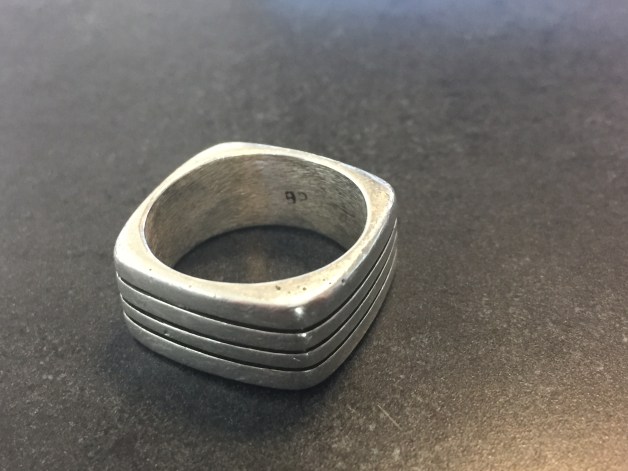
I brought this ring in on the first day of class as one of my “happy objects.” I have decided to think about and reflect on its history and use.

This ring is made of sterling silver, as indicated by a “925” stamped on its inner circular wall. More specifically, this number means that the metal is an alloy of 92.5% silver and 7.5% other metals, which help strengthen it (pure silver is a very “soft” metal and can get banged up shockingly easily) and make it more resistant to tarnishing (that is, the blackening of the surface as a result of interacting with oxygen in the air, also known as oxidation). Though I did have knowledge of silver and I understood the last links in the chain of the ring’s history, the origins of the raw material were beyond me. I had no idea where silver-mines are located or which countries are the world’s major producers of silver. Admittedly, Natalia’s silver earrings from Mexico definitely should have given me a clue because after a quick Google search, I learned that Mexico is the world’s leading producer of silver, and that the US is among the world’s top ten, with silver mainly coming from Alaska and Nevada. I am going to assume in this post that a scrappy, Hudson Valley-located artist would be more likely to purchase materials made in the US.

So, this metal is mined out west somewhere, and then it finds its way across the country, probably by way of an online supplier because there does not appear to be a single jewelry supply store that would deal in raw metal in the Hudson Valley. The jeweler makes a wax carving exactly like the silver ring on my hand, and then goes through the long, delicate process of creating a mold, into which liquid silver is eventually poured and then shock-cooled in water to complete the casting. After some cleaning up and detailing the three bands, which I have always assumed to be patinated (patina is a catch-all term used to describe a thin layer on metal or stone that is of a color different from that of the base), the jeweler sells it to Crafts People, a local art gallery, and on my first visit there, this ring catches my eye.IMG_4020.JPGAs I believe I mentioned on the first day of class, my knuckle was too fat because I broke my hand when I was younger, so one of the gallery directors—herself a jeweler—ground out the inner wall just enough to make room for my finger. Thus the ring was, in a sense, personalized for me. As I also admitted on the first day of class, I have lost it a good number of times in the three years since I purchased it. Because soap can be abrasive, I try not to wash my hands with it on; however, this means that I often put in on the first shelf or surface I see next to the sink I am about to use, and then I absentmindedly walk away without remembering to put it back on. This being just one example of the way I treat (or rather mistreat it), it is no surprise that despite my taking attempts to keep it away from the harmful effects of soap, it has accumulated a good many scratches and nicks in its surface. I have contemplated sanding it back to its original smoothness, but part of me knows that that would essentially erase the character it has picked up by being worn so frequently and cherished so much by me.
As you can see, the purpose of my ring has yet to change, though I imagine that if I needed to, I could melt it back down and get a good amount for the silver. If I had a scale, I would let you know how much it weighs; nevertheless, I can tell you that for an object of its size, it has quite a bit of heft. Though now it is purely ornamental, in its raw form, the purpose of this ring would shift to a much more utilitarian one. If I pass it down to a child who does not break their hand or have atypically fat knuckles, though, it might one day be worn as a pendant, thereby remaining ornamental, or be repurposed in some other way I cannot imagine at this time.

Alarm Clocks

I have decided to write this week’s post on the alarm clock I wrote about last week. I must say, it will probably be easier for me to write about a new object since I had already gone in depth about the clock in my last post. However, I have decided to take on the challenge of doing a bit of research about alarm clocks, their origins and how they have come to change to what we know them as today. I have decided to do this research because time has become such an important part of our studies in this class. We have read and spoken about how the objects in our lives are further meaningful because of how long we have had them. Also, we have spoken about how objects have adopted different uses over time or even lost function because of time; yet, we hold on to them and cherish them.

Alarm clocks are strange little (or big) objects that a quite odd if you take a minute to think about it. We have created a device that can be programmed to wake us up at any time of the day/night all based on our construct of time. Time alone is such a phenomenal invention but because its concept is so ingrained in our society we do not think of it as a construct but as a reality. Instead of making time beneficial to us we have come to structure our societies around time and subsequently have become its slave. We get scolded when we are late to places and get praised when we are early. Our timeliness to places is now determined and based on not our circadian rhythm but on these little devices we call alarm clocks. I fully recognize that I am writing about time mannerisms in a very Westernized cultural view.

Apparently, the first alarm clock was created by an American who needed it to wake up early for work. The first patented alarm clock was created in the 19th century. It is interesting to think of the first alarm clock as being invented so late in human history but then it only makes sense because around the late 18th century there was a shift in the way we lived. We had the industrial revolutions in Europe and then in North America, but we also cannot forget European imperialism into Africa and Asia. All of these surely impacted the way we structured our lives because now people needed to be at places on time, to be put very simply. It also makes wonder what people had to do before alarm clocks became popular. Of course, we can guess that people depended on their circadian rhythm to wake up on time.

I honestly do not where I am going with this post but I do not want to give up yet. Perhaps, what I am trying to write about will make more sense in person. Perhaps, I will have something better to say based on next week’s assignment. Either ways, my alarm clock does not have much history because it is such a practical device.

–I would love to hear what all of you think about the little I have written about.

Expounded Edition

img_7566

This particular object is 8-5/8 inches by 5-5/8 inches.

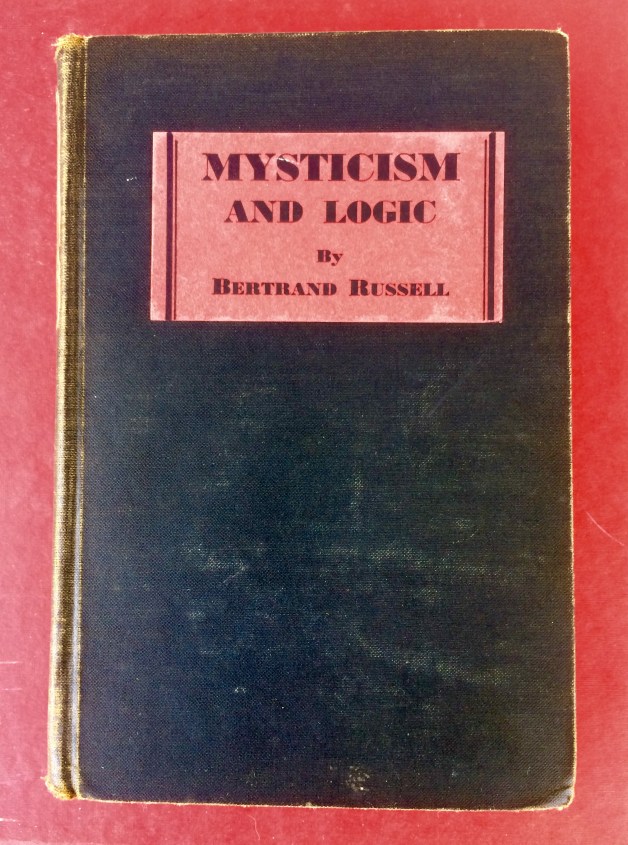
It seems obvious to state it is a book, but without foreknowledge, it is a black and red rectangular artifact containing what seems like 120 pieces of paper, but is 60 pages, halved, sewn, and glued to make a binding to hold them together.

The item itself declares it has been printed and published in 1929, a first edition, by W.W. Norton and Company in New York. It presumably had a dust jacket but otherwise, is encased in a dyed, black, woven cloth which has been heavily worn by what we can assume to be hands, other books, or the missing dust jacket itself. The edges are rounded and the dye of the fabric of every corner and curved surface has been worn away. The title on both the cover and binding is a glued-fast card stock which states eloquently “MYSTICISM AND LOGIC by Bertrand Russel,” in Minister Black, a typeface which I have found was created in the same year by a man named Carl Albert Fahrenwaldt1. Accompanying the binding’s statement is the logo and name “NORTON.” The paper contained within has a deckled edge, which points directly to the age of the item, and the grandiosity (or lack thereof) of the book. Publisher’s now choose this as a design feature, but at one point was a flaw in the printmaking process, a consequence of a water and frame method of sizing paper. In order to make books more affordable, or ready for sale quickly, the printmaker would forego trimming the edges of the paper stock of a book. W.W. Norton was a company of a mere six years at the time of publishing, so I would imagine that this is a fairly flashy printing2. The company had started out as man and wife transcribing lectures and making pamphlets of classes for Cooper Union, in their living room. Although since deceased, these two have certainly succeeded as Norton is a primary source of my monetary loss.

What I found to be most interesting about this book, beyond how it was made and whom contributed outside of the author in the printing process is the luxurious sets of annotations. There are four distinct sets of handwriting, sometimes arguing over the meaning and connotation of what Russell had published. A mysterious fifth insisted upon putting red checks near paragraphs, I can only speculate, he/she approved of. Some is in pencil, mostly black pen, and noticeably, the person who only uses capitalized block writing, is using this method as a form of highlighting, as we would today. All serial 232 pages, with some form of annotation, none of which I can lay claim to.

I came to own this book as it was given to me as a gift. I have owned two copies, one of which I willfully cast out last month during the beginning of the semester, during the practice of the Kondo Method, in what I refer to as the beginning of the Great Purge. In contacting the gift-giver, my best friend of seventeen years, and fellow book collector, she claims to have bought it at a yard sale for a mere five dollars, in a location she doesn’t recall, and has no connection or relevant information as to whom had owned or written on all of the pages. I came to love this book more than any other, because not only is it a first edition, but it can be encountered as what I thought of as an “Expanded Edition.” The previous owners’ notes are so remarkable in number but in speculation of Russell’s ideas, it is a truly unique object, even on the scale it was  produced. The initial function in its former life and its beginnings in 1929, was that of a philosophical value, like the contents. The reader was likely of higher education or curiosity. I myself would deem it a tough read if you have no interest in either. Although it has stayed in its original manufacturing state for nearly 90 years, it is worth noting that the purpose has not changed, other than how it is handled. I’ve read it four, encroaching on five times, and couldn’t tell you what half of it says. I handle it much gentler than the previous owners and find myself in a salon style debate with the penciled margins every time I open it to read it (which is probably in the hundreds by now).

img_7572

Notice T.S. as the only declarative contributor and the myriad of writing adding to the print.

In knowing nothing of the owners, I find solace in the particularities and histories of the publishers, designers, the author, and the work itself. I wish I knew more about the persons who left their commentary and legacy of philosophy in the margins than I do the author or the piece. I think it speaks to not only their willingness to deface the publication, but their divine opinions, of who they were or could have been. I imagine four people having introspective conversation or intellectual argumentation of Bertrand Russell, his relationship with science and thought, and the passion that went into the comment on page VI of the preface,

“T.S. * Russell REALLY says, then, that each thing is itself…”

The script is so small and barely legible so I can assume T.S. is a doctor, as this soliloquy is about 30 words long and I can only make out the first nine and the punctuation, underlines and so forth. It seems the very owner before me couldn’t quite grasp why this is important, so as I jokingly refer to myself as the book conservator, the keeper of ramblings of those since passed, they are safely refuged here, with me, indefinitely. Every so often, admittedly, I take it out to appreciate what’s hand written more than the printed words.


1 I mention this because I find this name interesting. It can be translated to “to go to the forest,” which is where you might find the paper that may be useful in printing your type creations.

2 This title, along with Freud’s works, as they were his ONLY American Publisher at the time, had launched Norton into popularity.


It’s a Pillow…it’s a Pet…

For this blog post, I decided to write about the “happy item” I brought in on the first day of class: my infamous Pillow Pet.

That’s him, the one and only. The Pillow Pet was invented around 2003 and was marketed toward little kids. I remember growing up seeing the commercials on Nickelodeon as a kid. It has two primary and obvious functions: to be a stuffed animal that a child can play with and be comforted by, and it’s also a pillow. Both the filling and the outside cover are made of 100% polyester. According to the tag, this particular Pillow Pet must have been made in the year 2010. He apparently was born (manufactured) in Jiangsu, China, and eventually was imported by Ontel Products Corp. to Fairfield, New Jersey. He eventually made his way to Queens, New York, where my mother purchased him as a Christmas gift for me. This little guy has probably done more traveling in 7 years than I have in my entire life.

I received my Pillow Pet either in 2014 or 2015. I have absolutely no reason or desire to use my Pillow Pet as a stuffed animal, so he mostly hangs out as a little pillow and for decoration. He mostly used to hang out on my bed, until I studied abroad in Germany and actually needed to sleep on him as a real pillow (okay, I didn’t need to use him as a pillow, I just preferred him over the pillow I was given). Although he’s a smaller pillow designed for a child’s head, that didn’t hinder me much from using him as a pillow. So far, I am the only person to ever own this particular Pillow Pet, so its function hasn’t really changed and there isn’t any “chain of ownership.”  In a way, you could say he went from a display object to one that was actually functional; however, the function I chose to use weren’t different from the function he was made for.

What I think is cool about my Pillow Pet is that, although Pillow Pets were originally intended to be for a significantly younger age group (the tag says “3+”) and the idea was clearly a mass-marketed capitalist scheme (who doesn’t know the Pillow Pet song?!), this Pillow Pet in particular has become a part of my story and my life. I can never tell the story of what it was like studying abroad without including my Pillow Pet. He is the only stuffed animal I bring to college out of the 10 I currently have at home. When I’m feeling down and alone, I hold him because he reminds me of my mom. I just realized I’ve been referring to my Pet as “he” versus “it” throughout this blog post. Although there are definitely millions of Pillow Pets exactly like this one, none of them have the same meaning to me as him. The idea of objects having a pulse, as Edmund de Waal describes in The Hare with Amber Eyes, holds true for this object in a way that it doesn’t with most of my other objects. One day I will probably have to part with him, and I know already that it will be a challenge. Until then, there will be room for him in my suitcase the next time I travel, just in case.

A License Plate Through the Years

image1.jpeg

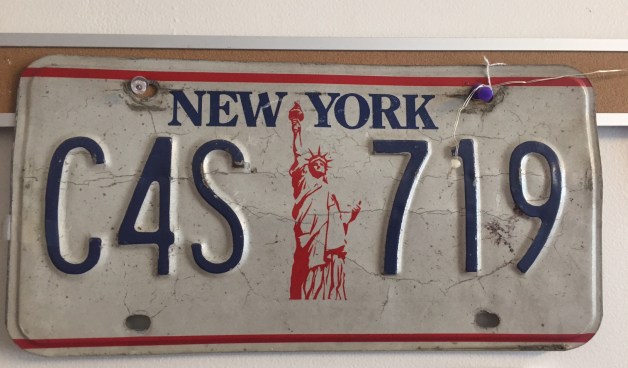
This license plate has been on display in my different living spaces (my rooms at home and now my dorm) since around 2004. As I’m typing this, I realize how long that actually is. What use did a license plate bring, whether it be aesthetically or functionally, to a 6/7 year old?

This is a 1986 design of a New York license plate, which was retired in the year 2000. Its a rectangular metal sheet with New York painted in blue on the top and a picture in red of the statue of liberty underneath. Punched into the metal is a combination of letters and numbers which is painted over in blue. The background is white with red stripes on the top and bottom. It’s obviously been used, which is displayed by it’s cracked paint and bent state.

This license plate was either from a car of my parents, that was given to my brother or directly from my brothers car in high school. For clarification, my brother is in his 30’s so he was in high school in the late 90’s early 2000’s. Regardless, I would consider it’s original ownership to be that of my brother.

Technically, you could say it’s original ownership was the United States Government, since all license plates must be issued by the DMV; a United States agency. Yet, I don’t consider that ownership in my mind. To me, it was just created and distributed by them. Also, apparently the creation of license plates is done by prisoners, but I don’t know the validity of that.

The function of this object is obvious to anyone living in the modern day world; to identify a car for purposes of registration and other bureaucratic things. It’s a car version of a social security number. The numbers itself have helped immensely with crime in recent years with the advancement of technology; if one gets their car stolen they can try and track it with security cameras and identify the car with this number. In a more personal and simple sense, this plate allowed my brother to drive his car legally.

When it came time for this plate to retire, my brother put it on display in his room.It’s functionally was completely removed; the plate was now just a symbol or a nice display on a wall, like some sort of trophy. A couple years later, come 2004, my brother now went to military school and my parents were separated. I was sharing a room with my sister previously, but with my brother away, I was given his room. All his stuff was half packed into boxes or gone, but the plate still sat, pinned to the wall. I don’t know why I loved it so much; I always thought it was just “cool”. When we moved into our current house, I brought it with me and pinned it to the wall also.

Over this winter break, my brother noticed it in my room and he asked me how I got it. At this point, over 10 years later I almost forgot about it. He told me you could use old plates if it was the same year as the car was made, and he had been looking for it cause he bought an older car and wanted to use them. I told him how I took them with me when we moved and had it ever since. He let me keep it and told me it wasn’t a big deal but I just found it interesting how he remembered after all these years that he had kept this simple old license plate. I brought it back with me to my dorm after and I still can’t really figure out what I like so much about it. In a way, it’s a stolen nostalgia; remembering the past that was never truly mine.

Dagger

I would like to answer this week’s assignment with an exploration of an antique military dagger that my parents own. I do not have access to it now, unfortunately, so I cannot provide any pictures. The dagger blade is about 8 or 9 inches long and resides within a sheath—both are a dark steely grey color. The sheath is decorative, which keeps with the overall theme of the object. Inscribed on the blade, near the base, is a name: Trota, if I remember correctly. The handle is royal looking, even sporting golden tassels, which, in a combat setting, would serve only to hinder the draw and wield, so it is likely that this dagger belonged to an officer—likely one high ranking and far enough removed from the melee environment to sacrifice some functionality in return for aesthetic appeal. On the center of the handle is an eagle symbol, wings outstretched, and beneath the eagle is a swastika. Did I forget to mention that it’s a Nazi dagger? Anyway, moving on.

The dagger was likely manufactured in Germany in the 1930’s or early 40’s, and would have been one of many issued to Nazi officers throughout the war. Also likely, is that the original owner of this particular dagger was, indeed, the man whose name is inscribed on the blade: the aforementioned Trota. The engraving does not look like one done by an amateur, so my guess is that it was done by supply command before it was issued to Trota. I know nothing of this man besides that he is a deceased Nazi officer; even though, as far as ownership goes, my parents are only twice removed from him. As far as I am aware, the dagger was taken from Germany by my grandfather at the end of the war: I do not know any nitty-gritty specifics, but I imagine it is more likely that the dagger was picked out from amongst other seized personal effects, than that it was taken directly by my grandfather from the late Trota.

Regardless, the dagger has been on quite a journey: It was born in a factory in Germany, furnished to the Nazis, hung on Trota’s hip, sat in on God knows how many events and secret meetings—and probably frequented many a Nazi officer’s club; it was then taken into American possession, stowed away in my grandfather’s Alice pack, shipped across the Atlantic, to then reside in my grandfather’s house for decade, after decade, after decade; and then, finally, was given to my parents. After all this time, the dagger – probably manufactured for a few reichsmark worth of materials – has accrued a value of approximately $1400. What was first designed, technically, to kill men, was likely never used for such purposes, instead decorating the belt of some Nazi officer; further, this same object witnessed the fall of – as Miller would say – the big beautiful fascist whole of which it was an infinitesimally minute part, then traveled thousands of miles across the world in the hands of its owner’s enemy, eventually winding up in a house in New York, only to be written about in a blog by someone its original owner would have happily used it to kill.

Bitter Bottles

fullsizerender-6

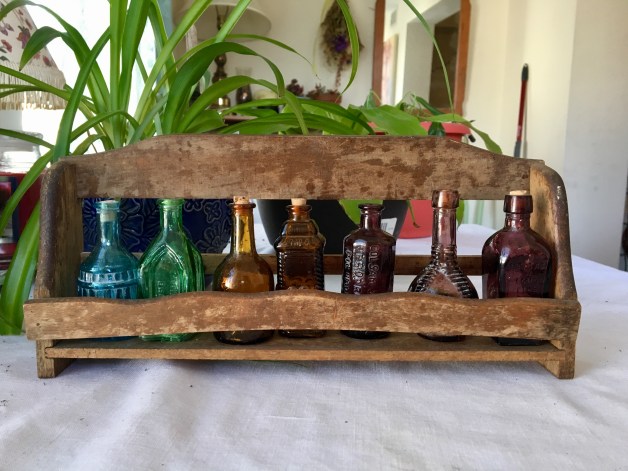
For this blog I have decided to explore a different object. I have a acquired a set of vintage bitter bottles from my parents home on Long Island. To my knowledge these bottles were purchased and owned by my mother however, I am not completely certain about this fact. These bottles are pretty iconic for me. They lived on the mantle above my staircase for quite a while. Going up and down the stairs I was so enamored by the teal, pink, purple, brown colored bottles. I always thought of them as bottles I could hold different magical potions in.  I could absolutely never touch them as my mother though I would break them. The bottles eventually made their way into my basement and for what they thought was going to be their final resting place–forgotten and collecting dust. Fast forward to last spring. I was getting ready to move into another apartment and while I was preparing and packing I was looking around my parents house to see if they had any furnishing I could take along with me. While rummaging downstairs I came across these bottles once again and after 22 years of being told to keep my distance with these objects, I finally picked them up. I finally got to feel the smooth texture of each bottle, their lightness, and I could finally get close enough to read what was engraved on the bottles.

These set of bottles I am currently exploring for my thesis project. While analyzing these bottles, I questioned why these bottles were fashioned in a set to be collected as a decorative object. The set has never held any liquids just merely for show. When I began researching, I found that collecting antique bitter bottles was a hobby of what seems like a pretty large community of people.

James H. Thompson in 1947 wrote the first book on bitters. Bitters being alcohol disguised as medicine. According to this book bitter bottles are one of the older bottle collecting categories. Bottles in this category must be embossed with the word “Bitters” or have a label which has the word “Bitters” printed as part of the trade name. Today, bitters bottles may sell anywhere from a few dollars for common clear or aqua examples to over ten thousand dollars for unusually colored figural varieties. These bottles meant a lot to me already but, to find out that they might be precious and valuable aside from the inscribed memories was exciting. However, this excitement did not last that long. While going through the process of identifying the traits that prove the bottles authenticity, I came across an engraving on the bottom of the bottle that said “made in Taiwan.” This only devalued these bottles monetary amount– in many ways the bottles are priceless to me.

Although these bottles are not originals, I do want to share some history about them. I never really used bitters and knew much about them until just a couple months ago. As I said earlier they used bitters to disguise alcohol as medicine. The practice of adding a small amount of herbal bitters to gin was so that it might be sold without taxation under the guise of medicinal liquor .This practice originated in England and became popular from 1850-1870, when laws which taxed liquor, the popularity of various temperance movements, and local restrictions on the liquor trade made bitters very appealing and highly valued. Additionally, the civilized man of the 1870’s could sate his desire for strong drink being condemned by the temperance union or from his neighbor for wasting his family’s money by taking his libations in the form of bitters. At this time everyone knew that a dose a day of “Hostetter’s Stomach Bitters” was not only respectable but would keep one in good health as well.

I am pretty amazed at the amount of information I did not know about these bottles until very recently. I would love to come across authentic bitter bottles from this time. I only own a replicate set of them and I think they are so beautiful but I could only imagine what it would be like to have an original.

Cups Made for Memories

Previously, I’d described my habitus as the map I have in which I’m tracking which baseball stadiums I’d been to, and which ones I still need to conquer. Prior to this tracking system, I had developed a collection to commemorate where I’d been, and perhaps piece together when. In every trip I’d take, every stadium I’d attend, I would purchase the souvenir cup. The plastic, oversized cups used for marked up beverages, something I was willing to pay an additional $10 for, and may every time. That endeavor, assuming I ever attend all 30 parks, will run me $300 (another $230 now), before even considering tickets and travel.

img_2505

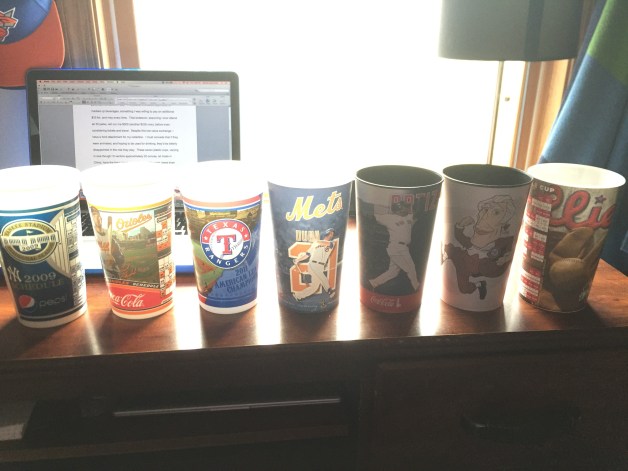
All 7 cups in order in which I bought them. Left to right: Yankees (2009), Orioles (2009), Rangers (2012), Mets (2012), Red Sox (2016), Nationals (2016), Phillies (2016)


Despite this low-value exchange, I have a fond attachment for my collection. I must concede that if they were animated, and hoping to be used for drinking, they’d be bitterly disappointed in the role they play. I use them as a display, and a reminder of where I’ve been, and when I see seven, I remember that I still need 23 more.  These seven plastic cups, varying in size though I’d venture approximately 32 ounces, all made in China, have the team logos, promotions, and the season’s schedule. I have accumulated this collection over time, ranging from 2009-2016, I would presume each one was manufactured in the year in which I bought it.  They vary in the messages they send, and are meant for drinking, I suppose, given that they are literally called souvenirs.  These cups obviously haven’t changed hands much, from manufacturer to buyer to the stadium concession stands where I purchased them.  I would enjoy my beverages on some hot days and nights, and some much cooler than I’d like (night games in May tend to leave you a little numb from cold).  Perhaps the most interesting part of compiling this collection is how difficult it is to get the cup from cupholder back to my house.  They’re so big and clunky and often still wet or sticky, without a lid to hold everything in.  It honestly is far more of a challenge than one would believe.  That fact, the obnoxious task of having to bring the cups from stadium to home, only increases my appreciation of them, as it is far more of an investment than it seems, I promise.  I’m sure you’ve all done it at one point or another, and you’ll probably agree, it’s just not as simple as bringing it home, there’s always something else at play.