Daniel Miller’s “Habitus”: A Reflection on My Mug

IMG_4007.JPGIMG_4011.JPGIMG_4010.JPG

The item I’ve chosen to analyze is my Ile-de-Ré mug that I got as a gift from my boss upon completion of an internship I did on the French island, Ile-de-Ré, in the summer of 2015. This is the same mug I brought in on the first day of class as an object that makes me happy. The mug is decorated with an image depicting a typical street on the island, and whenever I look at it, the corners of my mouth involuntarily start to curl up to form a smile. I recall the gentle, ever-blowing breeze, the wide open sky (no building there was taller than three floors high), the scent of the ocean, and the color scheme to which nearly all houses on the island adhered: white walls, a terra-cotta, shingled roof, and a pair of shutters for every window, each painted some shade of turquoise. This last memory—that adorably ubiquitous color scheme—is rendered in a faux-watercolor on this elegantly crafted, albeit cheap mug, so I never forget how Ile-de-Ré island looked (as if I could really forget such a place). In addition to the beauty of the island, the mug brings to mind memories of how independent and capable I felt when I was in France: I learned to cook for myself, I explored unfamiliar places by myself, and I traveled a good bit, sometimes alone. I associate those feelings strongly with these more sensory memories.

At home in New York, the Ile-de-Ré mug resides with all our other mugs, in a cupboard in the kitchen. When I’m on campus, however, its place is not in hiding, but on my dorm room desk with two other mugs I’ve collected since my time abroad. I typically place these three mugs together in a cluster, and together they stay unless I happen to use one, which, as I am a fan of tea, is relatively often. I’ve noticed that when I make tea, I’m more likely to pick up my Ile-de-Ré mug than my other two; I credit this to its unparalleled ability to calm and console me when I need it, evoking the memories mentioned I’ve described above. Reflecting on the mug reinforces what I already know—that I am a particularly sensitive and sentimental person, the kind of person who cherishes items like a souvenir mug because of how dearly they cherish the memories associated with them. Unlike the other two mugs, the one from Ile-de-Ré is special in that it reminds me of a particularly special point in my life. While it offers physical comfort when used as it was intended, even just looking at the pictures on it can do the trick. Maybe that’s why I keep my mugs on my desk, but all my other tableware in my closet: when I need to center myself, I just look over at it. When I need a cup of tea to relax, I need not search for it in my closet because it’s already out, on my desk, front and center. Admittedly, I’ve never questioned my choice of placement of these mugs until this assignment. Still, the more I think about it, the more it makes sense why I chose to keep them there. After all, what’s the point of owning a comforting item if it’s potentially a pain to get to?
A Reminder of a Former Home

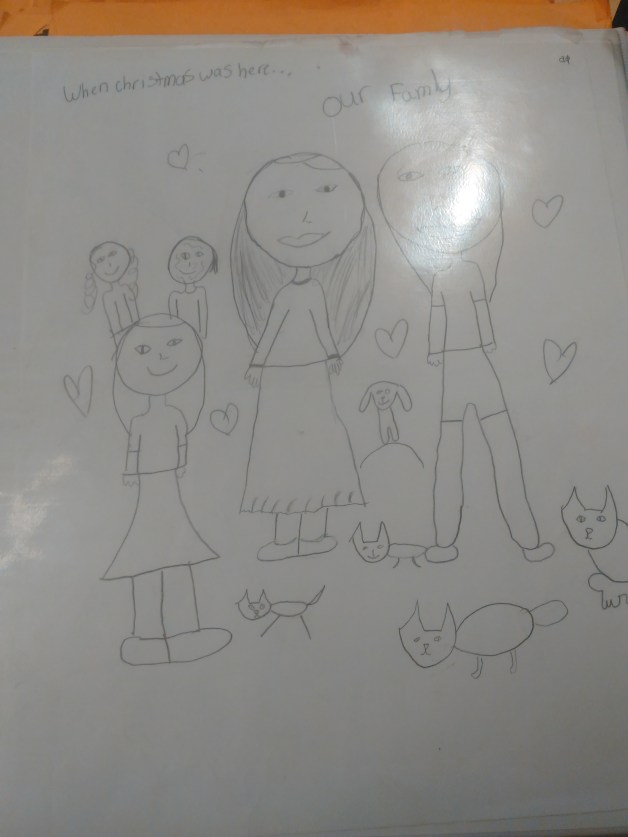
One of the objects that I brought with me to class on the first day was a picture that my sister drew. An eight-year-old girl with a hugely active imagination, my sister is constantly drawing. I have a million drawings that she’s given me, but when faced with the decision of what object to bring that really says something about my family, I snuck this one of my mother’s wall in her office. Part of the lure is that the picture contains all of our immediate family members, but even more than that, the picture contains an eerie sense of who we are as an entity. img_20170210_162525

In the foreground, there’s the artist herself and our four (now three) cats–who, if you ask my mom, actually do run the house. Right behind the five of them are my mother and stepfather. These are the people that my sister sees every day, so she’s obviously made them the biggest. One of the cats, though the photograph I took doesn’t show it, is actually in the process of peeing, since that particular cat likes to pee on things when he’s mad at us. In the background, my grandmother, who’s identifiable by the wrinkles on her face that my sister kindly drew in, standing next to me. My grandmother and I are, I suppose, more further removed from my sister than the rest of our family members. My grandmother lives next door, and I live all the way in New Paltz.

What’s interesting to me in regards to this picture as it pertains to a “habitus,” however, is that this picture never leaves my person. I have fitted it into the back of my binder, opposite a schedule of all the assignments I have due that week. img_20170210_162956

In the binder, I keep all my syllabi for classes and manila folders in which I store my readings for each class. I had first put the picture in there as a way to make the binder as a whole feel less daunting, but now I am more interested in this idea of the picture as a transient object in my habitus, just as I am a transient object in the unit of our family.

I didn’t frame the picture and put it on my wall, or skip the framing all together and take it up there like a lazy, broke college student. Instead I made sure that it would come with me wherever I went, that when I was in the library working, all I had to do was look over and be reminded of where I came from, and of whom I’m always trying to make proud. What does that say about me? I’m not sure, except that my whole habitus has become a habitus of convenience. Living in a dorm room, one is always aware that one’s living space isn’t permanent, isn’t even theirs. There are so many restrictions to what we can and can not put in our space that it often feels sterile and lifeless. The furniture is hard and uncomfortable, and we’re not allowed to bring any extra in (though I’ve cheated that rule and brought a folding wood bookcase for the past two years). I’m always aware that my area is one of transition. I’m never stopping for long there.

And even when I go home, I’m aware that it’s not really my home anymore. There’s my family, of course. And I have my own room. I’m lucky enough even to have my own office. But there’s always a sense that it’s a place I’ve left, and that in doing so I’ve also left an irrevocable chasm between my family’s space and mine. So perhaps the conclusion is that, without even knowing it, I’ve converted my entire habitus into something transient, that can be moved when I need it to. It follows, then, that the most important things follow me around, even in my micro-travels across campus from day to day. Maybe the object of the picture itself shapes the way I interact with this transience, letting me leave behind the anxious nature of never having anywhere permanent by allowing a physical representation of those I love come with me to all places. That picture is the thing that’s permanent, and maybe it makes every space a kind of home to me.

His name is not actually John

John is a friend I met last year through a job, and ever since then we have had one of those friendships that blossoms against time. What I mean by that is that our relationship defies all the notions and conventions of becoming friends because of how quickly we were to open up our living spaces to each other. In a matter of days, I was already hanging out in his room and he in mine. I have decided to write about John’s living space because ever since meeting him I have been puzzled about how he manages to live and function undisturbed and surrounded by heaps of clothing on the floor and on his bed. When you walk into John’s room the first thing you notice is nothing, everything is all over the place and there is no focal point in his room that particularly draws your attention. He has clothes on the floor, his dresser, his bed, his closet and even on his desk and they are not arranged in any specific manner. John has some wall decorations but the one he always mentions and perhaps the only part of his room that is put together is beside his bed. The wall is a collage of pictures with people he unconditionally loves. John would always point this out to me when he caught me staring at the unfamiliar faces on his wall.

Part of why John and I clicked is because we had heard about each other from a mutual friend but most importantly because he is one of the most hardworking, competent, amazing and the most careless person I have ever met. From the start, this combination of qualities was unheard of for me because I always associated smart, intelligent and amazing people with organization and structure, but John did not just fit that narrow box of mine. Picturing John’s room as I write I can now understand how his living space is a direct reflection of him. John is one of those people that has meltdowns the night before an essay because he had procrastinated for too long but he was also one of those people that would wake up at 6am to go visit grad schools across the nation. Again, it almost seems like I am writing about two different people but this is the type of person John is, and his messy and chaotic room reflected his character and how nonchalant he is. From having his clothes thrown all over his room, John demonstrates that he is a carefree person that does not need too much structure for him to feel happy or at peace. The collage of pictures on his wall show that he is a person that values friendships and his family while the amount of clothes he owned shows his love for looking and feeling good.

John has a certain nature of urgency about him because he would always put himself in situations that required him to be nervous and act fast and his room was exactly the same way. His belongings were always scattered and always required of him that sense of urgency he lives off. After knowing John for a couple of months, I came to realize that John is a person that does not plan and does not need to because as long as he knew what he had to do he did it, but in his own way. John’s room is a reflection of his personality but it is also a reflection of his upbringing in a society that requires so little structure of men. We live in a society that thinks that masculinity means being rough and having imperfections and part of that is carried into their living spaces and John’s room exemplifies how our place in society in addition to our upbringing and personality affects the way we arrange our living space. I say this because I know that part of me being a very organized person is that it was expected of me as a young girl to not be messy.

Luke and His Books

I thought it’d be interesting to reflect on how an object in my friend’s room is situated within it. My friend’s room is a lot different from my own–he lives in the dilapidated, muted pink house on the outskirts of Main St. When pulling into his driveway, the radio station you’re listening to automatically cuts out due to interference from the heavy amounts of led used in the gaudy pink paint. The front door is always unlocked, and a faint smell of cigarette smoke is omnipresent. It’s easy to see how Luke’s living situation heavily contrasts from my own–this unruly house seems to have few rules set in place aside from probably flushing the toilet after you use it.

Luke’s room is almost overflowing with stuff, and I’m envious of his proudly-mounted Cocteau Twins poster and his wood-carved incense holder. The thing is, while Luke’s room is filled with trinkets, papers and clothing, I find there is only one object that will be moved around, replaced, and handled extensively on a daily basis.

While his books are technically more than one object, I find that he treats them as a sort of homogenized entity in his room, as they form a cohesive wall which he has to actively switch around and tinker with depending on what book he is trying to extract from it.

As an English major, he is constantly leafing through one book or another, whether it’s The New Oxford Annotated Bible or Don Delillo. There are plenty of juxtapositions of books of differing subject matter and genres in the wall of books.

Although Luke has about 30 hefty books stacked up in his room, the reality is that this is only a small fraction of them. He has about 70 books strewn about his childhood bedroom that he felt he could live without up here. The books he ultimately decided to bring are extremely revealing of the overall aura that he wants these books to project–many of these are the books he is currently studying, that are taking up most of his critical capacities at the moment. There are also books that are always useful to keep on hand as an English major, such as  Introduction to Literary Theory by Terry Eagleton or Norton Shakespeare. Finally, there are those that are just his favorites. Those that make him happy to talk about if one were to see it proudly displayed in his wall of books and ask about. These for him are The Fact of A Door Frame by Adrienne Rich and The Tennis Court Oath by John Ashbery.

So, Luke’s small, varied possessions really don’t need to be there at all. They really seem to be there less for decorative purposes and more as a product of the seemingly Sisyphean task of moving in and out of one’s childhood home between every semester. All the emphasis in the room is really placed on the books, and those who enter are immediately drawn to the book wall, furiously scanning it in the hopes that their favorite book might be there. And that’s the point–nothing makes Luke feel more like himself than talking about what he knows best. It’s a safety net that allows for him to keep the ball in his own court so to speak, so that when new people enter his space he doesn’t feel vulnerable.

Residence & Resident.


The concept of “Habitus” within the scope of sociology had previously eluded me as an ambiguous sidebar, but Daniel Miller offers distinct insight on a psychological level and as societal mechanism worth mentioning. Small or large, homes can offer us great or little detail about the person and their background, but with a different scope, how they adapt and manipulate the environment, or conversely, how the environment changes them physically and emotionally.

As a child, I most admired my great grandmother. She lived in a tiny one bedroom apartment and was the only person I knew who kept art on her walls. Admittedly it was dated 40’s-70’s deco art (I mean this in the most affectionate sense possible), some curtains that undoubtedly matched her shirts, indicating she’d made them herself, and some hand drawn portraits of Jesus, John F. Kennedy, and Millard Fillmore. I understood the Fillmore, as he is a not so distant relative, and later the JFK (a Catholic staple in any Irish home) but the rest seemed puzzling, but enjoyable. I was determined to have her hang my precious works of art, which of course she did. Daniel Miller recognizes the differences in homes and the value of personalization, much like I had as a child. My stepmother’s ability to hang the most delicate porcelain masks, my mother’s metal butterflies and wooden spoons, and my grandmother’s bric a brac seemed so impersonal compared to my matriarch, Eleanor.
I am an art pusher, mainly because I can, let us call it a humanitarian effort. The idea of a bare wall translates to me as a vacant person, I’m rescuing visitors, if not the people themselves from boredom. My grandmother, Cheryl bought a painting from an unnamed angsty twelve year old and hung it at the top of her stairs for ten years. Just long enough for my embarrassment to become sentimental and spark some larger ambitions. She and I created together and found we had quite a bit in common. It changed the nature of our relationship. My mother, claiming her tiny brick wall would be sufficient decoration recently, received a 3′ x 4′ painting for her home warming from an anonymous source in the mail. Again, how could one throw away these precious gifts? Since, she’s invested in some “modern art” she found at a garage sale for her front room. This is not because I’m an artist and she feels that there’s a segway in the former hotel-esque art, or because either of us have great taste. “The room felt so cold and impersonal, and it matches the stucco outside, for flow…” says the former brick enthusiast. It gives the occasional visitor something to look at, another story to tell, a judgement to make about pleasures and interests, or as a color transition. As a story, perhaps about the person who inhabits a home, or a narrative of the home itself.
My walls will tell you loads of stories about how tasteless art can be, but it also reveals how daily habits and interests are integral for my well-being, and even remind me to be more conventional.
As an example, here’s a tiny (5″ square) shameless story from my bathroom about how I came to meet my current dentist and found I needed 1, 2, 3, wisdom teeth removed, which might as well serve someone else as a reminder to brush their teeth, or not use their mouths to open sealed pistachios:
fullsizerender
Through this journey, I’ve mostly bound myself to learning the fine art of repainting and mastering the skill of spackling, with promises and deliveries for landlords so as to not lose my deposits (i.e. ask me about NY State rental laws). Fortunately, I’ve never lost a deposit or had a landlord who fixed anything him/herself. In homes without anything on the walls, I find myself disturbed, without distraction, and a detraction from my initial “belonging,” or welcome within the space. I have since forced several minimalists in my life to accept art as gifts from their favorite artist(s), knowing they would feel obligated to display it. Having been given a speculative gift in the arts, I have maintained this empowered tradition of hanging things on the wall. From Sid Vicious posters to show flyers, friend’s drawings, gifts of paintings, to what I now believe is my own private gallery of mostly my own unsold works, some paintings from very talented people that I’ve bought over the years, and Dalí reproductions. The nooks and spaces within my apartment of so constrained in comparison to other places I’ve lived that I find myself painting smaller pieces, more to the needs of certain spaces in case a commission falls through, or I find something small and affordable to put into a particular space. In this way I accommodate the peculiarity of the walls built around posts and the lack of forethought of the builder. Much like the space drives me to endeavors and work smaller than I used to, I enjoy the tasks as a challenge.

As Miller dances around the definitions of accommodations, I would agree that it is a compromise between resident and residence, that we place our Stuff. I would like to add another definition by Merriam-Webster (a much less wordy definition than my perception textbook), ” the automatic adjustment of the eye for seeing at different distances effected chiefly by changes in the convexity of the crystalline lens,” which I think frames any encounter with art quite nicely. To see the whole of a painting is to see the entire home, but if you stand close enough you can see the complexity of the color, stroke, and ultimately the artist, much like an object tells about an inhabitant.


Reclaiming Agency Through Movement and Change

While reading chapter 3 of Daniel Millers, “Stuff” I identified with the the idea of accommodating oneself in a space through movement and change. Our bedroom, living room, kitchen, etc. and the objects that exist within them not only represent our connection to others around us/ world but, their arrangement demarcate periods of time in our lives. For this post I will be exclusively talking about my bedroom. By providing personal anecdote I seek to contribute to the notion of how the movement of objects can ultimately create change the transcends the physical domain and reconfigure our outlook on life as mentioned in the reading (pg.98-99).

In the space between objects I have displayed in my room and the orientation of the furniture I have live the experiences I have gone through, although silent and not physical they dwell within the crevices of my room. Every time I come home and sit on my bed, there is a release of this emotional energy and without my control they find their space in my room and settle. I bring to my room the happenings of each day, whether a good day or bad. But, what I find for me is that negative energy takes up more room than positive. The positive feels light and airy and the negative feels dark and dense. After a while the dark and dense builds up and the my space reaches a point of stagnation. I usually prefer to live in a space where I feel movement, leading me in a direction where I will eventually find relaxation, motivation, and most importantly clarity. The stagnation the begins to manifest itself in my room is a direct reflection of where I am in my life, stuck. Stuck in a particular mode of thinking, stuck in a routine, and so on. For sometime I will live in a space like that because I don’t have the ability yet to lead myself out of it. Additionally, I have the feeling like Miller was saying that “things are never going to change”. While this is all going on my objects remain in the same spot, in a way observing every move I make or lack thereof.

Nonetheless, the day will arrive where I throw my bags down and begin to rearrange everything. This day usually happens every couple of months for me and for a while I thought I was just being neurotic. I needed control over something because everything around me and within me felt out of control. What better way to do that then through picking up and moving things that you have complete agency over? (Also what I explained above was not apparent to me when I first began this habit of rearranging my room every couple of months. I wasn’t think about the dwelling of my emotional energy overtime, I was just thinking about reclaiming control.) My friends would always make fun of me–”There she goes again” or point out this habit I have and call me crazy and to be honest during this process I do feel kinda crazy–but I realized it’s part of the overall catharsis of rearranging your bedroom. Moving my furniture/objects begins to break up the shear build up of emotional energy over, in this case, a couple of months. After hours of moving things around I finally sit back down on my bed and I can feel that lightness, I can feel the openness between my objects. It is a feeling that language doesn’t seem to do justice. I feel invigorated afterwards–I may not have figured out how to exactly fix whats going on in my life, but I have a regained a sense of agency that I thought I was lost. In my current apartment I have gone through this process two or three times now for different reasoning. When I look back now and reflect on the emotional fluxes I have gone through, they are indefinitely attached to the orientation of my bedroom during that time.

Accommodations and Agency

I have always lived in a rental apartment with my mom. More accurately, my mom has always lived in a rental apartment and I also live there because I’m her daughter. Really, it is her place. My mom has always wanted to own something – a house, a condo, didn’t matter. She wanted something to call her own, but it was never attainable since New York City is so overpriced. She found a nice medium in the apartment we live in now. She’s been very good friends with our landlords for over 30 years and they let her do pretty much whatever she wants with the apartment.

My mom takes up the whole place (which is pretty large). Her trinkets, decorations, pictures, lamps, and furniture are all over the place. The cats have also claimed everything. I am confined to my little room in the back. Even there, her clothes claim the entire second rack in my closet. My room barely fits a regular sized dresser, nightstand, and bed. I could really use that second rack for my clothes. Nevertheless, my mother’s clothes exist there.

When I was in my freshman year of college I commuted, so I lived at home. I was fed up with my cramped little room. I was tired of the wall-to-wall carpet that had been there for decades, the paint peeling off of the walls, my bed that was only a twin size but still too big. We saved up some money and overhauled the entire room. I upgraded to a 7-foot loft bed, a brand new carpet, and some new paint. I could fit a desk under my bed and still had space to move around. As a final touch, I convinced my mom to donate some of her clothes in my closet, allowing me to completely reorganize the depths of my closet that I had never seen before.

For the first time, I had a room that really felt like me. It was spacious and functional. Before, I would trip over my bed or my dresser because they were so close together. Now, I can even do yoga in there, if I really wanted to. I reclaimed my bedroom as “mine,” even when the rest of the apartment is “my mom’s.” It is clutter-free, unlike the rest of my apartment still filled with my mom’s trinkets and favorite pictures, exactly the way I want it. Although I don’t mind the rest of the apartment, I find that I appreciate the things in my own room more. It serves as a sort of practice for when I actually do have my own apartment or place. It’s soothing, it represents me. As Miller notes about accommodation versus accommodating, I think I have finally accommodated the room to me.

A House Has Many Lives

I wanted to use this blog post to go into more detail about the materialistic environment of my house, being that this is one of Miller’s main focus points. As I had mentioned in class earlier today, my family structure, as well as the structure of my house, began to change tremendously since my dad remarried in my junior year of high school. The shift of objects and spaces in my house is quite fascinating, and it is something that I have always been rather mindful of, even before taking this class. Originally, my house was a mish-mash of 90s pastels and Russian eccentricity. My father was born and raised in Brooklyn, whereas my mother was born in Kiev, Ukraine, and traveled to the United States when she was sixteen.

Structurally, my house is build exactly the same as every other suburban, Long Island  house on my block. But growing up, the inside was quite different. The first thing you would see when you opened the door to my house was a wooden and glass, vertical display case, filled with matryoshka dolls, ceramic plates that I had made in art school, and a photograph or two. A plastic Czarina doll from Russia stood on the very top of the display case, with a large headdress and fixed blue eyes, which gazed directly at the front door (A little creepy, yes. But Russians are generally very spiritual/holistic people, and my mom liked the idea of having a “guard,” so to speak, watching over our house.). To me, this image really sets the scene for what my house was like. A unique cabinet, facing a not-so-unique, white, suburban door.

My house, at the time, had bright green oriental rugs, pictures of the family, paintings of forests, and lots of mirrors. I liked how my mother’s Russian accents brought color to diluted 90s atmosphere. The balance made it homey. It made it lived in, and different from whatever I could imagine my neighbor’s houses to look like, as Miller mentions, most “families never actually see their neighbours’ homes” ( 97).

When my dad remarried, he and my stepmom slowly began to renovate the house.  “Homes are the elephants of stuff” (81), Miller notes, and this is a phrase I like very much because it perfectly highlights just how big of a process “accommodating” (96) a home to your needs can be. The renovation began with the kitchen, being that my stepmom is an orthodox Jew, which entails many different kitchen alterations in order to keep up with the proper kosher rules. The following shifts in design began  in the living and dining room, in order to better accommodate guests for Shabbat dinners on Friday nights, and then the bathrooms, their bedroom etc. My house now serves an entirely different functionality from how it used to, and it is interesting to see the how the small changes accumulate to reflect the new dynamic of my home. The walls are now painted silver for a sleek look. The carpets are white, the couches are gray. We now have a new display case with little tchotchkes and little glass figurines that originally belonged to my stepmother’s family. The case has been moved to the dining room. There are less mirrors, but no paintings to replace them, other than a variety of Jewish pieces. My parents are still in the deciding process in terms of paintings–one that has been in motion for nearly two years. It seems the decisions they make in this “new” old house are so crucial, that they can almost not be made at all.

On the outside, our home is being reworked for functionality and for show. It looks stylish and tasteful to our guests, but I find is not as comfortable to live in. Yet, these spaces are important to my parents in more ways than simply meeting the peering eyes of our neighbors. This is most evident in the fact that my stepmom has painted all her closets in loud, obnoxious colors. Her clothing closet is hot pink, her linen closet bright blue. Her small office downstairs is purple. But these are all hidden from the outside. I find this to be quite funny. These colors make my stepmom happy, and even though our house now also belongs to her, it seems there is an image she wants to portray to our neighbors that I believe stops her from actually decorating the house in the way maybe Kondo would recommend. In this sense, our house can often feel like a museum. Everything is strategically placed to create a specific effect. But in my room, I have bright orange walls that are not hidden, decorations catered to me, and objects which I have accumulated over time that are staying exactly where they are. My room belongs to me, and in it I have power over my objects in a way that I do not anywhere else in my house. It is, as a result, my favorite place to be in.

House versus Home

I found an interesting concept on page 90, when Miller talks about au pairs and the rooms their host families prepare for them. It sparked the thought of “house vs. home.” Both in my life and my friends, the topic of a house versus a home has come up. We are all in college, and for some of us it was a difficult adjustment. “I want to go home” was a phrase I said an innumerable amount of times my freshman year, but some people have said “couldn’t you have just gone back to your dorm room?” The answer is no. There is a distinct difference between a physical house and what someone may consider home. It can also be a mental state. To think of one’s home and a “home away from home” is represented by college life extremely well.

“It seems that most families didn’t think twice before deciding that IKEA represented the perfect au pair style. Not just IKEA in general, but specifically white melamine IKEA furniture, which was found in approximately half of the photo-documented au pairs’ rooms we studied (90).” This bland colored living space made for au pairs by their host families represents the ease of simply replacing something or somebody. IKEA furniture is fun to put together, I will be honest, but after a few years of wear and tear, it might not even function correctly. Their products are cheap, very affordable, and will surely only last a few years. Miller describes this IKEA furniture in the UK as “cold” and “anonymous.” Plain, white, and there to temporarily serve. This is the au pair’s house. What items they choose to place inside of it will make it their own, their home. Additionally, if they do choose to call it “home,” that is their choice, and backs up the statement of home being a state of mind.

On the following page (91), Miller talks about having the autonomy to be able to put things in your house. Say you have purchased a house. You will reside there long-term, maybe start a family, host your own family for holidays. If you’re going to be living there for years to come, you should make it your own. This is where the items come in; pictures, furniture, electronics, appliances. The ability to feel comfortable in a space and call it your own is what makes a home. In my own dorm room, I have posters of my favorite TV shows and pictures of my friends and family. Whenever I go back to it at the end of the day, I feel welcomed. I feel safe. If I see someone’s dorm room and the walls are bare, I am confused. They are just going back to an empty space, but that is also their choice. I wanted my dorm room to be warm and welcoming, and I wanted it to feel like a home instead of a hotel. Some people have an easier time thinking to themselves that college is only permanent, so maybe that is why they have nothing on their walls to welcome them back at the end of the day. I won’t know, though, unless I ask them. If there is nothing in someone’s home, I can assume they are boring, bland, extremely minimalist, or anything else that pops into my mind. The only thing that will explain a complete lack of items is what they have to tell (much like George’s in “Empty.”)

I firmly believe that a house is the building. A home is something you make your own through your objects and personal expression.

Tying the Room Together

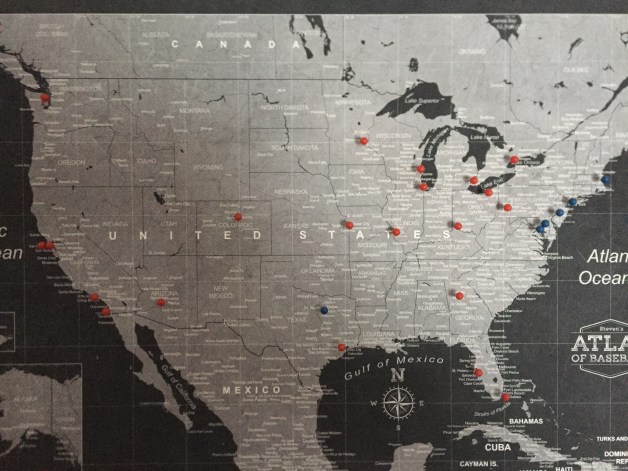
Throughout the reading, particular when Miller described objects in one’s home, I kept considering the phrase, “it really ties the room together.”  I felt that because it proved the point that I felt Miller is trying to make, that objects mean everything, and they also mean nothing.  To suggest that a room is not a room, or it isn’t a sufficient and fit room in which to be, if there isn’t a proper picture on the wall, or a beautiful pillow or blanket for the couch, perhaps a centerpiece or bowl on a table.  It’s cultural, it’s comforting, it’s downright odd.  With that said, I’ll move on into something I’ve gained some insight into recently about my own room.  I live at home with my parents, in the same room I grew up, and so many objects are new, but plenty are old.  I plan to graduate soon, and this means that in some capacity I plan to move out, whether I go to grad school or get a job, logistically, it may be a while until I do so.  Nevertheless, my mind moves towards what will stay, and what will go when I do.  I looked at all of the posters, bulletin boards, etc. hanging on my wall.  They provided comfort, they brightened up the room when I was growing up, and even in my recent endeavors.  Among these are TWO bulletin boards, I mostly hang pictures, school information, and other mementos on them.  Moving on, I have the headline from Derek Jeter’s final game in Yankee Stadium, a poster of the Super Bowl XLII (2007) Champion New York Giants, a few plaques I’d been gifted of old teams I’d admired, a frame in which the picture has been swapped numerous times (honestly I like the frame and that’s why it’s still hanging).  On Valentine’s Day last year, my girlfriend Alexa gave me a “candy poster”, which is my best way of describing it.  I’m sure some of you have seen one, it’s a poster with various sayings where candy is attached to add meaning, (ex. the first line reads “To my Sweetart” and a roll of Sweetart candy is attached).  Moreover, the bottom line is, at one point or another, these all meant a great deal to me, and in many ways they still do, or I would have taken them down a la Marie Kondo.  However, the most recent one I received is perhaps the most precious in that it defines me best.  Despite my affinity towards all of the posters and fixtures I’ve just described, they will likely stay here when I leave, and that’s not a bad thing by any means.  As cliche as this sounds, these are all symbols of where I’ve been.  So now you may be wondering logically, “won’t this new fixture turn out the same way.”  And the answer is yes, but not for a long, long time.  One of my true goals in life, and by that, I mean, my list of “A Thousand Places to See Before You Die”, consists of the 30 Major League ballparks in North America.  This Christmas, Alexa gave me “Steven’s Atlas of Baseball” which in its simplest form, is a map of North America.  The design purpose of this map is to showcase which stadiums I’ve been to, and which ones are still on the list.

baseball

My “Atlas of Baseball”

I conclude this by saying that this is my “habitus.”  For the rest of my life, I’ll never want to live without this, it is part of my lifestyle, as you all have no idea how badly I want to make those red pins disappear.  To think I’ve only made it to 7 of 30 (if you count closely, there are only 27 pins, as two won’t fit in New York, Chicago, and Los Angeles).  The bottom line being that for me, this map, will tie any room together.