The Tiger Maple Grandfather Clock

IMG_3857

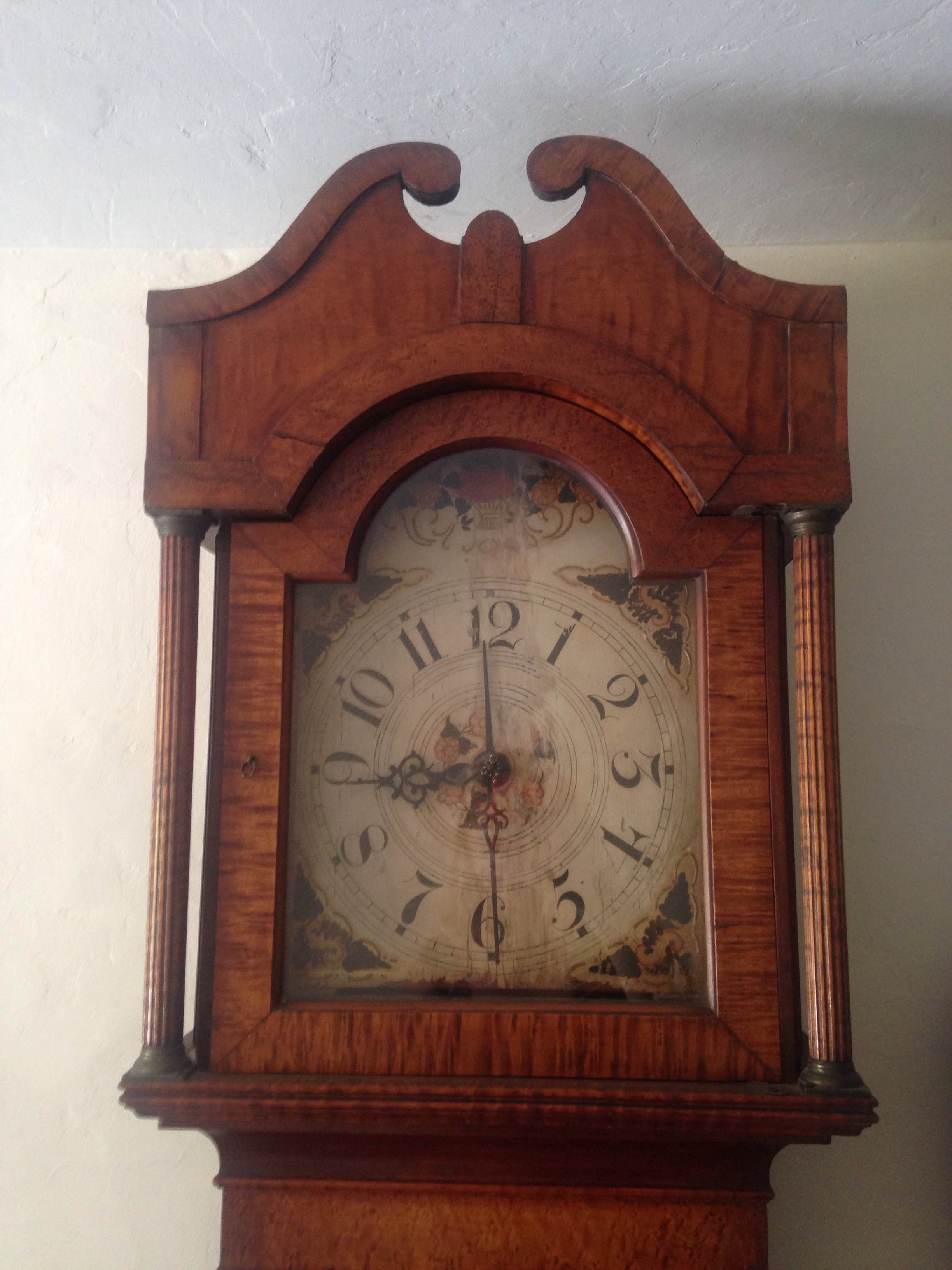
A grandfather clock that served to keep time but also served as a decorative piece of furniture, this 19th century clock belonged to Dewitt Chauncey LeFevre’s aunt and was passed down to him. This elegant clock not only functioned as a timekeeper and a living room furnishing; it’s uniquely patterned wood symbolizes the wealth of the LeFevre family.

Caption: A grandfather clock that served to keep time but also served as a decorative piece of furniture, this 19th century clock once belonged to Dewitt Chauncey LeFevre’s aunt and was passed down to him upon her death. This elegant clock not only functioned as a timekeeper and a living room furnishing; it’s uniquely patterned wood symbolizes the wealth of the LeFevre family.


Physical Description: The grandfather clock is about eight feet tall and it’s casing is composed of Tiger Maple wood. Tiger Maple wood is commonly referred to by many different names such as flamed maple, curly maple, ripple maple, fiddleback or tiger stripe. These names are derived from how the wood looks: the growth of the wood fibers is distorted in an undulating chatoyant (cat-eye) pattern, producing wavy lines known as “flames”. This type of wood is known for it’s beauty and is often used in making instruments. This clock’s wood is very noticeably striped and stained a golden hue. The face of the clock is white with a red, yellow, and green flower design and black numbers. According to Huguenot Street’s file, it once could have been a “Wag on Wall” clock – meaning before it was a grandfather clock, it did not have a base and the face of the clock probably hung on a wall on it’s own at one point. It is also said to have been reconverted from an electric clock, and while it looks like it is in good condition it has been repaired several times.
IMG_3962


Provenance: The Tiger Maple Grandfather clock is currently in possession of Historic Huguenot Street. It was gift to the foundation by DeWitt C. LeFevre, and in the archives it says that this clock was once his aunts. DeWitt LeFevre was the first president of the organization. I believe that the aunt it belonged to originally was Minnie Mariah LeFevre Jameison.


Narrative: On April 28, 1677, twelve Huguenots were granted a license that allowed them to purchase land along the Wallkill River for a settlement. The original Patentees of New Paltz were: Louis Bevier, Pierre Deyo, Christian Deyo, Antoine Crispell, Louis DuBois, Abraham DuBois, Isaac Dubois, Hugo Freer, Abraham Hasbrouck, Jean Hasbrouck, Andries LeFevre, and Simon LeFevre. Simon LeFevre was born in France around the year of 1640.

“Simon and Andries LeFevre, brothers and very much alike, were most likely the scholars of the group. From the records we would assume them to be quiet, somewhat withdrawn, giving the group of Patentees a touch of refinement, which love of books and study can bring. They were not fond of labor like some of the group, but did their share because it was the honorable thing to do. Both brothers died before old age came, so that we must draw most of our records from the children of Simon. Andries never married. By nature easy-going, they believed in peace and harmony. There has always been a tendency toward frugality. By tradition, the ancestors of the LeFevre family were scholars and most closely allied with royalty by blood and position.”


A descendant of Simon himself, DeWitt C. LeFevre also held a position of power and scholar as the first president of The LeFevre Family Association. One could say that he is almost a grandfather of the society, and the clock symbolises his family’s wealth and longevity. Bestowed as a gift by DeWitt, the clock resides in the LeFevre house on Historic Huguenot Street.

IMG_3961

The LeFevre House

My grandfather’s clock was too large for the shelf,

So it stood ninety years on the floor;IMG_3964

It was taller by half than the old man himself,

Though it weighed not a pennyweight more.


In watching its pendulum swing to and fro

Many hours he spent when a boy

And through childhood and manhood, the clock seemed to know

And to share both his grief and his joy.

“My Grandfather’s Clock”, a song written in 1876 by Henry Clay Work, from which the term Grandfather clock came into existence.

References:

Gannon, Peter Steven. Huguenot Refugees in the Settling of Colonial America. New York, N.Y. (122 E. 58th St., New York 10022): Huguenot Society of America, 1985. Print.

“History of Grandfather Clocks.” Klockit. Klockit, Inc., 2010. Web. 09 May 2015.

LeFevre Wright, Diane. “DeWitt LeFevre – The First President of the LeFevre Family, 1967 – 1973.” LeFevre Family News [New Paltz] 2002, Summer 2002 ed.: n. pag. Print.
(post in progress)

Breaking Traditions to Preserve an Heirloom: The Napkin Ring

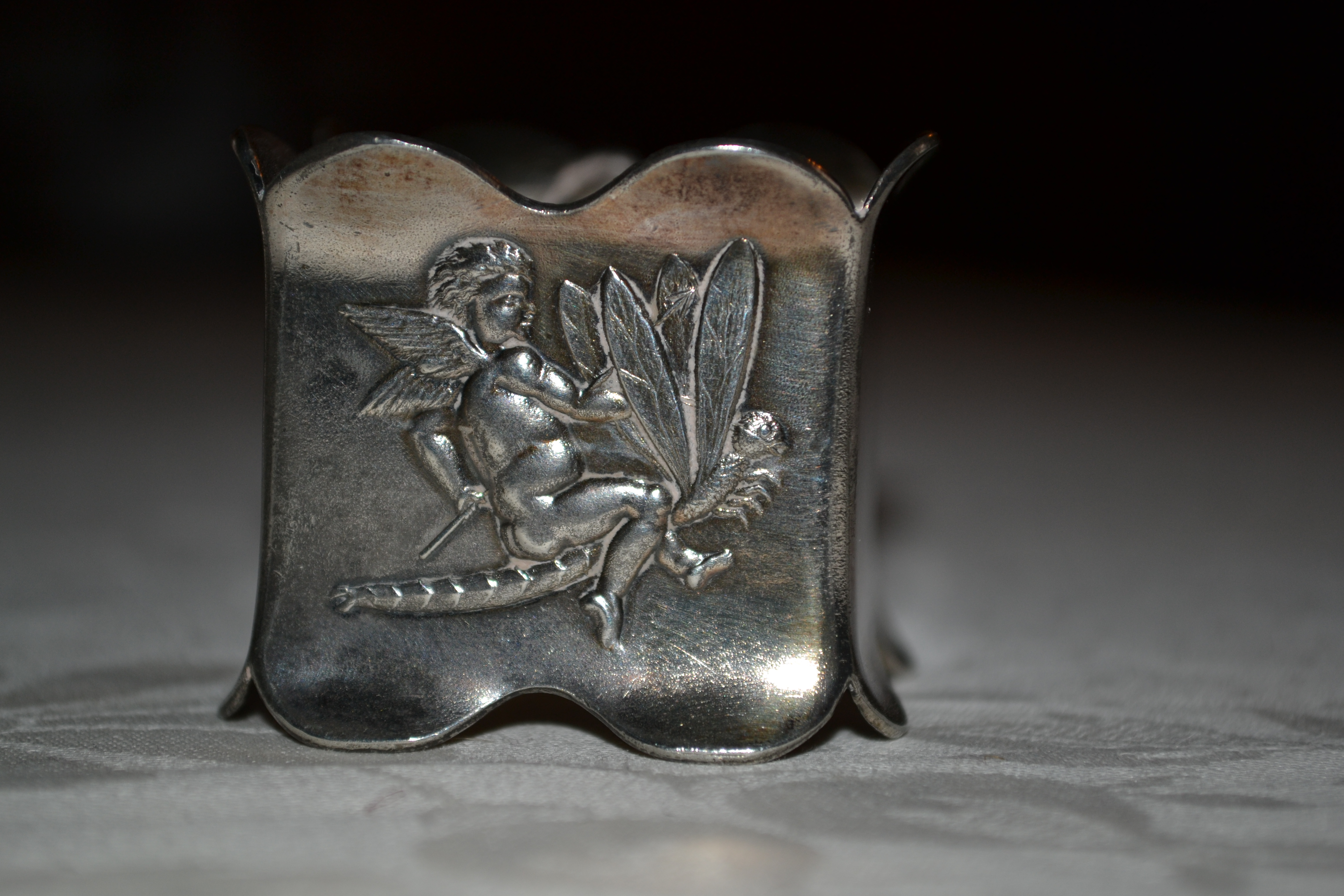
This 19th century napkin ring depicts an intricate engraving of cupid riding on a dragonfly.

This 19th century napkin ring depicts an intricate engraving of cupid riding on a dragonfly. Photo Credit: Historic Huguenot Street

Caption:

A dining accessory that also functioned as a place card, this 19th century napkin ring belonged to the family of Gertrude M Deyo. This uniquely square napkin ring embellished with the owner’s initials marks cornerstones of a woman’s life, from childhood to marriage, and serves as a reminder of the traditional passing of possession of family objects, as well as the need to break tradition to preserve its heritage (Historic Huguenot Street).

Description:

Despite the name, napkin “ring,” this item is one and a quarter inch square napkin holder made of silver (Historic Huguenot Street). It has scalloped edges, two curves to a side, along both the top and the bottom edges. Given the approximate date of creation for the item in the late-19th century, it has suffered minimal damage, leaving the only traces of wear and tear small areas of old sticky tape (Historic Huguenot Street).  The main aesthetic feature of the napkin ring is the unique pairing of Cupid and a dragonfly. Cupid is riding atop the intricately engraved wings of the dragonfly (Historic Huguenot Street). However, the cursive engraving of “GMD” is the eye to the history of tradition and financial status in New Paltz.

“GMD” stands for Gertrude M Deyo, who would later marry Abraham D Brodhead. Photo Credits: Historic Huguenot Street

Provenance:

The initials engraved on the item distinguish it has property of Gertrude M Deyo, born 1868, and this particular pure silver napkin ring was donated with three other napkin rings, one belonging to each of her parents, and one belonging to Gertrude’s younger sister (Historic Huguenot Street, The Deyo Family). Gertrude’s napkin ring most likely stayed with her for a large part of her life, entering into her role as a wife to Abraham D Brodhead, and finally rested in the hands of Gertrude’s niece, Mrs. Henry E Downer (Historic Huguenot Street). The exact date of transfer out of Gertrude’s possession is unknown, and depending on the date, the ring could have passed first into the hands of her sister, Elvira, and then to Gertrude’s niece.

Narrative:

The path of possession of this simplistic dining accessory is remarkably influenced by the culture of the era in which it was created, as well as by the elasticity of the society in which it served its primary function. The ring’s engraving of Gertrude’s initials prior to her marriage designate the ring as a part of childhood. At the time of Gertrude’s marriage in 1890, the dining accessory that she had carried on with her into her marry life, most likely as a part of her dowry to her husband, Abraham Deyo Brodhead (The Deyo Family). Although by this point in time the traditional use of the dowry was being phased out of European culture, it was still a part of American culture. The dowry’s function as a way to initiate the furnishings of the newly wedded couple’s home engaged the passing on of household furnishings, and it is in this way that the napkin ring, possibly along with the napkin rings of its set, most likely came to rest at the Abraham D Brodhead estate (“Dowry”).

The New Paltz Independence reported in July of 1894 that the Brodhead estate would be renovated, expanding the house and implementing the most up to date amenities. The renovations would preserve the character of the existing home in remembrance of the family’s sole ownership of the property (New Paltz Independence). Over the next few years, the estate was under renovations, but by March of 1895, the Brodheads were hosting parties and gatherings in their completed home, which was furnished in the most elegant of fashions (Waite). By the turn of the century, the home exuberated the wealth and status that Abraham tried to keep as his persona.

The dining room was the showcase of the family heirlooms, and undoubtedly where the napkin rings would have resided. As recorded by the Deyo House Furnishing Plan, the dining room was encapsulated in mahogany Empire side boards, with a mahogany drop leaf table in the center, both of which dated to the 19th century. The side boards and dining table shaped the style of furnishings in the Brodhead house, as did the late-19th century dining set (Haley). The napkin rings would complete the ode to the family heirlooms of the Deyo-Brodheads and would serve as an elegant match to the style of the dining room furnishings.

Just a few years after the home was completed, the illustrious 19th century dining set would soon be out of fashion, and a proper 20th century style called for the elegance of simplicity (Haley). The walls would be left plain, and any silver or glass objects would be used minimally and in rotation (Haley). The tiny napkin rings would, at best, be displayed occasionally as the Brodheads kept with the trends of the time and continued to improve their home.

The home, however, was sold at auction in 1915 due to the alleged bankruptcy of Abraham D Brodhead (New Paltz Independence). For the first time since the home was built, it passed out of the hands of the family that built it and the Brodheads lost their family home. In 1926, Abraham passed away; at that time, an inventory for sales was completed of the dining room’s furnishings (Haley). The napkin rings, absent, must have already passed from Gertrude to either her sister or the last known owner of the rings, Gertrude’s niece. The napkin rings could have passed back into the hands of Gertrude’s family at the time of bankruptcy, preserving the family ownership of the napkin rings and avoid being sold to an outside citizen as was the case of her husband’s family home. The idea of preserving the family’s possessions is keen, even a tiny dining accessory could be the tie between family members and remain as one of the persevering items of the family lineage.

References:

The Deyo (Deyoe) Family. Ed. Carol Van Wagner et al. New Paltz: Deyo Family Association & Huguenot Historical Society. 2003. Print.

“Dowry.” Encyclopaedia Britannica. Encyclopaedia Britannica Online Academic Edition. Encyclopædia Britannica Inc., 2015. Web. 24 April 2015.

Haley Jacquetta. “Furnishing Plan – Deyo House.” New Paltz: Huguenot Historical Society. 2001. Print.

Historic Huguenot Street. “Ring, Napkin.” New Paltz: Historic Huguenot Street, 2015. Information Pamphlet.

New Paltz Independence. 13 July 1894 New Paltz : Print.

New Paltz Independence. 6 August 1915 New Paltz : Print.

Waite, John C Associates. “Deyo House Historic Structure Report.” New York: Historical Collection Elting Library. Print.

Family & Faith in a Chaotic and Changing World: The 1650 Jean Hasbrouck Family Bible

The Jean Hasbrouck Family Bible, dated 1650. Belonging to one of the original patentees of New Paltz, the leather bound French bible includes a listed genealogy of the Hasbrouck family and the entire Bible.

The Jean Hasbrouck Family Bible, dated 1650. Belonging to one of the original patentees of New Paltz, the leather bound French bible includes a listed genealogy of the Hasbrouck family and conveys the importance of religion to the French Huguenots who fled France from religious persecution. (Photo: © Miriam Ward)

Physical Description of the Object 

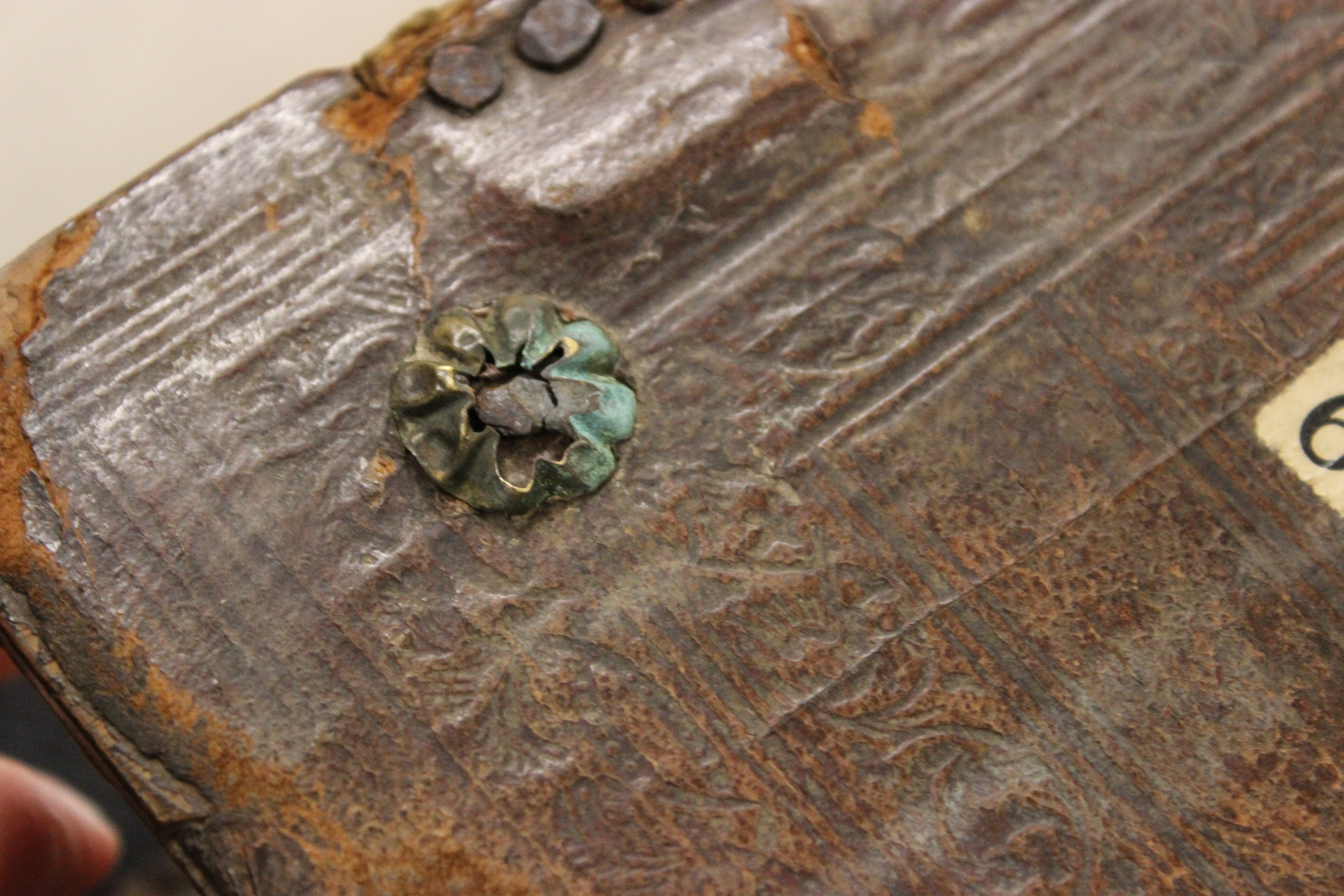
Jean Hasbrouck Family Bible, 1650. Detail showing copper ornament and leather bound cover. (Photo: © Miriam Ward)

The Hasbrouck Family is synonymous with Historic Huguenot Street and with the French Huguenots.  An object of great interest to the foundations of Historic Huguenot Street and one if its founding families is the Jean Hasbrouck Family Bible form 1650. This leather bound bible is extremely large and ornate. With over 500 pages, the bible remains almost in entire original form. With some restoration work done, the bible has a new bounding done by the historical society that reads “ Jean Hasbrouck French Bible.”

The cover and back of the 1650 Bible show wear and tear, revealing a strong wooden interior bound over the leather. Also, the front and back reveal copper straps that would have held the locks for the book. The first 11 pages of the Jean Hasbrouck bible are missing, including the important copyright page.

Provenance

Jean Hasbrouck Family Bible, 1650.

Jean Hasbrouck Family Bible, 1650. (Photo: © Miriam Ward)

Interior of the Hasbrouck Bible, including a handwritten genealogy. (Photo: © Miriam Ward)

The Jean Hasbrouck Family Bible holds a rich and telling history of both the Hasbrouck Family and the greater religious identity of the French Huguenots who settled in New Paltz, NY.  According to the Hasbrouck Family Website, the family name Hasbrouck is derived from a location, near the Ville d’Hazebrouck in Flanders (near Calais), France.The bible belonged to Jean Hasbrouck, one of the original patentees of New Paltz.  His exact birth date is unknown, but family histories put it at around the 1630s-1640s, outside Calais in France. Records show that Jean Hasbrouck died in 1714.  The history of the Hasbrouck Family comes to life when the bible is opened. Alongside the front cover and the back cover, lay hand written scripts detailing genealogy of the family. Unfortunately, many of these entries have given into deterioration and time, but many can be read. The eligible entries reveal to be the names of the children of Jean Hasbrouck and Anna Deyo. Their children were: Maria, Anne, Hester, Abraham, Isaac, Elizabeth and Jacob.  Jean married Anna Deyo in in 1676 in Manheim, Germany.  Jean Hasbrouck, left France and ended up in Mannheim, Germany alongside many other refugees. The bible stayed in the Hasbrouck family for years but the exact donor is unknown to Historic Hugeunot street, lost in time.

Narrative

Inside front cover of the Jean Hasbrouck Bible.

Inside front cover of the Jean Hasbrouck Bible. (Photo: © Miriam Ward)

The Jean Hasbrouck Family Bible is essential to the history of New Paltz. First of all, the bible reveals the incredible and rich religious history and ties that New Paltz was founded on. The bible, surviving and in the hands of Historic Hugenot Street today, shines immense light and importance of religious ties to the identity of the French Huguenots.

According to a family history compiled by descendant Kenneth Hasbrouck, the protestant church in Marck France burned around 1640 and the protestant population was forced to flee. Many French Huguenots at this time, fled to Mannheim, Germany for protection and with this haste transition could not bring many belongings with them. Even though it is not certain for sure, we can be fairly certain that Jean’s bible was made in France and that he brought it with him to Manheim, Germany.  Of the many objects to save and which to leave, the sheer fact that Jean saved this bible through such a tumultuous and changing time is very important.

Screen Shot 2015-04-16 at 10.03.51 PM

Jean Hasbrouck Letter of Recommendation, 1672 (Photo: © Historic Huguenot Street, Hudson River Valley Heritage)

Jean Hasbrouck, a founding patentee of New Paltz, received a ‘letter of recommendation’ from the French Church in Germany, confirming his and his wife’s good standing in the church, in preparation for his voyage to New York. The so called ‘letter of recommendation’ is striking. Written in 1672, this letter confirmed the relgious identity of Jean Hasbrouck and his wife. The fact that such a letter even existed gives us tremendous insight into not only the chaotic world that Jean Hasbrouck and his family lived in, but the importance of their religion to their life and identity.

The 1672 letter of recommendation shines a great light on the story of Jean’s bible. First off, it’s of importance because the weight and influence of such a letter of recommendation speaks to the importance of religion in the colonies. Further, the letter of recommendation speaks to the identity Jean and Anna Hasbrouck: that of French Protestant. The letter reads, “Jean Hasebruck and his wife are members of the Church Christ, and have lived among us during the time that they spent here, honorably & in a Christian way, attending the holy services, and taking Holy Sacrament of the Supper of our Lord Jesus Christ without scandal known to us. Thus we recommend them as such to our brothers in the Church where God will send them. Written at Mannheim in the Lower Palatinate this 17 March 1672 The leaders of the French Church in the said place & in the name of all…..” The letter of Recommendation from the French church in Germany cemented Jean Hasbrouck’s place in the colonies. The corelation between the family bible and the letter of recommendation goes hand in hand: the certificate allowed Jean and his family to join the church in the colonies by establishing their faith. The bible, materializes this faith.

The identity of French Protestant was central to the identity of Jean Hasbrouck, manifested in the family bible. On May 16th, 1672 Jean Hasbrouck and his wife Anna left Mannheim and sailed to Wiltwyck, New York in the Spring of 1673. In 1675, Abraham Hasbrouck sailed from Mannheim to Boston and ended up in New York to join his brother Jean and their small group of French Protestants. Jean and Abraham ended up becoming founding patentees of New Paltz, NY where they eventually settled.From a journey from Calais, France to Mannheim, Germany on a boat to New York Jean held onto his family bible. Jean and Anna ended up having seven children that they raised in New Paltz, NY. The names of the children are written in beautiful handwriting on the insides of the bible: Maria, Anne, Hester, Abraham, Isaac, Elizabeth and Jacob. In 1701, Jean Hasbrouck received permission from the Colony of England to “buy, sell, and trade lands, tenements, and hereditaments in this Kingdom…” The 1701 edict reveals the merchant nature of Jean Hasbrouck and how involved his family was. Jean, as a founding patentee of New Paltz, was extremely involved in the community. Along with his brother Abraham Hasbrouck and Louis Bevier, he served as the founding commissioners of the early courts of New Paltz. Serving in the court as a commissioner, Jean Hasbrouck held a very high status in the town.

Jean Hasbrouck will of 1712.

Jean Hasbrouck will of 1712. (© Historic Huguenot Street, Hudson River Valley Heritage)

In 1712, Jean Hasbrouck died. His last will and testament survives and has been translated by Historic Huguenot Street. The will, written in Dutch, reveals how Jean and his family were fluent in both French and Dutch. New York, after being a Dutch colony, certainly held onto its Dutch roots. The will conveys extremely devout and emotional language, conveying the importance of faith to Jean Hasbrouck. Jean writes, “…so I commend my Soul To God almighty my Creator and To jesus Christ my redeemer and To the Holy Ghost my sanctifier And my body to the Earth whence the same came from to be buried in A Christian fashion And rest there until my Soul and Body will be united upon the day of resurrection And receive the Eternal Bliss of salvation which God of his grace through the One merit of our savior has promised and prepared To all who have sincere and complete faith In him….” Jean Hasbrouck’s will of 1712 conveys how important and essential faith and religion were to his life. His bible reveals just that.

The Jean Hasbrouck Family Bible of 1650 conveys the centrality of faith to the life of the French Huguenots. In settling, and fostering, a community fleeing of religious persecution, Jean and his family were guided through faith.


Special thanks to Carrie Allmendinger of Historic Huguenot Street.

Works Cited

Fosdick, Lucian J. The French Blood in America. London: Flemming H. Revell, 1906. Print.

Hasbrouck, Jean. “Jean Hasbrouck Will 1712.” 1712.  Handwritten text. Historic Huguenot Street, New Paltz. Hudson River Valley Heritage. http://hrvh.org/cdm/compoundobject/collection/hhs/id/1491/rec/11

Hasbrouck, Jean. “Jean Hasbrouck Letter of Recommendation 1672.” 1672. Handwritten text: Manheim, Germany. Historic Huguenot Street, New Paltz. Hudson River Valley Heritage. http://hrvh.org/cdm/singleitem/collection/hhs/id/16/rec/2

Hasbrouck, Jon. “Hasbrouck, Our Family Name.” Hasbrouck Family. Web.  http://www.hasbrouckfamily.org/name.htm

Hasbrouck, Kenneth E. The Hasbrouck Family in America with European Background. Vol 1. New Paltz: Hasbrouck Family Association, 1961.  Print

Lawrence, Thomas. “Notary- Certificate to Jean Hasbrouck.” 1701, London. The Hasbrouck Family in America with European Background. Vol 1.

Roth, Eric. “New Paltz Town Records (1677-1932).” Historic Huguenot Street. Web  http://www.huguenotstreet.org/new-paltz-town-records/?rq=jean%20hasbrouck

Hand Forged to Machine Cast: Metal Work on Huguenot Street

Ironobj1Door1

This iron object may be a simple screwdriver or part of an old shutter fastener. Although its age and exact purpose are unknown, it is clearly the work of skilled blacksmith who poured time and sweat into its crafting. In contrast, the bronze door knob and escutcheon on the Deyo House, made in the late 1800s, were likely machine cast and mass-produced. Together, these objects chart the economic and cultural impact of the Industrial Revolution on the New Paltz community.

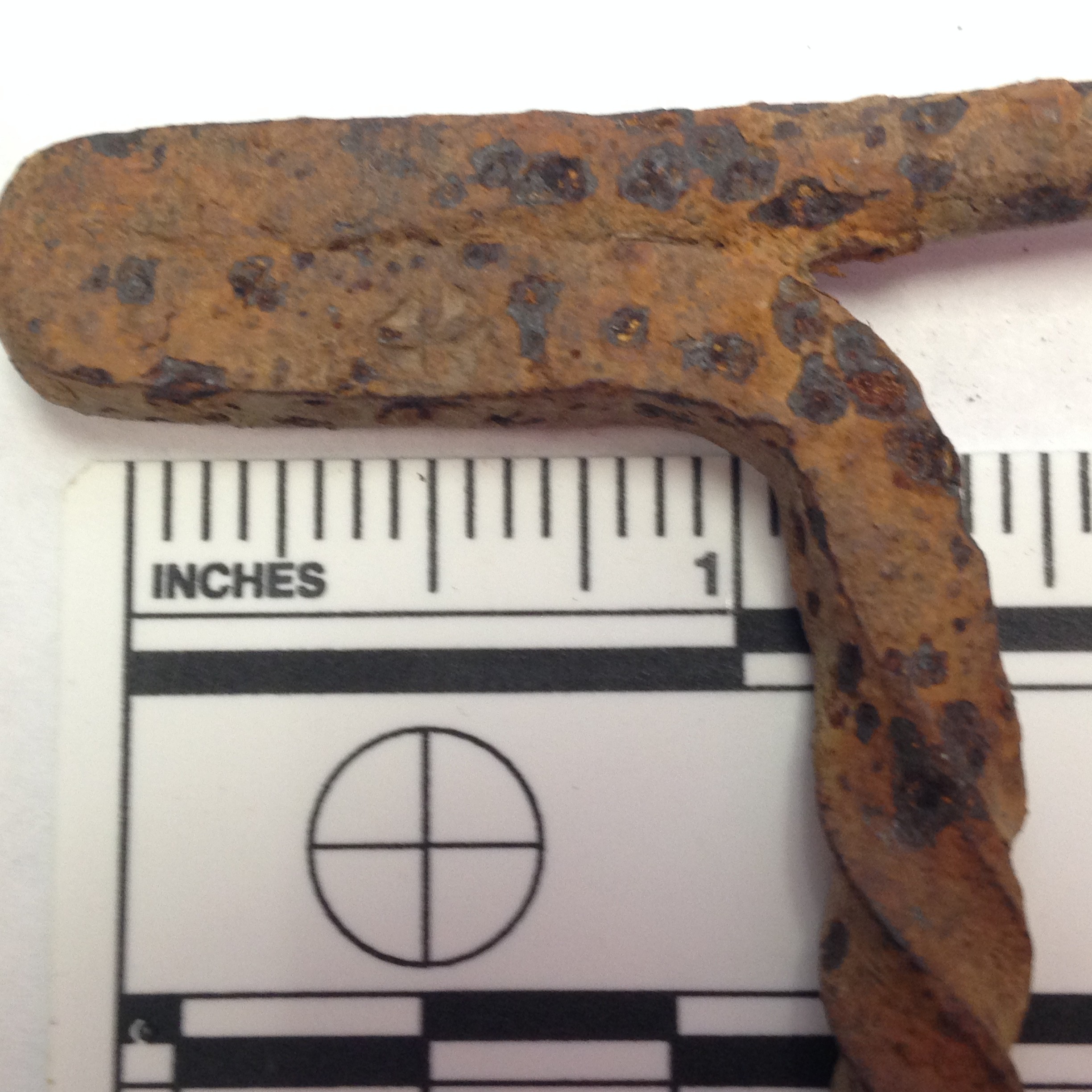
Roughly three and a quarter inches long and three inches at its widest point, the iron object resembles a rusty capital “T.” A close inspection of the wide bar indicates that the object was formed by hammering a single piece of iron into shape, making one end of the bar a little thicker than the other. It also reveals a small maker’s mark on one side, a little cross engraved into a circle, so small it is almost lost in the rust. Extending perpendicularly from the wide bar is a long shaft that spirals into a long flat point similar to the tip of a flat head screwdriver. The similarity has raised the possibility that the object is an unusual but well-crafted screwdriver. However, the spiral of the shaft and the delicate taper of the wide bar also resemble the decorative elements found on wrought iron shutter fasteners. Attempts to establish a more concrete identity for the object have been foiled by its sheer uniqueness.

Just above the half inch mark on the rule lies the faint imprint of a maker's mark.

Just above the half inch mark on the ruler lies the faint imprint of a maker’s mark.

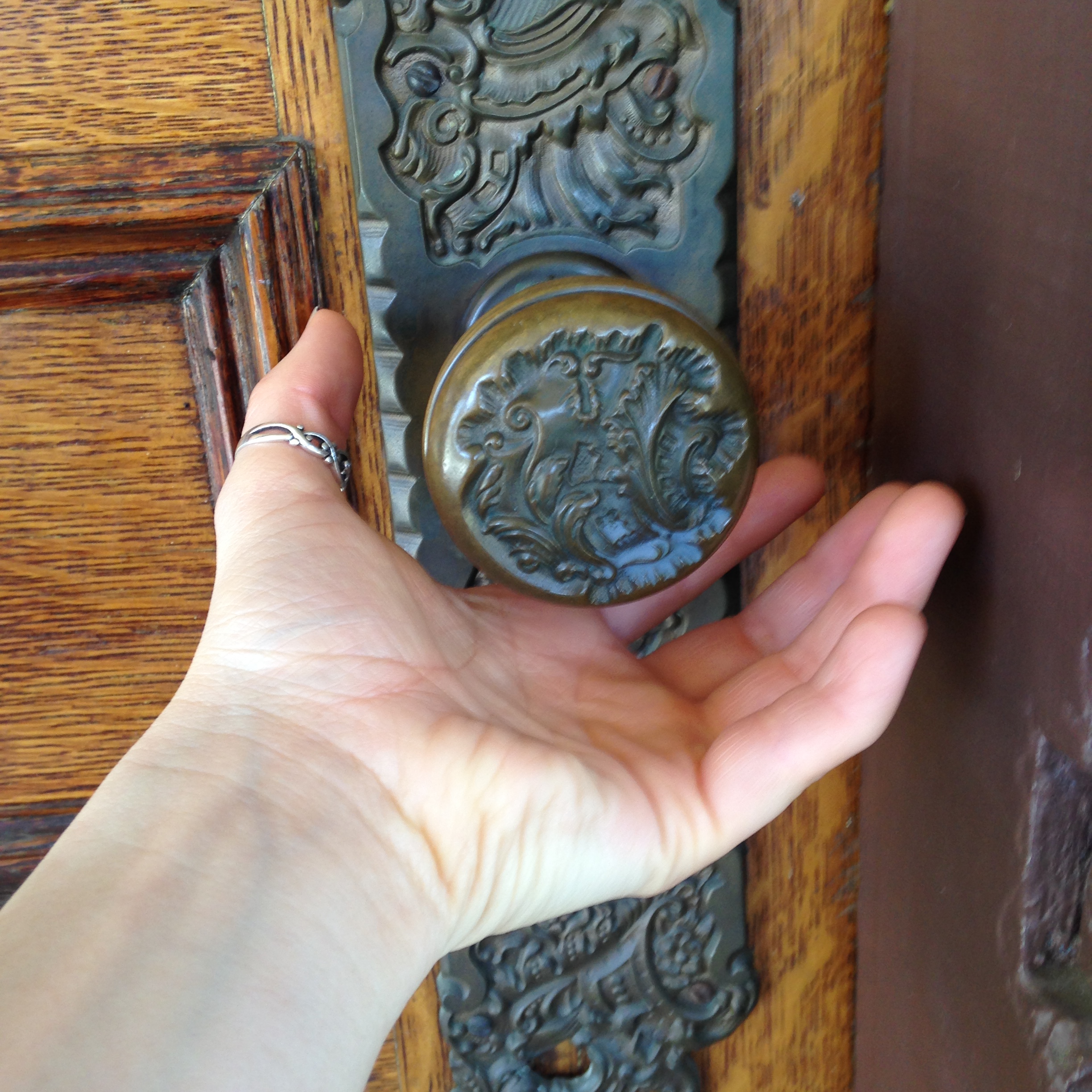
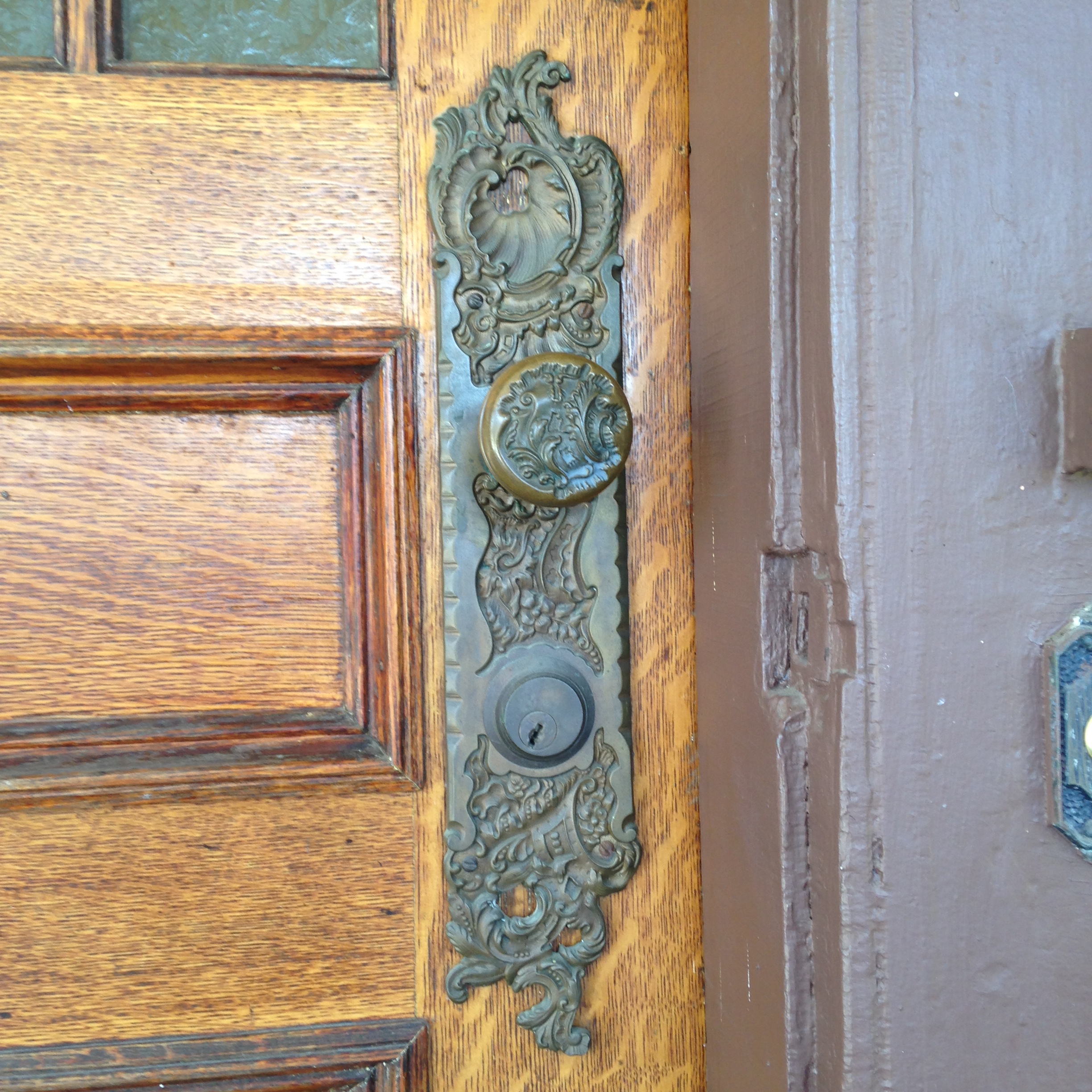
If the iron object is too unique to be defined, then the bronze door knob and escutcheon (the decorative plate around the keyhole) are perhaps too common although they might not appear so at first. Both the knob and the escutcheon have an elaborate floral pattern cast on the surface, giving the set an elegant, eye-catching air. The escutcheon is especially attention-grabbing. Measuring sixteen by three inches, it is a roughly rectangular shape. However, the top and bottom have been molded into the form of acanthus leaves, creating an asymmetry that draws the eyes away from the relatively simple wood door to the more impressive hardware. Although the bronze has become dull and tinged with verdigris, one can imagine that its original burnished gold color would have made the set even more beautiful. While there is no visible indication of who made the set, Weston Davey, Historic Preservationist for the Historical Huguenot Street, suggests that it was probably machine cast (Davey).

The acanthus leaves  at the top and bottom of the escutcheon are beautifully molded, giving the otherwise rectangular shape a fluid appearance.

The acanthus leaves at the top and bottom of the escutcheon are beautifully molded, giving the otherwise rectangular shape a fluid appearance.

Found during a recent archeological excavation near the Deyo house, the iron object’s ownership remains as much a mystery as the date of its making and its true function. However, Joseph Diamond, a professor at SUNY New Paltz and the head of the excavation, notes that if it is indeed a screwdriver, it is possible that it came from a kit used to maintain muskets (Diamond). If this is true, then the object would likely be carried around with its owner in times of conflict or on hunting trips in order to make potentially life-saving adjustments. Yet, it is just as possible that the object was once attached to one of the several structures that used to exist on the lawns between the Deyo house and the Bevier-Elting house, making it a far more stationary, and perhaps less dramatic object. Regardless of whether it was a tool kept close at hand or a piece of house hardware, it seems likely that the object served some functional purpose in the daily life of an early New Paltz resident. Perhaps even more importantly, the maker’s mark on the side indicates that it was the work of a craftsman who took pride in his work and wanted it to be recognized.

In contrast, the door knob and escutcheon, were likely purchased from a catalogue by Abraham and Gertrude Deyo-Brodhead when they chose to renovate the Deyo house in 1895. They have remained there ever since although the house has changed hands three times. The last owner, Harold L. Wood, sold the house to the present owner, the Huguenot Historical Society, in 1972.

The tension implied between the handcrafted, locally made iron tool and machine produced, nationally distributed door knob comes to a head in the 1895 renovation of the Deyo house.  Built by Pierre Deyo around 1692, the original Deyo house was modest stone structure not unlike the neighboring Bevier-Elting house. While later descendants added a wing to accommodate the growing family, the exterior of the house otherwise remained relatively the same. This changed when the Deyo-Brodheads inherited the house in 1893. Abraham and Gertrude were proud of their Huguenot heritage (both could trace their family line back to Christian Deyo, patriarch of the Deyo family and a signer of the original patent), but they nonetheless desired a grander space than the stone house built by their ancestors. In her summary of the Deyo house history, Jaquetta Haley suggests that their ambition was curbed only by a lack of funds. Most of the couple’s income was drawn from relatives or revenue from the horse racing track that Abraham had built across the Wallkill. However, in 1890, Abraham’s paternal great uncle died, leaving the family a substantial amount of money. Almost immediately after taking ownership of the house, the Deyo-Brodheads began making plans to renovate, transforming it from a simple stone house to a Queen Anne Style manor.

Almost every feature of the house is meant to impress even, as we have seen, the door knob on the front door. Yet, the grandeur rests on a certain superficiality made possible in part by the relatively new ability to mass produce luxury items using machine labor. The result was seemingly elegant items that could be afforded by the rich and the aspiring rich alike. The bronze door knob and escutcheon are an excellent example. The beautiful acanthus design gives the impression of being well-crafted. However, a quick scan of the door knob and lock section of the Montgomery Ward and Co.’s Catalogue and Buyer’s Guide for Spring of 1895 (around the time the renovations began) reveals several similar knob and escutcheon sets all selling for around a dollar (approximately twenty-five dollars today). This reproducibility signals a changing dynamic for the residents of New Paltz. Not only were craftsmen such as the blacksmith who made the iron object rendered obsolete, hastening a shift in the local economy, but the culture had also shifted from the practical aesthetic of the early settlers to an aesthetic of ornate imitation.

Reference

Davey, Weston. Personal Interview. 9 Apr. 2015.

Diamond, Joseph. Personal Interview. 13 Apr. 2015.

Haley, Jaquetta. “Furnishing Plan: Deyo House.” New York: Huguenot Historical Society, 2001. Print.

The Fabric of History

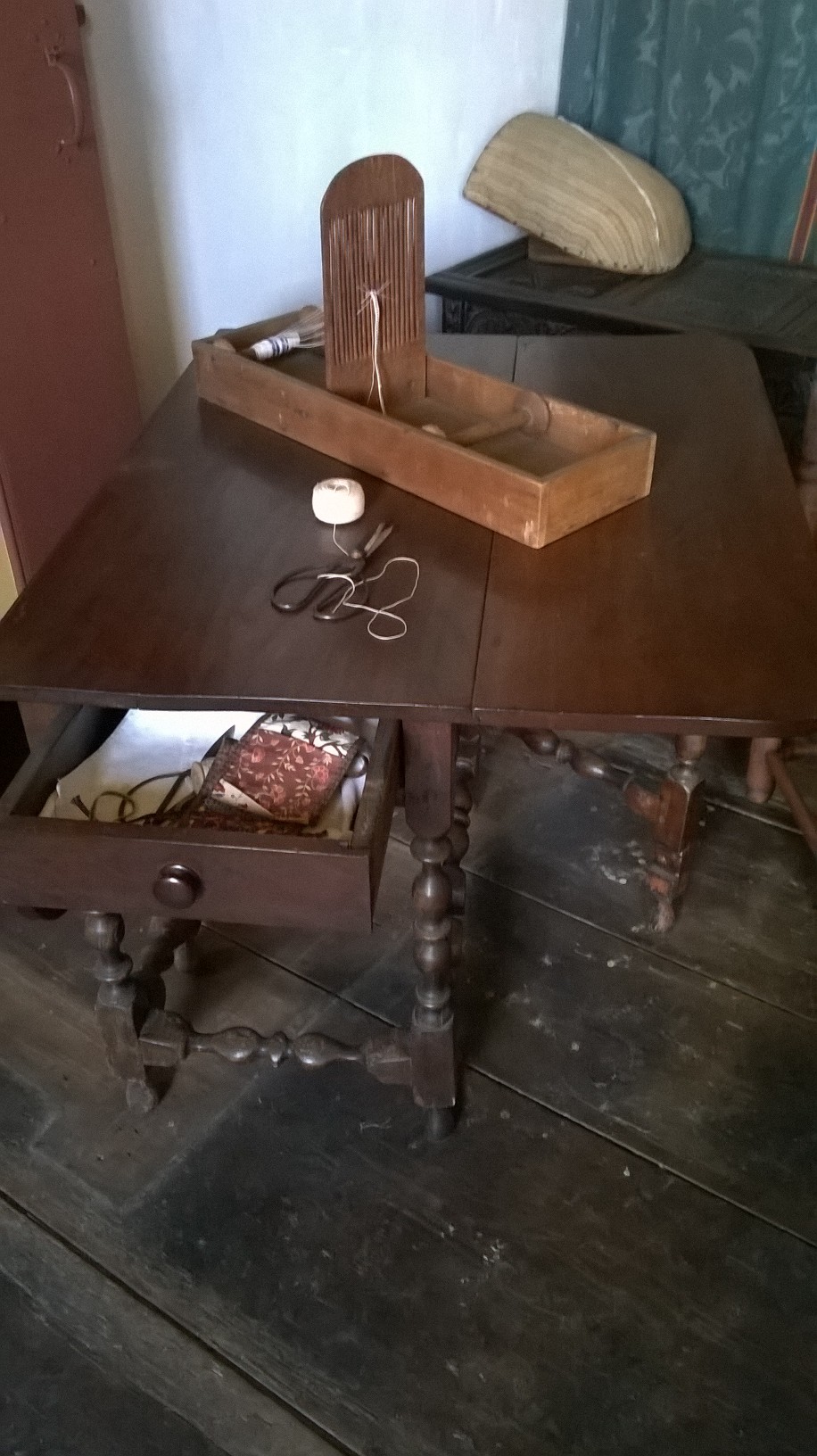
Although the contents of this simple table are unassuming and seemingly unimportant, the table actually displays a piece of technology that would become an important token household item during the establishment of the colonies.  This tabletop hand loom consists of a sturdy, hollow wooden base about one to two feet in length. Inside of the base is  a thin board with slots cut out of it at perfectly even intervals to create little bars; on these bars is cast a newly-begun fabric tape. On both sides of the board are rotating wooden dowels, one of which holds the thread being fed into the piece, and the other of which is empty but may very well have been designed to have the finished tape wound around it.

WP_20150401_11_12_45_Pro

3/4 view. A finished tape is faintly visible, draped across the cushion on the trunk in the background.

A very small hand loom, likely used by a young girl to weave long fabric tapes. These tapes were in high demand in colonial households for their usefulness in binding things together, as well as adjusting the fit of clothes as a money saver.

A back view of the loom. The weaving would actually be done on the end where the thread was being fed into the work, and the finished tape would gather at the back. 

During the mid sixteenth century, the textile industry thrived in Europe as well as in the colonies. The demand for trained textile workers was so great that, despite its being a predominantly Catholic nation, King Edward VI actively encouraged foreign Protestants to come and find work in England in 1549; the result was an influx of Protestant immigrants primarily from  France and Germany (AFM 214). In 1598, with the passing of the Edict of Nantes, Protestants were officially recognized and given a much wider range of religious and personal freedom; this cessation of the religious wars in France caused the textile industry there to grow significantly and, by 1646, French Protestant textile workers were known for their fine woolen fabrics (216). In 1685, when the Edict of Nantes was revoked and persecution of the Huguenot people resumed, the majority of them fled France in a panic, many relocating to England and other parts of Europe, and others settling in the New World.

The tabletop hand loom pictured here would have been used by a young girl. In the colonies, like in Europe, the majority of work to be done consisted of manual labor, a task considered unsuitable for women of the era. However, the need for more income was apparent to the Huguenot settlers, and as a result, women took up spinning and weaving (also referred to as knitting)–the typical “women’s work”–as a source of income. Family workshops became the norm throughout all of the colonies, to such an end that almost every household contained at least one “knitting frame” (loom) and one spinning wheel (217). The youngest girls would first learn the basics of weaving on miniature looms like this one, making long woven tapes that could then be used for a variety of household purposes, such as tailoring clothes or binding together items. As they grew bigger and their skills matured, young women would learn to weave cloth, some of which was used in the home and most of which was sold for profit both domestically and overseas. WP_20150401_11_13_00_Pro

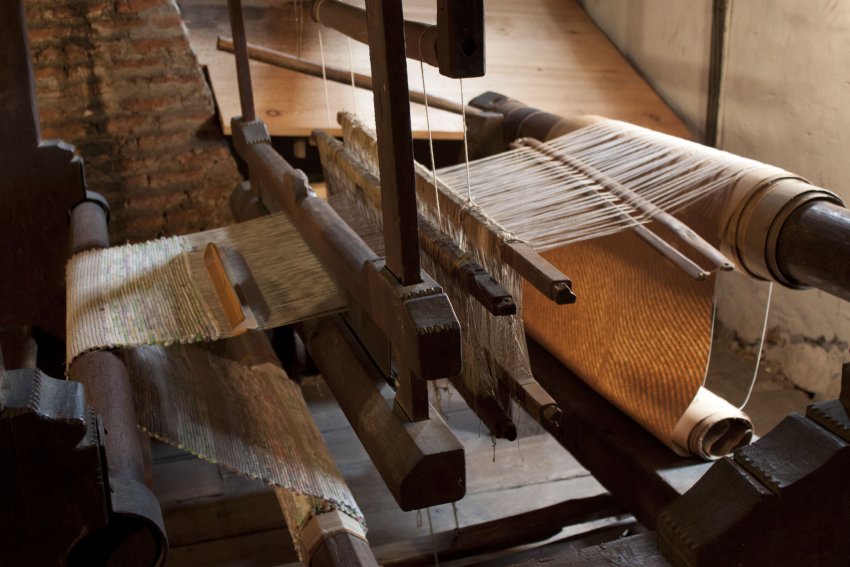
An example of the weaving process on a large adult-sized loom

An example of the weaving process on a large adult-sized loom

The Mysterious Ticking Noise

I spotted the clock on our class visit to Huguenot Street. Sitting on the mantle next to Abraham Lincoln, the beautiful timepiece with it’s elegant rose design captured my attention. It’s shape reminds me of a jukebox.

IMG_4297

This clock, according to Historic Huguenot’s archive, is described as having a “rectangular shaped base with molding, case with straight sides and arch at top, round clock face, white with black Roman numerals, hinged door closes over face, two round carved forms above hinged angular door with glass painting of a rose, door opens to clock works (all enclosed) two carved applied spindles gold leafed on either side of clock front, small pin for setting time.” It is from the late 19th century and is made out of wood, metal, and glass. The clock face is a little dirty and gilt and paint are coming off, but otherwise it is in pretty good condition.

1163 (

The above images are not my own, because when I went back to look at this object, the door to the Deyo house could not be opened and Ashley Trainer, who had been helping me, said the only way we would be able to get it would be to break in unless someone came to fix the lock. The clock is a mystery to me, and hopefully when I receive word that I can get back into the Deyo house, I will be able to discover more information behind it.

Historic Huguenot Street: Dutch Oven


The Dutch oven currently residing in the Abraham Hasbrouck house, gives a delicious start to interpreting the past on Historic Huguenot Street.

The Dutch Oven currently residing in the Abraham Hasbrouck house, is just one of the many cooking tools that were used by the female slaves. We can use this object as a clue to help figure out the untold stories of the slavery on Historic Huguenot Street. 

Physical Description:

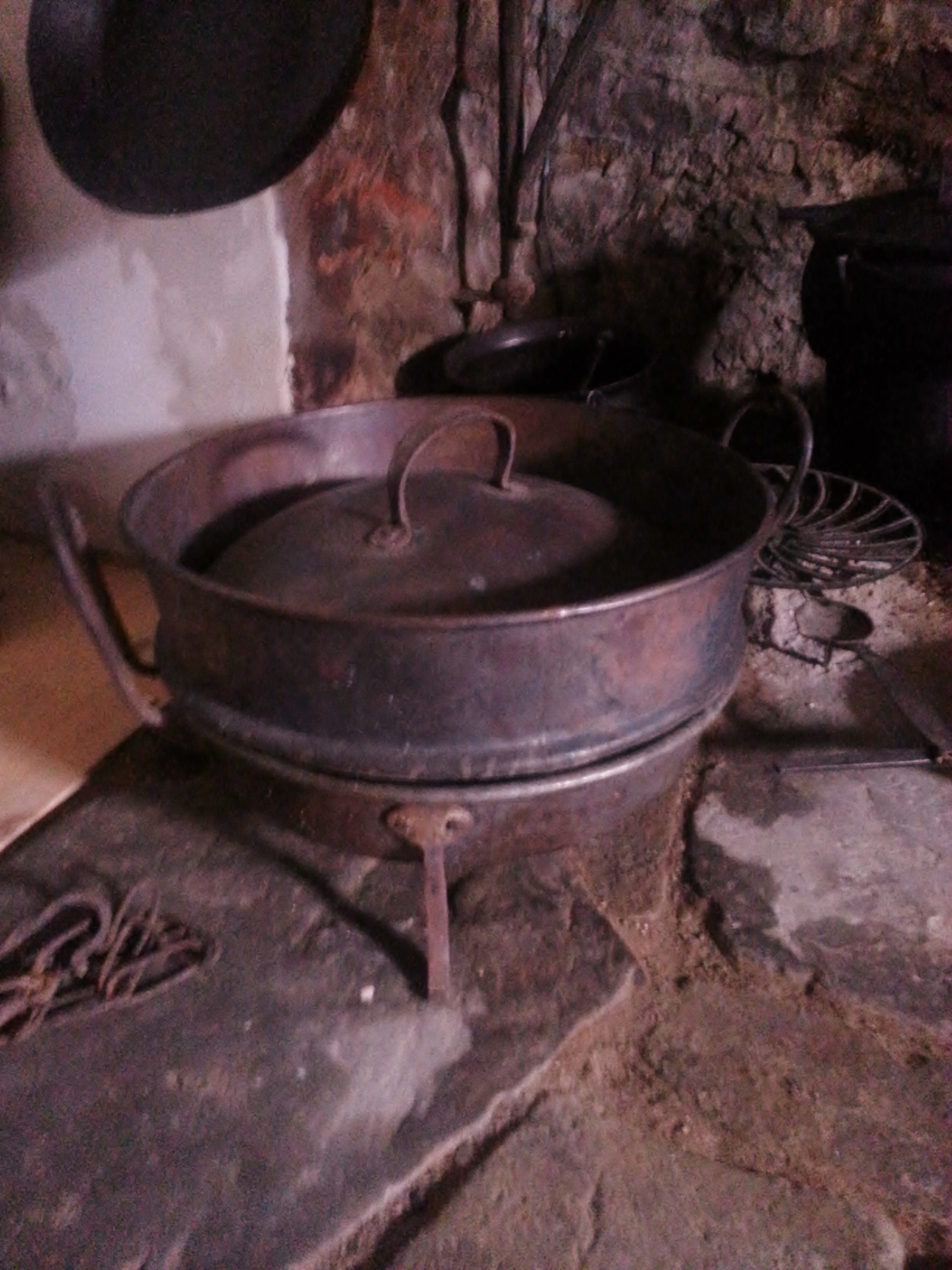
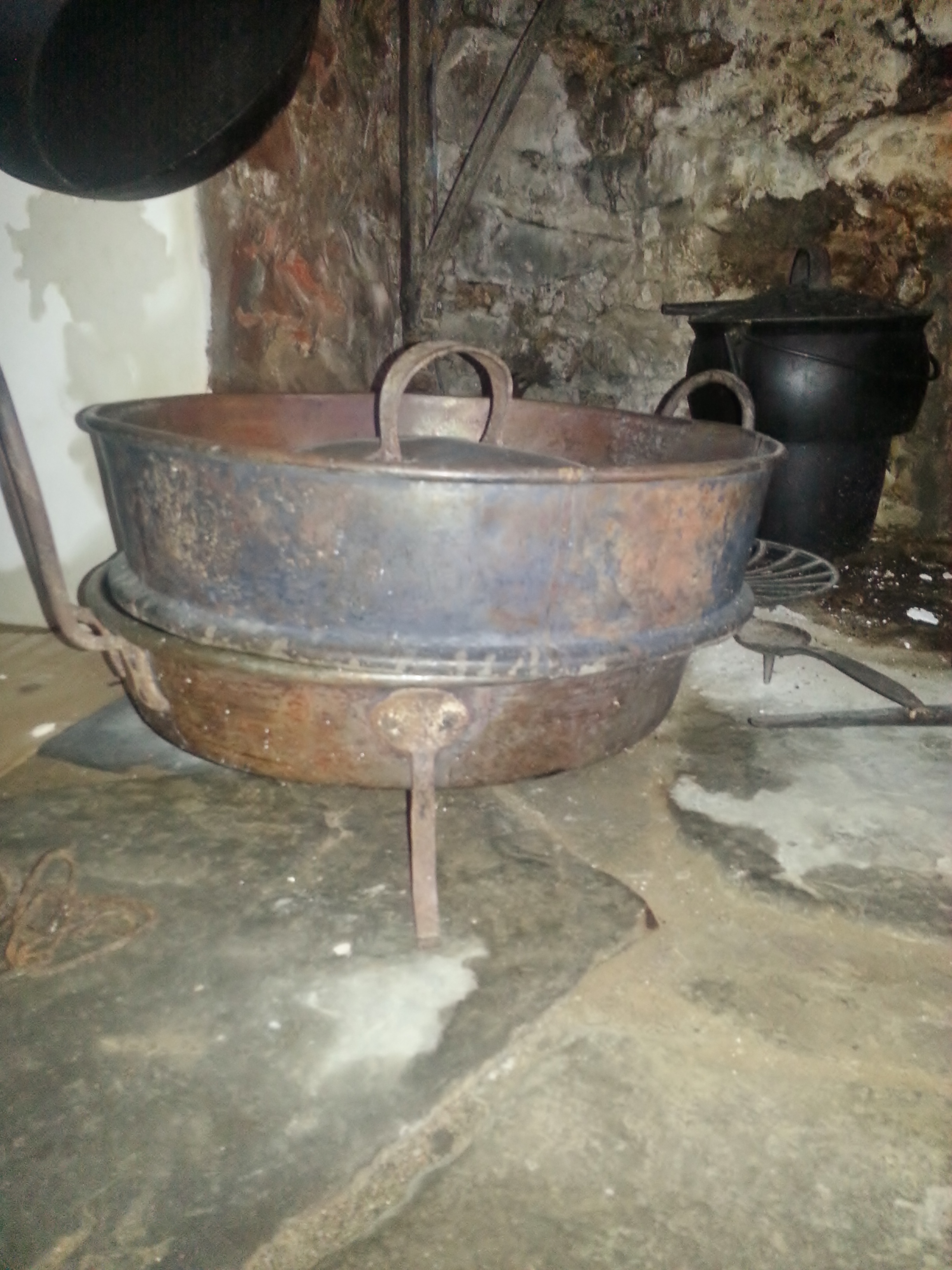
The Dutch Oven in the Abraham Hasbrouck house is 12 inches in height and 20 inches in diameter. There are two pieces; the lid and the base. The lid has one main handle in the middle on the top and the base has two handles across from each other on the sides. The base also has three legs on the bottom which allows for heat to be placed underneath. The handles and the legs are made of wrought iron. The shape of the Dutch Oven is circular and the base and lid follow this shape in unique ways. The lid slightly raised in the middle and dips down closer to the edge; however, the lid is mostly a flanged for heating purposes. The base caves in a tiny bit towards the center. The copper on this structure has been oxidized and the surface feels gritty to the touch.

Provenance:

The female slaves in the Hasbrouck households would have frequently used a Dutch Oven for its wide spectrum of capability. This particular example of a Dutch Oven is borrowed from Locust Grove. Locust Grove is a historic estate, museum, and nature preserve. The Mansion on Locust Grove was built in the mid-nineteenth century. It was built for the artist and inventor, Samuel Morse. This property was then handed down to the Young family and from there has been “protected in perpetuity” since 1953 (lgny.org). When the Young family first moved in, the house was prodominately redecorated. If the Dutch Oven currently residing in the Abraham Hasbrouck house was originally from the Morse family or brought in with the Young family, it cannot be older than roughly 150 years.

The Dutch Oven can be used in both an outside fireplace and inside fireplace. The aged and weathered texture shows how used this particular piece has been. The idea of the Dutch Oven exists in many cultures all over the world.  The original prototype is not clear; however, the impact of the Dutch Oven is very relevant. There are different names for this one idea, but labeling this oven “Dutch” circulates in literature during the 18th century (Evans). The first Dutch Oven to be brought or made in America is yet unknown. One hypothesis suggests that an Englishman named Abraham Darby went to Holland and observed the techniques for making these ovens, then spread this information (Evans). Whether the oven is Dutch or from another culture — this invention is able to travel well and is used for incredibly interchangeable ways of cooking food.

Narrative:

In the Hasbrouck households of Abraham and Jean, the most used rooms were the slave quarters. The slave quarters in each house were comprised of one cellar room. This one room would transform from a bedroom at night to a kitchen during the day. The female slaves were the ones who ran the kitchen. Their tasks were centered around the fireplace because the fire was the source of life for the food they produced for the Hasbrouck households. The slave quarters in the Abraham Hasbrouck house had low-ceilings and little ventilation. The smoke and soot from the fire defined the quality of air the women were breathing all day as they worked. The fireplace in the Abraham Hasbrouck house has a huge hearth which made space to orchestrate many forms of cooking at once.

There are no records of what a day was like for female slaves because there are scarcely any documents giving any sort of context about their lives. The only documented clues we have to their lives are in wills and runaway notices. The wills connected to the two Hasbrouck brothers give the possible opportunity to find any mention of the female slaves they owned. Mary Hasbrouck, wife to Abraham, left in her will to her son Daniel two slaves; “I give and bequeath to my son Daniel… gold, silver and negro and negress” among many other things she names (hrvh.org). Jean Hasbrouck left his daughter Elizabeth the slave named Molly; “I give to my daughter Elizabeth… my negro woman named Molly” (genealogy.rootsweb.ancestry.com). Molly enters the story around the early 18th century. Her name represents countless other slaves who have never been written down. All of the tools used for cooking hold some aspect of an untold story of the female slaves who have handled these objects. As the Dutch Oven helps us dissect just one part of a greater whole — Molly helps us by standing for the female slaves. She represents the endless possibilities of stories we will never know.

The Dutch Oven has a perfectly fitting name in French — “faitout” — which translates “to do everything” (Chappell). During the time this type of oven was used by Molly and the other female slaves of the Hasbrouck households, it certainly did live up to its French name. This invention has an incredible spectrum of versatility. Depending on where the heat is placed, this structure can perform multiple different tasks. The oven then receives heat from a ratio of hot coals.  Molly could use the Dutch oven for roasting, baking, making a stew, frying, etc.. If she wanted to roast meat, she would have to fuel the oven with heat from both the top and the bottom. She would place coals underneath the base and on top of the lid in a one-to-one ratio because roasting requires relatively equally dispersed heat. If Molly was baking bread, she would have to place more coals on top because most of the heat should come from the top while baking. If Molly was making a stew for the day or simmering some soup, mostly all of the heat would come from the bottom and so she would place the hot coals underneath the base.

In order for each meal to be cooked well, Molly would have had to develop a sense of balance for how many coals go on top or bottom and how the ratio affects the meal. Molly also had to be aware of avoiding hot spots. About every ten minutes or so she would have had to stop what she was doing and rotate the pot and lid in opposite directions (Evans 78). This would prevent the food from heating up in just one spot.

Dutch Oven

The oven currently in the Abraham Hasbrouck house is made from copper. Other Dutch Ovens were made from cast iron. Both materials are metals and therefore the heat conducts throughout the structure making both just as precarious for burns. The hot coals combined with the steadily heated oven, procures a chance for danger. The only descriptions we have of the slaves in New Paltz are from runaway slaves notices. Some descriptions include pockmarks and hunched backs because the living conditions were awful. The ceilings were low and they were expected to travel all day throughout these rooms (Weikel). For a small room with a huge fireplace filled with many different sources of burning metal, hot coals, flames, and boiling water… it is difficult to imagine that nothing happened.

How do we know what the day of a female slave was like? How really do we know what they did? The jambless fireplace of the Abraham Hasbrouck house gives us clues and the exact implications of using the Dutch oven gives us even more context. Even still, the amount of attention that went into one appliance is only a small fraction of the work completed in the kitchen on any given day. Besides the actual task of cooking, there is preparation and clean-up. The Dutch oven needs consistent attention after careful consideration of where to place a certain amount of heat for each specific dish. This gives a glimpse of how much interaction all of the materials on the fireplace might have had. There are so many other cooking tools and this one example of a Dutch oven is just part of a bigger whole.

References

Chappell, Mary Margaret. “The everything pot: there’s not much a Dutch oven can’t do.” Vegetarian Times 2014: 38. Academic OneFile. Web. 27 Apr. 2015.

EVANS, MATT, and JOHN EVANS. “The Dutch Oven.” Countryside & Small Stock Journal 94.3 (2010): 78. MasterFILE Premier. Web. 19 Apr. 2015.

“Hasbrouck Douments.” Hasbrouck Documents. Ancestry.com, n.d. Web. 24 Apr. 2015.

Kelly, Shirley. “History of the Dutch oven.” Countryside & Small Stock Journal 2013: 56. General OneFile. Web. 23 Apr. 2015.

“Mary (Deyo) Hasbrouck Will of 1729 :: Historic Huguenot Street.” Mary (Deyo) Hasbrouck Will of 1729 :: Historic Huguenot Street. Trans. David Wilkin. Hudson River Valley Heritage, 10 Nov. 2010. Web. 23 Apr. 2015.

“The Mansion | Locust Grove.” Locust Grove The Mansion Comments. Locust Grove Historic Estate, 2011. Web. 13 May 2015.

Weikel, Thomas. Personal Interview. 8 April 2015.

Arrowhead from Huguenot Street

CreationWhat do you need to score a meal? In 1450, a Lenape (Munsee) or Esopus hunter would need much more than a fork and knife. They would most likely use a bow and arrow, crafted by hand from scratch. Lenape bows were self bows, or a bow made from a single piece of wood with a sinew bow string. Bows were around 57-62 inches in height, almost as tall as a man (Campisi and Hauptman). The accompanying arrows had wood shafts, made out of fine grain wood rods or canes. The wood would be skillfully straightened through a process of soaking, heating, bending and reshaping. Once straight, the shaft was shaved to a uniform diameter, and then sanded and smoothed by being drawn back and forth on a slab of rough or fine grained sand stone (Kraft).

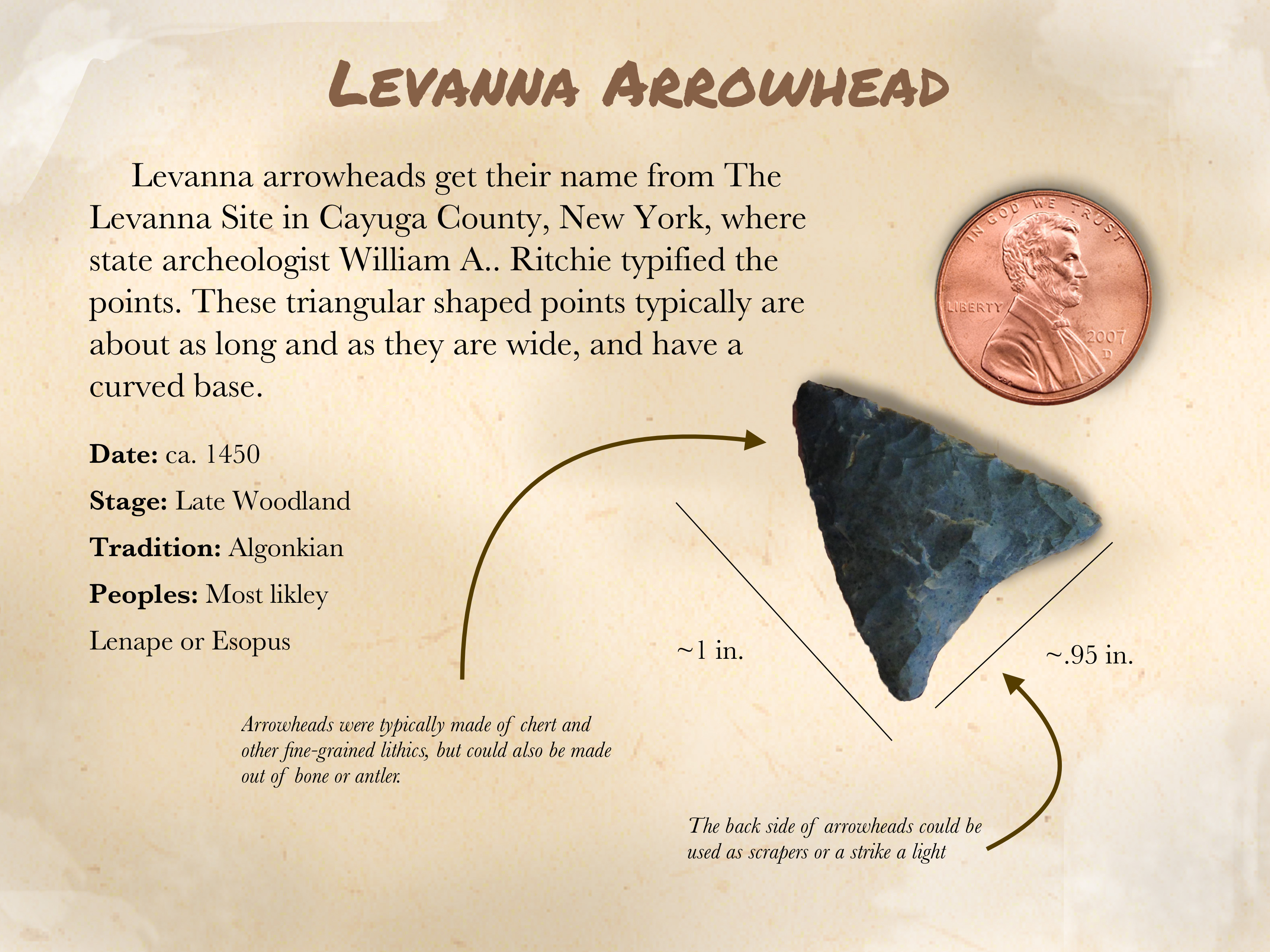
The arrowhead would be made out of local stones, cherts, flints, quartzite and siltstones (LITHICS-Net, “Point Type: Levanna.”). The edges of the arrowhead were made sharp via a pressure flaker, or a sharp piece of bone or wood, that could chip at the edges until made sharp. Arrowheads come in many shapes and sizes. Hunters in and around the area that is now Historic Huguenot Street would most likely be using Levanna or Madison arrowheads. The difference in arrowheads is usually based on shape, with Levanna arrowheads being more equilateral and Madison more isosceles.

After the arrowhead was made it was secured to the shaft. At the end of the shaft would be an incision, in which the arrowhead could be placed. Then, the arrowhead was further secured with resin or wet sinew wrapped around the shaft and the lower extremities of the arrowhead. As the sinew dried it would shrink, strong securing the arrowhead further (Kraft).

Physical Description of the Object: The arrowhead below is an excellent example of a Levanna arrowhead, it’s nearly equilateral in shape and has a concave base. It’s very small, as seen compared to the penny. Standard visual classification puts this Levanna arrowhead in the quartzite family; the rock’s small but visible specks classify it as metamorphic (not siltstone) and its dullness is similar to that of other samples (not chert or flint). It’s about an inch both ways and feels good in the hand, and probably better at the tip of an arrow.

Arrowhead2

Photo credit Nabi Jung

Lenape and Esopus hunters of the Late woodland period “probably carried a pouch full of triangular points ready to replace arrowheads broken in use” (Kraft). The arrowheads in this pouch could be used for more than just a projectile. The sharp point could be used for skinning game or dismembering for easier transportation. The back edge of an arrowhead could be used as a scraper, or if made out of flint a strike a light. If used for either of these purposes, the back edge would become dull and polished or vitrified.

The arrowhead from Huguenot Street has no signs of dulling on it’s back edge. Though time has worn then down, one can feel what remains of the sharp edges, along with indents of the stone that was chipped off with the pressure flaker. There are also no signs of resin or sinew from when, or if, it was tied to a shaft. Then how did it end up on the ground? Say it was once tied to a shaft and was shot in a hunt. What was the hunter after? Or in other words, what’s for dinner?

Photo credit Nabi Jung

Photo credit Nabi Jung

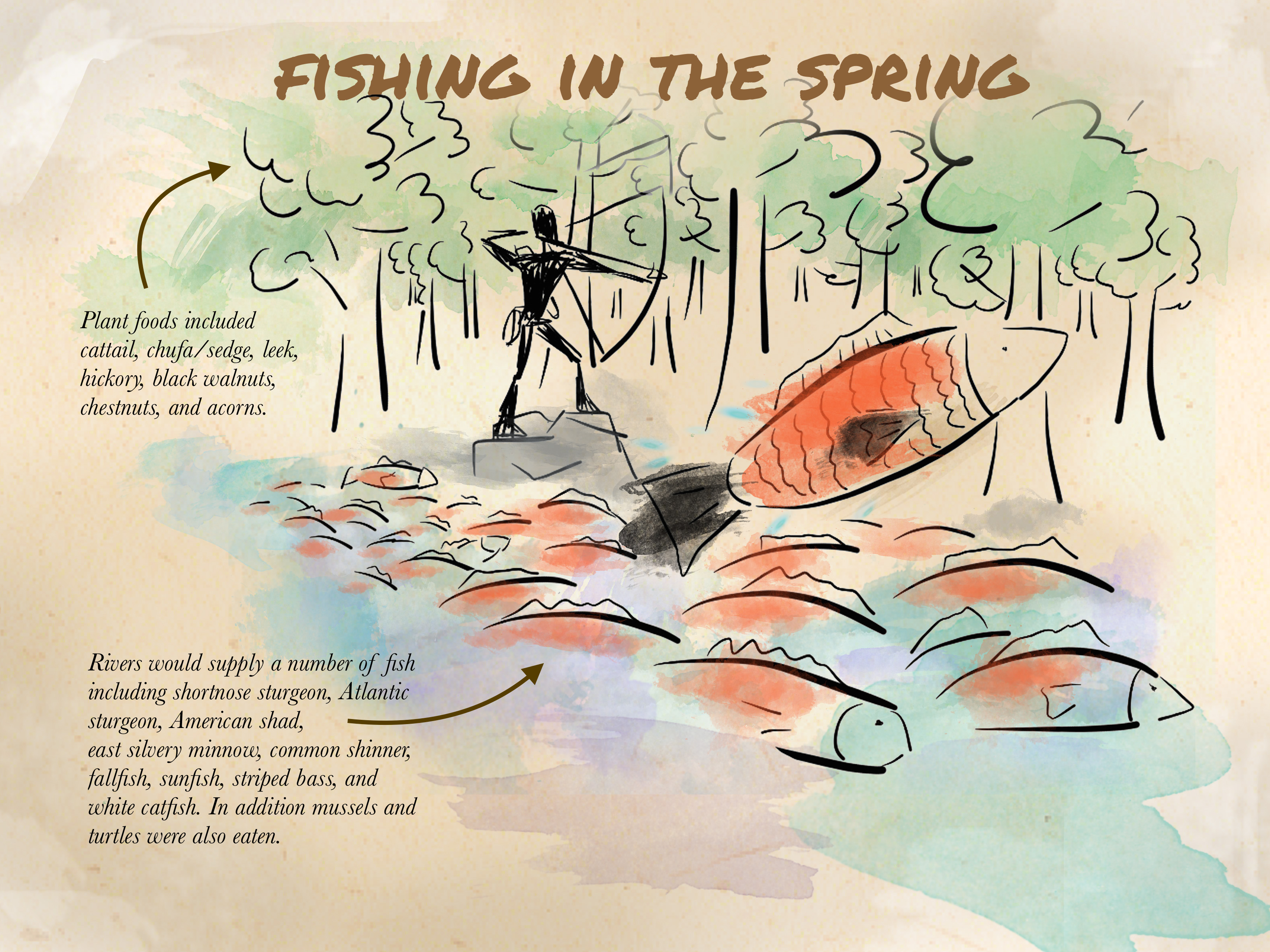
Narrative: There was a lot of large game in the area for hunting, even bison, but more common were elk, black bear, raccoons, turkeys, geese, turtles, fish and mussels. Bows and arrows were just as much employed for shoot fish as they were in war and hunting (Beauchamp). The largest quantities of protein available were during the spring where what must have astronomical numbers of shad, herring, striped bass, Atlantic salmon, and other fish swam up the Hudson and its tributaries (Funk). Historic Huguenot Street is located very close to the Walkill river, so maybe this arrow was shot at a fish, the fish swerves, the arrow misses, and it hits a rock. Snap! Off goes the arrowhead. The hunter doesn’t pick it up, he has more arrowheads in his pouch and besides, it’s spring, and he’s busy aiming at what will be the next of many catches today.

Or maybe not. There are no large chips on the arrowhead from collision with another rock. Maybe it hit something softer, something like flesh. It’s fall now, open season. One could pace after a elk or deer until it got exhausted and then club it to death, but who likes running? Hunters spot a herd of elk. They split up, slowly, trying to stay down wind as the surround the herd. Each hunter takes their position, and uproots the grass in front of him. Then he takes a piece of flint (maybe even an arrowhead) and starts a fire, with the uprooted grass preventing it from running back (Kraft). The elk run towards the center of the circle and the hunters follow, soon they are surrounded.

This is one theory behind the practice of burning forests. Burning was also another way of clearing fields for planting. In addition to the diverse protein options there were many plant options available. On an archeological site in Hurley, only 15 miles away from Huguenot Street, Professor Joseph Diamond excavated a number of plant and animal remains from ground pits. Among these were maize, acorns, black walnut, hickory, butternut, chestnut, and raspberries and blackberries. Discarding plant remains in these cleared areas would also make the soil more fertile, and promote these plants to regrow naturally in these areas (Diamond).

Clear land, along with high concentrations of edible plants, makes this land very attractive to deer and elk. It is much easier to hunt if you know where your prey will be. Professor Diamond believed that burning forests served these latter purposes rather than the first, and that hunting was more on a one to one basis. He mentioned the winter, as other sources had, when bears are fat and lethargic and snow is almost up to a deer’s belly. These factors make hunting easier, especially if one is equipped with snow shoes, though none have been found in the area (Kraft). Hunting in the winter would still require the hunter to stay downwind, slowly moving in closer, trying to mimic the quiet of the soft snow. As the elk looks away. Only the faintest rush breaks the silence as the arrow is drawn, the sinew pulled, the shot fired, and the elk falls dead.

Arrows designed for hunting were made specifically so that the arrowhead would not detach from the shaft. This was because arrows were usually recovered when hunting game and could be reused. There were some arrows designed to release the head when pulled out of the flesh. These were the arrows for people. In war, an arrow shot that was not fatal and then removed intact could be reused by one’s enemy. Whereas an arrowhead that was laced with poison, shot into an enemy, and then remained lodged in the body as the shaft was removed, proved to be much more deadly (Kraft).

Excavation

Photo credit Nabi Jung

Provenance: It would be hard to find out whether the Huguenot Street arrowhead was one of such arrowheads. If anything, knowing humans, it was probably dropped on accident. Once it hit the ground it stayed there as 46 cm of dirt piled onto of it. Above ground the world it once knew was disappearing; its creator ventured to the area less and less as the Huguenots started their street. The fish swam up stream in smaller numbers as industry polluted the river. A college campus becomes larger and larger, naming two dorm buildings after the Lenape and Esopus. One of it’s professors, Joe Diamond, starts excavating on Huguenot Street. On July 12, 2012 the arrowhead is taken out of the ground. It’s cleaned up, numbered, and put in a little plastic baggie. Then in 2015 it was brought into the Honors Center by Professor Diamond, who was kind enough to share it with me.

References

Beauchamp, William M. Bulletin of the New York State Museum: Aboriginal Chipped Stone Implements of New York. 16th ed. Vol. 4. Albany: U of the State of New York, 1897. Print.

Campisi, J., and L.M Hauptman. Neighbors and Intruders: An Ethnohistorical Exploration of the Indians of Hudson’s River. N.p.: n.p., 1978. Print.

Diamond, Joseph. Table 1. Wolfersteig Site. Microbotanicals by Feature and Table 2. Wolfersteig Site. Faunal Remains by Feature. Apr. 2015. Raw data. New York, New Paltz.

Funk, Robert E. Recent Contributions to Hudson Valley Prehistory. 22nd ed. Albany: U of the State of New York, State Education Dept., 1976. Print.

Kraft, Herbert C. The Lenape-Delaware Indian Heritage: 10,000 B.C.- A.D. 2000. N.p.: Lenape Books, 2001. Print.

LITHICS-Net. “Point Type: Levanna.” LITHICS-Net. LITHICS-Net, 1997-2008. Web. 15 Apr. 2015.

LITHICS-Net. “Point Type: Madison.” LITHICS-Net. LITHICS-Net, 1997-2008. Web. 15 Apr. 2015.

The Rise and Decline of Wood’s Hibernia Halfpenny

IMG_1181

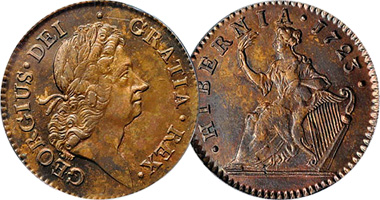
This weathered copper coin is a Hibernia halfpenny that was originally made in Ireland in 1723 for the purpose of currency. The excavation of the coin on Huguenot St in New Paltz, New York illustrates a migration of currency as well as people.

Description: The Hibernia halfpenny is about the size of a modern day quarter. On one side, the profile of King George I is pictured. The profile has long curly hair tied behind the ears. Around the circumference of the coin, it says Georgius Dei Gratia Rex. Translated from the Latin this means by the grace of King George. On the other side of the coin, it says Hibernia 1723 around the circumference. In the center, there is a woman pictured in a dress holding up a palm branch with her right hand and leaning against a harp with her left arm. Her face is also depicted in a profile. After almost 300 years of existence, the coin has been weathered and eroded. It is hard to make out these details because of the overt oxidation the coin has experienced over time creating the green substance on its surface.

Provenance: The original owner of the coin will forever be unknown for it was used as an object of exchange passing from person to person for different goods. In Ireland, the Hibernia coppers were made for use in small transactions at the local market or tavern such as for a loaf of bread that cost a penny (Danforth). The coin may have traveled from the pockets of middle class Irish citizens through the pockets of transatlantic seamen or through the pockets of Irish immigrants into the hands of The Huguenots in the Middle Colony of New York (Danforth). The coin now rests in its habitus amongst many other excavated, historical objects in Professor Diamond’s archives. It was discovered on July 20, 2012 at approximately N 50m / E 18m on Huguenot St in the ground that resides between the Bevier and Deyo houses across the street from the Dubois Fort. us_woods_hibernia_half_penny

Narrative: Although we may never know the coin’s owner, we do know its maker. William Wood owned copper and tin mines in Ireland. He purchased the royal patent that authorized him to produce up to 360 tons of halfpence and farthings for Ireland at 30 pence to the pound over a period of fourteen years for an annual fee of £800 paid to King George I (Hibernia). Wood believed this would be a profitable business and purchased the patent for £10,000 in 1722 from the king’s mistress, The Duchess of Kendal (Hibernia). At the time, Wood’s coinage was heavier than the coppers already in circulation in Ireland making his money more valuable (Hibernia). As a result of their weight and the cost of production, Wood’s Hibernia coppers were actually less profitable for him to mint (Hibernia). It is believed that he even would have lost money over those fourteen years from the deal (Hibernia).

Amongst numismatists, there seems to be a disagreement about the degree of reception the Wood’s Hibernia coppers received. According to Brian J. Danforth’s article in The Colonial Newsletter, “Wood’s Hibernia Coins Come to America”, the coins were first well received but lost popularity over time in Ireland. Danforth explains that the lower class of Ireland, who were largely illiterate and rarely made records, were the primary users of the copper coins. Since the primary users of the coins did not make records, numismatists do not accurately know the exact extent of usage that these coins received. However, Danforth believes the coins became very popular in Ireland because as he describes Ireland was a “coin starved” nation. Danforth also states that American colonies did not have a sufficient amount of coinage to satisfy their economic needs in the eighteenth century either. Furthermore, England did not even have enough coinage to satisfy its own needs resulting in this shortage of coinage in its distant lands (Danforth). It is in this apparent massive deficiency that Wood’s believed he had the potential for a successful business endeavor.

Because of Ireland’s desperate need for coins, the popularity of the coppers was almost inevitable. In the mid 1720’s some numismatists believe Wood’s coins were rejected, but Danforth believes the coins were used commonly in Ireland until 1737. Jonathan Swift led the campaign against Wood’s coppers that successfully leaves evidence of opposition to the coins for numismatists today (Danforth). According to Philip Nelson’s The Coinage of William Wood, 1722-1733, Swift and his allies opposed Wood’s coinage because the coins were not approved by the Irish Parliament, were minted under a private patent, and weighed more than the English royal issue (qtd. in Danforth). Wood’s original estimate on the amount of coppers to mint was also so large that the opposition believed they would hurt the Irish economy drastically (qtd. in Danforth). However, Danforth notes the rise in copper coins by 150 percent in 1728 illustrates the success of Wood’s coins with them actually becoming the dominant coinage in Ireland despite Swift’s oppositional forces. IMG_1225

The American Colonies similarly needed coinage for small transactions. In the Northern Colonies, this need was most prevalent because of the demands of urban centers, artisans, and commerce (Danforth). Danforth writes that Wood’s coppers came to America as a result of trade between the colonies and Ireland, immigrants from Ireland traveling to the colonies, and the eventual devaluation of the coins in Ireland. Before the American Revolution, Ireland traded more with the Middle Colonies than the rest of the colonies (Danforth). Wood’s money would have crossed the Atlantic in the pockets of seamen and would have been used in Irish seaports for everyday purchases (Danforth). The coins also became twice as valuable in the colonies as they were in Ireland allowing for some to take advantage of the exchange rate for profit (Danforth). In 1737, New York had what Danforth describes as a surplus of copper coins because of its growing economy and the devaluation of Hibernia Coppers in Ireland. New York also had the most favorable exchange rate of coppers amongst the other colonies (Danforth). Danforth describes how these factors contributed to New York becoming the foremost trade partner with Ireland.

During economically hard times, an increase in immigration to the colonies occurred bringing with them the cultures and customs of their homes (Danforth). An Irish famine in the late 1720’s spurred emigration from Ireland with people looking for employment in America (Danforth). Another massive surge of immigration in the mid 1730’s around the time of the monetary decline of Wood’s coins in Ireland also increased the export of the coins to America (Danforth). When leaving their homes, the Irish took as many coins as they could. Danforth notes they would have chosen to carry with them the coins with the highest amount of value that took up the least amount of space making coppers the best choice for poor immigrants. In 1729, the supply of copper coins in Ireland decreased. Although the attitude towards Irish immigrants in New England was often unwelcoming, Irish settlements and communities were still able to make roots in America (Danforth). Poor Irish immigrants were usually from rural areas and settled in the Middle Colonies with all their possessions from home including whatever money they could put in their pockets such as Wood’s coins (Danforth).

In 1736, it was announced that a new royal copper would be made in England and sent to Ireland securing the devaluation of Wood’s coins (Danforth). As a result, Wood’s coins were shipped “en masse” to the American colonies (Danforth). Irish leaders such as Swift and his advocates who had been against Wood’s coins from the beginning finally succeeded in receiving an official set of copper coins from the London mint (Danforth). Danforth also mentions regulations that were placed on the acceptance of Wood’s coins in Ireland limiting their use and decreasing their popularity significantly. The ideal shipping destination for the coins were the Middle Colonies because of their significant trade with Ireland, their Irish immigrant populations familiar with the coinage, and their growing economy in need of coins for daily exchanges (Danforth). As a result of all these factors, this Hibernia halfpenny landed in New Paltz amongst the Huguenots.

Bibliography

Danforth, Brian J. “Wood’s Hibernia Coins Come to America.” The Colonial Newsletter. Aug 2001. Web. 14 Apr 2015.

Diamond, Dr. Joseph. Personal Interview. 8 Apr 2015.

“Hibernia Coppers 1722- 1724: Introduction.” Coin and Currency Collections at the University of Notre Dame Department of Special Collections. 4 Jan 2001. Web. 14 Apr 2015

Rubino, Catherine. Image 1. 1 Apr 2015

“US Woods Hibernia Half Penny 1722 to 1724.” Coin Quest. Image 2. Web. 14 Apr 2015.

Rubino, Catherine. Image 3. 8 Apr 2015.

The Napkin Ring: A Remembrance of Massacre

napkin ring

A dining accessory that functioned as a place card, this napkin ring belonged to Gertrude M. Deyo as a child. At just over an inch in all dimensions, this square napkin ring embellished with Cupid riding a dragonfly sat atop a finely set dining table awaiting guests. Outside wall of the very same dining room, resided the skeletal remains of colonial conquest and slaughtering.

Despite the name, napkin “ring,” this item is one and a quarter inch square napkin holder made of silver. It has scalloped edges, two curves to a side, along both the top and the bottom edges. Given the approximate date of creation for the item in the mid 19th century, it has suffered minimal damage, leaving the only trace of wear and tear small areas of old sticky tape.  The main aesthetic feature of the napkin ring is the image of Cupid riding a dragonfly due to the intricate details on the wings of Cupid and the unique pairing of beings. However, the other engraving on it bears the historical significance of the object. This other engraving holds the personal history that’s embedded in the communal past of New Paltz, through three simple letters: “GMD” for Gertrude M Deyo.

Gertrude was born in New Paltz to Matthew Deyo and Julia Etta Deyo, in 1868 as the eighth generation of Deyo’s born in the United States (Van Wagner 184). She was given this prior to her marriage based on the use of her maiden name, and probably at a younger age since it is dated closer to the mid 19th century and Gertrude was born in 1868. It accompanied her most likely into her married years, and then was passed along to either to her sister, or directly to her niece, Mrs. Henry E Downer, the last owner of the ring (Van Wagner 255).

During the years of Gertrude’s marriage, she most likely kept her designated napkin ring with her, bringing her family’s silver dining accessories into her next life as a married woman. It would sit with the other dining furnishings, holding Gertrude’s name and place at the table with it. All would remain the same until  1894 when Gertrude’s husband, Abraham D Brodhead, decided to renovate the home in which they were living on Huguenot Street (NPT 1894). The home was to become “scarcely recognizable” and it was believed by members of the community that at least one of the other old stone houses should be “strictly guarded” to prevent a similar process of renovations from occurring (NPT 1894). The community feared that future generations would forget the lifestyle of their ancestors, that the culture of the time would be lost (NPT 1894). During this time, the couple moved all of their furnishings and themselves to the Tamney House for the duration of the renovation (NPT 1894). While excavating near the back of the home, a skeleton was discovered, along with parts of a shear and axe (NPT 1894). The New Paltz Times reported that very same month that the bones were of a Native American.

This, however, was not the first appearance of Native American corpses on the couple’s homestead, although it is reminiscent of a time of turmoil and conflict between the Huguenots and the native tribes of the area. Travel back in time another thirty years and Henry Johnson, much like Abraham Brodhead, while digging in his yard, revealed the human skeleton of a “red man” in the perfect state of preservation (NPT 1862). This body was seated upright, in the proper burial position of the Native American culture, and was determine to be at least two hundred years old, dating the skeleton back to the mid 17th Century (NPT 1862).

Flash back to the time in which the first Native American who was discovered lived, and the time in which Huguenots were only beginning to settle in present day Ulster County region.  The Natives still lived in peace, practicing their culture freely, without the interference or destruction of the settlers. The Huguenots, signing a contract with the native tribes in 1660, began to increase their population in nearby Esopus with rapid numbers (Sylvester 3). With more Huguenots, there became a need for more space, and less concern for the people that were sacrificing their lands for the Huguenots. In 1663, the Second Esopus War took place, resulting in the plundering of the Huguenots’ village (4). The Natives captured men, women, and children, and the Huguenots in return held a Native of respectable status hostage (4). With the help of the Native they held hostage, the Huguenots traversed the county to retrieve their wives, discovering the bountiful lands of New Paltz, the believed promised land of the Huguenots (5). It is along this area, on the east side of the Wallkill, that a single Native was killed along the journey, a person who attacked the caravan of men single-handedly and fell victim to the leader of the troop (5). Interestingly enough, the Natives of this time fought primarily with tomahawks and battle axes, being their most efficient weapons (4). The Huguenots returned to the fruitful land upon rescuing the women, thus settling in present day New Paltz.

Could this tale of the single Native American slaughtered during the first appearance of the Huguenots in New Paltz be the same Native found during the renovations of the Deyo House under Abraham Brodhead? Or could the body belong to another Native, evidence of another incident of colonial conquest and Western privilege? The Huguenots’ settlement in New Paltz was not one of harmony and community with the Natives of the region. It held bloodshed, captivities, pillaging, and destruction. The Huguenots built the life they felt they deserved, one of grand houses and silver, personalized dining accessories on top of the rotting and forgotten culture of the people whose land they invaded.  In the midst of a community shocked at Brodhead’s ability to alter a part of their past culture, they discovered the culture that they had impeded on and demolished for their own wanting, another community trampled in the name of modernity and self-fulfillment.

Works Cited

Van Wagner, Carol et al. The Deyo (Deyoe) Family. New Paltz: Huguenot Historical Society 2003. Print.

“New Paltz Times.” New Paltz Buildings. 1862. Print.

“New Paltz Times.” New Paltz Buildings. 1894. Print.

Sylvester, Nathaniel Bartlett. “New Paltz.” History of Ulster County, New York. Philadelphia: Everts &      Peck 1880. Print.