The Buzz Around Burt’s Bees

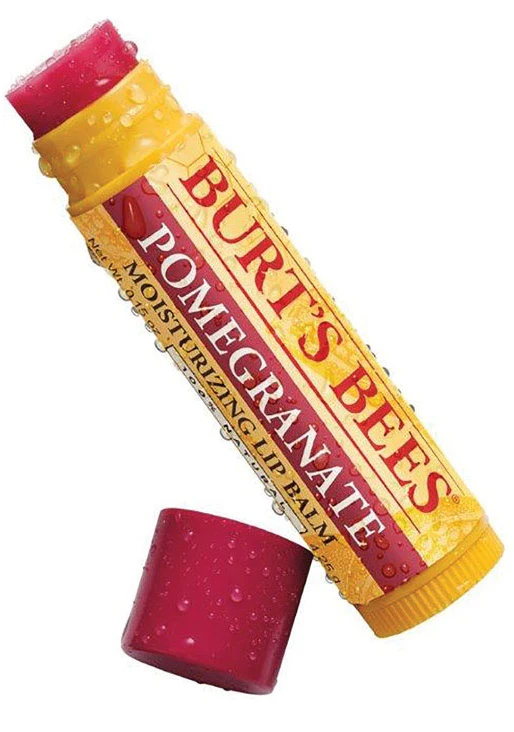
The annual struggle of frustratingly cracked lips has come to fruition as the seasons shift and the cooler air brings a dryer climate. And so I found myself in Top’s Market, digging through a small bin of chapstick to find my beloved Burt’s Bees pomegranate balm. The company claims to be founded on the idea that “bees are magical”, and what could be more magical than learning about the environmental impacts of your favorite products?

Burt’s Bees chapstick gets its charm from its use of “all-natural” ingredients, specifically beeswax, coconut oil, sunflower oil, vitamin E, rosemary leaf extract, and peppermint oil. The company prides itself on uplifting communities and its ambitions to improve sourcing practices, claiming 63% of waxes, butters, and oils to be “traced to origin and verified by on-site visits” (2022 Progress Report). Possibly the most iconic of these ingredients is the balm’s wax, being a heavily aestheticized and marketed part of this product. The company’s wax is sourced from Tanzania, whose opportunities in beeswax production and processing have attracted many buyers, most notably the European Union member countries, the United States, and Japan.

The Tanzanian beekeeping industry is estimated to employ 2 million rural people. The industry has such a presence that the Tanzania government developed the National Beekeeping Policy in 1998 to increase beekeeping’s contribution to the sustainable development of Tanzania and manage the conservation of the country’s natural resources for “the benefit of present and future generations” (Mwakatobe & Mlingwa, 2006). Here we see traces of the company’s claims; local workers continue to harvest the wax in traditional ways and are monetarily supported by the company’s donations. The journey of the wax is certainly taken for granted by consumers, as we have still not found the product’s final resting place.

Upon being harvested in Tanzania, the wax is shipped to a Burt’s Bees factory in North Carolina. Here machines mix the wax, add the other ingredients that were previously stated, and separate the mixture into the iconic honey-colored plastic tools.. According to their website, 100% of Burt’s Bees packaging is recyclable and the company is certified as carbon neutral. Beginning in 2021, the company switched to being powered by renewable energy and joined three different climate action communities.

Although the company’s website offers plenty of information on the recyclability of its packaging, information on where they source its plastic is lacking. According to Plastic Euope’s article on the process of plastic production, the material comes from “organic materials such as cellulose, coal, natural gas, salt and, of course, crude oil.” The dependence on crude oil for these productions may, unfortunately, cancel out the environmental efforts the Burt’s Bees company has made; oil production releases tons of pollutants into the air and oceans, causing things like ocean noise, habitat degradation and destruction, and interference in the lives of the people who are indigenous to the regions where oil is extracted (“Oil and Gas Development | Threats | WWF”).
Oil spills are a frequent consequence of oil production, with an estimated 150 spills happening each year in U.S. waters alone. These spills are not just disruptive to the lives of animals but to humans, ruining public natural resources and causing detrimental impacts on local communities. Although the Burt’s Bees company has made efforts—much more than many other companies in the cosmetic industry—to reduce their environmental impact, tracing each aspect of the product reveals some not-so-magical effects of production.

Oil spills are a frequent consequence of oil production, with an estimated 150 spills happening each year in U.S. waters alone. These spills are not just disruptive to the lives of animals but to humans, ruining public natural resources and causing detrimental impacts on local communities. The United States makes up most of the world’s crude oil production, creating jobs for many working-class Americans, but we must ask ourselves the cost of this. Although the Burt’s Bees company has made efforts—much more than many other companies in the cosmetic industry—to reduce their environmental impact, tracing each aspect of the product reveals some not-so-magical effects of production. 

Works Cited

“How Burt’s Bees Lip Balm Is Made | How Stuff Is Made.” Youtube, Refinery29, 27 6 2018, https://www.youtube.com/watch?v=bxnNdNzvp8M&ab_channel=Refinery29. Accessed 4 10 2024.

“Largest Oil Spills Affecting U.S. Waters Since 1969 | response.restoration.noaa.gov.” NOAA’s Office of Response and Restoration, https://response.restoration.noaa.gov/oil-and-chemical-spills/oil-spills/largest-oil-spills-affecting-us-waters-1969.html. Accessed 4 October 2024.

Mwakatobe, A., Mlingwa, C., 2006a. . “Tanzania-The status of Tanzanian honey Trade- Domestic and International Markets”.http://www.tanzaniagateway.org/docs/the_status_of_tanzanian_honey_trade_markets_nov2006.pdf (accessed 10.4.24). 

“Oil and Gas Development | Threats | WWF.” World Wildlife Fund, https://www.worldwildlife.org/threats/oil-and-gas-development. Accessed 4 October 2024.

2022 Progress Report. July 2020-June 2022 ed., Burts Bees, 2022, https://assets.ctfassets.net/96vm5wjuyy9f/BuxfFMaAhcZ2GmcukZaGh/485cc2b1722b49554109106cdcb98aaf/2022_BB_ProgressReport__1_.pdf.“Which country is the largest producer of plastics?” Milan Polymer Days, https://www.milanpolymerdays.org/blog/which-country-is-the-largest-producer-of-plastics. Accessed 4 October 2024.

Hand Knit Blanket

For this assignment, I wanted to see if I could trace the history of a piece that I created myself. As such, I chose to focus on this hand knit blanket that I made for my friend’s birthday last month.

Screenshot

The photo above shows the blanket folded into a rectangle shape. The blanket is about 3 feet wide with 5 feet long. This blanket consists of a textured design comprised of woven braids, each connected through small loops that I hand-knit. The blanket’s reds, whites, and pinks are splashed sporadically throughout the yarn, giving it a unique, splashed appearance. This blanket took four spools of yarn, $20, and 4 hours to make.

Since I made this blanket, it does not have a tag to trace its origins. Because of this, I chose to focus on who made this yarn, the history of the store I bought it from, and how this yarn came to be.

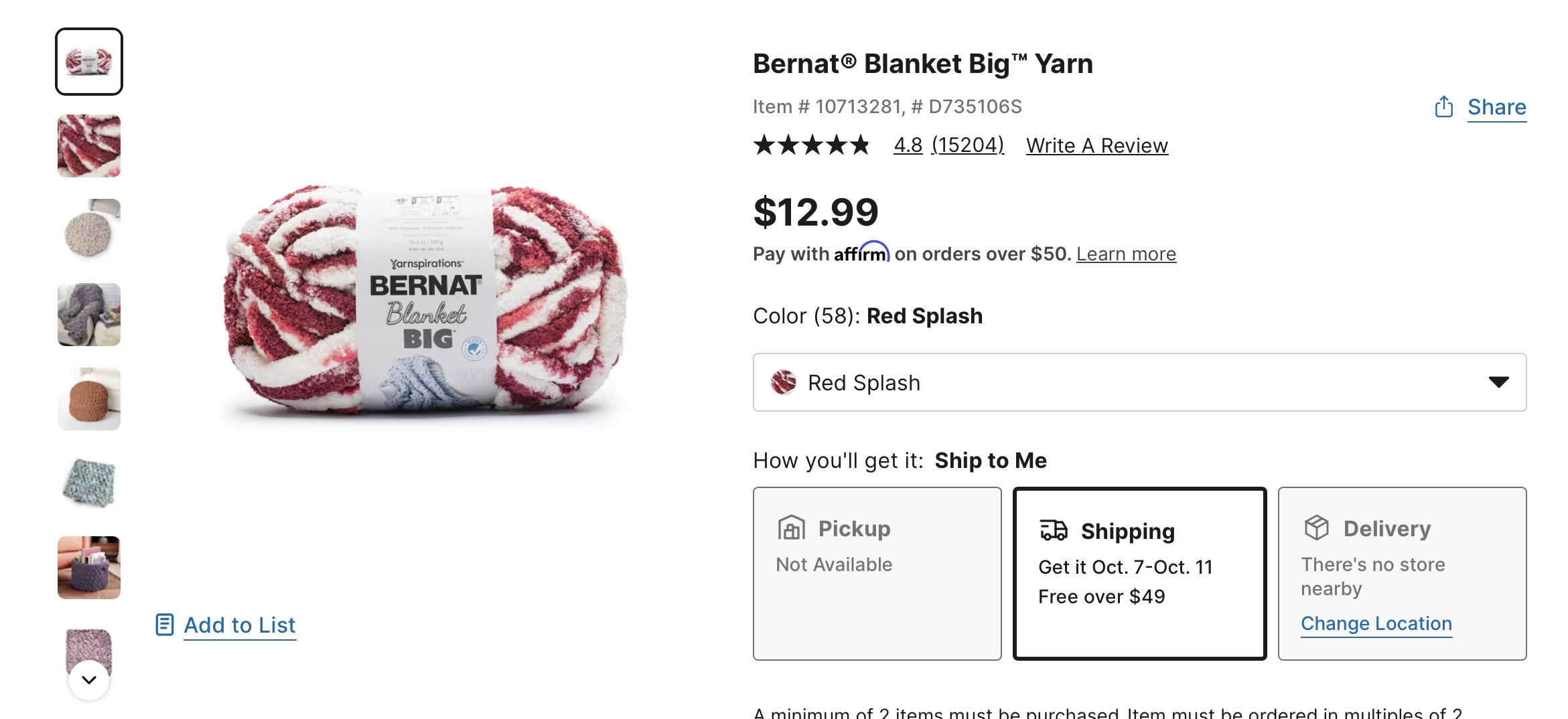
The yarn I used for this blanket was Bernat® Blanket Big™ Yarn in the “Red Splash” variety, as characterized by its red splotches against its white base. I bought this yarn online from Michaels, a widely recognized arts and crafts store.

This blanket was made of four spools of Bernat® Blanket Big™ Yarn. The color it came in was the Red Splash variety, as told by this yarn’s characteristic red splashes across its white base. I bought this yarn online from a Michaels store. A photo of this yarn on the Michaels website is shown below.

Screenshot

Established in 1973, Michaels is a famous craft store that’s known for its specialization in arts and crafts. With its 1300+ stores in 49 states, Michaels is a store that offers lots of art supplies both in-person and online (Michaels). I specifically ordered my yarn to be picked up at the NYC Michaels location that’s located in the Chelsea neighborhood of Manhattan. Though I did pick my order up from there, my package likely travelled from one of Michaels’ many distribution centers or warehouses by Michaels’ UPS delivery service.

I can imagine my yarn traveling in the back of the UPS van, nestled between all the other Michaels-brand supplies, and packaged in its plastic packaging that likely came from China, the “primary plastic supplier in the world” (Grand View Research). Understanding the origin of this packaging shows us how far parts of this blanket have travelled to get all the way to New York (and then SUNY New Paltz!). This plastic, derived from things like petroleum, was underground for so many years before humans decided it had another purpose — to protect the history and the work behind this blanket’s yarn.

The history of this yarn is where the Bernat Yarns Company comes into play.

The company that made this yarn is called Bernat Yarns. Originally founded in Hungary, the company relocated to Boston in 1902. Initially, Bernat focused on dyeing fabrics and restoring tapestries. Their expertise in needlework extended into fine arts, embroideries, furniture weaving, tapestries, and dye refining, exemplifying the Bernat Yarns Company’s skill with textiles (Jamaica Plain Historical Society).

In the 1950s, the Bernat Company was a pioneer in the textile industry, commercializing the use of acrylic yarns as opposed to woolen ones (Bernat). These acrylic yarns, with their polyester and nylon bases, were found to be much softer, easier to care for, and more affordable than traditional wool. This innovation allowed the Bernat Company to increase their sphere of influence, spreading through the United States and Canada. This innovation also allowed them to maintain their trademark — that baby blankets and winter items are some of the best items to make with their product.

The acrylic base of this yarn makes me think about the dyeing methods that were utilized to make the yarn the way it is now. Though the Bernat company does not have a specific process that I could find about dyeing their wool, I can infer that they likely utilize synthetic dyeing methods. I once tried to do the general cotton dyeing method with Sherpa fabric (another acrylic base). Because of the atomic composition of plastic fabric as opposed to cotton fabric, the dye did NOT hold and I was left with only grey-stained pink fabric instead of the black that I wanted. Synthetic dye, for polyester fabrics, is the only thing that will hold.

This type of dye was discovered in 1856 by William Henry Perkin, whose failed chemistry experiment created a whole new world of clothing dye (Science Museum). This dye allowed for fashion to suddenly become a whole lot brighter, and a fashion revolution in almost any shade imaginable. These dyes are now a staple in most clothing design spaces, as colors like blue and purple are very hard to come by naturally. 

In 1992, the Bernat Company was bought by a Canadian company. This caused some of its doors in the United States to close, but for their outreach to grow much bigger. By the late 1990s, Bernat solidified its reputation with “the launch of staple product lines such as Bernat Softee, an affordable and durable acrylic yarn that remains a popular choice for knitters and crocheters alike” (Jamaica Plain Historical Society). This yarn is the sister of the yarn that I used for my blanket, and helped pave the way for other “chunky yarns” to become more popular. 

I had assumed that the yarn was likely spun in a place where more synthetic products were generated (Asia). However, the Bernat company states that their products are mostly made in the United States and Canada by established weavers. So, for the most part, this yarn (and the blanket it became) hadn’t strayed too far from its original home. 

Ultimately, though this blanket is one that was made with my very own two hands, it is a blanket that has travelled many places, and is a result of a lot of scientific innovation. 

WORKS CITED:

Bernat Yarn. “About Us.” Bernat Yarn, https://bernat-yarn.com/about-us/. Accessed 4 Oct. 2024.

Grand View Research. “Synthetic Dyes Market Size, Share & Trends Analysis Report By Product (Acid, Basic, Reactive), By Application (Textile, Food & Beverages), By Region, And Segment Forecasts, 2023 – 2030.” Grand View Researchhttps://www.grandviewresearch.com/industry-analysis/synthetic-dyes-market-report. Accessed 4 Oct. 2024.

Jamaica Plain Historical Society. “Bernat Superior Looms Company: A Brief History.” Jamaica Plain Historical Society, 6 Apr. 2022, https://www.jphs.org/20th-century/2022/4/6/bernat-superior-looms-company-a-brief-history#gsc.tab=0. Accessed 4 Oct. 2024.

Michaels. “Bernat Big Chunky Yarn.” Michaels.com. Accessed 4 Oct. 2024.

Science Museum. “Colourful Chemistry: Artificial Dyes.” Science Museum, https://www.sciencemuseum.org.uk/objects-and-stories/chemistry/colourful-chemistry-artificial-dyes. Accessed 4 Oct. 2024.

From Fabric to Jean: The Production Process of Old Navy’s High-Waisted Wow Flare Jean


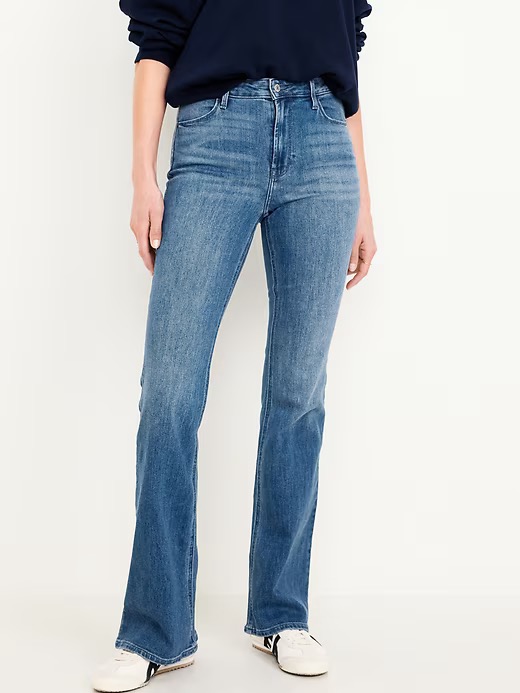
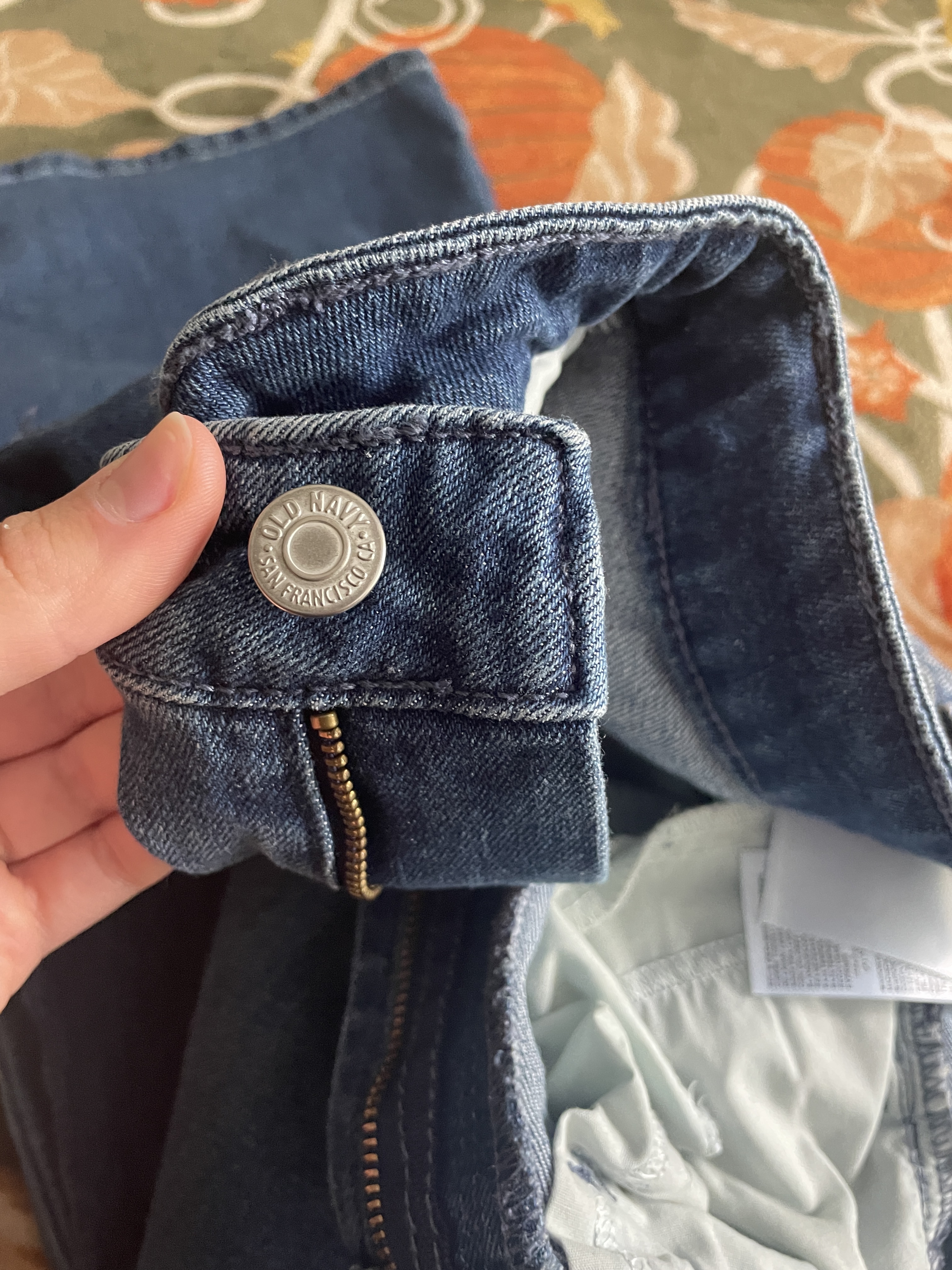
After a recent trip to the Poughkeepsie Galleria, I returned home with a pair of new jeans from Old Navy. The High-Waisted Wow Flare Jeans feature a medium wash and are crafted from a blend of materials. The fabric composition includes 69% cotton, 30% recycled polyester, 7% recycled cotton, and 1% spandex, offering a bit of stretch for a flexible fit. The brand offers different inseam lengths for regular, tall, and petite sizes. My pair, being a 0 regular, has a 32” inseam. The jeans are designed with a snug fit through the hips and thighs, flaring out from the knee. The jeans also feature a button front, belt loops, and front scoop and back patch pockets​. The button is engraved with “OLD NAVY” and “SAN FRANCISCO CA,” and the zipper below is an antique bronze. The outside stitching blends with the medium wash, making its appearance very subtle.

When I purchased them, the jeans were minimally packaged and folded neatly on a shelf with others of the same fit. They were organized by size, with the smallest sizes on the top shelf and the largest on the bottom. A rectangular adhesive sticker on the left leg indicated the size and inseam, while two paper tags on the belt and right front pocket featured the Old Navy brand and product barcode. 

*Not my pair of jeans; Used to show the original tags and stickers when displayed in store*

Old Navy emphasizes sourcing sustainable fibers for its clothing, particularly for its cotton products. Since 2022, they have implemented more eco-conscious manufacturing practices including water-efficient production practices and the Mill Sustainability Program. All strategic mills owned by The Gap, Old Navy’s parent distribution center, are obligated to perform under this program to help build a more water-resilient supply chain and improve its social performance. When dyeing and finishing the High-Waisted Wow Flare Jeans, denim specialists carefully oversee the amount of indigo dye used to produce its classic medium wash. The total dyeing process typically takes 30-60 minutes from start to finish. A pre-wash gives the jeans their “one-wash look”, which involves a laundry procedure of washing the jeans in just water. Washwell™, an additional program used to manufacture all of Old Navy’s clothing, reduces the water used in garment dyeing and finishing by at least 20 percent compared to conventional methods. 

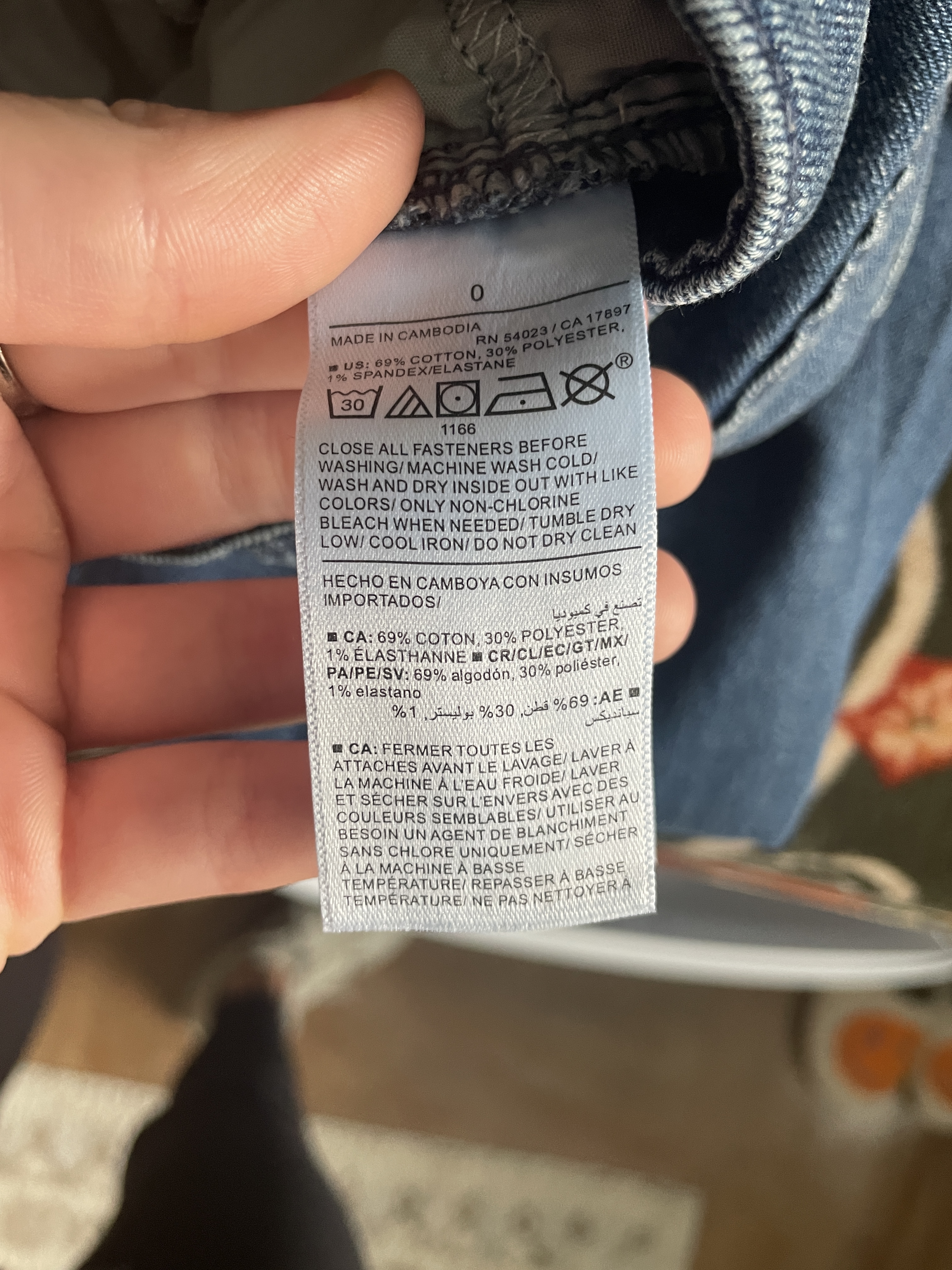
Old Navy’s transportation system involves a global supply chain, which sources raw materials from various countries including Bangladesh, Vietnam, and China. Based on the product’s tag, the High-Waisted Wow Flare Jeans were made in Cambodia. While the exact manufacturing location is unclear, The Gap primarily operates factories in Kandal, Cambodia according to the Cambodian Human Rights Portal. On average, it takes factories approximately 11-15 minutes to produce a single pair of jeans through the process of harvesting, washing, mixing, and then spinning the synthetic fibers. Sfgate News claims that Cambodian workers earn roughly $70 per month working in these factories. That would mean that a worker earned only $0.073 making my one pair if it took them 15 minutes to produce it. 

My jeans traveled approximately 8,749 miles to reach Fishkill, New York, home to one of The Gap’s distribution centers in Dutchess County. From there, they were likely transported to the Old Navy store at the Poughkeepsie Galleria. As of May 2024, the average spot rate for dry van trucking in New York is $2.02 per mile. It would cost $14.14 to transport my jeans from the distribution center in Fishkill to the Old Navy in Poughkeepsie since they are only 7.0 miles away from one another. 

To ship products efficiently, Old Navy uses a combination of sea, air, truck, and rail transportation, focusing on cost-effective and environmentally friendly methods. It’s unknown whether my jeans arrived in the U.S. by plane or cargo ship. Shipping a 20-foot container using ocean freight, which is the most common method, costs between $2,000 and $4,000 depending on demand, fuel prices, and port fees. If I knew the exact delivery route, I could determine whether they were taken to the distribution center by truck or train. Rail transport typically costs around $0.03 to $0.04 per ton-mile whereas trucking can range from $0.10 to $0.15 per ton-mile.

The journey of these jeans involved a great deal of resources, labor, and time. Learning about the history of my jeans deepened my appreciation for owning them and the privileges I have as a consumer. 

Works Cited:

Denimhunters. “How Jeans Are Made: The Pre-Washing Process.” Denimhunters, www.denimhunters.com/how-jeans-are-made-pre-washing/. Accessed 2 Oct. 2024.

Gap Inc. “Gap for Good.” Gap.com, www.gap.com/page/gap-for-good?cid=1086537. Accessed 2 Oct. 2024.

Gap Inc. “Product Life Cycle.” Gap Inc., www.gapinc.com/de-de/impact/esg-resources/governance-and-strategy/product-life-cycle. Accessed 2 Oct. 2024.

Gap Inc. “Water Stewardship.” Gap Inc., www.gapinc.com/en-us/impact/bridging-the-climate-gap/water-stewardship. Accessed 2 Oct. 2024.

Long John. “Jeans Recipe: What Is Needed for 1 Pair of Jeans?” Long John, www.long-john.nl/jeans-recipe-what-is-needed-for-1-pair/#:~:text=An%20average%20factory%20can%20produce,the%20wash%20treatment%20can%20start. Accessed 2 Oct. 2024.

MoverDB. “Container Shipping.” MoverDB, www.moverdb.com/container-shipping/. Accessed 2 Oct. 2024.

Old Navy. “High-Waisted Wow Flare Jeans.” Old Navy, www.oldnavy.gap.com/browse/product.do?pid=8568330020002&cid=3034852&pcid=3034847&vid=1#pdp-page-content. Accessed 2 Oct. 2024.

RSI Logistics. “Comparing the Costs of Rail Shipping vs. Truck Shipping.” RSI Logistics, www.rsilogistics.com/blog/comparing-the-costs-of-rail-shipping-vs-truck/. Accessed 2 Oct. 2024.

SFGate. “Garment Workers Say Gap Aided in Cambodian Strife.” SFGate, www.sfgate.com/news/article/garment-workers-say-gap-aided-in-cambodian-strife-2746484.php#. Accessed 2 Oct. 2024.

Sithi.org. “Garment Factories.” Cambodian Human Rights Portal, www.sithi.org/garment-factories. Accessed 2 Oct. 2024.

The History of Water Bottles

Watching how the use and perspective on consumer goods have changed over time is an interesting phenomenon. Water bottles, for example, began as an object of convenience and necessity. The practice of bottling and transporting water dates back to the earliest times of civilization, when horse-drawn carriages transported heavy and fragile bottles made of ceramic or glass. Eventually, plastic water bottles were developed, a lightweight and durable option more suited for everyday use. Finally, the bottle has progressed to the new sustainable alternative- stainless steel water bottles. 

Stanley Tumbler

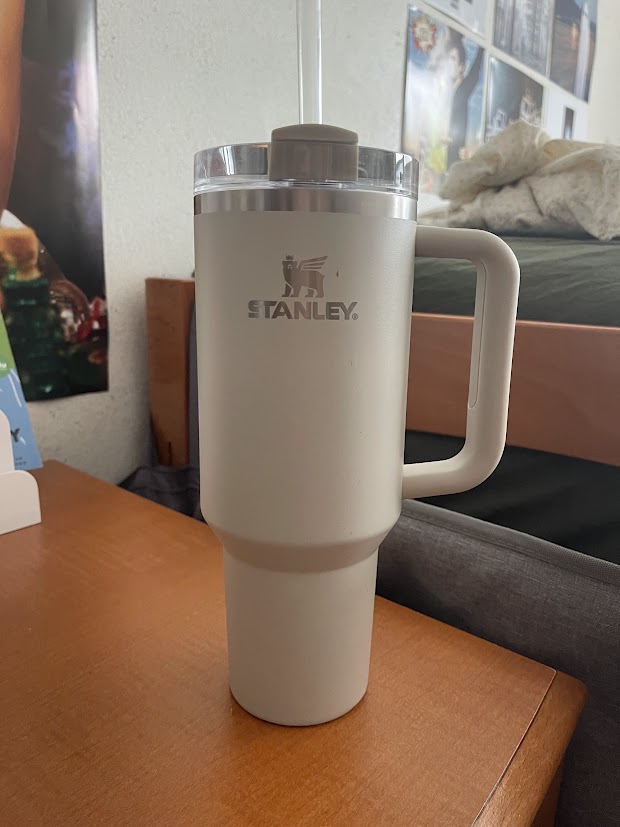
For my object, I take a closer look at my Stanley Tumbler. The tumbler stands ten inches tall with a capacity of 40 ounces. It is a taupe color, with a silver Stanley logo embellished on the front. I originally purchased this bottle online from Target, to provide myself with a new water bottle for the school year. For me to drink out of this bottle today, there is a lengthy process that often goes unnoticed by consumers. At the most basic level, the bottle itself needs to be produced. Starting with high-grade stainless steel, the bottle goes through a precise shaping and forming process to create a unique design and structure of the bottles. The stainless steel used to produce these models creates durability, corrosion resistance, and hygienic properties to ensure the longevity of the bottle. When looking at the process of shaping and creating the bottle, consumers should consider the specialized machinery and intricate processes that are crucial to the development of an item. Once the bottle was manufactured in Canada, it was shipped to the States and ended its journey in Long Island, New York. Once in Medford, an employee at Target packaged up my water bottle and set it out to be shipped to me. Another worker, someone from a postal service, transported my package from Target to my house, where I received my water bottle. Since then, this water bottle has gone essentially everywhere with me. From long car rides, and tests, to work, this water bottle has been a simple staple in my life.


When examining consumer behavior, there is a clear trend in consumption. What has changed about water bottles from early civilization to now is the context in which we view these bottles. Back then, a water bottle was a simple necessity, a place to store water and easily access it. Nowadays, these water bottles are used as a form of social class. Each year, there is a new rising trend in which water bottle brands are most popular. With each trend, people begin to consume more and more. The point of switching to stainless steel water bottles is to be sustainable and eliminate unnecessary waste where you can. However, rather than just buying one water bottle to be sustainable, it’s become a trend with these bottles for people to consume.

Consumerist trend of “accessorizing Stanley’s”

It would be hypocritical of me to not acknowledge how I myself have fed into consumer culture. Rather than purchasing any stainless steel bottle that I liked, I purchased the one with the logo that would be recognizable. I can acknowledge how I’ve fallen into the consumer trend of buying a new water bottle for the sole purpose of fitting in. While I just use my water bottle to keep my drinks cold, others use it to accessorize an outfit, owning every color the brand sells. Along with this, it’s become a trend to accessorize the bottle itself, with keychains and mini bags. The attempt to move from plastic water bottles to a more sustainable option has inevitably created more waste from the accessorizing of the bottle, and is counteractive to the original purpose of the product. This trend, much like others, is a performative way of contributing to the environment. Recycling, for example, may reduce some waste but mainly makes people feel good about themselves by the thought of contributing. This idea is seen with the trend in water bottles, and it’s interesting to see how I subconsciously fed into this culture myself. In addition to my Stanley, I’ve bought two Hydroflasks while in High School. While part of me wanted to help the environment and move away from excessive plastic waste, the other part wanted to fit into the current consumerist trend.

Banana

Bananas (1)

For this blog, I will be writing about a banana I ate yesterday because the sticker on it said it came from Ecuador and I thought it would be fun to track. Although I can not tell exactly where it came from, I wouldn’t be surprised if it came from Guayaquil, which is a very hot and humid place that has massive banana, cacao, plantain, and rice fields (I see them every time I go to the airport in Guayaquil). On Realtor.com, I found that an acre in Guayaquil costs around $200,000 (9). When it comes to industrial farming, roughly 2,000 banana plants can be grown on an acre (4), which translates to a cost of $100 per banana plant. I’ll tack on an additional $100 per plant per year for miscellaneous things such as insecticides, irrigation, fertilizer, and seed acquisition. The cost of unskilled labor in Ecuador ranges from $20-$25 per day, and to man a single acre this dense I’ll say takes 4 people, which makes the cost of labor $43,680 for the full year (assuming the workers got trained and are getting paid $30 a day). For my calculations, I will assume that only one head of bananas gets produced per plant per year (1) and that each head of bananas has 240 bananas (3). According to these numbers, 480,000 bananas are made in a year on a single acre. If I only factor in the cost of growing and maintaining (since I don’t know how or when Dole bought the property), each banana comes out to a little under $0.10 cents to produce. 

To transport the bananas overseas, they are packaged into massive 40 ft metal containers. Each container costs about $4000 (commercially) (10), and the ships coming out of Ecuador can haul 1,000 of these containers (6), each of which can hold a little under 100,000 bananas (12). Since Dole owns its own fleet, I will assume that they can get the cost of transporting each container from Guayaquil to Wilmington, Delaware (5) down to $3000.

Once the bananas touch base in Delaware, I will make the assumption that they will immediately be sorted and delivered to the customer warehouses, in this case Walmart. From there, Dole will deliver the bananas to the nearest Walmart distribution center located in Smyrna, Delaware. From Smyrna, the bananas would then probably get shipped directly over to Fishkill, New York. “As of May 2024, the average spot rate for a refrigerated truck was $2.42 per mile” (7), meaning that transporting the bananas from Wilmington to Smyrna would cost $90.02. If we add the average labor rate for the driver of $0.64 per mile, then it would cost a total of $113.83 to get one container’s worth of bananas over to Smyrna (11). Assuming the same rate, the cost to get the truck from Smyrna to Fishkill would cost $679.32. The total cost to get one banana from Guayaquil to Fishkill would then come out to roughly $0.04. Assuming Walmart only paid $4000 for the whole container of 100,000 bananas and that Sam’s Club paid three minimum wage employees to unload the delivery truck in an hour, the cost of acquiring each banana comes out to $0.04, bringing the cost of putting a single banana on the shelf at Sam’s Club to $0.08. 

The banana’s journey ended when I bought it as part of a bunch at Sam’s Club for ~$2 (including tax) earlier in the week. To get it home, I had to drive 15 minutes (~6 miles). “According to the U.S. Department of Energy, the average cost per mile of driving a car is $0.58” (8), which means that the roundtrip costs me around $6.96 in total. If I were to add the cost of the Sam’s Club membership per day, my new total would come out to $7.10. Given that I bought 12 items, the cost of me moving to get the bananas was $0.59. In total, I personally spent $2.59 to pick up 7 bananas, meaning that the one banana I ate cost me ~$0.37. 

In conclusion, the banana that I ate traveled 3,000 miles to reach me and cost a collective $0.55 to consume between Dole, Sam’s Club, and myself. 

Works Cited

  1. “Appendices.” Setting up and Running a School Garden, http://www.fao.org/4/a0218e/A0218E14.htm#:~:text=Bananas%20are%20grown%20and%20harvested,to%20fruit%20in%20warm%20weather. Accessed 30 Sep. 2024.
  1. “Banana Roadshow 2022: New Flavors and Textures of Ecuadorian Bananas.” FruitToday, 7 Sept. 2022, fruittoday.com/en/banana-roadshow-2022-new-flavors-and-textures-of-ecuadorian-bananas/. Accessed 30 Sep. 2024.
  1. “Bananas: From the Bunch to Your Breakfast.” Rainforest Alliance, 2 Nov. 2021, www.rainforest-alliance.org/resource-item/bananas-from-bunch-to-breakfast/#:~:text=As%20the%20bud%20unfolds%2C%20it,produce%20up%20to%20240%20bananas. Accessed 30 Sep. 2024.
  1. Bohol, Eulogia. “Banana Planting Distances and Support Systems.” Wikifarmer, 18 July 2023, wikifarmer.com/banana-planting-distances-and-support-systems/. Accessed 30 Sep. 2024.
  1. “Dole Food Company Expands to Second Weekly Service at Port Wilmington: Port Wilmington.” Port Wilmington | Full-Service, Deep Water Port and Marine Terminal., 18 Jan. 2024, portwilmington.com/dole-food-company-expands-to-second-weekly-service-at-port-wilmington/#:~:text=WILMINGTON%2C%20Delaware%20(January%2018%2C,Colombia%2C%20Honduras%2C%20and%20Guatemala. Accessed 30 Sep. 2024.
  1. Dole Plc – Our Business – Our Business Units – Dole Fresh Fruit, http://www.doleplc.com/our-business/our-business-units/dole-fresh-fruit/default.aspx. Accessed 30 Sep. 2024.
  1. “A Guide to Freight Trucking Rates in 2024.” Uber Freight, 29 May 2024, www.uberfreight.com/blog/freight-trucking-rates-guide/#:~:text=Average%20reefer%20trucking%20rate&text=Maintaining%20a%20set%20temperature%20means,mile%20as%20a%20contract%20rate. Accessed 30 Sep. 2024.
  1. “How Much Your Car Is Costing You per Mile.” Yahoo! Finance, Yahoo!, finance.yahoo.com/news/much-car-costing-per-mile-110042500.html?guccounter=1&guce_referrer=aHR0cHM6Ly93d3cuZ29vZ2xlLmNvbS8&guce_referrer_sig=AQAAAHVa-ipmq_KooPk5aG_YN_TwliRJ-G0-hjMZmSGFt36hENOVks09aaNVtnAbINCSLx0C832fn-vqzcG0ajFSxycxq7Cdetbr1wMdlnEuRcwt34R-G0nmEuna1xLs3QpHf5TZJW_xiFHF88EQ7JVHtT0ZeY_wlY4axZDtYAQ8ELB1. Accessed 30 Sep. 2024.
  1. Property for Sale in Ecuador – Realtor.Com, http://www.realtor.com/international/ec/. Accessed 30 Sep. 2024.
  1. “Ship a Container to Ecuador.” BR LOGISTICS USA Shipping Imports Exports, http://www.brlogistics.net/us/ship-a-container/to-ecuador/. Accessed 30 Sep. 2024.
  1. “Truck Driver Pay per Mile in 2024 at Werner Enterprises.” Werner Enterprises, 2 Aug. 2024, www.werner.com/blog/truck-drivers/pay-per-mile/#:~:text=The%20average%20pay%20for%20dedicated,the%20most%20experienced%20team%20member. Accessed 30 Sep.   2024.
  1. “What You Can Fit inside a Shipping Container.” ContainerCo, 21 July 2022, http://www.containerco.co.nz/shipping-containers-what-can-you-fit/#:~:text=So%20if%20you%20ever%20need,the%20items%20to%20protect%20them. Accessed 30 Sep. 2024.

Vintage Claddagh Ring

Throughout my childhood I was always reminded of the importance of family. I know that this importance is not stressed for everyone and that many people are not given families that care to uphold familial relationships, but for as long as I can remember family came first. This was especially prevalent on my Moms side of the family. As a child I was always told stories of my Nan who passed just a few months before I was born. My Moms Mother, Rosemary Catherine who I am named after, was a bright and loving soul. I’ve always been told that I am just like her and that she is where I get my artistic side from. I can remember being a small child and looking through the tons of  paintings and jewelry of hers that my aunt had kept all these years. As a kid these items always gave me such comfort, they tied me to someone I had never met but made me feel like I’d always known her. In the last few years my family decided to go through all of her old jewelry that my aunt wasn’t doing anything with. When I saw one of her old Claddagh rings I felt overwhelmingly drawn to it and knew I would love to keep it. 

This is a real 14k gold Claddagh ring that was my Nans. It is too small for me to wear, probably a size 5 or 6 and has a nice thin band stretched around the back of it. The hands of the ring come toward the front and surround the heart in the center. There are gaps on either side of the heart, separating the hands from it and making the design clear. The heart is topped with three connected protrusions that are rounded at the top resembling a crown. The ring to the left of it was one of her rings as well and is believed to also be a Claddagh but the engraved design has become so faint over the years that it is hard to say exactly what it is. Both rings are clearly not brand new and covered with years of scratches and dings that show their age. Although the exact year that my Nan got the rings is unknown, my mother says that she remembered them from her childhood. The many years that my Nan wore these rings are written all over their surfaces and serve as a reminder of the life she once lived. 

Claddagh rings were first created in the fishing Village of Claddagh in Galway, Ireland. The original Claddagh ring was created by famous Irish goldsmith Richard Joyce. The story behind it is that he was trained as a goldsmith after being captured by pirates and sold as a slave. He created this ring for the woman that he loved with each aspect of the ring representing something different. The heart at the center represents love, the hands surrounding it represents friendship and the crown on top represents royalty. The way a Claddagh ring is worn is telling of your status of love; it was originally worn with the heart facing toward yourself if you were married and away if you were not. Throughout the years many different ways of wearing the Claddagh have been developed and each positioning of the ring has a different meaning. These rings have served as a symbol of love and friendship and are still worn amongst many Irish people to this day. 

My Nan’s mother grew up in County Mayo, Ireland which is not too far from where Claddagh rings originated. She came to the United States in the early 1900’s and had my Nan in 1929. I still have family that live in Ireland, much of whom I have yet to meet. Every time I wear this ring I think of my Irish family and heritage as well as my Nan who I unfortunately never got the pleasure of knowing. I think it is really neat to possess an object that represents different aspects of my life and acts as a cultural grounding/reminder of the generations before me. 


Čierny kríž from Medjugorje

If there’s something you can learn from Slavic stereotypes—alcoholism, the post-communist brutalist architecture, chain-smoking cigarettes—the Christian devotion is one of the more truer ones.

It’s hard to imagine my Slovak heritage divorced from religion. Even a common parting word, zbohom, means “with God,” and it is a word that comes so naturally to me when hugging my relatives goodbye. Even as an agnostic, it’s hard to sequester myself from Catholicism. Yet, it isn’t just my tongue, but the objects that cling to my walls, that hang from my bedposts, that sit in my wallet, reminding me of our religious roots. One object that resonates with me is our black crucifix.

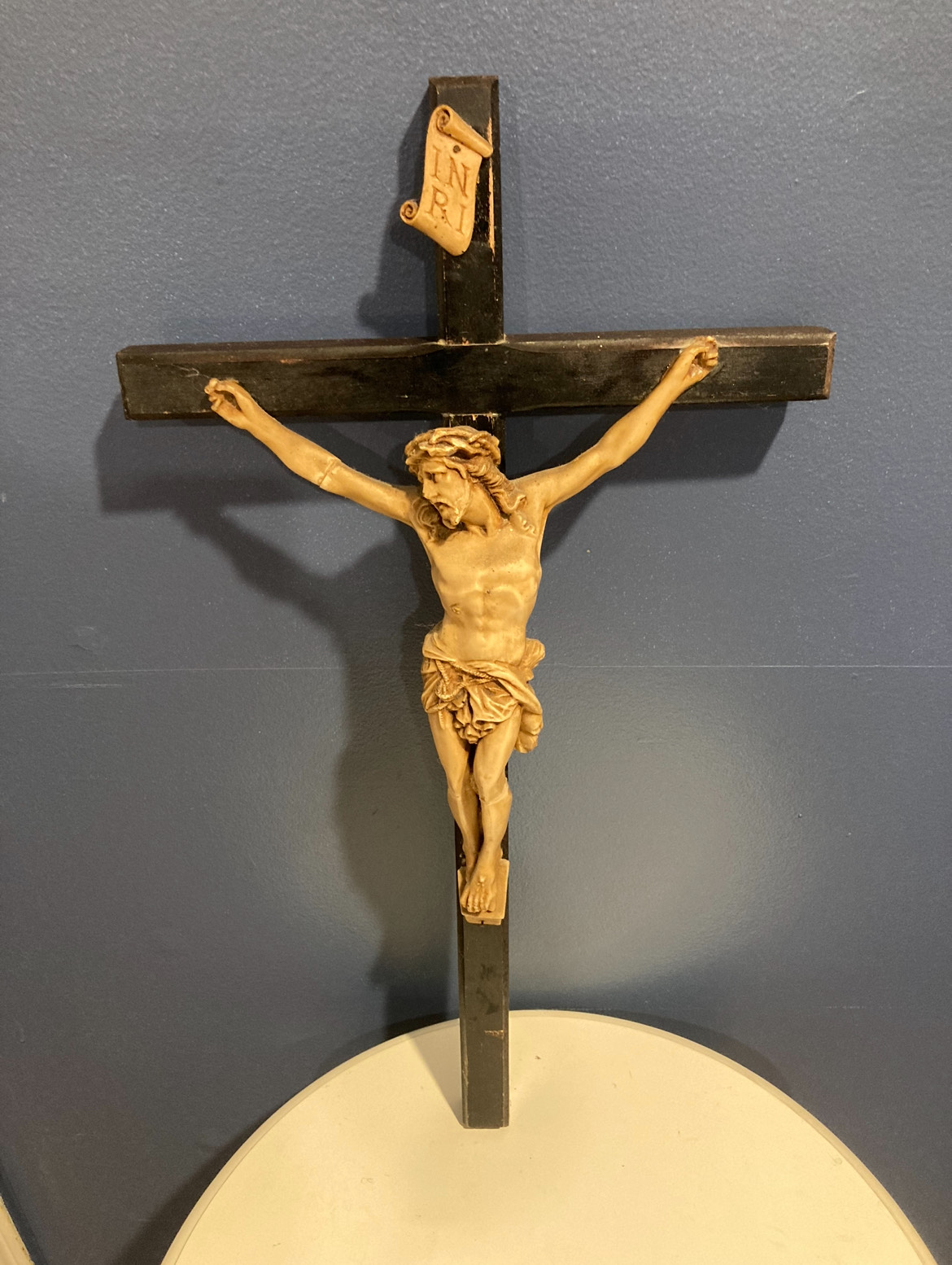
Black Crucifix, taken off the original wall, standing on my bedroom night-table.

The crucifix, standing around 25 inches long, 12 inches wide, is made from oak wood. Two pieces overlap to form the base, holding up a small wooden figure of Jesus Christ. He faces the right, clad in only a garment wrapped around his waist and bearing the crown of thorns. Inscripted in another piece of wood are the letters “INRI.” Compositionally, it is no different than any other crucifix, yet this one was an immigrant in my home, hanging in the kitchen for the first nine years of my life before moving to the hallway of our new home for the next ten (and counting!). It is an object that now exists in an unremarkable space, yet represents a deeper history of our Catholic Slovakian family.

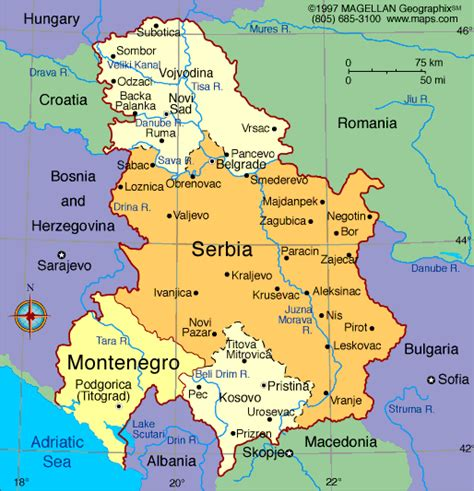
My family comes from a small village in Northwestern Serbia in a province called Vojvodina. Both my mother and father’s families immigrated here in the 19th century, leading to a collision of cultures and languages that resulted in a Slovakian-Serbian speaking region. A few empires and civil wars later, the Serbian village is still inhabited ethnically by Slovaks. My mother, who grew up in this village, could speak both Slovak and Serbian, navigating her tongue between the cyrillic script and Slovakian alphabet. My father is a native New Yorker, born and raised in Astoria, Queens, but he still frequented the village every summer. Both were raised catholic; both were raised speaking Slovak. Those two identities brought them together in union.

An image of Serbia, highlighting the Vojvodina province where my family is from. Source: toursmaps.com

But the story of the crucifix does not start here (though we will be returning); it begins thirteen hours away (allegedly by bus) in a small village called Medjugorje in Bosnia and Herzegovina (formerly part of the larger Yugoslavian empire). This is one of numerous pilgrimage sites for Catholics, having been established as such in 1981 after the apparition of the Virgin Mary.

The year was 1982, three years after my great-grandfather died. My great-grandmother, my Babička, at the time was a nun, living in Subotica and cooking meals for the bishops in a church. She was invited to live and work in Medjugorje, which had only begun to gain traction by that point. She took their offer, moving across soon-to-be-drawn international lines, and working as a caretaker for troubled youth. My Babička worked there for ten years, feeding and housing those youth in the hopes of rehabilitating them. It was during this period that she was given the crucifix from a local priest, though due to her old age and fading memory, the exact context and timestamp is not entirely certain. The crucifix did however make its way to our village in Serbia, along with my great-grandmother, once the Yugoslavian war broke out. It found a new home on her living room wall, along with countless other rosaries, statues, and books from the mountain. My Babička continued to visit Medjugorje, but she permanently settled back in our village, holding onto and eventually gifting these objects.

Something worth noting about this crucifix is its black paint. It is no accident that this is the shellac used, because this is a replica of a much larger wooden cross on top of Medjugorje. Though faded now, the black is meant to symbolize the darkest of sins, painted by those who touch its wood and soon after seek penance. Our family’s crucifix is matte black, a bit faded on the backside, but it still physically and symbolically maintains its color and meaning, as it hung from my Babička’s wall for twelve years.

The original black cross in Medjugorje. It is weathered from years of onslaught from the natural elements, but still an important cross for visiting Catholics to seek penance.

It is April 2004, and my parents are back in our small village, visiting my mother’s grandmother, my Babička, just one month before they were set to wed. It is here where the crucifix falls into my parents’ hands. It was a Catholic exchange, one not too unfamiliar within my family, but symbolically, its meaning had now changed. The matte black paint, meant to bear the weight of their worst sins, was now meant to prompt them to reconcile and to bear each other’s crosses as an act of love for each other and God. My Babička injected this new meaning into this object, handing it to them to bear and support this new crucifix in their new family til death. Fourteen years later, they filed for divorce.

For me, this crucifix exists in two contexts, pre- and post-divorce. Post-divorce, in the year 2024, it stands alone in my father’s home, sitting just above a light-switch, filling the blank blue wall between the bathroom and bedroom door. The crucifix has lost its luster, collecting dust and scuffs instead in the years of natural wear and tear. For my father, it is a reminder of his Slovak heritage and Catholic faith; for me, it is a reminder of the broken family unit betraying my Slovak and Catholic roots. It sounds grimmer than it actually feels, but looking at this cross—its inscriptions, its blemishes, its fine-wooden detailing—ultimately, it’s a part of me. It is a Yugoslavian Catholic reflection of myself and this new meaning I make of it, as time continues to pass and the crucifix still hangs.

The black crucifix in its original spot, above the light switch in my hallway, between the bedroom door and bathroom door.

Shirley Temple Doll

When my mother was a child, her grandmother bought her a Shirley Temple doll. Manufactured by Ideal Novelty sometime between 1970 and 1979, this model of doll was a staple of the U.S. toy market and would have been a typical gift for a young girl. The doll stands at 16 inches, and has blonde, curly hair rooted to its vinyl head. Printed details depict clear brown eyes, an open-mouthed smile, and light pink blush. The doll wears a white dress with puffed sleeves, scattered with red polka dots and sporting a matching red velvet belt. On its feet are a pair of red plastic Mary Jane shoes, which would have been worn with white socks.  

Ideal Shirley Temple doll and box. **This is the same model of doll, but not the specific object. 

The gift came with a condition: the doll must not, under any circumstance, be removed from its protective box. One day, Grandma Minnie Strassberg told my mother, this doll will be very valuable. I don’t want you to get it dirty. 

This was a big ask of my mother. Every day, against the instructions of her grandmother, she would remove the doll from its box. My mother would brush its carefully coifed hair, tweak and prod at the buttons and ribbons adorning the doll’s dress. The doll got along great with the other toys, and made friends with Raggedy Ann and Midge, Barbie’s pregnant and decidedly less glamorous friend. After playtime was over, my mother would put the doll back in its box, back in its rightful spot on her shelf, between an impressive collection of horse figurines and a box set of Nancy Drew books. By the time Grandma Minnie and Grandpa Harold and their little white dog Sherrie came around for dinner, everything was as it should be. If Grandma Minnie ever suspected what exactly was going on when she wasn’t around, she never let on.  

Grandma Minnie died at the age of ninety-five on November 30th, 2010, a week after my seventh birthday. I was around the age my mother had been when she was gifted the doll. My memory of my great-grandmother exists in flashes, pale and fuzzy with age. I remember her full head of curly hair, once a brilliant red, and how small she was when I hugged her. I remember the smell of the retirement home where she lived and the overgrown garden in the back. 

To know my great-grandmother is to have dinner with my family. This is where I listen to my grandfather recount anecdotes from his mother’s childhood, which was spent in her family’s Romanian restaurant in the Lower East Side alongside seven brothers and sisters. This is where, from the kitchen, I smell sweet potato and apple bake, a signature dish of Grandma Minnie’s that my mother makes on holidays. 

It was several years after her death when the doll came into my possession. My grandmother came across it while cleaning out the basement and thought of me. The doll had likely been there since my grandparent’s move from my mother’s childhood home in Ithaca, when it had been packed away and forgotten. The protective box Grandma Minnie had been insistent that the doll stay inside was long gone. It was missing a hair ribbon, as well as its socks. The doll’s hair was matted on one side, a permanent case of bedhead. In its condition, and without its protective box, the doll was likely not very valuable.  

I did what I could do to restore the doll to its original condition. I washed and conditioned its hair and used a pencil to recreate Shirley Temple’s iconic ringlets. I scrubbed the dirt from its face, and sewed a new pair of socks to replace the old ones. What I didn’t consider at the time, and what I understand now, is that the care I took in restoring the doll was an act of love. Now it sits on my bedroom shelf, huddled up next to a lumpy sock monkey and a long-legged ballerina. They, too, have become good friends. 

Piecing Together the Past: The Story of a Puzzle

Michaela Browne-Gallagher

Professor Mulready

History, Thought, and Art

09/20/2024       

                         Piecing Together the Past: The Story of a Puzzle

          This object was a gift. 

           Not to me, at least not at first. This object, a framed jigsaw puzzle of the Forth Road bridge, was first given to my grandfather, Martin Browne on September 4th, 1964.

          September 4th, 1964 is the day that the bridge shown in the puzzle opened its gates for the first time. Specifically, these gates are depicted as a large suspension bridge with tall, dark towers that seem to pierce the sky and the Forth River below. In the puzzle, this river is shown as an expanse of different shades of blue rippling under the bridge. 

          The bridge is shown to be grey and light brown in color, with the entrance of the bridge being brown, and the towers being grey. In the background, there is another large structure that’s made up of a series of links. Upon further research, I found that that is the Forth Bridge, the Forth Road Bridge’s sister bridge.  

          It is a bridge that was built by many, many men — my grandfather being one of them. 

          According to my mother, my grandfather was born in Fife, Scotland, on October 6th, 1926. He was the youngest of three boys and was sent out to work at age eleven. He was alone when he was sent out to work, having to cross hills, go through towns, and do odd jobs just to survive. He did all this with no shoes, my mother stresses, and that’s why, in almost every photo we have of him, the shoes he has are shining. 

        There are records in the National Federal Scottish Census with my grandfather’s name. In 1939, he was listed as an Edinburgh resident. In 1941, he was listed as a Glasgow resident, and the list goes until 1946, when he settled down in Dunfermline. This census, and later, the bridge, is a testament to how far my grandfather traveled, how hard he worked, and how many lives he must’ve lived before he settled down in Dunfermline. 

         He crossed many things on his journey—bridges, hills, cities, and towns. I’m not sure of the nature of his lives before he met my grandmother, but I can imagine him: his black hair, determined eyes, and soft voice, going through the motions until he found his home in Dunfermline.

          All this traveling is how he came to work in construction. At the time, construction was a well-paying job that offered job security. It was a stable job in Dunfermline, which was part of the reason he stayed. For my grandfather, that was everything that his upbringing hadn’t provided. Additionally, with he and his family’s upcoming move to London, as well as the fact that he would soon have a family of five, a job like this was an incredible opportunity despite the risks. 

          This bridge is located in Scotland. It was the first bridge of its time to be a multispan cantilever bridge that allowed for pedestrian, railway, and car access. Working on this bridge was something that my grandfather took pride in. This bridge was his labor of love.

           On the back of this puzzle, the initials of the ACD Bridge Company Ltd construction company are written in pencil. These initials are written in script, the typical handwriting for educated Scotsmen during this time.

          This company was founded in September of 1958, when construction for the Forth Road Bridge just began. This company is a conglomerate of different construction companies: Sir William Arrol & Company, The Cleveland Bridge & Engineering Company, and Dorman Long (Bridge & Engineering) Ltd. These companies were all established at different times but came together to oversee this monumental construction project. 

          Besides the signature, there is no one credited for the image that the puzzle is made up of. There are only the hastily scribbled letters on the back of the slightly browning puzzle pieces. This signature is interesting because it spans across three puzzle pieces. Because of this placement, the signature wouldn’t make sense unless the puzzle was pieced together. It makes me wonder, was it not supposed to be a puzzle? Was this signature hastily scribbled for a reason? Was it an afterthought? 

          My mother recalls that her father used to come home late a lot, his eyes tired, and soot staining clothes. She talks of how he had calloused hands, but how those calloused hands always held a paper-bagged gift for her and her sisters. From candy to marbles to puzzle pieces, he always thought of his family first. 

          To show for the hard work, he received this puzzle from his employers at ACD Bridge Company as a piece of his earnings. According to the company and online listings, there were only about 200 or so of these puzzles distributed to the workers, despite there being more than 4600 men working on it. My mother says that my grandfather was chosen to receive it because he was so handsome and because they wanted his photo for the newspaper. I couldn’t find any newspaper articles about any workers during the bridge’s opening ceremony, so I’m not sure how true my mother’s claim was, but I’ve heard it so much that I’d like to believe it’s true. 

         Looking at the cars shown in the puzzle, you can see that they bear the name “Dunlop”. Dunlop was a company that specialized in rubber products like tires and car equipment. Its logo is white and is shown on several cars on the puzzle. 

          This symbol was purposeful. This puzzle wasn’t even a true trophy, but an advertisement for Dunlop. I can imagine my grandfather’s calloused hands tracing the then fresh edges of the puzzle, wondering, waiting, if he could finally rest and if this was it.

          This jigsaw puzzle is approximately 200 pieces large, with it being 14 pieces by 14 pieces long and wide. Its specific dimensions are 24 inches by 18 inches. The edges of the jigsaw puzzle are rounded with age and use, and there are smudges scattered across the pieces. The size of this puzzle, slightly more than that of two pieces of paper lined up together, pales in comparison to the actual 2.5 km bridge.

          I have never seen this piece broken apart, and I have never seen the Forth River without its bridge. Both of these things are things only my grandfather experienced, and this puzzle, in a way, represents all the pieces coming together — steel, bolts, cables, and wires all coming together to form something way bigger than anything around it. 

          As my mother tells me this story, she pauses for a moment, smiles, and says how my grandfather came home the day the bridge opened, a smile on his face. That day, my grandfather didn’t have a single paper bag for his daughters. That was something new, because he always had a gift for them. 

          Instead, he had this puzzle, a few flowers Queen Elizabeth got him, and a plan. So, the first thing my grandfather had done once he brought it home was to let my mom and her sisters put the pieces together, and to rest. 

          My mother’s the one who, 40 years later, received the painting from my grandfather shortly before he died. It’s the puzzle she herself pieced together. It’s the puzzle she framed and placed on the wall before I could even properly walk. She mentions how she put it together as a child whenever she didn’t want to do her work, and how her sister often used it as a placemat. It is a puzzle that stands for so much and has witnessed so many memories, that it too has become an integral part of those memories. 

          I was never properly gifted this puzzle like my mother and grandfather were. It’s always been a part of my life — something that allows me to get to know about my grandfather. 

          Me and my mother love the puzzle despite it not being a true reward for all my grandfather’s hard work. But knowing the person that my mother portrays my grandfather as, I’m sure he would’ve loved it anyway.

          This puzzle of the bridge, regardless of its circumstances, shows the longevity of connection — how things can be advertised, made, loved, forgotten, and forgiven. 

          My uncalloused hands brush across the glass that protects this puzzle that is many, many years older than I am, and I wonder what it’s like to piece together something so much larger than myself.