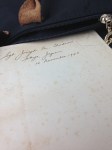
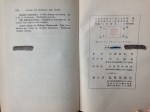
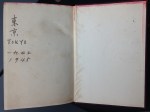
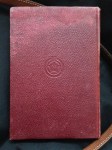
For this week, I chose to focus my research on my objects and ‘habitus’ by researching the greater history of missals in France. Since I don’t have the privilege of visiting my great grandmother’s apartment to view the habitus of her French Missal, nor do I have access to photos of her apartment, I can only imagine where she kept the missal. Most likely, she kept the book in a very special place. I imagine the leather-bound book resting in the living room, atop a table. Easy to get to but not in harms way. I also imagine the Missal by her bedside. Maybe she enjoyed reading prayers before bed. The Missal must have provided some level of comfort and security to her for she lived in the apartment alone in her later years. Alas, that is just speculation. So, I’ve decided to research in what is factual and known about the greater history of liturgy moving from Church to home.

The Council of Trent (1543-1563)
The fact that my great-grandmother held this Catholic Missal in her home, did not strike me at all. Until, Professor Mulready pointed out that this symbolized quite a phenomenon in Catholicism. Professor Mulready suggested a text that provided of great assistance with my research, “The History of the Vernacular and the Role of Translation” by Keith Pecklers and Gilbert Osdeik. Prior to the rise of the vernacular and translation, missals strictly only included Latin texts. Mass was said in Latin, for it was seen as the pure and old language of the Romans. The Church viewed mass and the text of mass to be a hierarchal and unchanging fact. There had been several attempts throughout history to shift mass to the vernacular and promote translation. At the Council of Trent in 1545, bishops split over the proposition to translate missals into the vernacular. Surprisingly, a majority of bishops accepted the translation of the liturgy into the vernacular but the proposal ultimately was shot down. The extremely important council of Trent concluded that “out of pastoral concern for the faithful, it was not the proper moment to shift from Latin to the vernacular; more time for catechis would be needed.” The liturgy and the Mass was viewed by the Church in a hierarchical order. The word of Jesus could not be translated–that was sacrilegious. Change, no change.
Fast Forward to 1937, where my great-grandmother was living in a suburb of Paris in Gagny. To view the world my great-grandmother grew up in, view the video about which features footage from the turn of the 19th century. My father sent me this video the other day as a resource because he knows I’m doing this project on the French missal. For my great-grandmother to own a missal truly represented a major shift in the Church’s view of the liturgy. Caught in a world on the eve of a second World War, and a complex and changing society, the word of the Lord was translated into French. The liturgy moved from closed off and intangible, to a very fluid and open text. The significance of my great-grandmother’s missal involves the fact that the majority of the text is in French. A major shift is happening here in 1937: faith and religion for Roman Catholics was becoming personal, in a tangible and physical way. The greater context of the missal, being incorporated into everyday life and easily accessible by the greater public is momentous.

The 1937 World Exposition in Paris. The increasingly international city my great-grandmother lived in.
The missal, in it’s small dimensions, was widely available at this time. It could be brought around and easily fit in a pocketbook. Rather than having one habitus, to borrow from Miller, the book was constantly on the move. The habitus of the missal was vast and endless. The novelty of the French missal in 1937 reflects the international shift and increasingly world view of Paris at the time. Housing a major international arts exposition in 1937, Paris was continuing to be a city of arts and culture. The popularization of the missal reflects the modern city where no longer could bishops in antiquated dress dictate faith for those city dwellers. For my great-grandmother, the missal did not sit in her apartment but rather accompanied her to mass and into the city. Fitting perfectly into her hands, the book was picked up, touched, and used for song and prayer. For my great-grandmother, a woman who valued her faith so strongly, the missal must have provided great expression. The increased availability of the French missal is something that is hugely important for process and intimacy of faith. I’m humbled to know that such a small object provided my great-grandmother with such inspiration and strength.




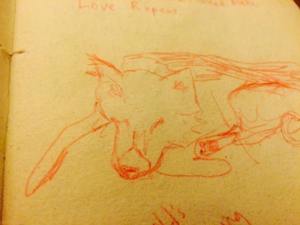 A moment must be captured swiftly lest it be taken away with the waking of the dog, or the sudden rush of an autumn
 been trying to get away from the personal. I wanted to step back and leave myself out of my objects. Bringing myself into them and into my writing makes me vulnerable, a feeling that I’ve been trying to get away from my whole life and one of the reasons I began writing in the first place. I try not to take words for granted, try and put them in their proper place at the right time. They are not objects themselves, or are they? They are brought into being and then erased, re-written. Aloud, they exist in air for a nano-second and disappear. I sweat over them, rubbing my hands beneath the table, chewing on a nail, wanting to speak but never wanting to say the wrong thing. Misunderstanding and failure are too close at hand for me to voice an opinion. It is only through many years of practice have I learned to overcome this.
 With the pen it is different. Here, you can speak up, work through your thoughts before presenting them. The details of a life are mundane to those who stand outside its sphere. You must choose carefully what to write to make it true, or else it’s just another slip of paper being put away in a draw. What you leave out becomes more important than what you keep. I have been writing in journals since I was a little girl drawing in them, pressing flowers and writing poetry. In this private place however, you can write as much as you want about whatever you want. I knew I wanted to be a writer before I turned thirteen. My sister followed my lead; the books I would read would become hers, but more often she would use my paints and art supplies to make her own creations. We flourished in our shared little world of imagination.






 The Materials of History, Thought, and Art