Preserving Cultural Traditions

For the chain of ownership assignment, I have researched the history behind my mother’s tortilla press. Before starting this assignment, I was struggling to come up with an object that connected to a story of my family’s history. However, when I asked my parents the tortilla press was suggested which I was fascinated by because I did not even know this object had a story. The object is owned by my mother, Beatriz.

The wooden tortilla press

My mother’s tortilla press sits on the top shelf of our smaller second pantry. Most of the time it is stored away but comes out on special occasions. The wooden tortilla press is used in the process of making homemade corn tortillas. After the dough is made and separated into many small-sized balls, the tortilla press allows for an easy way to thin out the tortillas and make them the same size. 

In 2001, the tortilla press was gifted to my mother as a wedding gift by my grandma’s neighbor, Efrain. This tortilla press originates from Mexico, where Efrain handmade my mother’s wooden tortilla press. Although the exact date of when the tortilla press was made is unknown, my parents expect that it was made in early January 2001. Making wooden tortilla presses was a hobby for Efrain. The wood used to make this tortilla press is most likely mahogany.

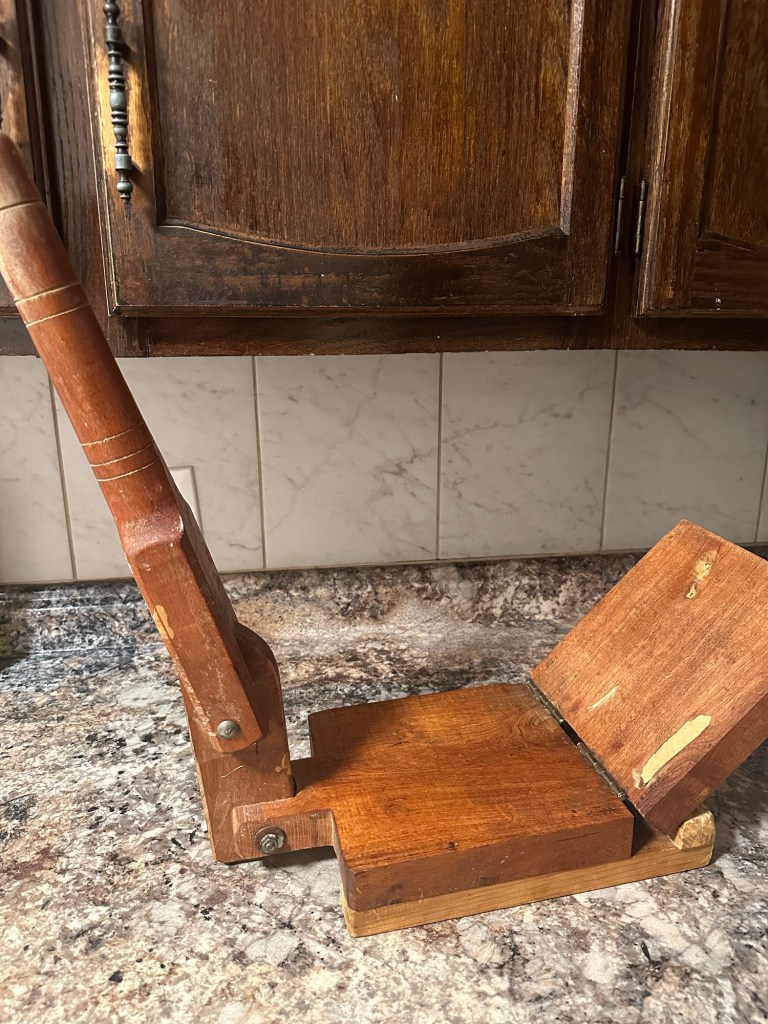
The age and use of the tortilla press can be minimally seen from the outside. When the tortilla press is closed with the handle horizontally it measures 16 inches. The top large wooden block measures 8.5 inches. The handle rests on a 4x1x1 wooden block that has two nails that are 2 inches apart. The handle has six engraved circles; the first three circles on the left are close together being 1/2 inch apart, third and fourth circles are 3 inches apart, the fourth and fifth circles are 1/2 apart, and fifth and sixth are 2 inches apart. The tortilla press is 3.5 inches tall with one inch being two 11×1.25×1 different wooden pieces that are on the edge of the bottom piece of the Mahogany.


While my mother did use her tortilla press in Mexico, she ultimately decided that it would be put to better use if she had it in New York; rather than being stored away at my grandma’s house in Mexico since this object is a prevalent kitchen appliance in Mexican households. Tortillas remain a staple in Mexico and Central America (Arnés and Astier 3). Twenty-three years later my mother still uses her tortilla press. Although today tortillas can be purchased at grocery stores or Tortilleria’s, “where the dough is mixed by machine, stamped into disks, and passed by conveyor belt over a flame” my mother still occasionally handmakes corn tortillas to maintain her traditional culinary practices and because they taste better fresh (Tortilla). I tend to eat more tortillas when they are homemade rather than store-bought.

With my mother’s tortilla press, she taught my sister and me how corn tortillas are made. Thus, anytime we make tortillas at home, my sister and I participate in the tortilla-making process. Passing down this tradition allows families to continue to engage in their cultural heritage. Not only is Mother’s wooden tortilla press meaningful to her because it was given as a handmade gift, but she was able to stay connected to her culture by bringing it with her to America. 

Works Cited

Arnés, Esperanza, and Marta Astier. “Handmade Comal Tortillas in Michoacán: Traditional Practices along the Rural-Urban Gradient.” International Journal of Environmental Research and Public Health, vol. 16, no. 17, 2019, pp. 3211-, https://doi.org/10.3390/ijerph16173211.

“Tortilla.” Britannica Academic, Encyclopædia Britannica, 4 Oct. 2021. s443-academic-eb-com.libdatabase.newpaltz.edu/levels/collegiate/article/tortilla/1353. Accessed 19 Sep. 2024.

Roger’s Token

Charlie Strittmatter

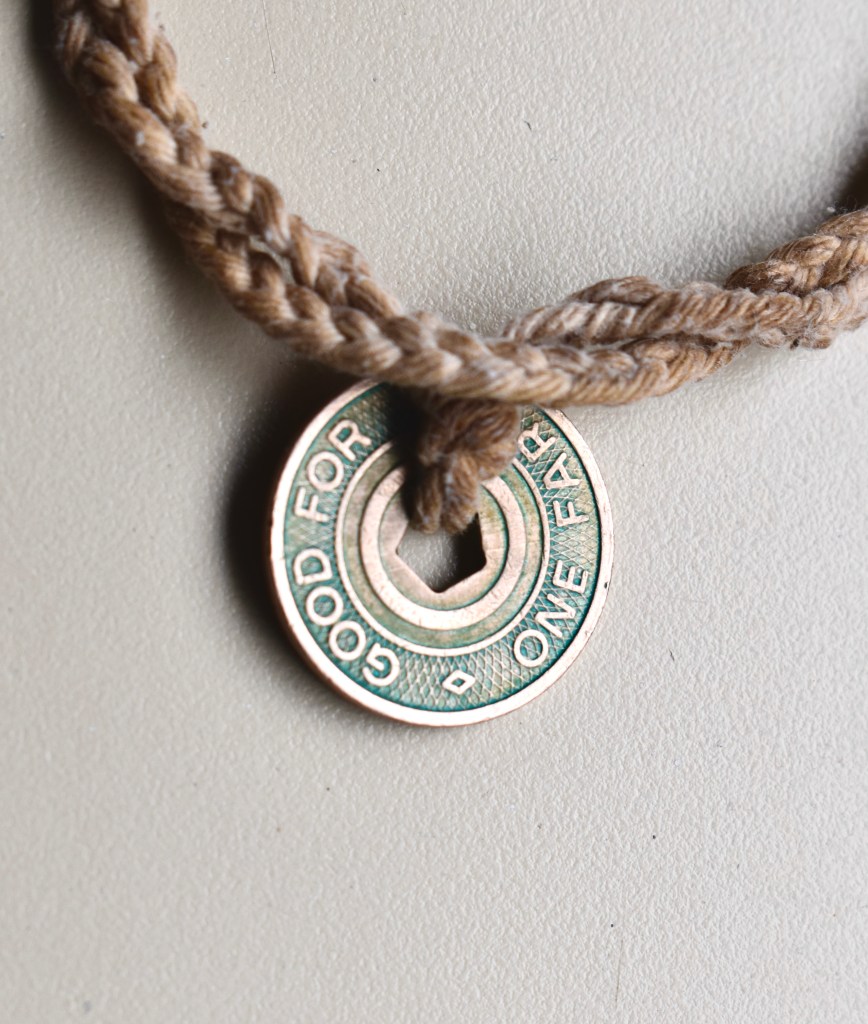
My necklace

Since being tasked with writing my previous blog post, I continued to be intrigued by the story and history behind the necklace I treasure. It only made sense to me to continue to share its story as it unexpectedly revealed itself to me. This object formerly meant (and presently still means) a great deal to me. Although, through nostalgic conversation and inquisitive questioning its meaning and importance has entirely transformed.

This necklace, in all its simplicity, I cherish immensely, because Eric made it and gave it to me. It hangs on the shorter side, the chain being made of a thin braid of three pieces of twine. A New York City subway token, fixed in the center of the necklace, is attached tightly with another, smaller braided piece of twine. To start off easy, I asked Eric from where he had gotten the string the necklace is made out of. The farthest back I got regarding its original location was in his pantry, but the string now resides in his bedroom. It sits there, still bundled up on a cardboard spool, waiting for the next time Eric puts his creative skills to use. The focus of my curiosity, the token, was discovered when Eric fished it out of a jar, filled with miscellaneous objects, he had found sitting in his father’s room. 

About three years ago (when he first found it), Eric fashioned the token onto a metal chain that he wore around his neck consistently for quite a while. Eventually, the chain had seen better days and snapped, no longer able to hold the token. Eric kept the token, awaiting a time when he came across a more functional chain to replace the old one. That led me to question why he eventually fashioned the token onto a twine necklace and then gifted it to me. Eric said he wanted to give me a gift that was unique and special to him; it being special to him because he believed that his father kept the token for a reason. That statement sparked more interest in me, since Eric had not known the reason why his father kept the token.

After a while of interrogating Eric, I hit a wall with the information I received, and took matters into my own hands. I sent a text to Eric’s father (Roger), this time, questioning the person I perceived to be the original owner of the token about its origins. The token’s story began to unveil itself.

Young and curious, Roger agreed to go on a trip with his father into New York City. The city was not new to his father, since he was an employee of the Long Island Rail Road and enjoyed traveling often. His father was very familiar with how to navigate the subways, so he knew what lies in store for them. As they arrived in the city, Roger’s father had told him that he wanted to show him a special place few people knew about. I can imagine that Roger was initially excited about this obscure location, but grew confused when he and his father never moved—why they never stepped off the subway each time it stopped. I can also imagine the anticipation building each time the doors opened, waiting for his father to lead the way off the rickety train, signaling they had arrived. The subway took them farther and further, deeper into the city, until finally, they stepped out.

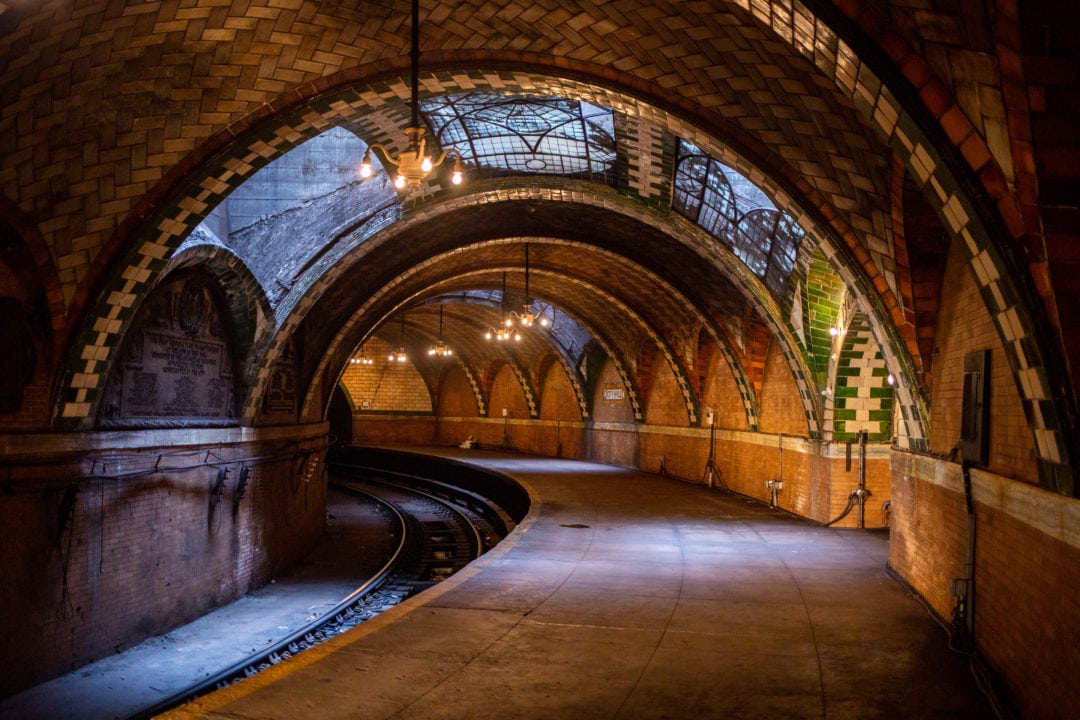
As a lover of architecture, Roger was in awe. The grand arches of Old City Hall, lined with precise tile work, bridged from one side of the tracks to the other, stretching above him and his father. Skylights made of beautifully intricate stained glass let in just the right amount of sunlight to brighten up the darkened tunnel. The lighting was soft, unlike the other subway stations where the fluorescent lights pained your eyes. Here, the natural light combined with the amber bulbs carefully placed in hanging chandeliers above the tracks, lessened the harshness of the subway station. The subway and its stations are known for being filled with antsy people, rushing to get on the train, trying to keep their child under control, hauling 5 suitcases bumping into everyone in their path. Here, time is slowed down, and wound back, back to another place in history. Back to a place where things took time, skill, and patience to create. The remnants of New York City’s transportation history remains wonderfully intact, encapsulated by the opulence of Old City Hall. As a way to remember the trip, Roger’s father had given him the subway token. Every now and then, Roger picks up the dulled token and is reminded of that day, and that subway ride.

This story not only tugged at my heart strings, but made me feel differently about the token hanging from my neck. Should I even have this? It felt wrong being the owner of something with such a sentimental and personal story attached to it (especially since it was not my story). It no longer felt like the token was mine. I expressed these feelings to Eric, who reassured me that Roger had plenty of these tokens, and he did not mind that I held on to one. This is when I truly realized, this is how objects work. They are supposed to change meaning, supposed to evolve. The token, a symbol of remembrance, once shared between a father and son, now reminds a girl of the one she loves.

The obscure location, Old City Hall Station, Photo: Alexandra Charitan

Works Cited:

Roadtrippers. “Here’s your chance to see NYC’s dazzling, abandoned City Hall station without risking a criminal trespass charge.” Roadtrippers, 16 Apr. 2019, roadtrippers.com/magazine/old-city-hall-subway-station.

My Grammy’s Piano

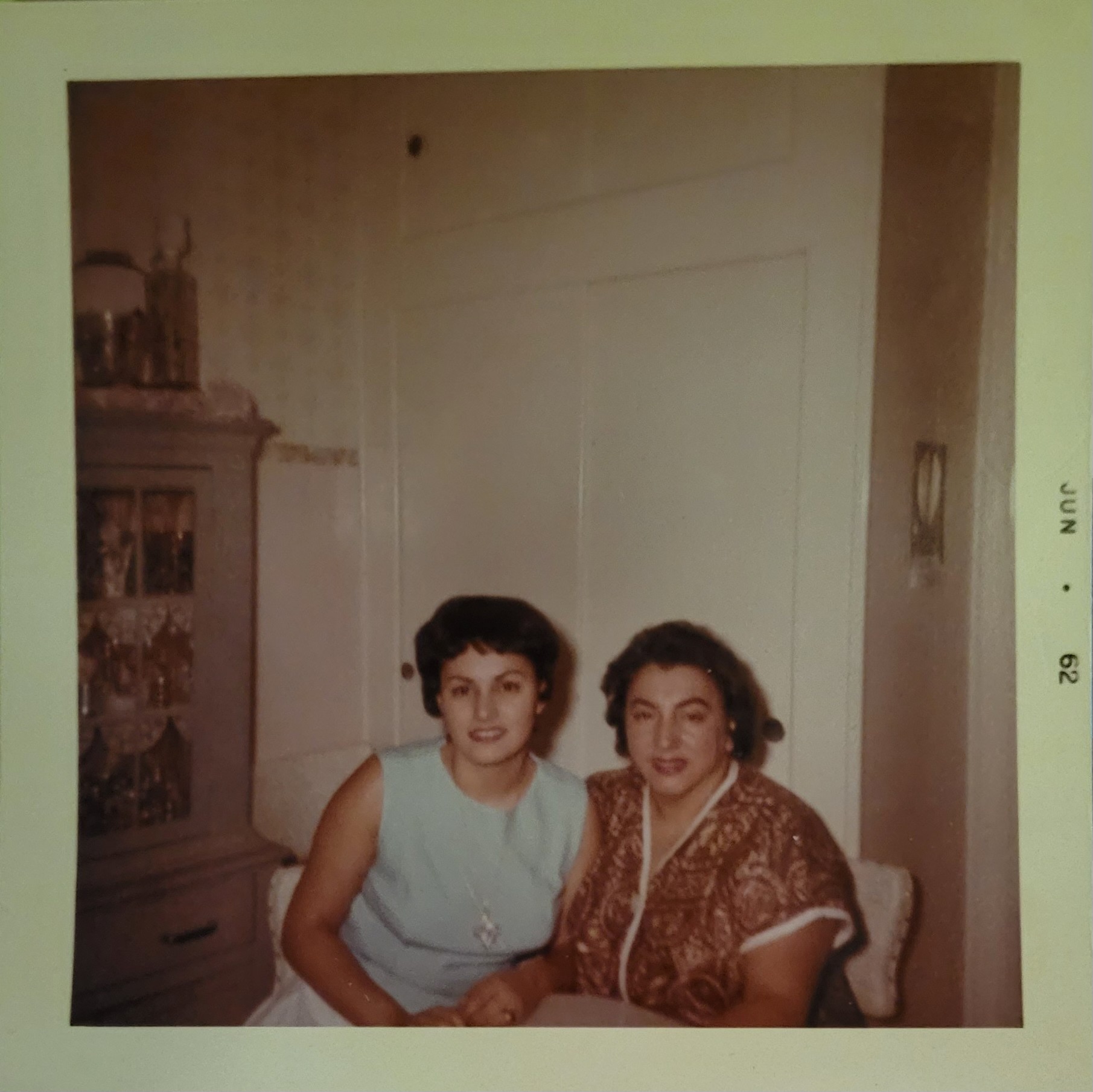
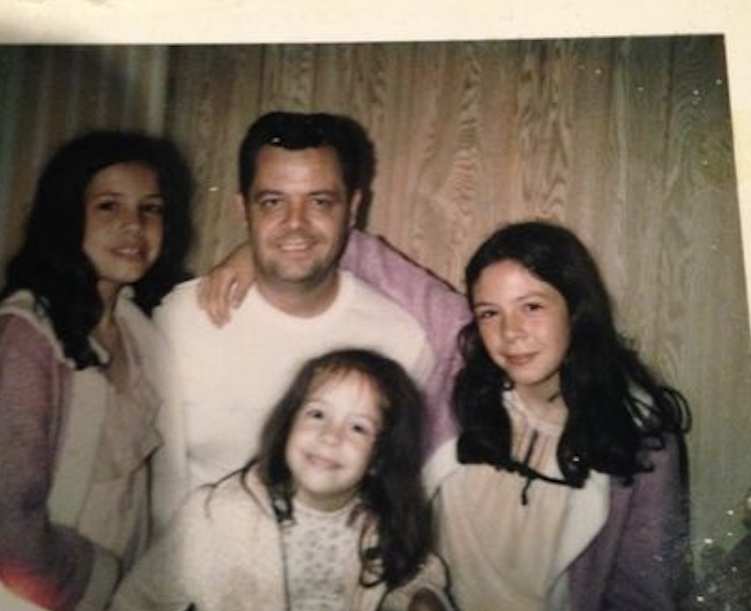
My great grandmother, Carmela, but best known as Millie, was born in Manhattan to two Italian immigrants. She lived in New York City her whole life, moving from Manhattan to Brooklyn, and along the way she met her husband Tony. In Brooklyn, she gave birth to her daughter Pamela, my Grammy. My grandmother grew up in Brooklyn, and eventually moved to New Jersey after she got married. There, she had her daughter, my Aunt Lisa. After splitting with her husband, Grammy took Lisa and moved back to Brooklyn with Millie and Tony, where she had her son, my dad Anthony.

my Grammy and my Great Grandma Millie

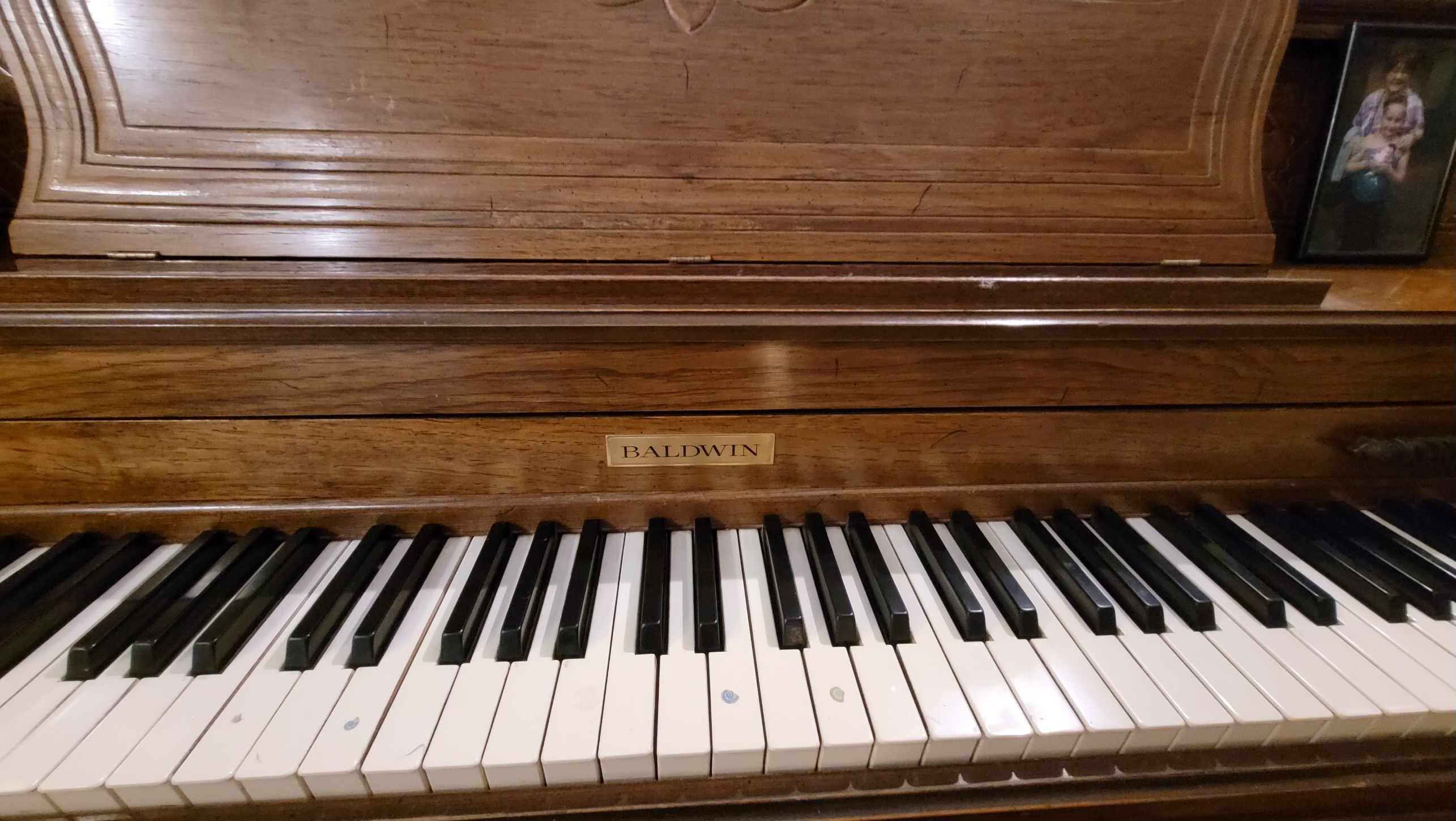
One of my great grandmother’s dreams was to have a piano in her home, and she shared this dream with her husband and daughter. She wanted her home to be filled with music, hoping her family would be able to learn to play. In 1973, my great grandmother, great grandfather, Grammy, and my aunt and my dad all had agreed to move out of their 2 family home in Brooklyn to a house in Staten Island together. They bought a house and were planning their move, when Millie passed unexpectedly from a heart attack. Her heart- wrenching passing led my great grandfather and Grammy to buy a different house, as they couldn’t bear to live in the one they had picked out alongside her. Even though she passed before she could live out her dream of having a piano in her home, my Grammy and Tony fulfilled it by purchasing a piano once the family had moved into their new house in Staten Island. They bought the Baldwin upright piano brand new in 1974, about a year after they moved.

the Baldwin label

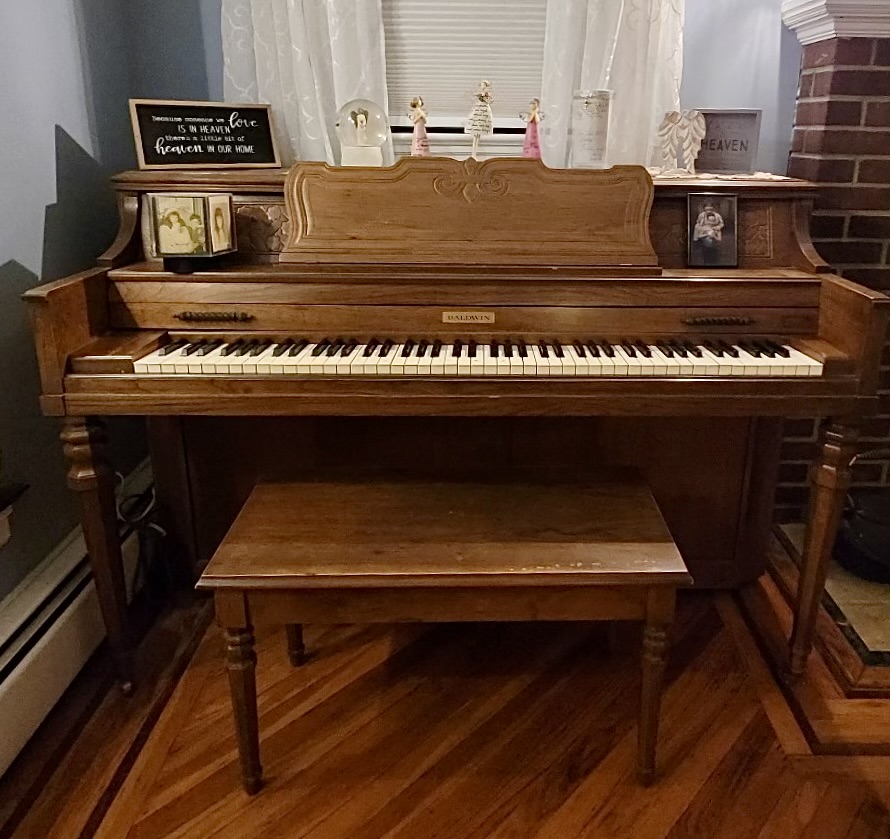
Though I wasn’t able to find how much a Baldwin upright piano would have been worth in 1974, a Yamaha upright piano would have been around $2,500, so it was most likely around a similar amount. The beautifully carved wooden piano stands at 58 inches wide, 40 inches high, and 25 inches deep, weighing about 500 pounds. It claimed its place in my grandmother’s living room from 1974 until she passed in 2019.

The piano’s first handler was my Aunt Lisa. Grammy signed up her daughter for piano lessons at the house. While my Aunt Lisa was being taught, her brother listened intently. One day, Grammy and Lisa were about in the house, away from the piano, when they heard it being played. “Isn’t that a tune you’ve been learning?” Grammy asked Aunt Lisa, as she recalls. My dad was found to be playing the song Lisa had been learning, completely by ear. Of course, Grammy signed him up for lessons as well after that. My dad was naturally musically talented, and still plays the piano beautifully to this day thanks to my great grandmother’s wish. 

the keys

When I was a kid, I remember being at Grammy’s house and listening to my dad play on that piano. On every Christmas Eve spent at my Grammy’s, he’d play the music for our family sing-along and while all us kids opened our presents. I remember my brother playing Fur Elise for Grammy, but jokingly speeding up turning the song into chaos, causing Grammy to exclaim “Play it nice!”. 

After my Grammy had passed, my family was faced with clearing out the many memories that house had held. The Baldwin upright piano was moved from its home of 45 years. Despite us already having a piano in our home, my dad of course took ownership of the Baldwin. Now, our piano sits in our living room across from my Grammy’s. 

Grammy’s piano in my living room

Old Wooden Table

For this blog, I will be discussing the history of my mom’s table that she has in Ecuador. Unfortunately I don’t have a picture of the table, so I will provide a picture of the house my mom built in Ecuador for herself along with a picture of a similarish wooden table that I found on Google. 

   Old Wooden Table from Google (1)  

                        Early days of my mom’s house

The table is roughly 4 feet long and 3 feet wide, and has a height of about 3 feet. I don’t know what kind of wood was used to make it, but it is a dark color similar to that of the face of the drawer in the picture. Instead of drawers like the table in the picture has, the top of the table that my mom has opens up (like a car hood) to reveal a hollow interior. The table is currently hidden in a room located in the back left corner of the house and is used solely as adornment. 

The table is important to my mom because it used to belong to her grandmother. To explain why this table is important to my mom, it is important to tell her story. My mother was born out of wedlock, and was then adopted and raised by her grandparents as their tenth child. When my great-grandmother passed away on September 13 of 2011, the many properties that my great-grandparents owned were passed down to their nine heirs, of which the majority voted against my mom being included in the inheritance. One of these properties was the house in a town called Giron and is the “main” house that the family would spend most of their time in and is also where my mom was raised. Almost immediately after the funeral, my mom was (aggressively) told to remove her stuff from the house in Giron because “she was not an heir”. 

Within hours of being kicked out my mom had a moving truck loaded up with all of her stuff from the house of Giron. Among these items were her childhood bed, her old clothes and books, some personal items, and most importantly an old wooden table. According to my mom, this table was the dining room table used in that house for decades (~50 years). In addition, when my mom brought the table, she also brought the stacks of fancy plates that were stored inside of the table. In the thirteen years since the death of my great-grandmother, the majority of the heirs still have no clue where this table is. I’m not condoning stealing, but I laugh every time I see the table because it shows me where I got my pettiness from. To my mom, this table represents her childhood memories and the struggles she had and still has to overcome as a result of her origin. Sometimes she’ll take out the plates and remember her old life, and sometimes she’ll even use the plates if we have a special guest over. When I see it however, I see a remnant of the family split. 

If you read my previous blog, you’ll remember that I mentioned that my great-grandfather raised cattle. Unlike the other girls in the bunch, my mom tagged along with my great-grandfather whenever he was working outside, did business, rode horses, went grocery shopping, and got drunk (she didn’t drink, she just protected him). As a result, the town gave my mom the nickname “el rabo de Don Segundo” or “Mr. Segundo’s tail” and my great-grandfather was extremely protective of my mom. Unfortunately, he died on July 4th, 1985, which was three or four months after my mom entered the U.S. with my brother. Given that my mom was being raised with her aunts and uncles, that meant that she was not raised with any of her real siblings from either her mom or dad’s side. Because of this weird family position that my mom is in, there has always been an “us vs them” mentality when dealing with 95% of my family. When I was very little, my cousins and I were playmates, but as we’ve grown up we’ve adopted this cold mentality and these unspoken alliances. In other words, when my great-grandmother died, so did the family’s law and order. 

I find it interesting that of all the things that my great grandparents owned, the material inheritance that my mom chose to bring with her into her “new” life is the same object that saw my great-grandparents, the heirs, and my mom sit down and eat together as a family. 

Works Cited

  1. Restorers, Van Dyke’s. “How to Restore a Wooden Table.” How to Restore a Wooden Table | Van Dyke’s Restorers, http://www.vandykes.com/blog/decorative-wood-blogs/how-to-restore-a-wooden-table/b/how-to-restore-a-wooden-table/. Accessed 18 Sept. 2024. 
The 119-Year-Old Colander

Written By: Nikki Hirschkind

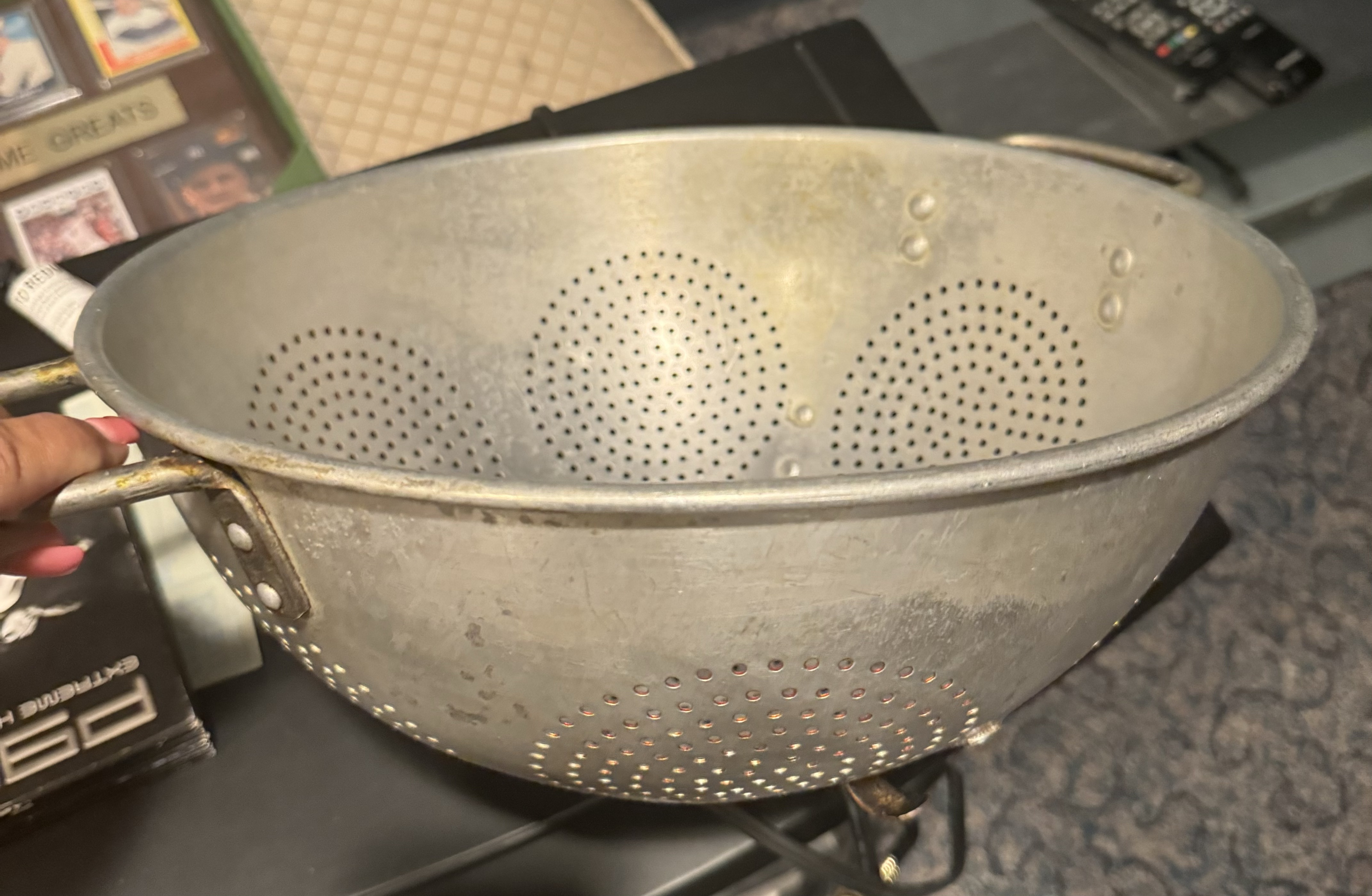
The object I will describe is a stainless steel colander that has been in my family for over 100 years. It has been passed down to generations of daughters, each using it in their own kitchens for decades. Today, the colander stays stored in my aunt’s basement until it is used for our annual Thanksgiving family dinner. 

The colander is large and spherical, with a wide rim that features a small lip. Two metal handles are attached to the exterior using four oval head screws. At the base, two curved hooks likely serve to hang it on a pot rack. Inside the colander are seven circular patterns of small rounded holes, allowing it to function as a strainer for ingredients of various sizes during cooking. Despite a few rust marks on the outer edges and inside, it is in excellent condition and works properly.

The story of the colander begins with my great-great-grandmother, Catherine Gandolfo. She was born in Palermo, Sicily, on May 2, 1888, and immigrated to the United States in Pennsylvania in 1908. Catherine married Frank Gandolfo when she was 17 and had four sons and a daughter between 1909 and 1929. One of the sons was the father of my grandmother, Nana. When talking to Nana about its history, she shared that her grandmother received the colander as a wedding gift from a friend at their wedding in 1905. However, there’s a possibility that her grandmother inherited it from her own mother, making the colander even older than we imagine.

My great-great-grandmother kept the colander until 1938, the year my great-grandfather, Matthew, married his wife, Theresa. As a wedding gift, Catherine gave the colander to her new daughter-in-law, starting a family tradition in which the colander would be passed down to the next daughter of the current owner.

Theresa and Matthew at their wedding in 1938

Theresa kept the colander in her kitchen in Garden City, New York, for nearly 22 years. In 1960, she gifted it to her daughter, Nana, on the day of her first wedding. The colander was brought to her home in Commack, where it remained there for almost 30 years. Nana fondly recalls using it to strain pots of ravioli or pounds of spaghetti.

Nana’s husband and daughters in the Commack house

            The colander became a staple at large family gatherings and pasta dinners during the time Nana’s children grew up. My mother, who is one of her daughters, cherishes the memories of those family dinners. Most Sundays were pasta night at the house, where there was always a big pot of sauce on the stove. For lunch those days, Nana would grab a meatball out of the pot and smash it up on a slice of Wonder bread for her and her daughters. My mother said she would always cook more pasta than the family needed. She would pour the large pot of steaming spaghetti into the colander, which held all of it without ever spilling over.

During Thanksgiving, Nana carries the tradition of preparing her famous stuffing. Using five loaves of stuffing bread and pounds of eggs, butter, and onions, she manages to perfect the recipe every year she makes it. The colander is perfect for mixing all of the ingredients and its depth easily holds the massive batch. 

In 1984, after remarrying, Nana moved to a new home in Holbrook, where the colander served many more pasta nights. In 2008, after the passing of her husband, she decided to move into my aunt’s house in Sayville. She brought the colander along, hoping it would carry the memories of her Holbrook home. Since then, it’s mainly been used for making her special Thanksgiving stuffing. Nevertheless, it’s always heartwarming to see my aunt pull it out for the holidays, watching Nana’s face light up with nostalgia.

Nana with her daughters during her second wedding in 1984

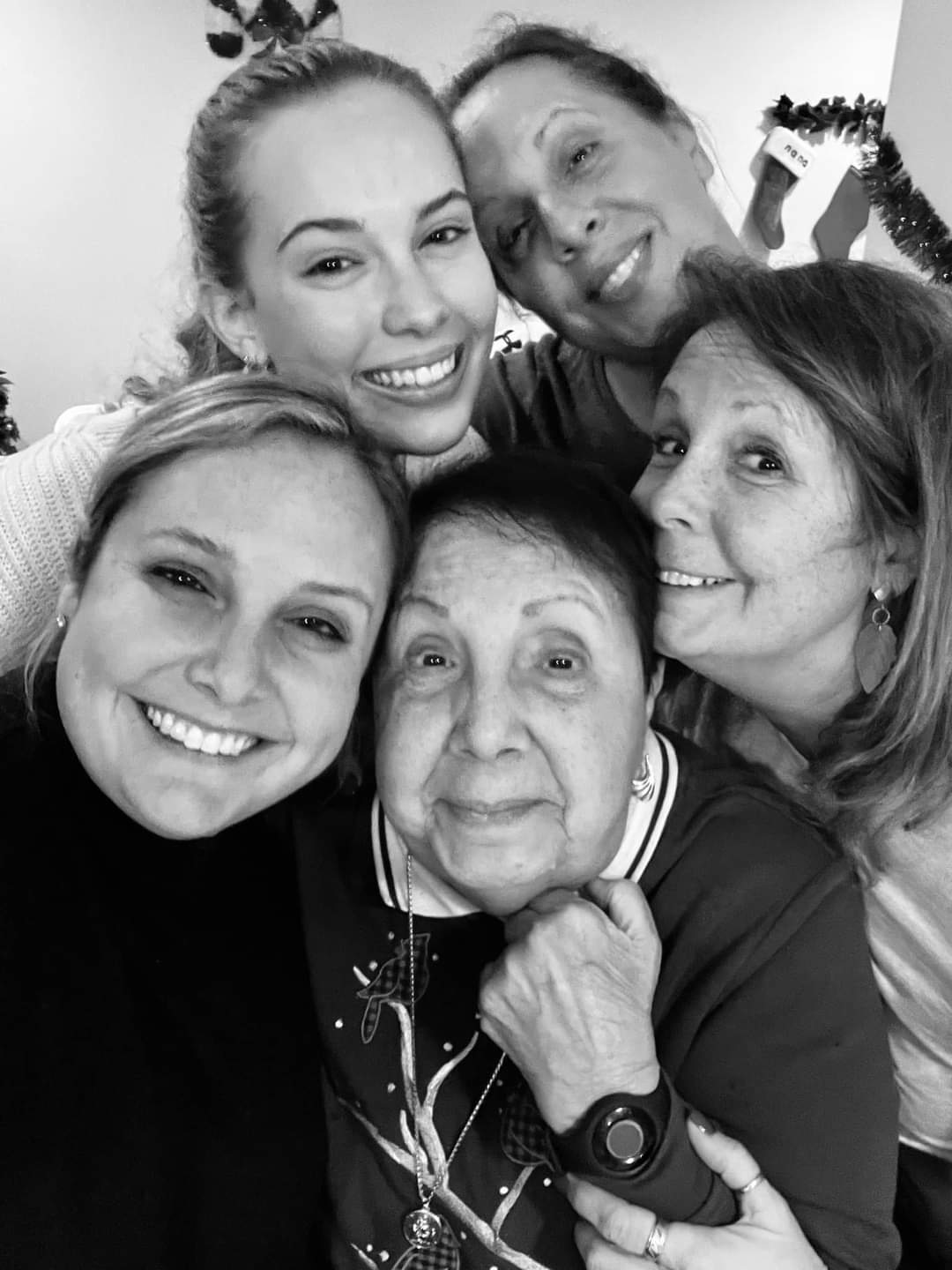
The colander carries a deep history, a symbol of family and love forged through a century of shared meals. Just like the durable stainless steel that has preserved it for over 100 years, the colander reflects the strength and resilience of our family and our connection with one another. Every year, I’m amazed to see it come out from its spot in the basement, still in pristine condition. I look forward to the day it’s passed down to me, as Nana intends for me to carry on its legacy.

The generation of daughters now (Top: Me on the left/My Mother on the right) (Bottom: My Aunt’s Daughter on the left/Nana in the middle/My Aunt on the right)

Mi Ultimá Muñeca

As a young girl, my sister and I constantly found ourselves getting lost in a fantasy world where only we and our dolls existed. In the summer of 2012, I got Taylor during a day spent in my grandpa’s apartment in Brooklyn. I saw the doll sitting on a dusty shelf, she was in brand-new condition, still wearing the original pink and brown striped dress she came in. I don’t know where or why my grandpa originally purchased a Barbie, but my sister and I pleaded for her to come home with us. She was my favorite thing, always by my side. Years later, as I grew up, this doll began to have a new meaning. In 2020, approaching my fifteenth birthday, I decided I wanted a Quinceañera. I wanted a day to celebrate my heritage and family. Unfortunately, after months of tireless planning, the party was ultimately canceled as we began to enter the peak of a global pandemic. Nevertheless, my mom made sure to gift me my last doll, mi ultimá muñeca. 

Taylor in the dress (Thanks to my sister for the picture!)

As part of the ceremony, it is tradition for the quinceañera to be gifted her last doll or ultimá muñeca. The last doll is typically made of porcelain and is gifted as a symbol of transition from childhood to adulthood. My mom, however, took this tradition and turned it into something special. My mother gifted me my doll with a custom version of my dress — a delicate dress made of pink tulle. The dress is strapless, the top has white floral lace embellishments with a long puffy skirt. The back has a corset made of ribbon, with small pearls and gems glimmering throughout the dress. 

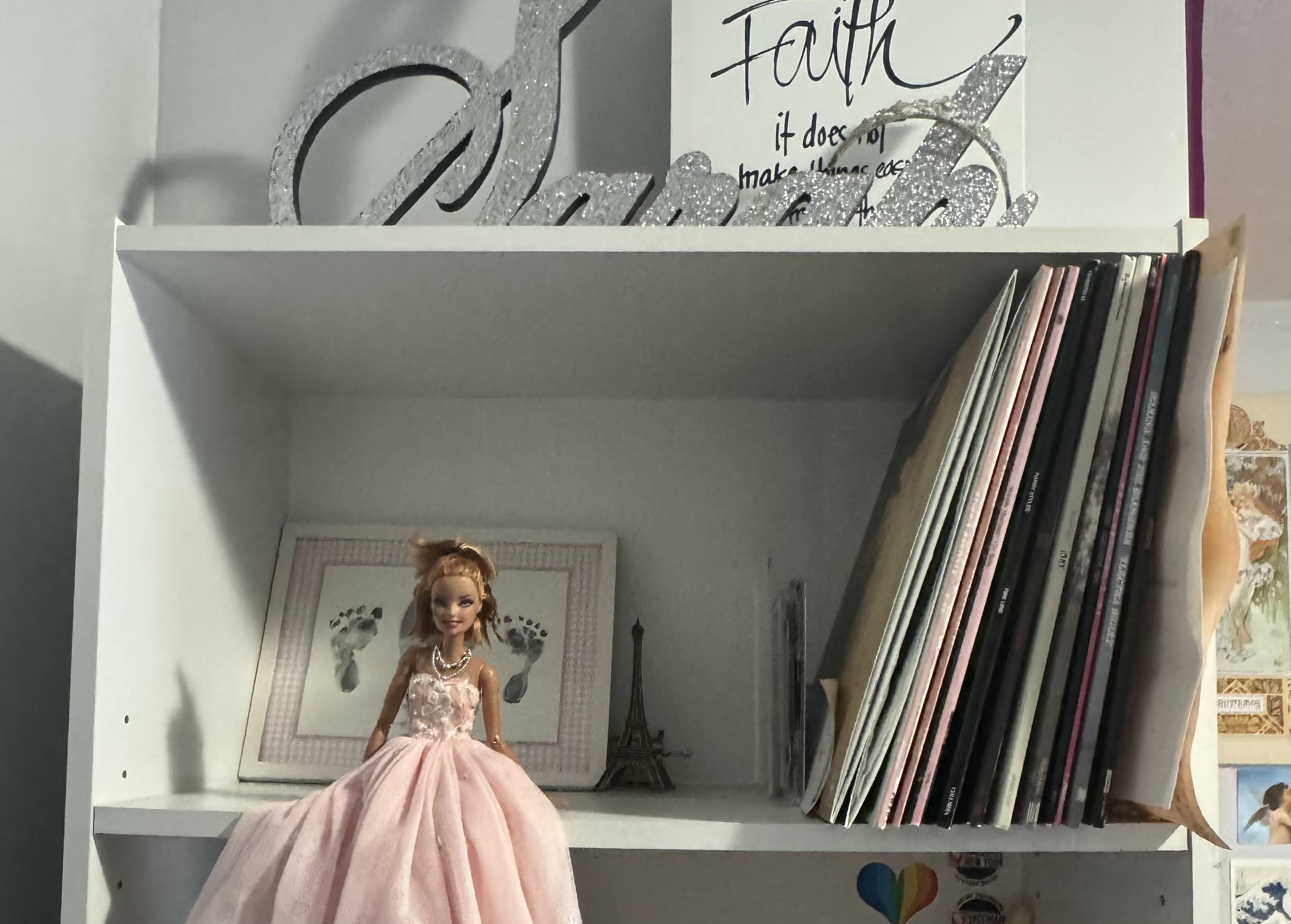
The doll is a symbol of my childhood– an artifact from the most precious and innocent moments of my life. A faded smiley face drawn on her cheek from my sister and I’s failed attempt at giving her a tattoo. Her botched haircut from the days we swore we were hairdressers. Her body, which my sister replaced with a newer version after her old one was broken, with an arm and leg taped on. She, admittedly a bit morbidly, took the head off the old Barbie and put it on the new one, but she would’ve done anything to make me happy. Taylor watched every stage of my life. She sits on the top shelf of my bookcase, in front of my framed newborn footprints and next to my vinyl collection. She watched my bedsheets change from pink Disney Princesses to white minimalist and saw the decorations on my wall change from pictures drawn with my friends to posters of my favorite artists. She watched me go from picking my outfit out for third grade picture day, to packing up to move into my first college dorm. Taylor is my days of being a little sister growing up with her big sister. Young girls dreaming of all the possibilities life holds. 

Taylor on the bookshelf of my childhood room

The dress symbolizes family, representing the bond between her mother and daughter. My mother is the strongest and most caring woman I know, and this is a reminder of everything she’s done for me. A reminder of how she spent months planning a party for me, pushing through all obstacles to ensure I had my day. One small item represents a lifetime of love and security. A lifetime of support through everything, and sacrificing what she wanted so I could be where I am today.

The dress is one small piece of a big and beautiful culture. Our Latino heritage is something that has always brought my family together. The language served as the only means of communication to my grandparents, the upbeat music filled the rooms of family gatherings. The food being an outlet for my mother and grandmother to reminisce on their childhood and the food their moms made for them. My Latina background is something my mom has always taught me to be prideful of.

My mom, sister, and I. Taken in Port Jefferson, Long Island in June of 2020. Pictures were taken prior to cancellation.

To many, this is just a doll—a simple toy played with as a child that is eventually put to the side and forgotten. To me, it holds a lifetime of stories and memories. I hope for the stories it holds to continue beyond me. I hope to have a daughter who will share this same love and joy as me— someone who is proud of her culture, the family she came from, and the person she has grown into.


The Brown-Creamer Hurley Homestead

The object I chose went beyond something you can see closely, touch, or hold in your hand. When I was asking family, specifically my mom about an object that has familial and personal history, she gave me the perfect idea. My object is my great grandmother Ruth Geiss’s house, that her and her second husband Arther Brown lived in over seventy years ago located in Hurley, NY. I was raised in Hurley, NY, so this house felt like the perfect place to learn about my past ancestors and how my family that was once separated, found each other again.

Finding pictures of the house during the time my great grandmother lived there was impossible, but my mom went to visit the house last year and the work they did to it is beautiful. Standing in front of the house on the right is my mom, Robyn Finch, in the middle is her cousin, Martie Brown-Lott, and on the left is her other cousin, Lori Creamer. The house known now as the Brown-Creamer Hurley Homestead has plenty of land surrounding it such as freshly cut grass and mulch with eight plants, four to each side of the door, with one big pink and white flower arrangement on the right, covering most of the front glass window. There are cobblestone steps from the driveway on the left side of the house leading up to the dark brown wood door. A glass window in the middle divided equally into four square sections with a minimalistic green wreath hanging center. Two grey pots that are holding more greenery on each side of door. A black lantern hanging on the upper left corner with an oval shaped bulb waiting to turn on as dusk approaches. The cream-colored home that was painted over red brick with a grey brick roof and red brick chimney is perceived to have rough texture. The black shutters equally bordering each window to make the house symmetrical on both sides. Also noticing the black lamppost on the right side of the stairs melded into the mulch to stay upright that is taller than all the women. It has a vertical infinity symbol above the middle tier. The bulb is enclosed by four glass windows and topped with a bell-like figure.

Now I want to immerse you in how this house became so prominent in my family’s history. Before the house was discovered by Ruth Geiss (pictured on the left) and her second husband Arthur Brown, Ruth originally married Douglas Creamer Sr and had three children (pictured below). One of the children being my grandmother (far right), Lorraine Creamer and her siblings Douglas Creamer Jr (far left) and Constance Creamer (middle). Unfortunately, a scandalous affair happening between Ruth and Arthur broke up the family which made Douglas Sr leave and never return. Ruth and Arthur raised her three children and had one child of their own named Lawrence Brown Jr. From there, Ruth and Arthur got married and move into the Brown-Creamer Hurley Homestead from Kingston, NY. As Ruth Geiss was suffering from uterine cancer, she died in 1953, being only 37 years old, leaving my grandmother Lorraine at only 18 years old. Lorraine took on the roll of raising her three siblings along with her stepfather Arthur in the Hurley Homestead.

The first reunion of the Brown/Creamer family in the Hurley Homestead happened in 1976. The reunion included Arthur Brown Sr who then remarried after Ruth passed to Dolly Brown. Lorraine Creamer (Finch) who married Robert Finch in 1975, their two children Robyn Finch, my mother, who Robert adopted from Lorraine’s first marriage and Joshua Finch who was Lorraine and Robert’s son. Douglas Creamer and his wife with their two twin daughters, Sherri and Lori Creamer. Constance Creamer with her husband and children. Finally, Lawrence Brown and his wife Georgette, with their two daughters Monique and Martie. Lorraine, my grandmother was closest with her youngest brother Lawrence who lived in Grants Pass, Oregon for the remainder of his adult life. Lorraine occasionally saw her brother Douglas who lived in Kansas City, Missouri, and he would often visit NY. There is an unknown reason Lorraine was least in touch with her sister Constance.

Fast forwarding to September 2018, Monique Brown, Lawrence Brown’s daughter, committed suicide. This devastating tragedy rekindled the relationship of my mother, Robyn Finch and her cousins, Martie Brown-Lott and her husband Jeremey Lott, Sherri Creamer and her husband, and Lori Creamer and her husband Jeff. Each year after, the family made it a point to visit one another to stay in touch. After Martie and Jeremy Brown-Lott adopted their son Larry in February of 2020, my mom, stepdad, sister, and I went to visit them in Pasadena, California when he was only 2 years old. After the brunt of COVID-19, in July 2022, my mom, stepdad and I went to visit Lori Creamer in Kansas City, Missouri. In September 2023, all the cousins visited Kingston, NY. Kingston, NY is where I currently live with my mom and stepdad. This past summer, June 2024, all the cousins visited Grants Pass, Oregon where Martie grew up. Each year it is the tradition of the Cousin’s Reunion. Going back to September of 2023, where the reunion was held in Kingston, NY, a return to the original family homestead was requested along with a visit to the Hurley Cemetery. My great grandfather was buried in between his two wives. In researching the Hurley Homestead, my stepdad, who has a GIS program called parcel viewer, for his commercial real estate business, found that my mother’s cousin’s daughter (on her stepfathers’ side) had bought the Brown-Creamer Hurley Homestead in 2021. Messaging was exchanged and a tour was planned for the cousin’s reunion on September 7th, 2023, to see the Hurley Homestead, 71 years after my great grandmother and great grandfather lived there.

Original Sin and an Old Victorian Gown

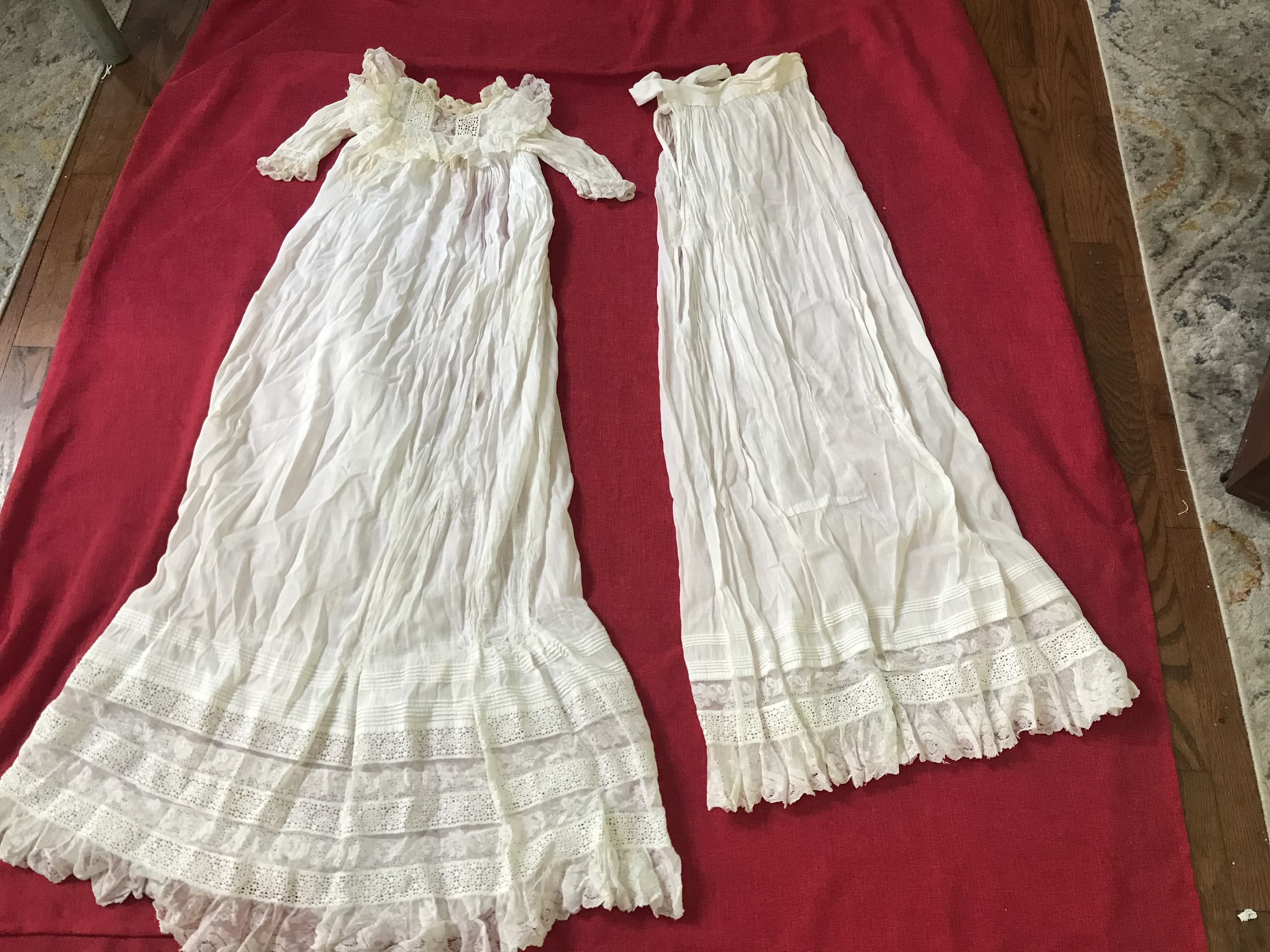
I have, like the majority of Catholic Irish-Americans, been to more baptisms than I can count. Considering my sizeable family—4 aunts, 1 uncle, 12 first cousins, and 14 second cousins—baptisms have seemingly become a semi-annual family reunion. The practice cleanses the newly born, washing away the Original Sin they have somehow carried into this life, symbolic of an official identification with the Church and God. It is emblematic of death and resurrection, of being reborn under holy waters blessed by the priest. It is at this practice that we are introduced to an off-white, frilly, and painfully antiquated baptismal gown with a perfectly matching petticoat.

The baptismal gown and petticoat

My grandmother was the first of her siblings to have a child. Married to a newly converted Catholic (my grandfather had grown up in a French Protestant family), it seemed undebatable that their firstborn would be baptized. Standing before God with hopes of forgiveness for Original Sin, one would think to show their holiness and piety through their dress. A nicely tailored suit, maybe? Perhaps a shining cross necklace?

This, of course, is where our beloved dress comes into the picture. 

Aunt Margaret had been saving this dress—although unknown where she got it—to hopefully dress her children for their baptisms. Upon my grandmother having her first child and never realizing that hope of having children, she gave the dress to her niece. A long and delicate white cotton, the skirt of the dress flows out seemingly far too long to fit the newborn it was meant for. Around the neckline are ruffled circles of lace, sewn in a way that causes the fabric to stick out and radiate from the child’s head. Thinner strands of fabric web together to outline the more prominent details, areas of thick lace that form interwoven circles and star shapes, sometimes connecting in floral patterns. The thin strands, however, are so fine in some areas that it is difficult to make out what the design is. Flower petals? Maybe leaves?

“A beautiful Victorian vintage gown”, in the words of my grandmother. One that is apparently not too long, as some (me) may have previously thought. The length of the skirt is meant to be draped over the arms of the godparents as they present their godchild to the Church for the first time, an act that effectively shows off the lacey frills that reach the floor of the altar. This gown—tagless, perhaps handmade—is far too delicate to be passed around. We see it—perhaps if we’re lucky, feel it—only during the occasion of a baptism. My grandmother is its keeper; when not in use she protects it, afraid of its being ruined. Not only does she guard the gown itself but its history and significance that go far beyond my Great-Great Aunt Margaret. She is graciously always willing to share such intangible stories that cannot, unlike this old Victorian gown, be stained and torn.

My Aunt Katie, Uncle Sean, and two cousins at their family baptism

Aunt Margaret was born to two Irish immigrants, both of whom were baptized into the Catholic Church. Her father, James Charles, was born on a family farm in County Leitrim, Clooncose townland, Ireland, and was christened at the nearby church. James was born in 1844, just a year before historians mark the beginning of the Great Famine, a very possible impetus for his decision to leave Ireland and settle in the United States. Before emigrating, however, he married a young Catholic girl named Annie Beirne. Although this story would tie nicely with an anecdote of finding unexpected love in a time of immense Irish conflict and trial, Annie lived in County Cavan, far too long of a distance from James’ family farm for the two to have met naturally. An arranged marriage, most likely.

After a year of leaving Ireland and settling in New York City alone, Annie too left Ireland to join her husband James. Although this marks quite a large gap in our story, we know that it was in New York (somewhere on Avenue C between 15th and 16th Street) that James and Annie Charles had their daughter Margaret. I don’t know much about her life, but I do know that she followed in my ancestors’ very Catholic footsteps: she was baptized, went to Church with her family, and undoubtedly wished to continue the tradition with her own children. This is why she came to possess the baptismal gown, and how it was eventually gifted to my grandmother. My grandmother who must be making her Aunt Margaret incomprehensibly happy with her continued use of the gown.

Every member of my family, since my grandparents’ firstborn, has worn this gown at their baptism. Although some larger children have had to be squeezed and shoved into the consequently unbuttonable dress (thanks to modern medicine, we no longer need to baptize infants almost immediately after birth), not a single one of us has entered the Church without our faces shining through radiating lace, without soft white cotton adorning our godparents’ arms. And the tradition will continue, so long as we make sure not to rip the fabric on the way.

Maybe Fourth Place Isn’t All That Bad

After asking my family around for objects with chains of history, I came back pretty much empty-handed apart from a few gems. One of these gems was a story from my grandfather; the story that started his pen/pencil collections.

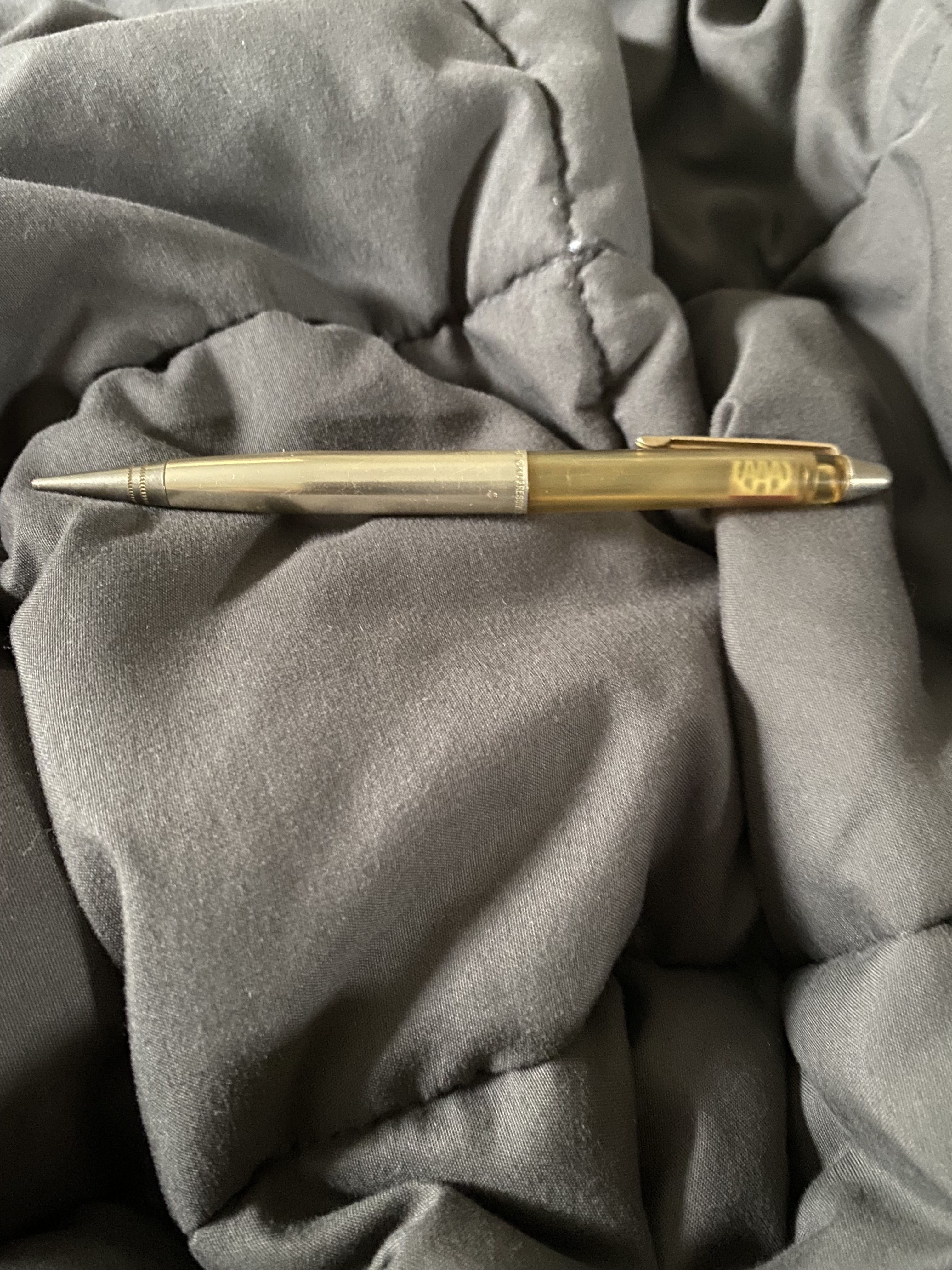
Poppy’s pencil

This object stands at about 5-1/8 inches long. From the top portion of the pencil to the endpoint, the pencil is embellished with a bronze-gold finish. The H-type lead appears out of the barrel with a continuous twist. Around the bottom is a raised surface of small, rounded ovals to create a small pattern, something to rub your finger over. A smooth nib at the top connects to a metal hook to attach to papers or your pockets. Made from plastic and metal, this pencil is special because halfway down the barrel, the pencil contains a liquid core on the upper side under the eraser. Now dried out from age, contained within the liquid core is a plastic 3-dimensional logo of AAA. Under this core lies a stamped imprint of the production. Embedded reads “Progressive Products INC. Union N.J. U.S.A.”

While I could not find the exact pencil online, I found it is “brothers and sisters” — pencils that are the same make and model but with different “themes.” I came to find the object is commonly called the “Vintage Progressive Floaty Mechanical Pencil,” and there are millions just like it. So, I kept searching. I wanted to know who created it, or more importantly, where it originated from. Upon further research, Progressive Products INC does not really exist anymore, well not the original anyway. By finding similar pencils online, I discovered a certificate of guarantee with the company name and address on the paper. It read, “PROGRESSIVE PRODUCTS INC. 701 Lehigh Avenue, Union, New Jersey.” Looking this up, you are given industrial property for sale, but no mention of the company. So, I kept looking. A New Jersey-based company product manufacturer called Progressive Promotions, now known as Dryvve, was the closest I could find, but I am unsure, mainly because they do not list an established date and look on the newer side of things. So, the trail ended here.

“Vintage 1950’s Southwestern Bell Telephone Floating Mechanical Pen Employee Award” – rubylane.com 

But the story that follows it has not ended. The story that follows this very pencil is how it became the first of his collection.

1949, in grade school, specifically Public School 12 of Troy, NY, my grandfather was in fourth grade. During this time children used to use “straight pens” which encompassed ink wells and fountain pens, ballpoints were not popular by any means.

AAA or the American Automobile Association, which began in the early 1900s, annually holds a safety poster art contest for children pre-k through 12. As part of a class project, my grandfather’s fourth-grade class must create an illustration for the contest. The goal of the contest was to promote safety messages in schools and encourage communication through creativity. The prize for this contest was that the top 3 pieces chosen would be put on display in Stanley Department Store located at Third and State Street, Troy NY, which current day I know as Hatchet Hardware.

My grandfather placed 4th. While upset about the loss, he soon found out that his piece was displayed at the store as an honorable mention. Poppy described the piece as a rugged baseball player, split in half; the left side showed the player beaten up, injured, and with crutches and a cast. On the right side, the player was healthy, bat in hand, and ready for the game. While I can picture such a drawing in my head, I yearn to know what it truly looks like and what care and skill my grandfather put into it. Did he stay up all hours of the night completing it, just like I do in the studios? Was he excited and prioritized this over schoolwork, like I do when I start painting? Was there a background? Was there text? I will not know; my grandfather can only remember so much.

Branched off from how this object got into the possession of my grandfather, what followed this story was when his collection began to grow. Around the same time as this story, while in grade school, there was a quite older gentleman in his neighborhood. He used to give my grandfather parts and broken pens. From this older gentleman, for whom I have no name, my grandfather started to fix pens. He told me all his classmates would pay him to fix their broken pens, and he made a small change by doing something he enjoyed. Life went on, and my grandfather stopped fixing pens until 20 years ago. He went to a garage sale and found broken pens for a dollar. Feeling nostalgic, my Poppy bought one, fixed it, and began to write again. To this day, he still does and encourages my grandmother to do the same as she battles Alzheimer’s.

Unfortunately, I was unable to find any news articles about this event happening, at least not in the town of New Paltz. Hopefully, when I return home, I will have to continue my findings in my town’s public library.

The Accessory Connecting Grandma to Granddaughter

During the summer of 2018, most of my mom’s side of the family gathered together for a wedding that my cousin was having in Marshall, Missouri. Marshall is between Kansas City and St. Louis but lies closer to Kansas City as it takes one hour and thirty minutes to reach Marshall from Kansas City. During the time spent there I got to see many family members, including my grandma Cecilia, where I was gifted timeless jewelry.

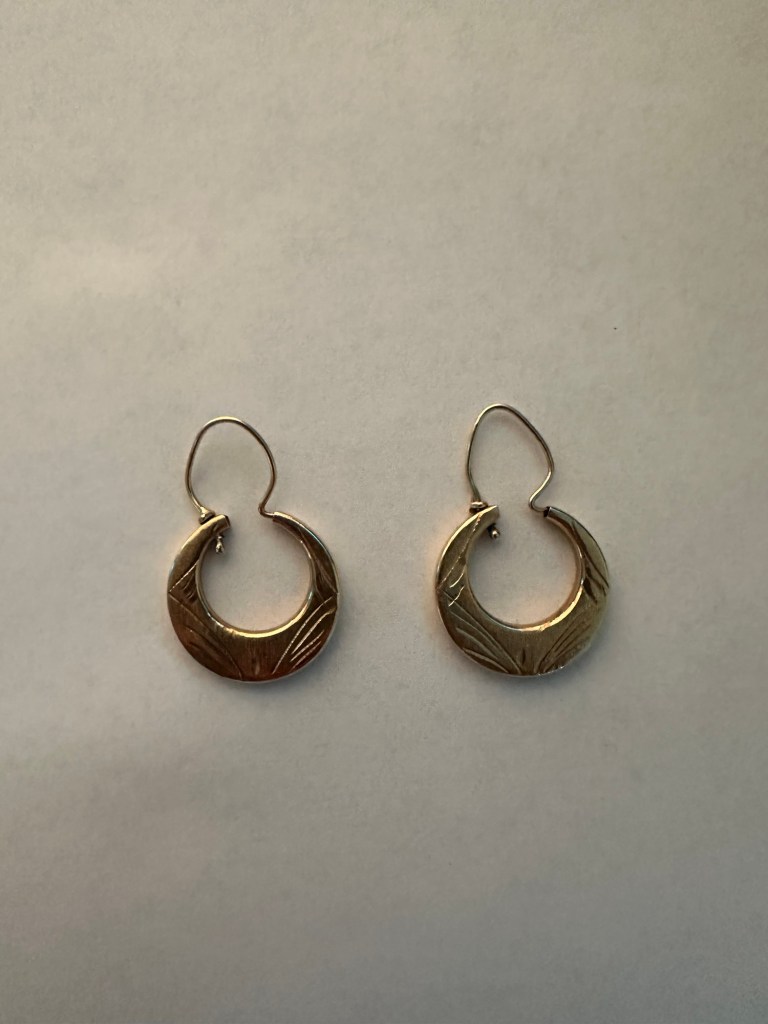
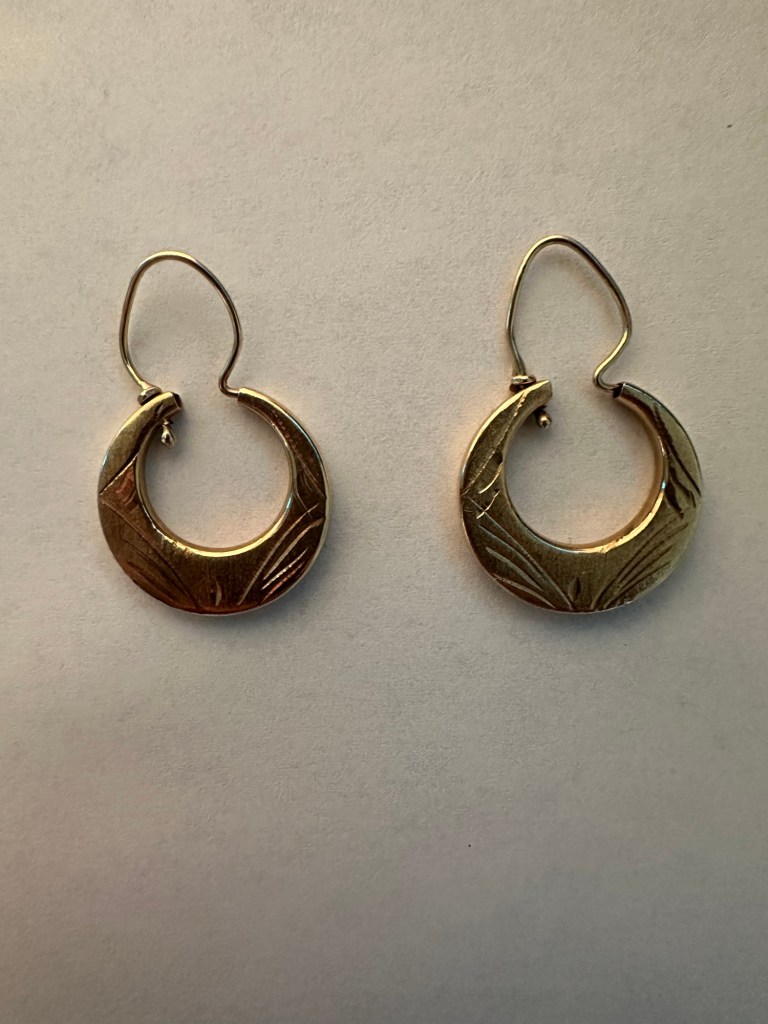
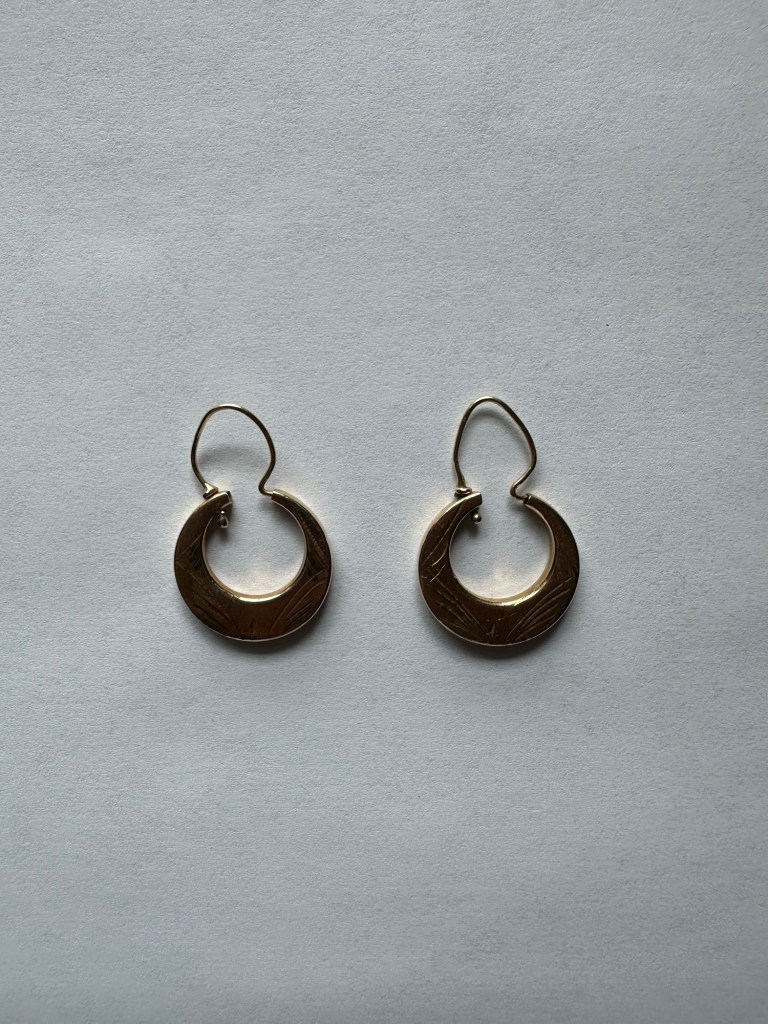
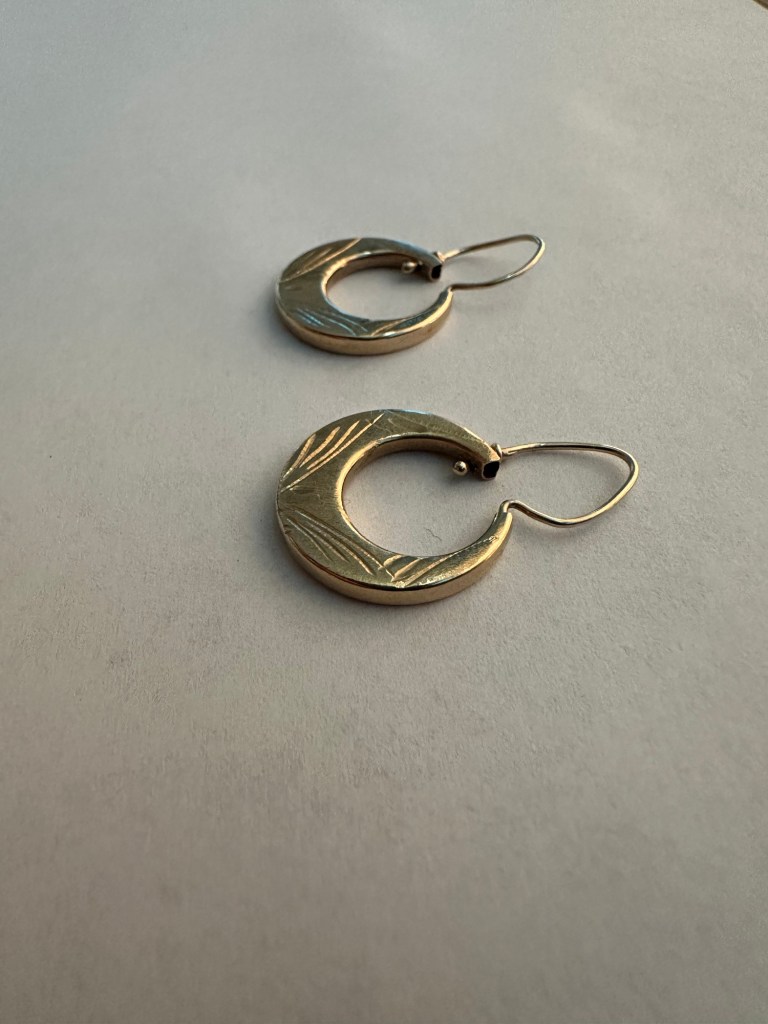
My grandma Cecilia gifted me a pair of small gold decorative accessories for me to wear on my ears. They have two main parts; the top is thin and bent in to connect to the bottom, thicker part. The bottom hoop like part of each accessory has multiple lines that showcase an intricate design.

At the point where the hoop is the widest it measures 13/16″. Measuring the top to the bottom, the length is 1 – 5/16″. The thickness of the hoop measures 1/16″.

For me to wear this gift, I must put the top part through my pierced lobes. Once, I have securely connected them on my ears. I am able to feel their weight. Typically, when I wear other accessories like this, I do not notice how heavy they feel, sometimes I even forget I am wearing them because the other pairs I own are very light. However, with these small gold hoops, their weight does not go unnoticed. Their heaviness is the dense material of the gold they are handcrafted from.

When worn the bottom hoop allows for dangling and swaying movements to occur; perhaps walking or shaking my head. Not only are these items physically close to me as I wear them on my skin, but close to my heart.

This pair of accessories is special to me because they are from my grandma Cecilia. My grandma Cecilia is my only living grandparent and the only one I remember having a relationship with. So, having a gift from her and a relationship with her is something that I cherish. She bought this unique handcrafted accessory gift in Mexico. When taken a close look, they are not identical; one of the two pieces has longer design lines craved in on the bottom hoop part than the other. Additionally, my grandma has many other granddaughters that she could have chosen to gift these earrings to.

Anytime I wear these earrings, I am reminded of my grandma. Whenever I see my grandma, she is always wearing these types of earrings. My grandma has lived in Mexico her entire life; so, when she visits the United States, or I visit Mexico, I am glad that she has gifted me something that reminds me of my family and their culture.

When other individuals point out that they like my earring and I happen to be wearing the ones that my grandma gifted me, it brings me happiness; because these earrings are not solely a form of self-expression to complement an outfit, but I get to talk about my grandma.