The Mourning Scene for Miss Ann Hasbrouck by Anna Benlien

Caption: Aren’t you curious about why this woman is crying? What secrets are buried within this artwork? What historical impact does this lithograph have? Who had this lithograph? Where is it now?
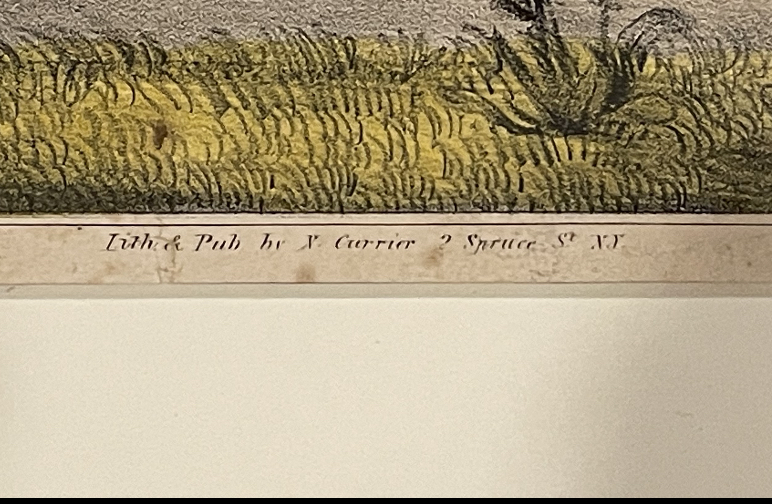
Physical Description of the Object: Overwhelmingly somber  18 x 15.5-inch lithograph before you. A woman in a black dress leans on the monument in a cemetery, distraught, as her handkerchief blows subtly in the wind. The monument was inscribed with the words “To the Memory of Miss Ann Hasbrouck, who died June 3rd, 1840, AGED 17 years, 8 months, 14 days”. The monument towers over the woman as an embracing willow tree seems to wrap the woman and tomb together. Pink roses flourish around the tomb as well as other plants do. In the distance, other headstones are clearly not as extravagant as this one. In the far back there is a  white church. The sky is a dusty thick gray and appears to be on the verge of crying alongside the women dressed in black. At the bottom of the lithograph says “Lith. and Pub by N Currier 2 Spruce Street NY”.

Provenance: This lithograph was first created in approximately 1840-1856 by Nathaniel Currier. Nathaniel Currier was born on March 27, 1813. He learned the art of this printing technique in Philadelphia and moved later to New York to pursue his love of lithography further. Currier and his business partner James Ives created over seven thousand different prints of American culture, everyday life,  and American leaders. Together they were unstoppable and became the most celebrated lithographers. A majority of their lithographs were affordably priced so a wide range of people could purchase their work. Their work touched so many lives by depicting American culture throughout America and the rest of the world. Currier died on November 20, 1888, and Ives died on January 3, 1895. Historians from Huguenot Street believe this artwork was probably created near the end of Ann Hasbrouck’s life. Historians from Huguenot Street say they purchased it in 1979 and it is currently housed in “Grimm: Painting Storage: Unit 2:Shelf B: Rack 1” (McGoldrick and Patkus). However, they do not know the chain of ownership prior to the purchase. 

Date(s) of Creation Narrative: Many people walk by art in museums and never stop to read where this art has come from or the significant value of what they are looking at. As of recently I have been self-aware of this habit and try to take time to read the artist’s statement when I am at a museum. I have been researching a  lithograph that is currently untitled and found in the storage at Hugenote Street. Historians at Huguenot Street refer to this lithograph by calling it “Mourning Scene for Miss Ann Hasbrouck”. If my former self saw this hanging in a museum I probably would have taken a moment to appreciate it and moved on to the next piece of art. I am so glad I was assigned this object because this lithograph has a powerful and deep historical significance to New Paltz’s history that many people do not know about. 

This lithograph was created by Nathaniel Currier and purchased by the Hasbrouck family in memory of Ann Hasbrock’s passing. The Hasbrouck family were French Huguenots who left France and later moved to the Locust Lawn in New Paltz. The site was later donated to Huguenot Street in 1958.  One of the very first settlers Josiah Hasbrouck passed the family farm business to his son Levi Hasbrouck. Levi continued his family legacy and generated sustainable wealth. It is also critical to identify that the Hasbrock family did have slaves working on their property. 

Ann Hasbrouck is the woman’s name depicted in the lithograph. She was born on September 18, 1822. Ann was the eldest of the Hasbrouck family. She died on June 3, 1840. This monument is fictional so, one could not visit this sight today. You can find however her headstone in the New Paltz Rural Cemetery.

This item is historically significant because regardless of your class, anyone could purchase these lithographs from Currier and Ives. At Huguenot Street, it says that it is of good quality which means that this lithograph was kept in good care and this was something of value to the family. When I put this image into Google Images a variety of lithographs were generated with a variety of names. This is because black and white lithographs were only six cents and hand colored were twenty cents. Larger works could be purchased for anywhere between three to five dollars which is equivalent to eighty to one hundred and twenty dollars today. It was shocking to see that the monument and the willow tree in the “Mourning Scene for Miss Ann Hasbrouck” are almost identical to those in the other images. Currier and Ives created a variety of lithograph that was mass printed and left the grave or memorial blank so families could personalize the name of the person who died. People who purchased this could fill in the names of those who passed away. I found it shocking to note that Walmart has replicas of them, you can purchase anywhere between approximately ten to forty dollars. 

I concluded that this object shows that regardless of your class, New Paltz and the rest of America, could remember their loved ones in a similar way. I find it interesting that anyone could purchase from the artist’s collection of work. This reminds me of how today people all buy from the same products or stores. This further shows how they mourn their dead and how they further preserve their memory.  It is evident that there is still so much we don’t know about the “Mourning Scene for Miss Ann Hasbrouck”.  

References

1830; Census Place: New Paltz, Ulster, New York; Series: M19; Roll: 106; Page: 233; Family History Library Film: 0017166

Ancestry.com. 1830 United States Federal Census [database on-line]. Provo, UT, USA: Ancestry.com Operations, Inc., 2010.
Images reproduced by FamilySearch.

Ancestry.com. 1850 United States Federal Census [database on-line]. Lehi, UT, USA: Ancestry.com Operations, Inc., 2009. Images reproduced by FamilySearch.

Ancestry.com. New York, U.S., State Census, 1855 [database on-line]. Provo, UT, USA: Ancestry.com Operations, Inc., 2013.

“Ann Hasbrouck (1822-1840) – Find a Grave Memorial.” Find a Grave, https://www.findagrave.com/memorial/57146842/ann-hasbrouck.

“Brief History of N. Currier and Currier & Ives.” The Old Print Shop, https://oldprintshop.com/brief-history-currier-ives. 

Census of the state of New York, for 1855. Microfilm. Various County Clerk Offices, New York.

“Currier & Ives.” David Barnett Gallery, https://davidbarnettgallery.com/artist/currier-ives.

Currier, Nathaniel. Mourning Scene for Miss Ann Hasbrouck. New Paltz, 1840. 

“Hasbrouck Family Association.” Historic Huguenot Street, https://www.huguenotstreet.org/hasbrouck.

Fifth Census of the United States, 1830. (NARA microfilm publication M19, 201 rolls). Records of the Bureau of the Census, Record Group 29. National Archives, Washington, D.C.

Locust Grove Estate – Locust Lawn, https://www.lgny.org/locust-lawn.

“The Great Book of Currier & Ives’ America : Rawls, Walton H .” Internet Archive, New York : Abbeville Press, 1 Jan. 1979, https://archive.org/details/greatbookofcurri0000rawl/page/n3/mode/2up. 

“Inflation Rate between 1800-2023: Inflation Calculator.” $3 In 1800 → 2023 | Inflation Calculator, https://www.officialdata.org/us/inflation/1800?amount=3#:~:text=%243%20in%201800%20is%20equivalent,of%20%2468.87%20over%20223%20years.

“Inflation Rate between 1800-2023: Inflation Calculator.” $5 In 1800 → 2023 | Inflation Calculator, https://www.officialdata.org/us/inflation/1800?amount=5#:~:text=%245%20in%201800%20is%20equivalent,cumulative%20price%20increase%20of%202%2C295.52%25. 

“Nathaniel Currier.” The Linda Hall Library, 16 Mar. 2022, https://www.lindahall.org/about/news/scientist-of-the-day/nathaniel-currier#:~:text=Nathaniel%20Currier%2C%20an%20American%20lithographer,27%2C%201813.

 The National Archives in Washington D.C.; Record Group: Records of the Bureau of the Census; Record Group Number: 29; Series Number: M432; Residence Date: 1850; Home in 1850: New Paltz, Ulster, New York; Roll: 608; Page: 329a

“New Paltz Town Records (1677-1932).” Historic Huguenot Street, https://www.huguenotstreet.org/new-paltz-town-records.

“Print: Sacred to the Memory Of.” Walmart.com, https://www.walmart.com/ip/Print-Sacred-To-The-Memory-Of/1386128605. 

Received by Louise McGoldrick, and Beth Patkus, Inquiry for Research Assignment , 20 Apr. 2023. 

Analog Experiment

For my analog experiment, I chose to listen to a record all the way through. While this sounds like it wouldn’t be quite the feat I think it is, there was an incredible amount of attention and intention that went into this experiment.

I have a few records hanging on my walls, and I’ve probably listened to them a few times (once), but I rarely have the means or time to sit and listen to a record all the way through. I’m also a chronic shuffler. I make a new playlist at the start of every season and put all the songs I’m currently listening to at the time in the playlist. That’s how I listen to music. Random songs from random albums, only placed in the order I found them, creating a perfect sonic representation of the season itself and where I was in life at the time. It’s a wonder to go back and listen to previous seasons, remembering where I was when I heard the songs for the first time, remembering why they were resonating with me, etc. But listening to an album all the way through is a different experience. Intended order is huge. Rarely do I listen to songs on an album in the order in which the artist wanted me to. On Spotify, you can listen all the way through in the correct order, but you can also skip. That’s one thing about listening to a record. You can’t really skip. 

My roommate Claire has a cute, vintage-looking (though it surely is not) record player in her room. For my experiment, I decided I was going to listen to music. Just listen. Not listen and scroll on my phone, not listen and read, not listen and do homework, not listen and talk to my friends, not listen and fall asleep, just listen. I was going to plug my (Dad’s) headphones (from 2005) into the record player and just listen. For the duration of the album. Uninterrupted. Because I can so do that, right?

The album of choice was Joni Mitchell’s “For the Roses.” This is Joni’s fifth album. I found it in a $2 bin at the local antique barn, took it as a good omen, and bought it immediately, despite not having the immediate tools with which to play it. As an artist myself I see Joni as an embodiment of what it means to be a woman and singer/songwriter at once. And as fans of Joni know, her music is no longer accessible on Spotify, which is where I do all my listening. The album had been stuck to my wall with duct tape for about two months, and now it was time to listen. JUST LISTEN. 

It was seven o’clock. I’d gotten home from my long day of classes, made myself dinner, and warned my roommates. 

“Nobody knock on my door until I text you. I have to listen to music,” I said before going upstairs. 

“You have to listen to music? You always listen to music,” responded Lia. It’s true. My whole life is underscored. Music is playing at all times; in my headphones, on my laptop, from my guitar. But in this moment I realized that that might not mean I’m always listening to music. It means music is always playing. 

I moved Claire’s record player into my room and placed it on my floor. I sat cross-legged in front of it, plugging my headphones in. Shoot, I barely know how to do this, do I? Slide the record out of the sleeve. Place it on the turntable. Lift up the arm that holds the needle. The record starts spinning. Now comes the part where I can feel my Dad over my shoulder, reminding me to place the needle down correctly so I don’t scratch the record. 

Shit. I totally just scratched the record. 

I try again. This time, I get it. There’s a gentle hum before the music starts. Okay. It’s go time. 

I listen. Side A plays in little scratches and hums. It’s beautiful. It’s loud. I close my eyes and it feels like Joni is sitting right next to me. I realize that for all the Joni I grew up hearing in the kitchen, this album almost never played. I don’t recognize a single song on Side A. Not only am I listening, I’m listening for the first time. I feel myself paying more attention to the music than I’ve paid to anything in a long time. It’s hard to think of a single task I complete on a daily basis that can’t be done while I also check my phone. But if I check my phone now, I’d surely miss a crucial word, note, moment. I wouldn’t be listening, it would just be playing. In fact, my phone was still downstairs for this very reason. 

Now for Side B. I flip the record knowing I was halfway done. How am I feeling? I realize, in horror, that I feel kind of anxious. I don’t know what to do with my hands. I sit on them. I don’t know where to look. I just watch the record spin. 

Man, I think. I must look crazy right now. 

Is that even true, though? Or is that just a product of growing up in a world in which anyone could take a picture of me at any given moment and show me what I look like? Also, why does that matter right now? Why is that on my mind at all?

I take a deep breath. Finally, a song I recognize. “You Turn Me On, I’m a Radio.” I hum along. And this is when I truly fall into the experience. The anxiety melts away once I stop thinking about myself, how I look, what I’m doing. I’m just listening now. And when I start just listening, it goes by so much faster. 

I’m not watching the needle anymore, so when the last song fades out, I’m expecting another one to start. But then the hum dies down and I hear it stop. It’s over. I listened. I just listened. 

I realized at that moment that I don’t have a clock in my room. I only know the time from my phone, which was still downstairs. So I don’t even know how long that was. I just know that I could feel every muscle in my body when I got up to put the record player back in Claire’s room. I could hear the rustling of the paper sleeve when I slid the record back into its case. I was tuned in. I was listening. 

Creation of the “Chandler”: Supply Chain of a Citizen Watch

What’s your reaction to the question, “what’s the time?” Do you glance down at your wrist or pull out your smartphone? In college, I notice that watches are less commonly worn. Many of us have traded interpreting analog watch faces for reading two sets of numbers separated by a colon.  

A rotation of my watch. Note the gleam of colors on the watch face resembles the mother-of-pearl.

Since 2017, I have owned an all-gray stainless-steel watch. The watch holds a lot of sentimental value as a Christmas gift from my parents. My 12-year-old self was delighted to make the quick discovery that the diamond-shaped hour and minute hands glow in the dark!  

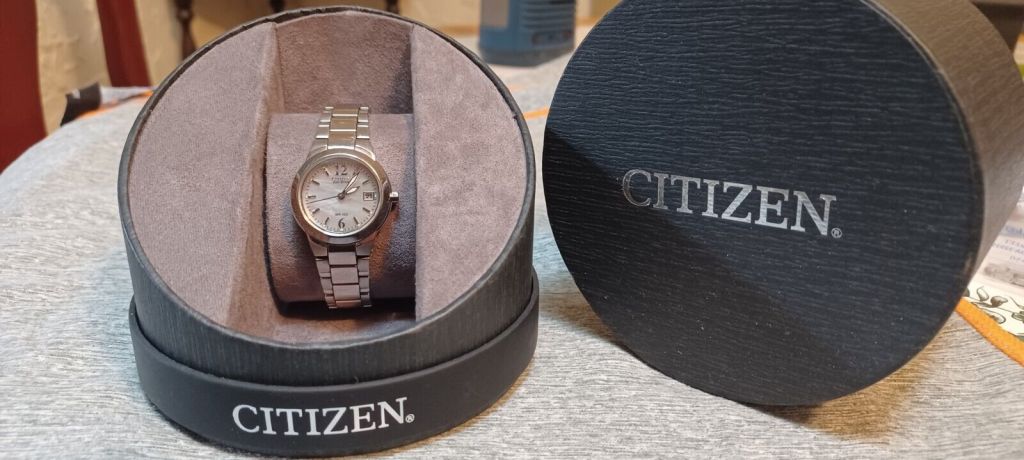
One of the watch’s features is a tunable push-button that adjusts the time and date. The date is displayed in black font next to that dial in a deeply set box. On the face of the 26mm-wide watch face, “12” and 6” are the only numbers engraved on a design that resembles a protection stone, the mother-of-pearl (Citizen Watch Co., Ltd.). The foldable clasp of the bracelet is engraved with the inscription “CITIZEN STAINLESS STEEL BAND CHINA.” There are also markings on the backside of the watch face that I ignored as meaningless until I started researching my Citizen watch. These tiny serial numbers were the foundational puzzle piece in sifting through research to identify the product’s name and origins.  

Chandler—the watch’s name—historically refers to a wax candle or soap maker (Merriam-Webster). They supply people with necessary home products that serve the purpose of maintaining hygiene or lighting. Citizen markets the watch with a name of French origins to convey positive connotations associated with light, including the fulfillment of knowledge, happiness, or prosperity. Chandler eloquently rolls off the tongue, as opposed to its identification name, “ew1670-59d.” Unlike today’s smartphone devices that can tell time, the Chandler does not need an electronic charger to function. Instead, Citizen features my watch as part of the company’s conscious effort to be environmentally driven in its “Eco-Drive” movement. Solar power, in the form of fluorescent lighting or sunlight, fuels all watches in the Eco-Drive collection.  

Raw materials for watches, such as my Chandler, are sourced at undisclosed locations. However, Citizen declares its involvement in Corporate Social Responsibility (CSR), which is an initiative that is mindful of its environmental, social, and economic sustainability. Citizen claims that they refuse to incorporate “tantalum, tin, tungsten, and gold, which are conflict minerals connected to inhumane acts committed by local armed groups in the Democratic Republic of the Congo…” into their signature watch collections. Instead, 99% of the exterior of watches like my Chandler is made of stainless steel and sapphire glass. The inner movement of the watches is made of steel, metal alloys, copper, a solar cell, and a rechargeable battery. The movement of a watch refers to the beating mechanism, which maintains its ability to accurately tell time (Citizen Watch Co., Ltd.). The composition of the raw materials used in the manufacturing process is broken down to the nearest hundredth of a percent.  

Within this global watch corporation worth more than 1.6 billion USD, Citizen accesses their alignment with CSR in their relations with key suppliers through their sustainable procurement policies. Key suppliers are defined as businesses that provide indispensable raw materials for the creation of Citizen watches. Firstly, the supplier questionnaire (SAQ) is a survey sent to selective raw material providers. The SAQ determines the level of risk—with a numerical value out of 100—in doing business with the 657 companies that compose 50% of their key suppliers. Then, the scores lower than 50 decide that Citizen should take immediate action to address any ethical or environmental violations assessed by the SAQ. However, the business practices of all key suppliers are not accounted for when Citizen’s total number of key suppliers is approximately 3,700 groups (Citizen Watch Co., Ltd.). The overwhelming number of unaccounted business relationships that are not disclosed in fine detail prevents a consumer from making a holistic assessment when determining if minerals and natural resources used for Citizen watches are ethically sourced. 

Although there is a lack of complete transparency in the sourcing of materials for the inner movements and exterior of a Citizen watch, the corporation takes pride in the rest of its watch supply chain. Namely, all Citizen watches are made in Japan. Their global website organizes and lists every factory in Japan involved in the design, processing, manufacture, and assembly of watches like my Chandler. Processing a watch involves polishing and refining the metals that hold together Citizen’s iconic watch cases. The company engineered the SuperTitaniumTM to be five times more durable than stainless steel to withstand scratches. Meanwhile, watch parts are made throughout Japan. For instance, Yubari Factory produces gears, and Citizen Fine Device Factory specializes in making crystal oscillators. (More factories can be found in the image below.) 

A map of Japan that is featured on Citizen’s website. They locate all of its factories involved in their watch supply chains.

Within the assembly factories (Myoko and Iida Tonooka Factory), the intricate parts are combined by hand through the skillful craftsmanship of watchmaking meisters. Depending on the watch, meisters either work in assembly lines or on the whole installation of a single product with tools like “tweezers, screwdrivers, probes, and watch hand retainers” (Citizen Watch Co., Ltd.).  

An example of Citizen watch box. Picture credits: jesnew-884.

In my phone interview with my father, he mentioned that my Chandler was the new and innovative watch displayed in one of many Macy’s department stores during the 2017 holiday shopping season. Over a video call, we discovered that an authentic Citizen watch arrives in a paper box branded with the Eco-Drive logo. The watch and bracelet rest on a gray, velvet-like cushion. They are stored within a hard, protective circular case that has the “CITIZEN” logo printed in gleaming silver and matte white font.

An example of how the Chandler Citizen watch looks inside its case. Picture credits: kimberlrobertso-4.

I tried tracing the supply chain between Macy’s and Citizen. Many questions and prompts, such as “How does a Citizen watch even up in Macy’s?” or “Supply chain of Macy’s watches,” remain unanswered. Rather, it was demoralizing to search for answers among pages of sponsored links that featured the command “Buy…!” next to Macy’s red star logo. The retailer persistently advertised “get FREE SHIPPING” on their dozens of men’s and women’s Citizen watches.  

I will take the relentless advertisements as a signal to stop my research for today. Yet my mind continues to churn with unanswered questions. What is a realistic and sizable impact that mindful consumers can make daily based on their conscious decisions? Do they have the time to tenaciously research the brand behind the article of clothing before clicking “Add to Cart?” Alternatively, how far does a consumer’s determination go to painstakingly follow the supply chain of a bunch of bananas before they walk to the grocery checkout line? 

Works Cited 

“Chandler Definition & Meaning.” Merriam-Webster, Merriam-Webster, 2023, https://www.merriam-webster.com/dictionary/chandler.  

Citizen Watch Co., Ltd. “Assembly.” CITIZEN Manufacture, Citizen Watch Co., Ltd., 2023, https://www.citizenwatch-global.com/manufacture/assembly.html

Citizen Watch Co., ltd. “Chandler.” CITIZEN, Citizen Watch Co., Ltd., 2023, https://www.citizenwatch.com/us/en/product/EW1670-59D.html.  

Citizen Watch Co., ltd. “CITIZEN GROUP’s CSR Procurement Guidelines.” Citizen Watch Co., Ltd., 1 Apr. 2020. https://www.citizenwatch-global.com/csrguideline/CSRProcurementGuideline.pdf 

Citizen Watch Co., ltd. Disclosure of Materials, Citizen Watch Co., Ltd., 2023, https://www.citizenwatch-global.com/citizen_l/special/modal/component.html.  

Citizen Watch Co., ltd. “Factories.” CITIZEN Manufacture, Citizen Watch Co., Ltd., 2023, https://www.citizenwatch-global.com/manufacture/factories.html

Citizen Watch Co., ltd. “Processing.” CITIZEN Manufacture, Citizen Watch Co., Ltd., 2023, https://www.citizenwatch-global.com/manufacture/processing.html. 

Citizen Watch Co., ltd. “Promoting Sustainable Procurement.” Social, Citizen Watch Co., Ltd., 2023, https://www.citizen.co.jp/global/sustainability/social/sourcing.html

The Sequence of a Squishmallow

A few days before my 19th birthday in November 2021, I got sent a giant stuffed animal by my aunt, uncle and cousin. The box was fairly big, so as I walked between the campus mailroom and my dorm room, I wondered what could possibly be inside. Opening it up, I saw a green blob that opened out to be a Squishmallow: his name was Baratelli, and he was a pastel green frog with rosy pink cheeks and a golden crown on top of his head. I likened him to my other frog Squishmallow across the room, Wendy, an 8-inch-tall green tree frog with a yellow belly and red eyes, and simply called him “Big Wendy”. I didn’t really like the name Baratelli. The object itself is simple; a sack of mysterious fluff surrounded by a mysteriously soft fabric lining. Big Wendy is special because there is a crown that rests atop his head, made of a secondary mysterious felty and metallic fabric. He also contains a tag with his own backstory, and he sits at 16 inches tall. Between my dorm room and my aunt’s computer, there were only a few steps to the process of receiving my new squishmallow, but I was curious to see how many steps were taken before my aunt even thought of buying him. According to toynk.com, all squishmallows are made using polyester fiber. Using polyester fiber keeps the stuffed toy “resistant to stains, wrinkles, and mildew and prevent[s] it from shrinking.” They are also quick-drying because of it. “Polyester fibers are usually made as continuous filaments either through a batch process using granulated polymer or a continuous polymerization method.” (toynk.com) They are also made of ultra-soft spandex, which makes them so durable, but light. These processes of production happen in China. No information is provided about its Chinese production besides the blanket statement “Made in China” that appears on most of US imported goods. The tag states that it was manufactured at Kelly Toys Holdings, LLC in Los Angeles, California. For the “distributed by” section, there are 3 places listed: Florida, USA; London, UK; and Darmstadt, Germany. I assume that Big Wendy was distributed by Jazwares LLC in Sunrise, Florida, since it is the closest location, but no other discernable information is found on the tag. So, my squishmallow was created with polyester fibers and spandex in China, then sent to Kelly Toys Holdings LLC in Los Angeles, then sent to Sunrise, Florida to then be sent, through Amazon Prime shipping, to New Paltz, NY. The popularity of Squishmallows was also a key step in the process. Squishmallows originally launched in 2017, producing 8 characters in 3 sizes, and sold at Walgreens. 2020 was when Squishmallows experienced an economic boom, when the pandemic was in full swing. Tiktok also popularized the toys, turning them into a trend, and creating #squishtok, which allowed people to display their collections to the world. As the line of toys succeeded, more forms of Squishmallows came out, and now the Squishmallows brand has over a thousand different characters, arranged in 12 different sizes between 3.5 and 24 inches tall. They became popular with my cousin, Sabrina, because of their popularity on TikTok, so when my birthday came up, buying a Squishmallow was an easy choice. Big Wendy (formerly “Baratelli”) was ordered on Amazon.com (currently listed as 24.99) and sold by Kelly Toys, with an Official Squishmallows logo to prove brand legitimacy. Now, about 1.5 years later, Big Wendy has become a staple in my room, and a convenient pillow when I need to rest. It’s interesting how many places my Squishmallow has been in before it became my own.

Works Cited:

Amazon.com: Customer Reviews: Squishmallows 16-Inch Frog Prince – Add … https://www.amazon.com/Squishmallows-16-Inch-Frog-Prince-Baratelli/product-reviews/B08TD9SDX2.

Frank, Lindsay. “Squishmallows.” See Mom Click, 25 Nov. 2022, https://seemomclick.com/squishmallows/.

Haasch, Palmer. “Squishmallows Went Viral in 2020 and Are Quickly Becoming Gen Z’s Beanie Babies.” Insider, 6 Mar. 2021, https://www.insider.com/squishmallow-squishmallows-walgreens-disney-cvs-viral-collectors-social-media-frog-2021-2.

Peterson, Sara. “What Are Squishmallows Made of?” Toynk Toys, Toynk Toys, 29 Dec. 2022, https://www.toynk.com/blogs/news/what-are-squishmallows-made-of.

“Squishmallows.” Wikipedia, Wikimedia Foundation, 19 Apr. 2023, https://en.wikipedia.org/wiki/Squishmallows.

Body Parts as Objects

If there is one thing most people would not consider to be an object, it would be body parts. Naturally, individuals today will believe a body part to be living, or at least connected to a living being and therefore not an object. Personally, I believe that a body part should not be considered an object and is a heavy source for ethical debate. But what about transplant organs? Or even animal body parts? How does our use of these body parts ethically differ from how body parts may have been viewed during the 1800’s?

In Mary Shelley’s 1818 novel, Frankenstein, the main character, Victor Frankenstein, uses human body parts to construct his Creation. In multiple instances, Victor refers to body parts using an object-like connotation, like, “materials at present,” or, “my materials” (Shelley, 80). He also describes the body parts as, “lifeless clay” (Shelley 81). Lastly, Victor references the Creatures body parts when explaining the methods in which he obtained them, saying, “The dissecting room and the slaughter house furnished many of my materials” (Shelley 81). By referring to body parts in this manner, readers can infer that Victor views human body parts as objects. This piqued my interest due to the controversial topic of using human body parts, or any body parts to complete some sort of task. Therefore, I wanted to research the difference in ethics surrounding the use of body parts today, versus in the 1800s.

One of the first things that came to mind when thinking about the ethical use of body parts during the 1800s was grave robbing. Technically, the term for grave robbing during the 1800’s was body snatching. The full definition of body snatching is the, “act of secretly removing corpses from graves in order to sell them” (Rimer). This act was actually very common during the 1800’s, especially in the United States. Here, many medical schools required the use of cadavers for anatomical practices, but had limited methods of obtaining these bodies. In fact, the punishment for executed prisoners was dissection, leaving a negative stigma against donating your body to science and therefore, the supply for fresh cadavers dramatically decreased. (Meier) This lead to a surge of body snatchers, or in this case, “Resurrectionists,” who were recruited by medical institutions to dig up fresh cadavers and body parts necessary for experimentation. These Resurrectionists mainly worked during colder seasons so that these bodies, or, “stiffs” would remain preserved before being dug up (Rimer). Most of the bodies recovered in this way would be of a skinnier stature, so that the muscles on the bodies would be readily accessible and free from excess fat for medical students to dissect. Also, the preferred age of the body recovered would be around 16-20 years old (Rimer). Most records state that, “those submitted to the anatomists’ knife at a University were largely the bodies of recently deceased African Americans (both enslaved and free) who were grave-robbed for the school by hired professionals — known as Resurrectionists — in Baltimore, Alexandria, Norfolk, Richmond, and elsewhere.” (Meier). Therefore, race and wealth also played a very important role in grave robbing during the 1800’s. Sometimes, women would be hired to pretend to be a relative of the corpse to claim the body for the Resurrectionists, relieving them of any troubles they might face in this process. In fact, these grave robbers were paid about $80 per corpse which is equivalent to $2100 today. (Rimer).

Authorities saw this as a moral issue and did not take much action against grave robbers, only sentencing them to a few years behind bars if anything. Some individuals began using different methods to protect their deceased family members since they could not rely on the authorities. these methods included caging up the graves, buying sturdier coffins, or even setting up a “coffin torpedo” which was a bomb set to go off if anyone forcefully pried the coffin open. (Rimer).

Surprisingly, for some states, “it took until the late nineteenth or early twentieth centuries to pass acts outlawing medical grave robbing.” (Meier). Therefore, I can infer that during the 1800’s, most individuals, especially those studying medicine, barely felt any remorse for their methods in obtaining bodies, and these bodies were definitely treated like objects, whether that be in the remorseless dissecting of them, or the bartering of them for large sums of money. Thankfully today there are other methods that allow students to study the human anatomy and plenty of repercussions against grave robbery. However, we still face some issues today involving the testing of products on animals or animal cruelty, but that is a whole other source for ethical debate.

Relating these grave robbers back to Victor Frankenstein, we can see that Victor also took upon methods of grave robbery to complete his Creature. I think that Mary Shelley wanted to convey a very important message relating not only to the type of character Victor is, but also to the politics surrounding the ethics of grave robbery during the 1800’s. I believe that Victor represents what the readers would most likely assume to be the average human being, and that the Creature is supposed to represent this horrendous monster. However by the end of the novel it is clear that the one character that contains the most human-natured characteristics is the Creature. This allows readers to see Victor in a more monstrous sense, representing how humans as we know them are more monstrous than any monster. Therefore, painting humans out to be individuals that cause more harm for personal gain than any good. Therefore Mary Shelley is criticizing those who do use human carcasses for material gain, while also criticizing humanity in general.

Citations

Meier, Allison C. “Grave Robbing, Black Cemeteries, and the American Medical School.” JSTOR Daily, 2018, https://daily.jstor.org/grave-robbing-black-cemeteries-and-the-american-medical-school/.

Rimer, Julie. “Body Snatching in the 1800’s.” Cemetery Index, June 2022, https://cemeteryindex.com/wordpress/featured-cemeteries/mt-washington-cemetery/julie-rimer-historical-ramblings/body-snatching-in-the-1800s/#:~:text=Body%20snatching%20is%20a%20term,for%20dissection%20and%20anatomy%20lessons.

Shelley, Mary Wollstonecraft, et al. Frankenstein, or, the Modern Prometheus: Mary Wollstonecraft Shelley, the Original 1818 Text. Broadview Press, 2012.

Assignment 4- The Philosopher’s Stone

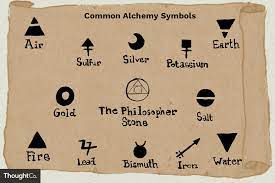
For my item for Assignment 4, I chose the philosopher’s stone to focus on. To fully describe what a philosopher’s stone is, I first have to explain what alchemy is. According to the Encyclopedia Britannica, alchemy is “…a form of speculative thought that, among other aims, tries to transform base metals such as lead and copper into silver or gold and to discover a cure for disease and a way of extending life”. Alchemists did this by “…heating and refining the metal in a variety of chemical processes” (Encyclopedia Britannica). Alchemy is also referred to as “a seemingly magical process of transformation, creation, or combination” (Oxford Languages).

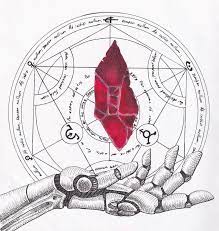
The philosopher’s stone is a substance that was often used by alchemists to “..transform base metals into precious ones, especially gold, and silver”. It is often portrayed as a red, jagged, translucent stone and has shown its face in various forms of media in pop culture.

For example, Harry Potter, Fullmetal Alchemist, The Flash, and Honey I Shrunk the Kids, all pretty well-known movies and TV shows, have all featured the philosopher’s stone at one point or another. Along with its ability to transform metals, cure disease, and extend life, this stone has also been known to symbolize the creation of life and ascension into Godhood (tvtropes.org). Alchemists also believed that an “…elixir of life could be derived from it” and many times these phrases are used interchangeably. An elixir of life oftentimes alludes to a liquid that can grant someone eternal life when paired with the philosopher’s stone (Encyclopedia Britannica).

The idea of this stone came about soon after alchemy first started being practiced. This pseudoscience originated in Egypt and remained a prominent feature of society in reference to early endeavors in chemistry. These concepts and practices not only remained relevant for centuries, but spread in influence all throughout Arabia, Greece, Rome, and eventually Western and central Europe, where the story of Frankenstein takes place. (Www.rsc.org).

In the early 1800s, Mary Shelley wrote the novel Frankenstein which we just recently completed in class. The main character of the book, Victor Frankenstein, is a scientist that has an obsessive fascination with the work of, at that point outdated, alchemists. By this time society had transitioned from the practice of alchemy to the practice of something more reminiscent of modern-day chemistry, but Victor was nonetheless fixated on the concepts related to alchemy such as everlasting life. We see the catalyst for this fascination on pages seventy-five and seventy-six of the novel. Victor quotes his natural philosophy professor at the University of Ingolstadt who explained how the ancient teachers of this science “…promised impossibilities, and performed nothing”. He then goes on to compare them to the “…modern master…” who “promises very little”. He talks about how they “…know that metals cannot be transmuted, and that the elixir of life is a chimera”. But they nonetheless have “…performed miracles…” and “…have acquired new and almost unlimited powers…” (Shelley, 75-76). This was an invaluable moment in Victor’s life in that it unleashed this unwavering determination within him. “Thus ended a day memorable to me; it decided my future destiny” (Shelley, 77). The study and implication of these concepts, such as the elixir of life, became Victor’s call to action in reference to him creating his creature.

Work Cited 

The Editors of Encyclopedia Britannica. 

“Philosopher’s Stone | Alchemy.” Encyclopedia Britannica, 2 May 2018, www.britannica.com/topic/philosophers-stone.

Multhauf, Robert P, and Robert Andrew Gilbert.

 “Alchemy | Definition, History, & Facts.” Encyclopedia Britannica, 6 Mar. 2019, www.britannica.com/topic/alchemy.

Oxford Languages. 

“Oxford Languages.” Oxford Languages, Oxford University Press, 2023, languages.oup.com/google-dictionary-en/.

‌“What Is Alchemy?” 

Www.rsc.org, www.rsc.org/periodic-table/alchemy/what-is-alchemy#:~:text=The%20art%20of%20 alchemy%20was.

Shelley, Mary. Frankenstein

1818. Beverly, Ma Rockport Publishers, 1 Jan. 1818.

“Philosopher’s Stone.”TV Tropes,     tvtropes.org/pmwiki/pmwiki.php/Main/PhilosophersStone#:~:text=Examples%20of%20the%20 Philosopher%27s%20 Stone%20in%20 media%3A%20 open%2 Close. Accessed 10 Apr. 2023.
The Ethics Surrounding the Excavation and Display of Mummies and Tombs from Ancient Egypt

When I go to mueseums, I typically browse for an hour or two, briefly read the some of the descriptions and think about how cool it is that they managed to find all of these artifacts or paintings from so long ago and provide hundreds of thousands of people the opportunity to see it.

But I never thought about how they came in the mueseum’s possession or if it is acceptable for them to even have or display these items. After learning about the ethics and colonization surounding museums, I came to realize how much of these collections shouldn’t belong in them as a multitude of these artifacts are stolen or simply have no reason to be displayed as it serves no substantial purpose.

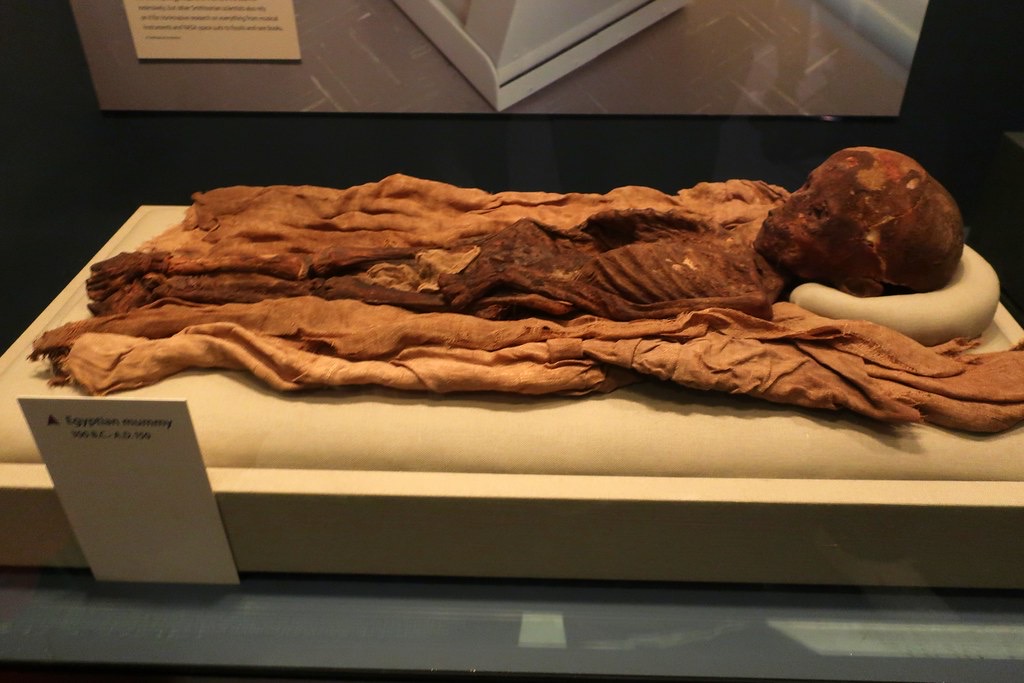
To further my understanding of items museums should or should not display in terms of ethics and morality, was through the exhibit I decided to focus on for this project in the Smithsonian: External Life in Ancient Egypt. I was atonished to see that they were displaying real life mummies from this time period. The little signs next to these bodies say things like “This is a real life mummy!” and that this body was a man 2,000 years ago…etc.I think it is safe to say that anyone who comes across exhibits like these may feel at least a little disturbed. Not only from the fact that a dead body is being displayed like a painting, but the fact that people decided to dig this body up and profit off of it.

As I delved into the other parts of the exhibit, I noticed I became more consciously aware of the unethics surrouning the display of these artificacts. Especially since the artifacts shown are so sacred to the ancient egyptian culture and were meant to stay concealed and secretive. For example the display of the artifacts that were found inside tombs. The ancient egyptians strongly believed in the afterlife, so there was a very ritualistic apprach to burying bodies, especially ones of higher power. These items were buried with the body so they could use them in the afterlife.

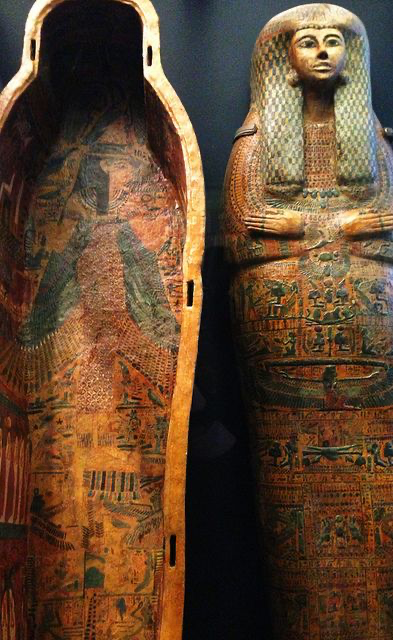
A certain section of the exhibit that I found to be particularly interesting was the one that displayed an empty tomb. It is a very beautiful artifact to look at because of all of the intricate carvings. The sign names this section as “The Story in the Coffin”, so all of the carvings, and symbols all over the tomb tell a story from the events of that time period. This raises the question of whether or not the egyptians may have intended for people in the future to see these relics so they can keep these stories alive. And is it okay for museums to be displaying these artificats even though they were excavated?

The concept of tombs originated in ancient Mesopotamia dating all the way from the early dynastic period and was known as The Great Death Pit. This was where servants of royalty would be buried with them so they can still serve them in the afterlife. This same idea of afterlife was a pretty universal concept amongst different cultures other than Egypt, like Rome and Israel. The most intricate tombs were the ones made for Pharaoahs in Ancient egypt. Egyptians would build these structures called Mastabas which were tombs made out of dried clay bricks and each of them contained a room where spiritual ceremonies were held for the dead. furhter emphasizing how much they value the afterlife and the elaborate processes associated with these burials.

Tombs have always been viewed as homes of the dead and considered their final resting place. Because this was such a valued ideology amongst a multitude of cultures and especially in egyptian culture, museums disturbing these artifcacts and taking them from their orignal home has a much greater impact on the group that it’s being taken from, as opposed to the people who breifly see it in an exhibit for 5 minutes.

I really liked being a part of this project as I feel I learned a lot more about museums and the colonization and unethics surrounding it. It further gave me the opportunity to learn more about Ancient Egypt, and widened my perspective on consumerism and material culture.

Material and Textiles Through Story Telling: Anna Benlien

In our group project, I wanted to continue the discussion on cloth proverbs used in Ghana. These textiles displayed in the exhibit are from 1990’s and are used to share messages and stories. The material displayed carries a rich history as well as very beautiful and detailed artwork. As I was thinking about cloth proverbs, I began to ponder other ways people use material/textiles to share their stories. 

In Ghan, featured in the Smithsonian exhibit titled African Voices, cloth proverbs are material that shares a story. These cloths are made into clothing for different occasions. The intricate patterns are almost like keys; if you know the pattern, you know the message.  These clothes become a way to communicate non-verbal with people in your community.  Many of these cloth proverbs are made into funeral attire but other cloths are used for more day-to-day attire. Some of the cloth proverbs translate to themes of jealousy, greed, and intention. The proverb says, “ A royal doesn’t cry… Not everyone has the good fortune of being born into royalty, so one must be prepared for hard time” (CITE). This proverb is reminding the wearer that not everyone has the same kind of status and wealth. Each cloth shows the values and mindsets of the people in Ghana. Many of these cloth proverbs carry oral stories and traditions passed down from generation to generation.

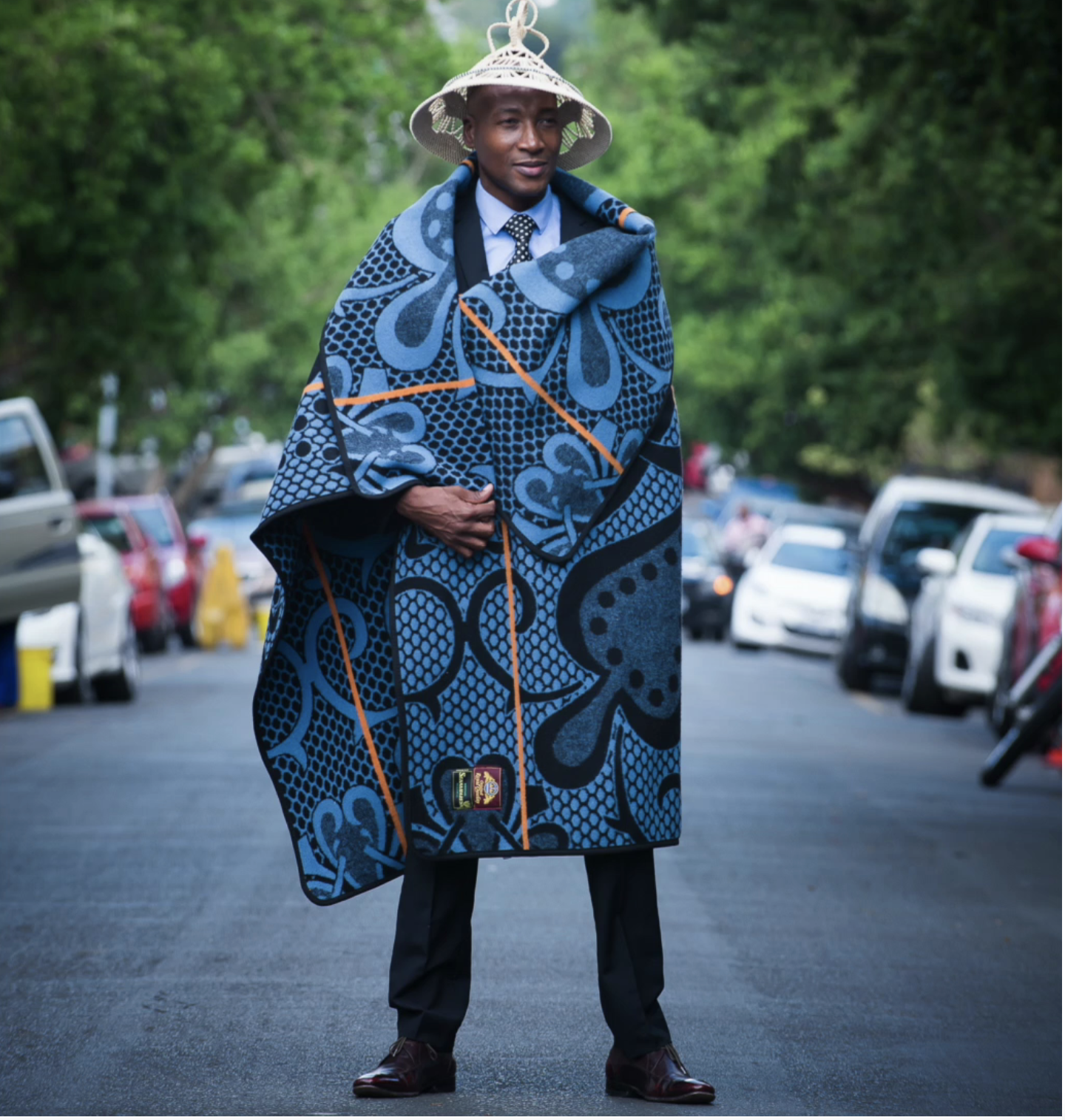
In comparison, in Lesotho, South Africa, it is common for people to wear Basotho blankets. They are very colorful and intricately designed. The Basotho blankets protect them from the cold but more importantly, they are “statues symbols and cultural identification” (Faces of Africa). These blankets are specially designed to protect the wearer from wind, rain, and extreme temperatures. Basotho blankets have three different class rankings to show status. They rank from acrylic to wool and cotton made for royalty. It is said that the first blanket was given as a gift to King Moshoeshoe by a British trader. The King began to wear this garment in a similar way indigenous people of Southern Africa wore animal skins. In the article, it quotes Elizabeth Masetho a waitress and a cultural activist when she says, “You have to know the history behind each pattern and why is that pattern there and what happened in Lesotho, You have to know your history in order to understand your future…” (Face of Africa). Each blanket had deep cultural stories woven into each stitch of its making. Traditionally, men will pin the blanket on their shoulders and women will pin the blanket across their chest. 

The Smithsonian exhibit, African Voices, that highlights these cloth proverbs, I believe did not do a good job of displaying these objects. From what I could see of the exhibit, it had limited information on these cloth proverbs. I was wondering how these clothes were acquired and if the translation provided was accurate. In addition, there is hardly any information on the artists that created these cloths. As I being to look at museum description, the more I find the need to add additional information to make it a well rounded description. Much of these descriptions in this exhibit are detailed so that the viewers are satisfied enough not to ask any more questions. I wonder if the artists in Ghana where asked about how these cloths were displayed in the museum .

 Today, in our society, we use materials and textiles for a variety of purposes. It is important to see what kinds of messages your clothing projects to the world. No matter where you live or in what time period, we have always used materials and textiles as a form of communication and storytelling.

Work Cited

Africa, Faces of. “Faces of Africa – a Nation in a Blanket.” CGTN Africa, 7 May 2019, https://africa.cgtn.com/2019/05/07/faces-of-africa-a-nation-in-a-blanket/.

Clothed in Symbols: Wearing Proverbs, https://quod.lib.umich.edu/p/passages/4761530.0007.004/–clothed-in-symbols-wearing-proverbs?rgn=main%3Bview.

“Exhibits.” Smithsonian National Museum of Natural History, https://naturalhistory.si.edu/exhibits.

“Kente Cloth: Moma.” The Museum of Modern Art, https://www.moma.org/audio/playlist/43/696.

The Bone Hall – Dehumanization Leads to Objectification

Where is the line between a living organism with stories, history, and life, and an object? At a glance, they appear to be so distinct that it is difficult to find their union, but it seems that bones comprise this societal gray area.

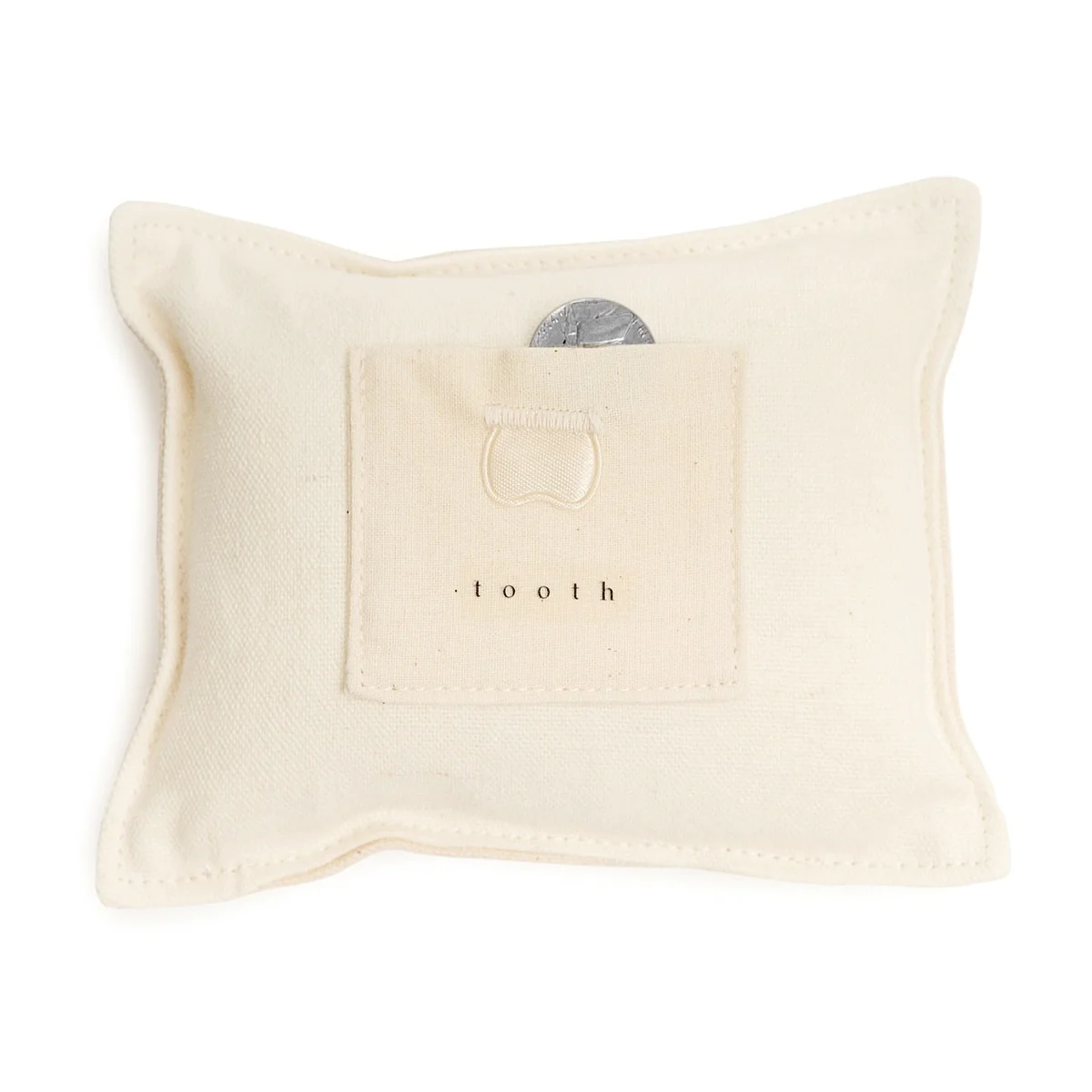
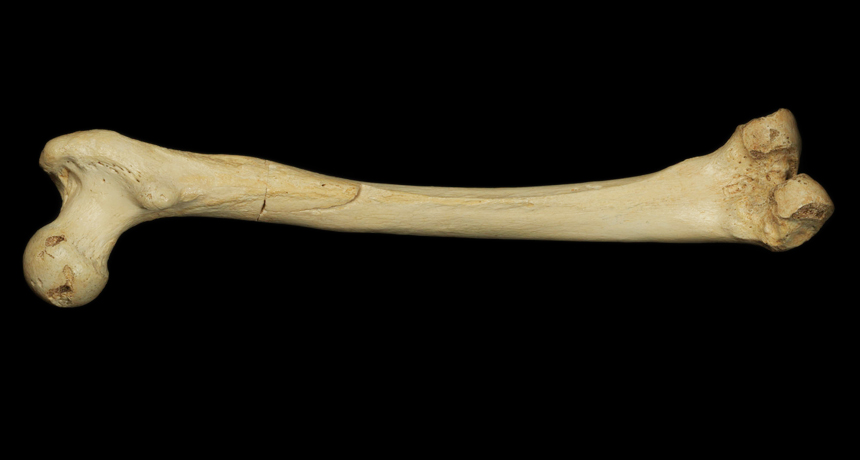
It is fascinating to think of bones as objects because they don’t seem to be objects while they are being used inside of us. I wonder the extent to which that is because they are invisible in our daily lives, but I don’t feel as though I think of the parts of my body I can see as objects either. Perhaps it is due to their different lifespans, the impermanence of hair, nails, and other parts the body naturally replenishes I am less likely to place value on. For, if they are going to be regrown, what does the object itself, that specific collection of cells, serve when separated from my body? For example, when children lose their baby teeth, they are losing bones. We don’t think of them so actively as bones because they are visible and distinct from the bones hidden elsewhere in our body, but they are bones. And, I hypothesize, because baby teeth grow back, there is not the kind of attachment we might otherwise feel. There seem to be two reasons other bones and the greater classification of “human remains” in particular feel distinct: their permanence and the attachment to our sense of self.

The permanence of bones doesn’t only exist in the sense that they physically last longer than the other parts of our body when exposed to the elements, but also that we associate them pretty exclusively with death. In order for someone’s bones to be a matter of discussion they’re either broken/in need of a relatively serious repair or the person has passed. The permanence of death is especially striking when viewing bones assembled to portray the figure of a human, as they are in museums.

Bones displayed in museums objectify the humans that used to inhabit them. Especially in noting the prominence of specific cultures and ethnicities being displayed, it feels evident that the possession of bones from specific people serves to dehumanize similar alive counterparts. It is hard to trace back the exact origins of this practice, but it is evident that the collections grew exponentially for African Americans during the Slave Trade and slavery, similar to the staggering and absurdly large increase in collecting Native American remains during the late 19th and early 20th centuries.

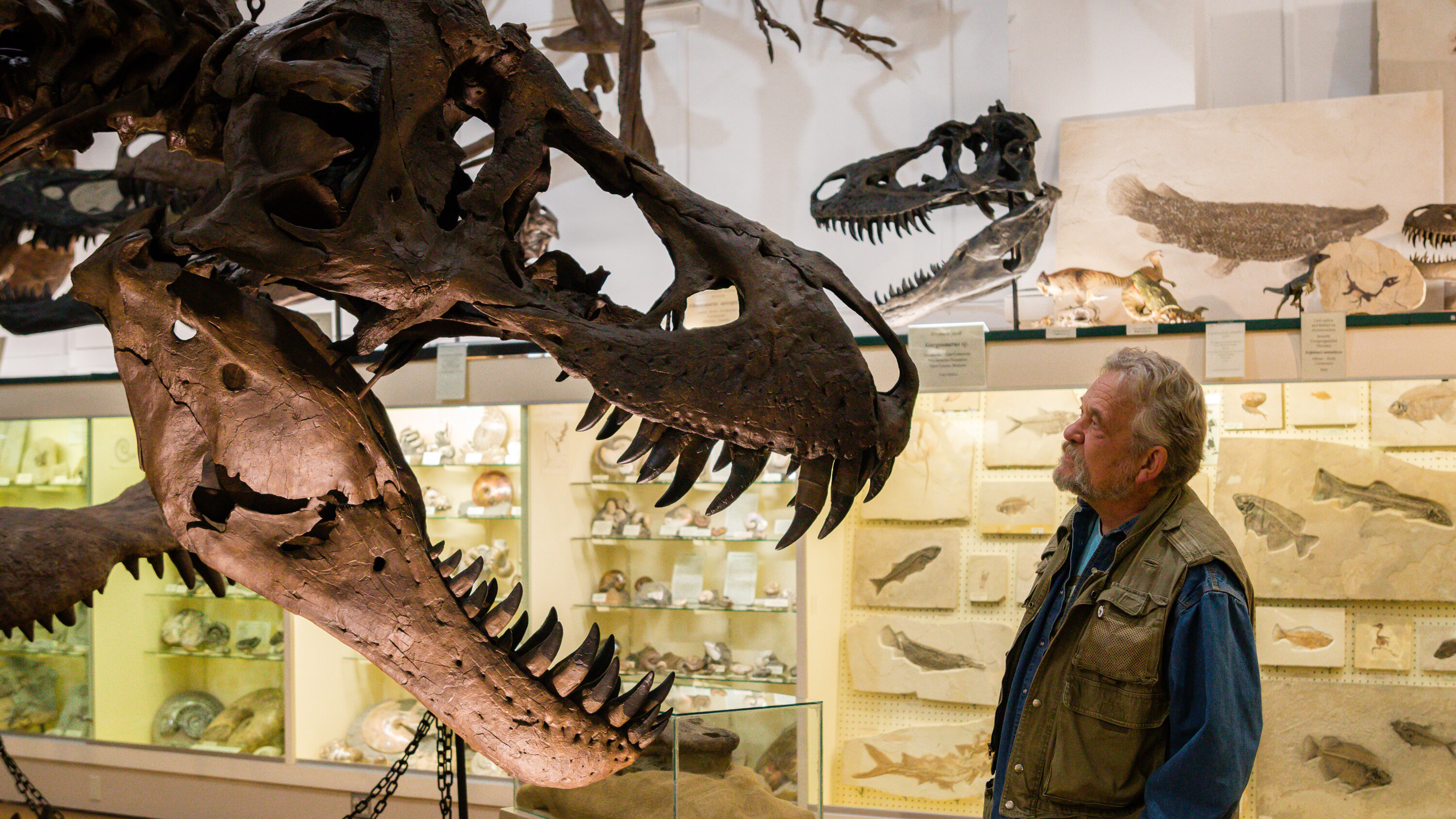
The main collection I looked at is The Bone Hall at the Museum of Natural History in New York City. This museum houses over 600 fossil specimen and over 100 dinosaur fossils, making it the largest collection in the United States. The dinosaur collection seems to not phase me–but do their bones truly become objects due to the amount of time that separates us? I wonder if it is moreso that I can reason for their lack of sentience makes it more humane. Fossils are also very expensive–to buy, store, maintain, and study. The revenue from museums helps make this possible and accessible for scientists, making me more inclined to support this endeavor. Especially because it is not a guarantee for scientists to have them otherwise: collecting these fossils has become popular for the extremely wealthy. This could pose a threat to science as scientists would lose access to fossils in private collections.

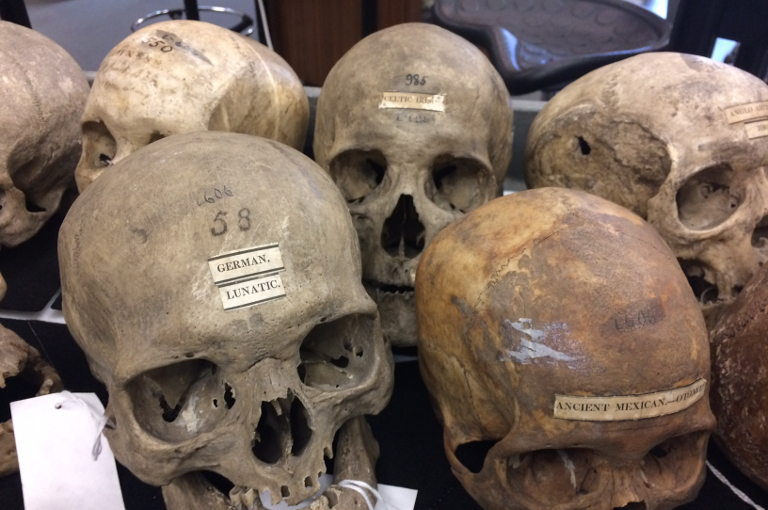
A particularly striking example of the misuse of objectifying bones is the Morton Cranial collection. This collection possesses 1,300 human skulls and was the foundation for popularizing the disproven “race science” that claimed people of color had smaller skulls and were therefore inferior. Since disproven, as the measurements were misinterpreted and skewed to represent the result they desired to achieve, these skulls remain in the collection. Retrieved largely during colonial exploits, it seems hard to reason that they “belong” in this collection–but now that they have been so thoroughly objectified that they are not connected to the people they once were, where do they go? Stripped of their name, stories, and humanity, what are bones but an object?

Lastly, returning to the Museum of Natural History, there is new legislation dictating what their policies should include for the repatriation of the dead. As previously mentioned, the number of Native American remains taken from burial sites, battle fields, and all other means, reached over 500,000 in U.S. collections. The policies surrounding this, and the repatriation of other bodies are weak. There is the 1990 Native American Graves Protection and Repatriation Act, which requires museums to return remains to tribes or lineal descendants that request them. Additionally, the Smithsonian, including the Museum of Natural History, allows remains from named individuals of any race to be claimed by descendants. While many African-American individuals in the anatomical collections are named, none have ever been reclaimed. This seems undoubtedly to be due to the initial and continued dehumanization of these people that progresses into the objectification of their remains. There is no known connections left, so the museum decides that they own any remains not claimed. This is a biased policy that allows for people who have the time and resources to find their ancestors, assuming there is even proof of lineage due to the sheer number of documents destroyed, lost, or never created. There is a reason there aren’t extensive “European” bone collections and displays, and it is because Indigenous and African people have been historically and systematically dehumanized so as to appear as objectified as possible.

Because these individuals are dead, does that mean they have no right to their bones and their bodies? I mean, they can’t, right? At least not in the way that we could know what they would want currently by asking. They are dead, after all. But, if not the individuals who grew these bones themselves–housed, harbored, protected, replenished, cared for, lived in, and existed due to these bones–then who? Their family? What if they have none or the lineage is severed? People from the same culture, religion, region of the Earth? Museums? Are these even “objects” that can be traded, bought and sold, and displayed, or should they be laid to rest? What defines how they felt about “rest” when we may know nothing about their wishes? What draws the line at humans, do all animals not grow, house, harbor, protect, replenish, care for, live in, and exist due to their bones? Why do museum collections around human bones seem so barbaric?

I don’t have the answers, and a lot of these questions are extremely complex and convoluted–but that doesn’t mean we shouldn’t be actively working to right the wrongs of previous generations. If their mistakes are excusable because  “that was just how things were back then,” what is our excuse now? I ask again, stripped of their name, stories, and humanity, what are bones but an object?