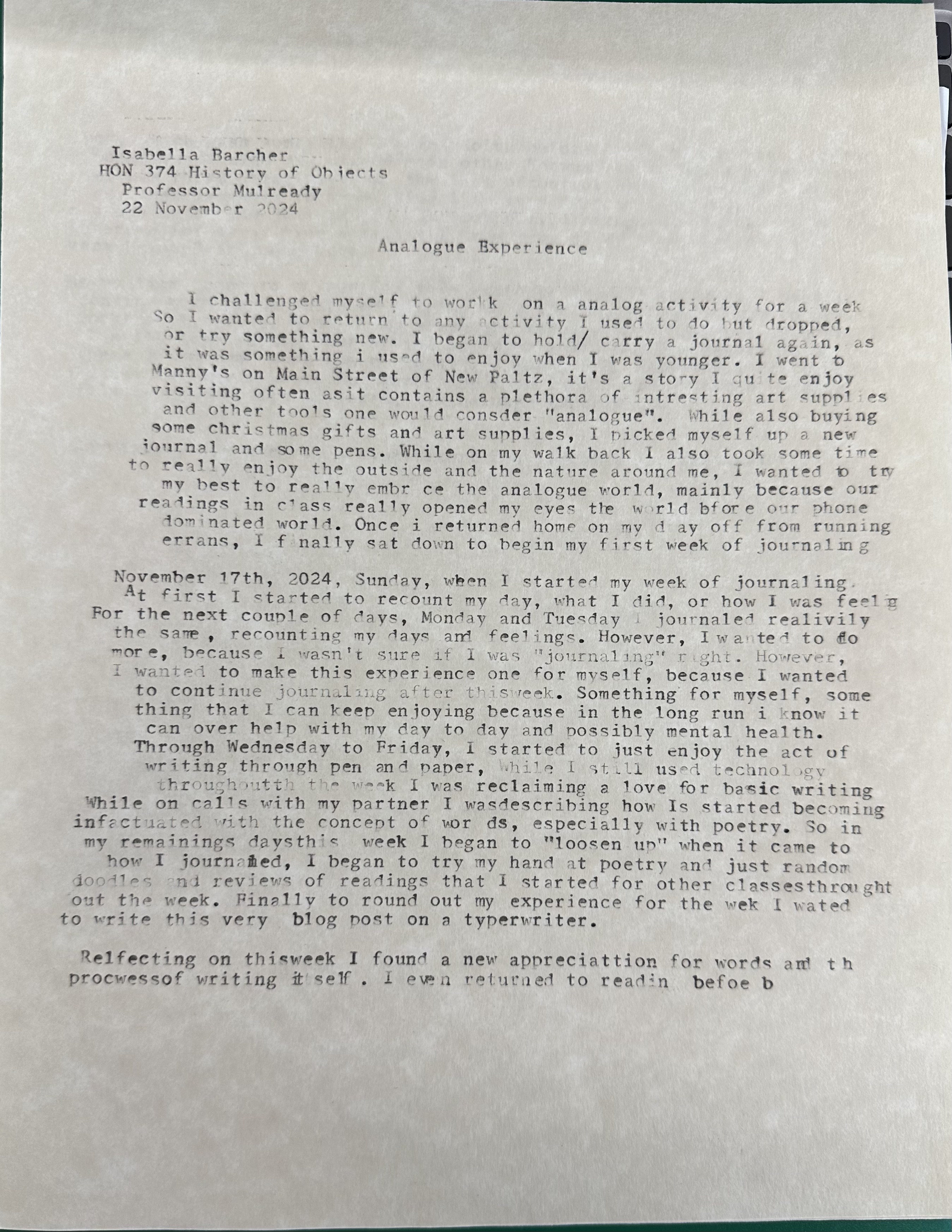
I wanted to challenge myself for my analog experiment by working on an analog task for a week. Additionally, I wanted to write this blog post on one of the original forms of writing: a typewriter.
Please enjoy this attempt and its many mistakes in spelling.
Most mornings I wake up to a bombardment of notifications from a variety of news apps—the New York Time, Le Monde, Al Jazeera, etc. The most pressing headlines, the most pertinent news that one must know. I typically scroll through the national and world news, starting my day off with a nice healthy dose of existential dread. Later in the evenings, I’ll take a walk while listening to current events podcasts, typically in French to improve my language skills.
One could say I’m a tad too dependent on digital media, especially when it comes to news. And so I decided to spend a few days buying and reading a physical newspaper.
My analog journey began on Tuesday. It was a beautiful, sunny, 60 degree day, completely normal for the middle of November in the North East (ha-ha). I asked my roommate where I could find a physical copy of a daily newspaper since I embarrassingly had little idea. They recommended I go to the gas station, and so that’s what I did; strolling off campus, crunching fallen gold leaves, listening to Janis Joplin, and contemplating the Earth’s warming.
The gas station only sells the Daily News during the week, shaking things up from my usual my usual New York Times read. It was a whopping $3.00, although it seemed like the cashier made the price up on the spot after a confused pause. I figured he probably was not used to college kids walking into the small store to buy the Daily News rather than a pack of White Claws.
I read the paper on my walk back to campus. I read all the articles in the news section, flipping haphazardly through sports and entertainment. Reading the physical paper proved to be better for remembering the smaller details; even writing this post days later, I can still recall which counties are currently under a drought warning in New York State, something I would never remember if I had read the article online. With reading digital news, my eyes seem to skip over certain information, latching onto the most “important” details that I want to remember. Each individual word of the physical newspaper captured my attention; they were part of a greater hole, no longer just black signs on a glowing screen.
The next day brought the newest issue of the New Paltz Oracle, thankfully saving me from the walk to the gas station. I came to realize how much I enjoy flipping through a physical paper, being able to smell the pages the same way I enjoy the smell of old, dusty books. Although I have preferred physical books over downloads on a Kindle or phone for years, I never considered I would feel the same with reading the news.
The final day of my experiment it rained. All day. No longer could I appreciate the warm fall scenery and crisp air; I dramatically trudged to the gas station, the $3.00 charge for the Daily News seeming much more detrimental this time around. I was generally cranky that day, and this journey seemed to make matters worse. What was the point, I wondered, of walking through the rain to get an overpriced paper that didn’t even tell me half of the information available for free on my phone?
I typically find issues with the increasingly digital world, feeling nostalgic for humanity’s dependance on analog experiences. I refuse to use Elfster for Secret Santa, I opt for buying things in person rather than ordering online. But my romanticized vision of the analog world took a blow with this experiment; never have I been more grateful for the option to have an insane amount of media available to me at the press of a button.
Admittedly, I still used my news apps during this experiment. While I did appreciate getting local and state news in the physical paper, I couldn’t give up my access to national and world events, especially not now. I am incredibly grateful to be privileged enough to have access to the internet, and even more so to a walkable town where I have enough money to buy a newspaper (plus a half and half iced tea on occasion). I did appreciate the experience of buying a physical paper, but until I have my own house and enough money to get the New York Times delivered every Sunday, I will stick with my digitized and wonderfully convenient news.
At the end of October, the Pokemon Company released a new mobile game called Pokemon TCG Pocket. For fellow nerds such as myself, this game is very fun to play since it incorporates the collecting and battling portions of the TCG (trading card game), but in a more condensed and fast paced version. My favorite part of the game is battling because I love the thrill of trying to predict and counter my opponent, so for my analog experiment I chose to play a full game of the TCG with a few of my friends.
Almost immediately after making the plan, I got hit with obstacles. First, a real TCG deck consists of 60 cards while a deck in the mobile game consists of 20. Although I have a lot of physical cards, it was very difficult to build a cohesive deck. For example, I knew I wanted to build a deck around Charizard (my favorite Pokemon), but I didn’t have enough copies of Charmander or Charmeleon to fit the mold of a deck. In the mobile game, I could have easily traded in some “pack points” for the cards I needed, but in the real world, I would have had to buy the cards as singles online. The second big issue I had was that I didn’t know the rules for a full-length battle (and neither did my friends). In the game, battles are designed so that they are between 5-10 minutes on average. If you have a question about what is happening or what you can do during your turn, the game will let you know. When we were battling with physical cards, we had to constantly open Google to figure out certain rules and technicalities.
Although it was a pain to set up and actually play, it was far more enjoyable than the mobile game for two big reasons. The first one being that I could actually put a face to my opponent and interact with him. Any actions or reactions during a turn were not confined to the limitations of my thoughts, but could be expressed with words and actions. For example, my friend “paralyzed” my Pokemon for 3 consecutive turns so I cursed him out. Obviously, it wasn’t a personal or aggressive remark, but simply a reaction that we could laugh over as friends. If I were to have a similar reaction while playing the mobile game, people would think that I’m out of my mind.
The second reason the game was more enjoyable to play physically was because I could have a conversation with the people/person I’m hanging out with. Since we only used our phones to check the rules, the only way we could distract ourselves and lower the tension of the battle was by having a conversation. There was no pressure from the in-game timer or voices in my head debating what my next move to be. These things were instead replaced by nostalgia and laughter. The flow of the battle was natural, and I think the personalities of each of us were apparent in our method of playing. I was more defensive and analytical, my friend (Michael) was more focused on playing the offensive, while my other friend (Kevin) was just playing for the vibe. The first match we played was between Michael and I, and it lasted 47 minutes with the final score being 6 – 4, where I had 6. The second battle was between Kevin and I, and it lasted 23 minutes with the final score being 6 – 2, where I had 6. The third battle was between Kevin and Michael, and it ended after 52 minutes of gameplay with the final score being 6 -5 in favor of Michael. The final battle was between Michael and I, and it lasted 72 minutes with the final score being 6 – 4 (again) in my favor.
Conducting this experiment was definitely enjoyable and had its pros and cons. However, I learned and realized a few things while playing. The first is my reliance on digital technology. Although a mobile battle is different from a physical battle, there is a lot of overlap. Despite the mobile game being the app I currently use the most, I could only remember a thing or two about the rules of battle. I realized that the only reason I know how to play the game is because the game corrects me if I’m wrong. While writing this blog, I noticed a similar trend. Although I know how to spell and write sentences, I rely heavily on autocorrect and the red/blue squiggle to pick up my slack. Another thing I noticed is I get easily distracted when I do anything on a screen. When I play the mobile game, I tend to hop in and out of different apps (such as Instagram) in between battles. While doing work on my laptop, I have the habit of Googling any random thought that comes to my mind. During the analog battle, there was no temptation to get up and do something else. Rather, my senses/mind were too busy processing and responding to what was happening in real time.
In class, we discussed how objects can become an extension of our minds. Throughout this experiment, I realized that digital technology has become an extension of me. I personally like to be in complete control of everything that I can control, so this realization spooked me out a bit, but then I realized that this extension is only ever useful if I make it useful. I find this thought interesting, and I plan on exploring it further.
Every day, I practice my religion and connect with God through reading scripture and prayer. Though I own a Bible, and have read directly from it quite a bit, it doesn’t leave its shelf during my prayer time. From the comfort of my bed, usually right before I sleep, I open a Bible app on my phone that provides me with a daily verse from the Bible, a video explaining the verse, and guided prayers. I’m also able to collect my thoughts for my own prayer by typing out what I want to communicate with God. In a world where technology has made seemingly everything more convenient than before, even things that weren’t inconvenient to begin with, even time with God has been digitized.
For my analog experiment, I wanted to turn away from my screen and look back into my many physical religious books I have stacked on my shelves. I turned towards the book Jesus Calling by Sarah Young to provide me with a daily verse, which led me into my Bible to find it. Flipping through my Holy book, I found the verse- 2 Corinthians 9:15: “Thanks be to God for his inexpressible gift!”. Instead of watching a video of someone talking to me about the verse, I read Young’s explanation of how we can receive God’s gifts. Instead of having a guided prayer pertaining to the verse ready for me to recite, I dove into a prayer book searching for one to recite related to Thanksgiving and gratefulness. And finally, instead of typing out my prayer, I hand wrote it with paper and pen, expressing the many things on my mind I was grateful for. Through this experiment, I hoped to rediscover communicating to God in a manual way, and asked the question- would I feel more connected to God if I was disconnected from my device?
In each part of my experiment, the verse, explanation, recitement, and prayer, I took note of my reactions and feelings. On the app I normally use, the verse you need is presented firstly, alone without its surrounding verses. While looking for the verse in my Bible, I enjoyed being able to flip through the physical book. It’s light and flimsy, and the pages are thin and soft to the touch. The words are incredibly small, which, to me, was delightful, as it forced me to get close to the book and skim multiple lines to find the one I was seeking. One downside I did find while reading the verse and the explanation was really concentrating on what it was saying. I found myself rereading everything at least twice, which wasn’t usually the case when I read from my phone. Also, watching a video seems to hold my attention better, and being able to see someone talking right at me gives me something to focus on. Nevertheless, reading Young’s explanation still gave me a feeling of deeper connection, and having to reread it multiple times helped reinforce what it was expressing. Normally, I spend my time on the app and when I’m done I open Instagram or Tik Tok, giving me no time to truly absorb what I’ve learned. Looking for a prayer in my prayer book made me quickly look over each page to find the right one, which had me feeling similar to how I felt when searching for the verse. Without having a prayer ready to go, I was able to make note of other prayers in my book I wanted to go back to. Finally, I feel I had the most positive experience writing my prayer out. Even though the option of typing my prayer is convenient and faster, it almost feels like I’m texting God, which honestly is pretty strange when I think about it. However, writing out my prayer felt like writing a letter to a friend, and while writing I wasn’t tempted to go back and correct myself or rearrange my prayer how I do when I type it.
Taking into account all my observations, and focusing on how I felt throughout my experiment, it’s safe to say this was a positive analog experience for me. I still feel positively towards the Bible app I’ve been using, as it does allow me to read and write comfortably from my bed at night, and the creators don’t include ads or push me to pay for a “premium” version. The videos give me a feeling of togetherness with other Christians featured in them as well. However, I feel reading from my physical books and handwriting my prayer provided more pros. I felt a deeper connection, and felt my conversation with God was more personal this way. Disconnecting from my device and its conveniences did help me feel closer to God, and helped my time with him feel truly fulfilling.
In exploring analog objects, I chose to focus on something deeply personal—my relationship with my Nana. We’ve been close since I was a young girl, and during quarantine, we developed a tradition of daily phone calls. Now that I’m away at school, we haven’t been able to talk as much as I’d like, but we’ve established a new routine of Wednesday afternoon calls. I go for a walk and chat with her, updating her all about my friends and classes, and she talks about her and the family. We easily go on for over an hour, sometimes even reaching the two-hour mark when the family drama gets intriguing.
While I love my phone calls and occasional texts with Nana, I miss our in-person talks with one another. She’s familiar with messaging on her iPhone, but Facetime is something completely out of her field of expertise. As an alternative, I thought sending her a letter would be a heartwarming surprise for her to open in the mail. I would be able to express my love and appreciation for her not only in spoken words but in the form of a handmade letter. When doing this, I wondered how creatively I could formulate these terms of endearment for her. Will using a single 8.5 x 11 paper limit how much I can write to her? Will my handwriting be too illegible for her? Should I make my handwriting larger knowing that she cannot read that well? Should I include small drawings in the letter? I hoped that after completing this experiment, I would find answers to all of these questions and discover a new form of communicating with Nana that goes beyond digital interaction. To measure the practicality of communicating through letters, in addition to our weekly chats, I asked Nana how she felt about opening the letter when she initially received it. With no surprise, she was thrilled to find her heartfelt message in her mailbox.
Observations:
The first obstacle I came across in this experiment was putting ink on paper. Between my stubborn writer’s block and the fear of not being able to erase my mistakes, it took me a while to even begin my letter. I can think of endless ways to describe my love for my Nana off the top of my head, but having to put those thoughts into physical words posed a challenge I didn’t think I’d come across. I was easily able to write birthday and Christmas cards to relatives in the past without hesitation, but now I was struggling to write an opener to my letter. Was this a creative block I had developed since being at school? Have I fallen into the comfort of typing everything on the computer without giving the delete bar and auto-correct a second thought? After these anxious thoughts left my mind, I knew I had to start writing soon and stop overthinking this task. At the end of the day, I was writing a personal message to Nana, and she was aware of how much I loved her. Anyway I express that to her would be greatly appreciated.
So I began writing. Instantly, I noticed that because I was writing in a letter format, I felt the need to sound very articulate and formal. I tried looking past this and began my letter with “To my Bestie”, a term we call each other whenever we’re together. The words that came after that opening statement flowed so freely on the page. It felt as if I was speaking right next to her at her small kitchen table. I was nervous that I would misspell or run out of space for some of my words, but writing on the paper allowed my thoughts to run cohesively onto the paper.
Overall, I was very satisfied with what I was able to write on my own. I usually rely on programs like Grammarly to autocorrect and rephrase my writing for emails and school assignments. However, I appreciated that those resources weren’t available to me during this experiment. I feel that it would take away from the intimacy of my written letter, almost in the sense that essays written with ChatAI lose their authenticity. I knew that filling the paper with my original thoughts and handwriting would be a precious gift to surprise Nana with. I ended the letter with our special goodbye to one another and dropped my pen in satisfaction.
People have always told me how admiring my relationship with Nana is. We’re able to talk to each other multiple times a week and treat each other like we are inseparable friends. I’m aware that some people my age are forced by their parents to speak to their grandparents and are praised when doing it. However, speaking to Nana has always been effortless for me. It never felt like a chore to pick up the phone with her or to go to her house to chat. When writing this letter, I felt a sense of accomplishment and pride that I’ve never felt when ending a conversation with her. I believe that is because I worked on something so meaningful for her and I was thrilled for her to receive it.
Unlike sending an email or using the phone, I needed to physically send Nana her letter through the mail. Luckily, I had envelopes and stamps in my room that I was able to use. It had been so long since I sent a physical message to someone that I Googled how to properly format the stamp and the recipient’s address on the front of the envelope. I felt embarrassed that I even had to do that, forgetting something so simple yet lost in memory. The convenience of a simple phone dial or send button had completely taken over my reality of physical communication.
Using the mail system to deliver my letter was not as easy as I assumed it would be. I wanted the letter to arrive at Nana’s house as soon as possible. This meant I needed to send out the letter on a business day before 12 pm since that is when the campus postman collects the mail each day. I also feared that the letter might get lost in transit since that has happened to me in the past. Fortunately, I was able to send out the letter before noon on a Wednesday, just in time for it to be collected and delivered to Nana within days’ notice. This entire process reminded me of the times I would send my Christmas letters to Santa, taking special care in the way I wrote my letter and leaving it in the mailbox with an endless feeling of excitement.
Reflection:
I noticed immediately when doing this experiment that I had lost my appreciation for the art of handmade things. I have always been a crafty person, especially when it comes to gifts, so my family is no stranger to receiving handmade goods or cards for the holidays. However, being at school and using my computer for most of my assignments has confined me to work electronically. Using this experiment as an opportunity to break through these technological constraints was so freeing to me. I was able to develop my creativity through the form of writing that made Nana feel so special.
This message will forever stay in Nana’s home, where she can revisit it anytime she wants as a physical reminder of my love for her. After calling her to confirm the letter’s delivery, she told me how delighted she was to open the mailbox that day and find the handwritten message. The affectionate gesture of seeing my handwritten words brought her to tears. She ensured that the letter would have a special place right next to her bedside for her to revisit.
Conclusion:
This process, which took me about an hour to complete, including the mailbox drop-off, was well worth the time. Knowing how meaningful my letter was to Nana and having her keep it as a token of our relationship encourages me to continue writing letters to her and my other loved ones. I’d like to start sending letters to my family during the holidays and birthdays so that they can receive more personal messages from me. I feel that they carry more significance than a pre-written Hallmark card or a classic “Happy Birthday” text.
Making this letter allowed me to express my thoughts in a physical form that’s unique to me and my art style. I was able to include small notes and drawings throughout the paper related to my relationship with Nana. Using my computer or phone would limit my ability to include these minor, yet expressive details. Sending a heart-eyed emoji, something Nana and I often do when texting, can never match the value of a hand-drawn picture.
I recommend that everyone should attempt to write a letter at least once. If they don’t have a special person to deliver it to, finding a pen pal would be a creative alternative to this experiment. It would allow people to develop their communication skills and form new relationships with others through their writing.
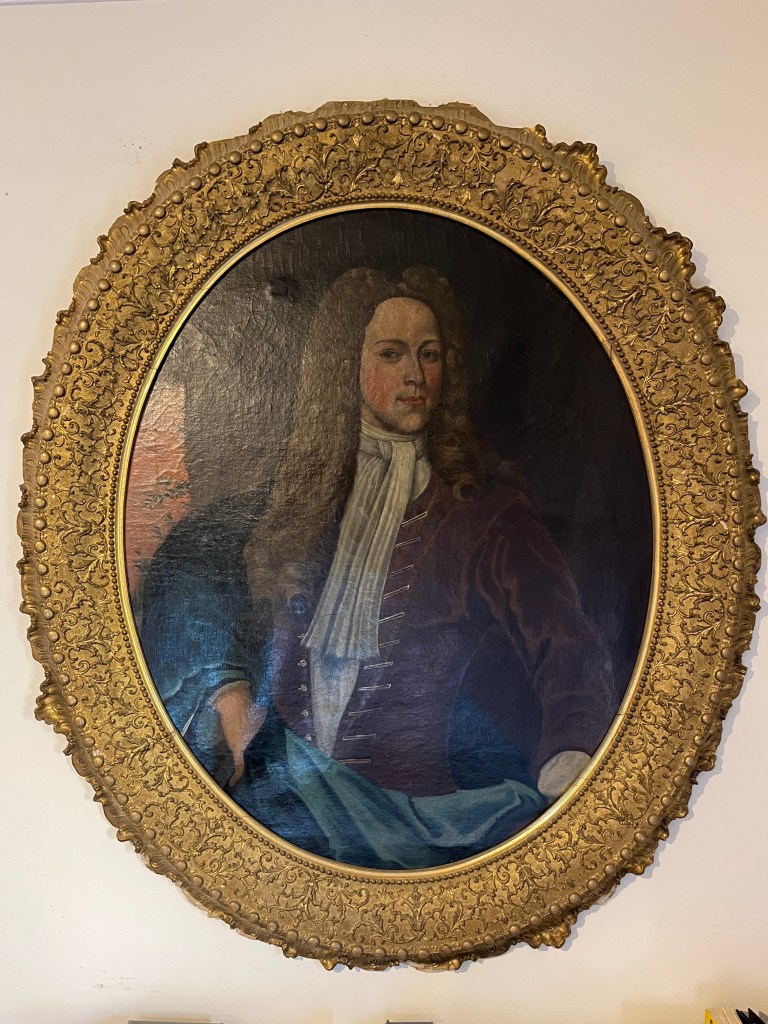
His prideful gaze washed and darkened over with aging varnish residue, a copy of Johannes De Peyster III’s portrait in New York Historical Society now resides over the desk of Grimm Louise’s Office within the historical walls of Huguenot Street. For the Huguenot Street historians he serves as a reminder to be timely with their work; but to history, it serves as a reminder of New York, and New Paltz, colonial government.
Physical Description:
The portrait is an oil on canvas in a wood gilt frame, the oval inside dimensions are 27 ¾” w x 35” h, and its frame dimensions are 35” w x 46” h. Looking at the portrait, Johannes De Peyster III, an influential businessman and Albany mayor from 1729-1733, is dressed in formal colonial attire that reflects his wealth. This features a clothing made from high-quality fabrics such as a long fitted coat, waistcoat, and lace cuffs and collar, representing status. His outfit is made of dark, somber hues such as blacks, browns, and dark greens, characteristic of formal fashion in the period.
His pose depieted in this portrait is dignified and restrained, his gaze is serious conveying the authority anticipated of a mayor. The background consists of minimalistic elements. What can be seen as a possible evening sky on the left side of the painting with muted blues and pinks coinciding with minimal dark foliage. Additionally, a dark and muted wooden structure contrasts with DePeyster’s figure and attire ensuring he remains the focal point. The color scheme of this piece consists of dark and subdued tones, with dramatic light and shadow contrasts that highlight DePeyster’s face and hands. This chiaroscuro effect highlights his features, the textures of his clothing, and the intricacies on his face. Which may show indications of age, implying his longevity and life experience
Given his age during the time of this portrait, DePeyster’s face should bear the lines and creases of age, however, in this portrait, DePeyster’s face is idealized providing the mayor with a young and glowing face, which in many historical cases reinforced their power and status. His hair, likely powdered or styled in colonial fashion, frames his face, emphasizing a receding hairline and his status as a higher-ranking official.
The portrait’s style is likely consistent with the restrained, realistic approach popular in early American colonial portraiture, which values realism, formality, and respectability above expressiveness or romanticized features. It may be heavily influenced by European, particularly Dutch, portrait traditions, demonstrating the enduring cultural linkages between colonial America and the Old World.
Provenance:
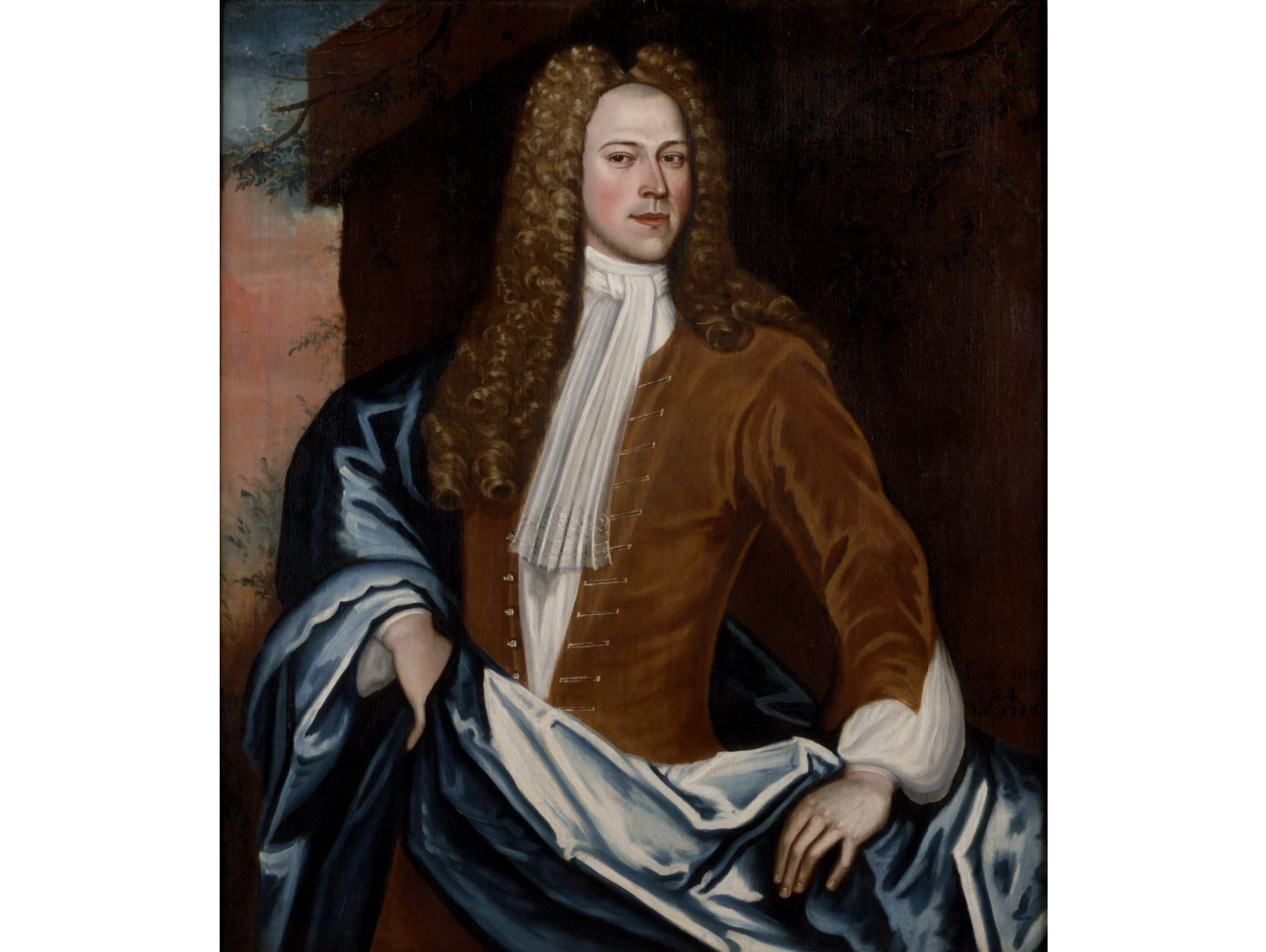
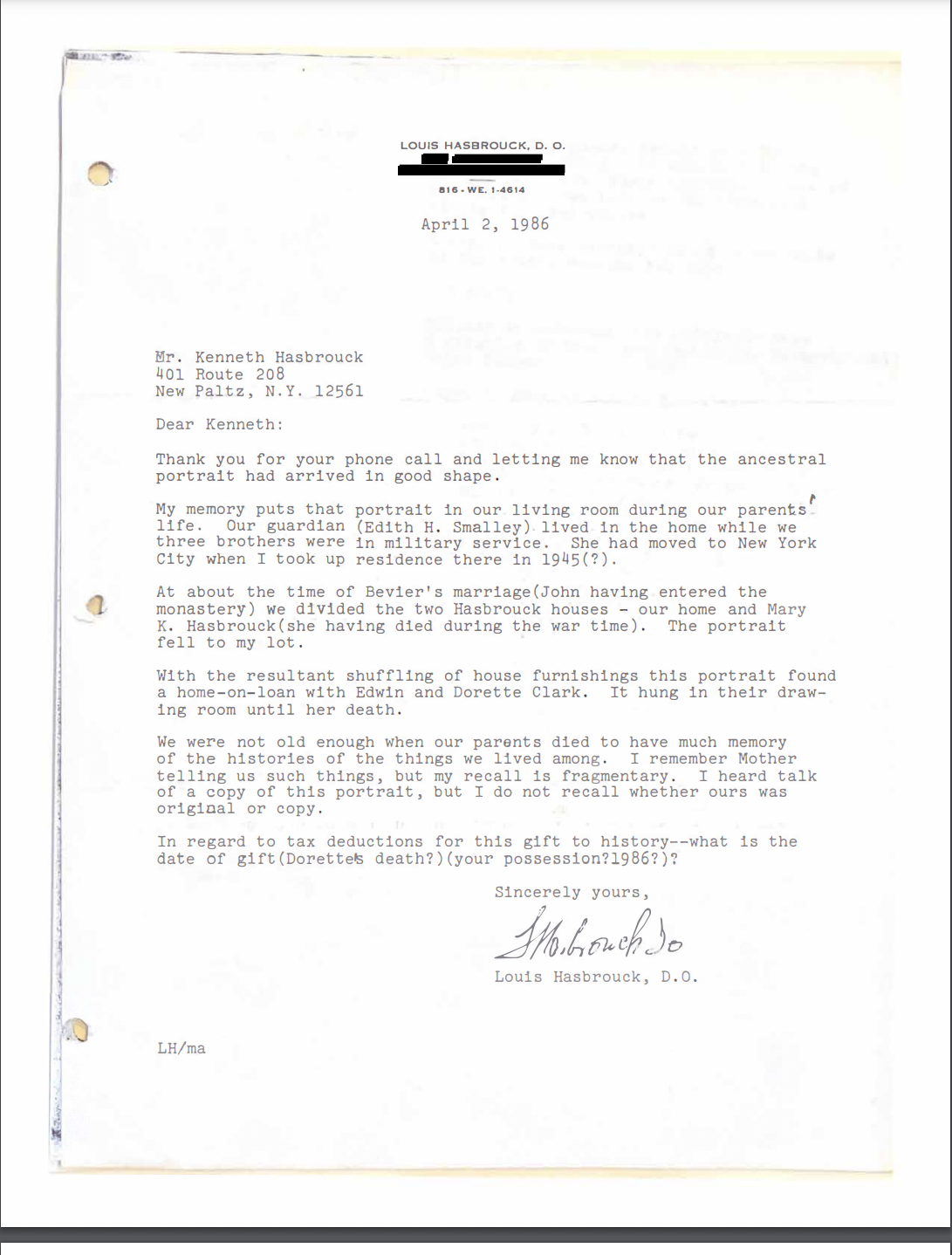
The subject of this work is Johannes DePuyster, John DePuyster Douw’s grandfather. The original portrait was painted around 1718 by Nehemiah Partridge. The original is in the New York Historical Society collection. However, this copy was donated on April 2nd, 1986 by Mr. Louis Hasbrouck to Mr. Kenneth Hasbrouck for the Historical Huguenot Street collections. The portrait found its way into the Hasbrouck family when the Donor’s mother, Helen Miller, a descendent of the subject, Johannes DePeyster III, married Levi Hasbrouck in 1918.
Mr. Louis Hasbrouck states his memory puts this very object into the living room of his parent’s estate. Their guardian, Edith H. Smalley, lived in the home while Louis and his two brothers were in military service. Smalley then moved to New York City when Mr. Louis Hasnrouck took residence in his parent’s estate around 1945.
While there isn’t any record of the exact location of the Hasbrouck family home what we do know is how such a painting ended up in Mr. Louis Hasbrouck’s lot. Bevier Hasbrouck marries and John enters a monastery. Dividing the two Hasbrouck homes, Louis Hasbrouck and his wife Susan Brunck Hinman and Mary K. Hasbrouck, who died during wartime. The portrait then fell into the possession of Louis Hasbrouck. During the division of the two Hasbrouck homes, the painting was found home-on-loan with Edwin and Dorette Clack which hung in their drawing room till death. This leads the painting to be brought back into possession of the Hasbrouck family.
“A letter from the Donor discussing the painting”“Genealogy connecting the donor to the portrait’s provenance”
Narrative
Johannes De Peyster was born in New York in 1694. He was the son of Johannes De Peyster, a merchant of Huguenot descent, and Anna Bancker De Peyster, an Albany native. His extended career in Albany and his time in military service serve as a model for success in early America.
In 1713, Johannes traveled upstate to learn business from his uncle, Albany entrepreneur Evert Bancker. In 1715, he married Albany-born Anna Schuyler, the eighteen-year-old daughter of Albany’s most important New Netherland family. De Peyster, after successfully conducting business with his uncle, then moved to his uncle’s house on the south side of State Street, Albany, where he would reside for the next seventy years. Additionally, in 1721, Johannes was elected first ward assistant, succeeding his uncle. The next year, in 1722, Johannes was elected alderman and was re-elected every year until 1726, when he was then named city recorder. Johannes was named mayor of Albany in 1729 and served until 1733. He was later elected as an alderman from 1748 to 1754. Additionally, he was a militia officer from 1717 to the 1740s. He frequently had contract business with city hall and was an active member of the Commissioners of Indian Affairs until he resigned in protest in 1746.
The object itself was originally created in 1718 by Nehemiah Partridge. Around 1718, Partridge was introduced to the society of Albany, New York, which had not yet been visited by any painters. It’s unclear how he met clients, although it might have been through Boston merchant Jacob Wendell, whose cousin Evert Bancker was one of Albany’s most influential.
We don’t have much information on our version of the portrait, we are unsure who created it or when it was copied from its original. Just like aging varnish, there is a mystery to what lies beneath the surface. However, this copy of this painting from the Hasbrouck family serves as a connection to the early European settlers in New Paltz, as well as a connection to the greater early Dutch colony of New York.
Provided documents from HHS by Louise McGoldrick, a Collections Manager at the site, connect a direct lineage to the Hasbruock family in possession of this portrait to the history of New Paltz. “There is a list of names (Louis – Louis – Joseph – Abraham – Joseph – Abraham) under the donor’s parent (G-37) that tracks the direct family line back to the Patentee, Abraham Hasbrouck (1657-1717).” (McGoldrick, 2024)
Genealogy recorded provided by Goldrick
To the history of New Paltz, The Patentees is a group of early male European settlers. These are the men who signed the 1677 land deal with the Esopus Munsee tribe, exchanging goods for permission to live on 40,000 acres of land that is now the larger New Paltz region. The Patentees consisted of men each representing French Huguent and Wallon origin, one of these men was Abraham Hasbrouck.
September 15th, 1677, the Esopus-Huguenot Land Agreement was enacted. The original boundaries of the patent contained a large part of present-day southeastern Ulster County, including portions of the towns of Esopus, Lloyd, Plattekill, Gardiner, and Shawangunk. For this land, Huguenots traded a collection of goods such as domestic supplies, tools, clothing, animals, and gunpowder and gave the Esopus the right to hunt on the lands exchanged within the patent.
The land agreement also reflects a connection to Albany and Johannes De Peyster III. From the seventeenth century through the eighteenth century, the fur trade between the Dutch and English settlers and the Iroquois nation dominated within the Capital region. Johannes De Peyster III served as mayor and a member of the Indian Affairs Commission during the major conflicts and trades between the natives and Albany settlers. The fur trade helped the Iroquois strengthen their hold in the region by allowing them to control key resources while still maintaining connections with European nations. De Peyster took part in the contacts between the two powers. De Peyster, who came from a wealthy business and political family, was a well-known fur merchant and landowner. As mayor and merchant, he was in charge of monitoring trade regulations and guaranteeing Albany’s powerful status. This contributed to the overall economic and political dynamics between the Iroquois and the British colonies.
Johannes De Peyster III’s portrait and history coincide with the history of Abraham Hasbrouck in the town of New Paltz. The two of these histories bridge to New York’s colonial history, one of major power and the other an individual rural town. Involved in fur trades and land agreements, both the influence in Albany and the smaller town of New Paltz participated in democratic interactions. These stories offer significance in a town such as New Paltz with an early Dutch influence; figures like De Peyster constituted an elite class of leaders who participated in local and regional decision-making processes. Although De Peyster is unlikely to have actually shifted voting habits, his participation illustrates the long tradition of civic duty and governance that formed colonial political culture and, eventually, the creation of American democracy. De Peyster’s family lineage connects the regions together.
We may never know what lies behind the intentions of this copy, or it’s true origins. What we can tell from his gaze is to always make sure to check our emails but to also look at the grand history of early America in the new world; connecting New Paltz to the bigger colonial history of New York state.
Works Cited
Goldstein, Jacob. “Murder in Colonial Albany: European and Indian Responses to Cross-Cultural Murders.” Order No. 1517173 The George Washington University, 2012. United States — District of Columbia: ProQuest. Web. 29 Oct. 2024.
Johannes de Peyster, exhibitions.nysm.nysed.gov/albany/bios/d/jodp.html#jdp. Accessed 3 Nov. 2024.
“Johannes DePeyster III (1694-1789).” Johannes DePeyster III (1694-1789). | New York Historical Society | Digital Collections, digitalcollections.nyhistory.org/islandora/object/nyhs%3A2121. Accessed 3 Nov. 2024.
New York Heritage Digital Collections, nyheritage.contentdm.oclc.org/digital/search/collection/hhs!p16694coll153. Accessed 29 Oct. 2024.
Image via Historic Huguenot Street website. This pillar and scroll mantle clock made in 1830 is decorated with a soft painting towards the bottom surrounded by a dark wooden frame. The clock made its way from its creation site in Connecticut to the possession of an influential New Paltz figure, Josiah Bruyn DuBois, who’s legacy, carried through this clock, rests in the permanent collection of Historic Huguenot Street thanks to his great-granddaughter, Emily DuBois Hoysradt.
The Clock
The wooden frame is stained to a dark brownish red that accentuates the natural grain of the wood while outlining the 20 inch tall, 17 and a half inch wide body. At the very top of this object, the wooden frame has a mirroring pattern of curvy, decorative wood carvings highlighted by the dark stain. The symmetry of the clock is conserved towards the bottom of the frame as well, but the carvings are more functional in that they serve as feet, holding the weight of the object.
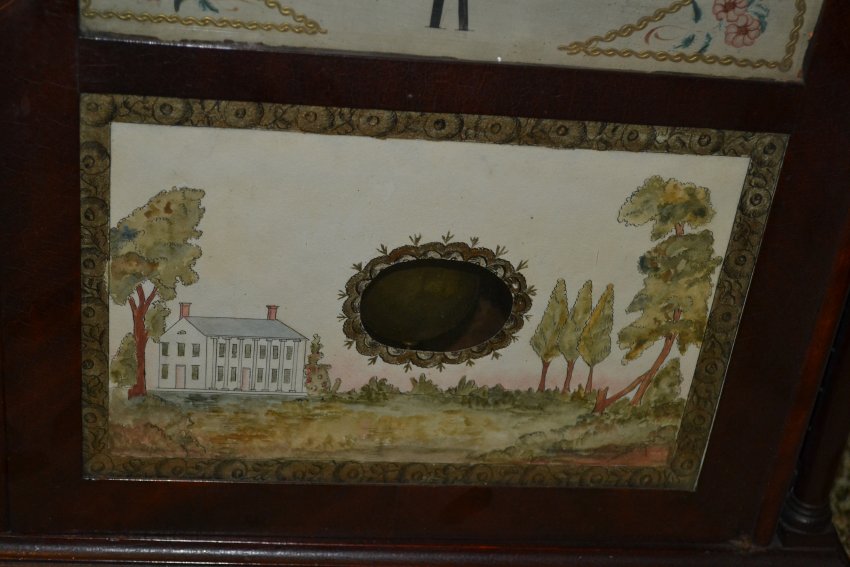
The hinged door, that reveals the clock beneath, is made of glass, to showcase the Roman numerals and pointy hands that indicate the time of day. The diamond shaped keyhole on the left side of the door stands out against the dark wood stain due to its stark white color. On the same rectangular plane as the clock’s Roman numerals, there are small, daisy-like flowers with bright green leaves painted in each corner, enclosed by squiggling gold lines. Below the clock, separated by a bar of stained wood, there is a more detailed painting of a simple landscape, which has been reverse painted onto the back of the glass paneling of the door. The painting depicts several trees growing on a lush, green piece of land with one lonely white estate rising from the grasses. There is an ellipse shaped portion in the center of the image that has been left unpainted so the holder of the object may view the clock’s golden pendulum as it moves with time.
Image via Louise McGoldrick, staff of Historic Huguenot Street. A closer look at the reverse painting on the lower portion of the glass paneling of the hinged door.
Provenance
This mantle clock was originally made in 1830, by a company called Eli Terry & Sons of Plymouth, located in Connecticut. This company manufactured several varieties of mantle clocks of the same configuration as this one, each with their own unique decorations in the corners of the clock as well as uniqueness in the paintings below the clock. Originally, the clock was owned by Josiah Bruyn DuBois Sr. who made a living mainly as a merchant in New Paltz, with his business partner (and father-in-law) Josiah Hasbrouck. It is unknown how he obtained the clock, whether he purchased it himself or it was gifted to him by another. Being a member of an influential family in New Paltz society, the mantle clock remained as a family heirloom passed down from generation to generation.
The clock eventually landed in the hands of Josiah’s great-granddaughter, Emily DuBois Hoysradt. Emily was a local artist and included this beautiful mantle clock in one of her works. Later on, Emily gifted the clock to Historic Huguenot Street where it belongs as part of the sites’ permanent collection
Image via Historic Huguenot website. Emily’s painting features the mantle clock, located above the fireplace, as well as a chair and candle holder, all which are objects she donated to Historic Huguenot Street. She even donated this painting.
Connections
At the time, a mantle clock like this one would have cost between $30 to $60 compared to now where the worth of the clock has increased to between $1,000 to $2,000 today. During the 1830s, this sum of money was not of billionaire status but it did reflect someone who lived comfortably. Josiah’s merchant business was successful enough not only for him to be in possession of this lavish clock but also to construct a home along Wallkill River on a plot of land named Libertyville, now Libertyville Road.
This land had been under the proprietorship of the DuBois family beginning with Josiah’s great-great grandfather, Louis DuBois, one of the founders of New Paltz. The house Josiah built was a Federal style estate, which was not small and typically consisted of 2-3 stories. These kinds of homes were based on symmetry, similar to the clock’s construction. Josiah’s house also may have resembled the estate depicted in the bottom left of the painting on the mantle clock, rectangular in shape with a door in the center and an even amount of windows on either side of the entrance as well as on the sides of the house. On the interior, houses like these typically were decorated with wooden furnishings and accents, curved structures, and lots of intricate molding and wallpaper. It can be imagined that the mantle clock may have been a centerpiece in a room with a cozy fireplace and plenty of places to sit. It may have been in the kind of room Josiah and his business partners conducted work, as they had their hands full with tasks so it was important they be aware of the time in case they needed to attend to other matters. This house is historically known as the Blake House although it was built by Josiah DuBois, it was eventually sold to William H. D. Blake, who’s name remained.
Josiah’s work was almost exclusively to do with money and financial activities. This included buying and selling goods from his store Josiah ran with his father-in-law Josiah Hasbrouck located in what is known as the Jean Hasbrouck House. Many of his documented sales also included goods such as magazine subscriptions, livestock, as well as enslaved peoples. Josiah also documented many exchanges of labor where workers were paid for their time and service. He handled much of his family’s real estate business as well, evidenced by the numerous documents of deeds, mortgages, maps, and legal papers meticulously dated and signed by Josiah.
Josiah’s role in the New Paltz community extended further than him being the local merchant and familial land manager. He was influential enough to be a member of the local political sphere, in which he served as Overseer of the Poor. This job was one he was elected to do, meaning one of two things, he was a trusted individual of the community or he was a member of an elite family that had the power and privilege to control certain aspects of society. Josiah’s role in this position was important for those who were not as privileged as he may have been. He provided money and resources for those in need and could not afford food, clothing, or medicine. Overseer of the Poor was a role that was common in most local communities during this time. Typically each town would have their own Overseer who distributed money to those who needed it most. Evidence of Josiah’s work was carefully documented and included every cent he authorized to be expended along with what it was used for and a reasoning why. Overseer of the Poor is interestingly an early version of the modern welfare systems we have in place today. Although Josiah’s role was limited to the local level, it can be observed that his field of work was significant and transformed into a hugely vital part of America’s modern political system.
Circling back to the object that started it all, the clock itself is reflective of the kind of lifestyle and taste Josiah DuBois had during his time of life. It serves as a reminder of the influential families that not only founded a thriving town, but also brought forth government systems and policies that are still in use today. The mantle clock emphasizes the idea that although time moves forward, systems, political practices, ways of life, and societal structure have persisted and remained as part of present day life, just like the existence of the clock, in all its antiquity.
Works Cited
Apmann, Sarah Bean, and Sarah Bean Apmann. “The Federal Style Explained – Village Preservation.” Village Preservation – Greenwich Village Society for Historic Preservation, 19 May 2020, http://www.villagepreservation.org/2016/03/30/the-federa.
Miller, Ann Brush, and Virginia Transportation Research Council. Orange County Road Orders, 1750-1800. 1 Jan. 1989, rosap.ntl.bts.gov/view/dot/19247#:~:text=Ea.
Something loosens in my mouth, and the hollow space under my tongue fills with blood. I stare at my reflection in the mirror, my mouth a stupid gaping hole on a wide pale face. I spit into the sink, and a white pearly stone hits the basin with a small clink.
“Oh, what the fuck,” I say out loud. “That’s my tooth.” I tongue the fresh hole in my gums. “That’s my fucking tooth.”
From outside the bathroom I hear wobble baby wobble baby wobble babywobble. I should be out there, on the dance floor, pleasantly tipsy, wobbling. Instead, I’m leaning over the sink, staring at my tooth. It’s an incredibly sobering experience.
A squawk comes from next to me. I look over, momentarily distracted by the sound, half expecting to see a large bird. The squawker is a girl with long blonde hair and skinny eyebrows. She is wearing a hot pink micro-mini skirt and not much else. This is also distracting. “Don’t even worry. I’m going to call 911,” she tells me.
Blood dribbles down my chin. In the back of my mind, I think that there’s an awful lot of blood coming out of me right now. Could it be a side effect of being on my period? Do I have a chronic blood-related disease that I was never diagnosed with? How much blood can a person lose before their body shuts down? “Don’t do that,” I manage to say. Little spots of light are floating across my peripheral vision. My eyes chase one across the top of mirror.
“I’m totally doing it right now!” the girl says, her phone planted to the side of her face, patting my shoulder in a gesture of reassurance. “Like, no offense, but you sort of look like you might pass out. Your face looks white, like, really white.” She squints at me. “Was that racist of me?”
I groan and spit more blood in the sink. I’m getting the nauseous feeling in the pit of my stomach that usually precedes me sprawling across the floor in a dead faint. I need to get out of this bathroom, out of this shitty bar.
“Maybe you should sit down or something,” the girl says. “That’s what the lady on the phone is saying, at least.”
I pluck my tooth out of the sink. A string of frothy red spit trails from it. I don’t have pockets, so I put the tooth back in my gum hole (a different sort of pocket).
“I tried,” I hear her say as the door swings shut behind me.
I shove my way through the crowd huddled in front of the bathrooms, slapping my hand against the wall as I go. A fresh wave of blood floods my mouth. I reach blindly for an abandoned drink, toss back the blue liquid left in it, swish, and spit. On shaky legs, I make a beeline for the exit, cup and tooth in hand.
“No drinks outside,” the bouncer tells me, half-stepping in front of me.
“It’s my tooth,” I say, edging towards the door. He doesn’t have anything to say to that.
The chilled autumn night hits me like a slap. The sky is a deep navy dotted with pinpricks of light. The moon is a delicate sliver. I rub my goose bumped arms with one hand and grip my spit-tooth cup with the other. I’m aimlessly walking, swerving around clumps of smokers and stragglers, the detritus of the night. The nausea has mostly passed. I remember something I saw online about how it’s best to put a separated tooth in milk. Somethimg about keeping the cells alive. Where could I get milk at three in the morning?
I make a turn at the street corner and run into something hard and cold. I back up, blinking, and look up at a very tall man. He is dressed in a nondescript black jacket and jeans. The skin on his face looks tight, like he’s fresh from a facelift, and I can’t place his age. I look at him. He looks at the hand holding my tooth cup.
“I can smell it,” he says. His mouth doesn’t move very much when he speaks. The man’s lips are pillowy, at odds with the taught skin around his mouth. He is very close to me all of a sudden. There is a medicinal smell coming from him, like cherry cough syrup.
I laugh nervously. “Okay!” I say. I swerve around him, clutching the cup to my chest. “Have a good night.” I watch him over my shoulder as I turn the corner, until he is out of sight.
I’m at a convenience store, perusing the bottled milks, when I think to look at the cup still clenched tight in my hand. My tooth isn’t there. I close my eyes and let my head fall forward and hit the sliding glass door with a thud. I know with complete certainty where my tooth ended up. I know I’m not getting it back.
Everyday, I stand here unable to move. At the end of this driveway, solely watching as cars drive by. I am only a mailbox.
I have been recently painted because parts of me were fading. The white wooden post that holds me up is so strong that even after the windiest days and harshest winter nights, we still stand, together we are one. We only have each other, as we do not have any other mailboxes near us. However, the family that owns me wants to make sure I do not show any parts of aging. The numbers that are stuck to my side have been replaced with more visible ones. As the white paint starts to chip away starting from the bottom of the post, I can see disgusted faces when my owners see the chipped paint as it disrupts the aesthetic of the house. Perhaps it was just time for a new coat of paint. Not only because of the years that have passed by since the wooden post that holds me has been painted, but all those dogs that walk by my post and I, that decide we are the best peeing spot. Every time a dog comes up to us, I know what is about to happen. I look down with disgust at the dog. We are not supposed to be their perfect peeing spot. I scream “Go away! We are not your peeing spot! Find somewhere else!”, but the dog does not care and does whatever he wants. I feel bad for my post as we experience life together, but my wooden post gets the worst of it.
I think of the individuals who visit me in two different categories, those who use me to store packages and letters and those who take everything I hold away from me. Most mornings, I am visited by this lovely woman who opens me up and gives me letters to hold. Then, she closes me up and off she goes until the next morning. Occasionally, I am visited by strangers who open me up and stuff me with packages. Then in the evenings, one of the family members walks up to me and opens me up to check if I hold any packages or letters. When I do, they take everything from me and leave me bare inside. So, I have completed my job. Sometimes I am tasked to send out a letter. Usually, it is my owner that gives me the letter to send out, he will raise my red flag. This will let the wonderful woman in the morning know that I have something for her. She will open me and take the letter with her. She will put down my flag, as I no longer hold anything that needs to be shipped. Then the woman checks to see if she has anything for me to give to my owners. And just like that she closes me up.
There is no other like me. I can see, hear, and talk. I am more than an ordinary mailbox.
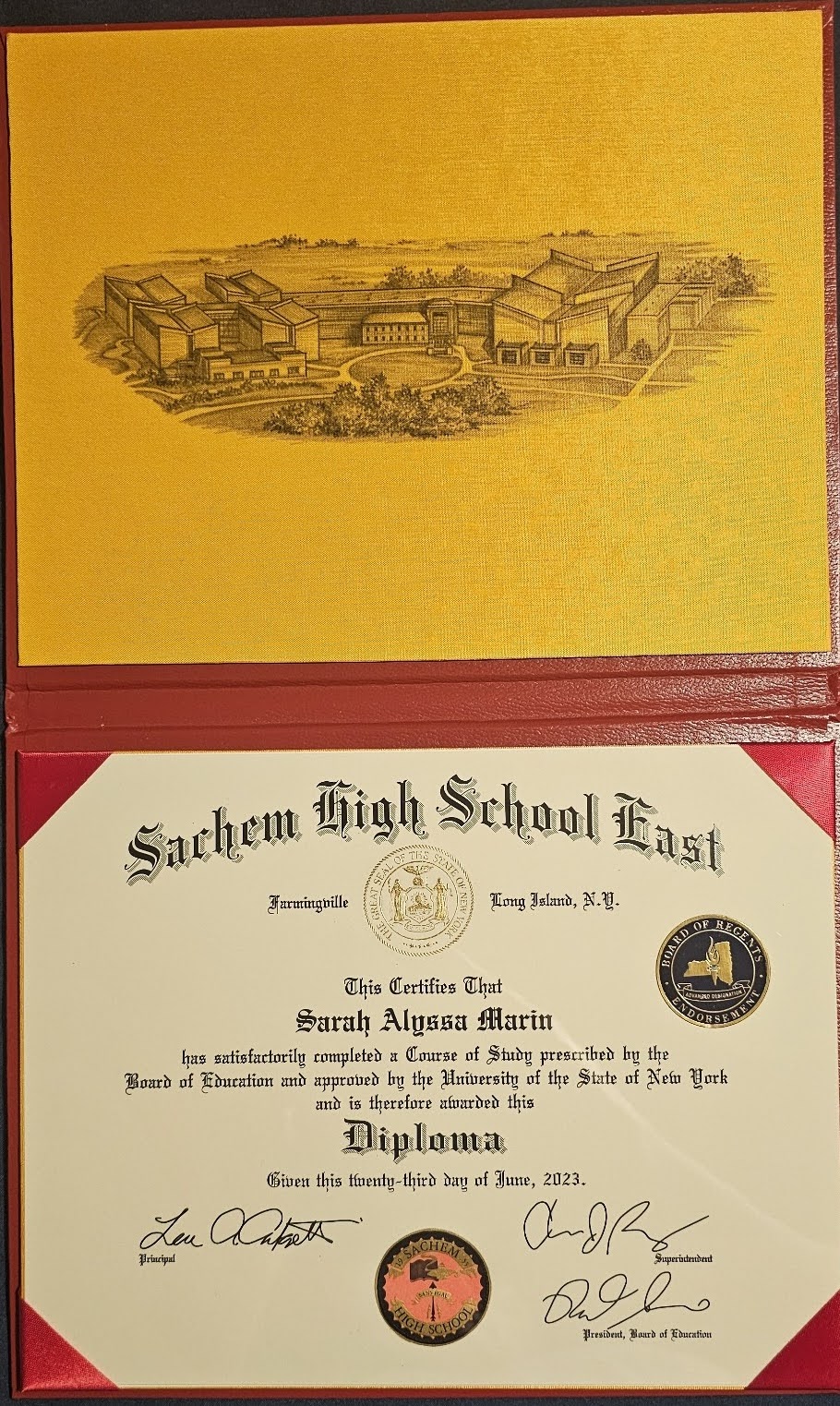
On June 23rd, 2023, students and families gathered outside Sachem East High School’s football field. Over 500 students took the center of the field, their bright red robes and customized graduation caps facing the crowd. The students eagerly waited for their class president to make the announcement, for them to turn their tassels, and for their graduation to be official. The last four years led up to this moment; everything was all for the diploma.
A high school diploma’s importance varies among people. A simple piece of paper, a check box on their resume, or a stepping stone in their academic career. My high school diploma is a reminder of my accomplishments and my background.
Photo of my family on my graduation day, June 23, 2023
This is a photo of my family on my graduation day. Immediately to the left of me is my mother, Tammy, whom only received her high school diploma and sacrificed her education to raise a family. My mother always had big dreams, but her selflessness and love for family she’s always valued most of all. I wouldn’t have been able to accomplish anything I have if it weren’t for her unconditional love and support. My high school diploma is a symbol of her sacrifices that helped others.
Next to her is my father, Peter, a first-generation son who was the first to graduate college. My dad has worked tirelessly since childhood to give me the life I have today. He taught me the importance of hard work and the determination you need to achieve your goals. He worked to get himself and his parents out of the dangerous streets of Hollis, Queens to the suburbs. He’s given up everything to give us everything. My diploma is a symbol of the lessons he’s taught me about hard work.
Inside of my diploma
My dad has his hands around my two little brothers, PJ and Ethan, and next to them is my older sister, Angelina. My little brothers are my motivation for most of the things I do. Watching them grow up, I want to continue to watch them grow into someone they are proud of. After I started college, it opened doors for PJ to begin thinking the same, something he never cared for before. Angelina is one of my biggest supporters in everything I do. Since I’ve been a kid, she’s believed in me and encouraged me the most. Though college wasn’t for her, she continues exploring possibilities of returning to school or pursuing her passion for art. My diploma is a symbol to them that they are capable of anything.
My grandparents are Maria and Pedro, but we call them Mafita and Abuelo. My grandparents are arguably some of the most influential people in this regard. They immigrated from Colombia with essentially nothing but the clothes on their backs. They relentlessly worked three jobs to provide for my father and his sister. Neither of them had the chance to graduate high school, as they began working at such a young age. I am consistently reminding myself of how lucky I am to have the chance to be an educated woman. The first woman in my family to graduate college. My grandmother unexpectedly passed away a couple of months after my graduation, so unbeknownst to me this would be the first and last recognition she saw me receive. She was over the moon for me that day, and I know I will continue to make her proud. I’m studying Spanish to become fluent and stay connected with my culture, which has always been very important to them. My diploma is a symbol of brighter beginnings after significant sacrifices.
Receiving diploma at graduation ceremony
Finally, what does this diploma mean to me specifically? This diploma is a symbol of my overcoming challenges I never thought I could. My struggle with mental health during my high school years started leading me to believe I may not make it to this point, or I may not accomplish anything I wanted to. The top of my graduation cap reads “She knows she lived through it to get to this moment.” Regardless of feeling like nothing was possible, this was possible. This diploma is a symbol that was only my beginning, that I’m capable of so much more, and I wouldn’t be where I am without the support of my family.







 The Materials of History, Thought, and Art