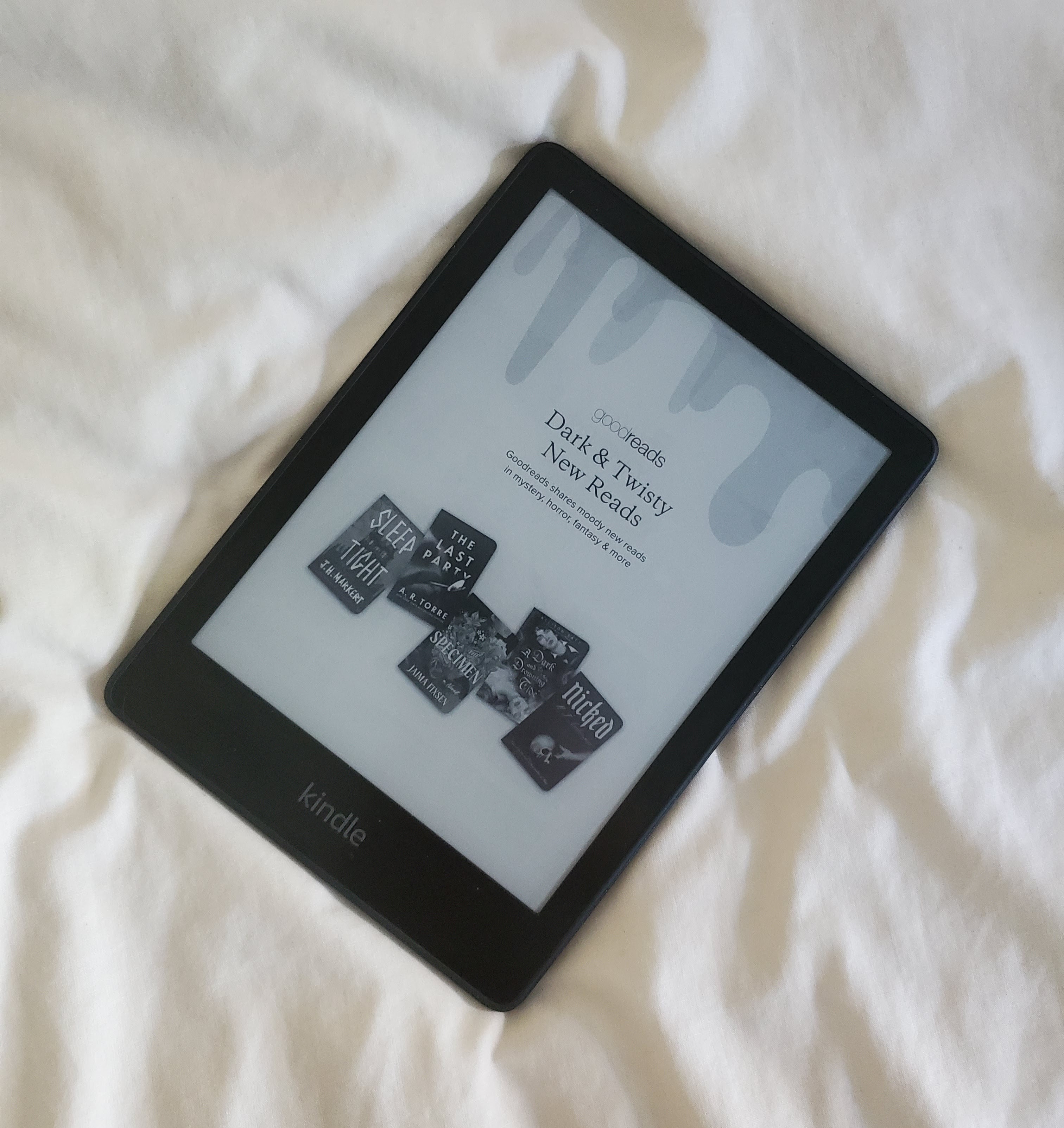
Kindle Paperwhite

One of my most used possessions is my 2022 11th generation Kindle Paperwhite. First released in October 2012, the Kindle Paperwhite is 6.6 inches long by 4.6 inches wide by 0.3 inches thick and weighs 5.6 oz. Structurally, it consists of a matte screen encased in a beveled plastic frame. The Kindle Paperwhite is named for its clean white display, which creates more contrast with the black text than the light gray screen of earlier Kindle e-reader models.  
If I were to deconstruct my Kindle, I would be able to identify four distinct components; a circuit board, the foundation for the Kindle’s electronic circuits: a Wi-Fi chip; a electrophoretic display, or the electronic ink screen; and a lithium-ion battery:. The circuit board is made in China and the Wi-Fi chip in South Korea, the leading manufacturer of mobile phone components. The electronic ink (E-ink) display was manufactured in Taiwan by E Ink Holdings.  

Electronic ink is the crux of e-reader success. The technology was first developed by physicist Joseph Jacobson and MIT undergraduates Barrett Comiskey and J.D. Albert out of MIT Media Lab, a multidisciplinary research laboratory. MIT filed a patent for the E-ink display in 1996. E Ink Corporation was founded the following year by Jacobson, Comiskey, Albert, Jerome Rubin, and Russ Wilcox. The business was acquired by Prime View International, a Taiwan-based manufacturer, in 2009.  

E-ink mimics the appearance of ink on paper through a process called electrophoresis. Two ultra-thin transparent plastic films, coated with pixel-sized electrodes, sandwich microcapsules filled with black and white pigment. The microcapsules are suspended in an oily substance. The black pigment is negatively charged, and the white is positively charged. When a charge is introduced via an electric current, the pigments rush towards the opposite charge, creating the look of black text on white paper. The screen is lit by seventeen low-powered LED lights, diffused across the screen via a flattened fiber optic cable, creating the illusion that the screen is backlit.

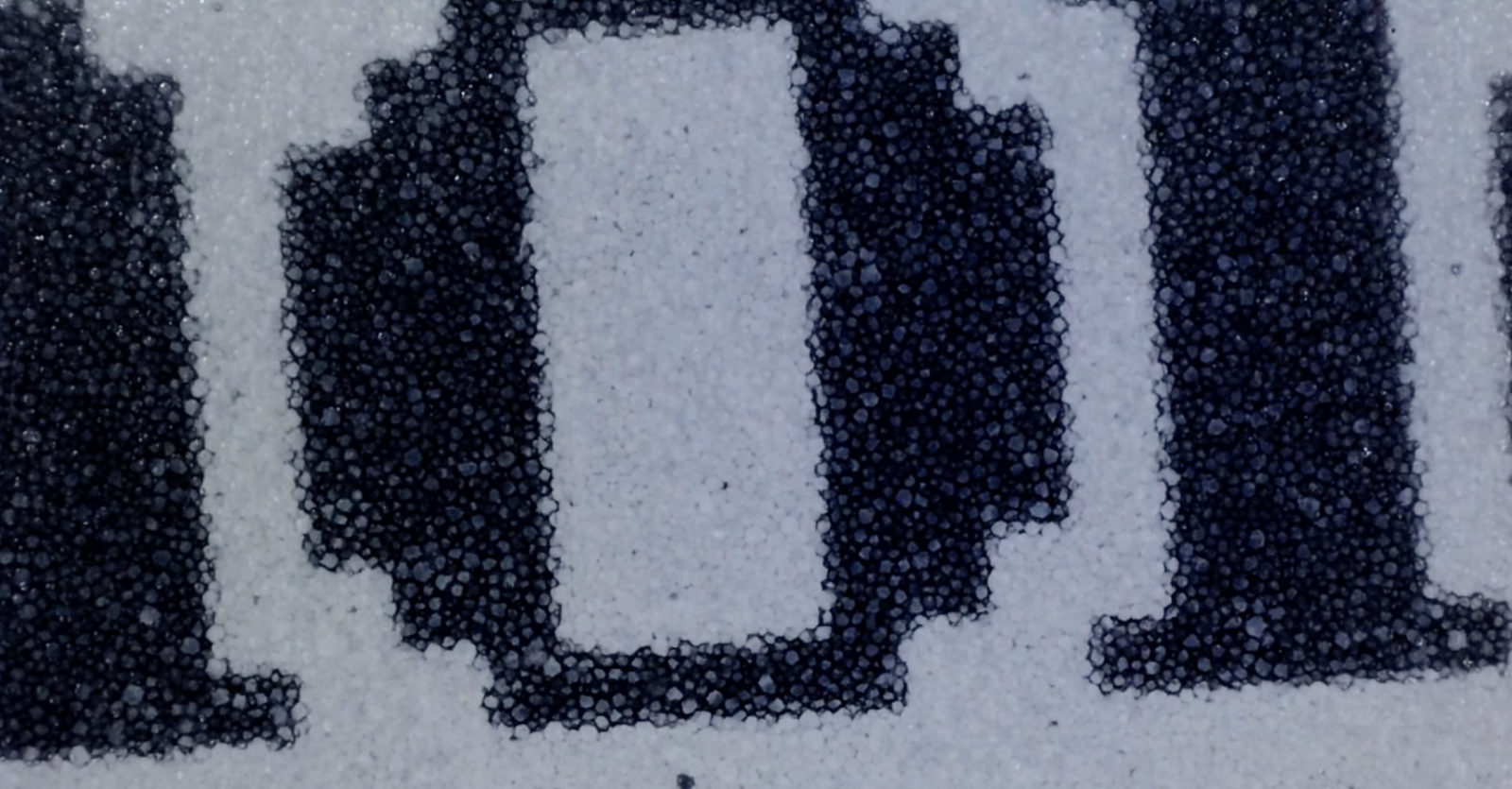
The working of an E-ink display.
A close-up of an E-ink display. The individual electrodes are visible. 

The lithium-ion battery, too, was produced in China. However, its individual components, specifically the heavy metals lithium and cobalt, were extracted halfway across the globe. In Chile and Australia, the two leading lithium exporters, the metal is pumped from brine reservoirs underneath salt flats and left to evaporate.  

Most the world’s cobalt is mined in the Democratic Republic of Congo. In a 2021 report for the Wilson Center, Michele Fabiola Lawson writes, “mining in the DRC involves people of all ages, including children, to work under harsh conditions. Of the 255,000 Congolese mining for cobalt, 40,000 are children, some as young as six years. Much of the work is informal small-scale mining in which laborers earn less than $2 per day while using their own tools, primarily their hands.” Both lithium and cobalt extraction pose serious environmental concerns, including pollution, biodiversity loss, and greenhouse gas emissions.  

The Kindle is a great product, and in the past, I have recommended it to anyone who will listen. Its E-ink technology is a versatile and low-energy alternative to traditional electronic screens. Yet the Kindle’s near perfect design does not justify the human and environmental cost of its production.  

Work Cited

Denning, Steve. “Why Amazon Can’t Make a Kindle in the USA.” Forbes, Forbes Magazine, 21 Apr. 2014, www.forbes.com/sites/stevedenning/2011/08/17/why-amazon-cant-make-a-kindle-in-the-usa/

Frankel, Todd C. “The Cobalt Pipeline.” Washington Post, 30 Sept. 2016, www.washingtonpost.com/graphics/business/batteries/congo-cobalt-mining-for-lithium-ion-battery/

“How Is Lithium Mined?” MIT Climate Portal, 12 Feb. 2024, climate.mit.edu/ask-mit/how-lithium-mined. 

Lawson, Michele Fabiola. “The DRC Mining Industry: Child Labor and Formalization of Small-Scale Mining.” Wilson Center, 1 Sept. 2021, www.wilsoncenter.org/blog-post/drc-mining-industry-child-labor-and-formalization-small-scale-mining

Strickland, Jonathan, and Chris Pollette. “How Does Kindle Work? What to Know in 2024.” HowStuffWorks, HowStuffWorks, 30 Apr. 2024, electronics.howstuffworks.com/gadgets/travel/amazon-kindle.htm. 

Vicente, Vann. “What Is E-Ink, and How Does It Work?” What Is E-Ink, and How Does It Work?, How To Geek, 18 Oct. 2021, www.howtogeek.com/752328/what-is-e-ink/

Grandmother Stover’s Trimmin’ Trinkets Cupcake Topper

The object I chose is a clown shaped cupcake topper manufactured by Grandmother Stover’s, a midcentury dollhouse miniatures company. It would have been sold in a multipack, packaged in clear plastic bags and stapled shut with cardboard. The object is white plastic with printed red, green, and black details. It is about 3 ½ inches tall. A round head sits on top of a thin stem that ends in a sharp point. There is a small crack where the head meets the stem. The print job is uneven and distorted, relaying the mass-produced nature of the object. The clown dons a triangular, striped, red cap with a green tip. Its expression is one of mischief. Curved black eyes, topped with raised eyebrows, glance to the side. Red circles define the cheeks. The typical round clown nose is the only three-dimensional component of the face, and has a red circle printed on it. Four curved lines make up a smiling mouth. 

Trimmin’ Trinkets clown cupcake toppers in their original packaging.

From 1943 to 1983, Grandmother Stover’s was one of the most prominent suppliers of dollhouse furniture and miniatures in the United States. The company, based in Columbus, Ohio, was founded by John Stover in an effort to provide dollhouse accessories for his children in a time when European imports in this market were limited. John, a successful businessman who owned an advertising business, was living in Upper Arlington with his wife Elizabeth and their three daughters when he came up with the idea to start a dollhouse company. In 1941, John purchased a dollhouse and a complete set of furnishings as a gift for his daughters. He would discover that most of the miniatures were handcrafted by German artisans working out of their homes. This inspired him to create the same sort of operation in central Ohio.  

A lot of Grandmother Stover’s miniatures listed on Etsy.

John named his fledgling company after his mother, Mrs. Anna Stover. She was an essential part of the operation and would help make the very first sample products. By 1970, Grandmother Stover’s, Inc. employed 15 full-time and 25 part-time employees. The Lancaster Eagle-Gazette published an article in December 1944 titled “New Idea in Christmas Toys Named for Lancaster Woman,” which stated, “this year the toys are being shipped to large stores from NYC to Los Angeles. The demand for them is much greater than the supply.” Grandmother Stover’s was turning out miniature kitchen supplies, newspapers, decks of cards, platters of food, gilded mirrors, bedspreads, bars of soap, and any other household item, appliance, or furnishing one could possibly imagine. The company also sold party favors, cake toppers, and other small miscellaneous toys as part of their Trimmin’ Trinkets line.  

Today, Grandmother Stover’s miniatures are renowned in hobbyist and collector circles. While the company no longer manufactures miniatures, their name brand adhesive glue can be purchased from online hobby and craft stores. John’s personal collection of his favorite one-of-a-kind miniatures was donated by his family to the Georgian Museum in Lancaster in 2006.  

The Old Curiosity Shop, a shadowbox arranged with Johns’s favorite miniatures. 

Works Cited 

Harvey, Joyce. “Remember When: Jack Stover Picked ‘The Purple Pepper.’” Lancaster Eagle-Gazette, Lancaster Eagle-Gazette, 25 Jan. 2021, http://www.lancastereaglegazette.com/story/news/2021/01/25/remember-when-jack-stover-picked-the-purple-pepper/6659362002/. 

Frankenstein’s Miniature

Mary Shelley’s Frankenstein poses questions about humanity and what is natural or inherent to it, the dangers of science and scientific inquiry without considering ethical implications, and what constitutes as monstrous in a world so wrought with violence. It is no wonder that it has been read by millions worldwide since its initial release and rerelease in 1818 and 1831, respectively. An aspect of Frankenstein that is not often analyzed is Shelley’s mention of objects – such as the scientific apparatuses Victor Frankenstein uses or the books that Frankenstein’s creature finds. One object that caught my attention is the “valuable miniature… of [his] mother” that William Frankenstein has in his possession when he is murdered (Shelley 96). What exactly is a miniature, why was it so valuable, and were miniatures an important part of life during the 1800s when the book was written?

When William Frankenstein is murdered, his cousin Elizabeth Lavenza is beside herself with grief and guilt: grief because she has just lost someone so dear to her and guilt because she was the one who gave William what “was doubtless the temptation which urged the murderer to the deed” (Shelley 96). During the 18th and 19th centuries, miniature portraits were an important aspect of European culture, particularly in England. These objects were “intricately embellished with gems and enameling” and the portraits themselves were a “valuable artwork” whose containers required “particular skills, precious materials, and technological know-how” to create (Skolnik; Pointon 49). Seen as luxurious, miniature portraits could be found in royal households, often showcased publicly, transforming “what is essentially a private object (a small scale-portrait)” into a “museum piece” (48-49). There was a time where miniature portraits were showcased in “the queen’s audience chamber, behind glass, between the wood paneling and a line of full-scale portraits” (48). Miniature portraits “of the royal giver” also served as gifts from monarchs “to reward loyal subject[s]” (Skolnik). However, “spending on luxury goods” was not limited to the wealthy and the “middling sort” eventually began to collect these objects (49). Collecting miniature portraits for the express purpose of displaying them “proved one way of establishing a visual family tree” (49), and with the movement of miniatures from royal life to ‘commoners,’ “sweethearts and spouses replaced sovereigns” (Skolnik). It was not uncommon for women to wear miniatures of their husbands “not hidden but placed facing outwards as part of their apparel” (51) and women in 18th and 19th century paintings were depicted wearing such miniatures. With these facts in mind, an English or European reader during this time would have immediately recognized the importance of the miniature in William’s possession as well as its value.

While reading Mary Shelley’s Frankenstein, it is easy to gloss over the objects mentioned within the novel; the miniature portrait worn by William Frankenstein is one such object. Yet, I believe Mary Shelley sought to call attention to the miniature portrait, however briefly. When Frankenstein’s creature recalls the murder of William, he states that “…I saw something glittering on his breast. I took it; it was a portrait of a most lovely woman” (Shelley 155). In both passages where the miniature portrait is mentioned, Shelley alludes to the monetary and sentimental value of the object. During the 1800s, a reader would have been able to relate to having one – or possibly more – miniature portrait of their loved ones, so Shelley would have been able to elicit a strong response from readers as they put themselves in Elizabeth’s, or even William’s, shoes. While miniature portraits are not the elaborate and expensive objects that they once were, today’s locket often holds just as much sentimental – if not monetary – value as the miniature portraits of the 18th and 19th centuries.

Works Cited
Pointon, Marcia. “‘Surrounded with Brilliants’: Miniature Portraits in Eighteenth-Century England.” The Art Bulletin, vol. 83, no. 1, 2001, pp. 48–71. JSTOR, https://doi.org/10.2307/3177190. Accessed 16 Nov. 2021.

Shelley, Mary Wollstonecraft, et al. Frankenstein, or, the Modern Prometheus: Mary Wollstonecraft Shelley, the Original 1818 Text. Broadview Press, 2012.

Skolnik, Lisa. “A Heartbeat Away Lockets Hold the Treasures of Several Lifetimes: [Chicagoland Final Edition].” Chicago Tribune, 11 May 1997, pp. 23–10, 23:1. ProQuest Central Essentials, https://libdatabase.newpaltz.edu/login?url=https://www.proquest.com/newspapers/heartbeat-away-lockets-hold-treasures-several/docview/418268253/se-2?accountid=12761. Accessed 16 Nov. 2021.

“Sparking” Emotion

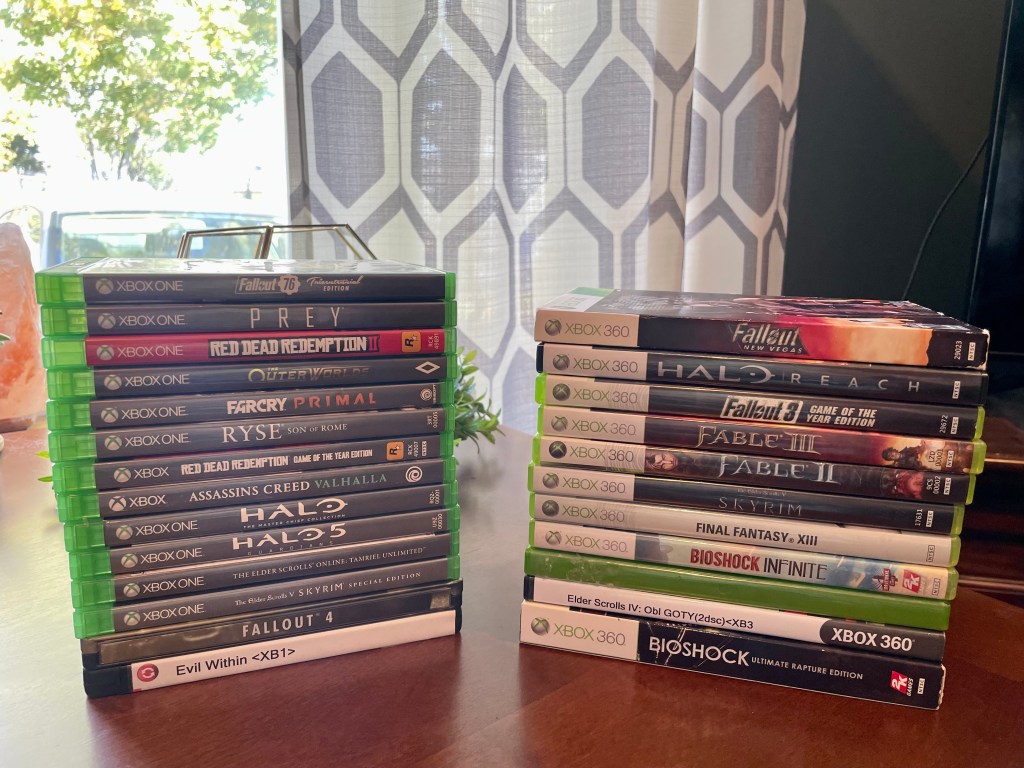
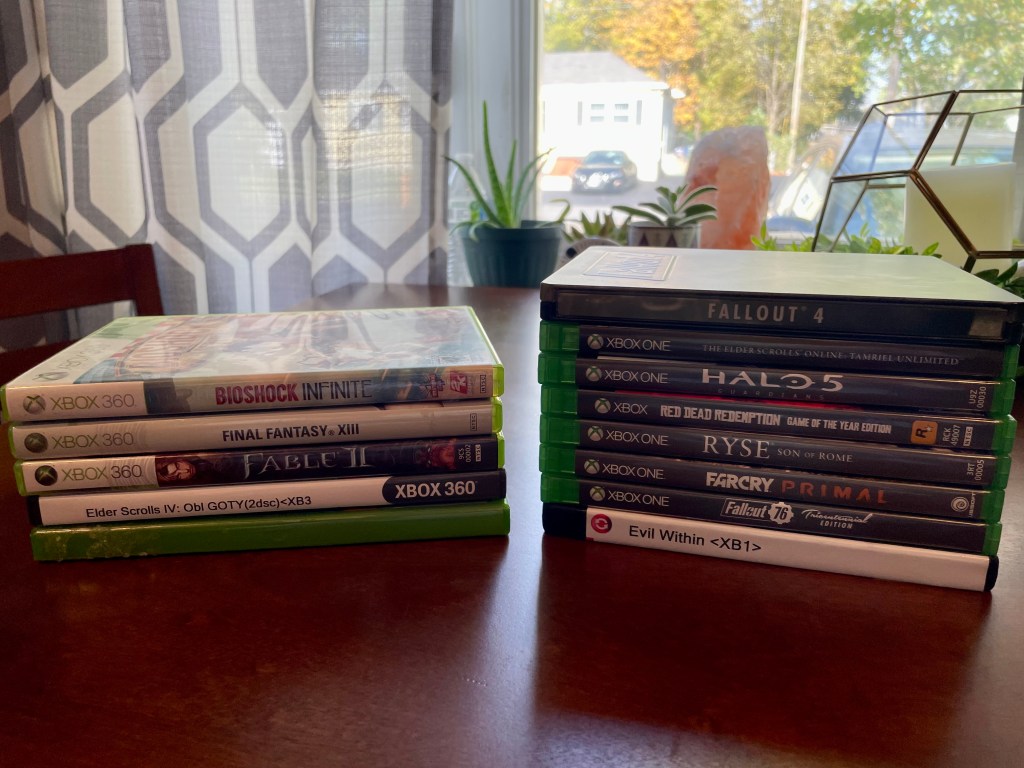
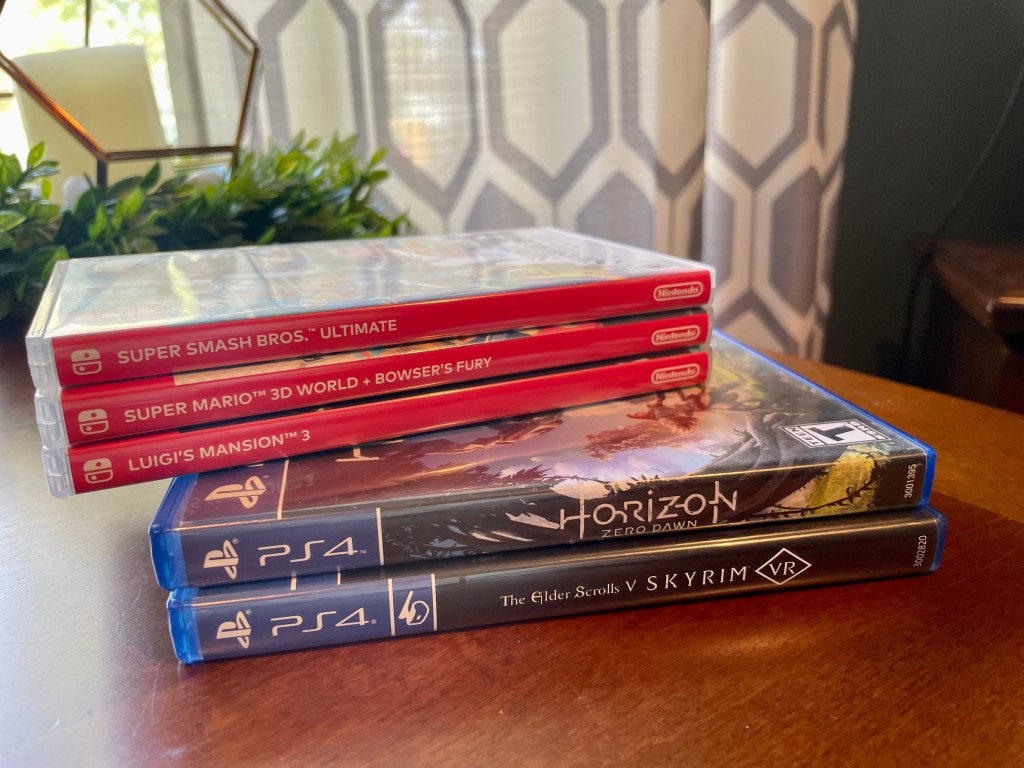
Marie Kondo’s “joy test” is one that seems extremely simple in theory. In practice, it is a bit more complicated. While the categories of clothing or books could have been sorted through, I felt this “joy test” should be done towards objects I feel more connected to, and so I chose my video games. I have several consoles and have purchased and been gifted many games over the years. I have played several of these games multiple times over and have spent countless late nights playing others with friends. I started with ten Xbox 360 games, thirteen Xbox One games, one Xbox Series X game, eight PlayStation 4 games, one PlayStation 5 game, and five Nintendo Switch games, for a grand total of thirty-eight video games across six consoles (not counting those that are still at my childhood home). If you can’t tell, I am more of an Xbox fan than a PlayStation fan!

Sorting through my video games was not as difficult as I expected but I was surprised by some of the choices I made. I expected that every game I own in the “Fallout” franchise would “spark joy” – even those I would rank lower on my list – but that was not the case. Both Fallout 4 and Fallout 76 were put into the “discard” pile. I was surprised by this because I love the “Fallout” franchise in its entirety – I have replayed Fallout 3 and Fallout: New Vegas numerous times and have played Fallout 4 twice. Fallout 76 had its drawbacks, but I enjoyed the time I spent playing with my friends discovering a new post-apocalyptic wasteland. Fallout 3 and Fallout: New Vegas, on the other hand, both caused immense joy. Not only was I flooded with memories of all the different times I have played the game, but I was also reminded of the passion I have for these games – how much knowledge I have of the characters, the setting, and the quests. Certain video games “sparked” conflicting emotions within me. If you know anything about The Last of Us and The Last of Us Part II, they are not feel-good games, especially the most recent installment. Yet, when I held the games in my hand, I found myself yearning to go back into the cordyceps-infected world that Joel, Ellie, and Abby lived in. I wanted to relive the experience that playing those games was – even if it meant going through the five stages of grief all over again – solely because of the deep emotional connection I formed with the characters. I felt the same way about Death Stranding – a game I consider to be a work of art. The Last of Us Part II and Death Stranding both had me sobbing uncontrollably at certain points, and yet I love the games so dearly for the journeys they took me on and the lessons they taught me. So, while these games did not “spark joy” per se, they did illicit a strong emotional reaction. There were, of course, games that received a dull reaction from me. One I was surprised by was Skyrim: VR. Skyrim is tied for my favorite video game of all-time and I was in awe at how well-done the virtual reality version of the game was. However, all I could think about was the awful headache I got every time I played the VR version, and into the “discard” pile that version of the game went.

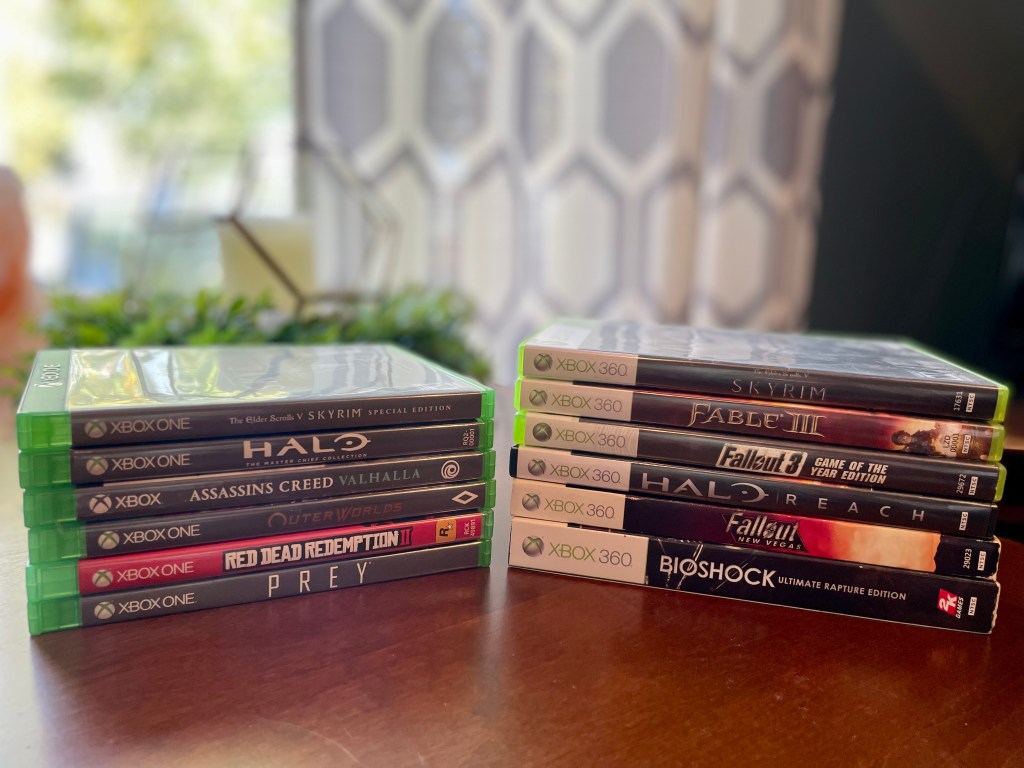
At the end of this “joy test,” I had “kept” six Xbox 360 games, five Xbox One games, one Xbox Series X game, six PlayStation 4 games, one PlayStation 5 game, and two Nintendo Switch games, for a grand total of nineteen games – exactly half of what I started with.

This exercise was very revealing and taught me a lot about my relationship to objects. For example, the two games from the “Fallout” franchise I chose to “keep” were the Xbox 360 games. Fallout 3 and Fallout: New Vegas were released in 2008 and 2010, respectively – they are both over a decade old and the graphics of Fallout 4 and Fallout 76 (made for Xbox One) far-surpass both games. Why did I choose to “keep” two games that are so old they can barely be played on my console without it crashing? Memory and emotion. Even games such as The Last of Us Part II and Death Stranding – whose poignant stories led to heartbreak and tears – I find great value in due to the way playing them made me feel.  This exercise taught me that I place the most importance on objects that I either have fond memories with/of, or that cause me to have a strong emotional reaction. Almost every game I chose to “keep” I could subcategorize into “games that I have fond memories of” and “games that made me deeply feel things, good or bad.” When I think of other objects I own, I see that same pattern repeating – even with my clothes! Overall, I found Marie Kondo’s “joy test” to be an enlightening and “joyful” experience and I believe many people can learn about themselves, and their relationship to their things, if they try the “joy test” themselves. 

A Memory Box

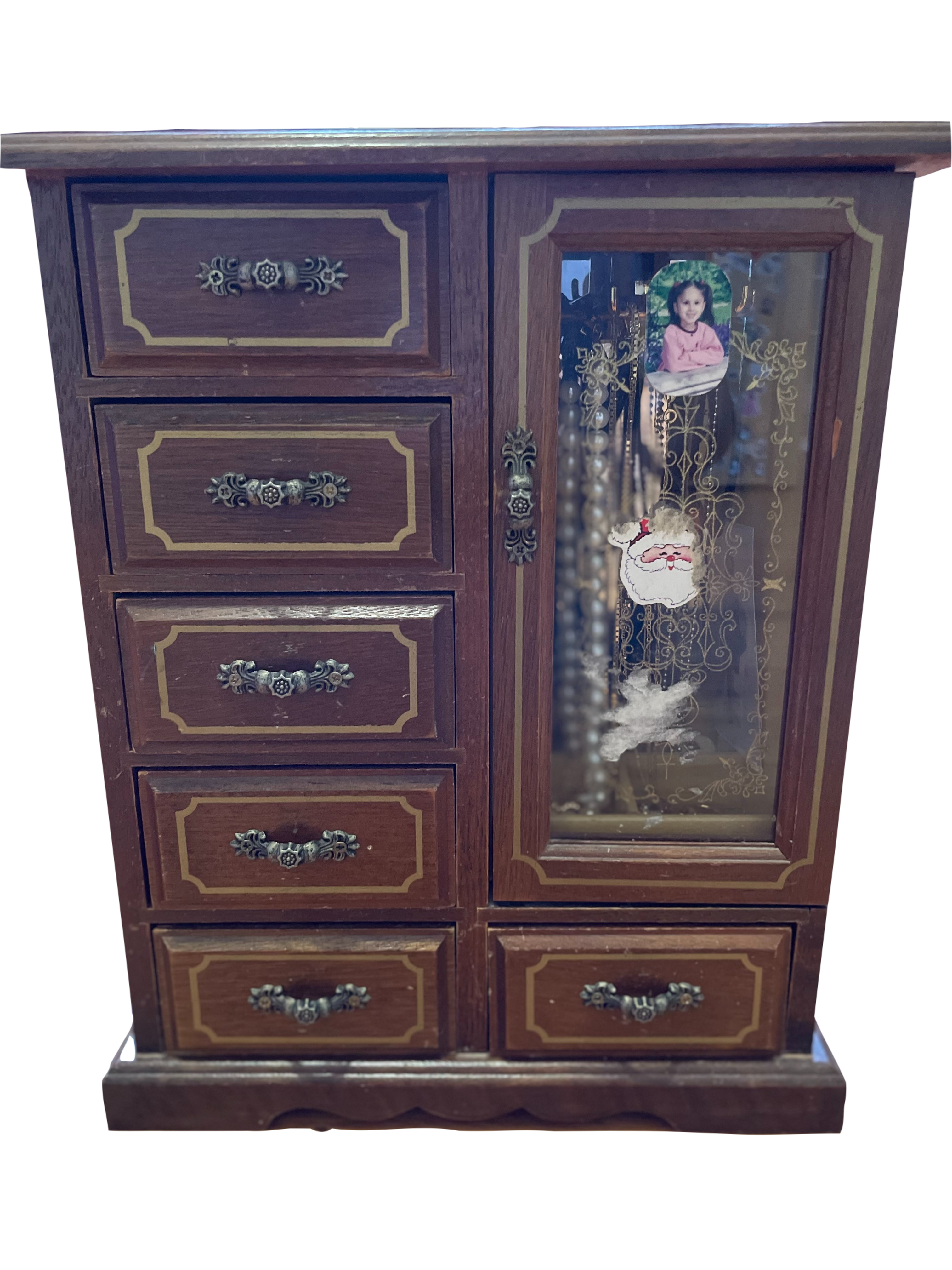
Front of jewelry/music box

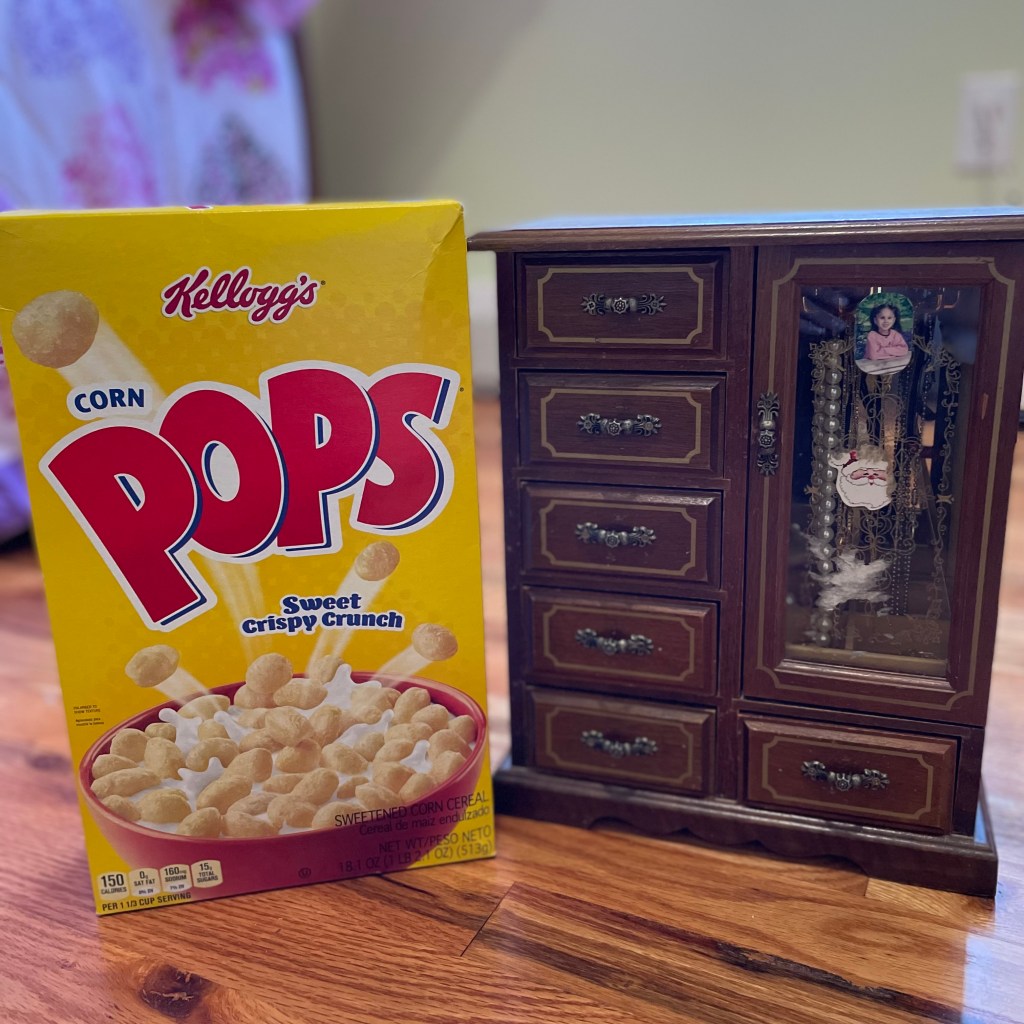
Before me I have a jewelry box, about 12.5” long and 10.3” inches wide. With measurements it can be hard to envision, but this is no average-sized jewelry box. Next to a box of cereal or a bottle of dish soap, the box looks abnormally large – even though the cereal box is slightly taller. This is a jewelry box with some heft! There is a thin layer of dust atop the box and on the edges of the bottom molding. The brown wooden jewelry box is worn, small scratches found on nearly every individual surface, even smaller chips on the corners. On the left-hand side of the jewelry box, there are five small drawers, each about 4” wide and 1.5” deep. The first drawer has a foam ring-holder that feels unpleasant when my fingernails make their way across the surface.

Dusty top of jewelry box

The drawers have decorative handles, which probably sparkled and shined when the jewelry box was new. Now the handles have lost their color – they may have been gold-plated or a sparkling silver at one point, but now they are a dull gray with specks of black. Each drawer has a small, rectangular outline painted on its front in a faded gold, about 3.3” in diameter. These rectangular accents have inverted corners, giving the design a more refined look. On some of the drawers the paint has not lifted at all; while on others, the paint has begun to wear away, chipped and stripped. On the right-hand side of the jewelry box there are two compartments, the first a door about 9” long. The door has the same rectangular accent around its edges, and within that accent there is a plastic window into the compartment. This plastic window has another muted gold design, which upon investigation is painted on the inside of the plastic. The design feels rough against my fingertips. This compartment is meant for necklaces and chains and has a small mirror at the very back of it. The box is too cluttered to see myself clearly.

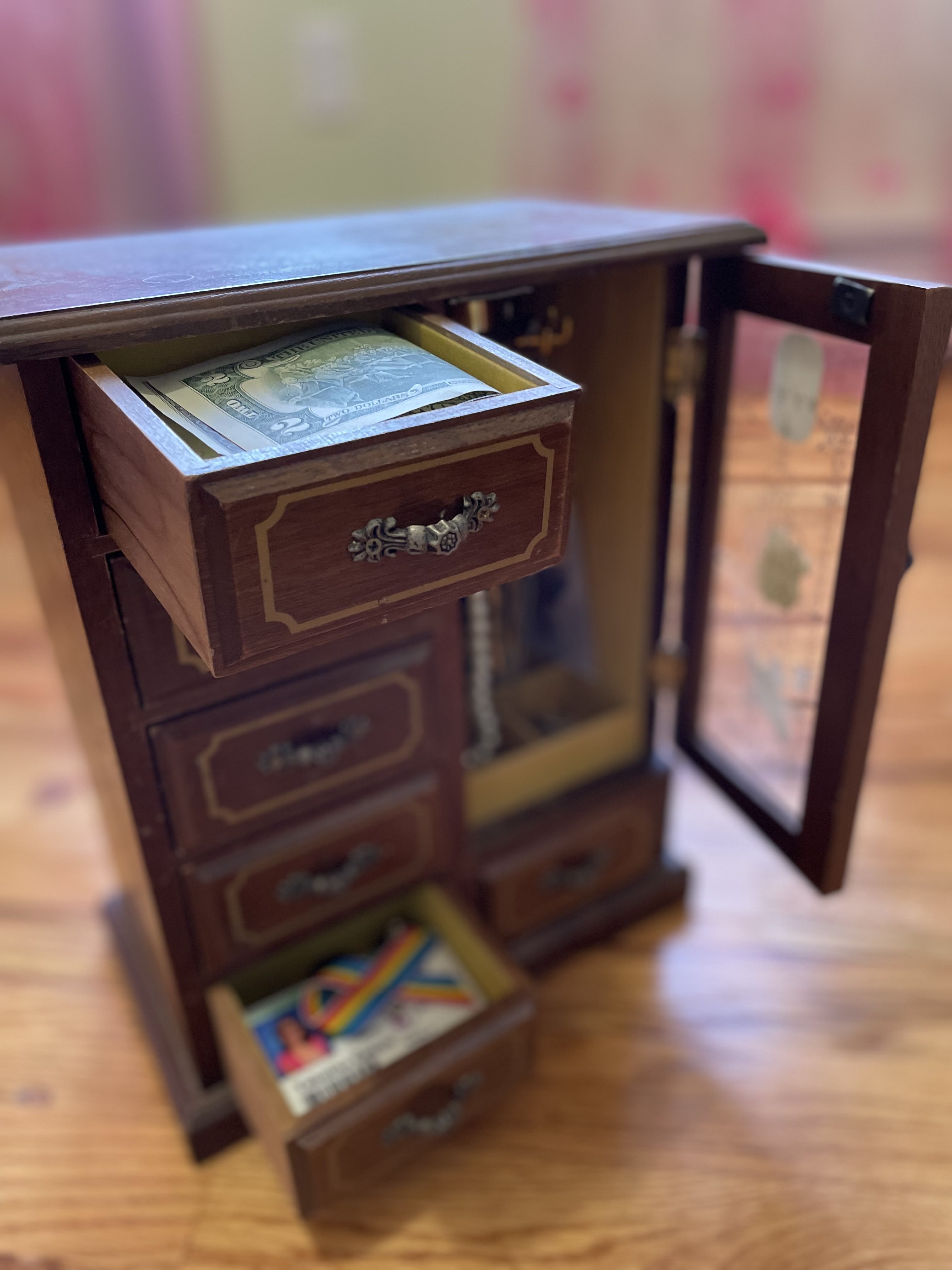
First and fifth drawers open, necklace compartment open – blurred so the focus can be on the first drawer.

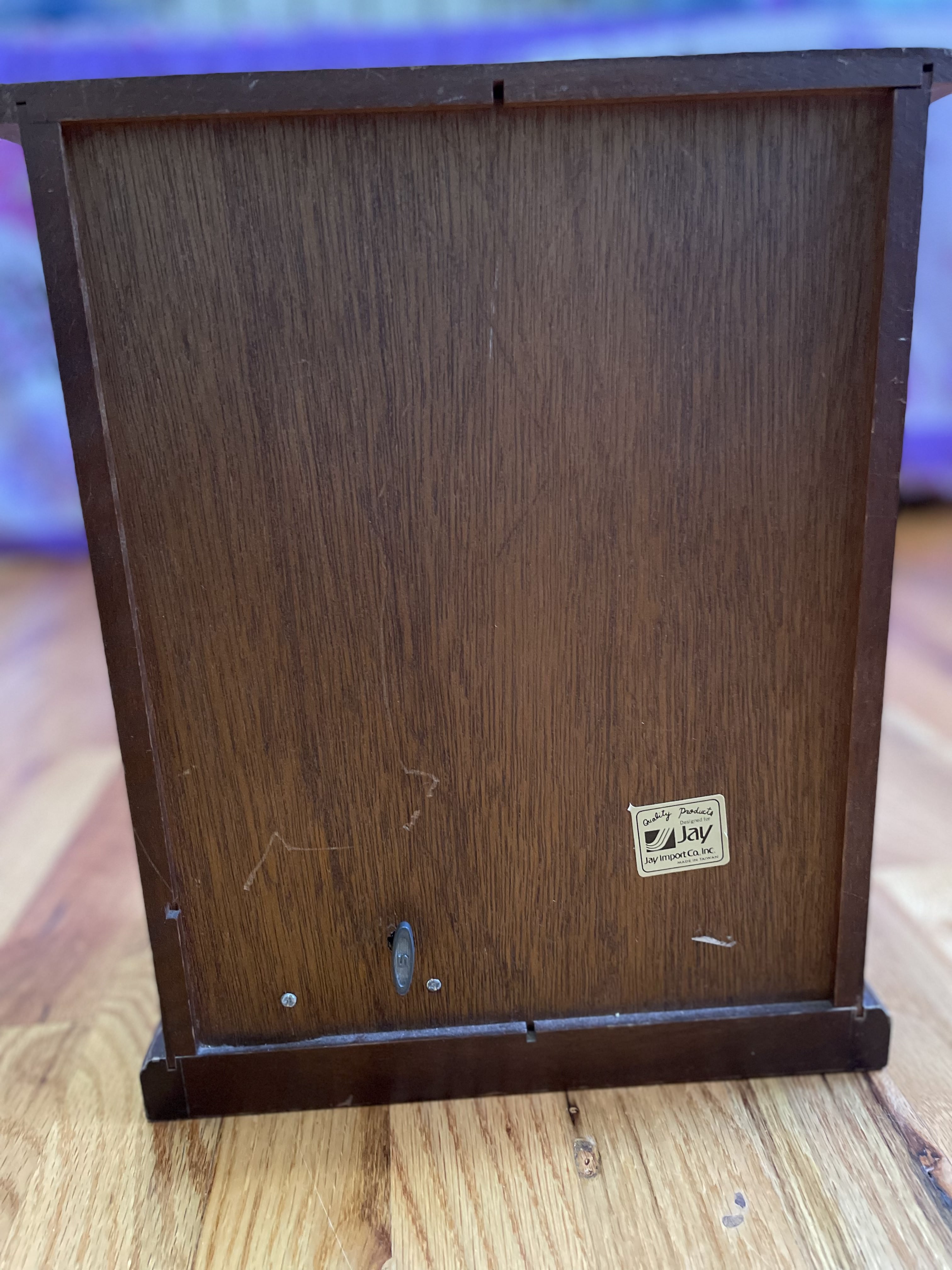
The second compartment on the right-hand side of the jewelry box is what makes this box more than just a jewelry box, and more like a memory box. Before I can tell you more about this sixth drawer, I must describe the back of the box. The back of the jewelry box has a small, shiny sticker that says, “Quality Products Designed for Jay, Jay Import Co. Inc. MADE IN TAIWAN.” On this same, plain surface, there is a small crank or “winder” that one might find on a music box. There are two visible screws underneath this crank. I turn it, wondering if it still works… to my surprise, it does (though it did give me some resistance at first)! That sixth drawer? When opened, it plays a beautiful lullaby – one that I rediscovered in August, played on an instrument called a Kalimba, and immediately recognized but could not place. This jewelry box doubles as a music box, one that I loved so dearly during my adolescence that you can see it was opened often – the drawer does not fit perfectly within its mold any longer, being slightly crooked when closed.

Close-up of sixth drawer

This jewelry box has not been used by me since I was in high school, at least 6 or more years ago, and has since been in my younger sister’s closet. However, this is a box with history, filled with memories of a different time in my life. Before me, my mother owned this box, a gift from her mother – my grandmother, Rocio. A tiny sticker of my preschool photograph adorns the window on the right-hand side of the box. Underneath that sticker is a sticker of Santa Claus I surely placed there – and later tried, but failed, to peel off. There seems to have been another sticker underneath that one which was successfully peeled off, at least to the point where you can no longer see the image. Opening each drawer one-by-one, I was taken back in time. I found a crisp, bright $2 bill in the first drawer – this is a lucky $2 bill I received from my stepfather’s coworker when I was barely a teenager, maybe 12. In the second drawer, I found a pair of earrings I wore to my junior prom. The third drawer held rubber bracelets from my Twilight days – “vampire girl” written across one. The next drawer held a silver jewelry box with my name written on it in my mother’s handwriting. Inside that box I found a small, gold pin that says “Mother” and underneath it has a heart with the initials “M.V.” engraved on it. I cannot easily recall knowing anybody with those initials.

Back of jewelry/music box; manufacturer label and music box crank visible

The fifth drawer on the left-hand side held two student IDs – one from eighth grade and another from tenth grade – a pride ribbon pin which I wore on my gown during my high school graduation, and several gold charms that can be put on a necklace. In the sixth drawer I found a dog tag which belonged to a close friend, given to me in middle school, and the tag for a mood bracelet. My necklace compartment holds a pearl necklace, a necklace made by an ex-boyfriend, and a carved-wooden turtle necklace I bought at Oktoberfest in Bear Mountain in 2013. Interestingly enough, I had been thinking fondly about that exact necklace last week, wondering where it had gone.

Tool of the Past

get-attachgment.aspx

get-attachment.aspx

CAPTION

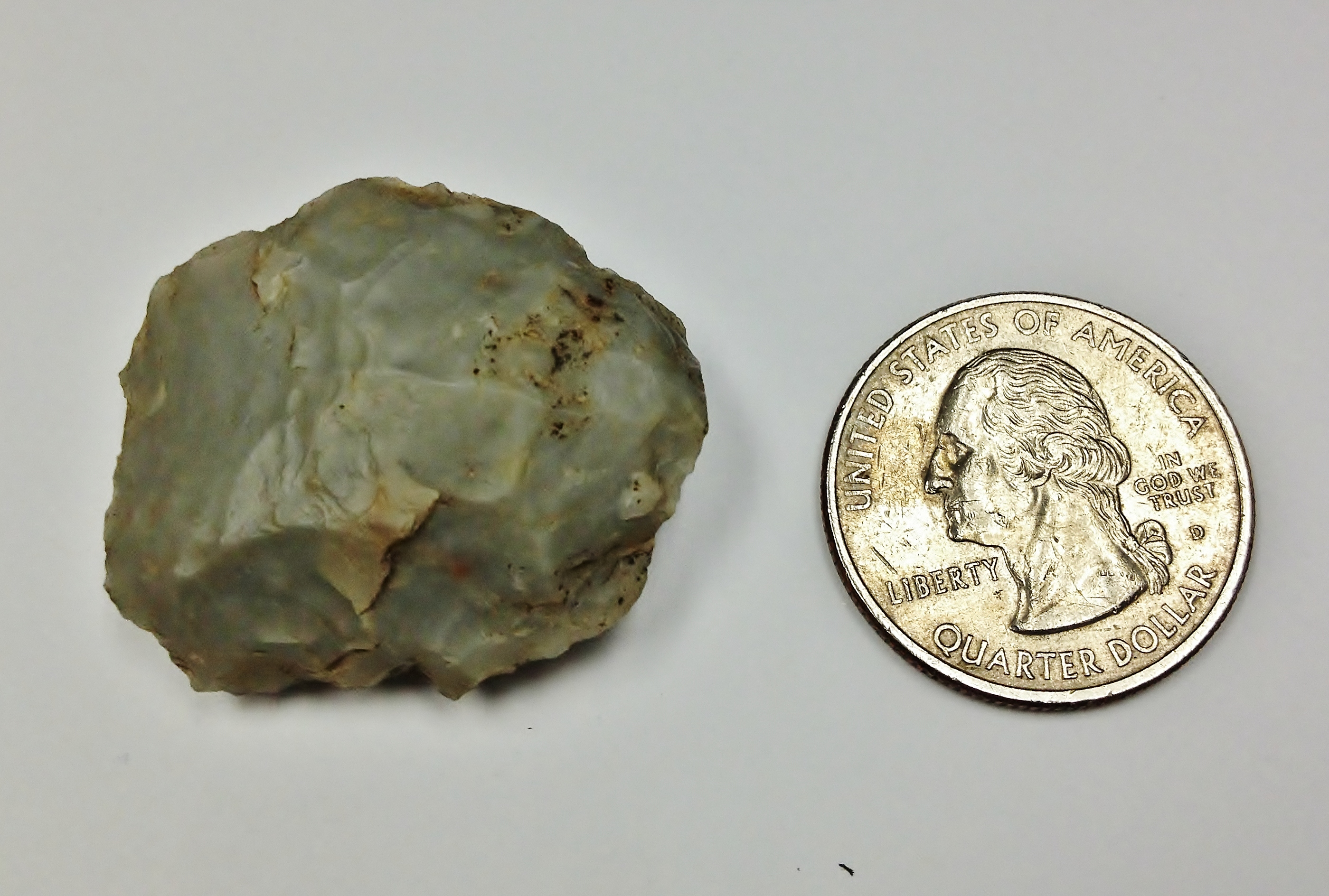
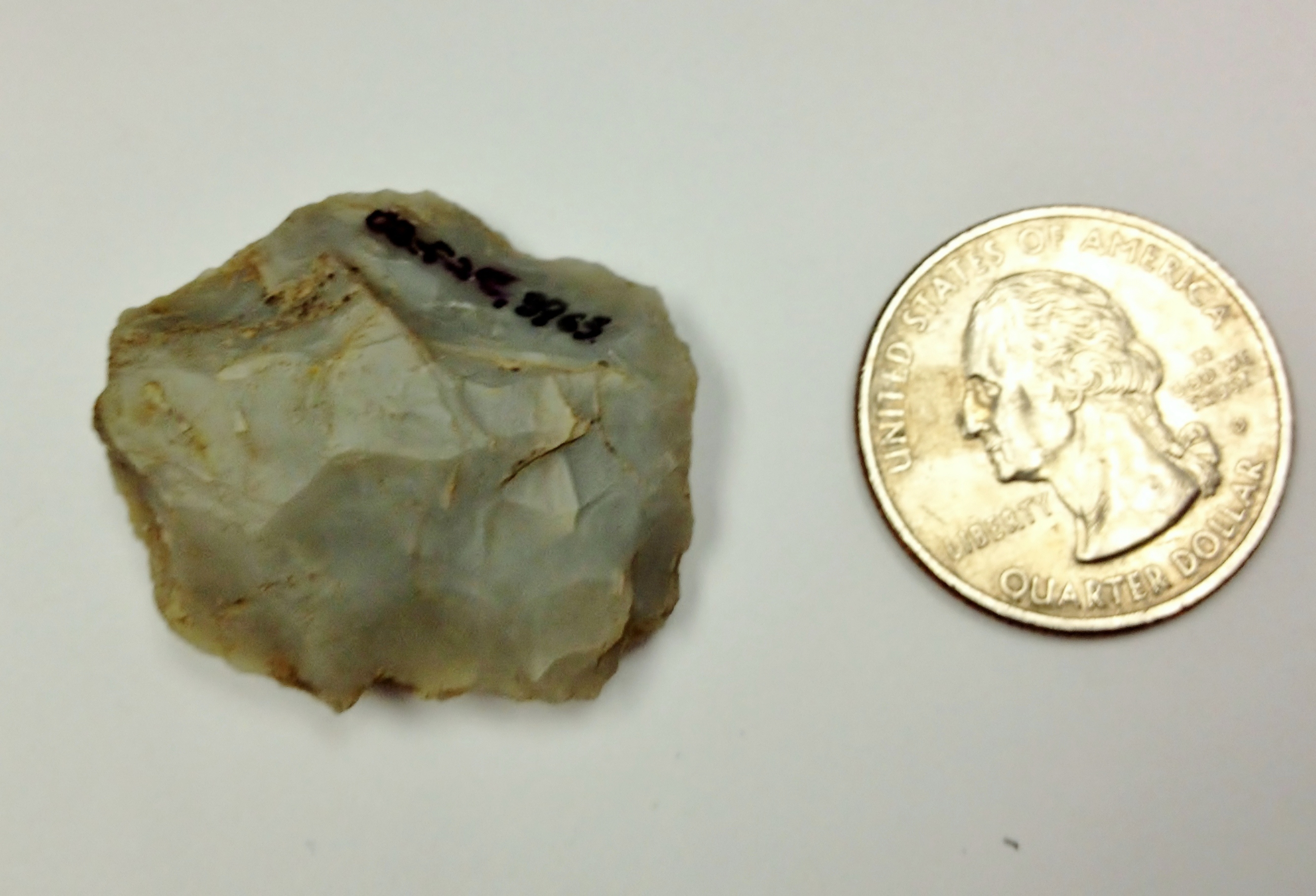
This Native American stone knife, among other stone tools, was essential to the survival and development of the Lenape civilization. It may seem insignificant, but these tools were used throughout Native American history, and it is even more effective in strength and sharpness than our steel knifes today. Because its exact date is unknown, this object speaks for centuries of history at New Paltz.

DESCRIPTION

This stone knife measures around 3.5cm by 2.6cm by .8cm. It is known as a cryptocrystalline lithic, and is made out of chert—either Eppler or Harmonyvale. It was sharpened by chipping flint, and the small sharp pieces could very well have had their own uses. It is a milky white/grey color, has percussion marks, and appears to be flat. It is temporarily non-diagnostic, which means it could have originated anywhere in the time span from 7000 BC-1678.

PROVENANCE

This artifact was found by archeologists in New Paltz on July 27th 2002, in unit 60 at the grid coordinate South 59, East 10. This is the location in historic Huguenot around the corner between the Jean Hasbrouck house and the Deyo house. It was then taken to be cleaned in a lab on August 15th of the same year. The archeologists who procured the small knife go under the initials: JG, LE, LN, and NH. It finally ended up in Dr. Joseph Diamond’s collection where it remains among several other historical and Native American objects found in New Paltz.

gtg

NARRATIVE

Native Americans from anywhere between 7000 BC and 1678 could have used these helpful objects. It is possible it was much bigger than this and chipped with age, or that it was made to be small, which can be useful as well. Perhaps it was from the earlier time periods, before the Dutch settlers came to the Huguenots to colonize. The Native Americans, known then as Munsee’s, had many stone tools like this. This particular tool is a knife, used to cut meat, vegetables, string, or create sharp flints. It is surprising how efficient these tools are, suggesting an understanding and intelligence in the Indians beyond settlers’ conception of them as barbaric. This knife, when chipped properly, is even sharper and stronger than our steel ones today. It was still widely used even after various trades were made between the Europeans and the Native Americans. In place of land, they received various metals, tools, industrial products, and alcohol. Some of these new objects were exponential to their survival, but were also the catalyst to their demise. This particular knife is significant to New Paltz history broadly, as it encompassed the lives of the ones who lived here initially. This item is indicative of how they used nature and what was around them to create sustaining lives and culture.

Because the exact date of this knife is unknown, it encompasses the entire Indian history on the land of what is now Huguenot Street, where it was found. The history of this time span is large and extensive, and takes us back from the beginning of the Indian culture in Munsee country to their demise from European settlement, war, and disease. The knife could have originated around 7,000 BCE, almost 10,000 years ago. This is very early in Native American history, when people belonging to “archaic cultural traditions” began hunting small game like deer and gathering plants more intensively in the Northeast. Between 4000 and 1000 years ago, Native American civilizations began to emerge, and their technological innovations developed, such as pottery, bows and arrows, longhouses, and vegetable cultivations.

It is likely possible this efficient tool originated around this time, or anytime hereafter, as its uses was not diminished by Native American advances or European settlers. It is necessary to unveil this timeline of Native American history in order to cover the potential histories this ambiguous object holds. Around 500 years ago Europeans began sailing to northeastern North American shores, and by 1607 it is discovered that the total Indian population in Munsee country may have been as large as 15,000 people. Around two years later Dutch merchants commissioned an Englishman named Henry Hudson to sail east to find a northern passage to the Orient. He sailed across the Atlantic to find a northwest passage instead and became the first European known to sail up the river that today bears his name. It is around this time fighting between the Indians and Europeans began, and shortly after various foreign diseases plagued the Indians, and by 1618, the 30-Years War broke out in Europe. The expansion of Europe, diseases spreading, trading, and fighting continued over the following 20 years, such as the first Mohawk-Mahican War, which ended in 1628. By 1634, the Indian population in Munsee country declined to somewhere around 6000 people, and by 1645 it dropped to 4000. In 1652, Esopus sachem Harmen Hekan, better known among settlers as Ankerop, started appearing in Dutch records, and by 1659, fighting broke out between Indians and settlers at Esopus. The Indian people living in Munsee country are reduced to less than 3000 as the colonial population in New Netherland reaches 9000 by 1664, and the Dutch signed a treaty ending the war with the Esopus, and New Netherland falls to an English fleet and is renamed New York.

Perhaps this object contains in it the more peaceful beginnings of this account of Indian history at New Paltz, being used and reused by a tribesman or woman to cut various meats, vegetables, and fashion tools and other creations. Maybe it was tossed in favor of a bigger stone that would serve more cutting purposes, or it was lost on a hunt, slipping from the strong mans hands with no time to look back. Maybe it was thrown in a desperate attempt to flee or fight as the European settlers destroyed Native American villages. It is mutually possible that it was one of the most important objects to a person’s life, as an essential key to survival, or the last thing on that person’s mind as his or her very way of existence is being changed and shaped. This small, seemingly insignificant stone knife holds in its mystery the entire Native American history here at New Paltz and our very origins.

lenape

RESOURCES

Grumet, Robert. The Munsee Indians: A History. Norman: University of Oklahoma Press, 2009. Print.

Kraft, Herbert. The Lenape-Delaware Indian Heritage: 10,000 BC to AD 2,000. Lenape Books, 2001. Print.

Diamond, Dr. Joseph. Personal Interview. 20 Mar 2013.

A Key

Image

I’ve always loved keys. As a child, I had been given various diaries with lock and key- but I never felt the need to write in any of the journals. I only wanted to lock the journal, keep the key safely in my pocket, and unlock it at my heart’s content.

Over the years I have given up on diaries, but my affinity for keys still remains. I have had several key necklaces and charms through out my adolescence, one being a small key necklace with a purple stone. One day, while working at the Staples in my hometown, I was ringing up a man who complemented my necklace and asked what it meant to me. I explained that it had no significance, that I just liked keys. He replied, “one day you’ll find out what it means to you” and as he handed me the tender, I noticed a key tattoo on his hand.

Of course, I pondered the significance of the key for many months. After a number of events in my life, I believe I have found it’s meaning to me, or at least in this stage of my life. I consider the key to be a constant reminder that I alone hold the key to my own happiness, success, and life in general. If there ever is a time when I am unhappy, it will remind me that I alone can change that. If there ever is a time when I feel as though my life is not on track, the key will remind me that I alone can get it on track again.

Today, I wear this key. Unlike all the others, it was not given to me as a gift. It was a key that I chose. I was wandering through the shops of New Paltz during my first semester when I came across a rack of all different types of keys, about two inches tall, with several different words engraved in each. This particular one has the word “wish” engraved in it. However, I must admit that this key was not chosen for the expression it displays. It was chosen because of its style- the twists, turns and elegant curls. It was chosen for its antiquated finish and profound essence. I have worn it every day since then.

I intend to have a key quite similar to this tattooed on my foot with the words “I hold the key” in fancy cursive. The placement of this tattoo has been a constant battle, because it must be perfect. I decided on the foot because it will be a place that will not be mistaken for a particular key of chastity, and because it will be in a place that is both subtle, yet perfectly capable of being seen when I need to see it. When I finally have the money to get it, I will think back to the man who found enough significance in a key to get it tattooed on his hand.

This necklace has received many compliments in the two years that I have worn it, and everyone always asks what the key opens. Although I never give such an abstract answer, I like to think that this key unlocks my deepest ambitions, without my ever knowing it.