
While searching for an object to date and chronicle the history of, I found this crumpled up play program of Lear’s Daughters. The front of the program lists the play’s title, director, dates, and a picture drawn by a New Paltz art student to fit the play. Many people who saw this program thought that the girl in the center of this picture was supposed to represent me. I did not know nor never met Jes Mackenzie, and I’m guessing she had never seen me either. The resemblance is just one funny coincidence that falls along the timeline of the assemblage of this object. There are a few other peculiarities that can be found through further describing the object.
It is fascinating that in describing this found object, I am also able to learn about its history: its production, as well as the names of the people who helped produce it. The same cannot be said for many objects in this world, and I find this object not only fiercely existing as a memory in my life, but also a detailed chronicle of the amount of minds and efforts it took to bring the play, and even this program, into inception. Upon opening the program, one can see not only the cast and production crew, but also a list of six dramaturges that each contributed to this very detailed program. Lear’s Daughters was a collaborative production between New Paltz’s theatre and English departments. Needless to say, then, in-depth analyzation of the play was applied throughout its production, and is even inserted within the program itself. Upon opening the program all the way, one beholds seven mini-essays with a meticulous analysis of each character. These essays were provided by the hard work of the dramaturgy. Back to the front of the program, one can see the dates of the play on the 9th and 10th of April 2010. If anyone else had found this program, however, they would not have known it was printed two years ago; there is no year listed in the play’s production dates at the front of the program. I am so confident in my dating of this object because I was part of its production. I played the role of Cordelia in the play.

I find it very interesting how the year-to-date of the program was irrelevant in this pamphlet’s production, as if the year would not matter to audiences. Admittedly, it is a little redundant during a then-current event. Yet I find it interesting how so much hard work went into this object, and yet no one thought to date it. It is as if it was constructed and thought to function only on the dates of the play, frozen in that moment and then soon tossed away at the end of the entertainment. Even more stunningly, on the back of the program is a list of King Lear stories throughout time, with exact dates, and yet the Lear’s Daughters production dates at the front of the program are left incomplete.
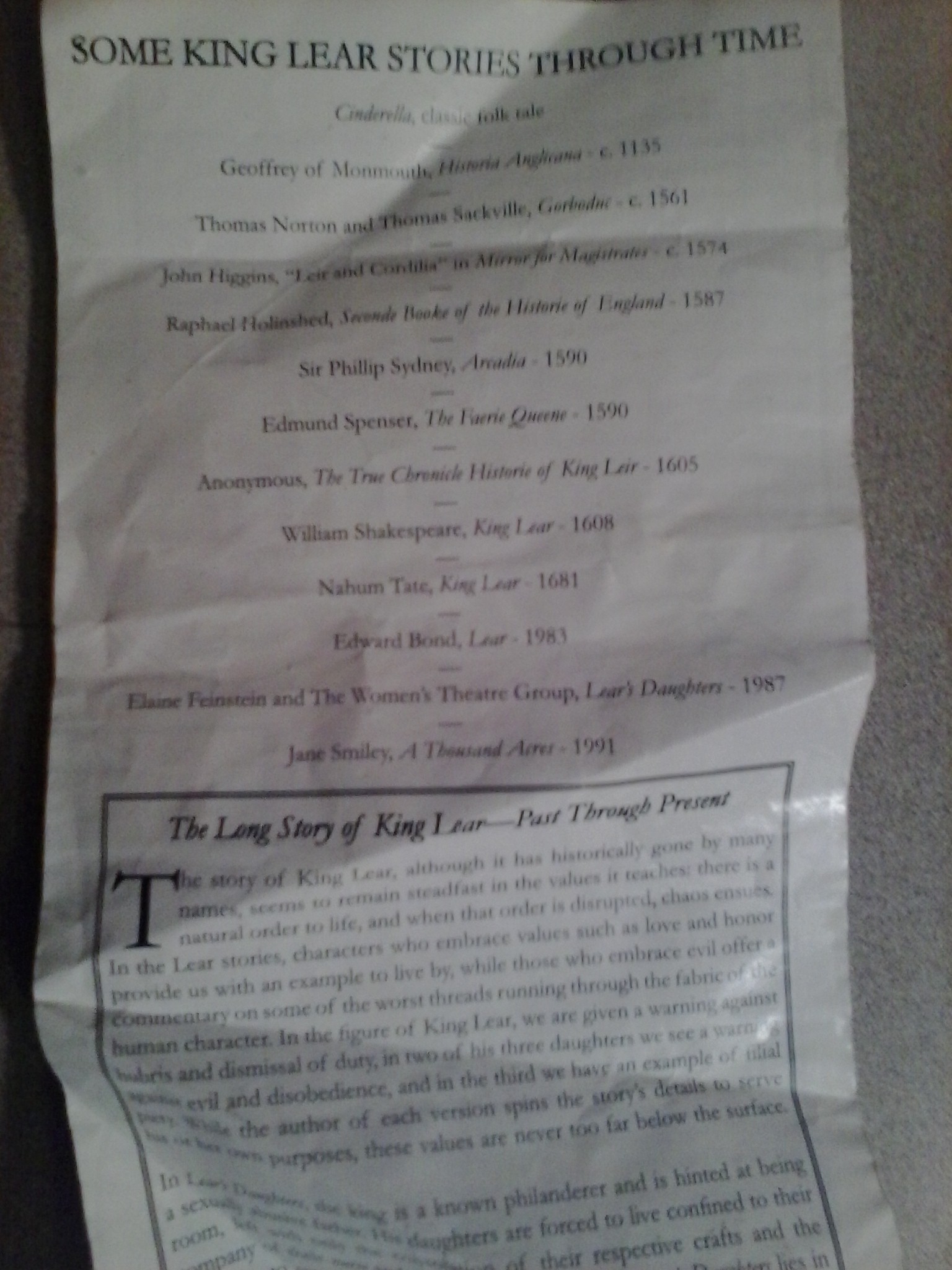
I remember taking very many of these programs, so that I may remember being in my first play. Since then, ironically, I have completely forgotten about the folios and have no idea where they lie, except for this one crumpled escapee. I found it on the bottom of one of my suitcases. I guess at one point I felt it was essential to bring to a destination to which I also no longer remember traveling.
 The Materials of History, Thought, and Art
I definitely understand collecting play programs; I performed a few times in middle school and kept each one. I also have some of the scripts lying around, but I am absolutely distraught about my missing No Fear Shakespeare version of A Midsummer Night’s Dream, which I remember using for an 8th grade performance. Perhaps I liked that show the most, not because I was Francis Flute, but because it was Shakespeare, and a fantastic synthesis of theater and literature, just like your play program.
I’ve never heard of Lear’s Daughters; a quick search online reveals a very interesting modernization about the three women and their tragedies. I would love to hear, from the perspective of a performer and an English major, what the play is about, especially since you describe an immersion that occurred during the play prep and looking back at the object.