Every Object Tells a Story

From the introduction, this actually seems like a very interesting book. The basic premise is that discovering History requires both historical texts as well as historical objects.

Objects are particularly important to history because they can tell us so much. They can tell us who used them, what they were used for, where they were made, when they were made, and so on. By knowing these bits of information, we can extrapolate further to discover a very large quantity of information about a culture or group of people. Although written texts can do some of this, they cannot help us with the deeper histories of civilizations. Written documentation is relatively recent, and so objects enable us to learn about those civilizations that did not have a written language. So long as we have an imagination, we can always continue to learn more about history through objects.

In the past few weeks, this course has really taught me to appreciate objects, and I certainly look at them in a very different light. After reading this Introduction from a historian’s point of view, I can really understand just how much you can learn from an object. The examples given in the text really illuminate the abundance of information hidden within a singular object. Each individual object is not only a piece of history, but also a clue towards understanding so much more.

Reading this made me very eager to start the project of the history of New Paltz. If every object has a story to tell, then we can discover so much about our community as well as the history it has to share with us. As a class, we can all learn the value of an object; discover the individual stories each object has to tell us, and work together to create a detailed history of our lovely community of New Paltz.

Jessi Putnam- New Paltz History

I was immediately shocked at how brief of the Wikipedia page is devoted to our fair New Paltz! And more disheartening still is that a good quarter of the page lists our various modes of transportation! New Paltz is home to one the oldest street in America, surely we have a little more history then that to tell.

There is a good amount of information given about the founding of New Paltz and historic Huguenot, but the story seems to fast forward quite suddenly after that. It jumps to modern demographics, politics, media appearances, etc. Although these are useful facts, I feel that the spirit and culture of New Paltz is terribly cut short. There is a short section on some of the cultural events that we host here in town, but there seems to be so much missing! How can this page not include everything that happened her in the 60’s for example, I mean we were almost the eternal home of Woodstock for heavens sake (although I’m sure it wouldn’t have been called Woodstock if it had taken place here). But that just goes to show and impact a seemingly small town like New Paltz can have on history. There needs to be more mention of the rich culture we have here. Some of New Paltz’s historical goings on may not have been the most upstanding or PC events but that is what makes New Paltz  unique. And it informs who we are a students here,

I did learn a few new things from the wikipedia page. Did you know New Paltz has a sister city,cause I didn’t; Its Niimi, Okayama, Japan. I also thought the section about New Paltz’s first Newspaper was interesting. But other then that, a lot of this was old news. 

As far as the Wikipedia page about the college, this was a little more juicy with history! I loves reading about all of the demonstrations and protests that took place on campus. There seems to have been some sort of political, student run action happening on this campus during every decade! New Paltz clearly was and still is full to the brim with free and independent thinkers who are not afraid to speak their minds. I also liked reading about all of the prominent people that have taught here or attended the school (minus Vinny from Jersey Shore of course). The page gets a little dull after that however, providing statistics and information on a few key buildings on campus. The Tripping fields don’t even get a mention!

P.S. I am ashamed of this…but I have never read our Alma Mater before this moment

Two-Dollar Bill

Image

Image

Much like Ricky, I had a really difficult time picking an object for this week’s assignment. The past week I have been assembling things that I could maybe write about, but none of them seemed to have a history worth delving into. It was not until I read Ricky’s post that I realized to look to my wallet. But not the one I’ve been using, (a see-through plastic coin purse circa 1990s… although that might be interesting to look into one day), but the wristlet I used to use all the time which has become more of a paper-collecting receptacle at this point. In there I found a two-dollar bill that has been there for roughly three years now. 

I received the bill when I sold my old books to a textbook buyer at the end of my freshman year. I made exactly $102 from that transaction (as you can imagine, there were about 12 books sold.) And although, as a college student, the 100 dollar bill was fun to look at, I knew (read: hoped) there would be more of those in my future. I did not know how lucky I would be to find a two-dollar bill again. There would be times where I would have absolutely no money left in the wallet besides the two-dollar bill, yet I could never bring myself to spend it. I felt like it was too rare of a find to just go and spend. What could be worth the exchange of this oddity? A pack of gum? Half of a latte? 

It is this sentiment that makes the two-dollar bill seem so valuable. In fact, it is not worth more than, you guessed it, two dollars. According to an article in Eagle News, one percent of bills produced annually are two-dollar bills. Furthermore, they make up $1.2 billion of printed currency in the US. There is even a website, usethetwo.com, devoted to cracking the myth of the two-dollar bill. Their mission is to get these bills back into circulation and stimulate our economy. 

Exploring the website further I was able to track my particular bill. Mine is from the most recent printing, the 2003A series, which occurred between July and September 2006. There were 230,420,000 bills printed in this series. According to usapapermoney.info, this bill was printed in Fort Worth, Texas in September of 2006 (as evident by the serial number beginning with a “D”.)

However, the two-dollar bill first came to be in 1976 to honor the 200th anniversary of the Declaration of Independence. The front of the bill has a portrait of Thomas Jefferson, author of the Declaration of Independence. The back of the bill features an illustration of the painting, Declaration of Independence, originally by John Trumbull.

Nowadays, you can even track your two-dollar bill. The website, wheresgeorge.com, which is most notably used to track one-dollar bills also features options for bills with denominations up to 100. Here is the list of the top 20 two-dollar bills reported.

After learning all of this and debunking the myth of the “valuable” two-dollar bill, I am still not sure I can part with mine. It has become a sort of keepsake for me. It has been a great conversation piece and something I find myself studying whenever I come across it. I always joke that I will spend it when it is literally the last bill I have left in my name. But who knows, it might just get me out of a tight spot one day.

An American Fortune

Fortune1

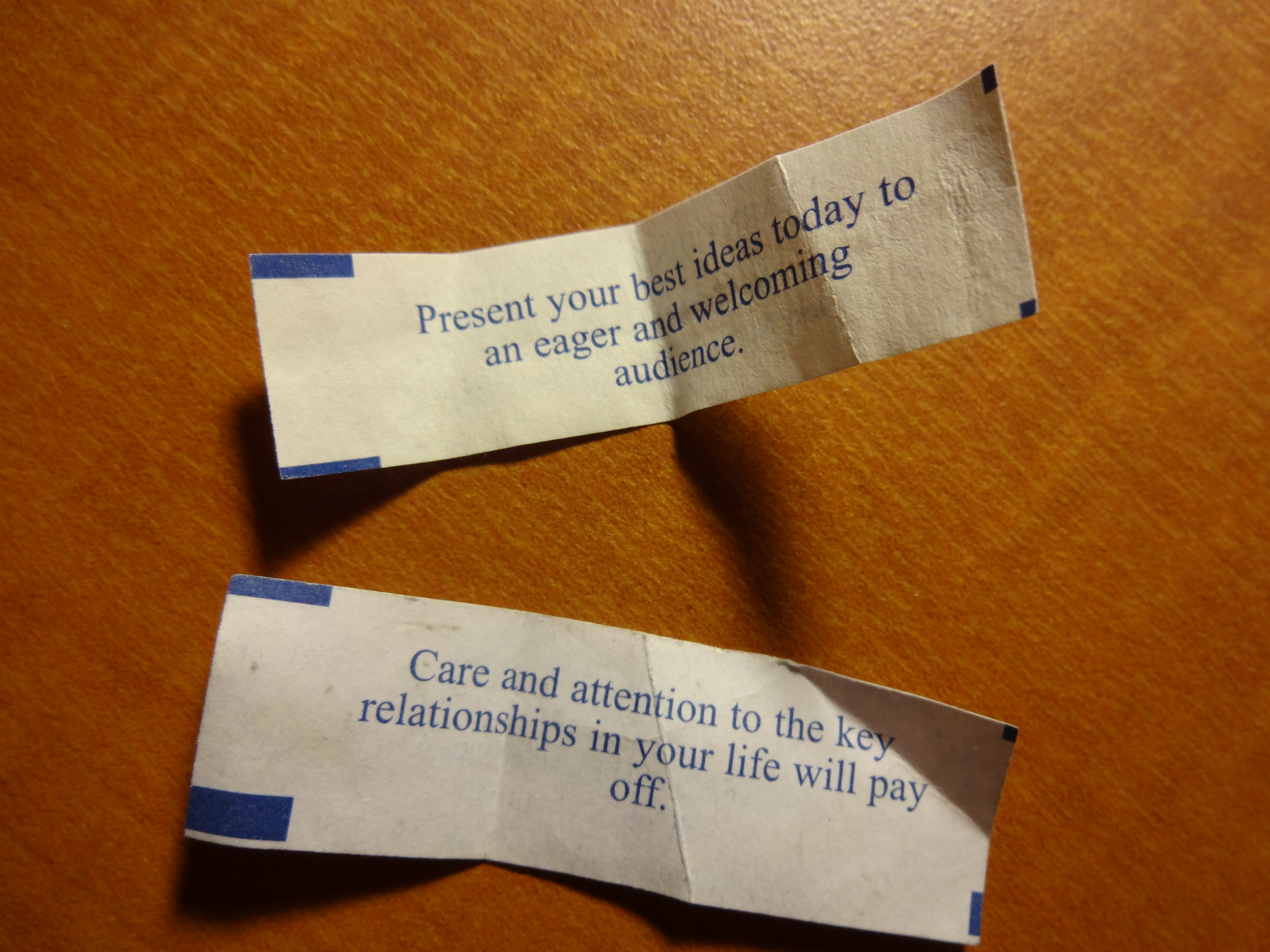
Picking an object wasn’t easy this week. The Hare with Amber Eyes had made me realize that I really don’t collect anything. That was until my friend was going through my wallet last night and found about 12 fortunes from fortune cookies. Some from this past weekend, others from years ago. Let’s just say, I have a fortune problem.

“Fortunes” are pieces of paper with words of inspiration, wisdom and vague prophesies or phrases. About an inch and a fourth long, the fortune also holds a chinese word or phrase on the back with lucky numbers attached to them. Mine currently says family and my lucky numbers are four, 25, 27, 52, 11 and 24.

According to Wikipedia (not exactly the best source for information) fortune cookies were “introduced by the Japanese, popularized by the Chinese but ultimately consumed by Americans.” According to ABC News, fortune cookies originated in Japan, and then were brought over to California. It wasn’t until the Japanese-American internment period that the Chinese took over the booming fortune cookie market and began spreading their fortune cookie wealth. The Japanese never achieved their fortune cookie status again.

The white piece of paper with red or blue writing was an essential part of Japanese culture. The fortune cookie in Japan, both larger and darker than the modern object, contained fortunes from Japanese temples. These cookies were seen as a dessert delicacy and were sold in some regions of Japan. Wikipedia reports that the most notable neighborhood was Fushimi Inari-taisha.

Erik Sumiharu Hagiwara-Nagata is the relative of the original Japanese-American introducer of the fortune cookie, Makoto Hagiwara. They reveal that the Japanese fortune cookie was also eaten at New Year’s festivities at Shinto shrines. They were called “folkcraft” or the Japanese name, tsuji ura sembei. These treats also weren’t owned or manufactured by one individual. They were a Japanese tradition, much like how apple pie or pizza have been called an “American” tradition today, according to ABC News and Hagiwara-Nagata.

DSC00154

However, today the object is much different compared to its original form in Japan. They still do have the same function as a treat, but they’re smaller, shaped differently and contain fortunes written by retired history professors and freelance writers in Brooklyn, N.Y. (Wonton Foods) The largest fortune cookie manufactures today, Wonton Foods, contains a databank of 10,000 fortunes which are rotated frequently. This is much different compared to the original fortunes, created in temples.

The only form of ownership was in America where Makoto Hagiwara served the first American fortune cookie at his restaurant, Japanese Tea Garden in San Francisco during the early 1900s. Since then the fortune cookie trend expanded throughout the United States by the Chinese due to the Japanese American internment period.

Although the original fortune cookie is from Japan, both Japanese and Chinese citizens say that the fortune cookie is an American food and is only expected to be served in American Chinese restaurants. Today, the fortune cookies are sold in China and Japan as American imported treats. So, remember: Next time you receive a fortune cookie at a restaurant, the words are actually written by a writer and not some wise man or woman in a temple.

The Thinking Chair Replica

photo

When I was little, apparently I really liked Blue’s Clues.  I have a replica of the thinking chair sitting in my basement to prove it.  It is approximately 4×4 feet and the back of the chair and the arms are leaning outward, stretched and slumped from years of use.  The chair has a soft velvet feel to it, with light curlicues against its rich burgundy.  It is outlined all around the edges with black that swirls and gets thicker at the front of the arms.  The sides are mummified with tape—an attempt to cover the rips in the material, revealing its rough inside skeleton, an unpolished wooden frame held together by many nails with their sharp ends exposed.  Who would think that such a lovely children’s prop with soft arms meant for a little prince would be a torture chamber on the inside? Those bits are covered though with duct tape and an affectionate resistance against getting rid of it.

My mom bought the thing from Sears, probably making a scene carrying that ostentatious chair through the lines of people and to the parking lot.  It is very small in comparison with other furniture, but I don’t know any mom other than my own who would bring it home.

stevechair-758231

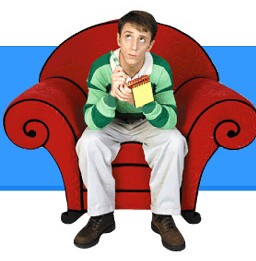
In Blue’s Clues, this red chair was designated to doing some serious contemplation on piecing together clues to solve the weekly mystery with Blue.  The main character Steve would sit on it, cross his legs, and bring his hand up to his chin: Rodin’s the Thinker with funny hair and a green striped long sleeve shirt.

Its counterpart was brought to my house, perhaps not to think, but to play.  As I got older my family and I used it as a normal chair, and friends would sit on it when the couches were filled up.  Bright and red and clashing with the other colors in the family room as it was, it became rather inconspicuous, an accepted part of our space.  My two cats eventually claimed it as theirs and it is now decked with little blankets and toys.

As we redecorated the house, we were going to get rid of it, but between our own sentimental value attached to it, and how fond of it my cats are, it is now the designated cat bed in my basement.

This chair has had so many different purposes in its lifetime, from being a space to think, to a space to play, to a space to sleep.  Depending on the owner of the thinking chair, it was used in different ways.  Much like the Netsuke in the Hare with Amber eyes was used differently depending on their owner.

As objects go through all of their different lives with different owners, they serve different purposes.  Depending on the use, the role the owner gives it, the object becomes something new, embedded in it all of its past lives.

Harry Potter and the Cultural Phenomenon

Front cover of Harry Potter and the Sorcerer's Stone, projected for re-publication Summer 2013.

Front cover of Harry Potter and the Sorcerer’s Stone, projected for re-publication Summer 2013.

Out of interest to extract as much content from one object as possible, I shall continue my observations of Harry Potter. In related news, following up from last week’s discussion of book covers, Scholastic just unveiled a new cover series in time for the 15th anniversary for the US publication of Sorcerer’s Stone. A few posters noted the darker tone induced by the cover, along with the complete scene shift, from the outside of Hogwarts to Diagon Alley. The detail of people and location heightens the wonder shared by both the reader and the protagonist, yet the image is also self-aware of the novel’s wonder, drawing that scene out from so many others. The article notes that the 1998 release, rather than 1997 in England, “really took the Potter craze to the next level.” In context of this week’s blog agenda—to reveal a historical route or trace of the object and its functionality—the separate publications and the fame of the book, despite its juvenile literary status, marks a shift in cultural use of Harry Potter and the Sorcerer’s Stone, and for juvenile literature as a whole. 

J.K. Rowling’s eclectic story about witches and wizards at boarding school marked a crucial point in modern literary history, especially in children’s and YA literature. Although authors such as Roald Dahl and E.B. White amassed novels of prolific and wondrous success prior to Rowling, Harry Potter contested stereotypes of juvenile novels. For one, children’s books no longer needed to be shorter than their older counterparts. At over three-hundred pages in the US paperback edition, Sorcerer’s Stone and its British counterpart contested repeated concern that children would not read such thick stories. It goes to show that my mother could finish reading The Giver and not the Sorcerer’s Stone, but many children, like me, were far from daunted by the page count. Secondly, juvenile novels could match more “sophisticated” work, receiving critical attention from scholarly sources and literary observers.Philosopher’s Stone mainly received children’s literary awards in the UK. However, as listed on the back cover, Sorcerer’s Stone received the following non-children-specific awards almost immediately after entering the US: New York Times Bestseller, Publishers Weekly Best Book of 1998, ALA Notable Book, and A New York Public Library Best Book of the Year 1998. Most notably, Sorcerer’s Stone stayed on top of the New York Times Bestseller list from August 1999 to July 2000, when a distinct, separate category was created for children’s literature, legitimizing the juvenile novels for critical acclaim. Without Sorcerer’s Stone, the multitude of different Bestseller categories would not exist today: “Children’s Middle Grade” and “Young Adult” were separated out of the general Children’s Chapter Books’ list this past December. Funny enough, at the time, many felt Scholastic was gypped by the new category. No one predicted the explosion of juvenile and YA literature in US popular culture after the newly-created category.

(The observation also adds temporal weight to my edition of Sorcerer’s Stone; the NYT Bestseller listing provided impetus to the September 1999 reprint in my hands. Barnes and Nobles likely marketed the NYT placing with the Harry Potter book at the storefront, and my mother picked up the novel at the onset of the literary revolution.)

Front cover for The Ultimate Harry Potter and Philosophy: Hogwarts for Muggles (2010)

Front cover for The Ultimate Harry Potter and Philosophy: Hogwarts for Muggles (2010)

As mentioned earlier, the book, originally intended as a simple children’s literary story, transformed into a universal novel and an academic source. Type “Harry Potter and the Sorcerer’s Stone” on JSTOR, Gale, or other library databases, and scholarly observations of character, religious context, and even an intriguing mirror theory in literary narratives will pop up amongst many, many others. Books exist to examine the world of Harry Potter in such a similar fashion (such as the one depicted to the right; I own a copy and enjoy it as a close, scholarly examination of themes and motifs prevalent through the series). At SUNY New Paltz, Sorcerer’s Stone is commonly used in the Classic Juvenile Fantasy Literature course. Similar models exist in famous schools such as Yale and Stanford (which observes good vs. evil in Philosopher’s Stone). Each explores not just the cultural status of the novel, but its relation to a child’s education, mindset, and as a study of the human condition. Rowling could have never guessed her work would be examined in universities.

When inspired on a train ride from Manchester to London in 1990, Rowling only thought of Harry Potter as one of her many writing ideas since six-years-old. After years struggling with poor economic means, hum-drum office work, a divorce, and single-motherhood, Harry provided a much needed outlet for her creative interests and a shed of hope to be published. Instead, she created an artifact of the late 20th and early 21st century, a literary movement, a fan culture, and a future for the advancement of juvenile fantasy in the marketplace, in academia, and in millions of children’s homes.

In class, we labeled the uniqueness and complexity of de Waals story by its thickness and its movement away from cliché or “other people’s stories.” Such notion of thinness, in this label, as a vice follows the narrow-minded perceptions we decided to abandon on day one. Does a collective story not entail a signature of awe? When millions of children experience a passion for reading from a single novel, a single story, could that “cliché,” or “thinness,” or shared story, really be so dulling and singular-minded? Isn’t there beauty and amazement when significance matches up to cultural phenomenon?

That is the story of Harry Potter, how one wizard boy with an unparalleled destiny unearthed the dreams and futures of so many children in the twentieth century. Sure, the copy of Harry Potter and the Sorcerer’s Stone in my hands remains solely in my care; the memories of reading the book around my home cannot be duplicated. Yet, strangely, they are; every time I read someone else’s experiences with the book, I remember my own, the stories fused and intertwined into a collective memory. Perhaps you experience that, too.

Wedding Rings for an Unmarried Woman

Image

Wedding Rings for an Unmarried Woman

My mom has always handed down jewelry to me. When I was 7, she had a tiny opal ring she had worn as a girl that she gifted me, and eventually took back when I outgrew it so I could give it to my child one day. She would let me dress myself up in her pearls, pull my hair back into sweeping updos held with gemstone-studded barrettes, and lovingly rearrange her jewelry box with my favorite pieces in the most noticeable, prominent positions. At the time, I felt like a princess; I didn’t realize that much of her jewelry was inexpensive, found at thrift shops or flea markets. Take these rings for example.

My mom gave me this set of rings when I was about 15 years old. They’re clearly a pair as the diamonds are the same size, set in silver, diamond shaped spaces with two raindrop-shaped details on each side. On the ring which I take to be the wedding band, there are three small diamonds; on the engagement band, there are two small diamonds on either side of a diamond in a larger, circular setting. When you look at the engagement ring from the side, there are spaces between the band itself and the settings in which the stones are placed. Both rings are a size six, made out of 14k gold, with either white gold or sterling silver inlays around the diamonds. On the inside of the wedding band are the numbers 65967 and some markings that may have been letters but are illegible now. On the inside of the engagement band are the numbers 65901 and the name D. Murphy.

My mom bought these rings in a thrift shop in Canada when she was in her 20’s, so I have no idea who D. Murphy is. I’ve looked for a ring company, but couldn’t find one, so I suppose the next logical conclusion is that D. Murphy was the owner of these rings. While I wear them because they remind me of my mom, the rings have a rich history, especially as they were wedding rings.

Wedding rings were first used in ancient Egyptian society. Unlike the fancy, expensive, jewel-encrusted rings we wear now, the Egyptians wove their rings out of reeds that grew along the Nile. The circle was the symbol of eternity; the space within it, the passageway to the new and unknown. As many, many years went by, people started to make wedding rings out of more durable substances, like ivory, leather, and eventually metal. As wedding rings became more valuable, giving them to another person showed trust and they served as a binding contract between a man and his betrothed. The rings were always worn on the third finger of the hand, or ring finger, because it was believed at the time that there was a vein connecting that finger directly to the heart. This website, http://www.weddingzone.net/px-pl078.htm, can give a more detailed insight into this practice.

I like to imagine that D. Murphy had a loving marriage and these rings only wound up in a thrift shop after she died of old age. Maybe she wore them during the Great Depression and they were her most prized possession; maybe her husband proposed to her with this engagement ring on a winter’s night, surrounded by candles and jazz music; or maybe she tragically lost her husband too young, and had to give away her rings because looking at them was too much to bear. I suppose I’ll never know. Whatever her story was, wearing them reminds me that true love does exist and hopefully, one day, these rings will be replaced with rings of my own. Who knows, maybe my little girl will dress up and place them in the most prominent place in my jewelry box.

Wooden Drawing Mannequin

Image

This is a 13.5 inch wooden drawing mannequin that I bought from IKEA in 2011. The mannequin is made completely out of wood and the individual pieces of the mannequin are put together with glue and screws that come in various sizes. The mannequin seems to be made out of twenty-eight wooden parts; the head, chest, hips, thighs, legs from the knee down, feet, upper arm, lower arm, and all the balls that connect to each limb allowing movement for the mannequin.

This mannequin has many purposes but the initial function and use of this mannequin is that it is used as a figure drawing aid. The mannequin allows for movement and therefore can be placed in different poses/ positions. Mannequins in general are often used by artists, tailors, designers, dressmakers, etc. and it is not uncommon for mannequins to be used to display clothing (as you would see in any type of clothing store). According to the American Heritage Dictionary of the English Language, a mannequin is “A life-size or partial representation of the human body, used for the fitting or displaying of clothes; a dummy. “ It is “a jointed model of the human body used by artists, especially to demonstrate the arrangement of drapery. Also called lay figure.”  The word originated form the Middle Dutch where it was called manikin or little man.

In another wordpress blog called “The Madness of Mannequins,” Emily and Per Ola dAulair go into the history of mannequins. Apparently, mannequins dated all the way back to 1350B.C. where it might have been the world’s first dress form. In the tomb of King Tut, an armless, legless, wooden torso is found exactly in the pharaoh’s measurements and it stands next to a chest full of the pharaoh’s clothing. The blog article states that although these “fake people” have been around in children’s toys, artist’s figures, wax figures, and tailor dummies, the European fashion doll was actually the original version of the modern mannequin. “In 1391, Charles IV of Spain shipped a life-sized doll, dressed in the style of the French court, to the Queen of England as part of ongoing peace negotiations. Henry IV dispatched miniature, elegantly-attired dolls to the de Medici women to update them on British trends. And Marie Antoinette kept her mother and sisters apprised of the latest vogues at Versailles with the elaborately clothed figures she regularly sent them.”http://mannequinmadness.wordpress.com/the-history-of-mannequin/

Although I don’t know exactly when the wooden mannequin I have was made, the sticker on the bottom of the mannequin indicates it was made in China.

For me, the uses of this mannequin have been plentiful, although I have yet to use it as a drawing model.  Its main use for me is as a form of entertainment for friends who visit my room. Since dormitory rooms are quite small the only place guests can sit on is my bed. My table happens to be right at the foot of my bed and so my mannequin is easily accessible to anyone sitting on my bed. The mannequin is perfect to play with during idle conversation and it can strangely be a good way to express emotion. You can make it seem like it is jumping with joy, it can be hunched over with depression, you can make it dance, and kick, sit, and it can strike incredible poses that defy gravity. It can also be a hanger for my jewelry, it can hold my bag of chocolates or snacks, and it can even hold bottled drinks.

The mannequin has been manipulated so much that I no longer have any idea what position each piece was in when I bought it. The chest and the hips have a flat surface to indicate the back and front, but I no longer know which is which. The joints are also a bit off and it takes a bit of jiggling for the limbs to move in the correct direction.

The Convenience and Burden of A City Dweller’s Necessity

nimagebn vn

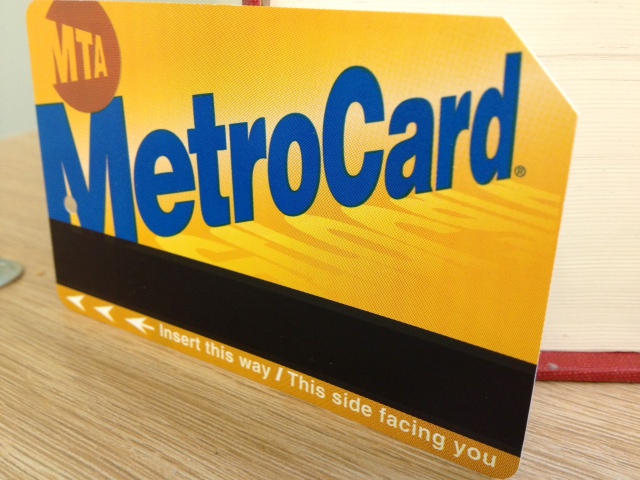
“That damn thing didn’t work again!”. This obnoxious statement of frustration is one I hear oh too often during the phone conversations with my well-mannered and (usually) exceptionally patient mother. Ironically that “damn thing” she refers to is the golden ticket for arriving and leaving from any place in New York City.  The Metropolitan Transit Authority’s little Metrocard is a necessity in any city dweller’s life and serves as both a treasure and a burden. According to the Metrocard’s Wikipedia page:” It was introduced to enhance the technology of the transit system and eliminate the burden of carrying and collecting tokens”.  Overall that statement does hold much truth to it even though it may be arguable for some of New York’s natives (such as my Mommy).

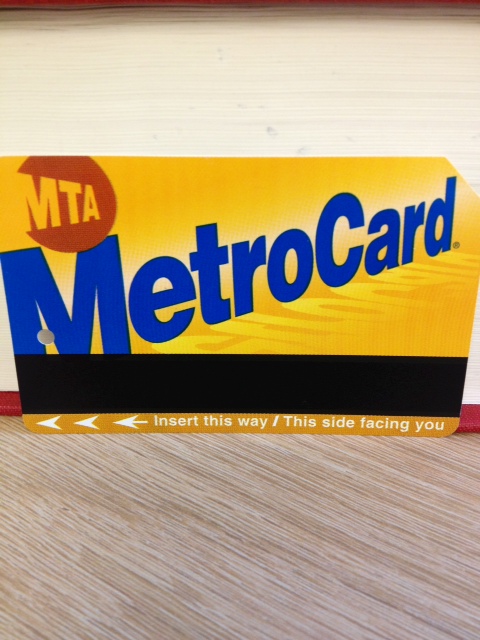
The Metrocard is thinner than any paper card and made from a smooth and shiny plastic material. It is rougly 4.5 inches wide with a length of 2.5 inches tall; matching up to the size of a credit card. It fits comfortably within anyone’s wallet and is composed of two detailed sides. The first side has remained the same over the years of my being and recognizable to people all over the world. It states: MTA Metrocard and in a much smaller font states: < < <- Insert this way / This side facing you. It is a wonder how these clear directions always seem to be escape eyes of the thousands of tourists that scatter the city. The card is a dark, mustard color and the Metrocard logo is written in royal blue. There is a thick black stripe vertically crossing the card and this is where the power of the card comes in. If any bending occurs around that area the card most likely will not be readable by the bus and train machines.

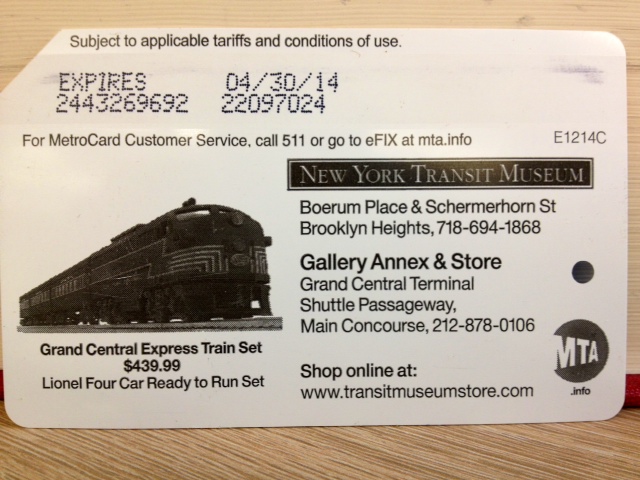
The back of the card is black and white and always displays the card’s expiration date, and the extensive card number at the top left corner. Despite those details, the back of a Metrocard is always different and can display quotes, words, advertisements, information about the MTA and all other sorts of interesting tidbits. The back of my card has an ad for the New York Transit Museum  with an address, picture of a train set and a website title. Now that I think of it, that would be a great place for me to have ventured to before writing this post and perhaps I will go there in the future if this card continues to significantly hold my interest.

The Metrocard was created by a division within the MTA known as: Metrocard Operations and is manufactured by Cubic Transportation Systems Inc. The tiny card serves a simple purpose:  since 2003, it is the only method of payment (besides quarters) taken for public transportation among the five boroughs and some parts of Long Island. It caters to every form of public transportation system in New York City making it incredibly dependable for the millions of commuters of the city. The card was first introduced in 1993 and was a blue card that is now a collector’s item. The card replaced tokens in the late 1990s and its usage has been growing ever since.  As the Metrocard’s popularity grew, the benefits such as the free bus to train, bus to bus transfer, grew with it and have dramatically changed New York City’s public transportation system. According to a NY Times article: “It was not until free MetroCard transfers between subways and buses were instituted in 1997 and the unlimited-ride cards were introduced on July 4, 1998, that the passes fully realized their power to transform the transit system”.  Indeed  the card changed the way commuters go about getting from one place to another and  usually this card is reliable and fairly straight forward to work. However when the words: “Just used”, “Please swipe again” or “See agent”  pop up on a bus or train’s transportation machine, it can throw one’s entire day off and be the biggest inconvenience imaginable.

The history of the Metrocard is extraordinary and the technological advances that has come with it over the years displays the tremendous progress of the transportation system that makes up the industrial and greatest city of the world. Yet, as with any piece of technology, the card has its on and off days and can play a major role in influencing a traveler’s punctuality. Financially, the Metrocard is costly, as the pay-per-ride fare has increased from $1.50 to $2.00 to $2.25 over the last decade. The unlimited weekly and monthly cost of Metrocards have rose as well and increases in cost are currently under discussion and will probably be issued within the next months. In conclusion this little card plays a noteworthy role in possibly every single New Yorker’s life and though I currently live upstate, my wallet seems to naturally always carry a Metrocard which I use for my visits to my home. Whether this one decides to work will be my pleasant (or unpleasant) surprise.

The Keeper of the Cat Whiskers

This urn really is a fascinating mystery. It appeared in an antique shop in Angus, Scotland in the 70’s. And yes, when I say “appeared,” that’s really what I mean. The shop owner walked into his store one day and there it was, sitting on the counter as though somebody had snuck in at night and left it as a present. It was hand painted, because on one side there are several little flaws in the brush strokes. It appeared delicate and precious, so the store owner decided to keep it in the store to see what would happen to it and if he could figure out where it came from. Its true origins are unknown to this day.

A week later, my mum was not very happy. The family was taking a day trip to Glamis castle and she couldn’t go because she had to take her O-Level exams that day at school. Her mum, Dorothy, felt bad for her and decided to get her a gift while in the town up by the castle. Dorothy came across the antique shop and went inside to take a look.

She bought the urn, without noticing that inscribed on its underside was “McLeish”— which happens to be my family’s last name. It’s almost like the urn was a “lost thing” trying its best to come back to a McLeish owner.

Although urns are usually associated with holding ashes, they are often used for decoration as well. My mum placed the urn on her bedside table and it lived there in Dundee for over twenty years. It made the cut for the move down to England and claimed a spot on the kitchen counter. It held Tetley tea bags.

Many of our possessions couldn’t come with us when we came to America. For some reason, this urn was chosen to accompany us. It traveled across the ocean by boat, along with our other possessions, while we flew to New York. I claimed it as mine, even though it wasn’t given to me. I didn’t actually do anything with it— it just sat in my kitchen by our table. But it was mine.

 Then it accidentally became a jello bowl.

I had my first bone graft done and I couldn’t eat anything solid. I was very out of it and wanted jello. Somehow, I thought I had grabbed a regular bowl to make my jello in… but I had grabbed the urn instead. It made a marvelous jello bowl because my cats (Smokie and Smirnoff) will eat anything, and if I leave any food uncovered, they will lick it and stick their paws in it and get it everywhere. This was the perfect jello bowl because I could eat it on the couch, then when I wanted to fall asleep, I could simply put on the lid and save it for later, without having to worry about my troublesome cats getting into it. The urn remained a jello bowl for three years and served faithfully through several more face surgeries.

Now, the urn looks like a proper urn, sitting on a table in my living room, in between two plants, with a picture of my grandmother Dorothy in front of it. If you look at it, you’d assume that her ashes were inside. But the urn holds something much, much different.

I used to try to keep my cats out of the urn to keep my jello safe. But now, the urn holds their fallen whiskers. Have you ever felt a cat whisker? They’re fascinating. They’re thick at one end, almost like plastic, and then taper to a thin, delicate point. When I first found one, I didn’t think I’d find another. I wanted a good place to keep it, so I put it in the urn. Now, it holds a whole collection of over forty whiskers, all from Smokie and Smirnoff. I don’t know why I keep them. It’s a little weird. I’ll definitely be a crazy cat lady when I’m older.

But the urn story gets even weirder. We now have two urns that look like this. The second one came in the mail. My grandad had found it on his doorstep. This one also has “McLeish” written on the bottom. So the McLeish urns remain a mystery. I don’t think we’ll ever know where they came from or how they were made. If only I knew an urn maker- maybe he could help figure out when and where it came from. It’s surprisingly hard to find out urn manufacture information on google! However, I think this makes the urns even more fascinating. Sometimes it’s nice for objects to come with a lot of mystery. Image