Victorian Needle Case – Part 2: its Provenance

The first assignment has led me on a fascinating quest for information in two directions: my own family history, as well as the history of needlework and its significance. This post will focus on the people involved with my Victorian needle case. Prof. Mulready raised an interesting possibility that perhaps the needle case was made as a gift for Ruth Broadwell, rather than made by her; in modern times, it’s common to have a gift engraved with the recipient’s name. However, in my experience collecting antique needlework items, the most common inscription is the maker’s name and a date, frequently found on a quilt or embroidered sampler. In “1898” Ruth would have been 78 years old, and “Vern’s oldest daughter” (my grandmother Nellie) was about nine years old. According to rootsweb.com, Ruth died in 1910, and so wrote the bequeathal note when Nellie was between the ages of 9 and 21. My grandmother was proficient in sewing, knitting, crochet, embroidery and tatting. It makes sense that her great-aunt would leave her this precious item. I just wish I knew where it was that Ruth was going — a trip? a hospital stay? “If I don’t come back…” That may remain a mystery forever.

Amanda1

The photo above includes my great-great-grandmother Amanda Lee Howe, seated on the right, with her sister Ruth Lee Broadwell seated on the left and her brother Spencer Lee, standing with his wife Mary. The photograph was taken in Iowa where Spencer lived. It was common to have photographs taken during rare family visits. Amanda lived in Potter County, PA — remember, no automobiles! A long-distance visit was a special occasion. I found a note from my third cousin Karen, with whom I corresponded via email during our joint family history search in 2003. She speculates that the visit may have taken place after the death of my great-great-grandfather Simeon Powers Buck Howe in 1873, which is backed-up by other photographs I have of Amanda. If so, this photo precedes the making of the needle case by Ruth, but is the only picture I have of her.

Howe Kids Nellie age 4

howes

Having deduced that Nellie received the needle case between age 9 and 21, I include two photos of her, above. The first was taken in late 1893, when she was around age 4. Nellie is in the center, with older brother Clinton and younger sisters Louise and Mabel. My assumption as to Nellie’s age is based on the apparent age of her baby sister Mabel who was born in May 1893, and the absense of younger siblings not yet born. The second photo shows the whole family: Lavern Buck Howe (son of Amanda Lee), his second wife Mary Daniels Howe (sister of his first wife, my own great-grandmother Ella Estelle Daniels Howe who died from complications of childbirth) and five children. Nellie is standing in the center; her older brother Clinton is missing, having been married in 1904. Based on the apparent age of little brother Lavern (b. 1900), Nellie would be about 18 years old in this photo. Did she have the needle case yet?

Howe Farm

Finally, this is a photograph of the Howe family farm. According to a published history of Potter County, PA, in 1832 Isaac Howe relocated his family from Lansing, Tompkins County, NY, to Bingham Township where the farm is located. Isaac’s son Simeon, would have been age 14. Family tradition holds that the farm in the photo was built by Simeon, and would have been occupied by him and wife Amanda Lee. (I hope to verify this someday by doing a deed search.) After Simeon’s death in 1873, Amanda married a neighbor Ebenezer Ryan. The farm was passed to her son Lavern Buck Howe, and later to his son Lavern Burdette Howe, the little boy in the family photo. It was in this farm house that the embroidered needle case resided after it came to Nellie.

My mother inherited a box of old family photos from her mother Nellie, including those posted here, and the velvet needle case. It now belongs to me, but next? I have two daughters and one granddaughter so far…

5 Centimes

Image

5 Centimes

Helly everyone! So for whatever reason, when I try to upload this photo to a text blog, it won’t work, therefore I have to write it as a photo caption. Hopefully this won’t cause any problems.

My object for today’s class is a French 5 centimes coin that I wear as a necklace. The coin is approximately a quarter of an inch wide and high, and looks silver. It smells metallic, a smell which instantly gives your mouth a funny and unpleasant taste. Despite its age, the coin is still very detailed, suggesting it didn’t have much circulation.

The front of the coin has the letters RF surrounded by what seems to be some sort of bough. The R and the F are combined with a flourish on their serifs and stand for la République Française. Above the RF is a war helmet, which I happen to know is of the French style thanks to my class in French civilization. Around the outer edge of the front side of this coin, there is a small detail that looks like a chain made of arrows, like this: <<<<. In the center of the coin, there is a hole.

The back side of the coin features more detail than the front. The same chain details runs around the outer rim and there seems to be another plant which surrounds the central hole. The top of the coin reads “Liberté, Egalité, Fraternité,” Liberty, Equality, Fraternity, the French national motto that was formed after the Revolution. On the left side of the hole, one finds the number 5; on the right, the abbreviation “Cmes.” This informs us that this coin is worth 5 centimes, or 5 cents. On the very bottom of the coin, we find its date of mint, 1918.

I bought this coin perhaps 2 years ago at a street vendor in New York City. She made a variety of necklaces with old coins and I was drawn to this particular coin for many reasons, most notably that it is French and I am a francophile, that I was leaving for France within the year, and that the script and decoration on this coin is beautiful.

Long before I found it on the streets of New York, however, this coin was traveling the world. According to my research, this coin must have been minted between 1917 and 1920 after World War One, and because materials were running low after the war, this coin is made of copper and nickel. The hole in the center served to set it apart from other coins of the same size but of greater value. Approximately 33 million of these coins were minted and therefore they are not of great value. One tidbit of information that I found very interesting is that during World War 2, when the Germans occupied France, all francs were printed without the letters for the République Française, RF, because the Germans thought it would be too nationalistic and cause rebellion against their soldiers.

While I have no idea who carried this coin, I like to imagine its life: who owned it? What did they purchase with it? How long did it spend in each owner’s pocket before being passed on to another? Did anyone stop to look at the beauty of its creation when it was just another 5 centimes?

Unfortunately, I will never know this information and this coin stopped being useful in 1999 when France adopted the Euro. It still makes me happy, however, knowing that something I wear around my neck has such a rich, secret history tied so closely to a country I love.

The Visual Makeup, Illustrations and All, of Harry Potter

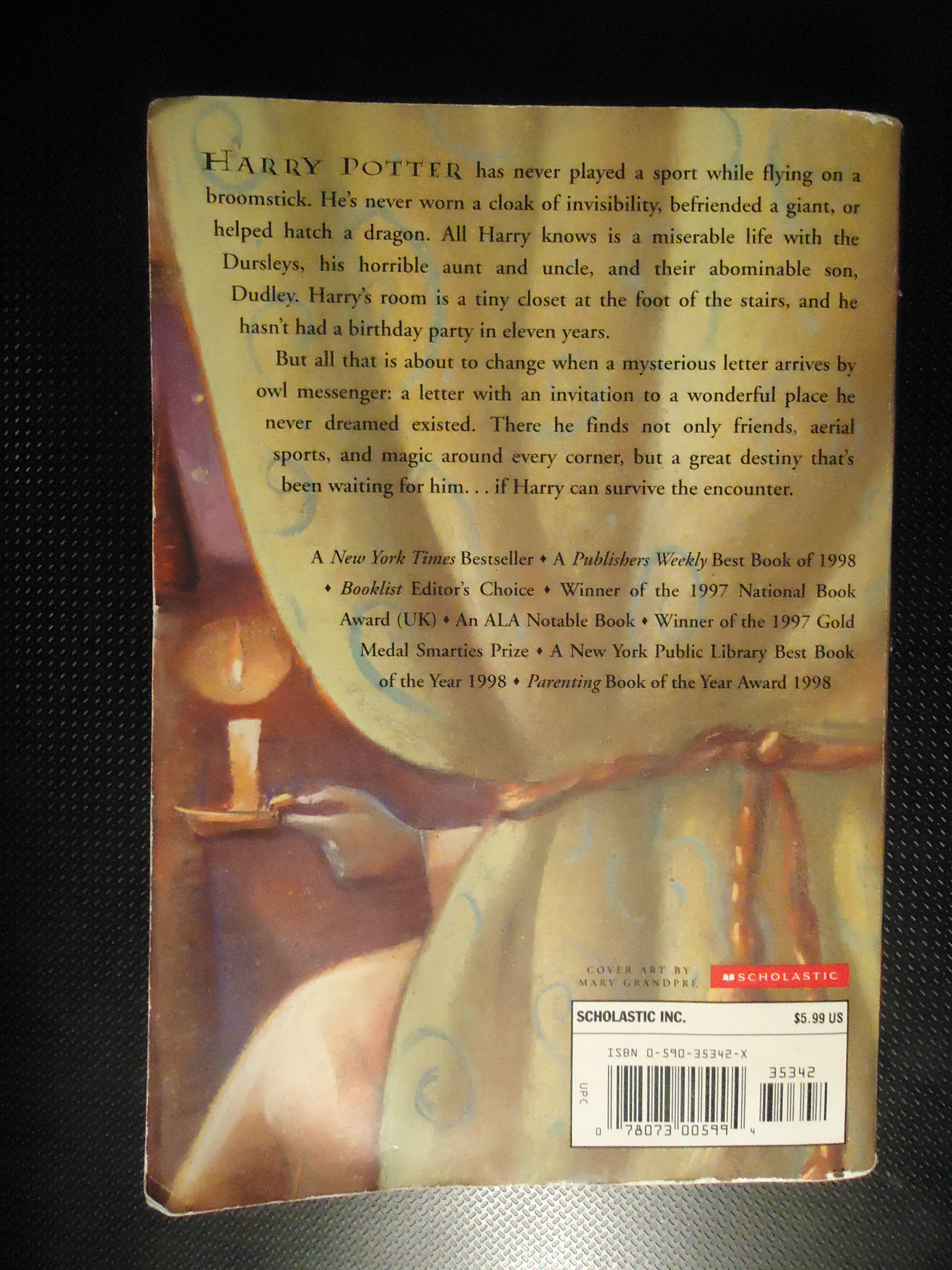
Early February 04When deciding whether to continue exploring my previously mentioned item, a tattered copy of Harry Potter and the Sorcerer’s Stone, the object’s lack of inheritance or personal cultural significance stopped my initial drive short. After one post about a very well-known, non-antique item, I could no longer see what should be described. I focused in on how my copy reflected my memories with the prized item, rather than vivid details of the book itself. Even though I provided pictures of the novel, you could not inherently know that cracked embossed metallic silver-gold lettering for the author, series title, a “THE EXTRAORDINARY NEW YORK TIMES BESTSELLER,” and the writing on the spine still stood out from the smooth, semi-sheen outer book layer. You would not conceptualize the size of the novel: 7.5×6.5x.75 inches, which is small compared to the hardcover and later books in the series, but large for its time as a juvenile novel. You could not visualize the semi-coarse pages glued to the spine, as opposed to a much sturdier woven fashion, marking the paperback as a massed-produced, short-lived item rather than an object worthy of artifact-status centuries from now; I will prove those bookmakers wrong. You could not identify the typeface, even by looking through the pages. Despite several online ask.com users stating the back cover of each Harry Potter novel identified its typeface, a 12-point Adobe Garamond, such could not be found in my edition. I love its fallacy. The other font, used across the novel for chapter numbers on the table of contents, the dedications, numerous “HARRY POTTER AND THE SORCERER’S STONE”’s before the story unfolds, chapter titles, the two-line drop-caps, page numbers, and headings, reveals the sheer magic of the novel, conjuring new font styles for visual delight. Mugglenet, a well-established fan-based Harry Potter website, provides a nearly-identical font called Lumos for all the obsessed Harry Potter fans. The same font exists on the cover page and spine’s metallic words, except “Harry Potter”: mimicking-font “Harry P” on Mugglenet almost matches the unique typeface except for more stubbly jagged lines for the electric-style stem of the “P.”

DSC02660I also did not describe the illustrations within the pages. At the beginning of each chapter, true to its identity as a children’s literature book, a black-and-white picture faintly hints at what is to come in the following pages. As if US illustrator Mary GrandPre set fine charcoal to the pages, the thick grayscale illustrations match her front-page style of skillful shading and blending, masking grand portions of the pictures in darkness. Unlike the much more realistic illustration on the front cover, the smaller chapter pictures feature thicker outlines, oftentimes identifying Harry by little more than their body outlines, a few clothing details, and hair, such as the illustration for Chapter Twelve, the Mirror of Erised.

Back cover of Harry Potter and the Sorcerer's Stone (1998)

Back cover of Harry Potter and the Sorcerer’s Stone (1998)

While my pictures provided a familiar view of the book to many in our age group, sometimes referred to by columnists and fans as the Harry Potter Generation, there are several distinctions between the American paperback versus hardcover illustration. Behind the embossed metallic font, the American front cover features a young black-haired boy in a yellow and red striped shirt, blue jeans, and a red cloak hanging from his neck, flying on a thin, wooden broom through two stone pillars, decorated by an intricate swirling design. His arm extends to catch a tiny gold ball with white wings, the gold hue and yellow blur of movement nearly blending into the brown stone. Behind the boy, a unicorn dashes from the middle out towards the woods on the left side of the cover; three beastly dog faces growl from the shadows of a castle on the right; small purple shadows of people on brooms stand against the pink-purple sky. While a golden “Harry Potter” stands out from the illustration, the rest of the title disguises itself in the middle archway. At the bottom, behind the embossed “J.K. Rowling,” a slightly opaque blue-and-red diamond strip covers the bottom pillar rungs and the thin grass landscape; the spine repeats the design. The front cover image prevails across most American copies, paperback or hardcover, although newer editions are significantly lighter, as if a graphic designer turned up the brightness and contrast in Photoshop. The back cover, differing from its hardcover counterpart, gives way to the light-hearted summary written upon the green drape (pictured to the right). Behind the drape, a dark hand decorated by peach cloth holds a similar-color candle on a brass candle-holder; the bright candlelight hardly illuminates the purple-brown blur behind. I do not believe anyone knows who this mysterious man might be, especially since this back cover only exists on paperback editions. As many more people turn to hardcover editions for material examination—perhaps because of promised longevity of the artifact—everyone recognizes Hedwig and Dumbledore on the back of the version’s book sleeve. Although the peach-clocked man behind the green drape exists on the front-inner flap of the hardcover sleeve, HP1_CoverGoogle Images reveals the figure’s arched bare foot, as if tiptoeing to his next destination. The figure, although still mysterious, could be linked up to the actions within the book, as several characters snoop around the castle at night to find the Sorcerer’s Stone.

Front cover of UK Bloomsbury publication of Harry Potter and the Philosopher's Stone (1997)

Front cover of UK Bloomsbury publication of Harry Potter and the Philosopher’s Stone (1997)

In contrast, the UK Bloomsbury edition of the first Harry Potter book features a much more simplistic illustrative and type style. The front page, with title, illustration, and front-page praise divided by thin green lines, distinctly separate images from words. “HARRY POTTER,” written in a gold Times New Roman, and “and the Philosopher’s Stone,” written in a small, white italic script, sit upon a solid crimson background. Underneath, an orange oval encapsulates a “J.K. Rowling” in a black Times New Roman-esque font style. The illustration of Harry Potter in front of the Hogwarts Express on Platform 9 and 3/4, evokes a distinct cartoon style with thick lines, bright colors, and unrealistic indications of time, place and environment. The Hogwarts Express, written in gold against a large green plate

Original back cover of Harry Potter and the Philosopher's Stone (1997)

Original back cover of Harry Potter and the Philosopher’s Stone (1997)

on the front of the red train, overtly proclaims its presence; the “9 3/4” sign towards the top looks like a piece of parchment floating in the sky; and stars within the smoke evoke magic rather than a realistic portrayal of stars with bright colors and skewed angles. The first back cover featured a wizard named Wizzy, created by illustrator Thomas Taylor and completely unrelated to the book content, donning a very odd wardrobe of purple and brown, carrying a large brown book, and smoking a pipe. The book description is just as silly: “Harry Potter thinks he’s an ordinary boy — until he is rescued by an owl, taken to Hogwarts School of Witchcraft and Wizardry, learns to play Quidditch, and does battle in a deadly duel. The Reason: HARRY POTTER IS A WIZARD.” After a few editions, Wizzy is replaced by Albus Dumbledore holding a Puter-Outer, and the summary receives slight renovation, though nothing compared to the eloquent, enticing summary on the US editions. Of course, by the time the novel reached the US, Americans were already ecstatic about the story, buying UK editions. The US cover reflects achieved fame, while the UK cover expresses a small hope in a long, complex children’s story nearly unprecedented across the globe.

Back cover of UK edition of  Harry Potter and the Philosopher's Stone

Revised back cover of UK edition of Harry Potter and the Philosopher’s Stone (1997)

Many differences between the UK and US editions amassed plenty of critical examination and pages of online content. As the most apparent change between the versions, Scholastic altered the title from “Philosopher’s to “Sorcerer’s” when buying US copy rights because the publishing company believed no child would read about a “philosopher.” America is also not as familiar with the legend of the “philosopher’s stone,” a legendary alchemist substance capable of turning base metals to gold or silver and as an elixir of life (just as described in the novel). Otherwise, one of many sources for each word change between the books can be found here at the Harry Potter Lexicon, another fan-made website for Harry Potter needs.

Fraying Red Threads

Jessi Putnam

100_4455

“Fraying Red Threads”

Once I had a Winnie the Pooh Bear sweatshirt. It belonged to my Gramma. She gave it to me one summer as I was about to leave for my first overnight at camp. It was a navy blue crew neck with a rectangular picture on Pooh on the front. The picture was enormous, and on my small scrawny body it seemed to consume my entire chest. Pooh Bear was that particularly annoying type of photo appliqué that feels kind of rubbery, you know, the kind thats just a bit sticky all the time and you cant leave it in the dryer too long or it will melt. It was the kind of sweatshirt people would make fun of you for wearing at that age. It was the kind of sweatshirt that most kids would stuff in their overnight bag, leave it there, and then lie the next day and say that they wore it. But that night as I lay in my sleeping bag scared and homesick with sleep a distant possibility, that sweatshirt got me through. The cabin smelled terrible and I couldn’t seem to block out the noise or the lights or my fears. So I covered my face with Winnie the Pooh and buried myself deep into its folds. The sweatshirt smelled like lavender and mountain breeze laundry detergent…the sweatshirt smelled like my Gramma.

I kept Winnie for a while after that, but eventually a big hole grew at the elbow, and I grew too big as well. I went without a Gramma scented protection shield for some time. But my senior year of high school, the imminent threat of leaving for college was upon me, and I wanted a new Winnie for my older self. My Gramma took me to huge wooden chest in one of the spare bedrooms at her house. She opened the lid and the smell came wafting out. The lavender and mountain breeze detergent that always reminds me of her but because of allergies I could never wash my own clothes in. I peered into the chest at all the possibilities and she told me to pick one.

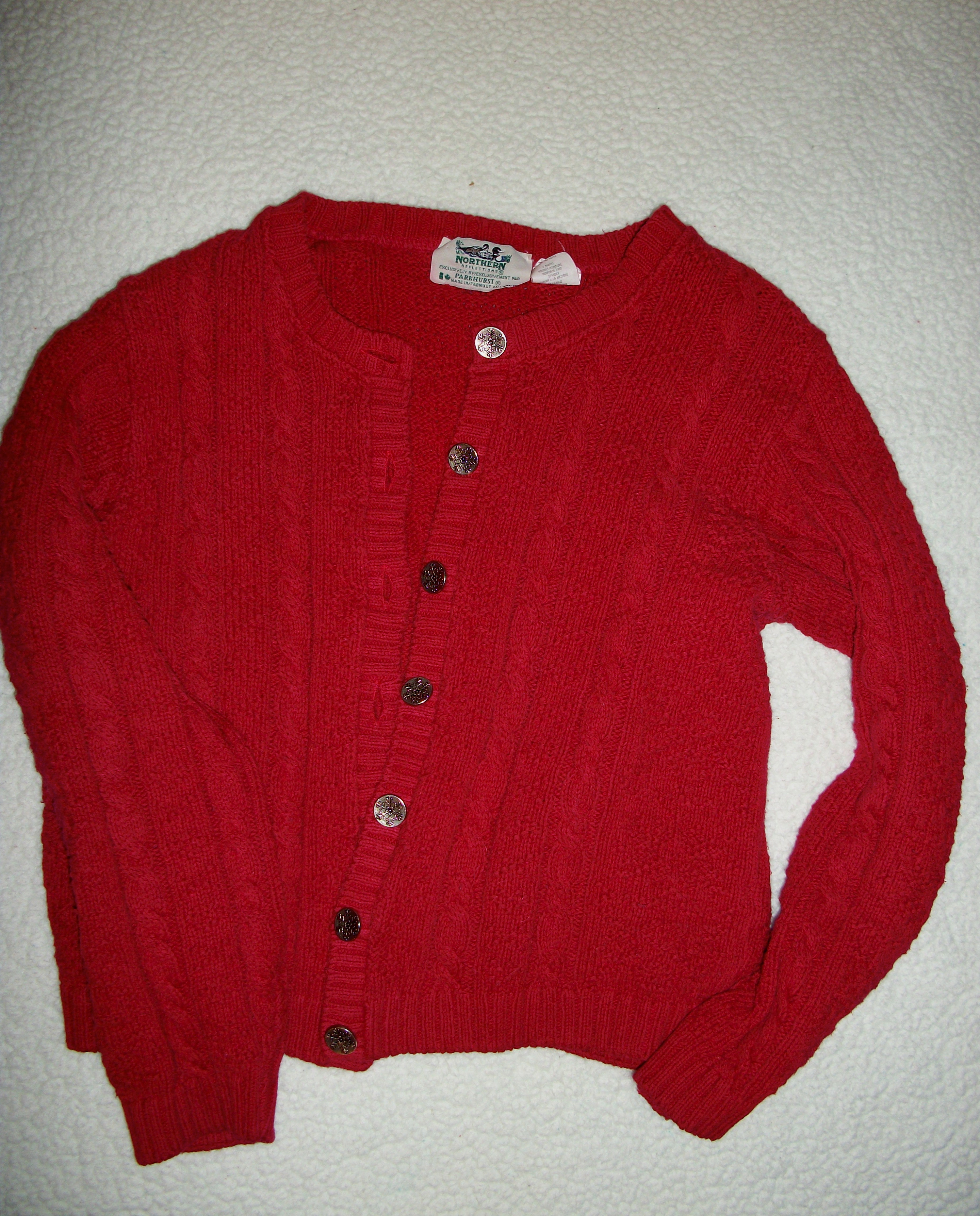
And there is was. I picked up the neatly folded bright red sweater and fell in love. It was a perfect fit, which is odd because I am over a foot taller then my Gramma. It was thick and baggy, falling loosely around my arms and torso. And it was soft with years of washing and wear and warm with more then fabric but also with memories. It has big metal buttons printed with snowflakes, and when you take the sweater out of the dryer you run the risk of searing your hand a bit on them. But the buttons are getting a little loose with age. They are holding on to their fraying red threads for dear life. I live in constant fear of the day I put on my sweater and a button has gone missing. But for some reason, despite the how long this sweater has been around, the extra button is still sewn to a seam along the bottom, so my fears are alleviated for the time being. According to the tag that is only hanging on by a few threads, the sweater is from a store called Northern Reflections. There are two loons embroidered on the top of the tag and the print is mostly in french. It reads “Farbique au Canada” with a small Canadian flag along side the text. Another tag lists out my sweaters washing instructions…”machine wash cool do not bleach tumble dry.” And below that is my sweaters contents…”70% cotton 25% acrylic 5% other fibre.

But none of that really matter to me, my sweater is made up of so much more. woven into its cable knits is my Gramma; the memories, love, and of course the smell. Sometimes I will just  hide my face in the sweater, absorbing its smell, its softness on my skin, and the nostalgia that rushes upon me every time I wear it. Like Pooh bear the first time I wore my red sweater did not go over very well with other kids. “Nice Gramma sweater” was the sarcastic remark of admittedly not one of my most favorite people in school. But it didn’t matter, I love that sweater. I love its sagging red fabric and fraying threads, its worn spots where years of elbows have leaned and its dangerously loose buttons. I love the smell of lavender and mountain breeze and I love wrapping it around me and feeling safe and at home. Now I fondly call it my “Gramma Sweater” and I plan on letting it keep me safe for a very long time.

Shark Tooth Necklace

Shark Shark

So, I decided to change it up this time and give my rosary beads a break. For this week’s blog I decided to showcase my shark tooth necklace. The necklace was given to me by a friend. She gave me the necklace on my 20th birthday before she transferred to another school in the middle of my second year at SUNY New Paltz. I consider it a symbol of our friendship. I wear it a lot now that she’s studying abroad in Italy. Maybe she’ll bring me back something else, who knows?

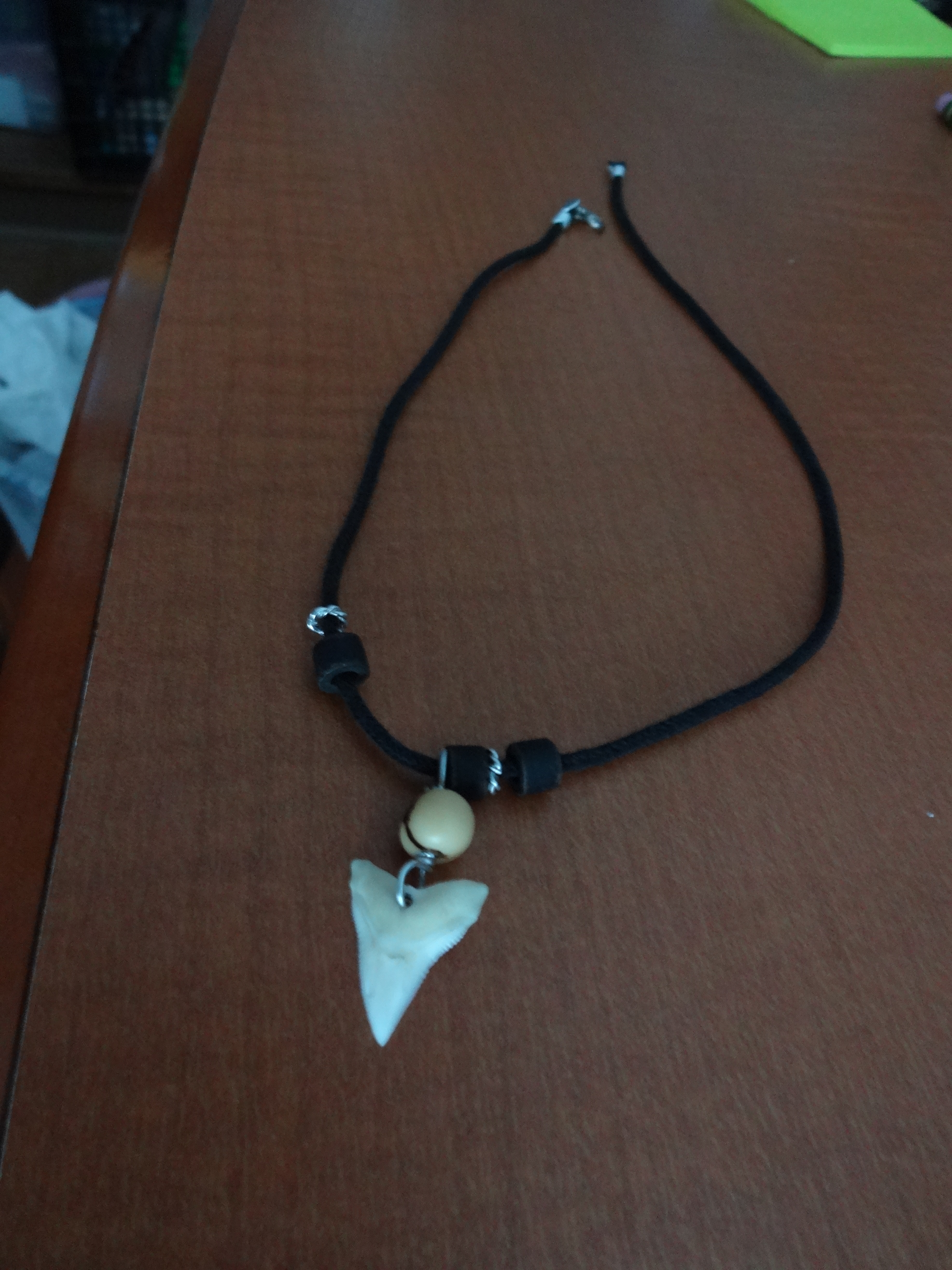
If you hold the shark tooth necklace at its sides you can feel the metal pieces which connect to each other. The metal pieces spiral into a thick black material, which almost feels like the strings of sweatshirts and hoodies. The string is rough as denim material. The necklace is about 7 to 8 inches long, revealing pieces of metal and wood around the string. The wood is dark, almost black even. The wood and pieces of metal, wrapped around the string, are uneven in quantity. When you hold up the necklace, there are two pieces of wood and one piece of metal on one side of the shark tooth, but then there is one piece of wood and one piece of metal on the left side.

Finally at the end of the necklace a piece of metal material holds the shark tooth necklace. Between the shark tooth necklace and metal is a plastic ball which feels smooth at the touch as if you’re rubbing a marble. Below, the shark tooth necklace is about a half an inch long. The white shark tooth is sharp around the edges. If you place your finger against the end, you’ll feel the sharpness against your skin. I wouldn’t push too hard though, you might create a cut.

So, I thought I would share my image’s description before I delve into what I’ve learned about it so far. Although they’re considered a fashion choice today, the tool was used very differently in the past. Shark teeth were used as weapons, and tools for food preparation. These tools were originally used by Native Hawaiians, who called them leiomano. Native Hawaiians would pass down some types of shark teeth to royalty. As the 20th century came along, the use of shark teeth became less a tool of survival and more of a fashion accessory.

It turns out a shark tooth necklace was a symbol of “male strength, potency and a proud display of masculinity,” as described by a few websites. The fashion choice was unsuccessful in the 1970s where they were worn to make up for some masculine shortcomings. Given their masculine and strength meaning, these necklaces offer a natural charm of “man of the wild.” They’re known to lure women and create “irresistible attraction for women near and far.” I don’t necessarily agree, but I do happen to love the quality of my necklace.

Unfortunately, the necklace broke this week, but maybe I’ll find a new latch soon. Any suggestions?

2000 Years

Image

A coin is tucked inside a letter on my bookshelf. It’s no ordinary coin, although it measures 1.5 cm long like a common American penny and weighs about the same as well.

The surface is brown and faded with chipped, bumpy edges. No evidence remains of its former bronze brilliance. A darker hue of brown lines its edge like it has been charred. The coin appears delicate from hundreds of years of existence, as though you could scrape away the design with one easy swipe of a nail file. Its surface is dull, and will never be shiny again because its thin, bronze top coat has been worn away with time. On one side lies the goddess Pax, raised out of the coin to emphasize her importance, with “Perfect Peace” inscribed around her in Latin. Although damaged with time, her figure is still visible, along with a large staff held in her hand.  The other side is a bumpy blur, although it once held a glorious, shiny depiction of Constantine I. This side doesn’t even look like a coin; if it was lying in the ground, it could easily be mistaken for a flat, bumpy pebble.           

It has been sitting in various places in my room since March 10th, 2005. It’s forgotten most of the time. However, this coin is rich in history. It lived before the Twin Towers were attacked. It survived before the Great Depression. It even lived before the Norman Invasion of England in 1066. “How did it end up in your room?” you may wonder.

Here is its story.

Let’s zoom back almost two thousand years to the Roman Empire. During the rule of Constantine the Great, this small bronze coin was made in the 18th year of his rule, around 324 A.D. Constantine was the first emperor to become a Christian (he thought that God would help him conquer more people) and therefore changed the history of all of Europe for the next thousand years. This coin was around for the beginning of a new kind of world as it passed from hand to hand over the years. It was called a “follis,” which is like our modern day penny, so it most likely passed through the hands of commoners as they went about their days selling fish in the marketplace, buying bread, paying back loans, and losing money in bets.

At some point, it fell into the ground— possibly slipping unnoticed through someone’s fingers. It lay there, squished into the soil, for much longer than it probably expected to, undiscovered for centuries. Countless people walked over it. The dark ages came and went. Kings and Queens rode by and peasants trudged over it. Genghis Khan and the Mongols stormed over it as they invaded. Vikings passed by in their boats. All were unaware of the small piece of history that was waiting to be discovered.

It was only recently that someone happened to look down at the right spot and pick it up. It was found by an archaeologist who was exploring the world from one end to the other.

This archaeologist was Mr. Bill Reilly, who became a middle school teacher several years later. He inspired minds like no one else could and created a passion for learning. His students had the craziest assignments (building life-sized catapults, making episodes of “The Daily Show”, turning school hallways into a museum for the community to visit)— and even those kids who were frequently suspended or hated going to school couldn’t help but look forward to his class all day. This small “follis” snagged a spot in his ancient coin collection, which students year after year observed and passed around while learning about ancient Rome.

I loved Mr. Reilly. What an interesting man he was! And he had fabulous stories from all over the world to share. I spent many hours after school with the coin in my palm, imagining epic battles, creamy togas, and vast empires. For my 12th birthday, Mr. Reilly gave me the coin. I loved it to pieces. It sat for a while in a white tin with other coins I had been collecting, until one day I realized that the tin just wasn’t its home. It wasn’t supposed to be with other coins. It was too special. So it sits inside the letter that Mr. Reilly gave me on my 12th birthday and it’s been there ever since- relocating to different spots in my room whenever I clean.

I think what I liked most about having this coin in my possession was that it was a secret. I had my own little piece of ancient Rome and nobody knew that except me (and Mr. Reilly).

My life is kind of like this penny. Although I won’t be around for as long, history is being created around me and I am experiencing “time.” I’m going to experience wonderful and horrible events! One day, what is happening right now will be a story in a young child’s textbook. We’ll be referred to as “Ancient New Yorkers!”  I keep this penny around as a reminder that all time is precious— and that history is still being written each and every day.

Image

The History of My Violin

ImageImageImageImage

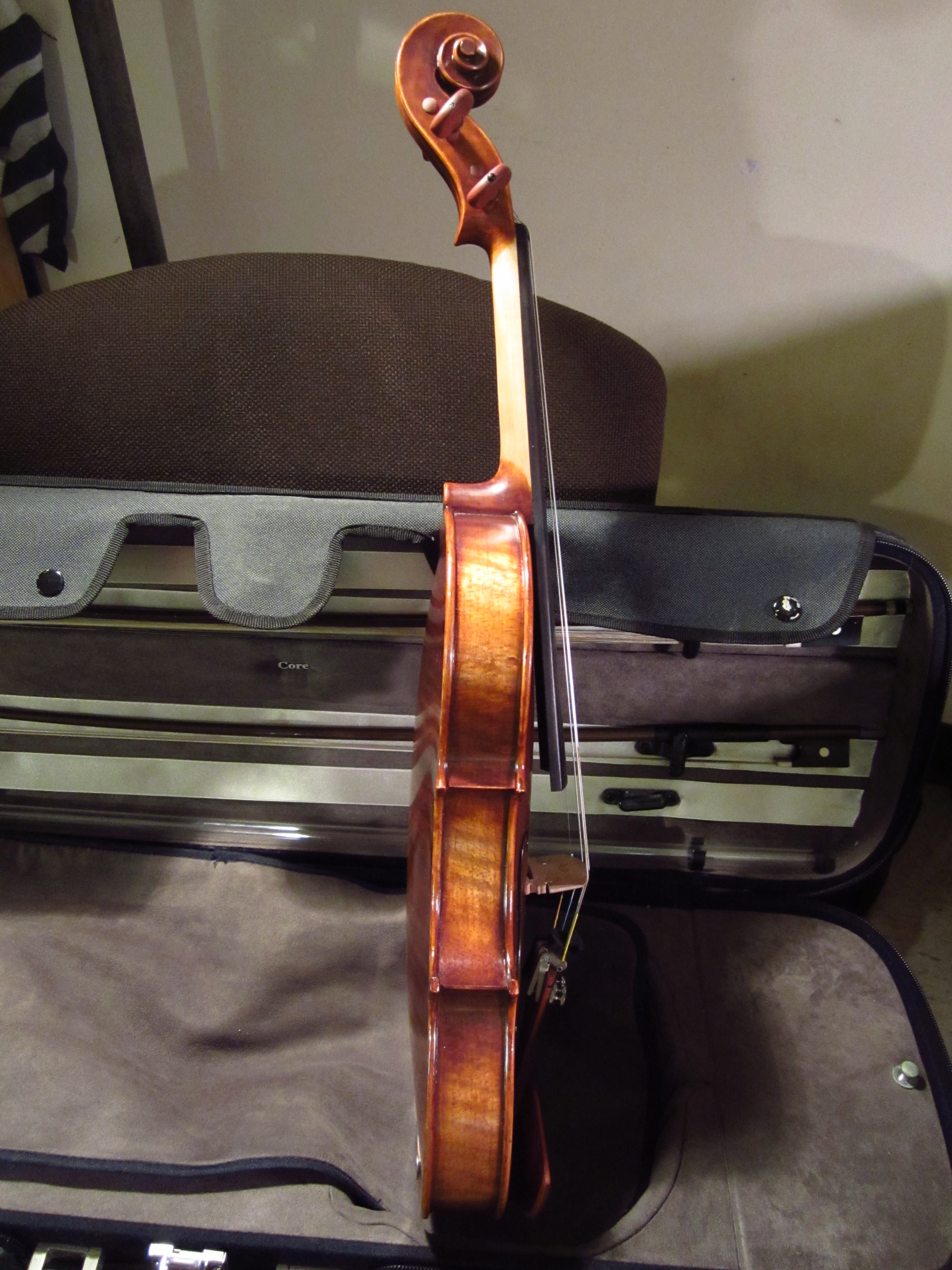
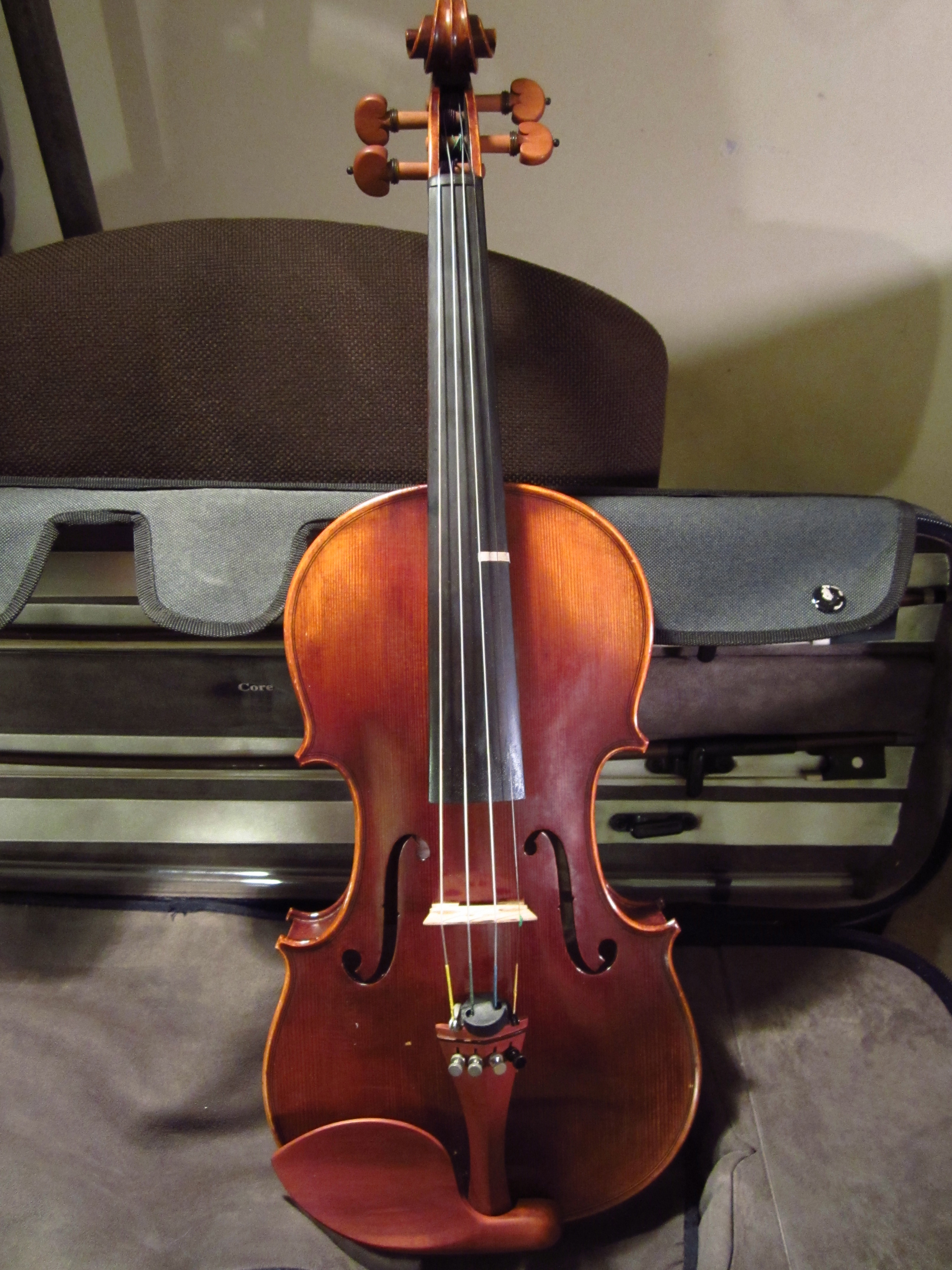
This is my violin. It is a standard 4/4 size, which is roughly 24 inches in height, and about one and a half inches thick. The body has a curved structure, much like the body of a woman. The bottom of the body is widest at 8 inches, where it graciously curves inward to about four and a half inches, and curves outward again to about six and a half inches. On the lower left (facing the violin) of the body you will see a circular wooden chin rest of about four inches. You will see another piece of wood about four inches long which holds the four metal fine tuning gears which keep the strings in place. On the front of the body, on either side of the strings, there are two f-holes about three inches in height through which the sound emerges. There is a wooden bridge about an inch in height and half a centimeter in thickness, which holds up the four strings. Two inches above the bridge, there is a black wooden fingerboard, which extends about eleven inches up the violin. The top five inches of the fingerboard constitutes the neck of the instrument, and above that you will see four pegs, two on either side, which hold the four strings. These pegs, when turned, will pull the string tighter for a higher pitch, or ease them for a lower pitch. At the very top of the violin is an elegant spiral curl, which is most evident of the fine craftsmanship of its creator.

This instrument is a dark honey-colored brown, with vertical grains running across the front of the body, and fine horizontal “ribs” can be observed on the back of the body. The strings are made of steel, and vary in thickness for different sounds. The left most string (G) is thickest, and each string gets progressively thinner until you get to the right most string (E), which is thinnest and produces the highest tone. About four and a half inches up the fingerboard, there is a small white piece of tape. This is to mark seventh position, and it was put there by my ninth and tenth grade Orchestra teacher, Mrs. Sckipp. The bottom half of the body has three small nicks, which were all put there by myself, accidentally. Each one is from my bow, which sometimes smacks against the body of the violin while I am carrying it around casually. It is fragile and surprisingly light in terms of weight, as the body is hollowed out.

Although the first stringed instruments came about in the 9th century, the violin has only been around since the 16th century. It first emerged in Northern Italy and spread throughout Europe. These instruments were handmade for hundreds of years, until the 1940’s when they begun being factory produced. The quality of the instruments suffered from the lack of care put into their creation, and since then there have been some manufacturers who have decided to use the conventional, hand-made method, which gives each instrument a unique look and tone.

My violin was handcrafted by a violinmaker under the training of Andreas Eastman of the Eastman String Company. Qian Ni founded Eastman Strings in 1992 after he moved to the United States from China. He gathered a group of talented violinmakers in order to begin his business, and has since built a very reputable reputation. This particular violin was made in 2004, and eventually ended up at a violin dealer by the name of Laurinel Owen, who works out of The House of Strings, in Bellport, New York. This beautiful instrument found its way to me in the summer of 2006, just before I entered the seventh grade.

I had been playing violin for about four years when my parents decided to grant my wish of getting my own, brand new violin. The instrument I had been using was my sister’s old, cheap violin that was most likely factory made because its quality was quite poor. When I arrived at the home of the dealer, there were 6 beautiful violins laid out before me and I was asked to choose which I wanted. After careful consideration, I chose this particular one, and my parents purchased it for $1100 as a gift to me. I was ecstatic.

This violin has been with me through years of practicing, auditions, and concert performances. It was with me as I played my first NYSSMA solo. It felt me tremble as I nervously prepared to perform in front of a judge for the first time. It was with me for all twelve seating auditions for concert and symphonic orchestra. It was with me as I played Christmas carols for a group of elderly folk at a nursing home. It has accompanied me through numerous school concerts, and has resonated vibrations to the tune of Brandenburg’s Concerto No. 3, Barber of Seville, Schubert’s Unfinished Symphony, Beethoven’s Scherzo Movement, and many more. This violin has felt the misplacements of my fingers, and screeched at me in poor intonation so that I might learn the proper placements. It has resonated with a deep, full, powerful voice as I learned how to help it sing.

This marvelous instrument has not only generated a sound for others to enjoy, but has also acted as a de-stressor for myself; it has allowed me to unwind and forget about the troubles that silence often brings. This violin may not have a very long history, or travelled through many different hands, but that does not mean that it will not create history. I intend to pass this instrument down to my children, and grandchildren, in hopes that it will journey through the lives of many more, creating memories and history as it travels through the ages.

Heredity

I’d like to start off by apologizing for the poor images, the camera on my phone is not the best.

IMG_20130204_005518I grew up in Long Island, a land of new-age house-clone developments and stuffy shopping malls. I struggled to keep up with every trend that passed through my middle school peers, from Undeebandz to customized Soffee shorts. I was a chubby girl with thick (and, admittedly, masculine) eyebrows that wanted to fit into the groups of popular skinny girls that sported a different Juicy tracksuit every day. These girls came from families of the upper upper middle class, that could afford buying into brand schemes. My parents just couldn’t keep up, and at the time, I selfishly hated them for it. There was a large concentration of Italian families in my neighborhood, and I felt that despite economic differences, one thing I had in common with these (now, as I see them, materialistic) popular kids was that I am Italian, too. This correlation ties into my “awkward” prepubescent years, a time in my life when I was consumed with entirely wrong values, as well as complete naiveté. I only cared about being Italian for ultimately futile reasons, such as fitting in with the In-Crowd.

For most of my childhood, both of my parents worked full-time in the city. My Dad would bring home all sorts of funny presents for me and my siblings, funny little odds and ends and doo-dads he would sweep up along the sides of tree-lined parks and greasy subways. One of my favorites was a heart sticker with a Beyonce-esque woman proclaiming through a speech bubble, “Put on your big girl panties and DEAL with it!” Another was a (printed) hand-painted portrait of Angelina Jolie, signed by the street artist, which still hangs in my room today. These objects would make me laugh, and then would eventually collect dust somewhere in the house. However, one object holds an explicitly visual memory of my experience, and has been taken care of and semi-worshipped through the years. One evening in August 2005, during the summer between  middle and high school, my dad was struggling to open my front door after coming home from work. I remember coming downstairs in a Metallica t-shirt, brushing my teeth, and seeing Dad struggling not to drop what was in his right hand. Shuffling under his arm were what looked like, through the glass abstracted door, two large brown rectangles. I rushed to the door, still brushing my teeth, and opened it for him. He came staggering inside and rested the two rectangles against the wall. I looked at them blankly, then back up at him, and said, while brushing, “Whaa ah dose?”

He simply put down his keys, and said, out of breath and sweating: “Ellis Island.” He then adjusted his collar, and looking duly ahead, disappeared into his office.

…Right.

I went upstairs, rinsed, Listerined, and went back downstairs to inspect what laid underneath the brown wrapping of these mysterious packages. What I found is one of the coolest primary documents I’ve encountered: a log of a number of passengers sailing from Naples on August 11th, 1920 upon the S.S. Providence. One of the last names from the bottom is Vincenzo Petrosino, my paternal grandfather that arrived in the United States at the age of fourteen. Unfortunately, I never met my grandfather, but this one strip of information on a seemingly mundane and even painfully meticulous travel document is the one splice of information I have on a man that single-handedly started his own fish restaurant in New York City and was able to support a family on this business alone – a business he built from the ground up.

IMG_20130204_005538

What was communicated through my father’s prideful stories of the “fish business” is that my grandfather was obviously a high roller. However, one particular anecdote that made his memory even more enchanting was the fact that “He came to America with two dollars in his pocket!” What a marvel, starting with two dollars and ending up making a decent living! I must have heard this particular line two hundred times, between family dinners, beach-parties, and communion brunches. I looked at this travel document, and alas, my father came out of his office and pointed out the $2 scrawled upon the paper. I was amazed. My grandpa was someone that came to America and started everything, from the ground up.

IMG_20130204_005555

I was proud of this fact, and I while I was definitely long past the years of wanting to be Italian just because it was a fad, I still caught myself wondering how I could be so stupid. It goes without saying that being a hard worker is not a primarily “Italian” trait. However, I can’t help but tie my Italian heritage in with my prideful family history. In some way, Grandpa Vincenzo even helped his granddaughter realize where true values really lie.

Turtle Pin

Image     Image


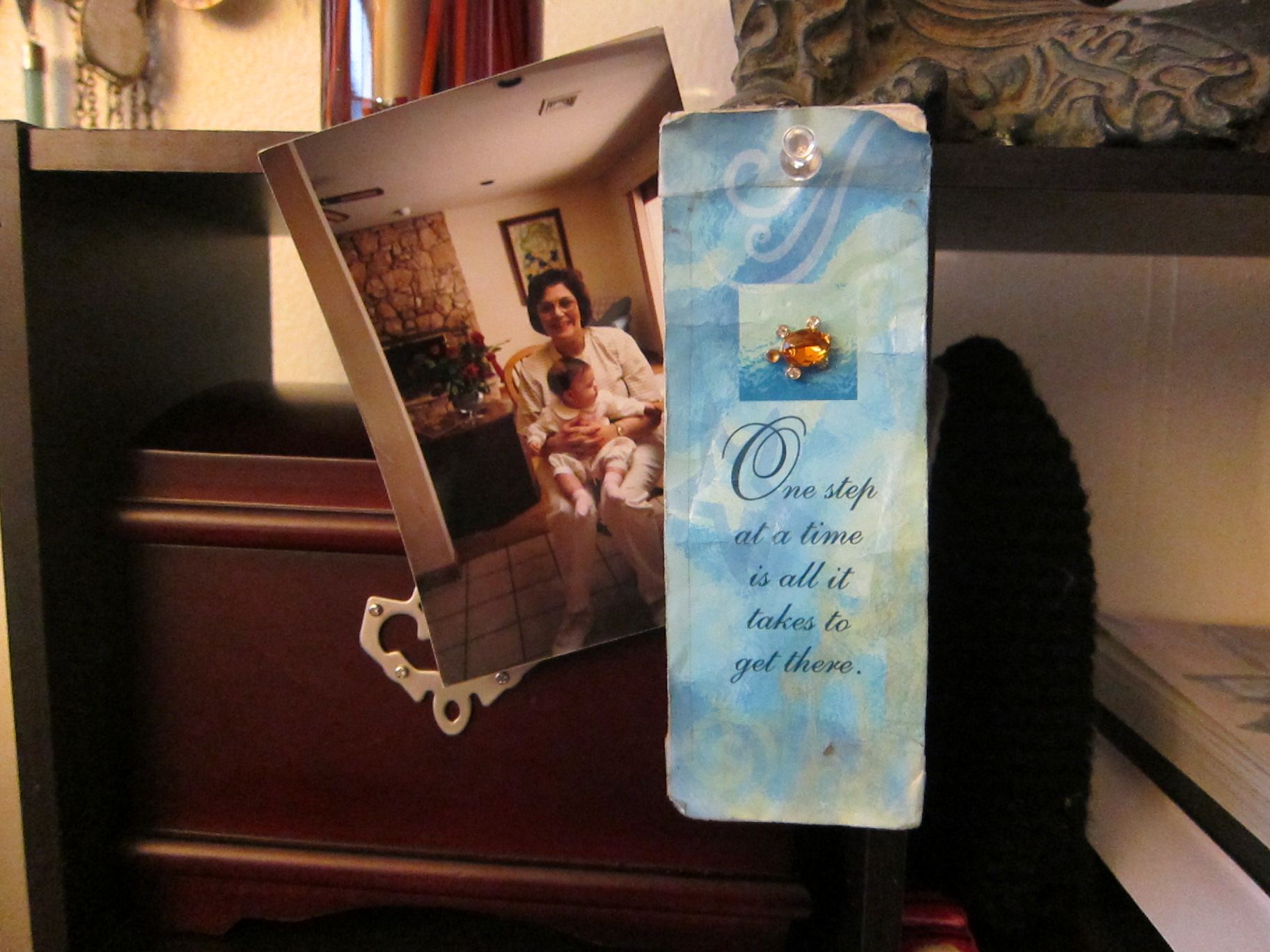
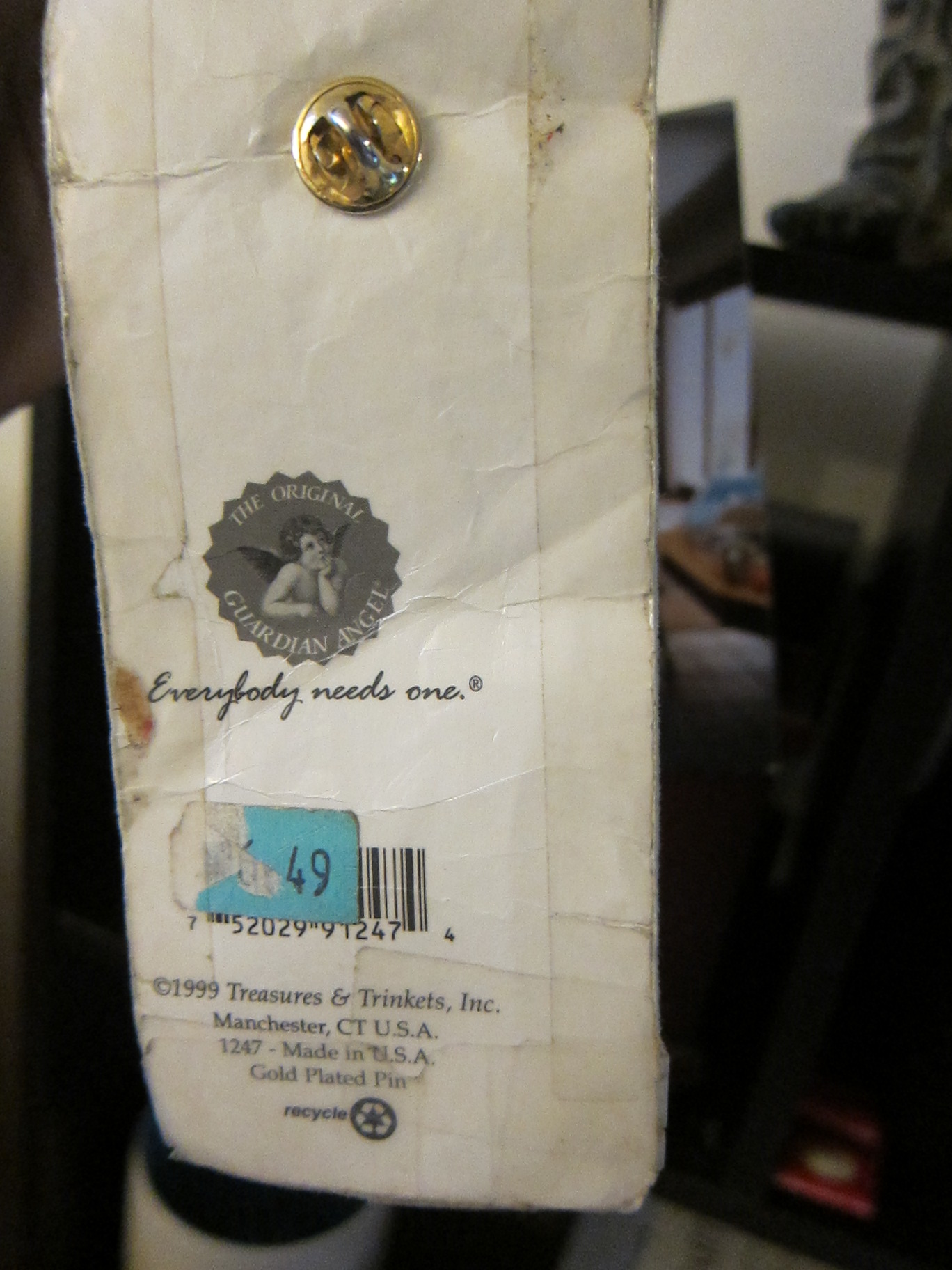
My object is a pin attached to a panel that reads in script “One step at a time is all it takes to get there.”  It is roughly 4 inches long and 2 inches wide.  The turtle has an amber-colored stone as its shell and little rhinestones for its feet and head; the rhinestone for the head is missing.  As I turned the panel to see the back (something I would rarely do if I wasn’t trying to describe this object in full detail) I noticed that the sides are covered in tape that I used to stop the layers of paper from peeling apart.  The back also has a logo with a picture of a cherub that reads “The Original Guardian Angel” and below it, “Everybody needs one.”

This pin was given to me from my late grandma when I was very young, probably around 6 or 7 years old.  I loved the turtle (as I had an affinity for turtles at the time) and the little inch-by-inch square scene it was attached to.  At that time I played with it, twisting the pin in the back to make the turtle rotate back and forth, as if it were swimming in its tiny seascape.

As I got older, through all of the redecorations and changes made to my room, the pin always stayed with me, in the second drawer of my nightstand.  As I began to love reading I used it as a bookmark many times.  I have never actually worn the turtle as a pin and it has always been attached to its paper.

I love the quote on my pin/bookmark, as it is very motivational to me.  I have always had a hard time accepting that large, daunting tasks can be broken down into simple steps, and that those small steps can accumulate into something great, colossal even.  I have a tendency to get too caught up in details or get overwhelmed by the apparent enormity of certain obstacles or goals, and this serves as a reminder for me to break it down into small, doable steps. 

When my Grandmother died of Lou Gehrig’s disease in 2003, the pin had even more significance to me.  She was the most elegant, blessed, strong person I have ever known.  Knowing that she, a woman who prevailed with grace through such tragedies, believed in me is a constant source of my personal strength and inspiration.  My family members often tell me that I remind them of her and I take that as a great honor.

This odd object that has never actually been used as it was supposed to be is now attached to a book stand on my desk in my dorm room, so I can look at it and remember how to tackle stressful obstacles in my life, and that my grandmas strength, grace, and vitality resonates inside of me every day.


Note: The first picture is of my turtle pin in my collage dorm, next to a picture of my grandmother and I.  The second picture reveals the tattered back of the panel. 


Propolis

IMG_2365 IMG_2367IMG_2378

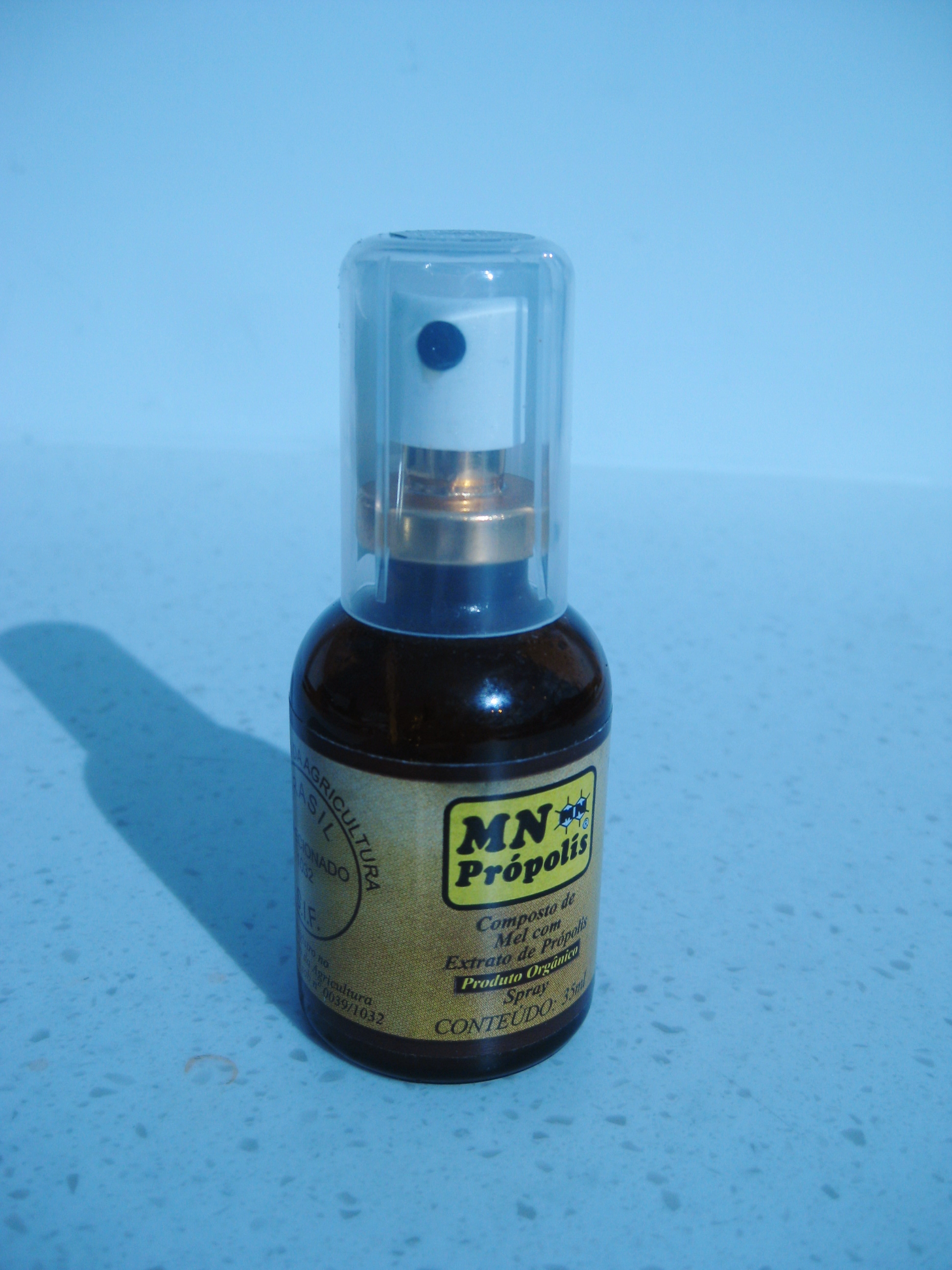
The object I chose to post is a bottle of Propolis.

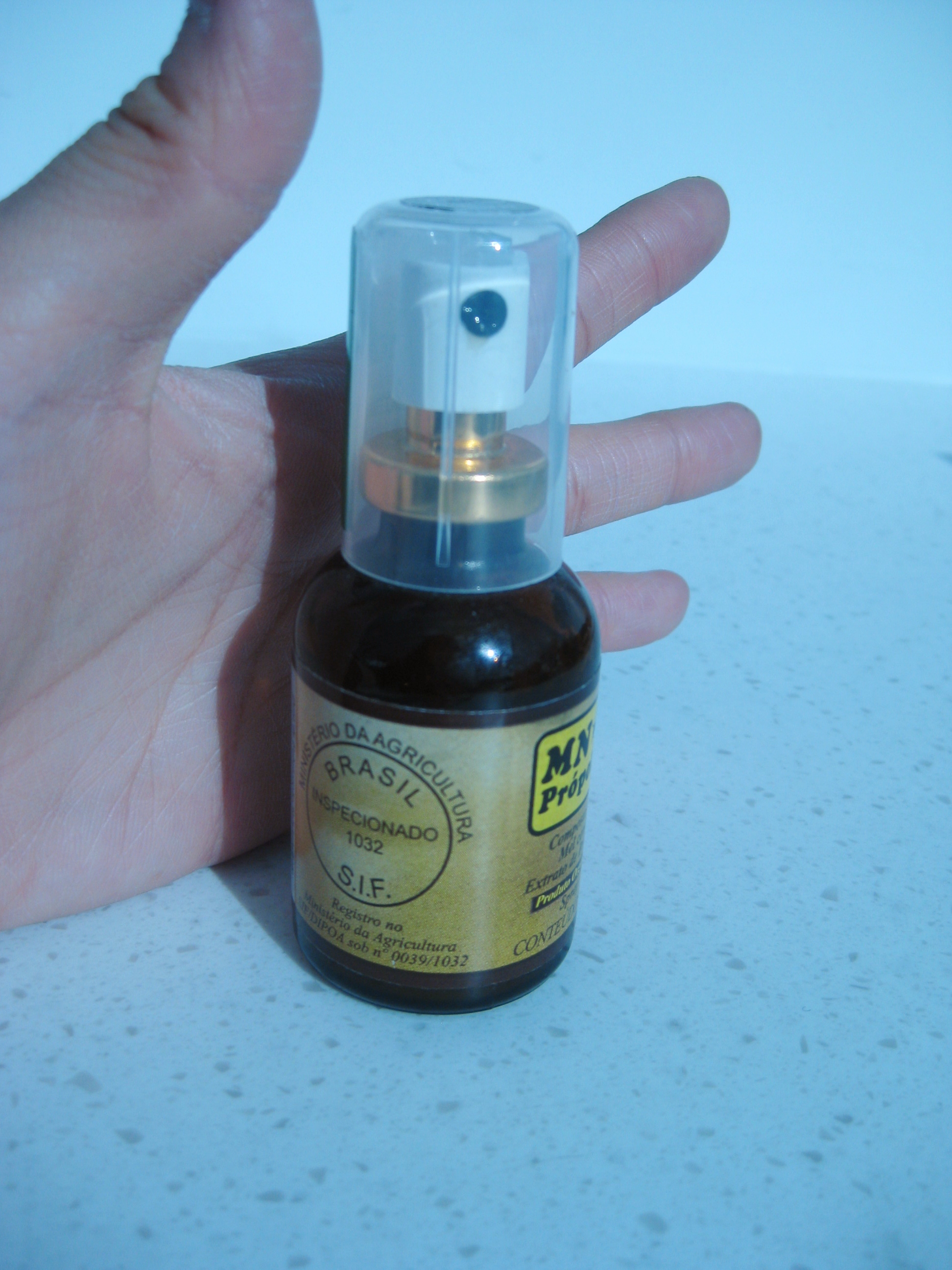
The bottle is about 9cm/ 3 ½ inches tall. The spout of the bottle is covered by a plastic lid that measures about 2 ½ cm in diameter. There is a circular black sticker on top of the cover that states “AGITE ANTES DE USAR,” which translates to “shake before using.” Another rectangular green and white sticker is attached to the side of the plastic covering. This sticker has the words “QUALITY SEAL,” “CERTIFIED ORGANIC,” “IBD,” “INSTITUTO BIODINAMICO,” “SP 162,” and “This product is inspected and certified by Instituto Biodinamico according to international standards” stated on it. The bottle itself is made out of a thick, amber colored glass. The glass itself has another brown-yellow sticker label that measures 3 ½ cm tall, which goes all the way around the circumference of the bottle. This label indicates that this product was imported from Brazil. The official name for this product as stated on the label seems to be “MN Propolis.” Underneath the name of the product the label states “Composto de Mel com Extracto de Propolis” and “Producto Organico Spray.” This seems to translate into “Product of Mel com, Propolis Extract” and “Organic Product Spray.”  This bottle contains 35ml of propolis and the ingredients include organic propolis extract and distilled water. Finally, the label states that the product is valid from March 2011 to March 2013.

The bottle is about 2/3 full of the propolis extract. When sprayed in the mouth, the propolis has an almost minty, medicinal, slightly sweet, and very strong almost honey-like flavor. The bottle  looks slightly worn. The multiple stickers on the product are fraying slightly at the ends.

According to my parents, propolis has numerous health benefits and can be used to treat many ailments. In our household, we mainly use it to spray in our throats when we are sick or when we show any cold symptoms. Propolis itself is “a resinous substance collected by honeybees from tree buds, used to fill crevices and to seal and varnish honeycombs.” According to the free medical dictionary, propolis is a “compound made by bees by mixing balsams and resin collected from vertain trees with saliva and digestive enzymes. Used for its antioxidant, antiviral, antibacterial, antitumor, and anti-inflammatory properties and to promote the healing of wounds” (Healthline).

To me it’s not the propolis itself that is important, but it is what the propolis signifies that is important. Up until I was in second grade my parents didn’t worry about health foods and eating healthy. However my father suddenly picked up an interest, which was followed by many comical, painful, gross, and frustrating memories for me and my two brothers. One in particular was when my father tried to make a “yummy” healthy snack for his kids. He took organic strawberry yogurt and organic peanut butter, mixed them together, placed them on some homemade bread, and handed it to us. Whenever we (my two brothers and I) are sick, my father force feeds us onion oil and cooked garlic. He also comes up with strange concoctions of apple cider vinegar honey, lemon, water, and various other health foods. I’m sure if it were someone else other than parents who encouraged us to eat health products, then my brothers and I would have listened more. However, because it was our own father telling us we should eat this, not eat that, exercise, and be healthy, it was almost a game for us kids to get away with replacing the health foods with the junkiest foods we could find.

The only strange health product I allow myself to take is this propolis. Not because my father pushed it on me, but because my mother, who never really pushes anything on us as she was always on our side, recommended it. Just as my father has his many home remedies for all kinds of ailments, my mother’s remedy is green tea and propolis. Every semester when the time comes for me to come back to school, my mother always makes sure I have a bottle of propolis equipped with me to face all the ailments of college.

Farlex. (2005). Propolis. The free dictionary. Retrieved February 1, 2013. From http://medical-dictionary.thefreedictionary.com/propolis

Healthline. (n.d.). Propolis. Healthline connect to better health. Retrieved February 1, 2013.  From http://www.healthline.com/natstandardcontent/propolis.