Crocheted Scarf

Image


(Click image for more photos)

I am a self-proclaimed “dabbler”. I like taking on new projects, hobbies, interests, skills that I could be decently okay at and adding them to my repertoire. Admittedly, I can only teach myself so much and sometimes I will give up, but hey, at least I tried! 

Well anyway, my project for myself during Winter Break of 2012 was to learn how to crochet. I was determined to at the very least make a headband, or something at least slightly more dignified than a string with some knots in it. My friend and former coworker is a crochet aficionado and took me shopping for all of the supplies that I would need. She recommended that I start with a thinner, light-colored yarn and a smaller hook. 

I went to work right away, scouring Youtube for the best tutorial (in case you didn’t know, you can teach yourself ANYTHING on Youtube. Anything.) I single-crocheted (that’s the name of the stitch) a “scarf” for hours upon hours, not getting as far as I wanted with it, but learning from every stitch. I knew I couldn’t pull the yarn too tightly, nor too loosely, and I figured out the best way to unravel the yarn without getting all tangled. Although I do not think this scarf was anything to write home about and was teeming with imperfections, it got me thinking about all of the other combinations I should pursue. 

This brought me to the craft store about a week later. The lush, thick yarn (Wool-Ease Thick and Quick… product placement) was on sale. The rich red, navy, and wheat colors seemed like a great combination to use. I just had to buy it! I knew it would be a very different experience than what I had been going through, but I was up for the challenge. I also bought a Q hook (15.75 mm) which I had heard would work best with yarn of that thickness. 

When I got home I went back on Youtube, looking up new stitches and techniques. I wanted to learn how to change colors and experiment with stitch-type. And so I began to work on this project, vaguely knowing that I wanted it to be really long and wide. I later thought I would make it into an infinity scarf (where the ends are stitched together to make it look like one big loop.) The process took about two weeks to do. The skin on my hands began to get chapped and irritated from the repeated motions, while my joints and muscles became sore from being persistently tense. I distinctly remember laying down on my back at one point, crocheting this monster of scarf and realizing it was taller than me! Probably a good 6+ feet. It got me thinking that this had the potential to be a great blanket and maybe I could make a blanket one day (if I had a mere month to spare.) I also came up with this arbitrary color pattern which came from experimentation and I am ultimately fond of. 

So needless to say, this scarf is a labor of love. It made me appreciate what work must go into other articles of clothing/fabric goods. It is something that I am really proud of and love to wear as a reminder of all the hard work I am capable of doing. Oh, and it keeps me warm. So there’s that, too. 
Rosary Beads

Rosary Beads

When I was a child, my mother and I used to attend Sunday mass every week. It was a ritual. She believed that church was a place of peace, forgiveness and most importantly, worship. Although we haven’t attended our church in a few years, we both have become religious in our own ways. So, it wasn’t a surprise to me when she handed me rosary beads before giving me a tight hug; brief, but a feeling no one forgets. “Take these rosary beads,” she said. “Remember God is always with you, and so am I.” I always associate these rosary beads with that moment and today, it still brings tears to my eyes.

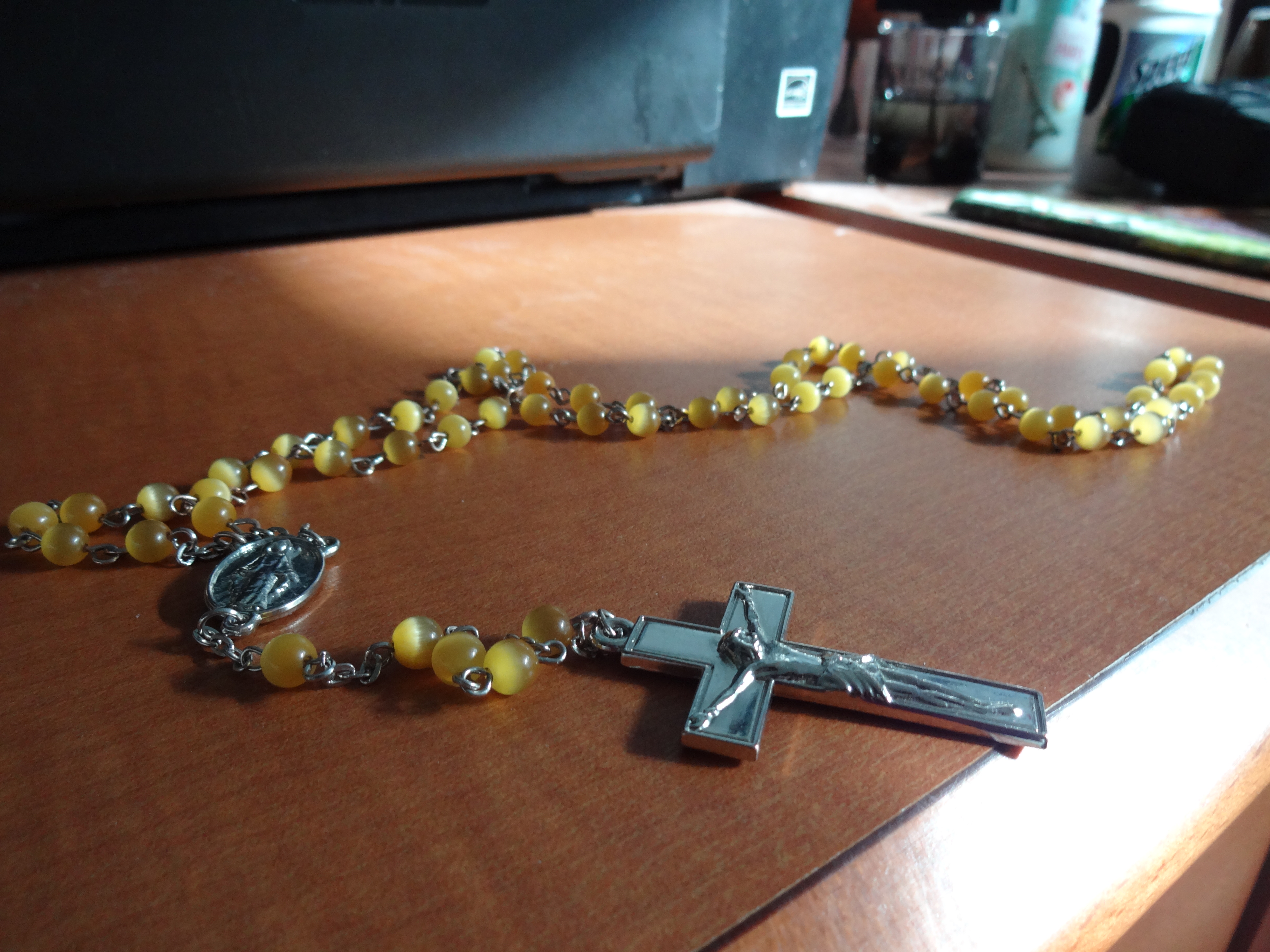
The beads together are about a foot long. The rosary is filled with yellow beads down a long metal chain. The separation between the beads from start to finish are about a half centimeter apart, with some variation as you go down the beads. They then become about a centimeter apart in some areas, but return to half a centimeter. As you continue on the chain of bright yellow beads, like a ring of suns attached to one another, the chains meet at an end. The ends are attached to an oval metal piece. On the oval is an engraved figure of the Virgin Mary. As you continue to scan the rosary beads, the metal pieces become one and are hooked to a cross, where Jesus is engraved with arms spread, a depiction of the day of his death. At the end, the rosary beads continue to have variations between one centimeter and a half a centimeter apart.

The beads are sphere-like and soft. Rosary beads come in all different types of materials, but mine seem to be pearls. The cross’ edges are sharp and as I begin to touch it, my thumb slowly elevates with the shape of Jesus’ body. Above the cross, Mary’s figure on the oval is less dominant. The sides of the oval are smooth, and her body creates less elevation as you rub your fingers on top of the oval. When you put the beads in your hand and shake, they create a jingle. It’s not loud or obnoxious, but there’s a clear tune when the beads hit each other. It reminds me of the time when I used to play with my grandmother’s rosary beads, located at the top of her dresser. She didn’t like that very much.

Although the rosary beads stand for a religious symbol, I have modified it to mean so much more. The beads and chain symbolize the connection my mother and I have. As it becomes one, I realize that we are one in the same. She’s my best friend. I find myself praying when times are difficult, and realizing that just like God, my mother is also with me. Although not present in the place where I stand, she’s just a phone call away. She’s proud of me and what I’ve become, but I think I’m more proud of her. It takes courage, determination and love to be who she is.

Don’t get me wrong, I’m still religious today. I usually take the rosary beads with me when I need to travel or when I’m afraid. I stick them in my pockets and grab them at my most vulnerable moments. I also pray with them. I usually just fiddle with them or wrap the beads around my hands and pray. I’ll sometimes say a prayer, or just talk to God. Of course, everyone has their own view on religion. But, I find that there’s comfort in knowing there’s a higher power looking over me, or maybe it’s just my mom.

Victorian Needle Case

needlecase1

needlecase2

needlecase3

The object I have chosen to discuss is a Victorian needle case. This item was found about ten years ago in a box of old family photos belonging to my mother.

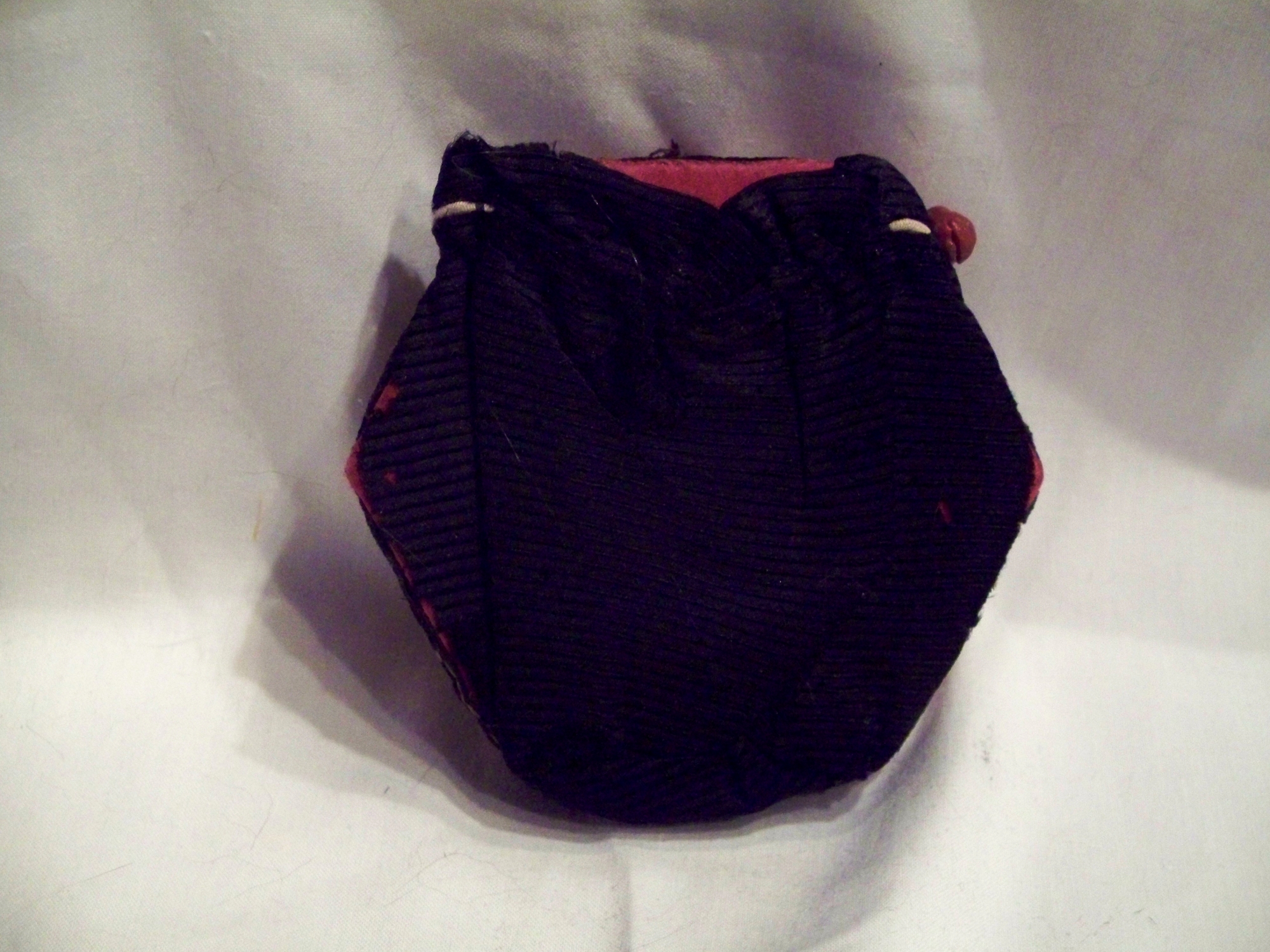
The case measures approximately 3 1/2″ across by 3/4″ thick. It was made from three hexagonal-shaped pieces of a rigid material (cardboard?) covered in burgundy velvet. Two of the pieces are sandwiched together with some type of soft material between, and edged in a strip of black velvet. A feather stitch pattern is embroidered along the edge in silk thread. The case in a closed position is shown in the first photo. On the back, there is a pocket made from black silk. It has a string gathering the top edge, with some type of bead on one side, as shown in the second photo.

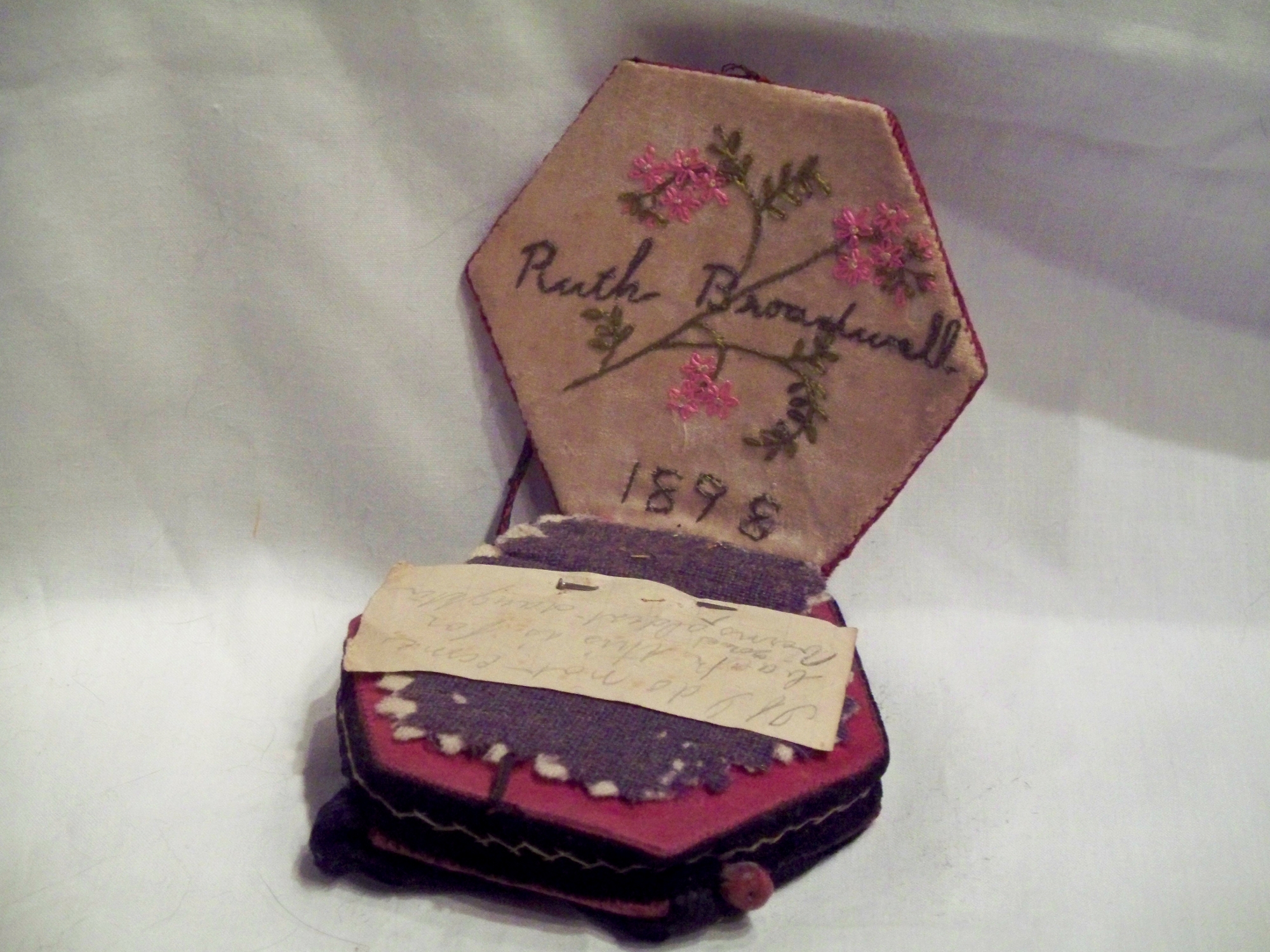
The third hexagon is lined in off-white silk which is embroidered with green and pink flowers and the inscription: “Ruth Broadwell 1898” — obviously the signature of the maker. This section is stitched to the first double-hexagon piece along one edge, with three layers of fine wool fabric between the sections to hold needles; there are three needles and one straight pin still secured to the wool on the underside. Originally, there was a narrow black and red ribbon secured to both sections (which has frayed apart) so that the case would only open to the length of the ribbon.

The care in constructing this needle case indicates that it was a very special object; the stitches are nearly invisible, and the materials are fine velvet and silk, rather than muslin or homespun cotton. But by far the most intriguing aspect of the needle case is the small pencil note pinned to the wool swatches: “If I do not come back this is for Vern’s oldest daughter.” Vern is my great-grandfather, Lavern Buck Howe, and his oldest daughter is my grandmother, Nellie Estelle Howe. The fact that Ruth made the effort to bequeath this object to Nellie underscores the fact that this was, indeed, a precious item to her.

When I found the needle case, I was in the midst of a three-year obsessive genealogical search for my ancestry, and was aware that Ruth Broadwell was related in some way to my great-great grandmother, Amanda Lee Howe. When I chose the needle case for the first post assignment, I checked my database and Ruth was not included. I went online to rootsweb.com, and not only ascertained that Amanda and Ruth were sisters, but also discovered their parents and grandparents — and beyond — generations previously unknown to me! My research will continue for the next assignment in two directions: my own genealogy, as well as research into the history of needlework.

This assignment has reignited an interest in my own family history, a passion which has been on the back burner for ten years. In addition, I have decided to focus my BFA thesis on my ancestry/family tree and the significance of needlework as a connection between my foremothers and myself.

My mug

mug

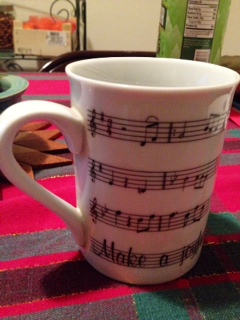
One of my objects that I hold close to me is one of my mugs. Although I have several because tea and coffee make up the only beverages I consume (besides water), this mug is particularly special to me. The mug is white and made from ceramic materials and seems to be about six inches tall and four inches wide. It can hold a decent amount of coffee or tea and seems a bit bigger than an average-sized mug.. Running horizontally across the mug there are four music staffs; three of them have only music notes and the fourth one at the very bottom of the mug has words written across the staff instead of music notes. These staffs run around the entire mug thus, making the details impossible not to see. To my current knowledge the music notes do not represent one particular song but just the beauty of music in general. However I have not played them on the piano yet so that may be something I will do in the future. The music is written under the treble or G clef which gives viewers a better idea of how the notes should be played. There is one sharp shown next to the treble cleft which represents the music’s time signature so Westerners (mainly) know that the notes should be played in the G major scale. Thus, when playing the notes out, one should play F sharp instead of F (unless a note is specified sharp within the music). There is also a ¾ in the time signature which represents the note value within the bar. Dating back to my music theory times I believe this signifies that there are three notes per measure and that the quarter note gets the beat. Music theory can be complicated and I doubt that many people would attempt to play the musical notes written on the mug. However, although I believe they are just there to display the importance of music, I think it is interesting to discuss them in deeper detail.

As stated earlier there is written text on my mug and the font is a bolded black cursive type. The text writes: “Make a joyful noise unto the Lord!” then in very small letters it states Psalm 100:1. Clearly, this message narrows down what type of music may be recorded or represented on this mug. Now the viewer can understand that the written notes most likely represent the music to a hymn or a Christian song. Music serves a great deal in Christian services and this message persuades it’s drinkers to perhaps speak to the Lord through music. The message is written at the very bottom of the mug which may even suggest that all these notes in the staff represent the Lord’s music and we should be using his music only to serve Him. When observing the mug upside down I see from this angle that its edges are fading into a light brown around the circular bottom. However the black staff, notes and text are still very visible to the viewer and this mug has been in use for over a year now so that’s pretty great. There is no descriptive label present on the mug despite the Bible verse acknowledgement. Yet I believe my mother purchased this mug for me off of a Christian website online. The mug feels cool to the touch and if one closes his eyes he can feel the lines of the staff when running his thumb up and down of the mug. These lines stand out tremendously and make the message all the more significant. In conclusion, this mug represents my love of tea-time that I spend with my mother, my love for the most important person in my life – my mother, and my love of singing not only for myself but for my faith.

A Tattered, Personal Edition of Harry Potter and the Sorcerer’s Stone

January 2013 7Harry Potter and the Sorcerer’s Stone, the first novel in a children’s literary phenomenon inspired by a train ride from Manchester to London, resides in millions and millions of homes across the country and the globe, inspiring young minds to read and write with its wonderful, fantastical tale. My book and I are just a part of the masses, yet its fourteen years of wear mark the 309-page novel as an artifact in my library collection—it similarly outdates nearly all objects I own—and is perhaps my most prized possession.

The book marks a muddled childhood and a certain dream. I remember sitting beside my mother, listening to her read an eclectic collection of stories for a seven-and-a-half-year-old. The Magic Tree House series decorated many near-21st-century family bookshelves. I later learned that educators labeled The Giver as a seventh-grade book. In the summer of 1999, before second grade, Mom came home with this now-aged copy of the Sorcerer’s Stone, saying the children’s book displayed in front of Barnes and Nobles amassed rave reviews. I recognized “Harry Potter” since I saw the Chamber of Secrets in my school library only a few months before. While reading the final chapter, “The Man with Two Faces,” Mom confessed she could not read any further, complaining it was “too long” and had “too many characters” to remember. I finished the book that night on my own. From then on, I read every story, no matter the difficulty, by myself.

Examining the contents of my copy, and searching the Internet for well-known facts about the famous book series, I know what I just described is impossible. On the fourth page, on the other side of the title page, at the very bottom, reads the following: “First Scholastic trade paperback printing, September 1999”: that is when I entered second grade. A quick look on Wikipedia will show that Chamber of Secrets entered the US in June 1999; I doubt my small upper-Westchester elementary school library would receive a children’s book about witches and wizards so quickly before I left for the summer. Even if my memories are somehow a lie, that I fabricated details about some of the most vivid moments of my life, my drive to write exists, and I accredit my near-fifteen-year passion to this little tattered book.

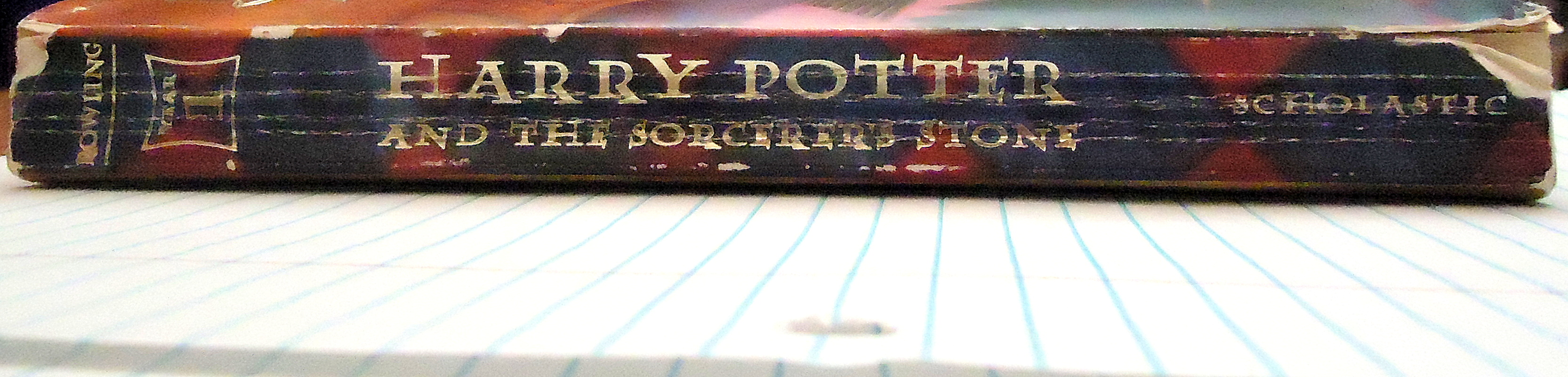
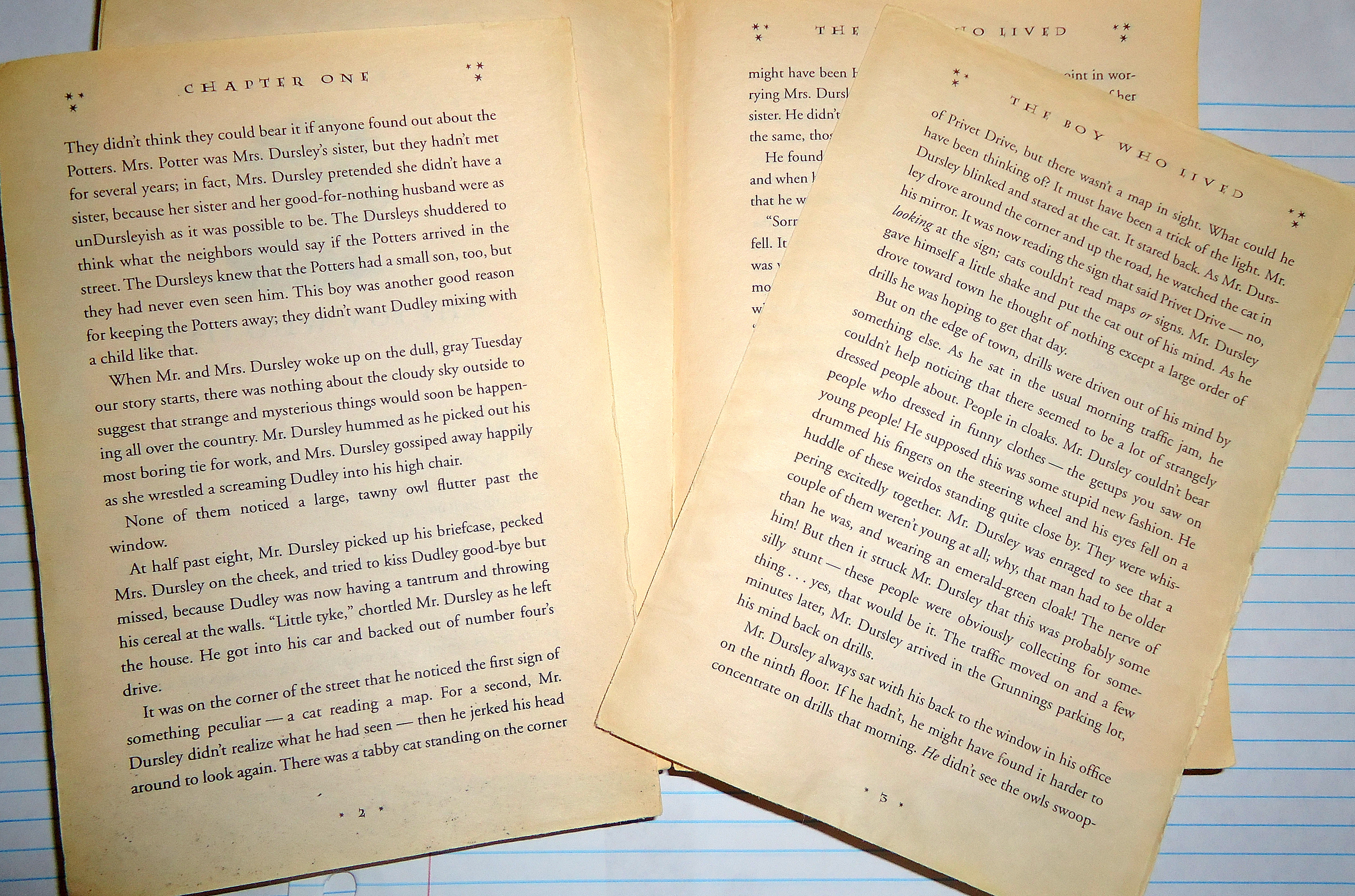
January 2013 15Already, I delved into the appearance of the nearly fifteen-year-old object. The cover and spine display considerably light wear-and-tear, given its age, and the edges are tattered and curled. On the front, a thin line runs between “SORCERER’S” and the bottom hem of Harry’s shirt, matching the several crease lines on the spine. The largest tears are upon the spine; while exposing the first few pages on either side, the curling edges threaten to release all its contents.

January 2013 12On the inside of the front cover, a green Post-It note covers a sticker of a young, short-haired girl in a white nightgown reading a novel, surrounded by copious amounts of blankets and pillows, a window behind providing fair lighting for her literary escape. On the bottom, within a slightly opaque box, reads “Jaime” in bright pink gel ink; a very poor drawing of a heart in the same color ink accompanies the name. In my early elementary-school days, nearly all of my books proudly displayed this label inside their front covers, yet I could not say where you would find these other books. I must have not touched them for years. The Post-it note, a fairly recent addition to the relic, holds some bullet notes for my Classic Juvenile Fantasy Literature final exam. On the other side, random pencil scribbles distract from the “Praise for J.K. Rowling’s Harry Potter and the Sorcerer’s Stone.” A tiny pink splotch towards the bottom proves the child filling her name on the opposite page did not wait for the ink to dry.

January 2013 9The yellowed pages, due to time or my father’s cigarette smoke floating around our household, make the book stand out from any other novel or collection on a bookshelf. Open to the beginning, and detached sheets which describe the Dursleys and their very strange day, will fall into your hands. Bend the book; the pages and binding, used to curving in unnatural waves, will give in to your force. Slide your fingers against the sheets–work them like a flip book–and you will find random folds on the top of pages, notation of numerous readings. Good luck trying to keep the first few pages intact.