The Edge: A History of the SUNY New Paltz Radio Station

The wall outside of the studio in S.U.B.

The wall outside of the studio in S.U.B.

(Click to enlarge images)

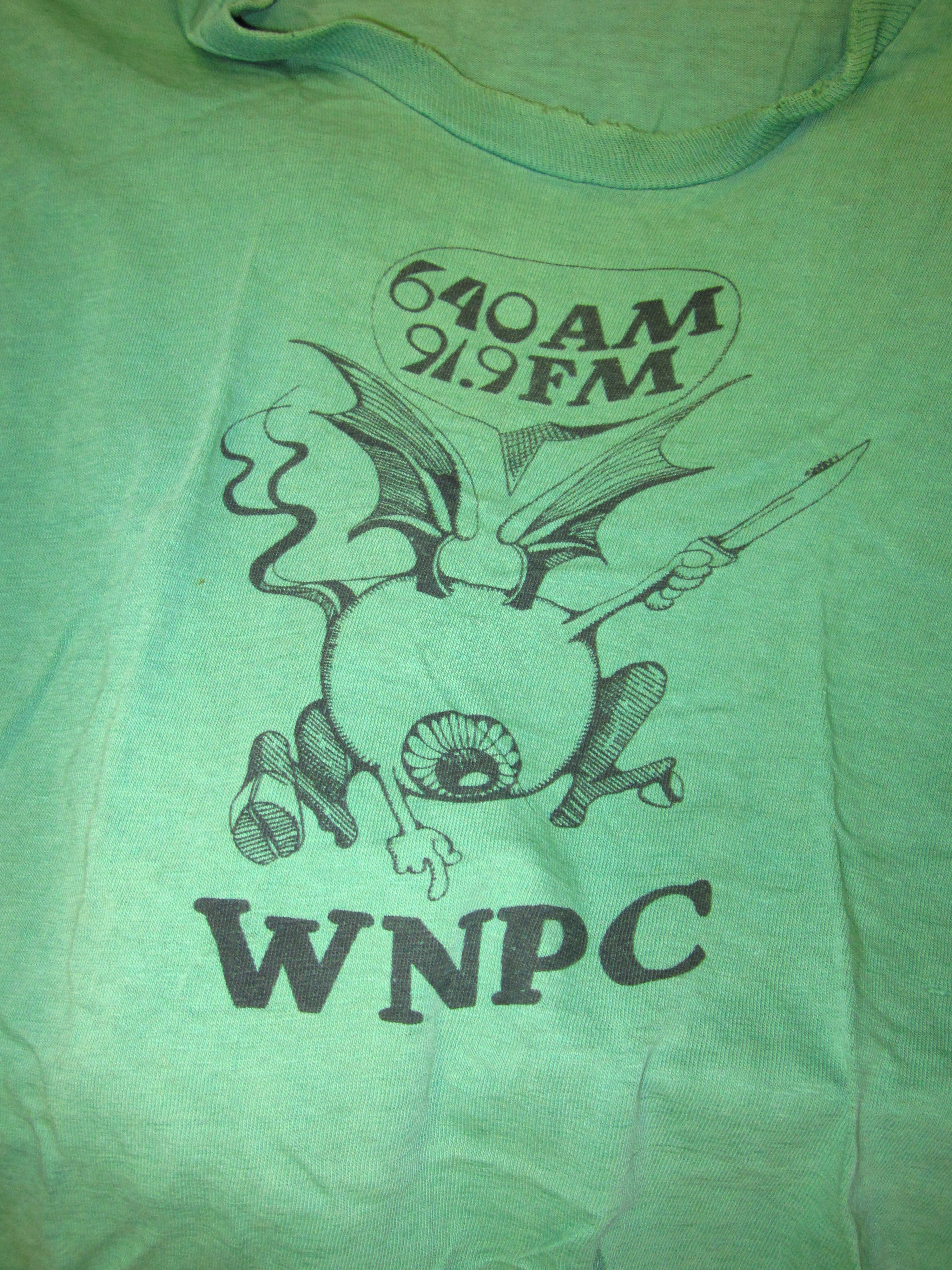
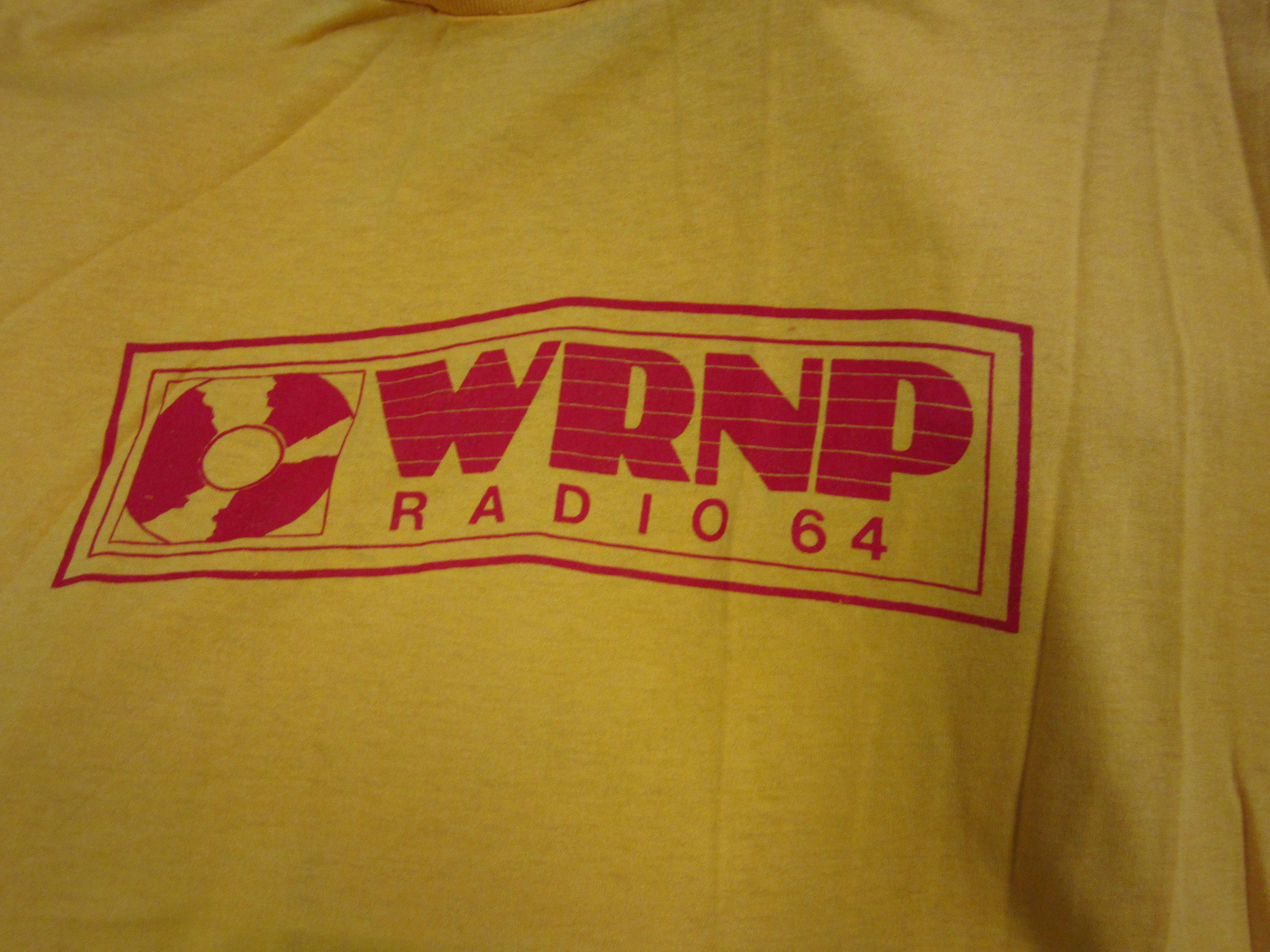
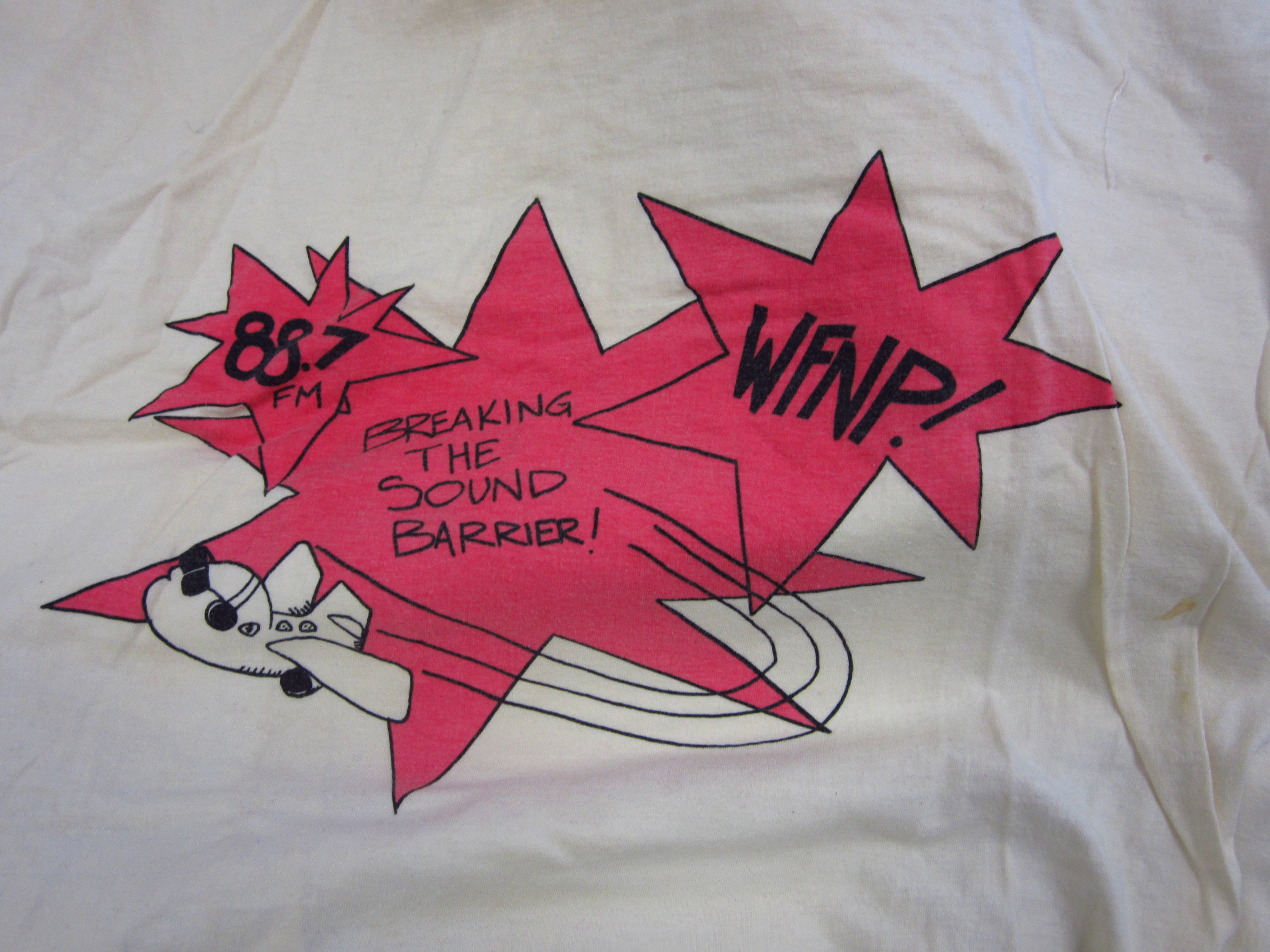
Caption: This collection of T-shirts from the SUNY New Paltz Radio Station demonstrates the development of the radio station across time, as well as providing insight into the history of the New Paltz radio station and how it has influenced the students on campus and the town of New Paltz.

Description: These are a collection of five T-Shirts from the New Paltz Radio Station. The IMG_0878earliest T-shirt is a light green, with an image outlined in black of a winged, hooved eyeball holding a sword and pointing downwards to the station’s call letters “WNPC”. There is a speech bubble above the eyeball with “640 AM, 91.9 FM” within it. This particular T-Shirt is a size large, and has been frayed around the edges with persistent wear. It is made of cotton and is soft to the touch.
The second T-shirt is a bit more simplistic. It is a mustard yellow color, with bright red lettering. There is a red outlined rectangle on the center chest area of the shirt, within it are the updated call letters “WRNP” to the IMG_0879right of an image of a red record. Below the call letters and within the box it says “Radio 64” also in red. This shirt is a size extra large, and has also been worn in excess. Its cotton material has been wrinkled, and is a bit crisp to the touch, as it has been sitting on a shelf for a very long time.
The third is a white cotton T-shirt of size extra large. The front displays an image of three pointed, star-like shapes, similar to those you might find inIMG_0880 a comic book to express an explosion or onomatopoeia. The largest explosion shape in the center reads “Breaking The Sound Barrier” in black lettering. The mid-sized explosion shape on the right hand side says “WFNP!” in bolded black lettering, while the smallest pointed shape on the left side says “88.7 FM” in black lettering. There is a white cartoon airplane with sunglasses and headphones flying out of the pointed shapes. This shirt is wrinkled, and appears to have a few small coffee stains on the front, in addition to some yellowed sweat stains in the armpits.
The fourth is a white cotton T-shirt with a rather large, more intricate design on front. IMG_0877“WFNP 88.7 FM” is written in bright green lettering on the top of the design. The center has the shadow of a human head in black, with green and white images of a leaf, a city, and a galaxy on the area where the brain would be located. This shadow is over a background of a graph of radio frequencies and wavelengths. At the bottom of the design are knobs and meters to measure volume. Curved along the bottom of this design is the expression “open your mind to music outside the mainstream” in bright green lettering. This shirt is a size extra large, and is relatively soft, but still crisp with time.

The final shirt in this collection is a very simple, gray cotton T-shirt with “88.7 IMG_0881FM The EDGE” written in dark blue lettering on the front chest area of the shirt. Underneath “the edge” it names the website, “www.wfnp.org.” The back of the T-shirt says “Bringing You Cutting Edge Music Commercial Free!” with an image of a radio tower emitting a signal below it. The entirety of the design and lettering is in the same dark blue color used on the front of the T-shirt. This T-shirt is also a size extra large, and is soft to the IMG_0882touch. It does not appear to be worn as extensively as the other four shirts.

Provenance: This collection of T-shirts was donated by Dennis O’Keefe. Dennis graduated from New Paltz in 1973. He was the General Manager of the radio station when it was first established in 1971, and he was a key player in the efforts to get the station up and running and wiring the campus for the AM signal. Even after he graduated, he was still an active background member of the radio station and also worked at the campus library. He collected these T-shirts over many years, starting at the birth of the radio station, through its development, and up until his death in 2006. He donated this set of shirts to the Special Collections of the Sojourner Truth Library before he passed.

Date(s) of Creation: Shirts: 1975 to 2006
Radio Station: 1971

Narrative: Although the popularity of radio may be declining now that music of your choice can be accessed at the click of a button, forty years ago, this was not the case. In the 1970’s, turning on your radio was the easiest and most popular way to discover new music and hear classic favorites. So, in 1971, a group of students worked together to establish a college radio station at SUNY New Paltz. The basic foundation for the station began in 1970 when Bruce Blatchy donated a surplus of $40,000 to be put towards equipment for the radio station. From there, he held elections for members of the executive board, which was to consist of students. At this time, there were four student positions: General Manager (Dennis O’Keefe), News Director (Robert Sholinsky), Program Director (Donald Weinstein), and Chief Announcer (Marc Greenberg). A single faculty member, Phil Livingston, oversaw the entire operation; but it was his intention that the students be the primary leaders of the station.

Space was set aside for the new station studio in the soon-to-be Student Union Building, but while that was still being built, the station was temporarily housed in the basement of the College Union Building, were the Yearbook committee worked. To the discontent of the Paltzonian President, they would be moved to a smaller room so that the station could be set up. The president of the yearbook club adamantly rejected this, and in his anger, quit his duties as yearbook coordinator. To this day, there is still no 1973 yearbook.

Amidst setting up the studio, students on the executive board were also needed to wire the campus for the AM frequency. This entailed draining the sewers and crawling through manholes in order to run cable to each of the dorms and the health center. A dirty, but necessary job for the effectiveness and legitimacy of the station.

With the cables set up, and the studio equipment set up in the College Union Building, the signal was ready to be sent out. Being that they were a new station not yet regulated by the Federal Communications Commissions (FCC), they were assigned the AM frequency of 640 kHz. Their call letters were WNPC, standing for New Paltz College. As of February 1972, students could listen to their peers’ broadcasts on their radios in their dorms.  By 1973, they obtained permission to broadcast over cable television on an FM frequency of 91.9 kHz. This allowed those in the village of New Paltz to tune in, so long as they had cable television.

By the Fall of 1973, the Student Union Building had been completed, and the station moved to its new studio on the fourth floor of the S.U.B. With this new space, the staff expanded, adding on the positions of Music Director, Chief Engineer, Advertising Manager, Production Manager, and Public Relations. The budget granted to the station was growing rapidly each year from $7,300 in 1973 to $10,000 in 1975. The station was becoming more and more successful and professional. Plenty of students on campus could tune in to hear classic rock, jazz, blues, talk radio, news, and so much more. Schedules of various WNPC shows were ever present in the campus newspaper. It was a popular and accomplished college radio station.

A DJ hard at work in the studio.

A DJ hard at work in the studio.

The call letters for the station changed a few times over the next several years. In 1976, WNPC became WRSW. By 1981, it had changed again to WRNP, standing for Radio New Paltz, which it stayed for the next eleven years. In 1992, the call letters changed to WFNP, which it still remains today.

As of 1980, the station was actively seeking FCC certification so that it could broadcast over FM radio. After several years of hard work and sales pitches to the FCC, the station was finally granted certification in 1989. It has been on 88.7 FM since then, sharing the waves with the classical station WRHV. The New Paltz radio station has one of the tallest transmitter towers of any college radio station, broadcasting 65 miles out. By the early 2000’s, the station updated its daytime programming from AM radio waves to a webcast that can be accessed from anywhere in the world at www.wfnp.org.

This station is not a club, but is a professional radio station that is held in high regard. It has allowed students to discuss serious world issues, broadcast important events, and provide easy listening to the entire Hudson Valley. It is a place where students can come together and learn how to use valuable equipment as well as speak professionally on the air. This collection of T-shirts illustrates the growth and evolution of a small college radio station that became a professional, legitimate station accessible from around the world. WFNP The Edge is an example of how far this school has come and all that it is capable of.

Some signatures of the stations DJs since 1973.

Some signatures of the stations DJs since 1973.


References:

Calabrese, Bruce. “What’s Happening With WRNP Radio?” The Oracle [New Paltz, NY]. 9     Mar. 1988. Print.

Combier-Kapel, Elise. “SUNY New Paltz Radio Station: a compilation of articles reprinted    from the Oracle and other sources.” Sojourner Truth Special Collections. New Paltz: 2010. Print.

Lugo, Anthony. “FM For WRNP Radio Closer Than Ever.” The Oracle [New Paltz, NY]. 22 Oct. 1987. Print.


The Swan Down Gloves

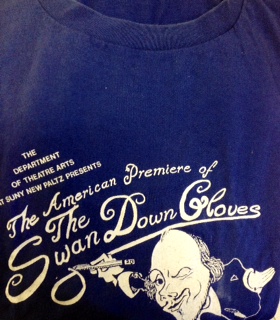
Caption & Description: A worn-out, short-sleeved T-shirt dating back to the 1980s that represents qualities ranging from pride, participation or simple appreciation for a good performance. This royal blue T-Shirt reveals a casual fit to its subject and is made up of cotton fibers. The thin white tag which depicts these details resting in back of the shirt is extremely fragile and displays almost no readable print. The material has a dry feel to it yet the detail in the middle of the tee ironically can be easily read and possesses very little fading. The text states: The Department of Theatre Arts at SUNY New Paltz Presents The American Premiere of The Swan Down Gloves. The character detailed under the writing most likely represents one of the main characters of the show known as Mazda, the Master of Shadows. But why was this production and t-shirt, among the dozens of musicals performed within the Theatre Arts department at New Paltz, cherished and seen as so significant in the eyes of all those involved? 

Provenance: Although no definite information has been confirmed, this t-shirt is believed to have been donated by the original director and writer of the show – Billie Brown – to the SUNY New Paltz memorabilia collection. Another assumption reveals someone within the theatre arts department saved and stored away the shirt. Surprisingly, as productions played a frequent part in the life of a theatre major, shirts representing each production were not always created. However because this was such a special show, the department made an exception so the shirt could serve as a way to remember the achievement of SUNY’s first American Premiere of London’s The Swan Down Gloves. Other items related to this show are also saved within SUNY New Paltz’s special collection such as the directorial notebook of the show with all the notes, stage directions and cast lines.


According to the New Paltz Oracle newspaper, the cast of the theatre art’s production of The Swan Down Gloves dates back to late March and early April of 1987. The exact show dates were March 26-29 and April 2-5. The performance was held in McKenna Theatre and the general admission ticket was $7. The oracle had frequent advertisements for college productions and even occasionally had reviews for certain shows for the public to read about. This production is just one of the examples of the richly talented contributions that the fine and performing arts departments within the college that is SUNY New Paltz. However, what makes this production particularly extraordinary is the fact that the theatre department at SUNY was the first group to stage an American version of this London production. Thus, the original director Billie Brown came to SUNY New Paltz to see the show and Nigel Heiss, the show’s original composer also came to New Paltz to assist with musical numbers.

Based off Billie Brown’s book, The Swan Down Gloves has the potential to captivates the minds of any audience with its imagination rendering mystical characteristics. The show debuted in London, 1981 with The Royal Shakespeare Company and through its distinctly pantomime way of being, proves to be a particularly unique show in itself. Generally, the show appears to be a spoof on William Shakespeare’s early life and includes several comedic characteristics that parallel with Shakespeare’s plays. The New Paltz Oracle describes in its description of the performance as: “A frolicking, rolicking romp through the joyous and sometimes bawdy realm of fable and fairy tale where boys play girls and vice versa, rats read Neitzsche and fairies guzzle gin”. This “bawdy realm” includes the simple plot of characters Kit (a glove maker) and his brother Will setting out on a journey to deliver a pair of special gloves to the court of London. The characters encounter many obstacles and throughout the show the audience becomes acquainted with vibrant characters such as Mazda – the Master of Shadows, Lumina – The Lady of Light and of course, Lady Alice – the sex kitten. (insert footnote). The characters’ outstanding experiences throughout the show seem of greater importance than the actual storyline as a review by John Barber states: “The script…….gives classical actors every chance for outrageous burlesque of panto people and conventions”. Clearly, the performance requires tremendous talent and ability which the theatre arts department could take grasp and re-create in the still very familiar McKenna Theatre.

Although little is still documented on the specific casting details and highlights of this show, the production of Billie Brown’s: The Swan Down Gloves was one to remember and appreciate during its current time and still today. This new type of performance composed of pantomime and Europe’s comedia dell’arte influences, introduced its audience to a different type of show.  This show displayed little similarities to popular musicals that were more commonly displayed in American playhouses. Thus, this show paved the way for a different type of audience and a different approach to theatre. SUNY New Paltz was gifted with this wonderful opportunity and so opened its doors to diversity within the theatrical performance world.

 Image


*sources to be continued 

“After Labour, Reward”

This pin was donated to special collections by Richard Hasbrouck in 2006. It was presented to a member of his family back in 1891.

In a dainty plastic bag in Sojourner Truth Library lies a beautiful golden pin on a chain. It is not a white gold— it is a yellow gold, either due to what it is made from or because of over one hundred years of exposure to the sunshine and oily hands. The pin is small, measuring ½ inch tall by ¾ inch wide. It is shaped like an open, hardcover book. In delicate cursive script, “After Labour Reward 1891” is engraved onto its surface. “After” and “Labour” are on the left page, and “Reward 1891” is on the right page. The pin, although solid, is well designed like a book, and the “pages” are not flat- they have a slight curve to them which makes them more realistic. Twenty six small, golden loops attached together connect the book to its pin. The chain is four inches long, and the needle is about 1 ½ inches long. The needle section of the pin is not purely a pin plated in gold, in the middle it has a swirl to it, as though it was taffy that somebody had decided to twist. Like a sewing pin, this pin has a small golden ball at its top.

Along with the pin in the collection was a sheet saying that the pin was presented to either Charlotte E. Reeve or Laura Hasbrouck. However, in the Auld Lang Syne yearbook, the classes from several years around 1981 are listed. Each class has a “slogan.” The graduating class from June 1891’s slogan was “After Labour, Reward.” There are twenty five students in this graduating class. However, only Charlotte E. Reeve is listed in this graduating class, so it would make the most sense that she was the student who was presented with this pin, not Laura Hasbrouck, because this pin was presented to the graduating class, and Laura Hasbrouck is not one of the twenty five names on the list.

This is significant to New Paltz history because it represents the growth of our university. ***

Image

Ariel Books Clock

Image

Overlooking the bustle of New Paltz’s Main Street, this clock represents the history of the business that is no longer there. Ariel Booksellers (1971-2005) was once a cornerstone of the town, offering a wide selection of books for community members and college students alike. Now the clock pays tribute to the fallen establishment and evokes a sense of mystery to those who seek it.

Description:

The clock is apparently round and contained in a metal frame. I might estimate that it is about 2-3 feet in diameter, although I am not confident in that measure. The hands are black and rounded. In place of numbers there are letters and symbols as following: 12->”I”, 1->”E”, 2->”L”, 3->”♦”, 4->”S”, 5->”K”, 6->”O”, 7->”O”, 8->”B”, 9->”♦”, 10->”A”, 11->”R”. When looking at the time from afar, the clock reads “ARIEL BOOKS”. The time is never correct, and I believe it may be frozen at 7:34. The clock is located above the Starbucks at 1 Plattekill Avenue.

Provenance:

The clock first appeared on Main Street after Ariel Booksellers’ owners Dean and Susan Avery decided to add another addition to their store (where the current Starbucks is located) in 1999. It has been that spot ever since.

Date of Creation: 

1999

Narrative: 

In the heart of New Paltz lies a constant reminder of its timelessness: the Ariel Books clock.

Right at the corner of Plattekill Avenue and Main Street is arguably the busiest intersection in the town of New Paltz, acting as a bypass for those travelling through the town, yet riddled with crosswalks where pedestrians control the traffic. Here there is a sense of ebb and flow, of intuitiveness and trustingness, that makes this a rich community center. Appropriately, this is the location of the Ariel Books clock. When a person comes to the town for the first time, whether a tourist or college freshman, he or she may notice the clock and how it adds to the small town charm. However, if there is not too much glare from the sun and the visible situation is just right, someone can make out the letters around the face of the clock, paying homage to an “Ariel Books”. Although the book store is no longer around, it had been a community staple and a part of New Paltz’s history.

Dean and Susan Avery came from New York City and fell in love with the New Paltz charm. By 1971, they opened the bookstore, occupying half of the space which was once a gas station (while the other half was used as a shoe store.) The name “Ariel” came from a reference to poets Percy Shelley and Sylvia Plath. At the time, there was only one other bookstore nearby, so Ariel had no problem becoming a community staple.

As the years passed, the Avery’s added space to the store, widening their inventory and increasing their counter space. The addition in 1985 led to an increase in student supplies to cater to the nearby SUNY needs.However, it was the renovation in 1999 that was the most dramatic. The addition would increase the bookstore’s size by 525 square feet, while adding an additional 1,300-square-foot cafe space. In order to keep up with their large chain competitors like Barnes and Noble, the Avery’s planned to incorporate a cafe into their business.

Image

Right after the renovation was completed, the soon-to-be Starbucks is shown here without the clock.

Herein lied the question of what cafe should occupy the space. Although the Avery’s had tried to bring in local businesses, they found no success in doing so. In their 28 years of being in New Paltz at that point they had seen the rise and fall of several failed cafes and did not want to repeat the pattern. So the Avery’s opened their space to Starbucks, but were met with major controversy from members of the Village planning board. Starbucks represented large chains and big business that were thought to detract from the small town, independent feel of New Paltz. However, Starbucks won out and opened their doors on November 6, 1999.

The Avery’s claim having  the coffeeshop as tenants helped keep their business thriving for as long as it did. However with the decline in book sales, Ariel Booksellers, like many other independent bookshops, had to cut its losses and close in 2005.

Sometime before its closing and after Starbucks moved in is when this clock made its first appearance. Perhaps it was the Avery’s way of appeasing the town members who were concerned that big business would ruin the independent spirit of New Paltz. As if labeling the building as property of the bookstore, where a big-time chain would be reminded of its small-town landlords. Facing out on the bustling New Paltz Main Street, the Ariel Books clock tells time in more ways than one.

References:

“Ariel Booksellers plan expansion.” 31 Jan 1985. Print.

Fanelli, Diane. New Paltz News. 27 Oct 1994. Print.

Hoffman, Mala. “Literary Achievement.” The Huguenot Herald. 24 Aug 2000. Print.

Newman, Rich. “Starbucks to make a splash next door to Ariel Booksellers.” The Times Herald-Record. 30 Oct 1999. Print.

O’Corozine, Rich. “Ariel Booksellers celebrates 25 years in business.” The Huguenot Herald. 5 Dec 1996.

Quinn, Erin. “Bestsellers and beans”. The Huguenot Herald. 17 Sep 1998. Print.

Quinn, Erin. “Off the Shelf.” The Huguenot Herald. 30 Jul 1998. Print.

The Hester Elting Sampler

1989.6166.01 (4)
CAPTION:

Hester Elting created this “marking sampler” in 1808, when she was about 9 years old. An embroidered sampler of this era was used to teach a young girl the alphabet and numbers, as well as how to spell her own name. It was necessary for a girl to learn how to stitch in order to mark linens, whether her own or her employer’s if she entered into domestic service.

PHYSICAL DESCRIPTION:

The Hester Elting sampler is wrought in blue and red cotton thread on homespun linen, and is 7″ x 10 1/2″ in size. Secured to the top edge is a sample alphabet of letters A through E, on finer linen (perhaps imported from Europe) and probably made by Hester’s teacher, attached as a guide for her work. Hester stitched the alphabet in both upper and lower case letters, and included numbers one through ten. She added rows of decorative border stitches to separate the bands, and signed it “Hester Elting in the 10 year of life.”

DATE OF CREATION: c. 1808

NARRATIVE:

Hester Elting was born on November 8, 1798, in New Paltz, New York, the daughter of Johannes Elting and Jannetje Wurts. Although the Elting family was not one of the twelve original founding families of New Paltz, the family exerted a significant influence from an early date. The great-great-grandfather of Hester’s father Johannes was Jan Elting, who immigrated from the Netherlands in 1657 to Long Island; the family later settled in Hurley, New York, just across the river from the future New Paltz settlement. He was among the witnesses to the purchase of land by the French Huguenots from the native American Lenape people in 1677. In the early 1700’s, Jan’s eldest son Roelif moved to New Paltz, and married Sarah, daughter of Abraham DuBois, one of the original patentees of the settlement. Hester’s mother, Jannetije Wurts, was the daughter of Dr. George Wurts, the first resident doctor in New Paltz, and Esther Hasbrouck; Esther was the great-granddaughter of Jean Hasbrouck, another of the original New Paltz patentees.

It is uncertain what type of education was available in New Paltz prior to the founding of the first district school in 1812. At that time, it was typical for children to be taught to read at home because it was important that everyone be equipped to read the Bible. Once a child could read, boys and girls often attended classes in the home of a woman in the neighborhood; these schools became known as “Dame Schools.” Hester’s second cousin Rebecca, nine years older, established a “Select School” for girls on 111 Huguenot Street in 1840, which continued until l853. Hester’s may have attended such a school when she stitched her sampler in 1808, but since the sampler is quite basic, she most likely completed her sampler under the tutelage of her own mother or another relative.

The embroidery sampler has a long history in Europe. The earliest dated sampler is housed in the Victoria & Albert Museum in England with the date of 1598, but references in literature occur even earlier. Originally a sampler was long and narrow, and contained a variety of stitches and motifs which could be used for future embroidery work. These pieces were stitched by experienced needleworkers, rolled up and kept in a sewing basket for reference. An example of such a sampler wrought by Loara Standish, daughter of Mayflower passenger Myles Standish, is located in the Pilgrim Hall Museum of Plymouth, Massachusetts. The sampler is dated c. 1653 when Loara was age 21.

With the arrival of the printing press, stitching patterns became readily available and the function of the sampler gradually changed. Education for boys and girls differed in early America. After learning to read, boys would be taught to write, a skill called “penmanship,” followed by arithmetic, to be used in the professions and trade. Girls, however, had no need to learn those skills and were instead taught to read and sew. Reading was taught orally; it was not necessary to be able to write in order to read. The Hester Elting sampler is an example of the new function of needlework: a young girl would be taught her alphabet and numbers by way of embroidery, learning to stitch at the same time. Since household linens were precious, a wife would “mark” them with initials and numbers so that each item was indentifiable and could be rotated for even wear. This skill was also taught to girls for use in domestic service employment.

Hester Elting married Thomas W. Deyo on February 20, 1819; she was 20 years old. She gave birth to a son, baptized Mauritius Deyo, on December 24, 1819. Hester died a week after her son’s birth on December 31, 1819 — barely 21 years old. The risk of childbirth remained acute until the late 19th century. Women had many children because the rate of childhood mortality was high: nearly one-third of children would die before reaching the age of 21. Every woman could expect to lose one or more of her children. “Maternal mortality,” death from complications of childbirth, was very common. Bacterial infections and phlebitis contracted during childbirth caused death for as many as one-sixth of the women who died during childbearing years. As many as 1 in 8 women would die in childbirth!

PROVENANCE:

Hester Elting Deyo had only one child, Mauritius Deyo. Mauritius Deyo was married to Mary Jane Winfield. They had 4 sons as of the 1875 New York State Census, residing in Hyde Park, New York. The rudimentary homespun sampler stitched by nine-year-old Hester Elting in 1808 was significant enough to be saved and passed down through the generations. The sampler was passed from Mauritius, to his son Ernest, to his son Alfred, to his son John Winfield Deyo. In 1989, the piece was donated to the collection of Historic Huguenot Street by John Winfield Deyo, along with many other documents from family archives. Portraits of Mauritius Deyo and Mary Jane Winfield Deyo currently hang in the “Deyo House” on Huguenot Street.

REFERENCES:

Friedland, Anne. Dutchess County Historical Society Yearbook, Vol. 79 (1994), 22-36. Poughkeepsie, NY: Dutchess County Historical Society. Print.

Heidgerd, William. A History of New Paltz, Bulletins No. 4 and 5. New Paltz, NY: Elting Memorial Library Haviland Collection. n.d. Print.

Larkin, Jack. “’No Force Can Death Resist‘: Reflections on Child and Infant Mortality in American History.” Sturbridge, MA: Olde Sturbridge Village, Inc. (2000). Web. 5 Apr. 2013.

Monaghan, E. Jennifer. “Literacy Instruction and Gender in Colonial New England.” American Quarterly, Vol. 40, No. 1 (1988). Web. 30 Mar. 2013.

New York State Census, 1875 (image of original document). Familysearch.org. Web. 20 Mar. 2013.

Peck, Amerlia. “American Needlework in the Eighteenth Century.” Heilbrunn Timeline of Art History. New York: The Metropolitan Museum of Art, 2000 –. Web. 5 Mar. 2013.

The Deyo (Deyoe) Family. New Paltz, NY: The Deyo Family Association, Huguenot Historical Society (2003). Print.

P&G’s Lapel Button

Note: Most of this is very much a work-in-progress. Since I did not receive word back from the owner of the button in time, I could not provide images or fully research the item. I also need to look back for a few extra bits of information in the Oracle. I might even have to research Manny’s, if that is where the button was really made.

Pat & George’s Lapel Button
New Paltz, New York
On the button reads “Pat and George’s” and “Make Orgies, Not War.” From such clues, the item places New Paltz at the heart of the counterculture movements in the mid-twentieth century, where the sexual revolution combines with dominant anti-war sentiment.

Physical Description:Cannot be determined.

Provenance: To be determined. Likely was either created at P&G’s or Manny’s between 1947 and 1980s, when the restaurant was known as Pat & George’s due to changes in ownership. Ed and Mike Beck, previous and current owners of the establishment, have no clue about the button and the whereabouts of the owners beforehand. I am currently attempting to contact the current owner of Manny’s and the owner of the lapel button in question.

Date of Creation: Between 1947 and 1980.

Narrative:
The button pulls New Paltz into the grand narratives of the Vietnam War and the sexual revolutions from the 1960s to 1980s. On October 14th, 1969, in the same year Edwin Beck purchased P&G’s, the Oracle publishes an open letter “sent to all New Paltz merchants concerning their role in tomorrow’s Vietnam Moratorium.” To protest the war in Vietnam, at a point when thirty-five thousand Americans have died and after five years of demonstrations and outrage, students initiated a movement to stop all town activity on October 15th, 1969. “Students and other citizens are going to suspend their normal activities by not attending school or work,” so town merchants were similarly encouraged to “not conduct business” and join with Poughkeepsie and many American communities in protest. The open letter gets more serious in its urgency for action and repercussion:

UUP and P&G 022“This is part of a continuing nationwide protest that will begin on the 15th of every month with an additional day of protest each month the war continues. Thus, in November it will be a two day protest, in December three days, etc. However, we are only asking our merchants to close the FIRST protest day of each month, beginning at 12:00 noon.
Any store remaining open the first day of protest each month will be boycotted for a period of one week this month followed by an additional week each succeeding month.

Such efforts join country-wide sentiments and actions against the war. On November 15th, 1969, more than five-hundred thousand people marched on Washington to protest the war, remaining the largest political rally in history and eliciting no response from the government. The war continued on until April 30, 1975, but the Vietnam Moratorium at New Paltz did not. (insert info about last mention of Moratorium in Oracle)

Not long after mentions of the Moratorium, Oracle issues in 1970 and 1971 feature campus events and discussions about sex in their “This Week On Campus” column. Little other news about sexual revolution activities exist in SUNY New Paltz news until the 1990s, when the school hosted a sex conference which included a lecture panel on sadomasochists, and instructional workshop on sex toys. However, mention of sex talks in the Oracle already shed light on the socially-progressive nature of the campus in the late 1960s and early 1970s, influenced by popular sex-liberating literature such as The Feminine Mystique by Betty Friedan (1963) and nationally-recognized protests such as the Stonewall Riots of 1969. Such cultural exposure allowed the “Make Orgies, Not War” button to exist, as more prudent towns would never hold such items.

The lapel button finally offers the deeply rooted connection of SUNY New Paltz to its surrounding community. After Edwin Beck took ownership of Pat & George’s in 1969, he hosted a party on-campus to introduce students to the restaurant. Subsequently, issues of the Oracle featured advertisements for Pat & George’s nearly every other issue. Nick Wesley, a disgruntled student writing in the Oracle on October 14th, 1969, expresses his disapproval of the Moratorium because “P&G’s is closing for the afternoon” and such would anger many World Series fans and picketers. Prior to that academic year, there is no mention of the establishment in the campus newspaper, confirming claims on the P&G’s website that Edwin Beck’s party at SUNY New Paltz reached out “to a wider audience and gave the students… a new place to call home.”

This button explains why there is a party life at SUNY New Paltz, why students today flock to P&G’s, McGillicuddy’s, Cabaloosa, Oasis, Snugs, and many other local institutions on weekend nights for their party fixes. These restaurants and clubs can owe their late night business to Ed Beck, an ambitious business man who converted his neighborhood bar into a local institution shared by townspeople and students alike. Because of his keen interest to invite the college students off campus, demonstrated by the liberal-minded button evoking the sexual freedoms and anti-war sentiments of 1970s college students, Edwin Beck converted New Paltz into the college town it is today, flourishing due to active student involvement at off-campus institutions.

References:
“A History of P&G’s.” P&G’s. 2012. Web. 29 March 2013.
Oracle, 1967 to 1971. Microfilm.
Skarda, Erin. “Moratorium Against the Vietnam War, Nov. 15, 1969.” Time. 28 June 2011. Web. 04 April 2013.
Wishnick, Ken. “The “Hello New Paltz” Show #113- Mike Beck.” Vimeo. 2011. Web. 29 March 2013.

Section headers for the site

Screen Shot 2013-04-03 at 12.04.42 AM

graphic translation of the stained glass window in Old Main

Screen Shot 2013-04-03 at 12.01.06 AM

The Mountain and the tower

Screen Shot 2013-04-03 at 12.01.49 AM

New Paltz Historical sign

Screen Shot 2013-04-03 at 12.03.55 AM

Graphic Translation of one the projectile points from Professor Diamond’s  collection

sorry they are kind of small….it would let me post them any larger, you can see the larger image if you click on them! These are the headers for the top of each of the different sections of objects for the omeka sit thus far. Let me know what you think!

Jennie C. Overton’s Autograph Book.

When Jennie C. Overton passed around her velveteen autograph book in June of 1889, she was creating a souvenir of her years at university that would last her a lifetime. Fellow classmates inscribed their names, inspiring quotes, and loving memories on each page, sometimes accompanied by photographs or hand-drawn illustrations. What the graduates of the New Paltz Normal School may not have realized at the time, however, was that their signatures, scrawled in perfect script, would document their experience for centuries to come. 

The book itself is moderately sized, approximately 8.25 inches in length, 7.25 inches in width, and .5 inches high. The cover, wrapped in plush, soft, blue-grey velvet and imprinted with the word “Autographs,” is starting to fray and become patchy with age. The pages, once crisp and firm, are yellowed around the edges and delicate, smooth but slowly turning to dust. A beautiful cover page, decorated in blues, creams, and browns, pictures a young lady reading, perched comfortably on the letter A for autograph.

And on the first page of the book, written in slanted, neat cursive, the name Jennie C. Overton

We might picture Jennie, perhaps sitting at her writing desk, perhaps in her bedroom, casually writing her name in her brand new autograph book, unaware of how this one single act would lead a future SUNY New Paltz undergraduate student to research her life and death, her impact on the world. Who was she? Where was she from? What was she studying? 

Jane C. Overton, nicknamed Jennie, was born on October 29th, 1865 in New York. Her parents were Wallace and Anna Overton, and she had three siblings: William, ten years her senior; Edna, two years her junior, and Lillie, four years her junior. The family started in Islip, on the south shore of Long Island, NY, but eventually moved to Bayport, NY by the time Jennie was 14. Her father was a farmer and her mother a housewife. 

There is not much documentation of Jennie’s life in the years before her arrival at the New Paltz Normal School. Once there, however, Jennie studied English and obtained her degree in 1889. At her commencement ceremony, Jennie presented an essay called “The Universal Language,” in which she discussed the promise of the Volapük language. Volapük is a constructed language that was created in 1879-1880 by Johann Martin Schleyer, with the goal of creating one language that all people of different countries could learn and speak. In her speech, Jennie said, “The world needs a common and simple medium of expression. Many attempts have been made to supply this need, but Volapük is the first and only one that gives evidence of success.” 

Jennie returned to New Paltz Normal School a second time, graduating with a second degree in old elementary English in 1893. Her roommate of that year, Bessie Monsell, wrote lovingly in her book, “I shall always look back with the greatest pleasure to the happiest year of my life which was spent with you, and to that time when I found a friend, that was a friend indeed. Remember me ever, as your loving room-mate of 1892-93, Bessie R. Monsell, Greenport, NY.”

Jennie disappeared from records again until 1900, when she is documented living with her parents in Bayport and working as a teacher. At this point in time, aged 35, she was still unmarried.

Another page of her autograph book is signed by Clara T. Hawkins and reads:

“To Miss Jennie C. Overton,

‘Only do thou in thought
And heart, to Him hold fast;
Be patient; more than thou
Hast sought,
Will come to thee at last.’ 

Lovingly yours,
Clara T. Hawkins,
South Haven, L.I.” 

The inscription would prove to be prophetic in a way. Sometime between 1900 and her death twelve years later, Jennie C. Overton would marry Clara T. Hawkins’ brother, Irving Hawins. They never had children. 

In July of 1909, the Kingston Daily Freeman noted that a Jennie C. Overton of Bayport, NY, entered Sahler’s Sanitarium in Kingston, NY. It is likely, judging by her death a few years later, that this was the same Jennie.

Jennie’s husband died in 1911, followed shortly by Jennie herself on the 28th of April, 1912. She shares a plot with her husband in the David Hawkins Cemetery in Suffolk County, New York.

The Psychology of Things

ImageIf our bodies were corporations, our brains would be the big bosses in crisp black suits that hold all of the power and make the executive decisions. Our brains are so powerful— they determine our outlook on life, how we interact with the world, and how we think about objects. Psychology is the scientific study of the mind and its functions. Psychologists have scrutinized the relationship between people and objects for many years since objects play such a significant role in our society. Even thousands of years ago, before items were easily available to many people, groups of humans used the environment around them to create objects that had some sort of purpose, either for enjoyment, survival, or simply to make life easier.

So what is so fascinating about our minds when it comes to objects? Each individual perceives the world around him or herself differently, which leads to many perspectives on objects between different individuals, families, communities, and cultures. If one specific object could travel around the world and meet every culture on our planet, it would be treated in hundreds of different ways since many cultures would view the object in unique ways from another culture.

Because the mind is so complex, there are thousands of topics psychologists can study in relation to objects, including differences in cultural views on objects and materialism, attachment to objects in adults and children, and consumer psychology. Through study of these topics, psychologists have been better able to understand how the human brain works and explain why humans act the way they do towards objects.

Image

Through researching worldviews on objects and materialism, psychologists have discovered that because cultures are so diverse, many cultures find it terribly difficult to understand other cultures’ views on objects. For example, in 1848, Native American culture was extremely different from the settlers of European descent. Over 300,000 Europeans flooded into California to look for gold, because in their culture gold was a source of wealth. However, in Native American culture, one did not become “wealthy” from obtaining objects like this. Gold had no value in their lives. Because their culture placed no emphasis on the value of gold, some tribes believed that the gold must have been a supernatural deity, since they understood and believed in the supernatural. This was the only way that they could “understand” the settlers’ obsession with gold. When we don’t understand the way another culture thinks about an object, we often project our own values and beliefs onto their thinking because it is the only thing that our mind can truly understand.

 Psychologists have also learned how different cultures view materialism and possession and which countries are the “most” materialistic. The United States seems like the most “materialistic” culture, since we are obsessed with making and spending money. However, according to a study conducted by Gülitz and Belk, there is a country that is more materialistic than the United States— Romania. It is interesting to think about Romania as a materialistic nation (since many people only think of Romania in reference to Dracula and Frankenstein). Romanians desire many household objects that we take for granted or don’t even consider having want for. This view may be because there was a debt in Romania, which led to rationing on many items. When we are denied something, psychologists have found that we tend to desire it even more.

Image

 Happiness is really the one thing that human beings desire above all else. Through study of humans and their objects, we can learn that having more objects does not necessarily make us happier. Take Graham Hill, for example, who was miserable while surrounded by thousands of fancy objects, but is now incredibly happy leading a simple life with much less “stuff.” We live in a material world, and we are surrounded by people and advertisements telling us to buy, buy, buy! We tend to feel that if we just buy one more object, we will be happier. Companies take advantage of this belief, and have created an entire field called Consumer Psychology. Psychologists are hired by companies to tweak their advertising to make their products more appealing to consumers. However, the happiness we feel from purchasing new things is only temporary, and we soon discover that having more does not necessarily bring the happiness we desire. This can be seen through attachment to objects, which many psychologists choose to study. Attachment to objects has become such a big problem in our world today that there are psychologists that specialize specifically in excessive attachment such as hoarding.

As much as 5% of the US population has an unhealthy attachment to objects, and 4 million people in the United States are hoarders. Hoarding has recently been placed under the spotlight with the new TLC show, “Hoarding: Buried Alive,” which follows the struggles of hoarders trying to part with objects that compromise the health, happiness and order of their lives. Although these people have lots of stuff, they are not necessarily happier, and their quality of life is both low and unsafe. Psychologists have studied hoarders to find that they keep, buy, and treasure items because they feel they will need them in the future or they truly believe it has sentimental value to them. Understanding the psychology of hoarding objects has helped psychologists and a hoarder’s family members to be able to help the individual clean out his or her house and keep from hoarding again. This is very important because understanding this could help change up to 4 million people’s lifestyles, making their homes safer for them and their families.

Image

Attachment to objects is more frequent than most people think. In fact, 70% of children are attached to a particular childhood toy or blanket. Psychologists have developed the attachment theory, which suggests that people attach to objects in order to compensate for perceived unreliable close relationships in their lives.

Image
Objects are a huge part of our environment as humans. In order to understand the mind, we must begin to understand how we interact with objects and what effects they have on our lives. For better or worse, material things surround us. The key to happiness is to understand which objects are helpful or harmful to our mental state and how their presence influences the way we think and behave.

BIBLIOGRAPHY:

“Filling the Void.” Hoarding: Buried Alive. TLC. 18 April 2010.

This television series shows various cases of hoarding. The types of materials hoarded vary from clothing, yard sale items, garbage, animals, and food. In most cases, there is a tragic event that triggers hoarding. In all cases, the lives and well-being of the hoarder and their family are compromised in the presence of so many objects.

Ger, Gülitz. Belk, R. “Cross Cultural Differences in Materialism.” Journal of Economic Psychology 17.1 (1996): 55-77. Web. 31 Mar. 2013.

http://www.provost.bilkent.edu.tr/guliz/economic_psychology.pdf

A study is conducted to examine various cultural differences in views towards materialism, possession, envy, non-generosity, and preservation. Results show that consumers from affluent Western countries and consumers from less affluent countries are not more or less materialistic than one another. Results also hint that the most socially and economically dynamic countries show the highest levels of materialism (Romania, Ukraine). Surprisingly, The United States does not have the highest level of materialism.

Hill, Graham. “Living With Less. A Lot Less.” Sunday Review: The New York Times. The New York Times, 9 Mar. 2013. Web. 20 Mar. 2013.

http://www.nytimes.com/2013/03/10/opinion/sunday/living-with-less-a-lot-less.html?pagewanted=2&_r=2

A young man shares his story of how materialism consumed him. He came into a great deal of money by chance, and found himself living lavishly with an abundance of clothing, furniture, and motor vehicles. He later finds that life with less objects is more freeing and results in happiness and appreciation.

Morris, Steven. “Why children become to attached to toys and comfort blankets”. The Guardian. The Guardian, 8 Mar. 2007. Web. 31 Mar. 2013.

http://www.guardian.co.uk/science/2007/mar/09/psychology.uknews

A study is conducted to test if children are more likely to choose an “original” toy that they cherish versus an identical toy that is brand new. Results show that the majority of children that came in with a toy or blanket they were attached to were likely to choose their original toy, rather than the new “duplicate” of the toy. Psychologist Bruce Hood suggests that children often anthropomorphize certain objects and give them an essence that cannot be duplicated.

Taylor, Steve. “The Madness of Materialism.” Psychology Today: Out of the Darkness. Psychology Today, 10 Mar. 2012. Web. 21 Mar. 2013.

http://www.psychologytoday.com/blog/out-the-darkness/201203/the-madness-materialism

Briefly discusses the European view on gold in the 17th century and the difficulty Native American’s had understanding why the Europeans valued it so much. The author discusses different explanations for materialism, and ultimately suggests that we feel the need to accumulate wealth and materials as a means of alleviating our inner discontents.