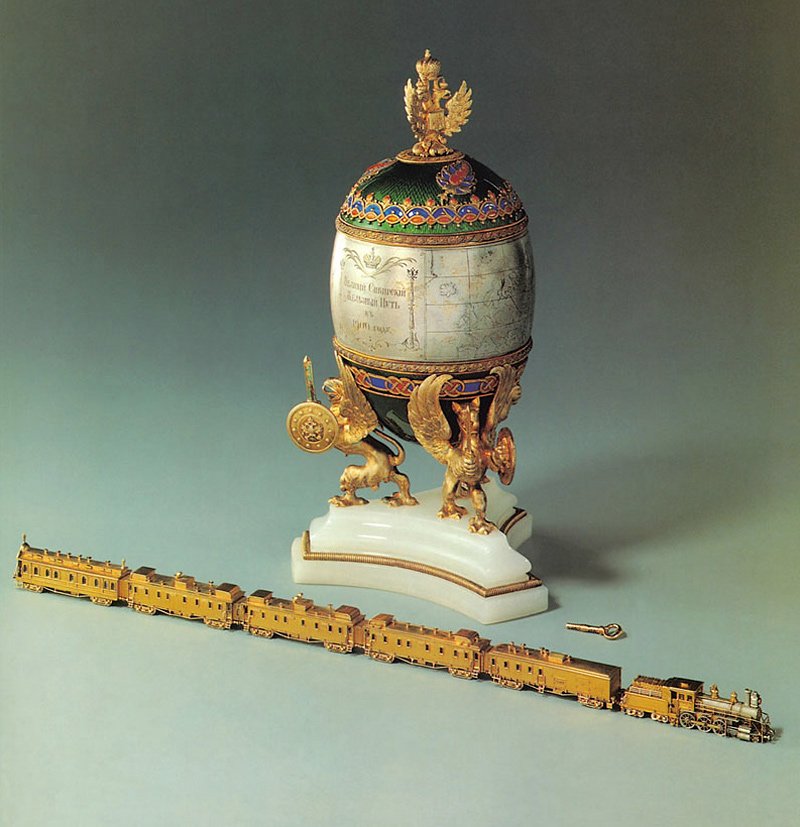
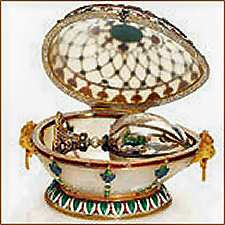
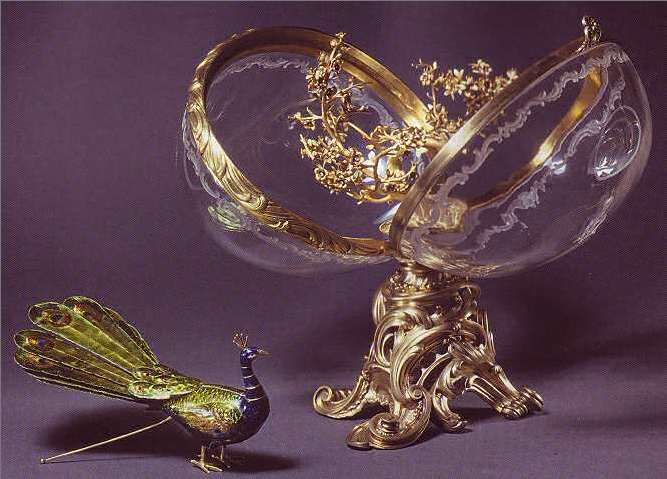
I have been staring at these eggs for days. It’s entirely my fault though, I’m mesmerized. It’s not that I didn’t expect to end up where I did, it’s just that it’s better than I imagined.
I tried to find information on Kingspoint Designs, but had no luck. Google gave me no website and the address to a closed location. However I did find a pintrest post selling the same egg I have, and another eBay listing selling a different Kingspoint Designs egg. Though the egg was a different design, the box in the picture for the eBay listing looked very similar, and had a sticker reading “made in China.” I didn’t know this about my egg, but it wasn’t very surprising. The pintrest post also identified my egg as a quail egg, which is nice to know. Two other websites also appeared when I googled Kingspoint Designs, each selling decorated eggs. I thought it was kind of weird that Google pulled up both sites when neither identified their egg’s manufacturer. The item numbers of the eggs on one of the websites have the same format (#XXXX) as the item number on my box. I tried calling both sellers, but neither answered. What I did learn from these websites is that the eggs are decorated in the Fabergé style, and this is where the fun began.
Egg decorating and gifting is a long standing Slavic tradition, originating in pagan times, and then adapted into the Christian tradition. According to this tradition, the first real Easter Egg (basically just an egg) was given to the Roman Emperor Tiberius by Mary Magdalene. When she told him of Christ’s resurrection, Tiberius said “Nobody can rise from the dead ….. this is as hard to believe as it is to believe this egg can turn red!” The egg turned red, and so comes the possible origin of the egg painting tradition. Even before this event, eggs had been a symbol of life and renewal.
The story goes that Tsar Alexander III wanted to give his wife, Empress Marie Fedorovna, an Easter egg inspired by one once owned by the Fedorovna’s aunt, which she had admired as a child. Easter was the biggest holiday of the year in the russian Orthodox Church, prompting the highest echelons of St Petersburg society to present jeweled gifts to their loved ones. In 1885, the Tsar goes to Peter Carl Fabergé, a world renowned jeweler, with the idea of a precious Easter egg as a surprise for Fedorovna. Here’s the result:
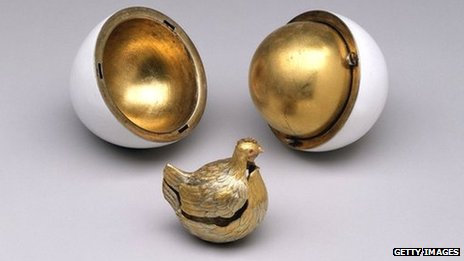 If a gold egg coated in white enamel with a gold yolk and a gold hen with ruby eyes inside isn’t enough for you, then maybe you feel like Tsar Alexander III because the hen originally contained a gold and diamond replica of the imperial crown with a separate ruby pendant suspended inside. The Empress was so happy that she received an egg ever year after. The tradition continued for fifty years until Tsar Nicholas II and Empress Alexandra were killed in the Russian Revolution. After the first egg Fabergé was given full range as to the eggs design, the only rule was there had to be a surprise. I found this part particularly interesting because it explains why my egg opens even though it is so small. It simply continues the tradition of being a vessel for a surprise. The other imperial eggs are super ornate and cool and some, like the Trans Siberian with it’s wind up train on the top left, have automated parts. I am dying to touch one of these eggs, feeling the small details and getting to know them better like DeWaal does with his netsuke, but alas I only have pictures. You can see them here if you’d like: http://www.mieks.com/eng/eggs.htm
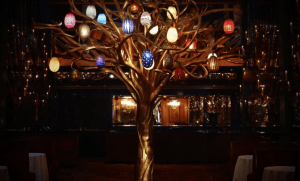 What I find funny is that my sister and I have always had this, appreciation let’s say, for gaudiness and excess. We fell in love with high tea and went to the Russian Tea Room, which is why I wasn’t surprised to find Russia in my egg’s ancestry; upstairs in the tea room I remember seeing this almost horrible gold tree with glowing glass eggs hanging off it (on the opposite side of the room is a large glass bear juggling these four metallic balls, it’s pretty hysterical). So in hindsight, my pink egg seems to be the start my sister and I developing our sense of taste together, while also starting the tradition of her always getting me birthday presents, and me always forgetting. Maybe one day I’ll get her a real Fabergé egg and that’ll make up for it.
 The Materials of History, Thought, and Art
You’ve done a great job interweaving your research experience with your discoveries. I particularly like your summary of the history of Faberge eggs. It evokes an age of decadence, yes, but also of craftsmanship. The attention to minute detail is breathtaking, particularly with pieces like the Four Leaf Clover egg listed on the website you linked. They seem almost impossible intricate, reminding me of the miniature Hindu statutes that they have at the Met. In both cases, the viewer is meant to be taken in by intricacy rather than grandeur (not to say that the eggs are not grand! They certainly are! But, their grandness comes from the details). You have certainly captured this sense of the eggs! I also think it is interesting that this egg seems to represent, on some level, the development of your own personal taste. It suggests that the items that we collect as young ones really do play an important role in shaping our relationship with the things around us. I wonder what other childhood things may have shaped us into the people we are now.