
The OED defines the word “ticket” as a “short written notice or document.” As I continue to research the ticket stub handed down by my matrilineal great grandparents, I realize just how apt this definition is. As I noted in the last post, a ticket offers proof of one’s presence in a particular place and a particular moment in time. It is a wonderfully specific little record. Unfortunately, not all records are so specific. While the ticket still stands like signpost, pointing me towards my family history, I find that the roads around the signpost have been obscured through disuse, forgetfulness, and, in some cases, calculated destruction. In my attempts to discover who exactly this ticket belonged to and what it was for, I find myself treading heavily into speculative territory. I hope that at some point, I can come back with a more definitive story. However, for now, I think I have just enough information to get a sense of what happened in San Sebastian on September 6, 1931.
Like most family histories, my mother’s family history is a murky mix of sometimes whimsical, often embellished stories and old photographs with the occasional date and name on the back. So, before attempting to answer the much more difficult question of who the ticket belonged to and why it was saved for so many years, I decided to figure out what the ticket was for. The eye-catching image of the man on horseback fending off a bull suggested that it was a ticket for a bullfight. Testing this hypothesis seemed like a good place to start. However, I soon found that despite the marked popularity of bullfighting in Spain, it is not easy to find information on the Playa de Torros in San Sebastian. This difficulty is due partially to my very limited ability to read Spanish which was, inevitably, the language of many of the web sites turned up by Google Search.
The scarcity also comes from a tendency to pass over San Sebastian’s bullring in order to praise Spain’s more widely venerated rings including those in Madrid and Pamplona. This tendency extends even into more academic writing on the topic. For example, San Sebastian is mentioned only a handful of times in Adrian Shubert’s rather helpful history of Spanish bullfighting, Death and Money in the Afternoon, and none of these reference the ring itself. However, he does note that San Sebastian was a popular summer destination for the Spanish as well as other Europeans, particularly people from France who arrived by trains “bursting at the seams” (Shubert 118).
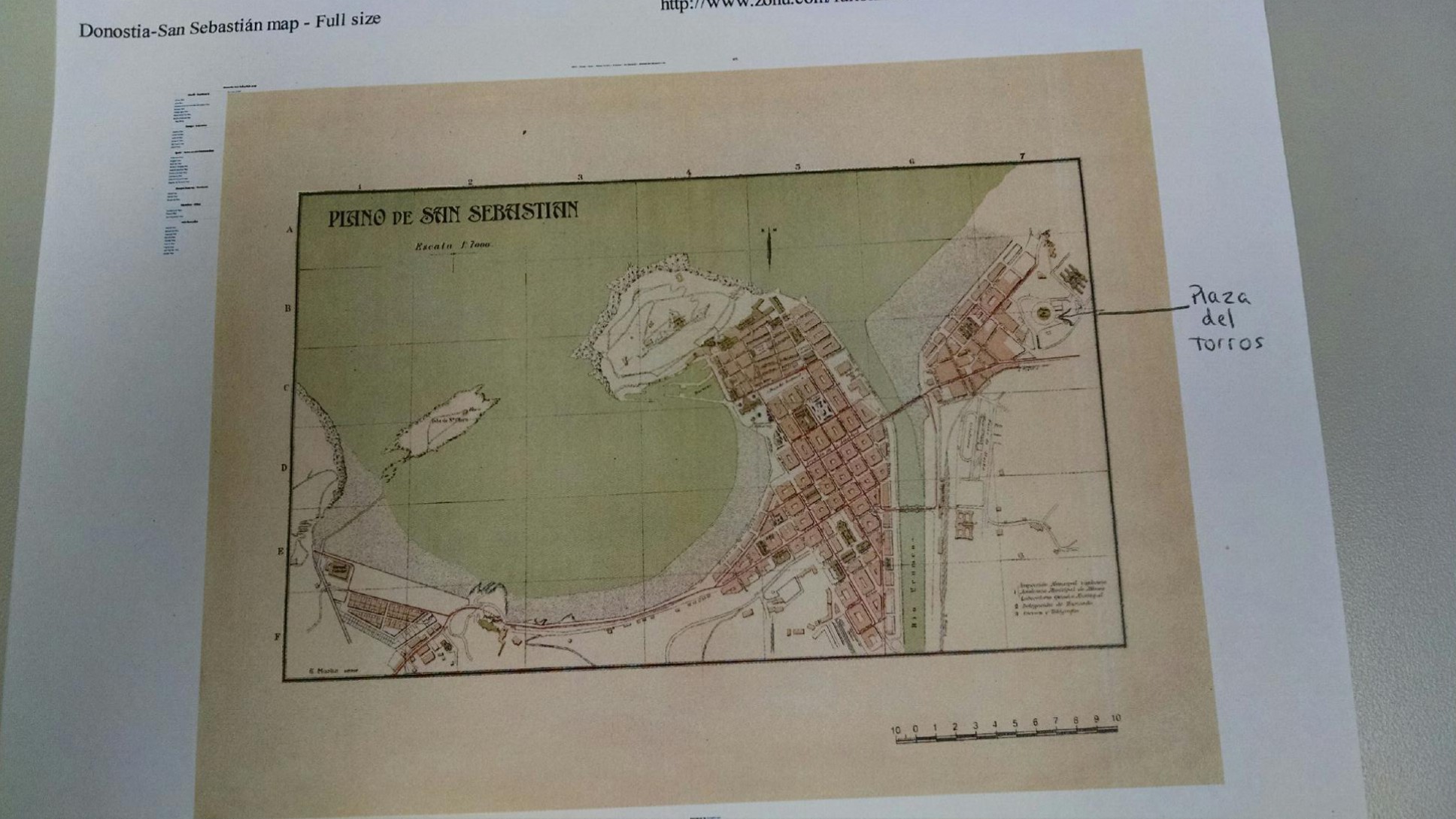
A map of San Sebastian. The Playa de Toros is located on the right.
Located on Spain’s northern coast near the border with France, San Sebastian is graced with beautiful beaches ringed with mountains, making it a breathtaking vacation locale. However, Shubert argues that it was its bullring that really gave San Sebastian a competitive edge over other similar cities. He cites one source who remarks that cities like San Sebastian “understood that to attract the largest number of visitors it was necessary to include the bullfight among their attractions” (30). San Sebastian had it all, making it appealing to a wide range of people, including celebrities such as Charlie Chaplin.

Charlie Chaplin, at the Playa de Toros (aka El Chofre) in San Sebastian on August 9, 1931. See citations for hyperlink to original article.
One newspaper article I found reports that Mr. Chaplin observed a bullfight for the first time at the San Sebastian arena just a month before my great grandparents attended (ABC foto). Bullfighting seems to have functioned as one the city’s primary social focal points, offering a center that allowed the city’s visitors (including my great grandparents) to gather and mingle with the noteable and famous and the not so notable and famous. Yet, while Shubert’s depiction of San Sebastian offers some clues as to why Emilio and Stella would have chosen to vacation there, it does not offer much information about my ticket stub. After much searching on my part, it is my sister, Holly Bruce, who makes a breakthrough, turning up a poster advertising a “Gran Corrida de Beneficencia” in San Sebastian on September 6, 1931.

Lot 408 or My sister’s find: A poster advertising the bullfight attended by Emilio and Stella (and possibly their children). Found on a French auction site. See citations below for hyperlink to original page.
Setting aside my affronted sense of sibling rivalry, Holly’s find answers all of the questions I raised in the last post about the ticket. Not only does the poster fill in the words missing from the front of the ticket, but it reveals what the ticket was for. The word corrida, which so prominently occupies the lower left half of the poster, translates to “bullfight.” Meanwhile, the phrase A favor de la Casa de Misericordia y Hospital de San Antonio Abad, written in thin black script underneath the date and the time, roughly translates to “In favor of the House of Mercy and the San Antonio Abad Hospital.” The text in the bottom left indicates that there will be eight bulls (8 Hermosos Toros) at this event while the text in the right hand corner lists the names of the matadors in the order that they will appear. Now the only question is, who did the ticket belong to and why did they save it?
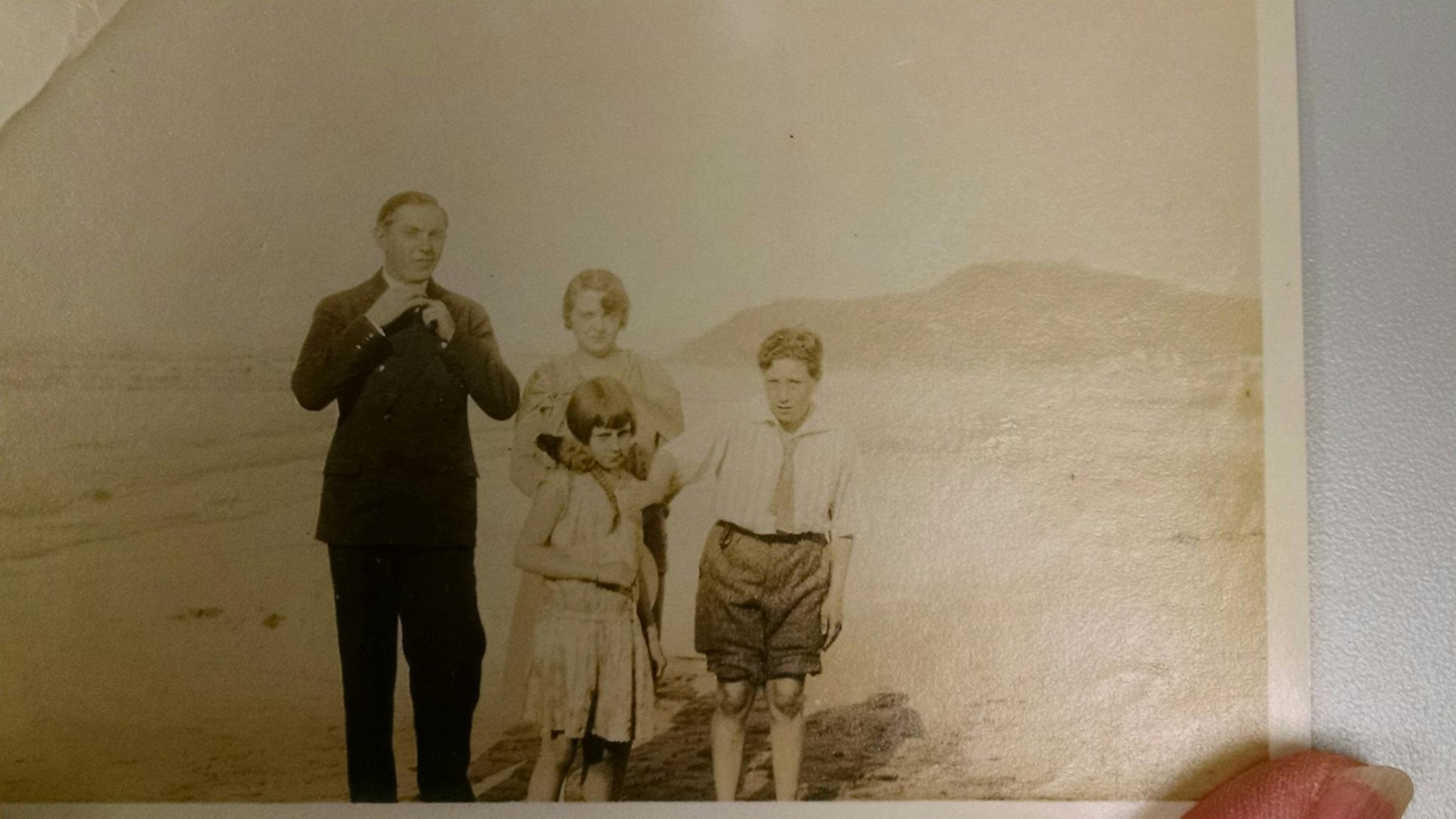
My Great Grandparents: Emilio de Jauregui (left) and Stella de Jauregui (back) with their children, Emilio Ricardo [my grandfather] (right) and little Stella (front). Thought to be a beach in San Sebastian
It is also possible that my great grandparents attended the event on business rather than pleasure. According to my uncle, Philip de Jauregui, Emilio Senior served as diplomat for El Salvador during the family’s time in Paris (a space of about six years between 1928 and 1934) although the position might have been more ceremonial than political. If this is accurate, then it would certainly make sense if the Salvadoran diplomat attended a charity bullfight, a move that would certainly be noted and probably positively received by the French and Spanish alike. Yet, the stern man featured in the photo above does not seem like the type to save a ticket stub. Perhaps it was my great grandmother, the serious lady standing to his left. My mother has her own supposition. She believes that it was the little girl in front, my great aunt Stella. Even if she did not attend the event herself, it is possible that her mother, father, or, even her brother gave the stub to her to make up for what she had missed. Or, perhaps she was simply drawn to the ticket’s aesthetic qualities. It is certainly beautiful enough. While there is no real evidence to believe she was the one who preserved the ticket all this time, it was little Stella that kept most of the family lore, collecting photos, mementos, and documents and stashing it in her California apartment. With Stella’s death in 2004, my mom’s connection with her past was significantly weakened, leaving us all to connect the dots on our own.
Perhaps we have connected the dots wrong. However, this seems to trace a tentative path back to that ring, back to the crowds shouting, and the dust rising off the arena as the matador dodges another thrust of bull horns. It traces a path back to the frozen faces of that little family huddled together on a beach, squinting at the camera, waiting for the flash so they can move again.
Works Cited
ABC foto. “Charlot va a los toros.” ABC foto. DIARIO ABC, S.L. 22 July 2014. Web. 28 Jan. 2015.
Gran Corrida Poster. Briscadieu Bordeaux. http://www.briscadieu-bordeaux.com/index.php?resultpage=14&action=fiche_vente&langue=fr&id=149 Web.
Martin, A. “Donostia-San Sebastian.” 1.700 “Zonu.com” http://www.zonu.com/fullsize-en/2011-02-08-12920/Donostia-San-Sebastian-map.html#.VM2zqgcpk10.email (30 January 2015).
Shubert, Adrian. Death and Money in the Afternoon: A History of the Spanish Bullfight. New York: Oxford UP, 1999. Print.
“ticket, n.1.” The OED Online. Oxford University Press, December 2014. Web. 1 February 2015.
 The Materials of History, Thought, and Art
I love how the ticket stub could be so elusive at first, but with conversations (and Google), it all falls into place. You illustrate how objects that some people deem trivial and throw away haphazardly can reveal much of a family’s history. You have even discovered perhaps part of the relationship between Stella and her brother – that is almost like travelling back in time, and it it something that is so rare to have insight to.
Wow, that is a really cool piece of family history. You did a great job connecting the photo and ticket stub, making the event that much more real. Your details reminded me of Edmund De Wall’s writing in The Hare with Amber Eyes. Every small piece makes it that much more tangible. Especially the imagery you used at the end. It made me feel like I was really there! Side note: Is that a parrot on little Stella’s shoulder, or something else? On closer inspection the creature looks like it has a rodent’s tail. Maybe it is just a stuffed animal.
Thanks! Haha, you have fixated on the very detail that I have been trying to figure out: what is on Stella’s shoulder? I am thinking that it might be a shawl with a braided end, but it could also be a stuffed animal. In another photo I have of the family, she is holding a doll, suggesting that she was still at an age where she liked to bring her toys with her.