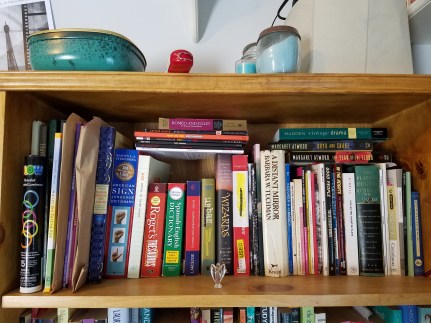
Due to a strenuous work schedule, I was not able to actually empty my whole bookshelf and go through each item. Instead, I focused on the top bookshelf, where I seem to keep most of my plays and books that I classify as “reference.” Like most English majors, I have more books than I have space for, and the thought of parting with any of them is just as painful as pulling teeth. However, for the sake of this exercise, I decided what I would “keep” and what I would “discard” based on the KonMari method mentioned in The Life-changing Magic of Tidying up.
On this shelf I have 51 items; 49 books and 2 objects. I have read about or drawn in about 45 of the books. The other 4 were given to me, and I simply wasn’t interested. However, the thought of parting with any book was almost too much to bear, and like KonMari mentions within the book, I was tempted to riffle through the pages to remember what the contents were. It was actually difficult simply to hold the book in my hands and think about whether or not it made me “happy.”
(I think the concept of happiness as pertaining to books is so subjective. A book can make you cry your eyes out, and still cause you to love it. I tended to think of “happiness” when it came to books as a book or play that moved me in some way.)
Going through the books also caused a deep sense of nostalgia, especially because the shelf contained yearbooks from my secondary school years. Again, I had to try hard not to confuse this nostalgia for “joy”, and try not to go through the books and read the inscriptions inside. Thinking about what really caused “joy” was hard, and in the end I only really had about 9 objects that made me objectively “happy” to look at.
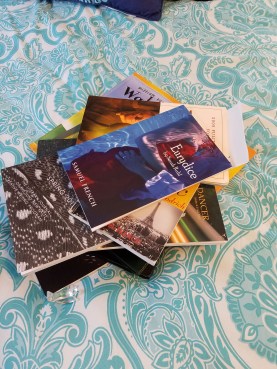
The “keep” pile
These contained the most sentimental value, and the plays that I enjoyed most out of my collection. Likewise, in this pile there is a precious book that my one of my teenage best friends gave to me on my sixteenth birthday. But I did not “hold” onto it because of the nostalgia, but because the thought of that friendship gave me joy, and therefore the object imbued it.
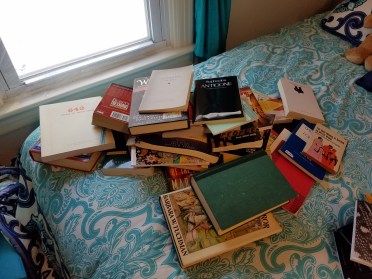
The “discard” pile
On the other hand, naturally the discard pile was much larger. Most of these things I cared very little about, even if I had enjoyed the story at the time. A lot of these were plays I’d had to read for a class, and according to the KonMari method they had therefore “fulfilled their purpose in [my] life”. Not that any of these works were necessarily bad, but they did not provide as moving an emotional experience (either during the deliberation process or at the time I’d read them) as the objects in the first pile.
I find the KonMari method fascinating, but I’m not sure it would be very effective for me. As idealistic as it is to think about having as few things as possible, someone like me can’t simply get rid of books. It is food for thought, though, that I continue to cling to books that didn’t necessarily have a great weight to them.
 The Materials of History, Thought, and Art
You must be logged in to post a comment.