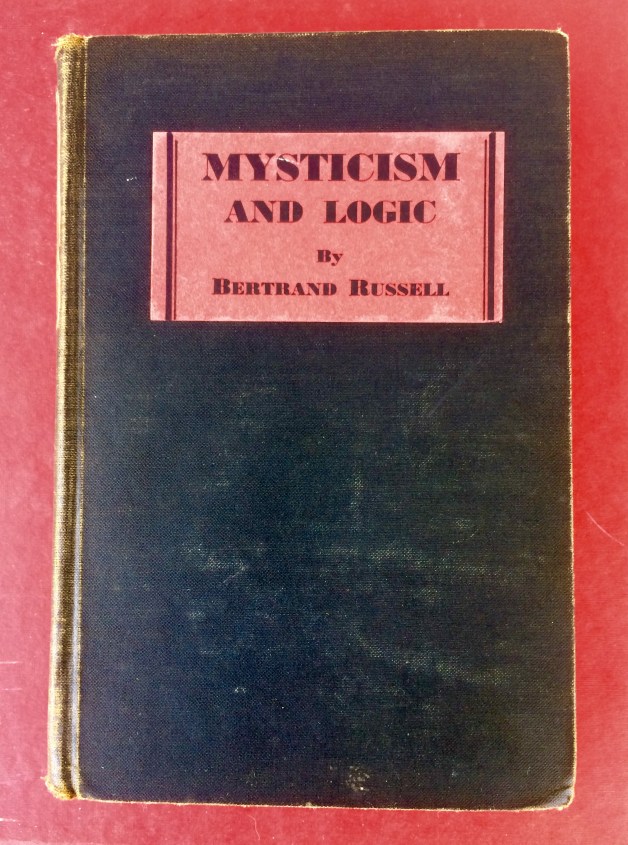
This particular object is 8-5/8 inches by 5-5/8 inches.
It seems obvious to state it is a book, but without foreknowledge, it is a black and red rectangular artifact containing what seems like 120 pieces of paper, but is 60 pages, halved, sewn, and glued to make a binding to hold them together.
The item itself declares it has been printed and published in 1929, a first edition, by W.W. Norton and Company in New York. It presumably had a dust jacket but otherwise, is encased in a dyed, black, woven cloth which has been heavily worn by what we can assume to be hands, other books, or the missing dust jacket itself. The edges are rounded and the dye of the fabric of every corner and curved surface has been worn away. The title on both the cover and binding is a glued-fast card stock which states eloquently “MYSTICISM AND LOGIC by Bertrand Russel,” in Minister Black, a typeface which I have found was created in the same year by a man named Carl Albert Fahrenwaldt1. Accompanying the binding’s statement is the logo and name “NORTON.” The paper contained within has a deckled edge, which points directly to the age of the item, and the grandiosity (or lack thereof) of the book. Publisher’s now choose this as a design feature, but at one point was a flaw in the printmaking process, a consequence of a water and frame method of sizing paper. In order to make books more affordable, or ready for sale quickly, the printmaker would forego trimming the edges of the paper stock of a book. W.W. Norton was a company of a mere six years at the time of publishing, so I would imagine that this is a fairly flashy printing2. The company had started out as man and wife transcribing lectures and making pamphlets of classes for Cooper Union, in their living room. Although since deceased, these two have certainly succeeded as Norton is a primary source of my monetary loss.
What I found to be most interesting about this book, beyond how it was made and whom contributed outside of the author in the printing process is the luxurious sets of annotations. There are four distinct sets of handwriting, sometimes arguing over the meaning and connotation of what Russell had published. A mysterious fifth insisted upon putting red checks near paragraphs, I can only speculate, he/she approved of. Some is in pencil, mostly black pen, and noticeably, the person who only uses capitalized block writing, is using this method as a form of highlighting, as we would today. All serial 232 pages, with some form of annotation, none of which I can lay claim to.
I came to own this book as it was given to me as a gift. I have owned two copies, one of which I willfully cast out last month during the beginning of the semester, during the practice of the Kondo Method, in what I refer to as the beginning of the Great Purge. In contacting the gift-giver, my best friend of seventeen years, and fellow book collector, she claims to have bought it at a yard sale for a mere five dollars, in a location she doesn’t recall, and has no connection or relevant information as to whom had owned or written on all of the pages. I came to love this book more than any other, because not only is it a first edition, but it can be encountered as what I thought of as an “Expanded Edition.” The previous owners’ notes are so remarkable in number but in speculation of Russell’s ideas, it is a truly unique object, even on the scale it was produced. The initial function in its former life and its beginnings in 1929, was that of a philosophical value, like the contents. The reader was likely of higher education or curiosity. I myself would deem it a tough read if you have no interest in either. Although it has stayed in its original manufacturing state for nearly 90 years, it is worth noting that the purpose has not changed, other than how it is handled. I’ve read it four, encroaching on five times, and couldn’t tell you what half of it says. I handle it much gentler than the previous owners and find myself in a salon style debate with the penciled margins every time I open it to read it (which is probably in the hundreds by now).

Notice T.S. as the only declarative contributor and the myriad of writing adding to the print.
In knowing nothing of the owners, I find solace in the particularities and histories of the publishers, designers, the author, and the work itself. I wish I knew more about the persons who left their commentary and legacy of philosophy in the margins than I do the author or the piece. I think it speaks to not only their willingness to deface the publication, but their divine opinions, of who they were or could have been. I imagine four people having introspective conversation or intellectual argumentation of Bertrand Russell, his relationship with science and thought, and the passion that went into the comment on page VI of the preface,
“T.S. * Russell REALLY says, then, that each thing is itself…”
The script is so small and barely legible so I can assume T.S. is a doctor, as this soliloquy is about 30 words long and I can only make out the first nine and the punctuation, underlines and so forth. It seems the very owner before me couldn’t quite grasp why this is important, so as I jokingly refer to myself as the book conservator, the keeper of ramblings of those since passed, they are safely refuged here, with me, indefinitely. Every so often, admittedly, I take it out to appreciate what’s hand written more than the printed words.
1 I mention this because I find this name interesting. It can be translated to “to go to the forest,” which is where you might find the paper that may be useful in printing your type creations.
2 This title, along with Freud’s works, as they were his ONLY American Publisher at the time, had launched Norton into popularity.
 The Materials of History, Thought, and Art
One of my favorite things when I purchase old books is to see if there is writing or some sort of handwritten dedication. I find it so fascinating to see who owned what before I did. This is a very interesting find, of a very interesting topic as well!
This was so detailed and interesting to read! I love going into bookshops and leafing through old books, I love the transitive nature of second-hand books originally bought/gifted decades ago. I love the image with the writing scrawled in the margins, not only is it aesthetically great, but it is so refreshing to see. I never annotate books like that, as having a kindle reader has made it seem almost obsolete. The analysis makes the antiquity of the item so much more interesting, especially the part about how Norton launched it into popularity.
You describe wonderfully and add interest to a book that is already incredibly cool and interesting. Finding old writing in old books is always a remarkable discovery. I have one little book from 1892 that has notes and corresponding dates in it ranging from 1907 to the 1950’s. It’s awesome to think about the people who left these scribbles; whether they be extremely old or long dead, I am connecting with something that they connected with, and also connecting with evidence that they left of their connection.