The KonMari Method & My “Komono”

I chose to use the KonMari method with my miscellaneous or komono drawer. I chose this drawer mainly because it was the messiest drawer in my entire room. I tend to be very organized, but for some reason this drawer looked like this:

before

Yikes

Pretty awful. I don’t know exactly how many objects I had in there, but it must have been up there in the thirty or forty range. It was certainly time for a clean-up, so I did what KonMari suggested and took every item out first. I looked at them, and tried to use a combination of her “joy” test as well as whether or not the object had some functional value. For example, somewhere in there is my wallet, deodorant, DayQuil and NyQuil, Excedrin migraine, etc. Some of these things I use everyday (like my wallet), others are saved for a rainy day (like the Excedrin). I decided to start putting stuff back in with some sort of organization, so here’s what it looked like about halfway through the process:

For the record, my SpongeBob Squarepants laundry hamper was not a part of my tidying and is here to stay. Anyway, I thought I was making some significant progress, until I came across a few items. While I could come up with a reason for keeping the NyQuil, the moisturizers, and my apparent soap hoard, there were a few items that had absolutely no purpose being there and even gave me the opposite feeling of joy: anger. For example, one item was a bottle of “special contact solution” that actually burned my eyes when I used it to rinse out my contacts last weekend. Since I am terribly sightless without contacts or glasses I failed to notice the bright orange warning labels with the instructions for use. I just thought it was regular contact solution. It wasn’t, and the hydrogen peroxide in the solution burned my eyes.  Another item I found was a LifeProof iPhone case that I bought when I first got my iPhone 6s. It worked really well in that it effectively protected my phone from breaking. However, it had a cover over the headphone jack, so I could not use my favorite headphones without prying the phone case completely off. This is hard to do, since the case essentially seals and locks shut when you put it on. It got annoying, so I stopped using it. It wouldn’t be so bad if the thing didn’t cost me almost $70. Yes, okay, it “technically” works, which is why I’ve kept it, but I can’t even listen to music, the one thing I mainly use my beautiful iPhone for! The fact that I paid money for such a useless item is super irritating.

The other two items were a plastic bag and a New Paltz ID card case. The plastic bag was annoying because I had absolutely no use for it and, in general, I hate plastic bags due to their negative environmental impact. The New Paltz card case doesn’t give me nearly as much anger as the other items, but it just kind of gets in the way and I don’t really ever use it.

no-good-items

The annoying items, excluding my TV and remote

Maybe I am a bit petty or over-dramatic for being so angry at a few items. Nevertheless, I left these items out while I put the others back in. It was quite nice to have a clutter-free drawer without these useless and annoying items! I honestly didn’t expect the project to go the way it did. Seeing the items I had bad experiences with and the emotional reaction I had to them made me appreciate the things I do like/use a lot more. Although I’m not quite sure that was what KonMari intended, I think I ultimately got to where she would want me to be: finding joy in the items I keep. I decided to get rid of the contact solution, as this project prompted me to give it to a friend who uses it. For now, the others are okay sitting in the back of my drawer. Perhaps one day I will need that LifeProof case or plastic bag. Overall, I did not find this process to be too difficult, but I did find it interesting that the KonMari method can apparently work backwards – in finding anger, you can also find joy.

after

Not the most beautiful tidying job, but good enough for me
Decluttering the Desk

I found this reading timely. I just moved into a new building on campus last week, so my things, especially small things, were strewn around my new room in comforting chaos. My desk both at home and here is the go-to spot for little papers, junk in my pockets, as well as my laptop, vitamin bottles, and anything else imaginable. So, you can imagine what it looked like in the recent days while I was unpacking all my bins. While doing this reading, I was sitting at said desk in Lefevre Hall. I suddenly became horrifically aware of everything that was in front of and around me. There was, at the time, a bright orange file holder (of which I put things in never to take them out again), a notepad labeled “shopping list,” a stray dryer sheet, my favorite pen with no cap, my checklist for the day, one of those round Eos chap-stick things, and a mug of tea. Those being but a few of the items, I immediately felt the need to clear my workspace. I contemplated using the “joy test” that KonMari praises and recommends, however, I thought the junk on my desk was not up to the standards of the joy test. If I applied the joy test, my desk would probably be totally empty. After our discussion in class on Tuesday, many of the things on my desk were those practical items; my set of mini drawers holds writing supplies and post-it notes, which I need but do not necessarily bring me joy. If the joy test extends beyond the object itself, though, then you could say it does bring me joy. If I did not have any pens, pencils, or post-it notes, I would have to take the bus that always runs late, as I do not have a car. Alternatively, I could walk to the store in the freezing cold. So, all in all, those pens and pencils in my little green set of drawers in a way does give me joy.

I picked up each item, trying not to think in such an extended way. Instead, I asked myself “do I need this?” I am usually a “I might need this later” type person, but once in a while, I get into those moods where I need to clear everything out. This turned into one of those moods. I picked up small papers that laid helplessly around and got rid of them. I put the chap-stick away in my first aid box. The dryer sheet found a permanent home in the garbage, and the orange file holder found a temporary home under my bed and out of the way.

It was strange going through my items, I think because I used a modified version of what we read about. Instead of asking if my shopping list notepad gave me joy, I asked myself if I really needed it. I became acutely aware of each item I had on my desk. Some of them were there because it held objects I needed like pens, scissors, and erasers. Some of the things were there simply because I placed them there days ago while unpacking, and I forgot about them. It was definitely not difficult because, as I stated before, the items I was dealing with were practical. Not a lot of them gave me any kind of joy. I am glad I got to do this experiment while also experiencing this move across buildings. If I hadn’t been assigned to do something like this, the poor desk would most likely be cluttered until the end of time.

The Necessity of Self-Evaluation in Tidying

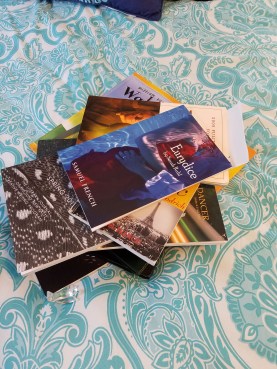
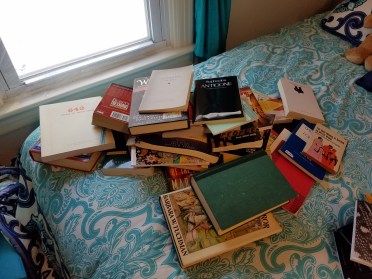
Considering all the clothes I have, I figured it would be simpler, as far as the experiment is concerned, to examine my book “collection”.  Not to be a contrarian, but based on the discussion in class, I appear to have a much lesser affinity for books and literature than the others taking this seminar.  Recently, I tidied up my room, essentially cramming unnecessary objects in places where they will be out of the way.  Among those objects, at least for me, were my books.  Now not to get it twisted, I have not yet thrown away, donated, or otherwise disposed of my books, nor do I know if I eventually will.  When I looked at the collection, I discovered the books of my childhood, the some of the first series and books I’d ever read, including Harry Potter and even the works of Shel Silverstein, of whom I was a fan, and still am today.  Those books, ones that are all-time favorites, and ones I would like my children to read, ones with that great level of sentimentality that even my parents (who didn’t read the aforementioned titles) can appreciate, have been moved to a separate bookcase in our “extra room” in the house.  For the most part, the books that remained in my room were kept in a crate placed on top of a dresser, which in hindsight is a little dangerous, as I tried to get them down and it was not a simple task.  And therein lies the rub, since I put the crate up there about a year ago, this was the first time that I actually went to take anything from it.  Immediately I knew that if I adopted the KonMari practice, all the books would go.  I must admit though, when I took the books out of the crate, I became nostalgic and realized why I kept them in the first place.  Many of them are sports related, most heavily based on the Yankees, of whom I have been a huge fan for years, even though my dad is a Mets fan..  Anyway, I had moments where I remembered when I chose to buy the books, or who gave them to me.  Some came to me a long time ago, and others fairly recently.  Two were heavily a part of the beginning of my collegiate life, two books that I actually read for English 101 back in Senior Year of high school.  I remembered my appreciation of these books as I read them, and a lack thereof for those I never got around to reading.  I have long realized that I do not enjoy reading the way many others, like those in the seminar, do.  It’s certainly not something I take pride in, but something I’ve learned to “deal with”.  It’s entirely possible, and in my opinion likely, that I will never again have the compulsion to pick up a book and begin reading, although there have been books that have made me feel so before, and there have certainly been required scholarly materials that have felt glued to my hands.  So my pile on the floor is probably underwhelming and exceptionally modest to some, though to me, the weight of sentimentality outweighs that of the physical weight of my pile.  My after picture is of the crate, empty, fittingly so, as if I were to fully participate in the experiment, at least 90% of those books would no longer be in my possession, and there would be no need for a crate.  I wish that there was, or maybe for a personal bookshelf instead, but alas, I am not a reader, only a collector of things.

A blurry reminder of what once wasDisplaying IMG_2488.JPG


Perhaps what the future should beDisplaying IMG_2489.JPG

All your books are not belong to us: a brief exploration of the KonMari method

overall

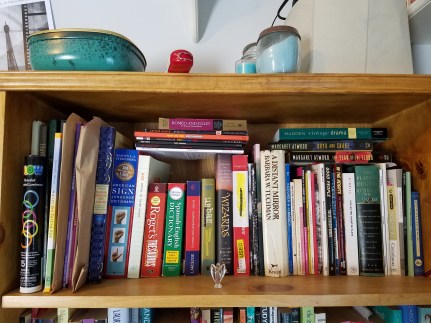
Due to a strenuous work schedule, I was not able to actually empty my whole bookshelf and go through each item. Instead, I focused on the top bookshelf, where I seem to keep most of my plays and books that I classify as “reference.” Like most English majors, I have more books than I have space for, and the thought of parting with any of them is just as painful as pulling teeth. However, for the sake of this exercise, I decided what I would “keep” and what I would “discard” based on the KonMari method mentioned in The Life-changing Magic of Tidying up.

On this shelf I have 51 items; 49 books and 2 objects. I have read about or drawn in about 45 of the books. The other 4 were given to me, and I simply wasn’t interested. However, the thought of parting with any book was almost too much to bear, and like KonMari mentions within the book, I was tempted to riffle through the pages to remember what the contents were. It was actually difficult simply to hold the book in my hands and think about whether or not it made me “happy.”

(I think the concept of  happiness as pertaining to books is so subjective. A book can make you cry your eyes out, and still cause you to love it. I tended to think of “happiness” when it came to books as a book or play that moved me in some way.)

Going through the books also caused a deep sense of nostalgia, especially because the shelf contained yearbooks from my secondary school years. Again, I had to try hard not to confuse this nostalgia for “joy”, and try not to go through the books and read the inscriptions inside. Thinking about what really caused “joy” was hard, and in the end I only really had about 9 objects that made me objectively “happy” to look at.

keep

The “keep” pile

These contained the most sentimental value, and the plays that I enjoyed most out of my collection. Likewise, in this pile there is a precious book that my one of my teenage best friends gave to me on my sixteenth birthday. But I did not “hold” onto it because of the nostalgia, but because the thought of that friendship gave me joy, and therefore the object imbued it.

discard

The “discard” pile

On the other hand, naturally the discard pile was much larger. Most of these things I cared very little about, even if I had enjoyed the story at the time. A lot of these were plays I’d had to read for a class, and according to the KonMari method they had therefore “fulfilled their purpose in [my] life”. Not that any of these works were necessarily bad, but they did not provide as moving an emotional experience (either during the deliberation process or at the time I’d read them) as the objects in the first pile.

I find the KonMari method fascinating, but I’m not sure it would be very effective for me. As idealistic as it is to think about having as few things as possible, someone like me can’t simply get rid of books. It is food for thought, though, that I continue to cling to books that didn’t necessarily have a great weight to them.