For this post I am going to discuss an odd little book that I own—an 1894 US History and Constitution topical outline written by J.K. Harley. I say that it is odd because, well, it isn’t really a book, even though it is technically a book, as it has a cover, back cover, and pages in between: but it is not a book insofar as a book presents information about the aspects of some subject or range of subjects; this one, rather, presents the aspects themselves. The book contains everything that there is to know about the history of the United States and its constitution, but tells the reader nothing about any of these things; and, in my opinion, it is this characteristic which makes the book so interesting. Never before have I encountered a book that is so immensely lacking in immediate discussion, but is, at the same time, so incredibly useful.
Imagine yourself as a poor young adult in America in the year 1900. You intend to become a teacher someday, and thus wish to undertake a full study of US history, but you cannot afford university. You go to the city library, and, after some searching, come face to face with a shelf about eight feet high and fifteen feet wide, filled completely with books about the history of the United States, hundreds and hundreds of them; and behind this shelf are ten more just like it. Where do you start? Intimidated, you pick one off of the shelf, open it, start reading, and the author is rambling about some random subject that literally couldn’t confuse you any more than it does. You have no internet to turn to for guidance, and the librarian may not have the slightest knowledge about US history; perhaps you could find a professor or scholar at a nearby university to point you in the right direction, but this is still an arduous route to take. Enter this topical outline, published in 1894, inside of which is delineated every single relevant term, historical event, important person, etc., that you could possibly need to know about in studying the history of the country and its constitution. This little book, not even 50 pages long, and not containing a single sentence of elaboration or detail, will now become the centerpiece of your study. It tells you exactly which random historical happening you need to look for on that packed shelf, and places it in the context of other events and pieces of information in a highly structured fashion.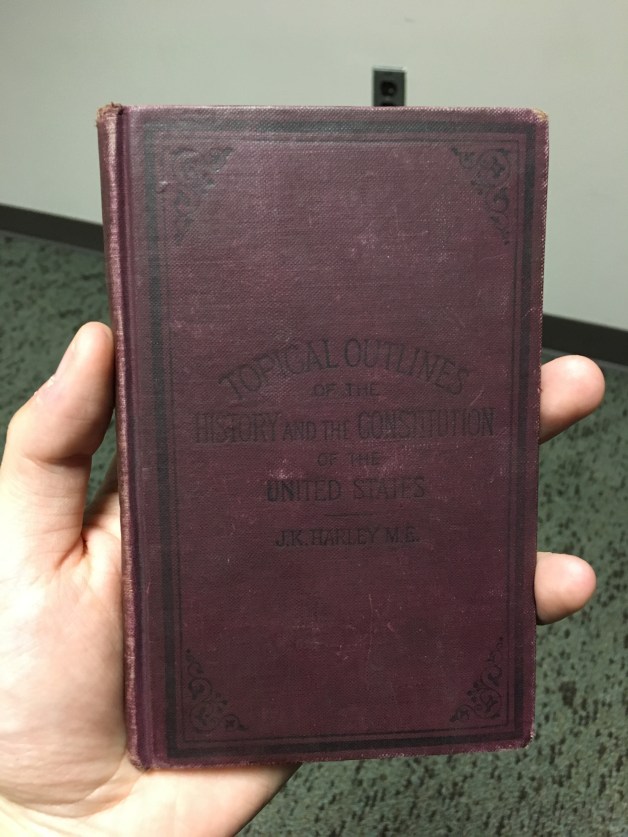
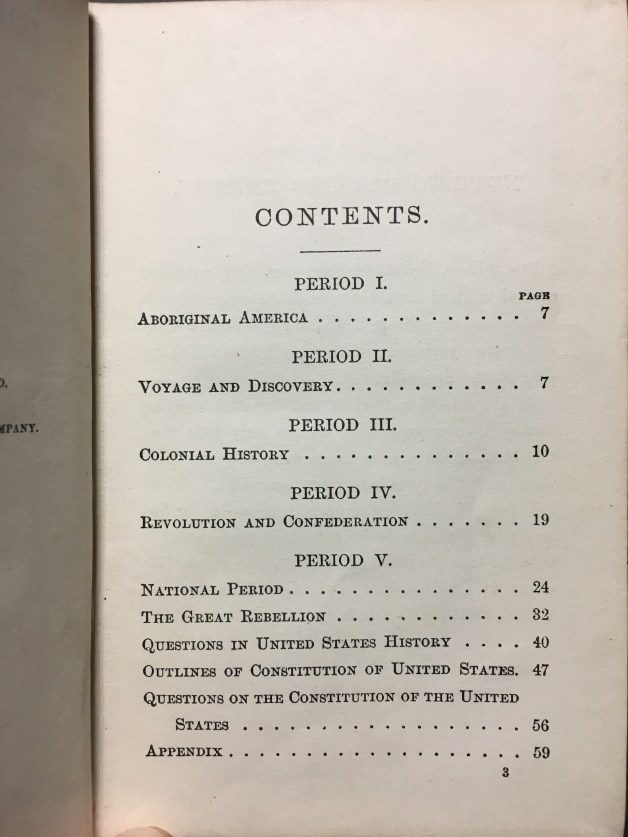

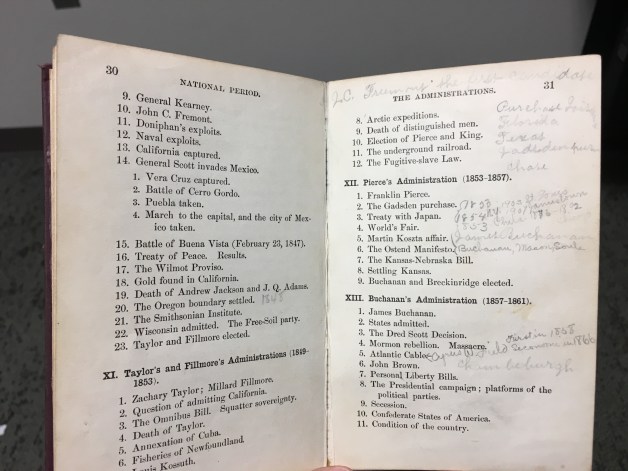 On to the history of this book. I purchased it for a dollar at a massive book sale at our campus library last semester; before it was there, it had been in the possession of the Gardiner Library, as far as I am aware. I am pretty sure that Gardiner may have collected books from various local libraries for this sale. Before Gardiner had it, however, I have no idea, so we will need to jump back in time to find more information. It is likely that this book was owned by a single student (the handwriting is consistent throughout, which leads me to believe it was not owned by any other students). As can be seen in the above pictures, the book is littered with scribblings and notes and dates and such. However, at the beginning of the book, on the first page, is the name of a person, written in ornate script; what looks like the name of a place, perhaps a school; and a date below it—April 3rd, 1907. These names and the date are written differently and in much larger print than any other handwriting in the book, and their position at the front and the style in which they were written leads me to believe that this is the name of the owner, the place or school s/he lived or attended, and a date that, for some reason, was noteworthy to the owner; I will assume that this is correct, otherwise I won’t be able to proceed. So, 1907. A hundred and ten years ago. The owner of this book was to the Civil War as we are to Vietnam. The name is oddly written and a little hard to read, but I think it says “Otta S. Robley:”probably a female name. The place/school seems to read “Mapleton Depot,” but it is hard to make out. However, if my reading is correct, then it is possible that this Otta girl lived in Mapleton, PA, about five hours away.
Anyway, so Otta seems to have owned this book for a while, and given serious attention to it, as her writing is scattered all throughout the book (except, I may add, in the section dealing with the constitution; I guess she wasn’t interested). Now, having established the probable original owner of the book, and knowing the last few stops that it has made on its long journey, I think the most likely scenario is that, after Otta stopped using it, she kept it somewhere in her house – attic or basement along with other old school stuff, maybe – and, eventually, she either decided to clean house and donated the book to the local Mapleton Library, or she might never have done so, dying with the book still tucked away somewhere. Maybe her children or spouse or some other relative donated it after she died when they went through her stuff. As I said, this seems to me the most likely story of this book, but my speculation is by no means whatsoever authoritative. If I am right, however, then it is potentially possible that Mapleton was one of the libraries that contributed to the book sale on campus. I will talk to some of the library faculty and see if I can find out any more information.
 The Materials of History, Thought, and Art
The history here is so rich. I really like the comparison of time (civil war/vietnam), which really helps put time into perspective. 1907 seems so obtuse otherwise. We sort of have a way of conceptualizing entire halves of centuries. I obviously also have a soft spot for handwriting in books. I’d be interested to find if someone at Gardiner library knows something. It hasn’t been long since their renovation either!