Physical Description:
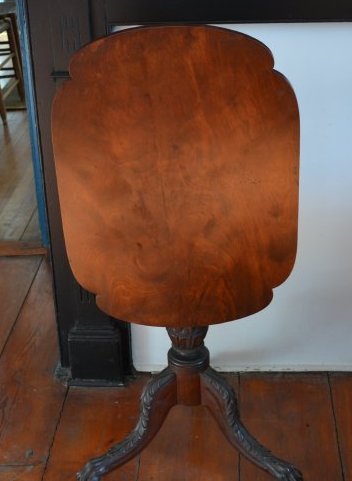
Photograph provided by Ashley Trainor: Front view of Charles Warner’s Tilt-top table
The table displayed to the left stands about 2ft off the ground when the table top is parallel with the floor. The table top is hinged allowing it to be turned on it side when is not being used to hold various objects. In its entirety, the table has minimal scratches/ chips. The base of the table has been constructed out 5 separate pieces of mahogany wood. The central piece is an urn-like base that appears to have been turned on a lathe with a pineapple carved into the center of it. The base is connected to three arched, tapered legs. Each leg consists of acanthus leaf carvings that transition into the paw of an animal (likely the paw of a lion). Attached to the center base and legs is a smaller table top, likely to function as a seat. The table top is an ovular shape with pinched corners that it approximately 2ft x 1.5ft. Beneath the tabletop is a makers mark inscribed “Charles Warner, Cabinet Maker, Poughkeepsie.” This type of table (hinged table top with smaller attached smaller seat) is referred to as a tilt-top table. This table was constructed approximately 1800-1820.




Illustrations of the decorative motifs most common in this style.
Furniture being designed during this time (1805-1830) which overlaps with the same time of Charles Warner’s life was referred to as American Empire style furniture. Influenced by neoclassical and french empire during the reign of Napoleon. Specifically this style was largely inspired by Napoleon’s architects Percier and Fontaine after Napoleon returned from a trip to Egypt in 1798.(LaChuisa, 2005) This style uses decorative motifs including rope twist carvings, animal paw feet, Acanthus leaves, stars, eagles with spread wings, etc. It was common during this era design to use oak, mahogany, and other dark woods for building furniture. However, dark woods were so popular that often mahogany was painted black. Also, inlays were often used and were made of ebony or maple veneer. This style varied within utilizing this set of visual motifs with New York City being the center of this design style. (LaChuisa, 2005) New York city was also the center of fashion at the time, which will relate to the utility of this kind of furniture explained later in this post.
Provenance:
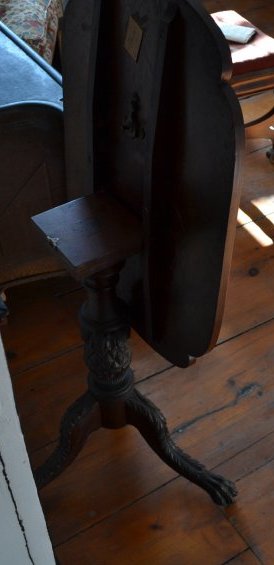
Side/Back view of Table. The Gold square at the top of the table is the Makers mark engraves “Charles Warner, Cabinet Maker, Poughkeepsie”
Sought out by furniture historians as a major landmark in cabinet making, Tilt-top tables arrived in America in the early eighteenth century from England. From their start in England, Tilt top tables were associated with a gentile behaviors, namely tea drinking. Tilt top tables were also referred to as tilt- top tea tables. Other common nomenclature used to refer to this kind of table was the “claw table” and the “snap table.” The tables became an indispensable unit of the ritual of tea drinking. Tilt top tables were just as necessary as the tea, kettle, and cups as they contributed to the fashionable parlors and heightened the status for politicians, artisans, laborers, etc.. Generally speaking, people invented new types of furniture to accommodate the continuously changing needs at the time. (Fayen)The tilt top table did contribute to the solving the problem of spatial efficiency however, this table gained recognition for its appearance more than its utility. Historians figure that this was in part due to the state of consumerism at the time. It was during this period that the production of goods were becoming more affordable and widespread to produce. The fashionable experience of tea drinking that was once only afforded to the rich and wealthy became accessible to those in the middle class. Between 1740-1790 tilt top tables were omnipresent components to American parlors. This time frame leads right into about the time of Charles Warner and his desire to construct these tables. Based on the provenance of the tilt top table it becomes clearer the intention of building such tables. (Fayen)
Makers Bio/Historical Narrative:

Detail image of the base of the table
Charles Warner worked as a cabinet maker in Poughkeepsie in 1820. It appears that Charles Warner was born and raised in Poughkeepsie, dying in 1834. He was the son of Thomas Warner who purchased a lot of land in Poughkeepsie “beginning at the northeast corner of Myndert Van Kleek’s garden fence along the new street” 1785. Warner was not only a cabinet maker but also, a businessman. He owned a considerable number of stock shares, including stock in the Poughkeepsie Whaling Company, the Farmers and Manufacturers Bank, the Eastern Market, the Poughkeepsie Steam Boat Company, and the Dutchess Whaling Company. Financial records indicate that Charles Warner was a successful cabinetmaker and businessman, with considerable financial resources for the period.(Fallen)
Charles Warner’s table, which now lives in the Empire gallery room in the Deyo House, signifies not only a time of advancement in consumerism and commercial trade, but also lends itself to the attitudes of status and fashion in the early 19th century in the Hudson Valley. Although little is known about the local artisan himself we can deduce by his financial resources that he was an affluent man who enjoyed and benefited off of the popularized gentile lifestyle of the early 19th century. Additionally, I ascertain based on the quality of craft that was involved in the construction of this table that there are a wide variety of Charles Warner tables scattered through the Hudson Valley. Although it is unknown who was utilizing this table, the specific qualities of this table indicate that the individuals were mindfully curating an image of what I like to call efficient elegance.
Work Cited
1. Fayen, Sarah Neale. “Tilt-Top Tables and Eighteenth-Century Consumerism.” Chipstone. N.p., n.d. Web.
2.Fallen, Todd. “A Regional Study in Early Nineteenth-century Cabinetmaking: Charles Warner, Cabinetmaker, Poughkeepsie, New York.” 2005. WAG Postprints. Web.
3.“American Empire (1800-1840).” Guide to Furniture Styles from Connected Lines. Connected Lines, n.d. Web. 04 May 2017.
4. LaChuisa, Chuck. “Furniture – Empire Style.” Empire Style. N.p., 2005. Web. 04 May 2017.


You must be logged in to post a comment.