My final blog post for this semester is about my favorite part of SUNY New Paltz: my sorority, Alpha Kappa Phi. Whether we realize it or not, objects are a huge aspect of who we are and how we represent ourselves to others. Through objects, my sorority has developed its own, unique identity and has been able to pass down traditions for generations. In examining a handful of sorority objects, I hope to reveal our history and some of our most important traditions, both the old and the new.
The Spoon Pin
I’ll begin with the blog post that started it all: the spoon pin. When I officially became a member of Alpha Kappa Phi in the Fall of 2015, I went to Florida for Winter break. There, my grandmother approached me with this pin. She told me it was her sister pin while she was an active sister (meaning while she was in the sorority at New Paltz). It’s shaped like a spoon, is approximately one inch tall, and has our sorority crest at the top of the handle. On the back is the needle used to pin the spoon onto whatever clothing a sister is wearing. The pin is something you receive upon becoming an official member of a Greek organization. When I became a member of Alpha Kappa Phi, I received my own sister pin: simply the Greek letters ΑΚΦ small and in gold. I was so proud to hold it, to have my first true letters. The pin, to me, represents that I am part of something bigger than myself. The spoon pin also represents something similar; you are truly a part of the organization. However, when I asked my grandmother why it was in the shape of a spoon, she told me it was to represent hospitality. Apparently, sororities used their houses to help those who may have needed a place to stay. They were to always be charitable and to give back to the community.
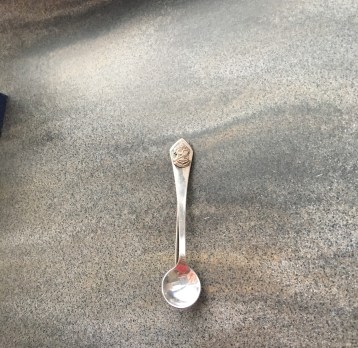
Spoon Pin with Crest
What I found through my original blog post is how traditions both change and remain the same over time. While we don’t use the spoon pin anymore, we still believe in community service and charity. Any time Relay for Life or some other charitable organization comes to the area, we are there to support the cause, and we are always raising money for our philanthropies. While the physical object may have changed, its meaning has not.
Link to original blog post: https://npobjects.wordpress.com/2017/02/17/not-a-spoon-you-eat-with/
Tikis
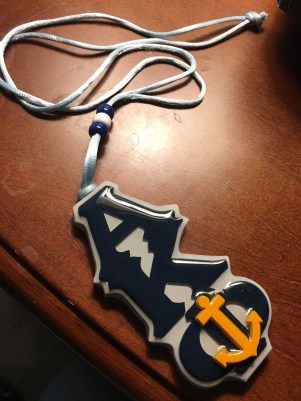
Standard tiki for ΑΚΦ
The objects you see here are called tikis. A tiki for a Greek organization is usually a wooden block of letters on a long string that you can wear as a necklace. Alpha Kappa Phi has four sorority colors, navy blue, robin’s egg blue, white, and gold, and our symbol is the anchor. The style of tiki we use incorporates all of these representations, depicted in the image on the left. The tiki below belongs to a member of Tau Kappa Epsilon, and it looks quite different from Alpha Kappa Phi’s tiki. It is black in the shape of a rectangle, with the Greek letters ΤΚΕ going vertically downwards. On the top of the tiki are the Greek letters ΒΑ, and the bottom displays the number 283. The whole tiki is wood and is custom for the person who owns it.

ΤΚΕ Tiki
Functionally, the tiki is very convenient. For us, whenever we are partaking in some event, we are required to show up in letters to represent the organization. If you forget to wear a lettered T-shirt that day (it happens), having a tiki in your bag is a really easy way to just put on letters for the moment. They essentially just serve as another form of letters. The ΤΚΕ tiki on the right also can serve as letters, however each tiki is unique to each person. For this one, the letters ΒΑ stand for “Beta Alpha,” which is this person’s pledge class. A pledge class is a group of people who work together while in the process of becoming a new member. His pledge class or group is called the Beta Alpha class. Someone in a different pledge class would not and could not have BA on his tiki. The number 283 means that he was the 283rd brother to be initiated into Tau Kappa Epsilon’s chapter at New Paltz, the Sigma Nu chapter. Each part of the tiki represents varying levels of the organization, from the individual all the way to the organization as a whole. This one object connects him to all of these varying levels. Our tiki is slightly less elaborate, however what both tikis do is connect the individual to the organization.
A Mug


This is a mug. More specifically, it’s a sorority beer mug. That crest on there is our crest. The words printed on it say “Alpha Kappa Phi,” “State University of New York, New Paltz,” “Julie” (my grandmother’s name) and “1954.” There’s no denying that this beer mug is associated with New Paltz and Alpha Kappa Phi. Underneath the mug “Nassau China Trenton NJ” is inscribed into the material, perhaps the locations it was made.
As my grandmother showed me this mug, she told me that she, her sisters and other members of Greek Life would go to the bars after classes with their mugs and use them instead of the glasses at the bars. At first I didn’t think much of this story, until later when I realized that an activity like that would never be permissible now. Ever since I’ve become a member of this organization, alumnae have drilled into me this message: “We are a sorority but we are also a business.” We always strive to maintain professionalism, and that means absolutely NO drinking in any attire that has letters. If I did something illegal or silly with having “Alpha Kappa Phi” all over my shirt, the organization will look bad and unprofessional. However, clearly this issue didn’t occur to my grandmother or any of the other active sisters in the 1950s. It’s interesting to see how attitudes about professionalism and drinking have changed throughout the past sixty or so years.
Our Song Book
The object here is my grandmother’s song book, one of the original books. It’s light blue, our color, and the text says, “Alpha Kappa Phi presents Agonian Melodies.” It also has a large anchor (our symbol) with a rose in the center (our flower) along with our Greek letters.
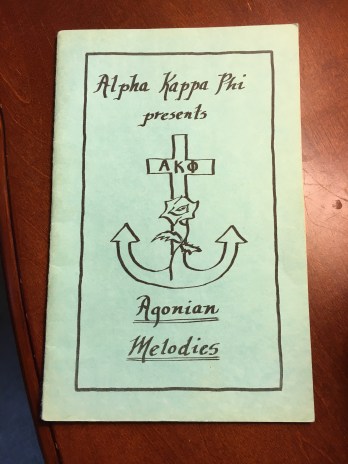
The song book represents something unique about Alpha Kappa Phi: we are a serenading sorority. Traditionally, Alpha Kappa Phi would meet up with other organizations and sing to them. I believe that other organizations, including fraternities, would do the same. We have a position called the Song Leader and her job is to lead the women in the songs as well as to create harmonies. When my grandmother was active, the Song Leader and the sorority would create whole new songs, usually to preexisting tunes (for example, one song is sung to the tune of “Yankee Doodle”). While we don’t always sing every single song anymore, it is still a requirement for all new sisters to learn some of the songs, particularly the important ones. Some of the lyrics and melodies have changed over the years as well, but these songs have been passed down for at least 80 years. This is my absolute favorite part of my sorority; I have never seen another organization do something like this, and this is what I think sets us apart from some other organizations.
A Banner
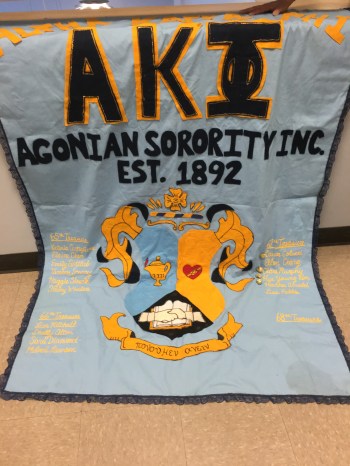 This banner is one that we often use for tabling events, such as Meet the Greeks or the club and involvement fair. It’s approximately six feet tall and made of felt with some lace trims. It features our Greek letters and our full sorority name along with our founding year and a detailed crest. Not visible in the photo are the words “Alpha Kappa Phi” directly above our Greek letters.
There are groupings of names beginning with a heading painted all over the banner, the first one on the left side being the 65th Treasure along with six names. These names and headings are the reason I chose to use this object. A “treasure” is analogous to what other organizations call “new member classes” or “pledge classes,” which I briefly explained in the paragraph on tikis. We call them “treasures” because we consider each group of new members a treasure to the organization (cheesy, maybe, but after seeing three treasures cross in my time at New Paltz I must wholeheartedly agree that each group has been a treasure to us). What I think this banner represents about us is not just the fact that it uses all of our colors and depicts our crest so perfectly, but that it also demonstrates a piece of our history that other objects perhaps don’t. The names on the banner represent the people who not only made this object but also made this organization. A sorority can’t function without people. Every single person who spent their college years in Alpha Kappa Phi has contributed to who we are now. We do our best to represent ourselves through objects, but by far the best way to do so is through the amazing individuals who are my sisters.
Letters
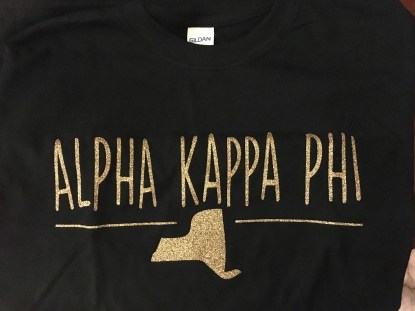 The last set of objects I’m using for this project are one of the best parts of being in any Greek organization: custom letters. The picture on the left is a t-shirt all of us active sisters recently purchased. It’s a simple, black t-shirt with “Alpha Kappa Phi” printed in glitter-gold. Underneath that is a picture of New York State, also in glitter-gold. The New York State picture not only looks cute stylistically but also represents our unique tie to New York since we are only located here.


The set of pictures above are of the sorority jacket. The color is always navy blue and the back always has 6-inch Greek letters ΑΚΦ in gold with “Agonian Sorority Inc.” written in script beneath them. The left sleeve always says “Κ chapter” (“Kappa chapter”). The right sleeve always has the sister’s treasure and semester crossed and the front always has her pledge name written in script. A pledge name is the name you recieve from your big sister, chosen because the meaning represents you in some way.
The jacket is important and traditional in that every sister, including almost all of the alumnae who attended New Paltz after 1996, has this jacket custom-made for her. While owning the jacket isn’t a requirement for membership, it is simply a tradition – albeit a new one – that unifies us. The t-shirt is not tradition but still serves a similar purpose. We recently decided to all buy the same shirt to wear to community service events, in black because it doesn’t show dirt. All of us active sisters currently have this shirt, and it is one more thing to bind us all together for something we all care about: giving back to the community. I don’t expect this shirt to become akin to the jacket in terms of traditions. However, both of them unify each of us to the bigger picture.
To wrap up this long blog post, I want to end with this concept of tradition. What has become clear to me through examining all of these objects is that each of them at one point were representative of a tradition in Alpha Kappa Phi. Each object was replicated and passed down to the next generation of sisters, and through these objects the organization became more and more defined. But as objects have changed over the years, so have traditions. My grandmother and other alumnae who graduated before the 1970s have no idea what a “treasure” is; that title for a pledge class was created in the 1980s and 1990s. My sister pin looks much different from the 1950s sister pin. However, they both have the same meaning; I can wear either interchangeably, and both still represent my relationship to the sorority. What I have found, then, is that just because an aspect of a tradition changes, or even a tradition dies out entirely, that doesn’t mean that the organization as a whole changes. Each Greek organization has a core “essence” about it that makes it unique. These objects that I’ve examined closely are all attempts at representing the essence of Alpha Kappa Phi, and as long as we still have members, that will never change.
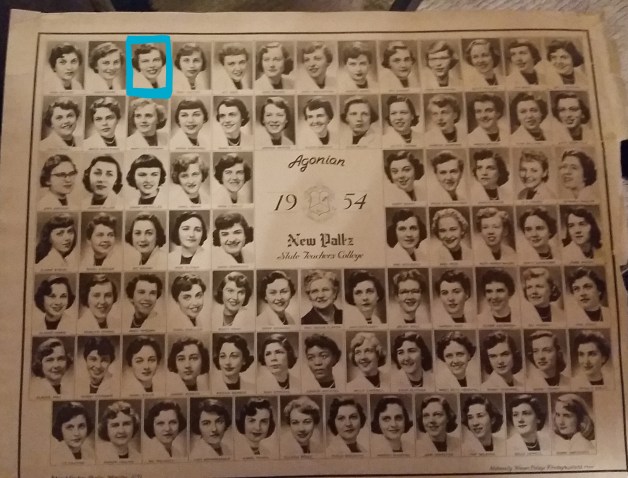
Alpha Kappa Phi, 1954 composite. Grandma Julie is circled in light blue.
 The Materials of History, Thought, and Art
OMG! We didn’t have “Tikis” in my day and if we weren’t wearing colors when we went drinking, it wasn’t a normal day! But is there any possibility you could send me a copy of the song book? I’d love to compare it to the songs we sang! (Wags, 1982, Beta Chapter, SUCOneonta). spayer@yahoo.com