Inventing History: “Washington’s Reception” Lithograph

Caption
At first sight, Washington’s Reception looks like just one of countless prints depicting a founding father. However, US history tells us that much of what is going on here is actually completely wrong! To understand why someone would produce such a falsified account of history, we have to examine the role of art in households of a family like the Brodheads.
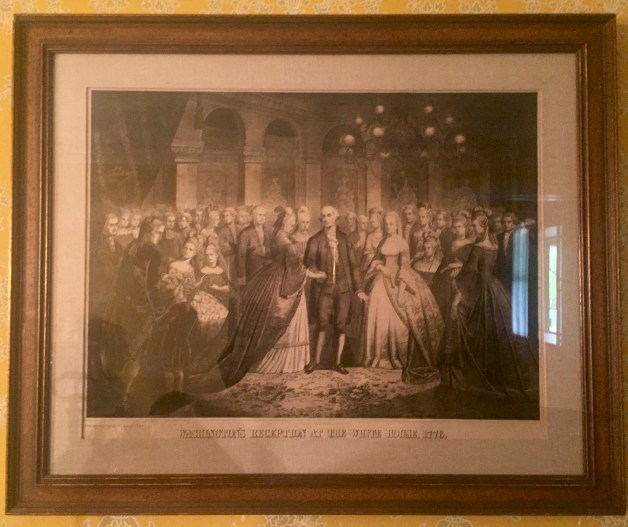
Washington's Reception, Deyo House

Copy of the framed print Washington’s Reception at the White House, 1776 in the Deyo House’s East Parlor
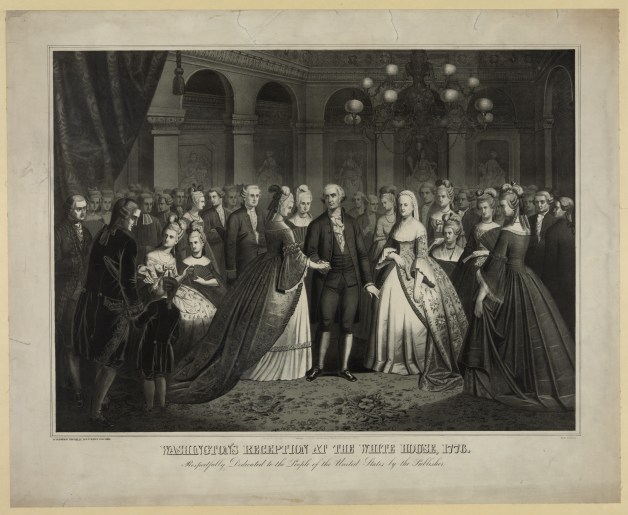
Washington's Reception, LoC

Full print underneath the matte and frame
Source: “Washington’s Reception at the White House, 1776.” Library of Congress, US Congress, http://www.loc.gov/pictures/item/2006677658. Accessed 20 Apr. 2017.

Physical Description
The print is a lithograph, sized 33.5 inches by 27.5 inches (Trainor). It depicts the historically impossible scene of President George Washington greeting guests in an ornate ballroom of one of the US’s most prestigious buildings, the White House, with his wife Martha standing by his side. The room is very opulent for the White House and resembles more closely the interior of a palace like Versailles. Regarding the guests, close observation reveals that nearly every single one them has the same face, giving the image an eerie quality.

The title is printed in serifed block letters reminiscent of fonts printed on contemporary US currency, with line weights varying to give the illusion of embossing. Below the title, written in delicate calligraphy, is a dedication to the American people, and above in very fine print is, written recognition of a copyright for the print to the publisher, Thomas Kelly. A light gray linen matte and wooden frame with subtly gilded edges display it simply and cleanly, keeping with the Colonial Revival aesthetic popular at the time of its creation (Trainor)

Provenance
This print was conceived by a lithographer named George Spohni (also spelled Spohny and Spohn) in Philidelphia and then published by Kelly in downtown Manhattan in 1867 (Falk 1817, 3128). Since the print is in the style that was popular in the late nineteenth century, what seems likely is that a collector of historical prints purchased it from Kelly, and that it later made its way upstate where it decorated a home in the Colonial Revival style (Kennedy). A descendant of that original homeowner probably decided to give it to Historical Huguenot Street once the Colonial Revival went out of style in the mid-twentieth century. This, however, is admittedly speculative.

Narrative
In the late nineteenth century, Americans became enamored with the Colonial Revival aesthetic, which celebrated historical figures and events in the US’s past. Sometimes, artists took this idealization further by fabricating events and placing these figures in them, as is the case in Washington’s Reception (Kennedy). Regarding the scene depicted, it should be noted that Washington and Martha have been placed in a building that, in 1776, would still have to wait twenty-four years to be completed. It is also worth mentioning that Washington was not elected president until 1789, which means that he and his wife would not have belonged in the White House in 1776, even if it had been standing. Even if the timing in this print was accurate and Washington had been elected immediately following the American Revolution (and the US had simply skipped over the confederacy stage), his inauguration took place not in Washington DC, but in New York City (Maclay 1). The Pennsylvania Senator William Maclay who witnessed the inauguration specifies in his diary that it took place at Federal Hall (1). Contrary to that which is depicted in the print, Washington was in fact not so calm and put-together at his inauguration; in fact, the senator describes him as trembling from nerves and consequently unable at times to read what he had to the Congress (2). After anxiously fiddlin with the papers he was reading from, continues Maclay, Washington apparently made an attempt to incorporate hand gestures to add emphasis to his address, but he came off as awkward rather than engaging. Our revered founding father, it seems, was just as human as anyone else attending the inauguration that day and appears to have suffered from stage fright! The calm, diplomatic Washington in the print is an invention of the lithographer, Spohni.
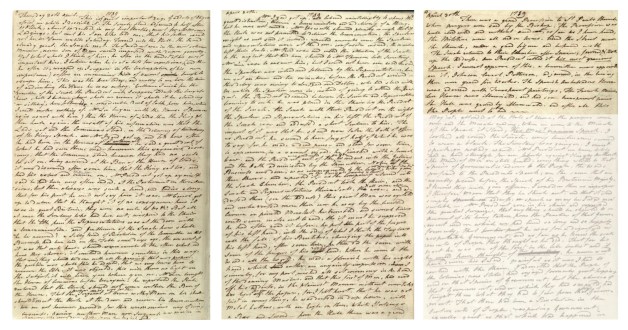
William McClay Diary Entries

Diary entries by  Senator William Maclay about the inauguration (faded section is an entry for the following day)
Source: Maclay, William. “Journal of William Maclay, April 30, 1789, [Original journal].” Library of Congress, US Congress, n.d., http://www.loc.gov/resource/msspin.pin0102/?sp=1&st=gallery. Accessed 2 May 2017.

Given that this print is evidently rife with inaccuracies, an investigation into the motivations behind making it seems warranted. As previously mentioned, given when it was created, its subject matter makes sense: the postbellum period was a time when Americans reverted to older styles associated with proud events in their nation’s history, and with that came imagery of historical figures (Russo). With uncertainty and violence of war fresh in their memories and the nation still reeling from the war, many Americans longed for stability and a sense of purpose. Great figures from the US’s past provided them with the consolation they sought. In the Northeast, this fixation with the past was paired with a reactionary disdain for and fear of immigrants entering the country from Europe, who, it was believed, were a threat American values (Gyure). These great figures Americans had hanging on their walls fought for a free and safe society that many were intent on depriving immigrants of. This nugget of information might explain the why Kelly, an Irish immigrant, and Spohni, a French immigrant, would have created and published such a mysterious piece (Falk 1817, 3128). As immigrants to the Northeast, they no doubt experienced intolerance, and in reaction, they may have decided to mock the country’s arguably shallow postbellum nostalgia by producing a sort of “political cartoon.” They might have decided to have all the guests have the same face to critique the wave of patriotism that was encouraging intolerant and insular—“un-American”—behaviors, as well as causing Americans to ignore the fact that their country was founded by a group of individuals of differing origins.

A print like Washington’s Reception would have likely hung in the Deyo House’s East Parlor. This room was where the Brodheads entertained guests both formally, and, because the parlor has only one door and is as a result the most isolated, privately as well, according to Jaquetta Haley’s Furnishings Plan: Deyo House (94-95). The fireplace, which is purely ornamental, established the room’s refined and formal atmosphere, which, in turn, called for the showcasing of “heirlooms inherited from earlier generations of Deyos as well as decorative pieces symbolic of their sophistication and broad ranging experiences” (Haley 95). Among a collection of objects of this sort, patriotic prints were to be expected, as they expressed one’s connection to the glory of the nation’s past (Holloway 142). The Brodheads probably had a print like Washington’s Reception that romanticized a great historical figure in US history, hanging in their home. Haley explains that it was important to legitimize the family’s status by impressing guests with these intriguing pieces in an entertaining space like the East Parlor (95). Historical accuracy, it can be assumed, would not have been as important as the impact of an effective—albeit potentially inaccurate—story told by these kinds of prints, so while the Brodheads would have probably known if the print they owned was accurate or not, they probably would not have cared either way as long as it served it purpose in the parlor.

East Parlor Display Pics

How the print is displayed in the Deyo House’s East Parlor

Works Cited

Falk, Peter Hastings. Who Was Who in American Art: 400 Years of Artists Active in America, 1564-1975. 3 vols. Madison (Conn.): Sound View Press, 1999. Print.

Gyure, Dale Allen. “Colonial Revival in America : Annotated Bibliography.” Edited by Dale Allen Gyure and Karen L. Mulder, Colonialrevival.lib.virginia.edu, 2003, colonialrevival.lib.virginia.edu/. Accessed 20 Apr. 2017.

Haley, Jacquetta. “East Parlor.” Furnishings Plan: Deyo House, Historical Huguenot Street, New Paltz, NY, 2001, pp. 94–102.

Holloway, Edward Stratton. American Furniture And Decoration Colonial And Federal. Read Books Ltd, 2013.

Kennedy, Martha. “Library Question – Answer [Question #12435925].” Received by Nathan Bergelson, 19 Apr. 2017.

Maclay, William. “Journal of William Maclay, April 30, 1789, [original journal].” Library of Congress, US Congress, n.d., http://www.loc.gov/resource/msspin.pin0102/?sp=1&st=gallery. Accessed 2 May 2017.

Russo, Courtbey. Personal interview with author. 25 Apr. 2017.

Spohni, George. Washington’s Reception at the White House, 1776. Lithograph. Historic Huguenot Street, New Paltz, NY, 1867.

Trainor, Ashley. “Nathan Bergelson: Dimensions of and materials used in ‘Washington’s Reception’ print.” E-mail received by author, 20 Apr. 2017.

“Washington’s Reception at the White House, 1776.” Library of Congress, US Congress, n.d., http://www.loc.gov/pictures/item/2006677658. Accessed 20 Apr. 2017.
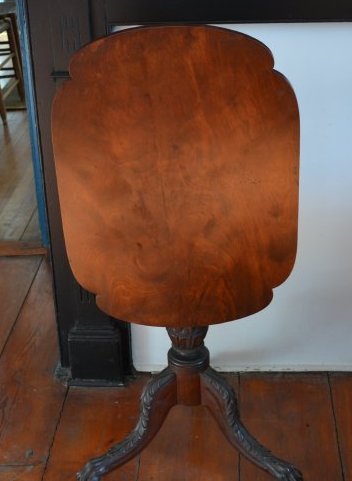

Tea, Anyone?

Physical Description:

113931

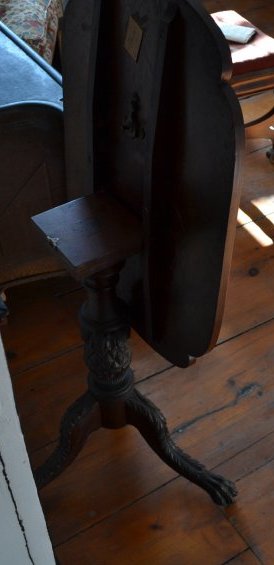
Photograph provided by Ashley Trainor: Front view of Charles Warner’s Tilt-top table

The table displayed to the left stands about 2ft off the ground when the table top is parallel with the floor. The table top is hinged allowing it to be turned on it side when is not being used to hold various objects. In its entirety, the table has minimal scratches/ chips. The base of the table has been constructed out 5 separate pieces of mahogany wood. The central piece is an urn-like base that appears to have been turned on a lathe with a pineapple carved into the center of it. The base is connected to three arched, tapered legs. Each leg consists of acanthus leaf carvings that transition into the paw of an animal (likely the paw of a lion). Attached to the center base and legs is a smaller table top, likely to function as a seat. The table top is an ovular shape with pinched corners that it approximately 2ft x 1.5ft. Beneath the tabletop is a makers mark inscribed “Charles Warner, Cabinet Maker, Poughkeepsie.” This type of table (hinged table top with smaller attached smaller seat) is referred to as a tilt-top table. This table was constructed approximately 1800-1820.

leafpawlegpineapple

splayedleg

Illustrations of the decorative motifs most common in this style.

Furniture being designed during this time (1805-1830) which overlaps with the same time of Charles Warner’s life was referred to as American Empire style furniture. Influenced by neoclassical and french empire during the reign of Napoleon. Specifically this style was largely inspired by Napoleon’s architects Percier and Fontaine after Napoleon returned from a trip to Egypt in 1798.(LaChuisa, 2005) This style uses decorative motifs including rope twist carvings, animal paw feet, Acanthus leaves, stars, eagles with spread wings, etc. It was common during this era design to use oak, mahogany, and other dark woods for building furniture. However, dark woods were so popular that often mahogany was painted black. Also, inlays were often used and were made of ebony or maple veneer. This style varied within utilizing this set of visual motifs with New York City being the center of this design style. (LaChuisa, 2005) New York city was also the center of fashion at the time, which will relate to the utility of this kind of furniture explained later in this post.

Provenance:

113931-3

Side/Back view of Table. The Gold square at the top of the table is the Makers mark engraves “Charles Warner, Cabinet Maker, Poughkeepsie”

Sought out by furniture historians as a major landmark in cabinet making, Tilt-top tables arrived in America in the early eighteenth century from England. From their start in England, Tilt top tables were associated with a gentile behaviors, namely tea drinking. Tilt top tables were also referred to as tilt- top tea tables. Other common nomenclature used to refer to this kind of table was the “claw table” and the “snap table.” The tables became an indispensable unit of the ritual of tea drinking. Tilt top tables were just as necessary as the tea, kettle, and cups as they contributed to the fashionable parlors and heightened the status for politicians, artisans, laborers, etc..  Generally speaking, people invented new types of furniture to accommodate the continuously changing needs at the time. (Fayen)The tilt top table did contribute to the solving the problem of spatial efficiency however, this table gained recognition for its appearance more than its utility. Historians figure that this was in part due to the state of consumerism at the time. It was during this period that the production of goods were becoming more affordable and widespread to produce. The fashionable experience of tea drinking that was once only afforded to the rich and wealthy became accessible to those in the middle class. Between 1740-1790 tilt top tables were omnipresent components to American parlors.  This time frame leads right into about the time of Charles Warner and his desire to construct these tables. Based on the provenance of the tilt top table it becomes clearer the intention of building such tables. (Fayen)

Makers Bio/Historical Narrative:

113931-2

Detail image of the base of the table

Charles Warner worked as a cabinet maker in Poughkeepsie in 1820. It appears that Charles Warner was born and raised in Poughkeepsie, dying in 1834. He was the son of Thomas Warner who purchased a lot of land in Poughkeepsie “beginning at the northeast corner of Myndert Van Kleek’s garden fence along the new street” 1785. Warner was not only a cabinet maker but also, a businessman. He owned a considerable number of stock shares, including stock in the Poughkeepsie Whaling Company, the Farmers and Manufacturers Bank, the Eastern Market, the Poughkeepsie Steam Boat Company, and the Dutchess Whaling Company. Financial records indicate that Charles Warner was a successful cabinetmaker and businessman, with considerable financial resources for the period.(Fallen)

Charles Warner’s table, which now lives in the Empire gallery room in the Deyo House, signifies not only a time of advancement in consumerism and commercial trade, but also lends itself to the attitudes of status and fashion in the early 19th century in the Hudson Valley. Although little is known about the local artisan himself we can deduce by his financial resources that he was an affluent man who enjoyed and benefited off of the popularized gentile lifestyle of the early 19th century. Additionally, I ascertain based on the quality of craft that was involved in the construction of this table that there are a wide variety of Charles Warner tables scattered through the Hudson Valley. Although it is unknown who was utilizing this table, the specific qualities of this table indicate that the individuals were mindfully curating an image of what I like to call efficient elegance.

Work Cited

1. Fayen, Sarah Neale. “Tilt-Top Tables and Eighteenth-Century Consumerism.” Chipstone.      N.p., n.d. Web.

2.Fallen, Todd. “A Regional Study in Early Nineteenth-century Cabinetmaking: Charles Warner, Cabinetmaker, Poughkeepsie, New York.” 2005. WAG Postprints. Web.

3.“American Empire (1800-1840).” Guide to Furniture Styles from Connected Lines. Connected Lines, n.d. Web. 04 May 2017.

4. LaChuisa, Chuck. “Furniture – Empire Style.” Empire Style. N.p., 2005. Web. 04 May 2017.

Creating an American Culture: The Federal Style

Caption

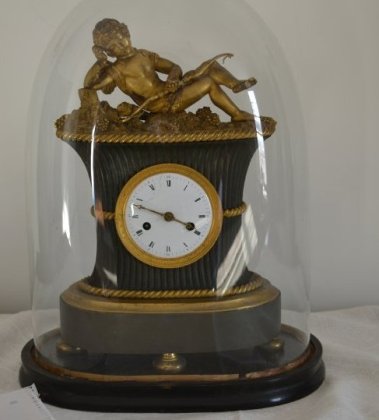
As baby Cupid rests on grapes and leaves, the United States has only just been born.  Made in 1788, this clock represents the Federal style, an artistic movement that impacted how architecture, furniture, and interior design styles were made. This clock would find its way into the home of Josiah DuBois, a Huguenot descendant and owner of an extravagant Federal inspired home. The house, as well as this clock, are the symbols of an attempt at creating a true “American” culture in the 1800s.

Object Description

Clock

Federal style clock feat. Cupid. Picture Credit: Jessica Wiessner.

The clock contains several parts: a wooden plate for a stand, the main part of the clock where the face is, a golden Cupid laying in leaves and grapes while holding his bow and arrow, and a glass covering.  The clock’s face uses Roman numerals as a signifier for time and is quite small in relation to the whole clock.  The frame containing the face and Cupid is wood painted black with gold trims around it. There are also ridges carved into the wood, giving it a bumpy texture.  Inside are the gears which are no longer functional.  Cupid lays in a comfortable pose on leaves and grapes with his bow facing straight ahead.   The glass is dome-shaped and covers the entire clock to protect it.  The whole clock is approximately 13.5 inches high and 9.5 inches wide and is quite heavy to pick up or handle.

Provenance

This clock is dated to 1788.  It originated from an apartment on Pine Street in New York City owned by a man named Samuel Boyd.  I have not been able to find much historical information on Samuel Boyd other than he lived there and may have owned some type of store.  It ended up at the Blake House, owned by William H.D. Blake, who died in 1926.  The family continued to own the house and its objects until 1984 when the items in the Blake House were donated to Historic Huguenot Street. The clock now resides in the Federal Style Room in the Deyo House.

There are a couple of possibilities as to how Blake acquired this clock. According to the Historic Huguenot Street website, Matilda Blake was very close to her cousin Amy L. Hepburn, whose parents were named Samuel Boyd and Sarah Booth Hepburn, therefore making Samuel Boyd the brother-in-law to William and Matilda (Booth) Blake. Perhaps this is the Samuel Boyd from Pine Street who owned the clock, and William Blake purchased the clock from him or otherwise received it as a gift. It has been extremely difficult, unfortunately, to find evidence of this relationship as the name Samuel Boyd was extremely common. It could also be possible that the Samuel Boyd on Pine Street is a completely different person from William Blake’s brother-in-law, and that William Blake simply purchased the clock directly from this person or from an antique shop.

Narrative

William Henry Dill Blake (1843-1926) was born in Montgomery, New York and served as an officer in the Civil War.  He married Matilda Booth in 1875 and together they had three children: Alfred Booth, William Culbert and Matilda. They moved to New Paltz in 1881 when Blake purchased the late Josiah DuBois’ house and 250-acre farm. He continued to live in New Paltz until his death in 1926. All three of his children graduated from the New Paltz Normal School and were heavily involved in the New Paltz community, especially Matilda.

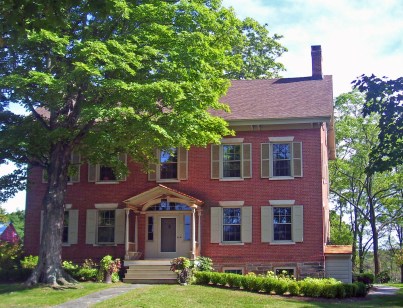
William Blake’s house is a story in and of itself and is important in understanding where the clock fits in.  It was constructed in 1822 on a large portion of land owned by the DuBois family since 1677.  Josiah DuBois owned and lived in the house until his death in 1869.  His daughter Elizabeth and her husband moved in the same year but only lived in it for twelve years until William Blake purchased it.  The house has become a historical landmark in New Paltz due to the property’s involvement in the original Huguenot settlement and the Revolutionary War.  The house was constructed in the Federalist style of architecture, so the clock this project focuses on must have fit in nicely with the theme of the house.

Josiah DuBois Farm House

Josiah DuBois Farm House. Source: WikiMedia Commons (link in references)

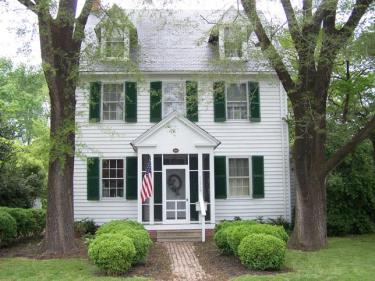
The Federal style was a movement in the three decades following the inception of the United States.  The developing system of government largely influenced the term Federal style, and the style itself served as a way for the newfound United States to create its own identity.  A prime example of the Federalist style is the White House, which has come to be a symbol of America and American identity. In addition, Neoclassicism, or a revival of ancient Greek and Roman art and culture, also heavily influenced furniture in this period. This would explain why the clock contains Cupid as its focal point.  Federal style furniture often comprises of thick, dark wood, simple designs, and marble.  Although elements of Neoclassicism (a relatively European movement) exist in the Federal period, the style is representative of the beginning of an American culture.  It is interesting that Josiah DuBois would choose this style for his house and William Blake would choose to maintain it.  The DuBois family were part of the original twelve French

Federal Style Ex 2

Colonel George Handy House, built 1805 in Maryland. Federal Style. Source link listed in references.

Huguenot settlers in New Paltz and brought their European culture and traditions with them when they emigrated to New Paltz in the 1600s.  The property they owned still contains several older structures, including a 1775 Dutch barn.  It is as though DuBois and Blake, like much of America at the time, were attempting to erase their own histories and ascribe to the new “American” story that was emerging through creating and preserving this Federal style.

References

“Landmark Designation Form.” Historic Huguenot Street. Town of New Paltz, New York.  2003.

“William H.D. Blake Family Papers.” Historic Huguenot Street revised 8 June 2005. <www.huguenotstreet.org/william-h-d-blake-family-papers/>

Thurlow, Matthew. “American Federal Era Period Rooms.” In Heilbrunn Timeline of Art History. New York: The Metropolitan Museum of Art, 2000-. <www.metmuseum.org/toah/hd/fede/hd_fede.htm> (November 2009).

Picture of Colonel George Handy House in Maryland. Built 1805. Source: http://www.oldhouses.com/archives/1800-1810?searchname=Built%20between%201800%20and%201810

Picture of Josiah DuBois House. Source Link: https://commons.wikimedia.org/wiki/File:Josiah_DuBois_Farm,_New_Paltz,_NY.jpg

The Bigger the Better

Context and Research

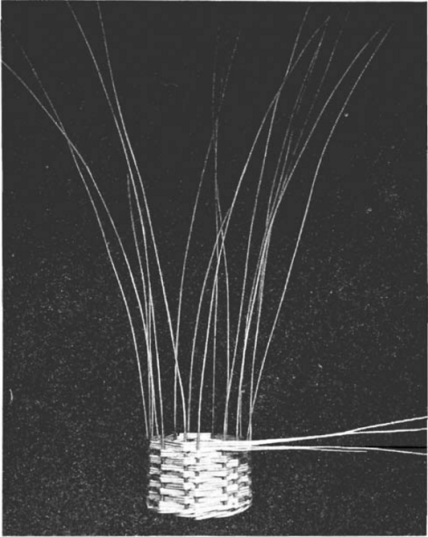
In Thomas Okey’s An Introduction to the Art of Basket Making, he details the experience one would have weaving a basket, right down to the tools used and the names of each type of strand of material. To form the “butt” of the basket, the basket-maker would first create a cross with pairs of smaller pieces (Slath-rods), and proceeds to weave a longer piece over and under the crossed pieces. To keep it still, the basket-maker takes one of the slath-rods, “brings it tightly over to his right, and lays it alongside the two sticks under his right foot… (Okey, 25)” This process created the bottom of the basket.

…and as the basket-maker weaves upward, we see the piece come to life.

in progress example

An example of a basket in progress. Okey, 31


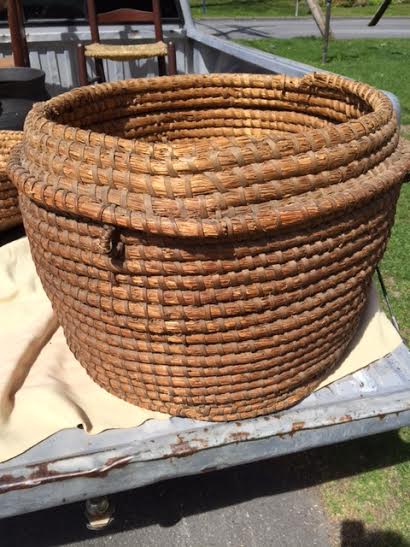
A lot of physical effort had to be put into basket making, using all parts of the body. My particular basket (pictured below) is huge, much wider than the example used by Okey. It is evident that a great effort must have been put into this creation by the particular basket-maker. Basket weaving has been one of the most common practices throughout human civilization. Instead of Glad tupperware containers like we have nowadays, people had baskets. They held everything from foods, to clothing, to seeds and crops, and were also used to transport goods. This enormous basket could have easily fit a relatively large toddler inside of it. It is rounded, composed of rawhide, reed, and is bound with straw. It is also tightly woven, with two small loops of either side, possibly to string some kind of strap through them. It now resides in the Jean Hasbrouck house, sitting flush against the wall of Joshiah Hasbrouck’s shop as part of the current interpretation of the room.

77301

Here it is, the big man. Photo courtesy of Ashley Trainor.

The family lore attached to this basket claims that it arrived in America with Louis DuBois in the 17th century, when the Huguenots originally fled religious persecution. In actuality, it is said to most likely be a 19th century basket. This is a period of 200 years that could separate fact from fiction. From the beginning, I knew I would have to do some mythbusting. After researching general material on Artstor, I’ve found that there are many more results for “19th century basket” than the term “17th century basket.” The first search also yields many similar looking artifacts: woven baskets, some of them enormous. Right off the bat, this makes me believe that the family lore is simply lore indeed. But, to add only more confusion, the basket was also mislabeled as a clothing basket upon its donation by Evelyn DuBois McLaury. The donation date is prior to 1990, however there is no exact date.

Still on my general ArtStor search, I found several sketches of cotton pickers. Pictured were slaves carrying enormous baskets full of cotton. After seeing those images, I immediately thought that this basket was used for farming. Since it is so large in size and so tightly woven it would make sense that it was used for storing freshly picked crops, specifically grain or seed. Since it is so tightly woven, it seems as if the person building it wanted nothing to fall out. If I were to go down the 19th century track, this would be the most plausible assumption.

Narrative

When fleeing to the new world in the late 17th century, this basket was brought by Louis DuBois in his escape from religious persecution. With them, the Huguenots brought the only things they knew: their families, their religion, and food. When settling on the banks of the Wallkill River, they constructed the notable stone houses that can be found on Historic Huguenot Street today. And inside are interpretations of their lives. This basket, being made of rawhide, this indicates that it is made of animal skin. Assuming the basket was made locally, it most likely would have been made of cow or sheep skin. Josiah Hasbrouck owned a country estate called Locust Lawn, located in present day Gardiner (“A Notion to Sew”). Crops grown there included rye, oats, corn, wheat, and apples. Animals owned were milk cows, chickens, beef cattle, and pigs, all of which were used completely to their full potential (“A Notion to Sew”). Photos collected in New Paltz Revisited indicate that a popular crop grown in New Paltz and surrounding areas were potatoes and other spuds (Johnson). Soil was rich in nutrients due to the establishment being along the banks of the Wallkill River. According to “New Paltz Town Records,” it states that once the town of New Paltz was founded, it “survived for the next two hundred years as an ‘isolated, conservative, tightly-knit farming community.’” Additionally, the Huguenots worked on a maintaining a healthy and prosperous relationship with the nearby Esopus Native Americans (Esopus Trails).

Throughout the Huguenot’s years establishing the town of New Paltz, they became an independent and self-sustaining community. Farming was the primary means of acquiring food. In addition to harvesting and maintain their own crops, there were also small shops set up, much like the one Josiah used in the preserved Jean Hasbrouck house, to sell goods, which was only the beginning of the exchange economy we have today.

Although I have absolutely no information on this basket’s creator, I can very well infer that it was made with the intention to be used in farming. The tightness of the winding and the sheer size of it indicates that it was used for something with harvesting crops: to gather as much as possible at one time, to store a large amount without fear of anything seeping into it, among countless other possibilities. Agriculture is a huge component of every early civilization’s way of life. It was what the Huguenots knew in France, and it was something they brought over to the Americas upon fleeing for life.

 Special thanks to Ashley Trainor and Carrie Allmendinger for all of their assistance!

Works Cited

“A Notion to Sew.” Hudson River Valley Heritage. N.p., 2 May 2008. Web. 28 Apr. 2017.

Esopus Trails: The History of Esopus Township. Ulster Park, NY: Maple Ridge School, Maple  Ridge Bruderhof, 2005. Print.

Johnson, Carol A. New Paltz Revisited. Charleston, SC: Arcadia Pub., 2010. Print.

“New Paltz Town Records (1677-1932).” Historic Huguenot Street. N.p., 27 June 2005. Web. 3 May 2017. <http://www.huguenotstreet.org/new-paltz-town-records/&gt;

Okey, Thomas. An Introduction to the Art of Basket Making. N.p.: n.p., n.d. Google Books. 13 Apr. 2013. Web. 2 May 2017.


Tilson’s Timepiece.

Narrative

Tillson_Residence_Highland_NY

“Lake Ledge,” the family home of the Tilson’s, Highland, New York.

1853 map

Oliver Tilson’s Ulster County, 1853. {HRVH}

August 7th, 1863 Harry C. Tilson was born to Mary and Oliver J. Tilson, of New Paltz Landing (now known as Highland), NY. His father Oliver was a fruit farmer, Rosendale town supervisor, and established cartographer for the county of Ulster (1853 map is stored with the Huguenot Historical Society’s Map Collection). On October 13th, 1886, Harry married Mathilda “May” Allen, daughter of a methodist reverend. Their marriage was cut short by the sudden illness and subsequent passing of May. They had three children the youngest being 5 years of age. Harry Tilson met his end 53 years later, after suffering a heart attack, post surgery, where he had relocated in the years following May’s death, in Deland Florida. The Kingston Daily Freeman reported that he was active in the Presbyterian church and the ancient order of Good Fellows (a now defunct masonic group).


Physical Description

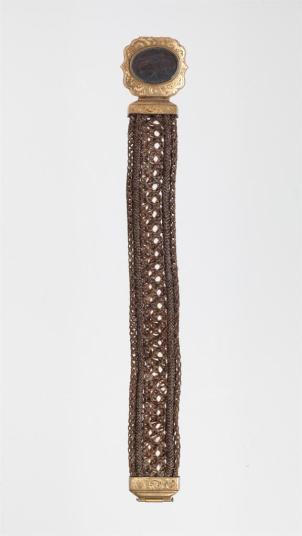
This item, once belonging to Harry C. Tillson, is a gold pocket watch, donated by the Tilson estate (Oliver Tilson II, Grandson to Harry) to the Historic Huguenot Street collection. The watch is that of a full hunter-cased style, a case which can be opened with one hand, and is roughly two inches in diameter. This design has a latching front and back, which closes to protect the crystal, hands, and dial (face) from dust and scratches. The mechanism on top is a push button type crown which opens the outer casing and winds the watch. The front outside is elaborately engraved with finial design of  the initials HTC. In the watch cover, there is also simple scripted engraving that reads “California 1875.” Both front and back closures are hinged at the bottom, which aligns with 9 on the dial. The outside, or rim of the timepiece itself is grooved, which is most likely for secured holding or pure decorative accent, as like the rest of the outer portion, it is gold. Immediately linked to the hoop surrounding the crown is a standard clasp, is a tightly woven chain of human hair, accented with gold, measuring approximately 7-½ inches. Connected on the opposite end, a latch to keep the watch worn, to a something such as a button hole, a belt loop, pocket, so as not to lose the watch, or as adornment. In the center of the chain there is an additional accent, which may act as an additional support, attached is two small charms or fobs, which have a design that has patinaed and worn away, and is now indistinguishable, but are likely to have matched the ends, or signified something of the bearer.

hair 2

Full Hunter Case Pocket watch with watch chain, made of human hair.                                      [Photo provided by Ashley Trainor, collections manager, Historical Huguenot Street]

Provenance

The watch is thought to be made in California 1875, rather than Harry purchasing it in that time, as he would have been twelve. In scaling the Tilson genealogy, it was determined to be Harry’s monogram, not only because the grantor is the paternal grandson, but because, any other Tilson carrying the HTC initials were born well after the inscription. Although I was unable to see the engraving itself in picture or person (collection unavailable), I am pressed to believe it is in/or the backside of the hunter-casing, as a maker or jeweler’s marked inscription or inception. Curiously, it is a practice for the maker to include his Name or Mark above the made date, as trademarking at this time, on casing is a sign of value or worth. Perhaps this has been worn away. Harry, himself, can be traced to California via his coal business of which he had built, along with the house next to the family home “Lake Ledge,” in the former New Paltz Landing, on Vineyard avenue. In the 1908 listing of copper mines, it is established that Mr. Tilson was in the business of mining copper in New Mexico, placing him much closer to California. This is a seminal reason as to why May Tilson’s death had been reported in a Los Angeles newspaper May 4th, 1900. The tight braid connecting this watch to Harry himself may have been made to commemorate his wife’s death in 1900, and is very likely to be made of her hair, a token of his love for her. Although this is speculative, it is common practice during this time and being so far from home, it may have been his only resolve at the time. It is unknown at this time as to where Mrs. Tilson is at rest, further burying the mystery of the hair attached to the watch.

Historical Hair Ornamentation

The use of human hair as adornment and memory begins in France and England in the 1700’s, something which Queen Victoria herself popularized. This trend became an evolving craft of wig makers, inevitably reaching to becoming another parlor craft of home makers and funerary momentos throughout Europe and the United states in the following century. This home craft extending beyond mourning, to include ornamental hair samples of lineage from children of the women weaving, keeping a very personal family album, an estrangement from bible cover lineage. In the United States this practice may have been adopted not only in craftwork, but to make special, as the sentimentality of the losses of the very recent Civil War and the onset of the manufacturing boom of the Industrial Revolution.

AWSS35953_35953_32666739 (1)

Women’s bracelet made of intricate hair work, American, 1850-1899 (Artstor

The hair mourning jewelry typically worn by women can range from elaborately woven laces to simple lockets containing a small snippet of hair. Being so popular towards the end of the 19th century, it was common for many jewelers to have in-house hair weavers, custom fitting precious metal (predominantly silver and gold) to chains and in this case, a watch chain. This particular chain and many like it often had charms accenting the rest of the metal work and clasps. These accents were particular to the owner of the watch of of the taste, and often a piece of jewelry belonging to the deceased.

Men’s accessories were not as elaborate of their counterpart’s however, the sentimentality remains, as an embodiment of the hair-owner’s soul, forever in  functional capacity with the bearer. In the cases of long braids, such as this example, it would be necessary for the hair to be long, and tightly woven so as to minimize fraying. The hair is often taken from the body before burial and for such a memento, it is likely to be conditioned to minimize its deterioration, as it is likely to be touched and used more than that of a women’s piece of jewelry, such as a brooch, pendant, or bracelet. It would be sensical then, for Harry to display his mourning practice and love for his deceased in this manner. As a business man, it would be important for Harry to keep time, and secondly, to have adequate remembrance of his wife. New Paltz’s rich history includes many items of hair-craft. It would befit the cultural practices at the time and his hometown if he were to display such a mourning practice.


American. Bracelet. 1850-1899, Woven hair, ARTstor. Web, 18 April 2017.

Holm, Christiane. “Sentimental Cuts: Eighteenth-Century Mourning Jewelry with Hair.” Eighteenth-Century Studies, vol. 38, no. 1, 2004, pp. 139–143.

“Los Angeles– Mrs. Harry C. Tilson”. May 4 1900. XIV, Page 226. Local Obituaries, Elting Memorial Library, New Paltz. 11 April 2017.

Lutz, Deborah. “The Dead Still Among Us: Victorian Secular Relics, Hair Jewelry, And Death Culture.” Victorian Literature and Culture, vol. 39, no. 1, 2011, pp. 127–142.

“Obituaries.” Kingston Daily Freeman 1 May 1953, Notices sec.: n. pag. Print. “Harry C. Tilson”

“Oliver J. Tillson Family Papers (1787-1899).” Historic Huguenot Street. Huguenot Historical Society, 17 May 2004. Web. 8 Apr. 2017.

Stevens, Horace J. The Copper handbook: a manual of the copper industry of the world. Vol. VIII. Houghton (Mich.): H.J. Stevens, 1909. Print. p. 1431

“Tilson: Mathilda”. October 13 1886. VII, Page 125. Local Marriages, Elting Memorial Library, New Paltz. 11 April 2017.

Tilson, Mercer V. The Tilson Genealogy. Vol. 1638-1911. Baltimore: Gateway Press, Inc., 1982. Print.

Tilson, Oliver J. “Map of Ulster County, New York.” The Library of Congress. N.p., n.d. Web. 12 Apr. 2017.


Older than this country: Pierre Deyo’s Ladder Back Chair

This ladder back chair, owned by Pierre Deyo in his lifetime and by the Deyo family until 1926, is thought to have been built between 1650 and 1700, making it older than the United States.

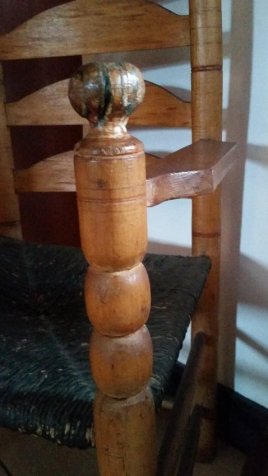
It is a heavy, large wooden chair in the ladder back style. The style was popular in the Middle Ages all the way through the eighteenth century (“Ladder Back Chair”). It has a tall back with four slats. It has a seat of rush, painted black. The seat is caving inwards, and is fraying towards the front of the seat. The right leg has some scratches on its finial. It is made of a pale wood, such as oak or pine, with a shellac finish (Giese).

chair 2

Picture Credit: Ashley Trainor. Used with permission

Provenance

Pierre Deyo, one of the original patentees of New Paltz, was the first owner of this piece.  It is thought to have been built between 1650 and 1700. He most likely would have bought it from a local craftsperson. When Pierre died in 1708, his land and estate was split between his four sons, Abraham, Christian, Pierre, and Hendricus (“Deyo Family Papers”). This item was considered part of the Deyo household, included within Deyo’s grandson Peter’s will in 1791 (State of New York). The chair remained in the Deyo family up until it was purchased by Historic Huguenot Street from the Andrew LeFevere Deyo estate shortly after his death in 1926.

Narrative

Pierre Deyo (ca 1648-1708) was one of the twelve patentees of New Paltz. Along with the other members of the Deyo family, he was incredibly involved in the community, as evidenced by their extensive collection of records collected and maintained by Huguenot Street. This chair, which today has a home in the Abraham House, is older than the United States, and remained in the Deyo family about as long. The ladder back style—which was ubiquitous at the time—is older still, thought to have originated in Europe in the Middle Ages (“Ladder Back Chair”). The simple, but enduring, style is now very much desired by collectors today, which is a testament to how well-crafted these chairs are.

This style also reveals an important aspect of New Paltz life at this time: their Protestant religion. Protestants tended to favor simpler, less ornate pieces which were more functional than beautiful. The Huguenot settlers were practitioners of a late ancient Christian asceticism. According to Richard Finn, in his book Asceticism in the Graeco-Roman World, this Protestant asceticism is based on Greek morality, and that

Virtuous living is not possible when an individual is craving bodily pleasures with desire and passion. Morality is not seen in the ancient theology as a balancing act between right and wrong, but a form of spiritual transformation, where the simple is sufficient, the bliss is within, the frugal is plenty (94).

Later on, the Deyos and other important families of New Paltz would obtain the more ostentatious and beautiful furniture of the Federalist and Victorian eras, but the desirability of the furniture shows that there is an enduring appeal towards this aesthetic.  Simple objects and simple homes speak to the fast held beliefs of these people—further evidenced by the plain decoration of the rebuilt French Reform Church.

The chair’s craft is also derived of the area. According to woodworker Bob Giese, the piece would have been made out of wood that could be obtained easily and locally; it is thought to be pine, oak, or perhaps maple. Additionally, is has been finished with shellac, which could be made by mixing tree resin and alcohol; as shellac has a shelf life (albeit of months or years), and requires skill to apply, Deyo himself was likely not the one who made the piece, but rather, a skilled local artisan.

This piece would most likely have sat by the fireplace in one of the few rooms of the Deyo home. After a long day of work, it would have been a comfortable place to return to and to unwind. Possibly, it could have been sat or worked on by a slave—Pierre owned at least one, as evidenced by a receipt in the Deyo family papers from 1694.

References

Deyo Family Papers. Huguenot Historical Society, 1998.

Finn, Richard. Asceticism in the Graeco-Roman World. Cambridge University Press, 2009.

Giese, Bob. Personal interview. 18 April 2017.

“Ladder-back Chair.” Encyclopedia Britannica. 21 December 2006.

https://www.britannica.com/topic/ladder-back-chair

Roth, Eric. “History of New Paltz”. New York History, no. 4, 1989.

Ulster County Office of the Surrogate. American Record Series A.:-Wills, Volume II. State of

New York, Ulster County, 1905.