I absolutely hate clutter. I don’t normally like to think in absolutes, but I feel that this animosity towards untidiness really originated during my time growing up. As a child, I was often responsible for performing the many household chores my parents would assign to me. Although I usually had to carry out a myriad of diverse tasks, the one I absolutely despised the most was cleaning clutter around the house. During this time, I began to develop the mindset that I should always attempt to prevent a mess from ever coming to fruition. As this ideology culminated during my days as a child, I feel as if this period served to define my personality as someone who maintains order by only retaining items that serve as a pure necessity.
In spite of this development, recent events have served to challenge my own conventional wisdom. Prior to writing the contents of this blog, I had been granted the opportunity to read and analyze Marie Kondo’s informative guide “The Life-Changing Magic of Tidying Up”. After taking Kondo’s words and advice into consideration, I attempted to apply her same principles to my dorm room at Suny New Paltz.
Admittedly, I was slightly skeptical at first. Up to this moment, I had tried everything to make my room as clean and clutter free as possible. My personal and my drawers only contained very little items on or within them. After closer inspection, I deemed that the paucity of items would make it impossible to sort and categorize these objects. As a result, I found these beginning stages to be quite difficult as I was unsure on how I would actually begin this process of tidying my room.

Still skeptical on the practicality of Kondo’s instructions, I decided to inspect my wardrobe. To my surprise, only now had I realized how disorganized it was. Granted, I’m sure they are other far messier closest than mine but I reasoned that this would serve as a suitable first step in this tidying process.
I began by categorizing each of my different articles of clothing into the following groups: jackets, sweaters, polos, t-shirts, casual button downs and then more formal button downs. After completing this short task, I immediately noticed a difference in the contents of my wardrobe. As everything began to appear much more orderly and unified than before, I desired to continue and see how far I could push Kondo’s philosophy. In order to achieve this, I decided to utilize her “Joy Test” to determine what pieces of attire should be retained and what pieces of attire should be theoretically discarded.

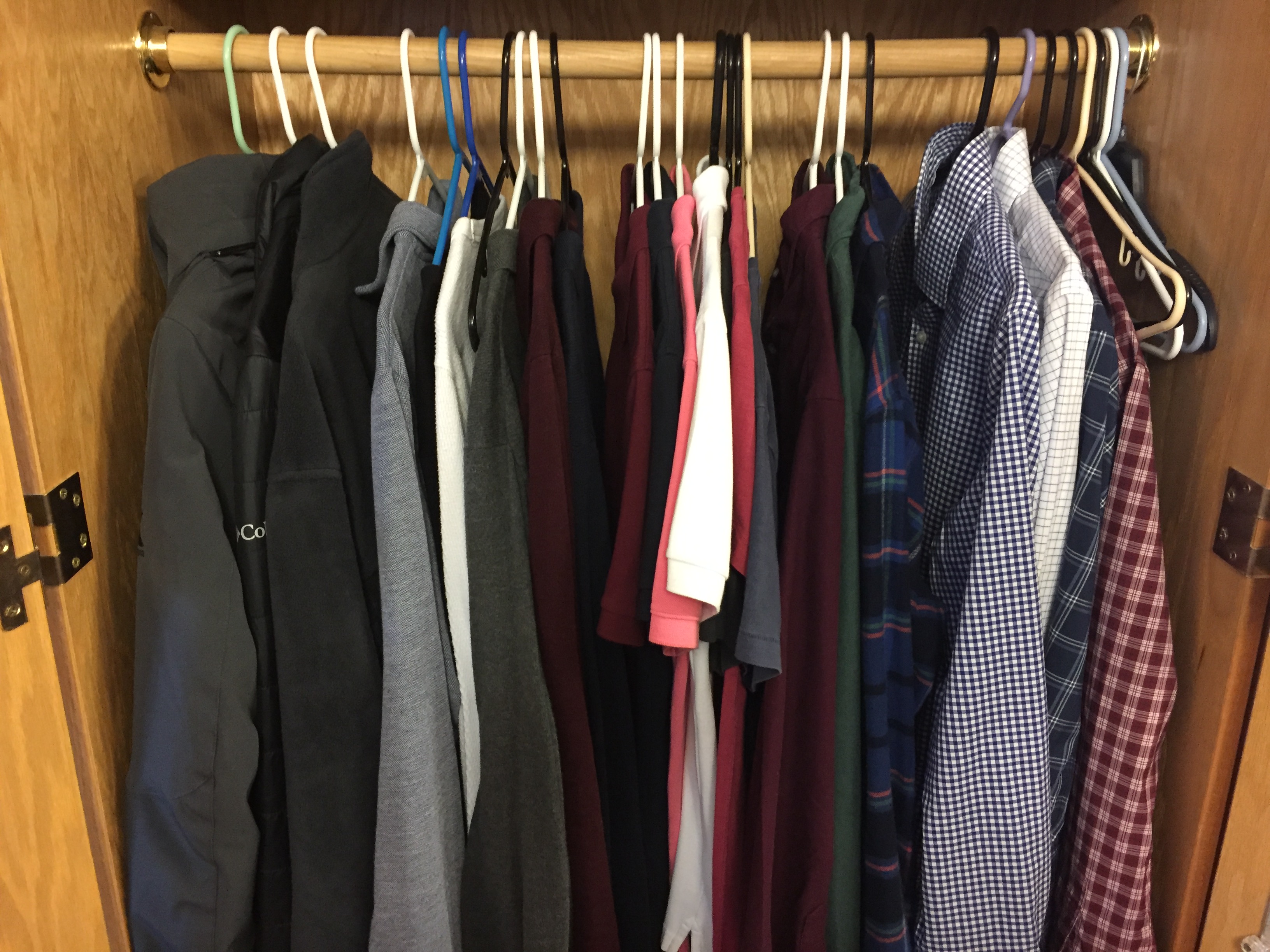
Before implementing this action, I was faced with an imperative question: what exactly constitutes joy? Up to this point in time, there was much uncertainty to how I would determine whether or not a specific article of clothing delivers any sort of joy. In an attempt to resolve this issue, I eventually came to the conclusion that I enjoyed clothes that I utilize the most and, by that same principle, I would find the least amount of joy in the clothes I utilized the least. Ultimately, this development inspired me to sort through my wardrobe once more and identify attire that I rarely wear on a day-to-day basis. After carefully inspecting each piece of clothing, I had removed seven out of thirty pieces of clothing from my wardrobe.

Despite my minimalistic approach to material objects, I discovered that the objects that deliver the most joy often serve an essential or important function within my life. Since I tend to own clothes that can be perceived as preppy, I often believe these pieces of attire help me emulate the professional and important characteristics of the successful businessman I see myself becoming in the near future.
Although I had only removed just under 25% of clothing from my wardrobe, the process of discarding underused clothing was quite more empowering than I had originally anticipated. After completing this small—yet impactful—endeavor, I can definitely state with certainty that this new streamlined wardrobe emitted a much greater vibe of joy than it did prior to the experiment. Since this process had seamlessly connected with my already established mindset of cleanliness, it has now become rather easy for me to see why Kondo’s ideas aided in maintaining the clutter-free environment I continue to desire. Moreover, this experiment also taught me a valuable lesson in that there can always be room for improvement no matter how perfectly you idealize your life to be. As a result, this project helped me to develop a greater connection and appreciation towards the objects that continue to influence myself and the environment around me.
 The Materials of History, Thought, and Art
You can definitely see the difference in your wardrobe even after only removing less then 25%. I agree that the ones that bring joy often come with a purpose which is why we continue to wear them. I always like keeping my room neat and clutter free. Before this assignment I felt as if I had been going about the process of organizing in not as efficient of a way. Now, I would love to bring this method into other areas of my room to effectively organize my space. This assignment made me realize that I was holding onto a lot of objects that brought me no joy or purpose.
I’m really impressed with your results! I like that you truly followed Kondo’s method–can’t say the same for myself–as it’s interesting to see how successful it was for you. I completely agree that this process was empowering and certainly impacted the way we see our objects. It was also very refreshing to read that you felt more “joy” in regards to your wardrobe after completing the process–that’s a true sign of success!
I found your experience and approach to living in general very interesting as many people, especially as students, struggle with living an organized and decluttered life. I personally definitely prefer tidiness as well, though I come from a family who has difficulty letting go of our belongings– also resulting in a disdain for decluttering. I wish I could relate to using this as a reason to live a more minimalist lifestyle, though I am also impressed that you were still able to scale down your belongings using Marie Kondo’s method!
I can say that I grew up in a similar household, where I was instilled with the same values regarding organization and cleanliness. Before the beginning of the experiment, I was also skeptical of the KonMari method, and I initially thought I had a well-organized wardrobe. The area where we seem to take different paths is on the way we determined which articles of clothing to keep. I found it fascinating the way you defined joy. I never thought about describing joy, in the context of sorting through clothing, as the clothes you wear the most. When I was tidying my wardrobe, I concluded that if I were to keep an article of clothing, it would have to flood my mind with wonderful memories when holding it in my hands. In the end, it was an impressive feat for you to discard over thirty articles of clothing from your wardrobe. That is nearly triple of how much I discarded. Well done!