I don’t really have any items that have been passed down in my family, and so I’m lacking in an object that I can trace the chain of ownership of. However, I do have this book that I acquired a few years ago, and sometimes I like to ponder its chain of ownership. This book has an uncanny ability to capture my essence, my being, my spirit. Sometimes I think that this book and I were meant to meet, it feels as if it was made for me. It’s called 365 Ways to Save the Earth, by Phillippe Bourseiller. I’m incredibly passionate about environmental issues and have heavily involved myself in that world on and off campus—through internships, clubs, and attending community meetings and events. Environmental advocacy, whether through the channel of politics or communications, is one of the possible paths I want to take after college. I firmly believe in the issue of climate change and climate justice, and working towards a more sustainable future for everyone, but I also really just enjoy nature and being outside and soaking in the beauty.
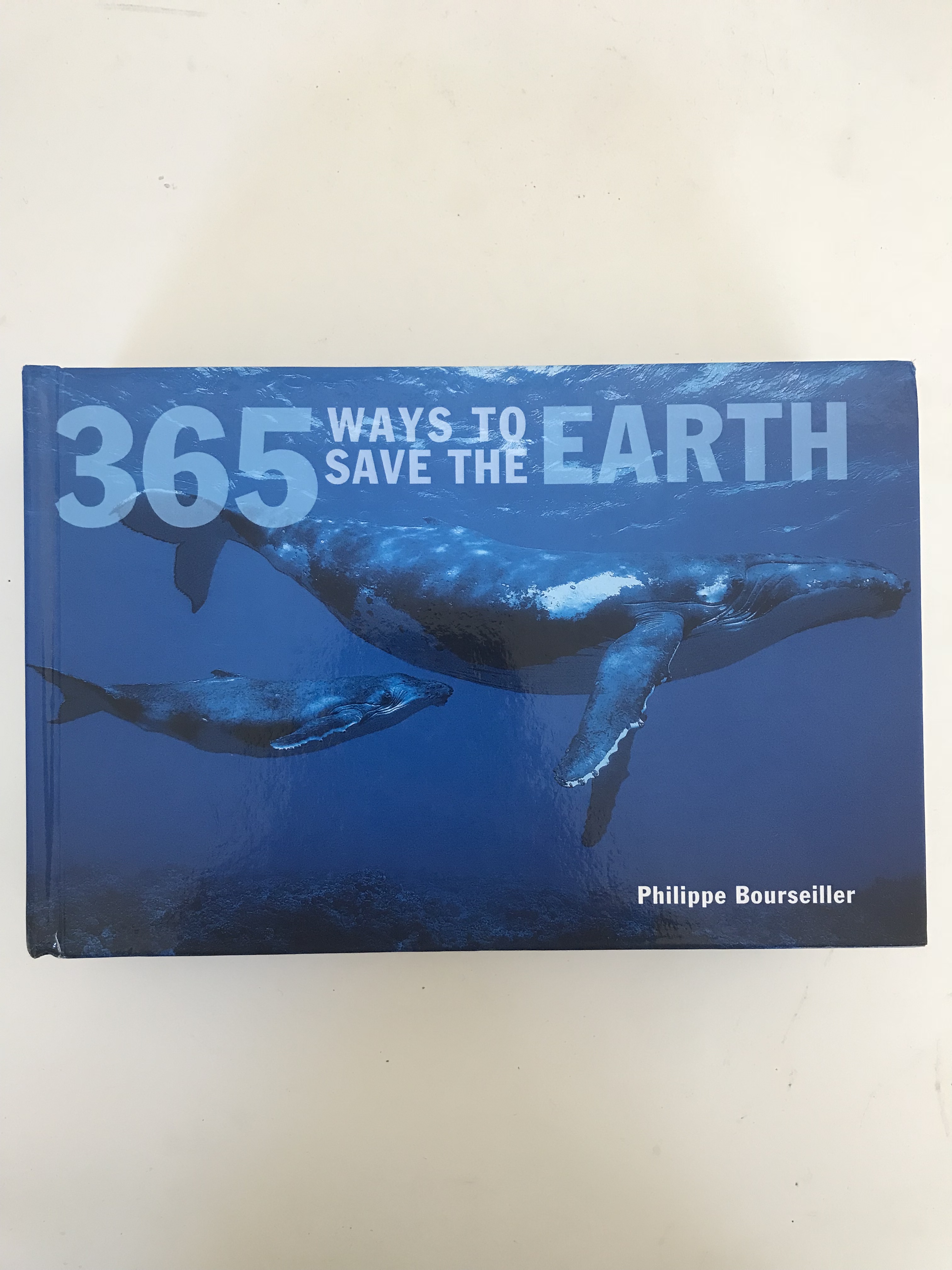
I bought this vast book for $1 at the Elting Memorial Library Fair during my freshman year here. I saw this book, laying among the rest, and it was an instant connection—I had to have it. The book’s bold cover, a clear photograph of a mother and baby whale swimming together in a melancholy blue ocean, and its thick, yet compact size is what caught my attention, and then of course, the title. I’m a big book lover, and a big earth lover, so this book seemed perfect. I immediately reached for it and was filled with joy, excitement, and appreciation. This book hits a deep chord for me, and I was inspired by the title, 365 Ways to Save the Earth, and already started to think of the kinds of projects I could do with it. The book is also reflective of the time in which I got it. I was a freshman, bright-eyed and bushy-tailed, with a lot of energy and an activist spirit—I wanted to take on the world, and this book seemed like a pretty good start. Once the book was in my hands, I wasn’t going to let it go, and especially finding out it only cost $1, it made it really easy to not let go. I was amazed. I felt like I was practically stealing the answers to the universe—for a $1! I couldn’t stop showing it off to people once I had gotten it, and I would find myself getting lost, flipping among the pages, carefully reading each tip and studying the photos. I still always have it with me today, and while I look at it less often, I always keep it by my desk, so I can see the cover and be reminded of that magical day, and reignite my passion.

One could characterize this book as a “coffee table book.” It’s hefty, intriguing, and has a lot of pictures—easy for guests to peruse through. The book is filled with awe-inspiring and breathtaking photographs of nature—from volcanoes, to elephants, to glaciers, and sea slugs. Each page contains an environmental tip for each day of the year on how we can strive to live a more sustainable and environmentally-conscious life on one page, and a beautiful image on the other, showing us exactly what our actions could be saving. Some tips are easier than others–to reuse materials before buying new ones, or start a compost–and others are a bit harder–like switching the way your house gets energy. Some also call on us as citizens of our respective countries to put pressure on our politicians and demand change. One aspect that I really appreciate about this book is its global mindset—there are photos from all around the world, places you may not even known had existed, or parts of the world you never thought you would see. It also has a universal nature, anyone can relate to this book, even if some of the tips don’t apply to you or aren’t feasible, we can still appreciate the stunning photos of this world that we share.


The book was published in Paris and New York in 2005. It was originally written in French. The photographs are a compilation of the photographer’s work, Bourseillier, over the past 15 years capturing nature from all angles (leaving no stone unturned). The book originally cost $29.95 in the U.S—I got it for a $1. I bought it used from the library fair, but it’s in really great condition, the binding has just become a little loose. I sometimes think why someone would give this (perfect) book away. There’s no note written in the front cover, as you sometimes see when buying used books. None of the pages are marked or folded. There’s almost zero trace of the past owner(s) or of human touch. Maybe it was owned by a couple who had it on their coffee table, but tired of the message. Maybe it was received as a gift, maybe someone had gotten all that they could from it, and wanted to spread the knowledge. Maybe someone had bought it second hand before I did. Maybe the person knew the photographer and had multiple copies. But I wonder, how did this beautiful book make its way to the Elting Memorial Library Book Fair in New Paltz, NY, during the fall of 2015, and make its way now into my possession? I wonder how long I’ll hold onto it, if I’ll ever donate it (probably not). Maybe I’ll give it to one of my children, if they’re environmentally inclined, and perhaps spark a passion that my mom sparked in me.
 The Materials of History, Thought, and Art
Isabelle, your blog post was so interesting to read. I think it’s amazing how we can relate and connect to our objects. Although a totally different object itself, I felt a strong connection to my elephant ring I posted about a few weeks ago. Objects can hold such different significance to different people. I am an environmental studies minor, so I share your interest in climate justice and love for nature and being outside; however, a lot of people in society don’t hold the same feelings. It is unfortunate, but interesting to think about how much this book means to you, and yet someone else just discarded it to the book fair you purchased it at. I think it is a very cool object and I think you should definitely pass it down to your future children and start your own chain of ownership!
I love your emotional connection to this book. I too love to learn, and this book not only shows that for you but also provides practical lessons you can share with others. I liked how you said some would mention it as a “coffee table” book, one that someone leaves out that usually says something about themselves, but is a lighthearted read. However, you make this book so much more than that. I hope that you make a future for this book, so that years from now someone can trace this book back to you, and be thankful for giving them these lessons.
I loved reading your post! I feel the same way you do about books–a couple come to mind that remind me of the relationship you have with this one. It must be special to look through the book now and think of how you’ve changed and grown since freshman year; for me, flipping through the pages of one of my favorite books always brings me back to a particular time in my life. I hope the book continues to bring you as much joy in years to come!
Isabelle, I love how you wondered at the possibilities of who may have owned this book before you, whose hands it may have passed through. I’m also a sucker for a good deal – a book that big and beautiful for $1? I would’ve bought it, too! I really related to this post and your emotional connection the book because a couple years before I started college, I bought an old book full of sheet music set to Alfred Tennyson’s poems at an antique store at the Water Street Market in New Paltz. Unlike your book, mine seems incredibly old and is not in great shape; the binding is falling apart and the pages are yellowed and covered in water stains. Despite this, I love the book, and part of the reason I love it so much is because I, like you, have often imagined where this book came from and how it ended up in that antique store, where I bought it for $10. There is something about the mystery of the origins of this book that contributes to its wonder and value, for me.